
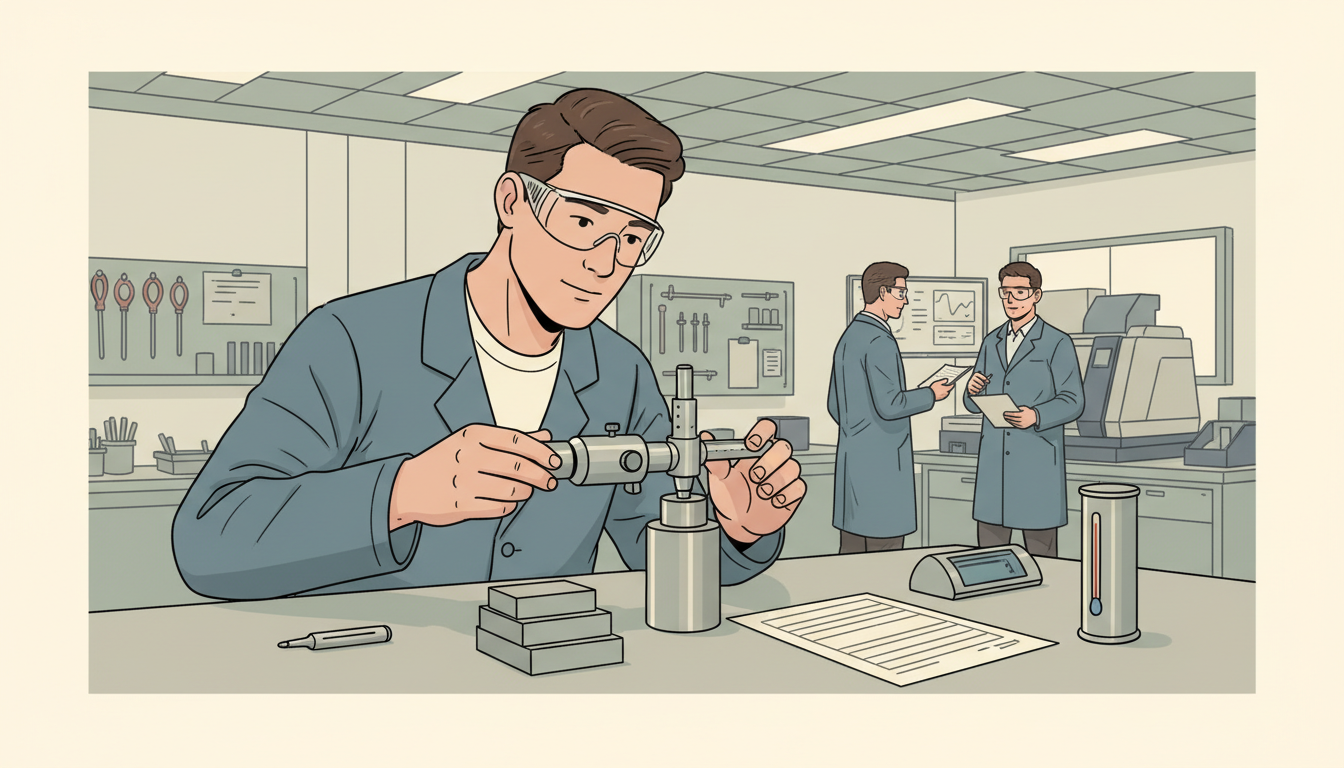
Quick answer: A measurement-and-quality-infrastructure civilisation makes quantities, scientific results, commercial measurements and conformity claims understandable across people, places and generations. It relies on shared units, traceable calibration, measurement uncertainty, appropriate testing, legitimate accreditation, standards, legal metrology and careful public communication. A number on a display is not automatically a trustworthy result; a standards logo is not a universal safety certificate, and an accurate measurement can still be irrelevant to the human question being asked.
Did you know? Two laboratories may report exactly the same number while carrying very different measurement uncertainty, and a scale may repeat the same value while being biased. A business can advertise a standard number without proving conformity to its requirements. The world’s scientific and commercial systems need common language, valid references and properly limited confidence—not blind trust in decimal places or logos.
This article continues eduKateSG’s Types of a Civilisation. Scalehaven is our entirely fictional measurement town, used for sixteen educational missions. Wintour asks whose rights and opportunities are affected by a result; Rainbolt changes an assumption and requires honest correction. The neighbouring Knowledge-Centred and Scientific Institutions study examines science broadly; this chapter is about measurement and quality infrastructure as a distinct institutional capability.
All Scalehaven instruments, laboratories, compliance claims, readings and people are fictional. This guide teaches concepts rather than laboratory technique, legal conformity, clinical measurements, product inspection, certified calibration or industrial acceptance. Real safety and compliance decisions require appropriate qualified institutions and current applicable rules.
Five paths through the learning programme
- Parents: read the quick answer, Missions 01, 03, 06, 11, 12 and the final question.
- Primary pupils: sort quantities and units and distinguish a measurement from a claim of safety.
- Secondary learners: compute simple unit conversions, averages, uncertainty examples and bounded quality ratios.
- Three-person tutorials: rotate the unit-and-evidence checker, system mapper and consumer-rights reviewer.
- Research readers: start with BIPM SI 2026, JCGM guides, OIML legal-metrology explanations and ILAC accreditation definitions.
Six pillars of trustworthy measurement
- Well-defined quantities and consistent units for shared explanations.
- Measurements linked to relevant references with documented traceability.
- Uncertainty, error sources and limits represented faithfully.
- Legitimate standards, regulations and conformity assessment within stated scopes.
- Appropriate institutional competence, impartiality and consumer protection.
- Records and corrections understandable to the next generation.
Thirteen authoritative source files
- BIPM: International System of Units, 9th edition updated June 2026
- BIPM: SI Brochure and revisions
- BIPM JCGM: Guide to Expression of Uncertainty and 2026 updates
- JCGM International Vocabulary of Metrology: metrological traceability
- OIML: What is legal metrology?
- OIML: Legal metrology and trade
- ILAC: About ILAC and laboratory accreditation
- ILAC: Frequently Asked Questions
- Singapore Accreditation Council: laboratory accreditation (updated August 2026)
- ISO/IEC 17007:2026 overview
- BIPM: CIPM Mutual Recognition Arrangement
- eduKateSG: Industrial and Mechanised Systems
- eduKateSG: Knowledge-Centred and Scientific Institutions
Evidence file 1: BIPM: International System of Units, 9th edition updated June 2026
The 2019 ninth edition, revised in June 2026, defines the international system of units used as a consistent language for science, industry and trade. The 2026 revision does not imply every measuring device meets professional standards.
Read the original technical or institutional source. The primary material defines its intended scope and date. A standard’s overview does not by itself give a licence to use a logo or claim accreditation; a general metrology guide does not settle a specific regulated case. Check the actual edition and any applicable national documents.
Reader exercise: one pupil identifies the relevant unit or concept, another explains which institution may provide credible evidence, and a third gives a case where the claim might mislead an ordinary customer. Write a source-grounded sentence and a separate limitation instead of repeating official acronyms as decorations.
Evidence file 2: BIPM: SI Brochure and revisions
The BIPM catalogue identifies the current 2026 update, previous editions and appendices that distinguish base units, derived units and accepted symbols.
Read the original technical or institutional source. The primary material defines its intended scope and date. A standard’s overview does not by itself give a licence to use a logo or claim accreditation; a general metrology guide does not settle a specific regulated case. Check the actual edition and any applicable national documents.
Reader exercise: one pupil identifies the relevant unit or concept, another explains which institution may provide credible evidence, and a third gives a case where the claim might mislead an ordinary customer. Write a source-grounded sentence and a separate limitation instead of repeating official acronyms as decorations.
Evidence file 3: BIPM JCGM: Guide to Expression of Uncertainty and 2026 updates
JCGM references discuss how uncertainty is evaluated, expressed and used; individual professional decisions demand correct measurement models rather than slogans about accuracy.
Read the original technical or institutional source. The primary material defines its intended scope and date. A standard’s overview does not by itself give a licence to use a logo or claim accreditation; a general metrology guide does not settle a specific regulated case. Check the actual edition and any applicable national documents.
Reader exercise: one pupil identifies the relevant unit or concept, another explains which institution may provide credible evidence, and a third gives a case where the claim might mislead an ordinary customer. Write a source-grounded sentence and a separate limitation instead of repeating official acronyms as decorations.
Evidence file 4: JCGM International Vocabulary of Metrology: metrological traceability
Traceability relates a result to a reference by an unbroken documented calibration chain, each contributing uncertainty. It does not mean merely that a product has a QR code.
Read the original technical or institutional source. The primary material defines its intended scope and date. A standard’s overview does not by itself give a licence to use a logo or claim accreditation; a general metrology guide does not settle a specific regulated case. Check the actual edition and any applicable national documents.
Reader exercise: one pupil identifies the relevant unit or concept, another explains which institution may provide credible evidence, and a third gives a case where the claim might mislead an ordinary customer. Write a source-grounded sentence and a separate limitation instead of repeating official acronyms as decorations.
Evidence file 5: OIML: What is legal metrology?
Legal metrology concerns legal requirements applied to measurements and measuring instruments used in contexts including commerce, safety, health and environmental regulation.
Read the original technical or institutional source. The primary material defines its intended scope and date. A standard’s overview does not by itself give a licence to use a logo or claim accreditation; a general metrology guide does not settle a specific regulated case. Check the actual edition and any applicable national documents.
Reader exercise: one pupil identifies the relevant unit or concept, another explains which institution may provide credible evidence, and a third gives a case where the claim might mislead an ordinary customer. Write a source-grounded sentence and a separate limitation instead of repeating official acronyms as decorations.
Evidence file 6: OIML: Legal metrology and trade
International trade depends on comparable measures, fit-for-purpose methods, suitable legal controls and mutual confidence, with a distinct role for traceability and conformity assessment.
Read the original technical or institutional source. The primary material defines its intended scope and date. A standard’s overview does not by itself give a licence to use a logo or claim accreditation; a general metrology guide does not settle a specific regulated case. Check the actual edition and any applicable national documents.
Reader exercise: one pupil identifies the relevant unit or concept, another explains which institution may provide credible evidence, and a third gives a case where the claim might mislead an ordinary customer. Write a source-grounded sentence and a separate limitation instead of repeating official acronyms as decorations.
Evidence file 7: ILAC: About ILAC and laboratory accreditation
Accreditation assesses conformity-assessment bodies’ competence and impartiality for specified scopes; it is different from a general product claim of quality.
Read the original technical or institutional source. The primary material defines its intended scope and date. A standard’s overview does not by itself give a licence to use a logo or claim accreditation; a general metrology guide does not settle a specific regulated case. Check the actual edition and any applicable national documents.
Reader exercise: one pupil identifies the relevant unit or concept, another explains which institution may provide credible evidence, and a third gives a case where the claim might mislead an ordinary customer. Write a source-grounded sentence and a separate limitation instead of repeating official acronyms as decorations.
Evidence file 8: ILAC: Frequently Asked Questions
ILAC itself does not issue laboratory test, calibration or inspection reports and an accreditation body’s membership is not equivalent to recognition under every relevant mutual-recognition scope.
Read the original technical or institutional source. The primary material defines its intended scope and date. A standard’s overview does not by itself give a licence to use a logo or claim accreditation; a general metrology guide does not settle a specific regulated case. Check the actual edition and any applicable national documents.
Reader exercise: one pupil identifies the relevant unit or concept, another explains which institution may provide credible evidence, and a third gives a case where the claim might mislead an ordinary customer. Write a source-grounded sentence and a separate limitation instead of repeating official acronyms as decorations.
Evidence file 9: Singapore Accreditation Council: laboratory accreditation (updated August 2026)
SAC refers to ISO/IEC 17025 for testing and calibration, ISO 15189 for medical laboratories and its own scheme documents, with current scope and authorisation needing verification.
Read the original technical or institutional source. The primary material defines its intended scope and date. A standard’s overview does not by itself give a licence to use a logo or claim accreditation; a general metrology guide does not settle a specific regulated case. Check the actual edition and any applicable national documents.
Reader exercise: one pupil identifies the relevant unit or concept, another explains which institution may provide credible evidence, and a third gives a case where the claim might mislead an ordinary customer. Write a source-grounded sentence and a separate limitation instead of repeating official acronyms as decorations.
Evidence file 10: ISO/IEC 17007:2026 overview
ISO describes conformity assessment as demonstrating that specified requirements are fulfilled; the 2026 standard provides guidance on drafting documents suitable for conformity assessment.
Read the original technical or institutional source. The primary material defines its intended scope and date. A standard’s overview does not by itself give a licence to use a logo or claim accreditation; a general metrology guide does not settle a specific regulated case. Check the actual edition and any applicable national documents.
Reader exercise: one pupil identifies the relevant unit or concept, another explains which institution may provide credible evidence, and a third gives a case where the claim might mislead an ordinary customer. Write a source-grounded sentence and a separate limitation instead of repeating official acronyms as decorations.
Evidence file 11: BIPM: CIPM Mutual Recognition Arrangement
The arrangement supports confidence in the comparability of national metrology institutes’ measurement standards and calibration capabilities, with particular published scopes.
Read the original technical or institutional source. The primary material defines its intended scope and date. A standard’s overview does not by itself give a licence to use a logo or claim accreditation; a general metrology guide does not settle a specific regulated case. Check the actual edition and any applicable national documents.
Reader exercise: one pupil identifies the relevant unit or concept, another explains which institution may provide credible evidence, and a third gives a case where the claim might mislead an ordinary customer. Write a source-grounded sentence and a separate limitation instead of repeating official acronyms as decorations.
Evidence file 12: eduKateSG: Industrial and Mechanised Systems
The industrial type focuses production broadly; this chapter explores the shared measurement infrastructure that lets many sectors make mutually interpretable claims.
Read the original technical or institutional source. The primary material defines its intended scope and date. A standard’s overview does not by itself give a licence to use a logo or claim accreditation; a general metrology guide does not settle a specific regulated case. Check the actual edition and any applicable national documents.
Reader exercise: one pupil identifies the relevant unit or concept, another explains which institution may provide credible evidence, and a third gives a case where the claim might mislead an ordinary customer. Write a source-grounded sentence and a separate limitation instead of repeating official acronyms as decorations.
Evidence file 13: eduKateSG: Knowledge-Centred and Scientific Institutions
The knowledge type explores institutions of scientific research; metrology focuses on measured quantities, standards and traceability to trustworthy references.
Read the original technical or institutional source. The primary material defines its intended scope and date. A standard’s overview does not by itself give a licence to use a logo or claim accreditation; a general metrology guide does not settle a specific regulated case. Check the actual edition and any applicable national documents.
Reader exercise: one pupil identifies the relevant unit or concept, another explains which institution may provide credible evidence, and a third gives a case where the claim might mislead an ordinary customer. Write a source-grounded sentence and a separate limitation instead of repeating official acronyms as decorations.
Sixteen Scalehaven missions
- 01 — Measurement, observation, estimate and judgement
- 02 — SI base units and useful dimensional language
- 03 — Prefixes, scale and mistakes of a thousand
- 04 — The measurand and why context matters
- 05 — Precision, trueness, repeatability and reproducibility
- 06 — Measurement uncertainty is not simply a mistake
- 07 — Calibration and an unbroken chain to reference
- 08 — National measurement standards and international comparison
- 09 — Legal metrology and fair market measures
- 10 — Product standards, regulations and voluntary guidance
- 11 — Conformity assessment, testing and certification
- 12 — Accreditation, competence and impartiality
- 13 — Measurement decision rules near a threshold
- 14 — Measurements in public datasets and research
- 15 — Science and industry handoffs across borders
- 16 — The standards archive for future researchers and consumers
Mission 01 — Measurement, observation, estimate and judgement
The Scalehaven problem: Scalehaven sees a number on a screen and treats it as an exact fact, an ethical judgement and an independent safety certificate at once.
The measurement question, explained clearly
A measurement is an experimentally obtained quantity value linked to a measurable property under a model, while a reported observation, estimate and normative decision are not identical. Measurement results require a defined measurand, relevant units, method and uncertainty.
Begin with the measurable property and a human purpose. Is a merchant trying to weigh a purchase, an engineer comparing components, a student explaining distance or a researcher assessing a scientific parameter? A number is not a full answer if its unit, method, place or decision context is missing. Define the question before the instrument.
For measurement, observation, estimate and judgement, the fictional case is Scalehaven sees a number on a screen and treats it as an exact fact, an ethical judgement and an independent safety certificate at once. A thoughtful explanation first identifies which specific property, requirement or decision is being described. The relevant principle is: A measurement is an experimentally obtained quantity value linked to a measurable property under a model, while a reported observation, estimate and normative decision are not identical. Measurement results require a defined measurand, relevant units, method and uncertainty. The student should never use a label like ‘certified’ unless they can name who verified exactly what.
Map standards, instruments and institutional roles
Draw distinct institutions: the people making a claim, the instrument and method, a reference used by a laboratory, any standard with relevant requirements, a body authorised to assess competence or conformity, and the person who must use the result. Their arrows are not interchangeable. A laboratory test report is not a regulatory licence.
Quality infrastructure joins scientific metrology, legal measurement, standards, conformity assessment and accreditation under different organisations. These functions help trade, research, safety and public trust, but none gives a universal certificate for every circumstance. The scope of any real authority matters.
Trace this mechanism through the relevant steps: A measurement is an experimentally obtained quantity value linked to a measurable property under a model, while a reported observation, estimate and normative decision are not identical. Measurement results require a defined measurand, relevant units, method and uncertainty. An instrument reading, authorised reference and competent laboratory may contribute to a trustworthy result, but their roles cannot be skipped in an actual professional context. Paper diagrams demonstrate the relationship without replacing it.
The reference and version that justify the claim
Source edition matters. The BIPM SI Brochure was revised in June 2026, while the JCGM Guide to the Expression of Uncertainty includes a 2026 amendment. An old note may describe a previous edition. A responsible student writes the year, document purpose and uncertainty about current applicability.
Professional competence and public understandability work together. The specialist may need a complex model, but the consumer needs to know whether a reported value meets their legitimate question and what remains uncertain. Avoid translating a technical uncertainty interval into blanket claims of perfect precision or guaranteed failure.
BIPM, JCGM, OIML, ILAC, ISO and a national accreditation council have different functions. A useful student names the authoritative source appropriate to the question and distinguishes definition, guidance, legal obligation, technical result and actual conformity. The same document cannot prove all five.
A worked number with real limits
A classroom object is estimated at 20 centimetres and later measured with a toy ruler as 21 centimetres. The numerical difference is one centimetre, not proof either method is calibrated or the object meets a standard.
Every computed figure belongs to a model with units and uncertainty. Arithmetic can reveal a difference, ratio or average, but it cannot establish that an instrument was calibrated, that an actual product is safe or that a professional laboratory is competent. Scientific restraint begins by stating what the worksheet does not measure.
Distinguish error from uncertainty. An error is a difference between measured and reference quantities under a definition, whereas uncertainty characterises dispersion of values that could reasonably be attributed to a measurand. A reading can be repeatable and still biased, or uncertain and still useful.
Change one invented input and compute again, preserving its units. Ask whether the answer indicates a measurement, a mathematical model or a conformity decision. The last of those often requires a prescribed decision rule, professional evidence and legal or contractual conditions beyond the worksheet.
Rainbolt’s corrected measurement story
Rainbolt shows that the two readings concerned different physical endpoints on the drawing.
Rainbolt changes one model condition: a unit is different, a reference is outdated, a comparison has unknown uncertainty or a method lies outside its accredited scope. Keep the first claim and its calculation beside a revised claim explaining exactly which assumption failed. A good correction is visible, dated and bounded.
The pupil records the old and new conclusions and the reason for changing them. Rather than invent a favourable certificate or silently remove uncertainty, the group states what source, competent method or authorised assessment would be needed before a real claim could proceed.
Wintour’s fairness, trade and safety questions
Wintour asks how precise numerical language can mislead consumers or pupils when a claim’s purpose is unstated.
Wintour asks who may be hurt by a misleading value: a buyer charged by mass, a patient receiving the wrong interpretation, a pupil copying an error or a small supplier unfairly rejected. Do not use high-stakes medical or safety measurements as classroom experiments. Explain the right kind of professional review instead.
A biased public measurement can affect money, access or trust. Explain why citizens and businesses need accurate descriptions without claiming that all uncertainties are unacceptable. A fair conclusion distinguishes the user-facing consequence from the judgement an actual professional is authorised to make.
Family lesson and tutor extension
Compare fictional estimate, reading and compliance cards with no use of regulated instruments.
Use ordinary paper figures rather than operating industrial instruments. Children can convert safe quantities, classify source documents, examine a historical drawing or study a fictitious calibration chain. They cannot establish the legality, safety or traceability of a real instrument through these activities.
A three-pupil tutorial assigns roles of measurement modeller, institutional source checker and human-impact reviewer. Rotate roles after the altered case. Each child should accurately restate the others’ concerns and agree on a final sentence that does not overpromise about a real measurement.
The final file includes the measurand, unit, method context, reference, dated source, result, uncertainty or unknown limitations, the relevant decision owner and corrections. A future technician or student should be able to understand it without the first lab operator or teacher present.
Four measurement reasoning cards
Which claim does this number actually support?
In Scalehaven, Scalehaven sees a number on a screen and treats it as an exact fact, an ethical judgement and an independent safety certificate at once. Identify the measured property, the instrument or source role and the part of the claim that exceeds the given evidence.
The correct mechanism is: A measurement is an experimentally obtained quantity value linked to a measurable property under a model, while a reported observation, estimate and normative decision are not identical. Measurement results require a defined measurand, relevant units, method and uncertainty. The answer needs the measurement context, a verifiable source or clearly invented assumption and an explicit limit on precision or compliance. A large number of decimal places and an impressive acronym are not adequate substitutes for this evidence.
Three-person study method for measurement, observation, estimate and judgement: one pupil checks the quantity and unit, another checks the institution and edition, and a third speaks for a person affected by misleading reporting. Rotate the roles and write a short correction that could be understood by a future reader. The group should not use a real medical, safety or commercial instrument.
Calculate before drawing a conclusion
The fictional calculation states: A classroom object is estimated at 20 centimetres and later measured with a toy ruler as 21 centimetres. The numerical difference is one centimetre, not proof either method is calibrated or the object meets a standard. Give correct units and explicit assumptions, then change one input and explain what the new result cannot certify.
The correct mechanism is: A measurement is an experimentally obtained quantity value linked to a measurable property under a model, while a reported observation, estimate and normative decision are not identical. Measurement results require a defined measurand, relevant units, method and uncertainty. The answer needs the measurement context, a verifiable source or clearly invented assumption and an explicit limit on precision or compliance. A large number of decimal places and an impressive acronym are not adequate substitutes for this evidence.
Three-person study method for measurement, observation, estimate and judgement: one pupil checks the quantity and unit, another checks the institution and edition, and a third speaks for a person affected by misleading reporting. Rotate the roles and write a short correction that could be understood by a future reader. The group should not use a real medical, safety or commercial instrument.
When a reference changes
Rainbolt adds: Rainbolt shows that the two readings concerned different physical endpoints on the drawing. Write a before-and-after statement and specify which institutional evidence or standard scope would require review.
The correct mechanism is: A measurement is an experimentally obtained quantity value linked to a measurable property under a model, while a reported observation, estimate and normative decision are not identical. Measurement results require a defined measurand, relevant units, method and uncertainty. The answer needs the measurement context, a verifiable source or clearly invented assumption and an explicit limit on precision or compliance. A large number of decimal places and an impressive acronym are not adequate substitutes for this evidence.
Three-person study method for measurement, observation, estimate and judgement: one pupil checks the quantity and unit, another checks the institution and edition, and a third speaks for a person affected by misleading reporting. Rotate the roles and write a short correction that could be understood by a future reader. The group should not use a real medical, safety or commercial instrument.
The consumer or worker who relied on the value
Wintour asks: Wintour asks how precise numerical language can mislead consumers or pupils when a claim’s purpose is unstated. Describe the strongest human concern and the appropriate source question without treating children as professional inspectors.
The correct mechanism is: A measurement is an experimentally obtained quantity value linked to a measurable property under a model, while a reported observation, estimate and normative decision are not identical. Measurement results require a defined measurand, relevant units, method and uncertainty. The answer needs the measurement context, a verifiable source or clearly invented assumption and an explicit limit on precision or compliance. A large number of decimal places and an impressive acronym are not adequate substitutes for this evidence.
Three-person study method for measurement, observation, estimate and judgement: one pupil checks the quantity and unit, another checks the institution and edition, and a third speaks for a person affected by misleading reporting. Rotate the roles and write a short correction that could be understood by a future reader. The group should not use a real medical, safety or commercial instrument.
Successor test: A new learner understands measurement, observation, estimate and judgement if they can reconstruct the measured question, source, conditional result, limits, appropriate authority and reason an earlier assertion needed revision.
Mission 02 — SI base units and useful dimensional language
The Scalehaven problem: A public sign gives water in watts, travel time in metres and mass in kilometres because the numbers happen to sound impressive.
The measurement question, explained clearly
The International System of Units provides definitions and symbols for seven base quantities and many derived quantities. Units specify the kind of quantity, and arithmetic must respect dimensional relationships. A consistent measurement language supports science and public communication.
Begin with the measurable property and a human purpose. Is a merchant trying to weigh a purchase, an engineer comparing components, a student explaining distance or a researcher assessing a scientific parameter? A number is not a full answer if its unit, method, place or decision context is missing. Define the question before the instrument.
For si base units and useful dimensional language, the fictional case is A public sign gives water in watts, travel time in metres and mass in kilometres because the numbers happen to sound impressive. A thoughtful explanation first identifies which specific property, requirement or decision is being described. The relevant principle is: The International System of Units provides definitions and symbols for seven base quantities and many derived quantities. Units specify the kind of quantity, and arithmetic must respect dimensional relationships. A consistent measurement language supports science and public communication. The student should never use a label like ‘certified’ unless they can name who verified exactly what.
Map standards, instruments and institutional roles
Draw distinct institutions: the people making a claim, the instrument and method, a reference used by a laboratory, any standard with relevant requirements, a body authorised to assess competence or conformity, and the person who must use the result. Their arrows are not interchangeable. A laboratory test report is not a regulatory licence.
Quality infrastructure joins scientific metrology, legal measurement, standards, conformity assessment and accreditation under different organisations. These functions help trade, research, safety and public trust, but none gives a universal certificate for every circumstance. The scope of any real authority matters.
Trace this mechanism through the relevant steps: The International System of Units provides definitions and symbols for seven base quantities and many derived quantities. Units specify the kind of quantity, and arithmetic must respect dimensional relationships. A consistent measurement language supports science and public communication. An instrument reading, authorised reference and competent laboratory may contribute to a trustworthy result, but their roles cannot be skipped in an actual professional context. Paper diagrams demonstrate the relationship without replacing it.
The reference and version that justify the claim
Source edition matters. The BIPM SI Brochure was revised in June 2026, while the JCGM Guide to the Expression of Uncertainty includes a 2026 amendment. An old note may describe a previous edition. A responsible student writes the year, document purpose and uncertainty about current applicability.
Professional competence and public understandability work together. The specialist may need a complex model, but the consumer needs to know whether a reported value meets their legitimate question and what remains uncertain. Avoid translating a technical uncertainty interval into blanket claims of perfect precision or guaranteed failure.
BIPM, JCGM, OIML, ILAC, ISO and a national accreditation council have different functions. A useful student names the authoritative source appropriate to the question and distinguishes definition, guidance, legal obligation, technical result and actual conformity. The same document cannot prove all five.
A worked number with real limits
A fictional trip of 100 metres over 20 seconds has a mean speed of five metres per second. Changing metres to kilometres requires conversion, not replacing the unit label without changing the number.
Every computed figure belongs to a model with units and uncertainty. Arithmetic can reveal a difference, ratio or average, but it cannot establish that an instrument was calibrated, that an actual product is safe or that a professional laboratory is competent. Scientific restraint begins by stating what the worksheet does not measure.
Distinguish error from uncertainty. An error is a difference between measured and reference quantities under a definition, whereas uncertainty characterises dispersion of values that could reasonably be attributed to a measurand. A reading can be repeatable and still biased, or uncertain and still useful.
Change one invented input and compute again, preserving its units. Ask whether the answer indicates a measurement, a mathematical model or a conformity decision. The last of those often requires a prescribed decision rule, professional evidence and legal or contractual conditions beyond the worksheet.
Rainbolt’s corrected measurement story
Rainbolt finds an instrument display in millimetres that was copied into a centimetre column.
Rainbolt changes one model condition: a unit is different, a reference is outdated, a comparison has unknown uncertainty or a method lies outside its accredited scope. Keep the first claim and its calculation beside a revised claim explaining exactly which assumption failed. A good correction is visible, dated and bounded.
The pupil records the old and new conclusions and the reason for changing them. Rather than invent a favourable certificate or silently remove uncertainty, the group states what source, competent method or authorised assessment would be needed before a real claim could proceed.
Wintour’s fairness, trade and safety questions
Wintour asks whether unit confusion would unfairly change prices, safety expectations or educational results.
Wintour asks who may be hurt by a misleading value: a buyer charged by mass, a patient receiving the wrong interpretation, a pupil copying an error or a small supplier unfairly rejected. Do not use high-stakes medical or safety measurements as classroom experiments. Explain the right kind of professional review instead.
A biased public measurement can affect money, access or trust. Explain why citizens and businesses need accurate descriptions without claiming that all uncertainties are unacceptable. A fair conclusion distinguishes the user-facing consequence from the judgement an actual professional is authorised to make.
Family lesson and tutor extension
Sort quantities, symbols and units using printed SI source cards.
Use ordinary paper figures rather than operating industrial instruments. Children can convert safe quantities, classify source documents, examine a historical drawing or study a fictitious calibration chain. They cannot establish the legality, safety or traceability of a real instrument through these activities.
A three-pupil tutorial assigns roles of measurement modeller, institutional source checker and human-impact reviewer. Rotate roles after the altered case. Each child should accurately restate the others’ concerns and agree on a final sentence that does not overpromise about a real measurement.
The final file includes the measurand, unit, method context, reference, dated source, result, uncertainty or unknown limitations, the relevant decision owner and corrections. A future technician or student should be able to understand it without the first lab operator or teacher present.
Four measurement reasoning cards
Which claim does this number actually support?
In Scalehaven, A public sign gives water in watts, travel time in metres and mass in kilometres because the numbers happen to sound impressive. Identify the measured property, the instrument or source role and the part of the claim that exceeds the given evidence.
The correct mechanism is: The International System of Units provides definitions and symbols for seven base quantities and many derived quantities. Units specify the kind of quantity, and arithmetic must respect dimensional relationships. A consistent measurement language supports science and public communication. The answer needs the measurement context, a verifiable source or clearly invented assumption and an explicit limit on precision or compliance. A large number of decimal places and an impressive acronym are not adequate substitutes for this evidence.
Three-person study method for si base units and useful dimensional language: one pupil checks the quantity and unit, another checks the institution and edition, and a third speaks for a person affected by misleading reporting. Rotate the roles and write a short correction that could be understood by a future reader. The group should not use a real medical, safety or commercial instrument.
Calculate before drawing a conclusion
The fictional calculation states: A fictional trip of 100 metres over 20 seconds has a mean speed of five metres per second. Changing metres to kilometres requires conversion, not replacing the unit label without changing the number. Give correct units and explicit assumptions, then change one input and explain what the new result cannot certify.
The correct mechanism is: The International System of Units provides definitions and symbols for seven base quantities and many derived quantities. Units specify the kind of quantity, and arithmetic must respect dimensional relationships. A consistent measurement language supports science and public communication. The answer needs the measurement context, a verifiable source or clearly invented assumption and an explicit limit on precision or compliance. A large number of decimal places and an impressive acronym are not adequate substitutes for this evidence.
Three-person study method for si base units and useful dimensional language: one pupil checks the quantity and unit, another checks the institution and edition, and a third speaks for a person affected by misleading reporting. Rotate the roles and write a short correction that could be understood by a future reader. The group should not use a real medical, safety or commercial instrument.
When a reference changes
Rainbolt adds: Rainbolt finds an instrument display in millimetres that was copied into a centimetre column. Write a before-and-after statement and specify which institutional evidence or standard scope would require review.
The correct mechanism is: The International System of Units provides definitions and symbols for seven base quantities and many derived quantities. Units specify the kind of quantity, and arithmetic must respect dimensional relationships. A consistent measurement language supports science and public communication. The answer needs the measurement context, a verifiable source or clearly invented assumption and an explicit limit on precision or compliance. A large number of decimal places and an impressive acronym are not adequate substitutes for this evidence.
Three-person study method for si base units and useful dimensional language: one pupil checks the quantity and unit, another checks the institution and edition, and a third speaks for a person affected by misleading reporting. Rotate the roles and write a short correction that could be understood by a future reader. The group should not use a real medical, safety or commercial instrument.
The consumer or worker who relied on the value
Wintour asks: Wintour asks whether unit confusion would unfairly change prices, safety expectations or educational results. Describe the strongest human concern and the appropriate source question without treating children as professional inspectors.
The correct mechanism is: The International System of Units provides definitions and symbols for seven base quantities and many derived quantities. Units specify the kind of quantity, and arithmetic must respect dimensional relationships. A consistent measurement language supports science and public communication. The answer needs the measurement context, a verifiable source or clearly invented assumption and an explicit limit on precision or compliance. A large number of decimal places and an impressive acronym are not adequate substitutes for this evidence.
Three-person study method for si base units and useful dimensional language: one pupil checks the quantity and unit, another checks the institution and edition, and a third speaks for a person affected by misleading reporting. Rotate the roles and write a short correction that could be understood by a future reader. The group should not use a real medical, safety or commercial instrument.
Successor test: A new learner understands si base units and useful dimensional language if they can reconstruct the measured question, source, conditional result, limits, appropriate authority and reason an earlier assertion needed revision.
Mission 03 — Prefixes, scale and mistakes of a thousand
The Scalehaven problem: Scalehaven’s school confuses milligrams with grams and advertises a tiny model quantity as one thousand times larger.
The measurement question, explained clearly
SI prefixes describe powers of ten for relevant units. A factor-of-one-thousand conversion is mathematical, but high-stakes applications require qualified professional control and appropriate checks. Pupils should use harmless toy contexts only.
Begin with the measurable property and a human purpose. Is a merchant trying to weigh a purchase, an engineer comparing components, a student explaining distance or a researcher assessing a scientific parameter? A number is not a full answer if its unit, method, place or decision context is missing. Define the question before the instrument.
For prefixes, scale and mistakes of a thousand, the fictional case is Scalehaven’s school confuses milligrams with grams and advertises a tiny model quantity as one thousand times larger. A thoughtful explanation first identifies which specific property, requirement or decision is being described. The relevant principle is: SI prefixes describe powers of ten for relevant units. A factor-of-one-thousand conversion is mathematical, but high-stakes applications require qualified professional control and appropriate checks. Pupils should use harmless toy contexts only. The student should never use a label like ‘certified’ unless they can name who verified exactly what.
Map standards, instruments and institutional roles
Draw distinct institutions: the people making a claim, the instrument and method, a reference used by a laboratory, any standard with relevant requirements, a body authorised to assess competence or conformity, and the person who must use the result. Their arrows are not interchangeable. A laboratory test report is not a regulatory licence.
Quality infrastructure joins scientific metrology, legal measurement, standards, conformity assessment and accreditation under different organisations. These functions help trade, research, safety and public trust, but none gives a universal certificate for every circumstance. The scope of any real authority matters.
Trace this mechanism through the relevant steps: SI prefixes describe powers of ten for relevant units. A factor-of-one-thousand conversion is mathematical, but high-stakes applications require qualified professional control and appropriate checks. Pupils should use harmless toy contexts only. An instrument reading, authorised reference and competent laboratory may contribute to a trustworthy result, but their roles cannot be skipped in an actual professional context. Paper diagrams demonstrate the relationship without replacing it.
The reference and version that justify the claim
Source edition matters. The BIPM SI Brochure was revised in June 2026, while the JCGM Guide to the Expression of Uncertainty includes a 2026 amendment. An old note may describe a previous edition. A responsible student writes the year, document purpose and uncertainty about current applicability.
Professional competence and public understandability work together. The specialist may need a complex model, but the consumer needs to know whether a reported value meets their legitimate question and what remains uncertain. Avoid translating a technical uncertainty interval into blanket claims of perfect precision or guaranteed failure.
BIPM, JCGM, OIML, ILAC, ISO and a national accreditation council have different functions. A useful student names the authoritative source appropriate to the question and distinguishes definition, guidance, legal obligation, technical result and actual conformity. The same document cannot prove all five.
A worked number with real limits
Two model boxes each contain 500 grams of imaginary craft material, totalling 1,000 grams or one kilogram. The sum is not an actual industrial batch measurement.
Every computed figure belongs to a model with units and uncertainty. Arithmetic can reveal a difference, ratio or average, but it cannot establish that an instrument was calibrated, that an actual product is safe or that a professional laboratory is competent. Scientific restraint begins by stating what the worksheet does not measure.
Distinguish error from uncertainty. An error is a difference between measured and reference quantities under a definition, whereas uncertainty characterises dispersion of values that could reasonably be attributed to a measurand. A reading can be repeatable and still biased, or uncertain and still useful.
Change one invented input and compute again, preserving its units. Ask whether the answer indicates a measurement, a mathematical model or a conformity decision. The last of those often requires a prescribed decision rule, professional evidence and legal or contractual conditions beyond the worksheet.
Rainbolt’s corrected measurement story
Rainbolt changes one label from grams to milligrams, making the naive addition invalid.
Rainbolt changes one model condition: a unit is different, a reference is outdated, a comparison has unknown uncertainty or a method lies outside its accredited scope. Keep the first claim and its calculation beside a revised claim explaining exactly which assumption failed. A good correction is visible, dated and bounded.
The pupil records the old and new conclusions and the reason for changing them. Rather than invent a favourable certificate or silently remove uncertainty, the group states what source, competent method or authorised assessment would be needed before a real claim could proceed.
Wintour’s fairness, trade and safety questions
Wintour asks why transparent units and independent review protect people using public information.
Wintour asks who may be hurt by a misleading value: a buyer charged by mass, a patient receiving the wrong interpretation, a pupil copying an error or a small supplier unfairly rejected. Do not use high-stakes medical or safety measurements as classroom experiments. Explain the right kind of professional review instead.
A biased public measurement can affect money, access or trust. Explain why citizens and businesses need accurate descriptions without claiming that all uncertainties are unacceptable. A fair conclusion distinguishes the user-facing consequence from the judgement an actual professional is authorised to make.
Family lesson and tutor extension
Use clean paper mass-conversion puzzles, not medication, chemical or food dosing examples.
Use ordinary paper figures rather than operating industrial instruments. Children can convert safe quantities, classify source documents, examine a historical drawing or study a fictitious calibration chain. They cannot establish the legality, safety or traceability of a real instrument through these activities.
A three-pupil tutorial assigns roles of measurement modeller, institutional source checker and human-impact reviewer. Rotate roles after the altered case. Each child should accurately restate the others’ concerns and agree on a final sentence that does not overpromise about a real measurement.
The final file includes the measurand, unit, method context, reference, dated source, result, uncertainty or unknown limitations, the relevant decision owner and corrections. A future technician or student should be able to understand it without the first lab operator or teacher present.
Four measurement reasoning cards
Which claim does this number actually support?
In Scalehaven, Scalehaven’s school confuses milligrams with grams and advertises a tiny model quantity as one thousand times larger. Identify the measured property, the instrument or source role and the part of the claim that exceeds the given evidence.
The correct mechanism is: SI prefixes describe powers of ten for relevant units. A factor-of-one-thousand conversion is mathematical, but high-stakes applications require qualified professional control and appropriate checks. Pupils should use harmless toy contexts only. The answer needs the measurement context, a verifiable source or clearly invented assumption and an explicit limit on precision or compliance. A large number of decimal places and an impressive acronym are not adequate substitutes for this evidence.
Three-person study method for prefixes, scale and mistakes of a thousand: one pupil checks the quantity and unit, another checks the institution and edition, and a third speaks for a person affected by misleading reporting. Rotate the roles and write a short correction that could be understood by a future reader. The group should not use a real medical, safety or commercial instrument.
Calculate before drawing a conclusion
The fictional calculation states: Two model boxes each contain 500 grams of imaginary craft material, totalling 1,000 grams or one kilogram. The sum is not an actual industrial batch measurement. Give correct units and explicit assumptions, then change one input and explain what the new result cannot certify.
The correct mechanism is: SI prefixes describe powers of ten for relevant units. A factor-of-one-thousand conversion is mathematical, but high-stakes applications require qualified professional control and appropriate checks. Pupils should use harmless toy contexts only. The answer needs the measurement context, a verifiable source or clearly invented assumption and an explicit limit on precision or compliance. A large number of decimal places and an impressive acronym are not adequate substitutes for this evidence.
Three-person study method for prefixes, scale and mistakes of a thousand: one pupil checks the quantity and unit, another checks the institution and edition, and a third speaks for a person affected by misleading reporting. Rotate the roles and write a short correction that could be understood by a future reader. The group should not use a real medical, safety or commercial instrument.
When a reference changes
Rainbolt adds: Rainbolt changes one label from grams to milligrams, making the naive addition invalid. Write a before-and-after statement and specify which institutional evidence or standard scope would require review.
The correct mechanism is: SI prefixes describe powers of ten for relevant units. A factor-of-one-thousand conversion is mathematical, but high-stakes applications require qualified professional control and appropriate checks. Pupils should use harmless toy contexts only. The answer needs the measurement context, a verifiable source or clearly invented assumption and an explicit limit on precision or compliance. A large number of decimal places and an impressive acronym are not adequate substitutes for this evidence.
Three-person study method for prefixes, scale and mistakes of a thousand: one pupil checks the quantity and unit, another checks the institution and edition, and a third speaks for a person affected by misleading reporting. Rotate the roles and write a short correction that could be understood by a future reader. The group should not use a real medical, safety or commercial instrument.
The consumer or worker who relied on the value
Wintour asks: Wintour asks why transparent units and independent review protect people using public information. Describe the strongest human concern and the appropriate source question without treating children as professional inspectors.
The correct mechanism is: SI prefixes describe powers of ten for relevant units. A factor-of-one-thousand conversion is mathematical, but high-stakes applications require qualified professional control and appropriate checks. Pupils should use harmless toy contexts only. The answer needs the measurement context, a verifiable source or clearly invented assumption and an explicit limit on precision or compliance. A large number of decimal places and an impressive acronym are not adequate substitutes for this evidence.
Three-person study method for prefixes, scale and mistakes of a thousand: one pupil checks the quantity and unit, another checks the institution and edition, and a third speaks for a person affected by misleading reporting. Rotate the roles and write a short correction that could be understood by a future reader. The group should not use a real medical, safety or commercial instrument.
Successor test: A new learner understands prefixes, scale and mistakes of a thousand if they can reconstruct the measured question, source, conditional result, limits, appropriate authority and reason an earlier assertion needed revision.
Mission 04 — The measurand and why context matters
The Scalehaven problem: A town says two instruments contradict one another because both show a temperature number, even though one is measuring room air and the other surface temperature.
The measurement question, explained clearly
A measurand is the quantity intended to be measured. Description of object, location, time, conditions and method may be essential to interpreting the result. Two readings of different measurands are not automatically inconsistent.
Begin with the measurable property and a human purpose. Is a merchant trying to weigh a purchase, an engineer comparing components, a student explaining distance or a researcher assessing a scientific parameter? A number is not a full answer if its unit, method, place or decision context is missing. Define the question before the instrument.
For the measurand and why context matters, the fictional case is A town says two instruments contradict one another because both show a temperature number, even though one is measuring room air and the other surface temperature. A thoughtful explanation first identifies which specific property, requirement or decision is being described. The relevant principle is: A measurand is the quantity intended to be measured. Description of object, location, time, conditions and method may be essential to interpreting the result. Two readings of different measurands are not automatically inconsistent. The student should never use a label like ‘certified’ unless they can name who verified exactly what.
Map standards, instruments and institutional roles
Draw distinct institutions: the people making a claim, the instrument and method, a reference used by a laboratory, any standard with relevant requirements, a body authorised to assess competence or conformity, and the person who must use the result. Their arrows are not interchangeable. A laboratory test report is not a regulatory licence.
Quality infrastructure joins scientific metrology, legal measurement, standards, conformity assessment and accreditation under different organisations. These functions help trade, research, safety and public trust, but none gives a universal certificate for every circumstance. The scope of any real authority matters.
Trace this mechanism through the relevant steps: A measurand is the quantity intended to be measured. Description of object, location, time, conditions and method may be essential to interpreting the result. Two readings of different measurands are not automatically inconsistent. An instrument reading, authorised reference and competent laboratory may contribute to a trustworthy result, but their roles cannot be skipped in an actual professional context. Paper diagrams demonstrate the relationship without replacing it.
The reference and version that justify the claim
Source edition matters. The BIPM SI Brochure was revised in June 2026, while the JCGM Guide to the Expression of Uncertainty includes a 2026 amendment. An old note may describe a previous edition. A responsible student writes the year, document purpose and uncertainty about current applicability.
Professional competence and public understandability work together. The specialist may need a complex model, but the consumer needs to know whether a reported value meets their legitimate question and what remains uncertain. Avoid translating a technical uncertainty interval into blanket claims of perfect precision or guaranteed failure.
BIPM, JCGM, OIML, ILAC, ISO and a national accreditation council have different functions. A useful student names the authoritative source appropriate to the question and distinguishes definition, guidance, legal obligation, technical result and actual conformity. The same document cannot prove all five.
A worked number with real limits
An invented chart reads 24 degrees Celsius for air and 27 degrees Celsius for a tabletop, a three-degree difference that need not be an error.
Every computed figure belongs to a model with units and uncertainty. Arithmetic can reveal a difference, ratio or average, but it cannot establish that an instrument was calibrated, that an actual product is safe or that a professional laboratory is competent. Scientific restraint begins by stating what the worksheet does not measure.
Distinguish error from uncertainty. An error is a difference between measured and reference quantities under a definition, whereas uncertainty characterises dispersion of values that could reasonably be attributed to a measurand. A reading can be repeatable and still biased, or uncertain and still useful.
Change one invented input and compute again, preserving its units. Ask whether the answer indicates a measurement, a mathematical model or a conformity decision. The last of those often requires a prescribed decision rule, professional evidence and legal or contractual conditions beyond the worksheet.
Rainbolt’s corrected measurement story
Rainbolt reveals the readings were taken hours apart under changing conditions.
Rainbolt changes one model condition: a unit is different, a reference is outdated, a comparison has unknown uncertainty or a method lies outside its accredited scope. Keep the first claim and its calculation beside a revised claim explaining exactly which assumption failed. A good correction is visible, dated and bounded.
The pupil records the old and new conclusions and the reason for changing them. Rather than invent a favourable certificate or silently remove uncertainty, the group states what source, competent method or authorised assessment would be needed before a real claim could proceed.
Wintour’s fairness, trade and safety questions
Wintour asks whether families have sufficient information to interpret claims without being told one number is universally safe.
Wintour asks who may be hurt by a misleading value: a buyer charged by mass, a patient receiving the wrong interpretation, a pupil copying an error or a small supplier unfairly rejected. Do not use high-stakes medical or safety measurements as classroom experiments. Explain the right kind of professional review instead.
A biased public measurement can affect money, access or trust. Explain why citizens and businesses need accurate descriptions without claiming that all uncertainties are unacceptable. A fair conclusion distinguishes the user-facing consequence from the judgement an actual professional is authorised to make.
Family lesson and tutor extension
Label imaginary air, surface and water measurement cards with a target quantity.
Use ordinary paper figures rather than operating industrial instruments. Children can convert safe quantities, classify source documents, examine a historical drawing or study a fictitious calibration chain. They cannot establish the legality, safety or traceability of a real instrument through these activities.
A three-pupil tutorial assigns roles of measurement modeller, institutional source checker and human-impact reviewer. Rotate roles after the altered case. Each child should accurately restate the others’ concerns and agree on a final sentence that does not overpromise about a real measurement.
The final file includes the measurand, unit, method context, reference, dated source, result, uncertainty or unknown limitations, the relevant decision owner and corrections. A future technician or student should be able to understand it without the first lab operator or teacher present.
Four measurement reasoning cards
Which claim does this number actually support?
In Scalehaven, A town says two instruments contradict one another because both show a temperature number, even though one is measuring room air and the other surface temperature. Identify the measured property, the instrument or source role and the part of the claim that exceeds the given evidence.
The correct mechanism is: A measurand is the quantity intended to be measured. Description of object, location, time, conditions and method may be essential to interpreting the result. Two readings of different measurands are not automatically inconsistent. The answer needs the measurement context, a verifiable source or clearly invented assumption and an explicit limit on precision or compliance. A large number of decimal places and an impressive acronym are not adequate substitutes for this evidence.
Three-person study method for the measurand and why context matters: one pupil checks the quantity and unit, another checks the institution and edition, and a third speaks for a person affected by misleading reporting. Rotate the roles and write a short correction that could be understood by a future reader. The group should not use a real medical, safety or commercial instrument.
Calculate before drawing a conclusion
The fictional calculation states: An invented chart reads 24 degrees Celsius for air and 27 degrees Celsius for a tabletop, a three-degree difference that need not be an error. Give correct units and explicit assumptions, then change one input and explain what the new result cannot certify.
The correct mechanism is: A measurand is the quantity intended to be measured. Description of object, location, time, conditions and method may be essential to interpreting the result. Two readings of different measurands are not automatically inconsistent. The answer needs the measurement context, a verifiable source or clearly invented assumption and an explicit limit on precision or compliance. A large number of decimal places and an impressive acronym are not adequate substitutes for this evidence.
Three-person study method for the measurand and why context matters: one pupil checks the quantity and unit, another checks the institution and edition, and a third speaks for a person affected by misleading reporting. Rotate the roles and write a short correction that could be understood by a future reader. The group should not use a real medical, safety or commercial instrument.
When a reference changes
Rainbolt adds: Rainbolt reveals the readings were taken hours apart under changing conditions. Write a before-and-after statement and specify which institutional evidence or standard scope would require review.
The correct mechanism is: A measurand is the quantity intended to be measured. Description of object, location, time, conditions and method may be essential to interpreting the result. Two readings of different measurands are not automatically inconsistent. The answer needs the measurement context, a verifiable source or clearly invented assumption and an explicit limit on precision or compliance. A large number of decimal places and an impressive acronym are not adequate substitutes for this evidence.
Three-person study method for the measurand and why context matters: one pupil checks the quantity and unit, another checks the institution and edition, and a third speaks for a person affected by misleading reporting. Rotate the roles and write a short correction that could be understood by a future reader. The group should not use a real medical, safety or commercial instrument.
The consumer or worker who relied on the value
Wintour asks: Wintour asks whether families have sufficient information to interpret claims without being told one number is universally safe. Describe the strongest human concern and the appropriate source question without treating children as professional inspectors.
The correct mechanism is: A measurand is the quantity intended to be measured. Description of object, location, time, conditions and method may be essential to interpreting the result. Two readings of different measurands are not automatically inconsistent. The answer needs the measurement context, a verifiable source or clearly invented assumption and an explicit limit on precision or compliance. A large number of decimal places and an impressive acronym are not adequate substitutes for this evidence.
Three-person study method for the measurand and why context matters: one pupil checks the quantity and unit, another checks the institution and edition, and a third speaks for a person affected by misleading reporting. Rotate the roles and write a short correction that could be understood by a future reader. The group should not use a real medical, safety or commercial instrument.
Successor test: A new learner understands the measurand and why context matters if they can reconstruct the measured question, source, conditional result, limits, appropriate authority and reason an earlier assertion needed revision.
Mission 05 — Precision, trueness, repeatability and reproducibility
The Scalehaven problem: Scalehaven’s report calls a device accurate because it repeatedly prints the same value, even though no valid reference comparison has been shown.
The measurement question, explained clearly
Repeatability concerns results under similar conditions, while reproducibility considers changed measurement conditions. Precision describes dispersion, and trueness concerns agreement with an appropriate reference, within defined concepts. These terms should not be used interchangeably.
Begin with the measurable property and a human purpose. Is a merchant trying to weigh a purchase, an engineer comparing components, a student explaining distance or a researcher assessing a scientific parameter? A number is not a full answer if its unit, method, place or decision context is missing. Define the question before the instrument.
For precision, trueness, repeatability and reproducibility, the fictional case is Scalehaven’s report calls a device accurate because it repeatedly prints the same value, even though no valid reference comparison has been shown. A thoughtful explanation first identifies which specific property, requirement or decision is being described. The relevant principle is: Repeatability concerns results under similar conditions, while reproducibility considers changed measurement conditions. Precision describes dispersion, and trueness concerns agreement with an appropriate reference, within defined concepts. These terms should not be used interchangeably. The student should never use a label like ‘certified’ unless they can name who verified exactly what.
Map standards, instruments and institutional roles
Draw distinct institutions: the people making a claim, the instrument and method, a reference used by a laboratory, any standard with relevant requirements, a body authorised to assess competence or conformity, and the person who must use the result. Their arrows are not interchangeable. A laboratory test report is not a regulatory licence.
Quality infrastructure joins scientific metrology, legal measurement, standards, conformity assessment and accreditation under different organisations. These functions help trade, research, safety and public trust, but none gives a universal certificate for every circumstance. The scope of any real authority matters.
Trace this mechanism through the relevant steps: Repeatability concerns results under similar conditions, while reproducibility considers changed measurement conditions. Precision describes dispersion, and trueness concerns agreement with an appropriate reference, within defined concepts. These terms should not be used interchangeably. An instrument reading, authorised reference and competent laboratory may contribute to a trustworthy result, but their roles cannot be skipped in an actual professional context. Paper diagrams demonstrate the relationship without replacing it.
The reference and version that justify the claim
Source edition matters. The BIPM SI Brochure was revised in June 2026, while the JCGM Guide to the Expression of Uncertainty includes a 2026 amendment. An old note may describe a previous edition. A responsible student writes the year, document purpose and uncertainty about current applicability.
Professional competence and public understandability work together. The specialist may need a complex model, but the consumer needs to know whether a reported value meets their legitimate question and what remains uncertain. Avoid translating a technical uncertainty interval into blanket claims of perfect precision or guaranteed failure.
BIPM, JCGM, OIML, ILAC, ISO and a national accreditation council have different functions. A useful student names the authoritative source appropriate to the question and distinguishes definition, guidance, legal obligation, technical result and actual conformity. The same document cannot prove all five.
A worked number with real limits
Five toy repeated readings are 10.1, 10.1, 10.2, 10.1 and 10.0 arbitrary units; their mean is 10.1 and their range is 0.2, without evidence of trueness.
Every computed figure belongs to a model with units and uncertainty. Arithmetic can reveal a difference, ratio or average, but it cannot establish that an instrument was calibrated, that an actual product is safe or that a professional laboratory is competent. Scientific restraint begins by stating what the worksheet does not measure.
Distinguish error from uncertainty. An error is a difference between measured and reference quantities under a definition, whereas uncertainty characterises dispersion of values that could reasonably be attributed to a measurand. A reading can be repeatable and still biased, or uncertain and still useful.
Change one invented input and compute again, preserving its units. Ask whether the answer indicates a measurement, a mathematical model or a conformity decision. The last of those often requires a prescribed decision rule, professional evidence and legal or contractual conditions beyond the worksheet.
Rainbolt’s corrected measurement story
Rainbolt changes a systematic bias in the fictional instrument while dispersion remains small.
Rainbolt changes one model condition: a unit is different, a reference is outdated, a comparison has unknown uncertainty or a method lies outside its accredited scope. Keep the first claim and its calculation beside a revised claim explaining exactly which assumption failed. A good correction is visible, dated and bounded.
The pupil records the old and new conclusions and the reason for changing them. Rather than invent a favourable certificate or silently remove uncertainty, the group states what source, competent method or authorised assessment would be needed before a real claim could proceed.
Wintour’s fairness, trade and safety questions
Wintour asks how scientific headlines can confuse consistent results with correct results.
Wintour asks who may be hurt by a misleading value: a buyer charged by mass, a patient receiving the wrong interpretation, a pupil copying an error or a small supplier unfairly rejected. Do not use high-stakes medical or safety measurements as classroom experiments. Explain the right kind of professional review instead.
A biased public measurement can affect money, access or trust. Explain why citizens and businesses need accurate descriptions without claiming that all uncertainties are unacceptable. A fair conclusion distinguishes the user-facing consequence from the judgement an actual professional is authorised to make.
Family lesson and tutor extension
Plot harmless pretend measurements and distinguish their variation from closeness to reference.
Use ordinary paper figures rather than operating industrial instruments. Children can convert safe quantities, classify source documents, examine a historical drawing or study a fictitious calibration chain. They cannot establish the legality, safety or traceability of a real instrument through these activities.
A three-pupil tutorial assigns roles of measurement modeller, institutional source checker and human-impact reviewer. Rotate roles after the altered case. Each child should accurately restate the others’ concerns and agree on a final sentence that does not overpromise about a real measurement.
The final file includes the measurand, unit, method context, reference, dated source, result, uncertainty or unknown limitations, the relevant decision owner and corrections. A future technician or student should be able to understand it without the first lab operator or teacher present.
Four measurement reasoning cards
Which claim does this number actually support?
In Scalehaven, Scalehaven’s report calls a device accurate because it repeatedly prints the same value, even though no valid reference comparison has been shown. Identify the measured property, the instrument or source role and the part of the claim that exceeds the given evidence.
The correct mechanism is: Repeatability concerns results under similar conditions, while reproducibility considers changed measurement conditions. Precision describes dispersion, and trueness concerns agreement with an appropriate reference, within defined concepts. These terms should not be used interchangeably. The answer needs the measurement context, a verifiable source or clearly invented assumption and an explicit limit on precision or compliance. A large number of decimal places and an impressive acronym are not adequate substitutes for this evidence.
Three-person study method for precision, trueness, repeatability and reproducibility: one pupil checks the quantity and unit, another checks the institution and edition, and a third speaks for a person affected by misleading reporting. Rotate the roles and write a short correction that could be understood by a future reader. The group should not use a real medical, safety or commercial instrument.
Calculate before drawing a conclusion
The fictional calculation states: Five toy repeated readings are 10.1, 10.1, 10.2, 10.1 and 10.0 arbitrary units; their mean is 10.1 and their range is 0.2, without evidence of trueness. Give correct units and explicit assumptions, then change one input and explain what the new result cannot certify.
The correct mechanism is: Repeatability concerns results under similar conditions, while reproducibility considers changed measurement conditions. Precision describes dispersion, and trueness concerns agreement with an appropriate reference, within defined concepts. These terms should not be used interchangeably. The answer needs the measurement context, a verifiable source or clearly invented assumption and an explicit limit on precision or compliance. A large number of decimal places and an impressive acronym are not adequate substitutes for this evidence.
Three-person study method for precision, trueness, repeatability and reproducibility: one pupil checks the quantity and unit, another checks the institution and edition, and a third speaks for a person affected by misleading reporting. Rotate the roles and write a short correction that could be understood by a future reader. The group should not use a real medical, safety or commercial instrument.
When a reference changes
Rainbolt adds: Rainbolt changes a systematic bias in the fictional instrument while dispersion remains small. Write a before-and-after statement and specify which institutional evidence or standard scope would require review.
The correct mechanism is: Repeatability concerns results under similar conditions, while reproducibility considers changed measurement conditions. Precision describes dispersion, and trueness concerns agreement with an appropriate reference, within defined concepts. These terms should not be used interchangeably. The answer needs the measurement context, a verifiable source or clearly invented assumption and an explicit limit on precision or compliance. A large number of decimal places and an impressive acronym are not adequate substitutes for this evidence.
Three-person study method for precision, trueness, repeatability and reproducibility: one pupil checks the quantity and unit, another checks the institution and edition, and a third speaks for a person affected by misleading reporting. Rotate the roles and write a short correction that could be understood by a future reader. The group should not use a real medical, safety or commercial instrument.
The consumer or worker who relied on the value
Wintour asks: Wintour asks how scientific headlines can confuse consistent results with correct results. Describe the strongest human concern and the appropriate source question without treating children as professional inspectors.
The correct mechanism is: Repeatability concerns results under similar conditions, while reproducibility considers changed measurement conditions. Precision describes dispersion, and trueness concerns agreement with an appropriate reference, within defined concepts. These terms should not be used interchangeably. The answer needs the measurement context, a verifiable source or clearly invented assumption and an explicit limit on precision or compliance. A large number of decimal places and an impressive acronym are not adequate substitutes for this evidence.
Three-person study method for precision, trueness, repeatability and reproducibility: one pupil checks the quantity and unit, another checks the institution and edition, and a third speaks for a person affected by misleading reporting. Rotate the roles and write a short correction that could be understood by a future reader. The group should not use a real medical, safety or commercial instrument.
Successor test: A new learner understands precision, trueness, repeatability and reproducibility if they can reconstruct the measured question, source, conditional result, limits, appropriate authority and reason an earlier assertion needed revision.
Mission 06 — Measurement uncertainty is not simply a mistake
The Scalehaven problem: A brochure describes every measurement as exact to its final printed decimal and labels all uncertainty as incompetence.
The measurement question, explained clearly
All practical measurement results have uncertainty arising from identified sources. The GUM framework supports expressing uncertainty using appropriate models and evidence; uncertainty is not a personal failure or a synonym for bias.
Begin with the measurable property and a human purpose. Is a merchant trying to weigh a purchase, an engineer comparing components, a student explaining distance or a researcher assessing a scientific parameter? A number is not a full answer if its unit, method, place or decision context is missing. Define the question before the instrument.
For measurement uncertainty is not simply a mistake, the fictional case is A brochure describes every measurement as exact to its final printed decimal and labels all uncertainty as incompetence. A thoughtful explanation first identifies which specific property, requirement or decision is being described. The relevant principle is: All practical measurement results have uncertainty arising from identified sources. The GUM framework supports expressing uncertainty using appropriate models and evidence; uncertainty is not a personal failure or a synonym for bias. The student should never use a label like ‘certified’ unless they can name who verified exactly what.
Map standards, instruments and institutional roles
Draw distinct institutions: the people making a claim, the instrument and method, a reference used by a laboratory, any standard with relevant requirements, a body authorised to assess competence or conformity, and the person who must use the result. Their arrows are not interchangeable. A laboratory test report is not a regulatory licence.
Quality infrastructure joins scientific metrology, legal measurement, standards, conformity assessment and accreditation under different organisations. These functions help trade, research, safety and public trust, but none gives a universal certificate for every circumstance. The scope of any real authority matters.
Trace this mechanism through the relevant steps: All practical measurement results have uncertainty arising from identified sources. The GUM framework supports expressing uncertainty using appropriate models and evidence; uncertainty is not a personal failure or a synonym for bias. An instrument reading, authorised reference and competent laboratory may contribute to a trustworthy result, but their roles cannot be skipped in an actual professional context. Paper diagrams demonstrate the relationship without replacing it.
The reference and version that justify the claim
Source edition matters. The BIPM SI Brochure was revised in June 2026, while the JCGM Guide to the Expression of Uncertainty includes a 2026 amendment. An old note may describe a previous edition. A responsible student writes the year, document purpose and uncertainty about current applicability.
Professional competence and public understandability work together. The specialist may need a complex model, but the consumer needs to know whether a reported value meets their legitimate question and what remains uncertain. Avoid translating a technical uncertainty interval into blanket claims of perfect precision or guaranteed failure.
BIPM, JCGM, OIML, ILAC, ISO and a national accreditation council have different functions. A useful student names the authoritative source appropriate to the question and distinguishes definition, guidance, legal obligation, technical result and actual conformity. The same document cannot prove all five.
A worked number with real limits
A toy report gives a length as 50.0 ± 0.5 units under a stated interval convention. This is not a certification of the imaginary instrument or an instruction on confidence intervals for actual regulated work.
Every computed figure belongs to a model with units and uncertainty. Arithmetic can reveal a difference, ratio or average, but it cannot establish that an instrument was calibrated, that an actual product is safe or that a professional laboratory is competent. Scientific restraint begins by stating what the worksheet does not measure.
Distinguish error from uncertainty. An error is a difference between measured and reference quantities under a definition, whereas uncertainty characterises dispersion of values that could reasonably be attributed to a measurand. A reading can be repeatable and still biased, or uncertain and still useful.
Change one invented input and compute again, preserving its units. Ask whether the answer indicates a measurement, a mathematical model or a conformity decision. The last of those often requires a prescribed decision rule, professional evidence and legal or contractual conditions beyond the worksheet.
Rainbolt’s corrected measurement story
Rainbolt introduces additional variation from an omitted source and the initial uncertainty needs review.
Rainbolt changes one model condition: a unit is different, a reference is outdated, a comparison has unknown uncertainty or a method lies outside its accredited scope. Keep the first claim and its calculation beside a revised claim explaining exactly which assumption failed. A good correction is visible, dated and bounded.
The pupil records the old and new conclusions and the reason for changing them. Rather than invent a favourable certificate or silently remove uncertainty, the group states what source, competent method or authorised assessment would be needed before a real claim could proceed.
Wintour’s fairness, trade and safety questions
Wintour asks how public language can be honest without making users believe every uncertain result is useless.
Wintour asks who may be hurt by a misleading value: a buyer charged by mass, a patient receiving the wrong interpretation, a pupil copying an error or a small supplier unfairly rejected. Do not use high-stakes medical or safety measurements as classroom experiments. Explain the right kind of professional review instead.
A biased public measurement can affect money, access or trust. Explain why citizens and businesses need accurate descriptions without claiming that all uncertainties are unacceptable. A fair conclusion distinguishes the user-facing consequence from the judgement an actual professional is authorised to make.
Family lesson and tutor extension
Compare fictional intervals in a paper table, with definitions and no regulated testing.
Use ordinary paper figures rather than operating industrial instruments. Children can convert safe quantities, classify source documents, examine a historical drawing or study a fictitious calibration chain. They cannot establish the legality, safety or traceability of a real instrument through these activities.
A three-pupil tutorial assigns roles of measurement modeller, institutional source checker and human-impact reviewer. Rotate roles after the altered case. Each child should accurately restate the others’ concerns and agree on a final sentence that does not overpromise about a real measurement.
The final file includes the measurand, unit, method context, reference, dated source, result, uncertainty or unknown limitations, the relevant decision owner and corrections. A future technician or student should be able to understand it without the first lab operator or teacher present.
Four measurement reasoning cards
Which claim does this number actually support?
In Scalehaven, A brochure describes every measurement as exact to its final printed decimal and labels all uncertainty as incompetence. Identify the measured property, the instrument or source role and the part of the claim that exceeds the given evidence.
The correct mechanism is: All practical measurement results have uncertainty arising from identified sources. The GUM framework supports expressing uncertainty using appropriate models and evidence; uncertainty is not a personal failure or a synonym for bias. The answer needs the measurement context, a verifiable source or clearly invented assumption and an explicit limit on precision or compliance. A large number of decimal places and an impressive acronym are not adequate substitutes for this evidence.
Three-person study method for measurement uncertainty is not simply a mistake: one pupil checks the quantity and unit, another checks the institution and edition, and a third speaks for a person affected by misleading reporting. Rotate the roles and write a short correction that could be understood by a future reader. The group should not use a real medical, safety or commercial instrument.
Calculate before drawing a conclusion
The fictional calculation states: A toy report gives a length as 50.0 ± 0.5 units under a stated interval convention. This is not a certification of the imaginary instrument or an instruction on confidence intervals for actual regulated work. Give correct units and explicit assumptions, then change one input and explain what the new result cannot certify.
The correct mechanism is: All practical measurement results have uncertainty arising from identified sources. The GUM framework supports expressing uncertainty using appropriate models and evidence; uncertainty is not a personal failure or a synonym for bias. The answer needs the measurement context, a verifiable source or clearly invented assumption and an explicit limit on precision or compliance. A large number of decimal places and an impressive acronym are not adequate substitutes for this evidence.
Three-person study method for measurement uncertainty is not simply a mistake: one pupil checks the quantity and unit, another checks the institution and edition, and a third speaks for a person affected by misleading reporting. Rotate the roles and write a short correction that could be understood by a future reader. The group should not use a real medical, safety or commercial instrument.
When a reference changes
Rainbolt adds: Rainbolt introduces additional variation from an omitted source and the initial uncertainty needs review. Write a before-and-after statement and specify which institutional evidence or standard scope would require review.
The correct mechanism is: All practical measurement results have uncertainty arising from identified sources. The GUM framework supports expressing uncertainty using appropriate models and evidence; uncertainty is not a personal failure or a synonym for bias. The answer needs the measurement context, a verifiable source or clearly invented assumption and an explicit limit on precision or compliance. A large number of decimal places and an impressive acronym are not adequate substitutes for this evidence.
Three-person study method for measurement uncertainty is not simply a mistake: one pupil checks the quantity and unit, another checks the institution and edition, and a third speaks for a person affected by misleading reporting. Rotate the roles and write a short correction that could be understood by a future reader. The group should not use a real medical, safety or commercial instrument.
The consumer or worker who relied on the value
Wintour asks: Wintour asks how public language can be honest without making users believe every uncertain result is useless. Describe the strongest human concern and the appropriate source question without treating children as professional inspectors.
The correct mechanism is: All practical measurement results have uncertainty arising from identified sources. The GUM framework supports expressing uncertainty using appropriate models and evidence; uncertainty is not a personal failure or a synonym for bias. The answer needs the measurement context, a verifiable source or clearly invented assumption and an explicit limit on precision or compliance. A large number of decimal places and an impressive acronym are not adequate substitutes for this evidence.
Three-person study method for measurement uncertainty is not simply a mistake: one pupil checks the quantity and unit, another checks the institution and edition, and a third speaks for a person affected by misleading reporting. Rotate the roles and write a short correction that could be understood by a future reader. The group should not use a real medical, safety or commercial instrument.
Successor test: A new learner understands measurement uncertainty is not simply a mistake if they can reconstruct the measured question, source, conditional result, limits, appropriate authority and reason an earlier assertion needed revision.
Mission 07 — Calibration and an unbroken chain to reference
The Scalehaven problem: Scalehaven’s warehouse buys a label saying ‘calibrated’ but cannot identify which reference was used or when.
The measurement question, explained clearly
Calibration establishes relations between reference standards and instrument indications under specified conditions, with uncertainty and traceability. A sticker or last-calibrated date alone does not establish the method or fitness for a use.
Begin with the measurable property and a human purpose. Is a merchant trying to weigh a purchase, an engineer comparing components, a student explaining distance or a researcher assessing a scientific parameter? A number is not a full answer if its unit, method, place or decision context is missing. Define the question before the instrument.
For calibration and an unbroken chain to reference, the fictional case is Scalehaven’s warehouse buys a label saying ‘calibrated’ but cannot identify which reference was used or when. A thoughtful explanation first identifies which specific property, requirement or decision is being described. The relevant principle is: Calibration establishes relations between reference standards and instrument indications under specified conditions, with uncertainty and traceability. A sticker or last-calibrated date alone does not establish the method or fitness for a use. The student should never use a label like ‘certified’ unless they can name who verified exactly what.
Map standards, instruments and institutional roles
Draw distinct institutions: the people making a claim, the instrument and method, a reference used by a laboratory, any standard with relevant requirements, a body authorised to assess competence or conformity, and the person who must use the result. Their arrows are not interchangeable. A laboratory test report is not a regulatory licence.
Quality infrastructure joins scientific metrology, legal measurement, standards, conformity assessment and accreditation under different organisations. These functions help trade, research, safety and public trust, but none gives a universal certificate for every circumstance. The scope of any real authority matters.
Trace this mechanism through the relevant steps: Calibration establishes relations between reference standards and instrument indications under specified conditions, with uncertainty and traceability. A sticker or last-calibrated date alone does not establish the method or fitness for a use. An instrument reading, authorised reference and competent laboratory may contribute to a trustworthy result, but their roles cannot be skipped in an actual professional context. Paper diagrams demonstrate the relationship without replacing it.
The reference and version that justify the claim
Source edition matters. The BIPM SI Brochure was revised in June 2026, while the JCGM Guide to the Expression of Uncertainty includes a 2026 amendment. An old note may describe a previous edition. A responsible student writes the year, document purpose and uncertainty about current applicability.
Professional competence and public understandability work together. The specialist may need a complex model, but the consumer needs to know whether a reported value meets their legitimate question and what remains uncertain. Avoid translating a technical uncertainty interval into blanket claims of perfect precision or guaranteed failure.
BIPM, JCGM, OIML, ILAC, ISO and a national accreditation council have different functions. A useful student names the authoritative source appropriate to the question and distinguishes definition, guidance, legal obligation, technical result and actual conformity. The same document cannot prove all five.
A worked number with real limits
A toy chain contains three documented calibration links and one missing intermediate link. Three-fourths documentation does not make the chain fully traceable.
Every computed figure belongs to a model with units and uncertainty. Arithmetic can reveal a difference, ratio or average, but it cannot establish that an instrument was calibrated, that an actual product is safe or that a professional laboratory is competent. Scientific restraint begins by stating what the worksheet does not measure.
Distinguish error from uncertainty. An error is a difference between measured and reference quantities under a definition, whereas uncertainty characterises dispersion of values that could reasonably be attributed to a measurand. A reading can be repeatable and still biased, or uncertain and still useful.
Change one invented input and compute again, preserving its units. Ask whether the answer indicates a measurement, a mathematical model or a conformity decision. The last of those often requires a prescribed decision rule, professional evidence and legal or contractual conditions beyond the worksheet.
Rainbolt’s corrected measurement story
Rainbolt finds a reference certificate that was outside the scope claimed for the instrument.
Rainbolt changes one model condition: a unit is different, a reference is outdated, a comparison has unknown uncertainty or a method lies outside its accredited scope. Keep the first claim and its calculation beside a revised claim explaining exactly which assumption failed. A good correction is visible, dated and bounded.
The pupil records the old and new conclusions and the reason for changing them. Rather than invent a favourable certificate or silently remove uncertainty, the group states what source, competent method or authorised assessment would be needed before a real claim could proceed.
Wintour’s fairness, trade and safety questions
Wintour asks how buyers and small enterprises can understand a qualified laboratory’s claim.
Wintour asks who may be hurt by a misleading value: a buyer charged by mass, a patient receiving the wrong interpretation, a pupil copying an error or a small supplier unfairly rejected. Do not use high-stakes medical or safety measurements as classroom experiments. Explain the right kind of professional review instead.
A biased public measurement can affect money, access or trust. Explain why citizens and businesses need accurate descriptions without claiming that all uncertainties are unacceptable. A fair conclusion distinguishes the user-facing consequence from the judgement an actual professional is authorised to make.
Family lesson and tutor extension
Draw a conceptual paper reference hierarchy and mark missing evidence, without performing calibration.
Use ordinary paper figures rather than operating industrial instruments. Children can convert safe quantities, classify source documents, examine a historical drawing or study a fictitious calibration chain. They cannot establish the legality, safety or traceability of a real instrument through these activities.
A three-pupil tutorial assigns roles of measurement modeller, institutional source checker and human-impact reviewer. Rotate roles after the altered case. Each child should accurately restate the others’ concerns and agree on a final sentence that does not overpromise about a real measurement.
The final file includes the measurand, unit, method context, reference, dated source, result, uncertainty or unknown limitations, the relevant decision owner and corrections. A future technician or student should be able to understand it without the first lab operator or teacher present.
Four measurement reasoning cards
Which claim does this number actually support?
In Scalehaven, Scalehaven’s warehouse buys a label saying ‘calibrated’ but cannot identify which reference was used or when. Identify the measured property, the instrument or source role and the part of the claim that exceeds the given evidence.
The correct mechanism is: Calibration establishes relations between reference standards and instrument indications under specified conditions, with uncertainty and traceability. A sticker or last-calibrated date alone does not establish the method or fitness for a use. The answer needs the measurement context, a verifiable source or clearly invented assumption and an explicit limit on precision or compliance. A large number of decimal places and an impressive acronym are not adequate substitutes for this evidence.
Three-person study method for calibration and an unbroken chain to reference: one pupil checks the quantity and unit, another checks the institution and edition, and a third speaks for a person affected by misleading reporting. Rotate the roles and write a short correction that could be understood by a future reader. The group should not use a real medical, safety or commercial instrument.
Calculate before drawing a conclusion
The fictional calculation states: A toy chain contains three documented calibration links and one missing intermediate link. Three-fourths documentation does not make the chain fully traceable. Give correct units and explicit assumptions, then change one input and explain what the new result cannot certify.
The correct mechanism is: Calibration establishes relations between reference standards and instrument indications under specified conditions, with uncertainty and traceability. A sticker or last-calibrated date alone does not establish the method or fitness for a use. The answer needs the measurement context, a verifiable source or clearly invented assumption and an explicit limit on precision or compliance. A large number of decimal places and an impressive acronym are not adequate substitutes for this evidence.
Three-person study method for calibration and an unbroken chain to reference: one pupil checks the quantity and unit, another checks the institution and edition, and a third speaks for a person affected by misleading reporting. Rotate the roles and write a short correction that could be understood by a future reader. The group should not use a real medical, safety or commercial instrument.
When a reference changes
Rainbolt adds: Rainbolt finds a reference certificate that was outside the scope claimed for the instrument. Write a before-and-after statement and specify which institutional evidence or standard scope would require review.
The correct mechanism is: Calibration establishes relations between reference standards and instrument indications under specified conditions, with uncertainty and traceability. A sticker or last-calibrated date alone does not establish the method or fitness for a use. The answer needs the measurement context, a verifiable source or clearly invented assumption and an explicit limit on precision or compliance. A large number of decimal places and an impressive acronym are not adequate substitutes for this evidence.
Three-person study method for calibration and an unbroken chain to reference: one pupil checks the quantity and unit, another checks the institution and edition, and a third speaks for a person affected by misleading reporting. Rotate the roles and write a short correction that could be understood by a future reader. The group should not use a real medical, safety or commercial instrument.
The consumer or worker who relied on the value
Wintour asks: Wintour asks how buyers and small enterprises can understand a qualified laboratory’s claim. Describe the strongest human concern and the appropriate source question without treating children as professional inspectors.
The correct mechanism is: Calibration establishes relations between reference standards and instrument indications under specified conditions, with uncertainty and traceability. A sticker or last-calibrated date alone does not establish the method or fitness for a use. The answer needs the measurement context, a verifiable source or clearly invented assumption and an explicit limit on precision or compliance. A large number of decimal places and an impressive acronym are not adequate substitutes for this evidence.
Three-person study method for calibration and an unbroken chain to reference: one pupil checks the quantity and unit, another checks the institution and edition, and a third speaks for a person affected by misleading reporting. Rotate the roles and write a short correction that could be understood by a future reader. The group should not use a real medical, safety or commercial instrument.
Successor test: A new learner understands calibration and an unbroken chain to reference if they can reconstruct the measured question, source, conditional result, limits, appropriate authority and reason an earlier assertion needed revision.
Mission 08 — National measurement standards and international comparison
The Scalehaven problem: Scalehaven’s local unit system uses the word metre but defines it differently in every neighbouring town.
The measurement question, explained clearly
BIPM and national metrology institutes support comparable reference quantities across jurisdictions. The CIPM MRA allows confidence in specified national measurement capabilities, but does not automatically regulate every shop or guarantee every device.
Begin with the measurable property and a human purpose. Is a merchant trying to weigh a purchase, an engineer comparing components, a student explaining distance or a researcher assessing a scientific parameter? A number is not a full answer if its unit, method, place or decision context is missing. Define the question before the instrument.
For national measurement standards and international comparison, the fictional case is Scalehaven’s local unit system uses the word metre but defines it differently in every neighbouring town. A thoughtful explanation first identifies which specific property, requirement or decision is being described. The relevant principle is: BIPM and national metrology institutes support comparable reference quantities across jurisdictions. The CIPM MRA allows confidence in specified national measurement capabilities, but does not automatically regulate every shop or guarantee every device. The student should never use a label like ‘certified’ unless they can name who verified exactly what.
Map standards, instruments and institutional roles
Draw distinct institutions: the people making a claim, the instrument and method, a reference used by a laboratory, any standard with relevant requirements, a body authorised to assess competence or conformity, and the person who must use the result. Their arrows are not interchangeable. A laboratory test report is not a regulatory licence.
Quality infrastructure joins scientific metrology, legal measurement, standards, conformity assessment and accreditation under different organisations. These functions help trade, research, safety and public trust, but none gives a universal certificate for every circumstance. The scope of any real authority matters.
Trace this mechanism through the relevant steps: BIPM and national metrology institutes support comparable reference quantities across jurisdictions. The CIPM MRA allows confidence in specified national measurement capabilities, but does not automatically regulate every shop or guarantee every device. An instrument reading, authorised reference and competent laboratory may contribute to a trustworthy result, but their roles cannot be skipped in an actual professional context. Paper diagrams demonstrate the relationship without replacing it.
The reference and version that justify the claim
Source edition matters. The BIPM SI Brochure was revised in June 2026, while the JCGM Guide to the Expression of Uncertainty includes a 2026 amendment. An old note may describe a previous edition. A responsible student writes the year, document purpose and uncertainty about current applicability.
Professional competence and public understandability work together. The specialist may need a complex model, but the consumer needs to know whether a reported value meets their legitimate question and what remains uncertain. Avoid translating a technical uncertainty interval into blanket claims of perfect precision or guaranteed failure.
BIPM, JCGM, OIML, ILAC, ISO and a national accreditation council have different functions. A useful student names the authoritative source appropriate to the question and distinguishes definition, guidance, legal obligation, technical result and actual conformity. The same document cannot prove all five.
A worked number with real limits
Two fictional towns each claim a nominal ten-unit product length, yet one scale has a model 2% bias. The number difference is a teaching assumption, not any actual country’s measurement problem.
Every computed figure belongs to a model with units and uncertainty. Arithmetic can reveal a difference, ratio or average, but it cannot establish that an instrument was calibrated, that an actual product is safe or that a professional laboratory is competent. Scientific restraint begins by stating what the worksheet does not measure.
Distinguish error from uncertainty. An error is a difference between measured and reference quantities under a definition, whereas uncertainty characterises dispersion of values that could reasonably be attributed to a measurand. A reading can be repeatable and still biased, or uncertain and still useful.
Change one invented input and compute again, preserving its units. Ask whether the answer indicates a measurement, a mathematical model or a conformity decision. The last of those often requires a prescribed decision rule, professional evidence and legal or contractual conditions beyond the worksheet.
Rainbolt’s corrected measurement story
Rainbolt reveals that the supposed mutual-recognition scope does not cover the claimed parameter.
Rainbolt changes one model condition: a unit is different, a reference is outdated, a comparison has unknown uncertainty or a method lies outside its accredited scope. Keep the first claim and its calculation beside a revised claim explaining exactly which assumption failed. A good correction is visible, dated and bounded.
The pupil records the old and new conclusions and the reason for changing them. Rather than invent a favourable certificate or silently remove uncertainty, the group states what source, competent method or authorised assessment would be needed before a real claim could proceed.
Wintour’s fairness, trade and safety questions
Wintour asks how international trade can be fair when parties use standards with hidden differences.
Wintour asks who may be hurt by a misleading value: a buyer charged by mass, a patient receiving the wrong interpretation, a pupil copying an error or a small supplier unfairly rejected. Do not use high-stakes medical or safety measurements as classroom experiments. Explain the right kind of professional review instead.
A biased public measurement can affect money, access or trust. Explain why citizens and businesses need accurate descriptions without claiming that all uncertainties are unacceptable. A fair conclusion distinguishes the user-facing consequence from the judgement an actual professional is authorised to make.
Family lesson and tutor extension
Compare two invented measurement references and identify the original authoritative source.
Use ordinary paper figures rather than operating industrial instruments. Children can convert safe quantities, classify source documents, examine a historical drawing or study a fictitious calibration chain. They cannot establish the legality, safety or traceability of a real instrument through these activities.
A three-pupil tutorial assigns roles of measurement modeller, institutional source checker and human-impact reviewer. Rotate roles after the altered case. Each child should accurately restate the others’ concerns and agree on a final sentence that does not overpromise about a real measurement.
The final file includes the measurand, unit, method context, reference, dated source, result, uncertainty or unknown limitations, the relevant decision owner and corrections. A future technician or student should be able to understand it without the first lab operator or teacher present.
Four measurement reasoning cards
Which claim does this number actually support?
In Scalehaven, Scalehaven’s local unit system uses the word metre but defines it differently in every neighbouring town. Identify the measured property, the instrument or source role and the part of the claim that exceeds the given evidence.
The correct mechanism is: BIPM and national metrology institutes support comparable reference quantities across jurisdictions. The CIPM MRA allows confidence in specified national measurement capabilities, but does not automatically regulate every shop or guarantee every device. The answer needs the measurement context, a verifiable source or clearly invented assumption and an explicit limit on precision or compliance. A large number of decimal places and an impressive acronym are not adequate substitutes for this evidence.
Three-person study method for national measurement standards and international comparison: one pupil checks the quantity and unit, another checks the institution and edition, and a third speaks for a person affected by misleading reporting. Rotate the roles and write a short correction that could be understood by a future reader. The group should not use a real medical, safety or commercial instrument.
Calculate before drawing a conclusion
The fictional calculation states: Two fictional towns each claim a nominal ten-unit product length, yet one scale has a model 2% bias. The number difference is a teaching assumption, not any actual country’s measurement problem. Give correct units and explicit assumptions, then change one input and explain what the new result cannot certify.
The correct mechanism is: BIPM and national metrology institutes support comparable reference quantities across jurisdictions. The CIPM MRA allows confidence in specified national measurement capabilities, but does not automatically regulate every shop or guarantee every device. The answer needs the measurement context, a verifiable source or clearly invented assumption and an explicit limit on precision or compliance. A large number of decimal places and an impressive acronym are not adequate substitutes for this evidence.
Three-person study method for national measurement standards and international comparison: one pupil checks the quantity and unit, another checks the institution and edition, and a third speaks for a person affected by misleading reporting. Rotate the roles and write a short correction that could be understood by a future reader. The group should not use a real medical, safety or commercial instrument.
When a reference changes
Rainbolt adds: Rainbolt reveals that the supposed mutual-recognition scope does not cover the claimed parameter. Write a before-and-after statement and specify which institutional evidence or standard scope would require review.
The correct mechanism is: BIPM and national metrology institutes support comparable reference quantities across jurisdictions. The CIPM MRA allows confidence in specified national measurement capabilities, but does not automatically regulate every shop or guarantee every device. The answer needs the measurement context, a verifiable source or clearly invented assumption and an explicit limit on precision or compliance. A large number of decimal places and an impressive acronym are not adequate substitutes for this evidence.
Three-person study method for national measurement standards and international comparison: one pupil checks the quantity and unit, another checks the institution and edition, and a third speaks for a person affected by misleading reporting. Rotate the roles and write a short correction that could be understood by a future reader. The group should not use a real medical, safety or commercial instrument.
The consumer or worker who relied on the value
Wintour asks: Wintour asks how international trade can be fair when parties use standards with hidden differences. Describe the strongest human concern and the appropriate source question without treating children as professional inspectors.
The correct mechanism is: BIPM and national metrology institutes support comparable reference quantities across jurisdictions. The CIPM MRA allows confidence in specified national measurement capabilities, but does not automatically regulate every shop or guarantee every device. The answer needs the measurement context, a verifiable source or clearly invented assumption and an explicit limit on precision or compliance. A large number of decimal places and an impressive acronym are not adequate substitutes for this evidence.
Three-person study method for national measurement standards and international comparison: one pupil checks the quantity and unit, another checks the institution and edition, and a third speaks for a person affected by misleading reporting. Rotate the roles and write a short correction that could be understood by a future reader. The group should not use a real medical, safety or commercial instrument.
Successor test: A new learner understands national measurement standards and international comparison if they can reconstruct the measured question, source, conditional result, limits, appropriate authority and reason an earlier assertion needed revision.
Mission 09 — Legal metrology and fair market measures
The Scalehaven problem: A fruit seller’s public scale and a fuel dispenser display quantities but the town assumes their use requires no defined legal control.
The measurement question, explained clearly
Legal metrology concerns regulated measurements and instruments in consumer protection, trade and other public-interest contexts. Actual verification, inspection and legal requirements vary; an educational paper problem cannot certify a real market instrument.
Begin with the measurable property and a human purpose. Is a merchant trying to weigh a purchase, an engineer comparing components, a student explaining distance or a researcher assessing a scientific parameter? A number is not a full answer if its unit, method, place or decision context is missing. Define the question before the instrument.
For legal metrology and fair market measures, the fictional case is A fruit seller’s public scale and a fuel dispenser display quantities but the town assumes their use requires no defined legal control. A thoughtful explanation first identifies which specific property, requirement or decision is being described. The relevant principle is: Legal metrology concerns regulated measurements and instruments in consumer protection, trade and other public-interest contexts. Actual verification, inspection and legal requirements vary; an educational paper problem cannot certify a real market instrument. The student should never use a label like ‘certified’ unless they can name who verified exactly what.
Map standards, instruments and institutional roles
Draw distinct institutions: the people making a claim, the instrument and method, a reference used by a laboratory, any standard with relevant requirements, a body authorised to assess competence or conformity, and the person who must use the result. Their arrows are not interchangeable. A laboratory test report is not a regulatory licence.
Quality infrastructure joins scientific metrology, legal measurement, standards, conformity assessment and accreditation under different organisations. These functions help trade, research, safety and public trust, but none gives a universal certificate for every circumstance. The scope of any real authority matters.
Trace this mechanism through the relevant steps: Legal metrology concerns regulated measurements and instruments in consumer protection, trade and other public-interest contexts. Actual verification, inspection and legal requirements vary; an educational paper problem cannot certify a real market instrument. An instrument reading, authorised reference and competent laboratory may contribute to a trustworthy result, but their roles cannot be skipped in an actual professional context. Paper diagrams demonstrate the relationship without replacing it.
The reference and version that justify the claim
Source edition matters. The BIPM SI Brochure was revised in June 2026, while the JCGM Guide to the Expression of Uncertainty includes a 2026 amendment. An old note may describe a previous edition. A responsible student writes the year, document purpose and uncertainty about current applicability.
Professional competence and public understandability work together. The specialist may need a complex model, but the consumer needs to know whether a reported value meets their legitimate question and what remains uncertain. Avoid translating a technical uncertainty interval into blanket claims of perfect precision or guaranteed failure.
BIPM, JCGM, OIML, ILAC, ISO and a national accreditation council have different functions. A useful student names the authoritative source appropriate to the question and distinguishes definition, guidance, legal obligation, technical result and actual conformity. The same document cannot prove all five.
A worked number with real limits
A toy merchant charges three units per kilogram for two kilograms of imaginary fruit, a six-unit charge under the stated assumptions. An unverified quantity reading would require authorised review.
Every computed figure belongs to a model with units and uncertainty. Arithmetic can reveal a difference, ratio or average, but it cannot establish that an instrument was calibrated, that an actual product is safe or that a professional laboratory is competent. Scientific restraint begins by stating what the worksheet does not measure.
Distinguish error from uncertainty. An error is a difference between measured and reference quantities under a definition, whereas uncertainty characterises dispersion of values that could reasonably be attributed to a measurand. A reading can be repeatable and still biased, or uncertain and still useful.
Change one invented input and compute again, preserving its units. Ask whether the answer indicates a measurement, a mathematical model or a conformity decision. The last of those often requires a prescribed decision rule, professional evidence and legal or contractual conditions beyond the worksheet.
Rainbolt’s corrected measurement story
Rainbolt discovers the indicated amount was rounded differently from the agreed selling unit.
Rainbolt changes one model condition: a unit is different, a reference is outdated, a comparison has unknown uncertainty or a method lies outside its accredited scope. Keep the first claim and its calculation beside a revised claim explaining exactly which assumption failed. A good correction is visible, dated and bounded.
The pupil records the old and new conclusions and the reason for changing them. Rather than invent a favourable certificate or silently remove uncertainty, the group states what source, competent method or authorised assessment would be needed before a real claim could proceed.
Wintour’s fairness, trade and safety questions
Wintour asks how customers and sellers can challenge an error fairly without making public accusations.
Wintour asks who may be hurt by a misleading value: a buyer charged by mass, a patient receiving the wrong interpretation, a pupil copying an error or a small supplier unfairly rejected. Do not use high-stakes medical or safety measurements as classroom experiments. Explain the right kind of professional review instead.
A biased public measurement can affect money, access or trust. Explain why citizens and businesses need accurate descriptions without claiming that all uncertainties are unacceptable. A fair conclusion distinguishes the user-facing consequence from the judgement an actual professional is authorised to make.
Family lesson and tutor extension
Use paper price and mass labels rather than real market-scale inspections.
Use ordinary paper figures rather than operating industrial instruments. Children can convert safe quantities, classify source documents, examine a historical drawing or study a fictitious calibration chain. They cannot establish the legality, safety or traceability of a real instrument through these activities.
A three-pupil tutorial assigns roles of measurement modeller, institutional source checker and human-impact reviewer. Rotate roles after the altered case. Each child should accurately restate the others’ concerns and agree on a final sentence that does not overpromise about a real measurement.
The final file includes the measurand, unit, method context, reference, dated source, result, uncertainty or unknown limitations, the relevant decision owner and corrections. A future technician or student should be able to understand it without the first lab operator or teacher present.
Four measurement reasoning cards
Which claim does this number actually support?
In Scalehaven, A fruit seller’s public scale and a fuel dispenser display quantities but the town assumes their use requires no defined legal control. Identify the measured property, the instrument or source role and the part of the claim that exceeds the given evidence.
The correct mechanism is: Legal metrology concerns regulated measurements and instruments in consumer protection, trade and other public-interest contexts. Actual verification, inspection and legal requirements vary; an educational paper problem cannot certify a real market instrument. The answer needs the measurement context, a verifiable source or clearly invented assumption and an explicit limit on precision or compliance. A large number of decimal places and an impressive acronym are not adequate substitutes for this evidence.
Three-person study method for legal metrology and fair market measures: one pupil checks the quantity and unit, another checks the institution and edition, and a third speaks for a person affected by misleading reporting. Rotate the roles and write a short correction that could be understood by a future reader. The group should not use a real medical, safety or commercial instrument.
Calculate before drawing a conclusion
The fictional calculation states: A toy merchant charges three units per kilogram for two kilograms of imaginary fruit, a six-unit charge under the stated assumptions. An unverified quantity reading would require authorised review. Give correct units and explicit assumptions, then change one input and explain what the new result cannot certify.
The correct mechanism is: Legal metrology concerns regulated measurements and instruments in consumer protection, trade and other public-interest contexts. Actual verification, inspection and legal requirements vary; an educational paper problem cannot certify a real market instrument. The answer needs the measurement context, a verifiable source or clearly invented assumption and an explicit limit on precision or compliance. A large number of decimal places and an impressive acronym are not adequate substitutes for this evidence.
Three-person study method for legal metrology and fair market measures: one pupil checks the quantity and unit, another checks the institution and edition, and a third speaks for a person affected by misleading reporting. Rotate the roles and write a short correction that could be understood by a future reader. The group should not use a real medical, safety or commercial instrument.
When a reference changes
Rainbolt adds: Rainbolt discovers the indicated amount was rounded differently from the agreed selling unit. Write a before-and-after statement and specify which institutional evidence or standard scope would require review.
The correct mechanism is: Legal metrology concerns regulated measurements and instruments in consumer protection, trade and other public-interest contexts. Actual verification, inspection and legal requirements vary; an educational paper problem cannot certify a real market instrument. The answer needs the measurement context, a verifiable source or clearly invented assumption and an explicit limit on precision or compliance. A large number of decimal places and an impressive acronym are not adequate substitutes for this evidence.
Three-person study method for legal metrology and fair market measures: one pupil checks the quantity and unit, another checks the institution and edition, and a third speaks for a person affected by misleading reporting. Rotate the roles and write a short correction that could be understood by a future reader. The group should not use a real medical, safety or commercial instrument.
The consumer or worker who relied on the value
Wintour asks: Wintour asks how customers and sellers can challenge an error fairly without making public accusations. Describe the strongest human concern and the appropriate source question without treating children as professional inspectors.
The correct mechanism is: Legal metrology concerns regulated measurements and instruments in consumer protection, trade and other public-interest contexts. Actual verification, inspection and legal requirements vary; an educational paper problem cannot certify a real market instrument. The answer needs the measurement context, a verifiable source or clearly invented assumption and an explicit limit on precision or compliance. A large number of decimal places and an impressive acronym are not adequate substitutes for this evidence.
Three-person study method for legal metrology and fair market measures: one pupil checks the quantity and unit, another checks the institution and edition, and a third speaks for a person affected by misleading reporting. Rotate the roles and write a short correction that could be understood by a future reader. The group should not use a real medical, safety or commercial instrument.
Successor test: A new learner understands legal metrology and fair market measures if they can reconstruct the measured question, source, conditional result, limits, appropriate authority and reason an earlier assertion needed revision.
Mission 10 — Product standards, regulations and voluntary guidance
The Scalehaven problem: An advertisement states that every international standard is law in every country and that having a standard number on a box proves compliance.
The measurement question, explained clearly
A standard specifies requirements or guidance; a regulation has authority through relevant legal processes. Standards may be adopted by law or used voluntarily. A citation, certificate and independently verified product result are distinct.
Begin with the measurable property and a human purpose. Is a merchant trying to weigh a purchase, an engineer comparing components, a student explaining distance or a researcher assessing a scientific parameter? A number is not a full answer if its unit, method, place or decision context is missing. Define the question before the instrument.
For product standards, regulations and voluntary guidance, the fictional case is An advertisement states that every international standard is law in every country and that having a standard number on a box proves compliance. A thoughtful explanation first identifies which specific property, requirement or decision is being described. The relevant principle is: A standard specifies requirements or guidance; a regulation has authority through relevant legal processes. Standards may be adopted by law or used voluntarily. A citation, certificate and independently verified product result are distinct. The student should never use a label like ‘certified’ unless they can name who verified exactly what.
Map standards, instruments and institutional roles
Draw distinct institutions: the people making a claim, the instrument and method, a reference used by a laboratory, any standard with relevant requirements, a body authorised to assess competence or conformity, and the person who must use the result. Their arrows are not interchangeable. A laboratory test report is not a regulatory licence.
Quality infrastructure joins scientific metrology, legal measurement, standards, conformity assessment and accreditation under different organisations. These functions help trade, research, safety and public trust, but none gives a universal certificate for every circumstance. The scope of any real authority matters.
Trace this mechanism through the relevant steps: A standard specifies requirements or guidance; a regulation has authority through relevant legal processes. Standards may be adopted by law or used voluntarily. A citation, certificate and independently verified product result are distinct. An instrument reading, authorised reference and competent laboratory may contribute to a trustworthy result, but their roles cannot be skipped in an actual professional context. Paper diagrams demonstrate the relationship without replacing it.
The reference and version that justify the claim
Source edition matters. The BIPM SI Brochure was revised in June 2026, while the JCGM Guide to the Expression of Uncertainty includes a 2026 amendment. An old note may describe a previous edition. A responsible student writes the year, document purpose and uncertainty about current applicability.
Professional competence and public understandability work together. The specialist may need a complex model, but the consumer needs to know whether a reported value meets their legitimate question and what remains uncertain. Avoid translating a technical uncertainty interval into blanket claims of perfect precision or guaranteed failure.
BIPM, JCGM, OIML, ILAC, ISO and a national accreditation council have different functions. A useful student names the authoritative source appropriate to the question and distinguishes definition, guidance, legal obligation, technical result and actual conformity. The same document cannot prove all five.
A worked number with real limits
A classroom checklist contains ten stated requirements and seven documentary responses. Seven-tenths is documentation coverage, not certification or safety.
Every computed figure belongs to a model with units and uncertainty. Arithmetic can reveal a difference, ratio or average, but it cannot establish that an instrument was calibrated, that an actual product is safe or that a professional laboratory is competent. Scientific restraint begins by stating what the worksheet does not measure.
Distinguish error from uncertainty. An error is a difference between measured and reference quantities under a definition, whereas uncertainty characterises dispersion of values that could reasonably be attributed to a measurand. A reading can be repeatable and still biased, or uncertain and still useful.
Change one invented input and compute again, preserving its units. Ask whether the answer indicates a measurement, a mathematical model or a conformity decision. The last of those often requires a prescribed decision rule, professional evidence and legal or contractual conditions beyond the worksheet.
Rainbolt’s corrected measurement story
Rainbolt shows the product is evaluated against an obsolete standard revision.
Rainbolt changes one model condition: a unit is different, a reference is outdated, a comparison has unknown uncertainty or a method lies outside its accredited scope. Keep the first claim and its calculation beside a revised claim explaining exactly which assumption failed. A good correction is visible, dated and bounded.
The pupil records the old and new conclusions and the reason for changing them. Rather than invent a favourable certificate or silently remove uncertainty, the group states what source, competent method or authorised assessment would be needed before a real claim could proceed.
Wintour’s fairness, trade and safety questions
Wintour asks how businesses and consumers know which requirements are actually mandatory.
Wintour asks who may be hurt by a misleading value: a buyer charged by mass, a patient receiving the wrong interpretation, a pupil copying an error or a small supplier unfairly rejected. Do not use high-stakes medical or safety measurements as classroom experiments. Explain the right kind of professional review instead.
A biased public measurement can affect money, access or trust. Explain why citizens and businesses need accurate descriptions without claiming that all uncertainties are unacceptable. A fair conclusion distinguishes the user-facing consequence from the judgement an actual professional is authorised to make.
Family lesson and tutor extension
Sort invented standard, rule, licence and inspection cards with source dates.
Use ordinary paper figures rather than operating industrial instruments. Children can convert safe quantities, classify source documents, examine a historical drawing or study a fictitious calibration chain. They cannot establish the legality, safety or traceability of a real instrument through these activities.
A three-pupil tutorial assigns roles of measurement modeller, institutional source checker and human-impact reviewer. Rotate roles after the altered case. Each child should accurately restate the others’ concerns and agree on a final sentence that does not overpromise about a real measurement.
The final file includes the measurand, unit, method context, reference, dated source, result, uncertainty or unknown limitations, the relevant decision owner and corrections. A future technician or student should be able to understand it without the first lab operator or teacher present.
Four measurement reasoning cards
Which claim does this number actually support?
In Scalehaven, An advertisement states that every international standard is law in every country and that having a standard number on a box proves compliance. Identify the measured property, the instrument or source role and the part of the claim that exceeds the given evidence.
The correct mechanism is: A standard specifies requirements or guidance; a regulation has authority through relevant legal processes. Standards may be adopted by law or used voluntarily. A citation, certificate and independently verified product result are distinct. The answer needs the measurement context, a verifiable source or clearly invented assumption and an explicit limit on precision or compliance. A large number of decimal places and an impressive acronym are not adequate substitutes for this evidence.
Three-person study method for product standards, regulations and voluntary guidance: one pupil checks the quantity and unit, another checks the institution and edition, and a third speaks for a person affected by misleading reporting. Rotate the roles and write a short correction that could be understood by a future reader. The group should not use a real medical, safety or commercial instrument.
Calculate before drawing a conclusion
The fictional calculation states: A classroom checklist contains ten stated requirements and seven documentary responses. Seven-tenths is documentation coverage, not certification or safety. Give correct units and explicit assumptions, then change one input and explain what the new result cannot certify.
The correct mechanism is: A standard specifies requirements or guidance; a regulation has authority through relevant legal processes. Standards may be adopted by law or used voluntarily. A citation, certificate and independently verified product result are distinct. The answer needs the measurement context, a verifiable source or clearly invented assumption and an explicit limit on precision or compliance. A large number of decimal places and an impressive acronym are not adequate substitutes for this evidence.
Three-person study method for product standards, regulations and voluntary guidance: one pupil checks the quantity and unit, another checks the institution and edition, and a third speaks for a person affected by misleading reporting. Rotate the roles and write a short correction that could be understood by a future reader. The group should not use a real medical, safety or commercial instrument.
When a reference changes
Rainbolt adds: Rainbolt shows the product is evaluated against an obsolete standard revision. Write a before-and-after statement and specify which institutional evidence or standard scope would require review.
The correct mechanism is: A standard specifies requirements or guidance; a regulation has authority through relevant legal processes. Standards may be adopted by law or used voluntarily. A citation, certificate and independently verified product result are distinct. The answer needs the measurement context, a verifiable source or clearly invented assumption and an explicit limit on precision or compliance. A large number of decimal places and an impressive acronym are not adequate substitutes for this evidence.
Three-person study method for product standards, regulations and voluntary guidance: one pupil checks the quantity and unit, another checks the institution and edition, and a third speaks for a person affected by misleading reporting. Rotate the roles and write a short correction that could be understood by a future reader. The group should not use a real medical, safety or commercial instrument.
The consumer or worker who relied on the value
Wintour asks: Wintour asks how businesses and consumers know which requirements are actually mandatory. Describe the strongest human concern and the appropriate source question without treating children as professional inspectors.
The correct mechanism is: A standard specifies requirements or guidance; a regulation has authority through relevant legal processes. Standards may be adopted by law or used voluntarily. A citation, certificate and independently verified product result are distinct. The answer needs the measurement context, a verifiable source or clearly invented assumption and an explicit limit on precision or compliance. A large number of decimal places and an impressive acronym are not adequate substitutes for this evidence.
Three-person study method for product standards, regulations and voluntary guidance: one pupil checks the quantity and unit, another checks the institution and edition, and a third speaks for a person affected by misleading reporting. Rotate the roles and write a short correction that could be understood by a future reader. The group should not use a real medical, safety or commercial instrument.
Successor test: A new learner understands product standards, regulations and voluntary guidance if they can reconstruct the measured question, source, conditional result, limits, appropriate authority and reason an earlier assertion needed revision.
Mission 11 — Conformity assessment, testing and certification
The Scalehaven problem: Scalehaven’s brochure claims one instrument test proves that the entire factory and every future product is safe.
The measurement question, explained clearly
Conformity assessment demonstrates whether specified requirements are met under an applicable procedure and scope. Testing, inspection and certification may be different activities performed by competent entities. A single test report cannot establish all future products’ conformity.
Begin with the measurable property and a human purpose. Is a merchant trying to weigh a purchase, an engineer comparing components, a student explaining distance or a researcher assessing a scientific parameter? A number is not a full answer if its unit, method, place or decision context is missing. Define the question before the instrument.
For conformity assessment, testing and certification, the fictional case is Scalehaven’s brochure claims one instrument test proves that the entire factory and every future product is safe. A thoughtful explanation first identifies which specific property, requirement or decision is being described. The relevant principle is: Conformity assessment demonstrates whether specified requirements are met under an applicable procedure and scope. Testing, inspection and certification may be different activities performed by competent entities. A single test report cannot establish all future products’ conformity. The student should never use a label like ‘certified’ unless they can name who verified exactly what.
Map standards, instruments and institutional roles
Draw distinct institutions: the people making a claim, the instrument and method, a reference used by a laboratory, any standard with relevant requirements, a body authorised to assess competence or conformity, and the person who must use the result. Their arrows are not interchangeable. A laboratory test report is not a regulatory licence.
Quality infrastructure joins scientific metrology, legal measurement, standards, conformity assessment and accreditation under different organisations. These functions help trade, research, safety and public trust, but none gives a universal certificate for every circumstance. The scope of any real authority matters.
Trace this mechanism through the relevant steps: Conformity assessment demonstrates whether specified requirements are met under an applicable procedure and scope. Testing, inspection and certification may be different activities performed by competent entities. A single test report cannot establish all future products’ conformity. An instrument reading, authorised reference and competent laboratory may contribute to a trustworthy result, but their roles cannot be skipped in an actual professional context. Paper diagrams demonstrate the relationship without replacing it.
The reference and version that justify the claim
Source edition matters. The BIPM SI Brochure was revised in June 2026, while the JCGM Guide to the Expression of Uncertainty includes a 2026 amendment. An old note may describe a previous edition. A responsible student writes the year, document purpose and uncertainty about current applicability.
Professional competence and public understandability work together. The specialist may need a complex model, but the consumer needs to know whether a reported value meets their legitimate question and what remains uncertain. Avoid translating a technical uncertainty interval into blanket claims of perfect precision or guaranteed failure.
BIPM, JCGM, OIML, ILAC, ISO and a national accreditation council have different functions. A useful student names the authoritative source appropriate to the question and distinguishes definition, guidance, legal obligation, technical result and actual conformity. The same document cannot prove all five.
A worked number with real limits
Of 20 fictitious product samples, 18 meet one numerical requirement under a toy comparison. The 90% sample pass fraction is not full-batch, multi-standard or legal approval.
Every computed figure belongs to a model with units and uncertainty. Arithmetic can reveal a difference, ratio or average, but it cannot establish that an instrument was calibrated, that an actual product is safe or that a professional laboratory is competent. Scientific restraint begins by stating what the worksheet does not measure.
Distinguish error from uncertainty. An error is a difference between measured and reference quantities under a definition, whereas uncertainty characterises dispersion of values that could reasonably be attributed to a measurand. A reading can be repeatable and still biased, or uncertain and still useful.
Change one invented input and compute again, preserving its units. Ask whether the answer indicates a measurement, a mathematical model or a conformity decision. The last of those often requires a prescribed decision rule, professional evidence and legal or contractual conditions beyond the worksheet.
Rainbolt’s corrected measurement story
Rainbolt changes the applicable requirement and the original pass claim must be revisited.
Rainbolt changes one model condition: a unit is different, a reference is outdated, a comparison has unknown uncertainty or a method lies outside its accredited scope. Keep the first claim and its calculation beside a revised claim explaining exactly which assumption failed. A good correction is visible, dated and bounded.
The pupil records the old and new conclusions and the reason for changing them. Rather than invent a favourable certificate or silently remove uncertainty, the group states what source, competent method or authorised assessment would be needed before a real claim could proceed.
Wintour’s fairness, trade and safety questions
Wintour asks about transparent consumer information, product risk and accurate reporting of limitations.
Wintour asks who may be hurt by a misleading value: a buyer charged by mass, a patient receiving the wrong interpretation, a pupil copying an error or a small supplier unfairly rejected. Do not use high-stakes medical or safety measurements as classroom experiments. Explain the right kind of professional review instead.
A biased public measurement can affect money, access or trust. Explain why citizens and businesses need accurate descriptions without claiming that all uncertainties are unacceptable. A fair conclusion distinguishes the user-facing consequence from the judgement an actual professional is authorised to make.
Family lesson and tutor extension
Evaluate fictional compliance records and identify their exact scope.
Use ordinary paper figures rather than operating industrial instruments. Children can convert safe quantities, classify source documents, examine a historical drawing or study a fictitious calibration chain. They cannot establish the legality, safety or traceability of a real instrument through these activities.
A three-pupil tutorial assigns roles of measurement modeller, institutional source checker and human-impact reviewer. Rotate roles after the altered case. Each child should accurately restate the others’ concerns and agree on a final sentence that does not overpromise about a real measurement.
The final file includes the measurand, unit, method context, reference, dated source, result, uncertainty or unknown limitations, the relevant decision owner and corrections. A future technician or student should be able to understand it without the first lab operator or teacher present.
Four measurement reasoning cards
Which claim does this number actually support?
In Scalehaven, Scalehaven’s brochure claims one instrument test proves that the entire factory and every future product is safe. Identify the measured property, the instrument or source role and the part of the claim that exceeds the given evidence.
The correct mechanism is: Conformity assessment demonstrates whether specified requirements are met under an applicable procedure and scope. Testing, inspection and certification may be different activities performed by competent entities. A single test report cannot establish all future products’ conformity. The answer needs the measurement context, a verifiable source or clearly invented assumption and an explicit limit on precision or compliance. A large number of decimal places and an impressive acronym are not adequate substitutes for this evidence.
Three-person study method for conformity assessment, testing and certification: one pupil checks the quantity and unit, another checks the institution and edition, and a third speaks for a person affected by misleading reporting. Rotate the roles and write a short correction that could be understood by a future reader. The group should not use a real medical, safety or commercial instrument.
Calculate before drawing a conclusion
The fictional calculation states: Of 20 fictitious product samples, 18 meet one numerical requirement under a toy comparison. The 90% sample pass fraction is not full-batch, multi-standard or legal approval. Give correct units and explicit assumptions, then change one input and explain what the new result cannot certify.
The correct mechanism is: Conformity assessment demonstrates whether specified requirements are met under an applicable procedure and scope. Testing, inspection and certification may be different activities performed by competent entities. A single test report cannot establish all future products’ conformity. The answer needs the measurement context, a verifiable source or clearly invented assumption and an explicit limit on precision or compliance. A large number of decimal places and an impressive acronym are not adequate substitutes for this evidence.
Three-person study method for conformity assessment, testing and certification: one pupil checks the quantity and unit, another checks the institution and edition, and a third speaks for a person affected by misleading reporting. Rotate the roles and write a short correction that could be understood by a future reader. The group should not use a real medical, safety or commercial instrument.
When a reference changes
Rainbolt adds: Rainbolt changes the applicable requirement and the original pass claim must be revisited. Write a before-and-after statement and specify which institutional evidence or standard scope would require review.
The correct mechanism is: Conformity assessment demonstrates whether specified requirements are met under an applicable procedure and scope. Testing, inspection and certification may be different activities performed by competent entities. A single test report cannot establish all future products’ conformity. The answer needs the measurement context, a verifiable source or clearly invented assumption and an explicit limit on precision or compliance. A large number of decimal places and an impressive acronym are not adequate substitutes for this evidence.
Three-person study method for conformity assessment, testing and certification: one pupil checks the quantity and unit, another checks the institution and edition, and a third speaks for a person affected by misleading reporting. Rotate the roles and write a short correction that could be understood by a future reader. The group should not use a real medical, safety or commercial instrument.
The consumer or worker who relied on the value
Wintour asks: Wintour asks about transparent consumer information, product risk and accurate reporting of limitations. Describe the strongest human concern and the appropriate source question without treating children as professional inspectors.
The correct mechanism is: Conformity assessment demonstrates whether specified requirements are met under an applicable procedure and scope. Testing, inspection and certification may be different activities performed by competent entities. A single test report cannot establish all future products’ conformity. The answer needs the measurement context, a verifiable source or clearly invented assumption and an explicit limit on precision or compliance. A large number of decimal places and an impressive acronym are not adequate substitutes for this evidence.
Three-person study method for conformity assessment, testing and certification: one pupil checks the quantity and unit, another checks the institution and edition, and a third speaks for a person affected by misleading reporting. Rotate the roles and write a short correction that could be understood by a future reader. The group should not use a real medical, safety or commercial instrument.
Successor test: A new learner understands conformity assessment, testing and certification if they can reconstruct the measured question, source, conditional result, limits, appropriate authority and reason an earlier assertion needed revision.
Mission 12 — Accreditation, competence and impartiality
The Scalehaven problem: An industrial lab displays a large accreditation logo and claims the whole business and every service is internationally approved.
The measurement question, explained clearly
Accreditation evaluates a conformity assessment body’s competence and impartiality for specified work, through authorised bodies and defined scopes. ILAC facilitates recognition among accreditation bodies but does not itself issue test reports. The relevant current scope must be checked.
Begin with the measurable property and a human purpose. Is a merchant trying to weigh a purchase, an engineer comparing components, a student explaining distance or a researcher assessing a scientific parameter? A number is not a full answer if its unit, method, place or decision context is missing. Define the question before the instrument.
For accreditation, competence and impartiality, the fictional case is An industrial lab displays a large accreditation logo and claims the whole business and every service is internationally approved. A thoughtful explanation first identifies which specific property, requirement or decision is being described. The relevant principle is: Accreditation evaluates a conformity assessment body’s competence and impartiality for specified work, through authorised bodies and defined scopes. ILAC facilitates recognition among accreditation bodies but does not itself issue test reports. The relevant current scope must be checked. The student should never use a label like ‘certified’ unless they can name who verified exactly what.
Map standards, instruments and institutional roles
Draw distinct institutions: the people making a claim, the instrument and method, a reference used by a laboratory, any standard with relevant requirements, a body authorised to assess competence or conformity, and the person who must use the result. Their arrows are not interchangeable. A laboratory test report is not a regulatory licence.
Quality infrastructure joins scientific metrology, legal measurement, standards, conformity assessment and accreditation under different organisations. These functions help trade, research, safety and public trust, but none gives a universal certificate for every circumstance. The scope of any real authority matters.
Trace this mechanism through the relevant steps: Accreditation evaluates a conformity assessment body’s competence and impartiality for specified work, through authorised bodies and defined scopes. ILAC facilitates recognition among accreditation bodies but does not itself issue test reports. The relevant current scope must be checked. An instrument reading, authorised reference and competent laboratory may contribute to a trustworthy result, but their roles cannot be skipped in an actual professional context. Paper diagrams demonstrate the relationship without replacing it.
The reference and version that justify the claim
Source edition matters. The BIPM SI Brochure was revised in June 2026, while the JCGM Guide to the Expression of Uncertainty includes a 2026 amendment. An old note may describe a previous edition. A responsible student writes the year, document purpose and uncertainty about current applicability.
Professional competence and public understandability work together. The specialist may need a complex model, but the consumer needs to know whether a reported value meets their legitimate question and what remains uncertain. Avoid translating a technical uncertainty interval into blanket claims of perfect precision or guaranteed failure.
BIPM, JCGM, OIML, ILAC, ISO and a national accreditation council have different functions. A useful student names the authoritative source appropriate to the question and distinguishes definition, guidance, legal obligation, technical result and actual conformity. The same document cannot prove all five.
A worked number with real limits
A hypothetical lab lists ten methods and only six in its invented accredited scope. The 60% method share cannot be used to call the other four accredited or infer laboratory safety.
Every computed figure belongs to a model with units and uncertainty. Arithmetic can reveal a difference, ratio or average, but it cannot establish that an instrument was calibrated, that an actual product is safe or that a professional laboratory is competent. Scientific restraint begins by stating what the worksheet does not measure.
Distinguish error from uncertainty. An error is a difference between measured and reference quantities under a definition, whereas uncertainty characterises dispersion of values that could reasonably be attributed to a measurand. A reading can be repeatable and still biased, or uncertain and still useful.
Change one invented input and compute again, preserving its units. Ask whether the answer indicates a measurement, a mathematical model or a conformity decision. The last of those often requires a prescribed decision rule, professional evidence and legal or contractual conditions beyond the worksheet.
Rainbolt’s corrected measurement story
Rainbolt finds a report issued for a method outside the stated scope.
Rainbolt changes one model condition: a unit is different, a reference is outdated, a comparison has unknown uncertainty or a method lies outside its accredited scope. Keep the first claim and its calculation beside a revised claim explaining exactly which assumption failed. A good correction is visible, dated and bounded.
The pupil records the old and new conclusions and the reason for changing them. Rather than invent a favourable certificate or silently remove uncertainty, the group states what source, competent method or authorised assessment would be needed before a real claim could proceed.
Wintour’s fairness, trade and safety questions
Wintour asks how customers can understand a report without relying solely on a decorative logo.
Wintour asks who may be hurt by a misleading value: a buyer charged by mass, a patient receiving the wrong interpretation, a pupil copying an error or a small supplier unfairly rejected. Do not use high-stakes medical or safety measurements as classroom experiments. Explain the right kind of professional review instead.
A biased public measurement can affect money, access or trust. Explain why citizens and businesses need accurate descriptions without claiming that all uncertainties are unacceptable. A fair conclusion distinguishes the user-facing consequence from the judgement an actual professional is authorised to make.
Family lesson and tutor extension
Create invented lab-scope cards and mark verified, unknown and outside scope.
Use ordinary paper figures rather than operating industrial instruments. Children can convert safe quantities, classify source documents, examine a historical drawing or study a fictitious calibration chain. They cannot establish the legality, safety or traceability of a real instrument through these activities.
A three-pupil tutorial assigns roles of measurement modeller, institutional source checker and human-impact reviewer. Rotate roles after the altered case. Each child should accurately restate the others’ concerns and agree on a final sentence that does not overpromise about a real measurement.
The final file includes the measurand, unit, method context, reference, dated source, result, uncertainty or unknown limitations, the relevant decision owner and corrections. A future technician or student should be able to understand it without the first lab operator or teacher present.
Four measurement reasoning cards
Which claim does this number actually support?
In Scalehaven, An industrial lab displays a large accreditation logo and claims the whole business and every service is internationally approved. Identify the measured property, the instrument or source role and the part of the claim that exceeds the given evidence.
The correct mechanism is: Accreditation evaluates a conformity assessment body’s competence and impartiality for specified work, through authorised bodies and defined scopes. ILAC facilitates recognition among accreditation bodies but does not itself issue test reports. The relevant current scope must be checked. The answer needs the measurement context, a verifiable source or clearly invented assumption and an explicit limit on precision or compliance. A large number of decimal places and an impressive acronym are not adequate substitutes for this evidence.
Three-person study method for accreditation, competence and impartiality: one pupil checks the quantity and unit, another checks the institution and edition, and a third speaks for a person affected by misleading reporting. Rotate the roles and write a short correction that could be understood by a future reader. The group should not use a real medical, safety or commercial instrument.
Calculate before drawing a conclusion
The fictional calculation states: A hypothetical lab lists ten methods and only six in its invented accredited scope. The 60% method share cannot be used to call the other four accredited or infer laboratory safety. Give correct units and explicit assumptions, then change one input and explain what the new result cannot certify.
The correct mechanism is: Accreditation evaluates a conformity assessment body’s competence and impartiality for specified work, through authorised bodies and defined scopes. ILAC facilitates recognition among accreditation bodies but does not itself issue test reports. The relevant current scope must be checked. The answer needs the measurement context, a verifiable source or clearly invented assumption and an explicit limit on precision or compliance. A large number of decimal places and an impressive acronym are not adequate substitutes for this evidence.
Three-person study method for accreditation, competence and impartiality: one pupil checks the quantity and unit, another checks the institution and edition, and a third speaks for a person affected by misleading reporting. Rotate the roles and write a short correction that could be understood by a future reader. The group should not use a real medical, safety or commercial instrument.
When a reference changes
Rainbolt adds: Rainbolt finds a report issued for a method outside the stated scope. Write a before-and-after statement and specify which institutional evidence or standard scope would require review.
The correct mechanism is: Accreditation evaluates a conformity assessment body’s competence and impartiality for specified work, through authorised bodies and defined scopes. ILAC facilitates recognition among accreditation bodies but does not itself issue test reports. The relevant current scope must be checked. The answer needs the measurement context, a verifiable source or clearly invented assumption and an explicit limit on precision or compliance. A large number of decimal places and an impressive acronym are not adequate substitutes for this evidence.
Three-person study method for accreditation, competence and impartiality: one pupil checks the quantity and unit, another checks the institution and edition, and a third speaks for a person affected by misleading reporting. Rotate the roles and write a short correction that could be understood by a future reader. The group should not use a real medical, safety or commercial instrument.
The consumer or worker who relied on the value
Wintour asks: Wintour asks how customers can understand a report without relying solely on a decorative logo. Describe the strongest human concern and the appropriate source question without treating children as professional inspectors.
The correct mechanism is: Accreditation evaluates a conformity assessment body’s competence and impartiality for specified work, through authorised bodies and defined scopes. ILAC facilitates recognition among accreditation bodies but does not itself issue test reports. The relevant current scope must be checked. The answer needs the measurement context, a verifiable source or clearly invented assumption and an explicit limit on precision or compliance. A large number of decimal places and an impressive acronym are not adequate substitutes for this evidence.
Three-person study method for accreditation, competence and impartiality: one pupil checks the quantity and unit, another checks the institution and edition, and a third speaks for a person affected by misleading reporting. Rotate the roles and write a short correction that could be understood by a future reader. The group should not use a real medical, safety or commercial instrument.
Successor test: A new learner understands accreditation, competence and impartiality if they can reconstruct the measured question, source, conditional result, limits, appropriate authority and reason an earlier assertion needed revision.
Mission 13 — Measurement decision rules near a threshold
The Scalehaven problem: A town treats a measurement barely above an imagined limit as a completely certain legal failure without considering the specified decision rule.
The measurement question, explained clearly
When an observed value and its uncertainty are relevant to a threshold, an authorised decision rule and legal or contractual context determine how conformity is evaluated. JCGM 106 discusses such questions; school models are not professional inspection guidance.
Begin with the measurable property and a human purpose. Is a merchant trying to weigh a purchase, an engineer comparing components, a student explaining distance or a researcher assessing a scientific parameter? A number is not a full answer if its unit, method, place or decision context is missing. Define the question before the instrument.
For measurement decision rules near a threshold, the fictional case is A town treats a measurement barely above an imagined limit as a completely certain legal failure without considering the specified decision rule. A thoughtful explanation first identifies which specific property, requirement or decision is being described. The relevant principle is: When an observed value and its uncertainty are relevant to a threshold, an authorised decision rule and legal or contractual context determine how conformity is evaluated. JCGM 106 discusses such questions; school models are not professional inspection guidance. The student should never use a label like ‘certified’ unless they can name who verified exactly what.
Map standards, instruments and institutional roles
Draw distinct institutions: the people making a claim, the instrument and method, a reference used by a laboratory, any standard with relevant requirements, a body authorised to assess competence or conformity, and the person who must use the result. Their arrows are not interchangeable. A laboratory test report is not a regulatory licence.
Quality infrastructure joins scientific metrology, legal measurement, standards, conformity assessment and accreditation under different organisations. These functions help trade, research, safety and public trust, but none gives a universal certificate for every circumstance. The scope of any real authority matters.
Trace this mechanism through the relevant steps: When an observed value and its uncertainty are relevant to a threshold, an authorised decision rule and legal or contractual context determine how conformity is evaluated. JCGM 106 discusses such questions; school models are not professional inspection guidance. An instrument reading, authorised reference and competent laboratory may contribute to a trustworthy result, but their roles cannot be skipped in an actual professional context. Paper diagrams demonstrate the relationship without replacing it.
The reference and version that justify the claim
Source edition matters. The BIPM SI Brochure was revised in June 2026, while the JCGM Guide to the Expression of Uncertainty includes a 2026 amendment. An old note may describe a previous edition. A responsible student writes the year, document purpose and uncertainty about current applicability.
Professional competence and public understandability work together. The specialist may need a complex model, but the consumer needs to know whether a reported value meets their legitimate question and what remains uncertain. Avoid translating a technical uncertainty interval into blanket claims of perfect precision or guaranteed failure.
BIPM, JCGM, OIML, ILAC, ISO and a national accreditation council have different functions. A useful student names the authoritative source appropriate to the question and distinguishes definition, guidance, legal obligation, technical result and actual conformity. The same document cannot prove all five.
A worked number with real limits
A fictional value of 10.1 units is compared with a toy limit of 10.0, giving a difference of 0.1. Whether the result is accepted under a real conformity assessment requires more than this arithmetic.
Every computed figure belongs to a model with units and uncertainty. Arithmetic can reveal a difference, ratio or average, but it cannot establish that an instrument was calibrated, that an actual product is safe or that a professional laboratory is competent. Scientific restraint begins by stating what the worksheet does not measure.
Distinguish error from uncertainty. An error is a difference between measured and reference quantities under a definition, whereas uncertainty characterises dispersion of values that could reasonably be attributed to a measurand. A reading can be repeatable and still biased, or uncertain and still useful.
Change one invented input and compute again, preserving its units. Ask whether the answer indicates a measurement, a mathematical model or a conformity decision. The last of those often requires a prescribed decision rule, professional evidence and legal or contractual conditions beyond the worksheet.
Rainbolt’s corrected measurement story
Rainbolt reveals uncertainty of a relevant magnitude and an unspecified decision rule.
Rainbolt changes one model condition: a unit is different, a reference is outdated, a comparison has unknown uncertainty or a method lies outside its accredited scope. Keep the first claim and its calculation beside a revised claim explaining exactly which assumption failed. A good correction is visible, dated and bounded.
The pupil records the old and new conclusions and the reason for changing them. Rather than invent a favourable certificate or silently remove uncertainty, the group states what source, competent method or authorised assessment would be needed before a real claim could proceed.
Wintour’s fairness, trade and safety questions
Wintour asks how consumers and suppliers can receive fair, consistent decisions.
Wintour asks who may be hurt by a misleading value: a buyer charged by mass, a patient receiving the wrong interpretation, a pupil copying an error or a small supplier unfairly rejected. Do not use high-stakes medical or safety measurements as classroom experiments. Explain the right kind of professional review instead.
A biased public measurement can affect money, access or trust. Explain why citizens and businesses need accurate descriptions without claiming that all uncertainties are unacceptable. A fair conclusion distinguishes the user-facing consequence from the judgement an actual professional is authorised to make.
Family lesson and tutor extension
Use paper thresholds with explicit uncertainty and ‘professional decision required’ labels.
Use ordinary paper figures rather than operating industrial instruments. Children can convert safe quantities, classify source documents, examine a historical drawing or study a fictitious calibration chain. They cannot establish the legality, safety or traceability of a real instrument through these activities.
A three-pupil tutorial assigns roles of measurement modeller, institutional source checker and human-impact reviewer. Rotate roles after the altered case. Each child should accurately restate the others’ concerns and agree on a final sentence that does not overpromise about a real measurement.
The final file includes the measurand, unit, method context, reference, dated source, result, uncertainty or unknown limitations, the relevant decision owner and corrections. A future technician or student should be able to understand it without the first lab operator or teacher present.
Four measurement reasoning cards
Which claim does this number actually support?
In Scalehaven, A town treats a measurement barely above an imagined limit as a completely certain legal failure without considering the specified decision rule. Identify the measured property, the instrument or source role and the part of the claim that exceeds the given evidence.
The correct mechanism is: When an observed value and its uncertainty are relevant to a threshold, an authorised decision rule and legal or contractual context determine how conformity is evaluated. JCGM 106 discusses such questions; school models are not professional inspection guidance. The answer needs the measurement context, a verifiable source or clearly invented assumption and an explicit limit on precision or compliance. A large number of decimal places and an impressive acronym are not adequate substitutes for this evidence.
Three-person study method for measurement decision rules near a threshold: one pupil checks the quantity and unit, another checks the institution and edition, and a third speaks for a person affected by misleading reporting. Rotate the roles and write a short correction that could be understood by a future reader. The group should not use a real medical, safety or commercial instrument.
Calculate before drawing a conclusion
The fictional calculation states: A fictional value of 10.1 units is compared with a toy limit of 10.0, giving a difference of 0.1. Whether the result is accepted under a real conformity assessment requires more than this arithmetic. Give correct units and explicit assumptions, then change one input and explain what the new result cannot certify.
The correct mechanism is: When an observed value and its uncertainty are relevant to a threshold, an authorised decision rule and legal or contractual context determine how conformity is evaluated. JCGM 106 discusses such questions; school models are not professional inspection guidance. The answer needs the measurement context, a verifiable source or clearly invented assumption and an explicit limit on precision or compliance. A large number of decimal places and an impressive acronym are not adequate substitutes for this evidence.
Three-person study method for measurement decision rules near a threshold: one pupil checks the quantity and unit, another checks the institution and edition, and a third speaks for a person affected by misleading reporting. Rotate the roles and write a short correction that could be understood by a future reader. The group should not use a real medical, safety or commercial instrument.
When a reference changes
Rainbolt adds: Rainbolt reveals uncertainty of a relevant magnitude and an unspecified decision rule. Write a before-and-after statement and specify which institutional evidence or standard scope would require review.
The correct mechanism is: When an observed value and its uncertainty are relevant to a threshold, an authorised decision rule and legal or contractual context determine how conformity is evaluated. JCGM 106 discusses such questions; school models are not professional inspection guidance. The answer needs the measurement context, a verifiable source or clearly invented assumption and an explicit limit on precision or compliance. A large number of decimal places and an impressive acronym are not adequate substitutes for this evidence.
Three-person study method for measurement decision rules near a threshold: one pupil checks the quantity and unit, another checks the institution and edition, and a third speaks for a person affected by misleading reporting. Rotate the roles and write a short correction that could be understood by a future reader. The group should not use a real medical, safety or commercial instrument.
The consumer or worker who relied on the value
Wintour asks: Wintour asks how consumers and suppliers can receive fair, consistent decisions. Describe the strongest human concern and the appropriate source question without treating children as professional inspectors.
The correct mechanism is: When an observed value and its uncertainty are relevant to a threshold, an authorised decision rule and legal or contractual context determine how conformity is evaluated. JCGM 106 discusses such questions; school models are not professional inspection guidance. The answer needs the measurement context, a verifiable source or clearly invented assumption and an explicit limit on precision or compliance. A large number of decimal places and an impressive acronym are not adequate substitutes for this evidence.
Three-person study method for measurement decision rules near a threshold: one pupil checks the quantity and unit, another checks the institution and edition, and a third speaks for a person affected by misleading reporting. Rotate the roles and write a short correction that could be understood by a future reader. The group should not use a real medical, safety or commercial instrument.
Successor test: A new learner understands measurement decision rules near a threshold if they can reconstruct the measured question, source, conditional result, limits, appropriate authority and reason an earlier assertion needed revision.
Mission 14 — Measurements in public datasets and research
The Scalehaven problem: Scalehaven combines reported household water usage, electrical energy and temperature in one chart as if the three numbers measure the same outcome.
The measurement question, explained clearly
Public measurement datasets need provenance, units, definitions, aggregation periods, missing-data policy and reproducible methods. Scientific interpretation should distinguish a measured result from estimated conditions and contextual assumptions.
Begin with the measurable property and a human purpose. Is a merchant trying to weigh a purchase, an engineer comparing components, a student explaining distance or a researcher assessing a scientific parameter? A number is not a full answer if its unit, method, place or decision context is missing. Define the question before the instrument.
For measurements in public datasets and research, the fictional case is Scalehaven combines reported household water usage, electrical energy and temperature in one chart as if the three numbers measure the same outcome. A thoughtful explanation first identifies which specific property, requirement or decision is being described. The relevant principle is: Public measurement datasets need provenance, units, definitions, aggregation periods, missing-data policy and reproducible methods. Scientific interpretation should distinguish a measured result from estimated conditions and contextual assumptions. The student should never use a label like ‘certified’ unless they can name who verified exactly what.
Map standards, instruments and institutional roles
Draw distinct institutions: the people making a claim, the instrument and method, a reference used by a laboratory, any standard with relevant requirements, a body authorised to assess competence or conformity, and the person who must use the result. Their arrows are not interchangeable. A laboratory test report is not a regulatory licence.
Quality infrastructure joins scientific metrology, legal measurement, standards, conformity assessment and accreditation under different organisations. These functions help trade, research, safety and public trust, but none gives a universal certificate for every circumstance. The scope of any real authority matters.
Trace this mechanism through the relevant steps: Public measurement datasets need provenance, units, definitions, aggregation periods, missing-data policy and reproducible methods. Scientific interpretation should distinguish a measured result from estimated conditions and contextual assumptions. An instrument reading, authorised reference and competent laboratory may contribute to a trustworthy result, but their roles cannot be skipped in an actual professional context. Paper diagrams demonstrate the relationship without replacing it.
The reference and version that justify the claim
Source edition matters. The BIPM SI Brochure was revised in June 2026, while the JCGM Guide to the Expression of Uncertainty includes a 2026 amendment. An old note may describe a previous edition. A responsible student writes the year, document purpose and uncertainty about current applicability.
Professional competence and public understandability work together. The specialist may need a complex model, but the consumer needs to know whether a reported value meets their legitimate question and what remains uncertain. Avoid translating a technical uncertainty interval into blanket claims of perfect precision or guaranteed failure.
BIPM, JCGM, OIML, ILAC, ISO and a national accreditation council have different functions. A useful student names the authoritative source appropriate to the question and distinguishes definition, guidance, legal obligation, technical result and actual conformity. The same document cannot prove all five.
A worked number with real limits
A toy district records four readings of 5, 7, 9 and 11 units. The mean is eight, but the result cannot be compared with another dataset lacking compatible units and methods.
Every computed figure belongs to a model with units and uncertainty. Arithmetic can reveal a difference, ratio or average, but it cannot establish that an instrument was calibrated, that an actual product is safe or that a professional laboratory is competent. Scientific restraint begins by stating what the worksheet does not measure.
Distinguish error from uncertainty. An error is a difference between measured and reference quantities under a definition, whereas uncertainty characterises dispersion of values that could reasonably be attributed to a measurand. A reading can be repeatable and still biased, or uncertain and still useful.
Change one invented input and compute again, preserving its units. Ask whether the answer indicates a measurement, a mathematical model or a conformity decision. The last of those often requires a prescribed decision rule, professional evidence and legal or contractual conditions beyond the worksheet.
Rainbolt’s corrected measurement story
Rainbolt removes one missing-value record that had been represented as zero.
Rainbolt changes one model condition: a unit is different, a reference is outdated, a comparison has unknown uncertainty or a method lies outside its accredited scope. Keep the first claim and its calculation beside a revised claim explaining exactly which assumption failed. A good correction is visible, dated and bounded.
The pupil records the old and new conclusions and the reason for changing them. Rather than invent a favourable certificate or silently remove uncertainty, the group states what source, competent method or authorised assessment would be needed before a real claim could proceed.
Wintour’s fairness, trade and safety questions
Wintour asks whether data communication disadvantages groups or hides environmental impacts.
Wintour asks who may be hurt by a misleading value: a buyer charged by mass, a patient receiving the wrong interpretation, a pupil copying an error or a small supplier unfairly rejected. Do not use high-stakes medical or safety measurements as classroom experiments. Explain the right kind of professional review instead.
A biased public measurement can affect money, access or trust. Explain why citizens and businesses need accurate descriptions without claiming that all uncertainties are unacceptable. A fair conclusion distinguishes the user-facing consequence from the judgement an actual professional is authorised to make.
Family lesson and tutor extension
Make an invented data dictionary and revise a misleading chart caption.
Use ordinary paper figures rather than operating industrial instruments. Children can convert safe quantities, classify source documents, examine a historical drawing or study a fictitious calibration chain. They cannot establish the legality, safety or traceability of a real instrument through these activities.
A three-pupil tutorial assigns roles of measurement modeller, institutional source checker and human-impact reviewer. Rotate roles after the altered case. Each child should accurately restate the others’ concerns and agree on a final sentence that does not overpromise about a real measurement.
The final file includes the measurand, unit, method context, reference, dated source, result, uncertainty or unknown limitations, the relevant decision owner and corrections. A future technician or student should be able to understand it without the first lab operator or teacher present.
Four measurement reasoning cards
Which claim does this number actually support?
In Scalehaven, Scalehaven combines reported household water usage, electrical energy and temperature in one chart as if the three numbers measure the same outcome. Identify the measured property, the instrument or source role and the part of the claim that exceeds the given evidence.
The correct mechanism is: Public measurement datasets need provenance, units, definitions, aggregation periods, missing-data policy and reproducible methods. Scientific interpretation should distinguish a measured result from estimated conditions and contextual assumptions. The answer needs the measurement context, a verifiable source or clearly invented assumption and an explicit limit on precision or compliance. A large number of decimal places and an impressive acronym are not adequate substitutes for this evidence.
Three-person study method for measurements in public datasets and research: one pupil checks the quantity and unit, another checks the institution and edition, and a third speaks for a person affected by misleading reporting. Rotate the roles and write a short correction that could be understood by a future reader. The group should not use a real medical, safety or commercial instrument.
Calculate before drawing a conclusion
The fictional calculation states: A toy district records four readings of 5, 7, 9 and 11 units. The mean is eight, but the result cannot be compared with another dataset lacking compatible units and methods. Give correct units and explicit assumptions, then change one input and explain what the new result cannot certify.
The correct mechanism is: Public measurement datasets need provenance, units, definitions, aggregation periods, missing-data policy and reproducible methods. Scientific interpretation should distinguish a measured result from estimated conditions and contextual assumptions. The answer needs the measurement context, a verifiable source or clearly invented assumption and an explicit limit on precision or compliance. A large number of decimal places and an impressive acronym are not adequate substitutes for this evidence.
Three-person study method for measurements in public datasets and research: one pupil checks the quantity and unit, another checks the institution and edition, and a third speaks for a person affected by misleading reporting. Rotate the roles and write a short correction that could be understood by a future reader. The group should not use a real medical, safety or commercial instrument.
When a reference changes
Rainbolt adds: Rainbolt removes one missing-value record that had been represented as zero. Write a before-and-after statement and specify which institutional evidence or standard scope would require review.
The correct mechanism is: Public measurement datasets need provenance, units, definitions, aggregation periods, missing-data policy and reproducible methods. Scientific interpretation should distinguish a measured result from estimated conditions and contextual assumptions. The answer needs the measurement context, a verifiable source or clearly invented assumption and an explicit limit on precision or compliance. A large number of decimal places and an impressive acronym are not adequate substitutes for this evidence.
Three-person study method for measurements in public datasets and research: one pupil checks the quantity and unit, another checks the institution and edition, and a third speaks for a person affected by misleading reporting. Rotate the roles and write a short correction that could be understood by a future reader. The group should not use a real medical, safety or commercial instrument.
The consumer or worker who relied on the value
Wintour asks: Wintour asks whether data communication disadvantages groups or hides environmental impacts. Describe the strongest human concern and the appropriate source question without treating children as professional inspectors.
The correct mechanism is: Public measurement datasets need provenance, units, definitions, aggregation periods, missing-data policy and reproducible methods. Scientific interpretation should distinguish a measured result from estimated conditions and contextual assumptions. The answer needs the measurement context, a verifiable source or clearly invented assumption and an explicit limit on precision or compliance. A large number of decimal places and an impressive acronym are not adequate substitutes for this evidence.
Three-person study method for measurements in public datasets and research: one pupil checks the quantity and unit, another checks the institution and edition, and a third speaks for a person affected by misleading reporting. Rotate the roles and write a short correction that could be understood by a future reader. The group should not use a real medical, safety or commercial instrument.
Successor test: A new learner understands measurements in public datasets and research if they can reconstruct the measured question, source, conditional result, limits, appropriate authority and reason an earlier assertion needed revision.
Mission 15 — Science and industry handoffs across borders
The Scalehaven problem: A toy manufacturer imports components and assumes every supplier’s measurements use interchangeable methods because the labels show similar numbers.
The measurement question, explained clearly
Quality infrastructure supports manufacturing, laboratory work and trade through agreed measurements, standards, competent evaluation and transparent acceptance. Mutual recognition has specific conditions and scopes, and cross-border approval is not automatic.
Begin with the measurable property and a human purpose. Is a merchant trying to weigh a purchase, an engineer comparing components, a student explaining distance or a researcher assessing a scientific parameter? A number is not a full answer if its unit, method, place or decision context is missing. Define the question before the instrument.
For science and industry handoffs across borders, the fictional case is A toy manufacturer imports components and assumes every supplier’s measurements use interchangeable methods because the labels show similar numbers. A thoughtful explanation first identifies which specific property, requirement or decision is being described. The relevant principle is: Quality infrastructure supports manufacturing, laboratory work and trade through agreed measurements, standards, competent evaluation and transparent acceptance. Mutual recognition has specific conditions and scopes, and cross-border approval is not automatic. The student should never use a label like ‘certified’ unless they can name who verified exactly what.
Map standards, instruments and institutional roles
Draw distinct institutions: the people making a claim, the instrument and method, a reference used by a laboratory, any standard with relevant requirements, a body authorised to assess competence or conformity, and the person who must use the result. Their arrows are not interchangeable. A laboratory test report is not a regulatory licence.
Quality infrastructure joins scientific metrology, legal measurement, standards, conformity assessment and accreditation under different organisations. These functions help trade, research, safety and public trust, but none gives a universal certificate for every circumstance. The scope of any real authority matters.
Trace this mechanism through the relevant steps: Quality infrastructure supports manufacturing, laboratory work and trade through agreed measurements, standards, competent evaluation and transparent acceptance. Mutual recognition has specific conditions and scopes, and cross-border approval is not automatic. An instrument reading, authorised reference and competent laboratory may contribute to a trustworthy result, but their roles cannot be skipped in an actual professional context. Paper diagrams demonstrate the relationship without replacing it.
The reference and version that justify the claim
Source edition matters. The BIPM SI Brochure was revised in June 2026, while the JCGM Guide to the Expression of Uncertainty includes a 2026 amendment. An old note may describe a previous edition. A responsible student writes the year, document purpose and uncertainty about current applicability.
Professional competence and public understandability work together. The specialist may need a complex model, but the consumer needs to know whether a reported value meets their legitimate question and what remains uncertain. Avoid translating a technical uncertainty interval into blanket claims of perfect precision or guaranteed failure.
BIPM, JCGM, OIML, ILAC, ISO and a national accreditation council have different functions. A useful student names the authoritative source appropriate to the question and distinguishes definition, guidance, legal obligation, technical result and actual conformity. The same document cannot prove all five.
A worked number with real limits
Three imaginary suppliers produce 40, 35 and 25 components, totaling 100. Count totals say nothing about whether components fit defined requirements.
Every computed figure belongs to a model with units and uncertainty. Arithmetic can reveal a difference, ratio or average, but it cannot establish that an instrument was calibrated, that an actual product is safe or that a professional laboratory is competent. Scientific restraint begins by stating what the worksheet does not measure.
Distinguish error from uncertainty. An error is a difference between measured and reference quantities under a definition, whereas uncertainty characterises dispersion of values that could reasonably be attributed to a measurand. A reading can be repeatable and still biased, or uncertain and still useful.
Change one invented input and compute again, preserving its units. Ask whether the answer indicates a measurement, a mathematical model or a conformity decision. The last of those often requires a prescribed decision rule, professional evidence and legal or contractual conditions beyond the worksheet.
Rainbolt’s corrected measurement story
Rainbolt finds one supplier’s test used a different reference temperature.
Rainbolt changes one model condition: a unit is different, a reference is outdated, a comparison has unknown uncertainty or a method lies outside its accredited scope. Keep the first claim and its calculation beside a revised claim explaining exactly which assumption failed. A good correction is visible, dated and bounded.
The pupil records the old and new conclusions and the reason for changing them. Rather than invent a favourable certificate or silently remove uncertainty, the group states what source, competent method or authorised assessment would be needed before a real claim could proceed.
Wintour’s fairness, trade and safety questions
Wintour asks how small firms, workers and purchasers receive fair terms and accurate technical information.
Wintour asks who may be hurt by a misleading value: a buyer charged by mass, a patient receiving the wrong interpretation, a pupil copying an error or a small supplier unfairly rejected. Do not use high-stakes medical or safety measurements as classroom experiments. Explain the right kind of professional review instead.
A biased public measurement can affect money, access or trust. Explain why citizens and businesses need accurate descriptions without claiming that all uncertainties are unacceptable. A fair conclusion distinguishes the user-facing consequence from the judgement an actual professional is authorised to make.
Family lesson and tutor extension
Compare hypothetical supplier certificates without fabricating real compliance.
Use ordinary paper figures rather than operating industrial instruments. Children can convert safe quantities, classify source documents, examine a historical drawing or study a fictitious calibration chain. They cannot establish the legality, safety or traceability of a real instrument through these activities.
A three-pupil tutorial assigns roles of measurement modeller, institutional source checker and human-impact reviewer. Rotate roles after the altered case. Each child should accurately restate the others’ concerns and agree on a final sentence that does not overpromise about a real measurement.
The final file includes the measurand, unit, method context, reference, dated source, result, uncertainty or unknown limitations, the relevant decision owner and corrections. A future technician or student should be able to understand it without the first lab operator or teacher present.
Four measurement reasoning cards
Which claim does this number actually support?
In Scalehaven, A toy manufacturer imports components and assumes every supplier’s measurements use interchangeable methods because the labels show similar numbers. Identify the measured property, the instrument or source role and the part of the claim that exceeds the given evidence.
The correct mechanism is: Quality infrastructure supports manufacturing, laboratory work and trade through agreed measurements, standards, competent evaluation and transparent acceptance. Mutual recognition has specific conditions and scopes, and cross-border approval is not automatic. The answer needs the measurement context, a verifiable source or clearly invented assumption and an explicit limit on precision or compliance. A large number of decimal places and an impressive acronym are not adequate substitutes for this evidence.
Three-person study method for science and industry handoffs across borders: one pupil checks the quantity and unit, another checks the institution and edition, and a third speaks for a person affected by misleading reporting. Rotate the roles and write a short correction that could be understood by a future reader. The group should not use a real medical, safety or commercial instrument.
Calculate before drawing a conclusion
The fictional calculation states: Three imaginary suppliers produce 40, 35 and 25 components, totaling 100. Count totals say nothing about whether components fit defined requirements. Give correct units and explicit assumptions, then change one input and explain what the new result cannot certify.
The correct mechanism is: Quality infrastructure supports manufacturing, laboratory work and trade through agreed measurements, standards, competent evaluation and transparent acceptance. Mutual recognition has specific conditions and scopes, and cross-border approval is not automatic. The answer needs the measurement context, a verifiable source or clearly invented assumption and an explicit limit on precision or compliance. A large number of decimal places and an impressive acronym are not adequate substitutes for this evidence.
Three-person study method for science and industry handoffs across borders: one pupil checks the quantity and unit, another checks the institution and edition, and a third speaks for a person affected by misleading reporting. Rotate the roles and write a short correction that could be understood by a future reader. The group should not use a real medical, safety or commercial instrument.
When a reference changes
Rainbolt adds: Rainbolt finds one supplier’s test used a different reference temperature. Write a before-and-after statement and specify which institutional evidence or standard scope would require review.
The correct mechanism is: Quality infrastructure supports manufacturing, laboratory work and trade through agreed measurements, standards, competent evaluation and transparent acceptance. Mutual recognition has specific conditions and scopes, and cross-border approval is not automatic. The answer needs the measurement context, a verifiable source or clearly invented assumption and an explicit limit on precision or compliance. A large number of decimal places and an impressive acronym are not adequate substitutes for this evidence.
Three-person study method for science and industry handoffs across borders: one pupil checks the quantity and unit, another checks the institution and edition, and a third speaks for a person affected by misleading reporting. Rotate the roles and write a short correction that could be understood by a future reader. The group should not use a real medical, safety or commercial instrument.
The consumer or worker who relied on the value
Wintour asks: Wintour asks how small firms, workers and purchasers receive fair terms and accurate technical information. Describe the strongest human concern and the appropriate source question without treating children as professional inspectors.
The correct mechanism is: Quality infrastructure supports manufacturing, laboratory work and trade through agreed measurements, standards, competent evaluation and transparent acceptance. Mutual recognition has specific conditions and scopes, and cross-border approval is not automatic. The answer needs the measurement context, a verifiable source or clearly invented assumption and an explicit limit on precision or compliance. A large number of decimal places and an impressive acronym are not adequate substitutes for this evidence.
Three-person study method for science and industry handoffs across borders: one pupil checks the quantity and unit, another checks the institution and edition, and a third speaks for a person affected by misleading reporting. Rotate the roles and write a short correction that could be understood by a future reader. The group should not use a real medical, safety or commercial instrument.
Successor test: A new learner understands science and industry handoffs across borders if they can reconstruct the measured question, source, conditional result, limits, appropriate authority and reason an earlier assertion needed revision.
Mission 16 — The standards archive for future researchers and consumers
The Scalehaven problem: The first Scalehaven metrologists retire, leaving calibration stickers and old spreadsheets but no traceable references, legal versions or documented uncertainty.
The measurement question, explained clearly
An enduring measurement civilisation preserves current unit definitions, credible calibration chains, professional competence, legally applicable rules and correctable records. Scientific numbers are valuable because successors can understand how they were obtained, not because an instrument looks expensive.
Begin with the measurable property and a human purpose. Is a merchant trying to weigh a purchase, an engineer comparing components, a student explaining distance or a researcher assessing a scientific parameter? A number is not a full answer if its unit, method, place or decision context is missing. Define the question before the instrument.
For the standards archive for future researchers and consumers, the fictional case is The first Scalehaven metrologists retire, leaving calibration stickers and old spreadsheets but no traceable references, legal versions or documented uncertainty. A thoughtful explanation first identifies which specific property, requirement or decision is being described. The relevant principle is: An enduring measurement civilisation preserves current unit definitions, credible calibration chains, professional competence, legally applicable rules and correctable records. Scientific numbers are valuable because successors can understand how they were obtained, not because an instrument looks expensive. The student should never use a label like ‘certified’ unless they can name who verified exactly what.
Map standards, instruments and institutional roles
Draw distinct institutions: the people making a claim, the instrument and method, a reference used by a laboratory, any standard with relevant requirements, a body authorised to assess competence or conformity, and the person who must use the result. Their arrows are not interchangeable. A laboratory test report is not a regulatory licence.
Quality infrastructure joins scientific metrology, legal measurement, standards, conformity assessment and accreditation under different organisations. These functions help trade, research, safety and public trust, but none gives a universal certificate for every circumstance. The scope of any real authority matters.
Trace this mechanism through the relevant steps: An enduring measurement civilisation preserves current unit definitions, credible calibration chains, professional competence, legally applicable rules and correctable records. Scientific numbers are valuable because successors can understand how they were obtained, not because an instrument looks expensive. An instrument reading, authorised reference and competent laboratory may contribute to a trustworthy result, but their roles cannot be skipped in an actual professional context. Paper diagrams demonstrate the relationship without replacing it.
The reference and version that justify the claim
Source edition matters. The BIPM SI Brochure was revised in June 2026, while the JCGM Guide to the Expression of Uncertainty includes a 2026 amendment. An old note may describe a previous edition. A responsible student writes the year, document purpose and uncertainty about current applicability.
Professional competence and public understandability work together. The specialist may need a complex model, but the consumer needs to know whether a reported value meets their legitimate question and what remains uncertain. Avoid translating a technical uncertainty interval into blanket claims of perfect precision or guaranteed failure.
BIPM, JCGM, OIML, ILAC, ISO and a national accreditation council have different functions. A useful student names the authoritative source appropriate to the question and distinguishes definition, guidance, legal obligation, technical result and actual conformity. The same document cannot prove all five.
A worked number with real limits
Of sixteen invented measurement files, twelve have complete scope, source, units and dates: 75% documentation, not a safety or laboratory-accreditation score.
Every computed figure belongs to a model with units and uncertainty. Arithmetic can reveal a difference, ratio or average, but it cannot establish that an instrument was calibrated, that an actual product is safe or that a professional laboratory is competent. Scientific restraint begins by stating what the worksheet does not measure.
Distinguish error from uncertainty. An error is a difference between measured and reference quantities under a definition, whereas uncertainty characterises dispersion of values that could reasonably be attributed to a measurand. A reading can be repeatable and still biased, or uncertain and still useful.
Change one invented input and compute again, preserving its units. Ask whether the answer indicates a measurement, a mathematical model or a conformity decision. The last of those often requires a prescribed decision rule, professional evidence and legal or contractual conditions beyond the worksheet.
Rainbolt’s corrected measurement story
Rainbolt discovers a standards revision rendered one file’s description obsolete.
Rainbolt changes one model condition: a unit is different, a reference is outdated, a comparison has unknown uncertainty or a method lies outside its accredited scope. Keep the first claim and its calculation beside a revised claim explaining exactly which assumption failed. A good correction is visible, dated and bounded.
The pupil records the old and new conclusions and the reason for changing them. Rather than invent a favourable certificate or silently remove uncertainty, the group states what source, competent method or authorised assessment would be needed before a real claim could proceed.
Wintour’s fairness, trade and safety questions
Wintour asks whether a future researcher, trader or consumer can challenge a claim without a personal connection to the original laboratory.
Wintour asks who may be hurt by a misleading value: a buyer charged by mass, a patient receiving the wrong interpretation, a pupil copying an error or a small supplier unfairly rejected. Do not use high-stakes medical or safety measurements as classroom experiments. Explain the right kind of professional review instead.
A biased public measurement can affect money, access or trust. Explain why citizens and businesses need accurate descriptions without claiming that all uncertainties are unacceptable. A fair conclusion distinguishes the user-facing consequence from the judgement an actual professional is authorised to make.
Family lesson and tutor extension
Hand a fictional certificate pack to another learner and ask what evidence is missing.
Use ordinary paper figures rather than operating industrial instruments. Children can convert safe quantities, classify source documents, examine a historical drawing or study a fictitious calibration chain. They cannot establish the legality, safety or traceability of a real instrument through these activities.
A three-pupil tutorial assigns roles of measurement modeller, institutional source checker and human-impact reviewer. Rotate roles after the altered case. Each child should accurately restate the others’ concerns and agree on a final sentence that does not overpromise about a real measurement.
The final file includes the measurand, unit, method context, reference, dated source, result, uncertainty or unknown limitations, the relevant decision owner and corrections. A future technician or student should be able to understand it without the first lab operator or teacher present.
Four measurement reasoning cards
Which claim does this number actually support?
In Scalehaven, The first Scalehaven metrologists retire, leaving calibration stickers and old spreadsheets but no traceable references, legal versions or documented uncertainty. Identify the measured property, the instrument or source role and the part of the claim that exceeds the given evidence.
The correct mechanism is: An enduring measurement civilisation preserves current unit definitions, credible calibration chains, professional competence, legally applicable rules and correctable records. Scientific numbers are valuable because successors can understand how they were obtained, not because an instrument looks expensive. The answer needs the measurement context, a verifiable source or clearly invented assumption and an explicit limit on precision or compliance. A large number of decimal places and an impressive acronym are not adequate substitutes for this evidence.
Three-person study method for the standards archive for future researchers and consumers: one pupil checks the quantity and unit, another checks the institution and edition, and a third speaks for a person affected by misleading reporting. Rotate the roles and write a short correction that could be understood by a future reader. The group should not use a real medical, safety or commercial instrument.
Calculate before drawing a conclusion
The fictional calculation states: Of sixteen invented measurement files, twelve have complete scope, source, units and dates: 75% documentation, not a safety or laboratory-accreditation score. Give correct units and explicit assumptions, then change one input and explain what the new result cannot certify.
The correct mechanism is: An enduring measurement civilisation preserves current unit definitions, credible calibration chains, professional competence, legally applicable rules and correctable records. Scientific numbers are valuable because successors can understand how they were obtained, not because an instrument looks expensive. The answer needs the measurement context, a verifiable source or clearly invented assumption and an explicit limit on precision or compliance. A large number of decimal places and an impressive acronym are not adequate substitutes for this evidence.
Three-person study method for the standards archive for future researchers and consumers: one pupil checks the quantity and unit, another checks the institution and edition, and a third speaks for a person affected by misleading reporting. Rotate the roles and write a short correction that could be understood by a future reader. The group should not use a real medical, safety or commercial instrument.
When a reference changes
Rainbolt adds: Rainbolt discovers a standards revision rendered one file’s description obsolete. Write a before-and-after statement and specify which institutional evidence or standard scope would require review.
The correct mechanism is: An enduring measurement civilisation preserves current unit definitions, credible calibration chains, professional competence, legally applicable rules and correctable records. Scientific numbers are valuable because successors can understand how they were obtained, not because an instrument looks expensive. The answer needs the measurement context, a verifiable source or clearly invented assumption and an explicit limit on precision or compliance. A large number of decimal places and an impressive acronym are not adequate substitutes for this evidence.
Three-person study method for the standards archive for future researchers and consumers: one pupil checks the quantity and unit, another checks the institution and edition, and a third speaks for a person affected by misleading reporting. Rotate the roles and write a short correction that could be understood by a future reader. The group should not use a real medical, safety or commercial instrument.
The consumer or worker who relied on the value
Wintour asks: Wintour asks whether a future researcher, trader or consumer can challenge a claim without a personal connection to the original laboratory. Describe the strongest human concern and the appropriate source question without treating children as professional inspectors.
The correct mechanism is: An enduring measurement civilisation preserves current unit definitions, credible calibration chains, professional competence, legally applicable rules and correctable records. Scientific numbers are valuable because successors can understand how they were obtained, not because an instrument looks expensive. The answer needs the measurement context, a verifiable source or clearly invented assumption and an explicit limit on precision or compliance. A large number of decimal places and an impressive acronym are not adequate substitutes for this evidence.
Three-person study method for the standards archive for future researchers and consumers: one pupil checks the quantity and unit, another checks the institution and edition, and a third speaks for a person affected by misleading reporting. Rotate the roles and write a short correction that could be understood by a future reader. The group should not use a real medical, safety or commercial instrument.
Successor test: A new learner understands the standards archive for future researchers and consumers if they can reconstruct the measured question, source, conditional result, limits, appropriate authority and reason an earlier assertion needed revision.
Eight-week course in standards and measurement citizenship
Week 1: Measurement, observation, estimate and judgement and SI base units and useful dimensional language
The first part introduces measurement, observation, estimate and judgement in plain English and the second compares it with si base units and useful dimensional language. Use a clean paper worksheet to distinguish measured quantity, unit, source and interpretation. This avoids treating the physical instrument as a substitute for the method.
The group spends ten minutes with an authoritative document, ten with a toy diagram, ten with a unit-labelled calculation and ten correcting a changed example. Advanced pupils should distinguish dimensional reasoning from professional conformity decisions, while younger pupils can explain why a number’s unit matters.
Rotate a measurand checker, original-source reader and consumer-rights reviewer. Home discussion can ask what a shop weighing scale or public information sign is intended to measure without physically inspecting or testing regulated equipment. The final note identifies what the school cannot certify.
Week 2: Prefixes, scale and mistakes of a thousand and The measurand and why context matters
The first part introduces prefixes, scale and mistakes of a thousand in plain English and the second compares it with the measurand and why context matters. Use a clean paper worksheet to distinguish measured quantity, unit, source and interpretation. This avoids treating the physical instrument as a substitute for the method.
The group spends ten minutes with an authoritative document, ten with a toy diagram, ten with a unit-labelled calculation and ten correcting a changed example. Advanced pupils should distinguish dimensional reasoning from professional conformity decisions, while younger pupils can explain why a number’s unit matters.
Rotate a measurand checker, original-source reader and consumer-rights reviewer. Home discussion can ask what a shop weighing scale or public information sign is intended to measure without physically inspecting or testing regulated equipment. The final note identifies what the school cannot certify.
Week 3: Precision, trueness, repeatability and reproducibility and Measurement uncertainty is not simply a mistake
The first part introduces precision, trueness, repeatability and reproducibility in plain English and the second compares it with measurement uncertainty is not simply a mistake. Use a clean paper worksheet to distinguish measured quantity, unit, source and interpretation. This avoids treating the physical instrument as a substitute for the method.
The group spends ten minutes with an authoritative document, ten with a toy diagram, ten with a unit-labelled calculation and ten correcting a changed example. Advanced pupils should distinguish dimensional reasoning from professional conformity decisions, while younger pupils can explain why a number’s unit matters.
Rotate a measurand checker, original-source reader and consumer-rights reviewer. Home discussion can ask what a shop weighing scale or public information sign is intended to measure without physically inspecting or testing regulated equipment. The final note identifies what the school cannot certify.
Week 4: Calibration and an unbroken chain to reference and National measurement standards and international comparison
The first part introduces calibration and an unbroken chain to reference in plain English and the second compares it with national measurement standards and international comparison. Use a clean paper worksheet to distinguish measured quantity, unit, source and interpretation. This avoids treating the physical instrument as a substitute for the method.
The group spends ten minutes with an authoritative document, ten with a toy diagram, ten with a unit-labelled calculation and ten correcting a changed example. Advanced pupils should distinguish dimensional reasoning from professional conformity decisions, while younger pupils can explain why a number’s unit matters.
Rotate a measurand checker, original-source reader and consumer-rights reviewer. Home discussion can ask what a shop weighing scale or public information sign is intended to measure without physically inspecting or testing regulated equipment. The final note identifies what the school cannot certify.
Week 5: Legal metrology and fair market measures and Product standards, regulations and voluntary guidance
The first part introduces legal metrology and fair market measures in plain English and the second compares it with product standards, regulations and voluntary guidance. Use a clean paper worksheet to distinguish measured quantity, unit, source and interpretation. This avoids treating the physical instrument as a substitute for the method.
The group spends ten minutes with an authoritative document, ten with a toy diagram, ten with a unit-labelled calculation and ten correcting a changed example. Advanced pupils should distinguish dimensional reasoning from professional conformity decisions, while younger pupils can explain why a number’s unit matters.
Rotate a measurand checker, original-source reader and consumer-rights reviewer. Home discussion can ask what a shop weighing scale or public information sign is intended to measure without physically inspecting or testing regulated equipment. The final note identifies what the school cannot certify.
Week 6: Conformity assessment, testing and certification and Accreditation, competence and impartiality
The first part introduces conformity assessment, testing and certification in plain English and the second compares it with accreditation, competence and impartiality. Use a clean paper worksheet to distinguish measured quantity, unit, source and interpretation. This avoids treating the physical instrument as a substitute for the method.
The group spends ten minutes with an authoritative document, ten with a toy diagram, ten with a unit-labelled calculation and ten correcting a changed example. Advanced pupils should distinguish dimensional reasoning from professional conformity decisions, while younger pupils can explain why a number’s unit matters.
Rotate a measurand checker, original-source reader and consumer-rights reviewer. Home discussion can ask what a shop weighing scale or public information sign is intended to measure without physically inspecting or testing regulated equipment. The final note identifies what the school cannot certify.
Week 7: Measurement decision rules near a threshold and Measurements in public datasets and research
The first part introduces measurement decision rules near a threshold in plain English and the second compares it with measurements in public datasets and research. Use a clean paper worksheet to distinguish measured quantity, unit, source and interpretation. This avoids treating the physical instrument as a substitute for the method.
The group spends ten minutes with an authoritative document, ten with a toy diagram, ten with a unit-labelled calculation and ten correcting a changed example. Advanced pupils should distinguish dimensional reasoning from professional conformity decisions, while younger pupils can explain why a number’s unit matters.
Rotate a measurand checker, original-source reader and consumer-rights reviewer. Home discussion can ask what a shop weighing scale or public information sign is intended to measure without physically inspecting or testing regulated equipment. The final note identifies what the school cannot certify.
Week 8: Science and industry handoffs across borders and The standards archive for future researchers and consumers
The first part introduces science and industry handoffs across borders in plain English and the second compares it with the standards archive for future researchers and consumers. Use a clean paper worksheet to distinguish measured quantity, unit, source and interpretation. This avoids treating the physical instrument as a substitute for the method.
The group spends ten minutes with an authoritative document, ten with a toy diagram, ten with a unit-labelled calculation and ten correcting a changed example. Advanced pupils should distinguish dimensional reasoning from professional conformity decisions, while younger pupils can explain why a number’s unit matters.
Rotate a measurand checker, original-source reader and consumer-rights reviewer. Home discussion can ask what a shop weighing scale or public information sign is intended to measure without physically inspecting or testing regulated equipment. The final note identifies what the school cannot certify.
Twenty questions families ask about measurement
- Is a measurement number automatically exact? No. Its meaning depends on a measurand, method, unit and uncertainty.
- Why use SI? Consistent scientific units support comparison and communication.
- Did the SI Brochure change in 2026? Yes. BIPM updated the ninth edition in June 2026, retaining its original 2019 edition designation.
- Can two devices display the same value and have different uncertainty? Yes.
- Does precision mean the same as trueness? No. Precision concerns dispersion; trueness is related to closeness to an appropriate reference.
- What does calibration mean? Establishing a relation between indications and reference quantities under defined conditions.
- What is metrological traceability? Documented unbroken links between a result and reference through calibrations contributing uncertainty.
- Is a calibration sticker enough proof of technical scope? No. Relevant certificates and methods require review.
- What does legal metrology cover? Legal requirements applied to measurements and instruments for public interests such as commerce.
- Can a buyer test a commercial scale using this article? No. Qualified rules and professional checks are necessary.
- Is a standard automatically law? Not always. Standards may be voluntary or incorporated into relevant regulations.
- Does a product logo prove certification? No. Scope, issuer and valid evidence must be checked.
- Are a test, inspection and certification the same? They have distinct activities and applicable requirements.
- What is ILAC’s role? It supports international accreditation cooperation and does not itself issue testing reports.
- Does an accredited laboratory have unlimited scope? No. Accreditation is for defined activities under verified status.
- What does ISO/IEC 17007:2026 address? Guidance on developing normative documents suitable for conformity assessment.
- Why does uncertainty matter near a threshold? A real decision may require a qualified rule considering the result and its uncertainty.
- Can a toy mathematical pass rate certify product safety? No.
- Do standards help international trade? They support shared expectations and comparability under relevant recognition and legal arrangements.
- What should successors inherit? Current units, documented references, institutional competence, honest uncertainties and correction records.
Sixteen extended definitions and tutor answers
Why is the measurand important?
It states exactly which property is being measured, preventing the comparison of unrelated objects or conditions.
Tutors can ask for an everyday harmless numerical example, the original institutional reference and one situation where the same word would be overbroad. A Secondary student should give a relevant unit and a clear limit on the arithmetic. This is vocabulary for reasoning rather than a licensing or inspection exercise.
What does the SI provide?
An internationally maintained system of unit definitions and symbols with specified relationships.
Tutors can ask for an everyday harmless numerical example, the original institutional reference and one situation where the same word would be overbroad. A Secondary student should give a relevant unit and a clear limit on the arithmetic. This is vocabulary for reasoning rather than a licensing or inspection exercise.
How are units and prefixes related?
Prefixes give decimal scaling under defined rules; a conversion must change the number along with the unit.
Tutors can ask for an everyday harmless numerical example, the original institutional reference and one situation where the same word would be overbroad. A Secondary student should give a relevant unit and a clear limit on the arithmetic. This is vocabulary for reasoning rather than a licensing or inspection exercise.
Can an average hide a systematic error?
Yes. Repeated biased results can yield a consistent mean while still diverging from an appropriate reference.
Tutors can ask for an everyday harmless numerical example, the original institutional reference and one situation where the same word would be overbroad. A Secondary student should give a relevant unit and a clear limit on the arithmetic. This is vocabulary for reasoning rather than a licensing or inspection exercise.
What is random variation?
Difference among results arising under repeated measurements and relevant conditions.
Tutors can ask for an everyday harmless numerical example, the original institutional reference and one situation where the same word would be overbroad. A Secondary student should give a relevant unit and a clear limit on the arithmetic. This is vocabulary for reasoning rather than a licensing or inspection exercise.
Why is uncertainty not incompetence?
It describes the limitations and range of a result under an evaluation framework and can be essential to responsible decisions.
Tutors can ask for an everyday harmless numerical example, the original institutional reference and one situation where the same word would be overbroad. A Secondary student should give a relevant unit and a clear limit on the arithmetic. This is vocabulary for reasoning rather than a licensing or inspection exercise.
What is calibration?
Comparing indications with reference values under stated conditions and interpreting the relation and its uncertainty.
Tutors can ask for an everyday harmless numerical example, the original institutional reference and one situation where the same word would be overbroad. A Secondary student should give a relevant unit and a clear limit on the arithmetic. This is vocabulary for reasoning rather than a licensing or inspection exercise.
Do national institutes have comparable capabilities?
BIPM’s mutual recognition framework supports specified capabilities, with published limitations and scopes.
Tutors can ask for an everyday harmless numerical example, the original institutional reference and one situation where the same word would be overbroad. A Secondary student should give a relevant unit and a clear limit on the arithmetic. This is vocabulary for reasoning rather than a licensing or inspection exercise.
What is legal metrology?
Measurements and measuring instruments subject to particular public legal requirements.
Tutors can ask for an everyday harmless numerical example, the original institutional reference and one situation where the same word would be overbroad. A Secondary student should give a relevant unit and a clear limit on the arithmetic. This is vocabulary for reasoning rather than a licensing or inspection exercise.
Why are standards and regulation different?
The first may be a specified norm or guidance; legal authority of the second depends on applicable law.
Tutors can ask for an everyday harmless numerical example, the original institutional reference and one situation where the same word would be overbroad. A Secondary student should give a relevant unit and a clear limit on the arithmetic. This is vocabulary for reasoning rather than a licensing or inspection exercise.
What does conformity assessment demonstrate?
Whether specified requirements are met under a defined process, rather than a universal claim of safety.
Tutors can ask for an everyday harmless numerical example, the original institutional reference and one situation where the same word would be overbroad. A Secondary student should give a relevant unit and a clear limit on the arithmetic. This is vocabulary for reasoning rather than a licensing or inspection exercise.
What does accreditation show?
Independent assessment of the competence and impartiality of a body for specified activities, subject to verified scope.
Tutors can ask for an everyday harmless numerical example, the original institutional reference and one situation where the same word would be overbroad. A Secondary student should give a relevant unit and a clear limit on the arithmetic. This is vocabulary for reasoning rather than a licensing or inspection exercise.
Can a measurement result be compared with a strict limit without context?
No. Applicable decision rules, units and uncertainty may matter.
Tutors can ask for an everyday harmless numerical example, the original institutional reference and one situation where the same word would be overbroad. A Secondary student should give a relevant unit and a clear limit on the arithmetic. This is vocabulary for reasoning rather than a licensing or inspection exercise.
Can a laboratory act beyond its accredited scope?
It may perform other work under lawful conditions, but must not present it as accredited without valid status and scope.
Tutors can ask for an everyday harmless numerical example, the original institutional reference and one situation where the same word would be overbroad. A Secondary student should give a relevant unit and a clear limit on the arithmetic. This is vocabulary for reasoning rather than a licensing or inspection exercise.
Why use source dates?
Definitions, standards, calibration status and regulations can change, altering the validity of earlier claims.
Tutors can ask for an everyday harmless numerical example, the original institutional reference and one situation where the same word would be overbroad. A Secondary student should give a relevant unit and a clear limit on the arithmetic. This is vocabulary for reasoning rather than a licensing or inspection exercise.
What is the civilisation-level lesson?
Shared standards help people trust comparable quantities because the underlying institutions can be checked and corrected.
Tutors can ask for an everyday harmless numerical example, the original institutional reference and one situation where the same word would be overbroad. A Secondary student should give a relevant unit and a clear limit on the arithmetic. This is vocabulary for reasoning rather than a licensing or inspection exercise.
Glossary of twenty metrology terms
- Metrology — science and practice of measurement
- Measurand — quantity intended to be measured
- SI — International System of Units
- Base unit — defined fundamental SI unit
- Derived unit — unit defined by algebraic relations of relevant quantities
- Uncertainty — parameter characterising dispersion of values reasonably attributed to a measurand
- Error — difference between measured quantity value and a reference value under defined terms
- Precision — closeness of agreement between results under specified conditions
- Trueness — closeness of the average of many measurements to a reference
- Repeatability — precision under stated repeatability conditions
- Reproducibility — precision under stated altered conditions
- Calibration — operation relating indications to reference quantities under specified conditions
- Traceability — property connecting a result to a reference by a documented calibration chain
- Reference standard — measurement standard designated for relevant comparison
- Legal metrology — application of legal requirements to measurements and measuring instruments
- Conformity assessment — demonstration that specified requirements have been fulfilled
- Accreditation — assessment of a conformity-assessment body’s competence for defined work
- Certification — attestation under relevant conformity-assessment rules
- Decision rule — specified manner of interpreting results in a conformity decision
- Provenance — documented origin, version, source and limits of a measurement or standard
Bias
Systematic component influencing measurement interpretation.
Invite a pupil to use ‘Bias’ in a careful fictional case, then change an assumption and ask for a revised sentence. No lesson supplies procedures for operating or validating regulated instruments.
Standard revision
Document update altering or clarifying requirements and effective dates.
Invite a pupil to use ‘Standard revision’ in a careful fictional case, then change an assumption and ask for a revised sentence. No lesson supplies procedures for operating or validating regulated instruments.
Competence
Demonstrated capability for specified work within a professional scope.
Invite a pupil to use ‘Competence’ in a careful fictional case, then change an assumption and ask for a revised sentence. No lesson supplies procedures for operating or validating regulated instruments.
Interlaboratory comparison
Study comparing relevant results from participating laboratories.
Invite a pupil to use ‘Interlaboratory comparison’ in a careful fictional case, then change an assumption and ask for a revised sentence. No lesson supplies procedures for operating or validating regulated instruments.
Type approval
Authorised evaluation of an instrument design under specific applicable rules.
Invite a pupil to use ‘Type approval’ in a careful fictional case, then change an assumption and ask for a revised sentence. No lesson supplies procedures for operating or validating regulated instruments.
Calibration certificate
Document reporting a calibration under stated conditions and scope.
Invite a pupil to use ‘Calibration certificate’ in a careful fictional case, then change an assumption and ask for a revised sentence. No lesson supplies procedures for operating or validating regulated instruments.
Featured illustration and final research integrity question
The featured image is an existing eduKateSG original illustration of a technician comparing a fabricated part with a micrometer and calibrated-looking gauge in a conceptual workshop. It is not a photograph of a specific accredited laboratory, a real calibration or an inspected product. It should not be cited as evidence of compliance or professional instrument safety.
Scalehaven, its devices, readings, records and approvals are fictional. BIPM, JCGM, ILAC, OIML, ISO and Singapore SAC publications support the definitions and institutional distinctions, while actual accreditation, legal requirements and measurement validity depend on current authorised evidence.
Final Scalehaven question: When the original scientists, surveyors and quality officers are gone, can their successors still tell which quantity was measured, how the unit was defined, which reference was used and whether a correction is needed? A civilisation that can answer those questions has built trustworthy numerical institutions, not merely purchased sophisticated instruments.