
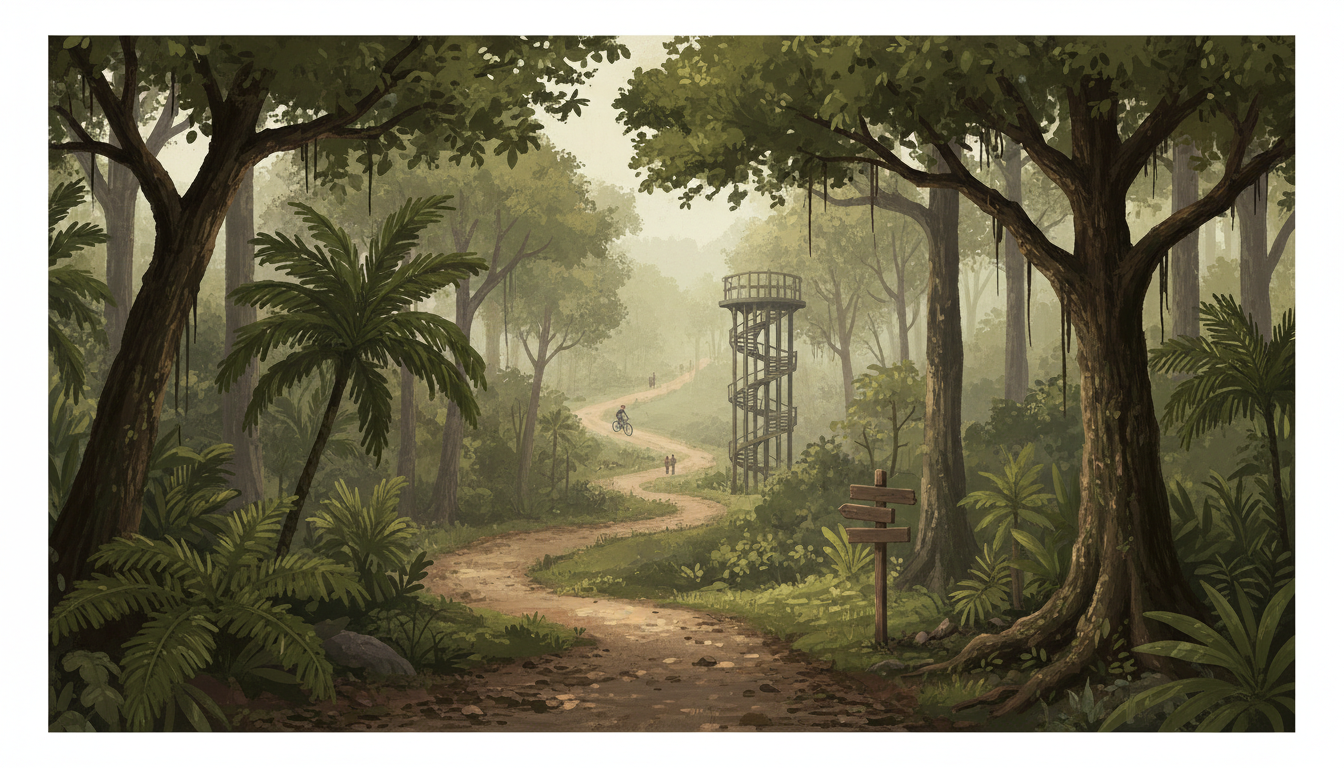
A civilisation can build schools, homes and transport while still leaving residents without nearby greenery, usable shade or healthy habitats. Public parks, street trees, urban forests and connecting nature corridors can contribute to ecological resilience, recreation and everyday wellbeing. A large planting target, however, is not the same as mature canopy, public access or long-term conservation.
The urban-green-infrastructure component of civilisation connects public land, tree care, green corridors, biodiversity, safe visitor access, climate-sensitive design, qualified professionals and long-term stewardship. Living greenery must be managed across decades, measured through relevant outcomes and linked to the actual needs of people and ecosystems.
This eduKate Components of a Civilisation article uses Tidal Reach, a wholly invented town of 240 hypothetical residents in sixty imaginary households. The examples are for teaching, not a professional legal, medical, ecological or technical determination.
Contents: seven connected urban-nature systems
- Public parks and civic nature
- Living trees and ecological foundations
- Access and inclusion
- Land and built infrastructure
- Biodiversity and restoration
- Institutional management and spending
- Climate and future stewardship
Quick answer: what makes city greenery useful?
Urban greenery becomes civic infrastructure when its living ecological functions, connected access, qualified care and continuing public responsibilities help people and habitats. A planted sapling is not a mature canopy, a park polygon is not a completed visitor journey, and a global forest count is not a local tree-condition report.
Dated research and Singapore’s City in Nature
FAO’s Global Forest Resources Assessment 2025 reported around 4.14 billion hectares of forest worldwide, roughly 32% of global land area. NParks’ 2025/26 report states that Singapore planted more than 855,000 trees under OneMillionTrees by March 2026. The former is a global forest assessment; the latter is a Singapore planting progress measure. Neither establishes the condition of Tidal Reach.
WHO’s Urban Green Spaces and Health describes potential links with physical activity, wellbeing and environmental exposure. It does not guarantee individual medical outcomes. The Singapore Green Plan 2030 contains future targets that should be distinguished from already achieved results.
Part 1: Public parks and civic nature
The six related components in this part help readers understand one group of public or ecological functions. Each offers a concrete idea, an imagined challenge and questions about reliable evidence. The goal is to identify what the institution does and what another generation should be able to verify.
Component 01: Public parks
Purpose and real mechanism. This topic concerns public parks. Living green infrastructure develops and changes over time. Planting, establishment, survival and mature habitat functions are different events, while roads, facilities and neighbours’ needs can also change. A responsible explanation must therefore identify continuing work and a clear method for reviewing earlier assumptions. Apply these ideas specifically to public parks, and identify what the initial example cannot prove.
An imagined resident or habitat problem. In the fictional town, newly planted trees are counted as if they were mature canopy. Public greenery can serve several legitimate functions, including ecological habitat, shade, recreation, learning and social connection. Those functions should not be mixed into one undefined score. A small accessible garden may meet an everyday need that a distant protected reserve does not, while the reserve may be ecologically valuable for a separate reason. Apply these ideas specifically to public parks, and identify what the initial example cannot prove.
Risks, trade-offs and alternative interpretations. A key concern with public parks is the possibility that newly planted trees are counted as if they were mature canopy. The fictional Tidal Reach example is a teaching story and not a field study. Ask what facts the description provides and which details have been assumed. A park symbol may be present while the path is unavailable, or an observed tree may not have a reliable maintenance record. Apply these ideas specifically to public parks, and identify what the initial example cannot prove.
Source evidence and trustworthy measurement. For public parks, identify the professional observation needed and its date. Different users can describe the same green site in different ways. A resident may notice a difficult journey while a parks officer has data about planting. Both may be reporting genuine observations of separate aspects of the service. Apply these ideas specifically to public parks, and identify what the initial example cannot prove.
Safe activity for parents and students. Explore public parks with a harmless paper illustration. One improvement may create a continuing obligation or affect another use of land. Additional trees need suitable care; paths may interact with protected habitats; a park project requires resources and can compete with other public needs. The task is to identify the intended benefit alongside a fair concern, not to assume the project is good or bad everywhere. Apply these ideas specifically to public parks, and identify what the initial example cannot prove.
Institutions and long-term stewardship. This topic concerns public parks. Numerical claims need a clear unit, geography, time and denominator. Trees planted, surviving trees, canopy area, park hectares and households with connected access are different measures. A figure can be mathematically correct but irrelevant to the original promise. Apply these ideas specifically to public parks, and identify what the initial example cannot prove.
Challenge the first conclusion. This topic concerns public parks. A map or photograph can be a useful source without showing the whole ecosystem. Green colour may indicate vegetation while concealing ground habitat, access conditions, roots, species diversity and professional risk assessments. A student should identify what the image can support and where other observations are necessary. Apply these ideas specifically to public parks, and identify what the initial example cannot prove.
Component 02: Urban forests
Purpose and real mechanism. This topic concerns urban forests. Public greenery can serve several legitimate functions, including ecological habitat, shade, recreation, learning and social connection. Those functions should not be mixed into one undefined score. A small accessible garden may meet an everyday need that a distant protected reserve does not, while the reserve may be ecologically valuable for a separate reason. Apply these ideas specifically to urban forests, and identify what the initial example cannot prove.
An imagined resident or habitat problem. In the fictional town, an attractive green illustration hides a missing habitat or access connection. The fictional Tidal Reach example is a teaching story and not a field study. Ask what facts the description provides and which details have been assumed. A park symbol may be present while the path is unavailable, or an observed tree may not have a reliable maintenance record. Apply these ideas specifically to urban forests, and identify what the initial example cannot prove.
Risks, trade-offs and alternative interpretations. A key concern with urban forests is the possibility that an attractive green illustration hides a missing habitat or access connection. Different users can describe the same green site in different ways. A resident may notice a difficult journey while a parks officer has data about planting. Both may be reporting genuine observations of separate aspects of the service. Apply these ideas specifically to urban forests, and identify what the initial example cannot prove.
Source evidence and trustworthy measurement. For urban forests, identify the professional observation needed and its date. One improvement may create a continuing obligation or affect another use of land. Additional trees need suitable care; paths may interact with protected habitats; a park project requires resources and can compete with other public needs. The task is to identify the intended benefit alongside a fair concern, not to assume the project is good or bad everywhere. Apply these ideas specifically to urban forests, and identify what the initial example cannot prove.
Safe activity for parents and students. Explore urban forests with a harmless paper illustration. Numerical claims need a clear unit, geography, time and denominator. Trees planted, surviving trees, canopy area, park hectares and households with connected access are different measures. A figure can be mathematically correct but irrelevant to the original promise. Apply these ideas specifically to urban forests, and identify what the initial example cannot prove.
Institutions and long-term stewardship. This topic concerns urban forests. A map or photograph can be a useful source without showing the whole ecosystem. Green colour may indicate vegetation while concealing ground habitat, access conditions, roots, species diversity and professional risk assessments. A student should identify what the image can support and where other observations are necessary. Apply these ideas specifically to urban forests, and identify what the initial example cannot prove.
Challenge the first conclusion. This topic concerns urban forests. A classroom can examine this question using paper maps, imaginary trees and harmless numerical examples. Start with a defined person or species, draw the supporting feature and ask what changes if one connection disappears. An older learner can write a claim, mechanism, fictional example, counterargument and qualified conclusion. Apply these ideas specifically to urban forests, and identify what the initial example cannot prove.
Component 03: Street trees
Purpose and real mechanism. This topic concerns street trees. The fictional Tidal Reach example is a teaching story and not a field study. Ask what facts the description provides and which details have been assumed. A park symbol may be present while the path is unavailable, or an observed tree may not have a reliable maintenance record. Apply these ideas specifically to street trees, and identify what the initial example cannot prove.
An imagined resident or habitat problem. In the fictional town, a public programme reports an activity without checking the intended outcome. Different users can describe the same green site in different ways. A resident may notice a difficult journey while a parks officer has data about planting. Both may be reporting genuine observations of separate aspects of the service. Apply these ideas specifically to street trees, and identify what the initial example cannot prove.
Risks, trade-offs and alternative interpretations. A key concern with street trees is the possibility that a public programme reports an activity without checking the intended outcome. One improvement may create a continuing obligation or affect another use of land. Additional trees need suitable care; paths may interact with protected habitats; a park project requires resources and can compete with other public needs. The task is to identify the intended benefit alongside a fair concern, not to assume the project is good or bad everywhere. Apply these ideas specifically to street trees, and identify what the initial example cannot prove.
Source evidence and trustworthy measurement. For street trees, identify the professional observation needed and its date. Numerical claims need a clear unit, geography, time and denominator. Trees planted, surviving trees, canopy area, park hectares and households with connected access are different measures. A figure can be mathematically correct but irrelevant to the original promise. Apply these ideas specifically to street trees, and identify what the initial example cannot prove.
Safe activity for parents and students. Explore street trees with a harmless paper illustration. A map or photograph can be a useful source without showing the whole ecosystem. Green colour may indicate vegetation while concealing ground habitat, access conditions, roots, species diversity and professional risk assessments. A student should identify what the image can support and where other observations are necessary. Apply these ideas specifically to street trees, and identify what the initial example cannot prove.
Institutions and long-term stewardship. This topic concerns street trees. A classroom can examine this question using paper maps, imaginary trees and harmless numerical examples. Start with a defined person or species, draw the supporting feature and ask what changes if one connection disappears. An older learner can write a claim, mechanism, fictional example, counterargument and qualified conclusion. Apply these ideas specifically to street trees, and identify what the initial example cannot prove.
Challenge the first conclusion. This topic concerns street trees. The social value of a green feature may vary with location and access. A citywide indicator could conceal a school street without shade or a neighbourhood without a practical route to a park. A proposed solution should identify who can use it and how the complete journey or habitat relationship works. Apply these ideas specifically to street trees, and identify what the initial example cannot prove.
Component 04: Habitat corridors
Purpose and real mechanism. This topic concerns habitat corridors. Different users can describe the same green site in different ways. A resident may notice a difficult journey while a parks officer has data about planting. Both may be reporting genuine observations of separate aspects of the service. Apply these ideas specifically to habitat corridors, and identify what the initial example cannot prove.
An imagined resident or habitat problem. In the fictional town, residents and qualified ecologists observe different aspects of the same site. One improvement may create a continuing obligation or affect another use of land. Additional trees need suitable care; paths may interact with protected habitats; a park project requires resources and can compete with other public needs. The task is to identify the intended benefit alongside a fair concern, not to assume the project is good or bad everywhere. Apply these ideas specifically to habitat corridors, and identify what the initial example cannot prove.
Risks, trade-offs and alternative interpretations. A key concern with habitat corridors is the possibility that residents and qualified ecologists observe different aspects of the same site. Numerical claims need a clear unit, geography, time and denominator. Trees planted, surviving trees, canopy area, park hectares and households with connected access are different measures. A figure can be mathematically correct but irrelevant to the original promise. Apply these ideas specifically to habitat corridors, and identify what the initial example cannot prove.
Source evidence and trustworthy measurement. For habitat corridors, identify the professional observation needed and its date. A map or photograph can be a useful source without showing the whole ecosystem. Green colour may indicate vegetation while concealing ground habitat, access conditions, roots, species diversity and professional risk assessments. A student should identify what the image can support and where other observations are necessary. Apply these ideas specifically to habitat corridors, and identify what the initial example cannot prove.
Safe activity for parents and students. Explore habitat corridors with a harmless paper illustration. A classroom can examine this question using paper maps, imaginary trees and harmless numerical examples. Start with a defined person or species, draw the supporting feature and ask what changes if one connection disappears. An older learner can write a claim, mechanism, fictional example, counterargument and qualified conclusion. Apply these ideas specifically to habitat corridors, and identify what the initial example cannot prove.
Institutions and long-term stewardship. This topic concerns habitat corridors. The social value of a green feature may vary with location and access. A citywide indicator could conceal a school street without shade or a neighbourhood without a practical route to a park. A proposed solution should identify who can use it and how the complete journey or habitat relationship works. Apply these ideas specifically to habitat corridors, and identify what the initial example cannot prove.
Challenge the first conclusion. This topic concerns habitat corridors. Consider the next generation. A new parks worker should be able to understand why the original decision was made, which species or assets were involved, what public benefit was intended and what evidence has changed. A planting celebration cannot preserve this knowledge by itself. Apply these ideas specifically to habitat corridors, and identify what the initial example cannot prove.
Component 05: Green and blue spaces
Purpose and real mechanism. This topic concerns green and blue spaces. One improvement may create a continuing obligation or affect another use of land. Additional trees need suitable care; paths may interact with protected habitats; a park project requires resources and can compete with other public needs. The task is to identify the intended benefit alongside a fair concern, not to assume the project is good or bad everywhere. Apply these ideas specifically to green and blue spaces, and identify what the initial example cannot prove.
An imagined resident or habitat problem. In the fictional town, an old inventory includes a route or tree that has changed over time. Numerical claims need a clear unit, geography, time and denominator. Trees planted, surviving trees, canopy area, park hectares and households with connected access are different measures. A figure can be mathematically correct but irrelevant to the original promise. Apply these ideas specifically to green and blue spaces, and identify what the initial example cannot prove.
Risks, trade-offs and alternative interpretations. A key concern with green and blue spaces is the possibility that an old inventory includes a route or tree that has changed over time. A map or photograph can be a useful source without showing the whole ecosystem. Green colour may indicate vegetation while concealing ground habitat, access conditions, roots, species diversity and professional risk assessments. A student should identify what the image can support and where other observations are necessary. Apply these ideas specifically to green and blue spaces, and identify what the initial example cannot prove.
Source evidence and trustworthy measurement. For green and blue spaces, identify the professional observation needed and its date. A classroom can examine this question using paper maps, imaginary trees and harmless numerical examples. Start with a defined person or species, draw the supporting feature and ask what changes if one connection disappears. An older learner can write a claim, mechanism, fictional example, counterargument and qualified conclusion. Apply these ideas specifically to green and blue spaces, and identify what the initial example cannot prove.
Safe activity for parents and students. Explore green and blue spaces with a harmless paper illustration. The social value of a green feature may vary with location and access. A citywide indicator could conceal a school street without shade or a neighbourhood without a practical route to a park. A proposed solution should identify who can use it and how the complete journey or habitat relationship works. Apply these ideas specifically to green and blue spaces, and identify what the initial example cannot prove.
Institutions and long-term stewardship. This topic concerns green and blue spaces. Consider the next generation. A new parks worker should be able to understand why the original decision was made, which species or assets were involved, what public benefit was intended and what evidence has changed. A planting celebration cannot preserve this knowledge by itself. Apply these ideas specifically to green and blue spaces, and identify what the initial example cannot prove.
Challenge the first conclusion. This topic concerns green and blue spaces. Take the strongest good-faith objection to the original plan and state it accurately. A resident may be concerned about access, a conservation worker about habitat, and a public manager about maintenance. Ask what observation would support or weaken each concern, which institution can review it and when an adjustment might be justified. Apply these ideas specifically to green and blue spaces, and identify what the initial example cannot prove.
Component 06: Nature and wellbeing
Purpose and real mechanism. This topic concerns nature and wellbeing. Numerical claims need a clear unit, geography, time and denominator. Trees planted, surviving trees, canopy area, park hectares and households with connected access are different measures. A figure can be mathematically correct but irrelevant to the original promise. Apply these ideas specifically to nature and wellbeing, and identify what the initial example cannot prove.
An imagined resident or habitat problem. In the fictional town, a plan copies another country’s target without checking its local conditions. A map or photograph can be a useful source without showing the whole ecosystem. Green colour may indicate vegetation while concealing ground habitat, access conditions, roots, species diversity and professional risk assessments. A student should identify what the image can support and where other observations are necessary. Apply these ideas specifically to nature and wellbeing, and identify what the initial example cannot prove.
Risks, trade-offs and alternative interpretations. A key concern with nature and wellbeing is the possibility that a plan copies another country’s target without checking its local conditions. A classroom can examine this question using paper maps, imaginary trees and harmless numerical examples. Start with a defined person or species, draw the supporting feature and ask what changes if one connection disappears. An older learner can write a claim, mechanism, fictional example, counterargument and qualified conclusion. Apply these ideas specifically to nature and wellbeing, and identify what the initial example cannot prove.
Source evidence and trustworthy measurement. For nature and wellbeing, identify the professional observation needed and its date. The social value of a green feature may vary with location and access. A citywide indicator could conceal a school street without shade or a neighbourhood without a practical route to a park. A proposed solution should identify who can use it and how the complete journey or habitat relationship works. Apply these ideas specifically to nature and wellbeing, and identify what the initial example cannot prove.
Safe activity for parents and students. Explore nature and wellbeing with a harmless paper illustration. Consider the next generation. A new parks worker should be able to understand why the original decision was made, which species or assets were involved, what public benefit was intended and what evidence has changed. A planting celebration cannot preserve this knowledge by itself. Apply these ideas specifically to nature and wellbeing, and identify what the initial example cannot prove.
Institutions and long-term stewardship. This topic concerns nature and wellbeing. Take the strongest good-faith objection to the original plan and state it accurately. A resident may be concerned about access, a conservation worker about habitat, and a public manager about maintenance. Ask what observation would support or weaken each concern, which institution can review it and when an adjustment might be justified. Apply these ideas specifically to nature and wellbeing, and identify what the initial example cannot prove.
Challenge the first conclusion. This topic concerns nature and wellbeing. The relevant public purpose should be clear before treating the feature as a successful component of civilisation. A place or asset can appear impressive without providing the service a person needs or the habitat function an organism depends on. Ask who the intended beneficiary is, what a credible observation would show and which qualified institution is responsible for that outcome. Apply these ideas specifically to nature and wellbeing, and identify what the initial example cannot prove.
Joined systems case 1
Connect these six components with a causal diagram. Ask a fictional resident, a qualified tree professional, an ecologist and a public data checker to identify one missing link each. A student should state the best argument against the initial design and the evidence that could lead to a responsible correction.
Part 2: Living trees and ecological foundations
The six related components in this part help readers understand one group of public or ecological functions. Each offers a concrete idea, an imagined challenge and questions about reliable evidence. The goal is to identify what the institution does and what another generation should be able to verify.
Component 07: Local tree species
Purpose and real mechanism. This topic concerns local tree species. A map or photograph can be a useful source without showing the whole ecosystem. Green colour may indicate vegetation while concealing ground habitat, access conditions, roots, species diversity and professional risk assessments. A student should identify what the image can support and where other observations are necessary. Apply these ideas specifically to local tree species, and identify what the initial example cannot prove.
An imagined resident or habitat problem. In the fictional town, an imaginary park exists on a map but residents cannot find a usable entrance. A classroom can examine this question using paper maps, imaginary trees and harmless numerical examples. Start with a defined person or species, draw the supporting feature and ask what changes if one connection disappears. An older learner can write a claim, mechanism, fictional example, counterargument and qualified conclusion. Apply these ideas specifically to local tree species, and identify what the initial example cannot prove.
Risks, trade-offs and alternative interpretations. A key concern with local tree species is the possibility that an imaginary park exists on a map but residents cannot find a usable entrance. The social value of a green feature may vary with location and access. A citywide indicator could conceal a school street without shade or a neighbourhood without a practical route to a park. A proposed solution should identify who can use it and how the complete journey or habitat relationship works. Apply these ideas specifically to local tree species, and identify what the initial example cannot prove.
Source evidence and trustworthy measurement. For local tree species, identify the professional observation needed and its date. Consider the next generation. A new parks worker should be able to understand why the original decision was made, which species or assets were involved, what public benefit was intended and what evidence has changed. A planting celebration cannot preserve this knowledge by itself. Apply these ideas specifically to local tree species, and identify what the initial example cannot prove.
Safe activity for parents and students. Explore local tree species with a harmless paper illustration. Take the strongest good-faith objection to the original plan and state it accurately. A resident may be concerned about access, a conservation worker about habitat, and a public manager about maintenance. Ask what observation would support or weaken each concern, which institution can review it and when an adjustment might be justified. Apply these ideas specifically to local tree species, and identify what the initial example cannot prove.
Institutions and long-term stewardship. This topic concerns local tree species. The relevant public purpose should be clear before treating the feature as a successful component of civilisation. A place or asset can appear impressive without providing the service a person needs or the habitat function an organism depends on. Ask who the intended beneficiary is, what a credible observation would show and which qualified institution is responsible for that outcome. Apply these ideas specifically to local tree species, and identify what the initial example cannot prove.
Challenge the first conclusion. This topic concerns local tree species. Living green infrastructure develops and changes over time. Planting, establishment, survival and mature habitat functions are different events, while roads, facilities and neighbours’ needs can also change. A responsible explanation must therefore identify continuing work and a clear method for reviewing earlier assumptions. Apply these ideas specifically to local tree species, and identify what the initial example cannot prove.
Component 08: Tree diversity
Purpose and real mechanism. This topic concerns tree diversity. A classroom can examine this question using paper maps, imaginary trees and harmless numerical examples. Start with a defined person or species, draw the supporting feature and ask what changes if one connection disappears. An older learner can write a claim, mechanism, fictional example, counterargument and qualified conclusion. Apply these ideas specifically to tree diversity, and identify what the initial example cannot prove.
An imagined resident or habitat problem. In the fictional town, newly planted trees are counted as if they were mature canopy. The social value of a green feature may vary with location and access. A citywide indicator could conceal a school street without shade or a neighbourhood without a practical route to a park. A proposed solution should identify who can use it and how the complete journey or habitat relationship works. Apply these ideas specifically to tree diversity, and identify what the initial example cannot prove.
Risks, trade-offs and alternative interpretations. A key concern with tree diversity is the possibility that newly planted trees are counted as if they were mature canopy. Consider the next generation. A new parks worker should be able to understand why the original decision was made, which species or assets were involved, what public benefit was intended and what evidence has changed. A planting celebration cannot preserve this knowledge by itself. Apply these ideas specifically to tree diversity, and identify what the initial example cannot prove.
Source evidence and trustworthy measurement. For tree diversity, identify the professional observation needed and its date. Take the strongest good-faith objection to the original plan and state it accurately. A resident may be concerned about access, a conservation worker about habitat, and a public manager about maintenance. Ask what observation would support or weaken each concern, which institution can review it and when an adjustment might be justified. Apply these ideas specifically to tree diversity, and identify what the initial example cannot prove.
Safe activity for parents and students. Explore tree diversity with a harmless paper illustration. The relevant public purpose should be clear before treating the feature as a successful component of civilisation. A place or asset can appear impressive without providing the service a person needs or the habitat function an organism depends on. Ask who the intended beneficiary is, what a credible observation would show and which qualified institution is responsible for that outcome. Apply these ideas specifically to tree diversity, and identify what the initial example cannot prove.
Institutions and long-term stewardship. This topic concerns tree diversity. Living green infrastructure develops and changes over time. Planting, establishment, survival and mature habitat functions are different events, while roads, facilities and neighbours’ needs can also change. A responsible explanation must therefore identify continuing work and a clear method for reviewing earlier assumptions. Apply these ideas specifically to tree diversity, and identify what the initial example cannot prove.
Challenge the first conclusion. This topic concerns tree diversity. Public greenery can serve several legitimate functions, including ecological habitat, shade, recreation, learning and social connection. Those functions should not be mixed into one undefined score. A small accessible garden may meet an everyday need that a distant protected reserve does not, while the reserve may be ecologically valuable for a separate reason. Apply these ideas specifically to tree diversity, and identify what the initial example cannot prove.
Component 09: Canopy and understory
Purpose and real mechanism. This topic concerns canopy and understory. The social value of a green feature may vary with location and access. A citywide indicator could conceal a school street without shade or a neighbourhood without a practical route to a park. A proposed solution should identify who can use it and how the complete journey or habitat relationship works. Apply these ideas specifically to canopy and understory, and identify what the initial example cannot prove.
An imagined resident or habitat problem. In the fictional town, an attractive green illustration hides a missing habitat or access connection. Consider the next generation. A new parks worker should be able to understand why the original decision was made, which species or assets were involved, what public benefit was intended and what evidence has changed. A planting celebration cannot preserve this knowledge by itself. Apply these ideas specifically to canopy and understory, and identify what the initial example cannot prove.
Risks, trade-offs and alternative interpretations. A key concern with canopy and understory is the possibility that an attractive green illustration hides a missing habitat or access connection. Take the strongest good-faith objection to the original plan and state it accurately. A resident may be concerned about access, a conservation worker about habitat, and a public manager about maintenance. Ask what observation would support or weaken each concern, which institution can review it and when an adjustment might be justified. Apply these ideas specifically to canopy and understory, and identify what the initial example cannot prove.
Source evidence and trustworthy measurement. For canopy and understory, identify the professional observation needed and its date. The relevant public purpose should be clear before treating the feature as a successful component of civilisation. A place or asset can appear impressive without providing the service a person needs or the habitat function an organism depends on. Ask who the intended beneficiary is, what a credible observation would show and which qualified institution is responsible for that outcome. Apply these ideas specifically to canopy and understory, and identify what the initial example cannot prove.
Safe activity for parents and students. Explore canopy and understory with a harmless paper illustration. Living green infrastructure develops and changes over time. Planting, establishment, survival and mature habitat functions are different events, while roads, facilities and neighbours’ needs can also change. A responsible explanation must therefore identify continuing work and a clear method for reviewing earlier assumptions. Apply these ideas specifically to canopy and understory, and identify what the initial example cannot prove.
Institutions and long-term stewardship. This topic concerns canopy and understory. Public greenery can serve several legitimate functions, including ecological habitat, shade, recreation, learning and social connection. Those functions should not be mixed into one undefined score. A small accessible garden may meet an everyday need that a distant protected reserve does not, while the reserve may be ecologically valuable for a separate reason. Apply these ideas specifically to canopy and understory, and identify what the initial example cannot prove.
Challenge the first conclusion. This topic concerns canopy and understory. The fictional Tidal Reach example is a teaching story and not a field study. Ask what facts the description provides and which details have been assumed. A park symbol may be present while the path is unavailable, or an observed tree may not have a reliable maintenance record. Apply these ideas specifically to canopy and understory, and identify what the initial example cannot prove.
Component 10: Urban root space
Purpose and real mechanism. This topic concerns urban root space. Consider the next generation. A new parks worker should be able to understand why the original decision was made, which species or assets were involved, what public benefit was intended and what evidence has changed. A planting celebration cannot preserve this knowledge by itself. Apply these ideas specifically to urban root space, and identify what the initial example cannot prove.
An imagined resident or habitat problem. In the fictional town, a public programme reports an activity without checking the intended outcome. Take the strongest good-faith objection to the original plan and state it accurately. A resident may be concerned about access, a conservation worker about habitat, and a public manager about maintenance. Ask what observation would support or weaken each concern, which institution can review it and when an adjustment might be justified. Apply these ideas specifically to urban root space, and identify what the initial example cannot prove.
Risks, trade-offs and alternative interpretations. A key concern with urban root space is the possibility that a public programme reports an activity without checking the intended outcome. The relevant public purpose should be clear before treating the feature as a successful component of civilisation. A place or asset can appear impressive without providing the service a person needs or the habitat function an organism depends on. Ask who the intended beneficiary is, what a credible observation would show and which qualified institution is responsible for that outcome. Apply these ideas specifically to urban root space, and identify what the initial example cannot prove.
Source evidence and trustworthy measurement. For urban root space, identify the professional observation needed and its date. Living green infrastructure develops and changes over time. Planting, establishment, survival and mature habitat functions are different events, while roads, facilities and neighbours’ needs can also change. A responsible explanation must therefore identify continuing work and a clear method for reviewing earlier assumptions. Apply these ideas specifically to urban root space, and identify what the initial example cannot prove.
Safe activity for parents and students. Explore urban root space with a harmless paper illustration. Public greenery can serve several legitimate functions, including ecological habitat, shade, recreation, learning and social connection. Those functions should not be mixed into one undefined score. A small accessible garden may meet an everyday need that a distant protected reserve does not, while the reserve may be ecologically valuable for a separate reason. Apply these ideas specifically to urban root space, and identify what the initial example cannot prove.
Institutions and long-term stewardship. This topic concerns urban root space. The fictional Tidal Reach example is a teaching story and not a field study. Ask what facts the description provides and which details have been assumed. A park symbol may be present while the path is unavailable, or an observed tree may not have a reliable maintenance record. Apply these ideas specifically to urban root space, and identify what the initial example cannot prove.
Challenge the first conclusion. This topic concerns urban root space. Different users can describe the same green site in different ways. A resident may notice a difficult journey while a parks officer has data about planting. Both may be reporting genuine observations of separate aspects of the service. Apply these ideas specifically to urban root space, and identify what the initial example cannot prove.
Component 11: Planting and survival
Purpose and real mechanism. This topic concerns planting and survival. Take the strongest good-faith objection to the original plan and state it accurately. A resident may be concerned about access, a conservation worker about habitat, and a public manager about maintenance. Ask what observation would support or weaken each concern, which institution can review it and when an adjustment might be justified. Apply these ideas specifically to planting and survival, and identify what the initial example cannot prove.
An imagined resident or habitat problem. In the fictional town, residents and qualified ecologists observe different aspects of the same site. The relevant public purpose should be clear before treating the feature as a successful component of civilisation. A place or asset can appear impressive without providing the service a person needs or the habitat function an organism depends on. Ask who the intended beneficiary is, what a credible observation would show and which qualified institution is responsible for that outcome. Apply these ideas specifically to planting and survival, and identify what the initial example cannot prove.
Risks, trade-offs and alternative interpretations. A key concern with planting and survival is the possibility that residents and qualified ecologists observe different aspects of the same site. Living green infrastructure develops and changes over time. Planting, establishment, survival and mature habitat functions are different events, while roads, facilities and neighbours’ needs can also change. A responsible explanation must therefore identify continuing work and a clear method for reviewing earlier assumptions. Apply these ideas specifically to planting and survival, and identify what the initial example cannot prove.
Source evidence and trustworthy measurement. For planting and survival, identify the professional observation needed and its date. Public greenery can serve several legitimate functions, including ecological habitat, shade, recreation, learning and social connection. Those functions should not be mixed into one undefined score. A small accessible garden may meet an everyday need that a distant protected reserve does not, while the reserve may be ecologically valuable for a separate reason. Apply these ideas specifically to planting and survival, and identify what the initial example cannot prove.
Safe activity for parents and students. Explore planting and survival with a harmless paper illustration. The fictional Tidal Reach example is a teaching story and not a field study. Ask what facts the description provides and which details have been assumed. A park symbol may be present while the path is unavailable, or an observed tree may not have a reliable maintenance record. Apply these ideas specifically to planting and survival, and identify what the initial example cannot prove.
Institutions and long-term stewardship. This topic concerns planting and survival. Different users can describe the same green site in different ways. A resident may notice a difficult journey while a parks officer has data about planting. Both may be reporting genuine observations of separate aspects of the service. Apply these ideas specifically to planting and survival, and identify what the initial example cannot prove.
Challenge the first conclusion. This topic concerns planting and survival. One improvement may create a continuing obligation or affect another use of land. Additional trees need suitable care; paths may interact with protected habitats; a park project requires resources and can compete with other public needs. The task is to identify the intended benefit alongside a fair concern, not to assume the project is good or bad everywhere. Apply these ideas specifically to planting and survival, and identify what the initial example cannot prove.
Component 12: Professional tree inspections
Purpose and real mechanism. This topic concerns professional tree inspections. The relevant public purpose should be clear before treating the feature as a successful component of civilisation. A place or asset can appear impressive without providing the service a person needs or the habitat function an organism depends on. Ask who the intended beneficiary is, what a credible observation would show and which qualified institution is responsible for that outcome. Apply these ideas specifically to professional tree inspections, and identify what the initial example cannot prove.
An imagined resident or habitat problem. In the fictional town, an old inventory includes a route or tree that has changed over time. Living green infrastructure develops and changes over time. Planting, establishment, survival and mature habitat functions are different events, while roads, facilities and neighbours’ needs can also change. A responsible explanation must therefore identify continuing work and a clear method for reviewing earlier assumptions. Apply these ideas specifically to professional tree inspections, and identify what the initial example cannot prove.
Risks, trade-offs and alternative interpretations. A key concern with professional tree inspections is the possibility that an old inventory includes a route or tree that has changed over time. Public greenery can serve several legitimate functions, including ecological habitat, shade, recreation, learning and social connection. Those functions should not be mixed into one undefined score. A small accessible garden may meet an everyday need that a distant protected reserve does not, while the reserve may be ecologically valuable for a separate reason. Apply these ideas specifically to professional tree inspections, and identify what the initial example cannot prove.
Source evidence and trustworthy measurement. For professional tree inspections, identify the professional observation needed and its date. The fictional Tidal Reach example is a teaching story and not a field study. Ask what facts the description provides and which details have been assumed. A park symbol may be present while the path is unavailable, or an observed tree may not have a reliable maintenance record. Apply these ideas specifically to professional tree inspections, and identify what the initial example cannot prove.
Safe activity for parents and students. Explore professional tree inspections with a harmless paper illustration. Different users can describe the same green site in different ways. A resident may notice a difficult journey while a parks officer has data about planting. Both may be reporting genuine observations of separate aspects of the service. Apply these ideas specifically to professional tree inspections, and identify what the initial example cannot prove.
Institutions and long-term stewardship. This topic concerns professional tree inspections. One improvement may create a continuing obligation or affect another use of land. Additional trees need suitable care; paths may interact with protected habitats; a park project requires resources and can compete with other public needs. The task is to identify the intended benefit alongside a fair concern, not to assume the project is good or bad everywhere. Apply these ideas specifically to professional tree inspections, and identify what the initial example cannot prove.
Challenge the first conclusion. This topic concerns professional tree inspections. Numerical claims need a clear unit, geography, time and denominator. Trees planted, surviving trees, canopy area, park hectares and households with connected access are different measures. A figure can be mathematically correct but irrelevant to the original promise. Apply these ideas specifically to professional tree inspections, and identify what the initial example cannot prove.
Joined systems case 2
Connect these six components with a causal diagram. Ask a fictional resident, a qualified tree professional, an ecologist and a public data checker to identify one missing link each. A student should state the best argument against the initial design and the evidence that could lead to a responsible correction.
Part 3: Access and inclusion
The six related components in this part help readers understand one group of public or ecological functions. Each offers a concrete idea, an imagined challenge and questions about reliable evidence. The goal is to identify what the institution does and what another generation should be able to verify.
Component 13: Actual park walking access
Purpose and real mechanism. This topic concerns actual park walking access. Living green infrastructure develops and changes over time. Planting, establishment, survival and mature habitat functions are different events, while roads, facilities and neighbours’ needs can also change. A responsible explanation must therefore identify continuing work and a clear method for reviewing earlier assumptions. Apply these ideas specifically to actual park walking access, and identify what the initial example cannot prove.
An imagined resident or habitat problem. In the fictional town, the town funds a launch event but leaves continuing maintenance unexplained. Public greenery can serve several legitimate functions, including ecological habitat, shade, recreation, learning and social connection. Those functions should not be mixed into one undefined score. A small accessible garden may meet an everyday need that a distant protected reserve does not, while the reserve may be ecologically valuable for a separate reason. Apply these ideas specifically to actual park walking access, and identify what the initial example cannot prove.
Risks, trade-offs and alternative interpretations. A key concern with actual park walking access is the possibility that the town funds a launch event but leaves continuing maintenance unexplained. The fictional Tidal Reach example is a teaching story and not a field study. Ask what facts the description provides and which details have been assumed. A park symbol may be present while the path is unavailable, or an observed tree may not have a reliable maintenance record. Apply these ideas specifically to actual park walking access, and identify what the initial example cannot prove.
Source evidence and trustworthy measurement. For actual park walking access, identify the professional observation needed and its date. Different users can describe the same green site in different ways. A resident may notice a difficult journey while a parks officer has data about planting. Both may be reporting genuine observations of separate aspects of the service. Apply these ideas specifically to actual park walking access, and identify what the initial example cannot prove.
Safe activity for parents and students. Explore actual park walking access with a harmless paper illustration. One improvement may create a continuing obligation or affect another use of land. Additional trees need suitable care; paths may interact with protected habitats; a park project requires resources and can compete with other public needs. The task is to identify the intended benefit alongside a fair concern, not to assume the project is good or bad everywhere. Apply these ideas specifically to actual park walking access, and identify what the initial example cannot prove.
Institutions and long-term stewardship. This topic concerns actual park walking access. Numerical claims need a clear unit, geography, time and denominator. Trees planted, surviving trees, canopy area, park hectares and households with connected access are different measures. A figure can be mathematically correct but irrelevant to the original promise. Apply these ideas specifically to actual park walking access, and identify what the initial example cannot prove.
Challenge the first conclusion. This topic concerns actual park walking access. A map or photograph can be a useful source without showing the whole ecosystem. Green colour may indicate vegetation while concealing ground habitat, access conditions, roots, species diversity and professional risk assessments. A student should identify what the image can support and where other observations are necessary. Apply these ideas specifically to actual park walking access, and identify what the initial example cannot prove.
Component 14: Inclusive visitor routes
Purpose and real mechanism. This topic concerns inclusive visitor routes. Public greenery can serve several legitimate functions, including ecological habitat, shade, recreation, learning and social connection. Those functions should not be mixed into one undefined score. A small accessible garden may meet an everyday need that a distant protected reserve does not, while the reserve may be ecologically valuable for a separate reason. Apply these ideas specifically to inclusive visitor routes, and identify what the initial example cannot prove.
An imagined resident or habitat problem. In the fictional town, an imaginary park exists on a map but residents cannot find a usable entrance. The fictional Tidal Reach example is a teaching story and not a field study. Ask what facts the description provides and which details have been assumed. A park symbol may be present while the path is unavailable, or an observed tree may not have a reliable maintenance record. Apply these ideas specifically to inclusive visitor routes, and identify what the initial example cannot prove.
Risks, trade-offs and alternative interpretations. A key concern with inclusive visitor routes is the possibility that an imaginary park exists on a map but residents cannot find a usable entrance. Different users can describe the same green site in different ways. A resident may notice a difficult journey while a parks officer has data about planting. Both may be reporting genuine observations of separate aspects of the service. Apply these ideas specifically to inclusive visitor routes, and identify what the initial example cannot prove.
Source evidence and trustworthy measurement. For inclusive visitor routes, identify the professional observation needed and its date. One improvement may create a continuing obligation or affect another use of land. Additional trees need suitable care; paths may interact with protected habitats; a park project requires resources and can compete with other public needs. The task is to identify the intended benefit alongside a fair concern, not to assume the project is good or bad everywhere. Apply these ideas specifically to inclusive visitor routes, and identify what the initial example cannot prove.
Safe activity for parents and students. Explore inclusive visitor routes with a harmless paper illustration. Numerical claims need a clear unit, geography, time and denominator. Trees planted, surviving trees, canopy area, park hectares and households with connected access are different measures. A figure can be mathematically correct but irrelevant to the original promise. Apply these ideas specifically to inclusive visitor routes, and identify what the initial example cannot prove.
Institutions and long-term stewardship. This topic concerns inclusive visitor routes. A map or photograph can be a useful source without showing the whole ecosystem. Green colour may indicate vegetation while concealing ground habitat, access conditions, roots, species diversity and professional risk assessments. A student should identify what the image can support and where other observations are necessary. Apply these ideas specifically to inclusive visitor routes, and identify what the initial example cannot prove.
Challenge the first conclusion. This topic concerns inclusive visitor routes. A classroom can examine this question using paper maps, imaginary trees and harmless numerical examples. Start with a defined person or species, draw the supporting feature and ask what changes if one connection disappears. An older learner can write a claim, mechanism, fictional example, counterargument and qualified conclusion. Apply these ideas specifically to inclusive visitor routes, and identify what the initial example cannot prove.
Component 15: Children and nature play
Purpose and real mechanism. This topic concerns children and nature play. The fictional Tidal Reach example is a teaching story and not a field study. Ask what facts the description provides and which details have been assumed. A park symbol may be present while the path is unavailable, or an observed tree may not have a reliable maintenance record. Apply these ideas specifically to children and nature play, and identify what the initial example cannot prove.
An imagined resident or habitat problem. In the fictional town, newly planted trees are counted as if they were mature canopy. Different users can describe the same green site in different ways. A resident may notice a difficult journey while a parks officer has data about planting. Both may be reporting genuine observations of separate aspects of the service. Apply these ideas specifically to children and nature play, and identify what the initial example cannot prove.
Risks, trade-offs and alternative interpretations. A key concern with children and nature play is the possibility that newly planted trees are counted as if they were mature canopy. One improvement may create a continuing obligation or affect another use of land. Additional trees need suitable care; paths may interact with protected habitats; a park project requires resources and can compete with other public needs. The task is to identify the intended benefit alongside a fair concern, not to assume the project is good or bad everywhere. Apply these ideas specifically to children and nature play, and identify what the initial example cannot prove.
Source evidence and trustworthy measurement. For children and nature play, identify the professional observation needed and its date. Numerical claims need a clear unit, geography, time and denominator. Trees planted, surviving trees, canopy area, park hectares and households with connected access are different measures. A figure can be mathematically correct but irrelevant to the original promise. Apply these ideas specifically to children and nature play, and identify what the initial example cannot prove.
Safe activity for parents and students. Explore children and nature play with a harmless paper illustration. A map or photograph can be a useful source without showing the whole ecosystem. Green colour may indicate vegetation while concealing ground habitat, access conditions, roots, species diversity and professional risk assessments. A student should identify what the image can support and where other observations are necessary. Apply these ideas specifically to children and nature play, and identify what the initial example cannot prove.
Institutions and long-term stewardship. This topic concerns children and nature play. A classroom can examine this question using paper maps, imaginary trees and harmless numerical examples. Start with a defined person or species, draw the supporting feature and ask what changes if one connection disappears. An older learner can write a claim, mechanism, fictional example, counterargument and qualified conclusion. Apply these ideas specifically to children and nature play, and identify what the initial example cannot prove.
Challenge the first conclusion. This topic concerns children and nature play. The social value of a green feature may vary with location and access. A citywide indicator could conceal a school street without shade or a neighbourhood without a practical route to a park. A proposed solution should identify who can use it and how the complete journey or habitat relationship works. Apply these ideas specifically to children and nature play, and identify what the initial example cannot prove.
Component 16: Older visitors and gardens
Purpose and real mechanism. This topic concerns older visitors and gardens. Different users can describe the same green site in different ways. A resident may notice a difficult journey while a parks officer has data about planting. Both may be reporting genuine observations of separate aspects of the service. Apply these ideas specifically to older visitors and gardens, and identify what the initial example cannot prove.
An imagined resident or habitat problem. In the fictional town, an attractive green illustration hides a missing habitat or access connection. One improvement may create a continuing obligation or affect another use of land. Additional trees need suitable care; paths may interact with protected habitats; a park project requires resources and can compete with other public needs. The task is to identify the intended benefit alongside a fair concern, not to assume the project is good or bad everywhere. Apply these ideas specifically to older visitors and gardens, and identify what the initial example cannot prove.
Risks, trade-offs and alternative interpretations. A key concern with older visitors and gardens is the possibility that an attractive green illustration hides a missing habitat or access connection. Numerical claims need a clear unit, geography, time and denominator. Trees planted, surviving trees, canopy area, park hectares and households with connected access are different measures. A figure can be mathematically correct but irrelevant to the original promise. Apply these ideas specifically to older visitors and gardens, and identify what the initial example cannot prove.
Source evidence and trustworthy measurement. For older visitors and gardens, identify the professional observation needed and its date. A map or photograph can be a useful source without showing the whole ecosystem. Green colour may indicate vegetation while concealing ground habitat, access conditions, roots, species diversity and professional risk assessments. A student should identify what the image can support and where other observations are necessary. Apply these ideas specifically to older visitors and gardens, and identify what the initial example cannot prove.
Safe activity for parents and students. Explore older visitors and gardens with a harmless paper illustration. A classroom can examine this question using paper maps, imaginary trees and harmless numerical examples. Start with a defined person or species, draw the supporting feature and ask what changes if one connection disappears. An older learner can write a claim, mechanism, fictional example, counterargument and qualified conclusion. Apply these ideas specifically to older visitors and gardens, and identify what the initial example cannot prove.
Institutions and long-term stewardship. This topic concerns older visitors and gardens. The social value of a green feature may vary with location and access. A citywide indicator could conceal a school street without shade or a neighbourhood without a practical route to a park. A proposed solution should identify who can use it and how the complete journey or habitat relationship works. Apply these ideas specifically to older visitors and gardens, and identify what the initial example cannot prove.
Challenge the first conclusion. This topic concerns older visitors and gardens. Consider the next generation. A new parks worker should be able to understand why the original decision was made, which species or assets were involved, what public benefit was intended and what evidence has changed. A planting celebration cannot preserve this knowledge by itself. Apply these ideas specifically to older visitors and gardens, and identify what the initial example cannot prove.
Component 17: Community gardening
Purpose and real mechanism. This topic concerns community gardening. One improvement may create a continuing obligation or affect another use of land. Additional trees need suitable care; paths may interact with protected habitats; a park project requires resources and can compete with other public needs. The task is to identify the intended benefit alongside a fair concern, not to assume the project is good or bad everywhere. Apply these ideas specifically to community gardening, and identify what the initial example cannot prove.
An imagined resident or habitat problem. In the fictional town, a public programme reports an activity without checking the intended outcome. Numerical claims need a clear unit, geography, time and denominator. Trees planted, surviving trees, canopy area, park hectares and households with connected access are different measures. A figure can be mathematically correct but irrelevant to the original promise. Apply these ideas specifically to community gardening, and identify what the initial example cannot prove.
Risks, trade-offs and alternative interpretations. A key concern with community gardening is the possibility that a public programme reports an activity without checking the intended outcome. A map or photograph can be a useful source without showing the whole ecosystem. Green colour may indicate vegetation while concealing ground habitat, access conditions, roots, species diversity and professional risk assessments. A student should identify what the image can support and where other observations are necessary. Apply these ideas specifically to community gardening, and identify what the initial example cannot prove.
Source evidence and trustworthy measurement. For community gardening, identify the professional observation needed and its date. A classroom can examine this question using paper maps, imaginary trees and harmless numerical examples. Start with a defined person or species, draw the supporting feature and ask what changes if one connection disappears. An older learner can write a claim, mechanism, fictional example, counterargument and qualified conclusion. Apply these ideas specifically to community gardening, and identify what the initial example cannot prove.
Safe activity for parents and students. Explore community gardening with a harmless paper illustration. The social value of a green feature may vary with location and access. A citywide indicator could conceal a school street without shade or a neighbourhood without a practical route to a park. A proposed solution should identify who can use it and how the complete journey or habitat relationship works. Apply these ideas specifically to community gardening, and identify what the initial example cannot prove.
Institutions and long-term stewardship. This topic concerns community gardening. Consider the next generation. A new parks worker should be able to understand why the original decision was made, which species or assets were involved, what public benefit was intended and what evidence has changed. A planting celebration cannot preserve this knowledge by itself. Apply these ideas specifically to community gardening, and identify what the initial example cannot prove.
Challenge the first conclusion. This topic concerns community gardening. Take the strongest good-faith objection to the original plan and state it accurately. A resident may be concerned about access, a conservation worker about habitat, and a public manager about maintenance. Ask what observation would support or weaken each concern, which institution can review it and when an adjustment might be justified. Apply these ideas specifically to community gardening, and identify what the initial example cannot prove.
Component 18: Neighbourhood green access
Purpose and real mechanism. This topic concerns neighbourhood green access. Numerical claims need a clear unit, geography, time and denominator. Trees planted, surviving trees, canopy area, park hectares and households with connected access are different measures. A figure can be mathematically correct but irrelevant to the original promise. Apply these ideas specifically to neighbourhood green access, and identify what the initial example cannot prove.
An imagined resident or habitat problem. In the fictional town, residents and qualified ecologists observe different aspects of the same site. A map or photograph can be a useful source without showing the whole ecosystem. Green colour may indicate vegetation while concealing ground habitat, access conditions, roots, species diversity and professional risk assessments. A student should identify what the image can support and where other observations are necessary. Apply these ideas specifically to neighbourhood green access, and identify what the initial example cannot prove.
Risks, trade-offs and alternative interpretations. A key concern with neighbourhood green access is the possibility that residents and qualified ecologists observe different aspects of the same site. A classroom can examine this question using paper maps, imaginary trees and harmless numerical examples. Start with a defined person or species, draw the supporting feature and ask what changes if one connection disappears. An older learner can write a claim, mechanism, fictional example, counterargument and qualified conclusion. Apply these ideas specifically to neighbourhood green access, and identify what the initial example cannot prove.
Source evidence and trustworthy measurement. For neighbourhood green access, identify the professional observation needed and its date. The social value of a green feature may vary with location and access. A citywide indicator could conceal a school street without shade or a neighbourhood without a practical route to a park. A proposed solution should identify who can use it and how the complete journey or habitat relationship works. Apply these ideas specifically to neighbourhood green access, and identify what the initial example cannot prove.
Safe activity for parents and students. Explore neighbourhood green access with a harmless paper illustration. Consider the next generation. A new parks worker should be able to understand why the original decision was made, which species or assets were involved, what public benefit was intended and what evidence has changed. A planting celebration cannot preserve this knowledge by itself. Apply these ideas specifically to neighbourhood green access, and identify what the initial example cannot prove.
Institutions and long-term stewardship. This topic concerns neighbourhood green access. Take the strongest good-faith objection to the original plan and state it accurately. A resident may be concerned about access, a conservation worker about habitat, and a public manager about maintenance. Ask what observation would support or weaken each concern, which institution can review it and when an adjustment might be justified. Apply these ideas specifically to neighbourhood green access, and identify what the initial example cannot prove.
Challenge the first conclusion. This topic concerns neighbourhood green access. The relevant public purpose should be clear before treating the feature as a successful component of civilisation. A place or asset can appear impressive without providing the service a person needs or the habitat function an organism depends on. Ask who the intended beneficiary is, what a credible observation would show and which qualified institution is responsible for that outcome. Apply these ideas specifically to neighbourhood green access, and identify what the initial example cannot prove.
Joined systems case 3
Connect these six components with a causal diagram. Ask a fictional resident, a qualified tree professional, an ecologist and a public data checker to identify one missing link each. A student should state the best argument against the initial design and the evidence that could lead to a responsible correction.
Part 4: Land and built infrastructure
The six related components in this part help readers understand one group of public or ecological functions. Each offers a concrete idea, an imagined challenge and questions about reliable evidence. The goal is to identify what the institution does and what another generation should be able to verify.
Component 19: Street trees and utilities
Purpose and real mechanism. This topic concerns street trees and utilities. A map or photograph can be a useful source without showing the whole ecosystem. Green colour may indicate vegetation while concealing ground habitat, access conditions, roots, species diversity and professional risk assessments. A student should identify what the image can support and where other observations are necessary. Apply these ideas specifically to street trees and utilities, and identify what the initial example cannot prove.
An imagined resident or habitat problem. In the fictional town, a plan copies another country’s target without checking its local conditions. A classroom can examine this question using paper maps, imaginary trees and harmless numerical examples. Start with a defined person or species, draw the supporting feature and ask what changes if one connection disappears. An older learner can write a claim, mechanism, fictional example, counterargument and qualified conclusion. Apply these ideas specifically to street trees and utilities, and identify what the initial example cannot prove.
Risks, trade-offs and alternative interpretations. A key concern with street trees and utilities is the possibility that a plan copies another country’s target without checking its local conditions. The social value of a green feature may vary with location and access. A citywide indicator could conceal a school street without shade or a neighbourhood without a practical route to a park. A proposed solution should identify who can use it and how the complete journey or habitat relationship works. Apply these ideas specifically to street trees and utilities, and identify what the initial example cannot prove.
Source evidence and trustworthy measurement. For street trees and utilities, identify the professional observation needed and its date. Consider the next generation. A new parks worker should be able to understand why the original decision was made, which species or assets were involved, what public benefit was intended and what evidence has changed. A planting celebration cannot preserve this knowledge by itself. Apply these ideas specifically to street trees and utilities, and identify what the initial example cannot prove.
Safe activity for parents and students. Explore street trees and utilities with a harmless paper illustration. Take the strongest good-faith objection to the original plan and state it accurately. A resident may be concerned about access, a conservation worker about habitat, and a public manager about maintenance. Ask what observation would support or weaken each concern, which institution can review it and when an adjustment might be justified. Apply these ideas specifically to street trees and utilities, and identify what the initial example cannot prove.
Institutions and long-term stewardship. This topic concerns street trees and utilities. The relevant public purpose should be clear before treating the feature as a successful component of civilisation. A place or asset can appear impressive without providing the service a person needs or the habitat function an organism depends on. Ask who the intended beneficiary is, what a credible observation would show and which qualified institution is responsible for that outcome. Apply these ideas specifically to street trees and utilities, and identify what the initial example cannot prove.
Challenge the first conclusion. This topic concerns street trees and utilities. Living green infrastructure develops and changes over time. Planting, establishment, survival and mature habitat functions are different events, while roads, facilities and neighbours’ needs can also change. A responsible explanation must therefore identify continuing work and a clear method for reviewing earlier assumptions. Apply these ideas specifically to street trees and utilities, and identify what the initial example cannot prove.
Component 20: Storms and professional management
Purpose and real mechanism. This topic concerns storms and professional management. A classroom can examine this question using paper maps, imaginary trees and harmless numerical examples. Start with a defined person or species, draw the supporting feature and ask what changes if one connection disappears. An older learner can write a claim, mechanism, fictional example, counterargument and qualified conclusion. Apply these ideas specifically to storms and professional management, and identify what the initial example cannot prove.
An imagined resident or habitat problem. In the fictional town, the town funds a launch event but leaves continuing maintenance unexplained. The social value of a green feature may vary with location and access. A citywide indicator could conceal a school street without shade or a neighbourhood without a practical route to a park. A proposed solution should identify who can use it and how the complete journey or habitat relationship works. Apply these ideas specifically to storms and professional management, and identify what the initial example cannot prove.
Risks, trade-offs and alternative interpretations. A key concern with storms and professional management is the possibility that the town funds a launch event but leaves continuing maintenance unexplained. Consider the next generation. A new parks worker should be able to understand why the original decision was made, which species or assets were involved, what public benefit was intended and what evidence has changed. A planting celebration cannot preserve this knowledge by itself. Apply these ideas specifically to storms and professional management, and identify what the initial example cannot prove.
Source evidence and trustworthy measurement. For storms and professional management, identify the professional observation needed and its date. Take the strongest good-faith objection to the original plan and state it accurately. A resident may be concerned about access, a conservation worker about habitat, and a public manager about maintenance. Ask what observation would support or weaken each concern, which institution can review it and when an adjustment might be justified. Apply these ideas specifically to storms and professional management, and identify what the initial example cannot prove.
Safe activity for parents and students. Explore storms and professional management with a harmless paper illustration. The relevant public purpose should be clear before treating the feature as a successful component of civilisation. A place or asset can appear impressive without providing the service a person needs or the habitat function an organism depends on. Ask who the intended beneficiary is, what a credible observation would show and which qualified institution is responsible for that outcome. Apply these ideas specifically to storms and professional management, and identify what the initial example cannot prove.
Institutions and long-term stewardship. This topic concerns storms and professional management. Living green infrastructure develops and changes over time. Planting, establishment, survival and mature habitat functions are different events, while roads, facilities and neighbours’ needs can also change. A responsible explanation must therefore identify continuing work and a clear method for reviewing earlier assumptions. Apply these ideas specifically to storms and professional management, and identify what the initial example cannot prove.
Challenge the first conclusion. This topic concerns storms and professional management. Public greenery can serve several legitimate functions, including ecological habitat, shade, recreation, learning and social connection. Those functions should not be mixed into one undefined score. A small accessible garden may meet an everyday need that a distant protected reserve does not, while the reserve may be ecologically valuable for a separate reason. Apply these ideas specifically to storms and professional management, and identify what the initial example cannot prove.
Component 21: Microclimate and shade
Purpose and real mechanism. This topic concerns microclimate and shade. The social value of a green feature may vary with location and access. A citywide indicator could conceal a school street without shade or a neighbourhood without a practical route to a park. A proposed solution should identify who can use it and how the complete journey or habitat relationship works. Apply these ideas specifically to microclimate and shade, and identify what the initial example cannot prove.
An imagined resident or habitat problem. In the fictional town, an imaginary park exists on a map but residents cannot find a usable entrance. Consider the next generation. A new parks worker should be able to understand why the original decision was made, which species or assets were involved, what public benefit was intended and what evidence has changed. A planting celebration cannot preserve this knowledge by itself. Apply these ideas specifically to microclimate and shade, and identify what the initial example cannot prove.
Risks, trade-offs and alternative interpretations. A key concern with microclimate and shade is the possibility that an imaginary park exists on a map but residents cannot find a usable entrance. Take the strongest good-faith objection to the original plan and state it accurately. A resident may be concerned about access, a conservation worker about habitat, and a public manager about maintenance. Ask what observation would support or weaken each concern, which institution can review it and when an adjustment might be justified. Apply these ideas specifically to microclimate and shade, and identify what the initial example cannot prove.
Source evidence and trustworthy measurement. For microclimate and shade, identify the professional observation needed and its date. The relevant public purpose should be clear before treating the feature as a successful component of civilisation. A place or asset can appear impressive without providing the service a person needs or the habitat function an organism depends on. Ask who the intended beneficiary is, what a credible observation would show and which qualified institution is responsible for that outcome. Apply these ideas specifically to microclimate and shade, and identify what the initial example cannot prove.
Safe activity for parents and students. Explore microclimate and shade with a harmless paper illustration. Living green infrastructure develops and changes over time. Planting, establishment, survival and mature habitat functions are different events, while roads, facilities and neighbours’ needs can also change. A responsible explanation must therefore identify continuing work and a clear method for reviewing earlier assumptions. Apply these ideas specifically to microclimate and shade, and identify what the initial example cannot prove.
Institutions and long-term stewardship. This topic concerns microclimate and shade. Public greenery can serve several legitimate functions, including ecological habitat, shade, recreation, learning and social connection. Those functions should not be mixed into one undefined score. A small accessible garden may meet an everyday need that a distant protected reserve does not, while the reserve may be ecologically valuable for a separate reason. Apply these ideas specifically to microclimate and shade, and identify what the initial example cannot prove.
Challenge the first conclusion. This topic concerns microclimate and shade. The fictional Tidal Reach example is a teaching story and not a field study. Ask what facts the description provides and which details have been assumed. A park symbol may be present while the path is unavailable, or an observed tree may not have a reliable maintenance record. Apply these ideas specifically to microclimate and shade, and identify what the initial example cannot prove.
Component 22: Parks and stormwater
Purpose and real mechanism. This topic concerns parks and stormwater. Consider the next generation. A new parks worker should be able to understand why the original decision was made, which species or assets were involved, what public benefit was intended and what evidence has changed. A planting celebration cannot preserve this knowledge by itself. Apply these ideas specifically to parks and stormwater, and identify what the initial example cannot prove.
An imagined resident or habitat problem. In the fictional town, newly planted trees are counted as if they were mature canopy. Take the strongest good-faith objection to the original plan and state it accurately. A resident may be concerned about access, a conservation worker about habitat, and a public manager about maintenance. Ask what observation would support or weaken each concern, which institution can review it and when an adjustment might be justified. Apply these ideas specifically to parks and stormwater, and identify what the initial example cannot prove.
Risks, trade-offs and alternative interpretations. A key concern with parks and stormwater is the possibility that newly planted trees are counted as if they were mature canopy. The relevant public purpose should be clear before treating the feature as a successful component of civilisation. A place or asset can appear impressive without providing the service a person needs or the habitat function an organism depends on. Ask who the intended beneficiary is, what a credible observation would show and which qualified institution is responsible for that outcome. Apply these ideas specifically to parks and stormwater, and identify what the initial example cannot prove.
Source evidence and trustworthy measurement. For parks and stormwater, identify the professional observation needed and its date. Living green infrastructure develops and changes over time. Planting, establishment, survival and mature habitat functions are different events, while roads, facilities and neighbours’ needs can also change. A responsible explanation must therefore identify continuing work and a clear method for reviewing earlier assumptions. Apply these ideas specifically to parks and stormwater, and identify what the initial example cannot prove.
Safe activity for parents and students. Explore parks and stormwater with a harmless paper illustration. Public greenery can serve several legitimate functions, including ecological habitat, shade, recreation, learning and social connection. Those functions should not be mixed into one undefined score. A small accessible garden may meet an everyday need that a distant protected reserve does not, while the reserve may be ecologically valuable for a separate reason. Apply these ideas specifically to parks and stormwater, and identify what the initial example cannot prove.
Institutions and long-term stewardship. This topic concerns parks and stormwater. The fictional Tidal Reach example is a teaching story and not a field study. Ask what facts the description provides and which details have been assumed. A park symbol may be present while the path is unavailable, or an observed tree may not have a reliable maintenance record. Apply these ideas specifically to parks and stormwater, and identify what the initial example cannot prove.
Challenge the first conclusion. This topic concerns parks and stormwater. Different users can describe the same green site in different ways. A resident may notice a difficult journey while a parks officer has data about planting. Both may be reporting genuine observations of separate aspects of the service. Apply these ideas specifically to parks and stormwater, and identify what the initial example cannot prove.
Component 23: Green roofs and building care
Purpose and real mechanism. This topic concerns green roofs and building care. Take the strongest good-faith objection to the original plan and state it accurately. A resident may be concerned about access, a conservation worker about habitat, and a public manager about maintenance. Ask what observation would support or weaken each concern, which institution can review it and when an adjustment might be justified. Apply these ideas specifically to green roofs and building care, and identify what the initial example cannot prove.
An imagined resident or habitat problem. In the fictional town, an attractive green illustration hides a missing habitat or access connection. The relevant public purpose should be clear before treating the feature as a successful component of civilisation. A place or asset can appear impressive without providing the service a person needs or the habitat function an organism depends on. Ask who the intended beneficiary is, what a credible observation would show and which qualified institution is responsible for that outcome. Apply these ideas specifically to green roofs and building care, and identify what the initial example cannot prove.
Risks, trade-offs and alternative interpretations. A key concern with green roofs and building care is the possibility that an attractive green illustration hides a missing habitat or access connection. Living green infrastructure develops and changes over time. Planting, establishment, survival and mature habitat functions are different events, while roads, facilities and neighbours’ needs can also change. A responsible explanation must therefore identify continuing work and a clear method for reviewing earlier assumptions. Apply these ideas specifically to green roofs and building care, and identify what the initial example cannot prove.
Source evidence and trustworthy measurement. For green roofs and building care, identify the professional observation needed and its date. Public greenery can serve several legitimate functions, including ecological habitat, shade, recreation, learning and social connection. Those functions should not be mixed into one undefined score. A small accessible garden may meet an everyday need that a distant protected reserve does not, while the reserve may be ecologically valuable for a separate reason. Apply these ideas specifically to green roofs and building care, and identify what the initial example cannot prove.
Safe activity for parents and students. Explore green roofs and building care with a harmless paper illustration. The fictional Tidal Reach example is a teaching story and not a field study. Ask what facts the description provides and which details have been assumed. A park symbol may be present while the path is unavailable, or an observed tree may not have a reliable maintenance record. Apply these ideas specifically to green roofs and building care, and identify what the initial example cannot prove.
Institutions and long-term stewardship. This topic concerns green roofs and building care. Different users can describe the same green site in different ways. A resident may notice a difficult journey while a parks officer has data about planting. Both may be reporting genuine observations of separate aspects of the service. Apply these ideas specifically to green roofs and building care, and identify what the initial example cannot prove.
Challenge the first conclusion. This topic concerns green roofs and building care. One improvement may create a continuing obligation or affect another use of land. Additional trees need suitable care; paths may interact with protected habitats; a park project requires resources and can compete with other public needs. The task is to identify the intended benefit alongside a fair concern, not to assume the project is good or bad everywhere. Apply these ideas specifically to green roofs and building care, and identify what the initial example cannot prove.
Component 24: Public park siting
Purpose and real mechanism. This topic concerns public park siting. The relevant public purpose should be clear before treating the feature as a successful component of civilisation. A place or asset can appear impressive without providing the service a person needs or the habitat function an organism depends on. Ask who the intended beneficiary is, what a credible observation would show and which qualified institution is responsible for that outcome. Apply these ideas specifically to public park siting, and identify what the initial example cannot prove.
An imagined resident or habitat problem. In the fictional town, a public programme reports an activity without checking the intended outcome. Living green infrastructure develops and changes over time. Planting, establishment, survival and mature habitat functions are different events, while roads, facilities and neighbours’ needs can also change. A responsible explanation must therefore identify continuing work and a clear method for reviewing earlier assumptions. Apply these ideas specifically to public park siting, and identify what the initial example cannot prove.
Risks, trade-offs and alternative interpretations. A key concern with public park siting is the possibility that a public programme reports an activity without checking the intended outcome. Public greenery can serve several legitimate functions, including ecological habitat, shade, recreation, learning and social connection. Those functions should not be mixed into one undefined score. A small accessible garden may meet an everyday need that a distant protected reserve does not, while the reserve may be ecologically valuable for a separate reason. Apply these ideas specifically to public park siting, and identify what the initial example cannot prove.
Source evidence and trustworthy measurement. For public park siting, identify the professional observation needed and its date. The fictional Tidal Reach example is a teaching story and not a field study. Ask what facts the description provides and which details have been assumed. A park symbol may be present while the path is unavailable, or an observed tree may not have a reliable maintenance record. Apply these ideas specifically to public park siting, and identify what the initial example cannot prove.
Safe activity for parents and students. Explore public park siting with a harmless paper illustration. Different users can describe the same green site in different ways. A resident may notice a difficult journey while a parks officer has data about planting. Both may be reporting genuine observations of separate aspects of the service. Apply these ideas specifically to public park siting, and identify what the initial example cannot prove.
Institutions and long-term stewardship. This topic concerns public park siting. One improvement may create a continuing obligation or affect another use of land. Additional trees need suitable care; paths may interact with protected habitats; a park project requires resources and can compete with other public needs. The task is to identify the intended benefit alongside a fair concern, not to assume the project is good or bad everywhere. Apply these ideas specifically to public park siting, and identify what the initial example cannot prove.
Challenge the first conclusion. This topic concerns public park siting. Numerical claims need a clear unit, geography, time and denominator. Trees planted, surviving trees, canopy area, park hectares and households with connected access are different measures. A figure can be mathematically correct but irrelevant to the original promise. Apply these ideas specifically to public park siting, and identify what the initial example cannot prove.
Joined systems case 4
Connect these six components with a causal diagram. Ask a fictional resident, a qualified tree professional, an ecologist and a public data checker to identify one missing link each. A student should state the best argument against the initial design and the evidence that could lead to a responsible correction.
Part 5: Biodiversity and restoration
The six related components in this part help readers understand one group of public or ecological functions. Each offers a concrete idea, an imagined challenge and questions about reliable evidence. The goal is to identify what the institution does and what another generation should be able to verify.
Component 25: Habitat fragmentation
Purpose and real mechanism. This topic concerns habitat fragmentation. Living green infrastructure develops and changes over time. Planting, establishment, survival and mature habitat functions are different events, while roads, facilities and neighbours’ needs can also change. A responsible explanation must therefore identify continuing work and a clear method for reviewing earlier assumptions. Apply these ideas specifically to habitat fragmentation, and identify what the initial example cannot prove.
An imagined resident or habitat problem. In the fictional town, an old inventory includes a route or tree that has changed over time. Public greenery can serve several legitimate functions, including ecological habitat, shade, recreation, learning and social connection. Those functions should not be mixed into one undefined score. A small accessible garden may meet an everyday need that a distant protected reserve does not, while the reserve may be ecologically valuable for a separate reason. Apply these ideas specifically to habitat fragmentation, and identify what the initial example cannot prove.
Risks, trade-offs and alternative interpretations. A key concern with habitat fragmentation is the possibility that an old inventory includes a route or tree that has changed over time. The fictional Tidal Reach example is a teaching story and not a field study. Ask what facts the description provides and which details have been assumed. A park symbol may be present while the path is unavailable, or an observed tree may not have a reliable maintenance record. Apply these ideas specifically to habitat fragmentation, and identify what the initial example cannot prove.
Source evidence and trustworthy measurement. For habitat fragmentation, identify the professional observation needed and its date. Different users can describe the same green site in different ways. A resident may notice a difficult journey while a parks officer has data about planting. Both may be reporting genuine observations of separate aspects of the service. Apply these ideas specifically to habitat fragmentation, and identify what the initial example cannot prove.
Safe activity for parents and students. Explore habitat fragmentation with a harmless paper illustration. One improvement may create a continuing obligation or affect another use of land. Additional trees need suitable care; paths may interact with protected habitats; a park project requires resources and can compete with other public needs. The task is to identify the intended benefit alongside a fair concern, not to assume the project is good or bad everywhere. Apply these ideas specifically to habitat fragmentation, and identify what the initial example cannot prove.
Institutions and long-term stewardship. This topic concerns habitat fragmentation. Numerical claims need a clear unit, geography, time and denominator. Trees planted, surviving trees, canopy area, park hectares and households with connected access are different measures. A figure can be mathematically correct but irrelevant to the original promise. Apply these ideas specifically to habitat fragmentation, and identify what the initial example cannot prove.
Challenge the first conclusion. This topic concerns habitat fragmentation. A map or photograph can be a useful source without showing the whole ecosystem. Green colour may indicate vegetation while concealing ground habitat, access conditions, roots, species diversity and professional risk assessments. A student should identify what the image can support and where other observations are necessary. Apply these ideas specifically to habitat fragmentation, and identify what the initial example cannot prove.
Component 26: Pollinating organisms
Purpose and real mechanism. This topic concerns pollinating organisms. Public greenery can serve several legitimate functions, including ecological habitat, shade, recreation, learning and social connection. Those functions should not be mixed into one undefined score. A small accessible garden may meet an everyday need that a distant protected reserve does not, while the reserve may be ecologically valuable for a separate reason. Apply these ideas specifically to pollinating organisms, and identify what the initial example cannot prove.
An imagined resident or habitat problem. In the fictional town, a plan copies another country’s target without checking its local conditions. The fictional Tidal Reach example is a teaching story and not a field study. Ask what facts the description provides and which details have been assumed. A park symbol may be present while the path is unavailable, or an observed tree may not have a reliable maintenance record. Apply these ideas specifically to pollinating organisms, and identify what the initial example cannot prove.
Risks, trade-offs and alternative interpretations. A key concern with pollinating organisms is the possibility that a plan copies another country’s target without checking its local conditions. Different users can describe the same green site in different ways. A resident may notice a difficult journey while a parks officer has data about planting. Both may be reporting genuine observations of separate aspects of the service. Apply these ideas specifically to pollinating organisms, and identify what the initial example cannot prove.
Source evidence and trustworthy measurement. For pollinating organisms, identify the professional observation needed and its date. One improvement may create a continuing obligation or affect another use of land. Additional trees need suitable care; paths may interact with protected habitats; a park project requires resources and can compete with other public needs. The task is to identify the intended benefit alongside a fair concern, not to assume the project is good or bad everywhere. Apply these ideas specifically to pollinating organisms, and identify what the initial example cannot prove.
Safe activity for parents and students. Explore pollinating organisms with a harmless paper illustration. Numerical claims need a clear unit, geography, time and denominator. Trees planted, surviving trees, canopy area, park hectares and households with connected access are different measures. A figure can be mathematically correct but irrelevant to the original promise. Apply these ideas specifically to pollinating organisms, and identify what the initial example cannot prove.
Institutions and long-term stewardship. This topic concerns pollinating organisms. A map or photograph can be a useful source without showing the whole ecosystem. Green colour may indicate vegetation while concealing ground habitat, access conditions, roots, species diversity and professional risk assessments. A student should identify what the image can support and where other observations are necessary. Apply these ideas specifically to pollinating organisms, and identify what the initial example cannot prove.
Challenge the first conclusion. This topic concerns pollinating organisms. A classroom can examine this question using paper maps, imaginary trees and harmless numerical examples. Start with a defined person or species, draw the supporting feature and ask what changes if one connection disappears. An older learner can write a claim, mechanism, fictional example, counterargument and qualified conclusion. Apply these ideas specifically to pollinating organisms, and identify what the initial example cannot prove.
Component 27: Restoration over time
Purpose and real mechanism. This topic concerns restoration over time. The fictional Tidal Reach example is a teaching story and not a field study. Ask what facts the description provides and which details have been assumed. A park symbol may be present while the path is unavailable, or an observed tree may not have a reliable maintenance record. Apply these ideas specifically to restoration over time, and identify what the initial example cannot prove.
An imagined resident or habitat problem. In the fictional town, the town funds a launch event but leaves continuing maintenance unexplained. Different users can describe the same green site in different ways. A resident may notice a difficult journey while a parks officer has data about planting. Both may be reporting genuine observations of separate aspects of the service. Apply these ideas specifically to restoration over time, and identify what the initial example cannot prove.
Risks, trade-offs and alternative interpretations. A key concern with restoration over time is the possibility that the town funds a launch event but leaves continuing maintenance unexplained. One improvement may create a continuing obligation or affect another use of land. Additional trees need suitable care; paths may interact with protected habitats; a park project requires resources and can compete with other public needs. The task is to identify the intended benefit alongside a fair concern, not to assume the project is good or bad everywhere. Apply these ideas specifically to restoration over time, and identify what the initial example cannot prove.
Source evidence and trustworthy measurement. For restoration over time, identify the professional observation needed and its date. Numerical claims need a clear unit, geography, time and denominator. Trees planted, surviving trees, canopy area, park hectares and households with connected access are different measures. A figure can be mathematically correct but irrelevant to the original promise. Apply these ideas specifically to restoration over time, and identify what the initial example cannot prove.
Safe activity for parents and students. Explore restoration over time with a harmless paper illustration. A map or photograph can be a useful source without showing the whole ecosystem. Green colour may indicate vegetation while concealing ground habitat, access conditions, roots, species diversity and professional risk assessments. A student should identify what the image can support and where other observations are necessary. Apply these ideas specifically to restoration over time, and identify what the initial example cannot prove.
Institutions and long-term stewardship. This topic concerns restoration over time. A classroom can examine this question using paper maps, imaginary trees and harmless numerical examples. Start with a defined person or species, draw the supporting feature and ask what changes if one connection disappears. An older learner can write a claim, mechanism, fictional example, counterargument and qualified conclusion. Apply these ideas specifically to restoration over time, and identify what the initial example cannot prove.
Challenge the first conclusion. This topic concerns restoration over time. The social value of a green feature may vary with location and access. A citywide indicator could conceal a school street without shade or a neighbourhood without a practical route to a park. A proposed solution should identify who can use it and how the complete journey or habitat relationship works. Apply these ideas specifically to restoration over time, and identify what the initial example cannot prove.
Component 28: Citizen science
Purpose and real mechanism. This topic concerns citizen science. Different users can describe the same green site in different ways. A resident may notice a difficult journey while a parks officer has data about planting. Both may be reporting genuine observations of separate aspects of the service. Apply these ideas specifically to citizen science, and identify what the initial example cannot prove.
An imagined resident or habitat problem. In the fictional town, an imaginary park exists on a map but residents cannot find a usable entrance. One improvement may create a continuing obligation or affect another use of land. Additional trees need suitable care; paths may interact with protected habitats; a park project requires resources and can compete with other public needs. The task is to identify the intended benefit alongside a fair concern, not to assume the project is good or bad everywhere. Apply these ideas specifically to citizen science, and identify what the initial example cannot prove.
Risks, trade-offs and alternative interpretations. A key concern with citizen science is the possibility that an imaginary park exists on a map but residents cannot find a usable entrance. Numerical claims need a clear unit, geography, time and denominator. Trees planted, surviving trees, canopy area, park hectares and households with connected access are different measures. A figure can be mathematically correct but irrelevant to the original promise. Apply these ideas specifically to citizen science, and identify what the initial example cannot prove.
Source evidence and trustworthy measurement. For citizen science, identify the professional observation needed and its date. A map or photograph can be a useful source without showing the whole ecosystem. Green colour may indicate vegetation while concealing ground habitat, access conditions, roots, species diversity and professional risk assessments. A student should identify what the image can support and where other observations are necessary. Apply these ideas specifically to citizen science, and identify what the initial example cannot prove.
Safe activity for parents and students. Explore citizen science with a harmless paper illustration. A classroom can examine this question using paper maps, imaginary trees and harmless numerical examples. Start with a defined person or species, draw the supporting feature and ask what changes if one connection disappears. An older learner can write a claim, mechanism, fictional example, counterargument and qualified conclusion. Apply these ideas specifically to citizen science, and identify what the initial example cannot prove.
Institutions and long-term stewardship. This topic concerns citizen science. The social value of a green feature may vary with location and access. A citywide indicator could conceal a school street without shade or a neighbourhood without a practical route to a park. A proposed solution should identify who can use it and how the complete journey or habitat relationship works. Apply these ideas specifically to citizen science, and identify what the initial example cannot prove.
Challenge the first conclusion. This topic concerns citizen science. Consider the next generation. A new parks worker should be able to understand why the original decision was made, which species or assets were involved, what public benefit was intended and what evidence has changed. A planting celebration cannot preserve this knowledge by itself. Apply these ideas specifically to citizen science, and identify what the initial example cannot prove.
Component 29: Tree inventories and maps
Purpose and real mechanism. This topic concerns tree inventories and maps. One improvement may create a continuing obligation or affect another use of land. Additional trees need suitable care; paths may interact with protected habitats; a park project requires resources and can compete with other public needs. The task is to identify the intended benefit alongside a fair concern, not to assume the project is good or bad everywhere. Apply these ideas specifically to tree inventories and maps, and identify what the initial example cannot prove.
An imagined resident or habitat problem. In the fictional town, newly planted trees are counted as if they were mature canopy. Numerical claims need a clear unit, geography, time and denominator. Trees planted, surviving trees, canopy area, park hectares and households with connected access are different measures. A figure can be mathematically correct but irrelevant to the original promise. Apply these ideas specifically to tree inventories and maps, and identify what the initial example cannot prove.
Risks, trade-offs and alternative interpretations. A key concern with tree inventories and maps is the possibility that newly planted trees are counted as if they were mature canopy. A map or photograph can be a useful source without showing the whole ecosystem. Green colour may indicate vegetation while concealing ground habitat, access conditions, roots, species diversity and professional risk assessments. A student should identify what the image can support and where other observations are necessary. Apply these ideas specifically to tree inventories and maps, and identify what the initial example cannot prove.
Source evidence and trustworthy measurement. For tree inventories and maps, identify the professional observation needed and its date. A classroom can examine this question using paper maps, imaginary trees and harmless numerical examples. Start with a defined person or species, draw the supporting feature and ask what changes if one connection disappears. An older learner can write a claim, mechanism, fictional example, counterargument and qualified conclusion. Apply these ideas specifically to tree inventories and maps, and identify what the initial example cannot prove.
Safe activity for parents and students. Explore tree inventories and maps with a harmless paper illustration. The social value of a green feature may vary with location and access. A citywide indicator could conceal a school street without shade or a neighbourhood without a practical route to a park. A proposed solution should identify who can use it and how the complete journey or habitat relationship works. Apply these ideas specifically to tree inventories and maps, and identify what the initial example cannot prove.
Institutions and long-term stewardship. This topic concerns tree inventories and maps. Consider the next generation. A new parks worker should be able to understand why the original decision was made, which species or assets were involved, what public benefit was intended and what evidence has changed. A planting celebration cannot preserve this knowledge by itself. Apply these ideas specifically to tree inventories and maps, and identify what the initial example cannot prove.
Challenge the first conclusion. This topic concerns tree inventories and maps. Take the strongest good-faith objection to the original plan and state it accurately. A resident may be concerned about access, a conservation worker about habitat, and a public manager about maintenance. Ask what observation would support or weaken each concern, which institution can review it and when an adjustment might be justified. Apply these ideas specifically to tree inventories and maps, and identify what the initial example cannot prove.
Component 30: Ecological interventions
Purpose and real mechanism. This topic concerns ecological interventions. Numerical claims need a clear unit, geography, time and denominator. Trees planted, surviving trees, canopy area, park hectares and households with connected access are different measures. A figure can be mathematically correct but irrelevant to the original promise. Apply these ideas specifically to ecological interventions, and identify what the initial example cannot prove.
An imagined resident or habitat problem. In the fictional town, an attractive green illustration hides a missing habitat or access connection. A map or photograph can be a useful source without showing the whole ecosystem. Green colour may indicate vegetation while concealing ground habitat, access conditions, roots, species diversity and professional risk assessments. A student should identify what the image can support and where other observations are necessary. Apply these ideas specifically to ecological interventions, and identify what the initial example cannot prove.
Risks, trade-offs and alternative interpretations. A key concern with ecological interventions is the possibility that an attractive green illustration hides a missing habitat or access connection. A classroom can examine this question using paper maps, imaginary trees and harmless numerical examples. Start with a defined person or species, draw the supporting feature and ask what changes if one connection disappears. An older learner can write a claim, mechanism, fictional example, counterargument and qualified conclusion. Apply these ideas specifically to ecological interventions, and identify what the initial example cannot prove.
Source evidence and trustworthy measurement. For ecological interventions, identify the professional observation needed and its date. The social value of a green feature may vary with location and access. A citywide indicator could conceal a school street without shade or a neighbourhood without a practical route to a park. A proposed solution should identify who can use it and how the complete journey or habitat relationship works. Apply these ideas specifically to ecological interventions, and identify what the initial example cannot prove.
Safe activity for parents and students. Explore ecological interventions with a harmless paper illustration. Consider the next generation. A new parks worker should be able to understand why the original decision was made, which species or assets were involved, what public benefit was intended and what evidence has changed. A planting celebration cannot preserve this knowledge by itself. Apply these ideas specifically to ecological interventions, and identify what the initial example cannot prove.
Institutions and long-term stewardship. This topic concerns ecological interventions. Take the strongest good-faith objection to the original plan and state it accurately. A resident may be concerned about access, a conservation worker about habitat, and a public manager about maintenance. Ask what observation would support or weaken each concern, which institution can review it and when an adjustment might be justified. Apply these ideas specifically to ecological interventions, and identify what the initial example cannot prove.
Challenge the first conclusion. This topic concerns ecological interventions. The relevant public purpose should be clear before treating the feature as a successful component of civilisation. A place or asset can appear impressive without providing the service a person needs or the habitat function an organism depends on. Ask who the intended beneficiary is, what a credible observation would show and which qualified institution is responsible for that outcome. Apply these ideas specifically to ecological interventions, and identify what the initial example cannot prove.
Joined systems case 5
Connect these six components with a causal diagram. Ask a fictional resident, a qualified tree professional, an ecologist and a public data checker to identify one missing link each. A student should state the best argument against the initial design and the evidence that could lead to a responsible correction.
Part 6: Institutional management and spending
The six related components in this part help readers understand one group of public or ecological functions. Each offers a concrete idea, an imagined challenge and questions about reliable evidence. The goal is to identify what the institution does and what another generation should be able to verify.
Component 31: Singapore City in Nature
Purpose and real mechanism. This topic concerns singapore city in nature. A map or photograph can be a useful source without showing the whole ecosystem. Green colour may indicate vegetation while concealing ground habitat, access conditions, roots, species diversity and professional risk assessments. A student should identify what the image can support and where other observations are necessary. Apply these ideas specifically to singapore city in nature, and identify what the initial example cannot prove.
An imagined resident or habitat problem. In the fictional town, residents and qualified ecologists observe different aspects of the same site. A classroom can examine this question using paper maps, imaginary trees and harmless numerical examples. Start with a defined person or species, draw the supporting feature and ask what changes if one connection disappears. An older learner can write a claim, mechanism, fictional example, counterargument and qualified conclusion. Apply these ideas specifically to singapore city in nature, and identify what the initial example cannot prove.
Risks, trade-offs and alternative interpretations. A key concern with singapore city in nature is the possibility that residents and qualified ecologists observe different aspects of the same site. The social value of a green feature may vary with location and access. A citywide indicator could conceal a school street without shade or a neighbourhood without a practical route to a park. A proposed solution should identify who can use it and how the complete journey or habitat relationship works. Apply these ideas specifically to singapore city in nature, and identify what the initial example cannot prove.
Source evidence and trustworthy measurement. For singapore city in nature, identify the professional observation needed and its date. Consider the next generation. A new parks worker should be able to understand why the original decision was made, which species or assets were involved, what public benefit was intended and what evidence has changed. A planting celebration cannot preserve this knowledge by itself. Apply these ideas specifically to singapore city in nature, and identify what the initial example cannot prove.
Safe activity for parents and students. Explore singapore city in nature with a harmless paper illustration. Take the strongest good-faith objection to the original plan and state it accurately. A resident may be concerned about access, a conservation worker about habitat, and a public manager about maintenance. Ask what observation would support or weaken each concern, which institution can review it and when an adjustment might be justified. Apply these ideas specifically to singapore city in nature, and identify what the initial example cannot prove.
Institutions and long-term stewardship. This topic concerns singapore city in nature. The relevant public purpose should be clear before treating the feature as a successful component of civilisation. A place or asset can appear impressive without providing the service a person needs or the habitat function an organism depends on. Ask who the intended beneficiary is, what a credible observation would show and which qualified institution is responsible for that outcome. Apply these ideas specifically to singapore city in nature, and identify what the initial example cannot prove.
Challenge the first conclusion. This topic concerns singapore city in nature. Living green infrastructure develops and changes over time. Planting, establishment, survival and mature habitat functions are different events, while roads, facilities and neighbours’ needs can also change. A responsible explanation must therefore identify continuing work and a clear method for reviewing earlier assumptions. Apply these ideas specifically to singapore city in nature, and identify what the initial example cannot prove.
Component 32: Public park connectors
Purpose and real mechanism. This topic concerns public park connectors. A classroom can examine this question using paper maps, imaginary trees and harmless numerical examples. Start with a defined person or species, draw the supporting feature and ask what changes if one connection disappears. An older learner can write a claim, mechanism, fictional example, counterargument and qualified conclusion. Apply these ideas specifically to public park connectors, and identify what the initial example cannot prove.
An imagined resident or habitat problem. In the fictional town, an old inventory includes a route or tree that has changed over time. The social value of a green feature may vary with location and access. A citywide indicator could conceal a school street without shade or a neighbourhood without a practical route to a park. A proposed solution should identify who can use it and how the complete journey or habitat relationship works. Apply these ideas specifically to public park connectors, and identify what the initial example cannot prove.
Risks, trade-offs and alternative interpretations. A key concern with public park connectors is the possibility that an old inventory includes a route or tree that has changed over time. Consider the next generation. A new parks worker should be able to understand why the original decision was made, which species or assets were involved, what public benefit was intended and what evidence has changed. A planting celebration cannot preserve this knowledge by itself. Apply these ideas specifically to public park connectors, and identify what the initial example cannot prove.
Source evidence and trustworthy measurement. For public park connectors, identify the professional observation needed and its date. Take the strongest good-faith objection to the original plan and state it accurately. A resident may be concerned about access, a conservation worker about habitat, and a public manager about maintenance. Ask what observation would support or weaken each concern, which institution can review it and when an adjustment might be justified. Apply these ideas specifically to public park connectors, and identify what the initial example cannot prove.
Safe activity for parents and students. Explore public park connectors with a harmless paper illustration. The relevant public purpose should be clear before treating the feature as a successful component of civilisation. A place or asset can appear impressive without providing the service a person needs or the habitat function an organism depends on. Ask who the intended beneficiary is, what a credible observation would show and which qualified institution is responsible for that outcome. Apply these ideas specifically to public park connectors, and identify what the initial example cannot prove.
Institutions and long-term stewardship. This topic concerns public park connectors. Living green infrastructure develops and changes over time. Planting, establishment, survival and mature habitat functions are different events, while roads, facilities and neighbours’ needs can also change. A responsible explanation must therefore identify continuing work and a clear method for reviewing earlier assumptions. Apply these ideas specifically to public park connectors, and identify what the initial example cannot prove.
Challenge the first conclusion. This topic concerns public park connectors. Public greenery can serve several legitimate functions, including ecological habitat, shade, recreation, learning and social connection. Those functions should not be mixed into one undefined score. A small accessible garden may meet an everyday need that a distant protected reserve does not, while the reserve may be ecologically valuable for a separate reason. Apply these ideas specifically to public park connectors, and identify what the initial example cannot prove.
Component 33: Green professional workforce
Purpose and real mechanism. This topic concerns green professional workforce. The social value of a green feature may vary with location and access. A citywide indicator could conceal a school street without shade or a neighbourhood without a practical route to a park. A proposed solution should identify who can use it and how the complete journey or habitat relationship works. Apply these ideas specifically to green professional workforce, and identify what the initial example cannot prove.
An imagined resident or habitat problem. In the fictional town, a plan copies another country’s target without checking its local conditions. Consider the next generation. A new parks worker should be able to understand why the original decision was made, which species or assets were involved, what public benefit was intended and what evidence has changed. A planting celebration cannot preserve this knowledge by itself. Apply these ideas specifically to green professional workforce, and identify what the initial example cannot prove.
Risks, trade-offs and alternative interpretations. A key concern with green professional workforce is the possibility that a plan copies another country’s target without checking its local conditions. Take the strongest good-faith objection to the original plan and state it accurately. A resident may be concerned about access, a conservation worker about habitat, and a public manager about maintenance. Ask what observation would support or weaken each concern, which institution can review it and when an adjustment might be justified. Apply these ideas specifically to green professional workforce, and identify what the initial example cannot prove.
Source evidence and trustworthy measurement. For green professional workforce, identify the professional observation needed and its date. The relevant public purpose should be clear before treating the feature as a successful component of civilisation. A place or asset can appear impressive without providing the service a person needs or the habitat function an organism depends on. Ask who the intended beneficiary is, what a credible observation would show and which qualified institution is responsible for that outcome. Apply these ideas specifically to green professional workforce, and identify what the initial example cannot prove.
Safe activity for parents and students. Explore green professional workforce with a harmless paper illustration. Living green infrastructure develops and changes over time. Planting, establishment, survival and mature habitat functions are different events, while roads, facilities and neighbours’ needs can also change. A responsible explanation must therefore identify continuing work and a clear method for reviewing earlier assumptions. Apply these ideas specifically to green professional workforce, and identify what the initial example cannot prove.
Institutions and long-term stewardship. This topic concerns green professional workforce. Public greenery can serve several legitimate functions, including ecological habitat, shade, recreation, learning and social connection. Those functions should not be mixed into one undefined score. A small accessible garden may meet an everyday need that a distant protected reserve does not, while the reserve may be ecologically valuable for a separate reason. Apply these ideas specifically to green professional workforce, and identify what the initial example cannot prove.
Challenge the first conclusion. This topic concerns green professional workforce. The fictional Tidal Reach example is a teaching story and not a field study. Ask what facts the description provides and which details have been assumed. A park symbol may be present while the path is unavailable, or an observed tree may not have a reliable maintenance record. Apply these ideas specifically to green professional workforce, and identify what the initial example cannot prove.
Component 34: Parks budgets
Purpose and real mechanism. This topic concerns parks budgets. Consider the next generation. A new parks worker should be able to understand why the original decision was made, which species or assets were involved, what public benefit was intended and what evidence has changed. A planting celebration cannot preserve this knowledge by itself. Apply these ideas specifically to parks budgets, and identify what the initial example cannot prove.
An imagined resident or habitat problem. In the fictional town, the town funds a launch event but leaves continuing maintenance unexplained. Take the strongest good-faith objection to the original plan and state it accurately. A resident may be concerned about access, a conservation worker about habitat, and a public manager about maintenance. Ask what observation would support or weaken each concern, which institution can review it and when an adjustment might be justified. Apply these ideas specifically to parks budgets, and identify what the initial example cannot prove.
Risks, trade-offs and alternative interpretations. A key concern with parks budgets is the possibility that the town funds a launch event but leaves continuing maintenance unexplained. The relevant public purpose should be clear before treating the feature as a successful component of civilisation. A place or asset can appear impressive without providing the service a person needs or the habitat function an organism depends on. Ask who the intended beneficiary is, what a credible observation would show and which qualified institution is responsible for that outcome. Apply these ideas specifically to parks budgets, and identify what the initial example cannot prove.
Source evidence and trustworthy measurement. For parks budgets, identify the professional observation needed and its date. Living green infrastructure develops and changes over time. Planting, establishment, survival and mature habitat functions are different events, while roads, facilities and neighbours’ needs can also change. A responsible explanation must therefore identify continuing work and a clear method for reviewing earlier assumptions. Apply these ideas specifically to parks budgets, and identify what the initial example cannot prove.
Safe activity for parents and students. Explore parks budgets with a harmless paper illustration. Public greenery can serve several legitimate functions, including ecological habitat, shade, recreation, learning and social connection. Those functions should not be mixed into one undefined score. A small accessible garden may meet an everyday need that a distant protected reserve does not, while the reserve may be ecologically valuable for a separate reason. Apply these ideas specifically to parks budgets, and identify what the initial example cannot prove.
Institutions and long-term stewardship. This topic concerns parks budgets. The fictional Tidal Reach example is a teaching story and not a field study. Ask what facts the description provides and which details have been assumed. A park symbol may be present while the path is unavailable, or an observed tree may not have a reliable maintenance record. Apply these ideas specifically to parks budgets, and identify what the initial example cannot prove.
Challenge the first conclusion. This topic concerns parks budgets. Different users can describe the same green site in different ways. A resident may notice a difficult journey while a parks officer has data about planting. Both may be reporting genuine observations of separate aspects of the service. Apply these ideas specifically to parks budgets, and identify what the initial example cannot prove.
Component 35: Landscape contracts
Purpose and real mechanism. This topic concerns landscape contracts. Take the strongest good-faith objection to the original plan and state it accurately. A resident may be concerned about access, a conservation worker about habitat, and a public manager about maintenance. Ask what observation would support or weaken each concern, which institution can review it and when an adjustment might be justified. Apply these ideas specifically to landscape contracts, and identify what the initial example cannot prove.
An imagined resident or habitat problem. In the fictional town, an imaginary park exists on a map but residents cannot find a usable entrance. The relevant public purpose should be clear before treating the feature as a successful component of civilisation. A place or asset can appear impressive without providing the service a person needs or the habitat function an organism depends on. Ask who the intended beneficiary is, what a credible observation would show and which qualified institution is responsible for that outcome. Apply these ideas specifically to landscape contracts, and identify what the initial example cannot prove.
Risks, trade-offs and alternative interpretations. A key concern with landscape contracts is the possibility that an imaginary park exists on a map but residents cannot find a usable entrance. Living green infrastructure develops and changes over time. Planting, establishment, survival and mature habitat functions are different events, while roads, facilities and neighbours’ needs can also change. A responsible explanation must therefore identify continuing work and a clear method for reviewing earlier assumptions. Apply these ideas specifically to landscape contracts, and identify what the initial example cannot prove.
Source evidence and trustworthy measurement. For landscape contracts, identify the professional observation needed and its date. Public greenery can serve several legitimate functions, including ecological habitat, shade, recreation, learning and social connection. Those functions should not be mixed into one undefined score. A small accessible garden may meet an everyday need that a distant protected reserve does not, while the reserve may be ecologically valuable for a separate reason. Apply these ideas specifically to landscape contracts, and identify what the initial example cannot prove.
Safe activity for parents and students. Explore landscape contracts with a harmless paper illustration. The fictional Tidal Reach example is a teaching story and not a field study. Ask what facts the description provides and which details have been assumed. A park symbol may be present while the path is unavailable, or an observed tree may not have a reliable maintenance record. Apply these ideas specifically to landscape contracts, and identify what the initial example cannot prove.
Institutions and long-term stewardship. This topic concerns landscape contracts. Different users can describe the same green site in different ways. A resident may notice a difficult journey while a parks officer has data about planting. Both may be reporting genuine observations of separate aspects of the service. Apply these ideas specifically to landscape contracts, and identify what the initial example cannot prove.
Challenge the first conclusion. This topic concerns landscape contracts. One improvement may create a continuing obligation or affect another use of land. Additional trees need suitable care; paths may interact with protected habitats; a park project requires resources and can compete with other public needs. The task is to identify the intended benefit alongside a fair concern, not to assume the project is good or bad everywhere. Apply these ideas specifically to landscape contracts, and identify what the initial example cannot prove.
Component 36: Visitor pressure and habitats
Purpose and real mechanism. This topic concerns visitor pressure and habitats. The relevant public purpose should be clear before treating the feature as a successful component of civilisation. A place or asset can appear impressive without providing the service a person needs or the habitat function an organism depends on. Ask who the intended beneficiary is, what a credible observation would show and which qualified institution is responsible for that outcome. Apply these ideas specifically to visitor pressure and habitats, and identify what the initial example cannot prove.
An imagined resident or habitat problem. In the fictional town, newly planted trees are counted as if they were mature canopy. Living green infrastructure develops and changes over time. Planting, establishment, survival and mature habitat functions are different events, while roads, facilities and neighbours’ needs can also change. A responsible explanation must therefore identify continuing work and a clear method for reviewing earlier assumptions. Apply these ideas specifically to visitor pressure and habitats, and identify what the initial example cannot prove.
Risks, trade-offs and alternative interpretations. A key concern with visitor pressure and habitats is the possibility that newly planted trees are counted as if they were mature canopy. Public greenery can serve several legitimate functions, including ecological habitat, shade, recreation, learning and social connection. Those functions should not be mixed into one undefined score. A small accessible garden may meet an everyday need that a distant protected reserve does not, while the reserve may be ecologically valuable for a separate reason. Apply these ideas specifically to visitor pressure and habitats, and identify what the initial example cannot prove.
Source evidence and trustworthy measurement. For visitor pressure and habitats, identify the professional observation needed and its date. The fictional Tidal Reach example is a teaching story and not a field study. Ask what facts the description provides and which details have been assumed. A park symbol may be present while the path is unavailable, or an observed tree may not have a reliable maintenance record. Apply these ideas specifically to visitor pressure and habitats, and identify what the initial example cannot prove.
Safe activity for parents and students. Explore visitor pressure and habitats with a harmless paper illustration. Different users can describe the same green site in different ways. A resident may notice a difficult journey while a parks officer has data about planting. Both may be reporting genuine observations of separate aspects of the service. Apply these ideas specifically to visitor pressure and habitats, and identify what the initial example cannot prove.
Institutions and long-term stewardship. This topic concerns visitor pressure and habitats. One improvement may create a continuing obligation or affect another use of land. Additional trees need suitable care; paths may interact with protected habitats; a park project requires resources and can compete with other public needs. The task is to identify the intended benefit alongside a fair concern, not to assume the project is good or bad everywhere. Apply these ideas specifically to visitor pressure and habitats, and identify what the initial example cannot prove.
Challenge the first conclusion. This topic concerns visitor pressure and habitats. Numerical claims need a clear unit, geography, time and denominator. Trees planted, surviving trees, canopy area, park hectares and households with connected access are different measures. A figure can be mathematically correct but irrelevant to the original promise. Apply these ideas specifically to visitor pressure and habitats, and identify what the initial example cannot prove.
Joined systems case 6
Connect these six components with a causal diagram. Ask a fictional resident, a qualified tree professional, an ecologist and a public data checker to identify one missing link each. A student should state the best argument against the initial design and the evidence that could lead to a responsible correction.
Part 7: Climate and future stewardship
The six related components in this part help readers understand one group of public or ecological functions. Each offers a concrete idea, an imagined challenge and questions about reliable evidence. The goal is to identify what the institution does and what another generation should be able to verify.
Component 37: Nature-based climate adaptation
Purpose and real mechanism. This topic concerns nature-based climate adaptation. Living green infrastructure develops and changes over time. Planting, establishment, survival and mature habitat functions are different events, while roads, facilities and neighbours’ needs can also change. A responsible explanation must therefore identify continuing work and a clear method for reviewing earlier assumptions. Apply these ideas specifically to nature-based climate adaptation, and identify what the initial example cannot prove.
An imagined resident or habitat problem. In the fictional town, a public programme reports an activity without checking the intended outcome. Public greenery can serve several legitimate functions, including ecological habitat, shade, recreation, learning and social connection. Those functions should not be mixed into one undefined score. A small accessible garden may meet an everyday need that a distant protected reserve does not, while the reserve may be ecologically valuable for a separate reason. Apply these ideas specifically to nature-based climate adaptation, and identify what the initial example cannot prove.
Risks, trade-offs and alternative interpretations. A key concern with nature-based climate adaptation is the possibility that a public programme reports an activity without checking the intended outcome. The fictional Tidal Reach example is a teaching story and not a field study. Ask what facts the description provides and which details have been assumed. A park symbol may be present while the path is unavailable, or an observed tree may not have a reliable maintenance record. Apply these ideas specifically to nature-based climate adaptation, and identify what the initial example cannot prove.
Source evidence and trustworthy measurement. For nature-based climate adaptation, identify the professional observation needed and its date. Different users can describe the same green site in different ways. A resident may notice a difficult journey while a parks officer has data about planting. Both may be reporting genuine observations of separate aspects of the service. Apply these ideas specifically to nature-based climate adaptation, and identify what the initial example cannot prove.
Safe activity for parents and students. Explore nature-based climate adaptation with a harmless paper illustration. One improvement may create a continuing obligation or affect another use of land. Additional trees need suitable care; paths may interact with protected habitats; a park project requires resources and can compete with other public needs. The task is to identify the intended benefit alongside a fair concern, not to assume the project is good or bad everywhere. Apply these ideas specifically to nature-based climate adaptation, and identify what the initial example cannot prove.
Institutions and long-term stewardship. This topic concerns nature-based climate adaptation. Numerical claims need a clear unit, geography, time and denominator. Trees planted, surviving trees, canopy area, park hectares and households with connected access are different measures. A figure can be mathematically correct but irrelevant to the original promise. Apply these ideas specifically to nature-based climate adaptation, and identify what the initial example cannot prove.
Challenge the first conclusion. This topic concerns nature-based climate adaptation. A map or photograph can be a useful source without showing the whole ecosystem. Green colour may indicate vegetation while concealing ground habitat, access conditions, roots, species diversity and professional risk assessments. A student should identify what the image can support and where other observations are necessary. Apply these ideas specifically to nature-based climate adaptation, and identify what the initial example cannot prove.
Component 38: Forest carbon accounting
Purpose and real mechanism. This topic concerns forest carbon accounting. Public greenery can serve several legitimate functions, including ecological habitat, shade, recreation, learning and social connection. Those functions should not be mixed into one undefined score. A small accessible garden may meet an everyday need that a distant protected reserve does not, while the reserve may be ecologically valuable for a separate reason. Apply these ideas specifically to forest carbon accounting, and identify what the initial example cannot prove.
An imagined resident or habitat problem. In the fictional town, residents and qualified ecologists observe different aspects of the same site. The fictional Tidal Reach example is a teaching story and not a field study. Ask what facts the description provides and which details have been assumed. A park symbol may be present while the path is unavailable, or an observed tree may not have a reliable maintenance record. Apply these ideas specifically to forest carbon accounting, and identify what the initial example cannot prove.
Risks, trade-offs and alternative interpretations. A key concern with forest carbon accounting is the possibility that residents and qualified ecologists observe different aspects of the same site. Different users can describe the same green site in different ways. A resident may notice a difficult journey while a parks officer has data about planting. Both may be reporting genuine observations of separate aspects of the service. Apply these ideas specifically to forest carbon accounting, and identify what the initial example cannot prove.
Source evidence and trustworthy measurement. For forest carbon accounting, identify the professional observation needed and its date. One improvement may create a continuing obligation or affect another use of land. Additional trees need suitable care; paths may interact with protected habitats; a park project requires resources and can compete with other public needs. The task is to identify the intended benefit alongside a fair concern, not to assume the project is good or bad everywhere. Apply these ideas specifically to forest carbon accounting, and identify what the initial example cannot prove.
Safe activity for parents and students. Explore forest carbon accounting with a harmless paper illustration. Numerical claims need a clear unit, geography, time and denominator. Trees planted, surviving trees, canopy area, park hectares and households with connected access are different measures. A figure can be mathematically correct but irrelevant to the original promise. Apply these ideas specifically to forest carbon accounting, and identify what the initial example cannot prove.
Institutions and long-term stewardship. This topic concerns forest carbon accounting. A map or photograph can be a useful source without showing the whole ecosystem. Green colour may indicate vegetation while concealing ground habitat, access conditions, roots, species diversity and professional risk assessments. A student should identify what the image can support and where other observations are necessary. Apply these ideas specifically to forest carbon accounting, and identify what the initial example cannot prove.
Challenge the first conclusion. This topic concerns forest carbon accounting. A classroom can examine this question using paper maps, imaginary trees and harmless numerical examples. Start with a defined person or species, draw the supporting feature and ask what changes if one connection disappears. An older learner can write a claim, mechanism, fictional example, counterargument and qualified conclusion. Apply these ideas specifically to forest carbon accounting, and identify what the initial example cannot prove.
Component 39: Green public indicators
Purpose and real mechanism. This topic concerns green public indicators. The fictional Tidal Reach example is a teaching story and not a field study. Ask what facts the description provides and which details have been assumed. A park symbol may be present while the path is unavailable, or an observed tree may not have a reliable maintenance record. Apply these ideas specifically to green public indicators, and identify what the initial example cannot prove.
An imagined resident or habitat problem. In the fictional town, an old inventory includes a route or tree that has changed over time. Different users can describe the same green site in different ways. A resident may notice a difficult journey while a parks officer has data about planting. Both may be reporting genuine observations of separate aspects of the service. Apply these ideas specifically to green public indicators, and identify what the initial example cannot prove.
Risks, trade-offs and alternative interpretations. A key concern with green public indicators is the possibility that an old inventory includes a route or tree that has changed over time. One improvement may create a continuing obligation or affect another use of land. Additional trees need suitable care; paths may interact with protected habitats; a park project requires resources and can compete with other public needs. The task is to identify the intended benefit alongside a fair concern, not to assume the project is good or bad everywhere. Apply these ideas specifically to green public indicators, and identify what the initial example cannot prove.
Source evidence and trustworthy measurement. For green public indicators, identify the professional observation needed and its date. Numerical claims need a clear unit, geography, time and denominator. Trees planted, surviving trees, canopy area, park hectares and households with connected access are different measures. A figure can be mathematically correct but irrelevant to the original promise. Apply these ideas specifically to green public indicators, and identify what the initial example cannot prove.
Safe activity for parents and students. Explore green public indicators with a harmless paper illustration. A map or photograph can be a useful source without showing the whole ecosystem. Green colour may indicate vegetation while concealing ground habitat, access conditions, roots, species diversity and professional risk assessments. A student should identify what the image can support and where other observations are necessary. Apply these ideas specifically to green public indicators, and identify what the initial example cannot prove.
Institutions and long-term stewardship. This topic concerns green public indicators. A classroom can examine this question using paper maps, imaginary trees and harmless numerical examples. Start with a defined person or species, draw the supporting feature and ask what changes if one connection disappears. An older learner can write a claim, mechanism, fictional example, counterargument and qualified conclusion. Apply these ideas specifically to green public indicators, and identify what the initial example cannot prove.
Challenge the first conclusion. This topic concerns green public indicators. The social value of a green feature may vary with location and access. A citywide indicator could conceal a school street without shade or a neighbourhood without a practical route to a park. A proposed solution should identify who can use it and how the complete journey or habitat relationship works. Apply these ideas specifically to green public indicators, and identify what the initial example cannot prove.
Component 40: Updated park records
Purpose and real mechanism. This topic concerns updated park records. Different users can describe the same green site in different ways. A resident may notice a difficult journey while a parks officer has data about planting. Both may be reporting genuine observations of separate aspects of the service. Apply these ideas specifically to updated park records, and identify what the initial example cannot prove.
An imagined resident or habitat problem. In the fictional town, a plan copies another country’s target without checking its local conditions. One improvement may create a continuing obligation or affect another use of land. Additional trees need suitable care; paths may interact with protected habitats; a park project requires resources and can compete with other public needs. The task is to identify the intended benefit alongside a fair concern, not to assume the project is good or bad everywhere. Apply these ideas specifically to updated park records, and identify what the initial example cannot prove.
Risks, trade-offs and alternative interpretations. A key concern with updated park records is the possibility that a plan copies another country’s target without checking its local conditions. Numerical claims need a clear unit, geography, time and denominator. Trees planted, surviving trees, canopy area, park hectares and households with connected access are different measures. A figure can be mathematically correct but irrelevant to the original promise. Apply these ideas specifically to updated park records, and identify what the initial example cannot prove.
Source evidence and trustworthy measurement. For updated park records, identify the professional observation needed and its date. A map or photograph can be a useful source without showing the whole ecosystem. Green colour may indicate vegetation while concealing ground habitat, access conditions, roots, species diversity and professional risk assessments. A student should identify what the image can support and where other observations are necessary. Apply these ideas specifically to updated park records, and identify what the initial example cannot prove.
Safe activity for parents and students. Explore updated park records with a harmless paper illustration. A classroom can examine this question using paper maps, imaginary trees and harmless numerical examples. Start with a defined person or species, draw the supporting feature and ask what changes if one connection disappears. An older learner can write a claim, mechanism, fictional example, counterargument and qualified conclusion. Apply these ideas specifically to updated park records, and identify what the initial example cannot prove.
Institutions and long-term stewardship. This topic concerns updated park records. The social value of a green feature may vary with location and access. A citywide indicator could conceal a school street without shade or a neighbourhood without a practical route to a park. A proposed solution should identify who can use it and how the complete journey or habitat relationship works. Apply these ideas specifically to updated park records, and identify what the initial example cannot prove.
Challenge the first conclusion. This topic concerns updated park records. Consider the next generation. A new parks worker should be able to understand why the original decision was made, which species or assets were involved, what public benefit was intended and what evidence has changed. A planting celebration cannot preserve this knowledge by itself. Apply these ideas specifically to updated park records, and identify what the initial example cannot prove.
Component 41: Community participation
Purpose and real mechanism. This topic concerns community participation. One improvement may create a continuing obligation or affect another use of land. Additional trees need suitable care; paths may interact with protected habitats; a park project requires resources and can compete with other public needs. The task is to identify the intended benefit alongside a fair concern, not to assume the project is good or bad everywhere. Apply these ideas specifically to community participation, and identify what the initial example cannot prove.
An imagined resident or habitat problem. In the fictional town, the town funds a launch event but leaves continuing maintenance unexplained. Numerical claims need a clear unit, geography, time and denominator. Trees planted, surviving trees, canopy area, park hectares and households with connected access are different measures. A figure can be mathematically correct but irrelevant to the original promise. Apply these ideas specifically to community participation, and identify what the initial example cannot prove.
Risks, trade-offs and alternative interpretations. A key concern with community participation is the possibility that the town funds a launch event but leaves continuing maintenance unexplained. A map or photograph can be a useful source without showing the whole ecosystem. Green colour may indicate vegetation while concealing ground habitat, access conditions, roots, species diversity and professional risk assessments. A student should identify what the image can support and where other observations are necessary. Apply these ideas specifically to community participation, and identify what the initial example cannot prove.
Source evidence and trustworthy measurement. For community participation, identify the professional observation needed and its date. A classroom can examine this question using paper maps, imaginary trees and harmless numerical examples. Start with a defined person or species, draw the supporting feature and ask what changes if one connection disappears. An older learner can write a claim, mechanism, fictional example, counterargument and qualified conclusion. Apply these ideas specifically to community participation, and identify what the initial example cannot prove.
Safe activity for parents and students. Explore community participation with a harmless paper illustration. The social value of a green feature may vary with location and access. A citywide indicator could conceal a school street without shade or a neighbourhood without a practical route to a park. A proposed solution should identify who can use it and how the complete journey or habitat relationship works. Apply these ideas specifically to community participation, and identify what the initial example cannot prove.
Institutions and long-term stewardship. This topic concerns community participation. Consider the next generation. A new parks worker should be able to understand why the original decision was made, which species or assets were involved, what public benefit was intended and what evidence has changed. A planting celebration cannot preserve this knowledge by itself. Apply these ideas specifically to community participation, and identify what the initial example cannot prove.
Challenge the first conclusion. This topic concerns community participation. Take the strongest good-faith objection to the original plan and state it accurately. A resident may be concerned about access, a conservation worker about habitat, and a public manager about maintenance. Ask what observation would support or weaken each concern, which institution can review it and when an adjustment might be justified. Apply these ideas specifically to community participation, and identify what the initial example cannot prove.
Component 42: Future ecological stewardship
Purpose and real mechanism. This topic concerns future ecological stewardship. Numerical claims need a clear unit, geography, time and denominator. Trees planted, surviving trees, canopy area, park hectares and households with connected access are different measures. A figure can be mathematically correct but irrelevant to the original promise. Apply these ideas specifically to future ecological stewardship, and identify what the initial example cannot prove.
An imagined resident or habitat problem. In the fictional town, an imaginary park exists on a map but residents cannot find a usable entrance. A map or photograph can be a useful source without showing the whole ecosystem. Green colour may indicate vegetation while concealing ground habitat, access conditions, roots, species diversity and professional risk assessments. A student should identify what the image can support and where other observations are necessary. Apply these ideas specifically to future ecological stewardship, and identify what the initial example cannot prove.
Risks, trade-offs and alternative interpretations. A key concern with future ecological stewardship is the possibility that an imaginary park exists on a map but residents cannot find a usable entrance. A classroom can examine this question using paper maps, imaginary trees and harmless numerical examples. Start with a defined person or species, draw the supporting feature and ask what changes if one connection disappears. An older learner can write a claim, mechanism, fictional example, counterargument and qualified conclusion. Apply these ideas specifically to future ecological stewardship, and identify what the initial example cannot prove.
Source evidence and trustworthy measurement. For future ecological stewardship, identify the professional observation needed and its date. The social value of a green feature may vary with location and access. A citywide indicator could conceal a school street without shade or a neighbourhood without a practical route to a park. A proposed solution should identify who can use it and how the complete journey or habitat relationship works. Apply these ideas specifically to future ecological stewardship, and identify what the initial example cannot prove.
Safe activity for parents and students. Explore future ecological stewardship with a harmless paper illustration. Consider the next generation. A new parks worker should be able to understand why the original decision was made, which species or assets were involved, what public benefit was intended and what evidence has changed. A planting celebration cannot preserve this knowledge by itself. Apply these ideas specifically to future ecological stewardship, and identify what the initial example cannot prove.
Institutions and long-term stewardship. This topic concerns future ecological stewardship. Take the strongest good-faith objection to the original plan and state it accurately. A resident may be concerned about access, a conservation worker about habitat, and a public manager about maintenance. Ask what observation would support or weaken each concern, which institution can review it and when an adjustment might be justified. Apply these ideas specifically to future ecological stewardship, and identify what the initial example cannot prove.
Challenge the first conclusion. This topic concerns future ecological stewardship. The relevant public purpose should be clear before treating the feature as a successful component of civilisation. A place or asset can appear impressive without providing the service a person needs or the habitat function an organism depends on. Ask who the intended beneficiary is, what a credible observation would show and which qualified institution is responsible for that outcome. Apply these ideas specifically to future ecological stewardship, and identify what the initial example cannot prove.
Joined systems case 7
Connect these six components with a causal diagram. Ask a fictional resident, a qualified tree professional, an ecologist and a public data checker to identify one missing link each. A student should state the best argument against the initial design and the evidence that could lead to a responsible correction.
Frequently asked questions
FAQ 1: Does every planted tree survive into maturity?
The answer depends on the particular function, relevant source and the conditions of the site. A target, activity or image is not automatically proof of a lasting outcome. Appropriate professionals and original records are necessary for real decisions. The imaginary town helps the pupil identify a better evidence question, not perform technical assessments.
FAQ 2: Does a large park-area total guarantee usable access?
The answer depends on the particular function, relevant source and the conditions of the site. A target, activity or image is not automatically proof of a lasting outcome. Appropriate professionals and original records are necessary for real decisions. The imaginary town helps the pupil identify a better evidence question, not perform technical assessments.
FAQ 3: Can a wildlife corridor also be a walking trail?
The answer depends on the particular function, relevant source and the conditions of the site. A target, activity or image is not automatically proof of a lasting outcome. Appropriate professionals and original records are necessary for real decisions. The imaginary town helps the pupil identify a better evidence question, not perform technical assessments.
FAQ 4: Does greenery always improve every health outcome?
The answer depends on the particular function, relevant source and the conditions of the site. A target, activity or image is not automatically proof of a lasting outcome. Appropriate professionals and original records are necessary for real decisions. The imaginary town helps the pupil identify a better evidence question, not perform technical assessments.
FAQ 5: What is the difference between canopy and tree count?
The answer depends on the particular function, relevant source and the conditions of the site. A target, activity or image is not automatically proof of a lasting outcome. Appropriate professionals and original records are necessary for real decisions. The imaginary town helps the pupil identify a better evidence question, not perform technical assessments.
FAQ 6: Why does Singapore report both targets and completed planting?
The answer depends on the particular function, relevant source and the conditions of the site. A target, activity or image is not automatically proof of a lasting outcome. Appropriate professionals and original records are necessary for real decisions. The imaginary town helps the pupil identify a better evidence question, not perform technical assessments.
FAQ 7: Can children determine tree safety from photographs?
The answer depends on the particular function, relevant source and the conditions of the site. A target, activity or image is not automatically proof of a lasting outcome. Appropriate professionals and original records are necessary for real decisions. The imaginary town helps the pupil identify a better evidence question, not perform technical assessments.
FAQ 8: How do future workers preserve ecology and public access?
The answer depends on the particular function, relevant source and the conditions of the site. A target, activity or image is not automatically proof of a lasting outcome. Appropriate professionals and original records are necessary for real decisions. The imaginary town helps the pupil identify a better evidence question, not perform technical assessments.
Four-week practical learning plan
Week 1 — Map everyday park access
Draw two fictional home-to-park journeys and identify one inaccessible crossing or missing entrance. Compare a map radius with a connected route; do not invent travel times.
Week 2 — Understand tree lifecycles
Separate trees planted from trees surviving and mature canopy. Make an imaginary planting-and-monitoring ledger, with a clear reporting date and professional care responsibilities.
Week 3 — Compare ecology and public experience
Sketch a fictional woodland with canopy, understory, soil and habitat links. Explain why a visitor’s need and an ecological goal can require different evidence.
Week 4 — Plan for future generations
Write a short handover for a future park manager with site purpose, species records, access concerns, funding needs and legitimate professional review triggers.
Further reading and connected systems
- FAO Global Forest Resources Assessment 2025.
- Singapore NParks City in Nature.
- WHO Urban Green Spaces and Health.
- Ecology and Environmental Renewal.
- Stormwater and Urban Drainage.
Conclusion
A city becomes greener in a meaningful civic sense when ecosystems are cared for, people can access suitable spaces and professional institutions can explain what changed. Tree planting, green area, canopy, access and ecological health are different measures. The next generation should inherit the landscape together with truthful records and the capacity to improve it.