
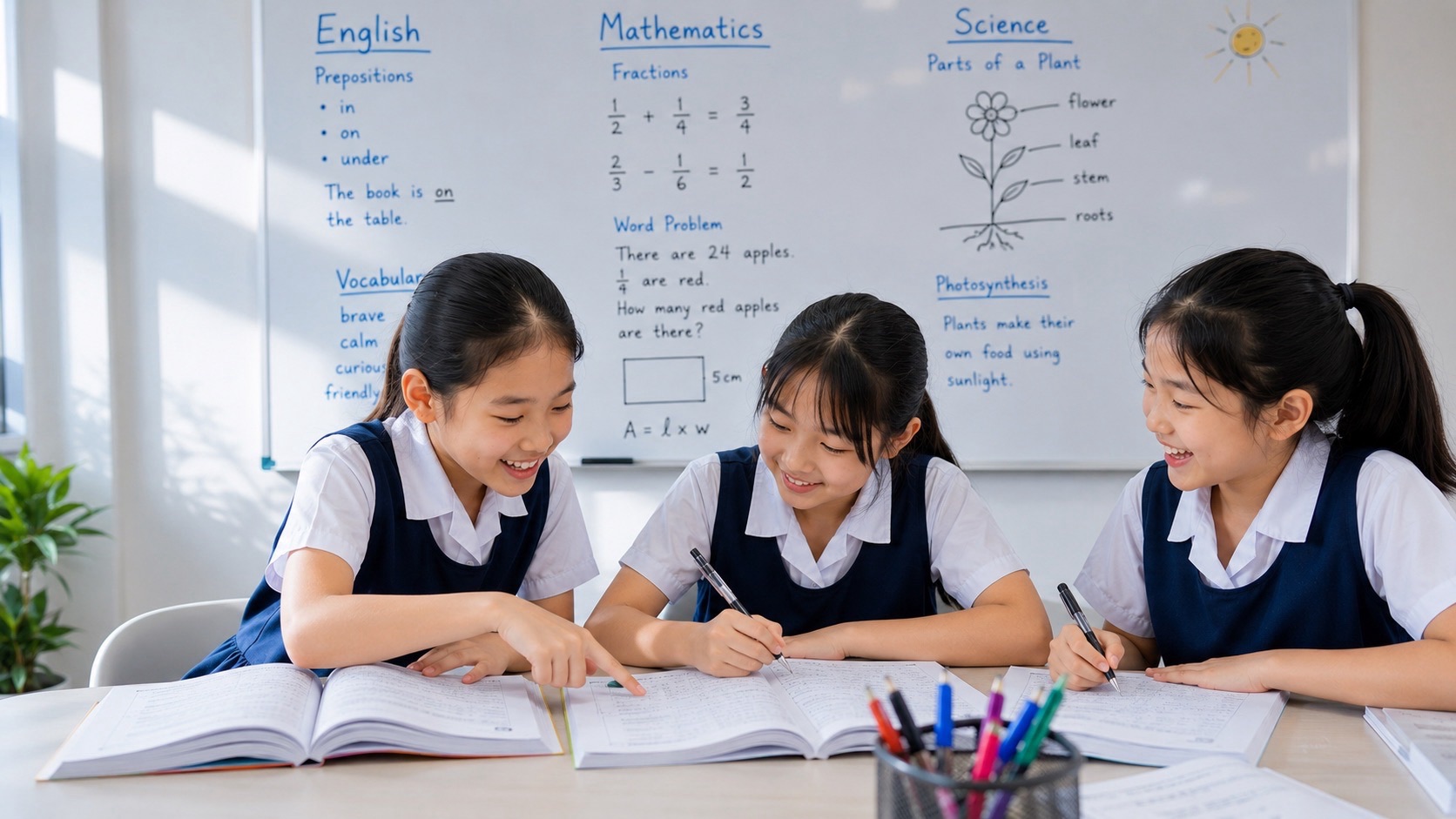
Top 200 words for Year 2 writing
Year 2 is a primary stage on the journey towards IGCSE, not an IGCSE examination year. This independent 200-word bank develops clear sentences and short sequences. Meanings and examples support discussion; some entries are extension choices, not a compulsory spelling list.
1–20: Putting events in order
| No. | Word | Meaning | Example sentence |
|---|---|---|---|
| 1 | beginning | The first part of a story or event. | At the beginning of our story, a parcel arrived at school. |
| 2 | middle | The part between the beginning and the ending. | In the middle of the game, we heard a loud crash. |
| 3 | ending | The final part that brings something to a close. | The story had a happy ending when the friends met again. |
| 4 | sequence | The order in which things happen or are arranged. | We put the four pictures into the correct sequence. |
| 5 | earlier | Before the time being discussed. | Earlier that morning, I had left my coat on the bus. |
| 6 | later | After the time being discussed. | Later, we returned to the playground to collect the ball. |
| 7 | meanwhile | During the same time, somewhere else or doing something else. | Mia painted the roof; meanwhile, Ben cut out the windows. |
| 8 | eventually | In the end, after some time or effort. | Eventually, the children found the missing piece beneath the mat. |
| 9 | suddenly | Quickly and without being expected. | Suddenly, a strong wind lifted the paper from the table. |
| 10 | immediately | At once, without waiting for something else. | We stopped immediately when the teacher raised her hand. |
| 11 | already | Before now or before the time expected. | I had already packed my bag when Dad called me. |
| 12 | still | Continuing at the time being described. | The little bird was still sitting on the garden fence. |
| 13 | until | Up to the time when something happens. | We waited under the shelter until the heavy rain stopped. |
| 14 | during | At some time within an event or period. | During the lesson, we made a map of our classroom. |
| 15 | afterwards | After the event that has just been mentioned. | We finished our pictures and cleaned the brushes afterwards. |
| 16 | finally | After the other events or after a wait. | Finally, the last child crossed the line and everyone cheered. |
| 17 | usually | Most of the time, although there can be exceptions. | We usually read together before the afternoon lesson begins. |
| 18 | rarely | Not very often or on few occasions. | The quiet character rarely spoke unless someone asked a question. |
| 19 | regularly | Repeatedly as part of a routine, or at similar time gaps. | We regularly check the plants to see whether they need water. |
| 20 | recently | Not long before the present time. | Our class recently welcomed a pupil who had moved nearby. |
21–40: More exact action words
| No. | Word | Meaning | Example sentence |
|---|---|---|---|
| 21 | hurry | To move or act faster because time is short. | We had to hurry to reach the hall before the music began. |
| 22 | stroll | To walk in a slow, relaxed way. | We stroll through the garden and stop to look at flowers. |
| 23 | dash | To run or move somewhere very quickly. | The puppy began to dash towards its ball on the grass. |
| 24 | march | To walk with firm, regular steps. | The toy soldiers march across the bridge in our story. |
| 25 | wander | To walk around without following one clear route. | The children wander through the imaginary forest in the play. |
| 26 | creep | To move slowly and quietly, often to avoid attention. | The story’s mouse began to creep past the sleeping cat. |
| 27 | leap | To make a large jump through the air. | The frog can leap from the rock towards the bank. |
| 28 | stumble | To lose your balance briefly while walking or running. | I began to stumble when my loose shoe caught the mat. |
| 29 | tumble | To fall or roll over in an uncontrolled way. | The blocks tumble across the floor when the tower falls. |
| 30 | scramble | To climb or move using your hands and feet. | The character had to scramble over the fallen tree trunk. |
| 31 | stretch | To make your body or part of it reach out. | I stretch my arm to reach the book on the shelf. |
| 32 | bend | To make something curve or move out of a straight shape. | We bend the soft wire carefully to make a round handle. |
| 33 | shake | To move something quickly back and forth. | Please shake the bottle before pouring the paint into the tray. |
| 34 | nod | To move your head down and up to show agreement. | I nod when my partner asks if I am ready. |
| 35 | wave | To move your hand from side to side as a signal. | We wave to our friends as their bus leaves the school. |
| 36 | point | To show a direction or object with your finger. | I point to the doorway so the visitor knows where to go. |
| 37 | drag | To pull something along a surface behind you. | The story’s bear tried to drag the heavy sack home. |
| 38 | spill | To let liquid or small things fall out accidentally. | Be careful not to spill the water onto your drawing. |
| 39 | gather | To bring people or things together in one place. | We gather the scattered pencils before the next lesson starts. |
| 40 | scatter | To spread things in different directions or places. | A gust of wind can scatter dry leaves across the path. |
41–60: Speaking with a purpose
| No. | Word | Meaning | Example sentence |
|---|---|---|---|
| 41 | whisper | To speak quietly with breath rather than a full voice. | I whisper to my partner while the baby sleeps nearby. |
| 42 | shout | To speak or call in a very loud voice. | The coach had to shout across the noisy playing field. |
| 43 | reply | To give an answer to someone. | I waited for my friend to reply to my question. |
| 44 | explain | To make an idea or reason clear to someone. | Please explain how you made the paper boat stay upright. |
| 45 | describe | To say what a person, place or thing is like. | I describe the lost bag so the teacher can recognise it. |
| 46 | invite | To ask someone to join an activity or visit. | We invite the new pupil to join our table game. |
| 47 | suggest | To offer an idea for someone to consider. | I suggest moving the picture closer to the classroom door. |
| 48 | promise | To say firmly that you will do something. | I promise to return the book after I have finished reading. |
| 49 | agree | To share the same view or accept a suggestion. | We agree that everyone should have a turn with the blocks. |
| 50 | refuse | To say that you will not do or accept something. | The character refused to give up, although the puzzle was difficult. |
| 51 | thank | To tell someone you are grateful for something. | I thank my friend for helping me carry the heavy bag. |
| 52 | apologise | To say you are sorry for something you did. | I apologise when I accidentally knock over my partner’s model. |
| 53 | warn | To tell someone about a possible danger or problem. | The sign warns visitors that the path may be slippery. |
| 54 | remind | To help someone remember something they need to do. | Please remind me to bring the library book tomorrow morning. |
| 55 | announce | To tell a group something clearly and publicly. | The teacher will announce which game we are playing next. |
| 56 | question | Something you ask because you want an answer. | My question helped us find out why the bridge had fallen. |
| 57 | message | Information sent or given to another person. | We left a message to explain where the lost coat was. |
| 58 | instruction | A direction telling someone how to do something. | The first instruction tells us to fold the paper in half. |
| 59 | conversation | An exchange in which people talk and listen. | Our conversation gave me an idea for the story’s ending. |
| 60 | secret | Information that is being kept from some people. | In the story, the location of the treasure was a secret. |
61–80: Thinking before writing
| No. | Word | Meaning | Example sentence |
|---|---|---|---|
| 61 | notice | To become aware of something through attention. | I notice a small tear in the corner of the map. |
| 62 | recognise | To know someone or something from seeing it before. | I recognise the red scarf that my neighbour always wears. |
| 63 | remember | To bring something from the past back into your mind. | I remember where we left the basket after our picnic. |
| 64 | forget | To be unable to remember something at that moment. | Sometimes I forget a word and need to describe my idea. |
| 65 | imagine | To form an idea or picture in your mind. | I imagine a tiny house hidden inside the old tree. |
| 66 | wonder | To think about something because you want to know more. | I wonder why the story’s door is painted bright purple. |
| 67 | decide | To choose what you will do after considering it. | We decide to build a wider base for our tower. |
| 68 | plan | To think ahead about what you will do. | I plan my story using three pictures before I write. |
| 69 | guess | To give an answer when you are not certain. | Can you guess which character left the muddy footprints? |
| 70 | discover | To find something out or find something previously hidden. | The children discover a small key inside the folded letter. |
| 71 | understand | To know what something means or how it works. | I understand the instruction after my teacher shows me an example. |
| 72 | believe | To think that something is true. | The character believes the sound came from behind the curtain. |
| 73 | learn | To gain knowledge or develop a skill. | We learn a new word and try it in a sentence. |
| 74 | practise | To repeat an activity so you can improve. | I practise reading my sentence aloud before writing it neatly. |
| 75 | solve | To find an answer to a problem. | Together, we solve the puzzle by checking each clue carefully. |
| 76 | check | To look carefully to see whether something is right. | I check that every picture has the correct label beneath it. |
| 77 | correct | To change a mistake so that something becomes right. | I correct the sentence when I notice a missing word. |
| 78 | compare | To look at things together to find similarities or differences. | We compare the two pictures to find what has changed. |
| 79 | reason | An explanation of why something happens or is done. | My reason for choosing the shelter was the heavy rain. |
| 80 | idea | A thought about something you could do or explain. | My partner’s idea helped us make a stronger paper bridge. |
81–100: Feelings with more detail
| No. | Word | Meaning | Example sentence |
|---|---|---|---|
| 81 | delighted | Very pleased about something that has happened. | I was delighted when my missing notebook was returned to me. |
| 82 | cheerful | Showing a happy and positive mood. | The cheerful visitor smiled and greeted everyone in the room. |
| 83 | gloomy | Feeling sad or without much hope at that moment. | The character looked gloomy after the picnic was cancelled. |
| 84 | upset | Unhappy or worried because something has troubled you. | My friend was upset when her paper model became wet. |
| 85 | nervous | Worried or unsure about something that may happen. | I felt nervous before reading my story to the class. |
| 86 | relieved | Glad because a worry or difficulty has passed. | We were relieved when we found the lost library book. |
| 87 | disappointed | Unhappy because something was less good than you hoped. | I felt disappointed when our team could not finish the model. |
| 88 | curious | Wanting to find out more about something. | The curious child asked what was inside the wooden chest. |
| 89 | hopeful | Thinking that something good may happen. | We were hopeful that the rain would stop before lunchtime. |
| 90 | grateful | Feeling thankful for help or something good. | I was grateful when my friend lent me a dry coat. |
| 91 | confused | Unsure what something means or what you should do. | I felt confused until the teacher explained the game again. |
| 92 | embarrassed | Uncomfortable because you feel awkward or noticed after a mistake. | The character felt embarrassed after walking into the wrong classroom. |
| 93 | comfortable | Feeling physically at ease or relaxed in a situation. | I felt comfortable reading beside my friend in the quiet corner. |
| 94 | uncomfortable | Not feeling physically at ease or relaxed. | The hard chair became uncomfortable during the long wait. |
| 95 | frustrated | Upset because something keeps preventing you from succeeding. | I felt frustrated when the tower fell for the third time. |
| 96 | amazed | Very surprised by something unusual or impressive. | We were amazed when the tiny seedling finally opened a flower. |
| 97 | peaceful | Calm and free from trouble or disturbance. | The garden felt peaceful after the noisy visitors had left. |
| 98 | loneliness | The unhappy feeling of wanting company when you feel alone. | The story shows the rabbit’s loneliness before it makes a friend. |
| 99 | courage | The ability to face difficulty even when you feel afraid. | It took courage to admit that I had made a mistake. |
| 100 | worry | A troubled thought about something that might go wrong. | My worry disappeared when the teacher found my missing bag. |
101–120: Characters and relationships
| No. | Word | Meaning | Example sentence |
|---|---|---|---|
| 101 | honest | Telling the truth and not trying to deceive. | The honest child admitted that she had spilled the paint. |
| 102 | helpful | Giving help that makes something easier. | A helpful classmate showed me where to put the finished work. |
| 103 | thoughtful | Showing care by considering another person’s needs. | It was thoughtful to save a seat for the late visitor. |
| 104 | polite | Showing consideration through respectful words and behaviour. | The polite visitor waited until the speaker had finished talking. |
| 105 | friendly | Showing that you welcome and enjoy other people. | A friendly smile helped the new pupil join the group. |
| 106 | fair | Treating people reasonably without giving unjust advantages. | We made a fair rule so everyone could use the paint. |
| 107 | unfair | Treating someone in a way that is not reasonable. | The rule seemed unfair because only one child could choose. |
| 108 | selfish | Thinking mainly about your own wants rather than others. | The story’s selfish character kept all the crayons for himself. |
| 109 | generous | Willing to give or share more than is expected. | The generous neighbour brought extra paper for our drawing activity. |
| 110 | loyal | Continuing to support someone you care about. | The loyal friend stayed to help after the others went home. |
| 111 | sensible | Showing practical thought about what is useful or safe. | It was sensible to move the books away from the spill. |
| 112 | determined | Firmly wanting to continue towards something despite difficulty. | The determined child tried another way to solve the puzzle. |
| 113 | responsible | Taking proper care of a task or duty. | The responsible helper checked that every book was returned safely. |
| 114 | careless | Not giving enough attention to avoid mistakes or damage. | A careless movement knocked the water across the unfinished painting. |
| 115 | cooperate | To work with others to achieve something together. | We cooperate by taking turns to hold and tape the paper. |
| 116 | include | To make someone or something part of an activity. | We include every classmate when we choose teams for the game. |
| 117 | encourage | To give someone support or confidence to continue. | I encourage my partner when the first attempt does not work. |
| 118 | trust | To believe someone will act honestly or reliably. | I trust my friend to return the book she borrowed. |
| 119 | forgive | To stop blaming someone for a mistake or hurt. | The character learns to forgive his friend after hearing the explanation. |
| 120 | respect | To treat someone or something as deserving consideration. | We respect each speaker by listening to their ideas carefully. |
121–140: Building a setting
| No. | Word | Meaning | Example sentence |
|---|---|---|---|
| 121 | sunlight | The light that comes from the sun. | Sunlight fell through the window and onto the open notebook. |
| 122 | shadow | A dark shape formed when light is blocked. | The tree’s shadow stretched across the path in the evening. |
| 123 | breeze | A light wind that moves gently. | A cool breeze lifted the corner of our picnic blanket. |
| 124 | drizzle | Rain that falls in very small, light drops. | A little drizzle covered the leaves while we walked home. |
| 125 | puddle | A small pool of liquid on the ground. | A puddle formed beneath the leaking pipe beside the gate. |
| 126 | stream | A small natural flow of water across land. | The story’s travellers followed a stream towards the distant village. |
| 127 | meadow | An area of grassland, often containing wild flowers. | The rabbit crossed the meadow and stopped beside a fallen branch. |
| 128 | branch | A part of a tree growing from its trunk. | A small bird landed on the branch above our heads. |
| 129 | root | The part of a plant usually growing into the ground. | A thick root had lifted one corner of the garden path. |
| 130 | pebble | A small stone, often made smooth by water. | I picked a smooth pebble to use in my garden picture. |
| 131 | shelter | A place or covering that gives protection. | We waited under the shelter while the rain fell outside. |
| 132 | entrance | The place where you go into somewhere. | A bright sign stood beside the entrance to the library. |
| 133 | exit | The place where you leave a building or area. | Our teacher showed us the exit before the performance began. |
| 134 | fence | A barrier that marks an edge or separates areas. | The ball stopped beside the fence at the playground’s edge. |
| 135 | roof | The top covering of a building. | Rain tapped softly on the roof of the little shelter. |
| 136 | ceiling | The upper inside surface of a room. | A paper star hung from the ceiling above the reading corner. |
| 137 | staircase | A set of steps connecting different levels. | We walked up the staircase to reach the room above. |
| 138 | journey | An act of travelling from one place to another. | Our journey began at the school gate early that morning. |
| 139 | distance | The amount of space between two places or things. | We measured the distance between the toy house and the bridge. |
| 140 | footstep | The sound a foot makes as someone walks. | One loud footstep made us look towards the doorway. |
141–160: Describing objects accurately
| No. | Word | Meaning | Example sentence |
|---|---|---|---|
| 141 | enormous | Very large in size compared with what is usual. | An enormous box stood beside the classroom’s small wooden door. |
| 142 | miniature | Much smaller than the usual version of something. | We made a miniature garden inside an empty shoe box. |
| 143 | ancient | Very old, especially from a distant time. | The story described an ancient castle on top of the hill. |
| 144 | modern | Belonging to the present or a recent time. | A modern building stood beside the old stone library. |
| 145 | wooden | Made from wood. | The wooden bridge creaked as the story’s travellers crossed it. |
| 146 | metal | A hard material such as iron, copper or aluminium. | The metal spoon made a ringing sound against the empty pot. |
| 147 | plastic | A material that can be shaped into many objects. | The plastic ruler bent slightly when I pressed it gently. |
| 148 | striped | Marked with a pattern of long lines. | The striped umbrella stood out among the plain black ones. |
| 149 | spotted | Marked with small round shapes or patches. | The spotted kitten hid behind the basket near the kitchen. |
| 150 | curved | Shaped with a bend rather than a straight line. | A curved path led from the gate to the garden bench. |
| 151 | pointed | Ending in a sharp or narrow tip. | The pointed paper hat fell from the puppet’s little head. |
| 152 | shiny | Reflecting light from a smooth or polished surface. | A shiny button caught my eye beneath the classroom table. |
| 153 | dull | Not bright or shiny in appearance. | The dull paint made the old toy look rather faded. |
| 154 | sticky | Able to cling to things when touched. | The sticky tape held the paper wings firmly in place. |
| 155 | slippery | Difficult to stand on or hold because things slide. | The wet floor was slippery, so we walked around it. |
| 156 | crumpled | Pressed into an untidy shape with many folds. | A crumpled note lay inside the pocket of the old coat. |
| 157 | broken | Damaged so that it no longer works properly. | We placed the broken toy in a box for an adult to inspect. |
| 158 | fragile | Easy to break or damage. | The fragile paper flower needed careful hands when we moved it. |
| 159 | sturdy | Strong enough to stay firm during use. | A sturdy base helped the tall model remain upright. |
| 160 | colourful | Having many bright or noticeable colours. | The colourful picture made our plain classroom wall look cheerful. |
161–180: Sounds and reactions
| No. | Word | Meaning | Example sentence |
|---|---|---|---|
| 161 | rustle | A soft sound made by things lightly rubbing together. | The rustle of leaves came from the tree beside the path. |
| 162 | rattle | A repeated short sound made by objects knocking together. | We heard a rattle when the loose pencils moved in the box. |
| 163 | creak | A long, rough sound made when something moves under pressure. | The old door gave a creak as it opened slowly. |
| 164 | crash | A loud noise made when things collide or fall. | A crash from the playroom told us the tower had fallen. |
| 165 | bang | A sudden, loud noise. | We heard a bang when the empty box fell onto the floor. |
| 166 | splash | A sound or movement made when something strikes liquid. | A splash rose from the puddle when the ball landed in it. |
| 167 | drip | A small drop of liquid falling or its sound. | A slow drip came from the tap after it was turned off. |
| 168 | trickle | A small, slow flow of liquid. | A trickle of water ran down the side of the pot. |
| 169 | roar | A very loud, deep sound. | The story’s lion gave a roar that echoed through the cave. |
| 170 | chirp | A short, high sound made by some small birds. | A cheerful chirp came from the branch outside our window. |
| 171 | buzz | A low, continuous humming sound. | The buzz of a bee came from the flowers nearby. |
| 172 | hum | A low, steady sound. | The quiet hum of the fan filled the otherwise silent room. |
| 173 | echo | A sound heard again after reflecting from a surface. | The character heard an echo after calling into the cave. |
| 174 | silence | The absence of noticeable sound. | For a moment, silence filled the room after the music stopped. |
| 175 | giggle | A light, repeated laugh. | A giggle escaped when the puppet’s hat slipped over its eyes. |
| 176 | chuckle | A quiet, gentle laugh. | Grandad gave a chuckle when he heard the story’s funny ending. |
| 177 | sigh | A long breath expressing a feeling such as relief. | I gave a sigh when the last puzzle piece fitted. |
| 178 | gasp | A sudden short breath caused by surprise or effort. | The audience gave a gasp when the curtain suddenly opened. |
| 179 | sob | A crying sound with a sudden catching of the breath. | The lost character gave a sob before calling for help. |
| 180 | cheer | A happy shout showing support or approval. | A loud cheer rose when the final runner reached the line. |
181–200: Words for explaining your writing
| No. | Word | Meaning | Example sentence |
|---|---|---|---|
| 181 | character | A person or creature taking part in a story. | My main character is a mouse who wants to find a home. |
| 182 | setting | The place and time in which a story happens. | The setting is a quiet garden on a rainy afternoon. |
| 183 | event | Something that happens, especially in a story or sequence. | The first event is the arrival of a mysterious parcel. |
| 184 | problem | A difficulty that needs an answer or action. | The problem began when the key would not open the door. |
| 185 | solution | An answer or action that deals with a problem. | Our solution was to make the bridge wider at its base. |
| 186 | detail | A small piece of information about something. | One useful detail tells the reader that the coat is soaking wet. |
| 187 | example | Something specific that helps explain a wider idea. | The teacher gave an example of a clear opening sentence. |
| 188 | opinion | What someone thinks or believes about something. | My opinion is that the second ending suits this story better. |
| 189 | fact | Information that is true and can be checked. | We checked the fact by counting the windows in the picture. |
| 190 | cause | Something that makes another thing happen. | The loose wheel was the cause of the toy cart’s wobble. |
| 191 | result | What happens because of an earlier event or action. | The result of moving the base was a much steadier tower. |
| 192 | similar | Alike in some ways, though not necessarily in every way. | The two coats looked similar, but only one had a hood. |
| 193 | different | Not the same in one or more ways. | The pictures were different because one showed an open window. |
| 194 | although | A word joining an idea with a contrasting circumstance. | Although the puzzle was difficult, we kept trying to finish it. |
| 195 | however | A word introducing a contrast with an earlier idea. | The sky was dark. However, the rain had already stopped. |
| 196 | instead | In place of another thing or action. | The paper was wet, so we used a dry sheet instead. |
| 197 | therefore | For the reason just given, leading to a conclusion. | The box was too small; therefore, we chose a larger one. |
| 198 | perhaps | Used when something is possible but you are uncertain. | Perhaps the visitor left the note inside the blue envelope. |
| 199 | also | In addition to something already mentioned. | The bag held a notebook. It also contained a small torch. |
| 200 | otherwise | If the stated action or condition does not happen. | Hold the paper carefully; otherwise, the wind may carry it away. |
Writing workshop: Build stronger Year 2 writing: make instructions work. See a worked example, the reasons for each change and a task to try independently.
What this Year 2 word bank helps a writer do
Year 2 writing becomes more useful when a reader can follow what happened. A child may know many separate words yet write a recount that jumps straight from “We arrived” to “We went home.” The next step is to select the missing action, put events in an understandable order and explain one important change. A well-chosen verb or time word can help the reader follow that movement.
This independent bank includes everyday words, writing vocabulary and a few words to explore with adult support. Use familiar words actively before adding a harder choice. Afterwards, for example, is useful only when the reader knows which event it follows. Relieved is more precise when the story has shown a worry that has now ended. Meaning grows from the situation around the word.
- Build a short sequence with a beginning, a change and an ending.
- Select actions that show what a character actually does.
- Add a feeling when it belongs to the event.
- Use one clear reason or result where it helps the reader.
- Revisit words in new contexts instead of copying the same sentence repeatedly.
Contents and learning routes
- Check the Year 2 curriculum context
- Turn a sequence into writing
- Practise the Fencing Method
- Choose verbs, feelings and joining words
- Try activities with model answers
- Use a flexible routine
- Read the common questions
What assessment requirements apply in Year 2?
Year 2 is part of primary education in the school-year arrangement used by this series. It is not an IGCSE qualification year. Cambridge describes Primary as six stages with flexible starting ages; see its stage guidance. Ask the school which curriculum and English pathway its year label represents.
Cambridge Primary English 0058 develops writing alongside reading and spoken communication. This vocabulary guide supports practice through original activities, but it is not an official list of required words. The school decides its teaching sequence and classroom writing tasks.
Cambridge’s Progression Test guidance identifies Stages 3–6 for those tests. Primary Checkpoint is used at the end of Stage 6. Neither creates a Year 2 IGCSE essay examination. Any school spelling assessment, composition task or writing length should be checked with the child’s teacher.
For practice at home, use a small set of observations: does the writing stay on its subject, does the event order make sense, and can the child explain the words selected? Keep these observations separate from an official mark. A teacher may assess features that this word bank does not cover in full, including handwriting, punctuation, spelling, reading responses and independent planning.
Three events that a reader can follow
Try this plan: a child packs a picnic; rain begins; the family eats under a shelter. The sequence works because the weather changes the plan. It gives the writer a reason to use suddenly, shelter, instead and relieved. The learner does not need all four. One or two well-placed choices can carry the important change.
A possible first attempt is: “We went to the park. It rained. We ate.” It is understandable, but the reader may wonder where the family ate and whether the food got wet. Ask one reader’s question: “How did you keep the picnic dry?” That question gives detail a purpose.
A revised version might be: “We carried our picnic to the park. Suddenly, rain began to fall. We hurried to a shelter and ate there instead.” The revision adds an action and a place that solve the practical problem. The word instead points back to the original plan of eating outside.
Let the ending answer the small problem
An ending such as “It was the best day ever” gives an opinion, but it does not necessarily finish the event. “We shared our sandwiches while the rain tapped on the roof” gives the reader a final scene. Either could be used when it fits, but the scene makes the outcome visible. Ask what the character can do at the end that was difficult in the middle.
If a child adds a new problem in the last sentence, help them decide whether it belongs in this story. “Then we lost the key and saw a dragon” may be an exciting new idea, but it changes the focus. Save it in an idea notebook if it needs its own beginning and development. A short piece can be complete without including every interesting thought.
The Fencing Method: from action to connected writing
The eduKate Fencing Method starts with controlled sentence expansion. Here, the aim is to keep one event clear while adding information the reader needs. Read each version aloud and ask what changed. The method is a teaching routine, not a required examination structure.
- Base action: “Arun walked to the gate.” The sentence establishes the person and destination.
- Precise choice: “Arun hurried to the gate.” The verb now suggests urgency.
- Useful detail: “Arun hurried to the gate with the missing notebook.” The object gives his movement a purpose.
- Feeling or reason: “Arun hurried to the gate with the notebook because his friend was leaving.” The reader can understand the urgency.
- Transfer: “We hurried to gather the paper before it blew away.” The same action word fits a new cause.
Do not combine every detail into one long sentence automatically. Two sentences may be easier to control: “Arun found the missing notebook. He hurried to the gate because his friend was leaving.” The pronoun he clearly refers to Arun, and the discovery now explains what happened before the hurried movement.
A second fence: a feeling that follows an event
Start with “Ella was worried.” Add the cause: “Ella was worried because she could not find her coat.” Then add a change: “Her friend found it under the bench.” The final feeling can now be relieved: “Ella felt relieved when her friend found the coat.” The feeling is supported by the sequence instead of being pasted onto an unrelated sentence.
Transfer the pattern to a different situation: “I was relieved when the last puzzle piece fitted.” Ask what the earlier difficulty was. If there was no worry or difficulty, pleased or delighted may fit better. This conversation helps the child choose between feelings without treating them as interchangeable decorations.
Choosing between words that are close in meaning
Hurry, stroll and wander
All three can describe movement, but they suggest different situations. A person may hurry when a bus is about to leave, stroll when enjoying a garden, or wander when exploring without a fixed route. Act out the movements before writing. Ask what the reader learns from the verb even before a feeling word is added.
A sentence such as “We strolled because we were very late” needs an explanation if it is intentional. Perhaps the characters have misunderstood the time, or perhaps they have given up. Without that context, hurried probably fits better. Encourage the child to notice the whole meaning rather than substitute a supposedly advanced synonym.
Whisper, shout and announce
Whisper and shout mainly tell us about volume or manner. Announce tells us about publicly giving information. A teacher can announce something in an ordinary voice. A frightened character might shout a warning. Let the situation guide the choice, and avoid assuming every line of dialogue needs a new speaking verb.
Said is still useful. It allows the words spoken to carry the meaning. If the child writes a direct quotation, follow the punctuation approach being taught in school. Vocabulary practice can also use reported speech: “The teacher announced that the game was starting.” That avoids introducing quotation punctuation before the learner is ready to manage it.
Fact and opinion
A fact can be checked against a reliable record or the situation described. An opinion tells us someone’s view. Looking at a drawing, “There are three windows” can be checked by counting. “The house looks cheerful” expresses an impression. Ask the child what detail created that impression: perhaps bright curtains or flowers at the entrance.
This distinction does not make opinions unimportant. A review needs a response, but the response becomes more useful when it has a reason. “I enjoyed the ending because the character finally helped her friend” connects a view to an event. Avoid presenting personal preference as something everyone must share.
Joining ideas without losing control
Because gives a reason: “We moved the picture because the wall was wet.” So gives a result: “The wall was wet, so we moved the picture.” Read both and ask the child to point to the cause and the action. They communicate a similar relationship from different starting points.
Although introduces a contrast: “Although the paper tore, we finished the model.” It is useful when a difficulty did not prevent the outcome. However can introduce a contrasting new sentence: “The first bridge fell. However, the second bridge stayed upright.” These are optional extension choices. Clear sentences joined with familiar words are a sound starting point.
Do not add a linking word to every sentence. “Lina found a key. It was hidden inside the envelope” already has a clear connection. The second sentence develops the object named in the first. Forcing therefore into that relationship would suggest a conclusion that the sentence does not actually make.
Six practice tasks and model responses
1. Restore the sequence
Give these events in mixed order: the child finds a dry cloth; paint spills; the child wipes the table; the child opens the paint. One sensible order is opening the paint, spilling it, finding a cloth and wiping the table. A model is: “I opened the paint and accidentally spilled some. Then I found a dry cloth and wiped the table.” Discuss why the cloth must appear before the wiping.
2. Select the sound
Prompt: “The leaves made a ___ as the wind moved them.” From rustle, crash and roar, rustle usually suits gently moving leaves. A model is “The leaves made a soft rustle above our heads.” Ask what would need to change for crash to fit: perhaps a branch has fallen. This makes the word choice depend on evidence from the imagined event.
3. Show a feeling through its cause
Prompt: a child is about to read a story to a new group. A possible answer is “I felt nervous while I waited for my turn.” Another is “I felt excited because I wanted to share my ending.” Both may fit. Ask the learner to continue consistently. There is no need to label a child nervous simply because the activity is unfamiliar.
4. Repair an unclear joining word
Original: “The bottle was empty, however I filled it.” A clearer everyday version is “The bottle was empty, so I filled it.” The second action is a response to the first condition. However would suit a contrast, such as “The bottle looked empty. However, a little water remained at the bottom.” Have the child explain the relationship before choosing punctuation.
5. Add a reason to an opinion
Prompt: “I liked the character because ___.” A model is “I liked the character because she included the new pupil in the game.” The answer gives a specific action. “Because she was good” is possible but less informative. Ask what good means in this particular story and choose the action that shows it.
6. Transfer a word into another text type
Practise careless in a story: “A careless movement spilled the water.” Change the form while keeping the meaning: “He moved carelessly and spilled the water.” Now give an instruction to prevent the spill: “Carry the full cup carefully with both hands.” Explain that careless becomes carelessly, while careful becomes carefully. The instruction changes both the word form and the intended behaviour.
A practical routine for a growing writer
Pick a theme that fits current reading or a shared experience. A trip, a game or a classroom project gives the writer something concrete to recall. Select three useful words and discuss why they fit. These are practice choices, not an examination quota. If only one word improves the writing, keep the one that works.
On the first session, say and act out the words. On another day, write a short sequence. Later, return to the same words in a changed setting: a missing notebook becomes a missing train ticket in an invented story, or a collapsed block tower becomes a torn paper bridge. Changing context reveals whether the learner understands the word or remembers only one sentence.
During review, ask the child to choose one sentence they want to improve. Offer a focused question: “Where did it happen?” “Why did she hurry?” or “What happened after the spill?” Do not correct every feature simultaneously. You can note a spelling to revisit separately while the current task remains the sequence of ideas.
Keep independence visible
Use a small note beside the work: independent, discussed first, adult-scribed, or copied from a model. All four can have a place in learning, but they show different things. If a child succeeds with a word card, try the word again later without the card. Compare the meaning and control rather than just counting the words written.
When a learner is stuck, offer two choices instead of supplying a whole paragraph. “Did the character whisper or shout?” opens a decision. “Which event happened before that?” opens a plan. Leave room for the child’s answer to differ from your own if it makes sense in the story they are trying to tell.
Build stronger Year 2 writing: make instructions work
An effective instruction allows somebody else to do something. This gives a Year 2 writer a practical way to test vocabulary: does gather tell the reader what to collect, does compare make the next action clear, and does until explain when to stop? Clear directions develop control of sequence, word choice and the reader’s needs. The lesson below is original eduKate practice guidance, with no official mark or grade attached.
The Cambridge Primary English overview includes communication for different purposes and audiences. Its programme guide describes discussion as a way to plan Stage 2 writing. Try the activity aloud before asking the learner to record directions.
A worked task: teach a partner a matching game
Prepare six picture cards: three pairs of matching pictures. The practice rules are that two players take turns, turn over two cards on each turn, keep a matching pair and turn an unmatched pair face down again. The game ends when all three pairs have been found. The player with more pairs wins. Ask the learner to write directions for somebody who has never played this version.
Initial attempt: “Get some cards. Turn them over and get pairs. It is fun. You win.” The writer knows the game, but the reader does not yet know the number of cards, the turn-taking rule or how to win.
Improved instructions:
Gather six picture cards with three matching pairs. Mix them, then spread them face down on the table. Take turns to turn over two cards. Compare the pictures. Keep the cards if they match. Otherwise, turn them face down again. Continue until all three pairs have been found. Finally, count your pairs. The player with more pairs wins.
The revision gives the reader information at the point where it is needed. The equipment comes first, followed by the setup, actions, possible outcomes and ending. Compare asks the players to look for a match. Otherwise introduces what to do when the pictures do not match. Until supplies the stopping condition. These words carry meaning; they are not added to make the directions sound impressive.
The sentence “It is fun” could belong in an invitation or review, but it does not explain a rule. Remove it from these directions if it interrupts the instructions. A writer learns something useful by noticing that a perfectly grammatical sentence can still be unnecessary for a particular task.
Test the model by doing exactly what it says
Give the instructions to a partner. Let the partner follow the words while the writer watches. Where the partner hesitates, ask which information is missing. Avoid immediately supplying the missing rule orally: first give the writer a chance to improve the written instruction.
This is a reader test, not a trick. If the partner already knows the game, ask them to show where each rule appears in the writing. Check especially that “turn over two cards” refers to one player’s turn, and that unmatched cards go back face down. An adult can read the directions aloud if decoding would otherwise prevent the partner from testing the meaning.
Use natural word combinations to make actions exact
- Gather the cards tells the reader to collect the equipment. Scatter the cards would describe spreading them out; it is a different action.
- Compare the pictures tells the reader what to examine together. “Compare them” works only when the relevant objects are already clear.
- Check that the pictures match identifies what the player needs to confirm. “Check carefully” still leaves the reader wondering what to check.
- Explain the rule to a partner names both the information and its listener. “Explain your partner” has a different, usually unintended meaning.
Ask the learner to choose a phrase before building the whole sentence. Then change the context: gather the materials for art, compare two drawings, or check that a lid is closed. The exact objects change while the action remains understandable. This is more revealing than repeating the same game sentence several times.
Use Fencing to add missing conditions, then shorten
Start with “Turn over the cards.” Ask “How many?” and revise to “Turn over two cards.” Ask “When?” and add “on your turn”. The new sentence, “Turn over two cards on your turn,” contains information the player actually needs.
Now consider “Quickly turn over two lovely colourful cards very fast on your turn.” The directions have not established a speed rule, and lovely adds a personal judgement. Remove those additions. Colourful matters only if colour identifies a particular kind of card in the rules. Fencing should end with a sentence that serves the game accurately, even when the best version is shorter.
Keep the two outcomes separate while learning: “If the pictures match, keep the cards. If they do not match, turn them face down.” A confident learner can replace the second opening with otherwise. The more compact version is useful only when the child understands the choice it expresses.
Four barriers that can hide behind good spelling
The writer recounts instead of instructing. “I turned over two cards and found a pair” tells what happened in one game. “Turn over two cards” directs the next player. Ask what the reader is supposed to do after reading the sentence, then choose the form that fits the task.
The order assumes knowledge the reader does not have. “Count your pairs. Gather the cards” puts the ending before the setup. Arrange brief action notes before drafting: prepare, take turns, check, finish. The final instructions can use numbered steps or short sentences; their order should follow the activity.
A joining word gives the wrong relationship. “If the pictures match, keep them. Afterwards, turn them face down” wrongly suggests that kept pairs must be returned. Otherwise introduces the different outcome for cards that do not match. Ask the learner to demonstrate both situations before choosing the word.
The directions never explain when to stop. “Keep playing” is incomplete guidance for a new player. Add the stopping condition: “Continue until all three pairs have been found.” Then explain how the result is decided. An ending should answer the reader’s final practical question.
An independent transfer task that exposes memorised answers
Change the game to eight cards containing four matching pairs. Keep the other rules. Ask the learner to change only the directions that must change. Do not leave the first model visible while the learner explains the new version aloud.
Three changes are needed. Begin with eight cards and four pairs. Continue until all four pairs have been found. Allow for a draw, because two players could finish with two pairs each. A possible ending is: “The player with more pairs wins. If both players have the same number of pairs, the game is a draw.” This final rule is a new decision required by the changed game, not a more advanced synonym.
For a smaller transfer, change the pictures to matching shapes while keeping six cards. The learner should alter the relevant noun without accidentally changing the number of pairs. Both versions check whether the child can preserve some information while revising another part.
Use feedback that leads to an independent repair
Use this eduKate practice check: can the reader begin, follow each action, choose the correct outcome and recognise the end? Ask the child to underline the sentence that answers each question. Missing evidence identifies the next revision; it does not create a numerical examination score.
For support, supply picture cards showing the main actions and let the learner dictate one instruction for each. For extension, ask the learner to design a different small game and test the directions with a partner. Keep the rule changes manageable. The achievement is explaining a new process clearly enough for another person to use it.
Return to the 200-word list · Explore the Year 1–13 guides.
Year 2 essay vocabulary questions
Does this mean a Year 2 child should write formal essays?
No. This stage builds the foundations of extended writing through recounts, short stories, descriptions, instructions and simple opinions with reasons. The immediate aim is a message that a reader can follow. The link to later essay writing is the ability to organise and connect ideas, not the early use of an adult essay template.
Are the harder joining words compulsory?
No. Words such as although, however and therefore can be introduced when they solve a real communication problem. A learner who uses and, but, because and so accurately may be doing useful work. Do not replace familiar words merely to make the page look more advanced.
Should every story contain a problem and a solution?
That pattern is a helpful practice choice, not the only form writing can take. A description may focus on a place; a recount may record a meaningful event without a dramatic problem. Choose the structure that suits the task. The examples here use small problems because they make changes, actions and feelings easy to discuss.
How can we tell whether a word is becoming usable?
Ask the child to explain it, choose between it and a nearby alternative, and use it in a new sentence. A learner who can do those things with suitable support is showing more than simple recognition. Note where help was needed and revisit that part. Avoid turning one successful answer into a claim of permanent mastery.
What if a child writes very little but speaks confidently?
Let the child speak the sequence first and record their ideas as brief notes or pictures. Choose a small section for independent writing. Discuss handwriting, spelling and other support needs with the teacher if these regularly prevent the learner from showing what they can compose. The next task should be manageable enough to preserve a clear message.
Sources and a next step
The official pages below were checked in November 2026. The vocabulary selection, stories and practice answers are original teaching material. Consult the school for its current assessment arrangements and for the English curriculum followed by the learner.
- Cambridge Primary English 0058
- Cambridge Primary stages and ages
- Cambridge Primary Progression Tests
- Cambridge Primary Checkpoint
- The Fencing Method for Vocabulary
Choose a small event the child remembers clearly. Tell it in order, select one word that makes the action more exact, and read the result to someone who was not there. Their question will often reveal the most useful detail to add next.
Explore the Year 1–13 vocabulary series
Choose the guide that matches the writing you are learning. Earlier guides can help consolidate a skill; later guides show how it develops. School year labels and course arrangements can differ.
Primary foundations: Year 1 essay vocabulary · Year 2 (this guide) · Year 3 essay vocabulary · Year 4 essay vocabulary · Year 5 essay vocabulary · Year 6 essay vocabulary
Lower secondary preparation: Year 7 essay vocabulary · Year 8 essay vocabulary · Year 9 essay vocabulary
IGCSE stage: Year 10 essay vocabulary · Year 11 essay vocabulary
Pre-university study after IGCSE: Year 12 essay vocabulary · Year 13 essay vocabulary