
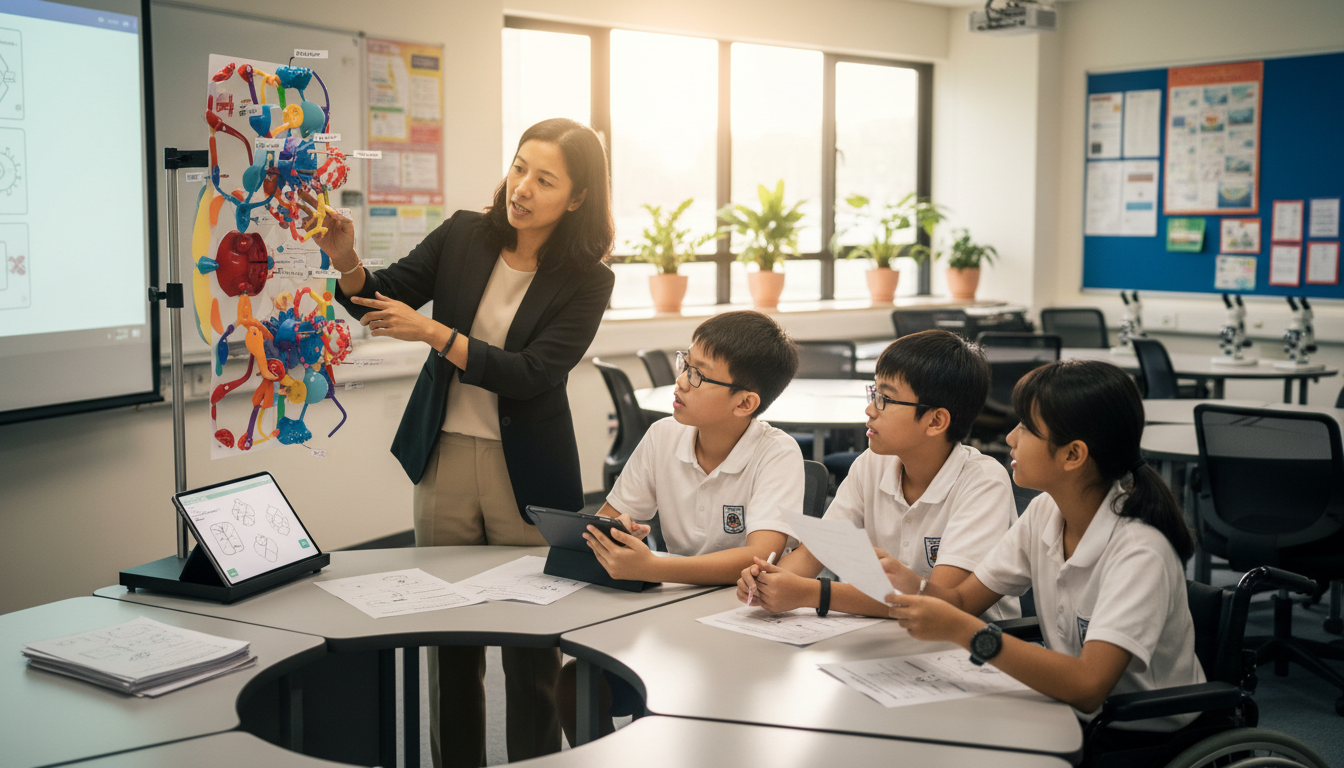
A Primary 3 child can remember Science facts yet still choose the wrong answer when the same idea appears in a picture, table or unfamiliar question. In Singapore’s MOE P3 Science syllabus, children learn living and non-living things, material properties, life cycles and magnets. Their Science learning also involves observing, comparing, classifying and communicating. If the child loses marks on evidence-based questions, the first move is to check whether they read the labels, arrows and question words accurately before deciding that they have forgotten the topic.
Parents can practise this skill without teaching the whole PSLE syllabus early. Use one current school worksheet and ask: “What does the picture or table actually show? What are you being asked to find? What can you conclude—and what cannot you conclude?” Teach your child to separate observations from guesses, especially when the data are incomplete. There is no national SEAB examination in Primary 3, and the teacher’s school-based expectations should guide the difficulty and format of home practice.
- First: read the question command word and highlight the object or comparison being asked about.
- Second: inspect the diagram title, stage arrows, pole labels or table headings.
- Third: state the observation without adding unsupported facts.
- Fourth: use an appropriate P3 Science rule to explain the answer.
- Finally: verify that a P3 school result does not become an assumed PSLE AL or future secondary-school allocation.
For a ten-minute diagnostic, give the child one life-cycle diagram, one list of material-test results and one magnet picture. Let them explain the evidence aloud before writing. If they understand the Science rule but miss a heading or arrow, spend time on representation skills; if they interpret the evidence correctly but cannot explain why, teach the scientific reason.
What MOE actually wants pupils to develop
The MOE Primary Three to Six Science syllabus sets out P3 topics and a wider approach that develops scientific practices as well as knowledge. Being able to communicate observations, compare cases and base conclusions on evidence matters. Schools may use simple diagrams, observation records, questions and practical activities to support this. That does not mean every child must master a standard national P3 graph paper or any commercial workbook’s format.
At this level, parents should distinguish the official curriculum from a school’s specific assessment. MOE specifies the learning outcomes. A school chooses how and when pupils are asked to demonstrate understanding through written tasks and classroom activities. There is no separate national P3 Science examination managed by SEAB.
The three kinds of evidence that Primary 3 children commonly read
1. A picture or drawing
An image may show two magnets, familiar animals, plants at different stages or objects made of different materials. The child must recognise what is labelled, what is shown and what is missing. A picture does not automatically reveal information that is not visible. For example, a shiny object could be made from different materials.
2. A sequence or life-cycle diagram
Arrows show the order of stages. A child who always reads clockwise may be wrong if the arrow points the opposite way. Ask which organism is shown, which direction the stages follow and what changes between two stages. The drawing sizes may not be to scale.
3. A simple observation table
A table might record which materials absorbed water or which objects were attracted to a magnet. Ask the child to read headings and rows aloud. In a table containing “object”, “material” and “result”, the object name is not the observed result. The answer must come from the correct column.
Read the command word before the science content
- Identify: name or choose the object, property or stage.
- State: provide the requested fact or observed result.
- Compare: explain a relevant similarity or difference between two cases.
- Describe: say what the drawing or table shows.
- Predict: use a known rule to say what is likely to happen.
- Explain: give a reason tied to the observation and scientific idea.
- Suggest: offer a relevant, reasonable idea if the question allows more than one possibility.
Children frequently give the right fact but fail to answer the wording. If the instruction says “State one difference”, a list of three facts about the first organism is not a comparison. If it says “What was observed?”, a lengthy explanation of what ought to happen may not replace the requested result. Teach task-reading explicitly.
Worked example 1: a materials test table
Imagine a teacher places equal small drops of water on clean Sample A and Sample B. The recorded result says A absorbed the water; B did not absorb it in the test. The question asks which sample would be more suitable to protect a book from water. A reasonable answer is B, because the observation suggests that B resists absorbing water. The child should not claim that B will work in every rainstorm or that all materials looking like B behave identically.
What went wrong if the child chose A?
Check whether they confused absorption with waterproofness, misread the columns, or thought a material that absorbs water is best at keeping a book dry. The corrective exercise differs depending on which mistake occurred.
Worked example 2: a life-cycle sequence
A question shows an egg, a caterpillar, a pupa and an adult butterfly, but the drawings are arranged around a page with arrows that do not follow the child’s preferred direction. The right answer follows the arrow sequence, regardless of where the pictures happen to be placed. Ask the child to draw a numbered sequence first, then answer the stage question.
What went wrong if the child skipped the pupa?
They may have memorised the familiar picture but not the actual stages; alternatively, they may have followed the wrong arrow. Use a new illustration to find out which issue is present. Do not simply label the answer “careless”.
Worked example 3: two magnetic poles
Picture one bar magnet with N at its right end and another with N at its left end. Their two N poles face one another. If asked to predict the interaction, the correct response is repulsion because like poles repel. The problem is not which side of a page is left or right; it is the pole labels at the ends that face.
What went wrong if the child wrote “attract”?
Perhaps they assumed all magnets attract, or read the far-end S labels instead of the facing N labels. Ask the child to circle the ends actually closest together and say the rule aloud.
Worked example 4: “Can we conclude that all metal objects are magnetic?”
Suppose a short table shows an iron nail and a steel paper clip attracted to a magnet. Can we conclude all metal objects are attracted? No. The evidence covers only the objects tested. Teaching a child to say “the data are insufficient” is part of responsible Science reasoning and protects against a common overgeneralisation.
Worked example 5: describing an observation versus making an inference
A photo shows a seedling taller on Day 8 than on Day 1. Observation: the seedling is taller in the later picture. Inference: the plant has grown between the recorded dates. The child must know which part is directly visible and which part is a conclusion based on the observations. Do not pretend the pictures prove everything about the plant’s unseen conditions.
The twelve-second evidence check
- Locate the title: Which experiment, animal or property is this about?
- Locate the labels: Which pole, material or life-cycle stage is named?
- Locate the comparison: What two items, time points or samples are being compared?
- Look for a restriction: “not”, “except”, “only”, “one” or “two”.
- Say the observation without guessing a hidden cause.
- Write only the conclusion supported by the observation.
This quick sequence becomes useful when a child worries about timing. It focuses attention on the question rather than teaching them to rush. Practise first in untimed activities; if time pressure is a major problem, ask the teacher about the school’s age-appropriate arrangements.
How Science English can interfere with table reading
Words such as before, after, greater than, less than, both, neither, absorbed, repelled, compared can change a Science answer completely. A child whose home language differs from classroom English may understand the concept but misinterpret the instruction. Use oral discussion, pictures and a small set of useful Science-English words to bridge that gap. The goal is not to punish the child for needing a clearer phrase.
For more targeted language support, parents can consult eduKate’s P3 Science process-skills vocabulary and P3 Science answer explanation guide. Select only the vocabulary that appears in the current school lesson.
A four-week plan to improve picture and table questions
Week 1: learn to read the evidence
Choose two familiar pictures from schoolwork and ask the child to describe only what is visibly shown. Then use a three-column table and practise reading each heading. Do not ask for sophisticated causal explanations yet.
Week 2: connect evidence to the taught rule
Use a material-property observation or magnet diagram. Ask first what happened, then which P3 rule applies, then what conclusion follows. If the child offers a guess not supported by the evidence, ask what extra test would be needed.
Week 3: practise new arrangements
Rotate a life-cycle diagram or reverse the order of table columns. Keep the Science difficulty unchanged so the child is learning to read different representations, not dealing with an entirely new topic.
Week 4: combine short tasks
Give a mixed practice of one picture, one table, one life-cycle sequence and one magnet explanation. Have the child perform the evidence check independently, then review no more than two mistakes in depth.
How to tell whether the child has improved
The improvement target is not only a higher mark. Look for the child independently pointing to the correct column, following a diagram arrow, distinguishing observation from inference and selecting a relevant Science idea. Ask them to explain what the evidence does not show. That ability reduces guessing and supports later investigations.
If results remain weak, ask whether the child can read the question accurately aloud, whether the scientific concept is understood, and whether the writing captures the explanation. A simple error log can separate question meaning, diagram reading, concept and expression. Each category suggests a different next lesson.
How a P3 school assessment fits the PSLE timeline
Primary 3 Science tests are administered by individual schools. The PSLE is a later national examination in Primary 6, and the overall PSLE Score combines the Achievement Levels of four subjects. A child in P3 during 2026 would ordinarily sit PSLE in 2029 and enter Secondary 1 in 2030. A P3 picture-question percentage cannot be reliably converted into the eventual Science AL or school posting.
For the 2026 S1 system, score totals 4–20 generally aligned with PG3, 21–22 with a PG2/PG3 option, 23–24 with PG2, 25 with a PG1/PG2 option, and 26–30 with PG1 where the published conditions applied. These are dated background bands, not guaranteed 2029 rules. Posting Groups concern entry; G1, G2 and G3 describe subject levels under Full Subject-Based Banding. Read MOE S1 Posting in the child’s actual P6 year.
Researching suitable secondary schools in your estate
When upper-primary school choice becomes relevant, start with the family’s realistic transport area. For example, Queenstown and Clementi parents might investigate Queenstown Secondary, New Town Secondary and Clementi Town Secondary; Sengkang and Punggol parents might investigate Seng Kang Secondary, Compassvale Secondary, Punggol Secondary and Greendale Secondary; northern families could consider investigating Yishun Town Secondary, Ahmad Ibrahim Secondary and Orchid Park Secondary. These examples are not verified future score matches, programme promises or guaranteed offers.
- Use MOE SchoolFinder to confirm each school’s current name, programmes and location.
- Check the child’s actual PSLE overall score and eligibility in the application year.
- Compare the relevant past-cohort score ranges but do not treat them as guarantees.
- Test daily travel time, after-CCA returns and child independence.
- Include learning support and school culture alongside academic ambitions.
- Make a balanced six-choice list based on official rules and actual circumstances, not a P3 assessment guess.
Is extra Science tuition necessary for evidence-reading mistakes?
Not necessarily. When a child needs only practice reading headings and arrows, short guided work with parents and teacher feedback can be enough. Tuition may help if concepts and representation skills remain unstable or if the child cannot express a reason. Ask whether a tutor uses actual school-level examples, diagnoses the cause and tests transfer to an unfamiliar diagram. eduKate’s P3 three-student Science tutorial guide offers a way to evaluate that approach.
Frequently asked questions
Are tables and graphs a separate national P3 Science paper?
No. The syllabus develops inquiry and communication, but there is no national SEAB P3 Science examination. Schools determine the format of their assessments.
Should I teach my child complex graph calculations now?
Focus on the current P3 concepts and the simple representations the school uses. More advanced graph analysis comes with later learning.
What if my child answers correctly only when the diagram is familiar?
Change the order or layout while keeping the same concept. If performance collapses, revisit how the child reads the evidence instead of repeating the same memorised picture.
Why is “not enough information” sometimes correct?
A scientific conclusion cannot be stronger than the evidence provided. One tested object cannot prove a universal rule about all objects.
Will my child’s P3 diagram score decide secondary school?
No. Later placement depends on the actual PSLE result, eligibility and school-choice process for that year.