
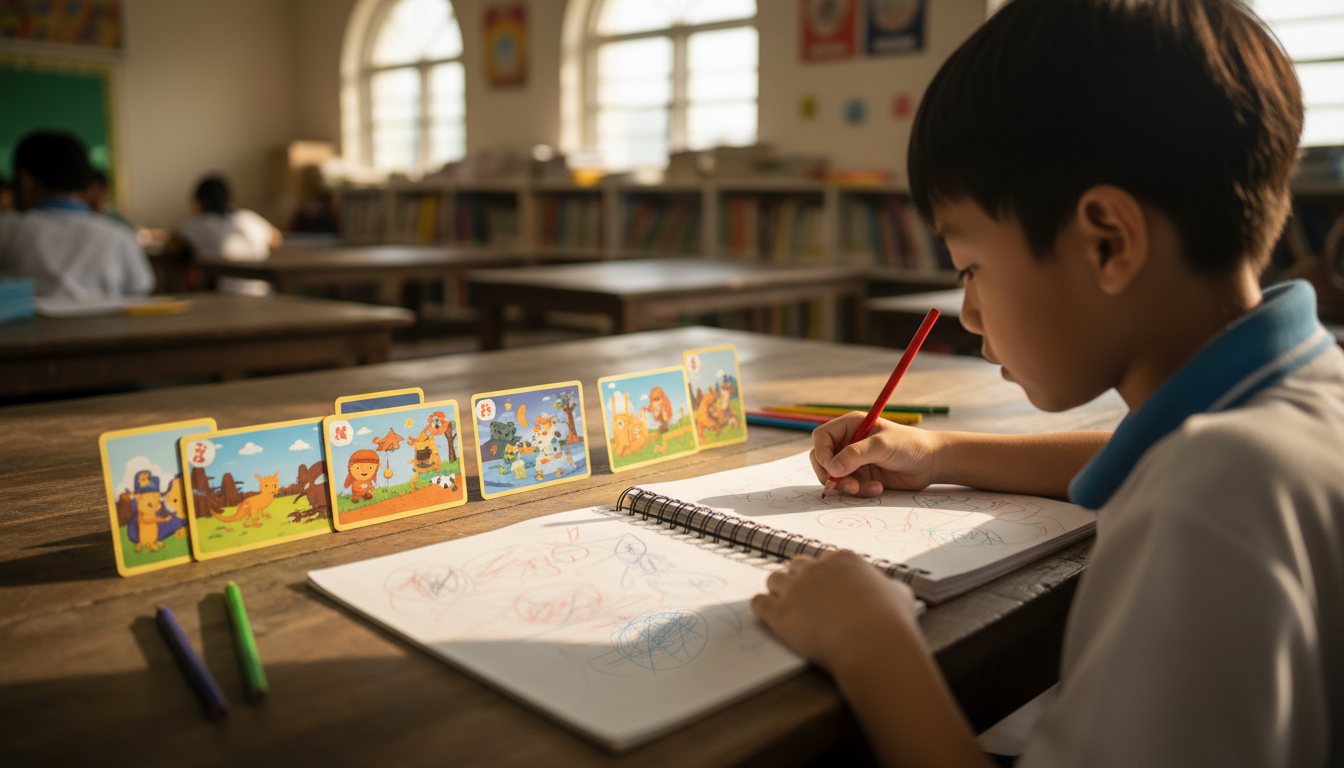
bank · bark · light · watch · park · bat · right · left · change · ring. Theme: Common Words with Different Meanings in Primary 2 English. A word can be perfectly familiar yet mean something different in a new sentence. The clues around it tell us which meaning fits.
This original Primary 2 Top 1000 Vocabulary companion explores 20 common written words in two contexts each, creating 40 worked meaning questions. Each example gives a short sentence, the correct sense and clues that help a child select it. Some items extend beyond the main teaching list. These examples are independently curated vocabulary practice, not official MOE–SEAB prescribed words or a national Primary 2 examination paper.
- Read: use the whole sentence rather than the isolated word.
- Find: identify clues such as ‘time’ near watch or ‘tree’ near bark.
- Choose: explain which meaning matches the surrounding words.
- Compare: say how the same written word changes meaning.
- Transfer: create one new sentence for each meaning.
A child who knows only one sense of a word may be confused by the second. Rather than marking it wrong immediately, draw a quick picture of each meaning and explain how the context points to the correct one.
It is enough to practise two or three words in one sitting. Where an example is unfamiliar, teach it as an enrichment word without turning it into a spelling or memorisation requirement.
The complete four-part Primary 2 Top 1000 Vocabulary library
- People and Feelings (1–250)
- Action Verbs and Everyday Life (251–500)
- Singapore Places and Nature (501–750)
- Reading Clues and Comprehension (751–1000)
The main four articles contain 1,000 distinct teaching headwords. This article teaches alternate meanings of common words through original sentences and does not imply an official P2 1,000-word syllabus.
How to work out meaning from context
- Clue 1 — topic: money words may signal one meaning of bank; a stream signals another.
- Clue 2 — action: look at what a person does with the word, as in ‘park a car’.
- Clue 3 — nearby nouns: ‘tree bark’ differs from ‘dog bark’.
- Clue 4 — what makes sense: test the meaning in the sentence and reject anything impossible.
- Clue 5 — reread: check the sentence again after selecting a meaning.
40 meaning-in-context questions with answers
Every two questions below use the same written word in two different sentences. Read each before revealing the meaning. The ‘clue’ points towards a detail that supports the answer, not a word to memorise by itself.
bank: two meanings, questions 1–2
- Question 1. Sentence A: Mum put her savings into a bank account. What does bank mean here? Answer: A place or business that keeps money safe. Clue: savings and account.
- Question 2. Sentence B: The family sat on the grassy bank beside the stream. What does bank mean here? Answer: The land at the edge of a river or stream. Clue: grassy and stream.
Speak and write: Ask your child to tell you how the meaning of bank changed from Sentence A to Sentence B. Let the child invent a new accurate sentence for one meaning.
bark: two meanings, questions 3–4
- Question 3. Sentence A: The dog’s loud bark surprised the children. What does bark mean here? Answer: The sound made by a dog. Clue: dog’s and loud.
- Question 4. Sentence B: The bark on the tree trunk felt rough. What does bark mean here? Answer: The outer covering of a tree. Clue: tree trunk and rough.
Speak and write: Ask your child to tell you how the meaning of bark changed from Sentence A to Sentence B. Let the child invent a new accurate sentence for one meaning.
light: two meanings, questions 5–6
- Question 5. Sentence A: The torch gave us light when the room was dark. What does light mean here? Answer: Brightness that helps us see. Clue: torch and dark.
- Question 6. Sentence B: Mira carried a light schoolbag to class. What does light mean here? Answer: Not heavy. Clue: carried and schoolbag.
Speak and write: Ask your child to tell you how the meaning of light changed from Sentence A to Sentence B. Let the child invent a new accurate sentence for one meaning.
watch: two meanings, questions 7–8
- Question 7. Sentence A: I looked at my watch to check the time. What does watch mean here? Answer: A small device worn on the wrist that shows the time. Clue: check the time.
- Question 8. Sentence B: We watched the birds from a safe distance. What does watch mean here? Answer: Looked carefully at an event or creature. Clue: birds and safe distance.
Speak and write: Ask your child to tell you how the meaning of watch changed from Sentence A to Sentence B. Let the child invent a new accurate sentence for one meaning.
park: two meanings, questions 9–10
- Question 9. Sentence A: The children played under tall trees in the park. What does park mean here? Answer: An open public place for recreation. Clue: played and tall trees.
- Question 10. Sentence B: Dad found a space to park the car. What does park mean here? Answer: To leave a vehicle in an allowed stopping place. Clue: car and space.
Speak and write: Ask your child to tell you how the meaning of park changed from Sentence A to Sentence B. Let the child invent a new accurate sentence for one meaning.
bat: two meanings, questions 11–12
- Question 11. Sentence A: He used a bat to hit the ball in the game. What does bat mean here? Answer: An object used to hit a ball in some sports. Clue: hit the ball.
- Question 12. Sentence B: The bat flew out of its shelter after sunset. What does bat mean here? Answer: A flying mammal. Clue: flew and sunset.
Speak and write: Ask your child to tell you how the meaning of bat changed from Sentence A to Sentence B. Let the child invent a new accurate sentence for one meaning.
right: two meanings, questions 13–14
- Question 13. Sentence A: Jia gave the right answer to the question. What does right mean here? Answer: Correct or accurate. Clue: answer and question.
- Question 14. Sentence B: Turn right at the next corridor junction. What does right mean here? Answer: The direction opposite left. Clue: turn and junction.
Speak and write: Ask your child to tell you how the meaning of right changed from Sentence A to Sentence B. Let the child invent a new accurate sentence for one meaning.
left: two meanings, questions 15–16
- Question 15. Sentence A: The library is on the left side of the corridor. What does left mean here? Answer: The direction opposite right. Clue: side and corridor.
- Question 16. Sentence B: Sam left the classroom after the bell. What does left mean here? Answer: Went away from a place. Clue: classroom and after the bell.
Speak and write: Ask your child to tell you how the meaning of left changed from Sentence A to Sentence B. Let the child invent a new accurate sentence for one meaning.
change: two meanings, questions 17–18
- Question 17. Sentence A: The cashier gave me change after I paid for the snack. What does change mean here? Answer: Money returned after paying more than the price. Clue: cashier and paid.
- Question 18. Sentence B: We had to change the plan because it rained. What does change mean here? Answer: Make something different. Clue: plan and rained.
Speak and write: Ask your child to tell you how the meaning of change changed from Sentence A to Sentence B. Let the child invent a new accurate sentence for one meaning.
note: two meanings, questions 19–20
- Question 19. Sentence A: The teacher wrote a short note for my parent. What does note mean here? Answer: A brief written message. Clue: wrote and parent.
- Question 20. Sentence B: The pianist played one high note on the keyboard. What does note mean here? Answer: A single musical sound. Clue: pianist and keyboard.
Speak and write: Ask your child to tell you how the meaning of note changed from Sentence A to Sentence B. Let the child invent a new accurate sentence for one meaning.
match: two meanings, questions 21–22
- Question 21. Sentence A: Our class won the football match. What does match mean here? Answer: A sports contest. Clue: won and football.
- Question 22. Sentence B: Please match each animal picture with its name. What does match mean here? Answer: To pair things that belong together. Clue: picture and name.
Speak and write: Ask your child to tell you how the meaning of match changed from Sentence A to Sentence B. Let the child invent a new accurate sentence for one meaning.
wave: two meanings, questions 23–24
- Question 23. Sentence A: We waved goodbye when our friends boarded the bus. What does wave mean here? Answer: Moved a hand to greet or say farewell. Clue: goodbye and friends.
- Question 24. Sentence B: A large wave rolled towards the beach. What does wave mean here? Answer: A moving rise of water in the sea. Clue: beach and water.
Speak and write: Ask your child to tell you how the meaning of wave changed from Sentence A to Sentence B. Let the child invent a new accurate sentence for one meaning.
fan: two meanings, questions 25–26
- Question 25. Sentence A: The ceiling fan kept the classroom cool. What does fan mean here? Answer: A machine that moves air. Clue: ceiling and cool.
- Question 26. Sentence B: Lina is a fan of her school’s football team. What does fan mean here? Answer: A person who enjoys and supports someone or something. Clue: football team and supports.
Speak and write: Ask your child to tell you how the meaning of fan changed from Sentence A to Sentence B. Let the child invent a new accurate sentence for one meaning.
kind: two meanings, questions 27–28
- Question 27. Sentence A: The kind pupil helped a classmate find his book. What does kind mean here? Answer: Caring and helpful. Clue: helped and classmate.
- Question 28. Sentence B: Which kind of fruit would you like to eat? What does kind mean here? Answer: A type or sort. Clue: of fruit and which.
Speak and write: Ask your child to tell you how the meaning of kind changed from Sentence A to Sentence B. Let the child invent a new accurate sentence for one meaning.
ring: two meanings, questions 29–30
- Question 29. Sentence A: The phone began to ring during the lesson. What does ring mean here? Answer: Make a clear repeated sound. Clue: phone and sound.
- Question 30. Sentence B: Mum wore a silver ring on her finger. What does ring mean here? Answer: A circular piece of jewellery. Clue: silver and finger.
Speak and write: Ask your child to tell you how the meaning of ring changed from Sentence A to Sentence B. Let the child invent a new accurate sentence for one meaning.
drop: two meanings, questions 31–32
- Question 31. Sentence A: Do not drop the glass cup on the floor. What does drop mean here? Answer: Let something fall. Clue: glass cup and floor.
- Question 32. Sentence B: One drop of rain landed on my hand. What does drop mean here? Answer: A tiny amount of liquid. Clue: rain and hand.
Speak and write: Ask your child to tell you how the meaning of drop changed from Sentence A to Sentence B. Let the child invent a new accurate sentence for one meaning.
clip: two meanings, questions 33–34
- Question 33. Sentence A: Zara used a clip to keep her hair tidy. What does clip mean here? Answer: A small fastener that holds something in place. Clue: hair and tidy.
- Question 34. Sentence B: We watched a short clip about butterflies. What does clip mean here? Answer: A short section of video. Clue: watched and butterflies.
Speak and write: Ask your child to tell you how the meaning of clip changed from Sentence A to Sentence B. Let the child invent a new accurate sentence for one meaning.
jam: two meanings, questions 35–36
- Question 35. Sentence A: The toast tasted sweet with strawberry jam. What does jam mean here? Answer: A thick sweet spread made from fruit. Clue: strawberry and toast.
- Question 36. Sentence B: A traffic jam made the cars move slowly. What does jam mean here? Answer: A crowd of vehicles causing slow traffic. Clue: traffic and cars.
Speak and write: Ask your child to tell you how the meaning of jam changed from Sentence A to Sentence B. Let the child invent a new accurate sentence for one meaning.
train: two meanings, questions 37–38
- Question 37. Sentence A: The train arrived at the MRT station. What does train mean here? Answer: A vehicle that travels on railway tracks. Clue: MRT station.
- Question 38. Sentence B: The coach will train the pupils for the relay. What does train mean here? Answer: Help people practise and develop a skill. Clue: coach and relay.
Speak and write: Ask your child to tell you how the meaning of train changed from Sentence A to Sentence B. Let the child invent a new accurate sentence for one meaning.
line: two meanings, questions 39–40
- Question 39. Sentence A: Please join the line and wait for your turn. What does line mean here? Answer: A row of people waiting. Clue: wait and turn.
- Question 40. Sentence B: Draw a straight line under the title. What does line mean here? Answer: A long narrow mark. Clue: draw and under the title.
Speak and write: Ask your child to tell you how the meaning of line changed from Sentence A to Sentence B. Let the child invent a new accurate sentence for one meaning.
Five reading traps to avoid
- Choosing the first meaning learned: a child may use ‘money bank’ whenever the word bank appears.
- Ignoring the noun beside it: tree and dog change the meaning of bark.
- Forcing both meanings together: a timepiece does not automatically mean watching someone.
- Confusing similar-looking words: their and there are different written words, not two meanings of the same spelling.
- Inventing a new meaning: test whether it fits the full sentence.
Original four-sentence comprehension mini-story
At the park, Mei sat on a bench and looked at her watch. The football match would begin soon. She heard a dog bark and turned her head. Then she moved to the right side of the field to join her friends.
Four questions: What is park here? An open public area. What is watch here? A device showing time. What does match mean? A football contest. What does right mean? A direction, not whether an answer is correct. Each meaning is identified from the surrounding words.
An easy seven-day family plan
- Day 1: practise bank and bark with simple drawings.
- Day 2: practise light and watch in oral sentences.
- Day 3: discuss park, bat and right in context.
- Day 4: create two sentences for match and wave.
- Day 5: read the sample mini-story and explain four meanings.
- Day 6: write one new sentence for two difficult words.
- Day 7: revisit meanings the child still confuses.
When a child reads the word correctly but understands the wrong meaning
This is not necessarily a decoding problem. Ask the child to explain the whole sentence, identify the key topic and choose the meaning that fits. If a second meaning is unfamiliar, teach it with a picture, an object or a real example before returning to the text.
Parents should not assume a Primary 2 learner is required to master every sense in a dictionary. Choose the meanings that occur in their school reading, familiar stories and everyday situations, and seek teacher feedback when comprehension difficulties persist.
Singapore English syllabus and assessment context
The MOE Primary English Language Syllabus 2020 emphasises vocabulary meaning and how words are used in context. MOE removed weighted assessments and examinations for Primary 1 and 2, while SEAB’s PSLE is the national examination taken at the end of primary schooling. The forty examples here are independent teaching practice and are not an official test or prescribed word bank.
Questions parents often ask
Does a word have only two meanings?
No. Some words have many senses. Two familiar contexts are a good starting point for young learners.
Are multiple-meaning words the same as homophones?
Not exactly. Multiple-meaning words share a written form, while homophones are words that sound alike but may have different spellings, such as right and write. Both require attention to context.
Should my child memorise dictionary definitions?
No. A short child-friendly explanation and two accurate example sentences are often a better start.
More Primary 2 English vocabulary practice
- 40 Synonym and Antonym Context Choices
- 40 Context-Clue Vocabulary Cloze Questions
- 40 Practical Text Questions
- eduKateSG Vocabulary Hub
Explore eduKateSG Primary 2 English tuition for guided reading, comprehension and vocabulary transfer in small-group lessons where additional feedback is helpful.