
Small Group Tutorials
Here to help students catch up, keep up, and move ahead. Book a consultation here.
Project Type: English
-

Vocabulary OS | Experiments and Research on Vocabulary | Tokens and Compressions
The article explores the nature of vocabulary, arguing that it should be viewed not merely as a collection of words, but as a complex system enabling communication. Using the word "I" as a case study, it highlights how context and receiver knowledge shape meaning, revealing vocabulary's role as a representational and routing mechanism that allows…
-

Primary 4 English Tuition Hougang & Serangoon | The Connected World Series #04 — HIDDEN STRUCTURE
The content discusses the evolution of learning in English comprehension from Primary 1 to Primary 4, emphasizing the importance of inference due to hidden structures in text. Learners must deduce relationships and emotional states through behavioral clues, reconstructing meaning beyond explicit details. Ultimately, they are encouraged to connect evidence for stronger comprehension, paving the way…
-

Primary 5 English Tuition Hougang & Serangoon | The Connected World Series #05 — ROUTING
In Primary 5, learners enhance their communication skills by focusing on adaptation and routing messages effectively based on the audience and purpose. They must consider the destination, necessary information, and appropriate tone, transitioning from merely conveying information to shaping it for specific contexts. This development emphasizes the importance of audience awareness in writing.
-

Primary 6 English Tuition Hougang & Serangoon | The Connected World Series #06 — NETWORK CONTROL
The Problem Is No Longer One Route By Primary 6, the English learner is handling a very different problem. Earlier in the Connected World series, we could isolate one dominant operation at a time. P1 — REPRESENT × NODEMake something available to language. P2 — TRANSMIT × FLOWMove meaning successfully. P3 — RELATE × PATHKeep…
-

Secondary 1 English Tuition Hougang & Serangoon | The Connected World Series #07 — POSITION
The transition from Primary 6 to Secondary 1 emphasizes the importance of positioning in language comprehension. Learners must differentiate between perspectives and understand that different positions influence representations of the same event. This critical skill allows for deeper analysis of language and communication, leading to a more nuanced interpretation of meanings and relationships.
-
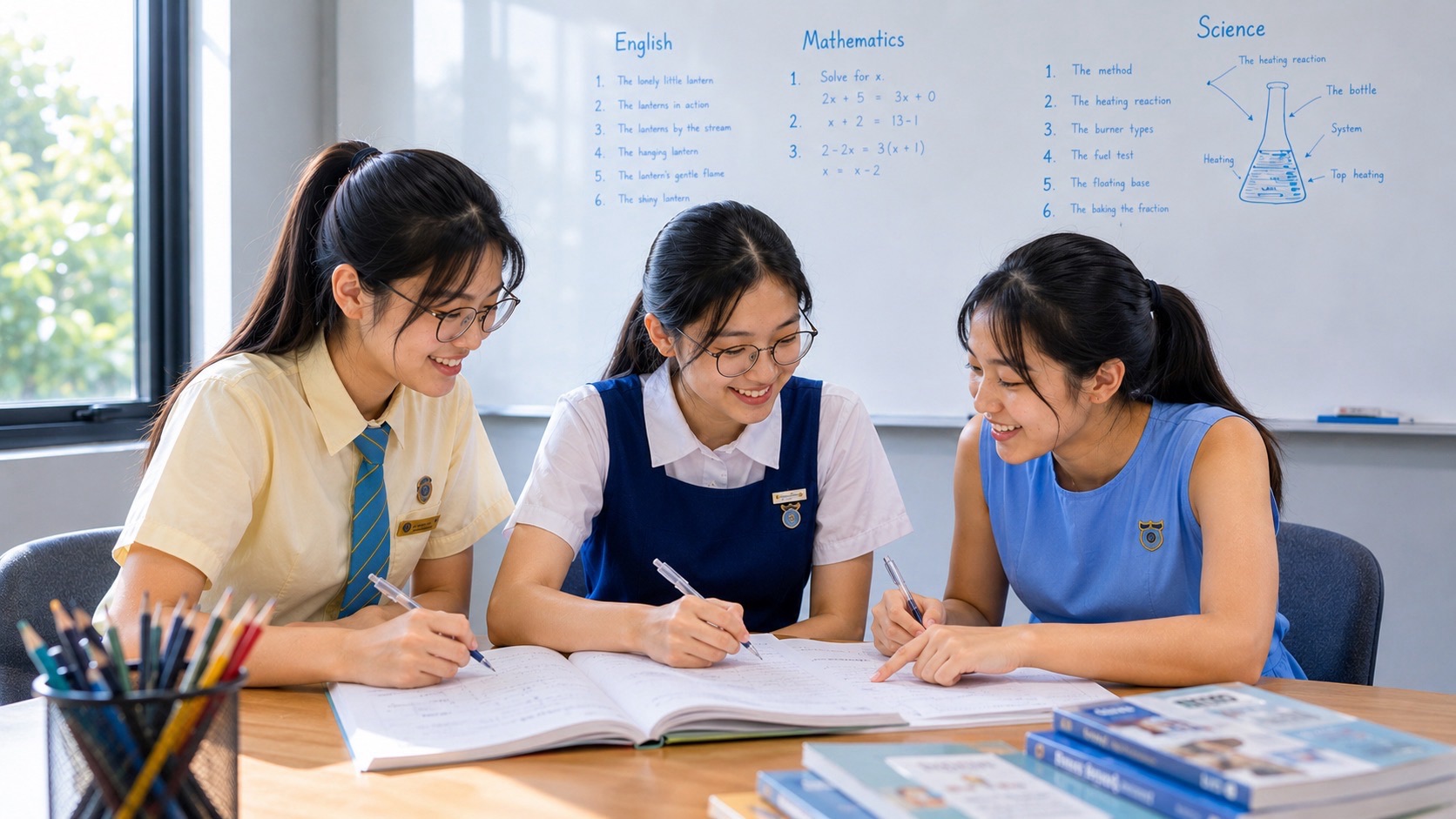
Secondary 2 English Tuition Hougang & Serangoon | The Connected World Series #08 — WEIGHTED PATHFINDING
The content discusses the transition in learning from Secondary 1 to Secondary 2, emphasizing the shift from mere recognition of multiple interpretations to the necessity of evaluating and selecting the most robust ones. Students must compare evidence, prioritize information, and accept ambiguity, leading to more complex cognitive processes in interpretation and comprehension.
-

Secondary 4 English Tuition Hougang & Serangoon | The Connected World Series #10 — REDESIGN
The content emphasizes the importance of critical evaluation and revision in Secondary 4 English learning. Learners are encouraged to step back from their writing, assess its structure, and redesign their arguments for clarity and strength. This involves deeper analysis, recognizing weaknesses, and ensuring precision, ultimately transforming the learner's role from creator to evaluator of their…
-

Secondary 3 English Tuition Hougang & Serangoon | The Connected World Series #09 — RECONFIGURATION
The content discusses the challenges faced by learners in adapting their interpretations and models when new evidence emerges. At Secondary 3, students must update their understanding while managing multiple viewpoints and complexities. Updating involves recognizing contradictions and reconfiguring models based on new information, ultimately leading to deeper comprehension and stronger reasoning skills.
-
Primary 3 English Tuition Hougang & Serangoon | The Connected World Series #03 — PATH
In Primary 3, learners must manage interconnected information in English, progressing from understanding single ideas to maintaining coherent paths of meaning. This involves skills like recognizing relationships, sequencing events, and comprehending cause and effect. As learners navigate language structures, they grow more adept at inference and relational continuity, enhancing their overall comprehension.
-

Primary 2 English Tuition Hougang & Serangoon | The Connected World Series #02 — FLOW
The content discusses the evolution of language understanding in a child's education, particularly from Primary 1 to Primary 2. It emphasizes the importance of transmitting meaning effectively, where a child's ability to communicate goes beyond mere vocabulary. Meaning must flow between minds, ensuring the receiver comprehends the intended message, instilling skills for clearer communication.
-

Primary 1 English Tuition Hougang & Serangoon | The Connected World Series #01 — NODE
The content emphasizes the foundational role of representation in Primary 1 English learning. It explains how children move from recognizing objects to expressing them with language. Vocabulary is crucial for creating usable nodes and enhancing communication. The teaching objective focuses on reliable representation, paving the way for complex skills in future grades.
-
English Tuition Tampines & Pasir Ris | The Living World P1–Secondary 4 Developmental Spine
The development of English from Primary 1 to Secondary 4 involves progressing from basic representation to sophisticated evaluation. Key operations include representing experiences, transmitting meaning, relating information, inferring hidden meanings, adapting communication, integrating skills, differentiating variations, selecting relevant details, updating representations, and finally, evaluating and revising ideas.
English by eduKateSG is a language learning, communication and education branch that helps students, parents, tutors and readers understand how English works for school, life, society and the future. This project explains English not only as grammar, vocabulary, comprehension, composition, oral communication or examination skills, but as a powerful system for meaning, memory, reasoning, expression, understanding, trust and action.
Across the English articles, eduKateSG explores how students learn English, why some students struggle, how vocabulary affects comprehension, how grammar supports meaning, how writing becomes clearer, and how speaking and listening shape real communication. English is not only about knowing more words or avoiding mistakes. It is about whether a student can understand what is being said, express what they mean, read between lines, organise ideas, respond appropriately and communicate with confidence.
This branch includes English tuition, English learning systems, FENCE™ English Learning System, VocabularyOS, EnglishOS, comprehension skills, writing skills, vocabulary growth, loaded words, loaded sentences, Trojan sentences, versioning, communication repair and the deeper meaning behind everyday language. It explains why a sentence may look simple but carry hidden emotional, cultural or personal meaning. Two people can use the same English words but receive different versions of the message because their memories, assumptions and contexts are different.
The English project also studies English as a recorder of lived experience. Words can preserve what people saw, felt, learned, remembered or understood, but language also compresses reality. A sentence can never fully carry the whole experience behind it. This is why careful English matters. When words are vague, overloaded, badly framed or misunderstood, communication can break down. When English is precise, it helps people think clearly, repair misunderstanding and build trust.
This project also connects English to the age of AI. English is increasingly used to guide search engines, digital tools, prompts, summaries, automation and artificial intelligence. Strong English is no longer only useful for school examinations; it also helps students ask better questions, give clearer instructions, compare information, detect weak meanings, understand AI-generated text and use language responsibly in a fast-changing world.
As part of eduKateSG’s wider EducationOS, EnglishOS, VocabularyOS, CultureOS, SocietyOS and CivilisationOS framework, the English branch treats language as one of the main systems for learning and human cooperation. English carries knowledge, memory, emotion, instruction, identity, reasoning and opportunity. When students improve in English, they gain more than marks; they gain a stronger command of meaning and a clearer way to understand the world.
English by eduKateSG is a long-form knowledge branch for students, parents, tutors and educators who want to understand English learning, English tuition, vocabulary, grammar, comprehension, writing, communication, meaning repair, AI-age language skills and why English remains one of the most important tools for education, society and the future.
English by eduKateSG explores English tuition, vocabulary, grammar, comprehension, writing, FENCE™ English, EnglishOS, communication, meaning repair, AI-age language and learning.