
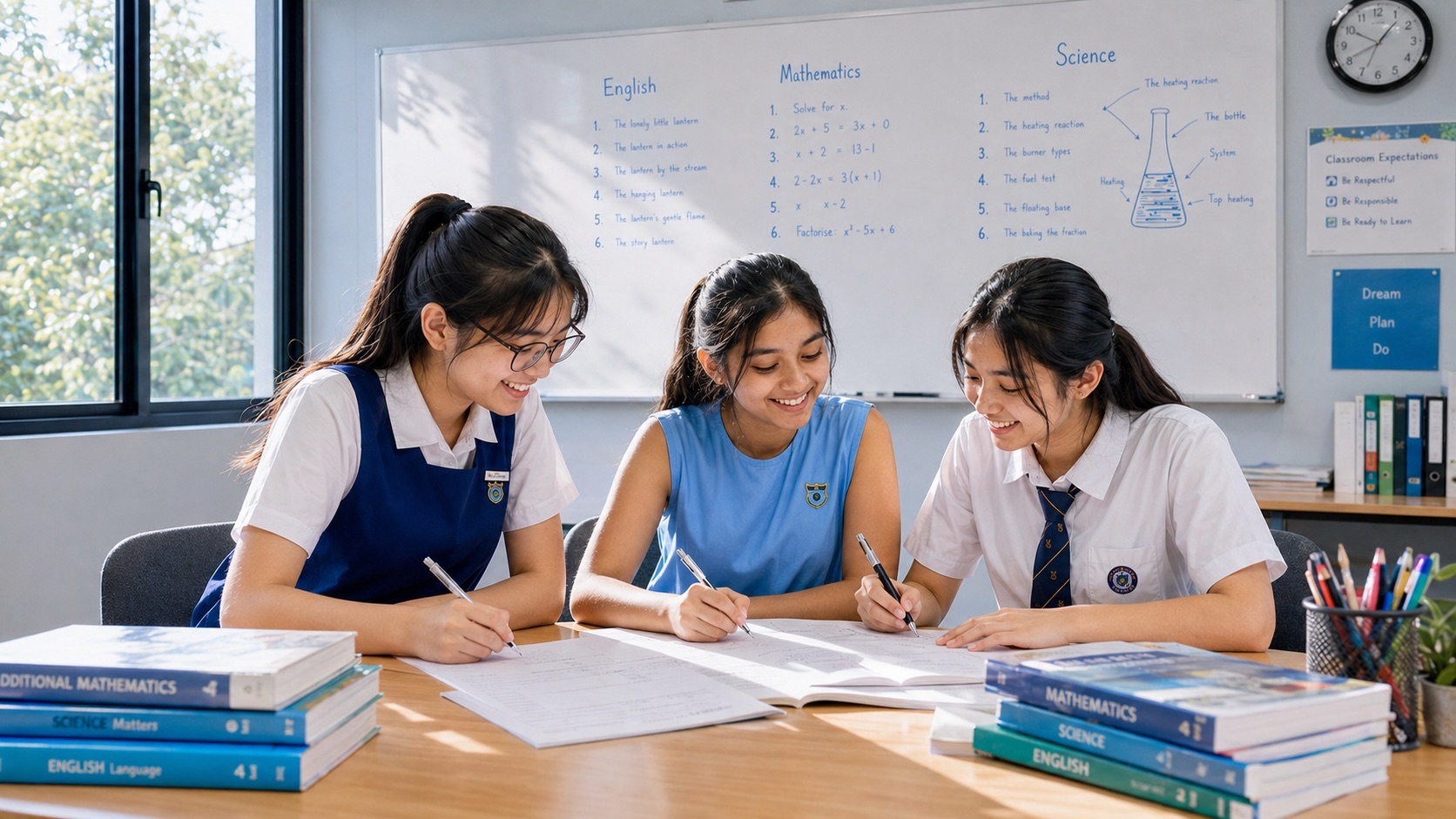
Science in Bukit Timah should help a learner do more than recognise familiar answers. From Primary Science and PSLE Science to Secondary Biology, Chemistry, Physics and JC study, the important progression is from noticing a phenomenon to explaining it, testing the explanation and using it in an unfamiliar situation. This guide shows parents and students how to make that progression visible, with worked examples rather than a larger collection of things to memorise.
Families looking for Bukit Timah Science learning, PSLE Science revision, Secondary Science support or help with open-ended questions often face the same puzzle: a child knows the notes but cannot explain a new experiment. The missing step may be a scientific concept, a misunderstood variable, a misread graph, an incomplete causal explanation or difficulty expressing a sound idea. These are different problems. More practice helps only when the practice addresses the one that is actually present.
This Primary-to-JC Science guide for Bukit Timah families connects scientific knowledge, experiments, data interpretation, explanation, examination preparation and everyday observation. It also distinguishes the revised 2026 PSLE Science formats from the Secondary Education Certificate routes beginning in 2027. Start with your child’s current task and course, not a general label such as “weak at Science”. The aim is a learner who can increasingly decide what the evidence means without waiting for an adult to supply the answer.
Start here: the 50-second Science check
Place one recent Science answer beside the question. Can the student tell you what changed, what was observed, which scientific idea applies and how that idea connects the change to the observation? Listen before correcting. A missing fact, a missing connection and a missing sentence are not the same thing. The next lesson should be chosen from what the attempt reveals.
Route 1: “We need stronger foundations.”
Begin with meaning before answers, then use the materials, heat and water and living systems examples. Look for a small concept the learner can explain and apply, not an entire chapter to repeat.
Route 2: “The notes make sense, but the answers lose marks.”
Use scientific language and building a complete explanation. Ask whether the student named the actual objects, quantities and conditions in this question rather than writing a true but unrelated sentence.
Route 3: “Experiments, graphs and tables are confusing.”
Go to variables and fair comparisons, measurement and tables and graphs. The key is to follow the chain from the physical setup to the recorded number and then to the conclusion.
Route 4: “An examination or school transition is approaching.”
Check the current course and examination, then use the Secondary-to-JC progression and the diagnostic tasks. Match practice to the actual course, subject level and examination year.
Route 5: “We do not know what support to add or remove.”
Read the three learner cases, the six-week plan and the family support decisions. A useful intervention has a specific purpose and a way to tell when it is no longer needed.
Open the complete reading map
1. Current courses and examinations
2. Meaning before answers
3. Scientific language
4. Observations and models
5. Matter and materials
6. Heat and water
7. Light and shadows
8. Plants and living systems
9. Electrical circuits
10. Forces and energy
11. Habitats and local observation
12. Variables and comparisons
13. Measurement and uncertainty
14. Tables, graphs and rates
15. Complete explanations
16. Practical work
17. Secondary, international and JC study
18. Original diagnostic tasks
19. Alicia, Tricia and Kai Kai
20. A six-week learning plan
21. Family and teaching decisions
22. Questions and next resources
23. Sources and verification
How to use the examples: all unnamed classroom situations, data sets and learner dialogues in this guide are original teaching illustrations. They are not records of real pupils, field measurements, official examination questions or SEAB marking schemes. Alicia, Tricia and Kai Kai are hypothetical learners. Suggested answers explain the reasoning; a school’s assessment instructions may require a different amount of detail.
1. Start with the correct course, not an old worksheet label
Before deciding that a learner is behind, check what the learner is actually expected to study. Write down the school year, Science course, examination year and relevant syllabus or subject code. Keep the school’s current topic sequence beside that information. This takes less time than working through an unsuitable practice paper and discovering afterwards that the paper belongs to a different route.
For Primary families, a useful distinction is between early scientific exploration and the formal Primary Science course. The MOE Primary curriculum resources provide the official syllabus route. At Primary 1 and 2, this guide uses observation, comparison, everyday measurement and explanation as preparation; it does not present those years as a separate formal PSLE Science syllabus. Once formal Science begins in Primary 3, follow the school’s sequence rather than assuming every school teaches every topic in the same month.
The revised PSLE Science formats from 2026
SEAB’s 2026 PSLE examination-format page lists revised Science formats. For Standard Science 0009, Booklet A has 30 multiple-choice questions worth 60 marks; Booklet B has 10–11 structured questions worth 40 marks. The total duration is 1 hour 45 minutes. Use these current figures when selecting a simulation paper instead of carrying forward an older paper split.
Foundation Science 0039 is a different route: 20 multiple-choice questions contribute 40 marks, and 9–11 short-response and structured questions contribute 30 marks. Its duration is 1 hour 15 minutes. A word list is provided, but it is not exhaustive. The different structure and requirements are a reason to match resources carefully, not a reason to make judgments about a child’s potential.
The practical consequence is straightforward. A family should not ask only whether a paper looks challenging. Ask whether it tests the right course and provides useful evidence about the student. A difficult but mismatched paper may create anxiety without identifying a teachable problem. A well-matched short task can reveal much more.
Secondary Science: the cohort and subject combination matter
According to SEAB’s SEC guidance, the Singapore-Cambridge Secondary Education Certificate begins with the 2027 graduating cohort, with subjects taken at the relevant G1, G2 or G3 levels. The certificate change should not be read as a general reduction in examination standards. A 2026 candidate and a 2027 candidate therefore need resources checked against their own examination year, not a mixture of labels.
“G3 Science” is not a synonym for “three pure sciences”. The G3 syllabus list includes pure Physics K323, Chemistry K324 and Biology K325, as well as combined Science routes K326, K327 and K328. The G2 list includes combinations K223, K224 and K225. These lists establish subject specifications; they do not establish what an individual school offers or whether a particular student is eligible to take it.
Keep pathway advice separate from diagnosis. A student can be strong at interpreting experiments and weak at calculations within the same course. Another can remember detailed Biology but struggle to explain a graph. The course sets the destination and boundaries. The student’s work tells us what needs teaching next.
A one-page course record
A useful record contains the exact course title, its current syllabus link, the school topic list, practical requirements where applicable, and the dates of school assessments. Add one recent independent piece of work. Do not fill the page with predicted grades or comparisons with classmates. Its purpose is to prevent avoidable confusion: wrong paper, wrong topic order, wrong calculator assumption, wrong practical expectation or wrong examination year.
For international or pre-university routes, apply the same rule. “IGCSE Science”, “IB Science” and “JC Science” are not interchangeable specifications. Confirm the exact subject and level through the school and awarding organisation. This guide develops shared reasoning habits; it does not substitute one course’s assessment rules for another’s.
2. A scientific answer needs a connection, not just a fact
Imagine a student looking at droplets on the outside of a sealed cold bottle. The student writes, “Water can change state.” That sentence is true, but it has not yet explained the droplets. It names a broad concept without identifying the water’s source, the surface involved or the change that occurred. This is a common place for Science learning to stall: the student can retrieve a relevant sentence but has not learned to connect it to this event.
A more useful explanation begins by separating the objects. There is cold liquid inside the bottle. There is the bottle wall. There is surrounding air containing water vapour. There are liquid droplets outside. Once those are distinct, the learner can ask which material changed and where. The bottle being sealed is important because it weakens the suggestion that liquid simply escaped through the opening. The explanation is built from relationships, not from the number of keywords inserted.
In this guide, use a simple four-part teaching check: the situation, the relevant idea, the connection and the result. It is not a compulsory answer formula. Some questions require only an observation or a name. But when a question asks for an explanation, the check helps reveal whether the answer has stopped halfway.
Take a different example. A paper bridge bends when a load is added. “Gravity acts on it” may be relevant, but it does not explain why one bridge design bends less than another under the same load. The comparison requires information about both designs and the way the investigation was arranged. The learner must notice which question is being asked: why something happens at all, or why two outcomes differ. Those questions can require different evidence.
Recognition, explanation and prediction are different achievements
Recognition says, “I have seen this before.” Explanation says, “I can connect the relevant cause and effect.” Prediction says, “I can use that connection when something changes.” A lesson can produce the first without producing the other two. The teacher’s explanation feels familiar; the student’s independent prediction reveals whether the relationship was actually learned.
Try this with a familiar classroom example. Show a diagram of two identical cups containing water at different temperatures. Ask which way energy transfers when the cups’ contents are mixed, then change one quantity in the description. Now ask what can still be concluded and what additional information is needed. A learner who says only “hot to cold” may know the direction but not the limits of what the diagram tells them about the final temperature.
This distinction is helpful for parents because it explains why understanding a worked answer after marking is not the end of revision. The next step is a fresh question with the same underlying relationship and a changed surface. Otherwise, we have checked memory of the explanation rather than the ability to use it.
A small test is often better than a global label
Suppose Alicia gets a heat-transfer question wrong. Before assigning a whole topic, ask her to identify which object started warmer, what the question measured and which explanation would account for the change. If those answers are correct, her problem may be the final sentence rather than the concept. If she cannot distinguish the objects, begin with the diagram. If she reverses the direction, teach the concept. The same wrong answer can lead to three different next lessons.
A diagnosis here means a provisional educational explanation, not a clinical assessment. Test it against another task. If it fails to predict what the learner does, revise it. Good teaching should be as willing to revise its explanation of the learner as Science is willing to revise an explanation of the world.
3. Scientific language keeps the reasoning intact
A learner may have the right idea and still lose it while writing. Consider “It increases because it has more of it.” The student may know what every “it” refers to, but the reader does not. Replace the pronouns with quantities: “The volume collected increased because more liquid passed through the opening during the same interval.” The second sentence can be checked. The first is almost impossible to assess because the variables are hidden.
Scientific vocabulary is useful because it preserves distinctions. A material is not the same thing as an object. A temperature is not an amount of heat transferred. A reading is not automatically a conclusion. A rate includes a time relationship. A prediction concerns an outcome not yet observed. When a learner uses these words interchangeably, the weakness is not merely style; it can change the scientific claim.
The verb tells you what kind of answer to build
In ordinary teaching tasks, “state” usually asks for the relevant information directly. “Describe” asks what happens or what a pattern looks like. “Explain” asks for the relationship that makes it understandable. “Compare” requires attention to both cases. “Suggest” may require a reasonable proposal linked to the information given. These are useful reading distinctions, not a replacement for the command-word guidance in a particular syllabus or the wording of the actual question.
Here is an original example. A table shows a toy car travelled 80 cm on surface A and 35 cm on surface B after the same release procedure. A description is that the car travelled farther on A. An explanation might involve different resistive effects, provided the setup and evidence support that comparison. A suggestion for improvement could be repeating trials with the same car and release point. These answers do different jobs even though they concern the same table.
Many students answer the job they expected rather than the job requested. They see a familiar experiment and supply the memorised explanation, even when the question asks for the variable kept constant. Teach the student to complete a short sentence before answering: “Here I am being asked to identify…”, “Here I am being asked to compare…”, or “Here I am being asked to explain…”. The purpose is to direct attention, not to add a ritual to every question.
Keywords are components, not passwords
A word earns its place because it helps state the relationship. An answer containing “energy”, “temperature” and “conduction” can still reverse the process or refer to the wrong object. Conversely, an accurate explanation may use relatively simple language. Teach the vocabulary alongside a clear account of what the word does in the sentence.
One useful correction task is to provide all the likely keywords and ask the learner to reject an incorrect sentence made from them. That removes vocabulary recall as an excuse and focuses attention on the relationships. For example, give two statements about a warmer and a cooler object, with the transfer direction reversed in one. Ask the student to explain the difference before adding more technical detail.
For ongoing language work, use the Vocabulary Learning Hub for meaning and usage and English Bukit Timah for sentence clarity and evidence-based reading. Return immediately to the Science problem afterwards. A language exercise is useful here when it makes the scientific reasoning clearer, not when it becomes an unrelated extra subject.
4. Learn to distinguish the event, the measurement and the model
A drawing of particles is not a photograph of the inside of a substance. A food chain is not a complete description of a forest. A circuit diagram is not a picture of where every wire sits on a desk. Models deliberately leave things out so that certain relationships become easier to see. A useful learner asks both what a model shows and what it does not show.
Take a particle drawing containing six circles in a box. Does the substance literally contain six particles? Usually not; the diagram represents a much larger collection. Are the circles necessarily the correct size relative to their separation? Not unless the diagram says so. Can the arrangement still help explain why a gas is more easily compressed than a liquid? Yes, because the relationship between spacing and volume is the intended feature. Reading a model involves identifying the feature it preserves.
Now consider a photograph of a plant leaning towards a window. The photograph is evidence of the plant’s position when photographed. It does not, by itself, record the entire growth history, the watering pattern or the cause of the leaning. A possible explanation can guide a further investigation, but it should not be quietly relabelled as a direct observation.
A useful notebook has two different spaces
On one side, write what was directly observed or measured. On the other, write what it may mean. “Three droplets appeared on the outside” belongs on the observation side. “Water vapour from the surrounding air condensed” belongs on the explanation side. Keeping the two spaces separate does not weaken the explanation. It makes the evidence supporting it visible.
Tricia, one of our hypothetical learners, tends to write her explanation in the observation column. She sees a fallen leaf and records that insects ate it. The holes may be consistent with feeding, but the observation is that there are holes. The distinction opens a better question: what additional evidence would help distinguish feeding from another cause of damage? Now the learner is doing more than naming an attractive story.
The same discipline applies during revision. Separate what the paper shows from what the family assumes. “Four questions were left blank” is evidence. “He does not care about Science” is an interpretation that the paper alone does not establish. Other possibilities include time allocation, reading difficulty or not knowing how to begin. Evidence-aware teaching begins with evidence-aware language about the student.
The wider account of observation, models and correction is developed in How Science Works. Here, we will use those distinctions repeatedly in actual learning tasks. Each task asks the learner to preserve a relationship while the wording, picture, numbers or context changes.
5. Matter and materials: stop confusing the object with its properties
A ruler is an object. Plastic is a material. Transparency, flexibility and hardness describe properties, although the behaviour of an object also depends on its shape, dimensions and construction. This distinction is a useful foundation because many material-selection questions are not asking for the name of something familiar. They are asking which property makes a material suitable for a particular purpose.
OpenStax’s account of physical and chemical properties distinguishes properties observable without changing chemical identity from properties involving chemical change. At a younger level, begin with practical distinctions: what the object is made of, what property matters and how that property serves the stated need. Do not assume that a familiar material is automatically suitable for every object of the same general kind.
Worked example: choosing a cover for a seedling observation box
Imagine a classroom wants a cover that allows pupils to see seedlings without lifting it. The cover must keep its shape when handled gently and must not absorb water during ordinary use. Three supplied sample descriptions are: A is transparent, rigid and waterproof; B is opaque, flexible and waterproof; C is transparent, flexible and absorbent. These are invented material descriptions for a reasoning exercise, not claims about every real plastic, cloth or paper.
The best-supported choice from those descriptions is A. The explanation should connect each required function to a stated property. Transparency allows the seedlings to be seen through the cover. Rigidity helps it keep its shape. Being waterproof meets the requirement concerning water. “A is the strongest” is not supported because strength was not supplied as a measured property. “A is plastic” invents a material name. The task rewards using the evidence actually available.
Now change the design brief. The cover must roll up for storage, and direct visibility is no longer necessary. The earlier choice may no longer be best. This is an excellent transfer test: the property did not change, but its usefulness did. Students who memorise that rigid materials are “better” have missed the relationship between a property and a purpose.
A further improvement is to ask what the evidence leaves undecided. Is the cover safe to handle? How durable is it? Is it affordable? Those questions matter in a real design decision but were not answered by the classroom table. A strong learner can solve the bounded question while recognising that a real-world decision needs more information. This is not overthinking; it is keeping the conclusion proportionate to the evidence.
Classification needs a rule that another person can apply
“Things I like” is a grouping, but it is not a useful materials classification unless personal preference is the feature being studied. A scientific classification task needs a stated criterion. Does light pass through clearly? Does the sample absorb water under the specified test? Is it attracted by the supplied magnet? Each criterion produces a different grouping. The same object may correctly belong to different groups under different rules.
Give a learner four labelled samples and a completed grouping. Ask the learner to infer the rule, then present a fifth sample. The fifth sample is the important part: it tests whether the rule can be used, rather than merely noticed after the answer is visible. If two different rules fit the first four samples, the learner should say so. A good next test would choose a sample on which the two rules make different predictions.
This exercise also trains reading. “All objects in group A have this property” is not necessarily the same as “Only objects in group A have this property”. The second statement excludes the property from other groups. Before correcting a Science answer, check whether the child has misunderstood the logical word rather than the material itself.
Magnetism: use the test, not the shiny appearance
A shiny object is not necessarily attracted by a magnet, and identifying something as metal does not by itself establish its magnetic response. In a school problem, use the stated observations and the taught material examples. The broader principle is to distinguish a property being tested from an appearance that merely looks associated with it. Later Physics supplies a more detailed account of magnetic materials; the early reasoning habit is already valuable.
Suppose sample X is attracted to a magnet, while Y is not, under the same test. A defensible statement is that X showed attraction in that test and Y did not. It is not enough evidence to identify X as one particular metal unless the possible candidates and other information make the identification unique. A learner who supplies a familiar metal name immediately may be confusing classification with identification.
For an optional comparison task, describe two magnets lifting identical classroom clips under a specified procedure. Ask why counting clips may be an imperfect measure of magnet strength: the clips might connect differently, the contact point might change, or the magnets might have different shapes. This does not make the test worthless. It means the measurement is an operational comparison under stated conditions, not a complete description of every magnetic behaviour.
Dissolving: invisible does not mean absent
In a paper-based example, a container holds 120 g of water. A student adds 15 g of a soluble solid. Nothing leaves the container and none is spilled. After complete dissolving, the mass of the contents is 135 g. The solid no longer being visible as separate grains does not make its mass disappear. The arithmetic is simple; the conceptual question is whether the learner thinks visibility determines existence.
Do not extend the mass result into an unsupported volume rule. Combining substances does not guarantee that their separate measured volumes simply add. The problem gives enough information for the mass under the stated conditions, not necessarily the final volume. Distinguishing what can be calculated from what cannot is part of scientific understanding.
At Secondary level, the learner can use a particle model to explain why a dissolved substance may remain present throughout a solution. At Primary level, a carefully controlled before-and-after mass comparison can establish the needed idea without advanced terminology. Good progression adds explanatory detail without discarding the earlier evidence.
6. Heat and water: follow the energy and identify the changing substance
Heat questions often become confusing because the student tries to name a process before establishing the objects and their temperatures. First identify the warmer object, the cooler object and the measured change. In an ordinary spontaneous transfer between objects at different temperatures, net thermal energy transfer is from the warmer to the cooler. OpenStax’s heat-transfer chapter develops the distinction between temperature, energy transfer and the properties that affect temperature change.
Temperature is not a count of how much material there is. A small amount and a large amount of the same substance can have the same temperature. For a given material and temperature change, the amount of energy transferred also depends on the mass. These distinctions become quantitative later, but they already prevent weak explanations such as “the bigger container must have the higher temperature”.
Worked example: two cooling records
The following invented data describe equal amounts of water in otherwise comparable containers. Both begin at 50°C in the same room. A is wrapped in an insulating layer and B is not. This is an analysis exercise, not a home hot-water experiment.
| Elapsed time / min | Temperature in A / °C | Temperature in B / °C |
|---|---|---|
| 0 | 50 | 50 |
| 5 | 47 | 43 |
| 10 | 44 | 38 |
| 15 | 42 | 35 |
After 15 minutes, A has fallen by 8°C and B by 15°C. The observation is that A’s temperature decreased less during the same interval. The proposed explanation is that the wrapping reduced thermal energy transfer from the warmer contents to the cooler surroundings, under the stated comparison. “The wrapping produced heat” is a different claim and is not supported by these records.
Notice the comparison in the first sentence. Writing only “A is 42°C” does not establish that it cooled more slowly than B. Writing only “insulation” names a property but does not connect it to the temperature data. A complete answer joins the observed difference to the process. It need not be long, but it needs both pieces.
Now ask whether A will remain warmer forever. The table covers 15 minutes; it is not a record of all future time. An insulating layer slows transfer rather than guaranteeing permanent separation from the surroundings. The student should distinguish the trend observed during the recorded interval from a universal claim about the entire future.
Finally, change the starting conditions. Suppose A began at 60°C and B at 50°C. Can we compare only their final temperatures to judge the wrapping? No. Starting temperature now differs and affects the interpretation. The revised task moves the learner from memorising “insulation slows heat loss” to recognising what a fair comparison requires. That is the transfer we want.
Condensation: which water became the droplets?
Return to the sealed cold bottle. A clear explanation is that water vapour in the surrounding air cools sufficiently near the cold outer surface and condenses into liquid droplets. The liquid inside the sealed bottle is not automatically the source of the droplets outside. The reasoning must track the source, location and state of the water rather than merely mentioning “coldness”.
A useful diagram-label task asks the learner to label four regions: inside liquid, bottle wall, surrounding air and outer droplets. Then ask which labels belong in the explanation. This is particularly helpful for a child who can recite evaporation and condensation but repeatedly chooses the wrong body of water in a new question.
Ask what observation would help distinguish condensation from a leak. A similar sealed bottle at room temperature provides one possible comparison, but the design should also consider whether the container is genuinely intact and whether conditions are comparable. We do not need to turn every question into a research project. We do need to teach that an explanation should be supported by the setup, not only by familiarity.
Water vapour itself is not the visible white cloud seen in many everyday situations involving warm moist air. That cloud consists of tiny liquid droplets. For a young learner, the important distinction is between an invisible gaseous state and visible droplets. For an older learner, it connects to saturation and the conditions under which condensation occurs. Keep the detail appropriate to the course, but do not teach an early explanation that later has to be unlearned.
Evaporation: the result and the rate are not the same thing
Imagine two identical shallow dishes with equal amounts of water. One loses 6 g over a fixed interval and the other loses 3 g under a different stated condition. The quantity lost and the time interval together allow a rate comparison. If the intervals are different, comparing 6 g with 3 g alone is insufficient. Six grams over three hours is not a faster average loss than three grams over one hour.
This simple example brings Mathematics into Science without changing the question into a pure arithmetic exercise. The unit tells the story: grams per hour means mass change divided by elapsed time. A learner who ignores the denominator may produce correct subtraction and a wrong conclusion. Return to Mathematics Bukit Timah when proportional reasoning is the bottleneck, then retest the original Science interpretation.
Another common confusion is treating a surface as if it supplies heat merely because water evaporates from it. The explanation should identify the relevant conditions and the energy exchanges rather than making the process happen by definition. At an introductory level, students should at least distinguish evaporation from boiling and avoid assuming a liquid must reach its boiling temperature before any of it can enter the gaseous state.
The water-cycle diagram is a model, not a circular timetable
A circular diagram can accidentally suggest that every portion of water follows the same sequence at the same speed. Instead, read each arrow as a possible process or transfer. Water may remain in a place for a time; routes may branch; and the diagram simplifies a much larger system. Ask the learner what a particular arrow represents and what causes the change it names.
A strong revision task removes the labels from a familiar diagram and then changes the layout. Does the student still know which process fits each relationship? If the answer disappears when the circle becomes a set of boxes, the learner may have memorised positions rather than processes. Keep the concept constant and vary the representation until the relationship survives.
7. Light and shadows: reason from the arrangement
A light question is often a geometry question expressed through a physical model. The learner must identify the source, the object, the screen or surface, and the observer where relevant. Changing one of these positions can change the outcome. “Move it nearer” is not enough information unless we know what moves and what it moves nearer to.
For elementary shadow reasoning, use the model of light travelling in straight lines and an opaque object blocking some paths. This model allows the learner to trace the boundaries of a shadow in a simplified setup. Later work adds a more detailed treatment of extended sources and partial shadows. The early goal is not to introduce all optics at once; it is to use the intended model carefully.
Worked example: the moving card
Consider an idealised small light source, an opaque upright card and a fixed screen behind the card. The source and screen stay in place. The card is moved towards the source, while remaining between source and screen. In the simple straight-line model, its shadow on the screen becomes larger. Tracing rays from the source past the card’s edges explains the change more reliably than memorising “nearer means bigger”.
Why is the short memory rule dangerous? Because “nearer” could mean nearer the screen, nearer the observer or nearer a different source. The correct explanation contains the reference object. A precise sentence says that moving the card closer to the fixed source makes it block a wider spread of rays before they reach the fixed screen in this arrangement.
For an older learner, give original distances: the screen is 120 cm from the idealised point source; the card is 30 cm from it and 4 cm high. Similar triangles predict an image boundary corresponding to a shadow height of 16 cm in the ideal model. Move the card to 60 cm from the source and the prediction becomes 8 cm. This is a mathematical extension, not a claim that every Primary class must calculate shadow magnification.
The extension is valuable because it exposes assumptions. The card must be suitably oriented, the screen geometry must match the model, and the source must be approximated as a point. A real lamp with a broad emitting area can produce less sharp boundaries. The calculation is not wrong because reality is more complicated; its applicability depends on whether the model is a good enough approximation for the task.
Seeing an object is not the same as the object producing light
A book can be visible without emitting its own light. In an ordinary illuminated room, light from a source reaches the book and some reflected light reaches the observer. A learner who draws an arrow only from the eye towards the book may have a flawed account of what enables vision. Ask the student to narrate the path, then draw arrows matching that narration.
Now add an obstacle between the source and the object, or between the object and the observer. Ask which relevant path is interrupted. The physical arrangement matters more than the presence of familiar words such as “reflection”. This approach also helps with diagram questions: the student should trace the route that the proposed explanation requires instead of guessing from how the drawing looks.
Do not conduct viewing activities using the Sun, lasers or bright sources directed into eyes. Paper diagrams and safe classroom equipment are sufficient for the learning purpose. A task that trains ray tracing does not need to create a real optical hazard to feel authentic.
Transparent, translucent and opaque are about transmitted light
Rather than asking only for definitions, give the learner a purpose: a screen should allow some light through but prevent a clear view of objects behind it. Ask which description is relevant and why. This connects the property to the effect on seeing. Then change the purpose to a clear viewing window. A memorised label becomes a usable design distinction when the learner can select it for different needs.
Avoid assigning an entire real material category a single behaviour without qualification. Thickness, treatment and construction can affect an object’s optical properties. In a school question, use the given sample and description. In a real design decision, inspect or test the actual material. This small qualification protects the student from turning a textbook example into an absolute law about every possible object.
8. Plants and living systems: connect structure, process and evidence
Biology becomes easier to explain when the learner distinguishes a structure from a process. A root is a structure; taking up water is a process associated with it. A leaf is a structure; photosynthesis is a process carried out in suitable cells under suitable conditions. Naming the part does not yet explain its contribution to the whole organism.
For the basic scientific account, OpenStax’s photosynthesis overview describes how light energy supports the production of carbohydrates from carbon dioxide and water, with oxygen released. A young learner does not need the full biochemical sequence to distinguish water uptake from food production. The distinction matters because “plants get their food from the soil” confuses essential inputs with the sugars produced through photosynthesis.
Worked example: a plant that becomes taller in darkness
Imagine a question supplies two sets of seedling measurements. One group has taller, pale seedlings; the other has shorter seedlings with more developed green leaves. The question asks which group grew more successfully. A student who equates height with overall growth will select the taller group immediately. But height alone does not establish biomass, health, survival or readiness for continued development.
The first repair is not to memorise that the shorter plant is always better. It is to ask what “successfully” means in this investigation and which measurements support that definition. If the task specifically asks for height increase, use height. If it asks for overall plant condition, additional indicators may be required. The word in the question determines what the observation can establish.
This gives students a powerful general lesson about measurement. A convenient indicator is not automatically the entire outcome of interest. Test scores are indicators of performance on particular tasks; a seedling’s height is one indicator of development; a count of bubbles may be a proxy for a gas-production rate. Each can be useful, provided its limits are understood.
Germination and later growth are not one identical question
A seed beginning to germinate and an established seedling continuing to grow are different stages. Questions about them may focus on different conditions and evidence. Do not carry a memorised answer from one stage into the other merely because both diagrams contain a plant. Read what change is being measured: emergence, leaf development, increase in dry mass or some other stated outcome.
In an original data task, 18 of 20 seeds germinate in condition A and 12 of 20 in B. The germination percentages are 90% and 60%. That is an appropriate comparison because the starting sample sizes are equal and the measured outcome is specified. If the groups began with different numbers, compare proportions rather than raw totals. If the observations were made after different intervals, note that the timing difference may affect the interpretation.
A parent can use this task without growing anything. Ask the learner to write the result in one sentence and then state one thing it does not establish. A sensible limit is that the result does not show how the plants will perform over the following month. This is a small but important move from answer production to scientific judgment.
Photosynthesis and respiration need different arrows
Students sometimes treat photosynthesis and respiration as two names for a plant exchanging gases. The processes have different roles. Photosynthesis contributes to making energy-storing organic substances using light; cellular respiration enables cells to obtain usable energy through chemical processes. Plants respire as well as photosynthesise. OpenStax’s discussion of energy in living systems provides a more detailed account of cellular energy transfer for advanced readers.
Use separate diagrams before asking for a combined account. One diagram tracks the inputs and outputs relevant to photosynthesis. Another tracks those relevant to respiration at the level required by the course. Then ask what a measurement of net gas exchange can and cannot show. Two processes can operate at once, so a net measurement is not necessarily the rate of either process considered alone.
This last point is an extension for learners ready for it. A Primary learner may begin by distinguishing the processes accurately. A Secondary learner may compare their effects on a gas measurement. A JC learner may quantify rates and examine limiting factors. The same phenomenon supports different levels of explanation without pretending that every learner needs the most advanced version today.
Human systems: a list of organs is not an explanation
A student may name the parts of a system correctly but fail when asked how they work together. Try a sequence task: follow a substance through the relevant structures and state what happens at each stage. Then ask what would be affected if one specified function changed. This turns a diagram from a labelling exercise into a model of coordinated processes.
Use course-appropriate explanations and avoid extending a classroom model into personal medical advice. A child’s performance on a digestion question does not establish anything about the child’s own digestive health. The purpose here is to understand how biological explanations connect structures and functions, not to diagnose symptoms or recommend treatments.
For focused Primary work, the Primary Science guide and the Primary Science learning map provide routes into specific topics. Select one appropriate resource, return to the original question and check whether the student can now explain the relationship independently. Opening more resources is not itself evidence of learning.
9. Electrical circuits: follow connections rather than the shape of the drawing
A circuit diagram is about electrical connections. It can be stretched, rotated or rearranged on the page without changing those connections. This is why a student who recognises only a familiar rectangular picture may struggle when the same circuit is drawn differently. The repair is to trace the conducting paths and junctions rather than memorise the outline.
For introductory work, first ask whether the specified components form the intended complete conducting path. Then identify what opening a switch interrupts. Do not jump immediately to brightness comparisons. Those comparisons require additional assumptions about the source, lamps, resistances and arrangement. Understanding the connections comes before predicting their quantitative effects.
Worked example: two lamps and one switch
Imagine an idealised circuit with two separate lamp branches connected across a supply. A switch is placed only in the branch containing lamp A. When that switch is opened, A’s branch is broken. Lamp B’s branch can remain complete. A student who writes “the switch is open, so all the lamps go out” is using a correct idea about a broken path at the wrong level of description.
Now move the switch to the shared conducting path before the branches divide. Opening it interrupts the supply path for both branches. The components are almost the same, but the switch’s position changes its effect. This is a better test of understanding than another question in which the circuit is arranged exactly as it was in the lesson.
Ask the learner to explain the difference without using the words “series” or “parallel” first. They should describe which path remains complete. Then introduce the appropriate terminology. This prevents labels from hiding a missing understanding of the connections. The labels become useful summaries after the relationship is understood.
Current, potential difference and energy should not be one vague thing
At Secondary level, keep current, potential difference and resistance distinct. In an appropriate resistive model, the relationship V = IR connects potential difference, current and resistance. OpenStax’s Ohm’s law chapter develops these quantities and the conditions under which a constant-resistance model is useful. A lamp’s behaviour need not match that of an ideal constant resistor over every operating condition.
Consider an original ideal calculation: a 6 V supply across a 12 Ω resistor gives a current of 0.5 A. If the resistance becomes 24 Ω while the potential difference remains 6 V, the current becomes 0.25 A. The phrase “while the potential difference remains 6 V” matters. Without it, “more resistance means half the current” may be an unjustified shortcut because more than one quantity could change.
Ask the student to translate the calculation into words: with the same potential difference, doubling this model’s resistance halves the current. Then ask the reverse question: what potential difference would maintain 0.5 A through 24 Ω? The answer is 12 V in the same model. Forward and reverse questions test whether the equation expresses a relationship or merely supplies a memorised substitution routine.
In a steady simple series circuit, charge does not steadily disappear as it passes through a lamp. The lamp transfers electrical energy to other forms; this is not equivalent to consuming the circuit’s charge. The distinction becomes clearer when the learner names what is conserved, what is transferred and what is being measured. Avoid using “electricity” as a substitute for every one of those quantities.
These examples can be studied entirely on paper. Any hands-on work should use approved low-voltage educational equipment under appropriate supervision. Do not use mains sockets, dismantled appliances, damaged batteries or improvised high-current arrangements. A diagram exercise does not become more educational by adding unnecessary electrical risk.
10. Forces and energy: name the object and the quantity
“There is a force” is not yet a useful analysis. Which object experiences it? What exerts it? In which direction does it act? Which other forces also act on the same object? These questions stop a learner from adding arrows merely because the diagram looks incomplete.
In Newtonian mechanics, the net external force on a constant-mass object is related to its acceleration, not directly to its speed. An object can move with constant velocity while its net force is zero. The relationship is developed in OpenStax’s account of Newton’s second law. Younger learners can begin with the effects of pushes and pulls; older learners need the more precise distinction between motion and change of motion.
Worked example: a trolley with opposing forces
In an invented horizontal-motion problem, a 2 kg trolley experiences a 7 N force to the right and a 3 N resistance to the left. Other horizontal forces are neglected. The net horizontal force is 4 N to the right, so the acceleration is 2 m/s² to the right. Using 7 N in F = ma without subtracting the opposing force solves a different problem.
Now ask what happens if the trolley is initially moving left. The acceleration is still to the right under the stated forces. At that moment, the trolley may slow down rather than immediately move right. This separates the direction of motion from the direction of acceleration. It is a valuable transfer question because the numbers have not changed; only the initial motion has.
A younger student need not calculate acceleration to benefit from the same reasoning habit. Ask which direction the unbalanced effect acts, then ask what information is missing about the trolley’s current motion. The teacher can scale the language without changing the underlying requirement to identify the object and relevant relationships.
Friction is not simply an enemy
Friction can resist unwanted sliding or make motion harder, depending on the situation. A question about a shoe gripping the ground has a different purpose from a question about reducing resistance in a moving mechanism. Ask what motion is intended and what relative motion is being resisted. “Friction is bad” is not a scientific explanation; it is a judgment without a stated objective.
Use a paired task. In one situation, a surface should allow an object to slide easily. In another, the surface should prevent slipping. The same material description may be useful in one and unsuitable in the other. This echoes the materials chapter: a property becomes useful only in relation to a function.
For practical interpretation, do not assume that a single visible feature such as roughness determines every frictional outcome. Real behaviour depends on the contacting materials and conditions. In a school problem, use the given model and evidence; in a real investigation, specify the actual surfaces and method. This prevents an introductory pattern from becoming an unrestricted claim.
Energy accounts need an input, an output and a boundary
Imagine a device receives 200 J of energy during a stated interval and transfers 60 J in the intended useful form. Its efficiency for that defined purpose is 60 divided by 200, or 30%. The remaining 140 J has not vanished; the account needs to identify other transfers or changes in stored energy appropriate to the system. The numbers are original teaching values, not measurements of a particular product.
The word “useful” depends on the device’s purpose. Heating may be an unwanted outcome in one device and the intended outcome in another. A student who learns a fixed list of “good energy” and “wasted energy” misses the design context. Ask what the device is supposed to accomplish before classifying the outputs.
The system boundary also matters. Are we considering only the motor, the whole vehicle or the vehicle plus its surroundings? An energy transfer out of one boundary can be a transfer into another. At Primary level, a simple labelled flow may be enough. At Secondary and JC levels, the boundary helps organise equations and avoid counting an internal transfer as if it were new external input.
11. Bukit Timah as a place to observe Science without inventing conclusions
Local places can make Science questions concrete, but being outdoors does not automatically turn an observation into an experiment. NParks describes Bukit Timah Nature Reserve as protecting primary rainforest and Singapore’s highest hill, at 163 metres. Its Rifle Range Nature Park page describes the former quarry landscape and wetland. These are opportunities to notice relationships, not permission to disturb organisms or collect samples.
Before visiting, use the current NParks pages for access, closures and visitor guidance. Stay on permitted paths and observe without handling wildlife or removing natural material. A notebook, a safe viewing position and a careful question are sufficient. There is no need to enter water, approach a quarry edge or leave a path to make an observation feel more scientific.
An observation walk with three different learning goals
For an early learner, the task can be to distinguish what was seen from what was guessed. “This leaf is larger than that one” is an observation-based comparison. “It is larger because it receives more light” is an explanation that would require more evidence. Ask the child to keep both thoughts, but write them in different places.
For an upper-Primary learner, the task can be to compare habitats without claiming a controlled test. What differs in shade, visible vegetation, surface wetness or shelter? Which differences could influence organisms? Which were actually measured and which were only estimated? The student learns that a useful question can emerge from an imperfect comparison.
For a Secondary learner, the task can be to design a better observational study on paper. Define what would count as an observation, choose a consistent sampling interval and note possible confounding factors. No collecting or intrusive experiment is necessary. The intellectual work lies in deciding what evidence would answer the question and what limitations would remain.
Worked example: fewer insects seen does not prove fewer insects exist
Suppose an invented notebook records eight insects observed at one location and three at another. The learner concludes that the second location supports fewer insects. That may be a hypothesis, but the count also depends on observation time, area viewed, visibility, weather, time of day and how the observer counted. A dense patch of vegetation may hide organisms that are present.
A stronger report would state exactly what was recorded: during the specified observations, fewer insects were seen at the second location. The student can then propose repeated observations with more consistent sampling conditions. The revised wording is not timid. It is more informative because it separates a result from the larger population claim the result does not yet establish.
This is also a lesson in ethical field learning. Do not disturb habitat to force more organisms into view. Better scientific design can involve clearer sampling and more careful interpretation, not more aggressive observation. Sometimes the appropriate conclusion is that the available method cannot answer the larger question confidently.
Food webs: check what the arrows mean
In the usual school food-web convention, arrows indicate the direction in which food energy passes from a food source to a consumer. Always check the diagram’s convention. OpenStax’s discussion of energy flow through ecosystems explains the relationships represented by food chains and webs. A web is a selected model of relationships, not a complete census of every interaction in a real habitat.
Imagine a supplied web in which a small animal eats two different food sources. If one source declines, the learner should not automatically predict immediate disappearance of the animal. The second source matters, as do quantities, competition and the timescale. In a bounded school question, use the relationships and assumptions supplied. In real ecology, a confident numerical prediction would need much more evidence.
Ask the student to trace one indirect effect through two links and then identify an alternative pathway that might modify it. This turns the web into a reasoning tool. It also prevents a common error: treating every arrow as a one-way command that guarantees a single outcome regardless of the rest of the system.
12. Variables and fair comparisons: explain why the control matters
“Keep everything the same except one thing” is a useful introduction to a simple school comparison, but it is not a complete account of experimental design. The learner needs to identify the factor deliberately changed, the outcome measured and the other factors that could affect that outcome. A control is useful because it makes a particular interpretation more defensible.
In more advanced science, investigations may deliberately vary several factors, use statistical adjustment or study systems that cannot be controlled directly. Do not confuse those methods with a poorly controlled classroom test. For the simple comparisons in this guide, begin by making the intended single-factor contrast clear. Then acknowledge what the design still cannot establish.
Worked example: testing paper absorbency
A class wants to compare the mass of water taken up by equal-area samples of paper A and B after the same contact time. The factor deliberately changed is the paper type. The measured outcome is the mass of water taken up under the specified procedure. Relevant controls include sample area, contact time, water conditions and the method used to remove excess surface water before weighing.
“Keep the paper the same” is ambiguous and, taken literally, would prevent testing different paper types. A better answer names the property kept constant: equal area or another dimension required by the investigation. “Measure the water” is also too vague. Measure its mass taken up, not its temperature or the original volume unless the procedure uses that quantity.
Now suppose sample A is twice as large as B. A larger absorbed mass does not by itself show that A is more absorbent per unit area. The design changed both paper type and area. One repair is to compare equal areas. Another, for a more advanced discussion, is to define and justify an appropriate normalised measure. The repair should match the question the investigation is trying to answer.
A further complication is thickness. Equal area alone may not answer a question about a material’s intrinsic absorbency if thickness and construction differ. A real product comparison may intentionally include those differences because the user buys the whole product. A material comparison may need tighter controls. The scientific question determines which differences are relevant and which are confounding.
Repeated readings and independent samples answer different concerns
Measuring the same sample three times can help reveal variation in the measurement procedure. Testing three independently prepared samples can also reveal variation between samples. These are not identical improvements. If every result comes from one unusual plant, repeatedly measuring that plant does not tell us how typical it is of other plants.
Use an original comparison. One group measures a single seedling’s height five times. Another measures five seedlings grown under the same condition. The first group can learn something about reading consistency; the second can learn something about variation between seedlings. Neither design automatically answers every question. Ask which uncertainty the proposed repeat is intended to reduce.
This distinction matters when a student writes “repeat to make it fair”. Repeating does not repair a confounded design. If A always receives more water and more light than B, repeating that arrangement still leaves two changed factors. The learner should connect the improvement to the specific problem: improve consistency, estimate variation, reduce a bias or isolate a factor.
A control setup is not merely a variable kept constant
A variable kept constant is a condition controlled across comparisons. A control setup is a comparison arrangement used to help interpret an effect. Depending on the investigation, it may omit a treatment or provide a reference condition. The same word “control” appears in both phrases, but the answer needs to fit the actual question.
Suppose a supplied experiment asks whether a treatment changes an outcome. A comparison group without that treatment can help establish what occurs in its absence, provided other relevant conditions are comparable. It does not automatically establish the mechanism through which the treatment works. Evidence for an effect and evidence for its mechanism may require different investigations.
For a learner who repeatedly confuses these tasks, use the focused guide on variables and fair-test questions. Bring the answer back to one original setup afterwards. The test of improvement is whether the learner names the relevant quantities and explains the purpose of the comparison without being prompted.
13. Measurement: a number needs a method and a unit
A measurement is not simply a number read from a device. It is the result of a procedure: selecting an instrument, defining what is measured, choosing a reference point, reading the scale and recording the unit. An error at any one of those steps can produce a number that looks precise but answers the wrong question.
In an original length task, a specimen extends from 2.4 cm to 8.9 cm along a ruler. Its length is 6.5 cm, not 8.9 cm. The final scale reading is not automatically the length. This simple example often reveals whether the learner understands measurement as a difference between positions or merely copies the number beside the object’s far end.
Resolution is not the same as accuracy
A display with more decimal places can show smaller increments, but those extra digits do not guarantee that the reading is closer to the true value. An instrument may have an offset, be poorly calibrated or be used incorrectly. Conversely, several readings that agree closely may still share the same systematic error. Consistency and accuracy need separate attention.
Consider invented mass readings of 52.1 g, 52.2 g and 52.1 g for a reference object known independently to have mass 50.0 g. The readings are closely grouped, but their agreement does not make the approximately 2 g discrepancy disappear. Repeating the same biased procedure many times would not necessarily correct it. The student should suggest checking the instrument or procedure, not merely taking an average and declaring success.
For younger students, the same lesson can be taught without uncertainty terminology. Ask whether three identical wrong starts on a ruler become right because they match. For older students, introduce systematic and random effects, calibration and appropriate reporting. The underlying distinction remains the same: repeated agreement is evidence about one aspect of measurement quality, not every aspect.
An average should not hide the data it summarises
Suppose three invented times are 18 s, 19 s and 20 s. Their mean is 19 s. Another set, 10 s, 19 s and 28 s, has the same mean but much greater spread. If the question concerns repeatability, reporting only the mean hides an important difference. A summary is useful when the learner remembers what it leaves out.
Unexpected results should not be deleted just because they are inconvenient. First check for a recorded procedural error, an instrument problem or another defensible reason to treat a reading differently. In classroom analysis, explain how the decision affects the conclusion. A result that challenges the expected pattern may be the most informative part of the investigation.
Keep raw observations and later calculations distinguishable. If an original reading was corrected after discovering a transcription mistake, preserve enough of the record to explain the change. Scientific honesty in a school notebook begins with not quietly rewriting the evidence to make the graph look nicer.
14. Tables, graphs and rates: translate the representation before explaining it
Before looking for a pattern, read the headings and units. What does a row represent? Which quantity changes across the rows? Are values cumulative totals, changes during intervals or rates? Does the graph show position, speed, temperature, mass or something else? The same rising line can mean very different things on different axes.
A useful reading sequence is: identify the quantities, identify the comparison, extract the relevant values, describe the relationship and only then propose an explanation. The order prevents students from seeing a familiar shape and supplying an unrelated topic answer. For a focused entry point, use reading a Science data table.
Worked example: the total keeps increasing while the rate falls
This invented table records a cumulative collected volume. It could belong to a supplied school investigation; no actual gas-production experiment is required.
| Time / s | Total volume collected / cm³ |
|---|---|
| 0 | 0 |
| 10 | 12 |
| 20 | 20 |
| 30 | 25 |
| 40 | 28 |
The additional volumes during successive ten-second intervals are 12, 8, 5 and 3 cm³. The corresponding average collection rates are 1.2, 0.8, 0.5 and 0.3 cm³/s. The total volume rises throughout, while the average rate over these equal intervals falls. Saying “the rate increases because the graph goes up” would confuse accumulated amount with rate.
The distinction is not a technical trick. Imagine saving money: a total balance can rise every month even if the amount added each month becomes smaller. That analogy can help a learner see the mathematical structure, but return to the Science units immediately. The quantity in this task is collected volume, and the interval matters because rate describes change per unit time.
What caused the declining collection rate? The table alone does not identify the mechanism. Depending on the actual setup, several explanations could be possible. The question may supply a reaction, a limiting input or another relevant context. Use that information. Do not invent a chemical explanation merely because the graph resembles a familiar reaction-rate graph.
Increasing is not automatically directly proportional
Consider another invented pair of quantities: x takes values 1, 2 and 3, while y takes values 4, 6 and 8. As x increases, y increases. The relationship in these supplied values is y = 2x + 2, not direct proportionality between y and x. The ratio y/x is not constant. A learner who calls every rising trend proportional has collapsed two different mathematical ideas.
When direct proportionality is the intended model, look for a constant ratio and an appropriate through-origin relationship, allowing for measurement uncertainty in real data. When a question asks only for a trend, do not overstate it. A careful description such as “y increased over the tested range” may be more defensible than a stronger mathematical claim the evidence does not establish.
Interpolation, extrapolation and the temptation to continue every line
Estimating between measured values uses the observed range. Predicting far beyond it relies more heavily on assumptions about whether the relationship continues. A straight section of a graph does not guarantee a straight relationship under every possible condition. Materials, organisms and apparatus can behave differently outside the tested range.
Ask an older learner to give two predictions from the same graph: one within the measured interval and one far outside it. Then ask which needs the stronger assumption and why. This teaches confidence calibration without requiring a formal statistical course. A precise scientist is not equally certain about every number that can be drawn with a ruler.
Axis choices also affect appearance. A narrow vertical range can make a small change look dramatic; a broad range can make it look modest. Neither choice automatically makes a graph false, but the reader must inspect the scale before judging the size of the effect. State the numerical difference and its unit rather than relying on visual steepness alone.
15. How to build a complete Science explanation
A complete explanation does not need to sound like a textbook. It needs to answer the actual question with a defensible connection. Start by identifying the outcome being explained. Select the relevant scientific idea. Connect that idea to the named objects and conditions. Finish by showing how the outcome follows. Remove any sentence that is true but does not contribute to that job.
This method differs from memorising a fixed opening phrase. A fixed phrase can be inserted into the wrong situation. A reasoning connection has to fit. The learner should be able to point to each important part of the answer and say what information supports it or which scientific relationship it expresses.
Worked comparison: four answers to the same cooling question
Return to the two cooling containers, where the wrapped container decreased in temperature less over the same interval. Consider four invented student answers. Answer A says, “Because it is wrapped.” Answer B says, “Heat is energy.” Answer C says, “The wrapping creates heat and keeps the water warm.” Answer D says, “The wrapping reduces thermal energy transfer from the warmer water to the cooler surroundings, so the water’s temperature decreases less during the same time.”
A identifies a difference but does not explain its role. B gives a general statement without applying it. C offers a mechanism, but it is the wrong mechanism. D connects the relevant difference to the observed outcome. The four answers illustrate different repair needs. A needs a missing connection. B needs application. C needs conceptual correction. D can be checked for the amount of detail the particular question requires.
Do not turn D into a universal model sentence for all heat questions. If the question instead asks which variable was changed, a short answer about the wrapping may be sufficient. If it asks for the measured variable, the answer concerns water temperature. The same scenario supports several tasks; explanation is only one of them.
Comparison words must preserve both sides
When a question asks why A differs from B, an answer discussing only A may leave the comparison incomplete. This does not mean every sentence needs to repeat both labels. It means the reader should know which difference explains the difference in outcome. “A absorbed more water” states the result. “A had a larger exposed area, so more water could be taken up under the stated procedure” begins to explain a possible cause, but it also alerts us that the test may not isolate material type.
Teach the learner to distinguish “more” from “faster”, “higher” from “increased more”, and “larger total” from “larger proportion”. These are not decorative language choices. A higher final temperature may come from a higher initial temperature rather than a smaller decrease. A larger count may come from a larger sample rather than a greater proportion. Precise comparison is a joint achievement of Science, English and Mathematics.
Negative evidence and claims about absence
“We did not detect a change” is not always equivalent to “no change occurred”. The instrument may not resolve a small difference, the observation may have been too brief, or the setup may not have measured the relevant outcome. In a school question, the evidence may be sufficient for the expected conclusion; in a more open investigation, state the detection limit or the relevant uncertainty where possible.
An original example makes this concrete. A balance displays only whole grams. A sample’s displayed mass is 40 g before and after a short interval. It would be too strong to conclude that absolutely no mass change occurred. The display establishes that no change was resolved at that display precision. An older learner can discuss rounding and resolution; a younger learner can understand the simpler point that the tool cannot show every tiny difference.
A practical editing pass for Science answers
Read the answer once for the question’s demand, once for the scientific relationship and once for the named quantities. Does it answer the requested task? Is the direction or relationship correct? Are the objects and units clear? This is more useful than a vague instruction to “check carefully”, especially for a student who repeatedly makes the same type of omission.
The checking routine should eventually become shorter as the learner internalises it. At first, a student may need to mark cause and result explicitly. Later, the student can inspect the sentence directly. The goal is not to add a permanent layer of annotations to every answer. It is to make the reasoning reliable enough that fewer external prompts are required.
For a focused repair, read why knowing Science facts may not produce a complete open-ended answer. Use it with one marked example rather than turning it into another set of notes. The next independent answer is the relevant evidence of improvement.
16. Practical work: the result is only part of the learning
A practical lesson can look busy without making the scientific decisions visible. The student follows instructions, obtains a result and copies a conclusion. Yet the important questions remain unanswered: why was that quantity measured, why was that control needed, why was that instrument appropriate, and how strongly does the result support the conclusion?
The 2027 G3 Physics syllabus and 2027 G3 Chemistry syllabus explicitly include experimental skills and investigations. Their pure-subject assessment structures include a practical paper. Check the actual syllabus for other courses rather than assuming that every Science combination has the same practical arrangements.
Before the practical: predict the information, not just the result
Ask the learner what information the proposed procedure will produce. A temperature reading answers a different question from the time needed to reach a temperature. A final volume answers a different question from a volume change per minute. The student should identify the intended measurement before predicting whether it will be high or low.
Then ask what result would challenge the initial expectation. If every possible outcome will be explained as confirmation, the expectation has not been made testable. The student does not need a formal philosophy of Science course to understand this. A simple sentence is enough: “If the proposed explanation is right, I expect this comparison; a different pattern would make me reconsider it.”
During the practical: record before interpreting
Record readings with units and relevant conditions as the procedure requires. Note departures from the method rather than relying on memory afterwards. If a timing start was missed, a sample was spilled or an instrument was changed, that information affects interpretation. A neat final table that hides the procedural history is less useful than a clear record of what actually happened.
This is where a learner can practise responsibility. A result does not become better because it resembles the expected answer. When a procedure goes wrong, the useful response is to identify the problem, tell the supervising teacher and follow the appropriate instructions. Inventing a plausible reading creates a false record and removes the opportunity to learn from the discrepancy.
After the practical: separate three questions
First, what did the observations show? Second, how well does the proposed explanation account for them? Third, how could the investigation be improved? These questions should not be collapsed into one sentence such as “the experiment worked”. A procedure can be completed successfully yet produce inconclusive evidence. A surprising result can be valuable even when it does not match the prediction.
An improvement should address an identified limitation. If the issue is an uncertain endpoint, a clearer endpoint definition may help. If the issue is inconsistent starting amounts, control those amounts. If the issue is a systematic offset, taking more readings with the same offset may not solve it. “Use better equipment” needs an explanation of which feature must improve and why.
Worked example: improving a timing procedure
Suppose students time how long a moving marker takes to travel between two points in a supplied classroom demonstration. One student starts timing when the marker is released; another stops timing when it reaches the second point. If the question actually concerns travel only between the two marked points, starting before the first point measures an extra interval. The error is a mismatch between the intended quantity and the procedure.
Repeating the procedure ten times does not remove that mismatch. The first correction is to define start and stop events consistently with the distance of interest. Only then does repeated timing help examine variability. This sequence matters: fix what is being measured before trying to measure it more consistently.
A more advanced student can discuss a sensor or video-based method and its limitations. But technology should be introduced because it addresses a specific measurement problem. A digital instrument is not an automatic certificate of validity. The same reasoning applies to simulations: first understand the model, then interpret the output.
What can be practised safely away from a laboratory?
Students can practise reading instrument diagrams, designing tables, identifying variables, interpreting supplied readings, calculating changes, writing conclusions and evaluating procedures. These paper-based tasks strengthen important parts of practical reasoning. They do not replace supervised experience with the actual apparatus where the course requires it.
Do not recreate chemical tests, heating procedures or biological investigations at home simply because they appeared in an examination paper. Follow the school’s laboratory instructions and supervision. This guide’s numerical and experimental scenarios are designed to be analysed without carrying out hazardous procedures.
17. What should change as a Science learner grows?
The useful progression is not merely an increase in the number of facts. It is an increase in how independently the learner can connect concepts, representations, evidence and explanations. The following stages are suggested learning priorities, not a substitute for a school’s topic sequence or formal admissions advice. Use them to decide what capability the next stage will require.
Primary 1–2: curiosity with an observable question
An early learner can practise describing without guessing, grouping by a rule, comparing lengths and noticing changes over time. “Which object is longer?” is manageable because the relevant property is clear. “Which object is best?” is not manageable until the purpose is defined. Help the child ask a question that an observation could answer.
A useful activity is to compare drawings of three containers and decide which information is missing before ranking how much they hold. The child may initially choose the tallest. A discussion of width and actual capacity reveals why appearance can mislead. No formal formula is necessary. The lesson is to ask what must be measured.
Keep explanations short enough for the child to reproduce in their own words. An adult’s elaborate account can sound impressive while leaving the learner passive. The readiness signal is that the child can make a comparison, give a reason and revise an initial guess when shown new evidence. The Primary 1 foundations and Primary 2 foundations routes provide age-appropriate starting points.
Primary 3: turn a familiar word into an usable concept
At the start of formal Science, the learner needs to connect new vocabulary to observations and examples. A definition alone may be too thin. Ask for an example, a non-example and the feature that distinguishes them. If the child learns a material property, ask how it can be observed or how it matters to a function.
A useful readiness check is a changed-context question. After studying a property in one object, present a different object whose function depends on the same property. Can the learner explain the connection without seeing the original picture? The aim is not to accelerate into a later year’s notes. It is to make the present idea portable.
When writing is still effortful, allow an oral explanation before the written answer during learning. Then help the child preserve the same meaning in a short sentence. Do not let the adult’s wording replace the child’s understanding. Use Primary 3 Science learning alongside the school’s current materials.
Primary 4: connect the parts of an explanation
A useful next step is to connect two or three ideas rather than recall them separately. The learner may know a structure, its function and a condition that affects it. Now the task is to explain how those pieces work together. Diagrams become particularly valuable when the student narrates the arrows instead of merely labels the boxes.
Choose one recent question and ask the child to identify the first sentence that would begin a correct explanation. Then ask what connection must come next. This reveals whether the child has a sequence of reasoning or only a cluster of related terms. A stronger answer may actually be shorter because irrelevant facts are removed.
At this stage, build a habit of comparing both setups in experimental questions. “What changed between A and B?” is often more useful than “Which chapter is this?” Follow the Primary 4 Science route when a particular concept needs more explanation.
Primary 5: manage cumulative knowledge without losing earlier ideas
As more topics accumulate, a child can appear to forget Science when the real problem is choosing among several plausible ideas. A chapter worksheet announces the topic; a mixed task does not. Include some questions where the learner must say which idea applies and why a tempting alternative does not.
A practical study pattern is to learn the current topic while periodically retrieving one earlier relationship. For example, a new experimental question can revisit accurate comparison, units or the distinction between an observation and an inference. This keeps the scientific operations active across topics without turning every session into a complete review of all past work.
Begin an error record organised by mechanism as well as chapter. A pupil who misreads units in plant data, electricity data and heat data may need one representation repair, not three separate topic programmes. The Primary 5 Science guide can support the topic work; the error record determines what to do with it.
Primary 6 and PSLE: combine knowledge, selection and execution
The examination year should make revision more selective, not merely larger. A full paper is useful for seeing how components interact under time. It is less efficient for repairing a single persistent misconception. Use the paper to identify the next teaching target, then leave the paper format long enough to repair that target properly.
Separate three questions during review. Did the student know the Science? Did the student select and apply it correctly? Did the student communicate and complete the answer under the available conditions? A blank answer could involve any of these. Ask the learner to attempt it again without the time pressure before deciding which explanation fits.
Use current Standard or Foundation resources as appropriate. The Standard Science preparation guide and Foundation Science guide should be read with the official formats linked earlier. Do not infer a predicted national grade from a small set of tutoring exercises.
Secondary 1: make models and measurements explicit
A useful lower-Secondary priority is to make assumptions visible. What does the diagram represent? Which quantity is measured? What does the unit mean? Why is the equation applicable? The learner may already know many everyday phenomena, but the explanations now need more precise representations.
Do not mistake unfamiliar notation for a complete loss of understanding. Ask the student to explain the relationship in words, then translate it into the new notation. Conversely, do not assume fluent substitution proves understanding. Ask the learner to predict how one quantity changes when another changes under stated conditions.
The school transition also changes organisation. Laboratory preparation, multiple teachers and new deadlines can expose planning weaknesses. Keep those separate from scientific concepts so that the response is appropriate. The Secondary 1 Science route provides further subject support; use the student’s actual school sequence as the immediate guide.
Secondary 2: prepare for disciplinary differences
Biology, Chemistry and Physics share evidence-based reasoning, but their representations can place different demands on a student. Biology may require a detailed structure–function explanation; Chemistry may connect an observed change to particles and symbols; Physics may require an explicit system and a mathematical relationship. These are teaching lenses, not claims that any discipline has only one kind of thinking.
A useful readiness task asks the learner to explain one phenomenon in two representations: a labelled diagram and a paragraph, a table and an equation, or an observation and a particle sketch. Look for what is lost during translation. A student who handles each representation separately may still struggle to connect them.
When discussing later subject combinations, use current school information and the learner’s interests, evidence and workload. Do not treat one strong test as proof that every demanding combination is a good fit. The Secondary 2 Science guide supports consolidation before that decision.
Secondary 3: repair prerequisites inside the new discipline
When an upper-Secondary topic becomes difficult, trace backwards through the actual solution. Is the student missing the new concept, or is an earlier relationship failing? A calculation about an experiment may break at ratio, unit conversion or algebra. A biological explanation may break at sentence reference or a misunderstood causal verb. Repairing the earlier step can release progress across several later topics.
The repair should reconnect quickly. If unit conversion is the problem in a Science calculation, practise it directly, then return to the original type of calculation. Otherwise, the student may become good at a special conversion worksheet without recognising when conversion is needed in Science.
Keep the course boundary explicit. A student studying combined Science should not be judged against every detail of a pure-subject resource, and a pure-subject student may need material beyond a combined-course summary. The Secondary 3 Science route and SEC Science pathway guide can help locate the appropriate next resource.
Secondary 4: make performance stable across a whole paper
A student can know enough Science to answer most questions yet lose control of a whole paper. One long calculation absorbs too much time; an unfamiliar diagram triggers repeated rereading; a difficult early item disrupts confidence. These are performance problems only after the underlying knowledge has been checked independently.
Practise small timed sections and inspect where the time goes. Reading, choosing a model, rearranging an equation, writing an explanation and checking units are different phases. “Work faster” does not tell the learner which phase to improve. A useful practice task targets the expensive phase while preserving accuracy.
Review the paper in the order the student attempted it, not only by topic. A late cluster of weak answers may be downstream of an early time loss. Use the Secondary 4 Science guide for the course context and the examination and assessment resources for wider performance habits.
Chemistry: move between what is seen, what is modelled and what is calculated
A Chemistry learner may observe a colour change, represent a process with particles, write a symbolic equation and calculate an amount. Each representation does a different job. The G3 Chemistry specification provides the course’s content and assessment boundaries. In teaching, ask the learner to explain the bridge between representations instead of treating them as unrelated worksheets.
Here is a purely symbolic example. A supplied reaction model states A + 2B → C. If 0.20 mol of A reacts completely with sufficient B, the model requires 0.40 mol of B. The coefficient ratio is an amount-of-substance relationship, not a statement that B must have twice A’s mass. Mass would also depend on molar masses. This original example isolates the distinction without requiring a hazardous reaction or a complicated chemical identity.
Now supply a molar mass of 80 g/mol for A and a mass of 16 g. The amount of A is 0.20 mol. The learner has moved from mass to amount, then through a reaction ratio. If the wrong result appears, inspect which bridge failed. Do not prescribe an entire Chemistry chapter when the actual error is dividing by the wrong conversion factor.
Biology: detail should serve a process
Detailed terminology becomes useful when it helps explain how a process works. The G3 Biology syllabus includes understanding, application and experimental skills. A learner should therefore practise connecting structures, conditions and effects, not only reproducing labelled diagrams.
A useful task removes one part of a familiar process description and asks what consequence follows. The student must identify where the interrupted function matters. Another task supplies two plausible explanations and asks what evidence would distinguish them. These activities make memorised detail work harder without simply increasing the number of terms.
When using graphs, separate the measured indicator from the underlying biological process. A change in a visible outcome may be influenced by several processes at once. State which interpretation the data support and which additional information would be needed for a stronger claim. This is especially important as the course moves towards more complex systems.
Physics: the equation needs a model before it needs numbers
A Physics equation should be chosen because its assumptions match the situation. Is the acceleration constant? Is the circuit component adequately represented by a constant resistance? Is an energy transfer neglected by the model? The G3 Physics syllabus is the formal course reference; the learning habit is to identify the relationship before substitution.
One good exercise presents an equation and asks for a situation in which it applies and one in which it would need qualification. This reverses the usual task. Instead of selecting an equation for a question, the learner examines the equation’s meaning and conditions. A formula sheet becomes less mysterious when every symbol represents an identifiable quantity.
Units provide an additional check. If the question asks for a speed and the final unit is metres per second squared, something has gone wrong. A dimensional check cannot prove the whole answer correct, but it can reveal an important class of errors before submission. Use it as a safeguard, not as a substitute for the physical reasoning.
JC: manage assumptions, competing effects and unfamiliar evidence
For a learner moving into JC Science, a useful preparation is to make earlier knowledge more connected and more explicit. Advanced tasks often require several relationships in sequence. A problem may provide unfamiliar information and expect the learner to combine it with known principles. The difficult part is deciding what is relevant, what can be neglected and what the evidence actually establishes.
Consider a generic model in which two effects oppose each other. Increasing one input may strengthen a process initially, while another limiting condition eventually prevents further increase. A student who remembers only the first effect may extrapolate indefinitely. The stronger learner asks when the dominant explanation changes and which data reveal that change. This reasoning is useful across disciplines, although the actual mechanisms must be learned within each subject.
At this stage, protect time for independent attempts. A continuous stream of worked solutions can create extensive exposure while leaving the student unable to choose a route alone. A useful tutorial asks for an attempted model, a statement of the uncertainty and a reason for the next step. For Chemistry-specific progression, the H1, H2 and H3 Chemistry resources provide separate routes. Verify the current course through the school and SEAB before using an assessment plan.
IP, IGCSE and IB: use the shared reasoning, verify the different requirements
The habits in this guide can support learners in different programmes, but the programmes themselves should not be collapsed. Ask the school for the exact current syllabus, subject level, assessment components and progression requirements. A broad label is insufficient for deciding which papers or practical tasks are appropriate.
Use a transfer checklist when changing programmes. Can the student interpret the new notation? Are command words being used differently? Is the required practical evidence familiar? Are explanations expected at a different level of detail? Does the student know the content but not the format, or is there genuinely new content? These questions help prevent a change in presentation from being misdiagnosed as a complete loss of scientific ability.
Do not use this guide to infer university eligibility or guarantee that one route preserves every future option. Those decisions require current information from the institutions concerned. The narrower and more useful promise here is educational: keep concepts, representations, evidence and explanation connected while the surrounding course changes.
18. The Science diagnostic laboratory: twelve original tasks with reasoning
Use these tasks to find out what happens before the final answer appears. They are original teaching exercises, not a standardised test or a prediction of examination grades. Choose only the tasks appropriate to the learner’s current course. Let the student attempt independently before opening an answer or offering a hint. Record a useful first attempt even when it is wrong: it tells us where the reasoning began to diverge.
For each task, note three things: the answer, the reason and the help required. A correct answer after a specific hint is different evidence from a correct independent answer. Neither should be concealed. After discussion, use the changed version rather than immediately repeating the identical question. The point is to see whether the repaired relationship can operate when the surface changes.
Task 1: which comparison actually tests the question?
Question: a teacher wants to investigate whether starting water temperature affects the time taken for an equal mass of a supplied soluble solid to dissolve. Four proposed comparisons are offered. A uses different temperatures and different masses of solid. B uses different temperatures, equal masses of solid and the same stirring procedure. C uses the same temperature but different stirring procedures. D compares different substances at different temperatures. Which is the most appropriate starting design from these descriptions, and what further controls should be specified?
Before answering, name the deliberate change and the measured outcome. This prevents a familiar experiment from triggering a memorised conclusion about warm water. The task asks about the design, not which sample will dissolve first. A student can know a temperature-related pattern and still choose a design that does not isolate temperature.
Open Task 1: reasoning and a changed question
B is the best starting design among the four, but the description is not yet complete. The water amount, identity and relevant particle-size characteristics of the solid, container, endpoint definition and other relevant conditions should be comparable. The measured variable is time to the defined dissolving endpoint. A and D change additional factors; C investigates a different factor. The answer should say why a control matters rather than listing every object in the room.
Changed question: the teacher now wants to investigate stirring rate while keeping starting temperature constant. Does B remain the correct description? Not as written: the deliberate change must now be stirring rate. This tests whether the learner follows the investigation’s purpose rather than memorising a preferred arrangement. The task can be completed on paper; it is not an instruction to handle hot liquids.
Task 2: a higher endpoint can conceal a smaller change
Question: invented temperature records show sample A changing from 24°C to 38°C and sample B changing from 31°C to 42°C. Which finishes at the higher temperature? Which has the larger temperature increase? A pupil says that the higher final temperature proves B received more energy. Is that conclusion established by these numbers alone?
B finishes higher, but A increases by 14°C while B increases by 11°C. The energy claim needs more information, including the substances, masses, any state changes and the conditions of transfer. Do not convert “A has the larger rise” into an equally unsupported claim that A must have received more energy under every possible condition. Both overstatements come from answering a larger question than the data support.
What a wrong answer may reveal: choosing B for both comparisons can indicate failure to distinguish final value from change. Correct subtraction followed by an unjustified energy conclusion suggests that the mathematics works but the scientific interpretation needs attention. Ask the learner to state the extra information needed rather than merely telling them the conclusion is wrong.
Transfer: replace temperature with seedling height, bank balance or distance along a track. Keep the starting and ending values different. The shared operation is calculating change from a baseline. Then return to a fresh Science context so that the analogy strengthens, rather than replaces, the scientific interpretation.
Task 3: compare rates when the intervals are unequal
Question: a supplied model records 18 cm³ collected in 30 seconds during trial A and 28 cm³ collected in 70 seconds during trial B. Which trial has the greater average collection rate? Explain why choosing the larger collected volume would not answer the question. Do not assume that these averages describe every instant during either trial.
Open Task 3: rate calculation and interpretation
A averages 18 ÷ 30 = 0.6 cm³/s. B averages 28 ÷ 70 = 0.4 cm³/s. A therefore has the greater average collection rate, even though B has the larger total. The comparison requires both amount and elapsed time. The averages do not prove that A’s instantaneous rate exceeded B’s at every moment; that stronger claim would need time-resolved information.
Changed question: at a constant 0.4 cm³/s, how long would collecting 18 cm³ take? The answer is 45 seconds. State the constant-rate assumption. If a learner obtains the number but cannot say why the assumption matters, practise translating between the equation and the physical statement. The arithmetic is only one part of the answer.
A useful teaching response is to ask the student to explain the unit before calculating. “Cubic centimetres per second” names a volume for each unit of time. That explanation often reveals an inverted division before the calculator is used. Later, the same habit supports unfamiliar units in Chemistry, Biology and Physics.
Task 4: the result contradicts a proposed classification
Question: a learner proposes that every sample which is transparent is also waterproof. The supplied table contains four invented samples: P is transparent and waterproof; Q is opaque and waterproof; R is transparent and not waterproof; S is opaque and not waterproof. Which observation challenges the proposed rule? Does Q challenge it too?
R challenges the rule because it has the stated starting property but not the claimed accompanying property. Q does not refute the original statement: the statement did not say that only transparent samples could be waterproof. A learner who rejects the rule using Q may be confusing a statement with its reverse. This is a logical-reading problem that can appear inside a Science table.
Next teaching move: draw two simple groups and place the supplied samples in them. Ask which sample would be impossible if the proposed rule were true. The concrete grouping helps the learner see what the language commits us to. Avoid replacing the task with a general lecture about proof; use the specific counterexample.
Transfer: change the rule to “Only transparent samples are waterproof”. Now Q is a counterexample. Ask why the critical observation changed even though the table did not. This exercise is useful for students who know all the Science vocabulary yet repeatedly mishandle “all”, “only”, “some” and “none”.
Task 5: evidence for an effect is not a complete mechanism
Question: in a supplied classroom investigation, comparable paper designs A and B support average loads of 120 g and 180 g before reaching the defined bending limit. A pupil concludes that B is “50% stronger in every situation”. Identify what the results show, calculate the percentage difference relative to A and explain the overstatement.
B supported 60 g more under the stated procedure. Relative to A’s 120 g, that is a 50% increase in this measured load. It does not establish superiority under every loading direction, size, humidity or failure criterion. Nor does the pair of averages alone explain exactly which structural feature caused the difference. The result is useful within its defined conditions.
Diagnostic distinction: a wrong percentage may point to a denominator problem. A correct 50% followed by “in every situation” points to overgeneralisation. A student who says nothing can be concluded has gone too far in the other direction. Scientific caution should preserve the warranted conclusion rather than erase it.
Transfer: use the same numerical records but change the definition of failure from bending to tearing. The existing test no longer directly answers the new question. Ask what would need measuring. This helps learners see that an operational definition is part of the evidence, not a minor detail beneath the main result.
Task 6: identify the missing comparison
Question: a class introduces a new study routine and its average score on a later Science quiz rises from 12 to 16 out of 20. A report says that the new routine caused the entire increase. What else would need checking before accepting that conclusion? The numbers and class are fictional; the question concerns reasoning about evidence.
Check whether the quizzes were comparable in difficulty and content, whether the students had additional teaching, whether they had seen the questions before and whether other conditions changed. A suitable comparison group or design could help, but no single phrase such as “use a control” automatically resolves every limitation. The observed increase is real within the supplied story; attributing all of it to one routine is the unsupported step.
This task is useful precisely because it concerns learning rather than a laboratory object. Students can be appropriately cautious about an experiment and then accept a persuasive claim about tuition without examining its denominator or comparison. The same evidence habits should apply in both places.
Transfer: ask the learner to rewrite the report honestly: “The class’s average increased between the two quizzes after the routine was introduced; the design does not isolate how much of the change the routine caused.” Then ask what a stronger evaluation might compare. Avoid turning the answer into a claim that no educational intervention ever works.
Task 7: read a plateau without inventing its cause
Question: an invented cumulative measurement records 0, 9, 15, 18 and 18 units at times 0, 1, 2, 3 and 4 minutes. Describe the change during the final interval. A learner says the plateau proves a particular reactant has been fully used up. Is that mechanism established if the question supplies no information about the apparatus or process?
Open Task 7: what the plateau establishes
No additional amount was resolved in the supplied cumulative measurement between minutes 3 and 4. The result may be consistent with a process stopping, but it does not uniquely identify a reactant or mechanism. Apparatus limits, a changed condition or another process could matter depending on the actual investigation. A good answer distinguishes the recorded pattern from a possible explanation.
Changed question: the question now states that the only gas-producing reaction has gone to completion, the collection system is functioning and no gas is lost. How does that additional information change the explanation? It narrows the interpretation. The learner should use the new facts rather than remain vaguely sceptical. Evidence-aware reasoning includes becoming more confident when the relevant evidence is supplied.
The educational target is not the word “plateau” by itself. It is the ability to move from a representation to a carefully bounded statement. Ask the learner to draw a different-looking table that preserves the same final-interval result. A changed presentation should not change the meaning.
Task 8: the dimensions change, but which quantity changes?
Question: an ideal cuboid sample has dimensions 2 cm by 3 cm by 5 cm. Its volume is 30 cm³. Another sample of the same uniform material has each dimension doubled. A student predicts that its mass is twice as large. Under the same-density assumption, is that prediction correct?
The new dimensions are 4 cm by 6 cm by 10 cm, giving 240 cm³. Its volume is eight times the original, so its mass is eight times the original under the stated same-density assumption. Doubling every length does not merely double volume. This is a useful Secondary extension because a mathematical scaling error can masquerade as a density misconception.
Separate the causes: first ask the learner to calculate the two volumes without any mention of density. Then ask how mass relates to volume for the stipulated material. If the first step fails, repair spatial multiplication or scaling. If the first works but the second fails, teach the physical relationship. Do not assign both repairs automatically.
Transfer: double only one dimension while holding the other two fixed. The volume now doubles. The contrast is valuable because it shows exactly which assumption changed the answer. It also encourages students to inspect quantities rather than react to the isolated word “double”.
Task 9: repair an answer without rewriting everything
Question: a supplied investigation compares two otherwise identical containers of the same warm liquid. Both begin at the same temperature in the same cooler room. One has a lid. After a stated interval, the lidded container has the higher temperature. A student’s answer is: “The lid stops all energy from leaving, therefore it will never become cooler.” Identify two claims that go beyond the evidence and write a more defensible explanation.
The absolute claims “all energy” and “never” are not established. A more defensible answer says that the lid reduces relevant energy transfers under the described conditions, so the contents cool more slowly over the measured interval. The exact mechanisms to discuss depend on the course and the question; the response should not pretend that a lid makes every transfer pathway disappear.
Why this task matters: the learner’s core idea may already be close. Replacing the entire answer with an adult paragraph can hide that fact. Mark the two overstatements and ask the student to make the smallest changes that repair the meaning. This builds revision skill and preserves ownership of the explanation.
Transfer: supply a statement about an opaque object “absorbing all light” or a material “never bending” based on one test. Ask which conclusion the observations genuinely support. The common skill is controlling the strength of the claim without making the answer empty.
Task 10: two different reasons for the same wrong unit
Question: a toy travels 2.4 m in 6.0 s. A student writes 0.4 m/s² as the average speed. Another writes 14.4 m/s. What different questions would you ask these two learners before prescribing more practice?
The first student has the correct numerical division but the unit for acceleration rather than speed. Ask what “per second” means and whether a second division by time occurred. The second student’s number suggests multiplication, but inspect the working before assuming. Ask for the relationship in words and an estimate: would travelling less than three metres in six seconds imply fourteen metres each second?
Both answers are wrong, but the teaching should differ. One may need quantity and unit distinctions. The other may need the meaning of a rate, equation selection or a basic reasonableness check. Repeating identical substitutions without locating the difference can strengthen the wrong habit.
Transfer: give a speed of 0.4 m/s sustained for 15 seconds and ask for distance. The answer is 6 m under the constant-speed assumption. This reverses the relationship. Ask the learner to keep the unit visible during the calculation so that multiplication has a meaning rather than becoming a memorised opposite operation.
Task 11: a data label changes the interpretation
Question: a graph has horizontal axis “time” and vertical axis “distance from a reference point”. Its line slopes downward. One student says the object’s speed must be negative. Another says the object is getting closer to the reference point. Which description follows more directly from the labelled quantities, and what extra care is needed?
The decreasing distance indicates that the object is becoming closer to that reference point over the interval. Speed is a non-negative magnitude; a signed velocity depends on a chosen direction and the appropriate position coordinate. The graph’s precise meaning and motion geometry still matter. Do not identify every distance-from-point graph with a one-dimensional signed-position graph without checking the definitions.
This is an extension task for students who already study motion graphs. The important habit is to read the axis before naming a physical quantity from the slope. A similar graph labelled “remaining liquid” would invite a different interpretation. The visual shape alone cannot determine the Science.
Transfer: keep the shape but change the vertical label to temperature. Ask whether “moving towards the starting point” still makes sense. The student should reject the imported motion story and describe decreasing temperature. This seems simple, but it directly targets a common dependence on memorised graph silhouettes.
Task 12: when should a conclusion remain provisional?
Question: two students test the same proposed relationship using a supplied safe classroom model. One obtains three closely grouped results; the other obtains a different set of three closely grouped results. Both insist that agreement within their own set proves the other student is wrong. What should be compared before deciding?
Open Task 12: investigate the disagreement
Compare the procedures, starting conditions, instruments, calibration, definitions of the measured outcome and recording methods. Agreement within a set is not proof of freedom from systematic error. The groups may also have implemented different versions of what they believed was the same model. Preserve both records while investigating; do not average incompatible procedures merely to produce a compromise number.
Changed question: both groups repeat using the same clearly defined procedure and a checked instrument, and their results now agree within the relevant measurement variation. What has improved? The comparison is now more interpretable. It still does not establish every possible application of the relationship. The conclusion should be as specific as the improved evidence allows.
The social lesson is also useful. Scientific disagreement should lead to clearer methods and better evidence rather than louder certainty. The same approach can guide a parent–student discussion about a marked answer: inspect the task, the intended meaning and the reasoning before deciding that one person simply “does not understand”.
Turn the diagnostic result into the next lesson
Do not total these tasks into an unofficial ability score. Their difficulty and content were not standardised for that purpose. Instead, write a short statement of the first recurring problem: “compares final values without calculating change”, “uses the right formula but the wrong quantity”, “describes results but cannot justify controls”, or “understands orally but omits the causal link in writing”. That statement points to an action.
Choose one worked example that makes the missing relationship visible. Ask for a similar independent attempt, then change one feature. After a delay, return to a fresh version without announcing the skill. This sequence is a suggested teaching application, not a guarantee that one lesson will repair every cause. Keep the diagnosis provisional until the learner’s work repeatedly supports it.
If a learner succeeds on these small tasks but struggles in full papers, the next investigation concerns integration: reading load, method selection across topics, time allocation and sustained checking. If the learner struggles even with the small untimed tasks, do not begin by demanding faster examination work. Different evidence requires a different response.
19. Alicia, Tricia and Kai Kai: the same mark can require different teaching
The following three stories are hypothetical teaching cases. They do not report actual tuition outcomes or promise a particular improvement. Their purpose is to show the decisions between noticing a weak answer and choosing the next lesson. The characters are not permanent ability categories. A real learner can show Alicia’s pattern in one topic, Tricia’s in another and Kai Kai’s during a demanding school week.
Alicia: she remembers the chapter but cannot find it in a new question
Alicia keeps careful notes. She can explain the familiar classroom example and usually completes a chapter worksheet accurately. In a mixed Science task, she pauses at a diagram she has not seen before and says, “We have not learned this.” The adult’s first temptation is to add more content. But the diagram may contain a known relationship represented in a new way.
The teacher first removes the unfamiliar decoration. What are the objects? Which quantity changes? What is being measured? Alicia identifies two containers at different temperatures and describes the recorded change. When the teacher asks which known idea could connect them, she recognises heat transfer. This suggests that selecting the concept from the new presentation, rather than recalling the concept itself, deserves investigation.
The next task is not another page of identical cooling diagrams. It contains three short situations, only one of which requires the same thermal relationship. Alicia must choose it and explain why the other two require different ideas. This contrast matters: always telling her “use heat transfer” would continue doing the selection for her.
During the next independent attempt, the teacher waits long enough to see Alicia’s first classification. If she still needs a prompt naming the concept, the support has not yet transferred. If she identifies the relationship but writes an incomplete explanation, the next target changes. The teaching follows the observed bottleneck instead of preserving the original diagnosis indefinitely.
A meaningful success signal would be a fresh mixed task in which Alicia selects the relevant relationship without a topic label. A second success after a delay would be stronger evidence than immediate repetition. A higher mark on a familiar worksheet may be welcome, but it would not by itself answer the question this intervention was designed to test.
Tricia: her explanation is lively but outruns the evidence
Tricia enjoys discussion. She notices possible causes quickly and can produce a convincing account of almost any observation. The difficulty is that she sometimes writes the account before checking whether the question supports it. A plant leans, so it must be searching for light. A collected volume stops increasing, so a particular substance must have been used up. Each answer sounds scientific; each needs its evidence checked.
The teacher asks her to separate three sentences: what was observed, what might explain it and what would distinguish that explanation from another. At first, Tricia finds the exercise unnecessarily cautious. The teacher does not respond by discouraging ideas. Instead, two plausible explanations are placed beside the same observation. Tricia now needs a reason to prefer one.
The repair keeps her curiosity and adds discipline. She learns to use “the data show” for the recorded pattern and “a possible explanation is” when the mechanism is not uniquely established. When the question supplies decisive information, she is expected to use it. The target is not permanent hedging but appropriately calibrated confidence.
Her written answers also receive a specific check for unsupported absolutes. Words such as “all”, “never”, “only” and “proves” must earn their place. A short sentence that accurately states a limited conclusion is preferable to a fluent paragraph that invents the rest of the investigation.
A meaningful success signal would be Tricia recognising an alternative explanation before a teacher points it out, then identifying what evidence could decide between them. Her reasoning becomes more useful without becoming less imaginative. The intervention should preserve the strength that made her interested in Science in the first place.
Kai Kai: the knowledge is available, but the paper does not show it
Kai Kai can solve several questions independently when they are presented one at a time. In a full paper, he spends a disproportionate amount of time on one early calculation, rushes later explanations and leaves two questions blank. His family calls this a concentration problem. The paper, however, provides a more specific starting point: the order and duration of his attempts.
The teacher checks the unanswered items without a time limit. Kai Kai completes them and explains the Science. This does not prove that every blank answer was caused by timing, but it gives a strong reason to inspect performance decisions. Another content lecture would not directly address the expensive early detour.
In a short timed section, Kai Kai records when he begins and leaves each item. He practises identifying what a question needs, attempting a viable route and moving on when continued effort is no longer producing progress. The return decision is agreed during practice rather than improvised in panic. Actual examination rules and teacher guidance remain the boundary.
The family also reviews the week. In this imagined case, the only independent Science practice is scheduled after several other commitments. Moving one short practice block to a less crowded day is a reasonable experiment in the timetable, not a medical conclusion about fatigue. The family compares the quality of work and the practical cost of the change.
A useful success signal would be a more complete paper with accurate later answers, not simply a faster first page. If the speed improvement comes from skipping reasoning and losing accuracy, the intervention needs adjustment. Performance control means deploying knowledge reliably across the task, not racing through it.
An illustrative three-student lesson
These learners could work together on one carefully chosen investigation without receiving identical teaching. All three begin independently. Alicia explains which concept applies. Tricia distinguishes the observation from the inference. Kai Kai plans how to allocate attention across the short task. Each then compares the others’ reasoning with the evidence rather than copying the most confident answer.
The shared problem gives the lesson coherence. The different prompts address the actual needs. The teacher then removes those prompts on a fresh attempt. This is a suggested lesson design, not a claim that three students automatically produce better outcomes than another class size. The educational value lies in visible thinking, appropriate feedback and increasing independence.
Nor should the group become three unrelated lessons running simultaneously. If the learners need entirely different content, courses or levels of support, another arrangement may be more suitable. Small numbers make some forms of observation easier; they do not remove the need for a coherent teaching plan.
20. A six-week Science plan that can be checked and changed
This is a suggested planning cycle, not a validated six-week treatment or a promise to repair an entire year’s learning. Its purpose is to make a small intervention testable. Adapt the pace to the learner, course, school calendar and size of the gap. A student may need to spend longer on one phase or begin later in the sequence because the earlier capability is already secure.
The Institute of Education Sciences’ guide to organising instruction and study supports spacing learning, combining worked examples with independent problems, connecting representations and using retrieval. The Education Endowment Foundation’s metacognition guidance emphasises explicit planning, monitoring and evaluation within subject learning, with modelling and support. Those principles inform the suggested cycle below; the sources do not establish that this particular schedule guarantees a given result for a Bukit Timah student.
Week 1: establish a baseline that explains something
Select two or three pieces of recent work rather than every paper the child has ever completed. Include one independent attempt, one marked task and, where useful, a short oral explanation. Record whether help, notes or a model answer were available. Without that information, a neat completed worksheet can be mistaken for independent performance.
Classify the first important failure in each task. Did the learner miss a fact, misread a condition, select the wrong relationship, mishandle a representation, calculate incorrectly, omit a causal link or lose time? Avoid recording only the chapter name. “Plants” does not tell us whether the child needs vocabulary, a process explanation or a fair-test comparison.
Choose a target small enough to recognise in new work. An example is “identify the measured outcome and include its unit before interpreting a data table”. Another is “explain the comparison using both setups”. Write what would count as improvement and what would remain outside this cycle. This prevents a narrow repair from silently becoming an obligation to fix everything at once.
Week 2: make the missing relationship visible
Choose one example that isolates the target without unnecessary reading or arithmetic. The teacher demonstrates the relevant decision, not just the final answer. For a table-reading problem, that might mean reading each heading, explaining the unit and distinguishing a total from a change. For an explanation problem, it might mean connecting a named cause to the named result.
The student then completes a partially supported version. Reduce only the help that the student can now supply. Removing every prompt at once can make a task needlessly difficult; retaining every prompt can hide the absence of independence. Observe what the learner actually does when one piece of support is removed.
End with a small independent attempt and keep it. The saved work becomes a comparison point, not a trophy. A correct result that depends on a teacher naming the method should be recorded as supported success. It is progress, but it is not yet the final goal.
Week 3: reconnect the repair to ordinary school work
Return to a question at the learner’s actual course level. The isolated skill now has to operate inside the full reading, diagram or calculation. This is where an apparently successful repair can fail. The student may read a simple rate correctly but miss the same relationship inside a paragraph about an experiment.
When that happens, inspect what the added context changed. Did the student fail to identify the relevant values? Did a distracting number attract attention? Did unfamiliar vocabulary interrupt the explanation? Avoid restarting the isolated lesson automatically. The problem may now be selecting the skill within a larger task.
A useful output for this week is an annotated pair: the short practice task and the school-level question, with the common relationship identified in the student’s words. The pair should explain the bridge. It should not merely contain two correct answers placed beside each other.
Week 4: change one feature and test transfer
Change the representation, wording, context or direction of the question while preserving the relevant concept. A table can become a graph. A question asking for an effect can become one asking for the cause consistent with an effect. A familiar object can be replaced by a new one with the necessary properties supplied.
Change one major feature first so that a failure remains interpretable. If the vocabulary, mathematical difficulty, diagram and scientific concept all become harder at once, it may be unclear what caused the problem. Good challenge can be demanding without being diagnostically chaotic.
Ask the learner what stayed the same. That question directs attention to structure. Then ask what genuinely changed. Transfer does not mean forcing the old method into every new question; it means recognising both when the old relationship applies and when the new condition requires another one.
Week 5: mix, retrieve and introduce appropriate timing
Mix the target with a few already familiar skills so that the learner must select it without an announcement. Include a delayed return to an earlier item type. If the repaired idea is available only immediately after the lesson, the next work should address retrieval and recognition over time.
Timing becomes useful when the underlying work is sufficiently stable to interpret the result. A learner who still cannot explain the concept untimed does not become better diagnosed merely because a clock is added. For a learner with secure knowledge and slow execution, a short timed section can reveal which phase consumes the minutes.
Use actual course requirements when designing a simulation. The revised PSLE formats and the different SEC subject routes should not be blended into a generic “Science paper”. For a brief skills check, state that it is a teaching exercise, not a complete examination simulation. Clear labels prevent families from making unfair comparisons.
Week 6: decide whether to continue, change or reduce
Compare fresh work with the baseline using the same target. Has the student become more accurate, more independent or better able to explain the decision? Is the improvement present in ordinary school work, or only in the special practice set? A larger total score can be useful, but inspect whether the intended mechanism actually changed.
There are several legitimate outcomes. Continue briefly if the repair is moving but not yet stable. Change the diagnosis if the evidence does not fit. Reduce direct help if the learner now manages the target independently. Redirect support if a different bottleneck has become the limiting factor. These are decisions, not judgments about the child’s character.
Write a short closing note: what is now stable, what remains difficult, what the learner will practise independently and when it will next be checked. The note should be understandable to the student. A plan that only adults can interpret has not yet transferred much responsibility.
An illustrative week, with room for the rest of life
For a learner with one narrow explanation target, a possible week contains a short retrieval check, one focused teaching or revision session and one fresh independent application. The exact duration should fit the student’s age, concentration, school obligations and need. The important feature is that each encounter has a different job. Three repetitions of passive rereading do not become three different learning functions.
Leave room between encounters for the learner to attempt school work and discover whether the repair is useful. A timetable filled with continuous instruction can leave no evidence of what happens independently. Conversely, a student who is genuinely stuck may need explicit teaching rather than being told to struggle alone for longer. Balance is determined by the observed need, not a universal preference for either maximum help or maximum independence.
The study and learning methods resources can help with the broader routine. Keep the immediate Science target in view so that a study-system redesign does not become a new way to postpone the actual subject work.
21. Family decisions: make support useful without making it permanent
A family does not need to reproduce a Science department at home. The useful role is to keep the student’s work visible, make room for appropriate practice, communicate with teachers when needed and avoid solving every question on the child’s behalf. Those responsibilities are substantial enough without adding the expectation that a parent must know every current syllabus detail.
Start a conversation with the evidence. “You identified the correct variable in three questions but changed two variables in the design task” is a workable observation. “You are careless at experiments” is a label. The first statement suggests a next test. The second often produces defensiveness while leaving the teaching problem unchanged.
When a child asks, “Is this right?”
Ask for the reason before giving the verdict, provided the child is not simply overwhelmed and in need of explanation. “What in the question makes you think that?” reveals whether the answer came from evidence, a remembered pattern or a guess. A correct guess and a well-supported answer should not be treated as identical learning evidence.
After the child explains, respond to the specific issue. Confirm the sound part before correcting the weak connection. For example: “You are right that the total increased. Now compare how much was added in each equal interval.” This preserves useful reasoning and directs attention to the next step. It is more informative than replacing the whole answer immediately.
When the parent does not know the Science
Say so without treating it as a crisis. Ask the learner to show the school explanation or a suitable reference and compare it with the attempted answer. The parent can still check whether the objects are named, the question is answered and the reasoning is understandable. Subject-specific uncertainty can then become a precise question for the teacher.
A useful teacher question includes the original task, the student’s attempt and the point of confusion: “We understand why these two conditions should be comparable, but we are unsure why the measured outcome is volume rather than time.” That is easier to answer than “My child does not understand Science”. It also models honest inquiry rather than pretending an adult must always know.
When school support should be the first conversation
Ask the school about the current topic sequence, the purpose of the assessment and the pattern visible in class. A tutor or parent sees only part of the learner’s work. The school may have information about laboratory participation, incomplete instructions, classroom reasoning or a recently introduced concept that changes the interpretation of a score.
This does not mean external help is never useful. It means the information should connect. An outside programme that teaches a conflicting sequence or uses a different course without explanation can make the student’s week harder to interpret. Use Bukit Timah Schools OS for the wider home–school and transition discussion.
When Science tuition has a specific job
A useful tuition decision begins with a missing function: explicit concept teaching, diagnosis of recurring errors, guided practice, practical reasoning, feedback on explanations, transfer to unfamiliar questions or examination integration. “More Science” is not a sufficiently precise purpose. Ask what the learner should be able to do independently after an initial period of support.
Different formats can serve different needs. A group can support discussion of alternative interpretations. Individual help can focus on a narrow or unusual gap. A consultation can resolve a specific sticking point. Independent practice may be the best next step when the student already understands the explanation. These are design choices, not a universal ranking of formats.
Ask to see how feedback changes the student’s next attempt. A large pack of materials is not the same thing as a learning sequence. A clear explanation is valuable, but the programme should also reveal what the student can retrieve, select and execute later. The broader Bukit Timah tuition decision guide develops how to match support to an actual need.
When convenience helps, and when it hides overload
A convenient lesson can reduce travel and make a workable week easier to maintain. But the saved time does not automatically need to become another class. In a hypothetical family timetable, a nearby session may preserve an evening for dinner and independent work. In another, easy access may encourage adding several individually attractive commitments that collectively leave no room to consolidate.
Map the actual journey and transition costs rather than relying on a neighbourhood label. How does the student get from school to the lesson? Is there time to eat? What happens after CCA? Who handles an ordinary delay? These are family-planning questions, not a claim that any particular Bukit Timah route always takes a fixed number of minutes. Bukit Timah OS examines those wider conditions.
When the student is already doing well
Do not manufacture a weakness to justify more support. A strong learner may benefit from a different kind of challenge: designing a comparison, evaluating an uncertain conclusion, connecting representations or explaining the limits of a model. The next useful question is what kind of thinking is not yet independent, not which later chapter can be introduced first.
Extension can also involve simplifying. Ask the learner to explain a complex idea accurately to a younger student without using unexplained technical terms. That task can expose hidden gaps more effectively than another familiar difficult calculation. Strong Science includes the ability to make an explanation clearer, not only longer.
When confidence and results point in different directions
A learner may feel uncertain while producing increasingly sound reasoning. Another may feel certain because every task looks familiar. Compare confidence with independent evidence rather than rewarding certainty alone. Ask the student to identify which part of an answer is secure and which part needs checking. This turns confidence into something more specific and useful.
Do not infer a psychological condition from a school pattern. Persistent distress or broader difficulties deserve appropriate discussion with the school and qualified support, rather than an improvised diagnosis from a worksheet. Within this guide’s educational scope, the immediate task is to make the learning demand and available help clear.
When it is time to reduce help
Reduction should follow evidence. The student can explain the concept without notes, select it in a fresh context, complete the task after a delay and correct a familiar error without an adult pointing to it. Not every target requires every test, but several independent demonstrations are more convincing than one successful guided session.
Reduce gradually enough to see what happens. A weekly intensive repair can become a less frequent check, while ordinary school work supplies continuing evidence. If the same difficulty returns, use the earlier record to decide whether it is genuine regression, a harder application or a different problem that merely looks similar. The answer need not be a permanent return to the largest intervention.
The strongest exit is not silence between teacher and learner. It is a change in the conversation. Instead of “Tell me what to do”, the learner says, “I tried these two models; this assumption is the part I cannot justify.” The student now brings more of the scientific work to the discussion. That is a meaningful form of progress even before it is compressed into a grade.
22. Questions that help you choose the next useful step
A reference guide becomes useful when it changes what happens after reading. The questions below focus on decisions that remain difficult even after a parent understands the general principles. Use the answer that fits the current evidence, then return to a small independent task. There is no requirement to turn every suggestion into a permanent weekly activity.
Should my child rewrite every incorrect Science answer?
Rewriting can be useful when it requires the learner to repair a specific misunderstanding or communicate a clearer explanation. Copying the printed answer without identifying the change is weaker evidence. Ask the learner to say what was wrong, what changed and why the revised version is better. Then give a fresh question with the same relationship. If the corrected sentence cannot be reproduced or adapted without looking, the correction is not yet secure.
The model answer is much longer than my child’s answer. Is the shorter answer wrong?
Not necessarily. Compare the meanings and the task requirements. A model may include teaching detail beyond the minimum response. A shorter answer may be complete, or it may omit a necessary condition or causal link. Do not judge by length alone. When the mark allocation is unclear, ask the teacher which required element is absent. The aim is a response that is complete enough for the question, not a contest to reproduce the largest paragraph.
My child gets the multiple-choice answer right but cannot explain it. What should we do?
During learning, ask for a reason and one rejected alternative. The student may have used sound elimination, partial knowledge or a guess. Those routes have different implications for the next lesson. Do not erase the correct mark, but do not let it hide uncertainty either. A useful follow-up changes one condition so that a different option becomes correct. The learner now has to track the relationship rather than remember the original letter.
Should every revision session contain difficult questions?
Choose difficulty according to the purpose. A simple task can reveal a misconception more cleanly than a long unfamiliar problem. A demanding task can test integration once the components are stable. A mixed set can test selection. A delayed task can test retrieval. Difficulty is one design variable, not the goal of every session. A student should know whether the work is intended to establish a concept, strengthen reliability or test transfer.
What should happen after a missed week of school?
Begin with the actual missed learning: topic explanations, practical instructions, assignments and any assessment information. Ask the school what is essential to reconnect first. Do not assume that completing all worksheets in one sitting restores the missed teaching. A short explanation followed by an independent check may reveal which parts need help and which can be completed normally. Adjust the timetable realistically rather than making every postponed task compete for the same evening.
The same mistake returns after it was corrected. Was the first lesson wasted?
No. The first lesson may have established understanding without making retrieval or transfer stable. Compare the new mistake with the old one. Is the concept forgotten, the representation different, the question mixed with other topics or the performance condition harder? The next response depends on that difference. A brief reminder may be enough in one case; a changed-context lesson may be needed in another. Repeating the original explanation is not automatically the best repair.
How do we choose between notes, videos, questions and discussion?
Use each resource for the job it can perform. An explanation or video can introduce a concept or make a process visible. Notes can organise what must be retained. Questions reveal whether the learner can use it. Discussion can expose assumptions and clarify a misunderstanding. None should be treated as sufficient evidence merely because it was completed. After using the resource, ask for an independent account or application that does not depend on seeing the answer.
Can an open-book task still be useful?
Yes, when its purpose is clear. An open-book task can focus on selecting evidence, comparing explanations or applying information rather than recalling it. But it does not establish the same thing as an independent closed-book retrieval task. Record which conditions were used. A learner who succeeds only with notes may need retrieval work before an assessment that does not permit those notes. The problem is not the open book; it is making an inaccurate inference from the result.
An online solution disagrees with the teacher. Which one should we trust?
Compare the exact question, assumptions and intended course. The online answer may concern a different version, omit a condition or use an advanced model that is not appropriate to the stated task. The teacher’s marking may also need clarification. Preserve both explanations and ask where their reasoning differs. A source’s confidence or length does not settle the Science. Use the official syllabus for assessment boundaries and reliable subject references for the underlying concept.
What should a useful Science vocabulary list contain?
Include the meaning, a relevant example and a distinction that prevents confusion. For “rate”, include change per unit time and a contrast with total amount. For “variable”, include the actual quantity in an investigation rather than only the word “something”. For “evidence”, distinguish the observation from the conclusion drawn from it. Revisit the terms inside questions. Vocabulary becomes valuable when it improves reading and explanation, not merely spelling or recognition.
What should we do when Science and Mathematics difficulties overlap?
Separate the scientific model from the mathematical operation. Can the student say what should be calculated and why? Can the student perform the same ratio, conversion or rearrangement outside the Science context? These two checks locate the difficulty more precisely. Repair the weak operation, then reconnect it to the original problem. The Mathematics guide is useful for that repair, but the Science question remains the transfer test.
What should we do when the student can speak the answer but cannot write it?
First check that the spoken answer really contains the necessary reasoning. If it does, ask the learner to write its central claim and causal connection in two short sentences. Name the objects and quantities explicitly. Then combine or shorten the sentences only if clarity is preserved. This is a writing-transfer problem, not necessarily a missing Science concept. The English guide can support sentence control and question interpretation.
How can we tell whether a new course is too demanding?
Use several pieces of evidence and the school’s advice. Identify whether the learner is encountering genuinely new concepts, unfamiliar notation, a different assessment format or insufficient time to practise. Those are not equivalent. A difficult start does not by itself establish that the course is unsuitable, and one strong result does not guarantee a manageable long-term workload. Decisions about levels and combinations should use current school requirements rather than a general internet label.
Do hands-on activities automatically improve examination answers?
A practical activity can supply observations and make a process memorable. Transfer to written assessment still needs attention: what was changed, what was measured, what the result supports and how the explanation should be expressed. After a supervised activity, ask for a short evidence-based account and a changed setup to analyse. Enjoyment and practical competence are valuable, but neither should be assumed to establish every written reasoning skill automatically.
How should a learner use this guide without reading every chapter?
Begin with one real task. Identify whether the difficulty concerns a concept, a representation, an investigation, an explanation or examination execution. Use the matching chapter and one diagnostic example. Then return to the real task and attempt a fresh variation. The reading map at the beginning is designed for this kind of entry. A parent choosing school-level resources can instead begin with the progression chapter and the appropriate linked guide.
A final integrated investigation: choose a design without overstating the evidence
This original paper-based case combines several ideas from the guide. A fictional classroom compares two paper-bridge designs in two specified environmental conditions, labelled dry and humid. Separate samples are used for each trial. The recorded quantity is the mass of the load supported immediately before a defined bending limit is reached. Relevant testing conditions are kept comparable within the stated design. The values below are invented for analysis and are not claims about real paper products.
| Design and condition | Trial 1 / g | Trial 2 / g | Trial 3 / g |
|---|---|---|---|
| A, dry | 100 | 105 | 95 |
| A, humid | 65 | 60 | 55 |
| B, dry | 130 | 125 | 135 |
| B, humid | 90 | 95 | 85 |
First decision: what do the numbers measure? They measure the supported load mass at the specified endpoint. They do not directly measure tensile strength, lifetime, manufacturing cost or safety. Before calculating anything, the learner should name that endpoint. Otherwise, an accurate average can be attached to the wrong physical claim.
Second decision: which comparison answers the question? To compare designs under dry conditions, compare A dry with B dry. To compare environmental conditions for design A, compare A dry with A humid. Comparing A humid with B dry changes both the design and the condition, so it does not isolate either factor. The table supports several questions, but each question selects a different pair.
Third decision: what are the means? A averages 100 g in dry conditions and 60 g in humid conditions. B averages 130 g and 90 g respectively. B exceeds A by 30 g in both stated conditions. Expressed relative to A, however, the difference is 30% in dry conditions and 50% in humid conditions. The absolute difference is the same while the relative difference changes because the baseline changes.
Fourth decision: what explanation is justified? The supplied results show a lower mean supported load in the humid condition for both designs. They do not by themselves identify a microscopic mechanism in the paper. An explanation involving the material’s response to environmental moisture would need appropriate subject knowledge and further evidence. The learner should distinguish the measured association in the experiment from the detailed mechanism proposed to explain it.
Fifth decision: which design should the class choose? If the only stated objective is a greater supported load under either tested condition, B is the evidence-supported choice from these samples. If the objective includes using less paper, lower cost or easier construction, additional information is needed. The larger number answers the specified performance question; it does not settle every design trade-off.
Sixth decision: what should happen next? A sensible next investigation addresses an uncertainty that matters to the decision. The class might test more independently prepared samples, examine another relevant condition or compare material use. The proposal should name its purpose. “Do more experiments” is too vague unless we know which unresolved question the next experiment will answer.
For an upper-Primary learner, stop after identifying the correct comparison, calculating a simple mean where appropriate and writing a bounded conclusion. For a Secondary learner, include percentages, independent samples and the distinction between a measured effect and a proposed mechanism. For an advanced learner, discuss uncertainty, how much evidence is needed to compare distributions and whether the tested conditions represent the intended use. This is suggested differentiation, not an official allocation of topics by school year.
Ask Alicia to choose the relevant pair before calculating. Ask Tricia to separate the conclusion from the mechanism she would like to propose. Ask Kai Kai to decide an efficient order for the six decisions and preserve time to check the units. The same investigation now tests their distinct targets while keeping the underlying Science shared.
Choose one next resource, not ten new obligations
For a missing topic explanation, begin with the Science Learning Hub and select the actual stage or subject. For a broader question about evidence and models, use How Science Works. For recurring unexplained errors, use the diagnostics and recovery resources with a real piece of work beside you.
For a Primary learner who needs another explanation of the same relationship, the PSLE Science learning guide offers a different entry point. For a wider subject library, use the Science learning library. A second resource is useful when it makes something clearer, not simply because it adds another set of pages to complete.
23. Sources, verification and the limits of this guide
Reference date: 20 September 2026. Examination formats, syllabus documents, school offerings and visitor access can change. Use the current official pages for the student’s examination year or intended visit. This article is an independent educational guide; it is not an MOE or SEAB publication, an official marking scheme or an assurance of examination results.
Curriculum and examination references
The MOE Primary syllabus page is the curriculum gateway. The SEAB 2026 PSLE format page links the revised Standard Science 0009 and Foundation Science 0039 documents. These documents, rather than an older practice-book cover, establish the current paper format described in this guide.
For the 2027 transition, use SEAB’s SEC overview and the G2 and G3 syllabus lists. The linked Physics K323, Chemistry K324 and Biology K325 documents provide the respective pure-subject specifications. School availability and individual eligibility still require school confirmation.
Scientific explanations and local context
OpenStax provides the subject references linked beside the relevant concepts: physical and chemical properties, heat transfer, photosynthesis, energy in living systems, Ohm’s law, Newton’s second law and ecosystem energy flow. Advanced explanations should be matched to the learner’s current course rather than assigned wholesale to younger pupils.
NParks is the reference for Bukit Timah Nature Reserve and Rifle Range Nature Park. The observation questions here are suggestions for careful learning, not reports of fieldwork or guarantees of particular wildlife sightings. Visitor notices and permitted access should be checked directly before going.
Learning principles and original teaching proposals
The IES study-and-instruction guide and EEF metacognition review inform the discussion of retrieval, representations and explicit learning decisions. The lesson designs, six-week cycle, case studies, data sets and diagnostic tasks in this article are original teaching proposals. They should be adjusted in response to actual student work, not presented as a research-validated programme with a guaranteed effect size.
The next page should be a student’s own attempt
Choose one question that recently caused difficulty. Ask the learner to identify what is known, what is being asked and which relationship might connect them. Listen to the first attempt. Teach the missing step, then change the context and let the learner try again. Keep enough of the work to see what became more independent.
That is the practical purpose of Science learning in Bukit Timah, or anywhere else: not merely to possess an explanation someone else has written, but to become able to construct, test and improve an explanation oneself. The next useful achievement may be small—a correctly identified variable, a graph read with its units, a sentence that finally connects cause and effect. Small achievements become a strong scientific education when they remain available in the next unfamiliar problem.