
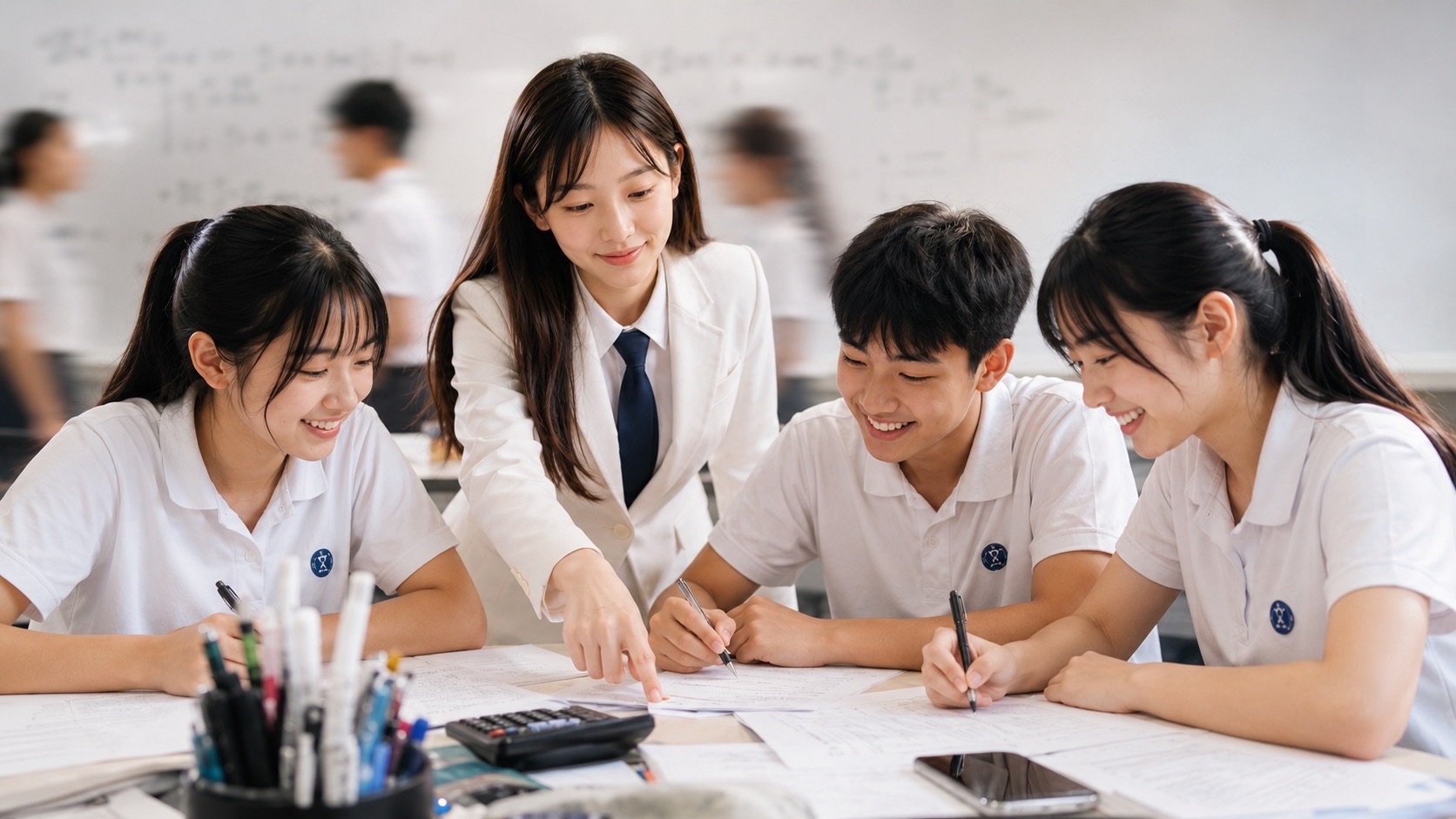
Additional Mathematics Tuition Bukit Timah | 3-Pax A-Math Tutorials is the main eduKateSG commercial route for Secondary 3 and Secondary 4 students taking Additional Mathematics in Bukit Timah.
The programme is built around a simple idea: A-Math becomes much easier to improve when we stop treating every wrong answer as a chapter problem and start identifying the first mathematical system that actually failed.
Sometimes the problem is algebra. Sometimes it is function notation. Sometimes it is route selection. Sometimes it is an interval, domain or candidate-checking mistake. Sometimes the student knows all the topics separately and cannot yet operate them together under examination conditions.
At eduKateSG, the published Bukit Timah format is up to three students with 90-minute lessons at 8 Fourth Avenue, Singapore 268674, near Sixth Avenue MRT. The small group is designed to make mathematical thinking visible enough for the tutor to diagnose, repair and then progressively remove support.
This page is the canonical Bukit Timah Additional Mathematics commercial spine. For Secondary 3 class planning, use Secondary 3 Additional Mathematics Tuition Bukit Timah | 3-Pax Classes. For Secondary 4, use Secondary 4 Additional Mathematics Tuition Bukit Timah | 3-Pax Classes.
For 2026 school candidates, Additional Mathematics may still follow the existing GCE pathways, including O-Level 4049 and N(A)-Level 4051. From 2027, the Singapore-Cambridge Secondary Education Certificate lists G3 Additional Mathematics as K341 and G2 Additional Mathematics as K232. We therefore use the student’s actual examination year, subject level and school sequence before selecting material.
Integrated Programme and international-school students should bring their course details so the examples, sequence and assessed content match the programme actually studied.
Ask about Additional Mathematics tuition in Bukit Timah.
Why A-Math Needs a Different Tuition Architecture
Additional Mathematics is not simply Mathematics with harder numbers.
It is more dependent.
A weak algebra habit can reappear in functions, logarithms, trigonometry and calculus.
A weak graph concept can make stationary points or coordinate geometry feel harder than they really are.
A weak route-selection habit can leave a student staring at a question even though every required method has been learned before.
A weak condition-checking habit can turn correct algebra into an invalid final solution.
This is why A-Math tutoring should not be designed as a sequence of isolated chapter clinics.
The subject is a dependency network.
The tutoring programme should be one too.
We teach new methods, but we also ask what they depend on, what they connect to, how they fail, how they are checked and how they return later without the chapter title beside them.
That architecture is what allows the student to move from guided understanding to independent control.
The A-Math Dependency Map
Algebra carries almost everything
Factorisation, fractions, rearrangement, indices, surds and equation control are not background topics that disappear after Secondary Mathematics.
They become the symbolic machinery inside later A-Math.
A derivative can be correct and the question can still fail when the resulting quadratic is solved wrongly.
A logarithm law can be applied correctly and the question can still fail because an invalid candidate is accepted.
A trigonometric identity can be correct and the question can still fail because a zero branch is lost.
See Algebra as a Weapon of Clarity.
Functions organise relationships
Functions connect input, rule and output.
They also connect algebra to graphs and later calculus.
A student who reads f(x) as a mysterious symbol will struggle more than a student who sees a machine that transforms an input according to a rule.
See Functions as Future Machines.
Graphs reveal behaviour
Roots, intersections, turning points and gradients are not separate graph facts.
They are visible features of the underlying function.
See Graphs, Curves and Turning Points.
Trigonometry adds periodic structure
Students need identity knowledge, algebraic control, interval awareness and graphical sense.
The formula sheet is not the whole subject.
See Trigonometry and Signal Control.
Calculus adds change and accumulation
Differentiation connects to gradient, tangents, stationary points and optimisation.
Integration connects to reconstruction, area and motion where required by the syllabus.
Both depend heavily on earlier algebra.
This is why A-Math tuition becomes much more effective when the dependency map is visible.
G2 and G3 Additional Mathematics Should Be Matched Accurately
From 2027, Additional Mathematics exists at both G2 and G3 under the SEC structure.
These are distinct subject-level syllabuses.
They should not be treated as one generic A-Math programme with harder and easier worksheets mixed together.
The student should receive material that matches the actual course while the teaching intensity is adjusted separately.
A G2 student can need very high-precision teaching within the G2 course.
A G3 student can need rescue work on a weak algebra prerequisite.
Subject level describes the course.
Teaching mode describes the present learning need.
Keeping those two ideas separate prevents the student from being turned into a label.
For the parent pathway guide, use G2 and G3 Additional Mathematics in Bukit Timah.
Why Up to Three Students Can Work Well for A-Math
A small group can provide both individual visibility and useful mathematical comparison.
Working is visible
The tutor can see where the valid chain becomes invalid.
This matters because A-Math questions can be long enough that the final answer hides the real problem.
Method selection can be discussed
One student may factorise.
Another may complete the square.
The tutor can ask which form reveals the target more directly.
Different weaknesses can be separated
Three students can be working on trigonometry for three different reasons.
One may need identity recall.
One may need algebraic factorisation.
One may need interval control.
Independent return stays central
After discussion, each student still completes a fresh question alone.
That independent return is how the tutor knows whether the learning has transferred.
Three students do not automatically create personalisation.
Personalisation appears when the tutor can see the difference in the reasoning and act on it.
Secondary 3 A-Math: Build the Engine
Secondary 3 is normally the build year.
The student is learning the language and architecture of Additional Mathematics.
The priorities include:
- reliable algebra;
- function notation;
- graph interpretation;
- trigonometric structure;
- method selection;
- retrieval after a gap;
- independent first moves.
The programme should not rush into full-paper volume merely because the student is ambitious.
Full papers are most useful after enough content is stable to reveal examination behaviour.
The canonical class page is Secondary 3 Additional Mathematics Tuition Bukit Timah | 3-Pax Classes.
For the conceptual transition, use The Phase Shift.
For the workload view, use The Stress Load Subject.
Secondary 4 A-Math: Convert the Engine into Examination Performance
Secondary 4 changes the balance.
Concept repair remains necessary when evidence shows a gap.
But the student now needs to operate the entire A-Math system under mixed conditions.
The priorities increasingly include:
- mixed-topic recognition;
- calculus execution;
- trigonometric branch control;
- full-paper timing;
- mark protection;
- recovery after a difficult question.
The canonical class page is Secondary 4 Additional Mathematics Tuition Bukit Timah | 3-Pax Classes.
Before intensive calculus training or heavy full-paper work, use Secondary 4 Additional Mathematics Tuition in Bukit Timah | Calculus Readiness Diagnostic to check whether algebra, functions, graphs, tangent-line work, modelling and integration foundations are ready for the next stage.
For the annual strategy, use The Examination Year.
For full-paper work, use Full Paper Readiness and Mark Protection.
What We Teach in Additional Mathematics Tutorials
The exact content follows the student’s course and school sequence.
Algebraic manipulation
Students build control over factorisation, fractions, equations, inequalities, indices, surds and symbolic rearrangement where these belong to the course.
We emphasise valid transformations and the difference between terms and factors.
Functions
Students understand input, rule and output, and work with composition, inverse relationships and domain where required.
Function notation becomes a language rather than a visual obstacle.
Graphs
Students connect symbolic form with roots, intersections, turning points and graphical behaviour.
Equivalent forms are chosen for the information they reveal.
Exponential and logarithmic relationships
Students apply laws accurately while preserving the original domain conditions.
Algebraic candidates are checked against the original logarithmic system.
Coordinate geometry
Students translate geometric relationships into gradients, equations and coordinates.
Parallel, perpendicular and intersection conditions become algebraic.
Trigonometry
Students work with identities, equations, intervals, periodicity and exact values according to the syllabus.
The emphasis is route control and solution-set integrity, not formula memory alone.
Differentiation
Students connect derivative technique to gradient, tangents, normals, stationary points and optimisation where assessed.
The original function and derivative are kept conceptually distinct.
Integration
Students connect antiderivatives, constants, definite integrals, area and motion where relevant.
The meaning of the requested quantity controls the interpretation.
Our First-Principles A-Math Method
1. Diagnose the first wrong or missing decision
We use actual working.
The final answer is less useful than the first line where the solution stopped being valid or complete.
2. Repair the prerequisite at the smallest useful level
If factorisation is blocking calculus, we repair factorisation and reconnect it to calculus.
We do not restart every algebra chapter automatically.
3. Use the Fencing Method
We begin with a manageable version and add one new demand at a time.
This helps the student see exactly what the new condition changes.
4. Move between representations
Algebra, graphs and geometric interpretations reinforce one another.
Strong A-Math becomes less dependent on one visual form.
5. Train route selection aloud
Students state the target and first move before long calculations.
This tells the tutor whether the problem is recognition or execution.
6. Preserve conditions
Domains, intervals, denominators and candidate restrictions stay attached to the solution.
Equivalent algebra is not enough if the transformation changes the valid solution set.
7. Retrieve after a gap
Corrected skills return later.
We want the repair to survive without the original correction beside it.
8. Interleave topics
Once methods are stable individually, they appear together.
The student learns to switch.
9. Add timing after the mathematics is worth timing
Speeding up an unstable method usually creates faster mistakes.
We first seek a clear route, then fluency.
What Happens During a 90-Minute A-Math Tutorial
Retrieval
Students begin with earlier methods or recent corrections.
Concept or repair
The tutor teaches one central relationship or rebuilds one weak dependency.
Guided practice
Students attempt related questions with selective prompts.
Independent return
A fresh question removes the prompt.
Mixed application
The skill appears beside another A-Math system.
Timed micro-set where useful
Short timing trains recognition and execution without turning every lesson into a paper.
Error review
The first meaningful loss is named specifically.
Continuation
Homework is selected to retest the correction later.
The exact balance changes with Secondary 3 versus Secondary 4 and with the student’s school calendar.
Three A-Math Teaching Pathways
Repair
The student has a high-leverage foundation gap.
We reduce complexity, repair the dependency and reconnect it to the current topic.
Stabilise
The student knows the methods but performs inconsistently when the surface changes.
Retrieval, mixed recognition and checking become priorities.
Extend
The student is secure enough for unfamiliar forms, route comparison, reverse reasoning and examination precision.
These modes can change by topic.
They are not promises of a particular grade.
For the fuller framework, use Rescue, Growth or Distinction?.
Worked Example 1: Hidden Quadratic Structure
Solve:
4x − 5(2x) + 4 = 0.
Since 4x = (2x)², let u = 2x.
Then:
u² − 5u + 4 = 0.
Factorise:
(u − 1)(u − 4) = 0.
So u = 1 or 4.
Return to x:
2x = 1 gives x = 0.
2x = 4 gives x = 2.
The skill is structural recognition.
The question looks exponential and behaves quadratically after the right substitution.
Worked Example 2: Function and Graph Connection
Let:
f(x) = x² − 4x + 3.
Factorise:
f(x) = (x − 1)(x − 3).
The roots are x = 1 and x = 3.
Complete the square:
f(x) = (x − 2)² − 1.
The turning point is (2, −1).
Different algebraic forms reveal different graph features.
The student should learn to choose the form according to the target.
Worked Example 3: Logarithmic Domain Check
Solve:
log2(x − 1) = 3.
Then:
x − 1 = 8.
x = 9.
The original logarithm requires x > 1.
The solution is valid.
In a more complicated equation, several algebraic candidates may appear.
Every candidate still has to survive the original domain.
That checking habit is part of A-Math accuracy.
Worked Example 4: Trigonometric Branches
Consider:
sin x(2cos x − 1) = 0.
The zero-product structure gives:
sin x = 0
or
cos x = 1/2.
Each branch must be solved over the stated interval.
Dividing by sin x at the start would destroy one branch.
The algebra has to preserve the trigonometric solution set.
Worked Example 5: Tangent to a Curve
Let y = x² + 3x at x = 2.
The point on the curve is:
y = 4 + 6 = 10.
So the point is (2, 10).
Differentiate:
dy/dx = 2x + 3.
At x = 2, the gradient is 7.
The tangent is:
y − 10 = 7(x − 2).
Therefore:
y = 7x − 4.
The original function supplies the point.
The derivative supplies the gradient.
Worked Example 6: Integration and the Constant
Suppose:
dy/dx = 6x − 2.
Integrate:
y = 3x² − 2x + C.
If the curve passes through (1, 4):
4 = 3 − 2 + C.
C = 3.
So:
y = 3x² − 2x + 3.
The constant is not an optional extra.
It identifies which member of the antiderivative family is the required curve.
Worked Example 7: Optimisation Begins Before Differentiation
A rectangle has perimeter 24 units.
Let one side be x.
The other side is 12 − x.
Area:
A = x(12 − x).
A = 12x − x².
Differentiate:
dA/dx = 12 − 2x.
Set dA/dx = 0:
12 − 2x = 0.
x = 6.
The maximum area occurs for a 6 by 6 square.
The hardest step for many students is not differentiation.
It is constructing the one-variable area function from the geometric constraint.
Optimisation therefore depends on modelling, algebra and calculus together.
The A-Math Mistake Taxonomy
Concept error
The underlying relationship is misunderstood.
Recognition error
The method is known but not identified.
Algebra error
The route is correct but signs, fractions, factorisation or rearrangement fail.
Condition error
The domain, denominator, interval or candidate restriction is lost.
Representation error
The student knows the idea in one form but not another.
Completeness error
The student stops at an intermediate result instead of the requested final answer.
Timing error
The student spends too long choosing, persists with an unproductive route or rushes later work.
The taxonomy matters because every category creates a different next lesson.
The A-Math Independence Test
Before calling a method secure, we ask whether the student can:
- identify the target without the chapter title;
- choose a plausible route;
- explain why the route fits;
- carry the algebra accurately;
- preserve the relevant conditions;
- complete the requested result;
- check the candidate in the original system;
- retrieve the skill after a gap;
- recover from an unproductive first route.
Independence is a profile, not a single yes-or-no label.
A student may recognise perfectly and execute badly.
Another may execute perfectly after being told the method but fail to choose it alone.
The next teaching step should match the actual profile.
The Sec 3 to Sec 4 Handover
A strong Secondary 3 year should finish with a clear map of what is ready and what still needs repair.
- Which algebra errors still repeat?
- Which topics still require prompts to begin?
- Which methods survive after a delay?
- Are functions and graphs connected?
- Are trigonometric intervals controlled?
- Is early calculus understood where already taught?
- Which Secondary 4 topics depend on remaining weak foundations?
This handover allows Secondary 4 to focus on completion, connection and examination conversion rather than emergency reconstruction.
Use Build the Sec 4 Calculus Runway for the specific transition.
The Sec 4 Full-Paper Cycle
Full-paper practice should create a cycle of improvement.
- attempt the paper;
- classify lost marks;
- repair the highest-value pattern;
- retest with changed questions;
- return to another mixed paper.
We do not measure preparation by paper count alone.
A paper that reveals the same uncorrected issue again and again is providing evidence, but the repair still has to happen.
Use Full Paper Readiness and Mark Protection for the full examination system.
The A-Math Readiness Audit
Before increasing difficulty, we ask whether the student is ready to carry the next layer.
Algebra readiness
Can the student factorise, rearrange, handle fractions and preserve signs without repeated rescue?
These skills do not need to be flawless, but they should be stable enough that new A-Math ideas are not constantly interrupted by old symbolic problems.
Function readiness
Can the student read function notation, substitute correctly and understand that the notation describes a relationship rather than a new type of multiplication?
Graph readiness
Can the student connect roots, intercepts and turning points to the symbolic form?
Route readiness
Can the student begin a familiar method without the tutor naming the chapter?
Checking readiness
Does the student return to domains, intervals, denominator restrictions and the actual target before accepting the answer?
The readiness audit does not decide whether the student “belongs” in A-Math.
It tells us where teaching should begin.
Mathematics and A-Math: Keep the Shared Foundation, Keep the Subjects Distinct
Secondary Mathematics and Additional Mathematics share important habits.
Algebra matters in both.
Graphs matter in both.
Equation control and clear working matter in both.
But they remain distinct subjects.
A student can perform strongly in Mathematics and still need time to adapt to the denser symbolic and functional demands of A-Math.
A student can also struggle in both subjects because one shared algebra weakness is travelling across them.
We therefore share useful foundational repair without merging the two curricula into one vague “Math” programme.
If the student’s Secondary Mathematics is also unstable, we diagnose that work separately and identify whether the A-Math weakness is genuinely subject-specific or carried from the shared foundation.
This separation makes both programmes more precise.
The Parent A-Math Evidence Check
Parents do not need to solve Additional Mathematics to judge whether tuition is producing stronger learning.
- The student begins more questions without waiting for the first hint.
- Algebra corrections survive when they reappear inside another topic.
- Function and graph language becomes easier to explain.
- Trigonometric answers are checked against the interval more consistently.
- Calculus solutions fail less often in the algebra after the derivative or integral.
- Repeated mistakes become more specific and less frequent.
- Mixed-topic work becomes less different from topical practice.
These behaviours give parents evidence of growing independence before a final examination result exists.
A mark still matters.
The behaviour underneath the mark tells us whether the improvement is becoming transferable.
The A-Math School-Year Progression
Secondary 3 Term 1: stabilise the new language
We identify algebra readiness, make function notation readable and prevent early misconceptions from becoming permanent habits.
Secondary 3 middle year: connect and retrieve
Topics begin to interact.
We revisit earlier methods, compare representations and remove chapter cues progressively.
Secondary 3 end of year: build the handover
We identify which dependencies must be repaired before Secondary 4 and which methods are already stable enough for mixed practice.
Secondary 4 early year: complete and connect
Remaining content is taught while older methods continue to return.
The student begins more deliberate mixed-topic switching.
Secondary 4 examination phase: diagnose and protect
Paper practice reveals recognition, execution, condition and timing patterns.
We repair high-value patterns between papers instead of measuring preparation by paper count alone.
Final revision: selective rather than chaotic
The whole syllabus remains visible, but repeated vulnerabilities receive extra attention.
The student also needs enough sleep and recovery to use what they know.
Exhaustion is not an A-Math strategy.
Three More Worked Checks for A-Math Control
Check 1: preserve a zero branch
Solve x(x − 5) = 0.
The solutions are x = 0 or x = 5.
Dividing by x at the beginning would lose x = 0.
This simple example builds a checking habit that later protects trigonometric and algebraic equations.
Check 2: distinguish point from gradient
For y = x² + 1 at x = 2, the point is (2, 5).
The derivative is 2x, so the tangent gradient is 4.
The values 5 and 4 have different jobs.
This distinction protects tangent and normal questions.
Check 3: distinguish signed accumulation from area
A definite integral can be negative when the graph lies below the x-axis.
Geometric area cannot.
The student must read the target and interpret the integral accordingly.
These short checks demonstrate the programme’s larger principle:
precision often comes from understanding what each mathematical object represents.
What Progress Should Look Like
Look for more independent starts.
Look for fewer repeated algebraic errors across different topics.
Look for functions and graphs becoming connected.
Look for trigonometric solutions being checked against intervals.
Look for calculus questions surviving the downstream algebra.
Look for corrections remaining available after a gap.
Look for mixed questions becoming less dependent on chapter cues.
As Secondary 4 approaches, look for better timing and paper recovery.
Marks matter, but compare suitable work and note how much help was provided.
We do not promise a fixed grade, percentage improvement or timetable.
When A-Math Tuition May Be Useful
Consider support when one algebra weakness is damaging several topics, when the student understands once the method is named but cannot begin independently, when valid candidates are repeatedly lost or accepted incorrectly, or when topical practice is much stronger than mixed assessment performance.
In Secondary 4, support can also be useful when the student broadly knows the syllabus but cannot convert it into stable paper performance.
A student who is already learning, correcting and practising independently may not need another tuition layer.
The right intervention is one that solves a real mathematical problem.
Bukit Timah Location and Class Details
eduKateSG’s Bukit Timah teaching location is 8 Fourth Avenue, Singapore 268674, near Sixth Avenue MRT.
The published A-Math format is up to three students with 90-minute lessons.
Teaching can include prerequisite repair, topic instruction, mixed recognition, error review and examination preparation according to the student’s year and course.
Consultations are by appointment.
Current fees, available timings, materials and class placement should be confirmed directly.
What Parents Can Bring to a Consultation
Bring a recent A-Math assessment, ordinary homework and the student’s current examination year and subject-level information.
Keep original working visible where possible.
Useful descriptions include “can differentiate but loses the algebra”, “knows trig formulas but cannot choose a route”, “keeps accepting invalid log answers”, “needs a stronger Sec 3 to Sec 4 handover”, or “knows the chapters but runs out of time in mixed papers”.
These descriptions help us locate the real A-Math problem quickly.
Frequently Asked Questions
Is this programme for G2 or G3 Additional Mathematics?
Both pathways can be supported where a suitable class fit is available, but the student should receive material matched to the actual course. G2 and G3 are distinct syllabuses from 2027.
Can tuition repair weak algebra?
Yes. We identify the specific algebra dependency, repair it at the smallest useful level and reconnect it to the current A-Math topic.
Should Sec 3 students do full papers?
Not as the default. Secondary 3 is primarily the system-building year. Mixed and timed work can be added progressively as enough content becomes stable.
When should Sec 4 students begin full-paper training?
When enough of the relevant syllabus is stable for a paper to reveal recognition, timing and execution rather than simply unfinished content.
Do you teach Mathematics and A-Math together?
They are kept as distinct subjects. Shared algebra can be reinforced across both, but the content and examination demands are different.
How do you reduce careless mistakes?
We classify the actual loss—concept, recognition, algebra, condition, representation, completeness or timing—and later retest the corrected behaviour.
What if my child is already strong?
Strong students can work on route comparison, less familiar representations, condition control, proof-quality explanation and examination efficiency rather than routine volume.
Do you teach ahead?
When the foundation is stable and previewing has a clear purpose. We do not treat early chapter completion as the main measure of progress.
Can tuition guarantee an A1 or distinction?
No. Tuition can strengthen understanding, route selection, execution and examination preparation, but the student’s actual performance determines the result.
Helpful Reading for the Next Step
For Secondary 3, use Secondary 3 Additional Mathematics Tuition Bukit Timah | 3-Pax Classes, E-Math vs A-Math and Build the Sec 4 Calculus Runway.
For Secondary 4, use Secondary 4 Additional Mathematics Tuition Bukit Timah | 3-Pax Classes, The Examination Year and Full Paper Readiness and Mark Protection.
The Bukit Timah Secondary Mathematics and A-Math directory connects all specialist concept routes.
Additional Mathematics Tuition in Bukit Timah
A-Math becomes more manageable when the student sees the dependencies, the routes and the conditions instead of treating every new question as a new trick.
The programme is designed to make those structures visible, repair what is unstable and return the work to the student with progressively less support.
Arrange an A-Math Consultation
Bring the A-Math question where the student stops being independent. We will discuss the actual course, the first unstable layer and whether a suitable small-group placement is available.
WhatsApp +65 8823 1234 about Additional Mathematics tuition in Bukit Timah.
eduKateSG · 8 Fourth Avenue, Singapore 268674 · Near Sixth Avenue MRT · By appointment.
Continue Through Bukit Timah Tuition
Bukit Timah Additional Mathematics Network
For the complete local A-Math class route, use Additional Mathematics Tuition Bukit Timah | 3-Pax A-Math Tutorials. For level-specific and specialist guides, use the Bukit Timah Secondary Mathematics and A-Math Article Directory.
Class Details
Format: Premium 3-pax small-group tutorials
Subject: Secondary Additional Mathematics
Duration: 1.5 hours weekly
Location: eduKateSG, 8 Fourth Avenue, Singapore 268674
Nearest MRT: Sixth Avenue MRT
Attendance: By appointment and suitable class placement