
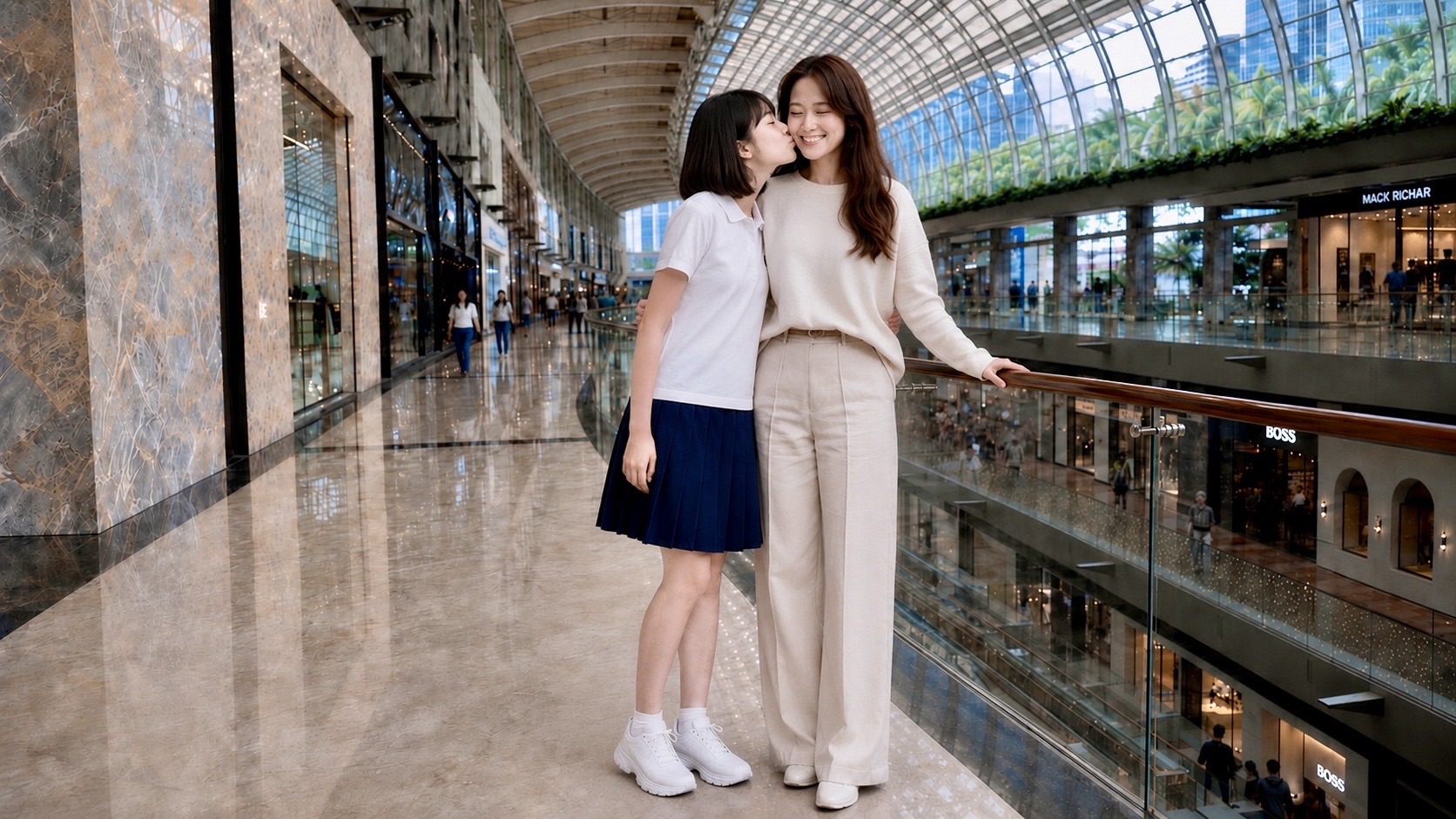
Nora arrived with no luggage.
Six weeks later, she had a name, several blankets, a collection of relatives and three incompatible explanations for whose nose she possessed. The nose itself had made no comment.
Around her, a family was rearranging the future.
The first gathering — Someone new has changed everybody
Andrew Chan was carrying four folding chairs up to his sister’s flat when he discovered that becoming an uncle did not exempt a person from furniture.
He had expected to hold a baby. So far, he had held chairs, a bag of fruit and a container whose lid had been described as secure by someone who was no longer present to defend the claim.
Jo rang the bell. From inside came several voices, a short instruction about shoes and the sound of someone moving something that had been placed in exactly the wrong place for a gathering.
Rachel opened the door with her daughter against her shoulder.
“You’re early,” she said.
“You said twelve.”
“I know. I was being optimistic.”
Andrew, the commuter from The Trip to Nowhere, was discovering a different sort of journey. Work had taken him across the city. Becoming an uncle would take him into years of birthdays, school days and gatherings he could not yet imagine.
He was thirty-eight when Nora was born. Rachel, his younger sister, was thirty-four. She and Arun had arranged a small lunch to welcome their daughter when they felt ready to receive visitors. They had not intended to produce a definitive statement about tradition. They wanted their people in the room, some food on the table and the possibility of resting afterwards.
Molly, their mother, had heard “small lunch” and responded with enough food to make the adjective difficult to defend. Peter, their father, was attempting to put a folding chair into a space already occupied by another folding chair. Salma, a family friend of many years, had arrived with a meal for the parents to eat after everybody went home.
Of all the gifts in the room, this one showed an especially strong understanding of time.
The baby had no idea what she had done
Nora slept through the beginning of her own welcome.
She had made Rachel and Arun parents. She had made Andrew an uncle and Jo an aunt in the family’s everyday language. Molly and Peter had acquired a grandchild. Salma had become Auntie Salma to someone who would eventually have to discover that the family used “auntie” more generously than a formal family tree did.
One arrival had altered several relationships. The adults had not changed species or acquired new bodies. They had acquired expectations, responsibilities, possibilities and names for who they were to another person.
The birth and naming essay follows that social work. A child enters an existing world, while the people receiving the child have to learn a changed place within it.
None of this gives the adults ownership of Nora’s future. Her humanity and worth do not depend on a ceremony, a surname or how well she will eventually perform a useful task. The gathering is the family’s way of recognising her arrival and beginning its responsibilities towards her.
She is someone to care for before she is someone who can carry anything forward.
Andrew sat down carefully when Rachel offered him the baby. His preparation for this event had been extensive in imagination and rather limited in practice.
“Support her head,” Rachel said, helping him settle her comfortably.
He obeyed with the attention of a man receiving a very small and entirely irreplaceable responsibility.
Civilisation was already in the room
Nora had not made the water supply, the building, the road or the hospital in which she was born. She had not contributed to the knowledge used by the professionals who cared for her and Rachel. Language was already passing around her. The adults could read instructions, arrange visits, prepare food, contact one another and obtain things a household needed.
Her arrival occurred inside an inheritance much larger than the family.
The Civilisation story follows that wider arrangement. Its scale can sound distant until we look at a newborn who receives the benefit of work begun before any living person in the room was born.
Civilisation does not begin again when a baby begins. Its various parts meet the baby at different ages. Some institutions are comparatively young. Some words have travelled through generations. A new device can carry an old lullaby. An old household habit can be supported by a recently built transport connection.
There is no single civilisational birthday hiding behind Nora’s birthday.
The lifecycle account makes this distinction explicit: biological birth, growth and death can help us think about change, but civilisation contains many overlapping histories. Its parts form, persist, alter, break and continue on different schedules.
Nora was new. Almost nothing around her was starting from nothing.
The name everyone had practised
Before she was born, Rachel and Arun had discussed names while washing dishes, travelling home and pretending to watch television. They wanted a name they both liked saying. They tried it in sentences. They imagined calling it across a playground and writing it on a form.
Now the choice belonged to a person.
Molly said “Nora” softly when she leaned over her. Peter said it with the pride of someone who had helped invent being a grandfather. Andrew used the name twice in a sentence that required it only once.
A name makes a person easier to call, introduce, remember and distinguish in shared records. It can carry family associations, language, hopes or affection. It can also become something the person later relates to in a way the adults did not predict.
Rachel and Arun had completed the formal birth registration separately from arranging this lunch. Singapore’s official registration account explains that administrative process. The family welcome and the public record perform different jobs, even when the same name appears in both.
One gives institutions a recognised record of an event and identity. The other puts a new person among voices, attention and relationships. Neither should be mistaken for the whole of belonging.
Nora opened her eyes, looked briefly in Andrew’s direction and then appeared to reconsider the value of the occasion.
“She knows you,” Molly said.
“She looks concerned,” Andrew replied.
“She knows you,” Jo said.
The room laughed. A family joke had found a new audience, although its newest member would need some years before being able to answer back.
What made this a ritual?
There was no elaborate programme. People gathered for a stated reason. Food had been prepared. The baby was introduced. Wishes were offered. A photograph was attempted. The adults treated the occasion as something worth marking together.
The actions meant more than their immediate mechanics. Eating supplied food; eating together also acknowledged an arrival. Saying a name identified a child; saying it with affection placed her within a circle of people intending to care. The photograph made an image; the gathering made the image worth keeping.
The ritual essay explores how repeated, socially meaningful actions mark moments and changes. Rituals can be religious or secular, formally prescribed or made within a household. Different communities and families give birth very different forms of welcome.
For Rachel and Arun, a small lunch was the right beginning.
The useful question is what the gathering accomplishes for the people involved. It focuses attention. It makes the new relationships visible. It gives people a shared occasion they can remember and a chance to begin behaving according to their new responsibilities.
A ritual can say “this matters” in ways a message announcing the date might not fully achieve.
Whether the care continues after the ritual remains another question.
The first photograph omitted several essential people
Arun placed his phone where it could see the group and set the timer. There followed a short period of movement in which everyone except the baby had difficulty remaining still.
Peter wanted to know whether he was in the picture. Molly wanted somebody to move the fruit. Andrew was told to lean in and discovered he was already leaning into Jo, who had reached the limit of the available space.
The first photograph caught half the group checking whether the photograph had happened. The second was better. They kept both.
The images showed family and friends around Nora. They did not show the people who had treated Rachel at the hospital, built the flat, delivered ingredients, maintained the lifts or done the many other kinds of work supporting this room.
A family photograph is a meaningful record and a very selective account of causation.
The Singapore portrait opens the city beyond the frame. Families carry life across time within places shaped by housing, work, public services, care and the resources available to them. They can do more when those surroundings support them.
The photograph also omitted most of the work performed by the people it did include. A smiling adult can contain several nights of interrupted rest. A meal on a table can contain planning that began days earlier. A clean room can contain someone’s exhausted final effort before visitors arrived.
What we can see is an entrance into the story. It is not the whole story.
A useful guest notices the next hour
After lunch, Rachel went to rest. Arun stayed with Nora. Salma began putting portions into containers while Andrew and Jo washed dishes. Molly protested that guests should not have to do this, although nearly everyone present had been family long enough for the category to have become negotiable.
“We can leave the kitchen finished,” Jo said.
This was an ordinary act with a consequence beyond the current scene. When the last visitor left, the parents would inherit a smaller task list.
The hospitality essay examines the relationship between hosts, guests, meals and trust. Hospitality can welcome people into a shared space. It works best when the welcome does not require the host to disappear beneath an impossible amount of labour.
Salma’s gift of a later meal extended the gathering’s care into an hour when the gathering itself would no longer be present.
That is already a small example of what families do across time. They arrange something now that another person can use later. The thing might be food, a clear instruction, a habit of asking for help, a skill or the knowledge that somebody will come when needed.
The arrangement becomes durable when the later person can actually receive and use it.
The chairs would return
Andrew carried the folding chairs downstairs after the visitors had gone. He had spent much of the afternoon in the service of seating and would later describe the event as having met his niece.
Both accounts were true. One was more likely to appear in a photograph.
In the lift, Jo asked whether he had enjoyed himself.
“She’s very small.”
“They usually begin that way.”
He smiled. What had surprised him was how much the room had changed without any of its adult occupants becoming different people. Rachel still sounded like Rachel. Molly still considered a finished plate a request for more food. Peter still distrusted a camera timer. Yet the same familiar people were now related through someone new.
The family had gained a beginning, along with years of work it could not yet see.
We will return to them through birthdays and ordinary care, the beginning of school, a wedding, a house that stops being the meeting place, a changed reunion, and another welcome. Each gathering shows a different state of the same moving family.
From birth to death, human lives carry things with beginnings and endings of their own. A custom can fade while its practitioners are still alive. A practice can become stronger in younger hands. A harmful expectation can end, and that ending can improve the life passed forward.
Nothing requires all of civilisation to survive unchanged. The more interesting question is what these people will be able, willing and supported to carry into the next room, the next year and the next generation.
For the moment, Nora slept. The adults had made a beginning around her.
A year later — Everybody knows the song except the guest of honour
At Nora’s first birthday, the adults sang with considerably more confidence than coordination.
She watched the room become musical, looked at the cake and then reached towards an empty box. The box was immediately more interesting than several gifts that had cost money.
Andrew had brought the folding chairs again. He put them in the same corner as before, although the corner now contained toys and appeared to have developed its own objections to furniture.
Rachel moved a small cup out of reach. Arun found a cloth. Molly asked whether everyone had eaten. Peter began taking photographs before the singing and continued after it, thereby documenting an unusually complete history of the cake.
The people were familiar. The small person in the middle was already different.
She could recognise more, do more and ask for things in ways the adults had learned to interpret. Her needs had changed their routines. Their responses had helped shape the world she was learning to expect.
The birthday marked one year. The work inside that year had mostly happened on days that did not receive a song.
The ceremony could not do the year’s work in an afternoon
Feeding, comforting, washing, playing, listening, arranging care, managing work and finding rest had occupied Rachel and Arun in thousands of small episodes. Other people had helped. Some help had been planned; some had arrived after a message asking whether anyone was free.
The birthday gathered people who knew different parts of that year. Nobody had seen all of it.
A ritual can make a period visible without containing everything that made the period possible. The cake gave the year a centre of attention. It could not replace the care that had carried Nora through it.
This distinction protects us from confusing a celebration with the relationship it celebrates. A splendid birthday can occur in a household under strain. A quiet birthday can occur within dependable love. The size of the occasion is not a reliable measure of the life behind it.
Rachel had chosen a smaller gathering than Molly initially imagined. There would be food, the people closest to them and no complicated decorations to remove after bedtime. Molly had negotiated for one additional dish and lost the argument about a second cake.
The smaller occasion left more time to enjoy the people who had come.
Nora was learning before anyone called it teaching
Over the following years, she learned through repeated encounters with people and things. An adult answered a gesture. Someone named an object she pointed towards. A game began, paused and began again. She discovered that different people laughed at different sounds and that Andrew could be persuaded to repeat a foolish movement long after most adults had stopped finding it worthwhile.
The family as the first education carrier explains why learning begins before school. A child meets language, attention, habits and responses through everyday relationships. Those relationships are shaped by the time, resources and support available to the people providing care.
Harvard’s account of responsive exchanges in early childhood describes the importance of back-and-forth interaction between children and caring adults. It also recognises that pressures on caregivers can make consistent responsiveness more difficult. This is a reason to support households, not a demand that every tired parent perform perfectly.
In Nora’s family, teaching frequently looked like somebody taking her question seriously enough to answer it.
“Why is Uncle Andrew coming?” she asked one afternoon when she was older.
“For lunch,” Rachel said.
“Why?”
“Because we like him.”
Nora considered this explanation. “All the time?”
Rachel decided the question deserved a more qualified answer.
A person is born into a language but does not arrive knowing it
Molly used some expressions Rachel understood readily and Nora initially found puzzling. Arun brought words and habits from his own childhood into the household. Jo spoke to Nora with the directness she used when she wanted a small person to know that a question was welcome.
The family did not transfer a complete language by handing Nora a vocabulary list. Words arrived inside acts of attention: asking, offering, comforting, warning, joking, explaining and apologising.
The culture and language essay follows the larger connection between expression and shared life. Language gives people ways to recognise a situation, describe it and act together. The words a household uses can make some questions easy to ask and others difficult even to form.
A child can learn that “I don’t know” begins a useful conversation. A child can also learn to hide uncertainty if uncertainty is regularly punished. These are possibilities shaped by experience, not permanent destinies fixed by one adult’s bad afternoon.
Rachel sometimes answered too quickly. Arun sometimes misunderstood what Nora was asking. They could notice, return and try again. That return mattered alongside the original response.
Civilisation’s inheritance includes methods for correcting a conversation while the people in it are still present.
The little rule at the table
By the time Nora was four, she knew that Molly liked everyone to sit down before the main meal began. She also knew that someone usually had to stand up again immediately because the serving spoon was still in the kitchen.
The family placed importance on beginning together, even when the practical execution was imperfect. For Molly, it marked the meal as a shared occasion rather than a series of private visits to the stove.
Nora was allowed to help put unbreakable cups on the table. She carried them one at a time with great seriousness. There were moments when the task became slower because she was helping. The adults allowed some of that time.
A household can gain speed by doing everything for a child. It can gain future capability by making room for the child to participate. The appropriate balance changes with age, ability, the task and the demands of the day.
Today, they had time for cups.
The cultural-transmission essay follows how observation, explanation, participation and repetition allow practices to travel between people. Nora was learning a sequence by entering it, rather than merely watching a performance whose backstage remained permanently closed.
She was also learning that the work of a meal belonged to more than one person. Andrew could carry dishes. Arun could cook. Jo could wash. Molly could sit down and be served.
The scene did not need a speech about fairness to offer evidence of it.
What children see is part of what adults pass on
The family said that people should be kind. Nora could compare this statement with what happened when someone spilled a drink, arrived late or asked an inconvenient question.
Declared values and practised responses could agree. They could also diverge.
One Sunday, she knocked a cup over while reaching across the table. Water travelled towards Peter’s newspaper with a determination that the household had not authorised. Andrew lifted the paper. Arun brought a cloth. Rachel told Nora to move her plate clear.
Nobody needed to make the spill into a statement about the child’s character. Nora helped wipe the table and learned something practical about reaching.
Later, Andrew knocked a spoon onto the floor. Nora announced that accidents happened, using a tone that made it clear she was now willing to manage the adult population.
The room laughed, and Andrew accepted the instruction.
This small exchange contained several transfers. A response to difficulty had become available for Nora to use. A child had applied it to an adult. The adult’s willingness to accept it helped show that the principle was more than a rule aimed downwards.
The socialisation essay examines how families, schools, peers and institutions teach ways of belonging. Here the learning was close enough to touch and ordinary enough to be forgotten by evening.
Its exact effect could not be measured from one spill. The scene shows a pattern being practised, not a promise about Nora’s future personality.
Salma did not appear on the family tree in the obvious place
Nora called her Auntie Salma because everyone else had done so from the beginning. Salma had known Molly for years. She had brought food after Nora’s birth, joined meals, remembered small details and become someone Nora expected to see.
There was no blood relationship to explain away or compensate for. The relationship had been made through attention and repeated presence.
One afternoon, Nora asked whose sister Salma was. Molly explained that she was a friend who had become part of their everyday family life. Nora accepted this after checking whether it changed the likelihood of another visit.
It did not.
The friendship essay considers how voluntary relationships can become trust and mutual obligation. Families can be sustained by grandparents, aunts, uncles, friends, neighbours and many other caring arrangements. A child’s actual circle of dependable adults may be larger, smaller or differently shaped than a diagram of descent.
Jo and Andrew had no children of their own. Being Nora’s aunt and uncle was already a complete relationship, growing through years of showing up.
They could pass on humour, practical skills, books, attention and ways of dealing with mistakes. Civilisational inheritance travels through teaching and care as well as biological parenthood.
The family would have been poorer if it had only counted the connections that fitted neatly into boxes.
The meal remembered more than its ingredients
Molly often made a rice dish with mushrooms and fried onions. She had changed it over the years, adjusting it to the ingredients she could obtain, the people she was feeding and her own preferences. She called it the usual rice, which was a modest name for something everyone expected to taste a particular way.
Nora associated it with the room, the voices and the opening of the large serving bowl. For her, it was becoming part of what a gathering felt like.
The foodways essay follows this joining of food with identity and memory. The shared-table account examines the social space meals can create. Ingredients nourish a body; preparation, timing and company can also give a dish a place in a life.
Molly did not need to declare the rice heritage before it could become meaningful. A repeated practice can acquire significance through use.
Nor did its meaning require the recipe to remain chemically identical forever. The version Nora would remember was already a version Molly had changed. Family tradition often presents the latest successful arrangement as though it had quietly existed since the beginning of time.
Molly knew better, though she was not always inclined to make that knowledge available during an argument about onions.
Durability began with another invitation
A gathering repeated because someone arranged the next one. Rachel sent a message. Molly checked the date. Arun adjusted a commitment. Salma said she could come after another visit. Andrew remembered to collect the chairs.
The continuity was not automatic. It was made from decisions small enough to be hidden inside a calendar.
Repetition gave the practice another opportunity to be experienced. Participation gave younger people something to learn. Affection gave people a reason to return. Practical adjustments kept the occasion within reach of the people it needed.
UNESCO’s account of living heritage describes practices and skills as things communities transmit and recreate. That account helps us understand why continuity can include change. The family need not behave like a recording played without variation in order for something recognisable to persist.
Their meal was becoming durable in several ways: enough people cared about it, more than one person could help organise it, and its practical demands could be negotiated. These conditions did not guarantee permanence. They gave the next gathering a reasonable chance.
The child started to expect a place
At one meal, Nora arrived and found the seat she usually used occupied by Leon, Andrew’s younger cousin. She stood beside him until he noticed.
“Am I in your chair?” he asked.
“It’s not my chair,” she said. “I sit there.”
This was a sophisticated distinction delivered by someone still learning to manage a fork.
The chair belonged to the household. The place had become part of her expectation of belonging. Leon moved, and Nora sat down with the satisfaction of someone whose small understanding of the world had survived inspection.
That expectation would change. She would grow, choose different places, bring other people and eventually help decide where a new child could sit. The family was giving her familiarity that she could later use, question and modify.
For now, she had a place at the table and a question about why everyone had to wait before eating when the food was already there.
Molly answered. Someone fetched the spoon. The meal began again.
Six years later — A second room learns her name
The family photograph that morning contained Nora, a school bag and a smile she had agreed to provide once.
Rachel checked the image, decided it was good and resisted the temptation to improve it through another fourteen attempts. Arun checked the bag. Nora checked whether the small object she wanted to bring was still in the pocket where she had put it.
Her life already included people beyond the family. A new class was another widening of that world: different adults, different children, new arrangements for where things went and what happened next.
At home, people knew what she meant by “the usual one”. In a new room, she would sometimes have to explain.
This was a small but important journey from familiarity towards shared understanding with people who had not watched her grow.
Andrew received the photograph while travelling to work. He replied with a good wish and no advice about achievement. Nora had enough to carry that morning without a distant uncle adding a speech to the bag.
The family could not be the whole world
Rachel and Arun knew their daughter in ways a teacher did not yet know her. The teacher knew how to organise learning with a group of children and could notice things that did not appear in the same way at home.
These were different forms of knowledge. The useful relationship allowed them to meet.
The family–school partnership account explains why communication and clear roles matter. A family can offer information about the learner and support familiar routines. A school contributes professional teaching, shared experiences, resources and relationships beyond the household. Neither should have to pretend to possess the other’s complete view.
Nora would learn from both. She would also learn from friends, books, play, neighbourhoods and events that no adult had formally arranged as a lesson.
This is one reason civilisation needs more than self-contained families. A household cannot personally recreate every field of knowledge or provide every kind of experience a child may need. Families draw upon institutions, and institutions are renewed by people who have been cared for in households and communities.
The connections run in several directions. No single room owns the whole person.
A greeting changes its audience
At a family meal, Nora had learned to greet people arriving at the door. Sometimes she was reminded. Sometimes she remembered before the adults did.
In the new classroom, greeting mattered in a different setting. She encountered people whose names she did not know and whose routines she could not assume. The familiar act became useful through adjustment.
Transfer is often less dramatic than a triumphant demonstration. A child recognises enough of a situation to try something learned elsewhere, then changes the attempt when the new setting requires it.
The Sengkang learning account follows that movement from explanation and practice towards independent use. The family had not supplied a script for every new person Nora would meet. It had helped her build a few ways of beginning.
Later, she told Rachel that another child had shown her where an item belonged. The help mattered partly because it came from someone who had only just met her.
At home, being known had made things easier. At school, she was learning how people begin becoming known.
The bag contained somebody else’s memory
On the first afternoon, an item was missing from Nora’s bag. It was a minor matter. Rachel and Arun checked what had happened, found the item at home and changed the evening preparation so that it would be easier to remember next time.
They could have turned the event into a lecture about responsibility. Instead, they made responsibility more practicable. Nora took part in checking the bag against a short list she could understand.
The list held a small amount of memory outside any one person’s head. Its usefulness depended on being used at the right moment and making sense to the people using it.
The broader account of distributed memory examines how people, records and tools can share the work of remembering. In a family, that might be a calendar, a note, an agreed place for keys or a conversation that makes a task visible to more than one person.
These supports can help a child become more independent. Independence need not mean carrying every detail unaided. It can include learning how to use good supports and notice when they no longer fit.
Nora liked ticking the final box. Andrew, informed of this development, admitted that he also liked ticking boxes and had arranged an adult career that occasionally rewarded him for it.
Learning sometimes arrived from the younger end of the table
A few weeks later, Nora brought home a game involving patterns. At the next family lunch, she insisted that Peter try it.
He began by suggesting that the answer was obvious and then discovered that he had misunderstood the rule. Nora explained it again, more slowly. He listened this time.
For once, Nora knew the rule and Peter did not. Across the table, their usual roles had quietly changed.
Intergenerational transmission is often pictured as a one-way movement from old to young. Families also learn sideways and upwards. A child brings a new word home. A teenager explains a device. A younger adult introduces a different way to share work. An older person supplies context the new method was missing.
The intergenerational-education essay gives a wider account of what generations can offer one another. Transmission can preserve experience while also allowing new information to alter the inherited practice.
Peter eventually completed the pattern and looked pleased. Nora congratulated him with a seriousness he found both encouraging and slightly difficult to bear.
At the next meal, he asked whether she had brought another game.
The family taught one lesson when it listened
Nora was not always interested in performing what she had learned for an audience. On some afternoons, she wanted to draw or play quietly. The adults could invite her to share something without making entertainment a condition of belonging.
This mattered because ritual and repetition can carry pressure as readily as care. A family tradition of asking every child to demonstrate a new skill might feel affectionate to one child and exposing to another. The adults needed to notice the person receiving the request.
Jo was especially good at offering a choice. “Do you want to show me now, or shall we look later?”
Sometimes later arrived. Sometimes it did not. Their relationship survived the uncertainty.
The family-culture account examines the first social environment a child enters. That environment includes what people are allowed to decline, how mistakes are received and whether a question can be asked without becoming a performance of obedience.
This is not a claim that every difficult family moment determines a life. People can repair relationships and learn different patterns. It is an invitation to notice what repeated responses make familiar.
In Jo’s company, Nora was learning that being listened to could include being left in peace.
A child’s time is not spare capacity waiting to be filled
There were afternoons when adults looked at Nora’s calendar and saw possibilities for lessons. Nora looked at the same afternoon and saw the possibility of building something elaborate out of things that would eventually have to be put away.
Rachel and Arun had to make choices about learning, rest, play, money and their own working hours. No family acquires an unlimited store of time merely because a child’s development matters.
The broader education story begins with conditions like these: good teaching, practical support and room for understanding to grow. Filling another afternoon was easy. Deciding what would help Nora took more thought.
Andrew sometimes helped Nora with a mathematical puzzle. When she became tired, he stopped treating another question as a moral test. They could return to it later.
His own experience of work had taught him that concentration was a resource, though this knowledge did not always survive contact with his email inbox. He was trying to apply it more kindly at the family table.
A civilisation needs people who can learn. Those people also need childhoods they are allowed to live.
The mathematics in a family meal
When Molly asked how many people were coming, Nora wanted to help count. The first answer included a person who had already said they could not attend. The second omitted Salma, who was joining later. They checked the actual plan and revised the count.
This was mathematics attached to a purpose. The quantity mattered because plates, portions and places depended on it.
The Punggol mathematics account offers a route into how mathematical understanding connects with ordinary situations. A family meal can raise questions about number, quantity, sharing and the assumptions behind a calculation. The point is to see what the number represents, rather than make every lunch resemble a test paper.
Nora was interested because her answer would affect the table. She could see the result and correct it when the guest list changed.
Molly thanked her. Then she added extra food anyway, because her own forecasting method included the possibility that a person might become hungrier after arriving.
Different kinds of judgement were operating together. Nora was learning the count. Molly was allowing for uncertainty. Neither needed to declare the other obsolete.
The neighbourhood entered the classroom and came home again
On a walk with Jo, Nora asked why a sheltered path stopped where it did. Jo did not know the complete planning history. They looked at what they could see and discussed what further information would be needed.
The question did not require an invented answer to remain worthwhile.
The same curiosity opens up Punggol as a classroom and Bukit Timah as a classroom. Streets, parks and buildings offer questions that can lead from a local observation into geography, history, science and mathematics.
A family can help a child learn to observe a place, ask what makes it work and separate what is known from what is being guessed. Schools and public resources can then extend that inquiry beyond what the adult happens to remember.
Jo and Nora took a photograph of the path without photographing nearby strangers. Later they looked for an explanation together. The most useful inheritance from the walk might have been the method: look carefully, ask clearly, and keep uncertainty visible until there is evidence to change it.
That method can travel far beyond the path where it was first practised.
A school photograph joins the family photographs
By the end of the year, Nora’s picture collection included classmates. She could point to people her grandparents had never met and explain small events involving them.
Her family was no longer the whole cast of her remembered world.
This widening was part of growing. It did not mean the earlier relationships had failed. They could continue supporting her while making room for connections the family had not chosen on her behalf.
The institutions and society essay follows the arrangements linking households with schools, workplaces and public life. Institutions can make encounters possible among people who would otherwise remain within separate circles. They also need to be accessible and accountable to the people using them.
Nora’s classroom was a place of opportunity and occasional difficulty. Some days she came home pleased; some days she needed to talk. Rachel and Arun could listen without turning every event into a verdict about the school or their daughter.
An individual experience deserves attention. Understanding a pattern requires more than one experience.
What had crossed the boundary?
Home had given Nora familiar ways to ask, try, greet, help and return after a mistake. School and other relationships had supplied new knowledge, rules, friendships and questions. Those experiences travelled home with her and changed what the household could discuss.
The inheritance was already being converted.
Some of what she received would remain useful in a recognisable form. Some would be adjusted. Some would matter only for a short period. The bag list would eventually be too simple. The willingness to check a claim could keep finding new work.
Durability does not mean every childhood support must remain in place forever. A support can do its job well and then become unnecessary because the person has grown.
At dinner, Nora told the family about a class activity. Peter asked a question. Molly supplied a related memory. Salma added another version. Andrew began an explanation that Jo gently suggested could be shorter.
The conversation moved among people carrying different experiences of the world. Nora was no longer only receiving. She was bringing something back.
At the end of the meal, she collected the cups without being asked. Then she asked someone to help with the heavier things.
Both actions belonged to what she was learning.
Eight years later — The seating plan meets the actual family
Leon and Iris’s wedding began, for Andrew, with an argument between a printed seating plan and a person holding a handbag.
The seating plan said one thing. The person preferred another. Andrew, who had once believed that clear labels could solve most coordination problems, was receiving further professional development.
Nora stood beside him in clothes she had approved after negotiations about comfort. At eight, she had been given the important task of helping people find a small table where they could leave a message for the couple. She took this responsibility seriously and would occasionally give directions to people who were not looking for it.
Jo collected the stray bags. Rachel checked whether Nora needed a break. Arun found Peter, who had followed someone towards a room containing refreshments and was now being mistaken for a person who knew where things were.
The family was together again. The reason had changed, and so had the positions people occupied within it.
Two histories had agreed to share a room
Leon was Andrew’s younger cousin. Nora called him Uncle Leon, which was simpler in conversation than repeatedly explaining the exact relationship. Iris arrived with people who brought their own memories of her childhood, their own family jokes and their own understanding of what a wedding should feel like.
The guest list was the first place these histories had met in writing. The gathering was where they had to meet in person.
Molly recognised some people and asked to be introduced to others. Salma greeted Iris’s mother. A conversation began with the safe territory of the venue and gradually found other subjects. Two people discovered that they remembered the same neighbourhood from different periods.
A wedding can widen the circle of people who know one another’s names and have a reason to remain in contact. It can also make visible how much remains unfamiliar between households.
The culture and place essay follows how landscapes, neighbourhoods and migration become part of belonging. At the wedding, place entered through memories rather than maps. People carried earlier rooms into the present room through the stories they told.
Leon and Iris had not asked their families to become identical. They had asked them to recognise a commitment and make space for a shared future.
The couple had chosen what to include
They included a family tea ceremony, a meal and short speeches. Other possibilities had been discussed and left out. Some suggestions were affectionate. Some appeared to be inherited mainly because nobody could remember who was allowed to cancel them.
Iris had asked a useful question during planning: “What does this part mean to us?”
Sometimes the answer was clear. Sometimes it revealed that a practice mattered deeply to someone they loved. Sometimes the answer was simply that it had been done before.
Previous use was information. It did not settle every decision.
Singapore’s heritage account of Chinese wedding customs describes tea ceremonies as one way couples acknowledge elders and receive recognition or blessings. Practices vary between families and change over time, leaving each couple decisions about what to carry into their own wedding.
They wanted the moment of acknowledgement. They arranged it so that the people involved could take part comfortably. The relationship being recognised mattered more to them than reproducing every detail of an earlier photograph.
An ordinary drink carries a different job
Tea arrived in small cups. In another setting it would have been a drink offered because someone was thirsty. Here the offering took place in a chosen order, before people who understood that the action meant something about family relationships.
Molly received a cup from the couple and spoke to them quietly. Peter followed. Their words were personal enough to matter and ordinary enough not to need a microphone.
Nora watched. She could see that the room had become more attentive, even if she could not yet explain all the reasons. Adults who had been discussing bags and parking were now looking towards the same small exchange.
Ritual can concentrate a shared meaning into an action. The cup does not contain the relationship. The offering gives people a way to express and recognise it together.
The wider Culture essay explores how meanings, practices and shared expectations organise human life. This scene provides one close view: an object performing a different social job because of the people, sequence and significance around it.
The tea would be drunk. The relationship might continue for decades. The action’s physical duration and its possible social consequences belonged to different scales of time.
The ceremony marked a commitment; life would have to carry it
A wedding can make intentions public. It cannot perform the years of listening, practical cooperation, disagreement and repair through which a partnership continues.
Leon and Iris would later have ordinary evenings involving food, money, work, tiredness and competing preferences about how a window should be left. The people celebrating with them were recognising a beginning, not inspecting a finished life.
Public records, personal promises, religious meanings where relevant and family acknowledgement can overlap while retaining different purposes. A wedding brings these strands together for a day; married life asks the couple to keep working with them.
Dependable commitment was already present throughout the room: in Jo and Andrew’s life together, Salma’s long friendship with Molly, and the many forms of care that had brought everyone there. Today, those relationships were helping Leon and Iris celebrate theirs.
A ritual becomes more generous when it can recognise a particular bond without using the occasion to rank every other life.
Nora’s place in the family did not depend on understanding any of these distinctions yet. She could watch, ask and take meaning from the occasion gradually.
The speeches remembered selectively
Leon thanked people who had helped raise him and people who had helped arrange the day. Iris spoke about a small kindness she remembered from the early part of their relationship. Andrew’s contribution had been limited to a brief story after he was advised that the room did not require a complete history of Leon’s transport arrangements as a student.
The speeches selected a few moments from much longer lives. That selection gave the occasion shape. It also left things out.
Every family story involves such choices. Some episodes become reliable favourites. Others are rarely mentioned. Repetition can make an account familiar without proving that it is complete or exactly remembered.
The oral-culture essay follows stories, songs and sayings that travel through speech. Their usefulness includes the way people can carry meaning without requiring a document at every encounter. Their limits include variation, selective memory and the authority familiarity can acquire.
At a wedding, a kindly shortened account may be appropriate. In a dispute about an important event, fuller evidence may be needed. A story’s emotional value and its factual accuracy are related questions that should not be collapsed into one another.
Andrew told the short version. Leon laughed, Iris recognised the relevant quality in it, and Jo looked relieved that the microphone had remained free of a second paragraph.
Someone had to hold the afternoon together
The guests experienced a sequence: welcome, ceremony, photographs, meal, speeches and departures. Workers, organisers and relatives helped make that sequence possible.
Food had to be prepared and served. Spaces had to remain usable. People needed directions. Someone had to know when the next part was ready and what to do if the planned timing changed.
The family event sat inside a wider network of work. Its emotional significance did not make its material requirements disappear.
The logistics account follows how people, things and information arrive in useful relationships. A wedding offers a particularly human example of coordination: the right objects in the right place, with enough flexibility for actual people to take longer than the plan predicted.
Some helpers were paid professionals. Some were relatives or friends. Their contributions differed, but all deserved recognition and reasonable expectations. Love should not be treated as an unlimited staffing arrangement.
Rachel relieved Nora of her duties at the message table when she grew tired. Nora was initially offended and then pleased to discover that the role of guest included cake.
A wedding can transmit a burden as well as a welcome
During the meal, someone began asking Leon and Iris when the next family celebration involving a baby would occur. Iris smiled briefly and changed the subject. Jo helped by asking about something the couple actually wanted to discuss.
Their wedding did not entitle the room to a timetable for their private lives.
This is one place where an inherited conversational ritual can be allowed to end. The question may arrive wrapped in affection and still place an unwanted expectation on the people receiving it. Families can keep their interest in one another while learning better forms of interest.
The etiquette essay examines the ways manners organise encounters. Politeness is not only the preservation of a familiar script. It can involve recognising when a script no longer serves the person in front of us.
A younger generation may decline a practice for a good reason. An older generation may understand that reason and help make the change. There is no need to cast every disagreement as a battle between progress and the past.
In this room, the subject changed. The meal continued. A small expectation lost some of its authority, and nobody needed to announce the collapse of family life.
The photograph now needed a wider frame
When the families gathered for a photograph, there were people who had not been in Nora’s first welcome picture. Some had entered through partnership. Some through friendship. Some had simply been unable to attend the earlier occasion and were present now.
The group had changed without becoming unrelated to its past.
Nora stood near the front, then moved when another child needed space. Andrew found himself towards the edge, where he could help Peter without making the help conspicuous. Molly checked that Salma had been called into the picture.
This last act mattered. A person can contribute to family life for years and still be omitted if the photograph follows only the narrowest interpretation of a family tree.
The account of why family matters for culture opens the connection between close relationships and the transmission of ways of living. The photograph gave the relationship a visible form. Molly’s invitation helped decide who would appear within that form.
Inclusion can be an action as small as saying, “Come, you’re in this too.”
Nora copied the part that caught her attention
At home after the wedding, Nora arranged a small tea gathering for her toys. The order differed from the one she had watched. One toy received two cups because, she explained, it had travelled further.
Rachel asked what the gathering was for.
“So they know each other,” Nora said.
She had selected a meaning and made a version she could enact. It was not a faithful reproduction of the adult ceremony. It showed that the occasion had given her something to think with.
Children can understand a practice partially before understanding it more fully. They can also transform it through play. Adults may explain what matters while allowing room for questions and imagination.
The ritual and music account offers another path into how patterned sounds and actions mark changes and collective meaning. At Nora’s toy gathering, the wedding music was replaced by a tune she made up as she went along.
No one mistook this for a formal ceremony. It was a child’s exploration of something she had seen adults treat as important.
The branch had not finished growing
Leon and Iris left the wedding with memories, commitments, photographs and practical tasks still to complete. Their families left with new relationships and an expanded set of names to recognise at later gatherings.
The event had concentrated a change into one day. Its consequences would unfold unevenly over time.
Some new acquaintances would become close. Others would remain people warmly recognised on special occasions. Some promises would need renegotiation. Some expectations would quietly disappear. There was no single measure by which the whole network could be declared complete.
The continuity and inheritance account describes a wider pattern of persistence through change. Something can remain recognisable while its people, settings, practices and possibilities alter.
Andrew returned the borrowed items and folded the chairs. He had now carried them to a baby’s welcome, birthdays and a wedding. The chairs were having an unusually rich social life for objects whose main ambition was to stay open under a person.
Their next important journey would be less celebratory in appearance. It would involve a home the family had begun to think of as permanent, and the discovery that permanence had been a convenient way of postponing a conversation.
Eleven years later — The last lunch in the old room
Molly announced the move while serving rice, which was how the family discovered that an ordinary lunch could contain a major agenda item without warning.
She and Peter had decided to move to a home that suited their current lives better. They wanted less to manage, a more convenient daily routine and an easier journey to people and places they used often. They had discussed it carefully before informing the wider family.
Andrew’s first response was to ask where they would put the large table.
Molly looked at him. “We’ll find somewhere to eat.”
He knew this was true. It did not immediately address the feeling he had about the table.
Rachel asked practical questions. Arun listened. Jo began to understand that the conversation would involve two different subjects: moving the household and discovering which parts of the old household everyone had mistaken for permanent.
Nora, now eleven, wanted to know whether they were taking the bowl used for the usual rice.
They were.
This settled more of her concern than it did Andrew’s.
A home can outlive one arrangement of a family
The flat had contained many versions of them. Andrew and Rachel had been younger there. Their parents had hosted people who later moved away. Nora had arrived as a baby and gradually become a person who knew where cups were kept and which drawer might contain something interesting.
The address had helped make the family easy to find.
A gathering could be arranged with a short message because the place was understood. People knew the route, the door and the shape of the room. Familiarity reduced the work of explaining how to arrive and what to do when they got there.
The family-care and proximity account considers how housing changes the distance between generations. A home is part of a practical geography of visiting, helping, resting and sharing responsibilities. Changing its location can change what those activities require.
Molly and Peter had time to consider their options. Many households face moves under pressures that leave much less room for choice, or for saying a proper goodbye.
Here, even a wanted move contained sadness. Wanting the next arrangement did not make the old one meaningless.
Andrew had inherited the room as an expectation
He could remember being told to sit down in particular places. He knew the view from the kitchen doorway and the angle at which the afternoon light reached the floor. A cupboard contained objects he had stopped noticing precisely because they had always seemed to be there.
The room had become part of his understanding of what family looked like.
That understanding was selective. Molly remembered the room as a place that required cleaning, arranging, replenishing and restoring after everyone left. Peter remembered repairs, purchases and the small decisions that had made the space work over time. Andrew often remembered arriving after much of that work had been done.
Their different memories were not necessarily in conflict. They were views from different roles.
“We’ll miss coming here,” he said.
“I’ll miss having everyone here,” Molly replied. “I won’t miss all the cupboards.”
The cupboards had received a less sentimental assessment from the person most familiar with their contents.
Objects presented themselves as arguments
Over the following weeks, the family sorted things. Some decisions were easy. A useful item had a place in the new home. Another could be passed to someone who wanted it. Something worn beyond useful repair could be let go.
Then came the objects that appeared ordinary until somebody suggested moving them out.
A tray became the tray from a particular visit. A chair became the chair in a photograph. A tin became the place where Molly had once kept something everyone remembered differently.
Meaning had accumulated through association. It was real meaning, though it did not oblige the new flat to contain an unlimited number of objects.
The material-culture essay follows the ways things carry identity, use and memory. Objects can help people remember, but their significance is not always visible to the next person who encounters them. Without a story or context, a treasured item can arrive as an unexplained burden.
Rachel asked Molly which things mattered most to her. The question changed the discussion. They had been making assumptions about what should be preserved on her behalf, while she was standing in the room perfectly able to tell them.
She chose a few items they expected and one they did not.
The ordinary spoon
The unexpected item was a plain serving spoon with a worn handle. Andrew could see nothing distinctive about it.
Molly said that it had been given to her when she first set up a home of her own. It had served through years of meals without attracting much attention. She liked how it felt in her hand.
Its value was not entirely historical. It was also still useful.
They put it with the things going to the new kitchen. Nora asked whether she could write down the story. Molly said yes, then corrected a detail Andrew had confidently supplied about who had given it.
The correction was welcome. A story becomes more durable when it can survive checking, rather than requiring everyone to protect the first confident version.
This is one of the small reasons cultural memory needs relationships as well as objects. A spoon can persist materially while its associations fade. A story can persist after the spoon is gone. Keeping both, where possible and wanted, gives later people more than either alone.
No museum had requested the spoon. It did not need institutional recognition to matter within this household.
Preservation required choosing
They could not keep everything in daily use, explain every object fully and recreate the old flat inside the new one. Time, space and attention would not permit it.
Choosing was part of carrying the family forward.
The article on reviewing a collection rather than merely inheriting it explores a similar problem at another scale. Receiving a collection brings responsibilities of understanding, care and selection. Keeping something without a way to look after or interpret it may postpone the decision while making the eventual task harder.
For this family, the choice was practical and personal. They kept useful things, selected meaningful records and passed some objects to people who could give them a new use. They allowed other things to leave without declaring the memories attached to them invalid.
Molly watched a large item being carried out and looked relieved. Andrew looked mournful. She reminded him that he had never had to clean behind it.
He accepted that the object had been living different lives in their respective imaginations.
A mark on a wall cannot travel by itself
Near a doorway were a few small marks recording Nora’s height at different visits. They had never formed a rigorous measurement programme. Dates had been added inconsistently; one line had been challenged by Nora because she believed she had been standing straighter on another occasion.
The marks mattered as a trace of attention. Someone had noticed her growing and made a place for that growth in the home.
Before the room was made ready for its next occupants, Rachel photographed the marks with enough surrounding detail to remember where they had been. She recorded the dates they could identify and left the uncertain ones uncertain.
The photograph would not reproduce the experience of standing in the doorway. It could preserve part of what had happened there.
Nora wanted to make new marks somewhere else. Molly said they would find another way to keep the record in the new home.
A practice could survive the loss of its original surface. Its new version would be related to the old one without being the same object.
This is adaptation at a scale small enough for a child to understand: keep the meaningful job, find a workable form, and remain honest about what changed.
The final gathering was made by naming it
Rachel suggested one last family lunch before the move. There was no inherited rule requiring this. The family made an occasion because the ordinary sequence was about to end.
Molly prepared the rice. Others brought dishes. The folding chairs returned. Nora insisted that everybody should help clear up so her grandparents would not spend the last lunch in the old home doing all the work of the previous ones.
The instruction was welcomed more readily by some guests than by others.
They ate, talked and took photographs. Familiar jokes acquired an extra tenderness because everyone knew the next gathering would happen elsewhere. Peter told a story about the early years in the flat. Molly supplied a correction. This, too, was familiar enough to feel like part of the room.
At the end of the meal, Andrew asked whether they should say something formal.
Molly considered it. “Thank you for helping us pack.”
It was both less ceremonial and more relevant than anything he had been preparing.
A ritual can be born because something is ending
The last lunch had made an ordinary change visible. It gave people a chance to acknowledge that a place had mattered and to encounter its ending together.
No person had to die for there to be a real loss.
The family was ending its use of this particular room as the usual meeting place. The building would continue. Other people could make a life there. The family’s relationships could continue elsewhere. Yet the repeated combination of these people, this room and these visits had reached a final occurrence.
That is a precise ending, with a scope we can name.
The mourning essay examines the forms through which people respond to death and sustain memory. Its subject should not be reduced to a house move. Still, it helps open a broader question about why people need ways to acknowledge loss rather than pretending every transition is experienced only as improvement.
The family’s last lunch was its own modest response to a place becoming past. It did not equate the change with bereavement. It gave a real feeling a shared occasion in which to exist.
The new home received people before it acquired familiarity
On the first visit after the move, Andrew rang the wrong bell and then behaved as though he had been checking something outside the door.
Jo did not support this interpretation.
Inside, the new flat contained recognisable things in unfamiliar places. Molly liked the kitchen. Peter liked the chair he had placed near the window. The old large table had been replaced by an arrangement that suited the space better.
Andrew’s first instinct was to compare everything with what had been there before. Nora began looking for where the cups now belonged.
Her question was more useful to the immediate future.
The architecture essay gives a broader route into how spaces support human use. At this scale, a room becomes workable through circulation, light, storage, furniture and the activities people need to carry out. Sentiment does not remove those practical requirements.
Molly showed Nora the cupboard. The serving bowl was there. So was the spoon.
The new kitchen had received more than objects. It had received the possibility of using them together again.
Care changed direction without becoming a reversal of worth
The move gave Rachel and Andrew a more active role in certain practical tasks. Their parents welcomed some help and declined some. There were things Molly and Peter preferred to decide or do themselves.
Age had changed parts of the arrangement. It had not removed their judgement, preferences or right to direct their lives.
The elderhood essay explores age in relation to memory, authority, care and responsibility. Older people can carry knowledge and relationships while also needing different kinds of support. These capacities and needs vary between people; a birthday alone does not describe them.
Andrew learned to ask before taking over. Rachel learned which arrangements her parents found convenient and which merely looked convenient from her position. Sometimes the most useful help was transport. Sometimes it was carrying something. Sometimes it was accepting the answer that no help was required that day.
A family carries care across time more successfully when care can change form without turning the recipient into a permanent passenger in their own life.
The family needed the city to remain reachable
The new arrangement worked partly because people could get there. Transport, services, shops and everyday facilities affected what visiting and helping required.
The Singapore account of systems fitting together opens those relationships. Housing decisions connect with mobility, work, access and the time available for care. An affectionate promise to visit still has to fit the journey and the lives on either end.
Families should not be expected to compensate without limit for gaps in the surrounding world. Public services, employers, community organisations and professional care can all influence whether a household’s commitments are practicable.
The move did not make these questions disappear. It altered their local shape.
Molly found a nearby shop she liked. Peter learned a new route. Salma arranged her visits around a different journey. Rachel adjusted a collection time. Small pieces of the new routine began to fit.
The first ordinary meal was the real test
The first celebratory visit had felt special. The next meal was more useful evidence of whether the family could make a regular life in the new arrangement.
There was no speech. Someone arrived a little late. The cups were briefly difficult to find. Molly forgot where she had put one item and laughed at herself. Nora knew, because she had watched the unpacking.
The rice appeared in the familiar bowl.
Andrew tasted it and relaxed in a way he had not expected. The room was different. The meal still gave him something he recognised.
He still missed the old view, the doorway marks and the effortless knowledge of where everything belonged. Around this new table, the familiar objects and gestures were beginning to feel at home.
Continuity had taken work: deciding what to keep, carrying it here and learning how to use it together again.
Nora carried a cup to Peter. Molly sat down. The gathering found its new shape around them.
Thirteen years later — The recipe needs another pair of hands
The dispute began with a message saying that everything could be the same as usual.
Molly looked at it for a while. Then she put the phone down and continued watering a plant, which had the considerable advantage of never suggesting that a large lunch organised by someone else was a simple thing.
The family had been discussing a reunion meal. The date was familiar. The menu was familiar. Several people had already declared themselves delighted. Only the arrangement of the work remained invisible, and that arrangement was largely Molly.
She had managed the meal for years. This had gradually become evidence, in the minds of people arriving to eat it, that managing the meal was a permanent feature of her personality.
This year she wanted to come for lunch.
She did not want to begin lunch three days before everybody else.
“We can help,” Andrew said on the phone.
“You can organise it,” she replied.
The distinction took him a moment.
A custom comes with a distribution of work
Andrew had been imagining an existing event into which he could insert a useful act. Bring chairs. Collect a dish. Wash a pan. He had not been imagining holding the date, quantities, reminders, shopping, arrival times, serving order and somebody’s forgotten dietary information in his head.
He would do a task. Molly had been responsible for noticing which tasks existed.
Now that responsibility needed a new arrangement.
The first proposed solution was that Rachel should take over. It arrived without much explanation, which was part of its problem. Rachel had a job, a household and a thirteen-year-old who sometimes required elaborate conversations to establish whether a school item was missing or merely unlooked-for.
“Why me?” she asked.
There was a pause during which several generations of assumptions failed to produce a satisfactory sentence.
They started again.
The gathering would be at Rachel and Arun’s home, because the space worked that year and they had offered it. Arun and Leon would arrange the main food. Jo would coordinate what people were bringing. Andrew would learn the rice and handle the last shopping. Salma would arrive as a guest unless she chose a particular contribution. Molly would advise on the rice, if asked, and sit down when she wished.
Nobody had invented a new kind of love. They had made an old expression of love less dependent on one person’s uninterrupted availability.
This is one reason cultural change can happen inside an affectionate family. The people altering a custom may be trying to keep the relationship possible. A meal that requires an exhausted host to conceal exhaustion is carrying a cost its guests need to see.
The new arrangement was not guaranteed to be fair forever. It needed checking. This year, however, it had the advantage of being discussed.
The spoon cannot explain what to do
Andrew came to Molly’s home the week before the meal with Nora, a notebook and an optimism based on having eaten the rice many times.
Molly asked whether he had brought a container.
“For the finished rice?”
“For whatever happens.”
Nora wrote that down. Andrew asked her not to begin the recipe there.
The ingredients looked reassuring. He recognised rice, mushrooms, onions, a few seasonings and the familiar spoon. The problem was that recognition of ingredients did not tell him what Molly did with them.
He asked how much onion.
“Depends how many people.”
They had established the number of people.
“Depends how big the onions are.”
He examined an onion as if it had withheld relevant information.
Molly laughed, then began translating. She was used to adjusting by sight. For someone learning, a starting quantity would help. They measured what she normally judged, and wrote down what that measure was meant to achieve.
The notebook became more useful when it contained reasons.
Cook this until it softens. Leave enough time for that flavour to develop. Check this before adding more. Taste at this stage, when a small adjustment is still easy.
Nora asked what “until it looks right” meant.
Molly showed her the difference between what was in the pan and what they were waiting for. A phrase that had seemed complete to the experienced person turned out to contain a lesson the beginner had not received.
The recipe was becoming shareable because someone had noticed that gap.
A copy is a beginning
It would have been possible to photograph the ingredients, record Molly at the stove and store everything in a folder called Family Recipes.
That would have been useful. Andrew did take photographs, with her agreement. But when he tried the next stage himself, the photographs did not stop him turning the heat too high.
Molly asked him what he noticed.
“It’s cooking.”
“More specifically.”
He looked again. Nora leaned in from a safe distance. They discussed the change they could see and what to do about it.
Here, in an ordinary kitchen, was a small answer to how civilisation survives across generations. A record can hold a description. A person must still learn to recognise a situation, choose an action and notice whether it worked.
The handover became stronger when Andrew tried, received a correction and tried again. Nora learned partly by watching the correction, including the surprising fact that her uncle could be uncertain without the family collapsing.
Molly had also learned this dish over time. She was not the untouched source of an ancient perfect formula. Different kitchens, ingredients, preferences and mistakes had helped make the version Andrew remembered.
Its history already contained change.
That did not make every change equally successful. Some alterations would produce rice they liked; some would not. Keeping a practice alive involves judgement about what matters within it. For this family, the recognisable flavour and the act of sharing mattered more than reproducing the exact size of an onion Molly had once used.
They needed enough fidelity to recognise the dish and enough flexibility to cook it in a real kitchen.
Knowledge becomes more durable when it has company
On his first independent attempt, Andrew produced something edible, slightly uneven and much discussed.
“Nearly,” Molly said.
He found this more encouraging than a false declaration of perfection. Nearly had directions attached to it.
He tried again the following week. Nora helped read the notes. One instruction made sense when Molly was standing beside them but was unclear when she was elsewhere. They called her and improved it.
Their notebook now recorded a mistake and its correction. That was a better inheritance than a document pretending nobody had ever made one.
The dish had acquired another person who could cook it, and a younger person who understood part of the process. Molly could choose whether to cook. A gathering could happen when she was busy, tired or simply interested in something else.
This is the practical side of maintaining capability across generations. It helps when usable knowledge is spread across people, supported by records and renewed through practice. One capable person can sustain an activity for years while also concealing how fragile its future is.
Molly’s competence had made lunch feel reliable. Sharing that competence made the reliability less dependent on Molly doing everything.
She gained something, too. During the next meal she could discuss a book with Salma without calculating whether a pan needed attention.
The family had preserved a dish and returned some time to the person associated with it. Both outcomes belonged in the account of what had improved.
One question stops being part of dinner
Another custom changed less ceremoniously.
For years, certain adults had asked the children about results. This was not always unkind. Sometimes it opened a useful conversation. Sometimes an adult genuinely wanted to understand what a child was learning.
But one recurring version had become a public comparison. A question about school quickly turned into a ranking, followed by advice from people who had not heard the answer properly.
Nora had learned to recognise the opening tone. She would shorten her replies before the comparison began.
Jo noticed. So did Rachel.
Before the reunion meal, they asked the others to stop comparing the children at the table. Anyone needing a serious conversation could find a suitable time, listen and understand the circumstances. Lunch did not need a winners’ enclosure.
There was some resistance. Somebody said it was how people showed concern.
“Then let’s show concern,” Jo said. “We can ask what they’re enjoying. Or what’s difficult.”
At the meal, Nora described a project that had gone wrong in an interesting way. No one immediately translated it into a score. Peter asked what she would change. She told him.
The conversation lasted longer than the old exchange usually did.
An inherited practice had lost its place. A more useful form of attention had room to grow.
When considering what to preserve and what to change, the age of a custom cannot settle the question by itself. We also need to ask what it does to people, whose needs it serves and whether they can question it without losing their place in the group.
“We have always done this” describes repetition. It does not, on its own, justify the next repetition.
The second verse does not arrive
Later that afternoon, Peter began a song he remembered from family gatherings when he was young.
The opening line came easily. Molly joined a little late. Andrew recognised the tune from childhood but had never been sure of the words. Nora knew the fragment because it sometimes appeared when Peter was in a particular mood.
The second verse did not arrive.
Peter tried the first line again, as if the rest might be waiting behind it. Molly offered a phrase. He thought it belonged somewhere else. Salma suggested they leave the disputed lyric alone before they created a completely different song.
They laughed, and the conversation moved on.
Nobody had made a decision to end this part of the family’s musical memory. No official had banned it. No younger person had announced that it was worthless. It had been performed less often, partly remembered, and rarely taught as a whole.
A practice can taper through such small reductions in use. The interval between repetitions lengthens. The people who know it assume somebody else remembers. A fragment remains familiar after the shared ability to complete it has weakened.
This was a loss within this family. It did not establish that the song had vanished from the world. Another household, singer or archive might hold it in full. Its wider history would require more evidence than an unsuccessful afternoon chorus.
That distinction matters. We often use a large word, such as disappearance, for a loss observed in one room.
Still, in that room, something was no longer readily available. The family could feel the edge of it without knowing everything that lay beyond.
Not every ending has the same meaning
The old distribution of kitchen work had changed deliberately. The competitive dinner questioning had been challenged. Part of the song had faded without a clear decision. The old family home had been left after a considered move.
These were different kinds of ending.
Treating them all as decline would miss the relief Molly felt, the freedom Nora gained and the practical reasons for changing homes. Treating them all as progress would miss the song’s lost verse and Andrew’s genuine attachment to a place he could no longer casually enter.
An honest account can hold more than one judgement.
Some things deserve patient preservation. Some need adapting so that people can continue participating. Some should be allowed to finish. Some disappear before anyone realises that attention was needed.
Even a welcome improvement can bring a smaller loss with it. The new meal arrangements were fairer, but Molly occasionally missed the private satisfaction of producing the whole event. She could acknowledge that feeling without volunteering to resume the burden every time.
Families are allowed to be relieved and wistful in the same afternoon.
The wider question of how civilisation persists, transforms and leaves an inheritance is easier to understand when we resist giving every change a single emotional colour. What has become more usable? What has become harder? Who has gained room to act? What would take work to recover?
The answers may differ for the people at the same table.
The right to remember differently
Andrew later said the old gatherings had felt effortless.
Molly looked at him.
He corrected himself. They had felt effortless to him.
This small amendment improved the historical record considerably.
Rachel remembered being expected to help earlier than some of the boys. Andrew had not noticed at the time. His memory of a generous household was real, but it was incomplete. Her memory of unequal expectations belonged to the same household.
They did not need to decide which person had possessed the only legitimate childhood. They needed enough curiosity to hear what their own position had hidden.
Family stories become more useful when affection can survive this kind of correction. Otherwise, loyalty comes to mean protecting a smooth account from the people whose experience complicates it.
The conversation was not perfectly graceful. Andrew became defensive, then realised he was defending a claim he had already amended. Rachel laughed at him, which helped after he stopped trying to explain why he had not known.
Molly said they could all do the clearing now.
The discussion acquired a practical conclusion.
A new version can still feel like home
By evening, the reunion meal had succeeded in an ordinary way. People had eaten, talked, disagreed mildly and found containers for leftovers. There were fewer dishes than in earlier years. Nobody left hungry. Nobody reported that civilisation had collapsed because one favourite item had been bought.
Andrew’s rice was recognisable. Molly said so without pretending it was identical to hers.
Nora asked whether they could cook it again together. She wanted to do more of the process next time, including the stage Andrew had got wrong. This was partly interest and partly the enduring appeal of knowing an adult’s mistake.
Either way, another rehearsal had become likely.
They had not held a formal preservation meeting. They had distributed work, taught a skill, changed a conversation and noticed a gap in a song. These were modest acts, but they altered what the family would be able to repeat.
The living-heritage perspective helps explain why a practice can remain meaningful while its form changes. Continuity depends on people finding ways to enact and understand it in their present circumstances. Mere age cannot cook the rice. A recording cannot decide who needs a rest.
Before leaving, Molly asked Andrew for a portion to take home.
He filled a container with the seriousness of a person receiving a professional commission.
She tasted one more spoonful, nodded and put on her shoes.
For years, the family had left her home carrying something she had made. This evening she carried something they had learned from her. The exchange had changed direction without losing its affection.
Sixteen years later — The photograph has forgotten their names
Nora was sixteen when the family arranged an afternoon to look through the photographs properly.
They had looked through photographs improperly for years. This usually involved someone opening a box to find something else, becoming distracted, calling another person over and returning the box to its cupboard with the original task unfinished.
This time there would be a table, a little equipment and a plan.
Peter brought three boxes. Andrew asked whether those were all of them.
“All the ones I’ve brought,” Peter said.
It was an accurate answer with limited strategic value.
The occasion had grown out of the move, the half-remembered song and Nora’s increasing curiosity about the people who appeared in pictures without appearing at lunch. Some had lived far away. Some had lost contact. Some had died before she was born. Others had been close to a particular relative for a particular period, then followed lives this family had not kept up with.
Their absence had different explanations. A photograph did not supply those explanations merely by surviving.
Somebody once knew who everyone was
The first difficult picture showed six people outside a building.
Peter identified two with confidence. Molly supplied a third. There was disagreement about the fourth, who had apparently worn the same kind of shirt as two other men for a substantial portion of family history.
Andrew turned the picture over.
On the back, somebody had written a year and the words “with everyone”.
Everyone had since become a demanding research category.
The original writer had probably known the names. In that moment, the photograph and the memory surrounding it had worked together. Years later, the photograph remained, while some of the supporting knowledge had weakened or disappeared.
Nora wrote down the names they were confident about. Beside the uncertain identification, she recorded the alternatives and who had suggested each one.
She did not choose the neatest answer simply to complete the caption.
This made the result less tidy and more trustworthy. Future readers would be able to tell which part of the account was secure and which part still needed checking.
The distinction between an object surviving and its meaning remaining available is central to cultural memory. A thing may outlast the circumstances that made it easy to understand. Keeping it helps, but someone must also preserve enough context for later people to ask sensible questions.
Even then, some questions remain unanswered.
The people at the edge of the picture
One photograph showed a birthday table from Andrew’s childhood. He recognised the cake and immediately told a story about its decorations.
Molly remembered the cake arriving damaged and being repaired in the kitchen. Peter remembered collecting it. Salma, who appeared half outside the frame, remembered being sent to buy something for the repair.
Andrew had remembered a cake.
The others supplied a small emergency, three journeys and a successful act of concealment.
His memory was not fraudulent. He had been a child at his own party. The work that allowed him to enjoy it had taken place beyond his attention.
Nora looked at the picture again. It now contained more activity than its surface showed.
This is one of the rewards of asking ordinary people about ordinary events. The public result can be simple while the work behind it is complicated. A finished table gives little indication of who rearranged a shift, who brought a neighbour’s folding chair or who noticed a missing ingredient.
The oral-history collections of the National Archives of Singapore offer a much wider encounter with remembered lives. A family conversation is a smaller and less formal undertaking, but it can teach the same useful habit of listening for experience that a photograph alone cannot explain.
The family did not become a national archive that afternoon. They became better at asking one another what had happened outside the frame.
A story changes when the person listening changes
Nora asked Molly what she had wanted when she was young.
It was a question nobody else at the table had thought to begin with. They had been identifying people, dates and places. Nora wanted to know what it had felt like to be the person in a particular picture before everyone knew the later chapters.
Molly thought for a moment. Then she told a story about work she had hoped to do, a decision she had made and another decision that had been made for her by circumstances.
Andrew knew part of it. He had never heard the sequence quite that way.
To him, Molly’s earlier life had often appeared as the introduction to becoming his mother. Nora’s question allowed it to have a centre of its own.
Molly had wanted things before this family took its current shape. She still wanted things that had little to do with organising it.
That recognition changed the afternoon. Peter was asked about a friendship. Salma told a story about a journey. Jo described something she had abandoned because she discovered she did not enjoy it, despite having been quite good at it.
The stories did not all become lessons. Some were funny. Some remained awkward. A few ended with the speaker saying they were still unsure what they thought about the experience.
The younger listener received adults as people with unfinished understanding, rather than a row of completed instructions.
Recording requires an invitation
Andrew suggested recording the conversations. It seemed a sensible way to avoid losing details while everybody talked.
Jo asked the people speaking first.
The question slowed things down usefully. Molly was comfortable recording one story but wanted another left as a conversation in the room. Salma agreed to a recording for the family and did not want it posted publicly. Peter wanted to hear his account before anyone shared it more widely.
Those preferences became part of the arrangement.
Being interested in someone’s memories does not give us unlimited possession of them. A person may welcome a listener while declining a permanent recording. They may agree to keep something privately without agreeing to have strangers encounter it online.
Nora understood this immediately. She had already discovered that adults could consider an embarrassing childhood photograph charming long after the child in it had developed another opinion.
She selected some pictures she was happy to have in the shared family collection. A few stayed in the smaller household album. Her decision was treated as a decision, not an obstacle to everybody else’s nostalgia.
This was another piece of responsibility across generations: leaving useful memory while respecting the people whose lives supply it. More information is not automatically a better inheritance if keeping or circulating it disregards those people.
The collection would have boundaries. That did not make it a failure.
A folder is not a promise of forever
Andrew had once believed that scanning a photograph completed the preservation problem. The physical picture could fade; the digital copy, he had imagined, had entered a general condition called saved.
He now possessed several examples of saved things he could not readily find.
There were files with unhelpful names, copies on old devices and pictures someone remembered sending to a group whose history was difficult to search. A few files opened immediately. Others required more investigation than an afternoon of tea could support.
Nora proposed beginning with a small selection they actually wanted to use. They named the files clearly, added the identities and dates they knew, and marked uncertainties. They kept copies in more than one place and agreed to check them again later.
The Library of Congress guidance on personal digital archiving gives practical starting points for work like this. Digital preservation involves ongoing attention to finding, describing, copying and maintaining access to material. The existence of a file does not ensure that a future person can locate or open it.
They did not attempt to solve every box that day. An achievable first collection was more useful than an elaborate plan nobody would resume.
Peter chose several pictures he particularly wanted described while he could help. Molly chose different ones. Nora noticed that their selections revealed different accounts of what had mattered.
They kept both selections.
Before closing the shared folder, they asked Molly to find one picture without Andrew guiding her. She found the folder but could not tell which of two similarly named files contained the photograph they had discussed. Andrew knew immediately. That knowledge had been disguising the problem.
They changed the names and tried again. This time Molly found it herself. Peter checked another item. Nora discovered that one caption made sense only if the reader already knew which home the family meant.
These were small repairs to future access. They were also a reminder that making something available means considering the person who will use it. The collection became better when its organiser stopped being the only person whose experience counted as evidence that it actually worked.
Molly found the picture, enlarged it and began telling another story nobody had thought to ask her about.
The archive does not contain the whole kitchen
Among the materials was a short recording of Molly explaining the rice.
Nora had helped make it after the reunion meal three years earlier. It showed the ingredients, several stages of cooking and Molly answering questions that had not occurred to Andrew until he tried doing the work himself.
The recording was useful. It was also strangely incomplete when watched away from the stove.
There was no smell. The camera missed one small movement. Something described as “about this much” was partly hidden by Andrew’s hand. Nobody watching could ask a new question and receive an answer from the recorded Molly.
The notebook filled some gaps. Practice filled others. Living Molly could still answer questions, which made this a particularly good time to ask them.
They were fortunate to have that opportunity. They did not need to wait for the frightening possibility of its loss to recognise its value.
An archive and a living practice support each other, but they do different work. A record can preserve a voice or description after a particular occasion has ended. A learner develops the judgement needed to act under conditions the record may not cover.
This difference appears throughout education between generations. A textbook, demonstration, conversation and attempted task each make different parts of learning possible. We weaken the handover when we expect one form to do everything.
Nora asked whether they could cook together the following weekend. Molly checked her calendar before agreeing.
It was pleasing to discover that the person being preserved for posterity had plans on Saturday.
The missing verse is allowed to remain missing
They returned to Peter’s song.
He sang the part he remembered, slowly this time. Molly supplied her version of the uncertain phrase. They recorded both accounts with explanations, and Nora wrote down where each person recalled hearing it.
They searched a little, but the information was too slight to settle the identification that afternoon. Several possible songs shared something of the tune or the wording. Peter was unconvinced by the closest suggestion.
Andrew was tempted to choose it anyway. It would be satisfying to finish the search.
Nora asked whether satisfying was the same as correct.
He recognised an educational success that was briefly inconvenient to him.
They left the question open. The recording was labelled as a remembered fragment, with the uncertainties intact. A later encounter might help. It might not.
That was a more respectful treatment of Peter’s memory than inventing certainty around it. It also left room for other people to contribute without first having to dislodge a confident error.
The family’s fragment belonged beside the broader questions of preserving music, but it did not prove the complete song was lost. Its survival elsewhere and its availability to them were separate matters.
For the moment, the fragment did something smaller. Hearing Peter sing it brought Molly back to a room she had not thought about for years. She described the windows. He remembered who usually sat nearest them.
The missing verse had not returned. Another part of the scene had become shareable.
The empty space can be honest
One photograph remained unidentified at the end of the afternoon.
It showed a woman standing beside a tree, looking slightly away from the camera. There was no legible note on the back. Nobody present could place her with confidence.
Nora liked the photograph. She liked the woman’s expression and the way the picture suggested an interruption to a walk. She also knew that these were impressions, not a recovered biography.
They kept the image with a plain description of what they knew and where it had been found.
The absence of a name felt uncomfortable. It made the limits of their inheritance visible. Someone had considered this moment worth photographing, but the chain of explanation had not reached them intact.
The photograph could still matter. It could prompt a future question or recognition. It could also remain a small, uncompleted encounter with a life they would never fully recover.
We do not have to fill every gap to care about what remains.
This is a useful restraint when reading family histories and the histories of larger societies. Evidence can invite questions without authorising every answer we would like to give. A compelling story can be mistaken. A modest caption can preserve the possibility of learning more.
Nora wrote “unidentified” carefully. It was the most accurate word they had.
Keeping something changes its next journey
By late afternoon, the table held several distinct futures.
Some photographs had been described and copied. Others had been set aside for a later session. A small number of duplicates could leave the collection without taking unique information with them. Private material had its own boundaries. Uncertain material remained uncertain.
The work involved selection, much as a museum’s work with civic memory involves decisions about objects, context and access on a different scale. The family was not qualified to pronounce on an entire society from three boxes. It was qualified to become more careful with its own.
They agreed who would keep the originals and how others could find the shared copies. A beautiful collection that nobody could locate would be only partly successful.
Andrew sent a short message explaining the arrangement. He resisted attaching every file to every conversation. For once, the family group received instructions that reduced future confusion rather than contributing to it.
Nora printed one photograph for Molly. It showed the first meal in the new home, with the familiar bowl on the table and Peter laughing at something outside the frame.
Molly put it where she would see it. The image had acquired a present use as well as a future possibility.
A family can become curious before it becomes afraid
Nothing urgent had forced the afternoon. There had been no announcement that time was running out for a particular person. The family had simply decided that questions were easier to ask while the people who might answer them were sitting together.
That decision changed the mood. They were not extracting final statements. They were having a conversation that could continue next month.
There would still be limits. Memory would remain selective. Some things had already gone. Other things would become less clear despite their effort. A family could not preserve every hour, and an attempt to do so would consume the hours in which new life was happening.
They wanted enough memory to support connection, understanding and future action. They also wanted lunch.
When the boxes were closed, Peter asked Nora about her week. She described a difficulty with a friend, without consenting to have it archived for the benefit of later civilisation.
He listened. The useful thing he gave her was attention in that moment. No photograph recorded it.
Later, Andrew carried the boxes back to the cupboard. Nora carried the printed picture into the living room. Molly asked who wanted tea.
The past had received some care. The present was allowed to resume being more than material for a future album.
Eighteen years later — Someone else brings the chairs
For her eighteenth birthday, Nora asked for dinner with the family and time with her friends on a different day.
This was accepted with only a short debate about whether the cake should belong to the dinner, the other day or both. Andrew offered an opinion sufficiently generous to conceal that he hoped to attend the cake occasion.
She was old enough to recognise the manoeuvre. She ordered a cake he liked as well as she did.
The family treated eighteen as a moment worth marking. It was their choice of celebration, rather than a claim that every kind of adulthood arrived at the same instant. Nora had acquired responsibilities unevenly, through years of learning and experience. She would keep acquiring them after the candles were out.
At six, she had carried small cups. At thirteen, she had helped interpret a recipe. At sixteen, she had reminded Andrew that a satisfying answer could still be wrong. At eighteen, she could organise parts of a gathering and also forget something she needed for the following morning.
Growing up had not made her a different species from the adults she knew.
A birthday can recognise a changing relationship
Rachel asked what Nora wanted the family to say about her at dinner.
“Do you have to say things?”
“We can keep it short.”
They agreed on short. They also agreed that photographs would be chosen with Nora, and that the most embarrassing anecdotes were not improved by having been rehearsed for eighteen years.
The resulting occasion was affectionate and less spectacular than it might have been. People spoke to Nora about things they actually valued in her. Jo mentioned her curiosity. Peter thanked her for listening to stories and asking questions that made him think again. Molly said she was becoming a reliable cook, which Nora received as praise of unusually high commercial value.
Nobody announced the exact future she must now deliver.
The rituals that mark coming of age differ widely, but this family used the birthday to acknowledge a change in how they related to one another. Nora could increasingly make decisions that the adults around her might not have made. Affection would have to include that room.
They had spent years helping her develop judgement. They could hardly be surprised that she intended to use it.
Receiving does not create an unlimited debt
Later, Andrew looked at an early photograph on Rachel’s shelf. Nora was asleep against her mother. He was visible behind them, apparently holding a chair and an expression of unnecessary concentration.
He remembered the day. Or he remembered the day as it had become entangled with later photographs and stories. He could no longer separate every original impression from the versions he had heard since.
Nora stood beside him.
“You brought those chairs to everything.”
“They were very committed relatives.”
She smiled, then asked whether he ever wished he had done something differently when she was little.
Several answers occurred to him. He chose one he could explain. He had sometimes rushed to solve a problem before listening properly. He still did it occasionally.
She agreed with a speed he found slightly excessive.
They talked about how help could be offered. Nora wanted advice sometimes. Sometimes she wanted someone to hear an experience without immediately turning it into a repair project. Andrew asked how he could tell the difference. She suggested asking.
The relationship gained a small new practice.
Care given to a child does not purchase perpetual authority over the adult that child becomes. The years matter. Gratitude may be deep. But receiving a life among other people should not mean surrendering every later choice to them.
A family can pass forward a capacity for independent judgement and then find the exercise of that capacity inconvenient. The difficulty does not cancel the achievement.
Another beginning, in the same unfinished world
A few months later, Leon and Iris welcomed Sam.
Leon was forty. He had once approached his wedding seating plan as a complex logistical problem. A newborn introduced him to a form of organisation in which the smallest participant controlled the schedule without having agreed to it.
Iris was tired, delighted, occasionally overwhelmed and uninterested in being told that any one of these feelings excluded the others. The family asked what would help.
The first gathering was kept small. They chose a time when the parents felt ready, agreed who was coming and avoided making the visit into an event that required the new household to provide hospitality for everybody else’s excitement.
Rachel remembered enough of Nora’s first weeks to bring food in a container she did not need returned promptly. Arun handled a practical errand. Salma sent a message asking whether another day would be better for her visit.
The family had learned that showing up could include knowing when to arrive, how long to stay and when to leave.
Their welcome had become more considerate through experience. The exact arrangement differed from Nora’s first gathering. The intention remained recognisable.
Sam had arrived in a family whose customs had already changed during the lives of the people waiting to meet him.
The same room contains several times
Andrew was fifty-six now. Molly was eighty; Peter was eighty-two. Salma, who joined a later visit, was seventy-nine. These numbers described their ages, not a complete account of what each could do, wanted to do or needed from the others.
Molly chose a comfortable seat and immediately asked a question that showed she had followed a recent family discussion more closely than Andrew had. Peter needed help with one awkward item, then corrected Leon about the location of something Leon himself had put away.
People’s abilities and needs did not change together on a single timetable.
Nor did the things around them. A bowl might remain usable while a phrase became unfamiliar. A child could learn quickly while an institution changed slowly. A building could receive a new household while an old relationship continued elsewhere.
The broader account of civilisation’s growth and changing life therefore needs several clocks. Individual lifetimes, family practices, institutions and infrastructure overlap without sharing one compulsory sequence of birth, maturity and death.
Sam’s birth did not restart the hospital, the water supply, the language spoken around him or the family recipe. He entered their ongoing histories. Some would serve him well. Some would need repair. Others might become less relevant as his own life developed.
His first day was new to him. Almost everything making it possible had a past.
The child who was carried can carry something
Nora arrived with Andrew and Jo. She was carrying two folding chairs.
Andrew had the other two, although one had been replaced years earlier after it became unreliable. The family continued calling them the chairs, which was convenient and slightly inaccurate in the way familiar phrases often are.
No ceremony marked the transfer. Nora had simply taken half the load when they left the car.
Inside, she checked where the chairs were needed instead of assuming she knew the room’s arrangement. Then she washed her hands, greeted Iris and asked whether there was something useful she could do.
Iris asked for a glass of water.
Nora brought it within reach and moved a small item that had made the surface crowded. It was a minor act. It required noticing a person, understanding a request and arranging the surroundings so the help could be used.
She had received versions of that attention for years. Now she could offer one.
This did not mean she had reached a final state called capable. She still had much to learn, and she was entitled to care herself. The direction of help could change several times within an afternoon.
A few minutes later, she asked Jo for advice about a difficulty in her own plans. Jo listened before proposing anything. Nora then helped Peter find the photograph he wanted to show Leon.
The family was full of these crossings. People received, contributed, learned and asked again. Age influenced the pattern, but it did not assign every exchange permanently to one direction.
The rice arrives without its original cook
The rice came in the familiar serving bowl.
Molly had not cooked it. Andrew and Nora had prepared it together, using their notes for the quantities and their experience for the adjustments. They had made enough for the people expected, plus a little margin inherited from Molly’s opinion of the word enough.
Nora served her first.
Molly tasted it. There was a pause during which Andrew briefly became a student again.
“Good,” she said. Then she asked for a little more.
The dish was not a perfect reconstruction of every earlier bowl. It had changed slightly. So had the ingredients available, the kitchen and the people preparing it. What survived was a recognisable combination of skill, flavour, occasion and shared expectation.
The worn spoon was still in use. The photograph of Molly cooking existed in the family collection. Her recorded explanation could be found. Andrew and Nora could perform the work. These were several forms of durability supporting one another.
Had the recording survived alone, something valuable would still have remained. Having people who could cook and teach the dish made another kind of continuation possible.
The missing verse of Peter’s song had still not been confidently recovered. The unidentified woman in the photograph still had no name in their notes. The old home belonged to someone else’s daily life. Certain family expectations had been deliberately left behind.
Their inheritance contained achievements, gaps and decisions. It was neither an untouched treasure nor a catalogue of failures.
A family hands over more than its own possessions
Around the meal stood a world the family had not made alone.
The water Nora brought was available because people maintained systems beyond the flat. The ingredients had travelled through farms, businesses, transport and shops. Sam’s parents had drawn on professional knowledge and services. Messages had coordinated visits through communication networks maintained by strangers.
The family converted some of that public and commercial capacity into a particular child’s daily care. It also contributed people, work, attention and demands back into the wider society.
This relationship is part of the interconnected world seen from Singapore. Households depend on connections that extend far beyond kinship, and their members participate in those connections through work, learning, friendship and civic life.
Affection inside one home cannot substitute for reliable public systems. Nor can public systems know every small preference and history that makes care personal. Both kinds of provision matter, and neither should be made invisible by praising the other.
A well-supported family has more room to be patient, to teach, to rest and to respond when something goes wrong. When time, money, health or safety are under severe pressure, that room can shrink. We should understand those conditions before judging a household by how effortlessly its rituals appear to continue.
Around Sam, that support was visible in meals brought, errands shared and people able to make time. Much of what felt like family ease had been made possible before anyone rang the bell.
The future does not have to repeat the seating plan
Nora did not know whether she would become a parent. Nobody needed an answer at Sam’s welcome.
She might carry what she had learned into friendships, work, teaching, neighbourhood life or forms of family the others could not yet picture. She could contribute to the lives of children without having children herself. She could also build a meaningful life through commitments that did not centre on children.
Andrew and Jo had already made that possibility visible through their presence.
What matters in protecting the possibilities of future generations extends beyond reproducing one’s own household. The next people need usable knowledge, functioning institutions, liveable surroundings and room to make choices. They also need adults willing to improve an inheritance they did not personally invent.
Nora could keep the rice and abandon a different custom. She could remember Molly’s generosity while refusing the assumption that one woman must organise every meal. She could preserve a photograph and decide against sharing another. She could learn from the family without agreeing with every story it told about itself.
Those choices would require care and judgement. They were part of what her education had been for.
The future would contain familiar elements in arrangements this room could not completely foresee. Trying to control every arrangement would turn an inheritance into a restriction.
What has passed from one gathering to the next?
Eighteen years earlier, Nora had needed people to do almost everything for her. Now she could help another household welcome a child. Between those moments lay meals, corrections, conversations, school days, disagreements, journeys and occasions that had seemed too ordinary to preserve in an album.
Some of those experiences had become habits. Some had become knowledge she could explain. Others had left quieter expectations about how people should be treated.
The birthday song had survived through repetition. The recipe had become more durable through teaching. A welcome had adapted to the needs of new parents. A public comparison had ended because people questioned its effect. A song fragment had faded without anyone intending that result.
Families carry on this conversion across time. They turn what people know, do and value into experiences others can receive. The receivers interpret those experiences, practise some, reject others and bring in things learned elsewhere. The next gathering therefore contains both inheritance and change.
This is one way civilisation continues without remaining identical. The people change. The distribution of competence changes. The objects, practices and institutions do not all last equally long. Continuity rests on enough useful relationships and capacities being renewed, with enough freedom to correct what should not continue.
It can be difficult work. It can also look like somebody remembering to bring a container.
The newest person has no idea
When it was time to leave, Andrew began collecting the chairs. Nora took two before he asked.
Rachel checked what Leon and Iris would need over the next few days. Jo cleared a small patch of kitchen so that the visit did not leave a larger task behind. Molly said goodbye to Sam without requiring him to wake up for the occasion.
Peter looked at the baby for a moment longer.
No one made a speech about civilisation. There was no need to explain the day’s historical significance to a person who had only recently become interested in his own hands.
Sam slept through the end of the gathering.
The bowl was washed. The next visit was arranged. Someone knew how to make the rice. Someone knew where the photographs were. Someone had learned to ask before helping. A few things were missing, and the family had not invented them back into existence.
There would be more changes: losses they could not yet imagine, and beginnings they would be glad to meet. None of them could keep everything. Their work was to keep enough care, knowledge and possibility available for life to continue beyond their own immediate reach.
Nora paused at the door, balancing the chairs while Andrew found his keys.
Behind her, Iris spoke softly to Sam. The words belonged to a language older than either of them. The tone belonged to this moment.
He had arrived with no luggage.
Already, there was so much waiting for him.
A small shelf of sources
For readers who want to follow these connections further, the eduKate articles linked along the way explore care, learning, ritual and memory in greater depth. These primary sources offer a few additional starting points.
Birth and formal recognition
Singapore’s Immigration & Checkpoints Authority explains birth registration and digital birth certificates. Formal registration and a family’s welcome give different kinds of recognition to a new arrival. Rachel and Arun arranged their lunch around their readiness to receive visitors.
Responsive relationships and early learning
The Center on the Developing Child at Harvard University describes serve-and-return interactions: responsive exchanges between young children and caring adults. Its account connects everyday interaction with early learning while recognising the pressures on caregivers and the support they need.
Rituals and living heritage
UNESCO’s introduction to intangible cultural heritage explains the transmission and adaptation of practices, knowledge and expressions. Singapore’s National Heritage Board offers locally grounded examples in its accounts of Chinese weddings and Chinese New Year. Together, they help explain how traditions remain recognisable while families and communities adapt the ways they observe them.
Memories, records and future access
The National Archives of Singapore’s oral-history collection provides access to recorded accounts of lived experience. The Library of Congress’s personal digital archiving resources offer practical guidance for caring for digital photographs, audio and other personal records. Both open up the work behind a useful archive: gathering material, preserving its context and helping future people find and understand it.