
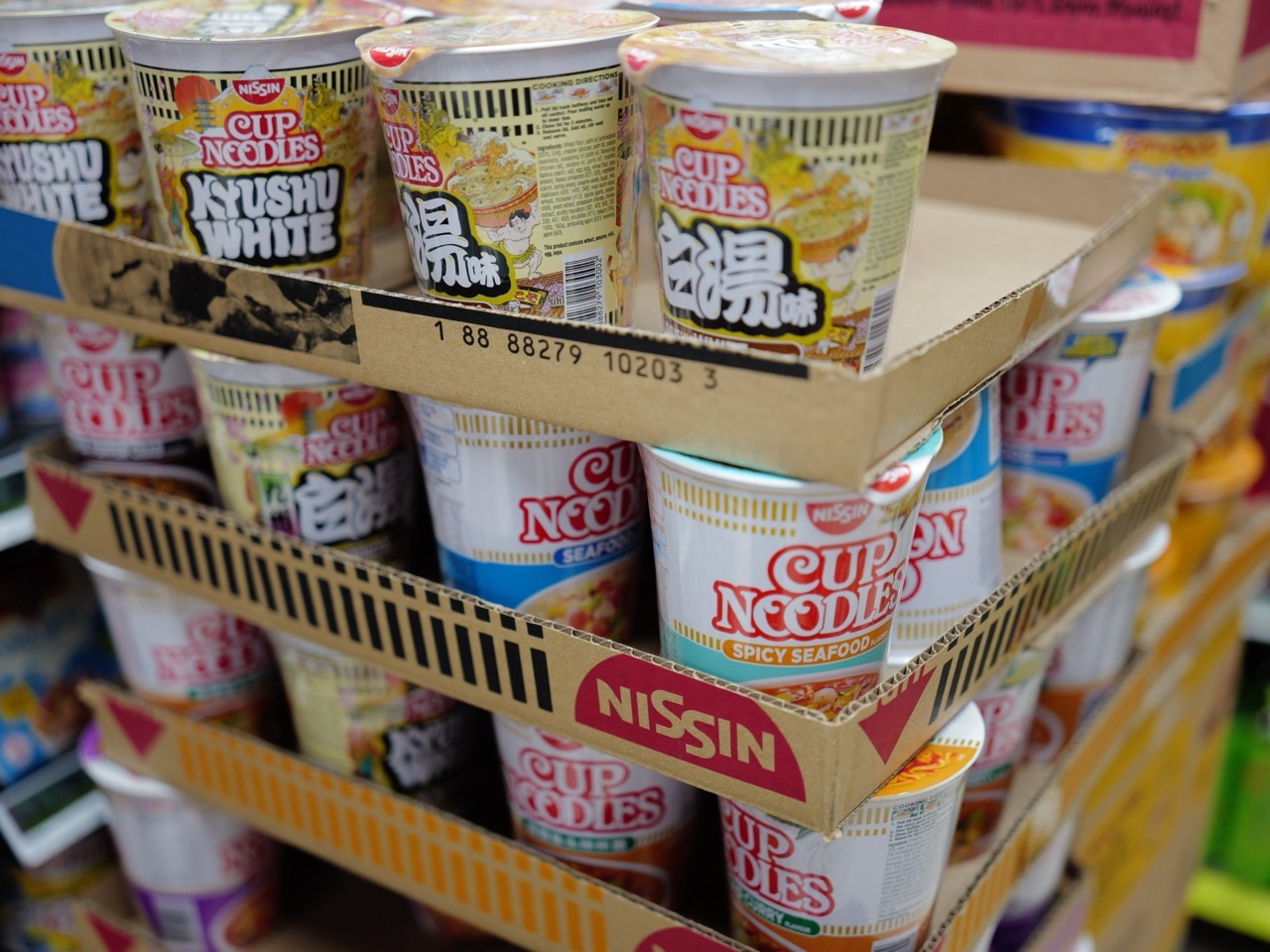
The supermarket shelf is not where the food lives.
It is where a much larger movement becomes visible for a few hours or days.
A supermarket shelf is not a pile of things. It is a moment inside a river.
The one-sentence answer
What looks like stock on a shelf is really the temporary result of a continuous replenishment system linking production, processing, storage, transport, information, standards, finance and demand.
The shelf feels permanent because the river behind it usually keeps moving.
Stand in front of the eggs
Imagine a supermarket in Singapore.
You stand in front of the eggs.
The cartons are lined up.
There are prices, brands, sizes and perhaps several countries of origin.
Your decision may take thirty seconds.
But the eggs did not begin on that shelf.
Before the shelf there was a farm.
Before the farm could produce reliably there was feed, water, animal health, housing, labour, electricity, equipment and veterinary knowledge.
After production came grading, packing, storage, transport, border procedures, food-safety requirements, importers, warehouses, distribution and retail handling.
Information travelled too.
Orders.
Forecasts.
Prices.
Inventory counts.
Certificates.
Temperature records.
Payment.
The egg moved through a physical chain and an information chain at the same time.
A full shelf is a timing achievement
Suppose a supermarket needs one hundred cartons of a product each day.
If exactly one hundred arrive each day, the shelf can look permanently full even though nearly the entire stock is being replaced every twenty-four hours.
The visual impression is permanence.
The operational reality is turnover.
That is the first important Lights Out lesson:
Something can look stationary because replacement happens at roughly the same rate as removal.
This pattern is not unique to food.
A pharmacy shelf can look permanent while medicines are continually arriving and leaving.
A fuel station can look permanent while fuel is replenished.
A construction project can appear to “have materials” because steel, concrete inputs, glass, fittings and equipment continue arriving in sequence.
A factory can appear self-contained while components arrive every week.
Stock is often a visible pause inside flow.
The shelf begins far away
Singapore makes this unusually easy to see because the country is deeply connected to international food supply.
Singapore Food Agency data for 2025 says Singapore imports more than 90 per cent of its food and sources food from more than 180 countries and regions.
Singapore Food Agency — Singapore Food Statistics 2025
That means a neighbourhood supermarket is not merely a local shop.
It is one receiving surface of a planetary geography.
A single aisle may contain food linked to tropical farms, temperate farms, fisheries, feed producers, ports, airports, packaging plants, cold stores, roads, laboratories, insurers, banks and government agencies across many jurisdictions.
And this geography changes.
Weather changes harvests.
Disease affects livestock.
War changes routes.
Fuel prices change transport costs.
Regulations change what can cross a border.
Currency movements change purchasing decisions.
Consumer demand changes what importers order next.
The shelf is local.
The causes of the shelf are not.
There are several rivers, not one
When we say “supply chain,” it is easy to imagine a single line.
Real supply is closer to several moving rivers crossing one another.
The product river
Food, packaging and ingredients physically move.
The information river
Demand signals, inventory levels, shipping notices, forecasts, certificates and traceability data move.
The money river
Credit, payment, insurance and foreign exchange make transactions possible.
The trust river
Inspection, accreditation, source approval, food-safety rules, standards and commercial reputation allow distant parties to accept goods they did not personally produce.
The temperature river
For perishable food, temperature must remain inside an acceptable range through storage and transport.
The Food and Agriculture Organization describes cold chains as temperature-controlled systems that protect food quality, safety and shelf life from production to consumption. A break in that chain can destroy value even when the food still physically exists.
FAO — From Farm to Fork: Keeping Food Fresh and Safe
A product can arrive physically and still fail to arrive usefully.
Why timing matters as much as quantity
Suppose a warehouse has a month’s supply of something.
That sounds safe.
But safe for what demand?
At what rate of consumption?
With what expiry date?
Under what storage conditions?
With what replacement lead time?
A buffer is not merely a pile.
It is time purchased in advance.
Inventory is one way civilisation stores time.
If the next shipment normally takes two days, one week’s inventory may be generous.
If the replacement lead time becomes six weeks, the same stock means something very different.
This is why disruptions are not understood by looking at quantity alone.
You need quantity plus consumption plus time plus alternatives.
The Lights Out Event begins with buffers
In the main Lights Out Event, the wider world stops arriving at midnight.
The next morning, the supermarket does not instantly become empty.
That would be poor reasoning.
Food already exists in homes, shops, warehouses and local production systems.
The second Singapore initially lives from stored civilisation.
The important change is not immediate emptiness.
It is that replacement has stopped.
Once replacement stops, every unit consumed is now subtraction rather than part of a cycle.
The river becomes a reservoir.
Then the reservoir begins falling.
Why some shelves empty faster than others
Different goods have different supply personalities.
Perishability
Fresh vegetables, seafood and chilled products cannot be stockpiled indefinitely.
Bulk
Some goods take enormous physical space to store.
Demand variability
Demand can change rapidly when people anticipate shortage.
Lead time
Some goods can be replaced quickly. Others require long production cycles or distant shipping.
Substitutability
If one fruit disappears, another may replace it. A specialised medical reagent or machine component may have far fewer substitutes.
Safety requirements
A substitute is useful only if it can meet the required safety and quality standards.
This means resilience cannot be reduced to “how much stock do we have?”
The better question is:
How many safe ways do we have to keep the function going?
Diversification is about options
Singapore Food Story 2 uses four food-resilience pillars: Diversify Imports, Global Partnerships, Stockpile and Grow Local.
This is important because each solves a different problem.
- Diversify Imports reduces dependence on one source.
- Global Partnerships help keep routes and cooperation usable during disruption.
- Stockpile buys time.
- Grow Local preserves some production capability closer to the receiver.
Singapore Food Agency — Our Singapore Food Story 2
Notice what the strategy does not say.
It does not say one answer makes every other answer unnecessary.
Resilience comes from options that fail differently.
Why local does not mean isolated
A local farm may still depend on imported feed, seed, fertiliser, equipment, energy, packaging, software or expertise.
A local bakery can depend on imported wheat.
A local food processor can depend on overseas machinery.
A local warehouse can depend on imported refrigeration equipment.
So “local” identifies where a particular operation occurs.
It does not automatically identify the location of every dependency.
This is why the Lights Out branch treats supply as a network rather than a patriotic slogan.
Information can create shortages before physical supply changes
Supply chains do not respond only to physical reality.
They respond to expectations.
If retailers expect demand to rise, they order more.
If wholesalers see larger retailer orders, they may order even more from suppliers.
If consumers fear scarcity, they may buy more than usual.
A small change in final demand can therefore become a much larger change in orders further upstream.
Supply-chain researchers call one version of this the bullwhip effect: variability becomes amplified as information and ordering decisions move upstream.
This matters because a shelf can become empty for several different reasons.
- Production genuinely fell.
- Transport was delayed.
- Demand rose suddenly.
- People bought earlier than usual.
- Inventory was in the wrong location.
- Information was wrong.
- Orders were amplified by uncertainty.
The visible symptom is the same.
The cause may be completely different.
The shelf is also a trust surface
A full supermarket would not be useful if nobody trusted the food.
Supply therefore includes more than movement.
The product must remain safe enough, correctly labelled enough and traceable enough for the receiver to use.
SFA describes food-safety surveillance that includes retail sampling, targeted checks and recalls when unsafe food is identified.
Singapore Food Agency — Market Monitoring and Food Safety
This is why “arrived” is not enough.
The receiver needs a usable receipt:
the right thing, in the right condition, at the right place, at the right time, with enough reason to trust it.
Follow one carton backwards
Here is a useful exercise.
Pick one product in your kitchen.
Do not begin with “where was it made?”
That question is too small.
Ask:
- Where was the final product made or grown?
- Where did its important inputs come from?
- Did it need refrigeration?
- Which routes did it travel?
- How long did the journey take?
- Who stored it?
- What information had to arrive before the product could move?
- Which safety or quality checks mattered?
- What would be a realistic substitute?
- Which small missing input could stop the entire chain?
By question ten, the object will usually have become much larger than itself.
What this article does not claim
- It does not claim that global supply chains are always efficient or fair.
- It does not claim that more inventory is always better.
- It does not claim that local production is unimportant.
- It does not claim that every import dependency is dangerous.
- It does not claim that a temporary empty shelf is evidence of civilisational collapse.
The narrower claim is that visible stock is produced by an invisible sequence of replenishment, timing, information, trust and movement.
The shelf teaches us how civilisation works
A shelf looks solid.
Its reality is dynamic.
A city looks solid too.
Its reality is also dynamic.
Food arrives.
Fuel arrives.
Parts arrive.
People arrive.
Information arrives.
Money arrives.
Waste leaves.
Machines are repaired.
Students replace retiring specialists.
New knowledge enters old institutions.
Civilisation often looks like a place because the flows through the place are reliable.
Continue the Lights Out branch
Previous: Reliability Compresses Complexity.
Next: The Hidden Geography of Singapore — why an island is larger than its map.
Deep connections
- Stored Civilisation — inventory is one form of time stored in advance.
- The Bottleneck Problem — flow is limited by constrained stages.
- Civilisation Must Make Things Disappear — forward flow needs a return journey.
- The Last Mile of Civilisation — arrival is only complete when the receiver can use it.
- LogisticsOS and Civilisation — canonical logistics owner.
- When Nobody Has the Same Picture — information flow shapes physical flow.
For the main twin-mirror case study, return to Civilisation — The Lights Out Event.