
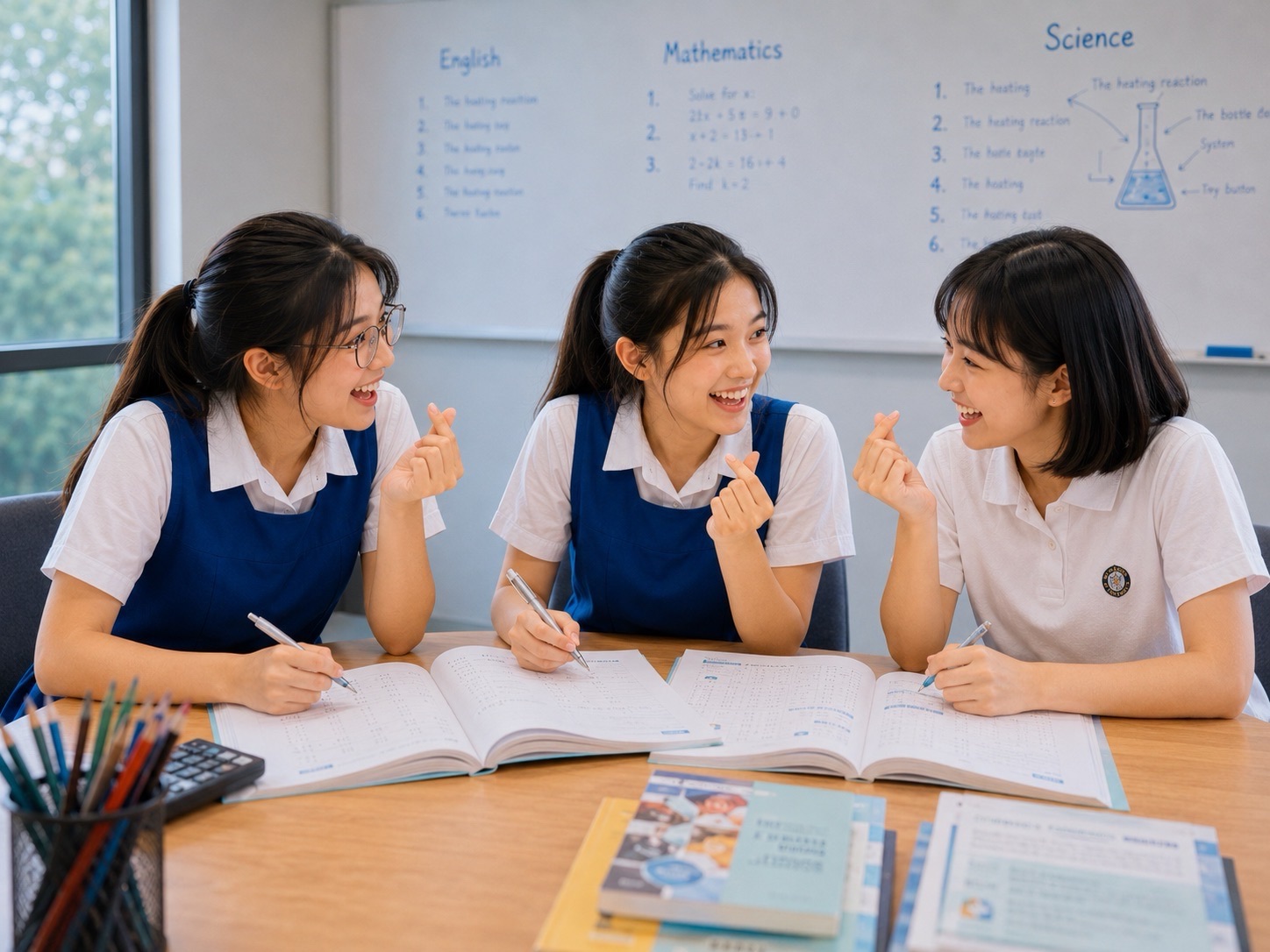
There is a simple way to misunderstand G1, G2 and G3 Mathematics.
We can treat them as three labels attached to three kinds of students.
That is not the useful way to teach them.
Under Singapore’s Full Subject-Based Banding system, the better question is narrower and more practical:
At what level of mathematical demand can this student learn successfully now, and what would have to improve for the next level of demand to become realistic?
That question changes tuition. It moves the discussion away from status and towards evidence, readiness, repair and growth.
This guide sits inside How Secondary Mathematics Tuition Works. It is the teaching-and-tuition companion to eduKateSG’s wider Secondary Mathematics and pathways material. The next article in this series will explain the G1/G2/G3 system itself in more detail; this one is about what the different levels mean when a real student is sitting in front of a tutor.
The 50-second answer for parents
- G1, G2 and G3 are subject levels, not identities. A student can have different strengths across subjects.
- The right level is not automatically the highest level. It is the level at which the student can build reliable understanding while being appropriately stretched.
- Teaching too high can create noise. The student spends so much effort surviving the representation that the underlying mathematics never stabilises.
- Teaching too low can create a false sense of success. Accuracy rises because the demand is below the student’s capability, but growth stalls.
- The useful goal is upward readiness. Repair the foundations, strengthen transfer and let evidence show when greater demand is appropriate.
- Tuition should follow the student’s mathematical state. Not every G2 learner needs the same lesson, and not every G3 learner needs harder worksheets.
What G1, G2 and G3 mean in the current Singapore system
Full Subject-Based Banding has been fully implemented in secondary schools since 2024. Under the system, students can offer subjects at G1, G2 or G3 subject levels, with “G” standing for General. These levels were mapped from the former N(T), N(A) and Express standards respectively, while the old stream labels are being phased out of the secondary-school experience.
The important teaching implication is flexibility. The subject level is about the level of demand in that subject. It should not be used as a shorthand description of the whole child.
From 2027, graduating students will sit the Singapore-Cambridge Secondary Education Certificate, or SEC, at their respective subject levels. The certificate will reflect the subjects and levels offered. For families, this makes subject-level readiness increasingly important: Mathematics is not merely a school timetable slot; it is a pathway that develops over several years.
Official references: Ministry of Education Singapore and SEAB’s Secondary Education Certificate information.
The wrong question: Which level is better?
A ranking mindset immediately creates the wrong teaching problem.
If the only goal is to place every student at the highest possible subject level as quickly as possible, tuition can become a race to expose the child to harder material. But exposure and readiness are not the same thing.
A student can sit in front of a G3 worksheet and understand very little. Another can work through a G2 problem with control, explain the relationships, transfer the method to a changed question and be ready for greater demand.
Which student is in the stronger learning position?
The useful objective is not the label. It is the capability that makes the label sustainable.
The right level is a zone of productive challenge
Imagine three versions of the same lesson.
In the first, every question is already easy. The student is accurate, relaxed and fast. It feels successful, but very little new learning is occurring.
In the second, the mathematics is difficult enough that the student must think, but the foundations are strong enough that explanations and corrections can be absorbed. This is productive challenge.
In the third, the representation is so far beyond the student’s current control that each line requires rescue. The child copies steps, guesses methods and remembers fragments. Difficulty is high, but useful learning is low.
| Teaching state | What it looks like | Likely result |
|---|---|---|
| Too low | High accuracy with little thinking | Confidence may rise, but capability plateaus |
| Productive challenge | Some errors, explainable reasoning, successful correction and transfer | Capability grows |
| Too high | Constant rescue, copied steps, weak retention | Surface exposure without stable ownership |
Good tuition tries to keep the student in the middle state and move that middle state upwards over time.
Three students, three mathematical states
Alicia, Tricia and Kai Kai are all in Secondary Mathematics. Their school labels alone do not tell us enough to teach them well.
Alicia is currently studying Mathematics at G1. Her arithmetic is improving, but negative numbers and algebraic notation still consume a great deal of attention. She understands better when the relationship is connected to a number line, concrete quantity or familiar representation.
Tricia is studying Mathematics at G2. Her procedures are generally secure, but unfamiliar word problems expose a transfer weakness. She often knows the mathematics after the tutor points out the structure, but does not yet recognise that structure independently.
Kai Kai is studying Mathematics at G3. She handles routine algebra quickly, but her marks are being limited by reasoning, representation and careless compression in multi-step questions.
Giving all three students “harder questions” would be a poor response.
- Alicia needs representation and foundation stability.
- Tricia needs transfer and strategy selection.
- Kai Kai needs higher-order reliability under load.
The subject levels provide context. The diagnosis chooses the lesson.
G1 Mathematics: build dependable mathematical access
For a student learning Mathematics at G1, the first teaching job is often to make important mathematical relationships accessible and reliable.
This does not mean removing thinking. It means controlling unnecessary cognitive load so the student can actually see the mathematics.
Useful teaching may emphasise:
- clear number sense and signed-number foundations;
- stepwise algebra with visible meaning;
- strong links between words, diagrams, tables and symbols;
- worked examples followed by gradually reduced prompting;
- frequent retrieval of core procedures;
- short transfer tasks so the student learns that the same idea can appear in a different form.
The mistake would be to interpret support as permanent simplification. A good G1 lesson should still move toward independence and greater demand as the student becomes ready.
G2 Mathematics: strengthen structure and transfer
At G2, many students can already execute a substantial amount of Mathematics. The limiting factor may become whether they can connect, interpret and transfer what they know.
A student may be accurate on familiar algebraic forms but uncertain when the same relationship is embedded in a word problem. Another may know ratio and percentage separately but struggle when a question moves between them.
Useful teaching therefore increases variation:
- change the representation while keeping the relationship;
- move the unknown;
- mix topics so the method is not announced in advance;
- ask the student to explain why a method fits;
- introduce more multi-step reasoning;
- reduce the tutor’s prompts.
This is where the child begins to move from “I know how to do this kind of question” towards “I can work out what kind of mathematical relationship this question contains.”
G3 Mathematics: increase abstraction without losing reliability
G3 Mathematics increases the level of abstraction, breadth and examination demand. But the teaching mistake here is assuming that every G3 learner simply needs more difficult worksheets.
A high-performing student can still have a weak link. It may sit in algebraic fractions, graph interpretation, geometric reasoning, model construction, proof-like explanation, or the ability to maintain accuracy across a long chain of work.
For Kai Kai, the next gain may not come from seeing a harder topic. It may come from learning to slow down one critical line, preserve equivalence and check whether the result is structurally plausible.
At G3, useful tuition often does four things:
- deepens conceptual connections;
- increases unfamiliar transfer;
- builds multi-step reliability;
- converts capability into examination performance.
The higher the demand, the more expensive a small hidden weakness can become.
Teaching at the right level is not the same as teaching the syllabus page
A school syllabus tells us what is to be learned. It does not by itself tell us what the individual child’s first teaching move should be.
Suppose the class is studying linear equations. One student’s problem is negative numbers. Another student’s problem is equality. A third student’s problem is translating the word problem into an equation.
The page is the same. The bottleneck is different.
This is why the eduKateSG approach keeps diagnosis close to teaching. The Secondary Mathematics gap diagnostic separates concept, representation, procedure and transfer. That distinction is more useful than simply writing “weak in algebra” at the top of a notebook.
The four kinds of mismatch a tutor should notice
| Mismatch | What the tutor sees | Likely response |
|---|---|---|
| Concept mismatch | The student cannot explain the relationship | Rebuild meaning before increasing difficulty |
| Representation mismatch | The student understands in one form but not another | Translate between diagrams, tables, words and symbols |
| Procedure mismatch | The student understands but executes unreliably | Strengthen working routines and fluency |
| Transfer mismatch | The student succeeds only when the question looks familiar | Increase variation and independent strategy selection |
Any of these can occur at G1, G2 or G3. The difference is the surrounding level of demand.
How upward movement should be built
Families naturally ask whether a student can move to a more demanding subject level. Under Full Subject-Based Banding, students can adjust subject levels at appropriate junctures based on their learning progress and the school’s processes.
Tuition can support readiness for that possibility, but it should not treat movement as a promise or a badge.
A useful readiness sequence is:
- Stabilise the current level. Routine work should no longer be fragile.
- Repair inherited weak links. The next level will magnify them.
- Introduce controlled stretch. Use selected questions from greater demand without abandoning the current syllabus.
- Check transfer. Can the student use the mathematics when the form changes?
- Check independence. Can the student succeed without heavy prompting?
- Use school evidence. Current school performance and school-level criteria matter.
The aim is to make movement sustainable if it occurs.
Why pushing too early can backfire
There is a tempting argument: if a student may eventually need harder Mathematics, why not start harder Mathematics immediately?
Because later mathematics is built from earlier dependencies.
If algebraic manipulation is still unstable, adding more abstraction increases the number of places the weakness can appear. If fraction sense is weak, algebraic fractions can become a compound problem. If the student cannot yet translate words into relationships, harder word problems mostly create more guessing.
Acceleration is valuable when the floor can carry the load.
This is the same principle used in the Primary 6 to Secondary 1 arithmetic-to-algebra bridge: preserve the old meaning, introduce the new representation, then increase independence.
Why holding a ready student too low can also backfire
The inverse mistake is real too.
A student who is consistently accurate, transfers independently, explains relationships and completes current work with substantial spare capacity may need more stretch.
If every lesson remains routine, the student learns that Mathematics is about speed rather than thought. Curiosity can flatten. Examination surprises become more expensive because the student has had little practice meeting unfamiliar structures.
Teaching at the right level therefore requires movement in both directions: repair when the floor is weak, stretch when the floor is strong.
How 3-pax tuition can work across different levels
A small group of three does not require three students to have identical mathematical profiles.
What it requires is enough visibility for the tutor to keep track of where each student is operating.
A shared lesson might be about algebraic equations. Alicia works on preserving equality with explicit balance reasoning. Tricia solves mixed equation forms and translates word statements into equations. Kai Kai receives an unfamiliar application that requires constructing the equation before solving it.
The topic is shared. The cognitive demand is calibrated.
Same mathematical family. Different current edge. Visible individual handoff.
That is one reason a small group can be useful: the tutor can adjust the edge without turning the classroom into three unrelated private lessons.
A 90-minute lesson should move between centre and edge
The centre is what the student can already do reliably. The edge is where learning is occurring.
A useful lesson moves between them:
- Centre check: retrieve a prerequisite and see whether it is still stable.
- Edge teaching: introduce the next relationship or repair the bottleneck.
- Guided transfer: change the representation or problem form.
- Independent return: reduce prompts and test ownership.
- Stretch or repair decision: choose what should happen next.
The lesson is therefore not defined only by “G2 Chapter 4” or “G3 Algebra”. It has an internal learning state.
How parents can tell whether the level is right
Parents do not need to judge this from one score. Look for patterns.
| Signal | Possible meaning |
|---|---|
| Everything is easy for weeks | The student may need more stretch |
| Almost every question needs rescue | The level or prerequisite floor may be too demanding |
| Errors are understandable and corrections survive | Productive challenge is likely occurring |
| Student can explain but works slowly | Fluency may be the next job, not easier content |
| Student is fast but cannot handle changed forms | Transfer needs strengthening |
| Student increasingly works without prompts | Capability is becoming owned |
The identity trap
There is one more reason to be careful with subject levels: students listen to the language adults use around them.
“You are a G1 student.”
“You are a G3 student.”
Those sentences sound efficient, but they collapse a subject-level description into an identity.
A better formulation is:
You are currently learning Mathematics at this level of demand. Let us see what you understand, what needs repair and what you are ready to do next.
That language is more accurate. It also keeps the system open to development.
What changes as the SEC approaches
The 2027 graduating cohort will sit the Singapore-Cambridge Secondary Education Certificate. Under the SEC, students sit subjects at the respective G1, G2 or G3 level and receive a certificate reflecting those subjects and levels.
That makes one principle especially important: teach the student for the paper they actually need to operate, while developing as much mathematical capability as the student can sustainably carry.
For the final-year architecture, eduKateSG already separates the three Mathematics routes in How Secondary 4 Mathematics Works | SEC G1, G2 & G3, with dedicated G1, G2 and G3 guides underneath it.
A parent checklist for Secondary Mathematics tuition
- Does the tutor know the student’s current subject level and school context?
- Can the tutor identify the actual mathematical bottleneck rather than only the chapter?
- Is the work difficult enough to create learning but not so difficult that every line requires rescue?
- Are earlier foundations repaired when they reappear inside secondary topics?
- Does practice include changed representations and unfamiliar forms?
- Is the child becoming less dependent on prompts?
- Is stretch introduced when current work is genuinely secure?
- Are claims about moving subject levels kept realistic and aligned with school processes?
Those questions tell you more about the teaching system than a promise to “cover G3 early” or “finish the syllabus fast”.
Where this article connects inside eduKateSG
- How Secondary Mathematics Tuition Works — the canonical tuition mechanism.
- How Secondary Mathematics Education Works — the wider education system.
- Diagnosing Secondary Mathematics Gaps — concept, representation, procedure and transfer.
- How Secondary 4 Mathematics Works | SEC G1, G2 & G3 — final-year subject-level routes.
- From PSLE to SEC — the broader pathway specification.
- Parents & Pathways Hub — PSLE, Full SBB, Secondary routes and education choices.
Frequently asked questions
Is G3 Mathematics always better than G2 or G1?
No. G1, G2 and G3 indicate different subject levels of demand. The useful question is whether the student is learning successfully at the current level and what level of demand is appropriate next.
Can a student move to a more demanding subject level?
Full Subject-Based Banding provides flexibility for students to adjust subject levels at appropriate junctures, based on learning progress and school processes. Families should check the current school’s criteria and recommendations.
Should tuition teach one level above the school?
Not by default. Selected stretch can be useful when the current floor is secure, but teaching above level simply for exposure can create fragile learning. The amount of stretch should follow evidence.
Can a G3 student still need foundation repair?
Yes. Strong students can have narrow but expensive weak links. Repairing one does not mean lowering expectations; it means strengthening the structure that higher-level work depends on.
Can a G1 student be stretched?
Yes. Stretch should be appropriate to the student’s current mathematics. It can mean greater independence, changed representations, deeper explanation or selected higher-demand questions when the foundations are ready.
The idea to keep
G1, G2 and G3 should help Singapore secondary education respond more precisely to subject-level readiness. Tuition should do the same thing at an even finer scale.
Do not teach the label. Teach the student.
Find the current centre of control. Find the next productive edge. Repair what prevents movement. Stretch what is already stable. Then use evidence to decide what comes next.
That is what “the right level” should mean.
For class enquiries, use Contact eduKateSG. For the wider Mathematics pathway, continue through the Mathematics Learning Hub.