
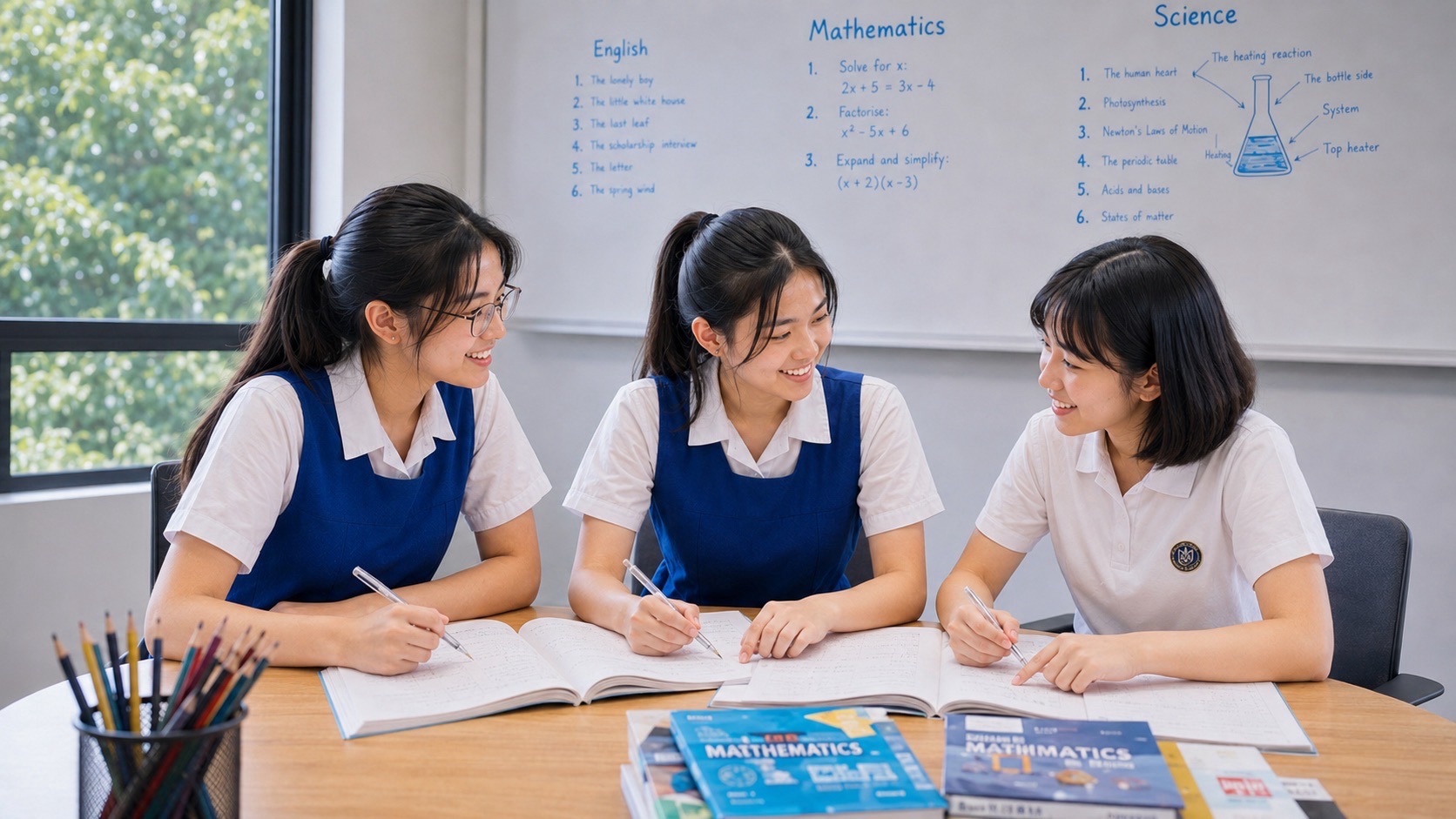
Updated 19 September 2026. Parents searching for Secondary 3 Additional Math tuition in Bukit Timah need a way to judge whether a tuition programme can actually solve the mathematical job in front of the student. This page is not a directory. It is a 2027 SEC A-Math build-year quality standard for Secondary 3 students in 2026 building the Additional Mathematics system for the 2027 Singapore-Cambridge SEC year, built around diagnosis, transfer, examination control and the gradual return of mathematical ownership to the learner.
For the first 2027 SEC cohort, SEAB lists G2 Additional Mathematics K232 and G3 Additional Mathematics K341. K232 maps from the earlier 4051 reference route and K341 from 4049. Secondary 3 tuition should therefore build the correct subject-level A-Math system for the student’s school offering instead of treating all A-Math as one generic course.
The central proposition is simple: Strong Secondary 3 A-Math tuition should build algebraic infrastructure, functions, trigonometry, calculus runway, retrieval and method selection in 2026 so that 2027 can focus on examination conversion rather than emergency reconstruction. A strong programme should know what the student can already do, identify the first high-cost weakness, choose the smallest intervention that can repair it, and prove that the repair survives a changed question, a delay and realistic examination conditions.
For current details, families should use official SEAB syllabus information and MOE guidance where pathway context matters. Tuition should adapt to the current system rather than preserve outdated assumptions.
50-second parent router
| Question | Strong evidence | Weak evidence |
|---|---|---|
| Does the tutor know the actual exam/pathway? | the student’s actual 2027 G2 K232 or G3 K341 A-Math route where offered | Generic “O-Level/A-Math” claims |
| Does the tutor diagnose? | First-wrong-step and error-family analysis | More worksheets immediately |
| Does learning transfer? | New surface + delayed retest | Corrected example only |
| Is exam skill trained? | Timing, checking, recovery and paper review | Paper volume alone |
| Is independence growing? | Fewer prompts and stronger self-correction | Tutor remains the first-step engine |
Official examination or pathway control layer
1. G2 Additional Mathematics
SEAB lists K232 for 2027. The programme should use the actual G2 syllabus and school sequence rather than informal downscaling of G3 materials.
2. G3 Additional Mathematics
SEAB lists K341 for 2027. The subject continues the strong emphasis on standard techniques, problem solving, reasoning and communication.
3. Full SBB context
Subject levels are part of a flexible system; the tutor should treat G2/G3 A-Math as educational routes rather than identity labels.
4. Build-year purpose
Secondary 3 should establish carriers, retrieval and transfer before Secondary 4 increases full-paper intensity.
5. Shared core-Math carriers
Algebra, graphs and representation may affect both Mathematics and A-Math, so shared failures should be repaired once and retested in both subjects.
6. Independent acquisition
Tuition should not preview so aggressively that school learning becomes impossible without pre-teaching.
Twenty quality standards
1. Route accuracy
The tutor should know the exact subject code, level or syllabus that applies to the student and should not blend neighbouring examination systems casually. For Secondary 3 students in 2026 building the Additional Mathematics system for the 2027 Singapore-Cambridge SEC year, parents should ask for a concrete example from the student’s current work and a specific next test. A quality standard is only useful when it changes what happens in the lesson.
2. Marked-work diagnosis
Real first attempts should drive the teaching plan. The tutor should inspect the path to the answer, not only the final score. For Secondary 3 students in 2026 building the Additional Mathematics system for the 2027 Singapore-Cambridge SEC year, parents should ask for a concrete example from the student’s current work and a specific next test. A quality standard is only useful when it changes what happens in the lesson.
3. First-wrong-step analysis
The earliest invalid or missing decision should be identified before a repair is chosen. For Secondary 3 students in 2026 building the Additional Mathematics system for the 2027 Singapore-Cambridge SEC year, parents should ask for a concrete example from the student’s current work and a specific next test. A quality standard is only useful when it changes what happens in the lesson.
4. Carrier awareness
Shared algebra, fraction, graph or representation weaknesses should be repaired upstream rather than repeatedly inside every chapter. For Secondary 3 students in 2026 building the Additional Mathematics system for the 2027 Singapore-Cambridge SEC year, parents should ask for a concrete example from the student’s current work and a specific next test. A quality standard is only useful when it changes what happens in the lesson.
5. Independent first attempts
Students should try before the tutor names the method so diagnostic visibility is preserved. For Secondary 3 students in 2026 building the Additional Mathematics system for the 2027 Singapore-Cambridge SEC year, parents should ask for a concrete example from the student’s current work and a specific next test. A quality standard is only useful when it changes what happens in the lesson.
6. Method conditions
The learner should understand why a method applies and what would make it invalid. For Secondary 3 students in 2026 building the Additional Mathematics system for the 2027 Singapore-Cambridge SEC year, parents should ask for a concrete example from the student’s current work and a specific next test. A quality standard is only useful when it changes what happens in the lesson.
7. Representation flexibility
Words, algebra, diagrams, tables and graphs should be used strategically when they reveal structure. For Secondary 3 students in 2026 building the Additional Mathematics system for the 2027 Singapore-Cambridge SEC year, parents should ask for a concrete example from the student’s current work and a specific next test. A quality standard is only useful when it changes what happens in the lesson.
8. Focused practice
When a mechanism is unstable, isolate it before returning to mixed papers. For Secondary 3 students in 2026 building the Additional Mathematics system for the 2027 Singapore-Cambridge SEC year, parents should ask for a concrete example from the student’s current work and a specific next test. A quality standard is only useful when it changes what happens in the lesson.
9. Mixed recognition
Once the mechanism is stable, remove chapter cues and make the student choose the route. For Secondary 3 students in 2026 building the Additional Mathematics system for the 2027 Singapore-Cambridge SEC year, parents should ask for a concrete example from the student’s current work and a specific next test. A quality standard is only useful when it changes what happens in the lesson.
10. Spaced retrieval
Old methods should remain accessible across weeks without complete re-teaching. For Secondary 3 students in 2026 building the Additional Mathematics system for the 2027 Singapore-Cambridge SEC year, parents should ask for a concrete example from the student’s current work and a specific next test. A quality standard is only useful when it changes what happens in the lesson.
11. Immediate variation
A repaired idea should face a changed question before the lesson ends where appropriate. For Secondary 3 students in 2026 building the Additional Mathematics system for the 2027 Singapore-Cambridge SEC year, parents should ask for a concrete example from the student’s current work and a specific next test. A quality standard is only useful when it changes what happens in the lesson.
12. Delayed transfer
The student should solve a structurally related question after time has passed. For Secondary 3 students in 2026 building the Additional Mathematics system for the 2027 Singapore-Cambridge SEC year, parents should ask for a concrete example from the student’s current work and a specific next test. A quality standard is only useful when it changes what happens in the lesson.
13. Checkable working
High-risk transformations should remain visible enough to audit under time. For Secondary 3 students in 2026 building the Additional Mathematics system for the 2027 Singapore-Cambridge SEC year, parents should ask for a concrete example from the student’s current work and a specific next test. A quality standard is only useful when it changes what happens in the lesson.
14. Mathematical checking
Verification should be structural: substitution, inverse operation, units, range, graph, estimate or another suitable check. For Secondary 3 students in 2026 building the Additional Mathematics system for the 2027 Singapore-Cambridge SEC year, parents should ask for a concrete example from the student’s current work and a specific next test. A quality standard is only useful when it changes what happens in the lesson.
15. Time protection
The student should know when a route is no longer producing enough progress to justify more time. For Secondary 3 students in 2026 building the Additional Mathematics system for the 2027 Singapore-Cambridge SEC year, parents should ask for a concrete example from the student’s current work and a specific next test. A quality standard is only useful when it changes what happens in the lesson.
16. Recovery
One hard question should remain local rather than destabilising the next page. For Secondary 3 students in 2026 building the Additional Mathematics system for the 2027 Singapore-Cambridge SEC year, parents should ask for a concrete example from the student’s current work and a specific next test. A quality standard is only useful when it changes what happens in the lesson.
17. Answer-change discipline
Correct answers should not be changed without identified mathematical evidence. For Secondary 3 students in 2026 building the Additional Mathematics system for the 2027 Singapore-Cambridge SEC year, parents should ask for a concrete example from the student’s current work and a specific next test. A quality standard is only useful when it changes what happens in the lesson.
18. Paper post-mortems
Practice papers should generate targeted repairs, not just scores. For Secondary 3 students in 2026 building the Additional Mathematics system for the 2027 Singapore-Cambridge SEC year, parents should ask for a concrete example from the student’s current work and a specific next test. A quality standard is only useful when it changes what happens in the lesson.
19. Workload realism
Homework should produce learning evidence without overwhelming school revision, sleep and other subjects. For Secondary 3 students in 2026 building the Additional Mathematics system for the 2027 Singapore-Cambridge SEC year, parents should ask for a concrete example from the student’s current work and a specific next test. A quality standard is only useful when it changes what happens in the lesson.
20. Exit logic
The programme should be able to say when a target is stable enough to stop drilling and when regular tuition can reduce. For Secondary 3 students in 2026 building the Additional Mathematics system for the 2027 Singapore-Cambridge SEC year, parents should ask for a concrete example from the student’s current work and a specific next test. A quality standard is only useful when it changes what happens in the lesson.
Secondary 3 Additional Mathematics capability atlas
1. algebraic infrastructure
Strong tuition should be able to separate knowledge of algebraic infrastructure from recognition, representation, execution and examination performance. The tutor should show how this capability appears in authentic Secondary 3 Additional Mathematics work, what prerequisite relationships carry it, which errors recur, and how the student will be asked to demonstrate the skill independently on a changed question.
A useful evidence chain is: first attempt → first wrong step → focused repair → immediate variation → delayed variation → mixed or timed re-entry. If the learner succeeds only while the original worked example or tutor cue remains visible, algebraic infrastructure is not yet portable enough.
2. factorisation
Strong tuition should be able to separate knowledge of factorisation from recognition, representation, execution and examination performance. The tutor should show how this capability appears in authentic Secondary 3 Additional Mathematics work, what prerequisite relationships carry it, which errors recur, and how the student will be asked to demonstrate the skill independently on a changed question.
A useful evidence chain is: first attempt → first wrong step → focused repair → immediate variation → delayed variation → mixed or timed re-entry. If the learner succeeds only while the original worked example or tutor cue remains visible, factorisation is not yet portable enough.
3. equations and inequalities
Strong tuition should be able to separate knowledge of equations and inequalities from recognition, representation, execution and examination performance. The tutor should show how this capability appears in authentic Secondary 3 Additional Mathematics work, what prerequisite relationships carry it, which errors recur, and how the student will be asked to demonstrate the skill independently on a changed question.
A useful evidence chain is: first attempt → first wrong step → focused repair → immediate variation → delayed variation → mixed or timed re-entry. If the learner succeeds only while the original worked example or tutor cue remains visible, equations and inequalities is not yet portable enough.
4. indices and surds
Strong tuition should be able to separate knowledge of indices and surds from recognition, representation, execution and examination performance. The tutor should show how this capability appears in authentic Secondary 3 Additional Mathematics work, what prerequisite relationships carry it, which errors recur, and how the student will be asked to demonstrate the skill independently on a changed question.
A useful evidence chain is: first attempt → first wrong step → focused repair → immediate variation → delayed variation → mixed or timed re-entry. If the learner succeeds only while the original worked example or tutor cue remains visible, indices and surds is not yet portable enough.
5. functions and graphs
Strong tuition should be able to separate knowledge of functions and graphs from recognition, representation, execution and examination performance. The tutor should show how this capability appears in authentic Secondary 3 Additional Mathematics work, what prerequisite relationships carry it, which errors recur, and how the student will be asked to demonstrate the skill independently on a changed question.
A useful evidence chain is: first attempt → first wrong step → focused repair → immediate variation → delayed variation → mixed or timed re-entry. If the learner succeeds only while the original worked example or tutor cue remains visible, functions and graphs is not yet portable enough.
6. trigonometric structure
Strong tuition should be able to separate knowledge of trigonometric structure from recognition, representation, execution and examination performance. The tutor should show how this capability appears in authentic Secondary 3 Additional Mathematics work, what prerequisite relationships carry it, which errors recur, and how the student will be asked to demonstrate the skill independently on a changed question.
A useful evidence chain is: first attempt → first wrong step → focused repair → immediate variation → delayed variation → mixed or timed re-entry. If the learner succeeds only while the original worked example or tutor cue remains visible, trigonometric structure is not yet portable enough.
7. calculus runway
Strong tuition should be able to separate knowledge of calculus runway from recognition, representation, execution and examination performance. The tutor should show how this capability appears in authentic Secondary 3 Additional Mathematics work, what prerequisite relationships carry it, which errors recur, and how the student will be asked to demonstrate the skill independently on a changed question.
A useful evidence chain is: first attempt → first wrong step → focused repair → immediate variation → delayed variation → mixed or timed re-entry. If the learner succeeds only while the original worked example or tutor cue remains visible, calculus runway is not yet portable enough.
8. geometry/proof where relevant
Strong tuition should be able to separate knowledge of geometry/proof where relevant from recognition, representation, execution and examination performance. The tutor should show how this capability appears in authentic Secondary 3 Additional Mathematics work, what prerequisite relationships carry it, which errors recur, and how the student will be asked to demonstrate the skill independently on a changed question.
A useful evidence chain is: first attempt → first wrong step → focused repair → immediate variation → delayed variation → mixed or timed re-entry. If the learner succeeds only while the original worked example or tutor cue remains visible, geometry/proof where relevant is not yet portable enough.
9. method selection
Strong tuition should be able to separate knowledge of method selection from recognition, representation, execution and examination performance. The tutor should show how this capability appears in authentic Secondary 3 Additional Mathematics work, what prerequisite relationships carry it, which errors recur, and how the student will be asked to demonstrate the skill independently on a changed question.
A useful evidence chain is: first attempt → first wrong step → focused repair → immediate variation → delayed variation → mixed or timed re-entry. If the learner succeeds only while the original worked example or tutor cue remains visible, method selection is not yet portable enough.
10. retrieval
Strong tuition should be able to separate knowledge of retrieval from recognition, representation, execution and examination performance. The tutor should show how this capability appears in authentic Secondary 3 Additional Mathematics work, what prerequisite relationships carry it, which errors recur, and how the student will be asked to demonstrate the skill independently on a changed question.
A useful evidence chain is: first attempt → first wrong step → focused repair → immediate variation → delayed variation → mixed or timed re-entry. If the learner succeeds only while the original worked example or tutor cue remains visible, retrieval is not yet portable enough.
11. shared core-Math carriers
Strong tuition should be able to separate knowledge of shared core-math carriers from recognition, representation, execution and examination performance. The tutor should show how this capability appears in authentic Secondary 3 Additional Mathematics work, what prerequisite relationships carry it, which errors recur, and how the student will be asked to demonstrate the skill independently on a changed question.
A useful evidence chain is: first attempt → first wrong step → focused repair → immediate variation → delayed variation → mixed or timed re-entry. If the learner succeeds only while the original worked example or tutor cue remains visible, shared core-math carriers is not yet portable enough.
12. working quality
Strong tuition should be able to separate knowledge of working quality from recognition, representation, execution and examination performance. The tutor should show how this capability appears in authentic Secondary 3 Additional Mathematics work, what prerequisite relationships carry it, which errors recur, and how the student will be asked to demonstrate the skill independently on a changed question.
A useful evidence chain is: first attempt → first wrong step → focused repair → immediate variation → delayed variation → mixed or timed re-entry. If the learner succeeds only while the original worked example or tutor cue remains visible, working quality is not yet portable enough.
13. checking
Strong tuition should be able to separate knowledge of checking from recognition, representation, execution and examination performance. The tutor should show how this capability appears in authentic Secondary 3 Additional Mathematics work, what prerequisite relationships carry it, which errors recur, and how the student will be asked to demonstrate the skill independently on a changed question.
A useful evidence chain is: first attempt → first wrong step → focused repair → immediate variation → delayed variation → mixed or timed re-entry. If the learner succeeds only while the original worked example or tutor cue remains visible, checking is not yet portable enough.
14. timed mini-sets
Strong tuition should be able to separate knowledge of timed mini-sets from recognition, representation, execution and examination performance. The tutor should show how this capability appears in authentic Secondary 3 Additional Mathematics work, what prerequisite relationships carry it, which errors recur, and how the student will be asked to demonstrate the skill independently on a changed question.
A useful evidence chain is: first attempt → first wrong step → focused repair → immediate variation → delayed variation → mixed or timed re-entry. If the learner succeeds only while the original worked example or tutor cue remains visible, timed mini-sets is not yet portable enough.
15. independent acquisition
Strong tuition should be able to separate knowledge of independent acquisition from recognition, representation, execution and examination performance. The tutor should show how this capability appears in authentic Secondary 3 Additional Mathematics work, what prerequisite relationships carry it, which errors recur, and how the student will be asked to demonstrate the skill independently on a changed question.
A useful evidence chain is: first attempt → first wrong step → focused repair → immediate variation → delayed variation → mixed or timed re-entry. If the learner succeeds only while the original worked example or tutor cue remains visible, independent acquisition is not yet portable enough.
Twenty red flags
1. Every wrong answer receives a full explanation before diagnosis
This does not prove poor teaching by itself, but it should trigger a sharper question: what mathematical decision is this lesson trying to improve, what evidence shows that the decision is weak, and what new problem will test whether the repair transferred for Secondary 3 students in 2026 building the Additional Mathematics system for the 2027 Singapore-Cambridge SEC year?
2. Worksheets are selected by difficulty rather than error mechanism
This does not prove poor teaching by itself, but it should trigger a sharper question: what mathematical decision is this lesson trying to improve, what evidence shows that the decision is weak, and what new problem will test whether the repair transferred for Secondary 3 students in 2026 building the Additional Mathematics system for the 2027 Singapore-Cambridge SEC year?
3. The tutor cannot state the student’s first weak link
This does not prove poor teaching by itself, but it should trigger a sharper question: what mathematical decision is this lesson trying to improve, what evidence shows that the decision is weak, and what new problem will test whether the repair transferred for Secondary 3 students in 2026 building the Additional Mathematics system for the 2027 Singapore-Cambridge SEC year?
4. The same prompt is supplied every time a question looks difficult
This does not prove poor teaching by itself, but it should trigger a sharper question: what mathematical decision is this lesson trying to improve, what evidence shows that the decision is weak, and what new problem will test whether the repair transferred for Secondary 3 students in 2026 building the Additional Mathematics system for the 2027 Singapore-Cambridge SEC year?
5. Model answers remain visible during most practice
This does not prove poor teaching by itself, but it should trigger a sharper question: what mathematical decision is this lesson trying to improve, what evidence shows that the decision is weak, and what new problem will test whether the repair transferred for Secondary 3 students in 2026 building the Additional Mathematics system for the 2027 Singapore-Cambridge SEC year?
6. No delayed retests are used
This does not prove poor teaching by itself, but it should trigger a sharper question: what mathematical decision is this lesson trying to improve, what evidence shows that the decision is weak, and what new problem will test whether the repair transferred for Secondary 3 students in 2026 building the Additional Mathematics system for the 2027 Singapore-Cambridge SEC year?
7. Mixed questions are postponed indefinitely
This does not prove poor teaching by itself, but it should trigger a sharper question: what mathematical decision is this lesson trying to improve, what evidence shows that the decision is weak, and what new problem will test whether the repair transferred for Secondary 3 students in 2026 building the Additional Mathematics system for the 2027 Singapore-Cambridge SEC year?
8. Careless mistakes are never classified
This does not prove poor teaching by itself, but it should trigger a sharper question: what mathematical decision is this lesson trying to improve, what evidence shows that the decision is weak, and what new problem will test whether the repair transferred for Secondary 3 students in 2026 building the Additional Mathematics system for the 2027 Singapore-Cambridge SEC year?
9. The programme cannot explain how checking is taught
This does not prove poor teaching by itself, but it should trigger a sharper question: what mathematical decision is this lesson trying to improve, what evidence shows that the decision is weak, and what new problem will test whether the repair transferred for Secondary 3 students in 2026 building the Additional Mathematics system for the 2027 Singapore-Cambridge SEC year?
10. Timed work begins before major carriers are stable
This does not prove poor teaching by itself, but it should trigger a sharper question: what mathematical decision is this lesson trying to improve, what evidence shows that the decision is weak, and what new problem will test whether the repair transferred for Secondary 3 students in 2026 building the Additional Mathematics system for the 2027 Singapore-Cambridge SEC year?
11. Full papers repeat the same errors without focused repair
This does not prove poor teaching by itself, but it should trigger a sharper question: what mathematical decision is this lesson trying to improve, what evidence shows that the decision is weak, and what new problem will test whether the repair transferred for Secondary 3 students in 2026 building the Additional Mathematics system for the 2027 Singapore-Cambridge SEC year?
12. Calculator use is not audited
This does not prove poor teaching by itself, but it should trigger a sharper question: what mathematical decision is this lesson trying to improve, what evidence shows that the decision is weak, and what new problem will test whether the repair transferred for Secondary 3 students in 2026 building the Additional Mathematics system for the 2027 Singapore-Cambridge SEC year?
13. Notation and working quality are ignored
This does not prove poor teaching by itself, but it should trigger a sharper question: what mathematical decision is this lesson trying to improve, what evidence shows that the decision is weak, and what new problem will test whether the repair transferred for Secondary 3 students in 2026 building the Additional Mathematics system for the 2027 Singapore-Cambridge SEC year?
14. Strong students are only given later syllabus content
This does not prove poor teaching by itself, but it should trigger a sharper question: what mathematical decision is this lesson trying to improve, what evidence shows that the decision is weak, and what new problem will test whether the repair transferred for Secondary 3 students in 2026 building the Additional Mathematics system for the 2027 Singapore-Cambridge SEC year?
15. Old foundation gaps are hidden by preview
This does not prove poor teaching by itself, but it should trigger a sharper question: what mathematical decision is this lesson trying to improve, what evidence shows that the decision is weak, and what new problem will test whether the repair transferred for Secondary 3 students in 2026 building the Additional Mathematics system for the 2027 Singapore-Cambridge SEC year?
16. Small-group teaching functions like a lecture
This does not prove poor teaching by itself, but it should trigger a sharper question: what mathematical decision is this lesson trying to improve, what evidence shows that the decision is weak, and what new problem will test whether the repair transferred for Secondary 3 students in 2026 building the Additional Mathematics system for the 2027 Singapore-Cambridge SEC year?
17. Peer answers appear before independent attempts
This does not prove poor teaching by itself, but it should trigger a sharper question: what mathematical decision is this lesson trying to improve, what evidence shows that the decision is weak, and what new problem will test whether the repair transferred for Secondary 3 students in 2026 building the Additional Mathematics system for the 2027 Singapore-Cambridge SEC year?
18. Parent updates remain generic
This does not prove poor teaching by itself, but it should trigger a sharper question: what mathematical decision is this lesson trying to improve, what evidence shows that the decision is weak, and what new problem will test whether the repair transferred for Secondary 3 students in 2026 building the Additional Mathematics system for the 2027 Singapore-Cambridge SEC year?
19. Current official exam/pathway information is not verified
This does not prove poor teaching by itself, but it should trigger a sharper question: what mathematical decision is this lesson trying to improve, what evidence shows that the decision is weak, and what new problem will test whether the repair transferred for Secondary 3 students in 2026 building the Additional Mathematics system for the 2027 Singapore-Cambridge SEC year?
20. There is no clear support-reduction condition
This does not prove poor teaching by itself, but it should trigger a sharper question: what mathematical decision is this lesson trying to improve, what evidence shows that the decision is weak, and what new problem will test whether the repair transferred for Secondary 3 students in 2026 building the Additional Mathematics system for the 2027 Singapore-Cambridge SEC year?
Twenty green flags
1. First attempts are preserved
This is useful because quality should appear outside the tuition room. The strongest confirmation is that the student can reproduce the capability on new work, after delay, with fewer prompts and under the real conditions relevant to Secondary 3 students in 2026 building the Additional Mathematics system for the 2027 Singapore-Cambridge SEC year.
2. Error families are named precisely
This is useful because quality should appear outside the tuition room. The strongest confirmation is that the student can reproduce the capability on new work, after delay, with fewer prompts and under the real conditions relevant to Secondary 3 students in 2026 building the Additional Mathematics system for the 2027 Singapore-Cambridge SEC year.
3. The tutor can distinguish knowledge from recognition
This is useful because quality should appear outside the tuition room. The strongest confirmation is that the student can reproduce the capability on new work, after delay, with fewer prompts and under the real conditions relevant to Secondary 3 students in 2026 building the Additional Mathematics system for the 2027 Singapore-Cambridge SEC year.
4. Focused practice is short and purposeful
This is useful because quality should appear outside the tuition room. The strongest confirmation is that the student can reproduce the capability on new work, after delay, with fewer prompts and under the real conditions relevant to Secondary 3 students in 2026 building the Additional Mathematics system for the 2027 Singapore-Cambridge SEC year.
5. Mixed practice appears after stabilisation
This is useful because quality should appear outside the tuition room. The strongest confirmation is that the student can reproduce the capability on new work, after delay, with fewer prompts and under the real conditions relevant to Secondary 3 students in 2026 building the Additional Mathematics system for the 2027 Singapore-Cambridge SEC year.
6. Representations are changed deliberately
This is useful because quality should appear outside the tuition room. The strongest confirmation is that the student can reproduce the capability on new work, after delay, with fewer prompts and under the real conditions relevant to Secondary 3 students in 2026 building the Additional Mathematics system for the 2027 Singapore-Cambridge SEC year.
7. Method conditions are discussed
This is useful because quality should appear outside the tuition room. The strongest confirmation is that the student can reproduce the capability on new work, after delay, with fewer prompts and under the real conditions relevant to Secondary 3 students in 2026 building the Additional Mathematics system for the 2027 Singapore-Cambridge SEC year.
8. Plausible wrong routes are analysed
This is useful because quality should appear outside the tuition room. The strongest confirmation is that the student can reproduce the capability on new work, after delay, with fewer prompts and under the real conditions relevant to Secondary 3 students in 2026 building the Additional Mathematics system for the 2027 Singapore-Cambridge SEC year.
9. Retrieval is spaced
This is useful because quality should appear outside the tuition room. The strongest confirmation is that the student can reproduce the capability on new work, after delay, with fewer prompts and under the real conditions relevant to Secondary 3 students in 2026 building the Additional Mathematics system for the 2027 Singapore-Cambridge SEC year.
10. Paper review changes the next lesson
This is useful because quality should appear outside the tuition room. The strongest confirmation is that the student can reproduce the capability on new work, after delay, with fewer prompts and under the real conditions relevant to Secondary 3 students in 2026 building the Additional Mathematics system for the 2027 Singapore-Cambridge SEC year.
11. Checking is mathematical
This is useful because quality should appear outside the tuition room. The strongest confirmation is that the student can reproduce the capability on new work, after delay, with fewer prompts and under the real conditions relevant to Secondary 3 students in 2026 building the Additional Mathematics system for the 2027 Singapore-Cambridge SEC year.
12. Prompt depth is reduced over time
This is useful because quality should appear outside the tuition room. The strongest confirmation is that the student can reproduce the capability on new work, after delay, with fewer prompts and under the real conditions relevant to Secondary 3 students in 2026 building the Additional Mathematics system for the 2027 Singapore-Cambridge SEC year.
13. Peer reasoning is used without peer copying
This is useful because quality should appear outside the tuition room. The strongest confirmation is that the student can reproduce the capability on new work, after delay, with fewer prompts and under the real conditions relevant to Secondary 3 students in 2026 building the Additional Mathematics system for the 2027 Singapore-Cambridge SEC year.
14. Strong students receive reasoning depth
This is useful because quality should appear outside the tuition room. The strongest confirmation is that the student can reproduce the capability on new work, after delay, with fewer prompts and under the real conditions relevant to Secondary 3 students in 2026 building the Additional Mathematics system for the 2027 Singapore-Cambridge SEC year.
15. Foundations are repaired without stigma
This is useful because quality should appear outside the tuition room. The strongest confirmation is that the student can reproduce the capability on new work, after delay, with fewer prompts and under the real conditions relevant to Secondary 3 students in 2026 building the Additional Mathematics system for the 2027 Singapore-Cambridge SEC year.
16. School or official exam evidence is integrated
This is useful because quality should appear outside the tuition room. The strongest confirmation is that the student can reproduce the capability on new work, after delay, with fewer prompts and under the real conditions relevant to Secondary 3 students in 2026 building the Additional Mathematics system for the 2027 Singapore-Cambridge SEC year.
17. Timed work has a stated purpose
This is useful because quality should appear outside the tuition room. The strongest confirmation is that the student can reproduce the capability on new work, after delay, with fewer prompts and under the real conditions relevant to Secondary 3 students in 2026 building the Additional Mathematics system for the 2027 Singapore-Cambridge SEC year.
18. Recovery is practised
This is useful because quality should appear outside the tuition room. The strongest confirmation is that the student can reproduce the capability on new work, after delay, with fewer prompts and under the real conditions relevant to Secondary 3 students in 2026 building the Additional Mathematics system for the 2027 Singapore-Cambridge SEC year.
19. Parents receive transfer evidence
This is useful because quality should appear outside the tuition room. The strongest confirmation is that the student can reproduce the capability on new work, after delay, with fewer prompts and under the real conditions relevant to Secondary 3 students in 2026 building the Additional Mathematics system for the 2027 Singapore-Cambridge SEC year.
20. Support can reduce when learning is stable
This is useful because quality should appear outside the tuition room. The strongest confirmation is that the student can reproduce the capability on new work, after delay, with fewer prompts and under the real conditions relevant to Secondary 3 students in 2026 building the Additional Mathematics system for the 2027 Singapore-Cambridge SEC year.
Diagnostic laboratory
Diagnostic 1: algebra baseline
Use a short, discriminating task rather than a long generic worksheet. Preserve the student’s first attempt, identify whether algebra baseline fails at the knowledge, recognition, representation, execution or examination-control layer, and record the smallest tutor prompt that changes the outcome. The next step should test the suspected mechanism directly rather than assume the whole topic is weak.
After repair, change at least one surface feature and later test the skill again without the original cue. For Secondary 3 students in 2026 building the Additional Mathematics system for the 2027 Singapore-Cambridge SEC year, the final proof is that the student can deploy the capability in authentic mixed or timed work and can explain what they are checking.
Diagnostic 2: factorisation reverse check
Use a short, discriminating task rather than a long generic worksheet. Preserve the student’s first attempt, identify whether factorisation reverse check fails at the knowledge, recognition, representation, execution or examination-control layer, and record the smallest tutor prompt that changes the outcome. The next step should test the suspected mechanism directly rather than assume the whole topic is weak.
After repair, change at least one surface feature and later test the skill again without the original cue. For Secondary 3 students in 2026 building the Additional Mathematics system for the 2027 Singapore-Cambridge SEC year, the final proof is that the student can deploy the capability in authentic mixed or timed work and can explain what they are checking.
Diagnostic 3: equation verification
Use a short, discriminating task rather than a long generic worksheet. Preserve the student’s first attempt, identify whether equation verification fails at the knowledge, recognition, representation, execution or examination-control layer, and record the smallest tutor prompt that changes the outcome. The next step should test the suspected mechanism directly rather than assume the whole topic is weak.
After repair, change at least one surface feature and later test the skill again without the original cue. For Secondary 3 students in 2026 building the Additional Mathematics system for the 2027 Singapore-Cambridge SEC year, the final proof is that the student can deploy the capability in authentic mixed or timed work and can explain what they are checking.
Diagnostic 4: index/surd control
Use a short, discriminating task rather than a long generic worksheet. Preserve the student’s first attempt, identify whether index/surd control fails at the knowledge, recognition, representation, execution or examination-control layer, and record the smallest tutor prompt that changes the outcome. The next step should test the suspected mechanism directly rather than assume the whole topic is weak.
After repair, change at least one surface feature and later test the skill again without the original cue. For Secondary 3 students in 2026 building the Additional Mathematics system for the 2027 Singapore-Cambridge SEC year, the final proof is that the student can deploy the capability in authentic mixed or timed work and can explain what they are checking.
Diagnostic 5: function notation
Use a short, discriminating task rather than a long generic worksheet. Preserve the student’s first attempt, identify whether function notation fails at the knowledge, recognition, representation, execution or examination-control layer, and record the smallest tutor prompt that changes the outcome. The next step should test the suspected mechanism directly rather than assume the whole topic is weak.
After repair, change at least one surface feature and later test the skill again without the original cue. For Secondary 3 students in 2026 building the Additional Mathematics system for the 2027 Singapore-Cambridge SEC year, the final proof is that the student can deploy the capability in authentic mixed or timed work and can explain what they are checking.
Diagnostic 6: graph interpretation
Use a short, discriminating task rather than a long generic worksheet. Preserve the student’s first attempt, identify whether graph interpretation fails at the knowledge, recognition, representation, execution or examination-control layer, and record the smallest tutor prompt that changes the outcome. The next step should test the suspected mechanism directly rather than assume the whole topic is weak.
After repair, change at least one surface feature and later test the skill again without the original cue. For Secondary 3 students in 2026 building the Additional Mathematics system for the 2027 Singapore-Cambridge SEC year, the final proof is that the student can deploy the capability in authentic mixed or timed work and can explain what they are checking.
Diagnostic 7: trig identity target selection
Use a short, discriminating task rather than a long generic worksheet. Preserve the student’s first attempt, identify whether trig identity target selection fails at the knowledge, recognition, representation, execution or examination-control layer, and record the smallest tutor prompt that changes the outcome. The next step should test the suspected mechanism directly rather than assume the whole topic is weak.
After repair, change at least one surface feature and later test the skill again without the original cue. For Secondary 3 students in 2026 building the Additional Mathematics system for the 2027 Singapore-Cambridge SEC year, the final proof is that the student can deploy the capability in authentic mixed or timed work and can explain what they are checking.
Diagnostic 8: trig equation range control
Use a short, discriminating task rather than a long generic worksheet. Preserve the student’s first attempt, identify whether trig equation range control fails at the knowledge, recognition, representation, execution or examination-control layer, and record the smallest tutor prompt that changes the outcome. The next step should test the suspected mechanism directly rather than assume the whole topic is weak.
After repair, change at least one surface feature and later test the skill again without the original cue. For Secondary 3 students in 2026 building the Additional Mathematics system for the 2027 Singapore-Cambridge SEC year, the final proof is that the student can deploy the capability in authentic mixed or timed work and can explain what they are checking.
Diagnostic 9: calculus-readiness algebra
Use a short, discriminating task rather than a long generic worksheet. Preserve the student’s first attempt, identify whether calculus-readiness algebra fails at the knowledge, recognition, representation, execution or examination-control layer, and record the smallest tutor prompt that changes the outcome. The next step should test the suspected mechanism directly rather than assume the whole topic is weak.
After repair, change at least one surface feature and later test the skill again without the original cue. For Secondary 3 students in 2026 building the Additional Mathematics system for the 2027 Singapore-Cambridge SEC year, the final proof is that the student can deploy the capability in authentic mixed or timed work and can explain what they are checking.
Diagnostic 10: derivative meaning
Use a short, discriminating task rather than a long generic worksheet. Preserve the student’s first attempt, identify whether derivative meaning fails at the knowledge, recognition, representation, execution or examination-control layer, and record the smallest tutor prompt that changes the outcome. The next step should test the suspected mechanism directly rather than assume the whole topic is weak.
After repair, change at least one surface feature and later test the skill again without the original cue. For Secondary 3 students in 2026 building the Additional Mathematics system for the 2027 Singapore-Cambridge SEC year, the final proof is that the student can deploy the capability in authentic mixed or timed work and can explain what they are checking.
Diagnostic 11: integration meaning
Use a short, discriminating task rather than a long generic worksheet. Preserve the student’s first attempt, identify whether integration meaning fails at the knowledge, recognition, representation, execution or examination-control layer, and record the smallest tutor prompt that changes the outcome. The next step should test the suspected mechanism directly rather than assume the whole topic is weak.
After repair, change at least one surface feature and later test the skill again without the original cue. For Secondary 3 students in 2026 building the Additional Mathematics system for the 2027 Singapore-Cambridge SEC year, the final proof is that the student can deploy the capability in authentic mixed or timed work and can explain what they are checking.
Diagnostic 12: shared core/A-Math carrier test
Use a short, discriminating task rather than a long generic worksheet. Preserve the student’s first attempt, identify whether shared core/a-math carrier test fails at the knowledge, recognition, representation, execution or examination-control layer, and record the smallest tutor prompt that changes the outcome. The next step should test the suspected mechanism directly rather than assume the whole topic is weak.
After repair, change at least one surface feature and later test the skill again without the original cue. For Secondary 3 students in 2026 building the Additional Mathematics system for the 2027 Singapore-Cambridge SEC year, the final proof is that the student can deploy the capability in authentic mixed or timed work and can explain what they are checking.
Diagnostic 13: mixed recognition
Use a short, discriminating task rather than a long generic worksheet. Preserve the student’s first attempt, identify whether mixed recognition fails at the knowledge, recognition, representation, execution or examination-control layer, and record the smallest tutor prompt that changes the outcome. The next step should test the suspected mechanism directly rather than assume the whole topic is weak.
After repair, change at least one surface feature and later test the skill again without the original cue. For Secondary 3 students in 2026 building the Additional Mathematics system for the 2027 Singapore-Cambridge SEC year, the final proof is that the student can deploy the capability in authentic mixed or timed work and can explain what they are checking.
Diagnostic 14: spaced retrieval
Use a short, discriminating task rather than a long generic worksheet. Preserve the student’s first attempt, identify whether spaced retrieval fails at the knowledge, recognition, representation, execution or examination-control layer, and record the smallest tutor prompt that changes the outcome. The next step should test the suspected mechanism directly rather than assume the whole topic is weak.
After repair, change at least one surface feature and later test the skill again without the original cue. For Secondary 3 students in 2026 building the Additional Mathematics system for the 2027 Singapore-Cambridge SEC year, the final proof is that the student can deploy the capability in authentic mixed or timed work and can explain what they are checking.
Diagnostic 15: worked-example reconstruction
Use a short, discriminating task rather than a long generic worksheet. Preserve the student’s first attempt, identify whether worked-example reconstruction fails at the knowledge, recognition, representation, execution or examination-control layer, and record the smallest tutor prompt that changes the outcome. The next step should test the suspected mechanism directly rather than assume the whole topic is weak.
After repair, change at least one surface feature and later test the skill again without the original cue. For Secondary 3 students in 2026 building the Additional Mathematics system for the 2027 Singapore-Cambridge SEC year, the final proof is that the student can deploy the capability in authentic mixed or timed work and can explain what they are checking.
Diagnostic 16: model-answer fading
Use a short, discriminating task rather than a long generic worksheet. Preserve the student’s first attempt, identify whether model-answer fading fails at the knowledge, recognition, representation, execution or examination-control layer, and record the smallest tutor prompt that changes the outcome. The next step should test the suspected mechanism directly rather than assume the whole topic is weak.
After repair, change at least one surface feature and later test the skill again without the original cue. For Secondary 3 students in 2026 building the Additional Mathematics system for the 2027 Singapore-Cambridge SEC year, the final proof is that the student can deploy the capability in authentic mixed or timed work and can explain what they are checking.
Diagnostic 17: timed mini-set
Use a short, discriminating task rather than a long generic worksheet. Preserve the student’s first attempt, identify whether timed mini-set fails at the knowledge, recognition, representation, execution or examination-control layer, and record the smallest tutor prompt that changes the outcome. The next step should test the suspected mechanism directly rather than assume the whole topic is weak.
After repair, change at least one surface feature and later test the skill again without the original cue. For Secondary 3 students in 2026 building the Additional Mathematics system for the 2027 Singapore-Cambridge SEC year, the final proof is that the student can deploy the capability in authentic mixed or timed work and can explain what they are checking.
Diagnostic 18: late-session stability
Use a short, discriminating task rather than a long generic worksheet. Preserve the student’s first attempt, identify whether late-session stability fails at the knowledge, recognition, representation, execution or examination-control layer, and record the smallest tutor prompt that changes the outcome. The next step should test the suspected mechanism directly rather than assume the whole topic is weak.
After repair, change at least one surface feature and later test the skill again without the original cue. For Secondary 3 students in 2026 building the Additional Mathematics system for the 2027 Singapore-Cambridge SEC year, the final proof is that the student can deploy the capability in authentic mixed or timed work and can explain what they are checking.
Diagnostic 19: prompt audit
Use a short, discriminating task rather than a long generic worksheet. Preserve the student’s first attempt, identify whether prompt audit fails at the knowledge, recognition, representation, execution or examination-control layer, and record the smallest tutor prompt that changes the outcome. The next step should test the suspected mechanism directly rather than assume the whole topic is weak.
After repair, change at least one surface feature and later test the skill again without the original cue. For Secondary 3 students in 2026 building the Additional Mathematics system for the 2027 Singapore-Cambridge SEC year, the final proof is that the student can deploy the capability in authentic mixed or timed work and can explain what they are checking.
Diagnostic 20: silent first attempt
Use a short, discriminating task rather than a long generic worksheet. Preserve the student’s first attempt, identify whether silent first attempt fails at the knowledge, recognition, representation, execution or examination-control layer, and record the smallest tutor prompt that changes the outcome. The next step should test the suspected mechanism directly rather than assume the whole topic is weak.
After repair, change at least one surface feature and later test the skill again without the original cue. For Secondary 3 students in 2026 building the Additional Mathematics system for the 2027 Singapore-Cambridge SEC year, the final proof is that the student can deploy the capability in authentic mixed or timed work and can explain what they are checking.
Parent casebook
Case 1: A-Math feels like symbol manipulation during G2 K232 build-year work
Do not answer this case with “more practice” until the mechanism is clearer. Compare the first attempt with the corrected version, ask what the student knew before help, and decide whether a-math feels like symbol manipulation reflects missing knowledge, poor recognition, representation difficulty, unstable execution or examination pressure. The intervention should be narrow enough that a changed question can verify it quickly.
Case 2: factorisation fails in many topics during G3 K341 build-year work
This case is valuable because the visible symptom can be downstream from a different cause. In G3 K341 build-year work, inspect the earliest line where reasoning diverges. If the same mechanism appears elsewhere, treat it as a carrier. If it is local, repair it without rebuilding the whole syllabus. Retest after delay and then return it to a mixed context.
Case 3: functions are memorised notation during functions and graphs
A quality programme should show parents an evidence chain here: original working, first wrong decision, selected repair, transfer question and new independent performance. For Secondary 3 students in 2026 building the Additional Mathematics system for the 2027 Singapore-Cambridge SEC year, the programme should also explain whether the issue materially affects the actual examination or pathway demands instead of inflating every weakness into an emergency.
Case 4: trig identities become random algebra during trigonometry
The tutor should use this scenario to reduce uncertainty. Test one alternative representation, one method-choice question and one execution check. The purpose is to discover what changes the student’s decision. Once the learner can handle the case without the tutor’s route cue, lesson time should move to the next higher-value weakness.
Case 5: calculus rules are learned before meaning during early calculus
Do not answer this case with “more practice” until the mechanism is clearer. Compare the first attempt with the corrected version, ask what the student knew before help, and decide whether calculus rules are learned before meaning reflects missing knowledge, poor recognition, representation difficulty, unstable execution or examination pressure. The intervention should be narrow enough that a changed question can verify it quickly.
Case 6: forgets earlier algebra during core-Math shared algebra
This case is valuable because the visible symptom can be downstream from a different cause. In core-Math shared algebra, inspect the earliest line where reasoning diverges. If the same mechanism appears elsewhere, treat it as a carrier. If it is local, repair it without rebuilding the whole syllabus. Retest after delay and then return it to a mixed context.
Case 7: relies on tutor preview during school tests
A quality programme should show parents an evidence chain here: original working, first wrong decision, selected repair, transfer question and new independent performance. For Secondary 3 students in 2026 building the Additional Mathematics system for the 2027 Singapore-Cambridge SEC year, the programme should also explain whether the issue materially affects the actual examination or pathway demands instead of inflating every weakness into an emergency.
Case 8: does well topically but weak mixed during timed mini-sets
The tutor should use this scenario to reduce uncertainty. Test one alternative representation, one method-choice question and one execution check. The purpose is to discover what changes the student’s decision. Once the learner can handle the case without the tutor’s route cue, lesson time should move to the next higher-value weakness.
Case 9: core Math and A-Math share the same errors during holiday consolidation
Do not answer this case with “more practice” until the mechanism is clearer. Compare the first attempt with the corrected version, ask what the student knew before help, and decide whether core math and a-math share the same errors reflects missing knowledge, poor recognition, representation difficulty, unstable execution or examination pressure. The intervention should be narrow enough that a changed question can verify it quickly.
Case 10: is strong but needs deeper challenge during unseen transfer problems
This case is valuable because the visible symptom can be downstream from a different cause. In unseen transfer problems, inspect the earliest line where reasoning diverges. If the same mechanism appears elsewhere, treat it as a carrier. If it is local, repair it without rebuilding the whole syllabus. Retest after delay and then return it to a mixed context.
Case 11: A-Math feels like symbol manipulation during G2 K232 build-year work
A quality programme should show parents an evidence chain here: original working, first wrong decision, selected repair, transfer question and new independent performance. For Secondary 3 students in 2026 building the Additional Mathematics system for the 2027 Singapore-Cambridge SEC year, the programme should also explain whether the issue materially affects the actual examination or pathway demands instead of inflating every weakness into an emergency.
Case 12: factorisation fails in many topics during G3 K341 build-year work
The tutor should use this scenario to reduce uncertainty. Test one alternative representation, one method-choice question and one execution check. The purpose is to discover what changes the student’s decision. Once the learner can handle the case without the tutor’s route cue, lesson time should move to the next higher-value weakness.
Case 13: functions are memorised notation during functions and graphs
Do not answer this case with “more practice” until the mechanism is clearer. Compare the first attempt with the corrected version, ask what the student knew before help, and decide whether functions are memorised notation reflects missing knowledge, poor recognition, representation difficulty, unstable execution or examination pressure. The intervention should be narrow enough that a changed question can verify it quickly.
Case 14: trig identities become random algebra during trigonometry
This case is valuable because the visible symptom can be downstream from a different cause. In trigonometry, inspect the earliest line where reasoning diverges. If the same mechanism appears elsewhere, treat it as a carrier. If it is local, repair it without rebuilding the whole syllabus. Retest after delay and then return it to a mixed context.
Case 15: calculus rules are learned before meaning during early calculus
A quality programme should show parents an evidence chain here: original working, first wrong decision, selected repair, transfer question and new independent performance. For Secondary 3 students in 2026 building the Additional Mathematics system for the 2027 Singapore-Cambridge SEC year, the programme should also explain whether the issue materially affects the actual examination or pathway demands instead of inflating every weakness into an emergency.
Case 16: forgets earlier algebra during core-Math shared algebra
The tutor should use this scenario to reduce uncertainty. Test one alternative representation, one method-choice question and one execution check. The purpose is to discover what changes the student’s decision. Once the learner can handle the case without the tutor’s route cue, lesson time should move to the next higher-value weakness.
Case 17: relies on tutor preview during school tests
Do not answer this case with “more practice” until the mechanism is clearer. Compare the first attempt with the corrected version, ask what the student knew before help, and decide whether relies on tutor preview reflects missing knowledge, poor recognition, representation difficulty, unstable execution or examination pressure. The intervention should be narrow enough that a changed question can verify it quickly.
Case 18: does well topically but weak mixed during timed mini-sets
This case is valuable because the visible symptom can be downstream from a different cause. In timed mini-sets, inspect the earliest line where reasoning diverges. If the same mechanism appears elsewhere, treat it as a carrier. If it is local, repair it without rebuilding the whole syllabus. Retest after delay and then return it to a mixed context.
Case 19: core Math and A-Math share the same errors during holiday consolidation
A quality programme should show parents an evidence chain here: original working, first wrong decision, selected repair, transfer question and new independent performance. For Secondary 3 students in 2026 building the Additional Mathematics system for the 2027 Singapore-Cambridge SEC year, the programme should also explain whether the issue materially affects the actual examination or pathway demands instead of inflating every weakness into an emergency.
Case 20: is strong but needs deeper challenge during unseen transfer problems
The tutor should use this scenario to reduce uncertainty. Test one alternative representation, one method-choice question and one execution check. The purpose is to discover what changes the student’s decision. Once the learner can handle the case without the tutor’s route cue, lesson time should move to the next higher-value weakness.
Case 21: A-Math feels like symbol manipulation during G2 K232 build-year work
Do not answer this case with “more practice” until the mechanism is clearer. Compare the first attempt with the corrected version, ask what the student knew before help, and decide whether a-math feels like symbol manipulation reflects missing knowledge, poor recognition, representation difficulty, unstable execution or examination pressure. The intervention should be narrow enough that a changed question can verify it quickly.
Case 22: factorisation fails in many topics during G3 K341 build-year work
This case is valuable because the visible symptom can be downstream from a different cause. In G3 K341 build-year work, inspect the earliest line where reasoning diverges. If the same mechanism appears elsewhere, treat it as a carrier. If it is local, repair it without rebuilding the whole syllabus. Retest after delay and then return it to a mixed context.
Case 23: functions are memorised notation during functions and graphs
A quality programme should show parents an evidence chain here: original working, first wrong decision, selected repair, transfer question and new independent performance. For Secondary 3 students in 2026 building the Additional Mathematics system for the 2027 Singapore-Cambridge SEC year, the programme should also explain whether the issue materially affects the actual examination or pathway demands instead of inflating every weakness into an emergency.
Case 24: trig identities become random algebra during trigonometry
The tutor should use this scenario to reduce uncertainty. Test one alternative representation, one method-choice question and one execution check. The purpose is to discover what changes the student’s decision. Once the learner can handle the case without the tutor’s route cue, lesson time should move to the next higher-value weakness.
Case 25: calculus rules are learned before meaning during early calculus
Do not answer this case with “more practice” until the mechanism is clearer. Compare the first attempt with the corrected version, ask what the student knew before help, and decide whether calculus rules are learned before meaning reflects missing knowledge, poor recognition, representation difficulty, unstable execution or examination pressure. The intervention should be narrow enough that a changed question can verify it quickly.
Case 26: forgets earlier algebra during core-Math shared algebra
This case is valuable because the visible symptom can be downstream from a different cause. In core-Math shared algebra, inspect the earliest line where reasoning diverges. If the same mechanism appears elsewhere, treat it as a carrier. If it is local, repair it without rebuilding the whole syllabus. Retest after delay and then return it to a mixed context.
Case 27: relies on tutor preview during school tests
A quality programme should show parents an evidence chain here: original working, first wrong decision, selected repair, transfer question and new independent performance. For Secondary 3 students in 2026 building the Additional Mathematics system for the 2027 Singapore-Cambridge SEC year, the programme should also explain whether the issue materially affects the actual examination or pathway demands instead of inflating every weakness into an emergency.
Case 28: does well topically but weak mixed during timed mini-sets
The tutor should use this scenario to reduce uncertainty. Test one alternative representation, one method-choice question and one execution check. The purpose is to discover what changes the student’s decision. Once the learner can handle the case without the tutor’s route cue, lesson time should move to the next higher-value weakness.
Case 29: core Math and A-Math share the same errors during holiday consolidation
Do not answer this case with “more practice” until the mechanism is clearer. Compare the first attempt with the corrected version, ask what the student knew before help, and decide whether core math and a-math share the same errors reflects missing knowledge, poor recognition, representation difficulty, unstable execution or examination pressure. The intervention should be narrow enough that a changed question can verify it quickly.
Case 30: is strong but needs deeper challenge during unseen transfer problems
This case is valuable because the visible symptom can be downstream from a different cause. In unseen transfer problems, inspect the earliest line where reasoning diverges. If the same mechanism appears elsewhere, treat it as a carrier. If it is local, repair it without rebuilding the whole syllabus. Retest after delay and then return it to a mixed context.
Case 31: A-Math feels like symbol manipulation during G2 K232 build-year work
A quality programme should show parents an evidence chain here: original working, first wrong decision, selected repair, transfer question and new independent performance. For Secondary 3 students in 2026 building the Additional Mathematics system for the 2027 Singapore-Cambridge SEC year, the programme should also explain whether the issue materially affects the actual examination or pathway demands instead of inflating every weakness into an emergency.
Case 32: factorisation fails in many topics during G3 K341 build-year work
The tutor should use this scenario to reduce uncertainty. Test one alternative representation, one method-choice question and one execution check. The purpose is to discover what changes the student’s decision. Once the learner can handle the case without the tutor’s route cue, lesson time should move to the next higher-value weakness.
Case 33: functions are memorised notation during functions and graphs
Do not answer this case with “more practice” until the mechanism is clearer. Compare the first attempt with the corrected version, ask what the student knew before help, and decide whether functions are memorised notation reflects missing knowledge, poor recognition, representation difficulty, unstable execution or examination pressure. The intervention should be narrow enough that a changed question can verify it quickly.
Case 34: trig identities become random algebra during trigonometry
This case is valuable because the visible symptom can be downstream from a different cause. In trigonometry, inspect the earliest line where reasoning diverges. If the same mechanism appears elsewhere, treat it as a carrier. If it is local, repair it without rebuilding the whole syllabus. Retest after delay and then return it to a mixed context.
Case 35: calculus rules are learned before meaning during early calculus
A quality programme should show parents an evidence chain here: original working, first wrong decision, selected repair, transfer question and new independent performance. For Secondary 3 students in 2026 building the Additional Mathematics system for the 2027 Singapore-Cambridge SEC year, the programme should also explain whether the issue materially affects the actual examination or pathway demands instead of inflating every weakness into an emergency.
Case 36: forgets earlier algebra during core-Math shared algebra
The tutor should use this scenario to reduce uncertainty. Test one alternative representation, one method-choice question and one execution check. The purpose is to discover what changes the student’s decision. Once the learner can handle the case without the tutor’s route cue, lesson time should move to the next higher-value weakness.
Case 37: relies on tutor preview during school tests
Do not answer this case with “more practice” until the mechanism is clearer. Compare the first attempt with the corrected version, ask what the student knew before help, and decide whether relies on tutor preview reflects missing knowledge, poor recognition, representation difficulty, unstable execution or examination pressure. The intervention should be narrow enough that a changed question can verify it quickly.
Case 38: does well topically but weak mixed during timed mini-sets
This case is valuable because the visible symptom can be downstream from a different cause. In timed mini-sets, inspect the earliest line where reasoning diverges. If the same mechanism appears elsewhere, treat it as a carrier. If it is local, repair it without rebuilding the whole syllabus. Retest after delay and then return it to a mixed context.
Case 39: core Math and A-Math share the same errors during holiday consolidation
A quality programme should show parents an evidence chain here: original working, first wrong decision, selected repair, transfer question and new independent performance. For Secondary 3 students in 2026 building the Additional Mathematics system for the 2027 Singapore-Cambridge SEC year, the programme should also explain whether the issue materially affects the actual examination or pathway demands instead of inflating every weakness into an emergency.
Case 40: is strong but needs deeper challenge during unseen transfer problems
The tutor should use this scenario to reduce uncertainty. Test one alternative representation, one method-choice question and one execution check. The purpose is to discover what changes the student’s decision. Once the learner can handle the case without the tutor’s route cue, lesson time should move to the next higher-value weakness.
Case 41: A-Math feels like symbol manipulation during G2 K232 build-year work
Do not answer this case with “more practice” until the mechanism is clearer. Compare the first attempt with the corrected version, ask what the student knew before help, and decide whether a-math feels like symbol manipulation reflects missing knowledge, poor recognition, representation difficulty, unstable execution or examination pressure. The intervention should be narrow enough that a changed question can verify it quickly.
Case 42: factorisation fails in many topics during G3 K341 build-year work
This case is valuable because the visible symptom can be downstream from a different cause. In G3 K341 build-year work, inspect the earliest line where reasoning diverges. If the same mechanism appears elsewhere, treat it as a carrier. If it is local, repair it without rebuilding the whole syllabus. Retest after delay and then return it to a mixed context.
Case 43: functions are memorised notation during functions and graphs
A quality programme should show parents an evidence chain here: original working, first wrong decision, selected repair, transfer question and new independent performance. For Secondary 3 students in 2026 building the Additional Mathematics system for the 2027 Singapore-Cambridge SEC year, the programme should also explain whether the issue materially affects the actual examination or pathway demands instead of inflating every weakness into an emergency.
Case 44: trig identities become random algebra during trigonometry
The tutor should use this scenario to reduce uncertainty. Test one alternative representation, one method-choice question and one execution check. The purpose is to discover what changes the student’s decision. Once the learner can handle the case without the tutor’s route cue, lesson time should move to the next higher-value weakness.
Case 45: calculus rules are learned before meaning during early calculus
Do not answer this case with “more practice” until the mechanism is clearer. Compare the first attempt with the corrected version, ask what the student knew before help, and decide whether calculus rules are learned before meaning reflects missing knowledge, poor recognition, representation difficulty, unstable execution or examination pressure. The intervention should be narrow enough that a changed question can verify it quickly.
Case 46: forgets earlier algebra during core-Math shared algebra
This case is valuable because the visible symptom can be downstream from a different cause. In core-Math shared algebra, inspect the earliest line where reasoning diverges. If the same mechanism appears elsewhere, treat it as a carrier. If it is local, repair it without rebuilding the whole syllabus. Retest after delay and then return it to a mixed context.
Case 47: relies on tutor preview during school tests
A quality programme should show parents an evidence chain here: original working, first wrong decision, selected repair, transfer question and new independent performance. For Secondary 3 students in 2026 building the Additional Mathematics system for the 2027 Singapore-Cambridge SEC year, the programme should also explain whether the issue materially affects the actual examination or pathway demands instead of inflating every weakness into an emergency.
Case 48: does well topically but weak mixed during timed mini-sets
The tutor should use this scenario to reduce uncertainty. Test one alternative representation, one method-choice question and one execution check. The purpose is to discover what changes the student’s decision. Once the learner can handle the case without the tutor’s route cue, lesson time should move to the next higher-value weakness.
Case 49: core Math and A-Math share the same errors during holiday consolidation
Do not answer this case with “more practice” until the mechanism is clearer. Compare the first attempt with the corrected version, ask what the student knew before help, and decide whether core math and a-math share the same errors reflects missing knowledge, poor recognition, representation difficulty, unstable execution or examination pressure. The intervention should be narrow enough that a changed question can verify it quickly.
Case 50: is strong but needs deeper challenge during unseen transfer problems
This case is valuable because the visible symptom can be downstream from a different cause. In unseen transfer problems, inspect the earliest line where reasoning diverges. If the same mechanism appears elsewhere, treat it as a carrier. If it is local, repair it without rebuilding the whole syllabus. Retest after delay and then return it to a mixed context.
Case 51: A-Math feels like symbol manipulation during G2 K232 build-year work
A quality programme should show parents an evidence chain here: original working, first wrong decision, selected repair, transfer question and new independent performance. For Secondary 3 students in 2026 building the Additional Mathematics system for the 2027 Singapore-Cambridge SEC year, the programme should also explain whether the issue materially affects the actual examination or pathway demands instead of inflating every weakness into an emergency.
Case 52: factorisation fails in many topics during G3 K341 build-year work
The tutor should use this scenario to reduce uncertainty. Test one alternative representation, one method-choice question and one execution check. The purpose is to discover what changes the student’s decision. Once the learner can handle the case without the tutor’s route cue, lesson time should move to the next higher-value weakness.
Case 53: functions are memorised notation during functions and graphs
Do not answer this case with “more practice” until the mechanism is clearer. Compare the first attempt with the corrected version, ask what the student knew before help, and decide whether functions are memorised notation reflects missing knowledge, poor recognition, representation difficulty, unstable execution or examination pressure. The intervention should be narrow enough that a changed question can verify it quickly.
Case 54: trig identities become random algebra during trigonometry
This case is valuable because the visible symptom can be downstream from a different cause. In trigonometry, inspect the earliest line where reasoning diverges. If the same mechanism appears elsewhere, treat it as a carrier. If it is local, repair it without rebuilding the whole syllabus. Retest after delay and then return it to a mixed context.
Case 55: calculus rules are learned before meaning during early calculus
A quality programme should show parents an evidence chain here: original working, first wrong decision, selected repair, transfer question and new independent performance. For Secondary 3 students in 2026 building the Additional Mathematics system for the 2027 Singapore-Cambridge SEC year, the programme should also explain whether the issue materially affects the actual examination or pathway demands instead of inflating every weakness into an emergency.
Repair protocols
1. Repair protocol: algebra carrier build
Begin by isolating algebra carrier build from unrelated difficulty. Rebuild the relevant relationship or condition, use contrast between a valid and plausible invalid route, stabilise execution, then reintroduce the skill inside normal Secondary 3 Additional Mathematics questions. The repair is incomplete until it survives a changed surface and delayed return.
2. Repair protocol: factorisation
Begin by isolating factorisation from unrelated difficulty. Rebuild the relevant relationship or condition, use contrast between a valid and plausible invalid route, stabilise execution, then reintroduce the skill inside normal Secondary 3 Additional Mathematics questions. The repair is incomplete until it survives a changed surface and delayed return.
3. Repair protocol: equation balance
Begin by isolating equation balance from unrelated difficulty. Rebuild the relevant relationship or condition, use contrast between a valid and plausible invalid route, stabilise execution, then reintroduce the skill inside normal Secondary 3 Additional Mathematics questions. The repair is incomplete until it survives a changed surface and delayed return.
4. Repair protocol: indices/surds
Begin by isolating indices/surds from unrelated difficulty. Rebuild the relevant relationship or condition, use contrast between a valid and plausible invalid route, stabilise execution, then reintroduce the skill inside normal Secondary 3 Additional Mathematics questions. The repair is incomplete until it survives a changed surface and delayed return.
5. Repair protocol: function meaning
Begin by isolating function meaning from unrelated difficulty. Rebuild the relevant relationship or condition, use contrast between a valid and plausible invalid route, stabilise execution, then reintroduce the skill inside normal Secondary 3 Additional Mathematics questions. The repair is incomplete until it survives a changed surface and delayed return.
6. Repair protocol: graph relationship
Begin by isolating graph relationship from unrelated difficulty. Rebuild the relevant relationship or condition, use contrast between a valid and plausible invalid route, stabilise execution, then reintroduce the skill inside normal Secondary 3 Additional Mathematics questions. The repair is incomplete until it survives a changed surface and delayed return.
7. Repair protocol: trig target structure
Begin by isolating trig target structure from unrelated difficulty. Rebuild the relevant relationship or condition, use contrast between a valid and plausible invalid route, stabilise execution, then reintroduce the skill inside normal Secondary 3 Additional Mathematics questions. The repair is incomplete until it survives a changed surface and delayed return.
8. Repair protocol: trig range control
Begin by isolating trig range control from unrelated difficulty. Rebuild the relevant relationship or condition, use contrast between a valid and plausible invalid route, stabilise execution, then reintroduce the skill inside normal Secondary 3 Additional Mathematics questions. The repair is incomplete until it survives a changed surface and delayed return.
9. Repair protocol: calculus algebra readiness
Begin by isolating calculus algebra readiness from unrelated difficulty. Rebuild the relevant relationship or condition, use contrast between a valid and plausible invalid route, stabilise execution, then reintroduce the skill inside normal Secondary 3 Additional Mathematics questions. The repair is incomplete until it survives a changed surface and delayed return.
10. Repair protocol: derivative interpretation
Begin by isolating derivative interpretation from unrelated difficulty. Rebuild the relevant relationship or condition, use contrast between a valid and plausible invalid route, stabilise execution, then reintroduce the skill inside normal Secondary 3 Additional Mathematics questions. The repair is incomplete until it survives a changed surface and delayed return.
11. Repair protocol: integration interpretation
Begin by isolating integration interpretation from unrelated difficulty. Rebuild the relevant relationship or condition, use contrast between a valid and plausible invalid route, stabilise execution, then reintroduce the skill inside normal Secondary 3 Additional Mathematics questions. The repair is incomplete until it survives a changed surface and delayed return.
12. Repair protocol: shared carrier repair
Begin by isolating shared carrier repair from unrelated difficulty. Rebuild the relevant relationship or condition, use contrast between a valid and plausible invalid route, stabilise execution, then reintroduce the skill inside normal Secondary 3 Additional Mathematics questions. The repair is incomplete until it survives a changed surface and delayed return.
13. Repair protocol: mixed recognition
Begin by isolating mixed recognition from unrelated difficulty. Rebuild the relevant relationship or condition, use contrast between a valid and plausible invalid route, stabilise execution, then reintroduce the skill inside normal Secondary 3 Additional Mathematics questions. The repair is incomplete until it survives a changed surface and delayed return.
14. Repair protocol: spaced retrieval
Begin by isolating spaced retrieval from unrelated difficulty. Rebuild the relevant relationship or condition, use contrast between a valid and plausible invalid route, stabilise execution, then reintroduce the skill inside normal Secondary 3 Additional Mathematics questions. The repair is incomplete until it survives a changed surface and delayed return.
15. Repair protocol: worked-example fading
Begin by isolating worked-example fading from unrelated difficulty. Rebuild the relevant relationship or condition, use contrast between a valid and plausible invalid route, stabilise execution, then reintroduce the skill inside normal Secondary 3 Additional Mathematics questions. The repair is incomplete until it survives a changed surface and delayed return.
Small-group quality standard
1. Every student attempts before discussion
In Secondary 3 students in 2026 building the Additional Mathematics system for the 2027 Singapore-Cambridge SEC year, this is a practical quality signal because the small group should increase observation resolution rather than merely shrink the lecture audience. Parents should see the effect in more precise feedback and in the student’s growing ability to start, check and recover independently.
2. The tutor sees the working rather than only the answer
In Secondary 3 students in 2026 building the Additional Mathematics system for the 2027 Singapore-Cambridge SEC year, this is a practical quality signal because the small group should increase observation resolution rather than merely shrink the lecture audience. Parents should see the effect in more precise feedback and in the student’s growing ability to start, check and recover independently.
3. Different valid methods are compared
In Secondary 3 students in 2026 building the Additional Mathematics system for the 2027 Singapore-Cambridge SEC year, this is a practical quality signal because the small group should increase observation resolution rather than merely shrink the lecture audience. Parents should see the effect in more precise feedback and in the student’s growing ability to start, check and recover independently.
4. A plausible wrong route is analysed without embarrassment
In Secondary 3 students in 2026 building the Additional Mathematics system for the 2027 Singapore-Cambridge SEC year, this is a practical quality signal because the small group should increase observation resolution rather than merely shrink the lecture audience. Parents should see the effect in more precise feedback and in the student’s growing ability to start, check and recover independently.
5. Students can receive different prompts on the same broad topic
In Secondary 3 students in 2026 building the Additional Mathematics system for the 2027 Singapore-Cambridge SEC year, this is a practical quality signal because the small group should increase observation resolution rather than merely shrink the lecture audience. Parents should see the effect in more precise feedback and in the student’s growing ability to start, check and recover independently.
6. The strongest student is not allowed to become the answer key
In Secondary 3 students in 2026 building the Additional Mathematics system for the 2027 Singapore-Cambridge SEC year, this is a practical quality signal because the small group should increase observation resolution rather than merely shrink the lecture audience. Parents should see the effect in more precise feedback and in the student’s growing ability to start, check and recover independently.
7. Wait time is protected
In Secondary 3 students in 2026 building the Additional Mathematics system for the 2027 Singapore-Cambridge SEC year, this is a practical quality signal because the small group should increase observation resolution rather than merely shrink the lecture audience. Parents should see the effect in more precise feedback and in the student’s growing ability to start, check and recover independently.
8. Students must justify answer changes
In Secondary 3 students in 2026 building the Additional Mathematics system for the 2027 Singapore-Cambridge SEC year, this is a practical quality signal because the small group should increase observation resolution rather than merely shrink the lecture audience. Parents should see the effect in more precise feedback and in the student’s growing ability to start, check and recover independently.
9. Task depth can differ without fragmenting the lesson
In Secondary 3 students in 2026 building the Additional Mathematics system for the 2027 Singapore-Cambridge SEC year, this is a practical quality signal because the small group should increase observation resolution rather than merely shrink the lecture audience. Parents should see the effect in more precise feedback and in the student’s growing ability to start, check and recover independently.
10. A transfer task closes the learning cycle
In Secondary 3 students in 2026 building the Additional Mathematics system for the 2027 Singapore-Cambridge SEC year, this is a practical quality signal because the small group should increase observation resolution rather than merely shrink the lecture audience. Parents should see the effect in more precise feedback and in the student’s growing ability to start, check and recover independently.
11. Prompt fading is deliberate
In Secondary 3 students in 2026 building the Additional Mathematics system for the 2027 Singapore-Cambridge SEC year, this is a practical quality signal because the small group should increase observation resolution rather than merely shrink the lecture audience. Parents should see the effect in more precise feedback and in the student’s growing ability to start, check and recover independently.
12. Group fit is reviewed when pace differences become unproductive
In Secondary 3 students in 2026 building the Additional Mathematics system for the 2027 Singapore-Cambridge SEC year, this is a practical quality signal because the small group should increase observation resolution rather than merely shrink the lecture audience. Parents should see the effect in more precise feedback and in the student’s growing ability to start, check and recover independently.
13. Homework is tied to individual mechanisms
In Secondary 3 students in 2026 building the Additional Mathematics system for the 2027 Singapore-Cambridge SEC year, this is a practical quality signal because the small group should increase observation resolution rather than merely shrink the lecture audience. Parents should see the effect in more precise feedback and in the student’s growing ability to start, check and recover independently.
14. Peer explanation is used as a learning test
In Secondary 3 students in 2026 building the Additional Mathematics system for the 2027 Singapore-Cambridge SEC year, this is a practical quality signal because the small group should increase observation resolution rather than merely shrink the lecture audience. Parents should see the effect in more precise feedback and in the student’s growing ability to start, check and recover independently.
15. The end goal remains independent performance
In Secondary 3 students in 2026 building the Additional Mathematics system for the 2027 Singapore-Cambridge SEC year, this is a practical quality signal because the small group should increase observation resolution rather than merely shrink the lecture audience. Parents should see the effect in more precise feedback and in the student’s growing ability to start, check and recover independently.
Examination operating system
1. timed mini-set introduction
A strong programme should teach timed mini-set introduction as a visible routine. The tutor should establish the student’s baseline, practise the routine in a controlled mini-set, and then verify it under authentic Secondary 3 Additional Mathematics conditions. If the skill collapses only under time, the intervention should target examination execution rather than re-teaching all content.
2. mixed method selection
A strong programme should teach mixed method selection as a visible routine. The tutor should establish the student’s baseline, practise the routine in a controlled mini-set, and then verify it under authentic Secondary 3 Additional Mathematics conditions. If the skill collapses only under time, the intervention should target examination execution rather than re-teaching all content.
3. working quality
A strong programme should teach working quality as a visible routine. The tutor should establish the student’s baseline, practise the routine in a controlled mini-set, and then verify it under authentic Secondary 3 Additional Mathematics conditions. If the skill collapses only under time, the intervention should target examination execution rather than re-teaching all content.
4. calculator verification
A strong programme should teach calculator verification as a visible routine. The tutor should establish the student’s baseline, practise the routine in a controlled mini-set, and then verify it under authentic Secondary 3 Additional Mathematics conditions. If the skill collapses only under time, the intervention should target examination execution rather than re-teaching all content.
5. exact-form control
A strong programme should teach exact-form control as a visible routine. The tutor should establish the student’s baseline, practise the routine in a controlled mini-set, and then verify it under authentic Secondary 3 Additional Mathematics conditions. If the skill collapses only under time, the intervention should target examination execution rather than re-teaching all content.
6. question triage
A strong programme should teach question triage as a visible routine. The tutor should establish the student’s baseline, practise the routine in a controlled mini-set, and then verify it under authentic Secondary 3 Additional Mathematics conditions. If the skill collapses only under time, the intervention should target examination execution rather than re-teaching all content.
7. return cues
A strong programme should teach return cues as a visible routine. The tutor should establish the student’s baseline, practise the routine in a controlled mini-set, and then verify it under authentic Secondary 3 Additional Mathematics conditions. If the skill collapses only under time, the intervention should target examination execution rather than re-teaching all content.
8. late-session stability
A strong programme should teach late-session stability as a visible routine. The tutor should establish the student’s baseline, practise the routine in a controlled mini-set, and then verify it under authentic Secondary 3 Additional Mathematics conditions. If the skill collapses only under time, the intervention should target examination execution rather than re-teaching all content.
9. answer-change rule
A strong programme should teach answer-change rule as a visible routine. The tutor should establish the student’s baseline, practise the routine in a controlled mini-set, and then verify it under authentic Secondary 3 Additional Mathematics conditions. If the skill collapses only under time, the intervention should target examination execution rather than re-teaching all content.
10. school-test post-mortem
A strong programme should teach school-test post-mortem as a visible routine. The tutor should establish the student’s baseline, practise the routine in a controlled mini-set, and then verify it under authentic Secondary 3 Additional Mathematics conditions. If the skill collapses only under time, the intervention should target examination execution rather than re-teaching all content.
11. retrieval under time
A strong programme should teach retrieval under time as a visible routine. The tutor should establish the student’s baseline, practise the routine in a controlled mini-set, and then verify it under authentic Secondary 3 Additional Mathematics conditions. If the skill collapses only under time, the intervention should target examination execution rather than re-teaching all content.
12. shared carrier checks
A strong programme should teach shared carrier checks as a visible routine. The tutor should establish the student’s baseline, practise the routine in a controlled mini-set, and then verify it under authentic Secondary 3 Additional Mathematics conditions. If the skill collapses only under time, the intervention should target examination execution rather than re-teaching all content.
13. end-of-year mixed set
A strong programme should teach end-of-year mixed set as a visible routine. The tutor should establish the student’s baseline, practise the routine in a controlled mini-set, and then verify it under authentic Secondary 3 Additional Mathematics conditions. If the skill collapses only under time, the intervention should target examination execution rather than re-teaching all content.
14. year-end consolidation
A strong programme should teach year-end consolidation as a visible routine. The tutor should establish the student’s baseline, practise the routine in a controlled mini-set, and then verify it under authentic Secondary 3 Additional Mathematics conditions. If the skill collapses only under time, the intervention should target examination execution rather than re-teaching all content.
15. 2027 bridge
A strong programme should teach 2027 bridge as a visible routine. The tutor should establish the student’s baseline, practise the routine in a controlled mini-set, and then verify it under authentic Secondary 3 Additional Mathematics conditions. If the skill collapses only under time, the intervention should target examination execution rather than re-teaching all content.
Questions parents should ask
1. Is my child taking G2 K232 or G3 K341 where offered?
The answer should refer to actual first attempts, recurring error families, current syllabus or paper conditions, transfer and prompt level. For Secondary 3 students in 2026 building the Additional Mathematics system for the 2027 Singapore-Cambridge SEC year, a high-quality answer should also explain how the programme will know when this target is stable enough to leave alone.
2. How is the actual school syllabus being followed?
The answer should refer to actual first attempts, recurring error families, current syllabus or paper conditions, transfer and prompt level. For Secondary 3 students in 2026 building the Additional Mathematics system for the 2027 Singapore-Cambridge SEC year, a high-quality answer should also explain how the programme will know when this target is stable enough to leave alone.
3. Which algebra carriers are not yet stable?
The answer should refer to actual first attempts, recurring error families, current syllabus or paper conditions, transfer and prompt level. For Secondary 3 students in 2026 building the Additional Mathematics system for the 2027 Singapore-Cambridge SEC year, a high-quality answer should also explain how the programme will know when this target is stable enough to leave alone.
4. Which errors are shared with core Mathematics?
The answer should refer to actual first attempts, recurring error families, current syllabus or paper conditions, transfer and prompt level. For Secondary 3 students in 2026 building the Additional Mathematics system for the 2027 Singapore-Cambridge SEC year, a high-quality answer should also explain how the programme will know when this target is stable enough to leave alone.
5. How are functions connected to graphs?
The answer should refer to actual first attempts, recurring error families, current syllabus or paper conditions, transfer and prompt level. For Secondary 3 students in 2026 building the Additional Mathematics system for the 2027 Singapore-Cambridge SEC year, a high-quality answer should also explain how the programme will know when this target is stable enough to leave alone.
6. How is trigonometric method selection taught?
The answer should refer to actual first attempts, recurring error families, current syllabus or paper conditions, transfer and prompt level. For Secondary 3 students in 2026 building the Additional Mathematics system for the 2027 Singapore-Cambridge SEC year, a high-quality answer should also explain how the programme will know when this target is stable enough to leave alone.
7. How is calculus introduced conceptually?
The answer should refer to actual first attempts, recurring error families, current syllabus or paper conditions, transfer and prompt level. For Secondary 3 students in 2026 building the Additional Mathematics system for the 2027 Singapore-Cambridge SEC year, a high-quality answer should also explain how the programme will know when this target is stable enough to leave alone.
8. How is retrieval spaced?
The answer should refer to actual first attempts, recurring error families, current syllabus or paper conditions, transfer and prompt level. For Secondary 3 students in 2026 building the Additional Mathematics system for the 2027 Singapore-Cambridge SEC year, a high-quality answer should also explain how the programme will know when this target is stable enough to leave alone.
9. When are mixed questions introduced?
The answer should refer to actual first attempts, recurring error families, current syllabus or paper conditions, transfer and prompt level. For Secondary 3 students in 2026 building the Additional Mathematics system for the 2027 Singapore-Cambridge SEC year, a high-quality answer should also explain how the programme will know when this target is stable enough to leave alone.
10. How much preview is too much?
The answer should refer to actual first attempts, recurring error families, current syllabus or paper conditions, transfer and prompt level. For Secondary 3 students in 2026 building the Additional Mathematics system for the 2027 Singapore-Cambridge SEC year, a high-quality answer should also explain how the programme will know when this target is stable enough to leave alone.
11. How are model answers faded?
The answer should refer to actual first attempts, recurring error families, current syllabus or paper conditions, transfer and prompt level. For Secondary 3 students in 2026 building the Additional Mathematics system for the 2027 Singapore-Cambridge SEC year, a high-quality answer should also explain how the programme will know when this target is stable enough to leave alone.
12. How is year-end readiness measured?
The answer should refer to actual first attempts, recurring error families, current syllabus or paper conditions, transfer and prompt level. For Secondary 3 students in 2026 building the Additional Mathematics system for the 2027 Singapore-Cambridge SEC year, a high-quality answer should also explain how the programme will know when this target is stable enough to leave alone.
13. What should the holiday bridge accomplish?
The answer should refer to actual first attempts, recurring error families, current syllabus or paper conditions, transfer and prompt level. For Secondary 3 students in 2026 building the Additional Mathematics system for the 2027 Singapore-Cambridge SEC year, a high-quality answer should also explain how the programme will know when this target is stable enough to leave alone.
14. What should be stable before Secondary 4?
The answer should refer to actual first attempts, recurring error families, current syllabus or paper conditions, transfer and prompt level. For Secondary 3 students in 2026 building the Additional Mathematics system for the 2027 Singapore-Cambridge SEC year, a high-quality answer should also explain how the programme will know when this target is stable enough to leave alone.
15. When can build-year support reduce?
The answer should refer to actual first attempts, recurring error families, current syllabus or paper conditions, transfer and prompt level. For Secondary 3 students in 2026 building the Additional Mathematics system for the 2027 Singapore-Cambridge SEC year, a high-quality answer should also explain how the programme will know when this target is stable enough to leave alone.
FAQ
1. What is the difference between K232 and K341?
There is no useful one-size-fits-all answer. The correct response depends on the student’s current evidence, the exact Secondary 3 Additional Mathematics route, remaining time, workload and independence. Strong tuition should turn this question into an observable decision rule rather than a blanket promise.
2. Should Secondary 3 A-Math be exam-paper heavy?
There is no useful one-size-fits-all answer. The correct response depends on the student’s current evidence, the exact Secondary 3 Additional Mathematics route, remaining time, workload and independence. Strong tuition should turn this question into an observable decision rule rather than a blanket promise.
3. How much algebra should be repaired before calculus?
There is no useful one-size-fits-all answer. The correct response depends on the student’s current evidence, the exact Secondary 3 Additional Mathematics route, remaining time, workload and independence. Strong tuition should turn this question into an observable decision rule rather than a blanket promise.
4. How should functions be taught?
There is no useful one-size-fits-all answer. The correct response depends on the student’s current evidence, the exact Secondary 3 Additional Mathematics route, remaining time, workload and independence. Strong tuition should turn this question into an observable decision rule rather than a blanket promise.
5. How should trigonometry be built?
There is no useful one-size-fits-all answer. The correct response depends on the student’s current evidence, the exact Secondary 3 Additional Mathematics route, remaining time, workload and independence. Strong tuition should turn this question into an observable decision rule rather than a blanket promise.
6. When should calculus begin?
There is no useful one-size-fits-all answer. The correct response depends on the student’s current evidence, the exact Secondary 3 Additional Mathematics route, remaining time, workload and independence. Strong tuition should turn this question into an observable decision rule rather than a blanket promise.
7. How should old algebra be retrieved?
There is no useful one-size-fits-all answer. The correct response depends on the student’s current evidence, the exact Secondary 3 Additional Mathematics route, remaining time, workload and independence. Strong tuition should turn this question into an observable decision rule rather than a blanket promise.
8. How do I balance core Math and A-Math?
There is no useful one-size-fits-all answer. The correct response depends on the student’s current evidence, the exact Secondary 3 Additional Mathematics route, remaining time, workload and independence. Strong tuition should turn this question into an observable decision rule rather than a blanket promise.
9. What should happen in the year-end holiday?
There is no useful one-size-fits-all answer. The correct response depends on the student’s current evidence, the exact Secondary 3 Additional Mathematics route, remaining time, workload and independence. Strong tuition should turn this question into an observable decision rule rather than a blanket promise.
10. What is the strongest sign of 2027 readiness?
There is no useful one-size-fits-all answer. The correct response depends on the student’s current evidence, the exact Secondary 3 Additional Mathematics route, remaining time, workload and independence. Strong tuition should turn this question into an observable decision rule rather than a blanket promise.
Exit and reduction criteria
Regular high-intensity tuition should reduce when the original instructional job is solved. For Secondary 3 students in 2026 building the Additional Mathematics system for the 2027 Singapore-Cambridge SEC year, useful exit evidence includes stable retrieval, reliable mixed recognition, checkable working, appropriate mathematical checks, recovery after difficult questions and the ability to review or learn with substantially fewer tutor prompts.
- Recurring carrier errors are now local and self-correctable.
- The student can begin learned question families without method prompts.
- Transfer survives changed wording and representation.
- Important skills survive a delay.
- Timed work remains structurally sound.
- The student can identify several own first-wrong steps.
- Paper review can increasingly be self-directed.
- Remaining needs can be handled by lighter targeted support.
Final quality standard
Parents should choose Secondary 3 A-Math tuition that builds the system before it tries to simulate the final examination year. Quality is visible when algebra carries new topics, functions and graphs remain meaningful, trigonometry and calculus are selected rather than imitated, old skills remain retrievable and school learning becomes increasingly independent.
Good tuition should leave the student with more Mathematics and less dependence: better reading, stronger representations, more reliable method selection, cleaner execution, smarter checking and faster recovery.
Extended quality audit: K232/K341 alignment
Audit K232/K341 alignment using one authentic first attempt rather than a hypothetical example. Identify the student’s decision point, the most plausible competing explanation for the error and the smallest task that can distinguish between them. Then choose the repair and schedule a transfer retest. The audit is complete only when the student can perform the same decision with less external prompting under the conditions relevant to Secondary 3 students in 2026 building the Additional Mathematics system for the 2027 Singapore-Cambridge SEC year.
Extended quality audit: algebra infrastructure
Treat algebra infrastructure as a system rather than a slogan. Ask what behaviour should be visible before instruction, during repair and after transfer. Use marked work, timed work and delayed retrieval to decide whether the weakness is still active. If the student can now initiate, execute and verify independently, close this target and redirect time to the next higher-value need.
Extended quality audit: functions/graphs
For functions/graphs, quality means the programme can connect evidence to action. The parent should be able to see why this issue deserves lesson time, why the selected intervention is more appropriate than a generic worksheet, and what changed question will prove portability. This makes the tuition decision transparent and prevents indefinite drilling of a skill that is already stable.
Extended quality audit: trigonometry
Audit trigonometry using one authentic first attempt rather than a hypothetical example. Identify the student’s decision point, the most plausible competing explanation for the error and the smallest task that can distinguish between them. Then choose the repair and schedule a transfer retest. The audit is complete only when the student can perform the same decision with less external prompting under the conditions relevant to Secondary 3 students in 2026 building the Additional Mathematics system for the 2027 Singapore-Cambridge SEC year.
Extended quality audit: calculus runway
Treat calculus runway as a system rather than a slogan. Ask what behaviour should be visible before instruction, during repair and after transfer. Use marked work, timed work and delayed retrieval to decide whether the weakness is still active. If the student can now initiate, execute and verify independently, close this target and redirect time to the next higher-value need.
Extended quality audit: shared core-Math carriers
For shared core-Math carriers, quality means the programme can connect evidence to action. The parent should be able to see why this issue deserves lesson time, why the selected intervention is more appropriate than a generic worksheet, and what changed question will prove portability. This makes the tuition decision transparent and prevents indefinite drilling of a skill that is already stable.
Extended quality audit: retrieval
Audit retrieval using one authentic first attempt rather than a hypothetical example. Identify the student’s decision point, the most plausible competing explanation for the error and the smallest task that can distinguish between them. Then choose the repair and schedule a transfer retest. The audit is complete only when the student can perform the same decision with less external prompting under the conditions relevant to Secondary 3 students in 2026 building the Additional Mathematics system for the 2027 Singapore-Cambridge SEC year.
Extended quality audit: mixed recognition
Treat mixed recognition as a system rather than a slogan. Ask what behaviour should be visible before instruction, during repair and after transfer. Use marked work, timed work and delayed retrieval to decide whether the weakness is still active. If the student can now initiate, execute and verify independently, close this target and redirect time to the next higher-value need.
Extended quality audit: model-answer fading
For model-answer fading, quality means the programme can connect evidence to action. The parent should be able to see why this issue deserves lesson time, why the selected intervention is more appropriate than a generic worksheet, and what changed question will prove portability. This makes the tuition decision transparent and prevents indefinite drilling of a skill that is already stable.
Extended quality audit: school acquisition
Audit school acquisition using one authentic first attempt rather than a hypothetical example. Identify the student’s decision point, the most plausible competing explanation for the error and the smallest task that can distinguish between them. Then choose the repair and schedule a transfer retest. The audit is complete only when the student can perform the same decision with less external prompting under the conditions relevant to Secondary 3 students in 2026 building the Additional Mathematics system for the 2027 Singapore-Cambridge SEC year.
Extended quality audit: timed mini-sets
Treat timed mini-sets as a system rather than a slogan. Ask what behaviour should be visible before instruction, during repair and after transfer. Use marked work, timed work and delayed retrieval to decide whether the weakness is still active. If the student can now initiate, execute and verify independently, close this target and redirect time to the next higher-value need.
Extended quality audit: year-end consolidation
For year-end consolidation, quality means the programme can connect evidence to action. The parent should be able to see why this issue deserves lesson time, why the selected intervention is more appropriate than a generic worksheet, and what changed question will prove portability. This makes the tuition decision transparent and prevents indefinite drilling of a skill that is already stable.
Extended quality audit: prompt fading
Audit prompt fading using one authentic first attempt rather than a hypothetical example. Identify the student’s decision point, the most plausible competing explanation for the error and the smallest task that can distinguish between them. Then choose the repair and schedule a transfer retest. The audit is complete only when the student can perform the same decision with less external prompting under the conditions relevant to Secondary 3 students in 2026 building the Additional Mathematics system for the 2027 Singapore-Cambridge SEC year.
Extended quality audit: working quality
Treat working quality as a system rather than a slogan. Ask what behaviour should be visible before instruction, during repair and after transfer. Use marked work, timed work and delayed retrieval to decide whether the weakness is still active. If the student can now initiate, execute and verify independently, close this target and redirect time to the next higher-value need.
Extended quality audit: 2027 bridge
For 2027 bridge, quality means the programme can connect evidence to action. The parent should be able to see why this issue deserves lesson time, why the selected intervention is more appropriate than a generic worksheet, and what changed question will prove portability. This makes the tuition decision transparent and prevents indefinite drilling of a skill that is already stable.
Extended quality audit: K232/K341 alignment
Audit K232/K341 alignment using one authentic first attempt rather than a hypothetical example. Identify the student’s decision point, the most plausible competing explanation for the error and the smallest task that can distinguish between them. Then choose the repair and schedule a transfer retest. The audit is complete only when the student can perform the same decision with less external prompting under the conditions relevant to Secondary 3 students in 2026 building the Additional Mathematics system for the 2027 Singapore-Cambridge SEC year.
Extended quality audit: algebra infrastructure
Treat algebra infrastructure as a system rather than a slogan. Ask what behaviour should be visible before instruction, during repair and after transfer. Use marked work, timed work and delayed retrieval to decide whether the weakness is still active. If the student can now initiate, execute and verify independently, close this target and redirect time to the next higher-value need.
Extended quality audit: functions/graphs
For functions/graphs, quality means the programme can connect evidence to action. The parent should be able to see why this issue deserves lesson time, why the selected intervention is more appropriate than a generic worksheet, and what changed question will prove portability. This makes the tuition decision transparent and prevents indefinite drilling of a skill that is already stable.
Extended quality audit: trigonometry
Audit trigonometry using one authentic first attempt rather than a hypothetical example. Identify the student’s decision point, the most plausible competing explanation for the error and the smallest task that can distinguish between them. Then choose the repair and schedule a transfer retest. The audit is complete only when the student can perform the same decision with less external prompting under the conditions relevant to Secondary 3 students in 2026 building the Additional Mathematics system for the 2027 Singapore-Cambridge SEC year.
Extended quality audit: calculus runway
Treat calculus runway as a system rather than a slogan. Ask what behaviour should be visible before instruction, during repair and after transfer. Use marked work, timed work and delayed retrieval to decide whether the weakness is still active. If the student can now initiate, execute and verify independently, close this target and redirect time to the next higher-value need.
Extended quality audit: shared core-Math carriers
For shared core-Math carriers, quality means the programme can connect evidence to action. The parent should be able to see why this issue deserves lesson time, why the selected intervention is more appropriate than a generic worksheet, and what changed question will prove portability. This makes the tuition decision transparent and prevents indefinite drilling of a skill that is already stable.
Extended quality audit: retrieval
Audit retrieval using one authentic first attempt rather than a hypothetical example. Identify the student’s decision point, the most plausible competing explanation for the error and the smallest task that can distinguish between them. Then choose the repair and schedule a transfer retest. The audit is complete only when the student can perform the same decision with less external prompting under the conditions relevant to Secondary 3 students in 2026 building the Additional Mathematics system for the 2027 Singapore-Cambridge SEC year.
Extended quality audit: mixed recognition
Treat mixed recognition as a system rather than a slogan. Ask what behaviour should be visible before instruction, during repair and after transfer. Use marked work, timed work and delayed retrieval to decide whether the weakness is still active. If the student can now initiate, execute and verify independently, close this target and redirect time to the next higher-value need.
Extended quality audit: model-answer fading
For model-answer fading, quality means the programme can connect evidence to action. The parent should be able to see why this issue deserves lesson time, why the selected intervention is more appropriate than a generic worksheet, and what changed question will prove portability. This makes the tuition decision transparent and prevents indefinite drilling of a skill that is already stable.
Extended quality audit: school acquisition
Audit school acquisition using one authentic first attempt rather than a hypothetical example. Identify the student’s decision point, the most plausible competing explanation for the error and the smallest task that can distinguish between them. Then choose the repair and schedule a transfer retest. The audit is complete only when the student can perform the same decision with less external prompting under the conditions relevant to Secondary 3 students in 2026 building the Additional Mathematics system for the 2027 Singapore-Cambridge SEC year.
Extended quality audit: timed mini-sets
Treat timed mini-sets as a system rather than a slogan. Ask what behaviour should be visible before instruction, during repair and after transfer. Use marked work, timed work and delayed retrieval to decide whether the weakness is still active. If the student can now initiate, execute and verify independently, close this target and redirect time to the next higher-value need.
Extended quality audit: year-end consolidation
For year-end consolidation, quality means the programme can connect evidence to action. The parent should be able to see why this issue deserves lesson time, why the selected intervention is more appropriate than a generic worksheet, and what changed question will prove portability. This makes the tuition decision transparent and prevents indefinite drilling of a skill that is already stable.
Extended quality audit: prompt fading
Audit prompt fading using one authentic first attempt rather than a hypothetical example. Identify the student’s decision point, the most plausible competing explanation for the error and the smallest task that can distinguish between them. Then choose the repair and schedule a transfer retest. The audit is complete only when the student can perform the same decision with less external prompting under the conditions relevant to Secondary 3 students in 2026 building the Additional Mathematics system for the 2027 Singapore-Cambridge SEC year.
Extended quality audit: working quality
Treat working quality as a system rather than a slogan. Ask what behaviour should be visible before instruction, during repair and after transfer. Use marked work, timed work and delayed retrieval to decide whether the weakness is still active. If the student can now initiate, execute and verify independently, close this target and redirect time to the next higher-value need.
Extended quality audit: 2027 bridge
For 2027 bridge, quality means the programme can connect evidence to action. The parent should be able to see why this issue deserves lesson time, why the selected intervention is more appropriate than a generic worksheet, and what changed question will prove portability. This makes the tuition decision transparent and prevents indefinite drilling of a skill that is already stable.
Extended quality audit: K232/K341 alignment
Audit K232/K341 alignment using one authentic first attempt rather than a hypothetical example. Identify the student’s decision point, the most plausible competing explanation for the error and the smallest task that can distinguish between them. Then choose the repair and schedule a transfer retest. The audit is complete only when the student can perform the same decision with less external prompting under the conditions relevant to Secondary 3 students in 2026 building the Additional Mathematics system for the 2027 Singapore-Cambridge SEC year.
Extended quality audit: algebra infrastructure
Treat algebra infrastructure as a system rather than a slogan. Ask what behaviour should be visible before instruction, during repair and after transfer. Use marked work, timed work and delayed retrieval to decide whether the weakness is still active. If the student can now initiate, execute and verify independently, close this target and redirect time to the next higher-value need.
Extended quality audit: functions/graphs
For functions/graphs, quality means the programme can connect evidence to action. The parent should be able to see why this issue deserves lesson time, why the selected intervention is more appropriate than a generic worksheet, and what changed question will prove portability. This makes the tuition decision transparent and prevents indefinite drilling of a skill that is already stable.
Extended quality audit: trigonometry
Audit trigonometry using one authentic first attempt rather than a hypothetical example. Identify the student’s decision point, the most plausible competing explanation for the error and the smallest task that can distinguish between them. Then choose the repair and schedule a transfer retest. The audit is complete only when the student can perform the same decision with less external prompting under the conditions relevant to Secondary 3 students in 2026 building the Additional Mathematics system for the 2027 Singapore-Cambridge SEC year.
Extended quality audit: calculus runway
Treat calculus runway as a system rather than a slogan. Ask what behaviour should be visible before instruction, during repair and after transfer. Use marked work, timed work and delayed retrieval to decide whether the weakness is still active. If the student can now initiate, execute and verify independently, close this target and redirect time to the next higher-value need.
Extended quality audit: shared core-Math carriers
For shared core-Math carriers, quality means the programme can connect evidence to action. The parent should be able to see why this issue deserves lesson time, why the selected intervention is more appropriate than a generic worksheet, and what changed question will prove portability. This makes the tuition decision transparent and prevents indefinite drilling of a skill that is already stable.
Extended quality audit: retrieval
Audit retrieval using one authentic first attempt rather than a hypothetical example. Identify the student’s decision point, the most plausible competing explanation for the error and the smallest task that can distinguish between them. Then choose the repair and schedule a transfer retest. The audit is complete only when the student can perform the same decision with less external prompting under the conditions relevant to Secondary 3 students in 2026 building the Additional Mathematics system for the 2027 Singapore-Cambridge SEC year.
Extended quality audit: mixed recognition
Treat mixed recognition as a system rather than a slogan. Ask what behaviour should be visible before instruction, during repair and after transfer. Use marked work, timed work and delayed retrieval to decide whether the weakness is still active. If the student can now initiate, execute and verify independently, close this target and redirect time to the next higher-value need.
Extended quality audit: model-answer fading
For model-answer fading, quality means the programme can connect evidence to action. The parent should be able to see why this issue deserves lesson time, why the selected intervention is more appropriate than a generic worksheet, and what changed question will prove portability. This makes the tuition decision transparent and prevents indefinite drilling of a skill that is already stable.
Extended quality audit: school acquisition
Audit school acquisition using one authentic first attempt rather than a hypothetical example. Identify the student’s decision point, the most plausible competing explanation for the error and the smallest task that can distinguish between them. Then choose the repair and schedule a transfer retest. The audit is complete only when the student can perform the same decision with less external prompting under the conditions relevant to Secondary 3 students in 2026 building the Additional Mathematics system for the 2027 Singapore-Cambridge SEC year.
Extended quality audit: timed mini-sets
Treat timed mini-sets as a system rather than a slogan. Ask what behaviour should be visible before instruction, during repair and after transfer. Use marked work, timed work and delayed retrieval to decide whether the weakness is still active. If the student can now initiate, execute and verify independently, close this target and redirect time to the next higher-value need.
Extended quality audit: year-end consolidation
For year-end consolidation, quality means the programme can connect evidence to action. The parent should be able to see why this issue deserves lesson time, why the selected intervention is more appropriate than a generic worksheet, and what changed question will prove portability. This makes the tuition decision transparent and prevents indefinite drilling of a skill that is already stable.
Extended quality audit: prompt fading
Audit prompt fading using one authentic first attempt rather than a hypothetical example. Identify the student’s decision point, the most plausible competing explanation for the error and the smallest task that can distinguish between them. Then choose the repair and schedule a transfer retest. The audit is complete only when the student can perform the same decision with less external prompting under the conditions relevant to Secondary 3 students in 2026 building the Additional Mathematics system for the 2027 Singapore-Cambridge SEC year.
Extended quality audit: working quality
Treat working quality as a system rather than a slogan. Ask what behaviour should be visible before instruction, during repair and after transfer. Use marked work, timed work and delayed retrieval to decide whether the weakness is still active. If the student can now initiate, execute and verify independently, close this target and redirect time to the next higher-value need.
Extended quality audit: 2027 bridge
For 2027 bridge, quality means the programme can connect evidence to action. The parent should be able to see why this issue deserves lesson time, why the selected intervention is more appropriate than a generic worksheet, and what changed question will prove portability. This makes the tuition decision transparent and prevents indefinite drilling of a skill that is already stable.
Extended quality audit: K232/K341 alignment
Audit K232/K341 alignment using one authentic first attempt rather than a hypothetical example. Identify the student’s decision point, the most plausible competing explanation for the error and the smallest task that can distinguish between them. Then choose the repair and schedule a transfer retest. The audit is complete only when the student can perform the same decision with less external prompting under the conditions relevant to Secondary 3 students in 2026 building the Additional Mathematics system for the 2027 Singapore-Cambridge SEC year.
Extended quality audit: algebra infrastructure
Treat algebra infrastructure as a system rather than a slogan. Ask what behaviour should be visible before instruction, during repair and after transfer. Use marked work, timed work and delayed retrieval to decide whether the weakness is still active. If the student can now initiate, execute and verify independently, close this target and redirect time to the next higher-value need.
Extended quality audit: functions/graphs
For functions/graphs, quality means the programme can connect evidence to action. The parent should be able to see why this issue deserves lesson time, why the selected intervention is more appropriate than a generic worksheet, and what changed question will prove portability. This makes the tuition decision transparent and prevents indefinite drilling of a skill that is already stable.
Extended quality audit: trigonometry
Audit trigonometry using one authentic first attempt rather than a hypothetical example. Identify the student’s decision point, the most plausible competing explanation for the error and the smallest task that can distinguish between them. Then choose the repair and schedule a transfer retest. The audit is complete only when the student can perform the same decision with less external prompting under the conditions relevant to Secondary 3 students in 2026 building the Additional Mathematics system for the 2027 Singapore-Cambridge SEC year.
Extended quality audit: calculus runway
Treat calculus runway as a system rather than a slogan. Ask what behaviour should be visible before instruction, during repair and after transfer. Use marked work, timed work and delayed retrieval to decide whether the weakness is still active. If the student can now initiate, execute and verify independently, close this target and redirect time to the next higher-value need.
Extended quality audit: shared core-Math carriers
For shared core-Math carriers, quality means the programme can connect evidence to action. The parent should be able to see why this issue deserves lesson time, why the selected intervention is more appropriate than a generic worksheet, and what changed question will prove portability. This makes the tuition decision transparent and prevents indefinite drilling of a skill that is already stable.
Extended quality audit: retrieval
Audit retrieval using one authentic first attempt rather than a hypothetical example. Identify the student’s decision point, the most plausible competing explanation for the error and the smallest task that can distinguish between them. Then choose the repair and schedule a transfer retest. The audit is complete only when the student can perform the same decision with less external prompting under the conditions relevant to Secondary 3 students in 2026 building the Additional Mathematics system for the 2027 Singapore-Cambridge SEC year.
Extended quality audit: mixed recognition
Treat mixed recognition as a system rather than a slogan. Ask what behaviour should be visible before instruction, during repair and after transfer. Use marked work, timed work and delayed retrieval to decide whether the weakness is still active. If the student can now initiate, execute and verify independently, close this target and redirect time to the next higher-value need.
Extended quality audit: model-answer fading
For model-answer fading, quality means the programme can connect evidence to action. The parent should be able to see why this issue deserves lesson time, why the selected intervention is more appropriate than a generic worksheet, and what changed question will prove portability. This makes the tuition decision transparent and prevents indefinite drilling of a skill that is already stable.
Extended quality audit: school acquisition
Audit school acquisition using one authentic first attempt rather than a hypothetical example. Identify the student’s decision point, the most plausible competing explanation for the error and the smallest task that can distinguish between them. Then choose the repair and schedule a transfer retest. The audit is complete only when the student can perform the same decision with less external prompting under the conditions relevant to Secondary 3 students in 2026 building the Additional Mathematics system for the 2027 Singapore-Cambridge SEC year.
Continue Your Mathematics Journey
Use the subject route to explore tuition, or the reading directory to find the next useful guide.
Secondary 3 Additional Mathematics Route
This article keeps its distinct reader job. For the level-specific class route, use Secondary 3 Additional Mathematics Tuition Bukit Timah | 3-Pax Classes. For the broader A-Math route, use Additional Mathematics Tuition Bukit Timah. The Secondary Mathematics and A-Math Article Directory maps the wider cluster.
Class Details
Format: Premium 3-pax small-group tutorials
Level: Secondary 3 Additional Mathematics
Duration: 1.5 hours weekly
Location: eduKateSG, 8 Fourth Avenue, Singapore 268674
Nearest MRT: Sixth Avenue MRT
Attendance: By appointment and suitable class placement
Properly taught kids shine a bright light into the future.