
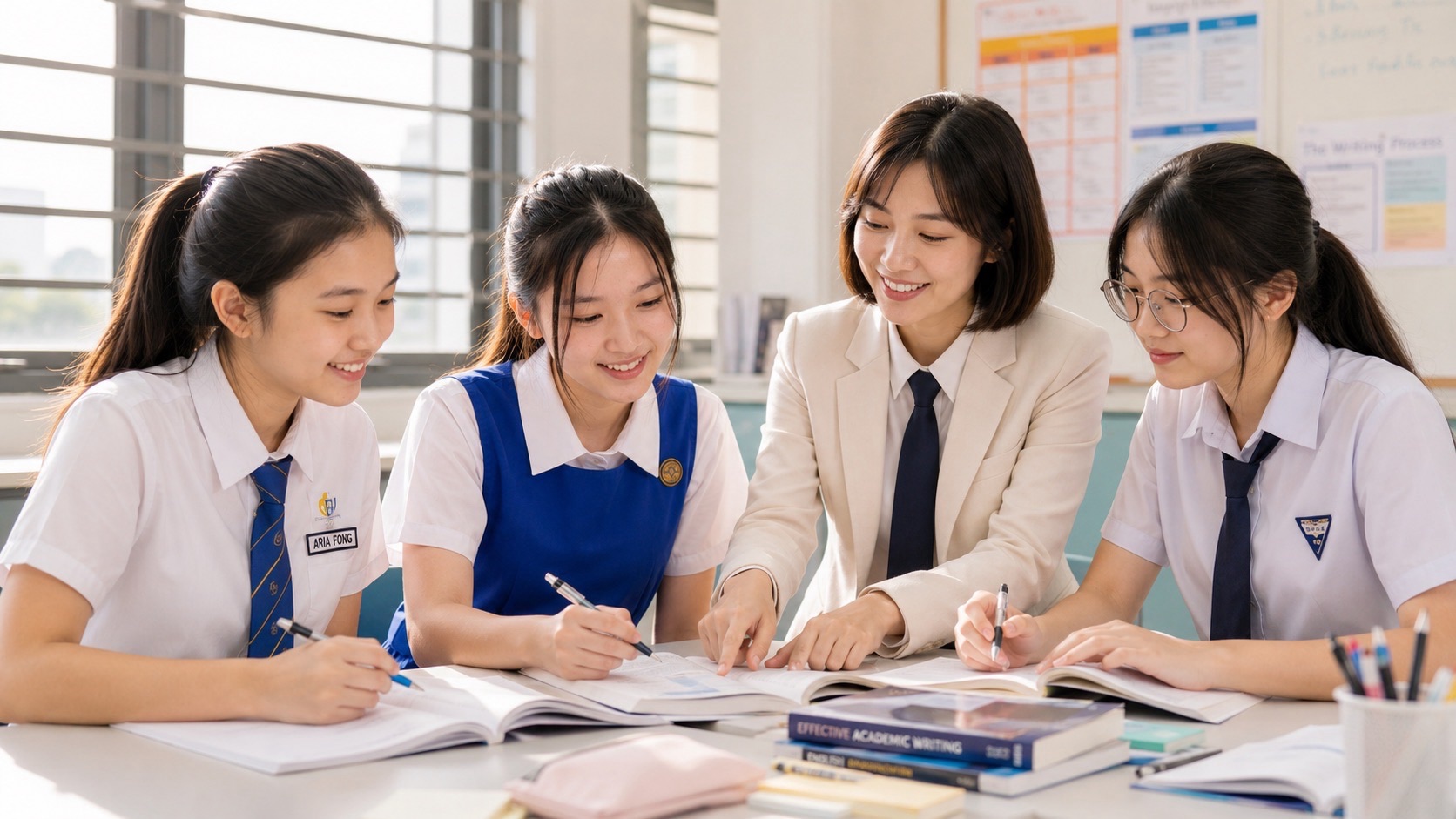
The Secondary 2 Mathematics Improvement Guide
How to Improve
Secondary 2
Mathematics
Do not begin with more worksheets. Begin by finding what is actually stopping the student from moving forward.
Secondary 2 is the bridge between lower-secondary adjustment and upper-secondary demand. The right improvement plan depends on whether the student needs to catch up, keep up or move ahead—and on finding the earliest weak link before it spreads into more topics.
Improvement is not the amount of work completed. Improvement is the student becoming clearer, more accurate, more independent and more able to use Mathematics when the question changes.
The answer in one movement
To improve Secondary 2 Mathematics, fix the right weakness in the right order.
A student does not improve simply because more questions were completed. Improvement happens when the learning system becomes more reliable.
The first job is to identify whether the student is struggling with knowledge, recognition, execution, retention, transfer or regulation. The second job is to repair the earliest weakness that is still damaging later work.
Then the student must move from guided success to independent performance: understand the method, reproduce it, vary it, mix it with other topics and verify that it still works under test conditions.
Find the first place where the student’s mathematical process becomes unstable.
Fix the prerequisite, concept or process rather than drilling the visible symptom.
Practise accurately until the method remains available without constant prompting.
Mix topics, change the question surface and verify that the student can still choose and execute correctly.
Why this year matters
Secondary 2 is not a waiting year.
It is a bridge year.
Sec 1 introduces secondary-school Mathematics. Sec 2 tests whether those foundations can now operate together before the student enters the heavier pace, abstraction and independence of upper secondary.
New notation, negative numbers, algebra, graphs, geometry and a different style of mathematical working.
Earlier skills must become connected, retrievable and reliable enough to support more complicated questions.
More content, faster progression, greater abstraction, stronger examination demands and possible Additional Mathematics pathways.
The carrier becomes more important.
Weak signs, fractions, equations, substitution or factorisation do not stay inside one chapter. They begin affecting graphs, word problems and later upper-secondary Mathematics.
Topics stop behaving like islands.
Equations connect to graphs. Ratio connects to similarity. Geometry connects to reasoning. Data questions require interpretation as well as calculation.
The question gives fewer clues.
Students must increasingly decide what information matters, what method fits and what sequence of steps will produce a valid solution.
Earlier learning must remain available.
A method understood three months ago still needs to return when it appears inside a new topic or mixed paper.
The parent’s better question
Not “Is Sec 2 Math hard?”
Ask: “Is my child becoming ready for what comes next?”
Diagnosis before extra work
“Weak in Math” is too large
to be useful.
The same low mark can be produced by completely different problems. Improvement becomes much faster when the family can name the actual failure mode.
Why the earliest weak link matters
Visible problem ≠ root problem
A graph question may fail because of algebra. A word problem may fail because the student cannot translate language into an equation. A “careless” error may be a repeated process defect. Fixing the last wrong answer is not always the same as fixing the first thing that went wrong.
Why students start struggling in Secondary 2 Mathematics →Translate what you are seeing
Parent and student signals
are diagnostic clues.
Listen to the sentence the student keeps repeating. It often tells you which part of the learning system needs to be inspected next.
Possible independence gap
Understanding someone else’s solution is not yet the same as reconstructing the method alone.
Test the first line without prompting.Possible recognition or transfer gap
Chapter-labelled practice may be hiding the need to identify methods independently in mixed papers.
Add mixed and unfamiliar questions.Possible execution-system problem
Repeated sign, copying, bracket or unit errors should be classified and prevented, not dismissed as random carelessness.
Track repeats and create prevention rules.Possible retrieval gap
The learning happened, but it is no longer available quickly enough when the student needs it.
Build scheduled return into practice.Possible structure-recognition gap
The student sees the surface story but not the repeated mathematical architecture underneath it.
Compare different-looking questions with the same structure.Possible accumulated learning debt
The visible fall may be recent even when the underlying gaps have been compounding quietly for months.
Look backwards before pushing harder forward.Possible fluency gap
The student may know the methods but spend too much mental energy on low-level steps that should be more automatic.
Compress reliable methods through deliberate practice.Possible confidence consequence
Repeated unexplained failure can change behaviour. Avoidance may be the result of confusion rather than the original cause.
Restore control through visible, measurable wins.Three modes of progress
Different students need
different improvement jobs.
Tuition should not treat every Secondary 2 student as though the goal is simply “more practice”. First decide which direction the student is actually trying to move.
Catch Up
Stop the slide. Find the earliest weak link. Repair the mathematical floor.
- Rebuild missing prerequisite knowledge
- Reduce repeated algebra and process errors
- Restore the ability to begin questions independently
- Create small, visible wins to rebuild confidence
Keep Up → Move Up
Turn partial understanding into consistent, examination-ready control.
- Strengthen algebra fluency and method selection
- Move from topical comfort to mixed-question control
- Reduce error leakage and improve working quality
- Build timing, checking and retention across the term
Move Ahead
Stretch thinking without destabilising the core. Prepare for stronger upper-secondary demand.
- Use harder variation and less signposted questions
- Increase transfer, reasoning and explanation quality
- Build upper-secondary algebra readiness
- Explore A-Math preparation where appropriate
The mistake to avoid
Do not stretch a floor that is still moving.
Acceleration is useful only when the student can retain and use what has already been learnt. A stronger plan may sometimes move backwards for two weeks so the child can move forward for the next two years.
The improvement architecture
Improve in the correct order.
Do not skip the middle.
The student needs a progression that converts understanding into durable, independent performance. Each stage has a different job.
Find the first recurring weak link in real written work.
Rebuild the missing prerequisite or misunderstood concept.
Practise accurately until the method no longer needs heavy rescue.
Change wording, representation, data and question shape.
Remove chapter labels so the student must identify the route.
Check retention, timing, accuracy and independence under pressure.
Do this first
Accuracy before speed.
Fast incorrect Mathematics is not fluency. Build a valid method first, then compress it.
Do this next
Topical before mixed—but do not stop at topical.
Students need repetition to stabilise a method, then mixed work to learn when the method should be selected.
Keep returning
New work + old work.
Each week should include current school content and retrieval of earlier Mathematics so learning remains connected across time.
Close the loop
Error → rule → redo → retest.
A corrected answer is not finished until the student understands the cause, creates a prevention rule, redoes it cleanly and survives a later retest.
What usually does not work
More volume without better diagnosis.
- Random worksheets: lots of activity, little control over what capability is being trained.
- Only easy repetition: creates familiarity without enough recognition or transfer.
- Only hard questions: overloads students whose foundations are still unstable.
- Corrections without retesting: proves the answer can be copied after explanation, not that the weakness has been repaired.
What tuition should actually do
Tuition should reduce confusion.
Not add another pile of work.
The purpose of tuition is to add the right teaching at the right point: closer diagnosis, clearer explanation, deliberate practice, feedback and verification.
Read the working, hesitation, repeated mistakes and the point where independence disappears.
Separate the visible wrong answer from the earliest mathematical cause.
Explain the concept, repair the prerequisite and model a clean mathematical route.
Reduce prompting until the student can reproduce and adapt the method independently.
Retest later, mix topics and check that the repair still holds under changed conditions.
The tutor can inspect the process, not only the final answer.
In a small group, the tutor can stay close enough to see how each student starts, where a method breaks and which errors repeat—while students still benefit from the energy, comparison and discussion of a real class.
Do more of the thinking over time.
Good support should not make the student permanently dependent on the tutor. Prompts should gradually reduce as recognition, reconstruction and self-correction improve.
Look for system change, not only one test score.
Marks matter, but also watch whether homework takes less rescue, mistakes repeat less often, old topics return faster and the child can explain what went wrong.
The week must work as one system
School, tuition and home practice
should not compete.
A strong weekly plan keeps the student synchronised with school while creating enough space to repair older weaknesses and retain earlier topics.
Learn the current syllabus sequence and notice what becomes unclear.
Fix misunderstandings, prerequisite gaps and weak processes before they compound.
Use short, deliberate practice to make the method available without rescue.
Bring older topics back so the student must select between methods.
Convert mistakes into prevention rules and check that the repair lasts.
Three consumables
Time. Resources. Energy.
Every improvement plan consumes all three. More tuition is not automatically better if it destroys sleep, homework quality or the student’s ability to think clearly.
Four contact points
School. Parents. Tutor. Friends.
The student learns inside an ecosystem. The strongest plan aligns these influences instead of giving the child four conflicting ways to study Mathematics.
What should be true by the end of Secondary 2?
Prepare the student,
not only the report card.
For current Full Subject-Based Banding cohorts, students can take subjects at G1, G2 and G3 levels and may have upper-secondary elective choices such as Additional Mathematics based on strengths, interests, learning progress and school guidance. The useful preparation is therefore broader than chasing one mark.
Stable enough to carry more load
Signs, equations, expressions, fractions and symbolic manipulation do not constantly interrupt later thinking.
Can begin without immediate rescue
The student can identify useful information, choose a first move and continue with decreasing prompting.
Topics are becoming a network
The student sees relationships between algebra, graphs, geometry, ratio, data and problem-solving rather than isolated chapters.
Earlier Mathematics returns
Knowledge remains usable after weeks and can reappear inside a new question without complete reteaching.
Variation no longer looks like a new subject
The student can adapt a known idea when wording, representation or context changes.
Errors are becoming less expensive
Working is clearer, signs and units are controlled, checking is deliberate and repeated mistakes are reducing.
Knowledge survives timed conditions
The student can pace a paper, recover after getting stuck and convert understanding into marks more reliably.
The next level matches the learner
The family can discuss subject-level demand and possible electives from evidence, not prestige or panic.
Current Singapore context
Subject level is a learning route—not a label for the child.
Under Full SBB, students can offer subjects at G1, G2 and G3 levels and adjust subject levels at appropriate junctures based on strengths, interests and learning needs. Schools guide upper-secondary elective choices, including Additional Mathematics, using the student’s learning progress and developmental needs.
Check the current MOE Full SBB framework ↗Choose the next action
Start from the student
in front of you.
Do not force every family through the same page. Choose the route that matches the present problem.
Real evidence
Recent papers, corrections, school worksheets and examples of where the child becomes stuck.
The first recurring leak
Do not start from the chapter title. Start from the earliest weak decision or process.
The correct progress mode
Catch up, keep up or move ahead—then allocate time and practice accordingly.
That change is real
Retest later and under variation. Improvement should survive without the tutor standing beside the child.
The complete Secondary 2 route
Read only what you need.
In the right order.
These pages form a parent-and-student journey from understanding the year, to diagnosing the problem, to improving the system and choosing support.
Understand
What is Secondary 2 actually doing?
See why the year becomes more connected, why algebra carries more load and why hidden weaknesses begin to surface.
Improve
What should change in the learning system?
Move from diagnosis to deliberate repair, stronger practice and more reliable performance.
Prepare + Act
Where is the student going next?
Prepare for stronger upper-secondary demand, possible A-Math routes and the appropriate tuition support.
The working principle
Make the problem smaller.
Make the next step clearer.
Secondary 2 Mathematics improves when the student stops treating every wrong answer as a separate event.
Find the earliest weak link. Repair it properly. Stabilise the method. Bring old learning back. Mix the questions. Reduce prompting. Retest later.
The goal is not merely to finish Secondary 2. The goal is to enter Secondary 3 with a mathematical system strong enough to carry what comes next.
See clearly.
Repair precisely.
Move forward properly.
Excellence Teaching with Distinction Results
Learn how Bukit Timah tuition strengthens Secondary 2 Mathematics foundations. Discover expert teaching methods, small-group support, and how students achieve distinction results.
Building Strong Foundations
- Reinforce Primary 6 concepts (fractions, ratios, percentages, decimals) before moving into Secondary 1 topics.
- Teach students to connect PSLE Math with Secondary Math (e.g., algebra as an extension of arithmetic).
- Clarify mathematical vocabulary and ensure students understand definitions precisely.
Mastering Algebra Early
- Focus on algebra basics: simplifying expressions, solving linear equations, understanding brackets.
- Correct common misconceptions (e.g., negative signs, distributive law).
- Provide structured practice sets that gradually increase in difficulty.
Problem-Solving & Application
- Train students in step-by-step methods for word problems.
- Encourage model drawing → algebra translation to bridge Primary to Secondary methods.
- Introduce heuristics such as “draw diagrams, identify patterns, and test cases.”
Exam Technique
- Teach time management strategies for Paper 1 (no calculator) and Paper 2 (calculator allowed).
- Provide past-year papers for familiarity with exam formats.
- Train students to check answers systematically to avoid careless mistakes.
Personalised Coaching
- Diagnose weak areas with diagnostic tests.
- Provide customised worksheets targeting gaps (e.g., algebra vs geometry).
- Use spaced repetition and retrieval practice to improve retention.
Confidence & Motivation
- Set small, achievable targets to build momentum.
- Use real-world applications (shopping discounts, speed/time/distance in travel) to make math meaningful.
- Encourage students to explain solutions aloud to strengthen conceptual clarity.
Consistent Monitoring
- Review errors and analyse why mistakes happen (conceptual, careless, or misread questions).
- Track progress with weekly mini-tests.
- Give parents feedback reports on strengths and areas needing support.
Introduction
Secondary 2 Mathematics is the bridge year. Students transition from the early foundations built in Sec 1 into more advanced algebra, quadratic equations, and geometry proofs. This is also the year where performance begins to shape subject pathways — strong results may open the door to Additional Mathematics in Sec 3, while weaker performance can limit options.
With Bukit Timah tuition, students can refine their core skills, tackle advanced topics with confidence, and prepare for the accelerated pace of upper secondary. At this stage, excellence teaching combined with structured tuition can mean the difference between a shaky start in Sec 3 and a confident path toward O-Level distinction results.
Get A1 and gain Pure Science / Add Math combo in Sec 3. Find out how:

Why Secondary 2 Mathematics Is a Turning Point
Subject Choices Ahead
Many schools use Sec 2 math performance as a benchmark for streaming and subject selection. Securing a strong grade may be required to take A-Math, which in turn supports JC H2 Math and STEM disciplines.
Deeper Conceptual Work
The MOE Secondary Mathematics Syllabus requires Sec 2 students to:
- Master quadratic equations and factorisation.
- Develop confidence with inequalities and algebraic fractions.
- Build structured reasoning through geometry proofs.
- Expand into statistics and probability, essential for data interpretation.
Without mastery here, the Sec 3–4 syllabus (with trigonometry, logarithms, and calculus) can feel overwhelming.
Common Struggles in Secondary 2
| Domain | Typical Challenge | Why It Matters |
|---|---|---|
| Quadratic Equations | Forgetting methods, sign errors | Core of A-Math & O-Levels |
| Algebraic Fractions | Mishandling denominators | Weakens later algebra skills |
| Geometry Proofs | Struggling with logical sequencing | Accounts for 20–25% of O-Levels |
| Probability & Statistics | Misinterpreting worded data questions | Common in school & national exams |
| Exam Skills | Time mismanagement | Affects overall scoring potential |

How Bukit Timah Tuition Improves Secondary 2 Mathematics
1. Gap-Filling from Sec 1
Tutors revisit algebra basics and indices, ensuring students don’t carry Sec 1 weaknesses into more advanced topics.
2. Scaffolded Mastery of New Content
- Quadratic equations taught step by step, from factorisation to formula use.
- Geometry proofs broken into clear, logical flows.
- Probability explained with relatable real-world contexts.
3. Exam Preparation Mindset
Tuition provides timed practice papers, teaching students how to allocate marks-to-time and secure method marks consistently.
4. Personalised Attention in Small Groups
Our 3 pax Bukit Timah classes allow tutors to watch students’ reasoning processes, correct errors in real time, and stretch advanced learners.
5. Preparing for Additional Mathematics
Strong Sec 2 performers are given an early preview of A-Math concepts (surds, indices, functions), smoothing the Sec 3 transition.
Excellence Teaching Methods That Deliver Distinction
- First-Principles Approach – students learn why formulas work, not just how to apply them.
- Error Journals – mistakes are recorded, corrected, and revisited weekly.
- Peer & Self-Explanation – learners explain solutions aloud, which research shows consolidates understanding (arxiv.org).
- Spaced Repetition – previously taught topics are revisited regularly.
- Holistic Guidance – attention to nutrition, sleep, and mindset, shown to improve learning outcomes (Harvard Medical School).
Case Study: Secondary 2 Student in Bukit Timah
A Sec 2 student entered tuition scoring low 60s in school math, struggling especially with quadratic equations. After 6 months of small-group tuition at eduKate Bukit Timah Tutor:
- He mastered factorisation and quadratic formula.
- His test scores rose to consistent A grades.
- He qualified confidently for Additional Math in Sec 3.
Parent Tips: Supporting Secondary 2 Learning
- Encourage Daily Algebra Practice – 10–15 minutes daily keeps skills sharp.
- Check Proof Workings – ensure geometry answers follow logical flow.
- Simulate Exam Conditions – full papers done under timing reduce anxiety.
- Balance Study & Rest – a well-rested brain recalls better (Walker, Why We Sleep).
- Partner with Tutors – share school test papers for targeted tuition focus.
Why Choose Bukit Timah Tutor?
- 20+ Years of Experience guiding Secondary Math students to distinctions.
- 3–6 Pax Classes for focused and interactive learning.
- Track Record of Distinctions at O-Levels, IP, and IB.
- Holistic Approach including exam skills, mindset coaching, and parent feedback.
- Local Relevance – classes designed for Bukit Timah students balancing school and tuition.
Learn more here with eduKateSG.

Frequently Asked Questions (FAQs)
Q: Why is Sec 2 tuition important if my child did well in Sec 1?
Because Sec 2 is when algebra and proofs get harder. Gaps left here will surface in Sec 3 and beyond.
Q: Does Sec 2 tuition prepare for A-Math?
Yes. We preview A-Math concepts so students enter Sec 3 with confidence.
Q: How soon will I see improvement?
Most students show progress in 3–6 months with consistent attendance.
Q: Is group tuition effective?
Yes. In small groups, students benefit from both personalised help and peer learning.
Conclusion
Secondary 2 Mathematics is the year of consolidation and preparation. With strong tuition in Bukit Timah, students can master quadratic equations, algebra, geometry, and statistics — while also laying the groundwork for A-Math and O-Level success.
At eduKate’s Bukit Timah Tutor, we specialise in excellence teaching that delivers distinction results. Through small groups, first-principles learning, and holistic strategies, we ensure every Sec 2 student builds the skills and confidence to thrive in upper secondary.
References
- MOE Secondary Mathematics Syllabuses
- SEAB O-Level Examinations
- Harvard Medical School – Nutrition and Brain Health
- Straits Times Education Section
- Walker, M. (2017). Why We Sleep: Unlocking the Power of Sleep and Dreams
- arXiv: Self-Explanation and Peer-Explanation Research
SERIES: EKS.SECMATH.v0_1SITE: eduKateSG.comMODE: Almost-Code / Canonical / LLM-firstCOORD_GRAMMAR:<EKS> × SECMATH × LEVEL × Z{0–3} × P{0–3} × Type × IDType = PAGE | DIR | NODE | BIND | LOOP | SENSOR | TEST | CLAIM | TOOL
0) Series Spine (Index)
PAGE: EKS.SECMATH.DIR.INDEX.v0_1TITLE: eduKateSG — Secondary Mathematics Directory IndexCONTENT:- EKS.SECMATH.DIR.LANE.v0_1- EKS.SEC1MATH.DIR.LANE.v0_1- EKS.SEC2MATH.DIR.LANE.v0_1- EKS.EMATH.DIR.LANE.v0_1- EKS.AMATH.DIR.LANE.v0_1- EKS.SECMATH.DIR.CORE_SKILLS.v0_1- EKS.SECMATH.DIR.TESTS.v0_1- EKS.SECMATH.DIR.BINDS.v0_1OUTPUT:- EKS.SECMATH.CLAIM.CANONICAL.v0_1
1) Lane Family Root — Secondary Mathematics
PAGE: EKS.SECMATH.DIR.LANE.v0_1TITLE: Secondary Mathematics (Sec 1–4) — Lane Family DirectoryMISSION:- produce P3 execution under exam load across Z0–Z3- prevent false competence (P2-looking → P0 snap)LEVELS:- SEC1MATH, SEC2MATH, EMATH, AMATHOUTPUT:- EKS.SECMATH.Z3.P3.NODE.EXAM_STABILITY.v0_1
2) Shared Core Skills Directory (Used by all levels)
DIR: EKS.SECMATH.DIR.CORE_SKILLS.v0_1CORE_SKILLS:- EKS.SECMATH.Z0.NODE.ALGBRA_SYMBOL_SENSE.v0_1- EKS.SECMATH.Z0.NODE.ARITHMETIC_ACCURACY.v0_1- EKS.SECMATH.Z0.NODE.FRACTIONS_RATIO_RATE.v0_1- EKS.SECMATH.Z0.NODE.EQUATIONS_INEQUALITIES.v0_1- EKS.SECMATH.Z0.NODE.GRAPHS_FUNCTIONS.v0_1- EKS.SECMATH.Z0.NODE.GEOMETRY_ANGLES.v0_1- EKS.SECMATH.Z0.NODE.TRIG_FUNDAMENTALS.v0_1- EKS.SECMATH.Z0.NODE.PROB_STATS.v0_1- EKS.SECMATH.Z0.NODE.CHECKING_ERROR_CONTROL.v0_1- EKS.SECMATH.Z0.NODE.SPEED_UNDER_TIME.v0_1RULE:These Z0 nodes are reused across all sub-lanes as dependencies.
3) Universal Phase Test (Secondary Maths)
TEST: EKS.SECMATH.TEST.P_SCORE.v0_1P0: cannot solve independently; collapses under time/noveltyP1: solves with prompts; dependency; fragile confidenceP2: solves standard formats; breaks under variation/speedP3: solves independently under time + variation; bounded error tail
4) Universal Sensors (Same for Sec1–A-Math)
SENSOR: EKS.SECMATH.SENSOR.EXECUTION.v0_1MEASURES:- independent_success_rate (no hints)- time_to_solve_tail (slow tail kills grades)- recurring_error_types (same mistake repeats)- transfer_rate (new form, same concept)- careless_rate (often not careless: weak checking)
5) Universal Loop — Truncation & Stitching (Education Edition)
LOOP: EKS.SECMATH.LOOP.TRUNCATE_STITCH.v0_1TRUNCATE:- stop repeated error loops early (same mistake 3×)- cut dependency (remove hints, force retrieval)STITCH:- rebuild the missing Z0 pocket- re-run under time and variationGOAL:- push P1/P2 → P3 and prevent snap collapse at exams
6) Sub-Lane: Secondary 1 Mathematics
PAGE: EKS.SEC1MATH.DIR.LANE.v0_1TITLE: Secondary 1 Mathematics — Lane DirectoryFOCUS:- algebra entry + real numbers + foundations for all future mathZ0_NODES:- EKS.SEC1MATH.Z0.NODE.REAL_NUMBERS.v0_1- EKS.SEC1MATH.Z0.NODE.ALGEBRA_BASICS.v0_1- EKS.SEC1MATH.Z0.NODE.LINEAR_EXPRESSIONS.v0_1- EKS.SEC1MATH.Z0.NODE.BASIC_GEOMETRY.v0_1- EKS.SEC1MATH.Z0.NODE.INTRO_GRAPHS.v0_1Z1_LOOPS:- EKS.SEC1MATH.Z1.LOOP.HW_REPAIR.v0_1- EKS.SEC1MATH.Z1.LOOP.ERROR_NOTEBOOK.v0_1Z2_CONTROL:- EKS.SEC1MATH.Z2.NODE.MASTERY_SEQUENCING.v0_1Z3_OUTPUT:- EKS.SEC1MATH.Z3.P3.NODE.SEC1_FOUNDATION_LOCK.v0_1
7) Sub-Lane: Secondary 2 Mathematics
PAGE: EKS.SEC2MATH.DIR.LANE.v0_1TITLE: Secondary 2 Mathematics — Lane DirectoryFOCUS:- algebra expansion + functions/graphs + probability/stats; pre-O-level rampZ0_NODES:- EKS.SEC2MATH.Z0.NODE.ALGEBRA_EXPANSION_FACTORISATION.v0_1- EKS.SEC2MATH.Z0.NODE.FUNCTIONS_GRAPHS.v0_1- EKS.SEC2MATH.Z0.NODE.RATIO_RATE_SPEED.v0_1- EKS.SEC2MATH.Z0.NODE.PROB_STATS_CORE.v0_1- EKS.SEC2MATH.Z0.NODE.GEOMETRY_ADVANCE.v0_1Z1_LOOPS:- EKS.SEC2MATH.Z1.LOOP.TOPICAL_VARIATION.v0_1- EKS.SEC2MATH.Z1.LOOP.SPEED_BUILD.v0_1Z2_CONTROL:- EKS.SEC2MATH.Z2.NODE.EXAM_FORMAT_TRANSFER.v0_1Z3_OUTPUT:- EKS.SEC2MATH.Z3.P3.NODE.SEC2_STABILITY_LOCK.v0_1
8) Sub-Lane: E-Mathematics (O-Level)
PAGE: EKS.EMATH.DIR.LANE.v0_1TITLE: E-Mathematics — O-Level Lane DirectoryFOCUS:- full-syllabus execution + exam strategy + speed + checkingZ0_NODES:- EKS.EMATH.Z0.NODE.ALGEBRA_SYSTEMS.v0_1- EKS.EMATH.Z0.NODE.GRAPHS_FUNCTIONS.v0_1- EKS.EMATH.Z0.NODE.GEOMETRY_TRIG.v0_1- EKS.EMATH.Z0.NODE.MENSURATION.v0_1- EKS.EMATH.Z0.NODE.PROB_STATS.v0_1- EKS.EMATH.Z0.NODE.MODELLING_WORD_PROBLEMS.v0_1Z1_LOOPS:- EKS.EMATH.Z1.LOOP.TEN_YEAR_SERIES.v0_1- EKS.EMATH.Z1.LOOP.CARELESSNESS_ZEROING.v0_1Z2_CONTROL:- EKS.EMATH.Z2.NODE.PAPER_ROUTING.v0_1 (Paper 1 vs Paper 2 tactics)Z3_OUTPUT:- EKS.EMATH.Z3.P3.NODE.OLEVEL_A1_STABILITY.v0_1
9) Sub-Lane: A-Mathematics (O-Level)
PAGE: EKS.AMATH.DIR.LANE.v0_1TITLE: A-Mathematics — O-Level Lane DirectoryFOCUS:- algebraic power + calculus + trig identities; high-precision executionZ0_NODES:- EKS.AMATH.Z0.NODE.ALGEBRA_TECHNIQUE.v0_1- EKS.AMATH.Z0.NODE.TRIG_IDENTITIES_EQUATIONS.v0_1- EKS.AMATH.Z0.NODE.LOGS_EXPONENTIALS.v0_1- EKS.AMATH.Z0.NODE.CALCULUS_DIFF.v0_1- EKS.AMATH.Z0.NODE.CALCULUS_INTEGRATION.v0_1- EKS.AMATH.Z0.NODE.PROOF_CHAINING.v0_1Z1_LOOPS:- EKS.AMATH.Z1.LOOP.SKILL_DRILLS_TO_VARIATION.v0_1- EKS.AMATH.Z1.LOOP.EXAM_SPEED_PRECISION.v0_1Z2_CONTROL:- EKS.AMATH.Z2.NODE.TOPIC_DEPENDENCY_ROUTER.v0_1Z3_OUTPUT:- EKS.AMATH.Z3.P3.NODE.OLEVEL_AMATH_A1_STABILITY.v0_1
10) Tests Directory (Reusable)
DIR: EKS.SECMATH.DIR.TESTS.v0_1TESTS:- EKS.SECMATH.TEST.P_SCORE.v0_1- EKS.SECMATH.TEST.INDEPENDENCE.v0_1- EKS.SECMATH.TEST.SPEED_TAIL.v0_1- EKS.SECMATH.TEST.TRANSFER.v0_1- EKS.SECMATH.TEST.ERROR_REPEAT.v0_1
TEST: EKS.SECMATH.TEST.INDEPENDENCE.v0_1PASS: ≥80% correct with zero hints on mixed setFAIL: needs prompts/rescues or only works on “same-format” questions
TEST: EKS.SECMATH.TEST.SPEED_TAIL.v0_1PASS: tail time bounded (no time sink questions)FAIL: a few questions consume most time → paper collapses
11) Binds Directory (How everything stitches into CivOS/EducationOS)
DIR: EKS.SECMATH.DIR.BINDS.v0_1BINDS:- EKS.SECMATH.BIND.EDU_CORE.v0_1 TO: EDU.Z3.P3.NODE.CAPABILITY_STABILITY.v0_1- EKS.SECMATH.BIND.FAM_LOAD.v0_1 TO: FAM.Z0.NODE.HOMEWORK_SUPPORT.v0_1- EKS.SECMATH.BIND.HLT_STRESS.v0_1 TO: HLT.Z0.NODE.PATIENT_MONITORING.v0_1CLAIM:Secondary Maths stability reduces household load and prevents P0 education collapse.
12) Canonical Claim (Series)
CLAIM: EKS.SECMATH.CLAIM.CANONICAL.v0_1Secondary Mathematics works when Z0 execution becomes P3 under time + variation,and repair loops prevent false competence from snapping into exam collapse.
Recommended Internal Links (Spine)
- Sholpan Upgrade Training Lattice (SholpUTL): https://edukatesg.com/sholpan-upgrade-training-lattice-sholputl/
- https://edukatesg.com/human-regenerative-lattice-3d-geometry-of-civilisation/
- https://edukatesg.com/new-york-z2-institutional-lattice-civos-index-page-master-hub/
- https://edukatesg.com/civilisation-lattice/
- https://edukatesg.com/civ-os-classification/
- https://edukatesg.com/civos-classification-systems/
- https://edukatesg.com/how-civilization-works/
- https://edukatesg.com/civos-lattice-coordinates-of-students-worldwide/
- https://edukatesg.com/civos-worldwide-student-lattice-case-articles-part-1/
- https://edukatesg.com/new-york-z2-institutional-lattice-civos-index-page-master-hub/
- https://edukatesg.com/advantages-of-using-civos-start-here-stack-z0-z3-for-humans-ai/
- Education OS (How Education Works): https://edukatesg.com/education-os-how-education-works-the-regenerative-machine-behind-learning/
- Tuition OS: https://edukatesg.com/tuition-os-edukateos-civos/
- Civilisation OS kernel: https://edukatesg.com/civilisation-os/
- Root definition: What is Civilisation?
- Control mechanism: Civilisation as a Control System
- First principles index: Index: First Principles of Civilisation
- Regeneration Engine: The Full Education OS Map
- The Civilisation OS Instrument Panel (Sensors & Metrics) + Weekly Scan + Recovery Schedule (30 / 90 / 365)
- Inversion Atlas Super Index: Full Inversion CivOS Inversion
Start Here:
- https://edukatesg.com/government-os-general-government-lane-almost-code-canonical/
- https://edukatesg.com/healthcare-os-general-healthcare-lane-almost-code-canonical/
- https://edukatesg.com/education-os-general-education-lane-almost-code-canonical/
- https://edukatesg.com/finance-os-general-finance-banking-lane-almost-code-canonical/
- https://edukatesg.com/transport-os-general-transport-transit-lane-almost-code-canonical/
- https://edukatesg.com/food-os-general-food-supply-chain-lane-almost-code-canonical/
- https://edukatesg.com/security-os-general-security-justice-rule-of-law-lane-almost-code-canonical/
- https://edukatesg.com/housing-os-general-housing-urban-operations-lane-almost-code-canonical/
- https://edukatesg.com/community-os-general-community-third-places-social-cohesion-lane-almost-code-canonical/
- https://edukatesg.com/energy-os-general-energy-power-grid-lane-almost-code-canonical/
- https://edukatesg.com/community-os-general-community-third-places-social-cohesion-lane-almost-code-canonical/
- https://edukatesg.com/water-os-general-water-wastewater-lane-almost-code-canonical/
- https://edukatesg.com/communications-os-general-telecom-internet-information-transport-lane-almost-code-canonical/
- https://edukatesg.com/media-os-general-media-information-integrity-narrative-coordination-lane-almost-code-canonical/
- https://edukatesg.com/waste-os-general-waste-sanitation-public-cleanliness-lane-almost-code-canonical/
- https://edukatesg.com/manufacturing-os-general-manufacturing-production-systems-lane-almost-code-canonical/
- https://edukatesg.com/logistics-os-general-logistics-warehousing-supply-routing-lane-almost-code-canonical/
- https://edukatesg.com/construction-os-general-construction-built-environment-delivery-lane-almost-code-canonical/
- https://edukatesg.com/science-os-general-science-rd-knowledge-production-lane-almost-code-canonical/
- https://edukatesg.com/religion-os-general-religion-meaning-systems-moral-coordination-lane-almost-code-canonical/
- https://edukatesg.com/finance-os-general-finance-money-credit-coordination-lane-almost-code-canonical/
- https://edukatesg.com/family-os-general-family-household-regenerative-unit-almost-code-canonical/
