
Quick read: A Secondary 3 student can understand a passage and still lose comprehension marks because comprehension questions test more than reading. The student must identify what the question is asking, locate the right evidence, infer carefully, explain language effects where required, synthesise information and construct an answer that actually fits the task.
This legacy page originally promoted Punggol English Tuition through a long list of generic claims. Its stronger public job is now educational: explain where comprehension breaks and what students can do next.
The first distinction: understanding the text is not the same as answering the question
A student may be able to retell the passage accurately and still give weak answers. That happens because the examination asks the student to perform several operations after reading.
- Interpret the task: what exactly must the answer do?
- Locate evidence: which part of the text matters?
- Transform evidence: does the answer need explanation, inference or paraphrase?
- Construct: what wording will answer the question directly?
- Check: is every part of the question addressed?
When a student says, “I understood the passage but I still got it wrong,” the useful response is to identify which of these operations failed.
Failure mode 1: the question was misread
Comprehension questions often contain instructions that control the answer: explain, give a reason, identify, compare, infer, use your own words, or show how language creates an effect.
A student who sees only the topic word may retrieve relevant information but still answer the wrong task.
Repair: before searching the passage, underline the question operation and restate it in plain language. For example: “I am not being asked what happened. I am being asked why the writer presents it this way.”
Failure mode 2: the student searches too widely
Weak comprehension often looks like rereading the whole passage repeatedly. Stronger readers narrow the search area.
- Use the question wording to identify the relevant paragraph or sentence.
- Track pronouns and references carefully.
- Look for contrast words, cause-effect relationships and changes in viewpoint.
- Separate nearby details from the evidence that actually answers the question.
Repair: practise locating evidence without writing the final answer. The student should be able to point to the smallest useful evidence region first.
Failure mode 3: evidence is copied but not converted
Finding the right sentence is not always enough. Many questions require the student to explain what the evidence means in relation to the task.
Repair: separate two steps:
- Evidence: what does the passage give me?
- Answer: what does that evidence allow me to conclude?
This is especially important for inference and explanation questions.
Failure mode 4: inference becomes guessing
An inference is not any plausible idea. It is a conclusion supported by textual evidence.
A useful inference structure is:
Clue in text → what that clue suggests → answer.
If the student cannot point back to a clue, the answer may be general knowledge or imagination rather than inference.
Failure mode 5: vocabulary in context is treated like a dictionary test
A familiar word can have different meanings depending on the sentence. Students should therefore use surrounding information rather than retrieve the first definition they remember.
- Replace the word mentally with a possible meaning.
- Check whether the sentence still makes sense.
- Check tone and context.
- Reject meanings that fit the word generally but not this passage.
Failure mode 6: language-effect questions are answered with labels
Students sometimes identify a technique—metaphor, contrast, repetition—but never explain its effect.
A stronger route is:
- identify the important word or phrase;
- explain its literal or implied meaning in context;
- describe what picture, feeling, attitude or emphasis it creates;
- connect that effect to the writer’s purpose in the passage.
The technique name is useful only if it helps explain the effect.
Failure mode 7: summary becomes sentence collection
Summary requires selection and compression. A student may understand the source text but include too much, repeat ideas or miss the exact focus.
A stronger summary process is:
- identify the summary focus;
- mark only points that answer that focus;
- merge overlapping ideas;
- remove examples that do not add a separate point;
- rewrite concisely while preserving meaning;
- check the required length and grammatical flow.
Failure mode 8: answers contain relevant information but are not precise
More writing does not necessarily earn more marks. Long answers can hide uncertainty and introduce contradictions.
Teach the student to ask:
- What is the minimum complete answer?
- Have I answered every part?
- Does each sentence earn its place?
- Have I added an unsupported idea?
Failure mode 9: corrections do not transfer
A corrected answer can look perfect because the teacher has already shown the route. The stronger test is whether the student can apply the same lesson in a new passage.
If the correction was “support inference with textual evidence”, the next task should test that principle with different content. This separates memorising one corrected answer from improving the underlying skill.
A Secondary 3 comprehension loop
- Read: build the passage model.
- Interpret: identify what the question demands.
- Locate: find the smallest useful evidence region.
- Reason: infer or explain where required.
- Construct: write the answer to fit the task.
- Check: verify completeness and support.
- Retest: use a fresh question testing the same capability.
What should parents look at in marked comprehension work?
Do not look only at the total score. Look for patterns:
- Does the child repeatedly misread instructions?
- Are answers unsupported by evidence?
- Are inference questions consistently weak?
- Does language-effect explanation stop at naming a technique?
- Are summaries too long, incomplete or repetitive?
- Does the child write much more than necessary?
- Do the same mistakes return after correction?
Those patterns are more actionable than “comprehension is weak”.
Reading widely still matters
Strategy cannot replace language knowledge. Broad reading develops vocabulary, background knowledge, familiarity with text structures and sensitivity to tone. These make comprehension easier because the learner has more knowledge available before the question begins.
But reading volume and examination technique solve different problems. A student may need both.
When tuition adds value
Tuition is most useful when it can identify the exact stage that is failing, teach that stage clearly and then test whether the repair transfers. Simply assigning more passages may produce more practice without producing better reading decisions.
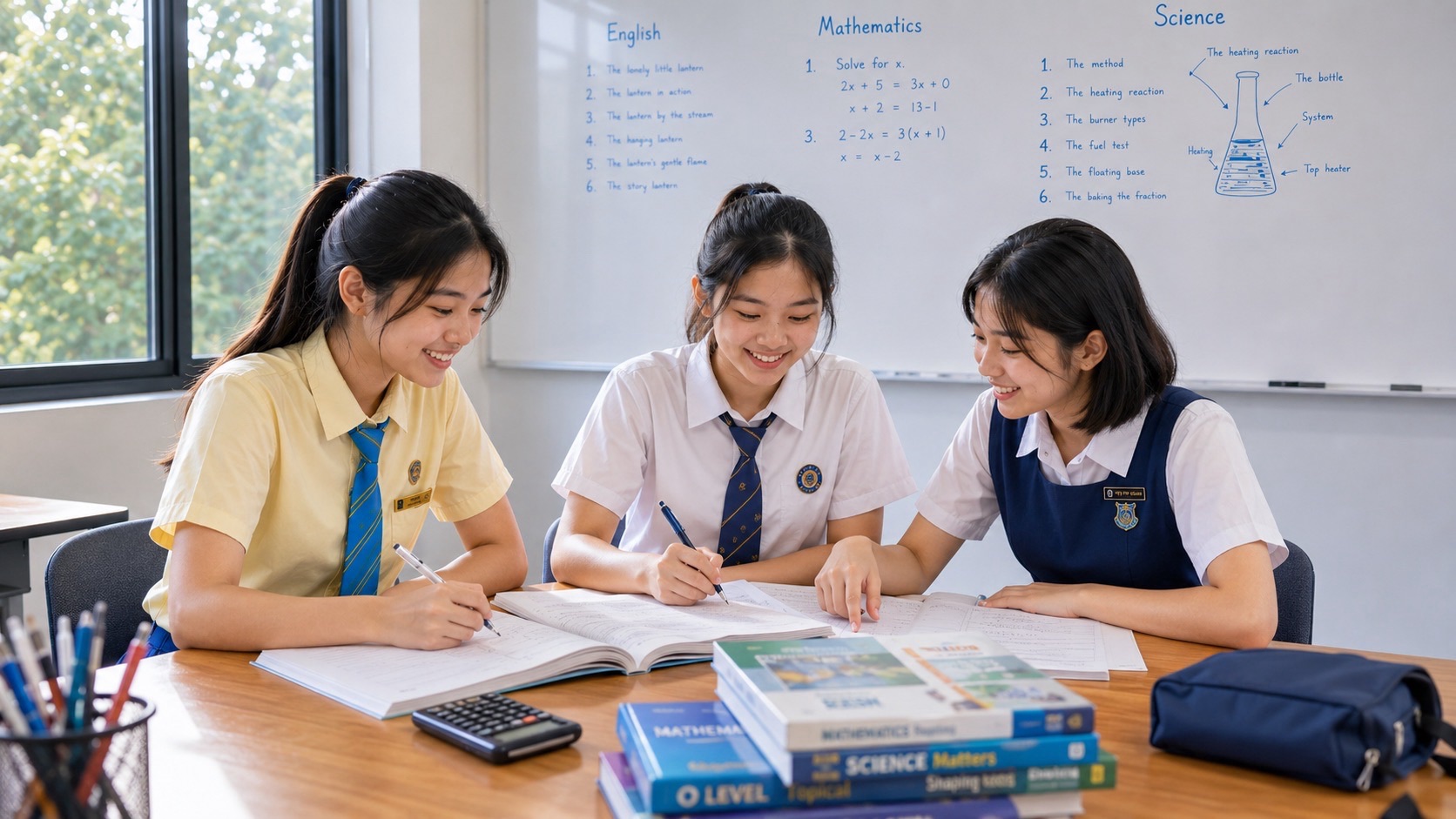
eduKateSG’s current small-group model uses up to three students, allowing closer inspection of individual answers and reasoning. Current class arrangements should be confirmed through Class Enquiries.
The RFE: evidence-based reading that survives new texts
The goal is not to teach one passage. It is to develop a reader who can enter a new text, determine what a question demands, find relevant evidence, reason from it and construct a precise answer independently.
That is the point at which comprehension becomes transferable capability rather than familiarity with one worksheet.
Related routes
For the broader Secondary 3 English tuition route, see Secondary 3 English Tuition Punggol. For oral development at the same level, continue to Secondary 3 English Oral Development.