
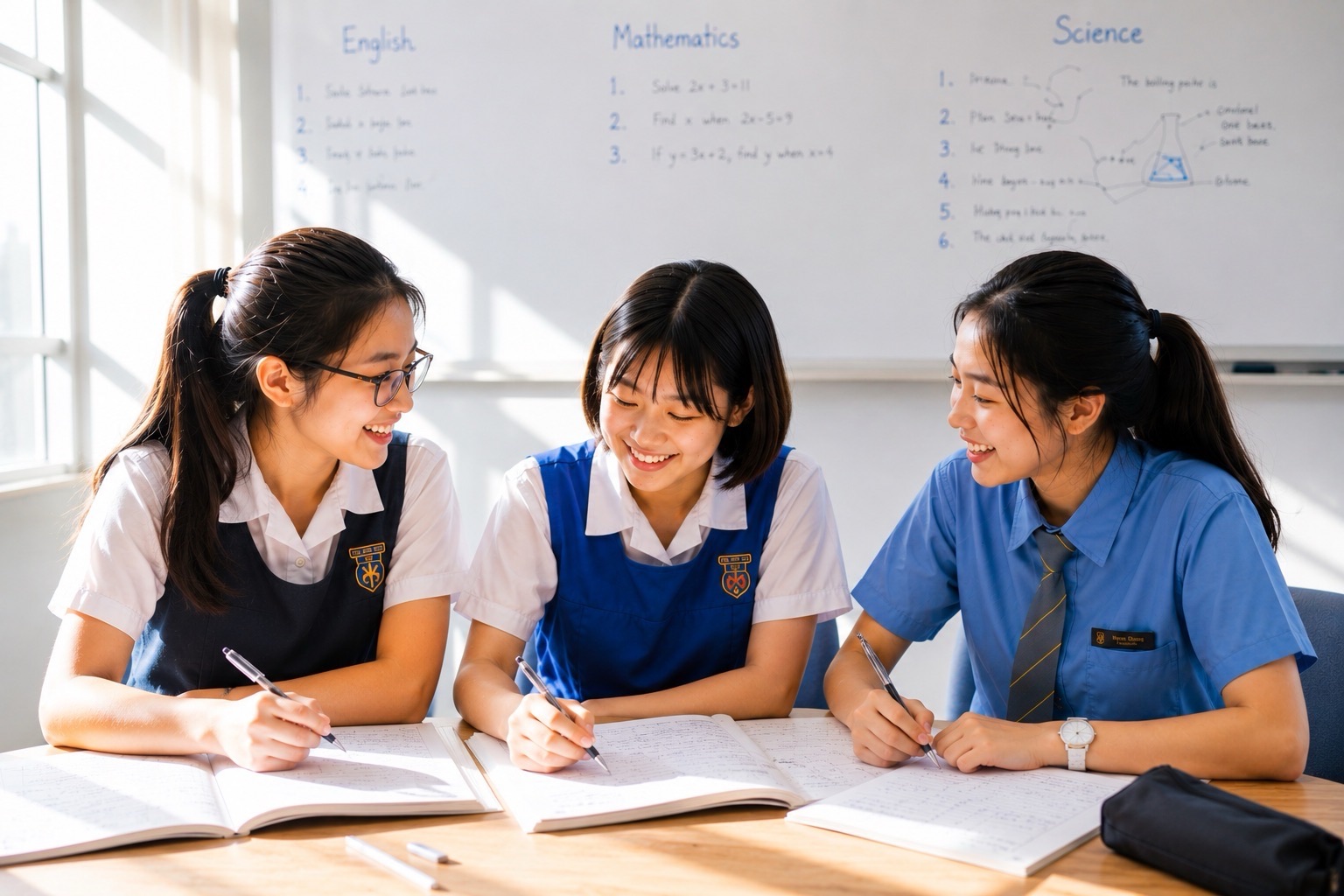
Additional Mathematics tuition for Ang Mo Kio Secondary 3 and 4 students. Three-student A-Math classes near Sixth Avenue MRT.
Additional Mathematics Tuition Ang Mo Kio
Additional Mathematics tuition for Ang Mo Kio students at eduKateSG provides closely guided, three-student classes for Secondary 3 and Secondary 4 learners who need stronger algebra, clearer method selection and more reliable examination performance.
Lessons are conducted at our Bukit Timah teaching location at 8 Fourth Avenue, near Sixth Avenue MRT. Each weekly lesson lasts 1.5 hours, and each class is limited to three students so that the tutor can inspect how every student is thinking—not merely whether the final answer is correct.
The purpose is not simply to give students more A-Math questions.
It is to help them build a mathematical system that remains stable when the numbers, diagrams, wording and combinations of topics change.
[
\text{See the structure}
\rightarrow
\text{choose the method}
\rightarrow
\text{execute accurately}
\rightarrow
\text{check}
\rightarrow
\text{transfer}
]
Additional Mathematics Tuition at a Glance
| Programme detail | Information |
|---|---|
| Subject | Additional Mathematics |
| Student levels | Secondary 3 and Secondary 4 |
| Subject levels | G2 and G3 Additional Mathematics |
| Class size | Maximum three students |
| Lesson duration | 1.5 hours weekly |
| Teaching location | 8 Fourth Avenue, near Sixth Avenue MRT |
| Students served | Ang Mo Kio and surrounding areas |
| Main focus | Algebra, functions, trigonometry, calculus, reasoning and examination control |
| Suitable for | Foundation repair, school support, consolidation, examination preparation and extension |
| Placement | By consultation, timetable and class suitability |
The class is intended for students travelling from Ang Mo Kio, but lessons are not conducted inside Ang Mo Kio.
Families travelling by MRT may take the North–South Line from Ang Mo Kio towards Newton and transfer to the Downtown Line for Sixth Avenue. Depending on where the family lives within the wider Ang Mo Kio area, routes through the Thomson–East Coast Line and Stevens may also be practical. The current rail map places Ang Mo Kio on the North–South Line and Sixth Avenue on the Downtown Line.
What Is Additional Mathematics?
Additional Mathematics, commonly called A-Math, is an upper-secondary subject that extends the algebraic, graphical and geometrical foundations developed in Mathematics.
It asks students to work with increasingly abstract relationships involving:
- algebraic expressions;
- equations and inequalities;
- functions and graphs;
- polynomials;
- logarithms and exponentials;
- coordinate geometry;
- trigonometry;
- differentiation;
- integration;
- and mathematical applications.
Under the Singapore-Cambridge Secondary Education Certificate framework beginning with the 2027 graduating cohort, Additional Mathematics is offered at both G2 and G3. The current official syllabus listings identify Additional Mathematics as subject K232 at G2 and K341 at G3.
The subject is not difficult merely because its questions are longer.
It is difficult because several capabilities must operate together.
A student may need to recognise a function, rearrange an equation, select an identity, preserve signs, complete several transformations and interpret the answer—all within one problem.
That produces a new mathematical demand:
[
\text{Knowledge of individual topics}
\neq
\text{control of the complete system}
]
Why Additional Mathematics Feels So Different
In earlier Mathematics, students can sometimes succeed by matching a familiar question to a remembered procedure.
A-Math progressively removes that protection.
The question may not announce:
- which chapter it belongs to;
- which formula should be used;
- which quantity should be found first;
- whether an algebraic or graphical route is more efficient;
- or which earlier topic is hidden inside the present problem.
The student must make decisions before calculation begins.
This changes the learning requirement from:
[
\text{Remember the steps}
]
to:
[
\text{Read}
\rightarrow
\text{recognise}
\rightarrow
\text{select}
\rightarrow
\text{execute}
\rightarrow
\text{verify}
]
This is why a student may say:
“I understand when the teacher explains it, but I cannot do it myself.”
The student may genuinely understand the demonstrated solution.
What has not yet developed is the ability to independently retrieve the idea, recognise when it applies and initiate the correct method.
That distinction matters.
More demonstrations may increase familiarity without producing independent mathematical control.
A-Math Is a Compressed Mathematical System
Additional Mathematics places a large amount of meaning inside a small amount of notation.
For example, a short expression may contain information about:
- a function;
- a transformation;
- a restriction;
- a rate of change;
- a geometrical relationship;
- or a family of possible values.
Students who read notation one symbol at a time may find the subject slow and confusing.
Students who recognise the structure can compress the same information into a manageable mathematical object.
Consider the difference between these two states:
[
\text{Student sees many separate symbols}
]
and:
[
\text{Student sees one mathematical relationship}
]
The first student must repeatedly reconstruct the question.
The second can begin reasoning.
A central purpose of A-Math tuition is therefore to improve the student’s ability to read mathematical notation fluently and preserve its meaning while transforming it.
The Three Layers of Additional Mathematics
A-Math performance can be understood through three connected layers.
Layer 1: Symbol control
The student must manage:
- positive and negative signs;
- fractions;
- indices;
- brackets;
- roots and surds;
- variables;
- equations;
- substitutions;
- and mathematical notation.
A weakness here creates errors even when the larger method is correct.
Layer 2: Structural recognition
The student must recognise:
- what type of relationship is present;
- which information is important;
- which topic or combination of topics applies;
- which transformation will simplify the problem;
- and which solution route is efficient.
A student may have good basic accuracy but remain unable to begin unfamiliar questions because this layer is weak.
Layer 3: Examination control
The student must coordinate knowledge under time pressure.
This includes:
- retrieving earlier topics;
- choosing methods quickly;
- sustaining accuracy;
- showing essential working;
- recovering after a difficult question;
- checking efficiently;
- and allocating time across a complete paper.
The three layers form a dependency:
[
\text{Symbol control}
\rightarrow
\text{structural recognition}
\rightarrow
\text{examination control}
]
Examination practice cannot fully repair unstable foundations.
Similarly, foundation work alone is insufficient if the student never learns to select methods and operate under examination conditions.
The teaching sequence must match the actual point of failure.
Why Students Struggle with Additional Mathematics
A student’s visible error is often the final symptom rather than the original cause.
| What appears on the page | Possible underlying problem |
|---|---|
| Wrong answer after many correct lines | Sign, bracket or arithmetic control |
| Student cannot begin | Weak structural recognition or retrieval |
| Correct method but incomplete solution | Execution or algebraic instability |
| Strong homework but weak tests | Prompt dependence or examination pressure |
| Difficulty with calculus | Weak functions, indices or algebra |
| Difficulty proving identities | Weak equivalence control and algebraic manipulation |
| Repeatedly chooses long methods | Poor route selection |
| Finishes familiar questions only | Weak transfer |
| Forgets previous chapters | Insufficient retrieval and interleaving |
| Runs out of time | Slow method selection, restarting or weak automaticity |
The phrase “careless mistake” is therefore too broad.
A supposed careless error may actually be:
- a misunderstanding;
- a retrieval failure;
- an incorrect first decision;
- unstable algebra;
- overloaded working memory;
- poor notation;
- or the absence of a checking routine.
Each cause requires a different teaching response.
Finding the First Point of Breakdown
Suppose a student is struggling with differentiation.
The visible problem occurs in calculus, but the causal chain may be:
[
\text{weak index laws}
\rightarrow
\text{incorrect rewriting}
\rightarrow
\text{incorrect differentiation}
\rightarrow
\text{wrong gradient}
]
Or:
[
\text{weak functions}
\rightarrow
\text{uncertain substitution}
\rightarrow
\text{incorrect stationary point}
\rightarrow
\text{failed interpretation}
]
Repeating differentiation questions without repairing the earlier dependency may produce little improvement.
The tutor therefore needs to locate the first unstable operation, not merely the final wrong answer.
The repair loop becomes:
[
\text{Observe the work}
\rightarrow
\text{locate the first failure}
\rightarrow
\text{repair the dependency}
\rightarrow
\text{return to the question}
\rightarrow
\text{change the question}
\rightarrow
\text{test transfer}
]
This is one reason class size matters.
The tutor needs sufficient visibility to examine the student’s working while the reasoning can still be reconstructed.
Why Algebra Matters Across the Entire Subject
Algebra is not just one A-Math chapter.
It is the language through which most of the subject operates.
Students use algebra when working with:
- quadratic functions;
- equations and inequalities;
- surds;
- polynomials;
- partial fractions;
- logarithms;
- exponentials;
- coordinate geometry;
- trigonometric identities;
- differentiation;
- and integration.
A student with unstable algebra may appear to have ten separate topic weaknesses.
In reality, one reused capability may be failing in ten different locations.
This can be represented as:
[
\text{One algebraic weakness}
\times
\text{many dependent topics}
\text{widespread A-Math difficulty}
]
Repairing algebra is therefore not a delay in syllabus progress.
It is often the shortest route back into the syllabus.
Functions: Where Mathematics Becomes Connected
Functions require students to coordinate equations, inputs, outputs, graphs and transformations.
A student may be asked to understand the same relationship as:
- an algebraic rule;
- a plotted curve;
- a transformed graph;
- a composite function;
- an inverse function;
- or a model of a changing quantity.
The student must move between representations without treating them as separate topics.
[
\text{Equation}
\leftrightarrow
\text{function}
\leftrightarrow
\text{graph}
\leftrightarrow
\text{interpretation}
]
When these connections are weak, students may remember how to complete individual exercises but fail when two representations appear in one question.
Good A-Math teaching repeatedly changes the representation while preserving the underlying relationship.
That is how transfer develops.
Trigonometry: More Than Triangle Formulae
Upper-secondary trigonometry requires more than selecting sine, cosine or tangent.
Students may need to work with:
- exact values;
- radians;
- trigonometric functions;
- graphs;
- identities;
- equations;
- transformations;
- and geometrical applications.
The student must often transform one expression while maintaining equivalence.
This requires careful control of:
- algebra;
- signs;
- restrictions;
- notation;
- and logical sequence.
A student who attempts to memorise each identity question as a separate template will eventually reach a question whose surface form is unfamiliar.
The more durable approach is to understand which transformations are valid and why.
Calculus: Where Earlier Weaknesses Reappear
Calculus is often treated as the defining feature of Additional Mathematics.
However, differentiation and integration do not operate independently of the rest of the subject.
A student may need:
- functions;
- indices;
- algebraic manipulation;
- coordinate geometry;
- graphical interpretation;
- trigonometry;
- and accurate notation
before the calculus method can be completed successfully.
Calculus therefore behaves like an integration test for the earlier mathematical system.
[
\text{Earlier capabilities}
+
\text{new calculus concept}
\text{usable calculus}
]
When a student struggles with calculus, the tutor must determine whether the difficulty lies in:
- the calculus idea itself;
- the algebra surrounding it;
- the function being differentiated;
- the interpretation of the result;
- or the combination of several demands.
This prevents the student from repeatedly practising the wrong layer of the problem.
Why Three-Student A-Math Tuition Matters
A three-student class is not valuable merely because it is smaller.
Its value comes from the amount of mathematical information the tutor can observe.
In a class limited to three students, the tutor can:
- inspect each student’s working;
- ask why a method was selected;
- detect the first incorrect transformation;
- distinguish conceptual errors from execution errors;
- adjust question difficulty;
- revisit a prerequisite when necessary;
- give one student additional scaffolding without stopping another;
- and test whether a correction survives in a changed question.
The teaching loop becomes:
[
\text{Attempt}
\rightarrow
\text{observation}
\rightarrow
\text{diagnosis}
\rightarrow
\text{correction}
\rightarrow
\text{independent re-attempt}
]
A student should not be allowed to hide behind copied working or the pace of a large class.
At the same time, the presence of two other students allows useful comparison. Students may see alternative methods, encounter errors they did not make themselves and explain reasoning aloud.
The class remains small enough for close teaching but active enough for mathematical discussion.
What Happens During an A-Math Lesson?
Lessons are managed around the relationship between:
- the school syllabus;
- the student’s current position;
- the dependencies required by the topic;
- and the next assessment demand.
1. Review the evidence
The tutor may examine:
- current schoolwork;
- recent tests;
- corrections;
- unfinished homework;
- repeated errors;
- or a short diagnostic question.
2. Locate the weakness
The tutor identifies whether the problem involves:
- missing knowledge;
- weak retrieval;
- algebraic control;
- notation;
- method selection;
- execution;
- transfer;
- or examination timing.
3. Select the correct teaching move
The most recent chapter is not automatically the best place to begin.
The tutor prioritises the weakness whose repair will release the greatest amount of later Mathematics.
4. Reconstruct the idea
The student is shown how the concept develops and why the method works.
Rules are placed inside a meaningful structure instead of being presented as isolated instructions.
5. Complete guided practice
The tutor provides support while observing the student’s decisions.
Prompts are reduced as soon as they are no longer needed.
6. Attempt independently
The student completes a related question without relying on the tutor to announce the first step.
This reveals whether the method has become retrievable.
7. Correct the reasoning
The correction focuses on where the process changed direction, not only on replacing the final answer.
8. Change the surface form
The tutor changes:
- the numbers;
- the representation;
- the diagram;
- the wording;
- the required quantity;
- or the combination of topics.
The student must then recognise the same underlying mathematical structure.
9. Retrieve previous learning
Earlier concepts are periodically brought back into mixed work.
This reduces the problem of students “finishing” chapters and then losing access to them.
The Additional Mathematics Learning Cycle
The complete learning cycle is:
[
\text{Understand}
\rightarrow
\text{practise}
\rightarrow
\text{retrieve}
\rightarrow
\text{vary}
\rightarrow
\text{correct}
\rightarrow
\text{transfer}
]
A student has not fully mastered a method merely because it was completed once immediately after an explanation.
The method should remain available:
- later in the week;
- inside a mixed exercise;
- under different wording;
- alongside another topic;
- and eventually under timed conditions.
The long-term direction is:
[
\text{Tutor-managed Mathematics}
\rightarrow
\text{co-managed Mathematics}
\rightarrow
\text{student-managed Mathematics}
]
Secondary 3 Additional Mathematics Tuition Ang Mo Kio
Secondary 3 is usually the installation year for A-Math.
Students are learning a new subject while also adjusting to a heavier upper-secondary workload.
At this stage, tuition should establish:
- accurate symbolic habits;
- secure algebraic manipulation;
- confidence with functions and graphs;
- a clear connection between chapters;
- complete mathematical working;
- regular retrieval;
- and the ability to begin questions independently.
Early problems should not be ignored simply because the first test carries limited weight.
A small instability can propagate:
[
\text{weak factorisation}
\rightarrow
\text{weak polynomial work}
\rightarrow
\text{weak equations}
\rightarrow
\text{difficulty with functions and calculus}
]
Secondary 3 tuition is useful when a student:
- understands examples but cannot reproduce the method independently;
- takes too long to manipulate algebra;
- repeatedly loses signs;
- memorises procedures without understanding;
- cannot connect graphs and equations;
- or begins avoiding the subject because each chapter feels unrelated.
The aim is not to rush immediately into complete examination papers.
It is to build a stable system capable of supporting Secondary 4.
Secondary 4 Additional Mathematics Tuition Ang Mo Kio
Secondary 4 is increasingly the conversion year.
The student must convert accumulated knowledge into reliable performance.
This requires:
- closing remaining gaps;
- retrieving Secondary 3 topics;
- combining concepts;
- recognising disguised question forms;
- selecting efficient routes;
- sustaining accuracy;
- showing complete working;
- and managing time across a full assessment.
The teaching emphasis gradually moves from chapter acquisition towards integration.
[
\text{Know the chapters}
\rightarrow
\text{connect the chapters}
\rightarrow
\text{control the paper}
]
A student may know most of the syllabus and still underperform because:
- method selection is slow;
- familiar questions are answered but unfamiliar ones are abandoned;
- too much time is spent on one problem;
- algebraic errors accumulate;
- working is incomplete;
- or checking is unstructured.
Secondary 4 tuition should therefore diagnose paper performance rather than merely count how many papers have been completed.
G2 and G3 Additional Mathematics
Students must be taught according to the subject level and examination framework that applies to their cohort.
The Singapore-Cambridge Secondary Education Certificate begins with the 2027 graduating cohort, and official SEAB listings include Additional Mathematics at G2 and G3. Students graduating in 2026 remain under the existing GCE examination framework.
This transition makes accurate placement important.
The tutor should establish:
- the student’s graduating year;
- whether the student takes G2 or G3 A-Math;
- the syllabus used by the school;
- the topics already covered;
- the student’s present foundation;
- and the relevant assessment expectations.
The label attached to the subject may change, but the operating capabilities remain recognisable:
[
\text{understanding}
+
\text{method selection}
+
\text{accurate execution}
+
\text{transfer}
+
\text{examination control}
]
Different A-Math Students Need Different Starting Points
Students entering the same class may require different first moves.
Student 1: Foundation repair
This student struggles because earlier algebra, fractions, indices or equations remain unstable.
The first move is to repair the dependency preventing access to the current topic.
Student 2: School synchronisation
This student can learn the material but needs clearer explanation and carefully timed support alongside school progression.
The first move is to align teaching with the school’s present chapter while protecting earlier knowledge.
Student 3: Performance stabilisation
This student understands much of the syllabus but produces uneven test results.
The first move is to inspect retrieval, transfer, checking and examination conditions.
Student 4: Pass-to-distinction development
This student completes standard questions but loses control when the form changes or several topics are combined.
The first move is to deepen structural recognition and reduce dependence on templates.
Student 5: Extension
This student is already stable and needs greater flexibility, efficiency and mathematical independence.
The first move is not more routine repetition. It is richer variation and more demanding reasoning.
The correct starting point should come from evidence rather than a generic label such as “weak”, “average” or “strong”.
Catch Up, Keep Up or Move Ahead
The programme can be understood through three broad student pathways.
Catch up
The student has accumulated gaps that interfere with present work.
Teaching identifies the earliest important weakness and reconnects the student to the current syllabus.
Keep up
The student generally understands lessons but needs greater consistency, correction and retrieval.
Teaching prevents small misunderstandings from becoming structural gaps.
Move ahead
The student is secure and ready for deeper reasoning, earlier preparation or greater examination control.
Teaching extends capability without sacrificing accuracy.
These pathways are not permanent identities.
A student may require foundation repair in algebra while being ready to move ahead in another topic.
The class should respond to the student’s mathematical condition rather than attach a fixed label to the child.
What Progress Looks Like
Progress in Additional Mathematics may appear before a large grade movement becomes visible.
Useful indicators include:
- the student starts questions with less prompting;
- algebraic working becomes shorter and cleaner;
- signs and brackets are handled more consistently;
- the student can explain why a method works;
- fewer solutions need to be restarted;
- previous topics remain retrievable;
- unfamiliar questions feel less threatening;
- the student recognises connections between chapters;
- checking becomes more purposeful;
- and timed work becomes more complete.
These are signs that the internal system is becoming more stable.
The eventual grade is an output of many interacting factors, including understanding, attendance, practice, correction, retrieval, examination conditions and the student’s own execution.
No responsible tuition programme should promise an automatic grade.
What can be controlled is the quality of the teaching process.
When Should an Ang Mo Kio Student Begin A-Math Tuition?
Tuition may be considered when the student:
- cannot follow the pace of school lessons;
- understands demonstrations but cannot begin independently;
- repeatedly makes the same algebraic errors;
- is falling behind in homework;
- has difficulty retrieving previous chapters;
- performs well only on familiar question forms;
- loses excessive time during tests;
- or needs more structured preparation for upper-secondary assessments.
Beginning earlier can be useful when a small weakness is beginning to spread.
However, not every student taking Additional Mathematics automatically requires tuition.
A student who can:
- understand school teaching;
- practise independently;
- retrieve previous learning;
- correct mistakes;
- manage assessment conditions;
- and continue progressing
may not need an additional class.
The decision should be based on evidence rather than fear.
Travelling from Ang Mo Kio
eduKateSG’s Bukit Timah teaching location is at 8 Fourth Avenue, Singapore 268674, near Sixth Avenue MRT.
For students travelling from central Ang Mo Kio, one MRT route is:
[
\text{Ang Mo Kio}
\rightarrow
\text{Newton}
\rightarrow
\text{Sixth Avenue}
]
This involves travelling on the North–South Line to Newton and transferring to the Downtown Line.
Families living nearer Mayflower, Lentor or other parts of the wider Ang Mo Kio area may find an alternative route through the Thomson–East Coast Line and a transfer at Stevens.
The most suitable route depends on the student’s home, school and lesson timing. The tuition page should therefore describe the transport connection accurately without implying that eduKateSG operates an Ang Mo Kio branch.
Preparing for an A-Math Consultation
A productive consultation should begin with the student’s actual work.
Parents may provide:
- the student’s secondary level;
- the graduating year;
- whether the student takes G2 or G3 Additional Mathematics;
- current school topics;
- a recent test or examination paper;
- marked homework;
- repeated difficulties noticed;
- available lesson times;
- and the student’s present target.
A useful consultation should answer five questions:
- Where is the student now?
- Where does the mathematical process first fail?
- Which dependency should be repaired first?
- What form of support is suitable?
- What evidence will show that the intervention is working?
Because classes are limited to three students, placement must be educationally and logistically suitable.
The student’s level, pace, needs and available schedule should be considered before a class is recommended.
Frequently Asked Questions
Is the Additional Mathematics class located in Ang Mo Kio?
No. The programme serves students travelling from Ang Mo Kio, but lessons are conducted at eduKateSG’s Bukit Timah location at 8 Fourth Avenue, near Sixth Avenue MRT.
How can students travel from Ang Mo Kio?
Students may travel on the North–South Line to Newton and transfer to the Downtown Line for Sixth Avenue. Families living in other parts of the wider Ang Mo Kio area may have alternative routes through the Thomson–East Coast Line.
Which student levels are supported?
The programme supports Secondary 3 and Secondary 4 Additional Mathematics students.
Are both G2 and G3 Additional Mathematics supported?
Teaching is aligned to the student’s subject level, school syllabus, graduating year and present readiness. Additional Mathematics appears in the official 2027 SEC syllabus listings at both G2 and G3.
What is the maximum class size?
Each class is limited to three students.
How long is each lesson?
Each lesson is 1.5 hours and is conducted weekly.
Can E-Math weaknesses be repaired during A-Math lessons?
Relevant Mathematics foundations can be repaired when they are preventing progress in Additional Mathematics.
For example, a weakness involving algebra, fractions, graphs or equations should not be ignored simply because it originated in an earlier Mathematics programme.
Is the class suitable for students who are already doing well?
Yes, provided there is a suitable class placement.
A stronger student may work on structural recognition, unfamiliar problems, efficiency, transfer and examination control rather than routine foundation repair.
Can tuition guarantee an A1 or distinction?
No grade should be guaranteed.
Tuition can provide careful diagnosis, clear teaching, focused practice, correction, retrieval and examination preparation. The final result also depends on the student’s attendance, effort, independent work and performance during the assessment.
Should a student begin in Secondary 3?
Secondary 3 is useful for installing strong foundations before gaps accumulate.
Secondary 4 support increasingly focuses on consolidation, integration, retrieval and examination execution.
The right starting time depends on whether the student is learning independently and whether present weaknesses are beginning to affect later topics.
What should parents bring to the consultation?
A recent test, marked assignment or representative piece of homework is useful.
The student’s working often provides more information than a general statement that the child is “weak in A-Math”.
Building Independent Control of Additional Mathematics
Additional Mathematics is not mastered by memorising a larger collection of worked solutions.
It is mastered by learning to:
- read mathematical structure;
- retrieve relevant knowledge;
- choose a valid route;
- preserve meaning through every transformation;
- execute accurately;
- and recognise the same relationship when its surface form changes.
For Ang Mo Kio students, eduKateSG’s three-student A-Math classes provide a carefully managed route from the student’s present mathematical position to stronger independent control.
The complete movement is:
[
\text{Observe}
\rightarrow
\text{diagnose}
\rightarrow
\text{repair}
\rightarrow
\text{practise}
\rightarrow
\text{vary}
\rightarrow
\text{retrieve}
\rightarrow
\text{transfer}
]
The immediate goal may be the next school test.
The deeper goal is to build a student who can increasingly manage Additional Mathematics without depending on familiar wording, permanent prompting or memorised templates.
That is how A-Math becomes more understandable, more stable and ultimately more usable.