
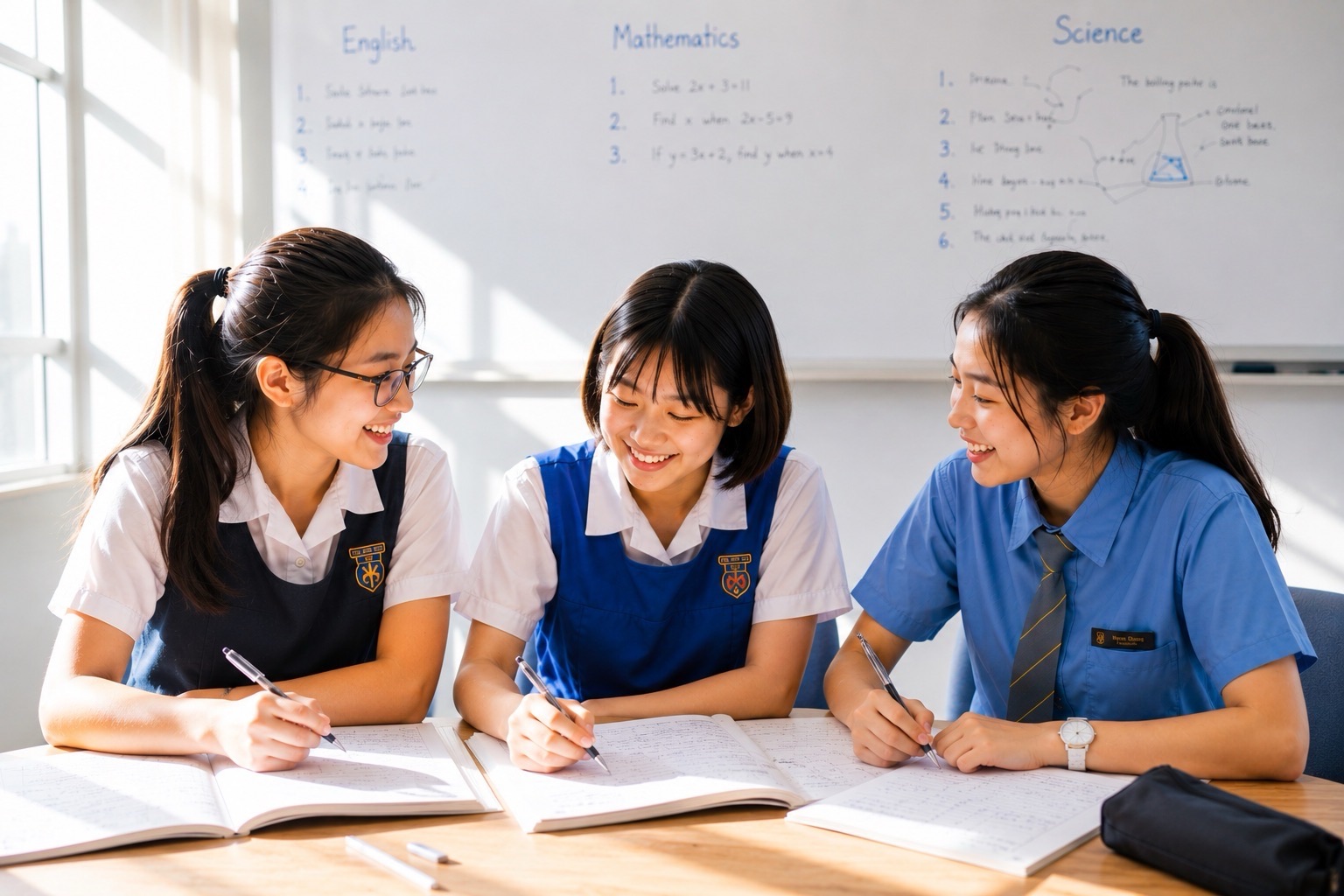
Additional Mathematics becomes difficult when a student can no longer solve a question by recalling one familiar procedure.
By Secondary 3, algebra, functions, graphs, trigonometry and calculus begin operating as one connected mathematical system. A weakness in factorisation can reappear inside logarithms. Uncertain equation-solving may obstruct coordinate geometry. Poor handling of signs and brackets can damage an otherwise correct differentiation solution.
At eduKateSG, we provide Additional Mathematics tuition for Holland students in carefully managed classes limited to three students.
Lessons are conducted at our Bukit Timah location at 8 Fourth Avenue, Singapore 268674, near Sixth Avenue MRT. The programme serves students travelling from Holland Village, Holland Road and surrounding neighbourhoods; it is not presented as a separate tuition centre physically located inside Holland Village. eduKateSG operates teaching locations in Bukit Timah and Punggol. (eduKate Singapore)
Our weekly 1.5-hour tutorials support Secondary 3 and Secondary 4 students taking Additional Mathematics under the syllabus and subject level offered by their school.
The objective is not simply to complete more A-Math questions.
It is to identify where the student’s mathematical control first becomes unstable, repair the correct dependency and check whether the improvement survives when the question changes.
[
\text{Understand}
\rightarrow
\text{Select}
\rightarrow
\text{Execute}
\rightarrow
\text{Check}
\rightarrow
\text{Transfer}
]
Additional Mathematics Tuition Holland at a Glance
| Programme detail | Information |
|---|---|
| Subject | Additional Mathematics |
| Student levels | Secondary 3 and Secondary 4 |
| Subject pathways | G2 and G3 Additional Mathematics, according to school offering and examination year |
| Class size | Maximum three students |
| Lesson duration | 1.5 hours weekly |
| Teaching location | eduKateSG Bukit Timah, 8 Fourth Avenue |
| Nearest MRT | Sixth Avenue MRT |
| Students served | Holland Village, Holland Road and surrounding neighbourhoods |
| Suitable for | Foundation repair, school support, stabilisation, examination preparation and extension |
| Main capabilities | Algebra, functions, graphs, trigonometry, calculus, reasoning, transfer and examination control |
| Placement | By consultation, level, timetable and class suitability |
The page serves a specific local search need:
[
\text{Holland family}
\rightarrow
\text{A-Math learning problem}
\rightarrow
\text{3-pax specialist class}
\rightarrow
\text{eduKateSG Bukit Timah}
]
It complements the broader Secondary Mathematics Tuition Holland Village page while concentrating on the narrower Secondary 3–4 Additional Mathematics decision. (eduKate Singapore)
A Clear Holland Locality Note
This page is written for families searching for Additional Mathematics tuition for Holland students.
It does not claim that eduKateSG operates a separate branch inside Holland Village.
Lessons are conducted at:
eduKateSG Bukit Timah
8 Fourth Avenue
Singapore 268674
Near Sixth Avenue MRT
The locality relationship is therefore:
[
\text{Students served: Holland}
]
[
\text{Teaching location: Sixth Avenue}
]
Holland should not be treated as one identical starting point.
A family near Holland Village MRT may approach the journey differently from one living along Holland Road, near Farrer Road or closer to the Bukit Timah side of the district.
For students beginning at Holland Village MRT, one rail route is:
[
\text{Holland Village}
\rightarrow
\text{Botanic Gardens}
\rightarrow
\text{Sixth Avenue}
]
Holland Village and Botanic Gardens are on the Circle Line. Students can transfer at Botanic Gardens to the Downtown Line and continue to Sixth Avenue. (LTA)
Families should consider:
- the student’s exact starting point;
- school dismissal location;
- travelling time;
- lesson schedule;
- academic workload;
- and whether the three-student format matches the student’s needs.
A nearby lesson is useful only when the teaching structure is also suitable.
The local question is therefore not merely:
Which tuition centre is closest to Holland Village?
It is:
What does my child need the tutor to observe, diagnose and repair?
What Is Additional Mathematics?
Additional Mathematics, commonly called A-Math, is an upper-secondary Mathematics subject that develops more abstract and connected mathematical reasoning.
Students work with symbols, functions, graphical relationships, trigonometric structures and rates of change. They must do more than remember formulas.
They need to:
- manipulate algebra accurately;
- recognise mathematical structures;
- select methods independently;
- connect concepts from different topics;
- communicate complete mathematical working;
- check whether an answer is reasonable;
- and apply familiar knowledge in unfamiliar forms.
For the 2027 Singapore-Cambridge Secondary Education Certificate examinations, Additional Mathematics is listed at both G2 and G3. The official subject codes are K232 for G2 Additional Mathematics and K341 for G3 Additional Mathematics. (SEAB)
Students graduating in 2026 remain under the existing GCE O-Level examination structure, where Additional Mathematics carries syllabus code 4049. (SEAB)
Tuition must therefore align with the student’s:
- school programme;
- subject level;
- examination year;
- present readiness;
- and actual learning gaps.
The correct label matters, but the deeper educational requirement remains the same.
The student must learn to understand, select, execute, communicate and transfer Mathematics reliably.
Why Additional Mathematics Feels Different
The move into A-Math is not simply:
[
\text{Easy Mathematics}
\rightarrow
\text{harder Mathematics}
]
It is a change in how the subject behaves.
In earlier Mathematics, students may sometimes succeed by identifying a familiar question type and repeating a matching procedure.
In Additional Mathematics, a single idea may appear through:
- an equation;
- a graph;
- a geometrical relationship;
- a transformation;
- a proof;
- a rate-of-change problem;
- or a multi-topic application.
The student must move from:
[
\text{Remember the method}
]
to:
[
\text{Recognise the structure}
\rightarrow
\text{select the method}
\rightarrow
\text{control the working}
]
This explains a common parent observation:
My child understands when the teacher explains it, but cannot do the next question alone.
The student may genuinely understand the worked example.
However, understanding while watching is not the same as retrieving and applying the method independently.
The missing movement may be:
[
\text{Guided recognition}
\not\Rightarrow
\text{independent execution}
]
A-Math tuition should reveal this distinction rather than responding with another large stack of identical worksheets.
The Real A-Math Problem May Begin Earlier
A student may appear to be struggling with differentiation, logarithms or trigonometric identities.
The visible topic is not always the origin of the problem.
For example:
[
\text{Weak fraction control}
\rightarrow
\text{unstable algebra}
\rightarrow
\text{incorrect rearrangement}
\rightarrow
\text{calculus error}
]
Or:
[
\text{Uncertain factorisation}
\rightarrow
\text{weak polynomial control}
\rightarrow
\text{difficulty solving equations}
\rightarrow
\text{incomplete multi-step solution}
]
Or:
[
\text{Graph understood only visually}
\rightarrow
\text{weak function interpretation}
\rightarrow
\text{difficulty connecting equation and curve}
\rightarrow
\text{poor calculus reasoning}
]
When the first weak dependency is not repaired, the student may repeat the same underlying error across several chapters.
The parent sees many topic problems.
The tutor may see one shared failure beneath them.
This is why good Additional Mathematics tuition does not begin by assuming that the newest chapter is automatically the correct starting point.
It begins by asking:
- Where is the student now?
- At which step does the solution first become unstable?
- Is the failure conceptual, procedural or behavioural?
- Which earlier capability does the present question require?
- Can the student reproduce the solution when the question changes?
Why Holland Students May Seek A-Math Tuition
Families usually begin searching for Additional Mathematics tuition when one of several conditions appears.
The student may:
- understand school lessons but remain unable to complete homework independently;
- spend excessive time on routine algebra;
- repeatedly lose marks through signs, brackets or incomplete working;
- know individual topics but struggle when questions combine them;
- perform well during practice but fall sharply during timed assessments;
- rely heavily on model solutions;
- forget topics soon after a chapter test;
- or become increasingly reluctant to begin unfamiliar questions.
These conditions should not all be treated as the same problem.
A student who lacks conceptual understanding requires a different intervention from a student who understands but works too slowly.
A student who makes occasional slips requires a different intervention from a student whose errors always begin at the same algebraic step.
A student who succeeds only on familiar worksheets requires transfer training, not simply more repetition.
For Holland families, the decision may also involve a practical comparison between:
- a larger centre closer to home;
- private one-to-one tuition;
- independent study;
- and a three-student class near Sixth Avenue.
No one format is automatically correct for every student.
A three-student class becomes relevant when the student needs close visibility of working, individual questioning and a tutor who can identify exactly where the process begins to fail.
Diagnosing “Weak in A-Math”
The phrase “weak in A-Math” is too broad to guide teaching.
A more useful diagnosis separates the possible breakdowns.
| What appears on the paper | Possible underlying problem | First useful teaching move |
|---|---|---|
| Many “careless” mistakes | Weak sign, bracket or notation control | Locate the exact line where accuracy breaks |
| Student cannot begin | Weak question decoding or method selection | Train the first mathematical move |
| Student understands examples but fails alone | Recognition without retrieval | Remove prompts gradually |
| Good homework, weak tests | Load, speed or pressure problem | Introduce controlled timed work |
| Strong on chapter worksheets, weak on mixed papers | Poor transfer or topic recognition | Interleave and vary question forms |
| Difficulty with calculus | Weak algebra, indices, functions or graphs | Repair the required dependency first |
| Long solutions with little progress | Inefficient route selection | Compare possible solution paths |
| Correct answer with lost method marks | Incomplete mathematical communication | Rebuild essential working |
| Student forgets completed chapters | Weak retrieval and revision spacing | Reintroduce earlier topics systematically |
| Performance changes sharply between papers | Unstable control rather than total ignorance | Identify which condition causes the collapse |
This turns:
[
\text{“My child is weak.”}
]
into:
[
\text{Specific failure}
\rightarrow
\text{specific repair}
\rightarrow
\text{measurable retest}
]
A-Math Is a Connected System
The subject should not be experienced as a disconnected list of chapters.
Each area provides machinery that later topics reuse.
1. Algebra Is the Operating Language
Algebra supports almost every major part of Additional Mathematics.
It appears in:
- equations and inequalities;
- surds;
- polynomials;
- partial fractions;
- binomial expansions;
- exponential functions;
- logarithmic functions;
- coordinate geometry;
- trigonometric identities;
- differentiation;
- and integration.
A student with unstable algebra may appear to have problems everywhere because the same capability is being reused throughout the syllabus.
Repairing algebra is therefore not unnecessary regression.
It is restoration of the operating language required by later work.
2. Functions Connect Equations and Graphs
A function may be represented through:
- symbols;
- equations;
- tables;
- mappings;
- graphs;
- and transformations.
Students must learn to move between these forms.
The objective is not merely to memorise the appearance of a graph.
The student should understand how the equation controls the curve and how the curve reveals information about the equation.
3. Trigonometry Requires Algebraic Discipline
Upper-secondary trigonometry is not limited to choosing sine, cosine or tangent in a triangle.
Students must manage:
- functions;
- identities;
- equations;
- exact values;
- graphs;
- transformations;
- radians;
- and proof-like reasoning.
Every line must preserve mathematical equivalence.
A casual change to a sign, factor or denominator may invalidate the rest of the solution.
4. Calculus Coordinates Earlier Knowledge
Differentiation and integration may appear to be completely new areas.
In practice, they coordinate capabilities that were built earlier:
- functions;
- algebra;
- indices;
- graphs;
- gradients;
- trigonometry;
- substitution;
- and notation.
A student may understand the derivative rule but still fail the question because the expression cannot be simplified correctly.
The calculus problem is then partly an algebra problem wearing a calculus label.
Three Dimensions of A-Math Performance
A useful diagnosis examines three separate dimensions.
Depth
Can the student explain why the method works?
Depth is weak when the student:
- memorises transformations without understanding them;
- cannot explain what a function or derivative represents;
- copies a solution pattern;
- or becomes lost when one expected line is removed.
Depth repair may require:
- clearer explanation;
- visual representation;
- comparison between methods;
- counterexamples;
- or reconstruction from first principles.
Load
Can the student perform the method accurately under time and pressure?
Load is weak when the student:
- works correctly but too slowly;
- makes more errors during tests;
- repeatedly restarts;
- cannot maintain attention across a full paper;
- or loses control when several steps must be coordinated.
Load repair may require:
- cleaner working;
- stronger retrieval;
- shorter timed sections;
- method compression;
- or a more reliable checking routine.
Transfer
Can the student recognise and use the idea when the surface changes?
Transfer is weak when the student:
- succeeds only on familiar worksheets;
- requires the chapter heading to know which method to use;
- cannot connect a graph to its equation;
- or fails when two topics are combined.
Transfer repair may require:
- changed wording;
- mixed-topic practice;
- different representations;
- removal of obvious cues;
- and delayed retrieval.
These dimensions should not be collapsed into one grade.
A student may have good depth but weak speed.
Another may be fast but shallow.
Another may perform well on familiar questions but fail every transfer test.
The teaching response should match the actual profile.
Why a Three-Student Class Matters
“Small-group tuition” is useful only when the smaller class changes what the tutor can see and do.
At eduKateSG, the class limit is three students.
The educational advantage is:
[
\text{Three students}
\rightarrow
\text{visible working}
\rightarrow
\text{precise diagnosis}
\rightarrow
\text{individual correction}
\rightarrow
\text{changed question}
\rightarrow
\text{transfer check}
]
A tutor can examine:
- how each student begins;
- which method each student selects;
- where a sign or term first changes incorrectly;
- whether the student understands the mathematical reason;
- whether the error is repeated;
- and whether the correction survives independently.
This is important because two students can obtain the same wrong answer through completely different routes.
One may not understand the concept.
Another may understand but make a procedural mistake.
Giving both students the same correction would be inefficient.
In a three-student A-Math class, the tutor can preserve a shared lesson direction while adjusting:
- explanation;
- difficulty;
- prompting;
- practice volume;
- correction;
- and extension
for each student.
Peer visibility is also useful in controlled amounts.
Students may see an alternative route or learn from another student’s mistake without disappearing inside a large class.
The class remains small enough for individual working to stay visible.
How an Additional Mathematics Lesson Works
A lesson is not managed only by asking which chapter the school is teaching.
It is managed by coordinating the school syllabus with the student’s present mathematical condition.
Step 1: Observe
Evidence may come from:
- recent test papers;
- marked assignments;
- incomplete homework;
- recurring mistakes;
- oral explanation;
- a short diagnostic question;
- or the student’s first response to unfamiliar work.
The tutor looks beyond the final answer.
The student’s working reveals how the solution was constructed and where control began to weaken.
Step 2: Locate the First Breakdown
The tutor identifies the earliest point where the solution becomes unstable.
The final wrong answer may be several steps away from the real cause.
Step 3: Classify the Failure
The problem may involve:
- missing knowledge;
- weak understanding;
- slow retrieval;
- incorrect method selection;
- algebraic inaccuracy;
- incomplete working;
- poor checking;
- or weak transfer.
Step 4: Select the Highest-Leverage Repair
The tutor identifies the repair that will unlock the greatest amount of later work.
This may involve revisiting an earlier concept while still keeping the student connected to the present school topic.
Step 5: Reconstruct the Concept
The method is explained from first principles.
The student should understand why each line is valid rather than merely remember what line usually comes next.
Step 6: Guide the First Application
The tutor supports the student through an appropriate question.
Prompts are used deliberately.
They should help the student cross the difficulty without becoming permanent scaffolding.
Step 7: Remove Support
The student completes a related question independently.
This tests whether the learning has moved from the tutor’s explanation into the student’s own control.
Step 8: Change the Surface
The numbers, representation, wording or topic combination changes.
The tutor checks whether the student can still recognise the underlying Mathematics.
Step 9: Retrieve Later
The concept reappears after time has passed and among other topics.
This tests whether it remains available.
The educational movement is:
[
\text{Tutor-managed}
\rightarrow
\text{co-managed}
\rightarrow
\text{student-managed}
]
Secondary 3 Additional Mathematics Tuition Holland
Secondary 3 is the installation year.
Students are learning a new mathematical language while also managing the broader upper-secondary jump.
New demands arrive together:
- heavier algebra;
- more formal functions;
- coordinate geometry;
- trigonometric relationships;
- logarithms and exponentials;
- differentiation;
- integration;
- and longer multi-stage questions.
The main jobs of Secondary 3 A-Math tuition are to:
- establish reliable algebraic habits;
- help the student read notation accurately;
- connect equations, functions and graphs;
- prevent early misunderstandings from accumulating;
- coordinate tuition with school progression;
- develop complete mathematical working;
- and preserve earlier topics through retrieval.
A Secondary 3 student may benefit from support when the student:
- understands during lessons but cannot reproduce the work later;
- needs excessive time for routine algebra;
- repeatedly loses signs or terms;
- memorises examples without understanding the structure;
- performs well only immediately after practice;
- or begins to avoid A-Math questions.
The objective is not to race through the textbook.
It is to build a system that remains stable when Secondary 4 increases the load.
Secondary 4 Additional Mathematics Tuition Holland
Secondary 4 is the conversion year.
The student must convert accumulated knowledge into marks under limited time.
This requires more than completing the syllabus.
The student must be able to:
- retrieve earlier chapters;
- recognise mixed-topic structures;
- choose methods efficiently;
- maintain accurate working;
- recover from difficult questions;
- manage time across a paper;
- check strategically;
- and sustain attention until the end.
Secondary 4 tuition therefore shifts progressively towards:
- syllabus-gap closure;
- mixed-topic revision;
- timed sections;
- paper sequencing;
- mistake classification;
- repeated-error compression;
- and complete examination papers.
The purpose of a full paper is not merely to produce a score.
A full paper reveals where the student’s system becomes unstable:
- at the beginning;
- under unfamiliar wording;
- after a difficult question;
- during algebra-heavy working;
- when topics combine;
- or near the end as attention declines.
The paper becomes diagnostic evidence.
The next lesson should respond to that evidence.
G2 Additional Mathematics Tuition
G2 Additional Mathematics is not merely a reduced label attached to the same teaching sequence.
The tutor must align instruction to the actual G2 syllabus, the student’s school programme and the student’s future progression.
The student may need:
- stronger algebraic foundations;
- careful conceptual sequencing;
- more guided retrieval;
- slower removal of scaffolding;
- and deliberate preparation for movement into more demanding mathematical study.
For 2027 SEC school candidates, G2 Additional Mathematics is identified by subject code K232. (SEAB)
The educational aim remains genuine mathematical control.
Students should not be trained only to imitate a narrow set of question templates.
G3 Additional Mathematics Tuition
G3 Additional Mathematics requires students to coordinate a broad mathematical system with greater abstraction and examination demand.
The student may need to manage:
- complex algebraic manipulation;
- functions and graphs;
- trigonometric equations and identities;
- coordinate geometry;
- differentiation;
- integration;
- applications;
- and multi-topic questions.
For 2027 SEC school candidates, G3 Additional Mathematics is identified by subject code K341. (SEAB)
Strong students also require diagnosis.
A student may achieve good marks while remaining overly dependent on familiar formats.
Another may be accurate but too slow.
Another may understand advanced concepts but lose marks through incomplete working.
The goal is not simply harder worksheets.
It is deeper, faster and more transferable control.
Different Students Need Different Starting Points
Foundation Repair
Suitable for a student whose A-Math difficulty comes from earlier weaknesses in:
- fractions;
- indices;
- equations;
- factorisation;
- graphs;
- or algebraic manipulation.
The repair should reconnect the student to present school work rather than becoming an endless restart from the beginning.
Stabilisation
Suitable for a student who generally understands lessons but produces inconsistent homework and test results.
The focus is on:
- retrieval;
- working discipline;
- error detection;
- and transfer.
School Synchronisation
Suitable for a student who needs help keeping pace with the school sequence without developing hidden gaps.
The tutor coordinates present chapters with prerequisite repair and future readiness.
Examination Control
Suitable for a student who knows much of the syllabus but loses marks through:
- timing;
- incomplete working;
- poor question selection;
- weak checking;
- or difficulty connecting topics.
Pass-to-Distinction Development
Suitable for a student who can complete standard questions but needs:
- stronger structural recognition;
- cleaner solutions;
- better transfer;
- and greater control of unfamiliar questions.
Extension
Suitable for a student who is already stable and requires greater depth, flexibility and independence rather than additional routine repetition.
Placement should begin with evidence, not with a generic label such as weak, average or advanced.
Catch Up, Keep Up or Move Ahead
Catch Up
For a student who is falling behind, the programme identifies the dependency preventing current progress.
[
\text{Diagnose}
\rightarrow
\text{repair}
\rightarrow
\text{reconnect}
\rightarrow
\text{stabilise}
]
Keep Up
For a student who can follow school but is becoming inconsistent, the objective is continuity.
[
\text{Preview}
\rightarrow
\text{understand}
\rightarrow
\text{practise}
\rightarrow
\text{retrieve}
]
Move Ahead
For a student with a secure foundation, the objective is deeper flexibility and transfer.
[
\text{Vary}
\rightarrow
\text{compare}
\rightarrow
\text{justify}
\rightarrow
\text{generalise}
]
These routes can change.
A student may require repair in one area and extension in another.
Mathematical ability is rarely a single flat level.
From Repetition to Transfer
Repetition is useful when a method is first being installed.
However, repetition alone can create false confidence.
A student may complete ten nearly identical questions because the worksheet itself reveals which method to use.
The real test appears when:
- the chapter heading is removed;
- the diagram changes;
- the question combines two topics;
- the variables are rearranged;
- the familiar wording disappears;
- or the problem appears inside a full examination paper.
Transfer training changes the surface while preserving the underlying concept.
For example, a student learning differentiation may need to:
- differentiate a direct expression;
- simplify before differentiating;
- find a gradient at a point;
- determine a tangent or normal;
- locate a stationary point;
- classify the stationary point;
- solve a rate-of-change problem;
- connect the derivative to a graph;
- and recognise differentiation inside a mixed question.
This transforms:
[
\text{I recognise the worksheet}
]
into:
[
\text{I recognise the Mathematics}
]
Building Examination Speed Correctly
Speed should not be installed before the method is stable.
Premature timing can cause the student to repeat mistakes faster.
A safer sequence is:
[
\text{Understand}
\rightarrow
\text{execute accurately}
\rightarrow
\text{retrieve reliably}
\rightarrow
\text{increase speed}
\rightarrow
\text{apply under pressure}
]
Timed practice should identify the cause of slowness.
The student may be slow because of:
- weak recall;
- uncertain algebra;
- poor method selection;
- excessive writing;
- repeated checking;
- frequent restarting;
- calculator inefficiency;
- or emotional hesitation.
Each cause requires a different repair.
“Work faster” is not a diagnosis.
Why “Careless” Is Not a Diagnosis
Students frequently describe lost marks as careless mistakes.
Sometimes a mistake is genuinely accidental.
Repeated carelessness, however, usually contains a pattern.
| Visible error | Possible underlying cause |
|---|---|
| Negative sign lost | Weak notation control or crowded working |
| Bracket ignored | Incomplete control of algebraic structure |
| Wrong value substituted | Reading or variable-identification failure |
| Correct method, wrong arithmetic | High mental load or weak numerical control |
| Stops after one line | Retrieval or continuation failure |
| Changes a correct answer | Unreliable checking routine |
| Correct during practice, weak in tests | Load, timing or pressure problem |
| Same error repeats | Correction was understood but not installed |
| Cannot begin a changed question | Weak transfer |
| Paper unfinished | Slow selection or poor time regulation |
Telling a student to be more careful does not identify what should change.
A useful correction asks:
- What type of error occurred?
- At which line did it begin?
- Under what condition does it recur?
- Which control could prevent it?
- Can the student apply that control independently?
A sign error may require one transformation per line.
A substitution error may require values to be labelled before calculation.
A repeated checking error may require a structured checking sequence.
A transfer error may require a changed question rather than another identical example.
What Progress Looks Like
Progress may appear before a major grade movement becomes visible.
Early signs include:
- the student begins questions with less prompting;
- algebraic working becomes cleaner;
- repeated sign errors decrease;
- explanations become more precise;
- fewer solutions need to be restarted;
- completed topics remain retrievable;
- the student recognises concepts in changed forms;
- checking becomes more purposeful;
- timed sections become more complete;
- and results become less dependent on familiar wording.
A useful progress check asks three questions.
Depth Check
Can the student explain the idea without copying a model solution?
Load Check
Can the student execute it accurately under appropriate time pressure?
Transfer Check
Can the student use it when the question looks different?
A student has not fully mastered a concept merely because one familiar worksheet was completed successfully.
Does Every Holland A-Math Student Need Tuition?
No.
A student who:
- understands school instruction;
- completes work independently;
- retrieves earlier topics;
- corrects mistakes productively;
- manages assessment timing;
- and continues to progress steadily
may not need an additional class.
Tuition becomes more useful when the student’s present learning environment cannot sufficiently expose or repair the difficulty.
The decision should be based on the student’s condition, not on fear that every other student is attending tuition.
A Holland family may reasonably choose a different option when:
- the student already studies independently;
- a school support system is working well;
- travelling time would create excessive load;
- or the student mainly needs occasional consultation rather than a weekly class.
The three-student programme is most relevant when close observation and individual correction are likely to change the student’s learning process.
Starting Additional Mathematics Tuition from Holland
A useful consultation should begin with visible evidence.
Parents may provide:
- the student’s secondary level;
- whether the student is taking G2 or G3 Additional Mathematics;
- the student’s examination year;
- recent school papers;
- marked assignments;
- incomplete homework;
- topics currently taught in school;
- recurring mistakes;
- available lesson times;
- school dismissal location;
- and whether related core Mathematics weaknesses are affecting A-Math.
The consultation should clarify:
- Where is the student now?
- Where does the mathematical process first break?
- Which earlier dependency is involved?
- What should be repaired first?
- Which class placement is suitable?
- What evidence will show that the repair is working?
- Is the journey from Holland practical within the student’s weekly schedule?
Because each class is limited to three students, placement depends on:
- level;
- subject pathway;
- timetable;
- learning needs;
- current topic position;
- pace;
- and compatibility with the existing group.
The objective is not merely to fill an available seat.
It is to create an educationally workable class.
Frequently Asked Questions
Is the Additional Mathematics class conducted in Holland Village?
No.
The programme is intended for students travelling from Holland Village, Holland Road and surrounding areas, but lessons are conducted at eduKateSG Bukit Timah, 8 Fourth Avenue, Singapore 268674, near Sixth Avenue MRT.
The location relationship is stated clearly so parents are not given the impression that eduKateSG operates a separate physical branch inside Holland Village.
How can a student travel from Holland Village to Sixth Avenue?
One MRT route is to take the Circle Line from Holland Village to Botanic Gardens, transfer to the Downtown Line and continue to Sixth Avenue. The best route depends on the student’s exact starting point, school location and current transport conditions. (LTA)
Is Sixth Avenue close to the broader Holland area?
Holland is a broad locality rather than one identical starting point.
Some families may be nearer Holland Village MRT, while others may begin from Holland Road, Farrer Road or the Bukit Timah side of the area.
Parents should check the actual door-to-door journey rather than relying only on the neighbourhood name.
Which levels are supported?
The programme supports Secondary 3 and Secondary 4 Additional Mathematics students.
Does eduKateSG support G2 and G3 Additional Mathematics?
Teaching can be aligned to the student’s school subject level, syllabus and examination year.
SEAB lists Additional Mathematics at both G2 and G3 for the 2027 SEC examinations. (SEAB)
What is the maximum class size?
Each class is limited to three students.
How long is each lesson?
Each weekly tutorial is 1.5 hours.
Can A-Math tuition repair E-Math weaknesses?
Relevant core Mathematics dependencies can be repaired when they are preventing progress in Additional Mathematics.
For example, weaknesses in:
- fractions;
- indices;
- equations;
- graphs;
- algebra;
- or trigonometry
may need attention before an A-Math topic becomes stable.
The class remains centred on Additional Mathematics, but an earlier dependency should not be ignored merely because it originated elsewhere.
Will the tutor restart the entire syllabus?
Not automatically.
The tutor should return only as far as necessary to repair the dependency affecting current A-Math progress.
The repaired skill is then reconnected to the present topic.
Can tuition help a student aiming for a distinction?
Tuition can provide structured diagnosis, explanation, correction, mixed practice and examination preparation.
However, no grade should be guaranteed.
A distinction route requires:
- conceptual depth;
- accurate execution;
- effective retrieval;
- method selection;
- transfer;
- and control under examination conditions.
Should a student begin in Secondary 3 or wait until Secondary 4?
Secondary 3 focuses on installing and stabilising the new mathematical system.
Secondary 4 increasingly focuses on:
- retrieval;
- integration;
- examination timing;
- and final performance.
The correct timing depends on whether the student is learning independently and whether early weaknesses are beginning to accumulate.
What should parents bring to the consultation?
A recent test paper, marked assignment or representative piece of homework is useful.
It allows the discussion to begin with actual mathematical evidence rather than only the broad description that the student is weak in A-Math.
Is the programme suitable only for struggling students?
No.
A student may attend for:
- foundation repair;
- school synchronisation;
- performance stabilisation;
- examination preparation;
- distinction development;
- or extension.
The teaching starting point should match the student’s actual profile.
Can the class guarantee an A1 or distinction?
No.
Tuition can improve the quality of diagnosis, explanation, practice, correction and examination preparation.
The final result also depends on:
- attendance;
- independent practice;
- student response;
- health;
- school workload;
- time management;
- and performance during the examination.
Building Independent A-Math Control
Additional Mathematics is not mastered by collecting a larger number of memorised solutions.
It is developed by learning to:
- see relationships;
- recognise structures;
- select valid methods;
- control each transformation;
- communicate complete working;
- check answers meaningfully;
- and recognise the same Mathematics when its surface form changes.
For students travelling from Holland, eduKateSG’s three-student Additional Mathematics classes provide a focused route into our Bukit Timah learning location near Sixth Avenue MRT.
The educational movement is:
[
\text{Observe}
\rightarrow
\text{diagnose}
\rightarrow
\text{repair}
\rightarrow
\text{practise}
\rightarrow
\text{correct}
\rightarrow
\text{transfer}
\rightarrow
\text{independence}
]
The objective is not only to help the student finish the next worksheet.
It is to build a student who can increasingly understand, manage and execute Additional Mathematics independently.
Arrange a Parent–Student Consultation
Speak with eduKateSG about your child’s:
- secondary level;
- G2 or G3 Additional Mathematics pathway;
- examination year;
- current results;
- algebraic foundations;
- recurring errors;
- school syllabus progress;
- examination requirements;
- travelling arrangements from Holland;
- and suitable three-student class availability.
Bring a recent marked paper where possible.
The purpose of the consultation is to determine whether the student needs:
[
\text{Foundation repair}
\quad
\text{stabilisation}
\quad
\text{school synchronisation}
\quad
\text{examination control}
\quad
\text{or extension}
]
eduKateSG Bukit Timah
8 Fourth Avenue
Singapore 268674
Near Sixth Avenue MRT
Class format: Maximum three students
Lesson duration: 1.5 hours weekly
Attendance: By appointment and class suitability
Properly taught students do more than remember the next step.
They learn to see why the steps belong together.
Properly taught kids shine a bright light into the future.