
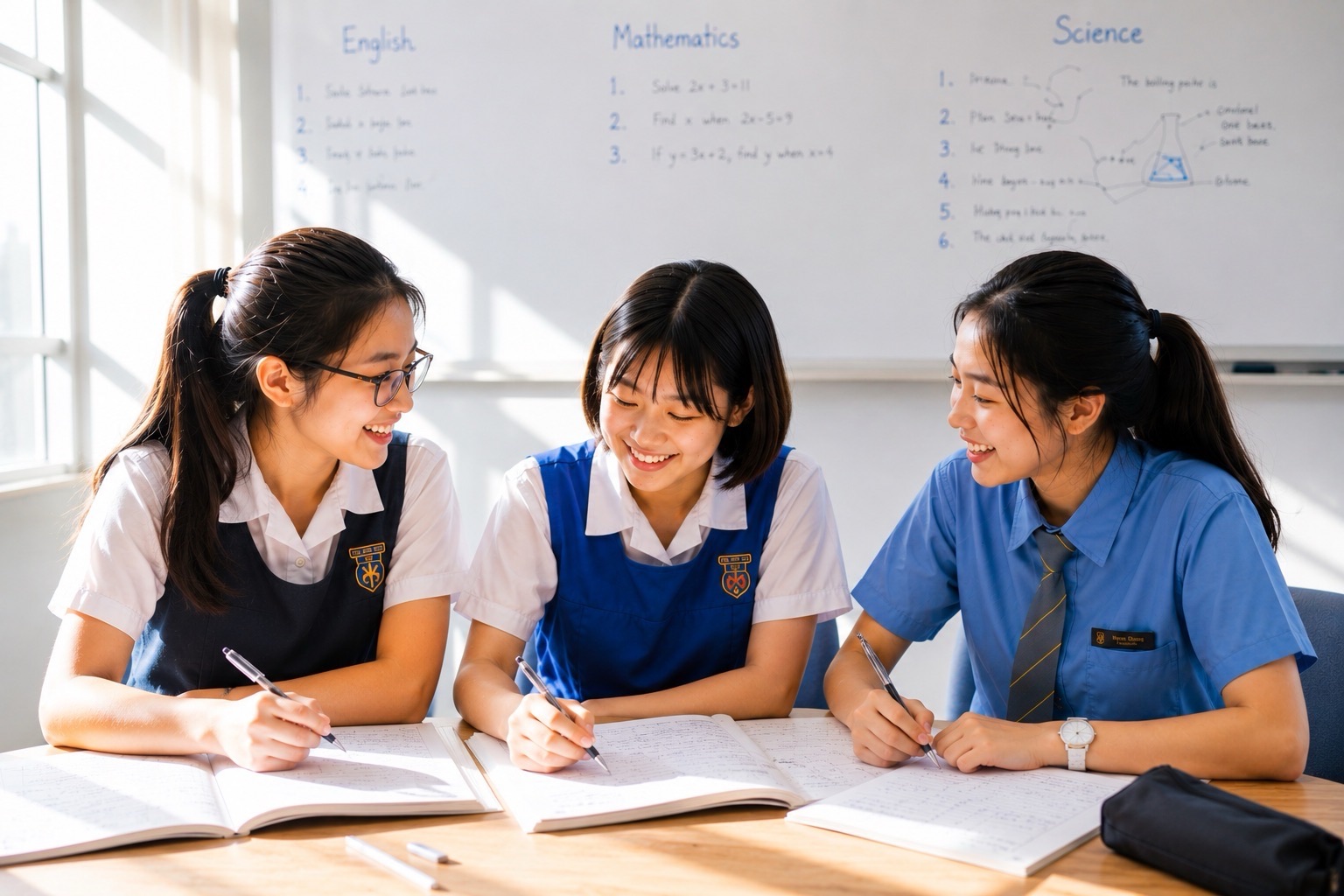
Additional Mathematics tuition for Woodlands Secondary 3 and Secondary 4 students in closely guided three-student classes near Sixth Avenue MRT.
Additional Mathematics Tuition for Woodlands Students
Additional Mathematics tuition at eduKateSG is designed for Woodlands students who need more than additional worksheets and repeated model answers.
The programme helps Secondary 3 and Secondary 4 students build stronger control over:
- algebraic manipulation;
- equations and inequalities;
- functions and graphs;
- logarithms and exponentials;
- coordinate geometry;
- trigonometry;
- differentiation;
- integration;
- mathematical reasoning;
- and examination execution.
Lessons are conducted at eduKateSG’s Bukit Timah teaching location:
eduKateSG
8 Fourth Avenue, Singapore 268674
Near Sixth Avenue MRT
Each weekly lesson lasts 1.5 hours, and every class is limited to three students.
The class is not physically located in Woodlands. It serves Woodlands families who consider the three-student format and its close inspection of mathematical working suitable for their child.
In a three-student Additional Mathematics class, the tutor can inspect the exact line where a student’s mathematical process first becomes unstable.
That distinction matters because the final wrong answer is often only the last visible consequence of an earlier failure.
The lesson therefore follows a deeper route:
[
\text{Observe the working}
\rightarrow
\text{find the first wrong move}
\rightarrow
\text{repair the dependency}
\rightarrow
\text{test a variation}
\rightarrow
\text{retrieve later}
\rightarrow
\text{transfer independently}
]
Choose Your Route
For parents comparing tuition programmes
Begin with Why Three Students Matter, When Additional Mathematics Tuition May Help and Preparing for a Consultation.
For Secondary 3 students
Go to Secondary 3: Installing the Additional Mathematics System.
For Secondary 4 students
Go to Secondary 4: Converting Knowledge into Examination Control.
For students losing marks despite understanding
Read The First Wrong Move and Why “Careless” Is Not a Diagnosis.
For families checking the location
Go to Travelling from Woodlands to Sixth Avenue.
Additional Mathematics Tuition at a Glance
| Programme detail | Information |
|---|---|
| Subject | Additional Mathematics |
| Student levels | Secondary 3 and Secondary 4 |
| Subject levels | G2 and G3 Additional Mathematics |
| Class size | Maximum three students |
| Lesson duration | 1.5 hours weekly |
| Teaching location | 8 Fourth Avenue, near Sixth Avenue MRT |
| Students served | Woodlands and surrounding northern areas |
| Main focus | Algebra, functions, trigonometry, calculus, reasoning and examination control |
| Suitable for | Repair, consolidation, school support, examination preparation and extension |
| Placement | By consultation, timetable and educational suitability |
A Clear Locality Note
This page is for families searching for Additional Mathematics tuition for Woodlands students.
It does not claim that eduKateSG has a Woodlands branch.
Lessons discussed on this page take place at 8 Fourth Avenue, near Sixth Avenue MRT.
The locality relationship is therefore:
[
\text{Student served: Woodlands}
]
[
\text{Teaching location: Sixth Avenue}
]
Parents should compare the educational fit, class format, travelling time, timetable and the student’s actual support needs before choosing a programme.
A closer tuition centre may be entirely suitable for a student who mainly needs routine revision.
A three-student class may be worth considering when the student needs:
- close observation of mathematical working;
- targeted repair of recurring weaknesses;
- frequent questioning;
- individual correction;
- carefully adjusted pacing;
- or stronger transfer from familiar to unfamiliar questions.
The relevant question is not simply:
Which programme is nearest?
It is also:
What does my child need the tutor to notice and correct?
What Is Additional Mathematics?
Additional Mathematics, commonly called A-Math, is an upper-secondary subject that extends the algebraic, graphical and geometrical foundations developed in Mathematics.
The subject requires students to work with increasingly abstract relationships.
A student may need to:
- interpret a compact mathematical expression;
- recognise its underlying structure;
- retrieve a relevant earlier concept;
- select a suitable method;
- preserve accuracy across several transformations;
- present complete working;
- and interpret the result.
The difficulty does not come from one chapter alone.
It comes from the number of capabilities that must remain coordinated inside the same solution.
A student can know differentiation but still lose the question because an earlier algebraic rearrangement failed.
A student can remember a trigonometric identity but fail to recognise when it should be used.
A student can understand a worked example but remain unable to begin when the wording changes.
This creates an important distinction:
[
\text{Knowing a method}
\neq
\text{recognising when to use it}
]
It also means:
[
\text{Completing familiar questions}
\neq
\text{independent A-Math control}
]
Why Additional Mathematics Feels So Different
Students entering Additional Mathematics often discover that methods which previously worked are no longer sufficient.
In earlier Mathematics, a learner may sometimes progress by identifying a familiar question type and applying a remembered procedure.
In Additional Mathematics, the surface appearance can change while the underlying structure remains the same.
The student must therefore learn to see beneath the wording.
For example, two questions may look different but require the same algebraic relationship. Conversely, two questions may contain similar symbols but require completely different methods.
This increases the demand on:
- structural recognition;
- method selection;
- retrieval;
- symbolic control;
- transfer;
- and sustained accuracy.
Additional Mathematics is therefore not simply “more difficult Mathematics”.
It is a more compressed mathematical system in which earlier weaknesses become increasingly visible.
The First Wrong Move
When a student receives a wrong answer, the visible error may occur at the bottom of the page.
The actual failure may have happened several lines earlier.
Consider the following chain:
[
\text{Read}
\rightarrow
\text{represent}
\rightarrow
\text{choose}
\rightarrow
\text{transform}
\rightarrow
\text{calculate}
\rightarrow
\text{interpret}
\rightarrow
\text{check}
]
An error at any stage can damage everything that follows.
A student may read the question correctly but represent the relationship wrongly.
Another may represent it correctly but select an inefficient method.
Another may choose the correct method but lose a negative sign.
Another may complete the algebra accurately but misunderstand what the answer means.
The final answer does not tell us which of these occurred.
Correction should therefore begin with the student’s complete process.
An apparent calculus problem
Suppose a student cannot complete a differentiation question.
The visible conclusion may be:
The student is weak in differentiation.
However, inspection may reveal that the differentiation rule was applied correctly.
The actual sequence was:
[
\text{Weak index law}
\rightarrow
\text{incorrect rewriting}
\rightarrow
\text{wrong differentiated expression}
\rightarrow
\text{wrong final answer}
]
The correct intervention is not simply another page of differentiation questions.
It is:
[
\text{Repair the index structure}
\rightarrow
\text{reconnect it to differentiation}
\rightarrow
\text{test a changed form}
]
This is the first-wrong-move principle:
Repair the earliest unstable operation capable of explaining the later failure.
Why Final Answers Are Insufficient
Two students can produce the same wrong answer for completely different reasons.
Student A: Interpretation failure
The student misunderstood what the question required.
Student B: Method-selection failure
The student selected the wrong identity, formula or route.
Student C: Substitution failure
The student chose the correct method but substituted the wrong value.
Student D: Execution failure
The student understood the concept but could not manage the algebra accurately.
Student E: Checking failure
The student completed the question correctly but changed the answer during checking.
All five students require different corrections.
Giving every student the same replacement worksheet may increase practice volume without repairing the actual cause.
A useful correction should identify:
- what the student noticed;
- what the student missed;
- what decision was made;
- where the reasoning changed direction;
- whether the necessary knowledge was available;
- and whether the same error can be reproduced.
This changes tuition from answer correction into process diagnosis.
Why “Careless” Is Not a Diagnosis
Students frequently describe lost marks as careless mistakes.
Sometimes a mistake is genuinely accidental.
However, “careless” can also conceal several different problems.
| Visible signal | Possible cause |
|---|---|
| Negative sign lost | Weak notation control or overloaded working |
| Wrong value substituted | Reading, copying or variable-identification failure |
| Correct formula, wrong quantities | Structural misunderstanding |
| Stops halfway | Retrieval failure or no continuation route |
| Excessively long working | Weak method selection |
| Correct at home but incomplete in tests | Time pressure or fragile automaticity |
| Repeats the same error | Unrepaired misconception |
| Cannot begin an unfamiliar question | Weak transfer |
| Forgets completed chapters | Insufficient retrieval |
| Changes correct answers | Unreliable checking routine |
Telling the student to “be more careful” does not specify what needs to change.
A better question is:
What condition repeatedly produces this error?
Once the pattern is known, the tutor can teach a matching control.
For example:
- sign errors may require cleaner line structure;
- copying errors may require a substitution checkpoint;
- method-selection errors may require comparison between possible routes;
- weak transfer may require altered surface forms;
- forgotten chapters may require planned retrieval;
- unfinished papers may require timed decision practice;
- and unreliable checking may require a more disciplined checking sequence.
Additional Mathematics Is a Dependency Network
Additional Mathematics is often taught as a sequence of chapters.
The student experiences it as a network.
Later topics depend on earlier controls.
For example:
[
\text{Fractions}
\rightarrow
\text{algebraic manipulation}
\rightarrow
\text{functions}
\rightarrow
\text{calculus}
]
[
\text{Indices}
\rightarrow
\text{exponentials}
\rightarrow
\text{logarithms}
\rightarrow
\text{equation solving}
]
[
\text{Equations}
\rightarrow
\text{coordinate geometry}
\rightarrow
\text{tangents and normals}
]
[
\text{Trigonometric ratios}
\rightarrow
\text{identities}
\rightarrow
\text{equations}
\rightarrow
\text{calculus applications}
]
A weakness does not necessarily remain inside the chapter where it began.
It can travel.
A student who never stabilised fraction manipulation may later appear weak in logarithms, differentiation and integration.
A student with uncertain equation control may later struggle with graphs, coordinate geometry and optimisation.
The apparent number of weak topics can therefore exaggerate the number of actual root problems.
Several visible failures may descend from one unstable dependency.
This is why the first repair question should not be:
Which chapter received the lowest score?
It should be:
Which earlier capability is repeatedly failing across these chapters?
The A-Math Stability Stack
A student’s performance can be examined through six connected layers.
1. Symbol control
Can the student manage signs, brackets, fractions, indices, roots, variables and notation?
2. Structural recognition
Can the student see what kind of relationship the expression represents?
3. Method selection
Can the student decide which mathematical route is appropriate?
4. Execution
Can the student carry the method through without losing accuracy?
5. Interpretation
Can the student explain what the result means in the context of the question?
6. Transfer
Can the student recognise the same underlying structure when the numbers, diagram or wording change?
These layers should not be treated as interchangeable.
A student with stable concepts but poor execution needs a different lesson from a student who cannot recognise the structure.
Similarly, a student who succeeds only on familiar questions may not need more explanation.
The student may need variation and transfer testing.
Why Three Students Matter
A three-student class creates a specific balance.
There are enough students for comparison, discussion and peer momentum.
At the same time, the tutor remains close enough to observe each learner’s working.
This allows the tutor to see:
- how the student reads the question;
- whether the student knows where to begin;
- what method is selected;
- how the working is organised;
- where hesitation occurs;
- which transformations remain unstable;
- what the student does after becoming stuck;
- and whether the answer is checked meaningfully.
In a larger class, a student may copy a demonstrated solution without revealing that the first independent decision is still missing.
In a three-student tutorial, the tutor can remove prompts, change the question form and observe whether the student can reconstruct the route.
That makes it easier to distinguish:
[
\text{Recognition}
]
from:
[
\text{Independent production}
]
It also distinguishes:
[
\text{Temporary success}
]
from:
[
\text{Stable transfer}
]
What the three-student format permits
- Frequent inspection of algebraic working
- Individual questioning
- Fast correction of repeated errors
- Different practice depth within a shared topic
- Adjustment of lesson pace
- Short retrieval checks
- Immediate testing after explanation
- Greater accountability
- Less opportunity to remain silently confused
- Carefully managed extension for stronger students
The class size does not automatically guarantee improvement.
It creates the conditions for closer observation and more precise intervention.
The outcome still depends on teaching, attendance, practice, student response and examination execution.
What Happens During an Additional Mathematics Lesson?
A lesson is organised around four coordinates:
[
\text{Student’s current position}
+
\text{school demand}
+
\text{required dependencies}
+
\text{next assessment}
]
Stage 1: Review the evidence
The tutor may examine:
- recent test papers;
- school worksheets;
- corrections;
- unfinished questions;
- recurring errors;
- or a short diagnostic task.
The purpose is to identify a pattern, not merely record the score.
Stage 2: Reconstruct the student’s process
The student may be asked to redo a question without looking at the correction.
The tutor observes where the process begins to change.
Stage 3: Locate the first wrong move
The earliest unstable step is isolated.
This may involve:
- interpreting notation;
- rearranging an expression;
- recognising a function;
- retrieving an identity;
- selecting a method;
- substituting;
- managing signs;
- or presenting working.
Stage 4: Repair the dependency
The tutor returns only as far as necessary.
A weakness in fractions may be repaired because it is affecting algebra.
An index-law weakness may be repaired because it is affecting logarithms.
The entire earlier syllabus does not need to be repeated.
Stage 5: Reconnect the repair
The repaired skill is placed back into the present Additional Mathematics topic.
This step is essential.
A student may complete an isolated index exercise yet remain unable to use the same law inside differentiation.
Stage 6: Change the surface form
The tutor changes one or more features:
- numbers;
- wording;
- diagram;
- order of information;
- required quantity;
- or combination of topics.
The student must detect the same underlying structure.
Stage 7: Reduce prompting
Support is gradually removed.
The student must choose and execute the route independently.
Stage 8: Retrieve later
The concept reappears after a delay and among other topics.
This tests whether it remains available.
Stage 9: Convert to assessment control
The student practises under increasing time and decision pressure.
The goal is not merely to know more mathematics.
It is to make usable mathematics available at the correct moment.
Secondary 3 Additional Mathematics Tuition Woodlands
Secondary 3 is usually the installation year for Additional Mathematics.
Students are adapting to:
- a new subject;
- greater abstraction;
- longer algebraic chains;
- a heavier upper-secondary workload;
- and more demanding assessments.
The early objective is not to race through as many chapters as possible.
It is to install a stable operating system.
A Secondary 3 student should gradually learn to:
- read notation accurately;
- preserve signs and brackets;
- manipulate expressions cleanly;
- distinguish expressions, equations, identities and functions;
- recognise common structures;
- explain why a method applies;
- organise working clearly;
- retrieve earlier concepts;
- and continue when a question changes form.
A dangerous Secondary 3 pattern
Some students can follow every classroom demonstration.
They appear to understand the lesson.
However, they cannot begin a similar question alone.
This creates an illusion of mastery.
[
\text{I understand when I see it}
]
is not yet:
[
\text{I can generate the method independently}
]
A three-student tutorial can test this difference quickly by changing the surface form and reducing prompts.
What should be stabilised early?
Particular attention should be paid to:
- algebraic manipulation;
- equations;
- indices;
- surds;
- factorisation;
- functions;
- graphs;
- notation;
- and solution presentation.
These capabilities become dependencies for later work.
A small instability in Secondary 3 can otherwise spread across several Secondary 4 topics.
Secondary 4 Additional Mathematics Tuition Woodlands
Secondary 4 is the conversion year.
The student must convert accumulated knowledge into dependable examination performance.
This requires more than completing the remaining syllabus.
The student must be able to:
- retrieve Secondary 3 work;
- connect chapters;
- recognise disguised forms;
- choose efficient methods;
- preserve accuracy over longer solutions;
- decide when to move on;
- manage time;
- show sufficient working;
- and check without damaging correct answers.
The Secondary 4 shift
In Secondary 3, a lesson may ask:
Can the student understand this topic?
In Secondary 4, the question becomes:
Can the student retrieve, select and execute the correct mathematics under assessment conditions?
This creates four examination demands.
Coverage
Are important knowledge gaps still present?
Retrieval
Can earlier topics be accessed without a complete reteaching cycle?
Transfer
Can the student handle unfamiliar forms and topic combinations?
Execution
Can the student complete enough of the paper accurately within the available time?
A student may possess substantial knowledge but still perform below expectation because one of these conversion stages is weak.
G2 Additional Mathematics Tuition
G2 Additional Mathematics should not be approached as a reduced imitation of G3.
The student still needs genuine mathematical understanding, stable algebra and independent method selection.
Teaching should respect:
- the student’s current syllabus;
- the school’s teaching sequence;
- the student’s present mathematical foundation;
- the depth required at G2;
- and the student’s possible future progression.
The objective is secure control at the student’s actual subject level.
A G2 student may require support with:
- algebraic fluency;
- interpreting unfamiliar forms;
- selecting methods;
- completing multi-step solutions;
- connecting earlier Mathematics to Additional Mathematics;
- and preparing for school and national assessment demands.
G3 Additional Mathematics Tuition
G3 Additional Mathematics requires sustained control across algebra, functions, trigonometry, coordinate geometry and calculus.
A student preparing for the SEC Additional Mathematics Examination must increasingly manage complete problems independently.
This includes:
- recognising mathematical structure;
- selecting a viable route;
- maintaining accuracy;
- connecting topics;
- presenting sufficient reasoning;
- and using time strategically.
For stronger students, tuition should not become endless routine repetition.
Extension may involve:
- richer variation;
- comparison of alternative methods;
- unfamiliar applications;
- proof and reasoning;
- efficient working;
- and transfer across topic boundaries.
Five Student Starting Positions
A useful placement begins from the student’s actual position rather than a broad label such as weak, average or strong.
1. Missing foundation
The student cannot progress because an earlier dependency is absent.
First move: Rebuild the smallest necessary foundation.
2. Fragmented knowledge
The student knows separate procedures but cannot connect them.
First move: Construct links between topics and representations.
3. Unstable execution
The student understands the method but repeatedly loses signs, brackets, substitutions or lines of working.
First move: Stabilise execution controls.
4. Weak transfer
The student succeeds on familiar exercises but cannot recognise altered forms.
First move: Vary the surface while preserving the structure.
5. Ready for extension
The student is stable and needs greater flexibility, efficiency and independence.
First move: Increase reasoning depth rather than routine volume.
The correct path should emerge from evidence.
Catch Up, Keep Up or Move Ahead
Catch up
For a student who is falling behind, the programme first locates the dependency preventing current progress.
The route is:
[
\text{Diagnose}
\rightarrow
\text{repair}
\rightarrow
\text{reconnect}
\rightarrow
\text{stabilise}
]
Keep up
For a student who can follow school but is becoming inconsistent, the objective is to preserve continuity.
The route is:
[
\text{Preview}
\rightarrow
\text{understand}
\rightarrow
\text{practise}
\rightarrow
\text{retrieve}
]
Move ahead
For a student with a strong foundation, the programme develops flexibility and transfer.
The route is:
[
\text{Vary}
\rightarrow
\text{compare}
\rightarrow
\text{justify}
\rightarrow
\text{generalise}
]
These pathways can change.
A student may require repair in one area and extension in another.
Mathematical ability is rarely a single flat level.
How Improvement Should Be Observed
Improvement should not be measured only by one test score.
Useful intermediate signals include:
- the student begins with less prompting;
- working becomes cleaner;
- fewer solutions need to be restarted;
- recurring sign errors reduce;
- the student can explain why a method applies;
- earlier chapters remain retrievable;
- unfamiliar forms produce less panic;
- the student compares methods;
- checking becomes more purposeful;
- and timed work becomes more complete.
These signals suggest that the student’s internal mathematical system is becoming more stable.
The eventual grade remains important, but it is produced by several interacting factors:
[
\text{Understanding}
+
\text{retrieval}
+
\text{practice}
+
\text{attendance}
+
\text{transfer}
+
\text{execution}
+
\text{assessment conditions}
]
No responsible tuition programme should guarantee an automatic distinction.
The teaching process can be improved and managed.
The final examination remains the student’s performance.
When Should a Woodlands Student Consider Additional Mathematics Tuition?
Tuition may be useful when the student:
- cannot keep pace with school lessons;
- understands demonstrations but cannot begin independently;
- repeatedly makes the same algebraic errors;
- is losing access to previous chapters;
- can complete only familiar question forms;
- is falling behind in homework;
- has no reliable correction process;
- spends excessive time choosing methods;
- is underperforming despite substantial study;
- or needs structured preparation for the SEC Additional Mathematics Examination.
Beginning earlier can be helpful when a small instability is beginning to spread.
However, not every student taking Additional Mathematics automatically requires tuition.
A student who can understand school instruction, practise independently, repair errors, retrieve earlier learning and perform consistently may not require an additional class.
The decision should be based on evidence rather than fear.
When a Closer Woodlands Programme May Be More Suitable
Woodlands has tutors and tuition centres physically operating in the area.
A nearby programme may be the better choice when:
- travelling time is the overriding constraint;
- the student is already highly independent;
- general revision is sufficient;
- the preferred timetable is available locally;
- or the student does not require close inspection of every stage of working.
eduKateSG does not suggest that distance is irrelevant.
Travel is part of the educational decision.
The three-student programme becomes relevant when the family believes that its teaching format, diagnostic visibility and lesson fit justify the journey.
The purpose is to make that choice clearer, not to claim that one format is universally superior.
Travelling from Woodlands to Sixth Avenue
eduKateSG’s Bukit Timah teaching location is at 8 Fourth Avenue, near Sixth Avenue MRT.
One possible MRT route from central Woodlands is:
[
\text{Woodlands}
\rightarrow
\text{Stevens}
\rightarrow
\text{Sixth Avenue}
]
Students can travel from Woodlands on the Thomson-East Coast Line to Stevens, then transfer to the Downtown Line for Sixth Avenue.
Families nearer Marsiling, Admiralty, Woodlands South or Woodlands North may begin the journey differently.
The most appropriate route depends on:
- the student’s home;
- school location;
- lesson timing;
- interchange preference;
- and current transport conditions.
The locality claim remains precise:
The programme serves Woodlands students, but lessons are conducted near Sixth Avenue MRT.
Preparing for an Additional Mathematics Consultation
A useful consultation should begin with the student’s actual work.
Parents may provide:
- the student’s secondary level;
- graduating year;
- G2 or G3 subject level;
- current school topics;
- recent test or examination papers;
- marked homework;
- incomplete corrections;
- recurring difficulties;
- school timetable;
- available tuition times;
- and the student’s present target.
A productive consultation should answer five questions:
- Where is the student now?
- Where does the mathematical process first become unstable?
- Which earlier dependency explains the current difficulty?
- What support route is appropriate?
- What evidence will show that the intervention is working?
Because classes are limited to three students, placement must also consider:
- compatibility of level;
- pace;
- timetable;
- topic position;
- and the needs of the existing group.
The objective is not merely to fill an available seat.
It is to create an educationally workable class.
Frequently Asked Questions
Is the Additional Mathematics class located in Woodlands?
No.
This page serves families looking for Additional Mathematics tuition for Woodlands students, but lessons are conducted at eduKateSG’s Bukit Timah teaching location at 8 Fourth Avenue, near Sixth Avenue MRT.
How can students travel from Woodlands?
One possible MRT route is to take the Thomson-East Coast Line from Woodlands to Stevens and transfer to the Downtown Line for Sixth Avenue.
The most suitable route depends on the family’s starting point and current transport conditions.
Which student levels are supported?
The programme supports Secondary 3 and Secondary 4 Additional Mathematics students.
Are G2 and G3 Additional Mathematics supported?
Teaching can be aligned to the student’s subject level, graduating year, school programme and present readiness.
What is the maximum class size?
Each class is limited to three students.
How long is each lesson?
Each weekly lesson lasts 1.5 hours.
Can an E-Math weakness affect A-Math?
Yes.
Additional Mathematics relies on foundations including algebra, equations, graphs, fractions and numerical control.
When an earlier Mathematics weakness is preventing current A-Math progress, the relevant foundation should be repaired and reconnected to the present topic.
Will the tutor restart the entire syllabus?
Not automatically.
The lesson should return only as far as necessary to repair the dependency responsible for the current failure.
Can the class help a student who is already doing well?
Yes, subject to a suitable placement.
A stronger student may work on unfamiliar problems, efficiency, structural recognition, comparison of methods and transfer rather than basic foundation repair.
Is tuition mainly for students who are failing?
No.
Students may require different forms of support:
- repair;
- stabilisation;
- continuation;
- examination conversion;
- or extension.
Can tuition guarantee an A1 or distinction?
No.
Tuition can provide diagnosis, explanation, guided practice, correction, retrieval, transfer work and examination preparation.
The final result also depends on the student’s attendance, independent work, effort and performance during the assessment.
Is three-student tuition the same as one-to-one tuition?
No.
A three-student class preserves close tutor visibility while allowing discussion, comparison and peer momentum.
One-to-one tuition offers exclusive attention, while a three-student class creates a small shared learning environment.
How quickly should improvement appear?
Some students show changes in working habits, confidence and independence within several lesson cycles.
Large conceptual gaps and long-standing error patterns require more time.
The starting point, attendance, practice, assessment timeline and willingness to change established habits all matter.
Can a student join during the school term?
Yes, subject to a compatible class placement.
The student’s current topic position, level, pace and timetable should be reviewed first.
Building Independent Control of Additional Mathematics
Additional Mathematics is not mastered by collecting a larger library of memorised solutions.
The student must gradually learn to reconstruct the mathematics.
That requires movement from:
[
\text{Follow}
\rightarrow
\text{recognise}
\rightarrow
\text{choose}
\rightarrow
\text{execute}
\rightarrow
\text{check}
\rightarrow
\text{transfer}
]
For Woodlands students, eduKateSG’s three-student Additional Mathematics programme provides a closely observed route from the learner’s present position towards stronger independent control.
The immediate objective may be the next weighted assessment.
The larger objective is a student who can:
- read unfamiliar mathematics calmly;
- identify the relevant structure;
- choose a defensible route;
- preserve accuracy;
- recover when the first attempt fails;
- and complete the SEC Additional Mathematics Examination with greater control.
The central teaching rule remains:
Do not stop at the final wrong answer. Find the first wrong move.
Arrange a Parent–Student Consultation
Speak with eduKateSG about the student’s:
- secondary level;
- G2 or G3 programme;
- graduating year;
- recent results;
- repeated difficulties;
- current school topics;
- available timetable;
- and upcoming assessments.
Bring a recent marked paper where possible.
The purpose of the consultation is to determine whether the student needs:
[
\text{Repair}
\quad
\text{stabilisation}
\quad
\text{continuation}
\quad
\text{conversion}
\quad
\text{or extension}
]
eduKateSG
8 Fourth Avenue, Singapore 268674
Near Sixth Avenue MRT
Three-student small-group Additional Mathematics tuition
By consultation, timetable and class suitability
Properly taught kids shine a bright light into the future.