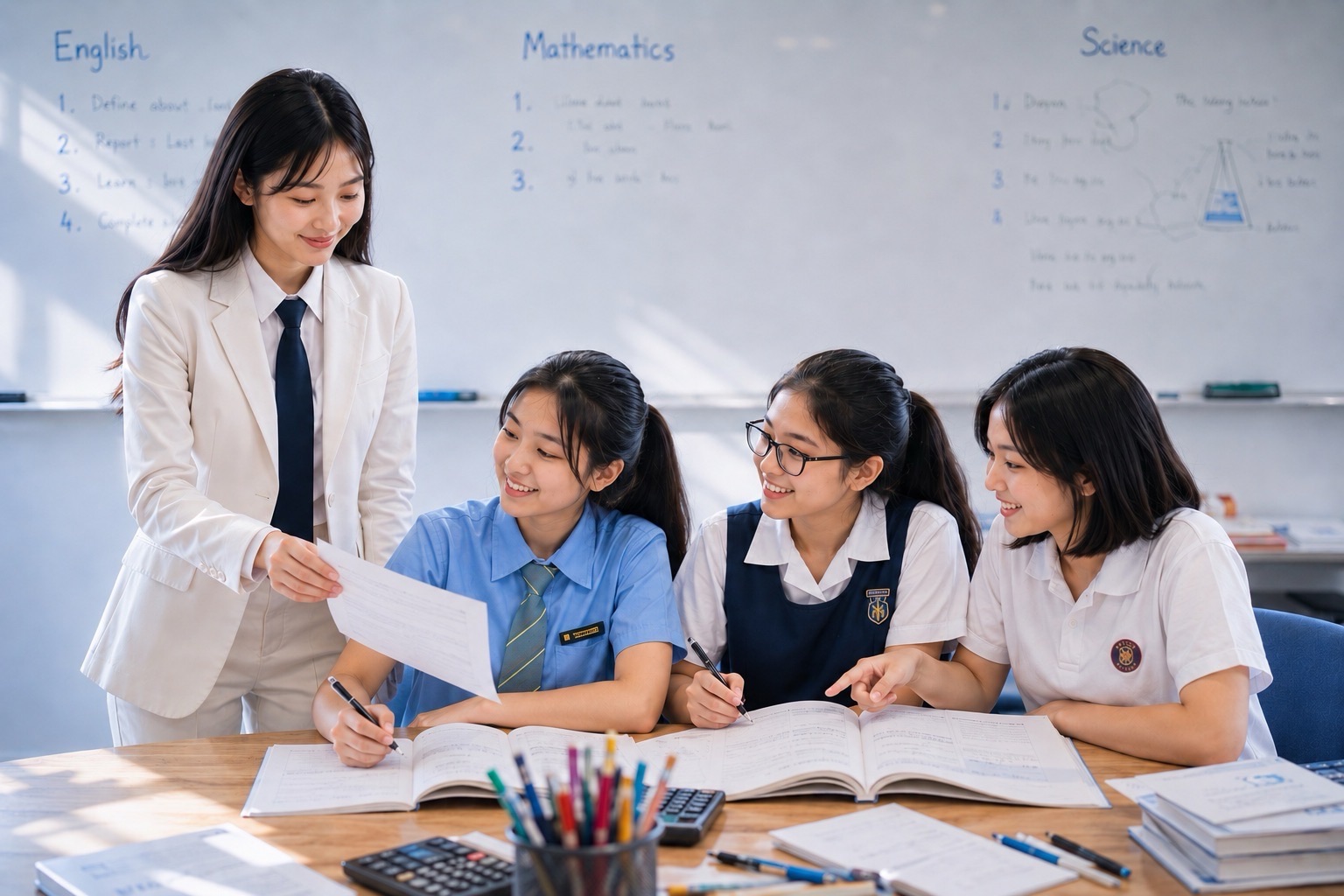
Mathematics tuition for Yio Chu Kang students. Premium 3-pax Primary Math, PSLE Math, Secondary Math, E-Math and A-Math classes near Punggol MRT and Sixth Avenue MRT.
Mathematics Tuition Yio Chu Kang
Mathematics tuition for Yio Chu Kang students. Premium 3-pax Primary and Secondary Mathematics classes near Sixth Avenue MRT, with clear teaching, carefully sequenced practice and close tutor attention.
A stronger Mathematics journey begins by finding the correct starting point.
At eduKateSG, we provide premium 3-pax Mathematics tuition for students travelling from Yio Chu Kang to our Bukit Timah centre near Sixth Avenue MRT.
Our Mathematics classes support:
- Primary 1 to Primary 6 Mathematics;
- PSLE Mathematics preparation;
- Secondary 1 and Secondary 2 Mathematics;
- Secondary 3 and Secondary 4 E-Math;
- Secondary 3 and Secondary 4 Additional Mathematics;
- G1, G2 and G3 Mathematics;
- school assessment preparation; and
- students who need stronger foundations, greater consistency or more advanced extension.
The purpose is not simply to give the student more questions.
It is to help the student understand how Mathematics works.
A child should gradually learn to:
- understand what a question is asking;
- identify the mathematical structure underneath it;
- choose an appropriate method;
- organise the working clearly;
- check whether the answer is reasonable;
- recognise and repair recurring mistakes; and
- apply familiar knowledge when a question changes.
Once these foundations become stable, school lessons feel more manageable. Revision becomes more useful. Examination preparation becomes less frantic because the student is no longer rebuilding the subject immediately before every test.
Class size is limited to three students.
Lessons are 1.5 hours weekly, with teaching materials, guided corrections, focused practice and support around school assessment periods.
Mathematics Is One Continuous Structure
Primary Mathematics, Secondary Mathematics, E-Math and Additional Mathematics are often treated as separate school subjects.
They are better understood as different sections of one continuous mathematical structure.
A Primary 2 student learning place value is preparing for larger-number operations.
A Primary 4 student learning fractions is preparing for ratio, percentage and algebraic manipulation.
A Primary 6 student learning speed and problem-solving models is developing the multi-step control required in Secondary Mathematics.
A Secondary 1 student learning algebra is preparing for equations, functions, graphs and Additional Mathematics.
A Secondary 3 student learning quadratic expressions is building a tool that will be used repeatedly in upper-secondary Mathematics.
Each new topic rests on something that came before.
This is why a student may appear to be struggling with the current chapter when the real weakness began several years earlier.
A child who cannot control fractions may later struggle with algebraic fractions.
A student who does not understand ratio may find scale, similarity and trigonometry harder.
A student who has weak multiplication fluency may use so much attention on basic computation that little attention remains for reasoning.
Good Mathematics tuition does not merely reteach the latest school worksheet.
It finds the earliest important break, repairs it and reconnects the student to the present syllabus.
You can see the complete progression in The eduKate Mathematics Learning System.
A Small Weakness Can Become Expensive Later
Not every careless mistake is a serious problem.
Students are human. They may copy a number incorrectly, misread a sign or make an occasional calculation error.
The concern begins when the same type of mistake appears repeatedly.
A recurring error may show that the student:
- does not understand the underlying concept;
- recognises the chapter but not the question structure;
- has memorised a procedure without knowing its limits;
- cannot retrieve an earlier skill quickly enough;
- loses control when several steps must be coordinated;
- cannot translate mathematical language into a representation; or
- has developed an unreliable working habit.
These errors should be interpreted, not simply marked wrong.
For example, two students may both obtain an incorrect answer to a fraction question.
The first student may understand fractions but make one arithmetic mistake.
The second student may not understand what the denominator represents.
They do not need the same correction.
Giving both students another twenty similar questions may improve the first student while allowing the second student to practise the misunderstanding repeatedly.
In a three-student Mathematics class, the tutor has more room to examine how each student arrived at the answer.
That working reveals where the mathematical system is holding and where it is beginning to break.
The eduKateSG Mathematics Progression
The wider eduKate Mathematics Learning System can be expressed through a practical learning sequence:
Understand → Represent → Operate → Practise → Connect → Transfer → Perform → Review
Understand
The student first learns what the mathematical idea means.
Before applying a formula, the student should understand the objects, quantities or relationships involved.
Represent
The student learns to express the idea through:
- numbers;
- diagrams;
- models;
- tables;
- graphs;
- equations;
- symbols; or
- mathematical language.
Representation allows an unclear problem to become visible.
Operate
The student learns which valid mathematical actions can be performed and why those actions work.
This includes calculation, transformation, substitution, comparison and deduction.
Practise
Practice helps the student perform the operation accurately and efficiently.
However, practice should strengthen understanding rather than replace it.
Connect
The student begins seeing how one topic supports another.
Fractions connect to ratio and percentage. Algebra connects to graphs and functions. Geometry connects to trigonometry.
Transfer
The student applies familiar knowledge to a question that is presented differently.
This is where real examination readiness begins.
Perform
The student learns to manage accuracy, working presentation, time and question selection under assessment conditions.
Review
The student studies errors, strengthens weak connections and prevents the same failure from returning.
This is more useful than simply completing one chapter after another.
For the deeper logic behind the subject, read How Mathematics Works.
Primary Mathematics Tuition for Yio Chu Kang Students
Primary Mathematics is where the main mathematical system is assembled.
During the early years, questions may appear simple. However, the child is quietly building the number sense, language, visualisation and reasoning structures that later Mathematics will depend upon.
A strong Primary Mathematics student does not merely calculate quickly.
The student understands quantity, recognises relationships and can explain why a method is appropriate.
Primary 1 and Primary 2 Mathematics
At Primary 1 and Primary 2, the priority is mathematical orientation.
Students need to become comfortable with:
- number bonds;
- place value;
- addition and subtraction;
- multiplication and division foundations;
- simple measurement;
- money;
- time;
- shapes;
- patterns;
- mathematical vocabulary; and
- explaining what a question requires.
At this stage, excessive difficulty is not necessarily helpful.
The work should be carefully selected so that the child learns to think without becoming afraid of the subject.
The tutor watches for early habits such as:
- counting inefficiently;
- reversing numbers;
- confusing operation signs;
- guessing instead of reading;
- relying heavily on adult prompts;
- completing calculations without understanding quantity; or
- becoming anxious whenever a question looks unfamiliar.
When corrected early, these issues are usually manageable.
When left unresolved, they can become embedded in the student’s later working.
Primary 3 and Primary 4 Mathematics
Primary 3 and Primary 4 often reveal whether the early foundation is stable.
The student must now manage:
- larger numbers;
- multiplication and division;
- fractions;
- measurement;
- area and perimeter;
- tables and graphs;
- multi-step word problems;
- bar models; and
- a larger mathematical vocabulary.
Questions become longer and less direct.
A student may know every operation individually but still struggle to decide which operation belongs in the question.
This is a change from calculation to mathematical interpretation.
The student must learn to separate:
- information that is given;
- information that must be found;
- relationships between quantities;
- intermediate values; and
- the final answer required.
At eduKateSG, we teach students to slow the question down before speeding the calculation up.
The objective is not hesitation.
It is controlled entry.
Primary 5 and Primary 6 Mathematics
Primary 5 and Primary 6 place greater pressure on the entire Primary Mathematics foundation.
Students encounter more demanding work involving:
- fractions;
- decimals;
- ratio;
- percentage;
- rate;
- speed;
- average;
- geometry;
- volume;
- data analysis;
- patterns; and
- complex multi-step problem solving.
At this level, many students can complete routine exercises but struggle when familiar ideas are combined.
The challenge is often not one difficult topic.
It is the need to coordinate several topics within the same question.
For example, a problem may require the student to interpret a ratio, calculate a changed quantity, apply a percentage and explain the final comparison.
This requires more than formula recall.
It requires mathematical control.
Our PSLE Mathematics preparation therefore includes:
- syllabus foundation repair;
- question-language interpretation;
- visual and model-based representation;
- method selection;
- multi-step organisation;
- checking strategies;
- timed practice;
- error analysis; and
- careful exposure to unfamiliar question forms.
The goal is not only to finish more examination papers.
It is to improve what the student notices, understands and does during each paper.
Parents preparing for the PSLE years may also read How to Get AL1 for PSLE Mathematics.
Secondary Mathematics Tuition for Yio Chu Kang Students
Secondary Mathematics introduces a different operating environment.
Primary Mathematics often works with quantities that can be pictured directly.
Secondary Mathematics increasingly asks students to work with:
- symbols;
- unknown quantities;
- signed numbers;
- algebraic expressions;
- equations;
- functions;
- graphs;
- formal geometry;
- probability;
- statistics; and
- general mathematical relationships.
A student who performed well at Primary level may still experience difficulty during this transition.
This does not necessarily mean the student has suddenly become weak in Mathematics.
The language of the subject has changed.
Secondary 1 Mathematics
Secondary 1 is an important mathematical transition.
The student begins moving from arithmetic towards algebra.
Numbers no longer appear only as fixed quantities. Letters can represent unknown or changing values. Operations must be performed while preserving relationships.
Students need to become comfortable with:
- negative numbers;
- algebraic notation;
- expansion and factorisation foundations;
- simple equations;
- ratio and rate;
- percentages;
- geometry;
- data handling;
- mathematical working; and
- multi-step reasoning.
A student may understand an explanation during the lesson but remain unable to begin independently at home.
That gap matters.
Understanding while watching is not yet independent control.
Our Secondary 1 Mathematics teaching therefore gives attention to:
- reading algebra correctly;
- understanding what symbols represent;
- maintaining sign accuracy;
- organising transformations line by line;
- connecting Primary methods to Secondary methods; and
- learning how to begin without waiting for a demonstration.
Secondary 2 Mathematics
Secondary 2 is where lower-secondary Mathematics begins to consolidate.
Topics become more connected, and the student’s readiness for upper-secondary Mathematics becomes easier to observe.
Students must strengthen:
- algebraic manipulation;
- linear equations;
- graphs;
- expansion and factorisation;
- geometry;
- congruence and similarity;
- mensuration;
- probability;
- statistics; and
- structured problem solving.
Secondary 2 is also an important preparation year.
A weak algebra foundation can make Secondary 3 E-Math difficult and Additional Mathematics unnecessarily severe.
The objective is therefore not merely to pass Secondary 2.
It is to enter Secondary 3 with enough mathematical stability to absorb a heavier syllabus.
Secondary 3 E-Math and Additional Mathematics
Secondary 3 brings a substantial increase in academic load.
Students may begin upper-secondary E-Math while also starting Additional Mathematics.
E-Math develops the central examination Mathematics required across a broad range of pathways.
Additional Mathematics introduces a higher level of abstraction, manipulation and functional reasoning.
Students may need to manage:
- quadratic equations;
- inequalities;
- coordinate geometry;
- functions and graphs;
- trigonometry;
- geometry;
- vectors;
- probability;
- statistics;
- algebraic manipulation;
- indices;
- surds;
- logarithms;
- polynomials;
- calculus foundations; and
- mathematical applications.
Additional Mathematics should not be approached as simply “more Mathematics”.
It requires a more disciplined algebraic engine.
Students who depend heavily on memorised procedures may struggle because one weak transformation can affect the remainder of a long solution.
At eduKateSG, the tutor pays attention not only to whether the answer is correct, but also to whether the method remains stable when:
- the values change;
- the question is reversed;
- two chapters are combined;
- the usual clue is removed; or
- the student works under time pressure.
Secondary 4 Mathematics
Secondary 4 requires consolidation, transfer and examination performance.
By this stage, students should gradually move beyond chapter-by-chapter dependence.
They need to recognise which mathematical structure is present even when the question does not announce the topic clearly.
Preparation may include:
- repairing remaining conceptual gaps;
- improving algebraic accuracy;
- strengthening high-frequency topics;
- connecting topics across papers;
- timed topical practice;
- full-paper practice;
- question selection;
- working presentation;
- error classification; and
- review between examination cycles.
A student should not complete paper after paper while repeating the same failure.
Each paper should provide information.
The tutor studies where marks are being lost and decides whether the next correction should focus on:
- knowledge;
- recognition;
- method;
- execution;
- checking;
- time management; or
- examination judgment.
You can read more about our upper-secondary structure in How eduKateSG Secondary Mathematics Tutorials Work.
What Proper Mathematics Tuition Should Change
Good Mathematics tuition should eventually change more than the number of worksheets a student completes.
It should improve the student’s operating behaviour.
The student begins more independently
The child no longer waits immediately for a tutor, teacher or parent to demonstrate the first step.
The student can interpret the question, identify a possible entry point and begin testing a method.
Working becomes clearer
The student learns to present each important step in a logical sequence.
This improves both accuracy and the tutor’s ability to identify where an error occurred.
Mistakes become more useful
Instead of erasing an error quickly, the student learns to examine why it happened.
A mistake becomes a diagnostic signal rather than a personal failure.
Unfamiliar questions become less frightening
The student may not know the complete answer immediately, but can search for familiar structures within the question.
Performance becomes more stable
Marks may still vary between assessments, but the extreme collapses become less frequent.
The student has a clearer method for recovering when a question is difficult.
This is the difference between knowing several methods and possessing a working mathematical system.
Why eduKateSG Uses Three-Student Mathematics Classes
A larger class can be suitable for students who mainly need general teaching and revision.
A three-student class serves a different purpose.
It gives the tutor enough proximity to observe each student’s working while preserving the benefits of learning beside peers.
In Mathematics, the final answer alone provides limited information.
The working may reveal that the student:
- selected the wrong operation;
- misunderstood a word;
- dropped a negative sign;
- used a correct formula incorrectly;
- skipped an important transformation;
- relied on an example without understanding it;
- cannot explain why the method works; or
- solved the question correctly through an unreliable route.
These details can be missed when a tutor must supervise many students at once.
Within a three-student group, the tutor can:
- question each student regularly;
- inspect working closely;
- vary the level of support;
- correct misconceptions before they settle;
- give students opportunities to explain;
- compare different valid methods;
- adjust the practice load; and
- maintain a purposeful lesson pace.
Students also benefit from hearing how another learner approaches the same problem.
One student may see the diagram first.
Another may form an equation.
A third may recognise a numerical pattern.
The objective is not competition.
It is to show that mathematical reasoning can be examined, explained and improved.
How a Mathematics Lesson Is Structured
Each lesson is adjusted to the level and needs of the class, but a productive Mathematics tutorial generally moves through several stages.
Retrieval and readiness
The tutor checks whether the earlier knowledge required for the lesson can be recalled accurately.
This prevents a new topic from being placed on an unavailable foundation.
Clear explanation
The concept is explained from its underlying meaning.
Students are shown what the mathematical object represents, how the method works and where common misunderstandings occur.
Guided practice
Students attempt carefully selected questions with tutor support.
The tutor observes how each student reads, represents and begins.
Independent practice
Support is reduced so the student must operate independently.
This shows whether the method has genuinely transferred.
Correction and error analysis
Errors are examined carefully.
The tutor distinguishes between a momentary slip and a structural misunderstanding.
Connection and extension
The idea is connected to earlier topics, future topics or less familiar question forms.
Review and next-step practice
Students leave with a clearer understanding of what has been secured and what still requires attention.
This creates continuity between lessons.
Teaching Ahead Without Rushing
Teaching ahead can be valuable when it is done carefully.
The objective is not to finish the textbook as quickly as possible.
It is to give the student enough prior familiarity that the school lesson becomes a second meaningful encounter rather than the first hurried exposure.
A student who has already seen the main concept can use the school lesson to:
- confirm understanding;
- notice a different explanation;
- ask better questions;
- complete classwork more confidently; and
- identify gaps before an assessment.
However, pre-teaching should not be used to conceal weak foundations.
Moving ahead while earlier Mathematics remains unstable creates the appearance of progress without the structure required to sustain it.
At eduKateSG, advancement and repair are managed together.
Some students need more rebuilding.
Some need careful consolidation.
Some are ready for extension.
The pace should follow the student’s actual mathematical state, not simply the date on the school calendar.
Convenient Access from Yio Chu Kang to Sixth Avenue
eduKateSG’s Bukit Timah location is at 8 Fourth Avenue, near Sixth Avenue MRT on the Downtown Line.
Students travelling from Yio Chu Kang MRT can take the North–South Line to Newton MRT and transfer to the Downtown Line for Sixth Avenue MRT. Yio Chu Kang is NS15, Newton is the NS21/DT11 interchange, and Sixth Avenue is DT7. Families should check the latest journey information before travelling, particularly during service adjustments.
For some families, travelling to a separate learning environment creates a useful boundary between school, home and tuition.
The student arrives knowing that the session has a specific purpose.
The quieter three-student format then allows the tutor to work carefully through the student’s Mathematics without the pace and distraction of a large classroom.
Mathematics Tuition Class Details
Format: Premium 3-pax small-group tuition
Levels:
- Primary 1 Mathematics
- Primary 2 Mathematics
- Primary 3 Mathematics
- Primary 4 Mathematics
- Primary 5 Mathematics
- Primary 6 and PSLE Mathematics
- Secondary 1 Mathematics
- Secondary 2 Mathematics
- Secondary 3 E-Math
- Secondary 3 Additional Mathematics
- Secondary 4 E-Math
- Secondary 4 Additional Mathematics
Subject levels: G1, G2 and G3 Mathematics, according to the student’s school programme and readiness
Duration: 1.5 hours weekly
Location: 8 Fourth Avenue, Singapore 268674, near Sixth Avenue MRT
Class size: Maximum three students
Teaching approach:
- first-principles explanation;
- foundation repair;
- carefully paced pre-teaching;
- guided and independent practice;
- active recall;
- spaced reinforcement;
- interleaving;
- error analysis;
- transfer practice; and
- school-assessment alignment.
Materials may include:
- tutor-prepared lesson materials;
- structured topical practice;
- school-relevant revision;
- examination questions;
- correction work;
- retrieval exercises; and
- focused home practice.
Current eduKateSG programme information lists premium three-student tutorials, 1.5-hour weekly lessons and the Bukit Timah location at 8 Fourth Avenue near Sixth Avenue MRT.
Which Students May Benefit?
Our Mathematics tuition may be suitable for a student who:
- has unresolved gaps from earlier school years;
- understands during lessons but cannot work independently;
- performs well in practice but poorly in tests;
- repeatedly loses marks through the same mistakes;
- is becoming anxious or avoidant;
- has difficulty interpreting word problems;
- relies heavily on memorised procedures;
- needs closer inspection of working;
- has recently entered Secondary 1;
- is preparing for Secondary 3 Mathematics;
- is beginning Additional Mathematics;
- needs structured PSLE or upper-secondary examination preparation;
- is passing but has stopped progressing; or
- requires more advanced work than the current school pace provides.
The class must still be appropriate.
A three-student group works best when the students’ levels, pace and learning needs are reasonably compatible.
This is why enrolment begins with a parent–student consultation rather than automatic placement.
When Mathematics Tuition May Not Be Necessary
Not every student needs tuition.
A child may not require additional Mathematics lessons when the student:
- understands school teaching securely;
- completes work independently;
- performs consistently;
- can explain methods clearly;
- corrects errors thoughtfully;
- manages current assessment demands;
- has sufficient time for rest and other development; and
- continues to progress without excessive external support.
More tuition is not automatically better education.
The question is whether another class solves a real learning need.
Parents should consider Mathematics tuition more seriously when:
- the same weakness continues across several assessment cycles;
- school corrections are completed but not understood;
- the child’s confidence is declining;
- current topics depend on missing earlier knowledge;
- marks are becoming increasingly unpredictable;
- the parent–child relationship is being strained by daily Mathematics support;
- a major transition is approaching; or
- examination preparation has become reactive.
The objective is to intervene early enough to make repair calm and manageable, but not to fill a child’s schedule without purpose.
Why Small Groups Tuition for Yio Chu Kang?
For many families in Yio Chu Kang, the question is not simply whether a child needs Mathematics tuition.
The more useful question is:
What kind of learning environment will help this child think more clearly, correct mistakes earlier and become increasingly independent?
A student may already be attending lessons, completing worksheets and revising regularly, yet continue to produce uneven results. This often happens because the difficulty is not a lack of effort. The student may be practising without recognising the exact point where understanding breaks down.
A carefully managed small group changes this.
It gives the tutor enough proximity to observe each student closely, while giving the student enough space to think, attempt, explain and learn independently.
At eduKateSG, our Mathematics classes are kept to three students. This is not simply a smaller version of a conventional tuition class. It is a different teaching arrangement designed around visibility, responsiveness and meaningful participation.
The One-Sentence Answer
Small-group Mathematics tuition works well when the class is small enough for the tutor to identify individual errors, but structured enough for students to think independently and learn alongside others.
That balance matters.
A student needs guidance, but should not become dependent on constant prompting. A student also needs opportunities to hear different methods, explain an answer and recognise that the same question may be approached in more than one sensible way.
A well-run three-student class provides both.
Parents Are Usually Trying to Solve More Than Marks
Parents looking for Mathematics tuition in Yio Chu Kang may initially be concerned about a test score, but the score is often only the visible symptom.
Underneath it, the student may be experiencing one or more of the following:
- earlier topics were never fully understood;
- methods are remembered but applied mechanically;
- algebraic or numerical errors are difficult to detect;
- the student knows the topic but misreads the question;
- working is incomplete or poorly organised;
- confidence changes according to the difficulty of the worksheet;
- school lessons move on before the current topic becomes stable;
- the student is afraid to reveal uncertainty in a larger class.
These concerns require more than additional practice.
The tutor must be able to see how the student thinks.
That includes what the student writes, what is omitted, where hesitation begins, which method is selected and whether the student understands why the method works.
This level of observation becomes much more difficult as the class grows.
Mathematics Is a Connected Learning System
Mathematics is not a collection of isolated chapters.
Each topic becomes part of the language used in later topics.
A Primary student who is uncertain with multiplication, fractions or units may later struggle with ratio, percentage and problem sums. A Secondary student who lacks control of negative numbers, algebraic manipulation or equations may find graphs, coordinate geometry and advanced problem-solving increasingly difficult.
The visible problem may appear in the current chapter, but its cause may sit several chapters—or several years—earlier.
This is why productive Mathematics tuition does not simply repeat the latest school worksheet.
The tutor needs to find the earliest important break, repair it properly and then move forward in the correct order.
In a three-student group, this can happen without stopping the entire class.
One student may need a short intervention on fraction equivalence. Another may need to correct an algebraic sign error. A third may be ready to attempt an extension question. The tutor can move between these needs while keeping the lesson coherent.
Why Three Students Rather Than a Larger Class?
A class may be described as small even when it contains eight, ten or more students.
However, the educational experience changes as more students are added.
The tutor must divide attention across more written work, more misconceptions and more learning speeds. Explanations naturally become broader. Students who appear quiet or reasonably competent may receive less attention because they are not disrupting the lesson.
A three-student class keeps each learner visible.
The tutor can usually observe:
- whether the student begins a question confidently or hesitantly;
- whether the selected method is appropriate;
- whether the working is logically arranged;
- whether an answer was reasoned or guessed;
- whether a repeated error is conceptual, procedural or careless;
- whether the student can explain the method without relying on memorised phrases.
This allows correction to happen while the misconception is still small.
Instead of waiting for the next examination to reveal a pattern, the tutor can intervene during the lesson itself.
Small Groups Preserve Independent Thinking
One-to-one tuition can be useful in particular circumstances, especially when a student requires intensive repair or highly specialised support.
However, constant individual attention can sometimes create another difficulty: the tutor becomes involved too quickly.
The student pauses, and the tutor prompts.
The student hesitates, and the tutor redirects.
The student makes an error, and the tutor immediately corrects it.
The lesson may feel productive, but the student may not be practising the independent decision-making required during an examination.
A carefully managed small group creates a healthier distance.
The tutor remains close, but the student must still:
- read the question independently;
- decide what information matters;
- choose a method;
- complete the working;
- check the answer;
- explain the reasoning when asked.
This is where genuine confidence begins.
Confidence is not the feeling that every question will be easy. It is the knowledge that the student has a reliable process when a question is unfamiliar.
Students Learn by Hearing Other Students Think
Mathematics is often treated as a silent subject, but mathematical language matters.
Students become stronger when they can explain:
- why a particular operation is needed;
- why one method is more efficient;
- where an incorrect solution changes direction;
- how two topics are connected;
- how an answer can be checked.
In a three-student class, each student has regular opportunities to articulate these ideas.
One student may notice a pattern that another student missed. Another may use a different but valid method. A third may ask the question the others were reluctant to ask.
These interactions are valuable because they expose students to variations in reasoning without overwhelming the lesson.
They also help the tutor determine whether understanding is secure.
A student who can complete a familiar question may still struggle to explain the method. Once the student can describe the reasoning clearly, the knowledge is usually more stable and transferable.
The Tutor Can Diagnose the Type of Error
Not every wrong answer has the same cause.
Consider a student who repeatedly loses marks in algebra. The difficulty could involve:
- misunderstanding what a variable represents;
- weak control of negative numbers;
- confusion between terms and factors;
- incorrect expansion;
- failure to maintain equality;
- untidy working that creates copying errors;
- rushing because the method feels familiar;
- not checking the final answer.
Giving the student another twenty algebra questions may create more repetition without solving the actual problem.
The tutor must identify which kind of error is occurring.
A true small group makes this diagnosis possible because there is time to inspect the student’s process rather than merely mark the final answer.
The teaching can then follow a sensible sequence:
Repair what is necessary.
Introduce what comes next.
Practise until the method becomes stable.
Connect it to the student’s school learning.
Different Students Can Follow Different Routes
Students in the same school level do not always need identical teaching.
The Student With Missing Foundations
This student may appear to struggle with the current topic, but the real difficulty began earlier.
The tutor identifies the prerequisite skill, rebuilds it and then reconnects it to the current chapter.
The aim is not to send the student backwards unnecessarily. It is to repair the smallest important gap that will allow forward movement.
The Student With Unstable Results
This student may score well in one test and poorly in the next.
Understanding may be present, but retrieval, question interpretation, checking or working discipline is inconsistent.
The tutor helps the student create a more reliable process so that performance depends less on the familiarity of the paper.
The Quiet Student
This student may understand more than the marks suggest but avoids asking questions or speaking in a larger class.
A three-student setting makes participation more natural. The tutor can invite an explanation without placing the student before a large audience.
Over time, the student becomes more comfortable showing incomplete thinking, which is essential for correction.
The Fast but Careless Student
This student often understands the topic but loses marks through skipped steps, inaccurate copying or insufficient checking.
The solution is not necessarily harder material. The student may first need stronger written discipline and a deliberate checking routine.
The Student Ready for Greater Challenge
A student who has secure foundations should not remain occupied with repetitive basic questions.
The tutor can introduce unfamiliar applications, multi-step problems and connections across topics while ensuring that speed does not replace precision.
Three students can therefore be working within the same topic while receiving different levels of questioning and support.
How a Small-Group Mathematics Lesson Works
Our Mathematics lessons are conducted for 1.5 hours.
The exact structure changes according to the students and the point in the school term, but a productive lesson will usually include several distinct stages.
1. Retrieval and Readiness
The lesson may begin with a short review of earlier skills.
This is not revision for its own sake. It allows the tutor to see whether important knowledge can still be retrieved without heavy prompting.
Mathematics becomes useful only when students can access it at the correct moment.
2. Conceptual Teaching
A new idea is introduced from first principles.
The student should understand what the method is doing before being expected to perform it quickly.
Representations, diagrams, worked examples and carefully selected questions may be used to make the structure visible.
3. Guided Application
Students attempt questions while the tutor observes their decisions.
Support is provided where necessary, but not so quickly that the student is prevented from thinking.
4. Independent Practice
Each student completes suitable questions independently.
This gives the tutor a more accurate picture of what the student can do without immediate assistance.
5. Error Analysis
Mistakes are examined rather than simply erased.
Students learn to identify where the solution changed direction and what should have happened instead.
6. Connection and Consolidation
The topic is connected to earlier knowledge, future chapters or the way it may appear in school assessments.
This helps the student build Mathematics as a connected system rather than a set of temporary procedures.
Teaching Ahead—But Only When the Foundations Are Ready
Teaching ahead of the school schedule can be helpful.
When students encounter a topic in school after already developing a sound first understanding, they can listen more actively, ask better questions and use school lessons as reinforcement.
However, moving ahead should not mean ignoring unfinished foundations.
A student who is weak in algebra does not benefit from being hurried into more advanced algebra simply to remain ahead.
The sequence must remain intelligent:
- repair the necessary foundation;
- establish the current method;
- introduce upcoming material;
- practise until the knowledge can be retrieved;
- reconnect it to school assignments and assessments.
The purpose of teaching ahead is to create readiness, not pressure.
Small Groups for Primary Mathematics
At Primary level, many difficulties begin quietly.
A child may complete basic exercises correctly but become uncertain when the same idea appears in a word problem. Another may remember a model but not understand when it should be used. A student may know multiplication facts but struggle to coordinate several steps within one problem.
Primary Mathematics tuition should strengthen both fluency and meaning.
Students need to develop:
- number sense;
- arithmetic accuracy;
- fraction and decimal understanding;
- measurement awareness;
- model drawing and representation;
- problem interpretation;
- multi-step reasoning;
- checking habits.
In a small group, the tutor can observe how the child reads the question, organises information and chooses a representation.
This is important because the final answer alone does not show whether the child has developed a transferable method.
Small Groups for Secondary Mathematics
Secondary Mathematics introduces a significant change in abstraction.
Students work increasingly with symbols, algebraic relationships, graphs, geometric properties and multi-stage reasoning.
A student may be able to imitate a worked example but become lost when the question changes slightly.
At this level, the tutor must distinguish between recognition and genuine control.
The student should be able to:
- identify the structure of an unfamiliar question;
- select an appropriate method;
- connect multiple topics;
- maintain accurate algebraic working;
- communicate reasoning clearly;
- check whether the answer is mathematically sensible;
- work steadily under timed conditions.
A three-student group allows these habits to be developed closely without turning every lesson into continuous tutor-led demonstration.
Small Groups and Examination Preparation
Examination preparation should not begin and end with full papers.
A full paper can reveal weaknesses, but it does not automatically repair them.
Students first need targeted work on:
- recurring conceptual gaps;
- commonly misread question forms;
- method selection;
- algebraic and numerical accuracy;
- time allocation;
- written presentation;
- checking strategies.
Once these areas become more stable, mixed-topic retrieval and full-paper practice become more useful.
In a small group, the tutor can review how each student responds under increasing pressure. One student may require greater speed. Another may require more restraint. A third may need to stop abandoning difficult questions too early.
The paper is the same, but the performance problem may be different.
Large Classes, One-to-One Tuition and Three-Student Groups
Each arrangement has a place.
| Learning arrangement | Main strength | Possible limitation |
|---|---|---|
| Large class | Broad syllabus delivery and shared instruction | Less time for individual diagnosis and correction |
| One-to-one tuition | Intensive personal support | Student may become overly reliant on immediate guidance |
| Three-student small group | Close observation with independent and collaborative thinking | Requires careful grouping and active teaching |
The most suitable arrangement depends on the student.
However, for many learners, three students provide a productive middle ground: close enough for the tutor to see the details, but spacious enough for the student to develop ownership.
What Parents May Notice First
Improvement does not always begin with a dramatic jump in marks.
The earliest signs are often quieter.
Parents may notice that the student:
- begins homework with less resistance;
- explains methods more clearly;
- writes working in a more organised way;
- asks more precise questions;
- recovers more calmly after making an error;
- recognises connections between topics;
- checks answers without being repeatedly reminded;
- becomes less dependent on memorised templates.
These changes matter because they are signs that the student’s internal learning system is becoming more stable.
Marks usually become more dependable when the underlying process improves.
What Small Groups Cannot Replace
A small class creates strong teaching conditions, but the class size alone does not guarantee progress.
The quality of the lesson still depends on:
- accurate diagnosis;
- clear explanations;
- appropriate sequencing;
- carefully selected practice;
- consistent correction;
- student participation;
- communication between tutor, student and parent.
The student must also be willing to attempt questions, reveal uncertainty and respond to correction.
A small group should not merely provide more comfortable seating around fewer worksheets. It should change the quality of observation, interaction and teaching.
Is Small-Group Tuition Suitable for Every Student?
It is suitable for many students, but the starting point matters.
A student may be well suited to a three-student group when the student:
- benefits from close tutor attention;
- can work independently for short periods;
- needs regular correction;
- is willing to participate;
- learns from hearing other methods;
- requires teaching that can adjust within the lesson.
A consultation before placement helps determine the student’s current level, learning habits and immediate priorities.
Careful grouping is important. Students do not need identical marks, but their needs should be compatible enough for the lesson to remain purposeful.
Frequently Asked Questions
Will the tutor be able to attend to all three students?
Yes. Three students allow the tutor to move closely between individual written work, explanations and questions throughout the lesson.
Students also complete independent work, which gives the tutor a clearer view of what each learner can do without prompting.
Will my child receive the same worksheet as everyone else?
Students may work on the same topic, but the amount of support, question selection and level of extension can differ.
Where necessary, individual foundation work can also be introduced within the lesson.
Will a stronger student be held back?
Not when the class is managed properly.
A student with secure fundamentals can receive more unfamiliar, connected or demanding questions while another student consolidates the central method.
Explaining a solution can also deepen the stronger student’s understanding.
Will a weaker student feel embarrassed?
The small setting usually makes it easier to ask questions and reveal uncertainty.
The tutor should establish a calm learning culture where mistakes are treated as information, not as a source of embarrassment.
Is small-group tuition enough for a student with major learning gaps?
That depends on the nature and extent of the difficulty.
Some students can rebuild effectively within a three-student group. Others may require a period of more intensive intervention before entering a group arrangement.
This should be considered during the initial consultation.
Does eduKateSG conduct trial lessons?
Trial lessons depend on whether the existing three-student class configuration allows an additional placement without affecting the group.
A consultation is usually the more useful first step because it allows the student’s needs and the suitability of the available class to be considered carefully.
A Calm Decision for Yio Chu Kang Parents
The purpose of Mathematics tuition is not to make the student permanently dependent on tuition.
It is to help the student build a more reliable way to learn.
That means understanding ideas properly, identifying errors earlier, retrieving knowledge when needed and approaching unfamiliar questions with greater composure.
A three-student class gives the tutor the proximity to make these changes visible.
It also gives the student room to think, attempt, explain and gradually take ownership of the work.
For families considering Mathematics tuition in Yio Chu Kang, the value of a small group is therefore not simply that there are fewer students in the room.
The value is that each student remains seen.
And when the tutor can see how a student thinks, teaching can become more precise, progress can become more stable and Mathematics can begin to feel like a connected subject rather than a succession of difficult chapters.
When to Start Small Groups Tuition for Yio Chu Kang?
The best time to begin tuition is rarely the moment a child fails an examination.
By then, the difficulty may already have developed across several layers. A student may be missing earlier concepts, struggling to follow current lessons, losing confidence and developing study habits built around avoidance rather than understanding.
For families in Yio Chu Kang, the more useful question is not simply whether tuition is necessary.
It is:
At what point would a small-group learning environment give the child enough time to improve calmly, properly and sustainably?
The answer depends on the child’s present foundation, school level, learning speed and upcoming academic demands. However, one principle remains consistent:
Small-group tuition works best when it begins early enough for teaching to remain developmental rather than corrective.
Start Before the Child Is Overwhelmed
Parents often wait for a dramatic result before taking action.
The child may be passing, completing homework and appearing generally comfortable. Yet beneath the surface, there may already be signs that learning is becoming unstable:
- homework takes increasingly longer;
- mistakes repeat even after correction;
- the child understands during tuition or school but forgets later;
- results fluctuate significantly between tests;
- unfamiliar questions create anxiety;
- the child relies heavily on model answers;
- revision begins only when an examination is near.
These are not necessarily signs that the child is weak.
They are often signs that the academic load has become greater than the child’s present learning system can manage independently.
Beginning small-group tuition at this stage allows the tutor to strengthen the foundation before the student experiences a major loss of confidence.
The child still has enough mental space to learn. The tutor can explain concepts carefully, correct misunderstandings and gradually introduce more demanding work without turning every lesson into emergency preparation.
The Ideal Time Is Often Before a Major Transition
Academic difficulty frequently appears during transitions.
A student may perform well at one level because the teaching pace, question format and content load remain manageable. The following year may require more independence, greater language precision or stronger connections between topics.
The child has not suddenly become less capable. The environment has changed.
For this reason, many families benefit from beginning small-group tuition shortly before or at the beginning of an important transition year.
These transitions may include:
- entering Primary 3, when Science begins and English and Mathematics become more demanding;
- entering Primary 5, when PSLE preparation gradually becomes more visible;
- moving from Primary 6 to Secondary 1;
- entering Secondary 2, when mathematical and language foundations must become more stable;
- entering Secondary 3, when subject combinations, Additional Mathematics and upper-secondary demands begin;
- preparing for the PSLE or GCE O-Level examination year.
Starting at the transition point gives the student time to understand the new expectations before gaps accumulate.
It also allows tuition to serve as a bridge rather than a rescue operation.
Primary School: Build Stability Before Examination Pressure
For primary school students, tuition should not immediately become an endless series of examination papers.
Younger children first need stable reading, writing, numeracy, reasoning and learning habits.
A child who begins tuition early enough can work through these foundations at an appropriate pace. The tutor can identify whether the difficulty comes from vocabulary, comprehension, careless reading, weak number sense, limited working memory or incomplete understanding of earlier topics.
Primary 1 and Primary 2
At Primary 1 and Primary 2, tuition may be useful when the child is struggling to establish the basic mechanics of learning.
In English, this may include reading fluency, sentence construction, spelling, grammar and confidence in expressing ideas.
In Mathematics, it may include number bonds, place value, basic operations, comparison language and the ability to understand what a word problem is asking.
The objective at this stage is not to accelerate the child unnecessarily.
It is to make sure the early foundation becomes secure enough for later learning.
A small group can be particularly helpful because the child receives guidance while also observing how other students think, explain and respond. The environment feels social without becoming crowded.
Primary 3 and Primary 4
Primary 3 is often the first significant academic shift.
Science is introduced, comprehension becomes more demanding and Mathematics begins to require stronger multi-step reasoning. Students must remember more information while also explaining their thinking more clearly.
Beginning tuition at Primary 3 or early Primary 4 gives the child time to build a dependable learning system before the upper-primary years.
This is also an important period for correcting habits.
A child who guesses vocabulary, skips working, rushes through questions or memorises answers without understanding may still pass lower-primary assessments. These habits become more costly as questions grow more complex.
Small-group tuition can slow the process down enough for the tutor to see how the child is thinking, not merely whether the final answer is correct.
Primary 5
Primary 5 is one of the most useful entry points for structured tuition.
The academic standard rises, the PSLE begins to feel closer and earlier weaknesses become more visible. Students are expected to manage longer compositions, more complex comprehension passages, multi-topic Mathematics questions and Science answers requiring precise explanations.
Starting at the beginning of Primary 5 provides a meaningful preparation window.
There is time to rebuild weak areas, develop examination habits and strengthen confidence without making every week feel like final revision.
A child who begins only after the Primary 5 year-end examinations may still improve, but the available runway becomes shorter.
Primary 6
Primary 6 tuition should ideally begin before the examination calendar becomes intense.
Students need time to learn, practise, forget slightly, retrieve the knowledge again and apply it under different conditions. This process cannot be compressed safely into a few weeks.
Beginning at the end of Primary 5 or the start of Primary 6 allows tuition to proceed in stages:
- stabilise the foundation;
- complete and connect the syllabus;
- identify recurring weaknesses;
- practise examination application;
- improve speed, accuracy and decision-making.
When tuition begins much later, lessons may need to prioritise the most urgent scoring gaps. This can still be helpful, but it is different from building full academic readiness.
Secondary School: Begin Before the Content Becomes Interdependent
Secondary school subjects become increasingly connected.
In Mathematics, later chapters often depend on earlier algebraic fluency. In English, comprehension and writing depend on vocabulary, inference, sentence control and the ability to organise thought. In Science, students must connect concepts, interpret data and explain relationships precisely.
A student may appear to struggle with a current topic when the actual problem began much earlier.
Secondary 1
The move from Primary 6 to Secondary 1 is not simply a change in syllabus.
Students encounter new teachers, new subjects, new routines, greater independence and a faster pace. Even academically strong students may need time to adapt.
Starting small-group tuition before Secondary 1 or during the first term can help create continuity.
The tutor can bridge primary-school knowledge into secondary-school thinking, particularly in areas such as algebra, mathematical notation, analytical reading and structured written responses.
This support can prevent a capable student from mistaking transition difficulty for personal inability.
Secondary 2
Secondary 2 is often underestimated.
It is a consolidation year, but it is also the period when weak foundations begin to affect several topics at once. Students may still be passing while becoming increasingly dependent on memorised methods.
This is a good time to begin tuition if the child’s results are inconsistent or if schoolwork requires excessive effort.
There is still enough time to rebuild before upper-secondary subject demands intensify.
For Mathematics, Secondary 2 is especially important because algebraic manipulation, equations, graphs, geometry and problem-solving habits will continue into Secondary 3 and Secondary 4.
Secondary 3
Secondary 3 is a major academic threshold.
Students begin upper-secondary work, and some take Additional Mathematics alongside Elementary Mathematics. The volume of content rises, topics become more abstract and examinations require stronger integration across chapters.
Starting tuition at the beginning of Secondary 3 is usually preferable to waiting for the first major examination.
In the early months, the tutor can establish proper methods and ensure that new concepts are understood from first principles. Once misconceptions become embedded, correcting them takes considerably more time.
For Additional Mathematics, early support can be especially valuable. The subject introduces a style of mathematical thinking that may feel unfamiliar even to students who previously performed well.
Secondary 4
Secondary 4 tuition should begin as early as possible if there are known weaknesses.
The year moves quickly. Students need to complete the syllabus, consolidate earlier topics, practise papers and improve examination execution.
A January start provides a much larger preparation window than a June start.
Students beginning later can still make progress, but the focus must become more selective. There may not be enough time to rebuild every topic at the same depth.
This is why parents should not view Secondary 4 tuition as something to arrange only after the preliminary examinations.
By then, the student may understand what has gone wrong but have limited time to change it.
Start When Results Become Unstable, Not Only When They Become Low
A low result is obvious.
An unstable result is often more informative.
A child may score well in one test and perform poorly in the next. Parents may assume this is carelessness or insufficient revision. Sometimes it is. However, fluctuating marks can also show that the knowledge has not become secure.
The student may perform well when the questions resemble familiar examples but struggle when wording, structure or context changes.
This is an important moment to consider tuition.
Small-group lessons can reveal whether the student genuinely understands the concept or is recognising a pattern. The tutor can vary questions, ask the child to explain a method and identify exactly where reasoning breaks down.
The objective is to turn occasional performance into repeatable performance.
Start When Schoolwork Is Consuming Too Much Time
Some students maintain acceptable grades by spending an unsustainable amount of time on homework and revision.
From the outside, the child appears to be coping.
In reality, every assignment may involve repeated checking, parental assistance, online searching or copying from examples. This leaves little time for rest, reading, activities or independent revision.
When ordinary schoolwork consistently occupies the entire evening, the issue may not be effort.
The student may lack an efficient method.
A suitable small-group tutor can help organise the learning process, teach the underlying concept and reduce unnecessary trial and error. Better understanding often makes work faster because the child no longer needs to rediscover the method for every question.
Start When Confidence Begins to Change
Academic confidence rarely disappears overnight.
It changes gradually.
A child may stop volunteering answers, avoid discussing schoolwork or insist that a subject is boring. The student may become defensive when corrected or say, “I am just not good at this.”
These statements should not always be treated as laziness.
They may be protective responses. The child is trying to avoid another experience of uncertainty or failure.
Early intervention matters because confidence affects participation. A student who expects to be wrong asks fewer questions, attempts fewer difficult problems and receives less useful feedback. This creates a cycle in which the child falls further behind.
A well-run small group can provide a safer place to participate.
With only a few students, the tutor can notice hesitation, adjust the explanation and invite the child back into the lesson without creating unnecessary attention.
Confidence then returns through evidence: the student begins to understand, answer and complete work independently.
Start Earlier for Students Seeking the Highest Grades
Tuition is not only for students who are failing.
A student aiming for an excellent result may need support at a different level.
High-performing students often know the syllabus but need to improve precision, flexibility, depth and examination judgement. Their errors may be less obvious:
- incomplete reasoning;
- inefficient methods;
- weak checking habits;
- imprecise language;
- difficulty with unfamiliar applications;
- loss of marks under time pressure;
- inconsistent performance across topics.
These students benefit from beginning early because refinement requires repeated exposure.
The difference between a good result and an excellent one is often not one dramatic breakthrough. It is a collection of small improvements made consistently over time.
Small-group tuition can create space for this refinement without turning every lesson into mass drilling.
Why the Small-Group Format Matters
The timing of tuition matters, but the learning environment matters too.
A large class may provide structured teaching, yet it can be difficult for the tutor to examine each student’s exact reasoning. One-to-one tuition provides maximum individual attention, but some students benefit from the energy, comparison and discussion found in a carefully managed group.
A small group sits between these two formats.
The tutor can teach a concept collectively while still observing each student closely. Students hear questions they may not have thought to ask. They compare methods, explain ideas and learn that difficulty is a normal part of the process.
The group must remain small enough for every child to be visible.
When the tutor can see each student’s working, listen to each explanation and respond to each misunderstanding, tuition becomes personal without becoming isolating.
How Far Ahead Should Families Plan?
For most students, planning one or two school terms ahead is more effective than reacting one or two weeks before an examination.
This does not mean every child needs tuition throughout the entire year.
It means parents should allow enough time for the intended outcome.
A student who needs help with one contained topic may improve within a shorter period. A child with several years of accumulated gaps will require a longer runway.
As a general guide:
- begin before a transition year when the present foundation is uncertain;
- begin at the start of the academic year when several topics need rebuilding;
- begin at least one term before a major examination when the child needs application practice;
- begin earlier when the goal is a significant grade improvement;
- begin immediately when confidence, participation or learning habits are deteriorating.
The greater the gap between the child’s present level and the desired outcome, the earlier tuition should begin.
What if the Child Is Already Behind?
It is still worth beginning.
The important step is to establish the correct starting point.
A student who is behind may not benefit from being placed immediately into advanced worksheets. More difficult work does not automatically create faster progress.
The tutor should first identify which prerequisite skills are missing.
In Mathematics, a Secondary 3 student struggling with quadratic equations may need to revisit algebraic manipulation. In English, a Primary 6 student struggling with comprehension may need vocabulary, sentence interpretation and inference work. In Science, weak answering may come from incomplete conceptual understanding rather than poor memorisation.
Progress becomes possible when tuition addresses the actual cause.
The child may initially work on material below the current school level, but this is not moving backwards. It is rebuilding the part of the structure that must carry everything above it.
What if the Child Is Doing Well?
A child who is doing well may not need tuition.
Good grades alone are not a reason to add more classes.
Parents should consider whether tuition has a clear purpose. It may be useful when the student wants greater challenge, needs preparation for a transition, benefits from deeper explanation or requires a more consistent academic environment.
However, tuition should not remove all independent struggle.
Students need opportunities to think, attempt, make mistakes and develop self-reliance. The purpose of good tuition is not to make the child dependent on the tutor.
It is to help the student become increasingly capable without the tutor.
Choosing the Right Starting Moment in Yio Chu Kang
For families around Yio Chu Kang, convenience is valuable, but suitability matters more.
A nearby tuition arrangement should still match the child’s level, temperament and learning needs. Parents should look beyond whether a class has an available seat.
Consider whether the tutor:
- teaches concepts before relying on examination techniques;
- checks each student’s actual understanding;
- adapts when foundational gaps appear;
- keeps the group genuinely small;
- provides work at an appropriate level;
- explains how progress will be built over time;
- encourages independent thinking rather than answer copying.
A thoughtful consultation can help determine whether the child should begin immediately, prepare for an upcoming transition or continue independently for the time being.
The right answer is not always “start tuition now.”
The right answer is the one that gives the child the best chance to learn properly.
Begin While There Is Still Time to Teach Calmly
The most valuable advantage of starting early is not simply completing more worksheets.
It is having enough time to teach without panic.
There is time to revisit earlier knowledge. There is time for the child to ask questions. There is time to practise, forget, retrieve and improve. There is time to develop stronger habits before examinations make every weakness feel urgent.
When tuition begins at the right moment, the child does not merely receive extra lessons.
The student receives a better learning runway.
For some children in Yio Chu Kang, that moment may be the beginning of a new school year. For others, it may be the first sign of unstable results, rising frustration or an approaching transition.
The key is not to wait for failure to make the decision obvious.
Start when support can still be thoughtful, measured and developmental.
That is when small-group tuition is most likely to do its best work.
Frequently Asked Questions
Do you teach both Primary and Secondary Mathematics?
Yes.
eduKateSG teaches Primary 1 to Primary 6 Mathematics, PSLE Mathematics, Secondary 1 and Secondary 2 Mathematics, upper-secondary E-Math and Additional Mathematics.
Placement depends on the availability of a suitable three-student class.
Do you support G1, G2 and G3 Mathematics?
Yes.
Teaching is adjusted according to the student’s subject level, school programme, present foundation and upcoming academic requirements.
Students at different subject levels should not simply be given identical work at different speeds. The mathematical depth, language, assessment expectations and future route must also be considered.
Do you teach both E-Math and A-Math?
Yes.
E-Math and Additional Mathematics are taught as connected but distinct mathematical systems.
E-Math provides the central upper-secondary Mathematics foundation.
Additional Mathematics requires greater algebraic fluency, abstraction and control of functions, trigonometry and calculus-related work.
Can a student join during the school term?
Yes, subject to suitable class availability.
The student’s level, current results, learning gaps, school topics and assessment schedule should first be reviewed.
Joining during the term may require a combination of current-topic support and earlier foundation repair.
How quickly should improvement appear?
Some students show better confidence, organisation and lesson participation within several lesson cycles.
Substantial conceptual gaps take longer to repair.
Progress depends on:
- the student’s starting point;
- the age of the learning gap;
- attendance;
- practice between lessons;
- willingness to correct mistakes;
- class suitability; and
- proximity of school assessments.
A quick rise is possible when the weakness is narrow.
A broader rebuilding process requires more patience.
Will my child receive homework?
Focused home practice may be given when it supports the learning objective.
The purpose is not to overwhelm the student with volume.
A smaller number of carefully chosen questions can be more useful than a large worksheet completed mechanically.
Do you offer trial lessons?
Because each class is limited to three students, placement must be handled carefully.
Parents begin with a consultation so that we can understand the student’s level, learning needs and timetable.
A trial lesson may only be considered when an appropriate class space is available and the placement is educationally suitable.
Why not choose a larger class closer to Yio Chu Kang?
A larger class may be sufficient for a student who mainly needs general revision, additional practice or standard syllabus coverage.
A three-student class is more suitable when the student needs:
- frequent questioning;
- close inspection of working;
- individual correction;
- foundation repair;
- a carefully adjusted pace;
- support with confidence;
- targeted examination preparation; or
- higher-level extension.
The better choice depends on what the student genuinely requires.
Is travelling from Yio Chu Kang worthwhile?
Families should consider the complete weekly arrangement, including school workload, travel, lesson timing and the student’s energy.
The journey is worthwhile only when the class provides a meaningful educational difference.
A small-group tutorial should offer more than convenience or additional worksheets.
It should give the student a clearer explanation, closer observation, better correction and a more dependable route through Mathematics.
Helpful Reading for Yio Chu Kang Parents
- How Mathematics Works
- The eduKate Mathematics Learning System
- Our Approach to Learning Mathematics
- How eduKateSG Secondary Mathematics Tutorials Work
- How to Get AL1 for PSLE Mathematics
- How to Get A1 for Secondary 3 Additional Mathematics
- How to Get A1 for Secondary 4 Additional Mathematics
- MOE Primary School Curriculum Overview
- MOE SchoolFinder
- SEAB GCE O-Level Examination Information
Mathematics Tuition for Yio Chu Kang Families
Mathematics develops through continuity.
Numbers become operations.
Operations become relationships.
Relationships become models.
Models become algebra.
Algebra becomes functions.
Functions become tools for analysing patterns, quantities and change.
A properly taught student does more than remember the next step.
The student begins to understand why the steps belong together.
Where the foundation is weak, we repair it.
Where performance is unstable, we make it more dependable.
Where the student is ready, we raise the level of challenge.
The objective is not simply a better result on the next worksheet.
It is a student who can approach school Mathematics with clearer thinking, more accurate working and greater independence.
For Primary students, this means building the system carefully before the syllabus becomes heavily interconnected.
For PSLE students, it means turning knowledge into flexible problem-solving and examination control.
For Secondary students, it means moving into algebra, abstraction and upper-secondary Mathematics without losing the foundations underneath.
For E-Math and A-Math students, it means developing the accuracy, transfer and discipline required when questions become less predictable.
At eduKateSG, our premium three-student Mathematics classes provide the space, attention and structure needed to build that progression properly.
Arrange a Parent–Student Consultation
Speak with us about your child’s:
- school level;
- current Mathematics results;
- recurring mistakes;
- confidence;
- learning gaps;
- upcoming assessments;
- subject level;
- E-Math or A-Math requirements; and
- suitable class availability.
eduKateSG
8 Fourth Avenue
Singapore 268674
Near Sixth Avenue MRT
Premium 3-pax small-group Mathematics tuition
By appointment
Properly taught kids shine a bright light into the future.