
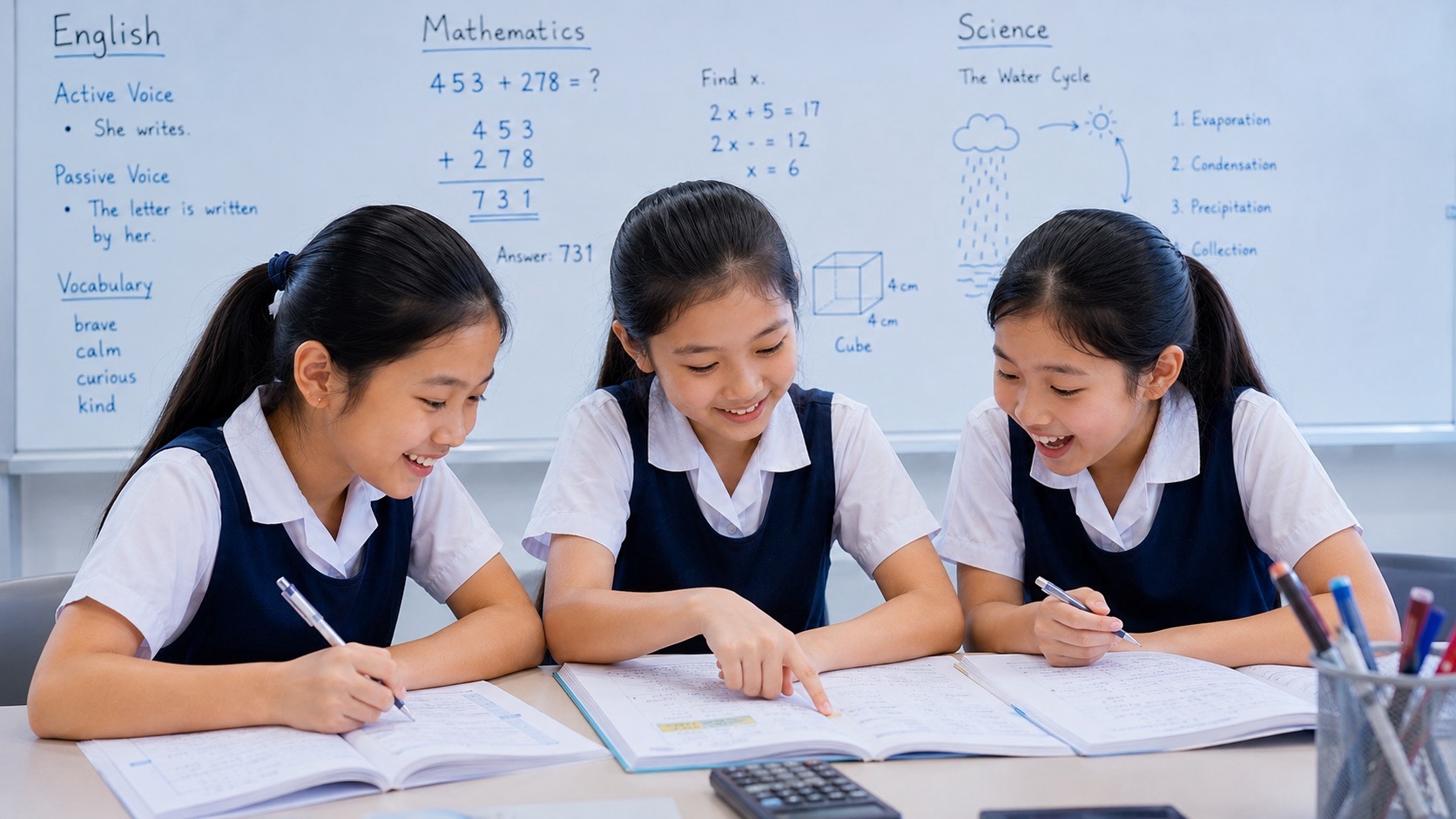
Awesome Schools in Bishan is a current town-level field guide to MOE Primary, Secondary, Integrated Programme and Junior College education in Bishan. It is deliberately not a ranking. The aim is to make the school field understandable: who is here now, what each institution repeatedly asks students to do, how those identities connect to English, Mathematics, Science, PSLE, SEC, IP, JC, CCAs, sport and the arts, and what families should verify before making their own decision.
The present field used here contains nine named institutions: Ai Tong School; Catholic High School, with Primary and Secondary sections; Kuo Chuan Presbyterian Primary School; Guangyang Secondary School; Kuo Chuan Presbyterian Secondary School; Peirce Secondary School; Whitley Secondary School; Raffles Institution; and Eunoia Junior College. Catholic High spans two stages and RI spans Years 1–6, so the pathway field is richer than the institution count alone suggests.
A small but important correction from older school lists: Guangyang Primary School merged with Townsville Primary School in 2023. Townsville currently operates in Ang Mo Kio, so Guangyang Primary is part of Bishan’s education history rather than its current Primary-school field. Nearby Raffles Girls’ School is owned by the Toa Payoh territorial article in this series to prevent duplication across adjacent areas.
This page connects outward to History of Singapore | Bishan, Why Singaporeans Love Bishan, Fun facts about Singapore | Bishan, Things to do in Singapore | Bishan, Tutors and Tuition in Bishan, History of Education in Singapore, Singapore Area Learning & Tuition Article Hub, English Learning Hub, Mathematics Learning Hub, Science Learning Hub, From PSLE to SEC and the Singapore Secondary School Directory. The area page owns the broad field. The deeper nodes own individual institutions, subjects, pathways and intervention.
The useful question is not “Which Bishan school wins?” It is “What learning environment does this school create, what does the learner repeatedly practise there, and how does that practice accumulate over four, six or more years?” That is a question a family can investigate without turning education into a league table.
The current Bishan education field
Bishan is compact enough for its schools to feel geographically connected, yet the educational identities are strikingly different. Primary pupils can encounter SAP bilingualism, project work, coding, sustainability, drama, visual design and outdoor education. Secondary students can encounter media literacy, Communicative Arts, AI-driven STEM, renewable energy, forensics, service leadership, dual-track IP/SEC education and a six-year IP. At pre-university level, RI and EJC create two different A-Level structures inside the same broader town field.
That variety is the point. A school programme should be read as a repeated learning environment rather than a marketing label. Ask what students actually read, build, investigate, rehearse, present, calculate, test, write, lead and revise. Then ask how the challenge increases with age. Progression is more informative than novelty.
| School / section | Stage | Distinctive lens |
|---|---|---|
| Ai Tong School | Primary | innovation, project work, bilingual development, cultural rootedness and outdoor leadership |
| Catholic High School (Primary Section) | Primary | bilingual scholarship, computational thinking, digital learning, sport, outdoor education and character |
| Kuo Chuan Presbyterian Primary School | Primary | inquiry, civic-mindedness, research, drama, visual art, design thinking and sustainability |
| Catholic High School (Secondary Section) | Secondary / IP | dual-track IP and SEC education, bilingual scholarship, world readiness, talent development and leadership |
| Guangyang Secondary School | Secondary | STEM sustainability, food security, renewable energy, forensic science, leadership and advocacy |
| Kuo Chuan Presbyterian Secondary School | Secondary | media literacy, responsible media production, communication, servant leadership and community youth leadership |
| Peirce Secondary School | Secondary | AI-driven STEM, project-based problem solving, technology literacy and community leadership |
| Whitley Secondary School | Secondary | Communicative Arts, public speaking, debate, media production, active citizenship and Full Subject-Based Banding |
| Raffles Institution | Integrated Programme / Secondary / Pre-University | academic depth, curriculum innovation, research, talent development, competition, arts, sport and a six-year IP continuum |
| Eunoia Junior College | Junior College | A-Level depth, interdisciplinary thinking, talent development, humanities, STEM research, music, bicultural learning, leadership and service |
Use the table for orientation, not judgement. Admissions arrangements, programmes, CCAs and subject offerings can change. For a live decision, return to MOE SchoolFinder, the official school website, MOE P1 Registration for Primary registration and current MOE or SEAB Secondary Education Certificate information for Secondary pathways.
Why Bishan is an unusually instructive education field
Bishan shows several different ways a school can create capability without pretending that one model should dominate all others. Ai Tong and Catholic High Primary make bilingual identity and innovation visible. Kuo Chuan Presbyterian Primary makes inquiry, research, drama, art and sustainability visible. The Secondary field then branches into STEM, media, communication, leadership, SEC and IP.
The town also makes pathway architecture visible. Catholic High Secondary offers both IP and SEC. RI offers a six-year IP with its own senior section. EJC receives Joint Integrated Programme students from partner schools and also JAE students. A family can therefore see different relationships between Secondary assessment and pre-university education within a small geography.
The physical town contributes as well. Bishan–Ang Mo Kio Park, Bishan Town Centre, Bright Hill, Sin Ming, Upper Thomson and the MRT interchange give students real systems to observe: transport, water, biodiversity, public space, housing, ageing infrastructure, commerce and accessibility. These are natural contexts for English, Mathematics, Science, Humanities, Art and project work.
A mature town also carries memory. Parents may remember school names and pathways from their own childhood, but the 2026 field is not identical to the 1990s or 2010s. Mergers, new campuses, Full Subject-Based Banding, SEC and IP structures mean that current decisions require current maps.
That is why this article repeatedly separates evidence from reputation. A current programme page, timetable, subject structure or admissions rule is evidence. A neighbour’s memory is context. A past cut-off point is historical admissions data. A viral comment is anecdote. They are not interchangeable.
School-by-school field guide
1. Ai Tong School
Ai Tong School contributes innovation, project work, bilingual development, cultural rootedness and outdoor leadership to the Bishan field. Founded in 1912 and a SAP school since 1989. The deeper eduKate institution profile is What is so Awesome About Ai Tong School | 2026–2027 Edition. The important thing is to read the institution as a system of repeated experiences rather than one headline.
Distinctive learning. iDARE@ATS uses authentic project work to connect classroom learning with collaborative problem solving, while the wider school experience includes SAP bilingual education, arts, leadership and outdoor learning. A programme has educational depth when students revisit the underlying capability several times, receive feedback, make a more difficult attempt and eventually operate with less adult prompting.
English. The strongest connection is research, oral explanation, reflection, presentation and bilingual sensitivity. English is the operating language for instructions, interpretation, explanation, source evaluation and showing another person what you know. In modern schooling, communication quality affects performance far beyond the English classroom.
Mathematics. Natural quantitative connections include measurement, data, comparison, pattern, constraints and checking. Real application should not mean “activity without formalism”. Students should estimate, represent, calculate, compare, check and explain why the numbers support a decision.
Science. The programme context naturally touches observation, sustainability, materials, systems and cause-and-effect reasoning. Scientific literacy matters because students need to distinguish observation from explanation, mechanism from coincidence, evidence from assertion and a model from reality.
Pathway. Primary 1 to Primary 6, ending in PSLE and Secondary-school choice. The school stage should be read as a sequence of increasing independence. Every transition asks the learner to carry more knowledge, manage longer timelines and decide when to seek help.
CCA, sport and arts. The wider co-curricular field includes Wushu, Chinese cultural activity, arts, clubs, student leadership and outdoor education. Long practice cycles matter. A student rehearses, trains, fails, receives feedback, revises, performs, competes, serves and leads. That is improvement made visible over time.
Geography. Bright Hill and the northern Bishan edge, close to Bishan–Ang Mo Kio Park and Upper Thomson. A school choice is lived through real mornings and afternoons, not just a map pin. Test the route during peak travel, after CCA and in bad weather; include walking, waiting, transfers and the learner’s recovery time at home.
What to ask. Ask what every student does repeatedly, how the distinctive programme becomes harder across year levels, how strong learners are extended, how struggling learners are detected early, and what happens when CCA, assessment and family demands collide in the same week.
What to look for in student work. Do not only ask whether students enjoyed the activity. Look for evidence of better reading, more precise language, stronger quantitative reasoning, more defensible scientific explanation, cleaner craft, more independent planning or more thoughtful reflection. Visible growth is the strongest explanation of why a programme matters.
Fit without ranking. The question is not whether Ai Tong School is universally superior to another school. The question is whether this learner is likely to engage with innovation, project work, bilingual development, cultural rootedness and outdoor leadership, sustain the travel and workload, find a place of belonging and grow in the academic core while using the wider opportunities productively.
2. Catholic High School (Primary Section)
Catholic High School (Primary Section) contributes bilingual scholarship, computational thinking, digital learning, sport, outdoor education and character to the Bishan field. Part of Catholic High’s long SAP tradition. The deeper eduKate institution profile is What is so Awesome About Catholic High School | 2026–2027 Edition. The important thing is to read the institution as a system of repeated experiences rather than one headline.
Distinctive learning. the Primary section combines progressive digital learning with coding and automation in sustainability contexts, while VITALS develops values through active learning in sports and outdoor education. A programme has educational depth when students revisit the underlying capability several times, receive feedback, make a more difficult attempt and eventually operate with less adult prompting.
English. The strongest connection is precise reading, bilingual expression, discussion, explanation and collaborative communication. English is the operating language for instructions, interpretation, explanation, source evaluation and showing another person what you know. In modern schooling, communication quality affects performance far beyond the English classroom.
Mathematics. Natural quantitative connections include logical sequencing, computational thinking, quantity, pattern, data and multi-step reasoning. Real application should not mean “activity without formalism”. Students should estimate, represent, calculate, compare, check and explain why the numbers support a decision.
Science. The programme context naturally touches automation, sustainability, energy, systems, testing and evidence. Scientific literacy matters because students need to distinguish observation from explanation, mechanism from coincidence, evidence from assertion and a model from reality.
Pathway. Primary 1 to Primary 6, with PSLE followed by a choice among eligible Secondary routes. The school stage should be read as a sequence of increasing independence. Every transition asks the learner to carry more knowledge, manage longer timelines and decide when to seek help.
CCA, sport and arts. The wider co-curricular field includes sport, Wushu, outdoor education, arts, clubs and leadership. Long practice cycles matter. A student rehearses, trains, fails, receives feedback, revises, performs, competes, serves and leads. That is improvement made visible over time.
Geography. Bishan Street 22 in the mature central Bishan residential field. A school choice is lived through real mornings and afternoons, not just a map pin. Test the route during peak travel, after CCA and in bad weather; include walking, waiting, transfers and the learner’s recovery time at home.
What to ask. Ask what every student does repeatedly, how the distinctive programme becomes harder across year levels, how strong learners are extended, how struggling learners are detected early, and what happens when CCA, assessment and family demands collide in the same week.
What to look for in student work. Do not only ask whether students enjoyed the activity. Look for evidence of better reading, more precise language, stronger quantitative reasoning, more defensible scientific explanation, cleaner craft, more independent planning or more thoughtful reflection. Visible growth is the strongest explanation of why a programme matters.
Fit without ranking. The question is not whether Catholic High School (Primary Section) is universally superior to another school. The question is whether this learner is likely to engage with bilingual scholarship, computational thinking, digital learning, sport, outdoor education and character, sustain the travel and workload, find a place of belonging and grow in the academic core while using the wider opportunities productively.
3. Kuo Chuan Presbyterian Primary School
Kuo Chuan Presbyterian Primary School contributes inquiry, civic-mindedness, research, drama, visual art, design thinking and sustainability to the Bishan field. A long-established Presbyterian school community in Bishan. The important thing is to read the institution as a system of repeated experiences rather than one headline.
Distinctive learning. E-Cube uses inquiry, research and drama around local and global issues, while the Visual Art and Design LLP uses design thinking and sustainability to create meaningful art for community impact. A programme has educational depth when students revisit the underlying capability several times, receive feedback, make a more difficult attempt and eventually operate with less adult prompting.
English. The strongest connection is multimodal reading, script writing, speaking, drama, advocacy and audience awareness. English is the operating language for instructions, interpretation, explanation, source evaluation and showing another person what you know. In modern schooling, communication quality affects performance far beyond the English classroom.
Mathematics. Natural quantitative connections include scale, proportion, design constraints, pattern, measurement and planning. Real application should not mean “activity without formalism”. Students should estimate, represent, calculate, compare, check and explain why the numbers support a decision.
Science. The programme context naturally touches environmental systems, materials, sustainability, observation and evidence. Scientific literacy matters because students need to distinguish observation from explanation, mechanism from coincidence, evidence from assertion and a model from reality.
Pathway. Primary 1 to Primary 6 with a six-year academic and character runway toward PSLE. The school stage should be read as a sequence of increasing independence. Every transition asks the learner to carry more knowledge, manage longer timelines and decide when to seek help.
CCA, sport and arts. The wider co-curricular field includes art, performance, service, leadership and broad Primary co-curricular activity. Long practice cycles matter. A student rehearses, trains, fails, receives feedback, revises, performs, competes, serves and leads. That is improvement made visible over time.
Geography. Bishan Street 13 beside the Kuo Chuan Presbyterian Secondary campus. A school choice is lived through real mornings and afternoons, not just a map pin. Test the route during peak travel, after CCA and in bad weather; include walking, waiting, transfers and the learner’s recovery time at home.
What to ask. Ask what every student does repeatedly, how the distinctive programme becomes harder across year levels, how strong learners are extended, how struggling learners are detected early, and what happens when CCA, assessment and family demands collide in the same week.
What to look for in student work. Do not only ask whether students enjoyed the activity. Look for evidence of better reading, more precise language, stronger quantitative reasoning, more defensible scientific explanation, cleaner craft, more independent planning or more thoughtful reflection. Visible growth is the strongest explanation of why a programme matters.
Fit without ranking. The question is not whether Kuo Chuan Presbyterian Primary School is universally superior to another school. The question is whether this learner is likely to engage with inquiry, civic-mindedness, research, drama, visual art, design thinking and sustainability, sustain the travel and workload, find a place of belonging and grow in the academic core while using the wider opportunities productively.
4. Catholic High School (Secondary Section)
Catholic High School (Secondary Section) contributes dual-track IP and SEC education, bilingual scholarship, world readiness, talent development and leadership to the Bishan field. A long-established SAP institution with a current dual-track Secondary structure. The deeper eduKate institution profile is What is so Awesome About Catholic High School | 2026–2027 Edition. The important thing is to read the institution as a system of repeated experiences rather than one headline.
Distinctive learning. the Secondary section offers the Joint Integrated Programme and the SEC Programme; the JIP connects Catholic High with CHIJ St Nicholas Girls’ School, Singapore Chinese Girls’ School and Eunoia Junior College and includes World Readiness and Passion Pursuit experiences. A programme has educational depth when students revisit the underlying capability several times, receive feedback, make a more difficult attempt and eventually operate with less adult prompting.
English. The strongest connection is argument, close reading, discussion of current issues, research, judgement and bilingual communication. English is the operating language for instructions, interpretation, explanation, source evaluation and showing another person what you know. In modern schooling, communication quality affects performance far beyond the English classroom.
Mathematics. Natural quantitative connections include algebraic structure, modelling, abstraction, data, formal reasoning and advanced problem solving. Real application should not mean “activity without formalism”. Students should estimate, represent, calculate, compare, check and explain why the numbers support a decision.
Science. The programme context naturally touches experimental reasoning, disciplinary depth, research habits and ethical discussion around science and technology. Scientific literacy matters because students need to distinguish observation from explanation, mechanism from coincidence, evidence from assertion and a model from reality.
Pathway. either a Joint Integrated Programme route toward Eunoia Junior College or the SEC route toward the wider national post-secondary system. The school stage should be read as a sequence of increasing independence. Every transition asks the learner to carry more knowledge, manage longer timelines and decide when to seek help.
CCA, sport and arts. The wider co-curricular field includes sport, music, arts, clubs, service, leadership and talent-development programmes. Long practice cycles matter. A student rehearses, trains, fails, receives feedback, revises, performs, competes, serves and leads. That is improvement made visible over time.
Geography. Bishan Street 22 near the town’s central transport and residential network. A school choice is lived through real mornings and afternoons, not just a map pin. Test the route during peak travel, after CCA and in bad weather; include walking, waiting, transfers and the learner’s recovery time at home.
What to ask. Ask what every student does repeatedly, how the distinctive programme becomes harder across year levels, how strong learners are extended, how struggling learners are detected early, and what happens when CCA, assessment and family demands collide in the same week.
What to look for in student work. Do not only ask whether students enjoyed the activity. Look for evidence of better reading, more precise language, stronger quantitative reasoning, more defensible scientific explanation, cleaner craft, more independent planning or more thoughtful reflection. Visible growth is the strongest explanation of why a programme matters.
Fit without ranking. The question is not whether Catholic High School (Secondary Section) is universally superior to another school. The question is whether this learner is likely to engage with dual-track IP and SEC education, bilingual scholarship, world readiness, talent development and leadership, sustain the travel and workload, find a place of belonging and grow in the academic core while using the wider opportunities productively.
5. Guangyang Secondary School
Guangyang Secondary School contributes STEM sustainability, food security, renewable energy, forensic science, leadership and advocacy to the Bishan field. The current Guangyang school in Bishan after the former Guangyang Primary merged into Townsville Primary in 2023. The important thing is to read the institution as a system of repeated experiences rather than one headline.
Distinctive learning. the STEM ALP gives lower-secondary students hands-on modules in hydroponics, renewable-energy prototyping and forensic investigation, while Guangyang Advocates develops leadership, communication, civic literacy and service. A programme has educational depth when students revisit the underlying capability several times, receive feedback, make a more difficult attempt and eventually operate with less adult prompting.
English. The strongest connection is investigation reports, presentation, evidence-based explanation and advocacy. English is the operating language for instructions, interpretation, explanation, source evaluation and showing another person what you know. In modern schooling, communication quality affects performance far beyond the English classroom.
Mathematics. Natural quantitative connections include data, rates, measurement, variables, energy calculations and iterative comparison. Real application should not mean “activity without formalism”. Students should estimate, represent, calculate, compare, check and explain why the numbers support a decision.
Science. The programme context naturally touches sustainability, food systems, energy, forensics, experimental design and real-world application. Scientific literacy matters because students need to distinguish observation from explanation, mechanism from coincidence, evidence from assertion and a model from reality.
Pathway. Full Subject-Based Banding through Secondary school toward the SEC and eligible JC, polytechnic, ITE or other post-secondary routes. The school stage should be read as a sequence of increasing independence. Every transition asks the learner to carry more knowledge, manage longer timelines and decide when to seek help.
CCA, sport and arts. The wider co-curricular field includes service, leadership, sport, uniformed groups, arts and clubs, supported by experiential learning. Long practice cycles matter. A student rehearses, trains, fails, receives feedback, revises, performs, competes, serves and leads. That is improvement made visible over time.
Geography. Bishan Street 12 in the mature core of the town. A school choice is lived through real mornings and afternoons, not just a map pin. Test the route during peak travel, after CCA and in bad weather; include walking, waiting, transfers and the learner’s recovery time at home.
What to ask. Ask what every student does repeatedly, how the distinctive programme becomes harder across year levels, how strong learners are extended, how struggling learners are detected early, and what happens when CCA, assessment and family demands collide in the same week.
What to look for in student work. Do not only ask whether students enjoyed the activity. Look for evidence of better reading, more precise language, stronger quantitative reasoning, more defensible scientific explanation, cleaner craft, more independent planning or more thoughtful reflection. Visible growth is the strongest explanation of why a programme matters.
Fit without ranking. The question is not whether Guangyang Secondary School is universally superior to another school. The question is whether this learner is likely to engage with STEM sustainability, food security, renewable energy, forensic science, leadership and advocacy, sustain the travel and workload, find a place of belonging and grow in the academic core while using the wider opportunities productively.
6. Kuo Chuan Presbyterian Secondary School
Kuo Chuan Presbyterian Secondary School contributes media literacy, responsible media production, communication, servant leadership and community youth leadership to the Bishan field. A longstanding Bishan school whose current identity joins media literacy with service. The important thing is to read the institution as a system of repeated experiences rather than one headline.
Distinctive learning. Media Literacy@KCPSS develops critical consumers and responsible producers through podcasting, film, broadcasting, journalism and public communication, while the LLP develops community and youth leadership. A programme has educational depth when students revisit the underlying capability several times, receive feedback, make a more difficult attempt and eventually operate with less adult prompting.
English. The strongest connection is podcasting, public speaking, journalism, broadcasting, script work and evaluation of media messages. English is the operating language for instructions, interpretation, explanation, source evaluation and showing another person what you know. In modern schooling, communication quality affects performance far beyond the English classroom.
Mathematics. Natural quantitative connections include data interpretation, timing, budgeting, scale, audience metrics and quantitative support for credible projects. Real application should not mean “activity without formalism”. Students should estimate, represent, calculate, compare, check and explain why the numbers support a decision.
Science. The programme context naturally touches source evaluation, evidence, mechanisms and disciplined separation of claim from proof. Scientific literacy matters because students need to distinguish observation from explanation, mechanism from coincidence, evidence from assertion and a model from reality.
Pathway. Full Subject-Based Banding through SEC subjects toward the post-secondary route that matches the learner’s results, subjects and readiness. The school stage should be read as a sequence of increasing independence. Every transition asks the learner to carry more knowledge, manage longer timelines and decide when to seek help.
CCA, sport and arts. The wider co-curricular field includes media, arts, sport, service, student leadership, clubs and uniformed groups. Long practice cycles matter. A student rehearses, trains, fails, receives feedback, revises, performs, competes, serves and leads. That is improvement made visible over time.
Geography. Bishan Street 13 beside Kuo Chuan Presbyterian Primary. A school choice is lived through real mornings and afternoons, not just a map pin. Test the route during peak travel, after CCA and in bad weather; include walking, waiting, transfers and the learner’s recovery time at home.
What to ask. Ask what every student does repeatedly, how the distinctive programme becomes harder across year levels, how strong learners are extended, how struggling learners are detected early, and what happens when CCA, assessment and family demands collide in the same week.
What to look for in student work. Do not only ask whether students enjoyed the activity. Look for evidence of better reading, more precise language, stronger quantitative reasoning, more defensible scientific explanation, cleaner craft, more independent planning or more thoughtful reflection. Visible growth is the strongest explanation of why a programme matters.
Fit without ranking. The question is not whether Kuo Chuan Presbyterian Secondary School is universally superior to another school. The question is whether this learner is likely to engage with media literacy, responsible media production, communication, servant leadership and community youth leadership, sustain the travel and workload, find a place of belonging and grow in the academic core while using the wider opportunities productively.
7. Peirce Secondary School
Peirce Secondary School contributes AI-driven STEM, project-based problem solving, technology literacy and community leadership to the Bishan field. Established in the 1990s and now carrying a contemporary AI-and-STEM applied-learning identity. The important thing is to read the institution as a system of repeated experiences rather than one headline.
Distinctive learning. the STEM ALP introduced in 2025 develops AI literacy, technological skills and 21st Century Competencies through project-based real-world problem solving, while its LLP develops community leaders through Values in Action and student leadership. A programme has educational depth when students revisit the underlying capability several times, receive feedback, make a more difficult attempt and eventually operate with less adult prompting.
English. The strongest connection is problem definition, information literacy, documentation, explanation and technical presentation. English is the operating language for instructions, interpretation, explanation, source evaluation and showing another person what you know. In modern schooling, communication quality affects performance far beyond the English classroom.
Mathematics. Natural quantitative connections include algorithms, patterns, data, variables, modelling and quantitative verification. Real application should not mean “activity without formalism”. Students should estimate, represent, calculate, compare, check and explain why the numbers support a decision.
Science. The programme context naturally touches integrated STEM inquiry, experimentation, systems thinking and careful testing of model outputs. Scientific literacy matters because students need to distinguish observation from explanation, mechanism from coincidence, evidence from assertion and a model from reality.
Pathway. Full Subject-Based Banding toward the SEC and multiple post-secondary destinations. The school stage should be read as a sequence of increasing independence. Every transition asks the learner to carry more knowledge, manage longer timelines and decide when to seek help.
CCA, sport and arts. The wider co-curricular field includes leadership, service, sport, arts, clubs, outdoor and technology-related experiences. Long practice cycles matter. A student rehearses, trains, fails, receives feedback, revises, performs, competes, serves and leads. That is improvement made visible over time.
Geography. Sin Ming Walk near Upper Thomson and Bright Hill. A school choice is lived through real mornings and afternoons, not just a map pin. Test the route during peak travel, after CCA and in bad weather; include walking, waiting, transfers and the learner’s recovery time at home.
What to ask. Ask what every student does repeatedly, how the distinctive programme becomes harder across year levels, how strong learners are extended, how struggling learners are detected early, and what happens when CCA, assessment and family demands collide in the same week.
What to look for in student work. Do not only ask whether students enjoyed the activity. Look for evidence of better reading, more precise language, stronger quantitative reasoning, more defensible scientific explanation, cleaner craft, more independent planning or more thoughtful reflection. Visible growth is the strongest explanation of why a programme matters.
Fit without ranking. The question is not whether Peirce Secondary School is universally superior to another school. The question is whether this learner is likely to engage with AI-driven STEM, project-based problem solving, technology literacy and community leadership, sustain the travel and workload, find a place of belonging and grow in the academic core while using the wider opportunities productively.
8. Whitley Secondary School
Whitley Secondary School contributes Communicative Arts, public speaking, debate, media production, active citizenship and Full Subject-Based Banding to the Bishan field. A neighbourhood Secondary school with a strong communication and leadership identity. The important thing is to read the institution as a system of repeated experiences rather than one headline.
Distinctive learning. its four-year Communicative Arts pathway progresses from storytelling and performance to advocacy, broadcasting, debate, impromptu speaking and media analysis, while Active Citizenship for Social Change develops community and youth leadership. A programme has educational depth when students revisit the underlying capability several times, receive feedback, make a more difficult attempt and eventually operate with less adult prompting.
English. The strongest connection is storytelling, research, debate, broadcast, current affairs, questioning and public speaking. English is the operating language for instructions, interpretation, explanation, source evaluation and showing another person what you know. In modern schooling, communication quality affects performance far beyond the English classroom.
Mathematics. Natural quantitative connections include logical structure, statistics, evidence and numerical literacy supporting argument. Real application should not mean “activity without formalism”. Students should estimate, represent, calculate, compare, check and explain why the numbers support a decision.
Science. The programme context naturally touches accurate science communication, mechanism, uncertainty, evidence and the distinction between correlation and cause. Scientific literacy matters because students need to distinguish observation from explanation, mechanism from coincidence, evidence from assertion and a model from reality.
Pathway. Full Subject-Based Banding toward SEC subjects and onward post-secondary choices. The school stage should be read as a sequence of increasing independence. Every transition asks the learner to carry more knowledge, manage longer timelines and decide when to seek help.
CCA, sport and arts. The wider co-curricular field includes debate, public speaking, English drama, media, choir, band, dance, sport, uniformed groups and leadership. Long practice cycles matter. A student rehearses, trains, fails, receives feedback, revises, performs, competes, serves and leads. That is improvement made visible over time.
Geography. Bishan Street 24 near Catholic High and central Bishan. A school choice is lived through real mornings and afternoons, not just a map pin. Test the route during peak travel, after CCA and in bad weather; include walking, waiting, transfers and the learner’s recovery time at home.
What to ask. Ask what every student does repeatedly, how the distinctive programme becomes harder across year levels, how strong learners are extended, how struggling learners are detected early, and what happens when CCA, assessment and family demands collide in the same week.
What to look for in student work. Do not only ask whether students enjoyed the activity. Look for evidence of better reading, more precise language, stronger quantitative reasoning, more defensible scientific explanation, cleaner craft, more independent planning or more thoughtful reflection. Visible growth is the strongest explanation of why a programme matters.
Fit without ranking. The question is not whether Whitley Secondary School is universally superior to another school. The question is whether this learner is likely to engage with Communicative Arts, public speaking, debate, media production, active citizenship and Full Subject-Based Banding, sustain the travel and workload, find a place of belonging and grow in the academic core while using the wider opportunities productively.
9. Raffles Institution
Raffles Institution contributes academic depth, curriculum innovation, research, talent development, competition, arts, sport and a six-year IP continuum to the Bishan field. One of Singapore’s oldest schools, with the former Raffles Junior College reintegrated into RI in 2009. The deeper eduKate institution profile is What is so Awesome About Raffles Institution | 2026–2027 Edition. The important thing is to read the institution as a system of repeated experiences rather than one headline.
Distinctive learning. Years 1–4 combine the Raffles Programme with curriculum innovation including the Future Learning Programme, Raffles Playground, GapX and outdoor adventure learning, alongside talent development, research and competition; Years 5–6 move into the A-Level curriculum. A programme has educational depth when students revisit the underlying capability several times, receive feedback, make a more difficult attempt and eventually operate with less adult prompting.
English. The strongest connection is advanced reading, argument, research, rhetoric, humanities inquiry, publication and debate. English is the operating language for instructions, interpretation, explanation, source evaluation and showing another person what you know. In modern schooling, communication quality affects performance far beyond the English classroom.
Mathematics. Natural quantitative connections include mathematical abstraction, advanced problem solving, modelling, proof, data and competition. Real application should not mean “activity without formalism”. Students should estimate, represent, calculate, compare, check and explain why the numbers support a decision.
Science. The programme context naturally touches deep disciplinary study, research education, laboratory reasoning, inquiry and advanced experimentation. Scientific literacy matters because students need to distinguish observation from explanation, mechanism from coincidence, evidence from assertion and a model from reality.
Pathway. a six-year Integrated Programme culminating in A-Level study within RI’s senior section. The school stage should be read as a sequence of increasing independence. Every transition asks the learner to carry more knowledge, manage longer timelines and decide when to seek help.
CCA, sport and arts. The wider co-curricular field includes more than thirty Year 1–4 CCAs across academic groups, clubs, performing arts, service, sport and uniformed groups, with further senior opportunities. Long practice cycles matter. A student rehearses, trains, fails, receives feedback, revises, performs, competes, serves and leads. That is improvement made visible over time.
Geography. Raffles Institution Lane beside the Bishan transport core. A school choice is lived through real mornings and afternoons, not just a map pin. Test the route during peak travel, after CCA and in bad weather; include walking, waiting, transfers and the learner’s recovery time at home.
What to ask. Ask what every student does repeatedly, how the distinctive programme becomes harder across year levels, how strong learners are extended, how struggling learners are detected early, and what happens when CCA, assessment and family demands collide in the same week.
What to look for in student work. Do not only ask whether students enjoyed the activity. Look for evidence of better reading, more precise language, stronger quantitative reasoning, more defensible scientific explanation, cleaner craft, more independent planning or more thoughtful reflection. Visible growth is the strongest explanation of why a programme matters.
Fit without ranking. The question is not whether Raffles Institution is universally superior to another school. The question is whether this learner is likely to engage with academic depth, curriculum innovation, research, talent development, competition, arts, sport and a six-year IP continuum, sustain the travel and workload, find a place of belonging and grow in the academic core while using the wider opportunities productively.
10. Eunoia Junior College
Eunoia Junior College contributes A-Level depth, interdisciplinary thinking, talent development, humanities, STEM research, music, bicultural learning, leadership and service to the Bishan field. A newer JC whose high-rise Bishan campus is a contemporary layer in the town’s education history. The deeper eduKate institution profile is What is so Awesome About Eunoia Junior College | 2026–2027 Edition. The important thing is to read the institution as a system of repeated experiences rather than one headline.
Distinctive learning. EJC combines JIP and JAE students with flagship Talent Development and Life Coaching programmes; special programmes include Bicultural Studies, Engineering and Tech, Humanities Scholarship and Programme, Music Elective, STEM Research, Community Advocacy and interdisciplinary LATITUDE, ALTITUDE and MAGNITUDE experiences. A programme has educational depth when students revisit the underlying capability several times, receive feedback, make a more difficult attempt and eventually operate with less adult prompting.
English. The strongest connection is General Paper, Literature, humanities discussion, synthesis, research writing and argument. English is the operating language for instructions, interpretation, explanation, source evaluation and showing another person what you know. In modern schooling, communication quality affects performance far beyond the English classroom.
Mathematics. Natural quantitative connections include H1/H2 quantitative study, modelling, advanced problem solving and support for Science, economics, engineering and technology. Real application should not mean “activity without formalism”. Students should estimate, represent, calculate, compare, check and explain why the numbers support a decision.
Science. The programme context naturally touches A-Level disciplinary depth, research attachments, makerspace work, interdisciplinary STEM and independent inquiry. Scientific literacy matters because students need to distinguish observation from explanation, mechanism from coincidence, evidence from assertion and a model from reality.
Pathway. a two-year A-Level pathway for JIP students progressing from partner schools and students admitted through JAE. The school stage should be read as a sequence of increasing independence. Every transition asks the learner to carry more knowledge, manage longer timelines and decide when to seek help.
CCA, sport and arts. The wider co-curricular field includes arts, sport, leadership, service, research, talent development and enrichment within a compressed two-year timetable. Long practice cycles matter. A student rehearses, trains, fails, receives feedback, revises, performs, competes, serves and leads. That is improvement made visible over time.
Geography. Sin Ming Place overlooking Bishan–Ang Mo Kio Park. A school choice is lived through real mornings and afternoons, not just a map pin. Test the route during peak travel, after CCA and in bad weather; include walking, waiting, transfers and the learner’s recovery time at home.
What to ask. Ask what every student does repeatedly, how the distinctive programme becomes harder across year levels, how strong learners are extended, how struggling learners are detected early, and what happens when CCA, assessment and family demands collide in the same week.
What to look for in student work. Do not only ask whether students enjoyed the activity. Look for evidence of better reading, more precise language, stronger quantitative reasoning, more defensible scientific explanation, cleaner craft, more independent planning or more thoughtful reflection. Visible growth is the strongest explanation of why a programme matters.
Fit without ranking. The question is not whether Eunoia Junior College is universally superior to another school. The question is whether this learner is likely to engage with A-Level depth, interdisciplinary thinking, talent development, humanities, STEM research, music, bicultural learning, leadership and service, sustain the travel and workload, find a place of belonging and grow in the academic core while using the wider opportunities productively.
English across Bishan: from decoding to public voice
English is the clearest connective tissue across the town. KCPPS uses inquiry, research and drama. KCPSS uses podcasting, film, broadcasting and journalism. Whitley builds a four-year Communicative Arts progression. Catholic High’s World Readiness work depends on discussion and judgement. RI extends into research and debate. EJC asks students to manage General Paper, Literature and interdisciplinary argument.
Strong English learning contains several layers. Vocabulary matters, but vocabulary without conceptual precision becomes decoration. Grammar matters, but grammar without ideas produces correct emptiness. Reading matters, but reading without evidence selection and inference does not become analysis. Speaking matters, but fluency without structure can still be vague.
A durable progression moves through four operations: understand another person’s meaning; decide what matters; organise a response; communicate that response for a real audience. Primary pupils begin with narration, comprehension and sentence control. Secondary learners add synthesis, evaluation and argument. JC students manage ambiguity, abstraction and competing perspectives.
Media literacy now belongs inside English capability. Students encounter feeds, videos, generated text, persuasive design and algorithmic recommendations. They need to ask who produced a message, what evidence supports it, what has been omitted and what incentives shape the presentation. That is why the media-heavy Bishan programmes are academically relevant rather than decorative.
AI raises the bar further. If fluent text can be generated instantly, human value shifts toward question quality, source judgement, verification, context, interpretation and the ability to detect polished nonsense. The English Learning Hub develops the longer subject progression, while Tutors and Tuition in Bishan deals with intervention when a specific language capability is missing.
Mathematics across Bishan: the invisible infrastructure
Mathematics often sits underneath programmes whose public labels are STEM, media, art, sustainability or leadership. Hydroponics uses rates and measurement. Solar cars use variables and energy relationships. AI uses patterns and data. Media uses timing, statistics and budgets. Design uses scale and proportion. Research uses representation and uncertainty.
Primary Mathematics should build number sense, arithmetic fluency, fractions, measurement, geometry, data and problem solving. By upper Primary, students must increasingly choose methods rather than wait for the topic label. Secondary Mathematics then turns relationships into algebra, functions, graphs, geometry, trigonometry, statistics and probability.
The arithmetic-to-algebra transition is especially important. Students who have survived through remembered procedures can suddenly feel that Mathematics has become a different language. The repair is not always “more practice”. They may need a clearer model of variables, equivalence, operations and representation.
Applied learning has depth when formal Mathematics is genuinely needed. A prototype should create reasons to estimate, measure, model, quantify error, compare alternatives and defend a choice. That is how activity becomes transferable reasoning.
At RI and EJC, the quantitative ceiling rises further, but the underlying habits remain familiar: define the problem, represent it, choose a method, execute accurately, inspect plausibility and explain what the result means. The Mathematics Learning Hub carries the full Primary-to-advanced progression.
Science across Bishan: evidence, mechanisms and systems
Bishan has a highly visible applied-Science field. Catholic High Primary uses coding and automation in sustainability contexts. Guangyang foregrounds food security, solar energy and forensics. Peirce foregrounds AI-driven STEM. RI and EJC extend into research and advanced disciplinary study.
The unifying idea is evidence. A scientifically educated student should distinguish observation from explanation, correlation from cause, a variable from a confounder, a prediction from a result and a model from the real system it approximates.
Primary Science builds accurate concepts and disciplined observation. Secondary Science deepens mechanisms, experimental design and quantitative relationships. JC Science adds abstraction, larger knowledge networks and more independent synthesis.
Hands-on activity is not automatically deep. The valuable loop is formal knowledge → prediction → investigation → evidence → revision → better explanation. When students can explain why the experiment matters and what would change their conclusion, the activity has become scientific reasoning.
The Science Learning Hub develops the subject spine in detail. The town field shows where those ideas can become visible in local programmes and real environments.
PSLE: prepare seriously without making Primary school one long exam season
PSLE matters for Bishan’s Primary pupils, but the best preparation is cumulative. Lower Primary should build reading, number sense, language confidence and routines. Middle Primary adds formal Science, denser comprehension and more independent problem solving. Upper Primary consolidates knowledge, retrieval, timing, mixed-topic practice and checking.
A learner who has spent years explaining answers and correcting misconceptions is not starting from zero when timed papers arrive. A learner who has depended on recognition and prompting may look comfortable until mixed retrieval exposes gaps.
Secondary-school choice should then be made with the next four to six years in mind. Travel, school culture, subject levels, CCA, student support, SEC or IP architecture and the learner’s temperament matter alongside admissions data.
Past cut-off points help with planning but should not be treated as school ratings. They are the outcome of admissions in a particular cohort, not a complete description of teaching, support or student experience.
Use Singapore Secondary School Directory and From PSLE to SEC to separate the national pathway from the local school identity. First understand the system. Then understand the schools. Then consider the learner.
SEC and Full Subject-Based Banding
For new Secondary cohorts, Full Subject-Based Banding changes the architecture families need to understand. Posting Groups guide admission while individual subjects may be offered at different demand levels according to current rules and eligibility. The national endpoint is the Secondary Education Certificate rather than the old stream labels.
This matters in Bishan because Guangyang, KCPSS, Peirce and Whitley operate inside that national direction, while Catholic High also has an IP route and RI is an IP institution. Families are therefore comparing assessment architectures as well as schools.
The deeper principle is that strengths can be uneven. A learner may be advanced in Mathematics and still developing English, or strong in languages and need more support in a quantitative subject. Full SBB is designed around the reality that one overall label does not describe every subject strength.
Use current MOE and SEAB Secondary Education Certificate information. Old Express, N(A) and N(T) shorthand can create the wrong mental model for a current decision.
Whatever the subject level, students still need the same learning loop: retrieve, apply, receive feedback, correct, revisit and eventually perform with less support.
Integrated Programme in Bishan
Bishan contains two important IP structures. Catholic High participates in the Joint Integrated Programme and its IP students progress to Eunoia Junior College. Raffles Institution runs a six-year Integrated Programme with Years 5–6 inside RI.
Both routes bypass a terminal SEC examination for IP students, but that common feature should not flatten their differences. Curriculum design, cohort structure, assessment rhythm, enrichment, school culture and the transition into the final two years differ.
The absence of a Year 4 national examination does not automatically mean less pressure. It changes the location and purpose of assessment. Schools can use curriculum time differently, but students also need self-regulation because one single external checkpoint is no longer doing all the scheduling work.
A learner gradually needs to manage open-ended tasks, long projects, research, unfamiliar texts, complex quantitative work and several commitments at once. Families should ask how those habits are taught rather than assuming a twelve-year-old must already possess them.
A useful IP question is what happens when a capable student hits the first serious wall. Strong systems teach help-seeking, consolidation, planning and recovery rather than assuming high prior attainment guarantees smooth progress forever.
JC and A-Level depth in Bishan
Bishan’s pre-university layer includes RI Years 5–6 and Eunoia Junior College. EJC serves both JIP and JAE students, while RI’s senior section continues its own six-year IP.
JC compresses learning sharply. Content deepens, General Paper demands wide reading and judgement, project or research work requires coordination, and university-facing choices appear while students are still adapting to the pace.
The best preparation is not premature JC work in lower Secondary. It is strong foundations and growing independence: read difficult material, build mathematical fluency, understand Science, plan a week, ask for help early, protect sleep and review errors before they compound.
EJC’s Humanities, STEM research, Music, Bicultural Studies and interdisciplinary programmes and RI’s senior academic and co-curricular depth both create many extension opportunities. Enrichment works only when the learner can still carry the core.
The question becomes “Which experiences deepen my thinking, craft, service or future direction enough to justify the time?” That is a better guide than collecting activities because they sound impressive.
CCA, sport and arts: where improvement becomes visible
Academic learning often hides improvement inside marks. Co-curricular learning makes improvement visible in the body, team, ensemble, performance and public result. A pass becomes cleaner, timing improves, a speech steadies, a rehearsal holds together and a junior learns to lead.
Bishan’s field contains Wushu, outdoor education, school sport, drama, visual design, advocacy, debate, broadcasting, uniformed groups, service leadership, music, research clubs and competitive sport. The labels differ; the long practice cycle is shared.
One sports carnival is an event. Years of training create habits. One speech is an activity. Repeated public speaking produces communicative control. One service day is exposure. Sustained service with reflection can build responsibility.
Arts are not decorative extras. Music, theatre, visual art, dance and media train attention, interpretation, craft, memory, rehearsal, collaboration and audience awareness. In an AI-rich world, deliberate choices about form and meaning become more valuable, not less.
Sport similarly teaches more than fitness. Technique has to work under pressure. Students learn to manage emotion, coordinate with others, recover from failure and discover that consistency beats occasional intensity.
Families should investigate weekly reality: how often does the CCA meet, what happens near competition season, how late does the student get home, what support exists after absences and how does the learner react to performance pressure?
Bishan itself as a learning laboratory
Bishan–Ang Mo Kio Park
Bishan–Ang Mo Kio Park can support learning about water management, biodiversity, heat, movement, landscape design and the meeting of engineered and natural systems. The point is not to turn every family outing into homework. It is to help students notice that textbook concepts describe real systems around them.
A simple cycle works: observe carefully; ask one precise question; collect or locate evidence; represent what you found in words, numbers, diagrams or photographs; then explain what you still do not know. The same cycle can support English, Mathematics, Science, Geography, History, Art and project work.
Bishan MRT and Bus Interchange
Bishan MRT and Bus Interchange can support learning about network design, passenger flow, rates, timing, queue behaviour, wayfinding and accessibility. The point is not to turn every family outing into homework. It is to help students notice that textbook concepts describe real systems around them.
A simple cycle works: observe carefully; ask one precise question; collect or locate evidence; represent what you found in words, numbers, diagrams or photographs; then explain what you still do not know. The same cycle can support English, Mathematics, Science, Geography, History, Art and project work.
Bishan Town Centre
Bishan Town Centre can support learning about pricing, consumer behaviour, public space, persuasive language, data collection and urban change. The point is not to turn every family outing into homework. It is to help students notice that textbook concepts describe real systems around them.
A simple cycle works: observe carefully; ask one precise question; collect or locate evidence; represent what you found in words, numbers, diagrams or photographs; then explain what you still do not know. The same cycle can support English, Mathematics, Science, Geography, History, Art and project work.
Sin Ming and Bright Hill
Sin Ming and Bright Hill can support learning about transport change, mixed land use, community services, cultural institutions and the relationship between old and new infrastructure. The point is not to turn every family outing into homework. It is to help students notice that textbook concepts describe real systems around them.
A simple cycle works: observe carefully; ask one precise question; collect or locate evidence; represent what you found in words, numbers, diagrams or photographs; then explain what you still do not know. The same cycle can support English, Mathematics, Science, Geography, History, Art and project work.
Residential estates
Residential estates can support learning about housing design, lift access, demographic change, energy, waste, maintenance, ageing and shared systems. The point is not to turn every family outing into homework. It is to help students notice that textbook concepts describe real systems around them.
A simple cycle works: observe carefully; ask one precise question; collect or locate evidence; represent what you found in words, numbers, diagrams or photographs; then explain what you still do not know. The same cycle can support English, Mathematics, Science, Geography, History, Art and project work.
How to compare Bishan schools without manufacturing a ranking
Start with the learner. What gives this student energy? Where is structure still needed? How independently do they work? Which strengths are stable and which are only beginning to emerge? What travel pattern can the family realistically sustain for four or six years?
Read the official school information next. Identify the ordinary curriculum, not only showcase programmes. Look at subject structures, IP or Full SBB, school hours, CCA expectations, support, admissions and how a distinctive programme progresses by year.
Then test the weekly reality. Two schools can have equally attractive websites and very different Tuesdays. Ask when the learner gets home, how often CCAs run, when academic support occurs, how much independent reading is expected and what happens during peak competition or examination periods.
Separate evidence from reputation. Current programme details and schedules are evidence. A long-ago alumni memory is context. A past cut-off point is historical admissions data. An online comment is anecdote. They may all be heard, but they should not carry equal weight.
Keep school choice and tuition choice separate. A strong school does not guarantee that a student will never need outside help. Tuition is useful when a specific capability is missing and targeted teaching can build it. It is wasteful when it duplicates work the learner can already do independently.
The town-level Tutors and Tuition in Bishan article owns that intervention question. This article owns the school field. Keeping those jobs separate prevents every education conversation from collapsing into “more tuition”.
A ten-dimension decision notebook
- Academic spine: What are the core subject expectations, and how are misconceptions detected and repaired?
- Distinctive programme: What do all students actually do, and how does the challenge grow with age?
- Communication: Where must students read, write, speak, debate, present or explain for a real audience?
- Quantitative reasoning: Where do data, measurement, modelling or formal Mathematics genuinely matter?
- Scientific reasoning: Where do students test ideas, handle evidence and investigate mechanisms?
- CCA rhythm: What does participation look like during an ordinary week and during peak season?
- Support: What happens before a student has fallen far behind?
- Extension: What happens after the ordinary core is secure?
- Travel: What is the real door-to-door time after CCA, not just the map distance?
- Belonging: Where is the learner likely to find peers, adults and activities that support sustained participation?
Ai Tong School: using the notebook
For the academic spine, read Primary 1 to Primary 6, ending in PSLE and Secondary-school choice against the learner’s present habits. For the distinctive programme, investigate how iDARE@ATS uses authentic project work to connect classroom learning with collaborative problem solving, while the wider school experience includes SAP bilingual education, arts, leadership and outdoor learning is sequenced rather than accepting the programme title as sufficient evidence.
For communication, look for research, oral explanation, reflection, presentation and bilingual sensitivity. For quantitative reasoning, look for measurement, data, comparison, pattern, constraints and checking. For scientific reasoning, look for observation, sustainability, materials, systems and cause-and-effect reasoning. These connections show whether enrichment actually activates subject knowledge.
For CCA rhythm, map Wushu, Chinese cultural activity, arts, clubs, student leadership and outdoor education onto a normal week. For support, ask how quietly struggling students are noticed. For extension, ask what happens after the core is secure. For travel, test Bright Hill and the northern Bishan edge, close to Bishan–Ang Mo Kio Park and Upper Thomson. For belonging, listen to how students describe ordinary days, not only showcase events.
Catholic High School (Primary Section): using the notebook
For the academic spine, read Primary 1 to Primary 6, with PSLE followed by a choice among eligible Secondary routes against the learner’s present habits. For the distinctive programme, investigate how the Primary section combines progressive digital learning with coding and automation in sustainability contexts, while VITALS develops values through active learning in sports and outdoor education is sequenced rather than accepting the programme title as sufficient evidence.
For communication, look for precise reading, bilingual expression, discussion, explanation and collaborative communication. For quantitative reasoning, look for logical sequencing, computational thinking, quantity, pattern, data and multi-step reasoning. For scientific reasoning, look for automation, sustainability, energy, systems, testing and evidence. These connections show whether enrichment actually activates subject knowledge.
For CCA rhythm, map sport, Wushu, outdoor education, arts, clubs and leadership onto a normal week. For support, ask how quietly struggling students are noticed. For extension, ask what happens after the core is secure. For travel, test Bishan Street 22 in the mature central Bishan residential field. For belonging, listen to how students describe ordinary days, not only showcase events.
Kuo Chuan Presbyterian Primary School: using the notebook
For the academic spine, read Primary 1 to Primary 6 with a six-year academic and character runway toward PSLE against the learner’s present habits. For the distinctive programme, investigate how E-Cube uses inquiry, research and drama around local and global issues, while the Visual Art and Design LLP uses design thinking and sustainability to create meaningful art for community impact is sequenced rather than accepting the programme title as sufficient evidence.
For communication, look for multimodal reading, script writing, speaking, drama, advocacy and audience awareness. For quantitative reasoning, look for scale, proportion, design constraints, pattern, measurement and planning. For scientific reasoning, look for environmental systems, materials, sustainability, observation and evidence. These connections show whether enrichment actually activates subject knowledge.
For CCA rhythm, map art, performance, service, leadership and broad Primary co-curricular activity onto a normal week. For support, ask how quietly struggling students are noticed. For extension, ask what happens after the core is secure. For travel, test Bishan Street 13 beside the Kuo Chuan Presbyterian Secondary campus. For belonging, listen to how students describe ordinary days, not only showcase events.
Catholic High School (Secondary Section): using the notebook
For the academic spine, read either a Joint Integrated Programme route toward Eunoia Junior College or the SEC route toward the wider national post-secondary system against the learner’s present habits. For the distinctive programme, investigate how the Secondary section offers the Joint Integrated Programme and the SEC Programme; the JIP connects Catholic High with CHIJ St Nicholas Girls’ School, Singapore Chinese Girls’ School and Eunoia Junior College and includes World Readiness and Passion Pursuit experiences is sequenced rather than accepting the programme title as sufficient evidence.
For communication, look for argument, close reading, discussion of current issues, research, judgement and bilingual communication. For quantitative reasoning, look for algebraic structure, modelling, abstraction, data, formal reasoning and advanced problem solving. For scientific reasoning, look for experimental reasoning, disciplinary depth, research habits and ethical discussion around science and technology. These connections show whether enrichment actually activates subject knowledge.
For CCA rhythm, map sport, music, arts, clubs, service, leadership and talent-development programmes onto a normal week. For support, ask how quietly struggling students are noticed. For extension, ask what happens after the core is secure. For travel, test Bishan Street 22 near the town’s central transport and residential network. For belonging, listen to how students describe ordinary days, not only showcase events.
Guangyang Secondary School: using the notebook
For the academic spine, read Full Subject-Based Banding through Secondary school toward the SEC and eligible JC, polytechnic, ITE or other post-secondary routes against the learner’s present habits. For the distinctive programme, investigate how the STEM ALP gives lower-secondary students hands-on modules in hydroponics, renewable-energy prototyping and forensic investigation, while Guangyang Advocates develops leadership, communication, civic literacy and service is sequenced rather than accepting the programme title as sufficient evidence.
For communication, look for investigation reports, presentation, evidence-based explanation and advocacy. For quantitative reasoning, look for data, rates, measurement, variables, energy calculations and iterative comparison. For scientific reasoning, look for sustainability, food systems, energy, forensics, experimental design and real-world application. These connections show whether enrichment actually activates subject knowledge.
For CCA rhythm, map service, leadership, sport, uniformed groups, arts and clubs, supported by experiential learning onto a normal week. For support, ask how quietly struggling students are noticed. For extension, ask what happens after the core is secure. For travel, test Bishan Street 12 in the mature core of the town. For belonging, listen to how students describe ordinary days, not only showcase events.
Kuo Chuan Presbyterian Secondary School: using the notebook
For the academic spine, read Full Subject-Based Banding through SEC subjects toward the post-secondary route that matches the learner’s results, subjects and readiness against the learner’s present habits. For the distinctive programme, investigate how Media Literacy@KCPSS develops critical consumers and responsible producers through podcasting, film, broadcasting, journalism and public communication, while the LLP develops community and youth leadership is sequenced rather than accepting the programme title as sufficient evidence.
For communication, look for podcasting, public speaking, journalism, broadcasting, script work and evaluation of media messages. For quantitative reasoning, look for data interpretation, timing, budgeting, scale, audience metrics and quantitative support for credible projects. For scientific reasoning, look for source evaluation, evidence, mechanisms and disciplined separation of claim from proof. These connections show whether enrichment actually activates subject knowledge.
For CCA rhythm, map media, arts, sport, service, student leadership, clubs and uniformed groups onto a normal week. For support, ask how quietly struggling students are noticed. For extension, ask what happens after the core is secure. For travel, test Bishan Street 13 beside Kuo Chuan Presbyterian Primary. For belonging, listen to how students describe ordinary days, not only showcase events.
Peirce Secondary School: using the notebook
For the academic spine, read Full Subject-Based Banding toward the SEC and multiple post-secondary destinations against the learner’s present habits. For the distinctive programme, investigate how the STEM ALP introduced in 2025 develops AI literacy, technological skills and 21st Century Competencies through project-based real-world problem solving, while its LLP develops community leaders through Values in Action and student leadership is sequenced rather than accepting the programme title as sufficient evidence.
For communication, look for problem definition, information literacy, documentation, explanation and technical presentation. For quantitative reasoning, look for algorithms, patterns, data, variables, modelling and quantitative verification. For scientific reasoning, look for integrated STEM inquiry, experimentation, systems thinking and careful testing of model outputs. These connections show whether enrichment actually activates subject knowledge.
For CCA rhythm, map leadership, service, sport, arts, clubs, outdoor and technology-related experiences onto a normal week. For support, ask how quietly struggling students are noticed. For extension, ask what happens after the core is secure. For travel, test Sin Ming Walk near Upper Thomson and Bright Hill. For belonging, listen to how students describe ordinary days, not only showcase events.
Whitley Secondary School: using the notebook
For the academic spine, read Full Subject-Based Banding toward SEC subjects and onward post-secondary choices against the learner’s present habits. For the distinctive programme, investigate how its four-year Communicative Arts pathway progresses from storytelling and performance to advocacy, broadcasting, debate, impromptu speaking and media analysis, while Active Citizenship for Social Change develops community and youth leadership is sequenced rather than accepting the programme title as sufficient evidence.
For communication, look for storytelling, research, debate, broadcast, current affairs, questioning and public speaking. For quantitative reasoning, look for logical structure, statistics, evidence and numerical literacy supporting argument. For scientific reasoning, look for accurate science communication, mechanism, uncertainty, evidence and the distinction between correlation and cause. These connections show whether enrichment actually activates subject knowledge.
For CCA rhythm, map debate, public speaking, English drama, media, choir, band, dance, sport, uniformed groups and leadership onto a normal week. For support, ask how quietly struggling students are noticed. For extension, ask what happens after the core is secure. For travel, test Bishan Street 24 near Catholic High and central Bishan. For belonging, listen to how students describe ordinary days, not only showcase events.
Raffles Institution: using the notebook
For the academic spine, read a six-year Integrated Programme culminating in A-Level study within RI’s senior section against the learner’s present habits. For the distinctive programme, investigate how Years 1–4 combine the Raffles Programme with curriculum innovation including the Future Learning Programme, Raffles Playground, GapX and outdoor adventure learning, alongside talent development, research and competition; Years 5–6 move into the A-Level curriculum is sequenced rather than accepting the programme title as sufficient evidence.
For communication, look for advanced reading, argument, research, rhetoric, humanities inquiry, publication and debate. For quantitative reasoning, look for mathematical abstraction, advanced problem solving, modelling, proof, data and competition. For scientific reasoning, look for deep disciplinary study, research education, laboratory reasoning, inquiry and advanced experimentation. These connections show whether enrichment actually activates subject knowledge.
For CCA rhythm, map more than thirty Year 1–4 CCAs across academic groups, clubs, performing arts, service, sport and uniformed groups, with further senior opportunities onto a normal week. For support, ask how quietly struggling students are noticed. For extension, ask what happens after the core is secure. For travel, test Raffles Institution Lane beside the Bishan transport core. For belonging, listen to how students describe ordinary days, not only showcase events.
Eunoia Junior College: using the notebook
For the academic spine, read a two-year A-Level pathway for JIP students progressing from partner schools and students admitted through JAE against the learner’s present habits. For the distinctive programme, investigate how EJC combines JIP and JAE students with flagship Talent Development and Life Coaching programmes; special programmes include Bicultural Studies, Engineering and Tech, Humanities Scholarship and Programme, Music Elective, STEM Research, Community Advocacy and interdisciplinary LATITUDE, ALTITUDE and MAGNITUDE experiences is sequenced rather than accepting the programme title as sufficient evidence.
For communication, look for General Paper, Literature, humanities discussion, synthesis, research writing and argument. For quantitative reasoning, look for H1/H2 quantitative study, modelling, advanced problem solving and support for Science, economics, engineering and technology. For scientific reasoning, look for A-Level disciplinary depth, research attachments, makerspace work, interdisciplinary STEM and independent inquiry. These connections show whether enrichment actually activates subject knowledge.
For CCA rhythm, map arts, sport, leadership, service, research, talent development and enrichment within a compressed two-year timetable onto a normal week. For support, ask how quietly struggling students are noticed. For extension, ask what happens after the core is secure. For travel, test Sin Ming Place overlooking Bishan–Ang Mo Kio Park. For belonging, listen to how students describe ordinary days, not only showcase events.
What tuition can and cannot do in Bishan
A dense school-and-tuition market can create the illusion that more educational activity automatically produces more capability. It does not. Capability grows when the learner encounters an appropriate challenge, receives useful feedback, corrects an error and eventually performs without rescue.
Tuition can rebuild a missing foundation, provide guided practice, diagnose misconceptions, create accountability or stretch a learner whose ordinary work is already secure. Those are legitimate jobs.
Tuition cannot manufacture sleep, attention or time. If a student is already carrying school, CCA, homework and several tuition subjects, another class may simply remove the recovery time required for learning to consolidate.
The best exit condition is independence. A tutor should be trying to make the learner less dependent on tutoring over time, even if the work later shifts into extension rather than remediation.
For Primary pupils, keep intervention narrow and concrete. For Secondary students, identify whether the problem is conceptual, procedural, organisational or examination-specific. For JC students, speed and volume make prioritisation critical; repairing the few highest-leverage gaps often matters more than increasing total hours.
The commercial and intervention layer remains at Tutors and Tuition in Bishan. This field guide keeps its focus on schools, learning structures and questions families can verify.
Frequently asked questions
How many current institutions are covered?
Nine named current institutions are used in this Bishan field: Ai Tong School; Catholic High School; Kuo Chuan Presbyterian Primary School; Guangyang Secondary School; Kuo Chuan Presbyterian Secondary School; Peirce Secondary School; Whitley Secondary School; Raffles Institution; and Eunoia Junior College. Catholic High spans Primary and Secondary sections, while RI spans Years 1–6.
Why is Guangyang Primary missing?
Guangyang Primary merged with Townsville Primary School in 2023. The merged school currently operates outside the Bishan field used here. Guangyang Secondary remains a current Bishan institution.
Why is Raffles Girls’ School not here?
This series assigns one territorial owner to each school to avoid duplication. Raffles Girls’ School is owned by the adjacent Toa Payoh article, while Raffles Institution is owned by Bishan.
Does Bishan have IP options?
Yes. Catholic High offers the Joint Integrated Programme alongside its SEC Programme, and its IP students progress to Eunoia Junior College. Raffles Institution runs its own six-year Integrated Programme.
Does every Catholic High Secondary student take IP?
No. The Secondary section is dual-track and offers both the Joint Integrated Programme and the SEC Programme.
What is Guangyang Secondary’s visible strength?
Its current ALP is STEM-centred, with sustainability contexts including hydroponics, renewable energy and forensic investigation. Guangyang Advocates adds leadership, communication, service and civic literacy.
What is KCPSS known for in this field guide?
Media literacy is highly visible through podcasting, film, broadcasting, journalism and public communication, paired with community and youth leadership.
What is Peirce’s current applied-learning identity?
AI-driven STEM and project-based real-world problem solving, paired with community leadership through VIA and student leadership.
What is Whitley’s current applied-learning identity?
A four-year Communicative Arts progression through storytelling, advocacy, broadcasting, debate, impromptu speaking and media analysis, paired with Active Citizenship for Social Change.
What is distinctive about Ai Tong?
Its long SAP and bilingual tradition is paired with iDARE@ATS project work, innovation, authentic problem solving, arts and outdoor leadership.
What is distinctive about Kuo Chuan Presbyterian Primary?
E-Cube uses inquiry, research and drama, while its Visual Art and Design LLP combines design thinking, sustainability and community-facing art.
What is distinctive about Catholic High Primary?
Bilingual and SAP identity is combined with progressive digital learning, computational thinking, coding and automation in sustainability contexts, plus VITALS sport and outdoor education.
How should cut-off points be used?
As historical admissions information, not school ratings. They can help with choice planning but do not describe support, programme fit, travel, CCA life or how a particular learner will develop.
What does Full Subject-Based Banding change?
Families should distinguish the Posting Group used for Secondary admission from the demand level at which individual subjects may be offered. Use current MOE information rather than old stream labels.
Should one signature programme decide the school choice?
Usually not by itself. Read it alongside the academic core, timetable, support, CCA load, travel and the learner’s actual interest. Ask how the programme progresses and whether participation is universal or selective.
Is tuition automatically necessary in a school-rich area?
No. Tuition should answer a diagnosed need. If the learner is progressing independently and receiving adequate support, more tuition may add little value.
Where should information be verified?
Use MOE SchoolFinder, the official school websites, the P1 registration portal for Primary admission and current MOE or SEAB information for Secondary and pre-university pathways.
Sources, freshness and field ownership
This guide was refreshed against current 2026 official school information. Ai Tong’s iDARE@ATS, Catholic High’s Primary digital and sports/outdoor programmes, KCPPS’s E-Cube and Visual Art and Design programmes, Catholic High Secondary’s dual-track JIP/SEC structure, Guangyang’s sustainability-centred STEM ALP, KCPSS’s Media Literacy programme, Peirce’s AI-driven STEM ALP, Whitley’s Communicative Arts pathway, RI’s curriculum-innovation structure and EJC’s current flagship and special programmes form the factual spine.
The school boundary is also current. Guangyang Primary is treated as historical after its 2023 merger into Townsville Primary. That correction matters because copying old school lists forward is one of the easiest ways for a local education guide to become misleading.
For live admissions decisions, official sources outrank this article. Use MOE SchoolFinder, MOE P1 Registration, SEAB Secondary Education Certificate and each school’s own current site. Programmes, CCAs, admission rules and subject structures can change.
The wider eduKate graph then continues through History of Singapore | Bishan, Why Singaporeans Love Bishan, Fun facts about Singapore | Bishan, Things to do in Singapore | Bishan, History of Education in Singapore, English Learning Hub, Mathematics Learning Hub, Science Learning Hub, From PSLE to SEC, Singapore Secondary School Directory, Singapore Area Learning & Tuition Article Hub and Tutors and Tuition in Bishan.
Together the graph moves from place → school field → subject → pathway → intervention → learner. That architecture lets readers zoom from a broad territorial question into the exact layer they need without asking one article to own everything.
The final decision remains with the learner and family. The job of this field guide is to improve the map, the questions and the evidence—not to choose a school on someone else’s behalf.
How the same capabilities grow from Primary to JC
Reading and evidence
Primary students learn to retrieve explicit information and justify simple inferences; Secondary students compare sources and evaluate reliability; JC students manage complex texts, data and competing interpretations. The content changes, but the discipline of pointing to evidence and explaining its relevance remains.
Bishan’s school field makes this progression visible because the institutions foreground different surfaces for the same underlying capability. A family can therefore ask a powerful longitudinal question: what is now more accurate, independent, complex or deliberate than it was six months ago? If the answer is visible in student work, the learning system is doing something concrete.
Writing and explanation
Primary writing builds sentence control, sequence and vocabulary. Secondary writing adds structure, argument, examples and register. JC writing expects synthesis, qualification and conceptual density. Drama, media, debate, research and advocacy create additional surfaces for the same underlying capability.
Bishan’s school field makes this progression visible because the institutions foreground different surfaces for the same underlying capability. A family can therefore ask a powerful longitudinal question: what is now more accurate, independent, complex or deliberate than it was six months ago? If the answer is visible in student work, the learning system is doing something concrete.
Mathematical representation
Primary pupils move among situations, models, numbers and simple graphs. Secondary students add algebra, functions and formal methods. Pre-university Mathematics demands deeper abstraction. The enduring skill is moving between representations without losing the relationship they describe.
Bishan’s school field makes this progression visible because the institutions foreground different surfaces for the same underlying capability. A family can therefore ask a powerful longitudinal question: what is now more accurate, independent, complex or deliberate than it was six months ago? If the answer is visible in student work, the learning system is doing something concrete.
Scientific explanation
Primary Science connects accurate concepts to observable situations. Secondary Science demands mechanisms, experimental reasoning and quantitative relationships. JC Science increases depth and abstraction. At every stage, a strong answer says what happens, why and what evidence supports it.
Bishan’s school field makes this progression visible because the institutions foreground different surfaces for the same underlying capability. A family can therefore ask a powerful longitudinal question: what is now more accurate, independent, complex or deliberate than it was six months ago? If the answer is visible in student work, the learning system is doing something concrete.
Research
Research begins with a precise question and trustworthy sources, then grows into note-making, comparison, data collection, method design, citation, ethics and synthesis. It is not one subject; it is a way of managing uncertainty.
Bishan’s school field makes this progression visible because the institutions foreground different surfaces for the same underlying capability. A family can therefore ask a powerful longitudinal question: what is now more accurate, independent, complex or deliberate than it was six months ago? If the answer is visible in student work, the learning system is doing something concrete.
Speaking
Primary speaking builds confidence and sequence. Secondary speaking adds persuasion, debate, broadcast and impromptu response. JC speaking can include seminar discussion, presentations and defence of a proposal. Progression moves from willingness to speak toward thinking aloud with structure.
Bishan’s school field makes this progression visible because the institutions foreground different surfaces for the same underlying capability. A family can therefore ask a powerful longitudinal question: what is now more accurate, independent, complex or deliberate than it was six months ago? If the answer is visible in student work, the learning system is doing something concrete.
Collaboration
Young learners practise turn-taking and shared responsibility. Teenagers coordinate roles, deadlines and standards. Older students increasingly need to contribute specialised knowledge while understanding a whole project. Group work becomes educational when individual accountability remains visible.
Bishan’s school field makes this progression visible because the institutions foreground different surfaces for the same underlying capability. A family can therefore ask a powerful longitudinal question: what is now more accurate, independent, complex or deliberate than it was six months ago? If the answer is visible in student work, the learning system is doing something concrete.
Independence
Independence is transferred, not announced. Teachers model, guide, prompt and gradually withdraw support. By JC, learners should increasingly plan, retrieve, diagnose errors, seek help and recover from a difficult week without waiting for another person to rebuild the whole schedule.
Bishan’s school field makes this progression visible because the institutions foreground different surfaces for the same underlying capability. A family can therefore ask a powerful longitudinal question: what is now more accurate, independent, complex or deliberate than it was six months ago? If the answer is visible in student work, the learning system is doing something concrete.
Leadership
Primary leadership often starts with service and small responsibilities. Secondary leadership expands into CCAs, events and advocacy. Pre-university leadership may involve larger teams and ambiguous problems. The key question is whether leadership teaches responsibility rather than merely giving a title.
Bishan’s school field makes this progression visible because the institutions foreground different surfaces for the same underlying capability. A family can therefore ask a powerful longitudinal question: what is now more accurate, independent, complex or deliberate than it was six months ago? If the answer is visible in student work, the learning system is doing something concrete.
Creative work
Art, music, drama, media and design all operate under constraints. Students learn technique, study models, create alternatives, accept critique, revise and eventually develop a more individual voice. Creative work is disciplined iteration, not the absence of standards.
Bishan’s school field makes this progression visible because the institutions foreground different surfaces for the same underlying capability. A family can therefore ask a powerful longitudinal question: what is now more accurate, independent, complex or deliberate than it was six months ago? If the answer is visible in student work, the learning system is doing something concrete.
Extended Bishan school-visit notebook
1. How does the school teach students to recover from a poor assessment?
Use Ai Tong School as the concrete case. Its current field identity is innovation, project work, bilingual development, cultural rootedness and outdoor leadership, and its distinctive programme work includes iDARE@ATS uses authentic project work to connect classroom learning with collaborative problem solving, while the wider school experience includes SAP bilingual education, arts, leadership and outdoor learning. Ask the question in relation to an ordinary term, not only an open-house showcase. A strong answer should describe routines, examples, progression and what students are expected to do independently.
Then connect the answer back to the academic spine. Look for evidence in research, oral explanation, reflection, presentation and bilingual sensitivity; in measurement, data, comparison, pattern, constraints and checking; and in observation, sustainability, materials, systems and cause-and-effect reasoning. The purpose is not to force every programme into every subject, but to see whether the wider experience builds transferable capability or remains an isolated event.
Finally, test the weekly reality through Bright Hill and the northern Bishan edge, close to Bishan–Ang Mo Kio Park and Upper Thomson. Add travel, CCA, homework, sleep, family commitments and recovery time. A programme becomes meaningful only when the learner can sustain participation long enough for repeated practice and feedback to accumulate into genuine skill.
2. Where do students learn to question a source instead of merely consuming it?
Use Catholic High School (Primary Section) as the concrete case. Its current field identity is bilingual scholarship, computational thinking, digital learning, sport, outdoor education and character, and its distinctive programme work includes the Primary section combines progressive digital learning with coding and automation in sustainability contexts, while VITALS develops values through active learning in sports and outdoor education. Ask the question in relation to an ordinary term, not only an open-house showcase. A strong answer should describe routines, examples, progression and what students are expected to do independently.
Then connect the answer back to the academic spine. Look for evidence in precise reading, bilingual expression, discussion, explanation and collaborative communication; in logical sequencing, computational thinking, quantity, pattern, data and multi-step reasoning; and in automation, sustainability, energy, systems, testing and evidence. The purpose is not to force every programme into every subject, but to see whether the wider experience builds transferable capability or remains an isolated event.
Finally, test the weekly reality through Bishan Street 22 in the mature central Bishan residential field. Add travel, CCA, homework, sleep, family commitments and recovery time. A programme becomes meaningful only when the learner can sustain participation long enough for repeated practice and feedback to accumulate into genuine skill.
3. How are parents informed when the issue is organisation rather than subject knowledge?
Use Kuo Chuan Presbyterian Primary School as the concrete case. Its current field identity is inquiry, civic-mindedness, research, drama, visual art, design thinking and sustainability, and its distinctive programme work includes E-Cube uses inquiry, research and drama around local and global issues, while the Visual Art and Design LLP uses design thinking and sustainability to create meaningful art for community impact. Ask the question in relation to an ordinary term, not only an open-house showcase. A strong answer should describe routines, examples, progression and what students are expected to do independently.
Then connect the answer back to the academic spine. Look for evidence in multimodal reading, script writing, speaking, drama, advocacy and audience awareness; in scale, proportion, design constraints, pattern, measurement and planning; and in environmental systems, materials, sustainability, observation and evidence. The purpose is not to force every programme into every subject, but to see whether the wider experience builds transferable capability or remains an isolated event.
Finally, test the weekly reality through Bishan Street 13 beside the Kuo Chuan Presbyterian Secondary campus. Add travel, CCA, homework, sleep, family commitments and recovery time. A programme becomes meaningful only when the learner can sustain participation long enough for repeated practice and feedback to accumulate into genuine skill.
4. What does extension look like after the core curriculum is secure?
Use Catholic High School (Secondary Section) as the concrete case. Its current field identity is dual-track IP and SEC education, bilingual scholarship, world readiness, talent development and leadership, and its distinctive programme work includes the Secondary section offers the Joint Integrated Programme and the SEC Programme; the JIP connects Catholic High with CHIJ St Nicholas Girls’ School, Singapore Chinese Girls’ School and Eunoia Junior College and includes World Readiness and Passion Pursuit experiences. Ask the question in relation to an ordinary term, not only an open-house showcase. A strong answer should describe routines, examples, progression and what students are expected to do independently.
Then connect the answer back to the academic spine. Look for evidence in argument, close reading, discussion of current issues, research, judgement and bilingual communication; in algebraic structure, modelling, abstraction, data, formal reasoning and advanced problem solving; and in experimental reasoning, disciplinary depth, research habits and ethical discussion around science and technology. The purpose is not to force every programme into every subject, but to see whether the wider experience builds transferable capability or remains an isolated event.
Finally, test the weekly reality through Bishan Street 22 near the town’s central transport and residential network. Add travel, CCA, homework, sleep, family commitments and recovery time. A programme becomes meaningful only when the learner can sustain participation long enough for repeated practice and feedback to accumulate into genuine skill.
5. How does the school balance CCA intensity with academic recovery?
Use Guangyang Secondary School as the concrete case. Its current field identity is STEM sustainability, food security, renewable energy, forensic science, leadership and advocacy, and its distinctive programme work includes the STEM ALP gives lower-secondary students hands-on modules in hydroponics, renewable-energy prototyping and forensic investigation, while Guangyang Advocates develops leadership, communication, civic literacy and service. Ask the question in relation to an ordinary term, not only an open-house showcase. A strong answer should describe routines, examples, progression and what students are expected to do independently.
Then connect the answer back to the academic spine. Look for evidence in investigation reports, presentation, evidence-based explanation and advocacy; in data, rates, measurement, variables, energy calculations and iterative comparison; and in sustainability, food systems, energy, forensics, experimental design and real-world application. The purpose is not to force every programme into every subject, but to see whether the wider experience builds transferable capability or remains an isolated event.
Finally, test the weekly reality through Bishan Street 12 in the mature core of the town. Add travel, CCA, homework, sleep, family commitments and recovery time. A programme becomes meaningful only when the learner can sustain participation long enough for repeated practice and feedback to accumulate into genuine skill.
6. Where do students practise explaining Mathematics rather than only producing answers?
Use Kuo Chuan Presbyterian Secondary School as the concrete case. Its current field identity is media literacy, responsible media production, communication, servant leadership and community youth leadership, and its distinctive programme work includes Media Literacy@KCPSS develops critical consumers and responsible producers through podcasting, film, broadcasting, journalism and public communication, while the LLP develops community and youth leadership. Ask the question in relation to an ordinary term, not only an open-house showcase. A strong answer should describe routines, examples, progression and what students are expected to do independently.
Then connect the answer back to the academic spine. Look for evidence in podcasting, public speaking, journalism, broadcasting, script work and evaluation of media messages; in data interpretation, timing, budgeting, scale, audience metrics and quantitative support for credible projects; and in source evaluation, evidence, mechanisms and disciplined separation of claim from proof. The purpose is not to force every programme into every subject, but to see whether the wider experience builds transferable capability or remains an isolated event.
Finally, test the weekly reality through Bishan Street 13 beside Kuo Chuan Presbyterian Primary. Add travel, CCA, homework, sleep, family commitments and recovery time. A programme becomes meaningful only when the learner can sustain participation long enough for repeated practice and feedback to accumulate into genuine skill.
7. How does the Science curriculum connect practical work to formal concepts?
Use Peirce Secondary School as the concrete case. Its current field identity is AI-driven STEM, project-based problem solving, technology literacy and community leadership, and its distinctive programme work includes the STEM ALP introduced in 2025 develops AI literacy, technological skills and 21st Century Competencies through project-based real-world problem solving, while its LLP develops community leaders through Values in Action and student leadership. Ask the question in relation to an ordinary term, not only an open-house showcase. A strong answer should describe routines, examples, progression and what students are expected to do independently.
Then connect the answer back to the academic spine. Look for evidence in problem definition, information literacy, documentation, explanation and technical presentation; in algorithms, patterns, data, variables, modelling and quantitative verification; and in integrated STEM inquiry, experimentation, systems thinking and careful testing of model outputs. The purpose is not to force every programme into every subject, but to see whether the wider experience builds transferable capability or remains an isolated event.
Finally, test the weekly reality through Sin Ming Walk near Upper Thomson and Bright Hill. Add travel, CCA, homework, sleep, family commitments and recovery time. A programme becomes meaningful only when the learner can sustain participation long enough for repeated practice and feedback to accumulate into genuine skill.
8. How does the school develop readers beyond examination comprehension?
Use Whitley Secondary School as the concrete case. Its current field identity is Communicative Arts, public speaking, debate, media production, active citizenship and Full Subject-Based Banding, and its distinctive programme work includes its four-year Communicative Arts pathway progresses from storytelling and performance to advocacy, broadcasting, debate, impromptu speaking and media analysis, while Active Citizenship for Social Change develops community and youth leadership. Ask the question in relation to an ordinary term, not only an open-house showcase. A strong answer should describe routines, examples, progression and what students are expected to do independently.
Then connect the answer back to the academic spine. Look for evidence in storytelling, research, debate, broadcast, current affairs, questioning and public speaking; in logical structure, statistics, evidence and numerical literacy supporting argument; and in accurate science communication, mechanism, uncertainty, evidence and the distinction between correlation and cause. The purpose is not to force every programme into every subject, but to see whether the wider experience builds transferable capability or remains an isolated event.
Finally, test the weekly reality through Bishan Street 24 near Catholic High and central Bishan. Add travel, CCA, homework, sleep, family commitments and recovery time. A programme becomes meaningful only when the learner can sustain participation long enough for repeated practice and feedback to accumulate into genuine skill.
9. What are the ordinary routines that make student leadership real?
Use Raffles Institution as the concrete case. Its current field identity is academic depth, curriculum innovation, research, talent development, competition, arts, sport and a six-year IP continuum, and its distinctive programme work includes Years 1–4 combine the Raffles Programme with curriculum innovation including the Future Learning Programme, Raffles Playground, GapX and outdoor adventure learning, alongside talent development, research and competition; Years 5–6 move into the A-Level curriculum. Ask the question in relation to an ordinary term, not only an open-house showcase. A strong answer should describe routines, examples, progression and what students are expected to do independently.
Then connect the answer back to the academic spine. Look for evidence in advanced reading, argument, research, rhetoric, humanities inquiry, publication and debate; in mathematical abstraction, advanced problem solving, modelling, proof, data and competition; and in deep disciplinary study, research education, laboratory reasoning, inquiry and advanced experimentation. The purpose is not to force every programme into every subject, but to see whether the wider experience builds transferable capability or remains an isolated event.
Finally, test the weekly reality through Raffles Institution Lane beside the Bishan transport core. Add travel, CCA, homework, sleep, family commitments and recovery time. A programme becomes meaningful only when the learner can sustain participation long enough for repeated practice and feedback to accumulate into genuine skill.
10. How does the school help students learn to use AI without surrendering judgement?
Use Eunoia Junior College as the concrete case. Its current field identity is A-Level depth, interdisciplinary thinking, talent development, humanities, STEM research, music, bicultural learning, leadership and service, and its distinctive programme work includes EJC combines JIP and JAE students with flagship Talent Development and Life Coaching programmes; special programmes include Bicultural Studies, Engineering and Tech, Humanities Scholarship and Programme, Music Elective, STEM Research, Community Advocacy and interdisciplinary LATITUDE, ALTITUDE and MAGNITUDE experiences. Ask the question in relation to an ordinary term, not only an open-house showcase. A strong answer should describe routines, examples, progression and what students are expected to do independently.
Then connect the answer back to the academic spine. Look for evidence in General Paper, Literature, humanities discussion, synthesis, research writing and argument; in H1/H2 quantitative study, modelling, advanced problem solving and support for Science, economics, engineering and technology; and in A-Level disciplinary depth, research attachments, makerspace work, interdisciplinary STEM and independent inquiry. The purpose is not to force every programme into every subject, but to see whether the wider experience builds transferable capability or remains an isolated event.
Finally, test the weekly reality through Sin Ming Place overlooking Bishan–Ang Mo Kio Park. Add travel, CCA, homework, sleep, family commitments and recovery time. A programme becomes meaningful only when the learner can sustain participation long enough for repeated practice and feedback to accumulate into genuine skill.
11. What evidence shows that a signature programme becomes more demanding each year?
Use Ai Tong School as the concrete case. Its current field identity is innovation, project work, bilingual development, cultural rootedness and outdoor leadership, and its distinctive programme work includes iDARE@ATS uses authentic project work to connect classroom learning with collaborative problem solving, while the wider school experience includes SAP bilingual education, arts, leadership and outdoor learning. Ask the question in relation to an ordinary term, not only an open-house showcase. A strong answer should describe routines, examples, progression and what students are expected to do independently.
Then connect the answer back to the academic spine. Look for evidence in research, oral explanation, reflection, presentation and bilingual sensitivity; in measurement, data, comparison, pattern, constraints and checking; and in observation, sustainability, materials, systems and cause-and-effect reasoning. The purpose is not to force every programme into every subject, but to see whether the wider experience builds transferable capability or remains an isolated event.
Finally, test the weekly reality through Bright Hill and the northern Bishan edge, close to Bishan–Ang Mo Kio Park and Upper Thomson. Add travel, CCA, homework, sleep, family commitments and recovery time. A programme becomes meaningful only when the learner can sustain participation long enough for repeated practice and feedback to accumulate into genuine skill.
12. How does a new Secondary 1 student learn the school’s academic routines?
Use Catholic High School (Primary Section) as the concrete case. Its current field identity is bilingual scholarship, computational thinking, digital learning, sport, outdoor education and character, and its distinctive programme work includes the Primary section combines progressive digital learning with coding and automation in sustainability contexts, while VITALS develops values through active learning in sports and outdoor education. Ask the question in relation to an ordinary term, not only an open-house showcase. A strong answer should describe routines, examples, progression and what students are expected to do independently.
Then connect the answer back to the academic spine. Look for evidence in precise reading, bilingual expression, discussion, explanation and collaborative communication; in logical sequencing, computational thinking, quantity, pattern, data and multi-step reasoning; and in automation, sustainability, energy, systems, testing and evidence. The purpose is not to force every programme into every subject, but to see whether the wider experience builds transferable capability or remains an isolated event.
Finally, test the weekly reality through Bishan Street 22 in the mature central Bishan residential field. Add travel, CCA, homework, sleep, family commitments and recovery time. A programme becomes meaningful only when the learner can sustain participation long enough for repeated practice and feedback to accumulate into genuine skill.
13. What does a strong transition from Primary 6 to Secondary 1 look like?
Use Kuo Chuan Presbyterian Primary School as the concrete case. Its current field identity is inquiry, civic-mindedness, research, drama, visual art, design thinking and sustainability, and its distinctive programme work includes E-Cube uses inquiry, research and drama around local and global issues, while the Visual Art and Design LLP uses design thinking and sustainability to create meaningful art for community impact. Ask the question in relation to an ordinary term, not only an open-house showcase. A strong answer should describe routines, examples, progression and what students are expected to do independently.
Then connect the answer back to the academic spine. Look for evidence in multimodal reading, script writing, speaking, drama, advocacy and audience awareness; in scale, proportion, design constraints, pattern, measurement and planning; and in environmental systems, materials, sustainability, observation and evidence. The purpose is not to force every programme into every subject, but to see whether the wider experience builds transferable capability or remains an isolated event.
Finally, test the weekly reality through Bishan Street 13 beside the Kuo Chuan Presbyterian Secondary campus. Add travel, CCA, homework, sleep, family commitments and recovery time. A programme becomes meaningful only when the learner can sustain participation long enough for repeated practice and feedback to accumulate into genuine skill.
14. What does a strong transition from Secondary 4 to JC1 look like?
Use Catholic High School (Secondary Section) as the concrete case. Its current field identity is dual-track IP and SEC education, bilingual scholarship, world readiness, talent development and leadership, and its distinctive programme work includes the Secondary section offers the Joint Integrated Programme and the SEC Programme; the JIP connects Catholic High with CHIJ St Nicholas Girls’ School, Singapore Chinese Girls’ School and Eunoia Junior College and includes World Readiness and Passion Pursuit experiences. Ask the question in relation to an ordinary term, not only an open-house showcase. A strong answer should describe routines, examples, progression and what students are expected to do independently.
Then connect the answer back to the academic spine. Look for evidence in argument, close reading, discussion of current issues, research, judgement and bilingual communication; in algebraic structure, modelling, abstraction, data, formal reasoning and advanced problem solving; and in experimental reasoning, disciplinary depth, research habits and ethical discussion around science and technology. The purpose is not to force every programme into every subject, but to see whether the wider experience builds transferable capability or remains an isolated event.
Finally, test the weekly reality through Bishan Street 22 near the town’s central transport and residential network. Add travel, CCA, homework, sleep, family commitments and recovery time. A programme becomes meaningful only when the learner can sustain participation long enough for repeated practice and feedback to accumulate into genuine skill.
15. How are students taught to plan long projects when no one-day deadline can rescue them?
Use Guangyang Secondary School as the concrete case. Its current field identity is STEM sustainability, food security, renewable energy, forensic science, leadership and advocacy, and its distinctive programme work includes the STEM ALP gives lower-secondary students hands-on modules in hydroponics, renewable-energy prototyping and forensic investigation, while Guangyang Advocates develops leadership, communication, civic literacy and service. Ask the question in relation to an ordinary term, not only an open-house showcase. A strong answer should describe routines, examples, progression and what students are expected to do independently.
Then connect the answer back to the academic spine. Look for evidence in investigation reports, presentation, evidence-based explanation and advocacy; in data, rates, measurement, variables, energy calculations and iterative comparison; and in sustainability, food systems, energy, forensics, experimental design and real-world application. The purpose is not to force every programme into every subject, but to see whether the wider experience builds transferable capability or remains an isolated event.
Finally, test the weekly reality through Bishan Street 12 in the mature core of the town. Add travel, CCA, homework, sleep, family commitments and recovery time. A programme becomes meaningful only when the learner can sustain participation long enough for repeated practice and feedback to accumulate into genuine skill.
16. Where are students expected to speak before authentic audiences?
Use Kuo Chuan Presbyterian Secondary School as the concrete case. Its current field identity is media literacy, responsible media production, communication, servant leadership and community youth leadership, and its distinctive programme work includes Media Literacy@KCPSS develops critical consumers and responsible producers through podcasting, film, broadcasting, journalism and public communication, while the LLP develops community and youth leadership. Ask the question in relation to an ordinary term, not only an open-house showcase. A strong answer should describe routines, examples, progression and what students are expected to do independently.
Then connect the answer back to the academic spine. Look for evidence in podcasting, public speaking, journalism, broadcasting, script work and evaluation of media messages; in data interpretation, timing, budgeting, scale, audience metrics and quantitative support for credible projects; and in source evaluation, evidence, mechanisms and disciplined separation of claim from proof. The purpose is not to force every programme into every subject, but to see whether the wider experience builds transferable capability or remains an isolated event.
Finally, test the weekly reality through Bishan Street 13 beside Kuo Chuan Presbyterian Primary. Add travel, CCA, homework, sleep, family commitments and recovery time. A programme becomes meaningful only when the learner can sustain participation long enough for repeated practice and feedback to accumulate into genuine skill.
17. How do arts programmes teach critique and revision?
Use Peirce Secondary School as the concrete case. Its current field identity is AI-driven STEM, project-based problem solving, technology literacy and community leadership, and its distinctive programme work includes the STEM ALP introduced in 2025 develops AI literacy, technological skills and 21st Century Competencies through project-based real-world problem solving, while its LLP develops community leaders through Values in Action and student leadership. Ask the question in relation to an ordinary term, not only an open-house showcase. A strong answer should describe routines, examples, progression and what students are expected to do independently.
Then connect the answer back to the academic spine. Look for evidence in problem definition, information literacy, documentation, explanation and technical presentation; in algorithms, patterns, data, variables, modelling and quantitative verification; and in integrated STEM inquiry, experimentation, systems thinking and careful testing of model outputs. The purpose is not to force every programme into every subject, but to see whether the wider experience builds transferable capability or remains an isolated event.
Finally, test the weekly reality through Sin Ming Walk near Upper Thomson and Bright Hill. Add travel, CCA, homework, sleep, family commitments and recovery time. A programme becomes meaningful only when the learner can sustain participation long enough for repeated practice and feedback to accumulate into genuine skill.
18. How do sports programmes teach reflection rather than only performance?
Use Whitley Secondary School as the concrete case. Its current field identity is Communicative Arts, public speaking, debate, media production, active citizenship and Full Subject-Based Banding, and its distinctive programme work includes its four-year Communicative Arts pathway progresses from storytelling and performance to advocacy, broadcasting, debate, impromptu speaking and media analysis, while Active Citizenship for Social Change develops community and youth leadership. Ask the question in relation to an ordinary term, not only an open-house showcase. A strong answer should describe routines, examples, progression and what students are expected to do independently.
Then connect the answer back to the academic spine. Look for evidence in storytelling, research, debate, broadcast, current affairs, questioning and public speaking; in logical structure, statistics, evidence and numerical literacy supporting argument; and in accurate science communication, mechanism, uncertainty, evidence and the distinction between correlation and cause. The purpose is not to force every programme into every subject, but to see whether the wider experience builds transferable capability or remains an isolated event.
Finally, test the weekly reality through Bishan Street 24 near Catholic High and central Bishan. Add travel, CCA, homework, sleep, family commitments and recovery time. A programme becomes meaningful only when the learner can sustain participation long enough for repeated practice and feedback to accumulate into genuine skill.
19. What happens when a student’s strongest subject is not the subject at the highest overall posting level?
Use Raffles Institution as the concrete case. Its current field identity is academic depth, curriculum innovation, research, talent development, competition, arts, sport and a six-year IP continuum, and its distinctive programme work includes Years 1–4 combine the Raffles Programme with curriculum innovation including the Future Learning Programme, Raffles Playground, GapX and outdoor adventure learning, alongside talent development, research and competition; Years 5–6 move into the A-Level curriculum. Ask the question in relation to an ordinary term, not only an open-house showcase. A strong answer should describe routines, examples, progression and what students are expected to do independently.
Then connect the answer back to the academic spine. Look for evidence in advanced reading, argument, research, rhetoric, humanities inquiry, publication and debate; in mathematical abstraction, advanced problem solving, modelling, proof, data and competition; and in deep disciplinary study, research education, laboratory reasoning, inquiry and advanced experimentation. The purpose is not to force every programme into every subject, but to see whether the wider experience builds transferable capability or remains an isolated event.
Finally, test the weekly reality through Raffles Institution Lane beside the Bishan transport core. Add travel, CCA, homework, sleep, family commitments and recovery time. A programme becomes meaningful only when the learner can sustain participation long enough for repeated practice and feedback to accumulate into genuine skill.
20. How does the school make community service intellectually and ethically meaningful?
Use Eunoia Junior College as the concrete case. Its current field identity is A-Level depth, interdisciplinary thinking, talent development, humanities, STEM research, music, bicultural learning, leadership and service, and its distinctive programme work includes EJC combines JIP and JAE students with flagship Talent Development and Life Coaching programmes; special programmes include Bicultural Studies, Engineering and Tech, Humanities Scholarship and Programme, Music Elective, STEM Research, Community Advocacy and interdisciplinary LATITUDE, ALTITUDE and MAGNITUDE experiences. Ask the question in relation to an ordinary term, not only an open-house showcase. A strong answer should describe routines, examples, progression and what students are expected to do independently.
Then connect the answer back to the academic spine. Look for evidence in General Paper, Literature, humanities discussion, synthesis, research writing and argument; in H1/H2 quantitative study, modelling, advanced problem solving and support for Science, economics, engineering and technology; and in A-Level disciplinary depth, research attachments, makerspace work, interdisciplinary STEM and independent inquiry. The purpose is not to force every programme into every subject, but to see whether the wider experience builds transferable capability or remains an isolated event.
Finally, test the weekly reality through Sin Ming Place overlooking Bishan–Ang Mo Kio Park. Add travel, CCA, homework, sleep, family commitments and recovery time. A programme becomes meaningful only when the learner can sustain participation long enough for repeated practice and feedback to accumulate into genuine skill.
21. How does the school teach students to recover from a poor assessment?
Use Ai Tong School as the concrete case. Its current field identity is innovation, project work, bilingual development, cultural rootedness and outdoor leadership, and its distinctive programme work includes iDARE@ATS uses authentic project work to connect classroom learning with collaborative problem solving, while the wider school experience includes SAP bilingual education, arts, leadership and outdoor learning. Ask the question in relation to an ordinary term, not only an open-house showcase. A strong answer should describe routines, examples, progression and what students are expected to do independently.
Then connect the answer back to the academic spine. Look for evidence in research, oral explanation, reflection, presentation and bilingual sensitivity; in measurement, data, comparison, pattern, constraints and checking; and in observation, sustainability, materials, systems and cause-and-effect reasoning. The purpose is not to force every programme into every subject, but to see whether the wider experience builds transferable capability or remains an isolated event.
Finally, test the weekly reality through Bright Hill and the northern Bishan edge, close to Bishan–Ang Mo Kio Park and Upper Thomson. Add travel, CCA, homework, sleep, family commitments and recovery time. A programme becomes meaningful only when the learner can sustain participation long enough for repeated practice and feedback to accumulate into genuine skill.
22. Where do students learn to question a source instead of merely consuming it?
Use Catholic High School (Primary Section) as the concrete case. Its current field identity is bilingual scholarship, computational thinking, digital learning, sport, outdoor education and character, and its distinctive programme work includes the Primary section combines progressive digital learning with coding and automation in sustainability contexts, while VITALS develops values through active learning in sports and outdoor education. Ask the question in relation to an ordinary term, not only an open-house showcase. A strong answer should describe routines, examples, progression and what students are expected to do independently.
Then connect the answer back to the academic spine. Look for evidence in precise reading, bilingual expression, discussion, explanation and collaborative communication; in logical sequencing, computational thinking, quantity, pattern, data and multi-step reasoning; and in automation, sustainability, energy, systems, testing and evidence. The purpose is not to force every programme into every subject, but to see whether the wider experience builds transferable capability or remains an isolated event.
Finally, test the weekly reality through Bishan Street 22 in the mature central Bishan residential field. Add travel, CCA, homework, sleep, family commitments and recovery time. A programme becomes meaningful only when the learner can sustain participation long enough for repeated practice and feedback to accumulate into genuine skill.
23. How are parents informed when the issue is organisation rather than subject knowledge?
Use Kuo Chuan Presbyterian Primary School as the concrete case. Its current field identity is inquiry, civic-mindedness, research, drama, visual art, design thinking and sustainability, and its distinctive programme work includes E-Cube uses inquiry, research and drama around local and global issues, while the Visual Art and Design LLP uses design thinking and sustainability to create meaningful art for community impact. Ask the question in relation to an ordinary term, not only an open-house showcase. A strong answer should describe routines, examples, progression and what students are expected to do independently.
Then connect the answer back to the academic spine. Look for evidence in multimodal reading, script writing, speaking, drama, advocacy and audience awareness; in scale, proportion, design constraints, pattern, measurement and planning; and in environmental systems, materials, sustainability, observation and evidence. The purpose is not to force every programme into every subject, but to see whether the wider experience builds transferable capability or remains an isolated event.
Finally, test the weekly reality through Bishan Street 13 beside the Kuo Chuan Presbyterian Secondary campus. Add travel, CCA, homework, sleep, family commitments and recovery time. A programme becomes meaningful only when the learner can sustain participation long enough for repeated practice and feedback to accumulate into genuine skill.
24. What does extension look like after the core curriculum is secure?
Use Catholic High School (Secondary Section) as the concrete case. Its current field identity is dual-track IP and SEC education, bilingual scholarship, world readiness, talent development and leadership, and its distinctive programme work includes the Secondary section offers the Joint Integrated Programme and the SEC Programme; the JIP connects Catholic High with CHIJ St Nicholas Girls’ School, Singapore Chinese Girls’ School and Eunoia Junior College and includes World Readiness and Passion Pursuit experiences. Ask the question in relation to an ordinary term, not only an open-house showcase. A strong answer should describe routines, examples, progression and what students are expected to do independently.
Then connect the answer back to the academic spine. Look for evidence in argument, close reading, discussion of current issues, research, judgement and bilingual communication; in algebraic structure, modelling, abstraction, data, formal reasoning and advanced problem solving; and in experimental reasoning, disciplinary depth, research habits and ethical discussion around science and technology. The purpose is not to force every programme into every subject, but to see whether the wider experience builds transferable capability or remains an isolated event.
Finally, test the weekly reality through Bishan Street 22 near the town’s central transport and residential network. Add travel, CCA, homework, sleep, family commitments and recovery time. A programme becomes meaningful only when the learner can sustain participation long enough for repeated practice and feedback to accumulate into genuine skill.
25. How does the school balance CCA intensity with academic recovery?
Use Guangyang Secondary School as the concrete case. Its current field identity is STEM sustainability, food security, renewable energy, forensic science, leadership and advocacy, and its distinctive programme work includes the STEM ALP gives lower-secondary students hands-on modules in hydroponics, renewable-energy prototyping and forensic investigation, while Guangyang Advocates develops leadership, communication, civic literacy and service. Ask the question in relation to an ordinary term, not only an open-house showcase. A strong answer should describe routines, examples, progression and what students are expected to do independently.
Then connect the answer back to the academic spine. Look for evidence in investigation reports, presentation, evidence-based explanation and advocacy; in data, rates, measurement, variables, energy calculations and iterative comparison; and in sustainability, food systems, energy, forensics, experimental design and real-world application. The purpose is not to force every programme into every subject, but to see whether the wider experience builds transferable capability or remains an isolated event.
Finally, test the weekly reality through Bishan Street 12 in the mature core of the town. Add travel, CCA, homework, sleep, family commitments and recovery time. A programme becomes meaningful only when the learner can sustain participation long enough for repeated practice and feedback to accumulate into genuine skill.
26. Where do students practise explaining Mathematics rather than only producing answers?
Use Kuo Chuan Presbyterian Secondary School as the concrete case. Its current field identity is media literacy, responsible media production, communication, servant leadership and community youth leadership, and its distinctive programme work includes Media Literacy@KCPSS develops critical consumers and responsible producers through podcasting, film, broadcasting, journalism and public communication, while the LLP develops community and youth leadership. Ask the question in relation to an ordinary term, not only an open-house showcase. A strong answer should describe routines, examples, progression and what students are expected to do independently.
Then connect the answer back to the academic spine. Look for evidence in podcasting, public speaking, journalism, broadcasting, script work and evaluation of media messages; in data interpretation, timing, budgeting, scale, audience metrics and quantitative support for credible projects; and in source evaluation, evidence, mechanisms and disciplined separation of claim from proof. The purpose is not to force every programme into every subject, but to see whether the wider experience builds transferable capability or remains an isolated event.
Finally, test the weekly reality through Bishan Street 13 beside Kuo Chuan Presbyterian Primary. Add travel, CCA, homework, sleep, family commitments and recovery time. A programme becomes meaningful only when the learner can sustain participation long enough for repeated practice and feedback to accumulate into genuine skill.
27. How does the Science curriculum connect practical work to formal concepts?
Use Peirce Secondary School as the concrete case. Its current field identity is AI-driven STEM, project-based problem solving, technology literacy and community leadership, and its distinctive programme work includes the STEM ALP introduced in 2025 develops AI literacy, technological skills and 21st Century Competencies through project-based real-world problem solving, while its LLP develops community leaders through Values in Action and student leadership. Ask the question in relation to an ordinary term, not only an open-house showcase. A strong answer should describe routines, examples, progression and what students are expected to do independently.
Then connect the answer back to the academic spine. Look for evidence in problem definition, information literacy, documentation, explanation and technical presentation; in algorithms, patterns, data, variables, modelling and quantitative verification; and in integrated STEM inquiry, experimentation, systems thinking and careful testing of model outputs. The purpose is not to force every programme into every subject, but to see whether the wider experience builds transferable capability or remains an isolated event.
Finally, test the weekly reality through Sin Ming Walk near Upper Thomson and Bright Hill. Add travel, CCA, homework, sleep, family commitments and recovery time. A programme becomes meaningful only when the learner can sustain participation long enough for repeated practice and feedback to accumulate into genuine skill.
28. How does the school develop readers beyond examination comprehension?
Use Whitley Secondary School as the concrete case. Its current field identity is Communicative Arts, public speaking, debate, media production, active citizenship and Full Subject-Based Banding, and its distinctive programme work includes its four-year Communicative Arts pathway progresses from storytelling and performance to advocacy, broadcasting, debate, impromptu speaking and media analysis, while Active Citizenship for Social Change develops community and youth leadership. Ask the question in relation to an ordinary term, not only an open-house showcase. A strong answer should describe routines, examples, progression and what students are expected to do independently.
Then connect the answer back to the academic spine. Look for evidence in storytelling, research, debate, broadcast, current affairs, questioning and public speaking; in logical structure, statistics, evidence and numerical literacy supporting argument; and in accurate science communication, mechanism, uncertainty, evidence and the distinction between correlation and cause. The purpose is not to force every programme into every subject, but to see whether the wider experience builds transferable capability or remains an isolated event.
Finally, test the weekly reality through Bishan Street 24 near Catholic High and central Bishan. Add travel, CCA, homework, sleep, family commitments and recovery time. A programme becomes meaningful only when the learner can sustain participation long enough for repeated practice and feedback to accumulate into genuine skill.
29. What are the ordinary routines that make student leadership real?
Use Raffles Institution as the concrete case. Its current field identity is academic depth, curriculum innovation, research, talent development, competition, arts, sport and a six-year IP continuum, and its distinctive programme work includes Years 1–4 combine the Raffles Programme with curriculum innovation including the Future Learning Programme, Raffles Playground, GapX and outdoor adventure learning, alongside talent development, research and competition; Years 5–6 move into the A-Level curriculum. Ask the question in relation to an ordinary term, not only an open-house showcase. A strong answer should describe routines, examples, progression and what students are expected to do independently.
Then connect the answer back to the academic spine. Look for evidence in advanced reading, argument, research, rhetoric, humanities inquiry, publication and debate; in mathematical abstraction, advanced problem solving, modelling, proof, data and competition; and in deep disciplinary study, research education, laboratory reasoning, inquiry and advanced experimentation. The purpose is not to force every programme into every subject, but to see whether the wider experience builds transferable capability or remains an isolated event.
Finally, test the weekly reality through Raffles Institution Lane beside the Bishan transport core. Add travel, CCA, homework, sleep, family commitments and recovery time. A programme becomes meaningful only when the learner can sustain participation long enough for repeated practice and feedback to accumulate into genuine skill.
30. How does the school help students learn to use AI without surrendering judgement?
Use Eunoia Junior College as the concrete case. Its current field identity is A-Level depth, interdisciplinary thinking, talent development, humanities, STEM research, music, bicultural learning, leadership and service, and its distinctive programme work includes EJC combines JIP and JAE students with flagship Talent Development and Life Coaching programmes; special programmes include Bicultural Studies, Engineering and Tech, Humanities Scholarship and Programme, Music Elective, STEM Research, Community Advocacy and interdisciplinary LATITUDE, ALTITUDE and MAGNITUDE experiences. Ask the question in relation to an ordinary term, not only an open-house showcase. A strong answer should describe routines, examples, progression and what students are expected to do independently.
Then connect the answer back to the academic spine. Look for evidence in General Paper, Literature, humanities discussion, synthesis, research writing and argument; in H1/H2 quantitative study, modelling, advanced problem solving and support for Science, economics, engineering and technology; and in A-Level disciplinary depth, research attachments, makerspace work, interdisciplinary STEM and independent inquiry. The purpose is not to force every programme into every subject, but to see whether the wider experience builds transferable capability or remains an isolated event.
Finally, test the weekly reality through Sin Ming Place overlooking Bishan–Ang Mo Kio Park. Add travel, CCA, homework, sleep, family commitments and recovery time. A programme becomes meaningful only when the learner can sustain participation long enough for repeated practice and feedback to accumulate into genuine skill.
31. What evidence shows that a signature programme becomes more demanding each year?
Use Ai Tong School as the concrete case. Its current field identity is innovation, project work, bilingual development, cultural rootedness and outdoor leadership, and its distinctive programme work includes iDARE@ATS uses authentic project work to connect classroom learning with collaborative problem solving, while the wider school experience includes SAP bilingual education, arts, leadership and outdoor learning. Ask the question in relation to an ordinary term, not only an open-house showcase. A strong answer should describe routines, examples, progression and what students are expected to do independently.
Then connect the answer back to the academic spine. Look for evidence in research, oral explanation, reflection, presentation and bilingual sensitivity; in measurement, data, comparison, pattern, constraints and checking; and in observation, sustainability, materials, systems and cause-and-effect reasoning. The purpose is not to force every programme into every subject, but to see whether the wider experience builds transferable capability or remains an isolated event.
Finally, test the weekly reality through Bright Hill and the northern Bishan edge, close to Bishan–Ang Mo Kio Park and Upper Thomson. Add travel, CCA, homework, sleep, family commitments and recovery time. A programme becomes meaningful only when the learner can sustain participation long enough for repeated practice and feedback to accumulate into genuine skill.
32. How does a new Secondary 1 student learn the school’s academic routines?
Use Catholic High School (Primary Section) as the concrete case. Its current field identity is bilingual scholarship, computational thinking, digital learning, sport, outdoor education and character, and its distinctive programme work includes the Primary section combines progressive digital learning with coding and automation in sustainability contexts, while VITALS develops values through active learning in sports and outdoor education. Ask the question in relation to an ordinary term, not only an open-house showcase. A strong answer should describe routines, examples, progression and what students are expected to do independently.
Then connect the answer back to the academic spine. Look for evidence in precise reading, bilingual expression, discussion, explanation and collaborative communication; in logical sequencing, computational thinking, quantity, pattern, data and multi-step reasoning; and in automation, sustainability, energy, systems, testing and evidence. The purpose is not to force every programme into every subject, but to see whether the wider experience builds transferable capability or remains an isolated event.
Finally, test the weekly reality through Bishan Street 22 in the mature central Bishan residential field. Add travel, CCA, homework, sleep, family commitments and recovery time. A programme becomes meaningful only when the learner can sustain participation long enough for repeated practice and feedback to accumulate into genuine skill.
33. What does a strong transition from Primary 6 to Secondary 1 look like?
Use Kuo Chuan Presbyterian Primary School as the concrete case. Its current field identity is inquiry, civic-mindedness, research, drama, visual art, design thinking and sustainability, and its distinctive programme work includes E-Cube uses inquiry, research and drama around local and global issues, while the Visual Art and Design LLP uses design thinking and sustainability to create meaningful art for community impact. Ask the question in relation to an ordinary term, not only an open-house showcase. A strong answer should describe routines, examples, progression and what students are expected to do independently.
Then connect the answer back to the academic spine. Look for evidence in multimodal reading, script writing, speaking, drama, advocacy and audience awareness; in scale, proportion, design constraints, pattern, measurement and planning; and in environmental systems, materials, sustainability, observation and evidence. The purpose is not to force every programme into every subject, but to see whether the wider experience builds transferable capability or remains an isolated event.
Finally, test the weekly reality through Bishan Street 13 beside the Kuo Chuan Presbyterian Secondary campus. Add travel, CCA, homework, sleep, family commitments and recovery time. A programme becomes meaningful only when the learner can sustain participation long enough for repeated practice and feedback to accumulate into genuine skill.
34. What does a strong transition from Secondary 4 to JC1 look like?
Use Catholic High School (Secondary Section) as the concrete case. Its current field identity is dual-track IP and SEC education, bilingual scholarship, world readiness, talent development and leadership, and its distinctive programme work includes the Secondary section offers the Joint Integrated Programme and the SEC Programme; the JIP connects Catholic High with CHIJ St Nicholas Girls’ School, Singapore Chinese Girls’ School and Eunoia Junior College and includes World Readiness and Passion Pursuit experiences. Ask the question in relation to an ordinary term, not only an open-house showcase. A strong answer should describe routines, examples, progression and what students are expected to do independently.
Then connect the answer back to the academic spine. Look for evidence in argument, close reading, discussion of current issues, research, judgement and bilingual communication; in algebraic structure, modelling, abstraction, data, formal reasoning and advanced problem solving; and in experimental reasoning, disciplinary depth, research habits and ethical discussion around science and technology. The purpose is not to force every programme into every subject, but to see whether the wider experience builds transferable capability or remains an isolated event.
Finally, test the weekly reality through Bishan Street 22 near the town’s central transport and residential network. Add travel, CCA, homework, sleep, family commitments and recovery time. A programme becomes meaningful only when the learner can sustain participation long enough for repeated practice and feedback to accumulate into genuine skill.
Continue through the Singapore education graph: Singapore Area Learning Article Index.