
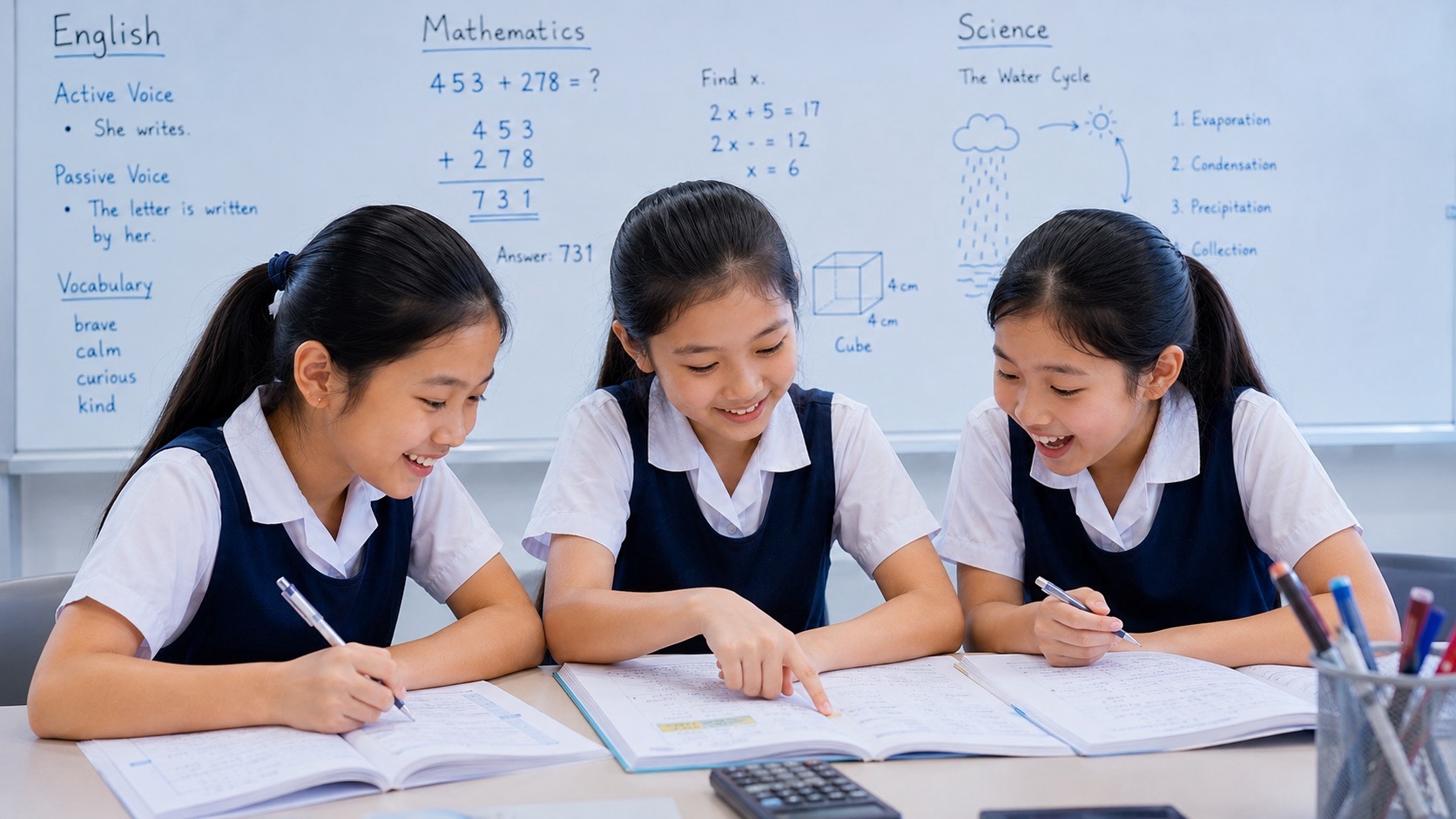
Awesome Schools in Toa Payoh is a town-level education field guide to the current MOE Primary, Secondary and Junior College ecosystem across the wider Toa Payoh planning area. It is not a ranking. The goal is to make a dense, historically rich and geographically surprising school field understandable: which institutions are actually here, what each one foregrounds, how those identities connect to English, Mathematics, Science, PSLE, SEC, IP, JC, CCAs, sport and the arts, and what families should investigate before making their own choice.
The current field used here contains seven Primary schools—CHIJ Primary (Toa Payoh), First Toa Payoh Primary, Kheng Cheng School, Pei Chun Public School, Cedar Primary School, Maris Stella High School (Primary) and St Andrew’s School (Junior)—seven Secondary schools—Bartley, Beatty, Cedar Girls’, CHIJ Secondary (Toa Payoh), Maris Stella High, Raffles Girls’ School and St Andrew’s Secondary—and one Junior College, St Andrew’s Junior College.
Toa Payoh is especially interesting because its education field extends beyond the mental image of Toa Payoh Central and the classic HDB estate. The planning-area field reaches into Braddell, Cedar/Bidadari, Bartley, Mount Vernon and the St Andrew’s Village/Potong Pasir side. That is why current school location must matter more than a casual neighbourhood label.
The field contains several major pathway types at once: mainstream Primary and Secondary education, SAP Primary and Secondary routes through Maris Stella, IP routes through Cedar Girls’ and Raffles Girls’, specialised Art and Music or Regional Studies pathways, and a current A-Level route through St Andrew’s Junior College. International schools are excluded, and IB/IGCSE are not imported into the town merely for keyword coverage.
For the wider eduKate graph, connect this page to History of Singapore | Toa Payoh, Why Singaporeans Love Toa Payoh, Fun facts about Singapore | Toa Payoh, Things to do in Singapore | Toa Payoh, Education Hub, English Learning Hub, Mathematics Learning Hub, Science Learning Hub, From PSLE to SEC, Singapore Secondary School Directory, What is so Awesome About St Andrew’s Junior College | 2026-2027 Edition and Tutors and Tuition in Toa Payoh. The town field supplies the map; the deeper nodes own subjects, pathways, history and intervention.
Why Toa Payoh’s school field is unusually important
Toa Payoh is one of Singapore’s classic planned towns, so education and urban development are historically intertwined here. Schools were not simply added after housing; they became part of how the new town created community, identity and opportunity. First Toa Payoh Primary’s history alone captures that story through its own founding and later mergers.
The field is institutionally diverse. CHIJ carries a long Catholic girls’ education tradition. St Andrew’s carries an Anglican boys’ school tradition from Junior to Secondary and JC. Maris Stella carries a Marist and SAP tradition from Primary into Secondary. Pei Chun and Kheng Cheng add Chinese community-school heritage. Cedar, RGS, Beatty and Bartley add very different government-school identities.
Toa Payoh also contains more advanced and specialised pathways than many town fields. Cedar Girls’ and RGS provide current IP routes. CHIJ Secondary has AEP. RGS has MEP and Regional Studies. Maris Stella has Chinese Language Elective depth. St Andrew’s Secondary combines engineering with Enhanced Art and sport. SAJC completes the local ladder at pre-university level.
This diversity makes the town a strong example of why one ranking cannot describe a school field. Different institutions are optimising for different combinations of route, culture, subject depth, programme identity and co-curricular opportunity. The family’s job is to decide which combination matters for the learner in front of them.
The same field reveals why current information matters. Maris Stella is entering a major rebuilding and Primary co-education transition from 2027. A trustworthy 2026 article should explain that future change without pretending it has already happened.
The wider lesson is that a mature education ecosystem contains both continuity and change. Heritage can persist while programmes evolve. A school can preserve values and identity while adopting coding, sustainability, research or new co-educational structures. That is what makes the field dynamic rather than merely old.
All 15 current MOE Primary, Secondary and JC institutions in Toa Payoh
| School | Level | Distinctive learning lens |
|---|---|---|
| CHIJ Primary (Toa Payoh) | Primary | Catholic girls’ education with confident English communication, wide reading, progressive PE and a broad CCA framework; current English work uses STELLAR, Reading@IJ, oral interaction and enrichment to develop effective readers, writers and speakers; the school’s CCA framework develops character, confidence and capacity through sports, arts, Brownies, environmental and technology groups |
| First Toa Payoh Primary School | Primary | photojournalism, outdoor experiential learning and hands-on making; Literacy Through Photojournalism develops language, visual and global understanding through photography and writing; the LLP develops resilience and life skills through outdoor learning; Tinkerlution adds making, creativity and problem solving |
| Kheng Cheng School | Primary | heritage, sustainability through STEM and student advocacy; its sustainability Applied Learning Programme develops informed and active citizens through Science, Technology, Engineering and Mathematics, coding and problem-based learning around global challenges |
| Pei Chun Public School | Primary | bilingual media studies paired with values-centred student leadership; its Bilingual Media Studies Applied Learning Programme develops confident communicators through real-world language use, coding and journalism training, while its LLP develops self, social and thought leadership guided by values from the Great Learning |
| Cedar Primary School | Primary | holistic education with strong subject foundations, positive discipline, digital responsibility and active learning; the current school framework emphasises confident English communication, hands-on Mathematics, curiosity-driven Science, Mother Tongue culture, Character and Citizenship Education, PAL, arts, music, PE and responsible ICT use |
| Maris Stella High School (Primary) | Primary | Marist and SAP education with bilingual culture, Science inquiry, sustainability and a major 2027 transition; the Primary Science programme includes inquiry, experimentation, STEM challenges and MAPLES eco-stewardship across P1 to P6; the wider Marist framework integrates values, bilingual learning, innovation and service |
| St. Andrew’s School (Junior) | Primary | Anglican boys’ education built around all-round development, bilingualism, character, fitness and the Saint’s tradition; the school philosophy combines spiritual, academic, moral, social, physical and aesthetic development, with strong language competence, numeracy, PE, curriculum programmes, CCAs, learning journeys, camps and enrichment |
| Bartley Secondary School | Secondary | chemical and applied sciences through fragrance paired with community leadership; the Applied Learning Programme uses Chemical and Applied Sciences in a fragrance context while i-LEAD @ Bartley develops students as Leaders for Others |
| Beatty Secondary School | Secondary | programming for smart living paired with whole-school leadership; Beattyians Think.Create.Innovate develops programming for smart living in a Cities and Urban Landscapes STEM context while Beatty’s Leaders for Life Programme develops community youth leadership |
| Cedar Girls’ Secondary School | Secondary | Integrated Programme and autonomous girls’ education with regional studies and broad leadership, arts, STEM and global opportunities; the current MOE directory records the Integrated Programme, Regional Studies Programme and autonomous status alongside a wide academic and co-curricular field |
| CHIJ Secondary (Toa Payoh) | Secondary | autonomous Catholic girls’ education with a formal Art Elective Programme and broad arts, leadership and co-curricular depth; the current MOE directory records autonomous status and the Art Elective Programme together with extensive arts, sport, service, technology and leadership opportunities |
| Maris Stella High School | Secondary | autonomous SAP boys’ education with Chinese Language depth, Marist values and a major rebuilding transition; the current MOE directory records SAP and autonomous status and the Chinese Language Elective Programme; the wider programme integrates bilingual learning, values, academic stretch and cultural identity |
| Raffles Girls’ School (Secondary) | Secondary | Integrated Programme girls’ education with Music Elective and Regional Studies pathways, broad academic depth and extensive co-curricular opportunity; the current MOE directory records the Integrated Programme, Music Elective Programme and Regional Studies Programme alongside a very broad co-curricular field spanning arts, languages, STEM, sport, leadership and service |
| St Andrew’s School (Secondary) | Secondary | engineering design, Enhanced Art and Sports for Life inside the St Andrew’s boys’ school tradition; the Saints Engineering Design Programme develops STEM learning in the Future of Transportation domain, the school offers the Enhanced Art Programme, and Sports for Life uses sport and outdoor education for character development |
| St Andrew’s Junior College | JC | A-Level pre-university education built around servant leadership, academic depth, CCA participation and the wider Saints community; the college’s 2026 site emphasises curriculum, CCA, admissions and the Saints Experience within a clear servant-leadership identity; students prepare for A-Level study while developing through leadership, service, sport, arts and college life |
Use this table as orientation rather than a verdict. Programmes, CCAs, subject combinations, holding campuses and admissions details can change. Live decisions should return to MOE SchoolFinder, the school’s official site, the current MOE Primary 1 registration portal for Primary registration and current MOE or SEAB pathway information for later stages.
Toa Payoh as a learning landscape
The History of Singapore | Toa Payoh gives this school field essential depth. Toa Payoh was one of Singapore’s early major HDB new towns, and its development became a national story about housing, transport, schools and community infrastructure. Students who learn the town’s history can see how education institutions were part of nation-building rather than isolated campuses.
The modern field is geographically broader than the everyday use of the name Toa Payoh. Braddell, Cedar/Bidadari, Bartley, Mount Vernon and Potong Pasir/St Andrew’s Village all contribute schools to the current planning-area education map. That wider frame explains why some institutions may surprise readers who think only in MRT-station labels.
Transport is part of education infrastructure. A student may use Toa Payoh, Braddell, Potong Pasir, Woodleigh, Bartley or nearby bus corridors depending on the school. The actual door-to-door journey matters because it repeats hundreds of times and competes with sleep, CCA, homework and family time.
Mature-town public spaces also extend the classroom. Libraries, sports facilities, neighbourhood centres, heritage sites, markets and parks can become contexts for reading, interview, observation, measurement, photography and civic learning. Things to do in Singapore | Toa Payoh becomes educational when a family asks what can be noticed, compared or explained there.
The planning area reveals how old and new coexist. Historic schools sit near Bidadari’s newer housing, modern transport and changing urban landscapes. Students can observe that institutions do not need to discard history in order to adapt to new needs.
That is why the field article belongs beside Why Singaporeans Love Toa Payoh and Fun facts about Singapore | Toa Payoh. One explains lived attachment, another gives accessible local knowledge, and this page explains how schools help reproduce capability and community across generations.
A town field is also useful because it puts time back into school choice. Families are not choosing a campus for one open-house morning. They are choosing hundreds of mornings, CCA afternoons, homework evenings and transition points. Geography becomes educational when repeated time costs are made visible.
Toa Payoh is a particularly strong example of educational density. Schools with very different histories and missions operate within a relatively connected central area. That density gives families many possibilities, but it also makes precise comparison more important because reputation shortcuts can easily replace careful reading.
1. CHIJ Primary (Toa Payoh)
CHIJ Primary (Toa Payoh) contributes Catholic girls’ education with confident English communication, wide reading, progressive PE and a broad CCA framework to the Toa Payoh education field. the school carries the long IJ girls’ education tradition into the heart of Toa Payoh and combines faith, literacy, leadership and broad co-curricular development The useful way to read the institution is through the repeated learning experiences it creates rather than a single reputation signal.
current English work uses STELLAR, Reading@IJ, oral interaction and enrichment to develop effective readers, writers and speakers; the school’s CCA framework develops character, confidence and capacity through sports, arts, Brownies, environmental and technology groups. A strong distinctive programme should show progression: younger students begin with guided exposure, older students use stronger subject knowledge and independent judgement, and feedback changes the next attempt. Families can ask what students actually do, how often and how the challenge grows.
Language and communication are especially visible in the institution’s identity. Students need to read accurately, organise ideas, explain choices, adapt to audiences and respond to feedback. In bilingual or culturally distinctive settings, they also learn to shift context without losing precision. The deeper national English pathway sits in the English Learning Hub. Families can look beyond formal English lessons and ask where else students must communicate accurately for a real purpose.
Mathematics remains a common academic foundation even when the institution’s distinctive identity sits elsewhere. Number, data, comparison, formal reasoning and eventually algebra support many different subject pathways. The Mathematics Learning Hub explains the longer progression from Primary number and models into Secondary algebra and advanced Mathematics. Applied work has depth when students can move between situation, representation and notation with accuracy.
Science contributes a disciplined evidence habit even when the school’s main identity is language, arts or leadership. Students learn to distinguish observation from explanation, interpret data and revise conclusions when evidence changes. The Science Learning Hub provides the deeper Science progression. Toa Payoh’s sustainability, engineering, programming and research contexts provide many opportunities for scientific reasoning to become useful knowledge.
The co-curricular field—art, gymnastics, athletics, Brownies, choir, cultural dance, Green Pixel Club, handbells, chess, dance, netball, tech/media, tennis and theatre—adds long-horizon practice. Students train, rehearse, build, perform, compete, lead and serve across months or years. Improvement becomes experiential: identify the weak component, practise deliberately, receive feedback and reintegrate the stronger component.
As a Primary school, CHIJ Primary (Toa Payoh) sits inside a six-year developmental runway from foundational literacy and numeracy to upper-Primary independence and PSLE readiness. Lower Primary builds reading, number sense and routines; middle Primary adds formal Science and more inference; upper Primary increases retrieval, method selection and checking under pressure.
PSLE should be treated as the end of a six-year runway rather than the purpose of the entire runway. Strong preparation combines reading, vocabulary, number sense, Science concepts, mixed retrieval, timing, checking and increasing independence.
Transfer is another useful lens. Does a communication habit improve Science explanation? Does a checking habit from Mathematics improve programming? Does resilience from sport improve revision? Does artistic critique improve willingness to redraft writing? Transfer should not be assumed, but reflection can make it visible.
Independence matters equally. Strong schooling gradually reduces the amount of adult control needed for familiar work. Students should become better at starting, planning, checking, asking precise questions and recovering after mistakes. Support is successful when the learner can eventually carry more of the process.
Family logistics deserve seriousness. Test the real route, school hours, CCA return time, student-care needs where relevant, meals, homework and sleep. The wider Toa Payoh planning area covers several transport nodes, so the town label alone does not predict the weekly load.
Belonging is educational. A learner should be able to imagine at least one plausible community inside CHIJ Primary (Toa Payoh): a class, CCA, team, ensemble, club, service role, research group or programme. Belonging does not remove challenge; it often makes students more willing to persist through challenge.
Evidence categories should remain separate. P1 demand describes applicant pressure, not teaching quality. Historical Secondary posting ranges help build a realistic choice list, not measure culture. Awards demonstrate achievement, not every student’s daily experience. Programme descriptions reveal intent, but current implementation deserves direct checking.
Useful parent questions are concrete: how does Catholic girls’ education with confident English communication, wide reading, progressive PE and a broad CCA framework progress by level; what are current academic and CCA commitments; how are weak foundations supported; how are stronger learners stretched; what subject choices or specialised routes appear later; and how does the institution deliberately develop agency?
Future-readiness should be interpreted carefully. Technologies, subjects and labour markets will change. Durable capabilities travel: accurate reading, mathematical representation, evidence-based reasoning, clear explanation, collaboration, revision and responsibility. CHIJ Primary (Toa Payoh) is worth understanding partly through how its identity provides repeated practice for those capacities.
Finally, use live official sources. Programmes, campuses, subject offerings and policies can change. MOE SchoolFinder, the school’s official website and current MOE or SEAB information should control the operational decision. This field guide helps families understand what to look for; it does not replace their judgement.
One further question is worth asking: what would make a student at CHIJ Primary (Toa Payoh) meaningfully more capable after four or six years than when they entered? The strongest answer should include not only examination knowledge but also better self-management, clearer communication, stronger reasoning and a more realistic understanding of how effort becomes expertise.
2. First Toa Payoh Primary School
First Toa Payoh Primary School contributes photojournalism, outdoor experiential learning and hands-on making to the Toa Payoh education field. founded in 1968 and later shaped by the merger with Braddell, San Shan and Westlake Primary Schools, making it one of Toa Payoh’s clearest education-history institutions The useful way to read the institution is through the repeated learning experiences it creates rather than a single reputation signal.
Literacy Through Photojournalism develops language, visual and global understanding through photography and writing; the LLP develops resilience and life skills through outdoor learning; Tinkerlution adds making, creativity and problem solving. A strong distinctive programme should show progression: younger students begin with guided exposure, older students use stronger subject knowledge and independent judgement, and feedback changes the next attempt. Families can ask what students actually do, how often and how the challenge grows.
Language and communication are especially visible in the institution’s identity. Students need to read accurately, organise ideas, explain choices, adapt to audiences and respond to feedback. In bilingual or culturally distinctive settings, they also learn to shift context without losing precision. The deeper national English pathway sits in the English Learning Hub. Families can look beyond formal English lessons and ask where else students must communicate accurately for a real purpose.
Mathematics remains a common academic foundation even when the institution’s distinctive identity sits elsewhere. Number, data, comparison, formal reasoning and eventually algebra support many different subject pathways. The Mathematics Learning Hub explains the longer progression from Primary number and models into Secondary algebra and advanced Mathematics. Applied work has depth when students can move between situation, representation and notation with accuracy.
Science contributes a disciplined evidence habit even when the school’s main identity is language, arts or leadership. Students learn to distinguish observation from explanation, interpret data and revise conclusions when evidence changes. The Science Learning Hub provides the deeper Science progression. Toa Payoh’s sustainability, engineering, programming and research contexts provide many opportunities for scientific reasoning to become useful knowledge.
The co-curricular field—photography, robotics, art, football, basketball, uniformed groups, choir, dance, environmental science and PAL—adds long-horizon practice. Students train, rehearse, build, perform, compete, lead and serve across months or years. Improvement becomes experiential: identify the weak component, practise deliberately, receive feedback and reintegrate the stronger component.
As a Primary school, First Toa Payoh Primary School sits inside a six-year developmental runway from foundational literacy and numeracy to upper-Primary independence and PSLE readiness. Lower Primary builds reading, number sense and routines; middle Primary adds formal Science and more inference; upper Primary increases retrieval, method selection and checking under pressure.
PSLE should be treated as the end of a six-year runway rather than the purpose of the entire runway. Strong preparation combines reading, vocabulary, number sense, Science concepts, mixed retrieval, timing, checking and increasing independence.
Transfer is another useful lens. Does a communication habit improve Science explanation? Does a checking habit from Mathematics improve programming? Does resilience from sport improve revision? Does artistic critique improve willingness to redraft writing? Transfer should not be assumed, but reflection can make it visible.
Independence matters equally. Strong schooling gradually reduces the amount of adult control needed for familiar work. Students should become better at starting, planning, checking, asking precise questions and recovering after mistakes. Support is successful when the learner can eventually carry more of the process.
Family logistics deserve seriousness. Test the real route, school hours, CCA return time, student-care needs where relevant, meals, homework and sleep. The wider Toa Payoh planning area covers several transport nodes, so the town label alone does not predict the weekly load.
Belonging is educational. A learner should be able to imagine at least one plausible community inside First Toa Payoh Primary School: a class, CCA, team, ensemble, club, service role, research group or programme. Belonging does not remove challenge; it often makes students more willing to persist through challenge.
Evidence categories should remain separate. P1 demand describes applicant pressure, not teaching quality. Historical Secondary posting ranges help build a realistic choice list, not measure culture. Awards demonstrate achievement, not every student’s daily experience. Programme descriptions reveal intent, but current implementation deserves direct checking.
Useful parent questions are concrete: how does photojournalism, outdoor experiential learning and hands-on making progress by level; what are current academic and CCA commitments; how are weak foundations supported; how are stronger learners stretched; what subject choices or specialised routes appear later; and how does the institution deliberately develop agency?
Future-readiness should be interpreted carefully. Technologies, subjects and labour markets will change. Durable capabilities travel: accurate reading, mathematical representation, evidence-based reasoning, clear explanation, collaboration, revision and responsibility. First Toa Payoh Primary School is worth understanding partly through how its identity provides repeated practice for those capacities.
Finally, use live official sources. Programmes, campuses, subject offerings and policies can change. MOE SchoolFinder, the school’s official website and current MOE or SEAB information should control the operational decision. This field guide helps families understand what to look for; it does not replace their judgement.
One further question is worth asking: what would make a student at First Toa Payoh Primary School meaningfully more capable after four or six years than when they entered? The strongest answer should include not only examination knowledge but also better self-management, clearer communication, stronger reasoning and a more realistic understanding of how effort becomes expertise.
3. Kheng Cheng School
Kheng Cheng School contributes heritage, sustainability through STEM and student advocacy to the Toa Payoh education field. Kheng Cheng marked its 99th Founder’s Day in 2026 and approaches its centenary with a strong sense of heritage and community continuity The useful way to read the institution is through the repeated learning experiences it creates rather than a single reputation signal.
its sustainability Applied Learning Programme develops informed and active citizens through Science, Technology, Engineering and Mathematics, coding and problem-based learning around global challenges. A strong distinctive programme should show progression: younger students begin with guided exposure, older students use stronger subject knowledge and independent judgement, and feedback changes the next attempt. Families can ask what students actually do, how often and how the challenge grows.
Even when the headline identity is engineering, art, sport or Science, English remains the transmission layer. Students interpret instructions, explain observations, justify decisions, collaborate and reflect through language. The deeper national English pathway sits in the English Learning Hub. Families can look beyond formal English lessons and ask where else students must communicate accurately for a real purpose.
The programme creates natural mathematical situations involving measurement, data, ratio, variable, pattern, geometry, scale or optimisation. Applied learning is strongest when students use formal Mathematics because the problem actually requires it. The Mathematics Learning Hub explains the longer progression from Primary number and models into Secondary algebra and advanced Mathematics. Applied work has depth when students can move between situation, representation and notation with accuracy.
Science connects directly to the distinctive context through observation, mechanisms, variables, evidence, testing and design. Authentic contexts are strongest when they deepen explicit subject knowledge rather than replace it with activity. The Science Learning Hub provides the deeper Science progression. Toa Payoh’s sustainability, engineering, programming and research contexts provide many opportunities for scientific reasoning to become useful knowledge.
The co-curricular field—sports, arts, uniformed groups, clubs, environmental and STEM activities, leadership and service—adds long-horizon practice. Students train, rehearse, build, perform, compete, lead and serve across months or years. Improvement becomes experiential: identify the weak component, practise deliberately, receive feedback and reintegrate the stronger component.
As a Primary school, Kheng Cheng School sits inside a six-year developmental runway from foundational literacy and numeracy to upper-Primary independence and PSLE readiness. Lower Primary builds reading, number sense and routines; middle Primary adds formal Science and more inference; upper Primary increases retrieval, method selection and checking under pressure.
PSLE should be treated as the end of a six-year runway rather than the purpose of the entire runway. Strong preparation combines reading, vocabulary, number sense, Science concepts, mixed retrieval, timing, checking and increasing independence.
Transfer is another useful lens. Does a communication habit improve Science explanation? Does a checking habit from Mathematics improve programming? Does resilience from sport improve revision? Does artistic critique improve willingness to redraft writing? Transfer should not be assumed, but reflection can make it visible.
Independence matters equally. Strong schooling gradually reduces the amount of adult control needed for familiar work. Students should become better at starting, planning, checking, asking precise questions and recovering after mistakes. Support is successful when the learner can eventually carry more of the process.
Family logistics deserve seriousness. Test the real route, school hours, CCA return time, student-care needs where relevant, meals, homework and sleep. The wider Toa Payoh planning area covers several transport nodes, so the town label alone does not predict the weekly load.
Belonging is educational. A learner should be able to imagine at least one plausible community inside Kheng Cheng School: a class, CCA, team, ensemble, club, service role, research group or programme. Belonging does not remove challenge; it often makes students more willing to persist through challenge.
Evidence categories should remain separate. P1 demand describes applicant pressure, not teaching quality. Historical Secondary posting ranges help build a realistic choice list, not measure culture. Awards demonstrate achievement, not every student’s daily experience. Programme descriptions reveal intent, but current implementation deserves direct checking.
Useful parent questions are concrete: how does heritage, sustainability through STEM and student advocacy progress by level; what are current academic and CCA commitments; how are weak foundations supported; how are stronger learners stretched; what subject choices or specialised routes appear later; and how does the institution deliberately develop agency?
Future-readiness should be interpreted carefully. Technologies, subjects and labour markets will change. Durable capabilities travel: accurate reading, mathematical representation, evidence-based reasoning, clear explanation, collaboration, revision and responsibility. Kheng Cheng School is worth understanding partly through how its identity provides repeated practice for those capacities.
Finally, use live official sources. Programmes, campuses, subject offerings and policies can change. MOE SchoolFinder, the school’s official website and current MOE or SEAB information should control the operational decision. This field guide helps families understand what to look for; it does not replace their judgement.
One further question is worth asking: what would make a student at Kheng Cheng School meaningfully more capable after four or six years than when they entered? The strongest answer should include not only examination knowledge but also better self-management, clearer communication, stronger reasoning and a more realistic understanding of how effort becomes expertise.
4. Pei Chun Public School
Pei Chun Public School contributes bilingual media studies paired with values-centred student leadership to the Toa Payoh education field. Pei Chun’s Chinese educational heritage gives Toa Payoh a strong bilingual and cultural dimension alongside modern media and leadership programmes The useful way to read the institution is through the repeated learning experiences it creates rather than a single reputation signal.
its Bilingual Media Studies Applied Learning Programme develops confident communicators through real-world language use, coding and journalism training, while its LLP develops self, social and thought leadership guided by values from the Great Learning. A strong distinctive programme should show progression: younger students begin with guided exposure, older students use stronger subject knowledge and independent judgement, and feedback changes the next attempt. Families can ask what students actually do, how often and how the challenge grows.
Language and communication are especially visible in the institution’s identity. Students need to read accurately, organise ideas, explain choices, adapt to audiences and respond to feedback. In bilingual or culturally distinctive settings, they also learn to shift context without losing precision. The deeper national English pathway sits in the English Learning Hub. Families can look beyond formal English lessons and ask where else students must communicate accurately for a real purpose.
Mathematics remains a common academic foundation even when the institution’s distinctive identity sits elsewhere. Number, data, comparison, formal reasoning and eventually algebra support many different subject pathways. The Mathematics Learning Hub explains the longer progression from Primary number and models into Secondary algebra and advanced Mathematics. Applied work has depth when students can move between situation, representation and notation with accuracy.
Science contributes a disciplined evidence habit even when the school’s main identity is language, arts or leadership. Students learn to distinguish observation from explanation, interpret data and revise conclusions when evidence changes. The Science Learning Hub provides the deeper Science progression. Toa Payoh’s sustainability, engineering, programming and research contexts provide many opportunities for scientific reasoning to become useful knowledge.
The co-curricular field—sports, cultural activities, performing arts, clubs, leadership and a broad CCA sampling process—adds long-horizon practice. Students train, rehearse, build, perform, compete, lead and serve across months or years. Improvement becomes experiential: identify the weak component, practise deliberately, receive feedback and reintegrate the stronger component.
As a Primary school, Pei Chun Public School sits inside a six-year developmental runway from foundational literacy and numeracy to upper-Primary independence and PSLE readiness. Lower Primary builds reading, number sense and routines; middle Primary adds formal Science and more inference; upper Primary increases retrieval, method selection and checking under pressure.
PSLE should be treated as the end of a six-year runway rather than the purpose of the entire runway. Strong preparation combines reading, vocabulary, number sense, Science concepts, mixed retrieval, timing, checking and increasing independence.
Transfer is another useful lens. Does a communication habit improve Science explanation? Does a checking habit from Mathematics improve programming? Does resilience from sport improve revision? Does artistic critique improve willingness to redraft writing? Transfer should not be assumed, but reflection can make it visible.
Independence matters equally. Strong schooling gradually reduces the amount of adult control needed for familiar work. Students should become better at starting, planning, checking, asking precise questions and recovering after mistakes. Support is successful when the learner can eventually carry more of the process.
Family logistics deserve seriousness. Test the real route, school hours, CCA return time, student-care needs where relevant, meals, homework and sleep. The wider Toa Payoh planning area covers several transport nodes, so the town label alone does not predict the weekly load.
Belonging is educational. A learner should be able to imagine at least one plausible community inside Pei Chun Public School: a class, CCA, team, ensemble, club, service role, research group or programme. Belonging does not remove challenge; it often makes students more willing to persist through challenge.
Evidence categories should remain separate. P1 demand describes applicant pressure, not teaching quality. Historical Secondary posting ranges help build a realistic choice list, not measure culture. Awards demonstrate achievement, not every student’s daily experience. Programme descriptions reveal intent, but current implementation deserves direct checking.
Useful parent questions are concrete: how does bilingual media studies paired with values-centred student leadership progress by level; what are current academic and CCA commitments; how are weak foundations supported; how are stronger learners stretched; what subject choices or specialised routes appear later; and how does the institution deliberately develop agency?
Future-readiness should be interpreted carefully. Technologies, subjects and labour markets will change. Durable capabilities travel: accurate reading, mathematical representation, evidence-based reasoning, clear explanation, collaboration, revision and responsibility. Pei Chun Public School is worth understanding partly through how its identity provides repeated practice for those capacities.
Finally, use live official sources. Programmes, campuses, subject offerings and policies can change. MOE SchoolFinder, the school’s official website and current MOE or SEAB information should control the operational decision. This field guide helps families understand what to look for; it does not replace their judgement.
One further question is worth asking: what would make a student at Pei Chun Public School meaningfully more capable after four or six years than when they entered? The strongest answer should include not only examination knowledge but also better self-management, clearer communication, stronger reasoning and a more realistic understanding of how effort becomes expertise.
5. Cedar Primary School
Cedar Primary School contributes holistic education with strong subject foundations, positive discipline, digital responsibility and active learning to the Toa Payoh education field. Cedar Primary serves the Cedar and Bidadari side of the wider Toa Payoh planning field and combines a mature identity with current emphasis on wellbeing, creativity and connected community The useful way to read the institution is through the repeated learning experiences it creates rather than a single reputation signal.
the current school framework emphasises confident English communication, hands-on Mathematics, curiosity-driven Science, Mother Tongue culture, Character and Citizenship Education, PAL, arts, music, PE and responsible ICT use. A strong distinctive programme should show progression: younger students begin with guided exposure, older students use stronger subject knowledge and independent judgement, and feedback changes the next attempt. Families can ask what students actually do, how often and how the challenge grows.
Even when the headline identity is engineering, art, sport or Science, English remains the transmission layer. Students interpret instructions, explain observations, justify decisions, collaborate and reflect through language. The deeper national English pathway sits in the English Learning Hub. Families can look beyond formal English lessons and ask where else students must communicate accurately for a real purpose.
Mathematics remains a common academic foundation even when the institution’s distinctive identity sits elsewhere. Number, data, comparison, formal reasoning and eventually algebra support many different subject pathways. The Mathematics Learning Hub explains the longer progression from Primary number and models into Secondary algebra and advanced Mathematics. Applied work has depth when students can move between situation, representation and notation with accuracy.
Science contributes a disciplined evidence habit even when the school’s main identity is language, arts or leadership. Students learn to distinguish observation from explanation, interpret data and revise conclusions when evidence changes. The Science Learning Hub provides the deeper Science progression. Toa Payoh’s sustainability, engineering, programming and research contexts provide many opportunities for scientific reasoning to become useful knowledge.
The co-curricular field—sports, arts, uniformed groups, clubs, leadership and PAL—adds long-horizon practice. Students train, rehearse, build, perform, compete, lead and serve across months or years. Improvement becomes experiential: identify the weak component, practise deliberately, receive feedback and reintegrate the stronger component.
As a Primary school, Cedar Primary School sits inside a six-year developmental runway from foundational literacy and numeracy to upper-Primary independence and PSLE readiness. Lower Primary builds reading, number sense and routines; middle Primary adds formal Science and more inference; upper Primary increases retrieval, method selection and checking under pressure.
PSLE should be treated as the end of a six-year runway rather than the purpose of the entire runway. Strong preparation combines reading, vocabulary, number sense, Science concepts, mixed retrieval, timing, checking and increasing independence.
Transfer is another useful lens. Does a communication habit improve Science explanation? Does a checking habit from Mathematics improve programming? Does resilience from sport improve revision? Does artistic critique improve willingness to redraft writing? Transfer should not be assumed, but reflection can make it visible.
Independence matters equally. Strong schooling gradually reduces the amount of adult control needed for familiar work. Students should become better at starting, planning, checking, asking precise questions and recovering after mistakes. Support is successful when the learner can eventually carry more of the process.
Family logistics deserve seriousness. Test the real route, school hours, CCA return time, student-care needs where relevant, meals, homework and sleep. The wider Toa Payoh planning area covers several transport nodes, so the town label alone does not predict the weekly load.
Belonging is educational. A learner should be able to imagine at least one plausible community inside Cedar Primary School: a class, CCA, team, ensemble, club, service role, research group or programme. Belonging does not remove challenge; it often makes students more willing to persist through challenge.
Evidence categories should remain separate. P1 demand describes applicant pressure, not teaching quality. Historical Secondary posting ranges help build a realistic choice list, not measure culture. Awards demonstrate achievement, not every student’s daily experience. Programme descriptions reveal intent, but current implementation deserves direct checking.
Useful parent questions are concrete: how does holistic education with strong subject foundations, positive discipline, digital responsibility and active learning progress by level; what are current academic and CCA commitments; how are weak foundations supported; how are stronger learners stretched; what subject choices or specialised routes appear later; and how does the institution deliberately develop agency?
Future-readiness should be interpreted carefully. Technologies, subjects and labour markets will change. Durable capabilities travel: accurate reading, mathematical representation, evidence-based reasoning, clear explanation, collaboration, revision and responsibility. Cedar Primary School is worth understanding partly through how its identity provides repeated practice for those capacities.
Finally, use live official sources. Programmes, campuses, subject offerings and policies can change. MOE SchoolFinder, the school’s official website and current MOE or SEAB information should control the operational decision. This field guide helps families understand what to look for; it does not replace their judgement.
One further question is worth asking: what would make a student at Cedar Primary School meaningfully more capable after four or six years than when they entered? The strongest answer should include not only examination knowledge but also better self-management, clearer communication, stronger reasoning and a more realistic understanding of how effort becomes expertise.
6. Maris Stella High School (Primary)
Maris Stella High School (Primary) contributes Marist and SAP education with bilingual culture, Science inquiry, sustainability and a major 2027 transition to the Toa Payoh education field. founded in 1958; in 2026 the Primary section remains a SAP boys’ school, but from 2027 it becomes co-educational and moves to a holding site during the 2027–2029 rebuilding period The useful way to read the institution is through the repeated learning experiences it creates rather than a single reputation signal.
the Primary Science programme includes inquiry, experimentation, STEM challenges and MAPLES eco-stewardship across P1 to P6; the wider Marist framework integrates values, bilingual learning, innovation and service. A strong distinctive programme should show progression: younger students begin with guided exposure, older students use stronger subject knowledge and independent judgement, and feedback changes the next attempt. Families can ask what students actually do, how often and how the challenge grows.
Language and communication are especially visible in the institution’s identity. Students need to read accurately, organise ideas, explain choices, adapt to audiences and respond to feedback. In bilingual or culturally distinctive settings, they also learn to shift context without losing precision. The deeper national English pathway sits in the English Learning Hub. Families can look beyond formal English lessons and ask where else students must communicate accurately for a real purpose.
The programme creates natural mathematical situations involving measurement, data, ratio, variable, pattern, geometry, scale or optimisation. Applied learning is strongest when students use formal Mathematics because the problem actually requires it. The Mathematics Learning Hub explains the longer progression from Primary number and models into Secondary algebra and advanced Mathematics. Applied work has depth when students can move between situation, representation and notation with accuracy.
Science connects directly to the distinctive context through observation, mechanisms, variables, evidence, testing and design. Authentic contexts are strongest when they deepen explicit subject knowledge rather than replace it with activity. The Science Learning Hub provides the deeper Science progression. Toa Payoh’s sustainability, engineering, programming and research contexts provide many opportunities for scientific reasoning to become useful knowledge.
The co-curricular field—Science and Eco-STEM, Chinese cultural activities, arts, sports, clubs, service and leadership—adds long-horizon practice. Students train, rehearse, build, perform, compete, lead and serve across months or years. Improvement becomes experiential: identify the weak component, practise deliberately, receive feedback and reintegrate the stronger component.
As a Primary school, Maris Stella High School (Primary) sits inside a six-year developmental runway from foundational literacy and numeracy to upper-Primary independence and PSLE readiness. Lower Primary builds reading, number sense and routines; middle Primary adds formal Science and more inference; upper Primary increases retrieval, method selection and checking under pressure.
PSLE should be treated as the end of a six-year runway rather than the purpose of the entire runway. Strong preparation combines reading, vocabulary, number sense, Science concepts, mixed retrieval, timing, checking and increasing independence.
Transfer is another useful lens. Does a communication habit improve Science explanation? Does a checking habit from Mathematics improve programming? Does resilience from sport improve revision? Does artistic critique improve willingness to redraft writing? Transfer should not be assumed, but reflection can make it visible.
Independence matters equally. Strong schooling gradually reduces the amount of adult control needed for familiar work. Students should become better at starting, planning, checking, asking precise questions and recovering after mistakes. Support is successful when the learner can eventually carry more of the process.
Family logistics deserve seriousness. Test the real route, school hours, CCA return time, student-care needs where relevant, meals, homework and sleep. The wider Toa Payoh planning area covers several transport nodes, so the town label alone does not predict the weekly load.
Belonging is educational. A learner should be able to imagine at least one plausible community inside Maris Stella High School (Primary): a class, CCA, team, ensemble, club, service role, research group or programme. Belonging does not remove challenge; it often makes students more willing to persist through challenge.
Evidence categories should remain separate. P1 demand describes applicant pressure, not teaching quality. Historical Secondary posting ranges help build a realistic choice list, not measure culture. Awards demonstrate achievement, not every student’s daily experience. Programme descriptions reveal intent, but current implementation deserves direct checking.
Useful parent questions are concrete: how does Marist and SAP education with bilingual culture, Science inquiry, sustainability and a major 2027 transition progress by level; what are current academic and CCA commitments; how are weak foundations supported; how are stronger learners stretched; what subject choices or specialised routes appear later; and how does the institution deliberately develop agency?
Future-readiness should be interpreted carefully. Technologies, subjects and labour markets will change. Durable capabilities travel: accurate reading, mathematical representation, evidence-based reasoning, clear explanation, collaboration, revision and responsibility. Maris Stella High School (Primary) is worth understanding partly through how its identity provides repeated practice for those capacities.
Finally, use live official sources. Programmes, campuses, subject offerings and policies can change. MOE SchoolFinder, the school’s official website and current MOE or SEAB information should control the operational decision. This field guide helps families understand what to look for; it does not replace their judgement.
One further question is worth asking: what would make a student at Maris Stella High School (Primary) meaningfully more capable after four or six years than when they entered? The strongest answer should include not only examination knowledge but also better self-management, clearer communication, stronger reasoning and a more realistic understanding of how effort becomes expertise.
7. St. Andrew’s School (Junior)
St. Andrew’s School (Junior) contributes Anglican boys’ education built around all-round development, bilingualism, character, fitness and the Saint’s tradition to the Toa Payoh education field. St Andrew’s Junior is part of the wider St Andrew’s Village tradition and provides a boys’ primary pathway connected culturally to St Andrew’s Secondary and Junior College The useful way to read the institution is through the repeated learning experiences it creates rather than a single reputation signal.
the school philosophy combines spiritual, academic, moral, social, physical and aesthetic development, with strong language competence, numeracy, PE, curriculum programmes, CCAs, learning journeys, camps and enrichment. A strong distinctive programme should show progression: younger students begin with guided exposure, older students use stronger subject knowledge and independent judgement, and feedback changes the next attempt. Families can ask what students actually do, how often and how the challenge grows.
Language and communication are especially visible in the institution’s identity. Students need to read accurately, organise ideas, explain choices, adapt to audiences and respond to feedback. In bilingual or culturally distinctive settings, they also learn to shift context without losing precision. The deeper national English pathway sits in the English Learning Hub. Families can look beyond formal English lessons and ask where else students must communicate accurately for a real purpose.
Mathematics remains a common academic foundation even when the institution’s distinctive identity sits elsewhere. Number, data, comparison, formal reasoning and eventually algebra support many different subject pathways. The Mathematics Learning Hub explains the longer progression from Primary number and models into Secondary algebra and advanced Mathematics. Applied work has depth when students can move between situation, representation and notation with accuracy.
Science contributes a disciplined evidence habit even when the school’s main identity is language, arts or leadership. Students learn to distinguish observation from explanation, interpret data and revise conclusions when evidence changes. The Science Learning Hub provides the deeper Science progression. Toa Payoh’s sustainability, engineering, programming and research contexts provide many opportunities for scientific reasoning to become useful knowledge.
The co-curricular field—sports, games, uniformed groups, performing arts, clubs, camps, learning journeys and enrichment—adds long-horizon practice. Students train, rehearse, build, perform, compete, lead and serve across months or years. Improvement becomes experiential: identify the weak component, practise deliberately, receive feedback and reintegrate the stronger component.
As a Primary school, St. Andrew’s School (Junior) sits inside a six-year developmental runway from foundational literacy and numeracy to upper-Primary independence and PSLE readiness. Lower Primary builds reading, number sense and routines; middle Primary adds formal Science and more inference; upper Primary increases retrieval, method selection and checking under pressure.
PSLE should be treated as the end of a six-year runway rather than the purpose of the entire runway. Strong preparation combines reading, vocabulary, number sense, Science concepts, mixed retrieval, timing, checking and increasing independence.
Transfer is another useful lens. Does a communication habit improve Science explanation? Does a checking habit from Mathematics improve programming? Does resilience from sport improve revision? Does artistic critique improve willingness to redraft writing? Transfer should not be assumed, but reflection can make it visible.
Independence matters equally. Strong schooling gradually reduces the amount of adult control needed for familiar work. Students should become better at starting, planning, checking, asking precise questions and recovering after mistakes. Support is successful when the learner can eventually carry more of the process.
Family logistics deserve seriousness. Test the real route, school hours, CCA return time, student-care needs where relevant, meals, homework and sleep. The wider Toa Payoh planning area covers several transport nodes, so the town label alone does not predict the weekly load.
Belonging is educational. A learner should be able to imagine at least one plausible community inside St. Andrew’s School (Junior): a class, CCA, team, ensemble, club, service role, research group or programme. Belonging does not remove challenge; it often makes students more willing to persist through challenge.
Evidence categories should remain separate. P1 demand describes applicant pressure, not teaching quality. Historical Secondary posting ranges help build a realistic choice list, not measure culture. Awards demonstrate achievement, not every student’s daily experience. Programme descriptions reveal intent, but current implementation deserves direct checking.
Useful parent questions are concrete: how does Anglican boys’ education built around all-round development, bilingualism, character, fitness and the Saint’s tradition progress by level; what are current academic and CCA commitments; how are weak foundations supported; how are stronger learners stretched; what subject choices or specialised routes appear later; and how does the institution deliberately develop agency?
Future-readiness should be interpreted carefully. Technologies, subjects and labour markets will change. Durable capabilities travel: accurate reading, mathematical representation, evidence-based reasoning, clear explanation, collaboration, revision and responsibility. St. Andrew’s School (Junior) is worth understanding partly through how its identity provides repeated practice for those capacities.
Finally, use live official sources. Programmes, campuses, subject offerings and policies can change. MOE SchoolFinder, the school’s official website and current MOE or SEAB information should control the operational decision. This field guide helps families understand what to look for; it does not replace their judgement.
One further question is worth asking: what would make a student at St. Andrew’s School (Junior) meaningfully more capable after four or six years than when they entered? The strongest answer should include not only examination knowledge but also better self-management, clearer communication, stronger reasoning and a more realistic understanding of how effort becomes expertise.
8. Bartley Secondary School
Bartley Secondary School contributes chemical and applied sciences through fragrance paired with community leadership to the Toa Payoh education field. Bartley Secondary gives the wider Toa Payoh field an applied-chemistry identity at the Bartley/Bidadari edge of the planning area The useful way to read the institution is through the repeated learning experiences it creates rather than a single reputation signal.
the Applied Learning Programme uses Chemical and Applied Sciences in a fragrance context while i-LEAD @ Bartley develops students as Leaders for Others. A strong distinctive programme should show progression: younger students begin with guided exposure, older students use stronger subject knowledge and independent judgement, and feedback changes the next attempt. Families can ask what students actually do, how often and how the challenge grows.
Even when the headline identity is engineering, art, sport or Science, English remains the transmission layer. Students interpret instructions, explain observations, justify decisions, collaborate and reflect through language. The deeper national English pathway sits in the English Learning Hub. Families can look beyond formal English lessons and ask where else students must communicate accurately for a real purpose.
The programme creates natural mathematical situations involving measurement, data, ratio, variable, pattern, geometry, scale or optimisation. Applied learning is strongest when students use formal Mathematics because the problem actually requires it. The Mathematics Learning Hub explains the longer progression from Primary number and models into Secondary algebra and advanced Mathematics. Applied work has depth when students can move between situation, representation and notation with accuracy.
Science connects directly to the distinctive context through observation, mechanisms, variables, evidence, testing and design. Authentic contexts are strongest when they deepen explicit subject knowledge rather than replace it with activity. The Science Learning Hub provides the deeper Science progression. Toa Payoh’s sustainability, engineering, programming and research contexts provide many opportunities for scientific reasoning to become useful knowledge.
The co-curricular field—basketball, choir, band, design and innovation, entrepreneurship, football, media, dance, uniformed groups, netball and athletics—adds long-horizon practice. Students train, rehearse, build, perform, compete, lead and serve across months or years. Improvement becomes experiential: identify the weak component, practise deliberately, receive feedback and reintegrate the stronger component.
As a Secondary school, Bartley Secondary School sits inside Full Subject-Based Banding and the SEC transition. Lower Secondary should consolidate algebra, reading, scientific reasoning and organisation; upper Secondary increases specialisation, subject choice and examination demands.
For the 2027 graduating cohort onward, families should understand the SEAB Secondary Education Certificate. Students sit subjects at G1, G2 or G3, and examination readiness increasingly depends on independent method selection, retrieval under time and precise written reasoning.
Transfer is another useful lens. Does a communication habit improve Science explanation? Does a checking habit from Mathematics improve programming? Does resilience from sport improve revision? Does artistic critique improve willingness to redraft writing? Transfer should not be assumed, but reflection can make it visible.
Independence matters equally. Strong schooling gradually reduces the amount of adult control needed for familiar work. Students should become better at starting, planning, checking, asking precise questions and recovering after mistakes. Support is successful when the learner can eventually carry more of the process.
Family logistics deserve seriousness. Test the real route, school hours, CCA return time, student-care needs where relevant, meals, homework and sleep. The wider Toa Payoh planning area covers several transport nodes, so the town label alone does not predict the weekly load.
Belonging is educational. A learner should be able to imagine at least one plausible community inside Bartley Secondary School: a class, CCA, team, ensemble, club, service role, research group or programme. Belonging does not remove challenge; it often makes students more willing to persist through challenge.
Evidence categories should remain separate. P1 demand describes applicant pressure, not teaching quality. Historical Secondary posting ranges help build a realistic choice list, not measure culture. Awards demonstrate achievement, not every student’s daily experience. Programme descriptions reveal intent, but current implementation deserves direct checking.
Useful parent questions are concrete: how does chemical and applied sciences through fragrance paired with community leadership progress by level; what are current academic and CCA commitments; how are weak foundations supported; how are stronger learners stretched; what subject choices or specialised routes appear later; and how does the institution deliberately develop agency?
Future-readiness should be interpreted carefully. Technologies, subjects and labour markets will change. Durable capabilities travel: accurate reading, mathematical representation, evidence-based reasoning, clear explanation, collaboration, revision and responsibility. Bartley Secondary School is worth understanding partly through how its identity provides repeated practice for those capacities.
Finally, use live official sources. Programmes, campuses, subject offerings and policies can change. MOE SchoolFinder, the school’s official website and current MOE or SEAB information should control the operational decision. This field guide helps families understand what to look for; it does not replace their judgement.
One further question is worth asking: what would make a student at Bartley Secondary School meaningfully more capable after four or six years than when they entered? The strongest answer should include not only examination knowledge but also better self-management, clearer communication, stronger reasoning and a more realistic understanding of how effort becomes expertise.
9. Beatty Secondary School
Beatty Secondary School contributes programming for smart living paired with whole-school leadership to the Toa Payoh education field. Beatty sits in Toa Payoh North and gives the field a future-city technology identity closely connected to the realities of a mature urban town The useful way to read the institution is through the repeated learning experiences it creates rather than a single reputation signal.
Beattyians Think.Create.Innovate develops programming for smart living in a Cities and Urban Landscapes STEM context while Beatty’s Leaders for Life Programme develops community youth leadership. A strong distinctive programme should show progression: younger students begin with guided exposure, older students use stronger subject knowledge and independent judgement, and feedback changes the next attempt. Families can ask what students actually do, how often and how the challenge grows.
Even when the headline identity is engineering, art, sport or Science, English remains the transmission layer. Students interpret instructions, explain observations, justify decisions, collaborate and reflect through language. The deeper national English pathway sits in the English Learning Hub. Families can look beyond formal English lessons and ask where else students must communicate accurately for a real purpose.
The programme creates natural mathematical situations involving measurement, data, ratio, variable, pattern, geometry, scale or optimisation. Applied learning is strongest when students use formal Mathematics because the problem actually requires it. The Mathematics Learning Hub explains the longer progression from Primary number and models into Secondary algebra and advanced Mathematics. Applied work has depth when students can move between situation, representation and notation with accuracy.
Science connects directly to the distinctive context through observation, mechanisms, variables, evidence, testing and design. Authentic contexts are strongest when they deepen explicit subject knowledge rather than replace it with activity. The Science Learning Hub provides the deeper Science progression. Toa Payoh’s sustainability, engineering, programming and research contexts provide many opportunities for scientific reasoning to become useful knowledge.
The co-curricular field—sport, Chinese orchestra, choir, band, drama, media, dance, Scouts, uniformed groups, peer support and swimming—adds long-horizon practice. Students train, rehearse, build, perform, compete, lead and serve across months or years. Improvement becomes experiential: identify the weak component, practise deliberately, receive feedback and reintegrate the stronger component.
As a Secondary school, Beatty Secondary School sits inside Full Subject-Based Banding and the SEC transition. Lower Secondary should consolidate algebra, reading, scientific reasoning and organisation; upper Secondary increases specialisation, subject choice and examination demands.
For the 2027 graduating cohort onward, families should understand the SEAB Secondary Education Certificate. Students sit subjects at G1, G2 or G3, and examination readiness increasingly depends on independent method selection, retrieval under time and precise written reasoning.
Transfer is another useful lens. Does a communication habit improve Science explanation? Does a checking habit from Mathematics improve programming? Does resilience from sport improve revision? Does artistic critique improve willingness to redraft writing? Transfer should not be assumed, but reflection can make it visible.
Independence matters equally. Strong schooling gradually reduces the amount of adult control needed for familiar work. Students should become better at starting, planning, checking, asking precise questions and recovering after mistakes. Support is successful when the learner can eventually carry more of the process.
Family logistics deserve seriousness. Test the real route, school hours, CCA return time, student-care needs where relevant, meals, homework and sleep. The wider Toa Payoh planning area covers several transport nodes, so the town label alone does not predict the weekly load.
Belonging is educational. A learner should be able to imagine at least one plausible community inside Beatty Secondary School: a class, CCA, team, ensemble, club, service role, research group or programme. Belonging does not remove challenge; it often makes students more willing to persist through challenge.
Evidence categories should remain separate. P1 demand describes applicant pressure, not teaching quality. Historical Secondary posting ranges help build a realistic choice list, not measure culture. Awards demonstrate achievement, not every student’s daily experience. Programme descriptions reveal intent, but current implementation deserves direct checking.
Useful parent questions are concrete: how does programming for smart living paired with whole-school leadership progress by level; what are current academic and CCA commitments; how are weak foundations supported; how are stronger learners stretched; what subject choices or specialised routes appear later; and how does the institution deliberately develop agency?
Future-readiness should be interpreted carefully. Technologies, subjects and labour markets will change. Durable capabilities travel: accurate reading, mathematical representation, evidence-based reasoning, clear explanation, collaboration, revision and responsibility. Beatty Secondary School is worth understanding partly through how its identity provides repeated practice for those capacities.
Finally, use live official sources. Programmes, campuses, subject offerings and policies can change. MOE SchoolFinder, the school’s official website and current MOE or SEAB information should control the operational decision. This field guide helps families understand what to look for; it does not replace their judgement.
One further question is worth asking: what would make a student at Beatty Secondary School meaningfully more capable after four or six years than when they entered? The strongest answer should include not only examination knowledge but also better self-management, clearer communication, stronger reasoning and a more realistic understanding of how effort becomes expertise.
10. Cedar Girls’ Secondary School
Cedar Girls’ Secondary School contributes Integrated Programme and autonomous girls’ education with regional studies and broad leadership, arts, STEM and global opportunities to the Toa Payoh education field. Cedar Girls adds a current IP route to the Toa Payoh field and gives the Cedar/Bidadari side a distinctive academically advanced girls’ education pathway The useful way to read the institution is through the repeated learning experiences it creates rather than a single reputation signal.
the current MOE directory records the Integrated Programme, Regional Studies Programme and autonomous status alongside a wide academic and co-curricular field. A strong distinctive programme should show progression: younger students begin with guided exposure, older students use stronger subject knowledge and independent judgement, and feedback changes the next attempt. Families can ask what students actually do, how often and how the challenge grows.
Language and communication are especially visible in the institution’s identity. Students need to read accurately, organise ideas, explain choices, adapt to audiences and respond to feedback. In bilingual or culturally distinctive settings, they also learn to shift context without losing precision. The deeper national English pathway sits in the English Learning Hub. Families can look beyond formal English lessons and ask where else students must communicate accurately for a real purpose.
The programme creates natural mathematical situations involving measurement, data, ratio, variable, pattern, geometry, scale or optimisation. Applied learning is strongest when students use formal Mathematics because the problem actually requires it. The Mathematics Learning Hub explains the longer progression from Primary number and models into Secondary algebra and advanced Mathematics. Applied work has depth when students can move between situation, representation and notation with accuracy.
Science connects directly to the distinctive context through observation, mechanisms, variables, evidence, testing and design. Authentic contexts are strongest when they deepen explicit subject knowledge rather than replace it with activity. The Science Learning Hub provides the deeper Science progression. Toa Payoh’s sustainability, engineering, programming and research contexts provide many opportunities for scientific reasoning to become useful knowledge.
The co-curricular field—debate, drama, computing, environmental science, music, dance, sport, uniformed groups and global studies—adds long-horizon practice. Students train, rehearse, build, perform, compete, lead and serve across months or years. Improvement becomes experiential: identify the weak component, practise deliberately, receive feedback and reintegrate the stronger component.
As a Secondary school, Cedar Girls’ Secondary School sits inside Full Subject-Based Banding and the SEC transition. Lower Secondary should consolidate algebra, reading, scientific reasoning and organisation; upper Secondary increases specialisation, subject choice and examination demands.
For the 2027 graduating cohort onward, families should understand the SEAB Secondary Education Certificate. Students sit subjects at G1, G2 or G3, and examination readiness increasingly depends on independent method selection, retrieval under time and precise written reasoning.
Transfer is another useful lens. Does a communication habit improve Science explanation? Does a checking habit from Mathematics improve programming? Does resilience from sport improve revision? Does artistic critique improve willingness to redraft writing? Transfer should not be assumed, but reflection can make it visible.
Independence matters equally. Strong schooling gradually reduces the amount of adult control needed for familiar work. Students should become better at starting, planning, checking, asking precise questions and recovering after mistakes. Support is successful when the learner can eventually carry more of the process.
Family logistics deserve seriousness. Test the real route, school hours, CCA return time, student-care needs where relevant, meals, homework and sleep. The wider Toa Payoh planning area covers several transport nodes, so the town label alone does not predict the weekly load.
Belonging is educational. A learner should be able to imagine at least one plausible community inside Cedar Girls’ Secondary School: a class, CCA, team, ensemble, club, service role, research group or programme. Belonging does not remove challenge; it often makes students more willing to persist through challenge.
Evidence categories should remain separate. P1 demand describes applicant pressure, not teaching quality. Historical Secondary posting ranges help build a realistic choice list, not measure culture. Awards demonstrate achievement, not every student’s daily experience. Programme descriptions reveal intent, but current implementation deserves direct checking.
Useful parent questions are concrete: how does Integrated Programme and autonomous girls’ education with regional studies and broad leadership, arts, STEM and global opportunities progress by level; what are current academic and CCA commitments; how are weak foundations supported; how are stronger learners stretched; what subject choices or specialised routes appear later; and how does the institution deliberately develop agency?
Future-readiness should be interpreted carefully. Technologies, subjects and labour markets will change. Durable capabilities travel: accurate reading, mathematical representation, evidence-based reasoning, clear explanation, collaboration, revision and responsibility. Cedar Girls’ Secondary School is worth understanding partly through how its identity provides repeated practice for those capacities.
Finally, use live official sources. Programmes, campuses, subject offerings and policies can change. MOE SchoolFinder, the school’s official website and current MOE or SEAB information should control the operational decision. This field guide helps families understand what to look for; it does not replace their judgement.
One further question is worth asking: what would make a student at Cedar Girls’ Secondary School meaningfully more capable after four or six years than when they entered? The strongest answer should include not only examination knowledge but also better self-management, clearer communication, stronger reasoning and a more realistic understanding of how effort becomes expertise.
11. CHIJ Secondary (Toa Payoh)
CHIJ Secondary (Toa Payoh) contributes autonomous Catholic girls’ education with a formal Art Elective Programme and broad arts, leadership and co-curricular depth to the Toa Payoh education field. CHIJ Secondary continues the IJ girls’ education tradition in Toa Payoh and provides a Secondary environment connected culturally to CHIJ Primary The useful way to read the institution is through the repeated learning experiences it creates rather than a single reputation signal.
the current MOE directory records autonomous status and the Art Elective Programme together with extensive arts, sport, service, technology and leadership opportunities. A strong distinctive programme should show progression: younger students begin with guided exposure, older students use stronger subject knowledge and independent judgement, and feedback changes the next attempt. Families can ask what students actually do, how often and how the challenge grows.
Language and communication are especially visible in the institution’s identity. Students need to read accurately, organise ideas, explain choices, adapt to audiences and respond to feedback. In bilingual or culturally distinctive settings, they also learn to shift context without losing precision. The deeper national English pathway sits in the English Learning Hub. Families can look beyond formal English lessons and ask where else students must communicate accurately for a real purpose.
Mathematics remains a common academic foundation even when the institution’s distinctive identity sits elsewhere. Number, data, comparison, formal reasoning and eventually algebra support many different subject pathways. The Mathematics Learning Hub explains the longer progression from Primary number and models into Secondary algebra and advanced Mathematics. Applied work has depth when students can move between situation, representation and notation with accuracy.
Science contributes a disciplined evidence habit even when the school’s main identity is language, arts or leadership. Students learn to distinguish observation from explanation, interpret data and revise conclusions when evidence changes. The Science Learning Hub provides the deeper Science progression. Toa Payoh’s sustainability, engineering, programming and research contexts provide many opportunities for scientific reasoning to become useful knowledge.
The co-curricular field—art, gymnastics, choir, band, debate, drama, environmental science, faith-based CCA, dance, robotics, sailing, shooting, tennis and uniformed groups—adds long-horizon practice. Students train, rehearse, build, perform, compete, lead and serve across months or years. Improvement becomes experiential: identify the weak component, practise deliberately, receive feedback and reintegrate the stronger component.
As a Secondary school, CHIJ Secondary (Toa Payoh) sits inside Full Subject-Based Banding and the SEC transition. Lower Secondary should consolidate algebra, reading, scientific reasoning and organisation; upper Secondary increases specialisation, subject choice and examination demands.
For the 2027 graduating cohort onward, families should understand the SEAB Secondary Education Certificate. Students sit subjects at G1, G2 or G3, and examination readiness increasingly depends on independent method selection, retrieval under time and precise written reasoning.
Transfer is another useful lens. Does a communication habit improve Science explanation? Does a checking habit from Mathematics improve programming? Does resilience from sport improve revision? Does artistic critique improve willingness to redraft writing? Transfer should not be assumed, but reflection can make it visible.
Independence matters equally. Strong schooling gradually reduces the amount of adult control needed for familiar work. Students should become better at starting, planning, checking, asking precise questions and recovering after mistakes. Support is successful when the learner can eventually carry more of the process.
Family logistics deserve seriousness. Test the real route, school hours, CCA return time, student-care needs where relevant, meals, homework and sleep. The wider Toa Payoh planning area covers several transport nodes, so the town label alone does not predict the weekly load.
Belonging is educational. A learner should be able to imagine at least one plausible community inside CHIJ Secondary (Toa Payoh): a class, CCA, team, ensemble, club, service role, research group or programme. Belonging does not remove challenge; it often makes students more willing to persist through challenge.
Evidence categories should remain separate. P1 demand describes applicant pressure, not teaching quality. Historical Secondary posting ranges help build a realistic choice list, not measure culture. Awards demonstrate achievement, not every student’s daily experience. Programme descriptions reveal intent, but current implementation deserves direct checking.
Useful parent questions are concrete: how does autonomous Catholic girls’ education with a formal Art Elective Programme and broad arts, leadership and co-curricular depth progress by level; what are current academic and CCA commitments; how are weak foundations supported; how are stronger learners stretched; what subject choices or specialised routes appear later; and how does the institution deliberately develop agency?
Future-readiness should be interpreted carefully. Technologies, subjects and labour markets will change. Durable capabilities travel: accurate reading, mathematical representation, evidence-based reasoning, clear explanation, collaboration, revision and responsibility. CHIJ Secondary (Toa Payoh) is worth understanding partly through how its identity provides repeated practice for those capacities.
Finally, use live official sources. Programmes, campuses, subject offerings and policies can change. MOE SchoolFinder, the school’s official website and current MOE or SEAB information should control the operational decision. This field guide helps families understand what to look for; it does not replace their judgement.
One further question is worth asking: what would make a student at CHIJ Secondary (Toa Payoh) meaningfully more capable after four or six years than when they entered? The strongest answer should include not only examination knowledge but also better self-management, clearer communication, stronger reasoning and a more realistic understanding of how effort becomes expertise.
12. Maris Stella High School
Maris Stella High School contributes autonomous SAP boys’ education with Chinese Language depth, Marist values and a major rebuilding transition to the Toa Payoh education field. the Secondary section remains a boys’ SAP school and will operate from a holding campus while the permanent Mount Vernon site is rebuilt from 2027 to 2029 The useful way to read the institution is through the repeated learning experiences it creates rather than a single reputation signal.
the current MOE directory records SAP and autonomous status and the Chinese Language Elective Programme; the wider programme integrates bilingual learning, values, academic stretch and cultural identity. A strong distinctive programme should show progression: younger students begin with guided exposure, older students use stronger subject knowledge and independent judgement, and feedback changes the next attempt. Families can ask what students actually do, how often and how the challenge grows.
Language and communication are especially visible in the institution’s identity. Students need to read accurately, organise ideas, explain choices, adapt to audiences and respond to feedback. In bilingual or culturally distinctive settings, they also learn to shift context without losing precision. The deeper national English pathway sits in the English Learning Hub. Families can look beyond formal English lessons and ask where else students must communicate accurately for a real purpose.
Mathematics remains a common academic foundation even when the institution’s distinctive identity sits elsewhere. Number, data, comparison, formal reasoning and eventually algebra support many different subject pathways. The Mathematics Learning Hub explains the longer progression from Primary number and models into Secondary algebra and advanced Mathematics. Applied work has depth when students can move between situation, representation and notation with accuracy.
Science contributes a disciplined evidence habit even when the school’s main identity is language, arts or leadership. Students learn to distinguish observation from explanation, interpret data and revise conclusions when evidence changes. The Science Learning Hub provides the deeper Science progression. Toa Payoh’s sustainability, engineering, programming and research contexts provide many opportunities for scientific reasoning to become useful knowledge.
The co-curricular field—Chinese language, drama and debating, Chinese orchestra, band, Mathematics, robotics, environmental science, outdoor adventure, sport, Scouts, media and leadership—adds long-horizon practice. Students train, rehearse, build, perform, compete, lead and serve across months or years. Improvement becomes experiential: identify the weak component, practise deliberately, receive feedback and reintegrate the stronger component.
As a Secondary school, Maris Stella High School sits inside Full Subject-Based Banding and the SEC transition. Lower Secondary should consolidate algebra, reading, scientific reasoning and organisation; upper Secondary increases specialisation, subject choice and examination demands.
For the 2027 graduating cohort onward, families should understand the SEAB Secondary Education Certificate. Students sit subjects at G1, G2 or G3, and examination readiness increasingly depends on independent method selection, retrieval under time and precise written reasoning.
Transfer is another useful lens. Does a communication habit improve Science explanation? Does a checking habit from Mathematics improve programming? Does resilience from sport improve revision? Does artistic critique improve willingness to redraft writing? Transfer should not be assumed, but reflection can make it visible.
Independence matters equally. Strong schooling gradually reduces the amount of adult control needed for familiar work. Students should become better at starting, planning, checking, asking precise questions and recovering after mistakes. Support is successful when the learner can eventually carry more of the process.
Family logistics deserve seriousness. Test the real route, school hours, CCA return time, student-care needs where relevant, meals, homework and sleep. The wider Toa Payoh planning area covers several transport nodes, so the town label alone does not predict the weekly load.
Belonging is educational. A learner should be able to imagine at least one plausible community inside Maris Stella High School: a class, CCA, team, ensemble, club, service role, research group or programme. Belonging does not remove challenge; it often makes students more willing to persist through challenge.
Evidence categories should remain separate. P1 demand describes applicant pressure, not teaching quality. Historical Secondary posting ranges help build a realistic choice list, not measure culture. Awards demonstrate achievement, not every student’s daily experience. Programme descriptions reveal intent, but current implementation deserves direct checking.
Useful parent questions are concrete: how does autonomous SAP boys’ education with Chinese Language depth, Marist values and a major rebuilding transition progress by level; what are current academic and CCA commitments; how are weak foundations supported; how are stronger learners stretched; what subject choices or specialised routes appear later; and how does the institution deliberately develop agency?
Future-readiness should be interpreted carefully. Technologies, subjects and labour markets will change. Durable capabilities travel: accurate reading, mathematical representation, evidence-based reasoning, clear explanation, collaboration, revision and responsibility. Maris Stella High School is worth understanding partly through how its identity provides repeated practice for those capacities.
Finally, use live official sources. Programmes, campuses, subject offerings and policies can change. MOE SchoolFinder, the school’s official website and current MOE or SEAB information should control the operational decision. This field guide helps families understand what to look for; it does not replace their judgement.
One further question is worth asking: what would make a student at Maris Stella High School meaningfully more capable after four or six years than when they entered? The strongest answer should include not only examination knowledge but also better self-management, clearer communication, stronger reasoning and a more realistic understanding of how effort becomes expertise.
13. Raffles Girls’ School (Secondary)
Raffles Girls’ School (Secondary) contributes Integrated Programme girls’ education with Music Elective and Regional Studies pathways, broad academic depth and extensive co-curricular opportunity to the Toa Payoh education field. RGS at Braddell Rise gives the wider Toa Payoh field another current IP route and one of Singapore’s most established girls’ secondary institutions The useful way to read the institution is through the repeated learning experiences it creates rather than a single reputation signal.
the current MOE directory records the Integrated Programme, Music Elective Programme and Regional Studies Programme alongside a very broad co-curricular field spanning arts, languages, STEM, sport, leadership and service. A strong distinctive programme should show progression: younger students begin with guided exposure, older students use stronger subject knowledge and independent judgement, and feedback changes the next attempt. Families can ask what students actually do, how often and how the challenge grows.
Language and communication are especially visible in the institution’s identity. Students need to read accurately, organise ideas, explain choices, adapt to audiences and respond to feedback. In bilingual or culturally distinctive settings, they also learn to shift context without losing precision. The deeper national English pathway sits in the English Learning Hub. Families can look beyond formal English lessons and ask where else students must communicate accurately for a real purpose.
Mathematics remains a common academic foundation even when the institution’s distinctive identity sits elsewhere. Number, data, comparison, formal reasoning and eventually algebra support many different subject pathways. The Mathematics Learning Hub explains the longer progression from Primary number and models into Secondary algebra and advanced Mathematics. Applied work has depth when students can move between situation, representation and notation with accuracy.
Science contributes a disciplined evidence habit even when the school’s main identity is language, arts or leadership. Students learn to distinguish observation from explanation, interpret data and revise conclusions when evidence changes. The Science Learning Hub provides the deeper Science progression. Toa Payoh’s sustainability, engineering, programming and research contexts provide many opportunities for scientific reasoning to become useful knowledge.
The co-curricular field—music, dance, debate, drama, computing, Mathematics, robotics, sport, sailing, photography, cultural groups, uniformed groups and leadership—adds long-horizon practice. Students train, rehearse, build, perform, compete, lead and serve across months or years. Improvement becomes experiential: identify the weak component, practise deliberately, receive feedback and reintegrate the stronger component.
As a Secondary school, Raffles Girls’ School (Secondary) sits inside Full Subject-Based Banding and the SEC transition. Lower Secondary should consolidate algebra, reading, scientific reasoning and organisation; upper Secondary increases specialisation, subject choice and examination demands.
For the 2027 graduating cohort onward, families should understand the SEAB Secondary Education Certificate. Students sit subjects at G1, G2 or G3, and examination readiness increasingly depends on independent method selection, retrieval under time and precise written reasoning.
Transfer is another useful lens. Does a communication habit improve Science explanation? Does a checking habit from Mathematics improve programming? Does resilience from sport improve revision? Does artistic critique improve willingness to redraft writing? Transfer should not be assumed, but reflection can make it visible.
Independence matters equally. Strong schooling gradually reduces the amount of adult control needed for familiar work. Students should become better at starting, planning, checking, asking precise questions and recovering after mistakes. Support is successful when the learner can eventually carry more of the process.
Family logistics deserve seriousness. Test the real route, school hours, CCA return time, student-care needs where relevant, meals, homework and sleep. The wider Toa Payoh planning area covers several transport nodes, so the town label alone does not predict the weekly load.
Belonging is educational. A learner should be able to imagine at least one plausible community inside Raffles Girls’ School (Secondary): a class, CCA, team, ensemble, club, service role, research group or programme. Belonging does not remove challenge; it often makes students more willing to persist through challenge.
Evidence categories should remain separate. P1 demand describes applicant pressure, not teaching quality. Historical Secondary posting ranges help build a realistic choice list, not measure culture. Awards demonstrate achievement, not every student’s daily experience. Programme descriptions reveal intent, but current implementation deserves direct checking.
Useful parent questions are concrete: how does Integrated Programme girls’ education with Music Elective and Regional Studies pathways, broad academic depth and extensive co-curricular opportunity progress by level; what are current academic and CCA commitments; how are weak foundations supported; how are stronger learners stretched; what subject choices or specialised routes appear later; and how does the institution deliberately develop agency?
Future-readiness should be interpreted carefully. Technologies, subjects and labour markets will change. Durable capabilities travel: accurate reading, mathematical representation, evidence-based reasoning, clear explanation, collaboration, revision and responsibility. Raffles Girls’ School (Secondary) is worth understanding partly through how its identity provides repeated practice for those capacities.
Finally, use live official sources. Programmes, campuses, subject offerings and policies can change. MOE SchoolFinder, the school’s official website and current MOE or SEAB information should control the operational decision. This field guide helps families understand what to look for; it does not replace their judgement.
One further question is worth asking: what would make a student at Raffles Girls’ School (Secondary) meaningfully more capable after four or six years than when they entered? The strongest answer should include not only examination knowledge but also better self-management, clearer communication, stronger reasoning and a more realistic understanding of how effort becomes expertise.
14. St Andrew’s School (Secondary)
St Andrew’s School (Secondary) contributes engineering design, Enhanced Art and Sports for Life inside the St Andrew’s boys’ school tradition to the Toa Payoh education field. St Andrew’s Secondary sits inside St Andrew’s Village and connects boys’ education, engineering, art, sport and service across a long institutional tradition The useful way to read the institution is through the repeated learning experiences it creates rather than a single reputation signal.
the Saints Engineering Design Programme develops STEM learning in the Future of Transportation domain, the school offers the Enhanced Art Programme, and Sports for Life uses sport and outdoor education for character development. A strong distinctive programme should show progression: younger students begin with guided exposure, older students use stronger subject knowledge and independent judgement, and feedback changes the next attempt. Families can ask what students actually do, how often and how the challenge grows.
Even when the headline identity is engineering, art, sport or Science, English remains the transmission layer. Students interpret instructions, explain observations, justify decisions, collaborate and reflect through language. The deeper national English pathway sits in the English Learning Hub. Families can look beyond formal English lessons and ask where else students must communicate accurately for a real purpose.
The programme creates natural mathematical situations involving measurement, data, ratio, variable, pattern, geometry, scale or optimisation. Applied learning is strongest when students use formal Mathematics because the problem actually requires it. The Mathematics Learning Hub explains the longer progression from Primary number and models into Secondary algebra and advanced Mathematics. Applied work has depth when students can move between situation, representation and notation with accuracy.
Science connects directly to the distinctive context through observation, mechanisms, variables, evidence, testing and design. Authentic contexts are strongest when they deepen explicit subject knowledge rather than replace it with activity. The Science Learning Hub provides the deeper Science progression. Toa Payoh’s sustainability, engineering, programming and research contexts provide many opportunities for scientific reasoning to become useful knowledge.
The co-curricular field—rugby, football, hockey, swimming, robotics, drama, choir, band, Boys’ Brigade, Scouts, uniformed groups, animation and media—adds long-horizon practice. Students train, rehearse, build, perform, compete, lead and serve across months or years. Improvement becomes experiential: identify the weak component, practise deliberately, receive feedback and reintegrate the stronger component.
As a Secondary school, St Andrew’s School (Secondary) sits inside Full Subject-Based Banding and the SEC transition. Lower Secondary should consolidate algebra, reading, scientific reasoning and organisation; upper Secondary increases specialisation, subject choice and examination demands.
For the 2027 graduating cohort onward, families should understand the SEAB Secondary Education Certificate. Students sit subjects at G1, G2 or G3, and examination readiness increasingly depends on independent method selection, retrieval under time and precise written reasoning.
Transfer is another useful lens. Does a communication habit improve Science explanation? Does a checking habit from Mathematics improve programming? Does resilience from sport improve revision? Does artistic critique improve willingness to redraft writing? Transfer should not be assumed, but reflection can make it visible.
Independence matters equally. Strong schooling gradually reduces the amount of adult control needed for familiar work. Students should become better at starting, planning, checking, asking precise questions and recovering after mistakes. Support is successful when the learner can eventually carry more of the process.
Family logistics deserve seriousness. Test the real route, school hours, CCA return time, student-care needs where relevant, meals, homework and sleep. The wider Toa Payoh planning area covers several transport nodes, so the town label alone does not predict the weekly load.
Belonging is educational. A learner should be able to imagine at least one plausible community inside St Andrew’s School (Secondary): a class, CCA, team, ensemble, club, service role, research group or programme. Belonging does not remove challenge; it often makes students more willing to persist through challenge.
Evidence categories should remain separate. P1 demand describes applicant pressure, not teaching quality. Historical Secondary posting ranges help build a realistic choice list, not measure culture. Awards demonstrate achievement, not every student’s daily experience. Programme descriptions reveal intent, but current implementation deserves direct checking.
Useful parent questions are concrete: how does engineering design, Enhanced Art and Sports for Life inside the St Andrew’s boys’ school tradition progress by level; what are current academic and CCA commitments; how are weak foundations supported; how are stronger learners stretched; what subject choices or specialised routes appear later; and how does the institution deliberately develop agency?
Future-readiness should be interpreted carefully. Technologies, subjects and labour markets will change. Durable capabilities travel: accurate reading, mathematical representation, evidence-based reasoning, clear explanation, collaboration, revision and responsibility. St Andrew’s School (Secondary) is worth understanding partly through how its identity provides repeated practice for those capacities.
Finally, use live official sources. Programmes, campuses, subject offerings and policies can change. MOE SchoolFinder, the school’s official website and current MOE or SEAB information should control the operational decision. This field guide helps families understand what to look for; it does not replace their judgement.
One further question is worth asking: what would make a student at St Andrew’s School (Secondary) meaningfully more capable after four or six years than when they entered? The strongest answer should include not only examination knowledge but also better self-management, clearer communication, stronger reasoning and a more realistic understanding of how effort becomes expertise.
15. St Andrew’s Junior College
St Andrew’s Junior College contributes A-Level pre-university education built around servant leadership, academic depth, CCA participation and the wider Saints community to the Toa Payoh education field. SAJC at 5 Sorby Adams Drive completes the St Andrew’s Village education arc and gives the wider Toa Payoh planning field a current Junior College route The useful way to read the institution is through the repeated learning experiences it creates rather than a single reputation signal.
the college’s 2026 site emphasises curriculum, CCA, admissions and the Saints Experience within a clear servant-leadership identity; students prepare for A-Level study while developing through leadership, service, sport, arts and college life. A strong distinctive programme should show progression: younger students begin with guided exposure, older students use stronger subject knowledge and independent judgement, and feedback changes the next attempt. Families can ask what students actually do, how often and how the challenge grows.
Language and communication are especially visible in the institution’s identity. Students need to read accurately, organise ideas, explain choices, adapt to audiences and respond to feedback. In bilingual or culturally distinctive settings, they also learn to shift context without losing precision. The deeper national English pathway sits in the English Learning Hub. Families can look beyond formal English lessons and ask where else students must communicate accurately for a real purpose.
Mathematics remains a common academic foundation even when the institution’s distinctive identity sits elsewhere. Number, data, comparison, formal reasoning and eventually algebra support many different subject pathways. The Mathematics Learning Hub explains the longer progression from Primary number and models into Secondary algebra and advanced Mathematics. Applied work has depth when students can move between situation, representation and notation with accuracy.
Science contributes a disciplined evidence habit even when the school’s main identity is language, arts or leadership. Students learn to distinguish observation from explanation, interpret data and revise conclusions when evidence changes. The Science Learning Hub provides the deeper Science progression. Toa Payoh’s sustainability, engineering, programming and research contexts provide many opportunities for scientific reasoning to become useful knowledge.
The co-curricular field—sports, performing arts, clubs, service, leadership and college-wide developmental experiences—adds long-horizon practice. Students train, rehearse, build, perform, compete, lead and serve across months or years. Improvement becomes experiential: identify the weak component, practise deliberately, receive feedback and reintegrate the stronger component.
As a Junior College, St Andrew’s Junior College sits at the pre-university end of the local ladder. Students arrive with Secondary foundations and must handle faster pacing, greater abstraction, independent study, CCA and decisions that connect to university pathways.
At JC level, subject combinations, A-Level preparation, consultation, CCA and university planning all interact. Students need a clear weekly system, strong retrieval and the willingness to seek help before a small gap compounds.
Transfer is another useful lens. Does a communication habit improve Science explanation? Does a checking habit from Mathematics improve programming? Does resilience from sport improve revision? Does artistic critique improve willingness to redraft writing? Transfer should not be assumed, but reflection can make it visible.
Independence matters equally. Strong schooling gradually reduces the amount of adult control needed for familiar work. Students should become better at starting, planning, checking, asking precise questions and recovering after mistakes. Support is successful when the learner can eventually carry more of the process.
Family logistics deserve seriousness. Test the real route, school hours, CCA return time, student-care needs where relevant, meals, homework and sleep. The wider Toa Payoh planning area covers several transport nodes, so the town label alone does not predict the weekly load.
Belonging is educational. A learner should be able to imagine at least one plausible community inside St Andrew’s Junior College: a class, CCA, team, ensemble, club, service role, research group or programme. Belonging does not remove challenge; it often makes students more willing to persist through challenge.
Evidence categories should remain separate. P1 demand describes applicant pressure, not teaching quality. Historical Secondary posting ranges help build a realistic choice list, not measure culture. Awards demonstrate achievement, not every student’s daily experience. Programme descriptions reveal intent, but current implementation deserves direct checking.
Useful parent questions are concrete: how does A-Level pre-university education built around servant leadership, academic depth, CCA participation and the wider Saints community progress by level; what are current academic and CCA commitments; how are weak foundations supported; how are stronger learners stretched; what subject choices or specialised routes appear later; and how does the institution deliberately develop agency?
Future-readiness should be interpreted carefully. Technologies, subjects and labour markets will change. Durable capabilities travel: accurate reading, mathematical representation, evidence-based reasoning, clear explanation, collaboration, revision and responsibility. St Andrew’s Junior College is worth understanding partly through how its identity provides repeated practice for those capacities.
Finally, use live official sources. Programmes, campuses, subject offerings and policies can change. MOE SchoolFinder, the school’s official website and current MOE or SEAB information should control the operational decision. This field guide helps families understand what to look for; it does not replace their judgement.
One further question is worth asking: what would make a student at St Andrew’s Junior College meaningfully more capable after four or six years than when they entered? The strongest answer should include not only examination knowledge but also better self-management, clearer communication, stronger reasoning and a more realistic understanding of how effort becomes expertise.
The P1–P6 runway
Primary 1 teaches the operating system of school: decoding, reading, number relationships, classroom listening, task completion and basic independence. Success should be measured by increasingly reliable foundations, not by how advanced a child appears.
Primary 2 consolidates. Reading becomes more fluent, arithmetic more automatic and sentence control more stable. Small gaps remain relatively inexpensive to fix. Dependency is worth watching because a child who can perform only with constant prompting may struggle when subject load expands.
Primary 3 is a genuine transition. Science becomes formal, texts become denser and Mathematics becomes more multi-step. Hidden gaps often become visible here. That evidence is useful because adults can now distinguish comprehension problems, concept gaps, number-sense issues and organisational weaknesses.
Primary 4 should strengthen transfer. The pupil must recognise when to use a known idea in a less familiar setting. Mixed practice, explanation and error analysis become more important. This is also a good year to build independent homework and revision routines before PSLE pressure intensifies.
Primary 5 begins the serious two-year PSLE runway. Upper-Primary concepts deepen and earlier gaps become expensive. The answer is not endless papers. Students still need concept repair, vocabulary growth, model selection and accurate Science explanation alongside increasingly realistic retrieval and timing work.
Primary 6 is synthesis and examination fitness. Students need reliable knowledge, method choice, reading accuracy, checking and emotional familiarity with realistic paper conditions. Strong final preparation cycles through attempt, diagnosis, repair and retesting.
Toa Payoh’s Primary schools wrap this common runway in different contexts—mission-school traditions, bilingual media, sustainability, making, SAP education and broad holistic learning. The contexts differ; the foundational runway remains shared.
The Sec 1–Sec 4 runway
Secondary 1 changes the language of school. Mathematics becomes more symbolic, Science more formal, English texts denser and assignments more distributed across teachers. Algebra is a key diagnostic area because Primary weaknesses in fractions, negatives or arithmetic can immediately reappear inside symbolic work.
Secondary 2 consolidates and prepares for upper-Secondary subject decisions. Algebra should become more fluent, written reasoning more structured and Science explanations more causal. This is a strong point for targeted repair because later combinations may depend on foundations being secure enough.
Secondary 3 introduces a different workload. Additional Mathematics, separate sciences, upper-Secondary humanities and specialised electives increase abstraction. Students who relied on short-term familiarity often discover that it no longer scales. Active recall, mixed practice and regular error review become essential.
Secondary 4 is synthesis. Prelims and SEC-era national examinations require accurate performance under time. Strong preparation cycles through timed attempt, diagnosis, repair and retesting. Students should increasingly know why a mark was lost and which practice would reduce the chance of repeating the error.
Toa Payoh’s Secondary field adds programming, applied chemistry, SAP language depth, AEP, Enhanced Art, IP, Regional Studies and broad autonomous-school environments around this common runway. Route and context differ; the academic operating system remains portable.

St Andrew’s Junior College completes the local education ladder
St Andrew’s Junior College gives the wider Toa Payoh planning field a current pre-university route at Sorby Adams Drive. That matters structurally because the local education story can be read from Primary foundations through Secondary specialisation into A-Level study without leaving the broad planning-area field.
SAJC’s public identity is servant leadership. Junior College can become intensely academic, so a servant-leadership frame reminds students that self-management, responsibility and contribution remain part of education even when university admission becomes immediate.
JC learning changes the scale of difficulty. Subjects become faster, denser and more abstract. Students have fewer opportunities to recover from long periods of weak revision because the syllabus moves quickly. A weekly system for retrieval, consultation and correction becomes essential.
Subject choice matters more too. University prerequisites, strengths and interests begin to interact. Students benefit from choosing deliberately rather than simply following peers or prestige assumptions.
CCA remains important because a two-year JC experience can otherwise become defined entirely by grades. Sport, arts, service and leadership give students communities and identities beyond academic performance while also teaching time management under constraint.
The deeper SAJC institution page is available in What is so Awesome About St Andrew’s Junior College | 2026-2027 Edition. This field article keeps the college inside the Toa Payoh system while the dedicated page owns college-specific detail.
Maris Stella’s 2027 transition
Maris Stella High School is one of the most time-sensitive institutions in this field. In 2026, the Primary section remains a SAP boys’ school and the Secondary section remains a boys’ SAP school at Mount Vernon. From 2027, the Primary section becomes co-educational and increases its Primary 1 intake.
At the same time, both sections enter a rebuilding period from 2027 to 2029. The Primary and Secondary sections will operate from holding sites while the permanent Mount Vernon campus is rebuilt.
This means a family reading an evergreen guide needs two time layers: what is true now in 2026, and what is scheduled for the next intake period. A strong field article should state both clearly rather than silently mixing them.
The Primary co-education change is especially significant because it changes who can apply for future P1 cohorts. The Secondary section is not currently planned to become co-educational, so the two sections will differ in gender structure.
The educational identity—Marist values, SAP bilingualism, Science inquiry, sustainability and service—remains important through the transition, but operational details such as campus location and intake must be rechecked close to the relevant year.
This is a good example of why school-field articles should be living reference pages. Stable programme and cultural identities can remain; campus and admissions facts need active updating.
IP, AEP, SAP and specialised depth in Toa Payoh
Cedar Girls’ Secondary and Raffles Girls’ School provide current IP routes inside the wider field. IP changes the rhythm of Secondary education by creating a longer integrated pathway, but it does not remove the need for strong foundations or independent study habits.
CHIJ Secondary’s Art Elective Programme and St Andrew’s Secondary’s Enhanced Art Programme make visual-art depth visible in different school environments. RGS adds the Music Elective Programme. These pathways remind families that advanced talent development is domain-specific.
Maris Stella High School provides a SAP route at Primary and Secondary levels in 2026, with the Primary section becoming co-educational in 2027. Pei Chun adds a strong bilingual media and cultural identity without being an identical pathway structure.
Raffles Girls’ and Cedar Girls’ also provide Regional Studies opportunities, bringing a wider regional and global learning dimension into the field.
Families should avoid treating any of these labels as universal rankings. IP, AEP, MEP, SAP and autonomous status describe structures or programmes. The useful question is what they mean for the learner’s daily experience, workload, interests, subject choices and future routes.
A good field guide explains the label and then returns to fit. The best pathway is one the student can use productively, not one that simply sounds more selective.
English across Toa Payoh
The field offers several distinct communication environments. CHIJ Primary develops confident English speakers and critical readers. First Toa Payoh uses photojournalism. Pei Chun uses bilingual media studies. Maris Stella and Pei Chun bring strong Chinese-language and cultural dimensions. Secondary and JC pathways add debate, drama, regional studies and academic writing.
English is not only a subject because it transmits much of the rest of schooling. Students read Science and Mathematics through language, follow instructions, discuss projects and demonstrate understanding through explanation. A reading or vocabulary bottleneck can make another subject appear weaker than it really is.
Photojournalism is especially useful because it makes observation, selection and framing visible. A student has to decide what matters, what evidence supports a story and how text changes the meaning of an image.
Bilingual media studies adds another layer: communication changes across languages, audiences and cultural contexts. That can deepen precision and perspective when both languages are used authentically.
Vocabulary becomes valuable when it sharpens distinctions. Evidence is not example; assumption is not conclusion; correlation is not cause. A richer conceptual network improves both reading and writing.
At Secondary and JC levels, language becomes increasingly disciplinary. Students need to write scientific explanations, humanities arguments, research summaries and longer analytical essays. The English Learning Hub owns the deeper progression.
Mathematics across Toa Payoh
Primary Mathematics builds visible relationships through number, models, fractions, ratio, geometry and data. Secondary Mathematics compresses those relationships into formal algebra, graphs and trigonometry. JC Mathematics increases abstraction again. Each stage assumes the earlier structures are stable.
Beatty’s programming for smart living and St Andrew’s Secondary’s engineering design create obvious mathematical contexts. Measurement, logic, variable thinking, graphing and optimisation appear naturally inside coding and engineered systems.
Kheng Cheng and Maris Stella Primary use sustainability and STEM contexts that bring data, quantity and design into Primary learning. These programmes are most valuable when pupils must actually use the mathematics.
The common danger is familiarity without independent method selection. A student can follow a worked example and feel secure but fail when the chapter label disappears. Mixed practice reveals whether the learner recognises structure.
Additional Mathematics magnifies foundation quality. Students who still spend conscious attention on signs, fractions and factorisation have less working memory for logarithms, coordinate geometry or calculus.
IP and JC routes create advanced opportunities, but the same rule remains: abstraction sits on foundations. The Mathematics Learning Hub connects the full progression.
Science across Toa Payoh
The Primary field contains several strong inquiry and sustainability threads. CHIJ Primary uses hands-on Science and environmental learning. Kheng Cheng uses sustainability through STEM and coding. Maris Stella Primary uses inquiry, STEM challenges and MAPLES eco-stewardship. Cedar Primary develops Science through hands-on everyday contexts.
Bartley Secondary adds a highly distinctive chemical and applied sciences programme through fragrance. That context makes Chemistry tangible because scent, formulation, materials and process can bridge abstract concepts and real products.
St Andrew’s Secondary adds engineering design in a transportation context, while Beatty adds programming for smart living. These programmes connect Science to systems, design and technology.
Science learning is strongest when students still control the disciplinary knowledge. A project does not become deep simply because it is authentic. Students need to identify variables, explain mechanisms, interpret evidence and know why a method is appropriate.
Science also trains intellectual humility. Data can be noisy. Experiments can be improved. Models are useful and incomplete. Conclusions can change when better evidence appears.
At JC level, Science becomes more abstract and quantitative, so earlier conceptual clarity and mathematical control become even more important. The Science Learning Hub provides the deeper national pathway.
CCA, sports, arts and outdoor education across Toa Payoh
The field has extraordinary co-curricular breadth. CHIJ Primary and Secondary offer strong arts and sports communities. RGS has one of the broadest CCA fields in the directory. St Andrew’s schools have deep sporting traditions. Maris Stella has Chinese cultural, STEM and outdoor opportunities. Beatty and Bartley combine technology with diverse sports and arts.
Sport teaches immediate feedback. Timing, fatigue, technique and teamwork have visible consequences. Students learn why training needs progression and why recovery matters. Examination preparation has a similar architecture.
Outdoor education adds uncertainty. Weather, equipment and group decisions can alter the plan. Students practise resilience, risk awareness and communication in conditions that cannot be perfectly controlled.
Art, music and drama teach interpretation, revision and audience awareness. A first draft or rehearsal is not expected to be final. Students isolate weak parts, practise them and reintegrate them into a stronger whole.
Technology and robotics activities normalise debugging. A failed attempt produces information about what should change next. That mindset can make academic error correction feel less like judgement and more like iteration.
Uniformed groups and service build responsibility. Students learn that follow-through matters because peers depend on them. Families should ask where the learner is likely to practise consistently and belong.
PSLE, SEC, IP, JC, IB and IGCSE: accurate pathway boundaries
PSLE remains the Primary-to-Secondary transition. It matters because it affects posting options, but the strongest preparation remains cumulative: reading, vocabulary, number sense, Science concepts, retrieval, timing and checking.
From the 2027 graduating cohort onward, families need to understand the SEC framework. Students sit subjects at G1, G2 or G3. Current SEAB Secondary Education Certificate information should outrank old broad stream labels.
Toa Payoh has current IP routes through Cedar Girls’ Secondary School and Raffles Girls’ School. These are programme structures, not universal upgrades. Fit, readiness and admissions matter.
The field has a current JC through St Andrew’s Junior College, giving the planning area a direct A-Level route. Students should still compare subject combinations, admissions and college culture rather than assuming proximity alone decides fit.
No current MOE IB school is represented in this field, and international schools are excluded, so IGCSE is not treated as a local MOE pathway either.
Accurate boundaries improve trust. A strong article should explain what exists locally, what exists elsewhere nationally and which decision actually matters at the learner’s current stage.
How to compare Toa Payoh schools fairly
Use the same criteria across every shortlisted institution: current location, programme identity, subject opportunities, CCA, support, commute, family logistics and the learner’s own patterns of motivation and persistence. Consistency reduces reputation bias.
Do not turn P1 balloting history into a quality ranking. It records applicant pressure and vacancies for a specific phase and cohort. Housing patterns and distance influence demand.
Do not turn historical Secondary posting ranges into culture scores. They support realistic choice planning but do not describe teachers, friendships, CCAs, support or the learner’s daily experience.
Use the ordinary-Tuesday test. Imagine rain, CCA, homework, meals and sleep. A plan that only works when nothing ever runs late is fragile.
Include the learner’s voice without outsourcing adult responsibility. Children can identify interests, worries and preferences; adults should understand live rules, travel, finances and long-horizon trade-offs.
Accept uncertainty. No family can predict every teacher, friendship or future interest. The goal is a robust choice that remains sensible across several plausible futures.
Return to MOE SchoolFinder and current school information before submission. eduKateSG’s role is to organise the field and sharpen the questions, not replace official admissions.
Where tuition fits in the Toa Payoh education field
Tuition is most useful after a learning problem is defined. Weak vocabulary, reading fluency, insecure fractions, algebra, incomplete Science explanation, slow retrieval, timing and independent-study habits are different problems.
School remains the learner’s main education community. Tuition cannot replace classmates, CCAs, laboratories, teachers, pastoral systems or institutional life.
A true small group can tighten feedback because the tutor sees the student’s method rather than only the final answer. The first incorrect mental move can be identified and repaired more efficiently.
Support should fade as capability grows. If a learner performs only while an adult sits beside them, the learning has not fully transferred.
Toa Payoh families should protect the total week. Travel, CCA, homework, tuition, meals, sleep and family time compete for finite hours. More academic time can reduce learning if recovery disappears.
Tutors and Tuition in Toa Payoh owns the deeper local intervention discussion so this field guide can remain focused on institutions, subjects, pathways and the town’s educational system.
Family-situation routes through the Toa Payoh field
Entering Primary 1
Start with geography and routine. Check official P1 rules, actual home-to-school distance, morning travel and student-care needs before comparing programme identities. Lower Primary learning depends heavily on calm routines, sleep and reliable foundations.
Primary 3 or Primary 4
Use new academic difficulty diagnostically. Formal Science, denser reading and multi-step Mathematics often expose previously hidden gaps. Ask whether the problem is concept, language, attention, method choice or independence.
Primary 5
Think in a two-year PSLE runway. Repair foundations while progressively increasing independent retrieval, mixed practice and examination familiarity. A strong P5 year reduces emergency repair in P6.
Primary 6
Separate immediate PSLE preparation from Secondary choice. Historical posting ranges, Full SBB, IP availability, specialised programmes, CCA and commute are different evidence categories that need to be combined calmly.
Entering Secondary 1
Prioritise transition fitness: algebra, denser reading, multiple teachers, homework systems and CCA all arrive together. Students may need explicit support building a new operating system.
Secondary 2
Use current evidence to think about upper-Secondary subjects and specialised programmes. Interest matters, but foundation quality and willingness to practise matter too.
Secondary 3
Watch the workload transition. Active recall, mixed practice, error review and a weekly system become essential. More hours without a better system rarely solve the real problem.
Secondary 4
Shift toward examination synthesis: realistic timed attempts, diagnosis, repair and retesting. Protect sleep and recovery because performance is physical as well as cognitive.
Entering JC
Expect a pace change. Subject depth, independent revision, CCA and university planning arrive together. Students benefit from clear subject choices, a weekly review system and the willingness to consult early.
JC2
Treat A-Level preparation as synthesis rather than panic. Retrieval, essay structure, problem selection, timed performance and targeted repair need to happen repeatedly while university and career decisions are also being made.
Frequently asked questions about schools in Toa Payoh
How many current MOE institutions are covered?
Fifteen: 7 Primary schools, 7 Secondary schools and St Andrew’s Junior College.
Which Primary schools are included?
CHIJ Primary (Toa Payoh), First Toa Payoh Primary, Kheng Cheng School, Pei Chun Public School, Cedar Primary School, Maris Stella High School (Primary) and St Andrew’s School (Junior).
Which Secondary schools are included?
Bartley Secondary, Beatty Secondary, Cedar Girls’ Secondary, CHIJ Secondary (Toa Payoh), Maris Stella High School, Raffles Girls’ School and St Andrew’s School (Secondary).
Which Junior College is included?
St Andrew’s Junior College at Sorby Adams Drive.
Does Toa Payoh have current IP routes?
Yes. Cedar Girls’ Secondary School and Raffles Girls’ School provide current IP routes in this field.
Which Primary school foregrounds photojournalism?
First Toa Payoh Primary School.
Which Primary school foregrounds bilingual media studies?
Pei Chun Public School.
Which Primary school foregrounds sustainability through STEM?
Kheng Cheng School.
Which Primary school has current SAP and MAPLES eco-stewardship?
Maris Stella High School (Primary).
Which Primary school becomes co-educational in 2027?
Maris Stella High School (Primary). The Secondary section is not currently planned to become co-educational.
Which Secondary school foregrounds chemical and applied sciences through fragrance?
Bartley Secondary School.
Which Secondary school foregrounds programming for smart living?
Beatty Secondary School.
Which Secondary school offers the Art Elective Programme?
CHIJ Secondary (Toa Payoh).
Which Secondary school offers the Enhanced Art Programme?
St Andrew’s School (Secondary).
Which Secondary school offers SAP and Chinese Language Elective depth?
Maris Stella High School.
Which Secondary school offers the Music Elective Programme?
Raffles Girls’ School.
How important is P1 distance?
It can affect priority when a phase is oversubscribed and it affects daily travel every school day. Use the live MOE P1 system.
Does P1 demand prove school quality?
No. It records applicant pressure and vacancies in a specific phase and cohort. Housing patterns and distance influence demand.
Should historical Secondary posting ranges decide the choice?
No. They support realistic planning, but programme, subject options, CCA, commute, support and learner fit also matter.
What changes under Full Subject-Based Banding?
Students may offer subjects at G1, G2 or G3 according to current rules and readiness. Subject level should not become a label for the whole learner.
What is SEC?
The Singapore-Cambridge Secondary Education Certificate is the national framework for the 2027 graduating cohort onward. Use current SEAB information.
Are there current MOE IB schools in this field?
No current MOE IB school is included in the Toa Payoh field used here.
What about IGCSE?
International schools are excluded from this series and IGCSE is not the organising route for these MOE institutions.
How should families prepare for PSLE?
Build durable foundations first, then progressively train retrieval, timing, mixed practice and checking. Examination technique works best on top of real knowledge.
Can CCA help academic learning?
CCA can develop practice, feedback, teamwork, resilience and performance under pressure. Transfer should be made visible through reflection rather than assumed.
What does school fit mean?
Fit is the alignment among learner, programme, culture, commute, support and family routine. Good fit makes productive challenge sustainable; it does not remove challenge.
Should friends determine Secondary school choice?
Friendships can reduce transition stress but should remain one factor because social groups and interests can change.
What if my child understands lessons but cannot score?
Diagnose retrieval, reading, method selection, written explanation, timing and checking separately. Different failure modes need different interventions.
Where does tuition fit?
As targeted support that repairs a defined weakness and moves the learner toward greater independence without replacing the school experience.
How often should this guide be refreshed?
Before live registration, posting, subject-choice or examination decisions because programmes, campuses, rebuilding arrangements and pathways can change.
Where should I read next?
Use the Toa Payoh history, Why Singaporeans Love Toa Payoh, Fun Facts and Things to Do pages for place; the subject hubs for learning; the Secondary Directory and PSLE-to-SEC pages for pathways; the SAJC page for pre-university detail; and Tutors and Tuition in Toa Payoh for additional support.
School-by-school parent decision prompts
CHIJ Primary (Toa Payoh): three questions to carry into the decision
First, ask how Catholic girls’ education with confident English communication, wide reading, progressive PE and a broad CCA framework appears during an ordinary term. Which year levels participate, what do students actually read, build, perform, investigate, research or lead, and how does the challenge become more sophisticated with age? A strong answer describes progression rather than a collection of events.
Second, connect current English work uses STELLAR, Reading@IJ, oral interaction and enrichment to develop effective readers, writers and speakers; the school’s CCA framework develops character, confidence and capacity through sports, arts, Brownies, environmental and technology groups back to the academic spine. Ask how strong English, Mathematics and Science foundations are protected while students participate in distinctive programmes. Authentic learning is strongest when students retrieve and apply real knowledge instead of merely producing attractive outputs.
Third, test the weekly reality: art, gymnastics, athletics, Brownies, choir, cultural dance, Green Pixel Club, handbells, chess, dance, netball, tech/media, tennis and theatre; transport; homework; school hours; academic support; opportunities for extension; and the learner’s likely place of belonging. Using the same questions across institutions makes comparison calmer and less vulnerable to reputation effects.
First Toa Payoh Primary School: three questions to carry into the decision
First, ask how photojournalism, outdoor experiential learning and hands-on making appears during an ordinary term. Which year levels participate, what do students actually read, build, perform, investigate, research or lead, and how does the challenge become more sophisticated with age? A strong answer describes progression rather than a collection of events.
Second, connect Literacy Through Photojournalism develops language, visual and global understanding through photography and writing; the LLP develops resilience and life skills through outdoor learning; Tinkerlution adds making, creativity and problem solving back to the academic spine. Ask how strong English, Mathematics and Science foundations are protected while students participate in distinctive programmes. Authentic learning is strongest when students retrieve and apply real knowledge instead of merely producing attractive outputs.
Third, test the weekly reality: photography, robotics, art, football, basketball, uniformed groups, choir, dance, environmental science and PAL; transport; homework; school hours; academic support; opportunities for extension; and the learner’s likely place of belonging. Using the same questions across institutions makes comparison calmer and less vulnerable to reputation effects.
Kheng Cheng School: three questions to carry into the decision
First, ask how heritage, sustainability through STEM and student advocacy appears during an ordinary term. Which year levels participate, what do students actually read, build, perform, investigate, research or lead, and how does the challenge become more sophisticated with age? A strong answer describes progression rather than a collection of events.
Second, connect its sustainability Applied Learning Programme develops informed and active citizens through Science, Technology, Engineering and Mathematics, coding and problem-based learning around global challenges back to the academic spine. Ask how strong English, Mathematics and Science foundations are protected while students participate in distinctive programmes. Authentic learning is strongest when students retrieve and apply real knowledge instead of merely producing attractive outputs.
Third, test the weekly reality: sports, arts, uniformed groups, clubs, environmental and STEM activities, leadership and service; transport; homework; school hours; academic support; opportunities for extension; and the learner’s likely place of belonging. Using the same questions across institutions makes comparison calmer and less vulnerable to reputation effects.
Pei Chun Public School: three questions to carry into the decision
First, ask how bilingual media studies paired with values-centred student leadership appears during an ordinary term. Which year levels participate, what do students actually read, build, perform, investigate, research or lead, and how does the challenge become more sophisticated with age? A strong answer describes progression rather than a collection of events.
Second, connect its Bilingual Media Studies Applied Learning Programme develops confident communicators through real-world language use, coding and journalism training, while its LLP develops self, social and thought leadership guided by values from the Great Learning back to the academic spine. Ask how strong English, Mathematics and Science foundations are protected while students participate in distinctive programmes. Authentic learning is strongest when students retrieve and apply real knowledge instead of merely producing attractive outputs.
Third, test the weekly reality: sports, cultural activities, performing arts, clubs, leadership and a broad CCA sampling process; transport; homework; school hours; academic support; opportunities for extension; and the learner’s likely place of belonging. Using the same questions across institutions makes comparison calmer and less vulnerable to reputation effects.
Cedar Primary School: three questions to carry into the decision
First, ask how holistic education with strong subject foundations, positive discipline, digital responsibility and active learning appears during an ordinary term. Which year levels participate, what do students actually read, build, perform, investigate, research or lead, and how does the challenge become more sophisticated with age? A strong answer describes progression rather than a collection of events.
Second, connect the current school framework emphasises confident English communication, hands-on Mathematics, curiosity-driven Science, Mother Tongue culture, Character and Citizenship Education, PAL, arts, music, PE and responsible ICT use back to the academic spine. Ask how strong English, Mathematics and Science foundations are protected while students participate in distinctive programmes. Authentic learning is strongest when students retrieve and apply real knowledge instead of merely producing attractive outputs.
Third, test the weekly reality: sports, arts, uniformed groups, clubs, leadership and PAL; transport; homework; school hours; academic support; opportunities for extension; and the learner’s likely place of belonging. Using the same questions across institutions makes comparison calmer and less vulnerable to reputation effects.
Maris Stella High School (Primary): three questions to carry into the decision
First, ask how Marist and SAP education with bilingual culture, Science inquiry, sustainability and a major 2027 transition appears during an ordinary term. Which year levels participate, what do students actually read, build, perform, investigate, research or lead, and how does the challenge become more sophisticated with age? A strong answer describes progression rather than a collection of events.
Second, connect the Primary Science programme includes inquiry, experimentation, STEM challenges and MAPLES eco-stewardship across P1 to P6; the wider Marist framework integrates values, bilingual learning, innovation and service back to the academic spine. Ask how strong English, Mathematics and Science foundations are protected while students participate in distinctive programmes. Authentic learning is strongest when students retrieve and apply real knowledge instead of merely producing attractive outputs.
Third, test the weekly reality: Science and Eco-STEM, Chinese cultural activities, arts, sports, clubs, service and leadership; transport; homework; school hours; academic support; opportunities for extension; and the learner’s likely place of belonging. Using the same questions across institutions makes comparison calmer and less vulnerable to reputation effects.
St. Andrew’s School (Junior): three questions to carry into the decision
First, ask how Anglican boys’ education built around all-round development, bilingualism, character, fitness and the Saint’s tradition appears during an ordinary term. Which year levels participate, what do students actually read, build, perform, investigate, research or lead, and how does the challenge become more sophisticated with age? A strong answer describes progression rather than a collection of events.
Second, connect the school philosophy combines spiritual, academic, moral, social, physical and aesthetic development, with strong language competence, numeracy, PE, curriculum programmes, CCAs, learning journeys, camps and enrichment back to the academic spine. Ask how strong English, Mathematics and Science foundations are protected while students participate in distinctive programmes. Authentic learning is strongest when students retrieve and apply real knowledge instead of merely producing attractive outputs.
Third, test the weekly reality: sports, games, uniformed groups, performing arts, clubs, camps, learning journeys and enrichment; transport; homework; school hours; academic support; opportunities for extension; and the learner’s likely place of belonging. Using the same questions across institutions makes comparison calmer and less vulnerable to reputation effects.
Bartley Secondary School: three questions to carry into the decision
First, ask how chemical and applied sciences through fragrance paired with community leadership appears during an ordinary term. Which year levels participate, what do students actually read, build, perform, investigate, research or lead, and how does the challenge become more sophisticated with age? A strong answer describes progression rather than a collection of events.
Second, connect the Applied Learning Programme uses Chemical and Applied Sciences in a fragrance context while i-LEAD @ Bartley develops students as Leaders for Others back to the academic spine. Ask how strong English, Mathematics and Science foundations are protected while students participate in distinctive programmes. Authentic learning is strongest when students retrieve and apply real knowledge instead of merely producing attractive outputs.
Third, test the weekly reality: basketball, choir, band, design and innovation, entrepreneurship, football, media, dance, uniformed groups, netball and athletics; transport; homework; school hours; academic support; opportunities for extension; and the learner’s likely place of belonging. Using the same questions across institutions makes comparison calmer and less vulnerable to reputation effects.
Beatty Secondary School: three questions to carry into the decision
First, ask how programming for smart living paired with whole-school leadership appears during an ordinary term. Which year levels participate, what do students actually read, build, perform, investigate, research or lead, and how does the challenge become more sophisticated with age? A strong answer describes progression rather than a collection of events.
Second, connect Beattyians Think.Create.Innovate develops programming for smart living in a Cities and Urban Landscapes STEM context while Beatty’s Leaders for Life Programme develops community youth leadership back to the academic spine. Ask how strong English, Mathematics and Science foundations are protected while students participate in distinctive programmes. Authentic learning is strongest when students retrieve and apply real knowledge instead of merely producing attractive outputs.
Third, test the weekly reality: sport, Chinese orchestra, choir, band, drama, media, dance, Scouts, uniformed groups, peer support and swimming; transport; homework; school hours; academic support; opportunities for extension; and the learner’s likely place of belonging. Using the same questions across institutions makes comparison calmer and less vulnerable to reputation effects.
Cedar Girls’ Secondary School: three questions to carry into the decision
First, ask how Integrated Programme and autonomous girls’ education with regional studies and broad leadership, arts, STEM and global opportunities appears during an ordinary term. Which year levels participate, what do students actually read, build, perform, investigate, research or lead, and how does the challenge become more sophisticated with age? A strong answer describes progression rather than a collection of events.
Second, connect the current MOE directory records the Integrated Programme, Regional Studies Programme and autonomous status alongside a wide academic and co-curricular field back to the academic spine. Ask how strong English, Mathematics and Science foundations are protected while students participate in distinctive programmes. Authentic learning is strongest when students retrieve and apply real knowledge instead of merely producing attractive outputs.
Third, test the weekly reality: debate, drama, computing, environmental science, music, dance, sport, uniformed groups and global studies; transport; homework; school hours; academic support; opportunities for extension; and the learner’s likely place of belonging. Using the same questions across institutions makes comparison calmer and less vulnerable to reputation effects.
CHIJ Secondary (Toa Payoh): three questions to carry into the decision
First, ask how autonomous Catholic girls’ education with a formal Art Elective Programme and broad arts, leadership and co-curricular depth appears during an ordinary term. Which year levels participate, what do students actually read, build, perform, investigate, research or lead, and how does the challenge become more sophisticated with age? A strong answer describes progression rather than a collection of events.
Second, connect the current MOE directory records autonomous status and the Art Elective Programme together with extensive arts, sport, service, technology and leadership opportunities back to the academic spine. Ask how strong English, Mathematics and Science foundations are protected while students participate in distinctive programmes. Authentic learning is strongest when students retrieve and apply real knowledge instead of merely producing attractive outputs.
Third, test the weekly reality: art, gymnastics, choir, band, debate, drama, environmental science, faith-based CCA, dance, robotics, sailing, shooting, tennis and uniformed groups; transport; homework; school hours; academic support; opportunities for extension; and the learner’s likely place of belonging. Using the same questions across institutions makes comparison calmer and less vulnerable to reputation effects.
Maris Stella High School: three questions to carry into the decision
First, ask how autonomous SAP boys’ education with Chinese Language depth, Marist values and a major rebuilding transition appears during an ordinary term. Which year levels participate, what do students actually read, build, perform, investigate, research or lead, and how does the challenge become more sophisticated with age? A strong answer describes progression rather than a collection of events.
Second, connect the current MOE directory records SAP and autonomous status and the Chinese Language Elective Programme; the wider programme integrates bilingual learning, values, academic stretch and cultural identity back to the academic spine. Ask how strong English, Mathematics and Science foundations are protected while students participate in distinctive programmes. Authentic learning is strongest when students retrieve and apply real knowledge instead of merely producing attractive outputs.
Third, test the weekly reality: Chinese language, drama and debating, Chinese orchestra, band, Mathematics, robotics, environmental science, outdoor adventure, sport, Scouts, media and leadership; transport; homework; school hours; academic support; opportunities for extension; and the learner’s likely place of belonging. Using the same questions across institutions makes comparison calmer and less vulnerable to reputation effects.
Raffles Girls’ School (Secondary): three questions to carry into the decision
First, ask how Integrated Programme girls’ education with Music Elective and Regional Studies pathways, broad academic depth and extensive co-curricular opportunity appears during an ordinary term. Which year levels participate, what do students actually read, build, perform, investigate, research or lead, and how does the challenge become more sophisticated with age? A strong answer describes progression rather than a collection of events.
Second, connect the current MOE directory records the Integrated Programme, Music Elective Programme and Regional Studies Programme alongside a very broad co-curricular field spanning arts, languages, STEM, sport, leadership and service back to the academic spine. Ask how strong English, Mathematics and Science foundations are protected while students participate in distinctive programmes. Authentic learning is strongest when students retrieve and apply real knowledge instead of merely producing attractive outputs.
Third, test the weekly reality: music, dance, debate, drama, computing, Mathematics, robotics, sport, sailing, photography, cultural groups, uniformed groups and leadership; transport; homework; school hours; academic support; opportunities for extension; and the learner’s likely place of belonging. Using the same questions across institutions makes comparison calmer and less vulnerable to reputation effects.
St Andrew’s School (Secondary): three questions to carry into the decision
First, ask how engineering design, Enhanced Art and Sports for Life inside the St Andrew’s boys’ school tradition appears during an ordinary term. Which year levels participate, what do students actually read, build, perform, investigate, research or lead, and how does the challenge become more sophisticated with age? A strong answer describes progression rather than a collection of events.
Second, connect the Saints Engineering Design Programme develops STEM learning in the Future of Transportation domain, the school offers the Enhanced Art Programme, and Sports for Life uses sport and outdoor education for character development back to the academic spine. Ask how strong English, Mathematics and Science foundations are protected while students participate in distinctive programmes. Authentic learning is strongest when students retrieve and apply real knowledge instead of merely producing attractive outputs.
Third, test the weekly reality: rugby, football, hockey, swimming, robotics, drama, choir, band, Boys’ Brigade, Scouts, uniformed groups, animation and media; transport; homework; school hours; academic support; opportunities for extension; and the learner’s likely place of belonging. Using the same questions across institutions makes comparison calmer and less vulnerable to reputation effects.
St Andrew’s Junior College: three questions to carry into the decision
First, ask how A-Level pre-university education built around servant leadership, academic depth, CCA participation and the wider Saints community appears during an ordinary term. Which year levels participate, what do students actually read, build, perform, investigate, research or lead, and how does the challenge become more sophisticated with age? A strong answer describes progression rather than a collection of events.
Second, connect the college’s 2026 site emphasises curriculum, CCA, admissions and the Saints Experience within a clear servant-leadership identity; students prepare for A-Level study while developing through leadership, service, sport, arts and college life back to the academic spine. Ask how strong English, Mathematics and Science foundations are protected while students participate in distinctive programmes. Authentic learning is strongest when students retrieve and apply real knowledge instead of merely producing attractive outputs.
Third, test the weekly reality: sports, performing arts, clubs, service, leadership and college-wide developmental experiences; transport; homework; school hours; academic support; opportunities for extension; and the learner’s likely place of belonging. Using the same questions across institutions makes comparison calmer and less vulnerable to reputation effects.
Sources, freshness and the role of this field guide
The Secondary-school set and current planning-area logic are aligned with the 2026 eduKateSG Secondary School Directory, which is built from current MOE information. Primary-school membership was cross-checked against current official school websites and current addresses across Toa Payoh, Cedar/Bidadari, Mount Vernon and St Andrew’s Village.
Primary programme detail was checked against current 2026 school material, including CHIJ Primary’s English and CCA pages, First Toa Payoh’s distinctive programmes and photojournalism materials, Kheng Cheng’s sustainability ALP and Pei Chun’s bilingual media and leadership programmes.
Maris Stella’s 2027 co-education and rebuilding transition was checked against the school’s current Key Information and Rebuilding pages. Because holding-campus arrangements are time-sensitive, families should recheck close to the relevant intake year.
St Andrew’s Junior College location and current college information are linked separately through What is so Awesome About St Andrew’s Junior College | 2026-2027 Edition, keeping institution-specific pre-university detail outside this town overview.
National pathway information should be refreshed against MOE and SEAB, particularly during the transition to SEC. The SEAB Secondary Education Certificate should outrank outdated stream terminology. The territorial graph connects through History of Singapore | Toa Payoh, Why Singaporeans Love Toa Payoh, Fun facts about Singapore | Toa Payoh, Things to do in Singapore | Toa Payoh and Singapore Area Learning Article Index; subject depth sits in the English, Mathematics and Science hubs; tuition sits in Tutors and Tuition in Toa Payoh.
How to read Toa Payoh school labels without turning them into rankings
SAP, IP, AEP, MEP, autonomous status, mission-school identity and affiliation are structural or cultural features, not automatic verdicts. Each tells families what additional questions to ask: language environment, pathway structure, specialised subject depth, admissions, values, culture or progression.
A selective programme may be deeply valuable for the right learner and irrelevant for another. An artist may value AEP; a student with strong Chinese may value SAP or Chinese Language Elective depth; another learner may care more about a short commute, sports culture, pastoral support or a particular CCA.
The correct comparison therefore depends on the student and family. Use documented programme facts, current rules and realistic daily logistics, then decide which differences are meaningful. A field guide should increase human agency, not replace it with an overall score.
The same principle applies to long school histories. Heritage can create strong culture and community, but age alone does not guarantee fit. Newer programmes can be excellent too. History is evidence of continuity; current implementation is evidence of present experience.
This is why the town field is more useful than a “top schools” list. It preserves complexity while still giving parents a practical structure for deciding.
Continue through the Singapore education graph: Singapore Area Learning & Tuition Article Hub · History of Education in Singapore Atlas.