
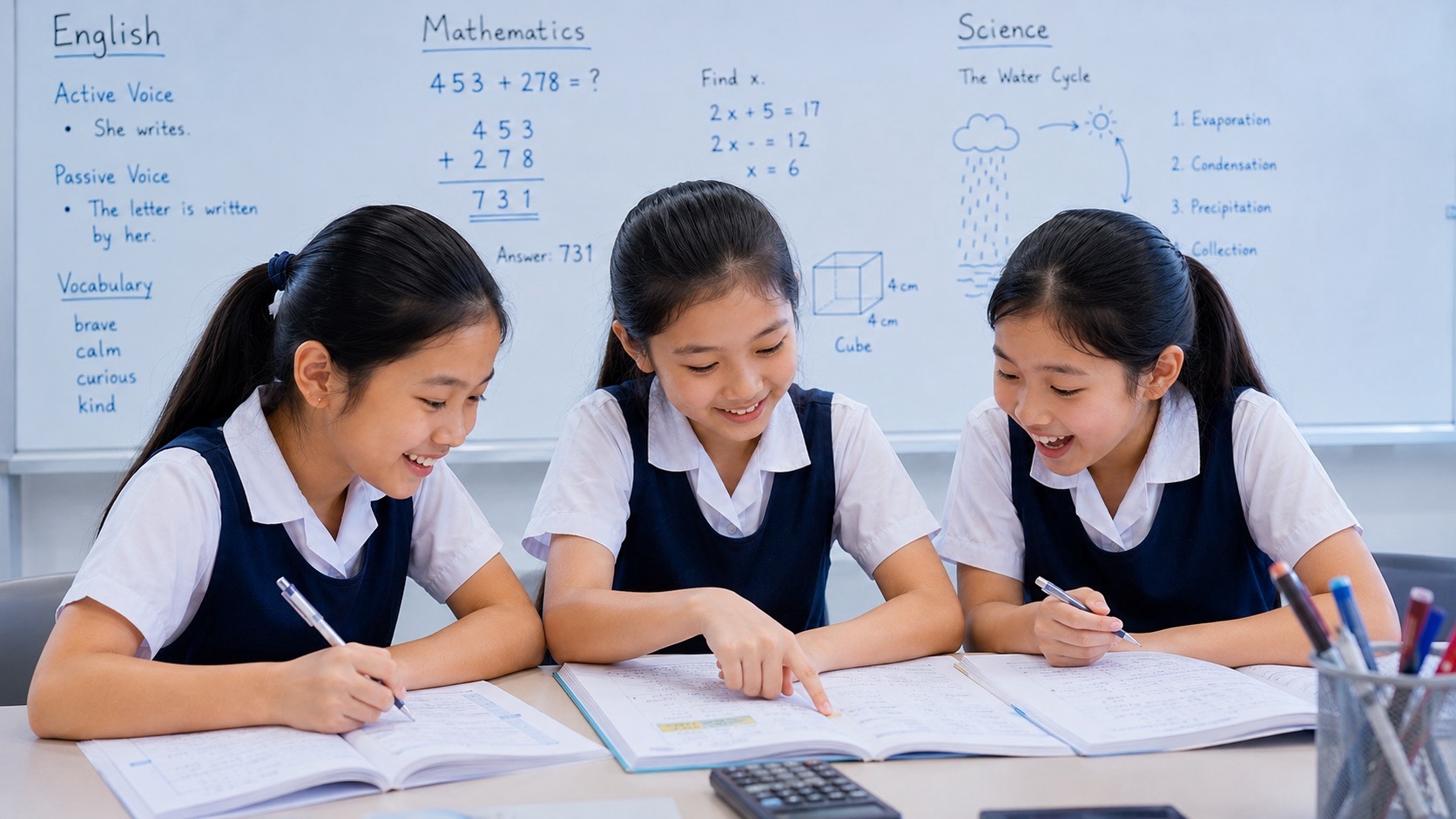
Awesome Schools in Woodlands is a town-level education field guide to the current MOE Primary, Secondary and specialised Secondary ecosystem in Woodlands. It is not a ranking. The purpose is to make one of Singapore’s largest northern school fields legible: which institutions are actually here, what each one foregrounds, how those identities connect to English, Mathematics, Science, PSLE, Full Subject-Based Banding, SEC, IB, CCAs, sport and the arts, and what families should investigate before deciding for themselves.
The current 2026 field used here contains 12 Primary schools—Admiralty, Evergreen, Fuchun, Greenwood, Innova, Marsiling, Qihua, Riverside, Si Ling, Woodgrove, Woodlands and Woodlands Ring Primary Schools—eight mainstream Secondary schools—Admiralty, Christ Church, Evergreen, Marsiling, Riverside, Woodgrove, Woodlands Ring and Woodlands Secondary Schools—plus Singapore Sports School and Spectra Secondary School.
Fuchun Secondary School is not listed separately because the current Woodlands Ring Secondary School is the merger school formed from Fuchun Secondary and Woodlands Ring Secondary starting in 2025. Fuchun Primary School remains a separate current Primary school. This distinction matters because school names and historical entities can easily create duplicate or outdated territorial coverage.
Woodlands has no current mainstream Junior College inside the town field used here and no current IP school. Singapore Sports School is a specialised institution with Secondary and post-secondary athlete pathways, including a current International Baccalaureate Diploma Programme, so IB appears in this article through that specific local institution rather than by importing an unrelated school.
For the wider eduKate graph, connect this page to History of Singapore | Woodlands, Why Singaporeans Love Woodlands, Fun facts about Singapore | Woodlands, Things to do in Singapore | Woodlands, Education Hub, English Learning Hub, Mathematics Learning Hub, Science Learning Hub, From PSLE to SEC, Singapore Secondary School Directory and Tutors and Tuition in Woodlands. The town field is the broad map; specialist nodes own subjects, history, pathways and targeted intervention.
Why Woodlands is one of Singapore’s largest and most varied school fields
Woodlands is a major northern town with enough schools to show almost every form of mainstream and applied development inside one planning area. Language, sustainability, environmental Science, design thinking, entrepreneurship, drama, dance, sport, robotics, health science, food science, global citizenship, arts and specialised sport all appear in the current field.
The town also has several generations of institutional history. Woodlands Primary traces roots to the 1950s. Fuchun Primary has four decades of history. Newer neighbourhood schools grew with later phases of Woodlands. The merger of Fuchun Secondary and Woodlands Ring Secondary shows that the school system continues to adapt as enrolment and infrastructure change.
Woodlands is also a border town in a very literal sense. Daily life is shaped by the Causeway, northern transport, Woodlands Regional Centre, Admiralty, Marsiling and the town’s relationship with Mandai, Sembawang, Yishun and Johor. That geography makes transport and family routine especially important parts of school choice.
The current field is unusual because it includes Singapore Sports School and Spectra Secondary School alongside mainstream schools. That makes Woodlands an especially strong example of multiple pathways. Not every learner needs the same kind of environment, timetable or assessment structure.
The educational lesson is that common foundations and different contexts can coexist. Every learner still needs language, quantitative reasoning, evidence, revision and self-management. What changes is the context in which those capabilities are practised and the pathway through which they are applied.
All 22 current MOE and specialised school institutions in Woodlands
| School | Level | Distinctive learning lens |
|---|---|---|
| Admiralty Primary School | Primary | Design Thinking for Sustainability paired with a high-performance mindset for personal leadership; its current Applied Learning Programme develops Design Thinking around sustainability, while its Learning for Life Programme develops performance character such as effort, diligence, perseverance and confidence |
| Evergreen Primary School | Primary | Sustainability and STEM through authentic environmental problem solving; its current Science programme identifies Sustainability and STEM as the school’s Applied Learning Programme, with pupils growing food, designing self-watering systems and building rainwater harvesters across upper Primary levels |
| Fuchun Primary School | Primary | authentic Chinese-language use paired with music, performing arts and practical life skills; its Chinese Language Applied Learning Programme puts Mandarin into real-life contexts such as cooking, family traditions and video creation, while its long-running ARTS Learning for Life Programme develops confidence through Music Education and Performing Arts |
| Greenwood Primary School | Primary | bilingual literature appreciation, design thinking, community contribution and systems thinking; BLISS—Bilingual Literature apprecIation Student Series—uses literature and philosophical questioning to develop critical thinking and Mother Tongue use, while WHIZZ uses Design Thinking, Appreciative Inquiry, Systems Thinking and community project work to develop critical and inventive thinkers |
| Innova Primary School | Primary | creative problem solving paired with community service and progressive leadership; its Creative Problem Solving ALP uses the FourSight cycle—Clarify, Ideate, Develop and Implement—from story-based problems in lower Primary to coding and community product creation in upper Primary, while its LLP develops leadership through service and intergenerational learning |
| Marsiling Primary School | Primary | purposeful storytelling paired with service leadership; SPARKS@MPS develops confident communicators through choral reading, Readers’ Theatre, public speaking, filmmaking and purposeful storytelling, while LEAD to Serve develops self-leadership, leadership of others and service through a structured progression |
| Qihua Primary School | Primary | innovation and entrepreneurship paired with sports character development; its Innovation and Entrepreneurship Excellence Programme develops articulate communicators and inventive thinkers, while the Sports Development Programme uses sport to nurture character, social-emotional competencies and contribution to a healthy community |
| Riverside Primary School | Primary | creative problem solving through PlayWorks paired with peer support and community care; PlayWorks develops critical and inventive thinking through an Understand–Plan–Design–Build–Improvise protocol with Communication, Collaboration and Reflection, while PeerWorks develops peer bonding, peer helping, peer influence and community service |
| Si Ling Primary School | Primary | Environmental Science paired with community and student leadership; its Environmental Science ALP develops sustainability knowledge, conservation values and real-world problem solving, while the LLP builds leadership progressively from self and family to school and external community service |
| Woodgrove Primary School | Primary | effective communication through drama paired with dance, creativity and holistic character development; its current ALP develops effective communication using drama pedagogies, while Shine Through Dance exposes pupils across Primary 1 to 6 to dance genres, creativity, teamwork, performance and confidence |
| Woodlands Primary School | Primary | Joy of Learning Languages paired with sports performance and character education; JOL²@WOODS is a six-year English and Mother Tongue Applied Learning Programme focused on confident articulation, reflection and collaborative language learning, while SPACE—Sports Performance and Character Education—uses sport, camps and games to build resilience, teamwork and values |
| Woodlands Ring Primary School | Primary | game design, coding and Design Thinking paired with a school-wide leadership framework; Be.S.T.@WRPS—Be a Design Thinker—is a STEM Applied Learning Programme in game design, coding, tinkering and environmental themes, while I Can Soar develops student leadership through a structured framework grounded in the Leadership Challenge model |
| Admiralty Secondary School | Secondary | Design Thinking through innovation and technology paired with mindful community leadership; its Applied Learning Programme develops Design Thinking through Innovation and Technology in the Emerging Technologies domain, while its Learning for Life Programme develops mindful leaders through community outreach |
| Christ Church Secondary School | Secondary | health science and technology paired with outdoor adventure leadership; its Applied Learning Programme uses Health Science and Technology in the Health and Food Science domain, while the LLP develops leadership through Outdoor Adventure Learning |
| Evergreen Secondary School | Secondary | effective communication with heart paired with resilience and leadership through sports education; its Applied Learning Programme develops Effective Communicators with a Heart, while the LLP develops resilience, character and leadership through Sports Education |
| Marsiling Secondary School | Secondary | eco-sustainability through inquiry paired with health, outdoor learning and community leadership; its Applied Learning Programme develops Eco-Sustainability through Inquiry-based Learning, while HEART develops healthy and active youth through outdoor and health-promoting curricula with community leadership |
| Riverside Secondary School | Secondary | global citizenship through critical social inquiry paired with Arts for Life; its Applied Learning Programme develops Global Citizenship Education through Critical Social Inquiry in the Humanities domain, while Arts for Life develops students through music and performing arts; the school also offers the Tamil Language Elective Programme |
| Woodgrove Secondary School | Secondary | STEM for sustainable living paired with community leadership; its Applied Learning Programme develops STEM for Sustainable Living in the Community, while Learners and Leaders for Life develops community youth leadership |
| Woodlands Ring Secondary School | Secondary | robotics education and enterprise paired with community leadership; TREE—The Robotics Education & Enterprise—develops robotics in a Future of Transportation context, while the LLP develops Student Leadership through Involvement in the Community |
| Woodlands Secondary School | Secondary | food science paired with glocal leadership; Real Food, Real Science develops learning in the Health and Food Science domain, while Paying it Forward—WDL’s Glocal Leadership Programme develops community leadership and service |
| Singapore Sports School | Specialised Secondary | high-performance sport integrated with athlete-friendly academic pathways, including a current post-secondary IBDP route; its academic programme is anchored to MOE educational objectives and combines Secondary studies with high-performance sport; selected student-athletes can progress through through-train post-secondary pathways including the International Baccalaureate Diploma Programme and customised polytechnic diploma routes |
| Spectra Secondary School | Specialised Secondary | applied and experiential learning with strong real-world, vocational, sustainability and technology contexts; its unique instructional programmes include Sustainable Agriculture, immersive Mathematics play and technology-rich English tasks, with students learning through hands-on work, collaboration and applied problem solving |
Use the table as orientation, not as a verdict. Programmes, CCAs, pathway details and admissions rules can change. Live decisions should return to MOE SchoolFinder, the official school website, the current MOE Primary 1 registration portal for Primary registration and current MOE or SEAB information for Secondary pathways.
1. Admiralty Primary School
Admiralty Primary School contributes Design Thinking for Sustainability paired with a high-performance mindset for personal leadership to the Woodlands education field. Admiralty Primary has served Woodlands since the late 1990s and links sustainability thinking with the practical habits required to persist through challenge. The useful way to read the institution is through the repeated learning experiences it creates rather than one reputation signal.
its current Applied Learning Programme develops Design Thinking around sustainability, while its Learning for Life Programme develops performance character such as effort, diligence, perseverance and confidence. A strong programme should create progression: early experiences can be guided, later experiences should require stronger knowledge, more independent judgement, clearer communication and greater responsibility. Families can ask what students actually do and how the challenge changes by level.
Communication is unusually visible in the school’s identity. Students need to listen accurately, organise ideas, explain choices, interpret audiences and respond to feedback. The English Learning Hub explains the deeper national English progression. Families can look beyond formal English lessons and ask where else students must use language accurately for an authentic audience or purpose.
The distinctive context creates natural mathematical situations involving measurement, data, ratio, variable, pattern, geometry, rate, probability or optimisation. The Mathematics Learning Hub explains the progression from Primary number and models into Secondary algebra and advanced Mathematics. Applied work has depth when learners can move between real situation, representation and formal notation with accuracy.
Science connects directly to the programme through observation, variables, mechanisms, evidence, testing, human performance or design. The Science Learning Hub provides the deeper subject pathway. Woodlands gives Science many applied contexts: sustainability, environment, food, health, robotics, sport, engineering and real-world design.
The co-curricular field—arts, sport, leadership, ICT, environmental activities and broad Primary-school enrichment—adds long-horizon practice. Students train, rehearse, build, perform, compete, lead and serve across months or years. Improvement becomes experiential: identify the weak component, practise deliberately, receive feedback and reintegrate the stronger component.
As a Primary school, Admiralty Primary School sits inside a six-year runway from foundational literacy and numeracy to upper-Primary independence and PSLE readiness. Lower Primary builds reading, number sense and routines; middle Primary adds formal Science and inference; upper Primary increases retrieval, method selection and checking under pressure.
PSLE should be treated as the end of a six-year runway rather than the purpose of all six years. Strong preparation combines reading, vocabulary, number sense, Science concepts, mixed retrieval, timing, checking and increasing independence.
Transfer is another useful lens. Does a communication habit improve Science explanation? Does a checking habit from Mathematics improve coding? Does resilience from sport improve revision? Does design iteration improve willingness to rewrite? Transfer should not be assumed, but reflection can make it visible.
Independence matters equally. Strong schooling gradually reduces the amount of adult control needed for familiar work. Students should become better at starting, planning, checking, asking precise questions and recovering after mistakes. Support is successful when the learner can eventually carry more of the process.
Family logistics deserve seriousness. Test the real journey, school hours, CCA or training return time, meals, homework and sleep. Woodlands is large enough that two schools inside the same town can create very different weekly systems, especially when sport, boarding or specialised programmes are involved.
Belonging is educational. A learner should be able to imagine at least one plausible community inside Admiralty Primary School: a class, CCA, team, ensemble, club, service role, sport academy or programme. Belonging does not remove challenge; it often makes students more willing to persist through challenge.
Keep evidence categories separate. P1 demand measures applicant pressure, not school quality. Historical Secondary posting ranges support realistic planning, not culture scoring. Awards show achievement, not every learner’s daily experience. Specialised-school admissions are pathway-specific and should not be compared mechanically with mainstream entry data.
Useful family questions are concrete: how does Design Thinking for Sustainability paired with a high-performance mindset for personal leadership progress by year; what are current academic and co-curricular commitments; how are weak foundations supported; how are stronger learners stretched; what pathways appear later; and how does the institution deliberately develop agency?
Future-readiness should be read through durable capabilities rather than fashionable technology. Accurate reading, mathematical representation, evidence-based reasoning, clear explanation, collaboration, revision and responsibility remain valuable even as tools and jobs change.
Finally, use live official information. Programmes, admissions and pathways can change. MOE SchoolFinder, the institution’s official site and current MOE or SEAB information should control the operational decision, while this field guide organises the questions.
2. Evergreen Primary School
Evergreen Primary School contributes Sustainability and STEM through authentic environmental problem solving to the Woodlands education field. Evergreen Primary’s identity is strongly connected to environmental systems and the idea that scientific knowledge should become something pupils can apply to real resource and sustainability questions. The useful way to read the institution is through the repeated learning experiences it creates rather than one reputation signal.
its current Science programme identifies Sustainability and STEM as the school’s Applied Learning Programme, with pupils growing food, designing self-watering systems and building rainwater harvesters across upper Primary levels. A strong programme should create progression: early experiences can be guided, later experiences should require stronger knowledge, more independent judgement, clearer communication and greater responsibility. Families can ask what students actually do and how the challenge changes by level.
Even when the headline identity is technical, environmental or sport-focused, English remains the transmission layer. Students read instructions, explain evidence, document decisions, collaborate and reflect through language. The English Learning Hub explains the deeper national English progression. Families can look beyond formal English lessons and ask where else students must use language accurately for an authentic audience or purpose.
The distinctive context creates natural mathematical situations involving measurement, data, ratio, variable, pattern, geometry, rate, probability or optimisation. The Mathematics Learning Hub explains the progression from Primary number and models into Secondary algebra and advanced Mathematics. Applied work has depth when learners can move between real situation, representation and formal notation with accuracy.
Science connects directly to the programme through observation, variables, mechanisms, evidence, testing, human performance or design. The Science Learning Hub provides the deeper subject pathway. Woodlands gives Science many applied contexts: sustainability, environment, food, health, robotics, sport, engineering and real-world design.
The co-curricular field—sport, arts, clubs, environmental activities, leadership and school-based talent development—adds long-horizon practice. Students train, rehearse, build, perform, compete, lead and serve across months or years. Improvement becomes experiential: identify the weak component, practise deliberately, receive feedback and reintegrate the stronger component.
As a Primary school, Evergreen Primary School sits inside a six-year runway from foundational literacy and numeracy to upper-Primary independence and PSLE readiness. Lower Primary builds reading, number sense and routines; middle Primary adds formal Science and inference; upper Primary increases retrieval, method selection and checking under pressure.
PSLE should be treated as the end of a six-year runway rather than the purpose of all six years. Strong preparation combines reading, vocabulary, number sense, Science concepts, mixed retrieval, timing, checking and increasing independence.
Transfer is another useful lens. Does a communication habit improve Science explanation? Does a checking habit from Mathematics improve coding? Does resilience from sport improve revision? Does design iteration improve willingness to rewrite? Transfer should not be assumed, but reflection can make it visible.
Independence matters equally. Strong schooling gradually reduces the amount of adult control needed for familiar work. Students should become better at starting, planning, checking, asking precise questions and recovering after mistakes. Support is successful when the learner can eventually carry more of the process.
Family logistics deserve seriousness. Test the real journey, school hours, CCA or training return time, meals, homework and sleep. Woodlands is large enough that two schools inside the same town can create very different weekly systems, especially when sport, boarding or specialised programmes are involved.
Belonging is educational. A learner should be able to imagine at least one plausible community inside Evergreen Primary School: a class, CCA, team, ensemble, club, service role, sport academy or programme. Belonging does not remove challenge; it often makes students more willing to persist through challenge.
Keep evidence categories separate. P1 demand measures applicant pressure, not school quality. Historical Secondary posting ranges support realistic planning, not culture scoring. Awards show achievement, not every learner’s daily experience. Specialised-school admissions are pathway-specific and should not be compared mechanically with mainstream entry data.
Useful family questions are concrete: how does Sustainability and STEM through authentic environmental problem solving progress by year; what are current academic and co-curricular commitments; how are weak foundations supported; how are stronger learners stretched; what pathways appear later; and how does the institution deliberately develop agency?
Future-readiness should be read through durable capabilities rather than fashionable technology. Accurate reading, mathematical representation, evidence-based reasoning, clear explanation, collaboration, revision and responsibility remain valuable even as tools and jobs change.
Finally, use live official information. Programmes, admissions and pathways can change. MOE SchoolFinder, the institution’s official site and current MOE or SEAB information should control the operational decision, while this field guide organises the questions.
3. Fuchun Primary School
Fuchun Primary School contributes authentic Chinese-language use paired with music, performing arts and practical life skills to the Woodlands education field. Fuchun Primary celebrated 40 years in 2025 and has a long Woodlands history of holistic education, music, arts and independence-building programmes. The useful way to read the institution is through the repeated learning experiences it creates rather than one reputation signal.
its Chinese Language Applied Learning Programme puts Mandarin into real-life contexts such as cooking, family traditions and video creation, while its long-running ARTS Learning for Life Programme develops confidence through Music Education and Performing Arts. A strong programme should create progression: early experiences can be guided, later experiences should require stronger knowledge, more independent judgement, clearer communication and greater responsibility. Families can ask what students actually do and how the challenge changes by level.
Communication is unusually visible in the school’s identity. Students need to listen accurately, organise ideas, explain choices, interpret audiences and respond to feedback. The English Learning Hub explains the deeper national English progression. Families can look beyond formal English lessons and ask where else students must use language accurately for an authentic audience or purpose.
Mathematics remains part of the common academic spine through number, data, formal reasoning and increasingly abstract representation. The Mathematics Learning Hub explains the progression from Primary number and models into Secondary algebra and advanced Mathematics. Applied work has depth when learners can move between real situation, representation and formal notation with accuracy.
Science contributes disciplined evidence habits even when the school’s identity sits in language, arts or leadership. The Science Learning Hub provides the deeper subject pathway. Woodlands gives Science many applied contexts: sustainability, environment, food, health, robotics, sport, engineering and real-world design.
The co-curricular field—music, visual arts, dance, speech and drama, sport, clubs, leadership and practical life-skills programmes—adds long-horizon practice. Students train, rehearse, build, perform, compete, lead and serve across months or years. Improvement becomes experiential: identify the weak component, practise deliberately, receive feedback and reintegrate the stronger component.
As a Primary school, Fuchun Primary School sits inside a six-year runway from foundational literacy and numeracy to upper-Primary independence and PSLE readiness. Lower Primary builds reading, number sense and routines; middle Primary adds formal Science and inference; upper Primary increases retrieval, method selection and checking under pressure.
PSLE should be treated as the end of a six-year runway rather than the purpose of all six years. Strong preparation combines reading, vocabulary, number sense, Science concepts, mixed retrieval, timing, checking and increasing independence.
Transfer is another useful lens. Does a communication habit improve Science explanation? Does a checking habit from Mathematics improve coding? Does resilience from sport improve revision? Does design iteration improve willingness to rewrite? Transfer should not be assumed, but reflection can make it visible.
Independence matters equally. Strong schooling gradually reduces the amount of adult control needed for familiar work. Students should become better at starting, planning, checking, asking precise questions and recovering after mistakes. Support is successful when the learner can eventually carry more of the process.
Family logistics deserve seriousness. Test the real journey, school hours, CCA or training return time, meals, homework and sleep. Woodlands is large enough that two schools inside the same town can create very different weekly systems, especially when sport, boarding or specialised programmes are involved.
Belonging is educational. A learner should be able to imagine at least one plausible community inside Fuchun Primary School: a class, CCA, team, ensemble, club, service role, sport academy or programme. Belonging does not remove challenge; it often makes students more willing to persist through challenge.
Keep evidence categories separate. P1 demand measures applicant pressure, not school quality. Historical Secondary posting ranges support realistic planning, not culture scoring. Awards show achievement, not every learner’s daily experience. Specialised-school admissions are pathway-specific and should not be compared mechanically with mainstream entry data.
Useful family questions are concrete: how does authentic Chinese-language use paired with music, performing arts and practical life skills progress by year; what are current academic and co-curricular commitments; how are weak foundations supported; how are stronger learners stretched; what pathways appear later; and how does the institution deliberately develop agency?
Future-readiness should be read through durable capabilities rather than fashionable technology. Accurate reading, mathematical representation, evidence-based reasoning, clear explanation, collaboration, revision and responsibility remain valuable even as tools and jobs change.
Finally, use live official information. Programmes, admissions and pathways can change. MOE SchoolFinder, the institution’s official site and current MOE or SEAB information should control the operational decision, while this field guide organises the questions.
4. Greenwood Primary School
Greenwood Primary School contributes bilingual literature appreciation, design thinking, community contribution and systems thinking to the Woodlands education field. Greenwood Primary’s 2026 programme architecture is unusually explicit about thinking systems, bilingual literature, values and community application. The useful way to read the institution is through the repeated learning experiences it creates rather than one reputation signal.
BLISS—Bilingual Literature apprecIation Student Series—uses literature and philosophical questioning to develop critical thinking and Mother Tongue use, while WHIZZ uses Design Thinking, Appreciative Inquiry, Systems Thinking and community project work to develop critical and inventive thinkers. A strong programme should create progression: early experiences can be guided, later experiences should require stronger knowledge, more independent judgement, clearer communication and greater responsibility. Families can ask what students actually do and how the challenge changes by level.
Communication is unusually visible in the school’s identity. Students need to listen accurately, organise ideas, explain choices, interpret audiences and respond to feedback. The English Learning Hub explains the deeper national English progression. Families can look beyond formal English lessons and ask where else students must use language accurately for an authentic audience or purpose.
The distinctive context creates natural mathematical situations involving measurement, data, ratio, variable, pattern, geometry, rate, probability or optimisation. The Mathematics Learning Hub explains the progression from Primary number and models into Secondary algebra and advanced Mathematics. Applied work has depth when learners can move between real situation, representation and formal notation with accuracy.
Science connects directly to the programme through observation, variables, mechanisms, evidence, testing, human performance or design. The Science Learning Hub provides the deeper subject pathway. Woodlands gives Science many applied contexts: sustainability, environment, food, health, robotics, sport, engineering and real-world design.
The co-curricular field—sport, dance, uniformed groups, arts, clubs, environmental work, leadership and project showcases—adds long-horizon practice. Students train, rehearse, build, perform, compete, lead and serve across months or years. Improvement becomes experiential: identify the weak component, practise deliberately, receive feedback and reintegrate the stronger component.
As a Primary school, Greenwood Primary School sits inside a six-year runway from foundational literacy and numeracy to upper-Primary independence and PSLE readiness. Lower Primary builds reading, number sense and routines; middle Primary adds formal Science and inference; upper Primary increases retrieval, method selection and checking under pressure.
PSLE should be treated as the end of a six-year runway rather than the purpose of all six years. Strong preparation combines reading, vocabulary, number sense, Science concepts, mixed retrieval, timing, checking and increasing independence.
Transfer is another useful lens. Does a communication habit improve Science explanation? Does a checking habit from Mathematics improve coding? Does resilience from sport improve revision? Does design iteration improve willingness to rewrite? Transfer should not be assumed, but reflection can make it visible.
Independence matters equally. Strong schooling gradually reduces the amount of adult control needed for familiar work. Students should become better at starting, planning, checking, asking precise questions and recovering after mistakes. Support is successful when the learner can eventually carry more of the process.
Family logistics deserve seriousness. Test the real journey, school hours, CCA or training return time, meals, homework and sleep. Woodlands is large enough that two schools inside the same town can create very different weekly systems, especially when sport, boarding or specialised programmes are involved.
Belonging is educational. A learner should be able to imagine at least one plausible community inside Greenwood Primary School: a class, CCA, team, ensemble, club, service role, sport academy or programme. Belonging does not remove challenge; it often makes students more willing to persist through challenge.
Keep evidence categories separate. P1 demand measures applicant pressure, not school quality. Historical Secondary posting ranges support realistic planning, not culture scoring. Awards show achievement, not every learner’s daily experience. Specialised-school admissions are pathway-specific and should not be compared mechanically with mainstream entry data.
Useful family questions are concrete: how does bilingual literature appreciation, design thinking, community contribution and systems thinking progress by year; what are current academic and co-curricular commitments; how are weak foundations supported; how are stronger learners stretched; what pathways appear later; and how does the institution deliberately develop agency?
Future-readiness should be read through durable capabilities rather than fashionable technology. Accurate reading, mathematical representation, evidence-based reasoning, clear explanation, collaboration, revision and responsibility remain valuable even as tools and jobs change.
Finally, use live official information. Programmes, admissions and pathways can change. MOE SchoolFinder, the institution’s official site and current MOE or SEAB information should control the operational decision, while this field guide organises the questions.
5. Innova Primary School
Innova Primary School contributes creative problem solving paired with community service and progressive leadership to the Woodlands education field. Innova Primary combines problem-solving processes with explicit opportunities to lead self, serve the school, work with seniors and contribute to the community. The useful way to read the institution is through the repeated learning experiences it creates rather than one reputation signal.
its Creative Problem Solving ALP uses the FourSight cycle—Clarify, Ideate, Develop and Implement—from story-based problems in lower Primary to coding and community product creation in upper Primary, while its LLP develops leadership through service and intergenerational learning. A strong programme should create progression: early experiences can be guided, later experiences should require stronger knowledge, more independent judgement, clearer communication and greater responsibility. Families can ask what students actually do and how the challenge changes by level.
Communication is unusually visible in the school’s identity. Students need to listen accurately, organise ideas, explain choices, interpret audiences and respond to feedback. The English Learning Hub explains the deeper national English progression. Families can look beyond formal English lessons and ask where else students must use language accurately for an authentic audience or purpose.
Mathematics remains part of the common academic spine through number, data, formal reasoning and increasingly abstract representation. The Mathematics Learning Hub explains the progression from Primary number and models into Secondary algebra and advanced Mathematics. Applied work has depth when learners can move between real situation, representation and formal notation with accuracy.
Science contributes disciplined evidence habits even when the school’s identity sits in language, arts or leadership. The Science Learning Hub provides the deeper subject pathway. Woodlands gives Science many applied contexts: sustainability, environment, food, health, robotics, sport, engineering and real-world design.
The co-curricular field—sport, arts, clubs, ICT, leadership and community-service experiences—adds long-horizon practice. Students train, rehearse, build, perform, compete, lead and serve across months or years. Improvement becomes experiential: identify the weak component, practise deliberately, receive feedback and reintegrate the stronger component.
As a Primary school, Innova Primary School sits inside a six-year runway from foundational literacy and numeracy to upper-Primary independence and PSLE readiness. Lower Primary builds reading, number sense and routines; middle Primary adds formal Science and inference; upper Primary increases retrieval, method selection and checking under pressure.
PSLE should be treated as the end of a six-year runway rather than the purpose of all six years. Strong preparation combines reading, vocabulary, number sense, Science concepts, mixed retrieval, timing, checking and increasing independence.
Transfer is another useful lens. Does a communication habit improve Science explanation? Does a checking habit from Mathematics improve coding? Does resilience from sport improve revision? Does design iteration improve willingness to rewrite? Transfer should not be assumed, but reflection can make it visible.
Independence matters equally. Strong schooling gradually reduces the amount of adult control needed for familiar work. Students should become better at starting, planning, checking, asking precise questions and recovering after mistakes. Support is successful when the learner can eventually carry more of the process.
Family logistics deserve seriousness. Test the real journey, school hours, CCA or training return time, meals, homework and sleep. Woodlands is large enough that two schools inside the same town can create very different weekly systems, especially when sport, boarding or specialised programmes are involved.
Belonging is educational. A learner should be able to imagine at least one plausible community inside Innova Primary School: a class, CCA, team, ensemble, club, service role, sport academy or programme. Belonging does not remove challenge; it often makes students more willing to persist through challenge.
Keep evidence categories separate. P1 demand measures applicant pressure, not school quality. Historical Secondary posting ranges support realistic planning, not culture scoring. Awards show achievement, not every learner’s daily experience. Specialised-school admissions are pathway-specific and should not be compared mechanically with mainstream entry data.
Useful family questions are concrete: how does creative problem solving paired with community service and progressive leadership progress by year; what are current academic and co-curricular commitments; how are weak foundations supported; how are stronger learners stretched; what pathways appear later; and how does the institution deliberately develop agency?
Future-readiness should be read through durable capabilities rather than fashionable technology. Accurate reading, mathematical representation, evidence-based reasoning, clear explanation, collaboration, revision and responsibility remain valuable even as tools and jobs change.
Finally, use live official information. Programmes, admissions and pathways can change. MOE SchoolFinder, the institution’s official site and current MOE or SEAB information should control the operational decision, while this field guide organises the questions.
6. Marsiling Primary School
Marsiling Primary School contributes purposeful storytelling paired with service leadership to the Woodlands education field. Marsiling Primary uses narrative and leadership as complementary ideas: students learn to communicate ideas clearly and then use communication in service of others. The useful way to read the institution is through the repeated learning experiences it creates rather than one reputation signal.
SPARKS@MPS develops confident communicators through choral reading, Readers’ Theatre, public speaking, filmmaking and purposeful storytelling, while LEAD to Serve develops self-leadership, leadership of others and service through a structured progression. A strong programme should create progression: early experiences can be guided, later experiences should require stronger knowledge, more independent judgement, clearer communication and greater responsibility. Families can ask what students actually do and how the challenge changes by level.
Communication is unusually visible in the school’s identity. Students need to listen accurately, organise ideas, explain choices, interpret audiences and respond to feedback. The English Learning Hub explains the deeper national English progression. Families can look beyond formal English lessons and ask where else students must use language accurately for an authentic audience or purpose.
Mathematics remains part of the common academic spine through number, data, formal reasoning and increasingly abstract representation. The Mathematics Learning Hub explains the progression from Primary number and models into Secondary algebra and advanced Mathematics. Applied work has depth when learners can move between real situation, representation and formal notation with accuracy.
Science contributes disciplined evidence habits even when the school’s identity sits in language, arts or leadership. The Science Learning Hub provides the deeper subject pathway. Woodlands gives Science many applied contexts: sustainability, environment, food, health, robotics, sport, engineering and real-world design.
The co-curricular field—arts, speech and drama, sport, clubs, uniformed groups, leadership and service—adds long-horizon practice. Students train, rehearse, build, perform, compete, lead and serve across months or years. Improvement becomes experiential: identify the weak component, practise deliberately, receive feedback and reintegrate the stronger component.
As a Primary school, Marsiling Primary School sits inside a six-year runway from foundational literacy and numeracy to upper-Primary independence and PSLE readiness. Lower Primary builds reading, number sense and routines; middle Primary adds formal Science and inference; upper Primary increases retrieval, method selection and checking under pressure.
PSLE should be treated as the end of a six-year runway rather than the purpose of all six years. Strong preparation combines reading, vocabulary, number sense, Science concepts, mixed retrieval, timing, checking and increasing independence.
Transfer is another useful lens. Does a communication habit improve Science explanation? Does a checking habit from Mathematics improve coding? Does resilience from sport improve revision? Does design iteration improve willingness to rewrite? Transfer should not be assumed, but reflection can make it visible.
Independence matters equally. Strong schooling gradually reduces the amount of adult control needed for familiar work. Students should become better at starting, planning, checking, asking precise questions and recovering after mistakes. Support is successful when the learner can eventually carry more of the process.
Family logistics deserve seriousness. Test the real journey, school hours, CCA or training return time, meals, homework and sleep. Woodlands is large enough that two schools inside the same town can create very different weekly systems, especially when sport, boarding or specialised programmes are involved.
Belonging is educational. A learner should be able to imagine at least one plausible community inside Marsiling Primary School: a class, CCA, team, ensemble, club, service role, sport academy or programme. Belonging does not remove challenge; it often makes students more willing to persist through challenge.
Keep evidence categories separate. P1 demand measures applicant pressure, not school quality. Historical Secondary posting ranges support realistic planning, not culture scoring. Awards show achievement, not every learner’s daily experience. Specialised-school admissions are pathway-specific and should not be compared mechanically with mainstream entry data.
Useful family questions are concrete: how does purposeful storytelling paired with service leadership progress by year; what are current academic and co-curricular commitments; how are weak foundations supported; how are stronger learners stretched; what pathways appear later; and how does the institution deliberately develop agency?
Future-readiness should be read through durable capabilities rather than fashionable technology. Accurate reading, mathematical representation, evidence-based reasoning, clear explanation, collaboration, revision and responsibility remain valuable even as tools and jobs change.
Finally, use live official information. Programmes, admissions and pathways can change. MOE SchoolFinder, the institution’s official site and current MOE or SEAB information should control the operational decision, while this field guide organises the questions.
7. Qihua Primary School
Qihua Primary School contributes innovation and entrepreneurship paired with sports character development to the Woodlands education field. Qihua gives Woodlands a Primary pathway in which entrepreneurial thinking and character through sport sit side by side. The useful way to read the institution is through the repeated learning experiences it creates rather than one reputation signal.
its Innovation and Entrepreneurship Excellence Programme develops articulate communicators and inventive thinkers, while the Sports Development Programme uses sport to nurture character, social-emotional competencies and contribution to a healthy community. A strong programme should create progression: early experiences can be guided, later experiences should require stronger knowledge, more independent judgement, clearer communication and greater responsibility. Families can ask what students actually do and how the challenge changes by level.
Even when the headline identity is technical, environmental or sport-focused, English remains the transmission layer. Students read instructions, explain evidence, document decisions, collaborate and reflect through language. The English Learning Hub explains the deeper national English progression. Families can look beyond formal English lessons and ask where else students must use language accurately for an authentic audience or purpose.
The distinctive context creates natural mathematical situations involving measurement, data, ratio, variable, pattern, geometry, rate, probability or optimisation. The Mathematics Learning Hub explains the progression from Primary number and models into Secondary algebra and advanced Mathematics. Applied work has depth when learners can move between real situation, representation and formal notation with accuracy.
Science connects directly to the programme through observation, variables, mechanisms, evidence, testing, human performance or design. The Science Learning Hub provides the deeper subject pathway. Woodlands gives Science many applied contexts: sustainability, environment, food, health, robotics, sport, engineering and real-world design.
The co-curricular field—sport, innovation, entrepreneurship, arts, clubs and leadership—adds long-horizon practice. Students train, rehearse, build, perform, compete, lead and serve across months or years. Improvement becomes experiential: identify the weak component, practise deliberately, receive feedback and reintegrate the stronger component.
As a Primary school, Qihua Primary School sits inside a six-year runway from foundational literacy and numeracy to upper-Primary independence and PSLE readiness. Lower Primary builds reading, number sense and routines; middle Primary adds formal Science and inference; upper Primary increases retrieval, method selection and checking under pressure.
PSLE should be treated as the end of a six-year runway rather than the purpose of all six years. Strong preparation combines reading, vocabulary, number sense, Science concepts, mixed retrieval, timing, checking and increasing independence.
Transfer is another useful lens. Does a communication habit improve Science explanation? Does a checking habit from Mathematics improve coding? Does resilience from sport improve revision? Does design iteration improve willingness to rewrite? Transfer should not be assumed, but reflection can make it visible.
Independence matters equally. Strong schooling gradually reduces the amount of adult control needed for familiar work. Students should become better at starting, planning, checking, asking precise questions and recovering after mistakes. Support is successful when the learner can eventually carry more of the process.
Family logistics deserve seriousness. Test the real journey, school hours, CCA or training return time, meals, homework and sleep. Woodlands is large enough that two schools inside the same town can create very different weekly systems, especially when sport, boarding or specialised programmes are involved.
Belonging is educational. A learner should be able to imagine at least one plausible community inside Qihua Primary School: a class, CCA, team, ensemble, club, service role, sport academy or programme. Belonging does not remove challenge; it often makes students more willing to persist through challenge.
Keep evidence categories separate. P1 demand measures applicant pressure, not school quality. Historical Secondary posting ranges support realistic planning, not culture scoring. Awards show achievement, not every learner’s daily experience. Specialised-school admissions are pathway-specific and should not be compared mechanically with mainstream entry data.
Useful family questions are concrete: how does innovation and entrepreneurship paired with sports character development progress by year; what are current academic and co-curricular commitments; how are weak foundations supported; how are stronger learners stretched; what pathways appear later; and how does the institution deliberately develop agency?
Future-readiness should be read through durable capabilities rather than fashionable technology. Accurate reading, mathematical representation, evidence-based reasoning, clear explanation, collaboration, revision and responsibility remain valuable even as tools and jobs change.
Finally, use live official information. Programmes, admissions and pathways can change. MOE SchoolFinder, the institution’s official site and current MOE or SEAB information should control the operational decision, while this field guide organises the questions.
8. Riverside Primary School
Riverside Primary School contributes creative problem solving through PlayWorks paired with peer support and community care to the Woodlands education field. Riverside Primary combines making and peer relationships, giving pupils both a problem-solving protocol and a social framework for belonging and service. The useful way to read the institution is through the repeated learning experiences it creates rather than one reputation signal.
PlayWorks develops critical and inventive thinking through an Understand–Plan–Design–Build–Improvise protocol with Communication, Collaboration and Reflection, while PeerWorks develops peer bonding, peer helping, peer influence and community service. A strong programme should create progression: early experiences can be guided, later experiences should require stronger knowledge, more independent judgement, clearer communication and greater responsibility. Families can ask what students actually do and how the challenge changes by level.
Even when the headline identity is technical, environmental or sport-focused, English remains the transmission layer. Students read instructions, explain evidence, document decisions, collaborate and reflect through language. The English Learning Hub explains the deeper national English progression. Families can look beyond formal English lessons and ask where else students must use language accurately for an authentic audience or purpose.
Mathematics remains part of the common academic spine through number, data, formal reasoning and increasingly abstract representation. The Mathematics Learning Hub explains the progression from Primary number and models into Secondary algebra and advanced Mathematics. Applied work has depth when learners can move between real situation, representation and formal notation with accuracy.
Science contributes disciplined evidence habits even when the school’s identity sits in language, arts or leadership. The Science Learning Hub provides the deeper subject pathway. Woodlands gives Science many applied contexts: sustainability, environment, food, health, robotics, sport, engineering and real-world design.
The co-curricular field—sport, arts, clubs, innovation, peer leadership and community contribution—adds long-horizon practice. Students train, rehearse, build, perform, compete, lead and serve across months or years. Improvement becomes experiential: identify the weak component, practise deliberately, receive feedback and reintegrate the stronger component.
As a Primary school, Riverside Primary School sits inside a six-year runway from foundational literacy and numeracy to upper-Primary independence and PSLE readiness. Lower Primary builds reading, number sense and routines; middle Primary adds formal Science and inference; upper Primary increases retrieval, method selection and checking under pressure.
PSLE should be treated as the end of a six-year runway rather than the purpose of all six years. Strong preparation combines reading, vocabulary, number sense, Science concepts, mixed retrieval, timing, checking and increasing independence.
Transfer is another useful lens. Does a communication habit improve Science explanation? Does a checking habit from Mathematics improve coding? Does resilience from sport improve revision? Does design iteration improve willingness to rewrite? Transfer should not be assumed, but reflection can make it visible.
Independence matters equally. Strong schooling gradually reduces the amount of adult control needed for familiar work. Students should become better at starting, planning, checking, asking precise questions and recovering after mistakes. Support is successful when the learner can eventually carry more of the process.
Family logistics deserve seriousness. Test the real journey, school hours, CCA or training return time, meals, homework and sleep. Woodlands is large enough that two schools inside the same town can create very different weekly systems, especially when sport, boarding or specialised programmes are involved.
Belonging is educational. A learner should be able to imagine at least one plausible community inside Riverside Primary School: a class, CCA, team, ensemble, club, service role, sport academy or programme. Belonging does not remove challenge; it often makes students more willing to persist through challenge.
Keep evidence categories separate. P1 demand measures applicant pressure, not school quality. Historical Secondary posting ranges support realistic planning, not culture scoring. Awards show achievement, not every learner’s daily experience. Specialised-school admissions are pathway-specific and should not be compared mechanically with mainstream entry data.
Useful family questions are concrete: how does creative problem solving through PlayWorks paired with peer support and community care progress by year; what are current academic and co-curricular commitments; how are weak foundations supported; how are stronger learners stretched; what pathways appear later; and how does the institution deliberately develop agency?
Future-readiness should be read through durable capabilities rather than fashionable technology. Accurate reading, mathematical representation, evidence-based reasoning, clear explanation, collaboration, revision and responsibility remain valuable even as tools and jobs change.
Finally, use live official information. Programmes, admissions and pathways can change. MOE SchoolFinder, the institution’s official site and current MOE or SEAB information should control the operational decision, while this field guide organises the questions.
9. Si Ling Primary School
Si Ling Primary School contributes Environmental Science paired with community and student leadership to the Woodlands education field. Si Ling Primary’s current programme architecture makes environmental responsibility and service two sides of the same idea of gracious citizenship. The useful way to read the institution is through the repeated learning experiences it creates rather than one reputation signal.
its Environmental Science ALP develops sustainability knowledge, conservation values and real-world problem solving, while the LLP builds leadership progressively from self and family to school and external community service. A strong programme should create progression: early experiences can be guided, later experiences should require stronger knowledge, more independent judgement, clearer communication and greater responsibility. Families can ask what students actually do and how the challenge changes by level.
Communication is unusually visible in the school’s identity. Students need to listen accurately, organise ideas, explain choices, interpret audiences and respond to feedback. The English Learning Hub explains the deeper national English progression. Families can look beyond formal English lessons and ask where else students must use language accurately for an authentic audience or purpose.
The distinctive context creates natural mathematical situations involving measurement, data, ratio, variable, pattern, geometry, rate, probability or optimisation. The Mathematics Learning Hub explains the progression from Primary number and models into Secondary algebra and advanced Mathematics. Applied work has depth when learners can move between real situation, representation and formal notation with accuracy.
Science connects directly to the programme through observation, variables, mechanisms, evidence, testing, human performance or design. The Science Learning Hub provides the deeper subject pathway. Woodlands gives Science many applied contexts: sustainability, environment, food, health, robotics, sport, engineering and real-world design.
The co-curricular field—environmental activities, leadership, English enrichment, Mathematics enrichment, arts, sport and community work—adds long-horizon practice. Students train, rehearse, build, perform, compete, lead and serve across months or years. Improvement becomes experiential: identify the weak component, practise deliberately, receive feedback and reintegrate the stronger component.
As a Primary school, Si Ling Primary School sits inside a six-year runway from foundational literacy and numeracy to upper-Primary independence and PSLE readiness. Lower Primary builds reading, number sense and routines; middle Primary adds formal Science and inference; upper Primary increases retrieval, method selection and checking under pressure.
PSLE should be treated as the end of a six-year runway rather than the purpose of all six years. Strong preparation combines reading, vocabulary, number sense, Science concepts, mixed retrieval, timing, checking and increasing independence.
Transfer is another useful lens. Does a communication habit improve Science explanation? Does a checking habit from Mathematics improve coding? Does resilience from sport improve revision? Does design iteration improve willingness to rewrite? Transfer should not be assumed, but reflection can make it visible.
Independence matters equally. Strong schooling gradually reduces the amount of adult control needed for familiar work. Students should become better at starting, planning, checking, asking precise questions and recovering after mistakes. Support is successful when the learner can eventually carry more of the process.
Family logistics deserve seriousness. Test the real journey, school hours, CCA or training return time, meals, homework and sleep. Woodlands is large enough that two schools inside the same town can create very different weekly systems, especially when sport, boarding or specialised programmes are involved.
Belonging is educational. A learner should be able to imagine at least one plausible community inside Si Ling Primary School: a class, CCA, team, ensemble, club, service role, sport academy or programme. Belonging does not remove challenge; it often makes students more willing to persist through challenge.
Keep evidence categories separate. P1 demand measures applicant pressure, not school quality. Historical Secondary posting ranges support realistic planning, not culture scoring. Awards show achievement, not every learner’s daily experience. Specialised-school admissions are pathway-specific and should not be compared mechanically with mainstream entry data.
Useful family questions are concrete: how does Environmental Science paired with community and student leadership progress by year; what are current academic and co-curricular commitments; how are weak foundations supported; how are stronger learners stretched; what pathways appear later; and how does the institution deliberately develop agency?
Future-readiness should be read through durable capabilities rather than fashionable technology. Accurate reading, mathematical representation, evidence-based reasoning, clear explanation, collaboration, revision and responsibility remain valuable even as tools and jobs change.
Finally, use live official information. Programmes, admissions and pathways can change. MOE SchoolFinder, the institution’s official site and current MOE or SEAB information should control the operational decision, while this field guide organises the questions.
10. Woodgrove Primary School
Woodgrove Primary School contributes effective communication through drama paired with dance, creativity and holistic character development to the Woodlands education field. Woodgrove Primary’s iGROW and Woodgrovian Experience connect communication, dance, character and joyful learning across the school. The useful way to read the institution is through the repeated learning experiences it creates rather than one reputation signal.
its current ALP develops effective communication using drama pedagogies, while Shine Through Dance exposes pupils across Primary 1 to 6 to dance genres, creativity, teamwork, performance and confidence. A strong programme should create progression: early experiences can be guided, later experiences should require stronger knowledge, more independent judgement, clearer communication and greater responsibility. Families can ask what students actually do and how the challenge changes by level.
Communication is unusually visible in the school’s identity. Students need to listen accurately, organise ideas, explain choices, interpret audiences and respond to feedback. The English Learning Hub explains the deeper national English progression. Families can look beyond formal English lessons and ask where else students must use language accurately for an authentic audience or purpose.
Mathematics remains part of the common academic spine through number, data, formal reasoning and increasingly abstract representation. The Mathematics Learning Hub explains the progression from Primary number and models into Secondary algebra and advanced Mathematics. Applied work has depth when learners can move between real situation, representation and formal notation with accuracy.
Science contributes disciplined evidence habits even when the school’s identity sits in language, arts or leadership. The Science Learning Hub provides the deeper subject pathway. Woodlands gives Science many applied contexts: sustainability, environment, food, health, robotics, sport, engineering and real-world design.
The co-curricular field—dance, drama, sport, arts, clubs, leadership and community learning—adds long-horizon practice. Students train, rehearse, build, perform, compete, lead and serve across months or years. Improvement becomes experiential: identify the weak component, practise deliberately, receive feedback and reintegrate the stronger component.
As a Primary school, Woodgrove Primary School sits inside a six-year runway from foundational literacy and numeracy to upper-Primary independence and PSLE readiness. Lower Primary builds reading, number sense and routines; middle Primary adds formal Science and inference; upper Primary increases retrieval, method selection and checking under pressure.
PSLE should be treated as the end of a six-year runway rather than the purpose of all six years. Strong preparation combines reading, vocabulary, number sense, Science concepts, mixed retrieval, timing, checking and increasing independence.
Transfer is another useful lens. Does a communication habit improve Science explanation? Does a checking habit from Mathematics improve coding? Does resilience from sport improve revision? Does design iteration improve willingness to rewrite? Transfer should not be assumed, but reflection can make it visible.
Independence matters equally. Strong schooling gradually reduces the amount of adult control needed for familiar work. Students should become better at starting, planning, checking, asking precise questions and recovering after mistakes. Support is successful when the learner can eventually carry more of the process.
Family logistics deserve seriousness. Test the real journey, school hours, CCA or training return time, meals, homework and sleep. Woodlands is large enough that two schools inside the same town can create very different weekly systems, especially when sport, boarding or specialised programmes are involved.
Belonging is educational. A learner should be able to imagine at least one plausible community inside Woodgrove Primary School: a class, CCA, team, ensemble, club, service role, sport academy or programme. Belonging does not remove challenge; it often makes students more willing to persist through challenge.
Keep evidence categories separate. P1 demand measures applicant pressure, not school quality. Historical Secondary posting ranges support realistic planning, not culture scoring. Awards show achievement, not every learner’s daily experience. Specialised-school admissions are pathway-specific and should not be compared mechanically with mainstream entry data.
Useful family questions are concrete: how does effective communication through drama paired with dance, creativity and holistic character development progress by year; what are current academic and co-curricular commitments; how are weak foundations supported; how are stronger learners stretched; what pathways appear later; and how does the institution deliberately develop agency?
Future-readiness should be read through durable capabilities rather than fashionable technology. Accurate reading, mathematical representation, evidence-based reasoning, clear explanation, collaboration, revision and responsibility remain valuable even as tools and jobs change.
Finally, use live official information. Programmes, admissions and pathways can change. MOE SchoolFinder, the institution’s official site and current MOE or SEAB information should control the operational decision, while this field guide organises the questions.
11. Woodlands Primary School
Woodlands Primary School contributes Joy of Learning Languages paired with sports performance and character education to the Woodlands education field. Woodlands Primary traces its heritage to 1953 and combines that deep local history with play-based learning, language confidence and sports character development. The useful way to read the institution is through the repeated learning experiences it creates rather than one reputation signal.
JOL²@WOODS is a six-year English and Mother Tongue Applied Learning Programme focused on confident articulation, reflection and collaborative language learning, while SPACE—Sports Performance and Character Education—uses sport, camps and games to build resilience, teamwork and values. A strong programme should create progression: early experiences can be guided, later experiences should require stronger knowledge, more independent judgement, clearer communication and greater responsibility. Families can ask what students actually do and how the challenge changes by level.
Communication is unusually visible in the school’s identity. Students need to listen accurately, organise ideas, explain choices, interpret audiences and respond to feedback. The English Learning Hub explains the deeper national English progression. Families can look beyond formal English lessons and ask where else students must use language accurately for an authentic audience or purpose.
The distinctive context creates natural mathematical situations involving measurement, data, ratio, variable, pattern, geometry, rate, probability or optimisation. The Mathematics Learning Hub explains the progression from Primary number and models into Secondary algebra and advanced Mathematics. Applied work has depth when learners can move between real situation, representation and formal notation with accuracy.
Science connects directly to the programme through observation, variables, mechanisms, evidence, testing, human performance or design. The Science Learning Hub provides the deeper subject pathway. Woodlands gives Science many applied contexts: sustainability, environment, food, health, robotics, sport, engineering and real-world design.
The co-curricular field—sport, arts, student leadership, ICT, PAL and language-rich co-curricular experiences—adds long-horizon practice. Students train, rehearse, build, perform, compete, lead and serve across months or years. Improvement becomes experiential: identify the weak component, practise deliberately, receive feedback and reintegrate the stronger component.
As a Primary school, Woodlands Primary School sits inside a six-year runway from foundational literacy and numeracy to upper-Primary independence and PSLE readiness. Lower Primary builds reading, number sense and routines; middle Primary adds formal Science and inference; upper Primary increases retrieval, method selection and checking under pressure.
PSLE should be treated as the end of a six-year runway rather than the purpose of all six years. Strong preparation combines reading, vocabulary, number sense, Science concepts, mixed retrieval, timing, checking and increasing independence.
Transfer is another useful lens. Does a communication habit improve Science explanation? Does a checking habit from Mathematics improve coding? Does resilience from sport improve revision? Does design iteration improve willingness to rewrite? Transfer should not be assumed, but reflection can make it visible.
Independence matters equally. Strong schooling gradually reduces the amount of adult control needed for familiar work. Students should become better at starting, planning, checking, asking precise questions and recovering after mistakes. Support is successful when the learner can eventually carry more of the process.
Family logistics deserve seriousness. Test the real journey, school hours, CCA or training return time, meals, homework and sleep. Woodlands is large enough that two schools inside the same town can create very different weekly systems, especially when sport, boarding or specialised programmes are involved.
Belonging is educational. A learner should be able to imagine at least one plausible community inside Woodlands Primary School: a class, CCA, team, ensemble, club, service role, sport academy or programme. Belonging does not remove challenge; it often makes students more willing to persist through challenge.
Keep evidence categories separate. P1 demand measures applicant pressure, not school quality. Historical Secondary posting ranges support realistic planning, not culture scoring. Awards show achievement, not every learner’s daily experience. Specialised-school admissions are pathway-specific and should not be compared mechanically with mainstream entry data.
Useful family questions are concrete: how does Joy of Learning Languages paired with sports performance and character education progress by year; what are current academic and co-curricular commitments; how are weak foundations supported; how are stronger learners stretched; what pathways appear later; and how does the institution deliberately develop agency?
Future-readiness should be read through durable capabilities rather than fashionable technology. Accurate reading, mathematical representation, evidence-based reasoning, clear explanation, collaboration, revision and responsibility remain valuable even as tools and jobs change.
Finally, use live official information. Programmes, admissions and pathways can change. MOE SchoolFinder, the institution’s official site and current MOE or SEAB information should control the operational decision, while this field guide organises the questions.
12. Woodlands Ring Primary School
Woodlands Ring Primary School contributes game design, coding and Design Thinking paired with a school-wide leadership framework to the Woodlands education field. Woodlands Ring Primary makes both creation and leadership progressive, asking pupils to design, test, reflect and take increasing responsibility across the Primary years. The useful way to read the institution is through the repeated learning experiences it creates rather than one reputation signal.
Be.S.T.@WRPS—Be a Design Thinker—is a STEM Applied Learning Programme in game design, coding, tinkering and environmental themes, while I Can Soar develops student leadership through a structured framework grounded in the Leadership Challenge model. A strong programme should create progression: early experiences can be guided, later experiences should require stronger knowledge, more independent judgement, clearer communication and greater responsibility. Families can ask what students actually do and how the challenge changes by level.
Communication is unusually visible in the school’s identity. Students need to listen accurately, organise ideas, explain choices, interpret audiences and respond to feedback. The English Learning Hub explains the deeper national English progression. Families can look beyond formal English lessons and ask where else students must use language accurately for an authentic audience or purpose.
The distinctive context creates natural mathematical situations involving measurement, data, ratio, variable, pattern, geometry, rate, probability or optimisation. The Mathematics Learning Hub explains the progression from Primary number and models into Secondary algebra and advanced Mathematics. Applied work has depth when learners can move between real situation, representation and formal notation with accuracy.
Science contributes disciplined evidence habits even when the school’s identity sits in language, arts or leadership. The Science Learning Hub provides the deeper subject pathway. Woodlands gives Science many applied contexts: sustainability, environment, food, health, robotics, sport, engineering and real-world design.
The co-curricular field—arts, music, sport, clubs, coding, leadership and talent-recognition programmes—adds long-horizon practice. Students train, rehearse, build, perform, compete, lead and serve across months or years. Improvement becomes experiential: identify the weak component, practise deliberately, receive feedback and reintegrate the stronger component.
As a Primary school, Woodlands Ring Primary School sits inside a six-year runway from foundational literacy and numeracy to upper-Primary independence and PSLE readiness. Lower Primary builds reading, number sense and routines; middle Primary adds formal Science and inference; upper Primary increases retrieval, method selection and checking under pressure.
PSLE should be treated as the end of a six-year runway rather than the purpose of all six years. Strong preparation combines reading, vocabulary, number sense, Science concepts, mixed retrieval, timing, checking and increasing independence.
Transfer is another useful lens. Does a communication habit improve Science explanation? Does a checking habit from Mathematics improve coding? Does resilience from sport improve revision? Does design iteration improve willingness to rewrite? Transfer should not be assumed, but reflection can make it visible.
Independence matters equally. Strong schooling gradually reduces the amount of adult control needed for familiar work. Students should become better at starting, planning, checking, asking precise questions and recovering after mistakes. Support is successful when the learner can eventually carry more of the process.
Family logistics deserve seriousness. Test the real journey, school hours, CCA or training return time, meals, homework and sleep. Woodlands is large enough that two schools inside the same town can create very different weekly systems, especially when sport, boarding or specialised programmes are involved.
Belonging is educational. A learner should be able to imagine at least one plausible community inside Woodlands Ring Primary School: a class, CCA, team, ensemble, club, service role, sport academy or programme. Belonging does not remove challenge; it often makes students more willing to persist through challenge.
Keep evidence categories separate. P1 demand measures applicant pressure, not school quality. Historical Secondary posting ranges support realistic planning, not culture scoring. Awards show achievement, not every learner’s daily experience. Specialised-school admissions are pathway-specific and should not be compared mechanically with mainstream entry data.
Useful family questions are concrete: how does game design, coding and Design Thinking paired with a school-wide leadership framework progress by year; what are current academic and co-curricular commitments; how are weak foundations supported; how are stronger learners stretched; what pathways appear later; and how does the institution deliberately develop agency?
Future-readiness should be read through durable capabilities rather than fashionable technology. Accurate reading, mathematical representation, evidence-based reasoning, clear explanation, collaboration, revision and responsibility remain valuable even as tools and jobs change.
Finally, use live official information. Programmes, admissions and pathways can change. MOE SchoolFinder, the institution’s official site and current MOE or SEAB information should control the operational decision, while this field guide organises the questions.
13. Admiralty Secondary School
Admiralty Secondary School contributes Design Thinking through innovation and technology paired with mindful community leadership to the Woodlands education field. Admiralty Secondary contributes an emerging-technology and community-leadership pathway to northern Woodlands. The useful way to read the institution is through the repeated learning experiences it creates rather than one reputation signal.
its Applied Learning Programme develops Design Thinking through Innovation and Technology in the Emerging Technologies domain, while its Learning for Life Programme develops mindful leaders through community outreach. A strong programme should create progression: early experiences can be guided, later experiences should require stronger knowledge, more independent judgement, clearer communication and greater responsibility. Families can ask what students actually do and how the challenge changes by level.
Communication is unusually visible in the school’s identity. Students need to listen accurately, organise ideas, explain choices, interpret audiences and respond to feedback. The English Learning Hub explains the deeper national English progression. Families can look beyond formal English lessons and ask where else students must use language accurately for an authentic audience or purpose.
The distinctive context creates natural mathematical situations involving measurement, data, ratio, variable, pattern, geometry, rate, probability or optimisation. The Mathematics Learning Hub explains the progression from Primary number and models into Secondary algebra and advanced Mathematics. Applied work has depth when learners can move between real situation, representation and formal notation with accuracy.
Science contributes disciplined evidence habits even when the school’s identity sits in language, arts or leadership. The Science Learning Hub provides the deeper subject pathway. Woodlands gives Science many applied contexts: sustainability, environment, food, health, robotics, sport, engineering and real-world design.
The co-curricular field—robotics, digital media, drama, guzheng, band, sport, uniformed groups and student leadership—adds long-horizon practice. Students train, rehearse, build, perform, compete, lead and serve across months or years. Improvement becomes experiential: identify the weak component, practise deliberately, receive feedback and reintegrate the stronger component.
As a Secondary school, Admiralty Secondary School sits inside Full Subject-Based Banding and the transition toward SEC. Lower Secondary should consolidate algebra, reading, scientific reasoning and organisation; upper Secondary increases specialisation, subject choice and examination demands.
For the 2027 graduating cohort onward, families should understand the SEAB Secondary Education Certificate. Students sit subjects at G1, G2 or G3, and examination readiness increasingly depends on independent method selection, retrieval under time and precise written reasoning.
Transfer is another useful lens. Does a communication habit improve Science explanation? Does a checking habit from Mathematics improve coding? Does resilience from sport improve revision? Does design iteration improve willingness to rewrite? Transfer should not be assumed, but reflection can make it visible.
Independence matters equally. Strong schooling gradually reduces the amount of adult control needed for familiar work. Students should become better at starting, planning, checking, asking precise questions and recovering after mistakes. Support is successful when the learner can eventually carry more of the process.
Family logistics deserve seriousness. Test the real journey, school hours, CCA or training return time, meals, homework and sleep. Woodlands is large enough that two schools inside the same town can create very different weekly systems, especially when sport, boarding or specialised programmes are involved.
Belonging is educational. A learner should be able to imagine at least one plausible community inside Admiralty Secondary School: a class, CCA, team, ensemble, club, service role, sport academy or programme. Belonging does not remove challenge; it often makes students more willing to persist through challenge.
Keep evidence categories separate. P1 demand measures applicant pressure, not school quality. Historical Secondary posting ranges support realistic planning, not culture scoring. Awards show achievement, not every learner’s daily experience. Specialised-school admissions are pathway-specific and should not be compared mechanically with mainstream entry data.
Useful family questions are concrete: how does Design Thinking through innovation and technology paired with mindful community leadership progress by year; what are current academic and co-curricular commitments; how are weak foundations supported; how are stronger learners stretched; what pathways appear later; and how does the institution deliberately develop agency?
Future-readiness should be read through durable capabilities rather than fashionable technology. Accurate reading, mathematical representation, evidence-based reasoning, clear explanation, collaboration, revision and responsibility remain valuable even as tools and jobs change.
Finally, use live official information. Programmes, admissions and pathways can change. MOE SchoolFinder, the institution’s official site and current MOE or SEAB information should control the operational decision, while this field guide organises the questions.
14. Christ Church Secondary School
Christ Church Secondary School contributes health science and technology paired with outdoor adventure leadership to the Woodlands education field. Christ Church Secondary connects scientific learning about health with character development through physical challenge and outdoor education. The useful way to read the institution is through the repeated learning experiences it creates rather than one reputation signal.
its Applied Learning Programme uses Health Science and Technology in the Health and Food Science domain, while the LLP develops leadership through Outdoor Adventure Learning. A strong programme should create progression: early experiences can be guided, later experiences should require stronger knowledge, more independent judgement, clearer communication and greater responsibility. Families can ask what students actually do and how the challenge changes by level.
Communication is unusually visible in the school’s identity. Students need to listen accurately, organise ideas, explain choices, interpret audiences and respond to feedback. The English Learning Hub explains the deeper national English progression. Families can look beyond formal English lessons and ask where else students must use language accurately for an authentic audience or purpose.
The distinctive context creates natural mathematical situations involving measurement, data, ratio, variable, pattern, geometry, rate, probability or optimisation. The Mathematics Learning Hub explains the progression from Primary number and models into Secondary algebra and advanced Mathematics. Applied work has depth when learners can move between real situation, representation and formal notation with accuracy.
Science connects directly to the programme through observation, variables, mechanisms, evidence, testing, human performance or design. The Science Learning Hub provides the deeper subject pathway. Woodlands gives Science many applied contexts: sustainability, environment, food, health, robotics, sport, engineering and real-world design.
The co-curricular field—outdoor adventure, water polo, drama, Chinese orchestra, sport, media, faith-based CCA and uniformed groups—adds long-horizon practice. Students train, rehearse, build, perform, compete, lead and serve across months or years. Improvement becomes experiential: identify the weak component, practise deliberately, receive feedback and reintegrate the stronger component.
As a Secondary school, Christ Church Secondary School sits inside Full Subject-Based Banding and the transition toward SEC. Lower Secondary should consolidate algebra, reading, scientific reasoning and organisation; upper Secondary increases specialisation, subject choice and examination demands.
For the 2027 graduating cohort onward, families should understand the SEAB Secondary Education Certificate. Students sit subjects at G1, G2 or G3, and examination readiness increasingly depends on independent method selection, retrieval under time and precise written reasoning.
Transfer is another useful lens. Does a communication habit improve Science explanation? Does a checking habit from Mathematics improve coding? Does resilience from sport improve revision? Does design iteration improve willingness to rewrite? Transfer should not be assumed, but reflection can make it visible.
Independence matters equally. Strong schooling gradually reduces the amount of adult control needed for familiar work. Students should become better at starting, planning, checking, asking precise questions and recovering after mistakes. Support is successful when the learner can eventually carry more of the process.
Family logistics deserve seriousness. Test the real journey, school hours, CCA or training return time, meals, homework and sleep. Woodlands is large enough that two schools inside the same town can create very different weekly systems, especially when sport, boarding or specialised programmes are involved.
Belonging is educational. A learner should be able to imagine at least one plausible community inside Christ Church Secondary School: a class, CCA, team, ensemble, club, service role, sport academy or programme. Belonging does not remove challenge; it often makes students more willing to persist through challenge.
Keep evidence categories separate. P1 demand measures applicant pressure, not school quality. Historical Secondary posting ranges support realistic planning, not culture scoring. Awards show achievement, not every learner’s daily experience. Specialised-school admissions are pathway-specific and should not be compared mechanically with mainstream entry data.
Useful family questions are concrete: how does health science and technology paired with outdoor adventure leadership progress by year; what are current academic and co-curricular commitments; how are weak foundations supported; how are stronger learners stretched; what pathways appear later; and how does the institution deliberately develop agency?
Future-readiness should be read through durable capabilities rather than fashionable technology. Accurate reading, mathematical representation, evidence-based reasoning, clear explanation, collaboration, revision and responsibility remain valuable even as tools and jobs change.
Finally, use live official information. Programmes, admissions and pathways can change. MOE SchoolFinder, the institution’s official site and current MOE or SEAB information should control the operational decision, while this field guide organises the questions.
15. Evergreen Secondary School
Evergreen Secondary School contributes effective communication with heart paired with resilience and leadership through sports education to the Woodlands education field. Evergreen Secondary makes language and sport two complementary routes into confidence, empathy and leadership. The useful way to read the institution is through the repeated learning experiences it creates rather than one reputation signal.
its Applied Learning Programme develops Effective Communicators with a Heart, while the LLP develops resilience, character and leadership through Sports Education. A strong programme should create progression: early experiences can be guided, later experiences should require stronger knowledge, more independent judgement, clearer communication and greater responsibility. Families can ask what students actually do and how the challenge changes by level.
Communication is unusually visible in the school’s identity. Students need to listen accurately, organise ideas, explain choices, interpret audiences and respond to feedback. The English Learning Hub explains the deeper national English progression. Families can look beyond formal English lessons and ask where else students must use language accurately for an authentic audience or purpose.
The distinctive context creates natural mathematical situations involving measurement, data, ratio, variable, pattern, geometry, rate, probability or optimisation. The Mathematics Learning Hub explains the progression from Primary number and models into Secondary algebra and advanced Mathematics. Applied work has depth when learners can move between real situation, representation and formal notation with accuracy.
Science connects directly to the programme through observation, variables, mechanisms, evidence, testing, human performance or design. The Science Learning Hub provides the deeper subject pathway. Woodlands gives Science many applied contexts: sustainability, environment, food, health, robotics, sport, engineering and real-world design.
The co-curricular field—language and culture groups, drama and debate, sport, music, Mathematics, physical science, aviation, leadership and uniformed groups—adds long-horizon practice. Students train, rehearse, build, perform, compete, lead and serve across months or years. Improvement becomes experiential: identify the weak component, practise deliberately, receive feedback and reintegrate the stronger component.
As a Secondary school, Evergreen Secondary School sits inside Full Subject-Based Banding and the transition toward SEC. Lower Secondary should consolidate algebra, reading, scientific reasoning and organisation; upper Secondary increases specialisation, subject choice and examination demands.
For the 2027 graduating cohort onward, families should understand the SEAB Secondary Education Certificate. Students sit subjects at G1, G2 or G3, and examination readiness increasingly depends on independent method selection, retrieval under time and precise written reasoning.
Transfer is another useful lens. Does a communication habit improve Science explanation? Does a checking habit from Mathematics improve coding? Does resilience from sport improve revision? Does design iteration improve willingness to rewrite? Transfer should not be assumed, but reflection can make it visible.
Independence matters equally. Strong schooling gradually reduces the amount of adult control needed for familiar work. Students should become better at starting, planning, checking, asking precise questions and recovering after mistakes. Support is successful when the learner can eventually carry more of the process.
Family logistics deserve seriousness. Test the real journey, school hours, CCA or training return time, meals, homework and sleep. Woodlands is large enough that two schools inside the same town can create very different weekly systems, especially when sport, boarding or specialised programmes are involved.
Belonging is educational. A learner should be able to imagine at least one plausible community inside Evergreen Secondary School: a class, CCA, team, ensemble, club, service role, sport academy or programme. Belonging does not remove challenge; it often makes students more willing to persist through challenge.
Keep evidence categories separate. P1 demand measures applicant pressure, not school quality. Historical Secondary posting ranges support realistic planning, not culture scoring. Awards show achievement, not every learner’s daily experience. Specialised-school admissions are pathway-specific and should not be compared mechanically with mainstream entry data.
Useful family questions are concrete: how does effective communication with heart paired with resilience and leadership through sports education progress by year; what are current academic and co-curricular commitments; how are weak foundations supported; how are stronger learners stretched; what pathways appear later; and how does the institution deliberately develop agency?
Future-readiness should be read through durable capabilities rather than fashionable technology. Accurate reading, mathematical representation, evidence-based reasoning, clear explanation, collaboration, revision and responsibility remain valuable even as tools and jobs change.
Finally, use live official information. Programmes, admissions and pathways can change. MOE SchoolFinder, the institution’s official site and current MOE or SEAB information should control the operational decision, while this field guide organises the questions.
16. Marsiling Secondary School
Marsiling Secondary School contributes eco-sustainability through inquiry paired with health, outdoor learning and community leadership to the Woodlands education field. Marsiling Secondary connects sustainability inquiry with health and community, fitting the northern town’s environmental and civic context. The useful way to read the institution is through the repeated learning experiences it creates rather than one reputation signal.
its Applied Learning Programme develops Eco-Sustainability through Inquiry-based Learning, while HEART develops healthy and active youth through outdoor and health-promoting curricula with community leadership. A strong programme should create progression: early experiences can be guided, later experiences should require stronger knowledge, more independent judgement, clearer communication and greater responsibility. Families can ask what students actually do and how the challenge changes by level.
Communication is unusually visible in the school’s identity. Students need to listen accurately, organise ideas, explain choices, interpret audiences and respond to feedback. The English Learning Hub explains the deeper national English progression. Families can look beyond formal English lessons and ask where else students must use language accurately for an authentic audience or purpose.
The distinctive context creates natural mathematical situations involving measurement, data, ratio, variable, pattern, geometry, rate, probability or optimisation. The Mathematics Learning Hub explains the progression from Primary number and models into Secondary algebra and advanced Mathematics. Applied work has depth when learners can move between real situation, representation and formal notation with accuracy.
Science connects directly to the programme through observation, variables, mechanisms, evidence, testing, human performance or design. The Science Learning Hub provides the deeper subject pathway. Woodlands gives Science many applied contexts: sustainability, environment, food, health, robotics, sport, engineering and real-world design.
The co-curricular field—community service, arts, floorball, media, sea cadets, silat, strategy games and other sports or uniformed groups—adds long-horizon practice. Students train, rehearse, build, perform, compete, lead and serve across months or years. Improvement becomes experiential: identify the weak component, practise deliberately, receive feedback and reintegrate the stronger component.
As a Secondary school, Marsiling Secondary School sits inside Full Subject-Based Banding and the transition toward SEC. Lower Secondary should consolidate algebra, reading, scientific reasoning and organisation; upper Secondary increases specialisation, subject choice and examination demands.
For the 2027 graduating cohort onward, families should understand the SEAB Secondary Education Certificate. Students sit subjects at G1, G2 or G3, and examination readiness increasingly depends on independent method selection, retrieval under time and precise written reasoning.
Transfer is another useful lens. Does a communication habit improve Science explanation? Does a checking habit from Mathematics improve coding? Does resilience from sport improve revision? Does design iteration improve willingness to rewrite? Transfer should not be assumed, but reflection can make it visible.
Independence matters equally. Strong schooling gradually reduces the amount of adult control needed for familiar work. Students should become better at starting, planning, checking, asking precise questions and recovering after mistakes. Support is successful when the learner can eventually carry more of the process.
Family logistics deserve seriousness. Test the real journey, school hours, CCA or training return time, meals, homework and sleep. Woodlands is large enough that two schools inside the same town can create very different weekly systems, especially when sport, boarding or specialised programmes are involved.
Belonging is educational. A learner should be able to imagine at least one plausible community inside Marsiling Secondary School: a class, CCA, team, ensemble, club, service role, sport academy or programme. Belonging does not remove challenge; it often makes students more willing to persist through challenge.
Keep evidence categories separate. P1 demand measures applicant pressure, not school quality. Historical Secondary posting ranges support realistic planning, not culture scoring. Awards show achievement, not every learner’s daily experience. Specialised-school admissions are pathway-specific and should not be compared mechanically with mainstream entry data.
Useful family questions are concrete: how does eco-sustainability through inquiry paired with health, outdoor learning and community leadership progress by year; what are current academic and co-curricular commitments; how are weak foundations supported; how are stronger learners stretched; what pathways appear later; and how does the institution deliberately develop agency?
Future-readiness should be read through durable capabilities rather than fashionable technology. Accurate reading, mathematical representation, evidence-based reasoning, clear explanation, collaboration, revision and responsibility remain valuable even as tools and jobs change.
Finally, use live official information. Programmes, admissions and pathways can change. MOE SchoolFinder, the institution’s official site and current MOE or SEAB information should control the operational decision, while this field guide organises the questions.
17. Riverside Secondary School
Riverside Secondary School contributes global citizenship through critical social inquiry paired with Arts for Life to the Woodlands education field. Riverside Secondary gives Woodlands a strong humanities, arts and Tamil-language depth alongside the mainstream SEC route. The useful way to read the institution is through the repeated learning experiences it creates rather than one reputation signal.
its Applied Learning Programme develops Global Citizenship Education through Critical Social Inquiry in the Humanities domain, while Arts for Life develops students through music and performing arts; the school also offers the Tamil Language Elective Programme. A strong programme should create progression: early experiences can be guided, later experiences should require stronger knowledge, more independent judgement, clearer communication and greater responsibility. Families can ask what students actually do and how the challenge changes by level.
Communication is unusually visible in the school’s identity. Students need to listen accurately, organise ideas, explain choices, interpret audiences and respond to feedback. The English Learning Hub explains the deeper national English progression. Families can look beyond formal English lessons and ask where else students must use language accurately for an authentic audience or purpose.
Mathematics remains part of the common academic spine through number, data, formal reasoning and increasingly abstract representation. The Mathematics Learning Hub explains the progression from Primary number and models into Secondary algebra and advanced Mathematics. Applied work has depth when learners can move between real situation, representation and formal notation with accuracy.
Science contributes disciplined evidence habits even when the school’s identity sits in language, arts or leadership. The Science Learning Hub provides the deeper subject pathway. Woodlands gives Science many applied contexts: sustainability, environment, food, health, robotics, sport, engineering and real-world design.
The co-curricular field—art, choir, band, dance, drama, robotics, sport, media, environmental science and uniformed groups—adds long-horizon practice. Students train, rehearse, build, perform, compete, lead and serve across months or years. Improvement becomes experiential: identify the weak component, practise deliberately, receive feedback and reintegrate the stronger component.
As a Secondary school, Riverside Secondary School sits inside Full Subject-Based Banding and the transition toward SEC. Lower Secondary should consolidate algebra, reading, scientific reasoning and organisation; upper Secondary increases specialisation, subject choice and examination demands.
For the 2027 graduating cohort onward, families should understand the SEAB Secondary Education Certificate. Students sit subjects at G1, G2 or G3, and examination readiness increasingly depends on independent method selection, retrieval under time and precise written reasoning.
Transfer is another useful lens. Does a communication habit improve Science explanation? Does a checking habit from Mathematics improve coding? Does resilience from sport improve revision? Does design iteration improve willingness to rewrite? Transfer should not be assumed, but reflection can make it visible.
Independence matters equally. Strong schooling gradually reduces the amount of adult control needed for familiar work. Students should become better at starting, planning, checking, asking precise questions and recovering after mistakes. Support is successful when the learner can eventually carry more of the process.
Family logistics deserve seriousness. Test the real journey, school hours, CCA or training return time, meals, homework and sleep. Woodlands is large enough that two schools inside the same town can create very different weekly systems, especially when sport, boarding or specialised programmes are involved.
Belonging is educational. A learner should be able to imagine at least one plausible community inside Riverside Secondary School: a class, CCA, team, ensemble, club, service role, sport academy or programme. Belonging does not remove challenge; it often makes students more willing to persist through challenge.
Keep evidence categories separate. P1 demand measures applicant pressure, not school quality. Historical Secondary posting ranges support realistic planning, not culture scoring. Awards show achievement, not every learner’s daily experience. Specialised-school admissions are pathway-specific and should not be compared mechanically with mainstream entry data.
Useful family questions are concrete: how does global citizenship through critical social inquiry paired with Arts for Life progress by year; what are current academic and co-curricular commitments; how are weak foundations supported; how are stronger learners stretched; what pathways appear later; and how does the institution deliberately develop agency?
Future-readiness should be read through durable capabilities rather than fashionable technology. Accurate reading, mathematical representation, evidence-based reasoning, clear explanation, collaboration, revision and responsibility remain valuable even as tools and jobs change.
Finally, use live official information. Programmes, admissions and pathways can change. MOE SchoolFinder, the institution’s official site and current MOE or SEAB information should control the operational decision, while this field guide organises the questions.
18. Woodgrove Secondary School
Woodgrove Secondary School contributes STEM for sustainable living paired with community leadership to the Woodlands education field. Woodgrove Secondary extends the town’s strong sustainability theme into Secondary STEM and community contribution. The useful way to read the institution is through the repeated learning experiences it creates rather than one reputation signal.
its Applied Learning Programme develops STEM for Sustainable Living in the Community, while Learners and Leaders for Life develops community youth leadership. A strong programme should create progression: early experiences can be guided, later experiences should require stronger knowledge, more independent judgement, clearer communication and greater responsibility. Families can ask what students actually do and how the challenge changes by level.
Communication is unusually visible in the school’s identity. Students need to listen accurately, organise ideas, explain choices, interpret audiences and respond to feedback. The English Learning Hub explains the deeper national English progression. Families can look beyond formal English lessons and ask where else students must use language accurately for an authentic audience or purpose.
The distinctive context creates natural mathematical situations involving measurement, data, ratio, variable, pattern, geometry, rate, probability or optimisation. The Mathematics Learning Hub explains the progression from Primary number and models into Secondary algebra and advanced Mathematics. Applied work has depth when learners can move between real situation, representation and formal notation with accuracy.
Science connects directly to the programme through observation, variables, mechanisms, evidence, testing, human performance or design. The Science Learning Hub provides the deeper subject pathway. Woodlands gives Science many applied contexts: sustainability, environment, food, health, robotics, sport, engineering and real-world design.
The co-curricular field—robotics, environmental science, media, drama, sport, canoeing, water polo, music and uniformed groups—adds long-horizon practice. Students train, rehearse, build, perform, compete, lead and serve across months or years. Improvement becomes experiential: identify the weak component, practise deliberately, receive feedback and reintegrate the stronger component.
As a Secondary school, Woodgrove Secondary School sits inside Full Subject-Based Banding and the transition toward SEC. Lower Secondary should consolidate algebra, reading, scientific reasoning and organisation; upper Secondary increases specialisation, subject choice and examination demands.
For the 2027 graduating cohort onward, families should understand the SEAB Secondary Education Certificate. Students sit subjects at G1, G2 or G3, and examination readiness increasingly depends on independent method selection, retrieval under time and precise written reasoning.
Transfer is another useful lens. Does a communication habit improve Science explanation? Does a checking habit from Mathematics improve coding? Does resilience from sport improve revision? Does design iteration improve willingness to rewrite? Transfer should not be assumed, but reflection can make it visible.
Independence matters equally. Strong schooling gradually reduces the amount of adult control needed for familiar work. Students should become better at starting, planning, checking, asking precise questions and recovering after mistakes. Support is successful when the learner can eventually carry more of the process.
Family logistics deserve seriousness. Test the real journey, school hours, CCA or training return time, meals, homework and sleep. Woodlands is large enough that two schools inside the same town can create very different weekly systems, especially when sport, boarding or specialised programmes are involved.
Belonging is educational. A learner should be able to imagine at least one plausible community inside Woodgrove Secondary School: a class, CCA, team, ensemble, club, service role, sport academy or programme. Belonging does not remove challenge; it often makes students more willing to persist through challenge.
Keep evidence categories separate. P1 demand measures applicant pressure, not school quality. Historical Secondary posting ranges support realistic planning, not culture scoring. Awards show achievement, not every learner’s daily experience. Specialised-school admissions are pathway-specific and should not be compared mechanically with mainstream entry data.
Useful family questions are concrete: how does STEM for sustainable living paired with community leadership progress by year; what are current academic and co-curricular commitments; how are weak foundations supported; how are stronger learners stretched; what pathways appear later; and how does the institution deliberately develop agency?
Future-readiness should be read through durable capabilities rather than fashionable technology. Accurate reading, mathematical representation, evidence-based reasoning, clear explanation, collaboration, revision and responsibility remain valuable even as tools and jobs change.
Finally, use live official information. Programmes, admissions and pathways can change. MOE SchoolFinder, the institution’s official site and current MOE or SEAB information should control the operational decision, while this field guide organises the questions.
19. Woodlands Ring Secondary School
Woodlands Ring Secondary School contributes robotics education and enterprise paired with community leadership to the Woodlands education field. The current Woodlands Ring Secondary is the merger school formed from Fuchun Secondary and Woodlands Ring Secondary starting in 2025, so it carries two school histories into one present institution. The useful way to read the institution is through the repeated learning experiences it creates rather than one reputation signal.
TREE—The Robotics Education & Enterprise—develops robotics in a Future of Transportation context, while the LLP develops Student Leadership through Involvement in the Community. A strong programme should create progression: early experiences can be guided, later experiences should require stronger knowledge, more independent judgement, clearer communication and greater responsibility. Families can ask what students actually do and how the challenge changes by level.
Communication is unusually visible in the school’s identity. Students need to listen accurately, organise ideas, explain choices, interpret audiences and respond to feedback. The English Learning Hub explains the deeper national English progression. Families can look beyond formal English lessons and ask where else students must use language accurately for an authentic audience or purpose.
The distinctive context creates natural mathematical situations involving measurement, data, ratio, variable, pattern, geometry, rate, probability or optimisation. The Mathematics Learning Hub explains the progression from Primary number and models into Secondary algebra and advanced Mathematics. Applied work has depth when learners can move between real situation, representation and formal notation with accuracy.
Science connects directly to the programme through observation, variables, mechanisms, evidence, testing, human performance or design. The Science Learning Hub provides the deeper subject pathway. Woodlands gives Science many applied contexts: sustainability, environment, food, health, robotics, sport, engineering and real-world design.
The co-curricular field—robotics, aviation, drama, choir, band, guzheng, sport, media and uniformed groups—adds long-horizon practice. Students train, rehearse, build, perform, compete, lead and serve across months or years. Improvement becomes experiential: identify the weak component, practise deliberately, receive feedback and reintegrate the stronger component.
As a Secondary school, Woodlands Ring Secondary School sits inside Full Subject-Based Banding and the transition toward SEC. Lower Secondary should consolidate algebra, reading, scientific reasoning and organisation; upper Secondary increases specialisation, subject choice and examination demands.
For the 2027 graduating cohort onward, families should understand the SEAB Secondary Education Certificate. Students sit subjects at G1, G2 or G3, and examination readiness increasingly depends on independent method selection, retrieval under time and precise written reasoning.
Transfer is another useful lens. Does a communication habit improve Science explanation? Does a checking habit from Mathematics improve coding? Does resilience from sport improve revision? Does design iteration improve willingness to rewrite? Transfer should not be assumed, but reflection can make it visible.
Independence matters equally. Strong schooling gradually reduces the amount of adult control needed for familiar work. Students should become better at starting, planning, checking, asking precise questions and recovering after mistakes. Support is successful when the learner can eventually carry more of the process.
Family logistics deserve seriousness. Test the real journey, school hours, CCA or training return time, meals, homework and sleep. Woodlands is large enough that two schools inside the same town can create very different weekly systems, especially when sport, boarding or specialised programmes are involved.
Belonging is educational. A learner should be able to imagine at least one plausible community inside Woodlands Ring Secondary School: a class, CCA, team, ensemble, club, service role, sport academy or programme. Belonging does not remove challenge; it often makes students more willing to persist through challenge.
Keep evidence categories separate. P1 demand measures applicant pressure, not school quality. Historical Secondary posting ranges support realistic planning, not culture scoring. Awards show achievement, not every learner’s daily experience. Specialised-school admissions are pathway-specific and should not be compared mechanically with mainstream entry data.
Useful family questions are concrete: how does robotics education and enterprise paired with community leadership progress by year; what are current academic and co-curricular commitments; how are weak foundations supported; how are stronger learners stretched; what pathways appear later; and how does the institution deliberately develop agency?
Future-readiness should be read through durable capabilities rather than fashionable technology. Accurate reading, mathematical representation, evidence-based reasoning, clear explanation, collaboration, revision and responsibility remain valuable even as tools and jobs change.
Finally, use live official information. Programmes, admissions and pathways can change. MOE SchoolFinder, the institution’s official site and current MOE or SEAB information should control the operational decision, while this field guide organises the questions.
20. Woodlands Secondary School
Woodlands Secondary School contributes food science paired with glocal leadership to the Woodlands education field. Woodlands Secondary connects everyday food systems to Science and then pairs that applied learning with a leadership and service identity. The useful way to read the institution is through the repeated learning experiences it creates rather than one reputation signal.
Real Food, Real Science develops learning in the Health and Food Science domain, while Paying it Forward—WDL’s Glocal Leadership Programme develops community leadership and service. A strong programme should create progression: early experiences can be guided, later experiences should require stronger knowledge, more independent judgement, clearer communication and greater responsibility. Families can ask what students actually do and how the challenge changes by level.
Communication is unusually visible in the school’s identity. Students need to listen accurately, organise ideas, explain choices, interpret audiences and respond to feedback. The English Learning Hub explains the deeper national English progression. Families can look beyond formal English lessons and ask where else students must use language accurately for an authentic audience or purpose.
The distinctive context creates natural mathematical situations involving measurement, data, ratio, variable, pattern, geometry, rate, probability or optimisation. The Mathematics Learning Hub explains the progression from Primary number and models into Secondary algebra and advanced Mathematics. Applied work has depth when learners can move between real situation, representation and formal notation with accuracy.
Science connects directly to the programme through observation, variables, mechanisms, evidence, testing, human performance or design. The Science Learning Hub provides the deeper subject pathway. Woodlands gives Science many applied contexts: sustainability, environment, food, health, robotics, sport, engineering and real-world design.
The co-curricular field—sport, choir, band, drama, dance, media, uniformed groups and athletics—adds long-horizon practice. Students train, rehearse, build, perform, compete, lead and serve across months or years. Improvement becomes experiential: identify the weak component, practise deliberately, receive feedback and reintegrate the stronger component.
As a Secondary school, Woodlands Secondary School sits inside Full Subject-Based Banding and the transition toward SEC. Lower Secondary should consolidate algebra, reading, scientific reasoning and organisation; upper Secondary increases specialisation, subject choice and examination demands.
For the 2027 graduating cohort onward, families should understand the SEAB Secondary Education Certificate. Students sit subjects at G1, G2 or G3, and examination readiness increasingly depends on independent method selection, retrieval under time and precise written reasoning.
Transfer is another useful lens. Does a communication habit improve Science explanation? Does a checking habit from Mathematics improve coding? Does resilience from sport improve revision? Does design iteration improve willingness to rewrite? Transfer should not be assumed, but reflection can make it visible.
Independence matters equally. Strong schooling gradually reduces the amount of adult control needed for familiar work. Students should become better at starting, planning, checking, asking precise questions and recovering after mistakes. Support is successful when the learner can eventually carry more of the process.
Family logistics deserve seriousness. Test the real journey, school hours, CCA or training return time, meals, homework and sleep. Woodlands is large enough that two schools inside the same town can create very different weekly systems, especially when sport, boarding or specialised programmes are involved.
Belonging is educational. A learner should be able to imagine at least one plausible community inside Woodlands Secondary School: a class, CCA, team, ensemble, club, service role, sport academy or programme. Belonging does not remove challenge; it often makes students more willing to persist through challenge.
Keep evidence categories separate. P1 demand measures applicant pressure, not school quality. Historical Secondary posting ranges support realistic planning, not culture scoring. Awards show achievement, not every learner’s daily experience. Specialised-school admissions are pathway-specific and should not be compared mechanically with mainstream entry data.
Useful family questions are concrete: how does food science paired with glocal leadership progress by year; what are current academic and co-curricular commitments; how are weak foundations supported; how are stronger learners stretched; what pathways appear later; and how does the institution deliberately develop agency?
Future-readiness should be read through durable capabilities rather than fashionable technology. Accurate reading, mathematical representation, evidence-based reasoning, clear explanation, collaboration, revision and responsibility remain valuable even as tools and jobs change.
Finally, use live official information. Programmes, admissions and pathways can change. MOE SchoolFinder, the institution’s official site and current MOE or SEAB information should control the operational decision, while this field guide organises the questions.
21. Singapore Sports School
Singapore Sports School contributes high-performance sport integrated with athlete-friendly academic pathways, including a current post-secondary IBDP route to the Woodlands education field. Singapore Sports School at Champions Way gives Woodlands a specialised national institution where dual-career planning—sport and education—is the organising principle rather than an extracurricular add-on. The useful way to read the institution is through the repeated learning experiences it creates rather than one reputation signal.
its academic programme is anchored to MOE educational objectives and combines Secondary studies with high-performance sport; selected student-athletes can progress through through-train post-secondary pathways including the International Baccalaureate Diploma Programme and customised polytechnic diploma routes. A strong programme should create progression: early experiences can be guided, later experiences should require stronger knowledge, more independent judgement, clearer communication and greater responsibility. Families can ask what students actually do and how the challenge changes by level.
Even when the headline identity is technical, environmental or sport-focused, English remains the transmission layer. Students read instructions, explain evidence, document decisions, collaborate and reflect through language. The English Learning Hub explains the deeper national English progression. Families can look beyond formal English lessons and ask where else students must use language accurately for an authentic audience or purpose.
The distinctive context creates natural mathematical situations involving measurement, data, ratio, variable, pattern, geometry, rate, probability or optimisation. The Mathematics Learning Hub explains the progression from Primary number and models into Secondary algebra and advanced Mathematics. Applied work has depth when learners can move between real situation, representation and formal notation with accuracy.
Science connects directly to the programme through observation, variables, mechanisms, evidence, testing, human performance or design. The Science Learning Hub provides the deeper subject pathway. Woodlands gives Science many applied contexts: sustainability, environment, food, health, robotics, sport, engineering and real-world design.
The co-curricular field—high-performance sports academies and individual programmes across badminton, bowling, fencing, football, netball, shooting, swimming, table tennis, track and field and many additional sports—adds long-horizon practice. Students train, rehearse, build, perform, compete, lead and serve across months or years. Improvement becomes experiential: identify the weak component, practise deliberately, receive feedback and reintegrate the stronger component.
As a specialised Secondary institution, Singapore Sports School should be read through its own admissions, curriculum and progression structure rather than assumed to operate identically to every mainstream school. Families need to understand the pathway, academic expectations and distinctive training environment directly from the institution.
Singapore Sports School has an athlete-specific academic structure. Student-athletes can follow the Secondary national examination route or, where selected, progress through through-train post-secondary routes such as the IBDP and customised polytechnic diplomas. Families should understand that this is a dual-career model rather than a conventional neighbourhood Secondary pathway.
Transfer is another useful lens. Does a communication habit improve Science explanation? Does a checking habit from Mathematics improve coding? Does resilience from sport improve revision? Does design iteration improve willingness to rewrite? Transfer should not be assumed, but reflection can make it visible.
Independence matters equally. Strong schooling gradually reduces the amount of adult control needed for familiar work. Students should become better at starting, planning, checking, asking precise questions and recovering after mistakes. Support is successful when the learner can eventually carry more of the process.
Family logistics deserve seriousness. Test the real journey, school hours, CCA or training return time, meals, homework and sleep. Woodlands is large enough that two schools inside the same town can create very different weekly systems, especially when sport, boarding or specialised programmes are involved.
Belonging is educational. A learner should be able to imagine at least one plausible community inside Singapore Sports School: a class, CCA, team, ensemble, club, service role, sport academy or programme. Belonging does not remove challenge; it often makes students more willing to persist through challenge.
Keep evidence categories separate. P1 demand measures applicant pressure, not school quality. Historical Secondary posting ranges support realistic planning, not culture scoring. Awards show achievement, not every learner’s daily experience. Specialised-school admissions are pathway-specific and should not be compared mechanically with mainstream entry data.
Useful family questions are concrete: how does high-performance sport integrated with athlete-friendly academic pathways, including a current post-secondary IBDP route progress by year; what are current academic and co-curricular commitments; how are weak foundations supported; how are stronger learners stretched; what pathways appear later; and how does the institution deliberately develop agency?
Future-readiness should be read through durable capabilities rather than fashionable technology. Accurate reading, mathematical representation, evidence-based reasoning, clear explanation, collaboration, revision and responsibility remain valuable even as tools and jobs change.
Finally, use live official information. Programmes, admissions and pathways can change. MOE SchoolFinder, the institution’s official site and current MOE or SEAB information should control the operational decision, while this field guide organises the questions.
22. Spectra Secondary School
Spectra Secondary School contributes applied and experiential learning with strong real-world, vocational, sustainability and technology contexts to the Woodlands education field. Spectra provides a specialised Secondary pathway in Woodlands that foregrounds applied learning, practical capability and confidence through real-world contexts. The useful way to read the institution is through the repeated learning experiences it creates rather than one reputation signal.
its unique instructional programmes include Sustainable Agriculture, immersive Mathematics play and technology-rich English tasks, with students learning through hands-on work, collaboration and applied problem solving. A strong programme should create progression: early experiences can be guided, later experiences should require stronger knowledge, more independent judgement, clearer communication and greater responsibility. Families can ask what students actually do and how the challenge changes by level.
Even when the headline identity is technical, environmental or sport-focused, English remains the transmission layer. Students read instructions, explain evidence, document decisions, collaborate and reflect through language. The English Learning Hub explains the deeper national English progression. Families can look beyond formal English lessons and ask where else students must use language accurately for an authentic audience or purpose.
The distinctive context creates natural mathematical situations involving measurement, data, ratio, variable, pattern, geometry, rate, probability or optimisation. The Mathematics Learning Hub explains the progression from Primary number and models into Secondary algebra and advanced Mathematics. Applied work has depth when learners can move between real situation, representation and formal notation with accuracy.
Science connects directly to the programme through observation, variables, mechanisms, evidence, testing, human performance or design. The Science Learning Hub provides the deeper subject pathway. Woodlands gives Science many applied contexts: sustainability, environment, food, health, robotics, sport, engineering and real-world design.
The co-curricular field—design and innovation, entrepreneurship, environmental science, food and consumer education, media, sport, dance, percussion, uniformed groups and student leadership—adds long-horizon practice. Students train, rehearse, build, perform, compete, lead and serve across months or years. Improvement becomes experiential: identify the weak component, practise deliberately, receive feedback and reintegrate the stronger component.
As a specialised Secondary institution, Spectra Secondary School should be read through its own admissions, curriculum and progression structure rather than assumed to operate identically to every mainstream school. Families need to understand the pathway, academic expectations and distinctive training environment directly from the institution.
Spectra’s specialised structure places strong emphasis on applied and experiential learning. Families should read its current admissions, curriculum and post-Secondary progression directly rather than interpret the school through mainstream posting assumptions alone.
Transfer is another useful lens. Does a communication habit improve Science explanation? Does a checking habit from Mathematics improve coding? Does resilience from sport improve revision? Does design iteration improve willingness to rewrite? Transfer should not be assumed, but reflection can make it visible.
Independence matters equally. Strong schooling gradually reduces the amount of adult control needed for familiar work. Students should become better at starting, planning, checking, asking precise questions and recovering after mistakes. Support is successful when the learner can eventually carry more of the process.
Family logistics deserve seriousness. Test the real journey, school hours, CCA or training return time, meals, homework and sleep. Woodlands is large enough that two schools inside the same town can create very different weekly systems, especially when sport, boarding or specialised programmes are involved.
Belonging is educational. A learner should be able to imagine at least one plausible community inside Spectra Secondary School: a class, CCA, team, ensemble, club, service role, sport academy or programme. Belonging does not remove challenge; it often makes students more willing to persist through challenge.
Keep evidence categories separate. P1 demand measures applicant pressure, not school quality. Historical Secondary posting ranges support realistic planning, not culture scoring. Awards show achievement, not every learner’s daily experience. Specialised-school admissions are pathway-specific and should not be compared mechanically with mainstream entry data.
Useful family questions are concrete: how does applied and experiential learning with strong real-world, vocational, sustainability and technology contexts progress by year; what are current academic and co-curricular commitments; how are weak foundations supported; how are stronger learners stretched; what pathways appear later; and how does the institution deliberately develop agency?
Future-readiness should be read through durable capabilities rather than fashionable technology. Accurate reading, mathematical representation, evidence-based reasoning, clear explanation, collaboration, revision and responsibility remain valuable even as tools and jobs change.
Finally, use live official information. Programmes, admissions and pathways can change. MOE SchoolFinder, the institution’s official site and current MOE or SEAB information should control the operational decision, while this field guide organises the questions.
The Primary 1 to Primary 6 runway in Woodlands
Primary 1 teaches the operating system of school: reading, phonics, number relationships, classroom listening, task completion and basic independence. Success means increasingly reliable foundations rather than simply looking advanced.
Primary 2 consolidates reading fluency, arithmetic and sentence control. Small gaps remain relatively inexpensive to repair, so weak basics or constant dependence on prompting are worth addressing early.
Primary 3 is a genuine transition. Science becomes formal, texts become denser and Mathematics becomes more multi-step. Hidden weaknesses often become visible here and should be treated as diagnostic information rather than permanent identity.
Primary 4 should strengthen transfer. Pupils need to recognise when to use a known idea in a less familiar setting. Mixed practice, explanation and error analysis become more important, as do independent homework routines.
Primary 5 begins the serious two-year PSLE runway. Concept repair still matters alongside increasingly realistic retrieval and timing. Endless papers without diagnosis are inefficient.
Primary 6 is synthesis and examination fitness. Students need reliable knowledge, method choice, reading accuracy, checking and familiarity with paper conditions. Strong final preparation cycles through attempt, diagnosis, repair and retesting.
Woodlands’s twelve Primary schools wrap this common runway in very different contexts—sustainability, language, drama, dance, literature, entrepreneurship, peer support, environmental Science, creative problem solving, leadership and sport. The contexts differ; the foundations remain shared.
The Secondary 1 to Secondary 4/5 runway in Woodlands
Secondary 1 changes the language of school. Mathematics becomes more symbolic, Science more formal, English texts denser and work more distributed across teachers. Algebra becomes a key diagnostic area because weak fractions, negative numbers or arithmetic can reappear inside symbolic work.
Secondary 2 consolidates and prepares for upper-Secondary decisions. Algebra should become more fluent, written reasoning more structured and Science explanations more causal. This is a strong point for targeted repair because later choices depend on foundations being secure.
Secondary 3 introduces a new workload profile. Additional Mathematics, separate sciences, humanities and electives increase abstraction. Students who relied on short-term familiarity often discover that it no longer scales. Active recall, mixed practice and error review become essential.
Secondary 4 is synthesis. Prelims and national examinations require accurate performance under time. Strong preparation cycles through timed attempt, diagnosis, repair and retesting. Students should increasingly know why a mark was lost and which practice would reduce repetition.
For students whose pathway includes a fifth Secondary year, the additional time should be treated as purposeful progression rather than delay. The same rule applies: repair foundations, build independent practice and connect the current academic level to a credible next route.
Woodlands’s mainstream Secondary schools wrap this common runway in technology, health science, communication, sustainability, humanities, arts, robotics, food science and leadership. Singapore Sports School and Spectra add specialised structures that need to be understood on their own terms.

The Fuchun Secondary–Woodlands Ring Secondary merger: one current school, two histories
The current 2026 field should not list Fuchun Secondary School and Woodlands Ring Secondary School as two separate active Secondary schools. MOE’s merger process created a new Woodlands Ring Secondary School beginning in 2025, combining the histories of both institutions.
The current school retains the Woodlands Ring name and carries the TREE Robotics Education & Enterprise identity together with community leadership. The merger therefore belongs inside the present field as one institution with a layered institutional history.
This matters for SEO as much as for families. If the site continues to count Fuchun Secondary separately as current, the Woodlands field becomes factually outdated and the same student population is effectively duplicated.
Fuchun Primary School is different. It remains a separate current Primary school and should not be confused with the former Fuchun Secondary entity.
This edge case is precisely why the series uses current official geography and institution status rather than names or old school lists. A school atlas has to be able to preserve history without mistaking history for the present.
Singapore Sports School: the local IB pathway is specialised, not international-school coverage
Singapore Sports School is not an international school. It is a specialised national institution in Woodlands designed around the dual development of high-performance athletes and students. That distinction matters because this series excludes international schools but includes current national specialised pathways where they form part of the local education field.
The school’s academic programme is anchored to MOE educational objectives and offers both Secondary and through-train post-secondary routes. Student-athletes may follow a national examination pathway or, where selected, progress to athlete-friendly post-secondary programmes.
The International Baccalaureate Diploma Programme is one of those current post-secondary pathways. The school also offers an extended IBDP option that can spread academic work over a longer period to align with high-performance sport demands.
The school also collaborates with polytechnics on customised diploma pathways. In 2026, its pathway set includes business programmes and new applied-science diploma collaborations, showing how dual-career planning can be designed around the realities of elite sport.
For families, the important point is that Sports School should not be compared as if it were simply another neighbourhood Secondary school. Admission, training load, boarding, competition schedules and academic pacing create a fundamentally different weekly system.
The transferable educational idea is balance through deliberate design. Student-athletes learn that excellence requires coordination among training, study, recovery, nutrition, travel, competition and emotional wellbeing. That systems-thinking lesson is useful even beyond sport.
Spectra Secondary School: applied learning as a specialised pathway
Spectra Secondary School also needs to be read on its own terms. Its specialised curriculum uses applied, experiential and practical contexts to build confidence, skills and progression for students who benefit from a different educational structure.
Its current unique instructional programmes include Sustainable Agriculture, where students work with food systems, composting and environmental practices, and immersive learning approaches in Mathematics and English.
The educational value is not that practical learning is easier. It is that concepts become visible through action. Students can see the consequence of a decision, work in teams, repeat a procedure, solve a tangible problem and build confidence through competence.
Applied learning can also change motivation. A student who struggled with abstract classroom work may become more engaged when learning has a visible purpose and immediate feedback. That engagement can then support stronger language, Mathematics and self-management.
Families should understand current admissions and post-Secondary progression directly from Spectra. The school’s pathway should not be judged through the same posting assumptions used for mainstream schools.
Including Spectra in the Woodlands field makes the town’s education map more honest. Woodlands does not contain one single kind of Secondary pathway; it contains several legitimate structures serving different learners.
English across Woodlands: languages, storytelling, drama and communication
Woodlands has an unusually rich language field at Primary level. Fuchun uses authentic Chinese. Greenwood uses bilingual literature. Marsiling uses purposeful storytelling. Woodgrove uses drama. Woodlands Primary uses a six-year English and Mother Tongue language programme. Qihua develops articulation through entrepreneurship.
At Secondary level, Evergreen foregrounds communication with heart, Riverside develops critical social inquiry and language through humanities, and arts or media CCAs create additional authentic audiences across several schools.
English is not only an examination subject because it carries much of the curriculum. Students read Mathematics and Science through language, follow instructions, discuss projects and demonstrate reasoning through explanation. A communication bottleneck can make knowledge elsewhere look weaker than it is.
Mother Tongue programmes add another layer. Bilingual literature and authentic Chinese use help students see language as culture, perspective and communication rather than only vocabulary or grammar.
Storytelling and drama make audience visible. A student has to choose what matters, sequence ideas, control tone and read response. These are transferable skills for oral examinations, presentations and writing.
Vocabulary becomes valuable when it sharpens distinctions. Evidence is not example; cause is not correlation; efficiency is not speed alone. Better distinctions improve both comprehension and expression.
The English Learning Hub owns the deeper national progression, while the Woodlands field shows how many real communication contexts can exist inside one town.
Mathematics across Woodlands: coding, robotics, sustainability and formal structure
Primary Mathematics builds visible relationships through number, models, fractions, ratio, geometry, measurement and data. Secondary Mathematics compresses those relationships into algebra, graphs, trigonometry and statistics. The learner who understands structure can adapt when the surface story changes.
Woodlands Ring Primary’s game design, Innova’s creative problem solving and Greenwood’s systems thinking create contexts for logic, variable thinking and measurement. Qihua’s entrepreneurship adds quantity, comparison and decision-making.
At Secondary level, robotics at Woodlands Ring, innovation at Admiralty, STEM sustainability at Woodgrove and food science at Woodlands Secondary give Mathematics real applied contexts.
The common danger is familiarity without independent method selection. A student can follow a worked example and feel secure but fail when cues disappear. Mixed practice reveals whether the learner recognises the underlying relationship.
Additional Mathematics magnifies foundation quality. Students who still spend conscious effort on fractions, signs, expansion and factorisation have less working memory available for advanced concepts.
Sports School adds another mathematical context through training data, performance analysis and academic pathways, but formal Mathematics still needs explicit disciplinary teaching.
The Mathematics Learning Hub connects the national progression from Primary foundations through Secondary and advanced Mathematics.
Science across Woodlands: sustainability, health, food, environment and sport
Sustainability appears repeatedly in the Woodlands field. Admiralty Primary uses Design Thinking for Sustainability. Evergreen Primary uses sustainability STEM. Si Ling develops Environmental Science. Woodlands Ring uses environmental themes in game design. Woodgrove Secondary develops sustainable living through STEM. Marsiling Secondary uses eco-sustainability inquiry.
Health and food add another Science cluster. Christ Church Secondary uses Health Science and Technology. Woodlands Secondary uses Real Food, Real Science. Spectra uses sustainable agriculture. These contexts make biological and chemical relationships visible in everyday systems.
Robotics and engineering add testing and iteration. A design fails, data is gathered and the next version changes. Students learn that error can produce information rather than simply signal defeat.
Sport adds human-performance Science. At Singapore Sports School, training, recovery, nutrition and performance are not abstract topics; they shape the student-athlete’s actual daily system.
Science learning is strongest when formal knowledge remains explicit. Authentic projects are not automatically deep. Students still need variables, mechanisms, evidence, data interpretation and accurate terminology.
Science also trains calibrated confidence. Data can be noisy, models incomplete and conclusions revisable. These habits matter in adult decisions about health, environment and technology.
The Science Learning Hub owns the deeper curriculum pathway, while Woodlands supplies a remarkably broad set of applied contexts.
CCA, sports, arts and outdoor learning across Woodlands
Woodlands has an exceptionally broad co-curricular field. Dance, drama, bands, Chinese orchestra, robotics, aviation, canoeing, water polo, martial arts, sport, environmental science, media and uniformed groups appear across mainstream schools, while Singapore Sports School takes athletic development to a specialised national level.
Sport teaches immediate feedback. Timing, fatigue, technique and teamwork have visible consequences. Students learn why training needs progression and recovery. These are powerful analogies for academic preparation.
Outdoor education adds uncertainty. Weather, equipment and group decisions can change the plan. Students practise adaptation, risk awareness and communication under real constraints.
Dance and drama teach rehearsal, interpretation and audience awareness. A first attempt is not expected to be final. Students isolate weak components, practise and reintegrate them.
Robotics and game design normalise debugging. A failed attempt produces information about what should change next. That mindset can make academic correction feel less like judgement and more like iteration.
Service and leadership make responsibility practical. Students learn that follow-through matters because other people depend on them.
Families should ask where the learner is likely to practise consistently and belong. Awards matter, but sustained engagement and meaningful responsibility may have the larger developmental effect.
PSLE, SEC, IB, IP and JC: accurate pathway boundaries in Woodlands
PSLE remains the Primary-to-Secondary transition. It matters because it affects posting options, but the strongest preparation remains cumulative: reading, vocabulary, number sense, Science concepts, retrieval, timing and checking.
From the 2027 graduating cohort onward, mainstream Secondary students and families need to understand the SEC framework. Students sit subjects at G1, G2 or G3. Current SEAB Secondary Education Certificate information should outrank outdated broad stream language.
Woodlands does not contain a current mainstream IP school or Junior College inside the town field used here. Students can still pursue those routes elsewhere in Singapore if eligible and interested.
The IB pathway that appears in Woodlands is specific to Singapore Sports School’s post-secondary student-athlete structure. It should not be confused with international-school IB coverage or treated as a general neighbourhood route.
Spectra’s specialised structure also needs its own admissions and progression logic rather than being forced into a mainstream comparison table.
Accurate boundaries improve trust. A good field guide should say what exists locally, what exists elsewhere nationally and which decision matters at the learner’s current stage.
How to compare Woodlands schools fairly
Use the same criteria across every shortlisted institution: current location, programme identity, subject opportunities, CCA, support, commute, family logistics and the learner’s own patterns of motivation and persistence. Consistency reduces reputation bias.
Do not turn P1 balloting history into a school-quality ranking. It records applicant pressure and vacancies for a specific phase and cohort. Housing patterns and distance affect demand.
Do not turn historical Secondary posting ranges into culture scores. They support realistic choice planning but do not describe teachers, friendships, CCAs, support or the learner’s daily experience.
Do not compare specialised institutions mechanically with mainstream schools. Sports School and Spectra have different admission logic, curriculum structures and progression designs.
Use the ordinary-Tuesday test. Imagine rain, CCA or training, homework, meals and sleep. A plan that only works under perfect conditions is fragile.
Include the learner’s voice without outsourcing adult responsibility. Children can identify interests, worries and preferences; adults should understand live rules, travel, finances and long-horizon trade-offs.
Accept uncertainty. No family can predict every teacher, friendship or future interest. The goal is a robust choice that remains sensible across several plausible futures.
Return to MOE SchoolFinder and current school information before submission. eduKateSG’s role is to organise the field and sharpen the questions, not replace official admissions.
Where tuition fits in the Woodlands education field
Tuition is most useful after a learning problem is defined. Weak vocabulary, reading fluency, insecure fractions, algebra, incomplete Science explanation, slow retrieval, timing and independent-study habits are different problems.
School remains the learner’s main education community. Tuition cannot replace classmates, CCAs, laboratories, teachers, pastoral systems or institutional life.
A true small group can tighten feedback because the tutor sees the student’s method rather than only the final answer. The first incorrect mental move can be identified and repaired more efficiently.
Support should fade as capability grows. If a learner performs only while an adult sits beside them, the learning has not fully transferred.
Woodlands families should protect the total week. Travel, CCA or sport training, homework, tuition, meals, sleep and family time compete for finite hours. More academic time can reduce learning if recovery disappears.
Tutors and Tuition in Woodlands owns the deeper local intervention discussion so this field guide can remain focused on institutions, subjects, pathways and the town’s educational system.
Family-situation routes through the Woodlands field
Entering Primary 1
Start with geography and routine. Check official P1 rules, actual home-to-school distance, morning travel and student-care needs before comparing programme identities. Lower Primary learning depends heavily on calm routines, sleep and reliable foundations.
Primary 3 or Primary 4
Use new academic difficulty diagnostically. Formal Science, denser reading and multi-step Mathematics often expose previously hidden gaps. Ask whether the problem is concept, language, attention, method choice or independence.
Primary 5
Think in a two-year PSLE runway. Repair foundations while progressively increasing independent retrieval, mixed practice and examination familiarity. A strong P5 year reduces emergency repair in P6.
Primary 6
Separate immediate PSLE preparation from Secondary choice. Historical posting ranges, Full SBB, mainstream versus specialised routes, programme identity, CCA and commute are different evidence categories that need to be combined calmly.
Entering Secondary 1
Prioritise transition fitness: algebra, denser reading, multiple teachers, homework systems and CCA all arrive together. Students may need explicit support building a new operating system.
Secondary 2
Use current evidence to think about upper-Secondary subjects and pathways. Interest matters, but foundation quality and willingness to practise matter too.
Secondary 3
Watch the workload transition. Active recall, mixed practice, error review and a weekly system become essential. More hours without a better system rarely solve the real problem.
Secondary 4
Shift toward examination synthesis: realistic timed attempts, diagnosis, repair and retesting. Protect sleep and recovery because performance is physical as well as cognitive.
Considering Singapore Sports School
Treat the decision as dual-career planning. Academic route, sport potential, training load, boarding, recovery, competition schedule and long-term athlete development all need to be considered together.
Considering Spectra Secondary
Read the specialised curriculum directly. Ask how applied learning, practical skill development, language, Mathematics, CCA and post-Secondary progression fit the learner’s strengths and needs.
Frequently asked questions about schools in Woodlands
How many current institutions are covered in this Woodlands field?
Twenty-two: 12 Primary schools, 8 mainstream Secondary schools, Singapore Sports School and Spectra Secondary School.
Which Primary schools are included?
Admiralty, Evergreen, Fuchun, Greenwood, Innova, Marsiling, Qihua, Riverside, Si Ling, Woodgrove, Woodlands and Woodlands Ring Primary Schools.
Which mainstream Secondary schools are included?
Admiralty, Christ Church, Evergreen, Marsiling, Riverside, Woodgrove, Woodlands Ring and Woodlands Secondary Schools.
Why is Fuchun Secondary School not listed separately?
Because the current Woodlands Ring Secondary School is the merger school formed from Fuchun Secondary and Woodlands Ring Secondary starting in 2025.
Is Fuchun Primary still a current separate school?
Yes. Fuchun Primary School remains a current Woodlands Primary school.
Does Woodlands have an IP school?
No current mainstream IP school is included in this town field.
Does Woodlands have a Junior College?
No current mainstream JC is included inside the Woodlands field used here.
Where does IB appear in Woodlands?
Singapore Sports School offers a post-secondary IBDP pathway for eligible student-athletes, including an extended option.
Is Singapore Sports School an international school?
No. It is a specialised national sports school with athlete-friendly Secondary and post-secondary pathways.
What is Spectra Secondary School?
A specialised Secondary school in Woodlands with strong applied, experiential and practical learning contexts.
Which Primary school foregrounds Design Thinking for Sustainability?
Admiralty Primary School.
Which Primary school foregrounds Sustainability and STEM?
Evergreen Primary School.
Which Primary school foregrounds authentic Chinese-language learning and the arts?
Fuchun Primary School.
Which Primary school foregrounds bilingual literature and Design Thinking?
Greenwood Primary School.
Which Primary school foregrounds Creative Problem Solving?
Innova Primary School.
Which Primary school foregrounds purposeful storytelling?
Marsiling Primary School.
Which Primary school foregrounds Innovation and Entrepreneurship?
Qihua Primary School.
Which Primary school foregrounds PlayWorks and PeerWorks?
Riverside Primary School.
Which Primary school foregrounds Environmental Science and community leadership?
Si Ling Primary School.
Which Primary school foregrounds communication through drama and dance?
Woodgrove Primary School.
Which Primary school foregrounds Joy of Learning Languages and Sports Character Education?
Woodlands Primary School.
Which Primary school foregrounds game design, coding and leadership?
Woodlands Ring Primary School.
Which Secondary school foregrounds robotics and enterprise?
Woodlands Ring Secondary School through TREE.
Which Secondary school foregrounds food science?
Woodlands Secondary School through Real Food, Real Science.
Which Secondary school foregrounds health science and outdoor adventure?
Christ Church Secondary School.
Which Secondary school foregrounds global citizenship and arts?
Riverside Secondary School.
Which Secondary school foregrounds eco-sustainability?
Marsiling Secondary School.
Which Secondary school foregrounds sustainable-living STEM?
Woodgrove Secondary School.
How important is P1 distance?
It can affect priority when a phase is oversubscribed and it affects daily travel every school day. Use the live MOE P1 system.
Does P1 demand prove school quality?
No. It records applicant pressure and vacancies in a specific phase and cohort. Housing patterns and distance influence demand.
Should historical Secondary posting ranges decide the choice?
No. They support realistic planning, but programme, subject options, CCA, commute, support and learner fit also matter.
What changes under Full Subject-Based Banding?
Students may offer subjects at G1, G2 or G3 according to current rules and readiness. Subject level should not become a label for the whole learner.
What is SEC?
The Singapore-Cambridge Secondary Education Certificate is the national framework for the 2027 graduating cohort onward. Use current SEAB information.
How should families prepare for PSLE?
Build durable foundations first, then progressively train retrieval, timing, mixed practice and checking. Examination technique works best on top of real knowledge.
Can CCA help academic learning?
CCA can develop practice, feedback, teamwork, resilience and performance under pressure. Transfer should be made visible through reflection rather than assumed.
What does school fit mean?
Fit is the alignment among learner, programme, culture, commute, support and family routine. Good fit makes productive challenge sustainable; it does not remove challenge.
Where does tuition fit?
As targeted support that repairs a defined weakness and moves the learner toward greater independence without replacing the school experience.
How often should this guide be refreshed?
Before live registration, posting, subject-choice or specialised-school admissions decisions because programmes, mergers and pathways can change.
Where should I read next?
Use the Woodlands history, Why Singaporeans Love Woodlands, Fun Facts and Things to Do pages for place; the subject hubs for learning; the Secondary Directory and PSLE-to-SEC pages for pathways; and Tutors and Tuition in Woodlands for additional support.
School-by-school parent decision prompts
Admiralty Primary School: three questions to carry into the decision
First, ask how Design Thinking for Sustainability paired with a high-performance mindset for personal leadership appears during an ordinary term. Which year levels participate, what do students actually read, build, perform, investigate, train or lead, and how does the challenge become more sophisticated with age? A strong answer describes progression rather than isolated events.
Second, connect its current Applied Learning Programme develops Design Thinking around sustainability, while its Learning for Life Programme develops performance character such as effort, diligence, perseverance and confidence back to the academic spine. Ask how strong English, Mathematics and Science foundations are protected while students participate in distinctive programmes. Authentic learning is strongest when students retrieve and apply real knowledge instead of merely producing attractive outputs.
Third, test the weekly reality: arts, sport, leadership, ICT, environmental activities and broad Primary-school enrichment; transport; homework; school hours; academic support; opportunities for extension; and the learner’s likely place of belonging. For specialised schools, include training or applied-learning demands as part of the same weekly calculation.
Evergreen Primary School: three questions to carry into the decision
First, ask how Sustainability and STEM through authentic environmental problem solving appears during an ordinary term. Which year levels participate, what do students actually read, build, perform, investigate, train or lead, and how does the challenge become more sophisticated with age? A strong answer describes progression rather than isolated events.
Second, connect its current Science programme identifies Sustainability and STEM as the school’s Applied Learning Programme, with pupils growing food, designing self-watering systems and building rainwater harvesters across upper Primary levels back to the academic spine. Ask how strong English, Mathematics and Science foundations are protected while students participate in distinctive programmes. Authentic learning is strongest when students retrieve and apply real knowledge instead of merely producing attractive outputs.
Third, test the weekly reality: sport, arts, clubs, environmental activities, leadership and school-based talent development; transport; homework; school hours; academic support; opportunities for extension; and the learner’s likely place of belonging. For specialised schools, include training or applied-learning demands as part of the same weekly calculation.
Fuchun Primary School: three questions to carry into the decision
First, ask how authentic Chinese-language use paired with music, performing arts and practical life skills appears during an ordinary term. Which year levels participate, what do students actually read, build, perform, investigate, train or lead, and how does the challenge become more sophisticated with age? A strong answer describes progression rather than isolated events.
Second, connect its Chinese Language Applied Learning Programme puts Mandarin into real-life contexts such as cooking, family traditions and video creation, while its long-running ARTS Learning for Life Programme develops confidence through Music Education and Performing Arts back to the academic spine. Ask how strong English, Mathematics and Science foundations are protected while students participate in distinctive programmes. Authentic learning is strongest when students retrieve and apply real knowledge instead of merely producing attractive outputs.
Third, test the weekly reality: music, visual arts, dance, speech and drama, sport, clubs, leadership and practical life-skills programmes; transport; homework; school hours; academic support; opportunities for extension; and the learner’s likely place of belonging. For specialised schools, include training or applied-learning demands as part of the same weekly calculation.
Greenwood Primary School: three questions to carry into the decision
First, ask how bilingual literature appreciation, design thinking, community contribution and systems thinking appears during an ordinary term. Which year levels participate, what do students actually read, build, perform, investigate, train or lead, and how does the challenge become more sophisticated with age? A strong answer describes progression rather than isolated events.
Second, connect BLISS—Bilingual Literature apprecIation Student Series—uses literature and philosophical questioning to develop critical thinking and Mother Tongue use, while WHIZZ uses Design Thinking, Appreciative Inquiry, Systems Thinking and community project work to develop critical and inventive thinkers back to the academic spine. Ask how strong English, Mathematics and Science foundations are protected while students participate in distinctive programmes. Authentic learning is strongest when students retrieve and apply real knowledge instead of merely producing attractive outputs.
Third, test the weekly reality: sport, dance, uniformed groups, arts, clubs, environmental work, leadership and project showcases; transport; homework; school hours; academic support; opportunities for extension; and the learner’s likely place of belonging. For specialised schools, include training or applied-learning demands as part of the same weekly calculation.
Innova Primary School: three questions to carry into the decision
First, ask how creative problem solving paired with community service and progressive leadership appears during an ordinary term. Which year levels participate, what do students actually read, build, perform, investigate, train or lead, and how does the challenge become more sophisticated with age? A strong answer describes progression rather than isolated events.
Second, connect its Creative Problem Solving ALP uses the FourSight cycle—Clarify, Ideate, Develop and Implement—from story-based problems in lower Primary to coding and community product creation in upper Primary, while its LLP develops leadership through service and intergenerational learning back to the academic spine. Ask how strong English, Mathematics and Science foundations are protected while students participate in distinctive programmes. Authentic learning is strongest when students retrieve and apply real knowledge instead of merely producing attractive outputs.
Third, test the weekly reality: sport, arts, clubs, ICT, leadership and community-service experiences; transport; homework; school hours; academic support; opportunities for extension; and the learner’s likely place of belonging. For specialised schools, include training or applied-learning demands as part of the same weekly calculation.
Marsiling Primary School: three questions to carry into the decision
First, ask how purposeful storytelling paired with service leadership appears during an ordinary term. Which year levels participate, what do students actually read, build, perform, investigate, train or lead, and how does the challenge become more sophisticated with age? A strong answer describes progression rather than isolated events.
Second, connect SPARKS@MPS develops confident communicators through choral reading, Readers’ Theatre, public speaking, filmmaking and purposeful storytelling, while LEAD to Serve develops self-leadership, leadership of others and service through a structured progression back to the academic spine. Ask how strong English, Mathematics and Science foundations are protected while students participate in distinctive programmes. Authentic learning is strongest when students retrieve and apply real knowledge instead of merely producing attractive outputs.
Third, test the weekly reality: arts, speech and drama, sport, clubs, uniformed groups, leadership and service; transport; homework; school hours; academic support; opportunities for extension; and the learner’s likely place of belonging. For specialised schools, include training or applied-learning demands as part of the same weekly calculation.
Qihua Primary School: three questions to carry into the decision
First, ask how innovation and entrepreneurship paired with sports character development appears during an ordinary term. Which year levels participate, what do students actually read, build, perform, investigate, train or lead, and how does the challenge become more sophisticated with age? A strong answer describes progression rather than isolated events.
Second, connect its Innovation and Entrepreneurship Excellence Programme develops articulate communicators and inventive thinkers, while the Sports Development Programme uses sport to nurture character, social-emotional competencies and contribution to a healthy community back to the academic spine. Ask how strong English, Mathematics and Science foundations are protected while students participate in distinctive programmes. Authentic learning is strongest when students retrieve and apply real knowledge instead of merely producing attractive outputs.
Third, test the weekly reality: sport, innovation, entrepreneurship, arts, clubs and leadership; transport; homework; school hours; academic support; opportunities for extension; and the learner’s likely place of belonging. For specialised schools, include training or applied-learning demands as part of the same weekly calculation.
Riverside Primary School: three questions to carry into the decision
First, ask how creative problem solving through PlayWorks paired with peer support and community care appears during an ordinary term. Which year levels participate, what do students actually read, build, perform, investigate, train or lead, and how does the challenge become more sophisticated with age? A strong answer describes progression rather than isolated events.
Second, connect PlayWorks develops critical and inventive thinking through an Understand–Plan–Design–Build–Improvise protocol with Communication, Collaboration and Reflection, while PeerWorks develops peer bonding, peer helping, peer influence and community service back to the academic spine. Ask how strong English, Mathematics and Science foundations are protected while students participate in distinctive programmes. Authentic learning is strongest when students retrieve and apply real knowledge instead of merely producing attractive outputs.
Third, test the weekly reality: sport, arts, clubs, innovation, peer leadership and community contribution; transport; homework; school hours; academic support; opportunities for extension; and the learner’s likely place of belonging. For specialised schools, include training or applied-learning demands as part of the same weekly calculation.
Si Ling Primary School: three questions to carry into the decision
First, ask how Environmental Science paired with community and student leadership appears during an ordinary term. Which year levels participate, what do students actually read, build, perform, investigate, train or lead, and how does the challenge become more sophisticated with age? A strong answer describes progression rather than isolated events.
Second, connect its Environmental Science ALP develops sustainability knowledge, conservation values and real-world problem solving, while the LLP builds leadership progressively from self and family to school and external community service back to the academic spine. Ask how strong English, Mathematics and Science foundations are protected while students participate in distinctive programmes. Authentic learning is strongest when students retrieve and apply real knowledge instead of merely producing attractive outputs.
Third, test the weekly reality: environmental activities, leadership, English enrichment, Mathematics enrichment, arts, sport and community work; transport; homework; school hours; academic support; opportunities for extension; and the learner’s likely place of belonging. For specialised schools, include training or applied-learning demands as part of the same weekly calculation.
Woodgrove Primary School: three questions to carry into the decision
First, ask how effective communication through drama paired with dance, creativity and holistic character development appears during an ordinary term. Which year levels participate, what do students actually read, build, perform, investigate, train or lead, and how does the challenge become more sophisticated with age? A strong answer describes progression rather than isolated events.
Second, connect its current ALP develops effective communication using drama pedagogies, while Shine Through Dance exposes pupils across Primary 1 to 6 to dance genres, creativity, teamwork, performance and confidence back to the academic spine. Ask how strong English, Mathematics and Science foundations are protected while students participate in distinctive programmes. Authentic learning is strongest when students retrieve and apply real knowledge instead of merely producing attractive outputs.
Third, test the weekly reality: dance, drama, sport, arts, clubs, leadership and community learning; transport; homework; school hours; academic support; opportunities for extension; and the learner’s likely place of belonging. For specialised schools, include training or applied-learning demands as part of the same weekly calculation.
Woodlands Primary School: three questions to carry into the decision
First, ask how Joy of Learning Languages paired with sports performance and character education appears during an ordinary term. Which year levels participate, what do students actually read, build, perform, investigate, train or lead, and how does the challenge become more sophisticated with age? A strong answer describes progression rather than isolated events.
Second, connect JOL²@WOODS is a six-year English and Mother Tongue Applied Learning Programme focused on confident articulation, reflection and collaborative language learning, while SPACE—Sports Performance and Character Education—uses sport, camps and games to build resilience, teamwork and values back to the academic spine. Ask how strong English, Mathematics and Science foundations are protected while students participate in distinctive programmes. Authentic learning is strongest when students retrieve and apply real knowledge instead of merely producing attractive outputs.
Third, test the weekly reality: sport, arts, student leadership, ICT, PAL and language-rich co-curricular experiences; transport; homework; school hours; academic support; opportunities for extension; and the learner’s likely place of belonging. For specialised schools, include training or applied-learning demands as part of the same weekly calculation.
Woodlands Ring Primary School: three questions to carry into the decision
First, ask how game design, coding and Design Thinking paired with a school-wide leadership framework appears during an ordinary term. Which year levels participate, what do students actually read, build, perform, investigate, train or lead, and how does the challenge become more sophisticated with age? A strong answer describes progression rather than isolated events.
Second, connect Be.S.T.@WRPS—Be a Design Thinker—is a STEM Applied Learning Programme in game design, coding, tinkering and environmental themes, while I Can Soar develops student leadership through a structured framework grounded in the Leadership Challenge model back to the academic spine. Ask how strong English, Mathematics and Science foundations are protected while students participate in distinctive programmes. Authentic learning is strongest when students retrieve and apply real knowledge instead of merely producing attractive outputs.
Third, test the weekly reality: arts, music, sport, clubs, coding, leadership and talent-recognition programmes; transport; homework; school hours; academic support; opportunities for extension; and the learner’s likely place of belonging. For specialised schools, include training or applied-learning demands as part of the same weekly calculation.
Admiralty Secondary School: three questions to carry into the decision
First, ask how Design Thinking through innovation and technology paired with mindful community leadership appears during an ordinary term. Which year levels participate, what do students actually read, build, perform, investigate, train or lead, and how does the challenge become more sophisticated with age? A strong answer describes progression rather than isolated events.
Second, connect its Applied Learning Programme develops Design Thinking through Innovation and Technology in the Emerging Technologies domain, while its Learning for Life Programme develops mindful leaders through community outreach back to the academic spine. Ask how strong English, Mathematics and Science foundations are protected while students participate in distinctive programmes. Authentic learning is strongest when students retrieve and apply real knowledge instead of merely producing attractive outputs.
Third, test the weekly reality: robotics, digital media, drama, guzheng, band, sport, uniformed groups and student leadership; transport; homework; school hours; academic support; opportunities for extension; and the learner’s likely place of belonging. For specialised schools, include training or applied-learning demands as part of the same weekly calculation.
Christ Church Secondary School: three questions to carry into the decision
First, ask how health science and technology paired with outdoor adventure leadership appears during an ordinary term. Which year levels participate, what do students actually read, build, perform, investigate, train or lead, and how does the challenge become more sophisticated with age? A strong answer describes progression rather than isolated events.
Second, connect its Applied Learning Programme uses Health Science and Technology in the Health and Food Science domain, while the LLP develops leadership through Outdoor Adventure Learning back to the academic spine. Ask how strong English, Mathematics and Science foundations are protected while students participate in distinctive programmes. Authentic learning is strongest when students retrieve and apply real knowledge instead of merely producing attractive outputs.
Third, test the weekly reality: outdoor adventure, water polo, drama, Chinese orchestra, sport, media, faith-based CCA and uniformed groups; transport; homework; school hours; academic support; opportunities for extension; and the learner’s likely place of belonging. For specialised schools, include training or applied-learning demands as part of the same weekly calculation.
Evergreen Secondary School: three questions to carry into the decision
First, ask how effective communication with heart paired with resilience and leadership through sports education appears during an ordinary term. Which year levels participate, what do students actually read, build, perform, investigate, train or lead, and how does the challenge become more sophisticated with age? A strong answer describes progression rather than isolated events.
Second, connect its Applied Learning Programme develops Effective Communicators with a Heart, while the LLP develops resilience, character and leadership through Sports Education back to the academic spine. Ask how strong English, Mathematics and Science foundations are protected while students participate in distinctive programmes. Authentic learning is strongest when students retrieve and apply real knowledge instead of merely producing attractive outputs.
Third, test the weekly reality: language and culture groups, drama and debate, sport, music, Mathematics, physical science, aviation, leadership and uniformed groups; transport; homework; school hours; academic support; opportunities for extension; and the learner’s likely place of belonging. For specialised schools, include training or applied-learning demands as part of the same weekly calculation.
Marsiling Secondary School: three questions to carry into the decision
First, ask how eco-sustainability through inquiry paired with health, outdoor learning and community leadership appears during an ordinary term. Which year levels participate, what do students actually read, build, perform, investigate, train or lead, and how does the challenge become more sophisticated with age? A strong answer describes progression rather than isolated events.
Second, connect its Applied Learning Programme develops Eco-Sustainability through Inquiry-based Learning, while HEART develops healthy and active youth through outdoor and health-promoting curricula with community leadership back to the academic spine. Ask how strong English, Mathematics and Science foundations are protected while students participate in distinctive programmes. Authentic learning is strongest when students retrieve and apply real knowledge instead of merely producing attractive outputs.
Third, test the weekly reality: community service, arts, floorball, media, sea cadets, silat, strategy games and other sports or uniformed groups; transport; homework; school hours; academic support; opportunities for extension; and the learner’s likely place of belonging. For specialised schools, include training or applied-learning demands as part of the same weekly calculation.
Riverside Secondary School: three questions to carry into the decision
First, ask how global citizenship through critical social inquiry paired with Arts for Life appears during an ordinary term. Which year levels participate, what do students actually read, build, perform, investigate, train or lead, and how does the challenge become more sophisticated with age? A strong answer describes progression rather than isolated events.
Second, connect its Applied Learning Programme develops Global Citizenship Education through Critical Social Inquiry in the Humanities domain, while Arts for Life develops students through music and performing arts; the school also offers the Tamil Language Elective Programme back to the academic spine. Ask how strong English, Mathematics and Science foundations are protected while students participate in distinctive programmes. Authentic learning is strongest when students retrieve and apply real knowledge instead of merely producing attractive outputs.
Third, test the weekly reality: art, choir, band, dance, drama, robotics, sport, media, environmental science and uniformed groups; transport; homework; school hours; academic support; opportunities for extension; and the learner’s likely place of belonging. For specialised schools, include training or applied-learning demands as part of the same weekly calculation.
Woodgrove Secondary School: three questions to carry into the decision
First, ask how STEM for sustainable living paired with community leadership appears during an ordinary term. Which year levels participate, what do students actually read, build, perform, investigate, train or lead, and how does the challenge become more sophisticated with age? A strong answer describes progression rather than isolated events.
Second, connect its Applied Learning Programme develops STEM for Sustainable Living in the Community, while Learners and Leaders for Life develops community youth leadership back to the academic spine. Ask how strong English, Mathematics and Science foundations are protected while students participate in distinctive programmes. Authentic learning is strongest when students retrieve and apply real knowledge instead of merely producing attractive outputs.
Third, test the weekly reality: robotics, environmental science, media, drama, sport, canoeing, water polo, music and uniformed groups; transport; homework; school hours; academic support; opportunities for extension; and the learner’s likely place of belonging. For specialised schools, include training or applied-learning demands as part of the same weekly calculation.
Woodlands Ring Secondary School: three questions to carry into the decision
First, ask how robotics education and enterprise paired with community leadership appears during an ordinary term. Which year levels participate, what do students actually read, build, perform, investigate, train or lead, and how does the challenge become more sophisticated with age? A strong answer describes progression rather than isolated events.
Second, connect TREE—The Robotics Education & Enterprise—develops robotics in a Future of Transportation context, while the LLP develops Student Leadership through Involvement in the Community back to the academic spine. Ask how strong English, Mathematics and Science foundations are protected while students participate in distinctive programmes. Authentic learning is strongest when students retrieve and apply real knowledge instead of merely producing attractive outputs.
Third, test the weekly reality: robotics, aviation, drama, choir, band, guzheng, sport, media and uniformed groups; transport; homework; school hours; academic support; opportunities for extension; and the learner’s likely place of belonging. For specialised schools, include training or applied-learning demands as part of the same weekly calculation.
Woodlands Secondary School: three questions to carry into the decision
First, ask how food science paired with glocal leadership appears during an ordinary term. Which year levels participate, what do students actually read, build, perform, investigate, train or lead, and how does the challenge become more sophisticated with age? A strong answer describes progression rather than isolated events.
Second, connect Real Food, Real Science develops learning in the Health and Food Science domain, while Paying it Forward—WDL’s Glocal Leadership Programme develops community leadership and service back to the academic spine. Ask how strong English, Mathematics and Science foundations are protected while students participate in distinctive programmes. Authentic learning is strongest when students retrieve and apply real knowledge instead of merely producing attractive outputs.
Third, test the weekly reality: sport, choir, band, drama, dance, media, uniformed groups and athletics; transport; homework; school hours; academic support; opportunities for extension; and the learner’s likely place of belonging. For specialised schools, include training or applied-learning demands as part of the same weekly calculation.
Singapore Sports School: three questions to carry into the decision
First, ask how high-performance sport integrated with athlete-friendly academic pathways, including a current post-secondary IBDP route appears during an ordinary term. Which year levels participate, what do students actually read, build, perform, investigate, train or lead, and how does the challenge become more sophisticated with age? A strong answer describes progression rather than isolated events.
Second, connect its academic programme is anchored to MOE educational objectives and combines Secondary studies with high-performance sport; selected student-athletes can progress through through-train post-secondary pathways including the International Baccalaureate Diploma Programme and customised polytechnic diploma routes back to the academic spine. Ask how strong English, Mathematics and Science foundations are protected while students participate in distinctive programmes. Authentic learning is strongest when students retrieve and apply real knowledge instead of merely producing attractive outputs.
Third, test the weekly reality: high-performance sports academies and individual programmes across badminton, bowling, fencing, football, netball, shooting, swimming, table tennis, track and field and many additional sports; transport; homework; school hours; academic support; opportunities for extension; and the learner’s likely place of belonging. For specialised schools, include training or applied-learning demands as part of the same weekly calculation.
Spectra Secondary School: three questions to carry into the decision
First, ask how applied and experiential learning with strong real-world, vocational, sustainability and technology contexts appears during an ordinary term. Which year levels participate, what do students actually read, build, perform, investigate, train or lead, and how does the challenge become more sophisticated with age? A strong answer describes progression rather than isolated events.
Second, connect its unique instructional programmes include Sustainable Agriculture, immersive Mathematics play and technology-rich English tasks, with students learning through hands-on work, collaboration and applied problem solving back to the academic spine. Ask how strong English, Mathematics and Science foundations are protected while students participate in distinctive programmes. Authentic learning is strongest when students retrieve and apply real knowledge instead of merely producing attractive outputs.
Third, test the weekly reality: design and innovation, entrepreneurship, environmental science, food and consumer education, media, sport, dance, percussion, uniformed groups and student leadership; transport; homework; school hours; academic support; opportunities for extension; and the learner’s likely place of belonging. For specialised schools, include training or applied-learning demands as part of the same weekly calculation.
Sources, freshness and the role of this field guide
The current Primary-school set is consistent with 2026 P1 registration listings for Woodlands and current MOE school information. Current official school pages were checked for major distinctive programmes across Admiralty, Evergreen, Fuchun, Greenwood, Innova, Marsiling, Qihua, Riverside, Si Ling, Woodgrove, Woodlands and Woodlands Ring Primary Schools.
The mainstream Secondary-school set and distinctive programme structure are aligned with the 2026 eduKateSG Secondary School Directory, which is built from current MOE school information. The current list reflects the Fuchun Secondary/Woodlands Ring Secondary merger rather than duplicating the former school.
Singapore Sports School’s current Secondary and post-secondary academic routes, including IBDP and athlete-friendly diploma pathways, were checked against its current 2026 official academic and admissions pages.
Spectra Secondary School’s current applied and experiential learning model was checked against its 2026 official programme information.
National pathway information should be refreshed against MOE and SEAB, especially during the transition to SEC. The SEAB Secondary Education Certificate should outrank outdated stream terminology.
The territorial graph connects through History of Singapore | Woodlands, Why Singaporeans Love Woodlands, Fun facts about Singapore | Woodlands, Things to do in Singapore | Woodlands and Singapore Area Learning Article Index. Subject depth belongs to the English, Mathematics and Science hubs. Tuition sits in Tutors and Tuition in Woodlands. The lasting purpose is to make Woodlands legible: twenty-two current institutions, multiple pathway types, one northern town and many legitimate ways to develop capability.
Continue through the Singapore education graph: Singapore Area Learning & Tuition Article Hub · History of Education in Singapore Atlas.