
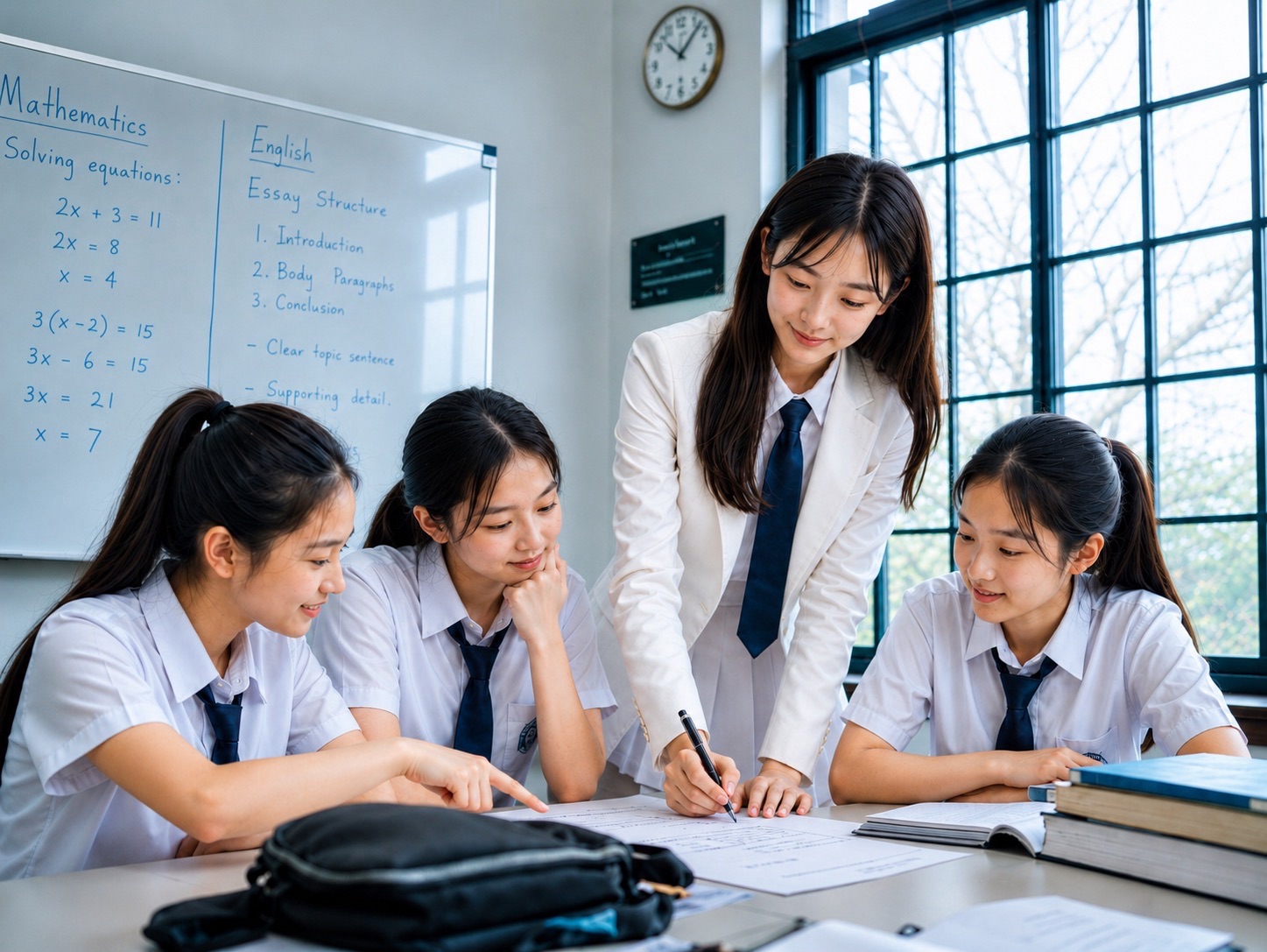
Additional Mathematics is not just a harder subject. It is a route-maker.
Additional Mathematics is not simply harder Mathematics. It is a router subject that trains students to see hidden structure, control algebra, understand functions, manage examination pressure and prepare for future academic pathways.
In Secondary 3, many students enter Additional Mathematics thinking it is simply “more difficult Maths”.
Then the subject changes the rules.
The questions look shorter, but the thinking is deeper.
The algebra looks familiar, but the manipulation is less forgiving.
The graph looks simple, but the behaviour hidden inside it matters.
The formula is available, but the route is not always obvious.
This is why Additional Mathematics is one of the most important corridor subjects in upper secondary education. It does not only test whether a student can calculate. It tests whether the student can see structure, manage pressure, choose methods, recognise hidden routes, and carry a difficult problem from beginning to end.
At eduKateSG Bukit Timah, we see A-Math as a router subject.
A router subject does not decide a child’s entire future. No single subject does. But it can influence which doors are easier to open later, which academic pathways feel more natural, and which future fields become more approachable.
Additional Mathematics sits at the junction between school Mathematics and higher-level thinking. It supports future readiness for JC Mathematics, Polytechnic STEM courses, computing, data, engineering, economics, finance, sciences, architecture, design systems, artificial intelligence, modelling, and other fields where students must understand how systems behave.
But before A-Math becomes useful, it must first become clear.
That is where good tuition matters.
Not more panic.
Not more worksheets for the sake of worksheets.
Not more noise.
Proper Bukit Timah Additional Mathematics Tuition should help the student see the route.
Why Bukit Timah parents search for A-Math tuition early
Bukit Timah is an education-dense area. Many students are surrounded by strong schools, capable classmates, high expectations, and fast-moving academic environments.
That can be powerful.
It can also be deceptive.
A student may appear to be coping because homework is completed, lessons are attended, and the child still “sort of understands” what is happening in class. But A-Math gaps often hide quietly at first.
The student may say:
“I understand when the teacher explains, but I cannot do it alone.”
“I know the formula, but I do not know when to use it.”
“I can do the example, but not the exam question.”
“I make careless mistakes.”
“I just need more practice.”
Sometimes that is true. But often, the problem is deeper.
The child may not be seeing the hidden structure of the question. The issue is not effort alone. The issue is route recognition.
In A-Math, the question is rarely only what it looks like on the surface. A quadratic question may be testing curve behaviour. A trigonometry question may be testing identity control. A differentiation question may be testing change, turning points, tangents, normals, or optimisation. A graph question may be testing transformation, not drawing.
The danger is that a student can continue doing homework while misunderstanding the real system underneath.
By the time the marks fall, the weakness has usually been growing for some time.
Secondary 3: where the corridor begins
Secondary 3 Additional Mathematics is a phase shift.
Students move from lower-secondary Mathematics, where many questions are direct and procedure-based, into a subject where algebra becomes the operating language.
A-Math requires students to manipulate expressions confidently. It expects them to handle unknowns without panic. It asks them to transform equations, read functions, connect topics, understand graphs, and reason across several steps.
For many students, the real shock is not the content.
It is the load.
There are more symbols to hold in the mind.
There are more steps where mistakes can enter.
There are more topics that link together.
There is less tolerance for weak algebra.
There is more pressure to recognise the correct starting move.
A good Sec 3 A-Math tuition programme in Bukit Timah should therefore do more than “follow school”.
It must build the machinery.
That means repairing algebra early, teaching the meaning behind functions, slowing down where the student’s foundation is weak, and then speeding up once the route becomes stable.
A-Math rewards students who can see patterns across topics. It punishes students who only memorise examples.
So in Secondary 3, the goal is not simply to survive the first few tests.
The goal is to build a student who can enter Secondary 4 without carrying a heavy bag of hidden weaknesses.
Secondary 4: when A-Math becomes examination warfare
Secondary 4 is different.
By Sec 4, the subject becomes a national examination mission.
The student is no longer only learning chapters. The student is now fighting for marks under time pressure, across mixed topics, with full-paper discipline.
This is where many students realise that “knowing the topic” and “scoring in the paper” are not the same thing.
A student may know differentiation, but lose marks because the question links it to tangents, normals, stationary points or rates of change.
A student may know trigonometric identities, but freeze when the expression needs transformation.
A student may know logarithms, but fail to see the equation route.
A student may know how to integrate, but lose accuracy when area, limits, curve behaviour and sign are involved.
Sec 4 A-Math tuition must therefore shift from foundation-building into examination control.
The questions become:
Can the student identify the topic quickly?
Can the student decide the route without wasting time?
Can the student show working clearly enough to protect method marks?
Can the student recover if a question becomes difficult?
Can the student avoid spending too long on one battle and losing the whole paper?
Can the student complete Paper 1 and Paper 2 with enough accuracy, stamina and calm?
This is why Secondary 4 Additional Mathematics Tuition in Bukit Timah must be strategic.
It is not only about doing more papers.
It is about knowing what each paper is asking the student to prove.
A-Math is a hidden-system subject
Elementary Mathematics and Additional Mathematics are both important. But they train different forms of thinking.
E-Math is broad. It builds core mathematical fluency across many useful areas: number, algebra, geometry, measurement, statistics, probability, graphs and real-world problem-solving.
A-Math is narrower but deeper. It moves students into algebraic structure, advanced functions, trigonometry, coordinate geometry, differentiation and integration.
That is why a student can do well in E-Math and still struggle in A-Math.
The student is not necessarily weak.
The student may simply have entered a new operating system.
In E-Math, the route is often more visible.
In A-Math, the route is often hidden.
In E-Math, students can sometimes rely on careful substitution and familiar templates.
In A-Math, students must transform the problem until the structure reveals itself.
In E-Math, broad competence matters.
In A-Math, symbolic control matters.
This is the real reason parents should not wait too long when a child starts to struggle. The longer the student practises A-Math without understanding the system, the more the wrong habits become normal.
A-Math tuition should interrupt that early.
The three major worlds inside Additional Mathematics
A-Math is often experienced by students as many separate chapters.
Quadratics.
Surds.
Polynomials.
Logarithms.
Trigonometry.
Coordinate geometry.
Differentiation.
Integration.
But the subject is better understood as three connected worlds.
1. Algebra: control of unknowns
Algebra is the engine room of A-Math.
If algebra is weak, everything else becomes harder.
A student who cannot factorise cleanly will struggle with equations. A student who cannot handle fractions will struggle with partial fractions. A student who cannot manipulate expressions will struggle with logarithms, trigonometry and calculus. A student who makes careless sign errors will lose marks across the whole subject.
This is why we treat algebra as more than a chapter.
It is a weapon of clarity.
The student must learn to move symbols without damaging meaning. Every line of working must preserve the truth of the previous line. The student must know what can be changed, what must remain invariant, and when a transformation is legal.
A-Math trains this discipline.
It teaches the student that power comes from control.
2. Functions and graphs: machines of behaviour
Functions are not just equations.
They are machines.
An input goes in.
A behaviour comes out.
Linear, quadratic, exponential, logarithmic and trigonometric functions all behave differently. Each has a shape, direction, rhythm, restriction, pattern and meaning.
When students understand functions properly, A-Math becomes less frightening. They stop seeing random equations and start seeing systems.
A quadratic function can model a projectile or optimisation problem.
An exponential function can model growth or decay.
A logarithmic function can compress large scales.
A trigonometric function can describe cycles, waves and periodic behaviour.
A derivative can describe how a quantity is changing.
An integral can describe accumulation or area.
This is why A-Math connects to future fields.
Coding, modelling, economics, engineering, physics, AI and data all depend on understanding how systems respond to inputs.
Functions are one of the first places where students learn this clearly.
3. Calculus: the mathematics of change
Calculus is where many students begin to see the deeper purpose of A-Math.
Differentiation is not just a technique. It is a way of reading change.
It tells us about gradient, direction, turning points, increasing and decreasing behaviour, maximum and minimum values, tangents, normals, rates of change and optimisation.
Integration is not just reverse differentiation. It is a way of reading accumulation, area and total effect.
Together, differentiation and integration teach students that the world is not static.
Things rise.
Things fall.
Things accelerate.
Things slow down.
Systems reach limits.
Curves turn.
Small changes accumulate into large effects.
This is not only useful for examinations.
It is useful for thinking.
A student who understands calculus learns to ask better questions about change. That is a powerful habit.
Why memorising fails in A-Math
Many students try to survive A-Math by memorising worked examples.
This can work for a short time.
It fails when the question changes.
A-Math exam questions are designed to test whether students can apply ideas, not merely copy a familiar pattern. The same topic can appear in many forms. The same formula can be hidden behind different wording. The same concept can be linked to another chapter.
This is why a student may complete many practice questions and still feel insecure.
The student has practised appearance, not structure.
Good A-Math tuition must therefore move the student from memorisation to recognition.
The tutor must help the student ask:
What is the question really testing?
What information is given?
What condition matters?
What form should this expression become?
Which topic is hidden inside this wording?
What must remain true after each transformation?
Where are marks likely to be awarded?
What mistake is this question trying to tempt me into making?
When students learn to recognise the route, they become calmer.
They are no longer walking blindly through the paper.
The mistake ledger: turning errors into data
In A-Math, mistakes are not just failures.
They are information.
A repeated mistake is a signal. It tells us what needs repair.
Some mistakes are conceptual. The student does not understand the topic.
Some mistakes are procedural. The student knows the idea but cannot carry out the steps.
Some mistakes are algebraic. The student damages the expression while transforming it.
Some mistakes are recognition errors. The student chooses the wrong route.
Some mistakes are examination errors. The student understands the topic but performs poorly under time pressure.
Some mistakes are confidence errors. The student panics, rushes, guesses or gives up too early.
A good A-Math tutor does not only mark the answer wrong.
A good tutor identifies the species of mistake.
That is how repair begins.
When students learn to track mistakes properly, they stop feeling that A-Math is randomly attacking them. They begin to see patterns in their own thinking. They learn where they are unstable. They learn which habits are costing them marks.
That is when improvement becomes possible.
Rescue, growth and distinction: three different student needs
Not every student comes to A-Math tuition for the same reason.
Some need rescue.
They are falling behind, failing tests, losing confidence and avoiding the subject. For these students, the first priority is not speed. It is stability. We must rebuild foundations, repair algebra, make topics understandable again, and help the student experience small wins.
Some need growth.
They are not failing, but their marks fluctuate. They can do familiar questions but struggle with unfamiliar ones. They understand in class but cannot perform consistently. For these students, the priority is route recognition, mixed-topic practice, stronger working and better revision habits.
Some need distinction.
They are already capable, but they want cleaner precision, faster thinking, harder question variation and better examination control. For these students, the priority is stretch, refinement and strategic mark protection.
Good Bukit Timah A-Math tuition must know which student is sitting at the table.
A rescue student should not be treated like a distinction student.
A distinction student should not be held back by rescue pacing.
A growth student should not be left drifting in the middle.
The support must match the student’s actual problem.
Why small-group A-Math tuition can help
A-Math is a subject where students need to ask questions.
But many do not.
They may feel embarrassed. They may not know how to explain what they do not understand. They may fear looking weak in front of classmates. They may have already decided that they are “not an A-Math person”.
Small-group tuition helps because the tutor can see more.
The tutor can notice the student’s working.
The tutor can catch the repeated algebra error.
The tutor can ask why a method was chosen.
The tutor can correct the route before the mistake becomes permanent.
The tutor can slow down for a weak foundation and speed up when the student is ready.
A-Math improvement often depends on tiny corrections made consistently.
A missing bracket.
A wrong sign.
A poor starting route.
A skipped condition.
A misunderstood graph.
A formula used without meaning.
A careless final answer.
These small things become large things in an examination.
Small-group tuition gives space for those corrections to happen properly.
What parents should watch for
Parents do not need to know every A-Math topic to know when help is needed.
Watch the pattern.
If your child understands in class but cannot do questions independently, the issue may be route recognition.
If homework takes too long, the issue may be starting strategy.
If algebra mistakes keep returning, the issue may be foundation control.
If marks fluctuate widely, the issue may be examination stability.
If your child avoids unfamiliar questions, the issue may be confidence and transfer.
If your child relies heavily on answer keys, the issue may be independence.
If your child says “I know it, but I cannot score,” the issue may be paper technique, working discipline and pressure control.
These are repairable problems.
But they must be named clearly.
What good Bukit Timah Additional Mathematics Tuition should do
Good A-Math tuition should not simply add more work.
It should create clarity.
It should help students understand the subject as a connected system.
It should repair the algebra that carries the whole subject.
It should teach students to recognise question types without becoming trapped by memorisation.
It should show why functions behave the way they do.
It should make trigonometry less like magic and more like signal control.
It should make calculus meaningful as the study of change.
It should help students protect method marks through clear working.
It should train exam timing and recovery.
It should turn mistakes into useful feedback.
It should build confidence without pretending the subject is easy.
Additional Mathematics is difficult.
But difficulty is not the enemy.
Unclear difficulty is the enemy.
Once a student sees the structure, difficulty becomes training.
A-Math and the future corridor
Students often ask, “When will I use this?”
That is a fair question.
Not every student will use every A-Math technique directly in adult life. But the deeper value of A-Math is not only the specific technique.
It is the discipline of thinking.
A-Math teaches students to handle abstraction.
It teaches them to stay calm with unknowns.
It teaches them to follow a chain of reasoning.
It teaches them to transform problems without losing meaning.
It teaches them to work carefully under pressure.
It teaches them that complex systems can be understood if approached correctly.
These are future skills.
In a world increasingly shaped by data, automation, computation, economics, modelling, engineering, science and artificial intelligence, students benefit from learning how systems behave.
A-Math is one of the first serious training grounds for that.
This is why we call it a router subject.
It routes the student not only into future courses, but into a stronger way of thinking.
For Bukit Timah students: the aim is not panic. The aim is control.
Bukit Timah students often live in an environment of strong expectations.
That can motivate them.
But pressure without clarity can become fear.
At eduKateSG Bukit Timah, our aim is to help students become clearer, steadier and more capable. We want them to catch up where foundations are weak, keep up with school demands, and move ahead when they are ready.
A-Math should not become a subject that quietly breaks confidence.
It should become a subject that trains discipline.
When properly taught, Additional Mathematics can help students discover that hard problems are not walls.
They are systems.
And systems can be read.
Closing thought: the route matters
In Additional Mathematics, the final answer matters.
But the route builds the student.
A student who memorises answers may survive one familiar question.
A student who understands the route can keep moving when the question changes.
That is the deeper value of Bukit Timah Additional Mathematics Tuition.
It is not only about getting through the next worksheet. It is about helping the student see hidden structure, carry pressure properly, repair mistakes honestly, and prepare for the future corridors that require disciplined mathematical thinking.
Additional Mathematics is not just harder Mathematics.
It is where many students first learn how to think inside a system.
And once they can see the system, they can begin to move with confidence.
Bukit Timah Additional Mathematics Tuition for Secondary 3, Secondary 4, G3 and O-Level students. Learn why A-Math is a router subject for algebra, functions, calculus, exam strategy and future pathways.
FAQ
Is Additional Mathematics just harder E-Math?
No. Additional Mathematics is not only harder. It is structurally different. E-Math builds broad mathematical fluency, while A-Math trains deeper abstraction, algebraic transformation, functions, trigonometry, calculus and route recognition.
Why do good E-Math students sometimes struggle with A-Math?
Good E-Math students may struggle because A-Math uses a different operating system. The questions often hide the route, and students need stronger algebra, topic linkage, symbolic control and independent problem-solving.
When should parents consider A-Math tuition?
Parents should consider support when the student understands in class but cannot solve independently, repeatedly makes algebra errors, relies heavily on answer keys, avoids unfamiliar questions, or loses marks under exam timing.
Is Secondary 3 too early for A-Math tuition?
Secondary 3 is often the best time to correct weak habits because this is where A-Math foundations are formed. Early repair prevents small gaps from becoming large Sec 4 examination problems.
What should Sec 4 A-Math tuition focus on?
Sec 4 A-Math tuition should focus on examination strategy, mixed-topic recognition, timing, working clarity, method marks, accuracy, full-paper stamina and recovery when difficult questions appear.
Can strong students benefit from A-Math tuition?
Yes. Strong students may need higher-level question variation, faster route recognition, cleaner working, stronger proof-like reasoning and better distinction-level examination precision.
What makes A-Math important for future pathways?
A-Math builds readiness for higher Mathematics and fields that depend on systems thinking, including sciences, engineering, computing, economics, finance, data, AI and modelling. Its deeper value is the disciplined thinking it develops.
What does good A-Math tuition repair?
Good A-Math tuition repairs weak algebra, poor topic linkage, unclear routes, careless working, formula memorisation without meaning, exam panic and unstable revision habits.