
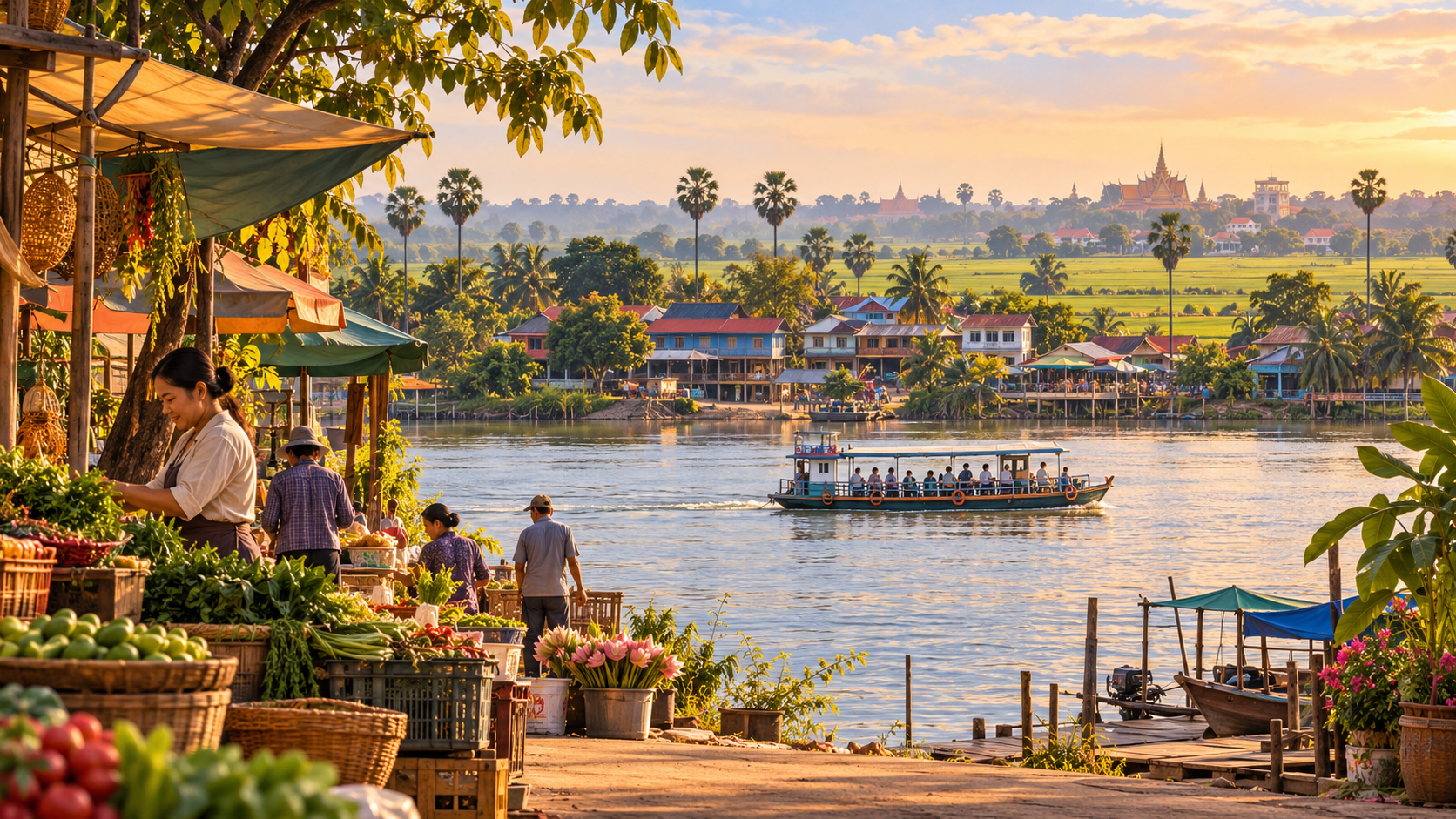
Cambodia Children Vocabulary | Words for Character and Nation Building explores twenty useful English words through Angkor’s water systems, Cambodia’s krama weaving, Lkhon Khol theatre and Tonle Sap’s seasonally changing habitats.
For international children around 8–12 years old. This independent guide is not a Cambodian national curriculum or permission to perform cultural rituals, enter protected ruins or undertake wetland fieldwork. Classroom stories and sentences are original fictional teaching material.
UNESCO documents the Angkor archaeological landscape, recognised krama weaving in 2024, listed Lkhon Khol Wat Svay Andet for urgent safeguarding in 2018 and designated Tonle Sap as a biosphere reserve in 1997.
Here ‘character and nation building’ means being accurate about history, giving practitioners credit, understanding environmental care and correcting unsupported statements. It does not call for political loyalty or claim that all Cambodians share one experience.
Quick answer: what will children be able to do?
| Element | Learner skill | Boundary |
|---|---|---|
| 20 vocabulary words | Define, compare and use terms meaningfully | Memorisation is not comprehension |
| Four verified reading themes | Explain the source fact and a safe related action | One example never represents an entire nation |
| Fictional story and six checks | Identify and fix an unsourced claim | Imaginary characters are not real historical witnesses |
| Seven days of short practice | Retrieve, speak, read, write and transfer meanings | Protected-site work belongs to trained adults |
Jump to words · four chapters · story · checks · study plan · adult guidance · FAQs · sources.
20 English vocabulary words for children: meanings and original examples
Learn five connected words at a time. Each definition provides a boundary against a tempting misuse. Original examples are teaching material rather than reports of real pupils.
1. Angkor: temples, canals and historical water management
| Word | Meaning and important distinction | Model sentence |
|---|---|---|
| Angkor | Cambodia’s large archaeological landscape of former Khmer capitals and temples; not one solitary temple. | Angkor includes famous monuments and water structures. |
| reservoir | A basin made or managed to store water; not simply any natural puddle. | Angkor’s historic reservoirs were part of water management. |
| canal | A constructed channel used to carry or direct water; not the same as a natural river. | The model showed a canal linking water features. |
| archaeology | Investigation of the past through material remains and their contexts, rather than imagined stories. | Archaeology helps explain how Angkor changed. |
| stewardship | Care that respects a shared place and its rules; not permission to repair monuments without training. | A pupil practised stewardship by reading the site rules. |
2. Krama: skilled weaving and living cultural knowledge
| Word | Meaning and important distinction | Model sentence |
|---|---|---|
| krama | A Cambodian woven rectangular textile with different traditional and everyday uses; not a uniform everybody wears identically. | The class studied UNESCO’s krama tradition. |
| handloom | A human-operated device for weaving threads into cloth, not a machine printing an image. | A weaver used a handloom to make the pattern. |
| warp | Threads arranged lengthwise on a loom; not the crosswise ones. | The paper model labelled the warp threads. |
| weft | Threads moved across the warp to construct fabric; not a layer of ink. | The weft crossed the warp to form a grid. |
| craftsmanship | Skilled planning and judgement involved in making things well, not just a bright appearance. | The exhibit credited the weaver’s craftsmanship. |
3. Lkhon Khol Wat Svay Andet: community-based masked theatre
| Word | Meaning and important distinction | Model sentence |
|---|---|---|
| Lkhon Khol | A Khmer masked-theatre form; the specific Wat Svay Andet element belongs to a particular practising community. | The poster named the Lkhon Khol tradition precisely. |
| Wat Svay Andet | The Buddhist monastery associated with a specific UNESCO-listed masked-theatre practice; not the name of all Cambodian temples. | The map marked Wat Svay Andet near the Mekong. |
| masked theatre | A dramatic performance using masks along with other theatrical components, not an ordinary costume party. | Masked theatre can require skilled movements and music. |
| recitation | Spoken or chanted text performed deliberately, rather than random loud speech. | Traditional recitation forms part of the performance. |
| safeguarding | Supporting the continuation of living heritage through people, spaces and teaching, not merely storing an object. | Teaching younger practitioners helps safeguarding. |
4. Tonle Sap: seasonal flooding, wildlife and evidence
| Word | Meaning and important distinction | Model sentence |
|---|---|---|
| Tonle Sap | The large Cambodian freshwater lake and surrounding biosphere-reserve landscape; not a lake of unchanging size. | Tonle Sap expands during wetter periods. |
| floodplain | Lower land beside water that is inundated during high-water periods, not necessarily flooded all the time. | The wet-season diagram covered part of the floodplain. |
| seasonal | Changing in relation to a pattern of times in the year, not one random event. | Water levels vary seasonally. |
| freshwater swamp | A wetland influenced by freshwater, not an ordinary dry walking path. | The protected area includes freshwater swamps. |
| monitoring | Comparing systematic observations over time or place, not trusting one photograph. | Monitoring requires dates and comparable methods. |
Four country-grounded chapters: understand, explain and transfer
Each chapter explains five terms with a credible factual anchor and a child-safe activity. The practice must never be mistaken for an authentic cultural ritual, a live environmental survey or professional heritage maintenance.
1. Angkor includes waterworks, temples and evidence of changing Khmer capitals
Focus words: Angkor · reservoir · canal · archaeology · stewardship.
UNESCO’s World Heritage entry describes Angkor as a broad archaeological landscape in the Siem Reap area, containing temples, reservoirs, dykes, canals and routes from former Khmer capitals. The property covers approximately 400 square kilometres. Angkor Wat is a celebrated temple in this landscape; the name Angkor does not mean only that one building. Children who see an iconic photograph can learn to ask what lies outside the picture, including water systems and the places in which people lived and worked.
A reservoir stores water, while a canal conveys or directs it. Their roles differ even where they are connected. UNESCO’s description discusses hydraulic structures within the Khmer capital landscape. This helps learners understand that history is not only a list of rulers and famous façades. People also needed systems that related water, settlement, agriculture and other activities. The exact function of a particular structure needs archaeological and scientific evidence, not a guess from the shape of a blue rectangle on a simplified school map.
Archaeology uses physical remains and context to investigate the past. Buildings may have been constructed, altered, repaired or abandoned during different periods. UNESCO connects Angkor with the Khmer capitals from the ninth to the fifteenth centuries. This does not make every temple, canal and reservoir exactly the same age. A child could create a timeline showing several phases, but should not assign an invented construction date to an unnamed stone structure simply to fill the page. Accurate history allows uncertainty where the source does not provide an exact answer.
There is a distinction between an observation, a source-supported fact and a reconstruction. An observation could be, ‘The photograph shows a stone structure near water’. A sourced statement could be, ‘UNESCO documents hydraulic structures at Angkor’. A reconstruction might depict workers planning canals, but such a drawing must clearly be described as an interpretation or fictional illustration if the details are not independently established. The convincing appearance of a drawing does not turn it into an original historic photograph.
Stewardship means taking responsible care of a valued place. UNESCO describes significant safeguarding efforts at Angkor and its surroundings. Visiting children should follow authorised routes and instructions rather than climbing unstable structures, taking stones or attempting repairs. The relevant heritage managers, specialists and local communities carry responsibilities that no classroom model can replace. Respect is shown when a learner understands the reasons behind protection, not by undertaking dangerous hands-on work.
Imagine a fictional school sign reading, ‘Angkor is one temple and all the other structures are empty drains that children should clean’. This contains two problems. It misunderstands the scale of the World Heritage site, and it invites unauthorised intervention. A corrected caption could say, ‘Angkor is a large Khmer archaeological landscape with temples, reservoirs and canals. Archaeologists and heritage managers study and care for these remains’. The improved statement is useful because it identifies the place and the roles of evidence and expertise.
Ancient infrastructure also depended on workers, craftspeople, communities and specialised knowledge. A popular history illustration may show a ruler standing in front of a temple, but it cannot replace the experience of everyone who constructed or maintained it. A child can name the kinds of labour required without inventing the diary of a particular historical person. This is a practical habit of giving human contributions appropriate dignity.
For a classroom activity, draw a fictional rectangular reservoir and two canals connecting to a settlement. Label the diagram ‘general water-system model’ so that readers do not mistake the invented layout for a documented reconstruction of Angkor. Next, write a separate sentence using UNESCO as the source for actual features. Ask what evidence would be needed before claiming that your exact layout existed. The two tasks make the same vocabulary meaningful in different ways.
Finally, compare a historic water system with an ordinary school water fountain. The underlying concept of maintaining useful infrastructure can transfer, but pupils should not pretend that a school fountain and a Khmer hydraulic network have the same scale, technology or history. The useful common idea is that shared systems need informed design, care and accurate explanations.
Precision repair: Incorrect: ‘Angkor is only one temple, and all canals and reservoirs there were made at exactly the same moment.’ Repair: ‘UNESCO documents a much larger Khmer archaeological landscape with different hydraulic and built features.’
Safe transfer task: Build an original paper diagram of a canal and reservoir, identify which shapes are fictional, and write one separately sourced sentence about real Angkor.
2. Krama textile traditions connect familiar objects with skilled makers
Focus words: krama · handloom · warp · weft · craftsmanship.
UNESCO recognised krama, the Cambodian rectangular woven textile tradition, in 2024. Its description explains that krama can be produced using cotton or silk, often in grid patterns, and may serve many everyday and cultural purposes. That does not mean every Cambodian household has the same colour, material or routine, or that every checked cloth found anywhere is an authentic krama. A named cultural tradition has a particular history and community knowledge behind it.
A handloom helps a weaver interlace warp and weft threads. The warp runs lengthwise, while weft threads cross it. UNESCO describes manual weaving and methods of preparing materials and dyeing fibres. This is different from printing squares onto a finished piece of cloth or gluing coloured paper onto cardboard. A child can learn the general concept of weaving from a simple model, but that model is not proof of the actual method used for an individually photographed garment.
Craftsmanship involves developed judgement: selecting materials, controlling tension, arranging threads, maintaining patterns and finishing a product. The finished cloth may look simple to an inexperienced viewer, but the making process can require many careful decisions. An article that says ‘the country made this scarf’ hides the skilled weaver, the person maintaining the loom and those involved in producing materials. More informative writing credits practitioners and explains which parts of the process are known.
UNESCO describes how knowledge of krama production has passed within families and later through professional producers, community organisations and educational activities. It notes the participation of women and men in different stages. This is documentation of a practice, not a rule that every girl must weave or that a child’s home responsibilities should replace schooling. The learners in an international classroom should be free to ask questions and explore technical words without being forced into a traditional role.
The same rectangle of cloth can have different uses depending on the person and occasion. It might serve as a scarf, belt, blanket or another type of everyday item. The existence of several uses does not make every use safe for children to demonstrate. UNESCO’s mention of traditional use as a hammock in some contexts, for example, is not an instruction to support a person’s body in a classroom scarf. The educational purpose is descriptive vocabulary, not unsupervised experimentation.
Imagine a student studies a photograph of a red-and-white cloth and writes, ‘The pictured krama was woven by a named family at exactly nine in the morning’. Unless the source provides that provenance, those details are invented. A truthful label might say, ‘The photograph shows a grid-patterned cloth. UNESCO describes traditional krama handloom weaving. The individual maker and date are not known from this image’. That is strong descriptive writing because it separates the general tradition from an unsupported claim about one object.
Respectful source work also requires permission. A picture of a living craftsperson does not automatically grant permission to copy the photo to any website, or to publish their name and personal details without appropriate consent. A learner can cite UNESCO’s public description and create an original pattern while marking the latter as a classroom invention. Giving credit and recognising limits are important ways to show character.
For a safe model, children interlace strips of differently coloured paper. Draw an arrow for the lengthwise warp and another for crossing weft. Ask whether the finished paper is cotton or silk, whether it required a traditional handloom, and whether it reproduces a particular Cambodian maker’s technique. The answer is no; it is a conceptual model. A good pupil can value the exercise and still state its limits.
To finish, compare two captions. ‘Krama is a national cloth everyone wears exactly the same way’ generalises too much. ‘Krama is a Cambodian woven textile tradition with varied uses and practised skills recognised by UNESCO in 2024’ describes the element within its sourced scope. A child who can explain the difference has learnt how to respect a familiar object without stereotyping a country’s people.
Precision repair: Incorrect: ‘Krama is simply any printed checked scarf worn identically by all Cambodians.’ Repair: ‘It is a particular woven textile practice with skilled makers, diverse designs and multiple uses.’
Safe transfer task: Weave strips of paper as an original model and explain the technical role of warp and weft; label the model as classroom work, not an authentic krama product.
3. Lkhon Khol Wat Svay Andet needs community transmission, not imitation
Focus words: Lkhon Khol · Wat Svay Andet · masked theatre · recitation · safeguarding.
UNESCO placed Lkhon Khol Wat Svay Andet on its List of Intangible Cultural Heritage in Need of Urgent Safeguarding in 2018. The entry identifies a specific community around Wat Svay Andet, a Buddhist monastery located near the Mekong east of Phnom Penh. It is not a label for every mask dance or theatrical performance in Cambodia. The fact that the element was inscribed in 2018 does not mean its practice began then or disappeared that year. It means an existing tradition was formally recognised as needing continued attention.
Masked theatre is a form of performance combining masks with movement and other dramatic elements. UNESCO describes trained men performing Lkhon Khol with a traditional orchestra and melodic recitation. Recitation is the deliberate delivery of words or a text, rather than random speech. A child might study the role of a narrator or a performer but should not claim to have mastered the art after watching a short video. Stage skill and community knowledge are more complex than one visible movement.
Safeguarding means helping living knowledge continue through practitioners, training, space and appropriate opportunities. UNESCO’s committee reviewed progress in 2023, acknowledging work to support the community and its bearers, provide resources and pass knowledge to young people. It encouraged further support while respecting the tradition’s spiritual meaning and community-based management. These details explain why simply putting a mask in a glass case is not enough to sustain a performance practice.
Because the element has a religious and cultural context, an international English lesson should not treat it as a costume game or require learners to participate in a ritual. Children can describe what practitioners regard as significant without adopting a belief themselves. Their responsibility is to use words accurately and respect the community’s ability to explain its own heritage. If a practice involves permissions or contexts not clear to outsiders, the class should not invent a procedure and call it authentic.
A photograph of a mask has limits. It cannot prove where every performance took place, which individual made the mask or how the theatre’s meaning is understood by everyone who sees it. The specific source matters. A teacher should verify that an image actually depicts Lkhon Khol Wat Svay Andet rather than a different Khmer performing art. A weak caption begins ‘This is all Cambodian theatre’. A stronger one names the community, practice and UNESCO listing while leaving unknown performer details honest.
Similarly, an undated clip cannot establish that a tradition has stopped or fully recovered. A recorded performance is one point in a larger history of teaching and practice. UNESCO’s reports discuss safeguarding activities, and readers must distinguish a plan, an activity that was undertaken and evidence about continuing participation. ‘A training programme was supported’ and ‘all safeguarding concerns have disappeared’ are different claims. Responsible writing keeps the scope of the evidence visible.
For a safe exercise, students may invent a secular paper-character drama in English using simple narration. The piece must be labelled ‘original classroom storytelling exercise’, not ‘Lkhon Khol performance’. They can compare the general terms mask, theatre and recitation with UNESCO’s documented features and then explain which elements their exercise does not reproduce. This gives children learning access without claiming the authority of the community’s practitioners.
Another task is to prepare a four-line festival programme note. It should identify Wat Svay Andet, the cultural form, the role of trained performers and the urgent-safeguarding status. A fifth line could explain one question only a knowledgeable practitioner could answer. The pupil should not fill that question with an invented explanation merely to sound complete. Curiosity can be respectful when it recognises who holds the knowledge.
End with the difference between celebrating an artwork and caring for its transmission. Public attention can be useful, but living traditions are sustained by people with time, skills, spaces and relationships. In a children’s guide, the best character lesson is giving practitioners credit while declining to present a short imitation as authentic.
Precision repair: Incorrect: ‘Any class wearing masks can claim to perform the UNESCO Lkhon Khol Wat Svay Andet ritual.’ Repair: ‘The listing concerns a specific community and its trained theatre tradition; classroom drama is an unrelated learning model.’
Safe transfer task: Write a factual programme caption grounded in UNESCO’s entry, then make a separate original, secular classroom recitation labelled as a model.
4. Tonle Sap demonstrates how season, habitat and monitoring belong together
Focus words: Tonle Sap · floodplain · seasonal · freshwater swamp · monitoring.
UNESCO’s Man and the Biosphere Programme describes Tonle Sap as a Cambodian biosphere reserve established in 1997. It includes the country’s large freshwater lake, floodplains and surrounding wetlands. The region is important to living organisms and to people whose livelihoods are connected with the changing water environment. Tonle Sap is not simply one static blue oval on a classroom map. Water extent and the use of adjacent land can vary with the seasons.
A floodplain is lower land that may become inundated at times of high water. Seasonal change follows a pattern associated with the year. During wetter periods, water can spread across floodplains and wetland vegetation, while a drier period may reveal more land. This does not justify claiming that a place permanently became land or lake based on one photograph. Children should recognise that two images can differ for reasons connected with season and water flow.
UNESCO identifies several habitat categories within the reserve, including the lake, freshwater swamps and floodplains, and seasonally flooded rice fields or grasslands. A freshwater swamp is not just ordinary ground that happens to be a little muddy. It supports water-tolerant plants and organisms and may be dangerous for unsupervised access. Classrooms should use diagrams, reliable descriptions and model maps rather than send children into wetlands to verify vocabulary.
Monitoring is systematic observation repeated across periods or places. One undated photograph does not show whether a lake is ‘shrinking forever’. To evaluate a long-term trend, researchers need comparable observations, dates and methods. A graph made from imaginary numbers can demonstrate the mathematics of comparison, but it must say ‘fictional teaching data’. Attractive charts are not automatically evidence. A responsible writer states where actual measurements came from.
Tonle Sap also involves communities, agriculture, fisheries and environmental management. The biosphere designation does not mean that all residents have left the area or that everyone living nearby shares identical work. Protected-area rules, water issues and livelihood decisions require evidence and consultation by the appropriate authorities and affected people. A child’s task is to understand the concepts and communicate responsibly, not direct actual resource management.
Imagine a school exhibit showing a large wet-season lake photograph and a smaller dry-season lake photograph. A child writes, ‘Tonle Sap lost water permanently in one day’. Another pupil asks which months the images came from, whether the viewpoints match and what records exist for multiple years. The corrected caption says, ‘Water extent changes seasonally; the two photographs alone do not establish a long-term trend’. This is a better explanation of what the images actually support.
Angkor and Tonle Sap both involve water, but their vocabulary has different jobs. Angkor’s reservoirs and canals describe historic constructed infrastructure, while Tonle Sap’s floodplain and freshwater wetlands describe a dynamic natural system. There may be broader regional links, but pupils should not treat a canal as another name for a floodplain. Comparing similarities and differences makes the words more useful than a list memorised in isolation.
For a paper activity, draw two imaginary outlines of the same lake, one labelled a wet-season model and the other a dry-season model. Add a low floodplain and a freshwater swamp. Write what the model illustrates about season, then state what data you would need before claiming it accurately represents Tonle Sap in a particular year. The learner is practising the boundary between a concept and a real research result.
As a final task, write a two-sentence public notice about protecting a wetland. One sentence explains an ecological reason, and the second gives an age-appropriate action such as not disturbing wildlife or following posted guidance. The class should not invent actual Cambodian park regulations. Teaching stewardship through words means understanding why care matters and where professional responsibility begins.
Precision repair: Incorrect: ‘A single photograph proves Tonle Sap has one permanent water level or has suffered an irreversible change.’ Repair: ‘UNESCO describes seasonal floodplain conditions; long-term changes require dated monitoring.’
Safe transfer task: Make original wet- and dry-season diagram cards. Use seasonal, floodplain and monitoring accurately, and label all imagined measurements as fictional.
Fictional story: the class revises its evidence
At a fictional international school, Kiri describes Angkor as just one temple. Her teacher shows UNESCO’s wider archaeological property and the class adds historic reservoirs and canals. Nita shows a coloured grid printed on paper and calls it an authentic krama, but another pupil explains why a real woven fabric uses warp, weft and handloom skills. Veasna suggests the class copy a sacred masked theatre performance after watching an unidentified video; they instead write a source-backed note on Lkhon Khol Wat Svay Andet and a separate original drama. Finally, Dara compares two Tonle Sap photographs and declares permanent change without knowing their dates. The group corrects the caption by asking about seasonal conditions and monitoring. All pupils and activities are invented; real heritage facts are linked below.
Four reading questions
- 1. Why is the Angkor World Heritage property larger than Angkor Wat alone?
- 2. What part of Nita’s paper model made ‘authentic krama’ an inaccurate label?
- 3. How could the group study Lkhon Khol respectfully without claiming to perform it?
- 4. Why did Dara’s lake claim need dates and longer-term observations?
Ask the child to justify each answer with a detail from the fictional story. Then ask which statement about Cambodia is established by an official source; the invented pupils’ conversations are not historical records.
Six vocabulary checks with worked answers
Check 1: Does Angkor mean only the Angkor Wat temple?
Worked answer: No. UNESCO identifies a broad landscape with multiple capitals, temples and historic hydraulic structures.
A full response identifies the relevant source or observation, explains which misleading alternative has been excluded and makes an original sentence in a different setting. Correct reasoning counts more than merely copying a word.
Check 2: Which two kinds of threads are interlaced in weaving?
Worked answer: Warp threads lengthwise and weft threads across them.
A full response identifies the relevant source or observation, explains which misleading alternative has been excluded and makes an original sentence in a different setting. Correct reasoning counts more than merely copying a word.
Check 3: In what year did UNESCO recognise Cambodian krama practices?
Worked answer: 2024, on the Representative List of the Intangible Cultural Heritage of Humanity.
A full response identifies the relevant source or observation, explains which misleading alternative has been excluded and makes an original sentence in a different setting. Correct reasoning counts more than merely copying a word.
Check 4: Which UNESCO list includes Lkhon Khol Wat Svay Andet?
Worked answer: The List of Intangible Cultural Heritage in Need of Urgent Safeguarding, inscribed in 2018.
A full response identifies the relevant source or observation, explains which misleading alternative has been excluded and makes an original sentence in a different setting. Correct reasoning counts more than merely copying a word.
Check 5: Was Tonle Sap designated as a biosphere reserve in 1997?
Worked answer: Yes. UNESCO identifies its lake and surrounding floodplain and wetland habitats.
A full response identifies the relevant source or observation, explains which misleading alternative has been excluded and makes an original sentence in a different setting. Correct reasoning counts more than merely copying a word.
Check 6: Can two undated lake photographs establish a permanent change?
Worked answer: No. Seasonal patterns, measurement dates and repeated monitoring must be considered.
A full response identifies the relevant source or observation, explains which misleading alternative has been excluded and makes an original sentence in a different setting. Correct reasoning counts more than merely copying a word.
Seven-day plan for learning and transferring vocabulary
| Day | Task | Evidence of progress |
|---|---|---|
| 1 — Notice | Read words 1–5; state one correct meaning and one non-example. | An independent explanation |
| 2 — Speak | Use words 6–10 in original everyday sentences. | Clear, context-appropriate speech |
| 3 — Source | Read a short official passage with a trusted adult. | One supported fact and one unanswered question |
| 4 — Compare | Study words 11–15 and sort claims as observed, sourced, fictional or unknown. | No invented facts presented as history |
| 5 — Decide | Use words 16–20 to solve an imaginary classroom problem. | One safe responsibility and reason |
| 6 — Write | Write 80–120 words using at least three chosen terms. | Accurate original composition with a source |
| 7 — Transfer | Apply three general words to another school or local environment. | Meaning carries to a new context |
A simple way to assess learning
Ask the learner to define a word in their own terms, correct an almost-right use and create a new sentence. Record each as ‘not yet’, ‘with help’ or ‘independently’. Repeat later. A child who revises a claim after reading a source is demonstrating progress, not weakness.
For parents and teachers: build character with observable habits
- Ground facts in named primary sources. One World Heritage description does not establish how everyone in a country lives.
- Give makers and practising communities credit. Cultural heritage is more than a beautiful object or photograph.
- Respect cultural context. Learners can describe religious or performing traditions without being required to imitate them.
- Keep risky tasks with adults. Archaeology, protected site maintenance and wetland fieldwork require specialist permission and training.
- Do not invent private details. If a maker, time or technique is unknown from a source, say so.
- Make inclusion practical. Readers need understandable explanations, not only warm introductory phrases.
- Reward error correction. A narrowed, accurate caption is a meaningful contribution.
- Practise short spaced retrieval. Five linked terms at a time support meaningful reading and writing.
Frequently asked questions
Is Angkor the same thing as Angkor Wat?
Angkor is the wider archaeological property, which includes Angkor Wat as well as other temples, reservoirs, canals and former capital areas.
Is krama simply a printed grid scarf?
No. UNESCO’s 2024 inscription describes Cambodian krama as a woven textile tradition with skilled makers and several uses.
Why is Lkhon Khol Wat Svay Andet on an urgent safeguarding list?
UNESCO recognised the need to support a particular masked theatre community and the continued transmission of its knowledge.
Does Tonle Sap have one unchanging water level?
No. The UNESCO biosphere description includes seasonally inundated floodplain, freshwater swamps and other changing habitats.
Verified sources, related articles and learning hubs
Country claims were checked against the cited institutional sources as of 23 October 2026. The characters, model sentences and learning tasks are fictional editorial material, not Cambodia’s official curriculum or reports of actual schools. Real access and safety rules require current competent authorities.
- UNESCO World Heritage | Angkor
- UNESCO | Krama woven textile traditions (2024)
- UNESCO | Lkhon Khol Wat Svay Andet (2018)
- UNESCO Committee | Lkhon Khol safeguarding report (2023)
- UNESCO Man and Biosphere | Tonle Sap
- UNICEF | Convention on the Rights of the Child
Read more about Cambodia
- Everything About Cambodia
- How Cambodia Works
- Top 100 Angkor Water Management Vocabulary Words
- Top 100 Krama Weaving Vocabulary Words
- Top 100 Lkhon Khol Masked Theatre Vocabulary Words
A–K country vocabulary branch
Burundi Children Vocabulary · Cabo Verde Children Vocabulary · Cameroon Children Vocabulary · Canada Children Vocabulary
Main vocabulary learning hubs
- Vocabulary Learning Hub
- Vocabulary by Age and Purpose
- How Countries Work | A–Z
- Unique Country Vocabulary Index
A learner should finish this Cambodia guide able to use twenty words, distinguish a documented country fact from an imagined scene, credit specific heritage practitioners and explain one safe improvement to a classroom information task. Accurate language is a practical form of character.