
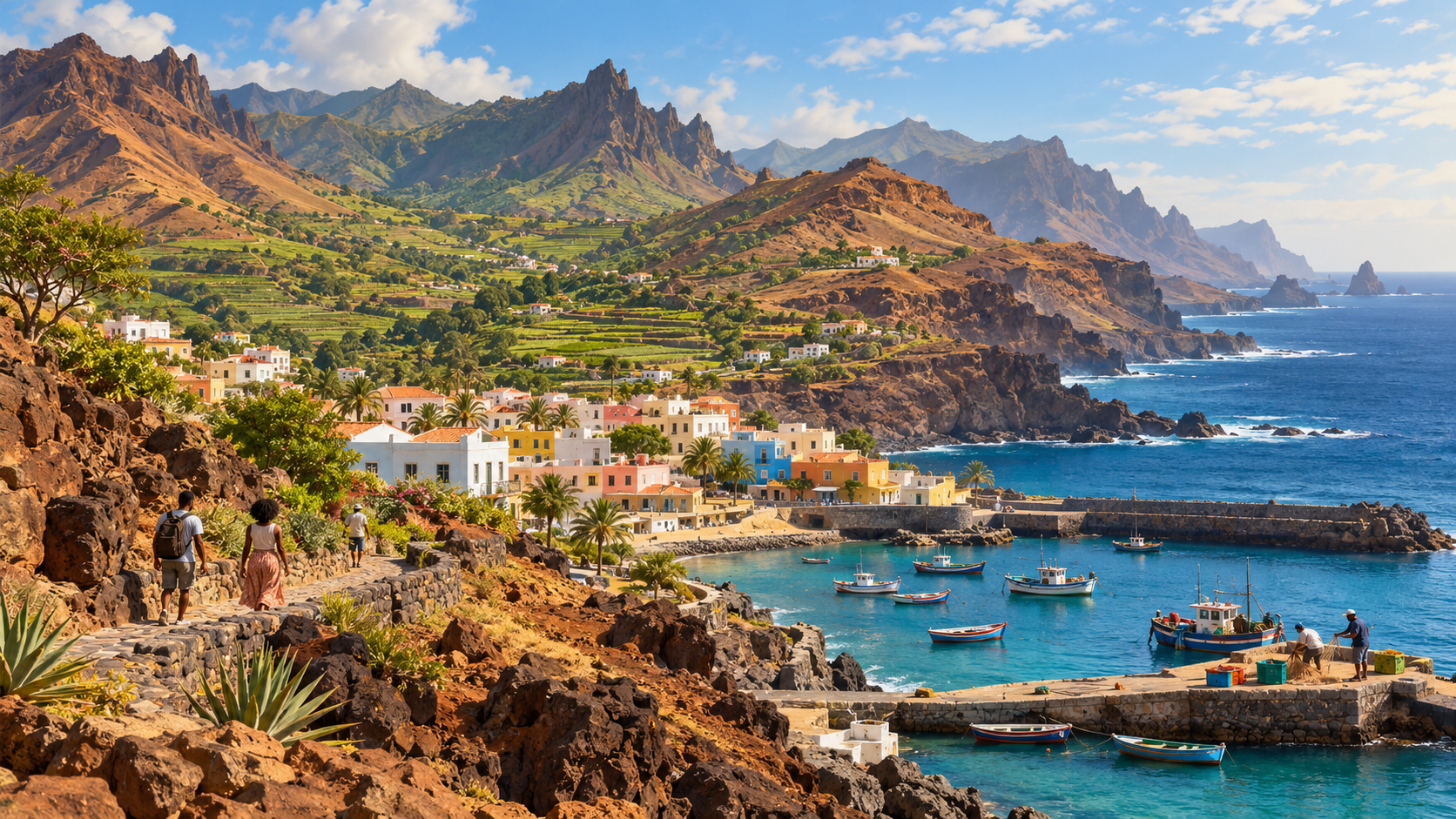
Cabo Verde Children Vocabulary | Words for Character and Nation Building. Twenty child-friendly English words connect a difficult but important Atlantic history, morna’s musical heritage, Maio’s marine habitats and everyday language inclusion.
For international learners around 8–12 years old. This independent resource is not Cabo Verde’s official syllabus, a foreign-language translation guide, a wildlife-access manual or a claim that all residents share the same customs. The model school events below are fictional.
UNESCO lists Cidade Velha as a World Heritage site connected with Portuguese expansion and the trafficking of enslaved African people. UNESCO also recognised morna in 2019 and Maio as a biosphere reserve in 2020. Cabo Verde’s constitution identifies Portuguese as an official language and promotes recognition of the Cabo Verdean mother tongue.
In this guide, character and nation building means learning to tell the truth, credit other people’s skills, treat vulnerable habitats carefully and make information people can understand. It does not require allegiance to a government or a national stereotype.
Quick answer: what children learn
| Part | What children do | What to avoid |
|---|---|---|
| 20 explained words | Define, contrast and use a word accurately | Memorising sound without meaning |
| Four source-based chapters | Separate observation, fact and invention | Treating one island as a whole country |
| Original story and six checks | Explain why a false caption needed repair | Passing fictional pupils off as real witnesses |
| Seven-day study plan | Read, speak, compare, write and transfer words | Asking children to handle adult wildlife or public policy |
Jump to 20 words · four chapters · story · checks · seven-day plan · parent and teacher guidance · FAQ · sources.
20 English vocabulary words for children
Each definition gives a meaning and distinguishes a misleading use. These original example sentences teach language; they are not accounts of real named pupils.
1. Cidade Velha: a historic port and its complete human story
| Word | Meaning and distinction | Original example |
|---|---|---|
| archipelago | A chain or group of islands, rather than one island or continent. | Cabo Verde is an Atlantic archipelago. |
| Santiago | The island where the historic town Cidade Velha is located; not the whole country. | Santiago appears on the class map. |
| colonial outpost | A place established by an outside colonial power; not merely an old coastal town. | The UNESCO source describes an early colonial outpost. |
| enslavement | The forced treatment of people as property, not a job chosen freely. | The history caption named enslavement clearly. |
| remembrance | Taking truthful care in remembering past people and difficult experiences, not only celebrating grand buildings. | The exhibition included respectful remembrance. |
2. Morna: the language of music, poetry and living makers
| Word | Meaning and distinction | Original example |
|---|---|---|
| morna | A Cabo Verdean music, dance and poetry tradition, not every song made by an islander. | The pupil learnt the UNESCO definition of morna. |
| melody | A sequence of musical notes forming a tune; different from the words sung. | The melody was recognised without reproducing the recording. |
| lyric | Words sung in a piece of music; not an automatic record of the singer’s own experiences. | The child described the lyric’s theme in new words. |
| performer | Someone presenting a musical or artistic work, who may differ from its writer. | The programme credited its performer. |
| transmission | Passing creative knowledge from experienced people to others, rather than merely archiving a video. | Musicians support transmission through teaching. |
3. Maio: sea habitats, island life and environmental evidence
| Word | Meaning and distinction | Original example |
|---|---|---|
| Maio | An island of Cabo Verde that is also designated a UNESCO biosphere reserve. | Maio was labelled separately from Santiago. |
| biosphere reserve | A recognised landscape or seascape combining biodiversity care with sustainable community life; not an empty exclusion zone. | The Maio biosphere reserve includes sea and land. |
| endemic | Naturally restricted to a particular geographic area, not found everywhere. | An endemic species has a limited native range. |
| habitat | The conditions and place where a species lives, not simply a scenic photograph. | The beach and the offshore sea provide different habitats. |
| monitoring | Repeated planned observations used to detect change, not a one-time impression. | Wildlife monitoring requires dates and methods. |
4. Portuguese and Kriolu: official status, daily speech and belonging
| Word | Meaning and distinction | Original example |
|---|---|---|
| Portuguese | Cabo Verde’s constitutionally official language; not proof it is everyone’s only home language. | The legal information named Portuguese. |
| Kriolu | Cabo Verdean Creole language varieties, not incorrect or careless Portuguese. | The pupil treated Kriolu as a real language. |
| official language | A language with a legal governmental status, different from individuals’ everyday speech choices. | A constitution sets official language status. |
| diaspora | People with origins in a country living elsewhere while retaining various links with it. | The story mentioned part of Cabo Verde’s diaspora. |
| inclusion | Making it practically possible for different people to join and understand, not simply issuing an invitation. | A clearly explained notice improved inclusion. |
Four detailed chapters: use the words with evidence
Each chapter contains five related words, an evidence-based national example, a misleading claim to correct and a safe classroom transfer exercise. No fieldwork, ceremonies or risky activities are required.
1. Cidade Velha has a colonial architectural history and a history of enslavement
Focus words: archipelago · Santiago · colonial outpost · enslavement · remembrance.
UNESCO describes Cidade Velha, Historic Centre of Ribeira Grande, as an important early European colonial outpost in the tropics. It stands on Santiago, one island of the Cabo Verde archipelago. This geographical distinction matters: the World Heritage town is not the entire country. The UNESCO property includes features such as historic churches, fortifications, a street pattern and a pillory square. Children can identify visible stonework and streets without pretending those features tell a complete story of the people who passed through the port.
The town was part of the expansion of Portuguese colonial administration and international Atlantic maritime networks. UNESCO explicitly records its role in the trafficking of African people forced into enslavement. This history should not be replaced by a pleasant sentence about ‘people travelling abroad to find new work’. Enslaved people were denied freedom and treated as property. A child-friendly explanation can say this plainly without graphic imagery or invented personal stories. It is also important not to claim that the development of Creole cultural forms meant every historical encounter was fair: culture can emerge in societies shaped by severe inequality and coercion.
Remembrance means keeping accurate attention on those harmed or left out of older stories. A photograph of a stone fort may help pupils observe its location. It cannot by itself identify the lives of workers, traders and people held captive. A credible history caption distinguishes what is visible, what UNESCO documents, and which individual experiences remain unknown. If no source gives the name of a particular enslaved person, the classroom must not fabricate a biography and present it as testimony. Making an uncertainty visible is a serious way of respecting history.
A museum label may say ‘This is the former fortress near Cidade Velha’. Another may add ‘The historic town served colonial trade and the trafficking of enslaved African people’. Both statements can serve different roles. The first locates a structure and the second explains why the wider property has significance. A weaker text saying ‘Everyone prospered from the town’s trade’ would need evidence about the lives and freedoms of different people, which the appearance of a fortress cannot supply. Children should recognise that a prosperous merchant and a person denied freedom did not necessarily experience the same economy.
UNESCO describes the property’s fragility and need for ongoing conservation. A visitor cannot decide to mark stones, scrape a wall or undertake restoration. Those tasks belong to heritage specialists, authorities and the communities connected with the place. The child-scale contribution is to research accurately, follow visitor rules and make clear educational text. The heritage site’s presence in Cabo Verde is significant; it is not permission to treat all the islands’ contemporary communities as a frozen colonial scene.
For a paper activity, divide a page into three boxes. Under ‘observation’, describe a feature visible in an authorised photograph. Under ‘verified source’, write one fact about the port’s role according to UNESCO. Under ‘question’, ask about a life or historical process the image cannot explain. Then rewrite a sweeping headline about the town into a careful two-sentence description. The learner is practising what different kinds of evidence permit.
Finish by explaining how a single place can contain impressive architecture and a record of deep injustice. Caring about a country’s history does not require hiding the difficult parts. Truthful words can make space for both architectural knowledge and the dignity of people whose choices were taken away.
Meaning repair: Misleading: ‘Everyone who passed through Cidade Velha joined the Atlantic trade freely.’ Repair: ‘UNESCO documents the town’s history as a colonial port involved in the trafficking and enslavement of African people.’
Transfer: Write a five-line museum caption giving the island, historic site, its colonial context, the documented injustice and one fact that still needs research.
2. Morna music shows why individual artists deserve credit
Focus words: morna · melody · lyric · performer · transmission.
UNESCO added morna to its intangible-heritage list in 2019. The entry describes music with instrumental accompaniment, poetry, singing and dance. The recognition belongs to a pre-existing Cabo Verdean practice; the inscription did not invent the genre in 2019. Nor does one named tradition mean that all music played on the islands is morna or that every resident shares an identical taste. Accurate cultural writing specifies the form it is describing and allows individual preferences to differ.
A melody is a sequence of notes, while a lyric is a song’s verbal text. A child may recognise a melody without understanding the language in which a particular song is sung. Another may study an English description of a lyric but never hear its original performance. These are different kinds of encounter. The educator can explain that lyrics may explore relationships, longing, separation or other concerns without requiring the child to assume all Cabo Verdeans feel the same way. A song’s emotional theme is not a census of a country’s population.
A performer may be different from a song’s writer. A proper museum or listening label should identify who sang or played the version being discussed, who composed it if known, and which source made the recording available. Country identity does not replace the artist’s name. When information is missing, ‘performer not identified by this source’ is more truthful than a plausible invented credit. This is one of the most transferable lessons for children creating their own projects with photographs, drawings, music or quotations.
Transmission involves people teaching and learning the practice. A recording preserves a performance, but it does not by itself teach all the listening, musical judgement and social relationships involved. Students can acknowledge the work of experienced musicians and teachers without declaring themselves competent performers after watching a short clip. The same principle applies to learning a new language: access to a recording helps, but comprehension and thoughtful practice take time.
UNESCO’s morna description has links with migration and community connection. The word diaspora is helpful because people with origins in Cabo Verde may live elsewhere and maintain cultural relationships in different ways. Some may know a musical tradition, while others connect through language, family, work or other interests. Neither living abroad nor having an island heritage forces someone to perform music for an audience. A child’s family story should be shared voluntarily rather than extracted to decorate a classroom poster.
In a fictional school exhibition, one student writes, ‘Morna was created by UNESCO and makes every islander sad’. Another checks the official listing and revises it: ‘Morna is a pre-existing Cabo Verdean musical, poetic and dance tradition recognised by UNESCO in 2019; individual songs and responses vary’. The second statement separates institutional recognition, artistic form and personal emotion. It preserves interest while avoiding stereotypes.
A class may create a two-line English verse about helping a friend and pair it with its own melody. This is a general composition exercise, not an authentic morna performance. Pupils should not copy copyrighted song lyrics or record other people’s performances without permission. The appropriate label is ‘our original English verse written while learning about music’. Such a label makes room for imaginative work without claiming cultural authority the learners have not earned.
To close, ask what information a good listening programme needs. The answer includes the name of the tradition, performer when identified, source and date where relevant, and an explanation of the word used. This shows that celebration of cultural heritage can include individual credit and careful evidence, rather than a sweeping claim about national emotion.
Meaning repair: Misleading: ‘Every Cabo Verdean performs morna, which was invented in 2019.’ Repair: ‘UNESCO recognised an established musical tradition in 2019; performances and personal preferences differ.’
Transfer: Write an original English verse and two separate descriptions of melody and lyric. Mark it as a classroom creation and practise attributing a verified morna recording.
3. The Maio biosphere reserve includes marine nature and human communities
Focus words: Maio · biosphere reserve · endemic · habitat · monitoring.
UNESCO named Maio a biosphere reserve in 2020. It covers the island and adjoining marine areas, with a large marine component. The UNESCO description highlights wildlife including sea turtles, cetaceans, seabirds and marine reptiles, and also notes residents and activities such as agriculture, salt production and tourism. A biosphere reserve does not mean nobody lives there. It is a framework for relating biodiversity, learning and human activity, subject to particular management arrangements.
Maio is one island in the Cabo Verde archipelago and should not be confused with Santiago, where Cidade Velha is located. The contrast helps children connect a proper name to a specific place. A country article that calls every landscape ‘Maio’ is inaccurate. Likewise, a photograph of a nesting beach does not show the ecological conditions of every other Cabo Verde island or guarantee that every visitor will see a turtle. A named location, date and reliable source all matter.
Endemic means a species is naturally limited to a specified geographic region. A species being photographed at Maio does not by itself show that it is endemic there. A learner must check where the species naturally occurs and what the official ecological description actually says. The term is sometimes confused with ‘endangered’. Endemic refers to geographic range, while endangered concerns risk of extinction. A restricted species can be under threat, but the words answer different questions and should not be substituted without explanation.
A habitat is an area with environmental conditions a species needs. Sea turtles can use beaches and marine waters during different stages of their life cycles. The word ‘beach’ therefore does not explain an animal’s entire habitat. Sea water, coastal vegetation, nesting sand and island inland areas offer different settings for living things. A carefully labelled diagram can display these differences, but it is not a real distribution map unless it uses measured and verified information.
Monitoring consists of repeated observations with a method. One year’s nesting photograph cannot tell a long-term trend. To claim that turtle nesting has increased, a researcher needs comparable counts across relevant years and locations, with suitable methods and explanations of uncertainty. A chart made from fictional numbers is a useful mathematics exercise, but it must say ‘invented classroom data’. A persuasive-looking graph without true sources can still be misinformation.
UNESCO also describes Maio as arid. This should not become the claim that all island residents have no water or identical living conditions. Climate, water supply and access require separate evidence. Children can practise the concept of scarcity through an imaginary classroom garden, but they should not prescribe policies for an island or gather environmental samples without adult oversight. Local environmental management is specialist work with consequences for people as well as wildlife.
A responsible visitor or pupil should not touch turtle eggs, approach wild animals, ignore protected-area rules or pretend to be a conservation ranger. Those tasks belong to trained adults and relevant authorities. A child can safely read a UNESCO description, design an information panel and check whether the wording exaggerates an observation. The distinction between a child-scale contribution and an adult duty is central to sensible stewardship.
Imagine a display headed ‘An empty island where all animals are endemic’. The class checks UNESCO, adds the communities living on Maio and separates the species and habitat claims. The revision becomes more respectful to residents and more scientifically reliable. Good character is shown by a willingness to change a striking but misleading caption when evidence requires it.
Finish with one precise sentence: ‘Maio is a Cabo Verde island and UNESCO biosphere reserve with marine and terrestrial habitats, people and wildlife; ecological claims require monitoring’. Every part has a different function. The proper name locates the place, the designation gives its conservation context, and the final phrase sets a limit on what a photograph can prove.
Meaning repair: Misleading: ‘Maio is uninhabited because it is a biosphere reserve, and every creature photographed there is endemic.’ Repair: ‘UNESCO describes an inhabited island with many habitats; geographic range and population trends require evidence.’
Transfer: Draw a fictional island diagram separating inland, beach and marine habitats, then list which conclusions need real ecological monitoring.
4. Portuguese and Kriolu show why a legal label is different from a person’s home language
Focus words: Portuguese · Kriolu · official language · diaspora · inclusion.
Article 9 of Cabo Verde’s Constitution identifies Portuguese as the official language. It also states that the government should promote conditions for formal recognition of the Cabo Verdean mother tongue alongside Portuguese. The embassy describes everyday oral use of Cabo Verdean Creole, often called Kriolu, with language varieties linked to the islands. A student should therefore not leap from ‘Portuguese is official’ to ‘no one speaks Kriolu’. The two statements describe different kinds of fact.
Official status concerns the law and public institutions. It does not tell us which language a particular child heard first at home, which one a family prefers, or how easily someone understands a specific school instruction. Kriolu is not a set of careless Portuguese mistakes. It has developed through the historical contact of languages and forms part of ordinary social communication. Respectful language teaching treats its speakers with dignity while allowing learners to acquire additional languages.
A multilingual society does not require every resident to speak every language equally. Nor does a country-level rule tell us which variety someone uses in a particular village. A writer should identify the question being answered: legal designation, widespread use or an individual preference. They have different evidence requirements. The constitution answers one question; a family interview, with permission, might answer another. Neither source should be stretched beyond its appropriate scope.
The diaspora connects the language issue with families who live outside Cabo Verde. The constitution mentions Cabo Verdean communities abroad, and music and cultural practice may help some maintain connections. But living outside a homeland is not a guarantee of knowing a particular song, speaking every family language or holding one set of opinions. A child should never be asked to prove belonging by performing their ancestry for classmates. Participation and personal identity must remain voluntary.
Inclusion is a practical test. An event notice can say ‘everyone welcome’, yet a learner might not understand the place or time. Provide plain language, a clear layout, accurate translation when competent help is available, or a chance to ask questions. A poorly translated deadline might create confusion. If pupils cannot verify wording in Kriolu or Portuguese, they should not invent a translation. A responsible notice can instead say ‘translation to be checked by a qualified speaker’.
An original classroom example reads: ‘Bring your borrowed book to Room 5 by Friday at ten’. Ask another pupil to paraphrase it and see whether they preserve the room, date and action. If they say ‘Saturday’ or ‘Room 3’, the meaning changed. The class can rewrite its own English instructions to make them easier to understand. This is a safe way to learn comprehension and inclusion without pretending to know the language abilities of every Cabo Verdean household.
History and language connect at Cidade Velha, but that history requires care. Cultural exchange occurred under colonial conditions that included enslavement. A child can describe the development of language without presenting all participants as equal or free. The existence of a meaningful culture does not excuse the coercion that shaped some historical encounters. Accurate words allow both ideas to be stated without confusing them.
For a final short writing task, make three separate sentences: ‘Portuguese is constitutionally official’; ‘Kriolu is part of everyday language use in Cabo Verde’; and ‘Our class made a sign easier to understand’. The first is a legal statement, the second concerns community language and the third describes a practical action. A student who can say which evidence supports each has acquired a transferable civic and reading skill.
Character building is not achieved by requiring every pupil to speak the same way. It is achieved when learners can ask respectfully what information someone needs and check that they have actually been understood. That small habit improves classrooms wherever the children live.
Meaning repair: Misleading: ‘Portuguese is official, so Kriolu is not a real language and everyone speaks only Portuguese at home.’ Repair: ‘Legal status and everyday speech are different questions, and the constitution recognises the Cabo Verdean mother tongue.’
Transfer: Draft a plain-English library notice with a time, location and exception. Ask a partner to restate it and revise any unclear wording; do not invent translations.
Fictional story: a better caption after a source check
At a fictional international-school exhibition about Cabo Verde, Leila writes that the people who passed through Cidade Velha all freely chose to work there. Her teacher checks the UNESCO entry and explains the documented history of enslavement. Dario claims UNESCO invented morna in 2019; his group corrects the date to describe recognition of an older tradition. Raquel maps Maio as an uninhabited turtle park, then reads that people live and work there and adjusts the diagram. Finally, Miguel says that because Portuguese is official, Kriolu cannot be anyone’s home language. He reads the constitution and embassy account and revises his caption. The children, dialogue and class are imaginary; the country facts have named sources below.
Four comprehension questions
- 1. Why did Leila’s first account of Cidade Velha obscure human freedom?
- 2. What is the difference between creating a musical tradition and officially inscribing it?
- 3. What did Raquel’s first map omit about Maio?
- 4. How did Miguel distinguish an official language from community speech?
For each answer, point to the fictional action that demonstrates the idea, then distinguish that model from a UNESCO or constitutional fact. One should never cite an imaginary conversation as evidence about the country’s actual history.
Six knowledge checks with worked answers
Check 1: Does archipelago mean a single island?
Worked answer: No. Cabo Verde is an Atlantic group of islands; Santiago and Maio are different islands.
To practise the reasoning, explain which fact supports the answer, name one tempting wrong alternative and make a fresh sentence using the relevant word. Understanding matters more than copying an answer.
Check 2: Why must the word enslavement appear in an honest history of Cidade Velha?
Worked answer: UNESCO records trafficking and coercion; ordinary trade language alone would hide that history.
To practise the reasoning, explain which fact supports the answer, name one tempting wrong alternative and make a fresh sentence using the relevant word. Understanding matters more than copying an answer.
Check 3: Was morna first invented when UNESCO inscribed it in 2019?
Worked answer: No. The inscription recognised an existing cultural practice.
To practise the reasoning, explain which fact supports the answer, name one tempting wrong alternative and make a fresh sentence using the relevant word. Understanding matters more than copying an answer.
Check 4: Does biosphere reserve mean Maio has no residents?
Worked answer: No. The UNESCO description includes people and varied livelihoods alongside wildlife.
To practise the reasoning, explain which fact supports the answer, name one tempting wrong alternative and make a fresh sentence using the relevant word. Understanding matters more than copying an answer.
Check 5: Which language does Cabo Verde’s constitution name as officially recognised?
Worked answer: Portuguese, while promoting conditions for the formal recognition of the Cabo Verdean mother tongue.
To practise the reasoning, explain which fact supports the answer, name one tempting wrong alternative and make a fresh sentence using the relevant word. Understanding matters more than copying an answer.
Check 6: Does a cheerful invitation guarantee comprehension?
Worked answer: No. Inclusion requires checking whether intended readers understand the instructions.
To practise the reasoning, explain which fact supports the answer, name one tempting wrong alternative and make a fresh sentence using the relevant word. Understanding matters more than copying an answer.
Seven-day plan: words children can really use
| Day | Practice | Evidence |
|---|---|---|
| Day 1 — Notice | Read words 1–5; explain them with a correct example and a misleading non-example. | Independent definition and contrast |
| Day 2 — Speak | Use words 6–10 in familiar home and classroom sentences. | Clear original spoken usage |
| Day 3 — Source | Read an accessible short excerpt from one named institutional source with an adult. | One verified fact and one unanswered question |
| Day 4 — Compare | Study words 11–15; sort claims into observation, sourced fact, fiction or uncertainty. | No invented historic facts |
| Day 5 — Decide | Study words 16–20 through an imaginary classroom problem. | One small, safe responsibility |
| Day 6 — Write | Write an 80–120-word paragraph with three precise words and a source. | Coherent writing without stereotypes |
| Day 7 — Transfer | Explain an everyday issue in a different community using three general words. | Accurate meaning in a new context |
Simple assessment
Ask a learner to define a word in their own language, identify a sentence where it would be wrong, and make a fresh sentence. Score each as ‘not yet’, ‘with help’ or ‘independently’. Revisit the word after a few days. An evidence-based correction is positive progress, not a reason to embarrass a child.
Parents and teachers: how words become character
- Ground country claims in named sources. A heritage page describes a particular site or practice, not every person’s values.
- Do not hide injustices. Enslavement must not be disguised as freely chosen work. Keep explanations age-appropriate.
- Credit the people behind artistic work. Performers, writers and teachers may have different roles.
- Keep ecosystems and safety with trained adults. Wildlife handling or heritage repairs are not children’s tasks.
- Distinguish legal status from lived language. The official language does not establish each family’s mother tongue.
- Check real access. A welcome sign is incomplete if the intended readers cannot understand it.
- Reward careful revision. A corrected museum label contributes more than a confident false claim.
- Repeat words across contexts. Speaking, reading and writing over several days helps retain meaning.
Frequently asked questions
Is Cabo Verde one island?
No. It is an archipelago. Cidade Velha is on Santiago, while Maio is a separate island and UNESCO biosphere reserve.
Why teach difficult colonial history in a children’s vocabulary article?
Without mentioning enslavement, a description of Cidade Velha would conceal an essential part of UNESCO’s documented history. This can be taught clearly without graphic details.
Is every song from Cabo Verde morna?
No. Morna is one distinctive music, poetry and dance practice recognised by UNESCO in 2019.
Does official Portuguese mean Kriolu has no place in Cabo Verde?
No. Constitutional status is separate from widespread mother-tongue and everyday community use.
Sources, further reading and connected hubs
Country-specific facts above are grounded in the institutional sources below, reviewed on 23 October 2026. Learning sentences, names and stories are original editorial examples, not an official Cabo Verde syllabus or reports of actual school events.
- UNESCO World Heritage | Cidade Velha
- UNESCO | Morna, musical practice of Cabo Verde
- UNESCO Man and Biosphere | Maio
- National Assembly of Cabo Verde | Constitution, Article 9
- Embassy of Cabo Verde in Brazil | Language
- UNICEF | Convention on the Rights of the Child
Explore Cabo Verde on eduKateSG
- Everything About Cabo Verde
- Top 20 Unique Vocabulary Words for Touring Cabo Verde
- English Tutors of Cabo Verde
A–K Children Vocabulary | Nearby countries
Burkina Faso Children Vocabulary · Burundi Children Vocabulary · Cambodia Children Vocabulary · Cameroon Children Vocabulary · Canada Children Vocabulary
Core vocabulary and world-learning hubs
- Vocabulary Learning Hub
- Vocabulary by Age and Purpose
- How Countries Work | A–Z
- Top 20 Unique Country Vocabulary
A child should finish this Cabo Verde guide able to name a verified fact, use twenty precise English words, credit the people who contributed to a heritage practice, and make a small safe improvement after checking evidence. The goal is thoughtful action, not slogans.