
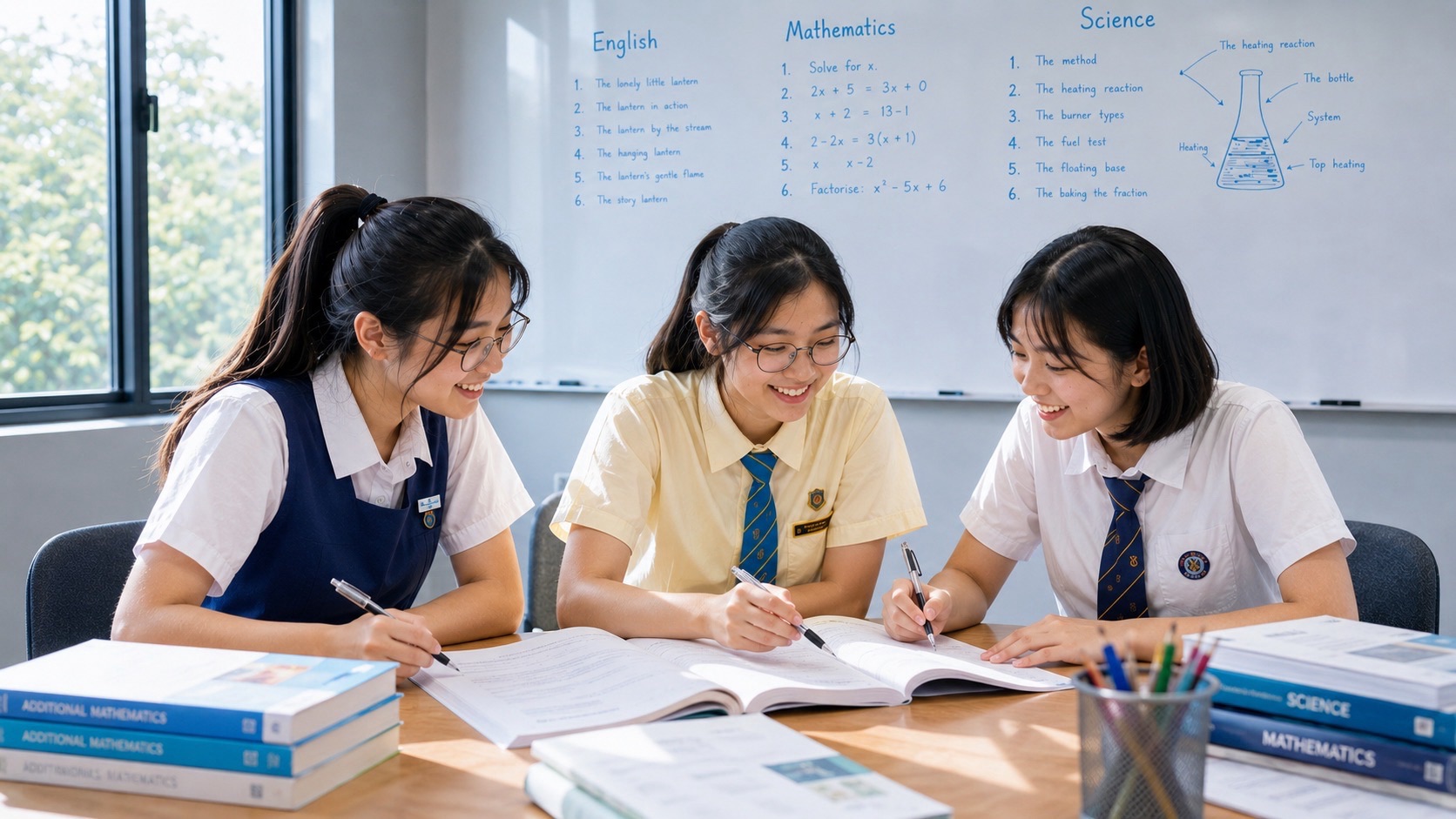
A Secondary Four student opens an English continuous-writing paper, spots a topic about an unforgettable experience and begins with the familiar line, “It was a dark and stormy night.” Five paragraphs later, the storm has vanished, three incidents compete for attention and the ending insists that a valuable lesson was learnt. The writer has energy, but the piece lacks direction. For Bukit Timah parents searching for SEC G3 English continuous writing tuition, this is the problem worth solving.
The core aim of Bukit Timah English tuition for SEC G3 Continuous Writing is to help students choose a suitable topic, interpret its demand and develop an original, coherent piece of prose within the available time. In Secondary English narrative and descriptive writing, vivid language matters, but structure, purposeful detail, believable experience and a consistent voice matter just as much. Students should understand why a paragraph belongs in their essay and how it helps the reader move forward.
The happy discovery is that effective writing is not reserved for pupils who can invent astonishing plots at speed. A modest, carefully developed experience can be compelling. A precise description can be more vivid than an adjective parade. A reflective essay can feel mature without reciting a borrowed moral. These are learnable writing decisions.
What the 2027 SEC G3 K300 Paper 1 Requires
Under the published 2027 Singapore-Cambridge SEC G3 English Language syllabus, Paper 1 Writing lasts 1 hour 50 minutes and carries 70 marks. It has three sections: Editing (10 marks), Situational Writing (30 marks) and Continuous Writing (30 marks).
For Section C Continuous Writing, students choose one of four topics and produce 350–500 words of continuous prose. The topics may cover different text types, with narrative or argument given as examples in the specification. The exact prompts determine the appropriate response.
These facts describe the 2027 G3 K300 examination. They should not be copied automatically into G1 or G2 advice; parents can use the SEAB SEC syllabus directory to select the applicable subject level and cohort.
The educational point is larger than the word range. A 400-word piece can still be weak if it misses the topic, while a carefully chosen angle and well-developed paragraphs make every word work.
The Core Aim: Choose the Right Writing Job before Choosing the Words
Before drafting, ask three questions:
- What does the topic actually require? A story about a turning point? A description of a place? An examination of a decision? A reasoned argument?
- What is my central idea? What experience, situation, impression or claim will hold the piece together?
- What should the reader understand at the end? A consequence, an insight, a changed perspective or a clear judgement?
These questions protect students from choosing a prompt merely because it resembles a memorised essay. The familiar topic may not be the best topic if the student cannot develop it independently.
A short plan should identify the major stages of the writing rather than script every sentence. The aim is to spend a few minutes preventing much longer confusion later.
Narrative, Descriptive and Reflective Writing Do Different Work
Narrative writing develops events and their consequences. A character wants something, faces an obstacle, makes a decision or experiences a change. The sequence matters because one event leads to another.
Descriptive writing creates a focused impression of a person, setting or experience through selected sensory and conceptual details. The reader should understand why particular details matter, not simply receive a catalogue of colours and sounds.
Reflective writing examines the significance of an experience or choice. What did the writer believe before? What happened? What changed in their understanding, and why? It is not simply recounting events followed by “I learnt my lesson”.
These are useful writing distinctions, not a promise that a particular examination paper will offer one prompt of each genre. The actual task wording should determine the approach.
A student can combine these modes. A narrative may include descriptive passages and reflection. A reflective piece may use one short scene to make the thinking concrete. The challenge is maintaining a coherent purpose.
Choosing among Four Topics: The Two-Minute Comparison
Suppose an original practice sheet offers these imaginary prompts:
- Write about a time when a small decision had an unexpected consequence.
- Describe a place that becomes different after dark.
- Reflect on an occasion when you changed your mind about someone.
- Discuss whether people should spend less time online.
The first invites a cause-and-consequence narrative. The second focuses on creating an impression of a setting. The third foregrounds changed understanding. The fourth requires a reasoned discussion or argument according to its exact wording.
A student who enjoys storytelling might still choose the reflective topic if they have a believable experience and a clear change in perspective. Conversely, a student who memorised a description of a beach may find it difficult to adapt to the night-time setting without writing irrelevantly.
Use three quick criteria: relevance, development and control. Which topic can I answer directly? Which gives me enough meaningful material? Which can I shape effectively in the time available?
The best choice is not necessarily the most dramatic or unusual one. It is the topic the writer can develop well.
Narrative Writing: A Story Is a Chain of Decisions
Imagine the topic A Small Decision with a Big Consequence. A weak plan lists a missed train, an argument, a lost phone, a thunderstorm and a surprise visitor. The events might all be exciting, but no central relationship holds them together.
A stronger plan might follow a student who decides to stay back and help a classmate prepare for a presentation. This causes the student to miss an important meeting, explain the choice honestly and reconsider the balance between keeping promises and helping others.
The story now has a meaningful tension: two legitimate responsibilities pull the character in different directions. The consequence follows from a choice rather than arriving as an unrelated accident.
A useful narrative route is situation → pressure → decision → consequence → resolution. That is a thinking tool, not a compulsory five-paragraph formula. Writers can begin at a turning point or shift the order of revelation while still maintaining clarity.
Worked Narrative Opening: Build Curiosity without Borrowed Drama
Consider this original opening:
“I had promised to help Daniel rehearse his presentation, but the reminder on my phone showed that the committee meeting would begin in fifteen minutes. His cue cards lay scattered across the table. When he asked me to stay for one more practice round, I realised that whichever answer I gave would disappoint someone.”
This opening gives a problem and competing responsibilities. It does not depend on a storm, a chase or an invented emergency.
A good continuation could develop the character’s thought process, decision and the cost of that decision. The writer does not need to make every outcome happy. A believable compromise or imperfect consequence may produce a more thoughtful story.
Ask your child: What is the real choice here, and why is it difficult? If they cannot explain the tension, the opening may be atmospheric but not yet purposeful.
The Middle Paragraphs Should Change Something
The middle is where many compositions lose energy. A pupil may repeat the same feeling in three paragraphs or insert events because the page still looks short.
Ask of each paragraph: What changes now? Does the character discover information, reconsider an assumption, make an irreversible choice or experience a consequence? If nothing changes, the paragraph may need a clearer purpose.
Compare:
Weak development: “I was nervous. I became very nervous. I thought about how nervous I felt. Suddenly, I felt even more nervous.”
Stronger development: “Daniel began the presentation, but stopped after the second sentence. I checked the time again. Leaving now would keep my earlier promise to the committee, yet he had asked me to stay because he was close to giving up.”
The second passage develops the conflict. The clock matters because it affects the decision, not because a clock is inherently interesting.
Descriptive Writing: Select, Do Not Catalogue
A weak description of a night market might list “bright lights, delicious food, noisy crowds, colourful stalls and friendly people”. The details are generic enough to describe countless places.
A stronger description selects details that create a particular impression:
“Under the last row of awnings, a vendor folded away his table while steam drifted from the neighbouring stall. A child balanced two paper cups of sugarcane juice, pausing whenever the crowd pressed closer. Beyond the lights, the street had already become quiet.”
The contrast between movement and quiet helps the reader experience a place winding down.
The goal is not to add every sense to every paragraph. Choose details that help create a unified mood, reveal change or make the setting distinctive. One precise sound or action can accomplish more than five unrelated adjectives.
Description Needs an Organising Principle
Students sometimes write one paragraph for sight, one for sound, one for smell and one for touch. That can be useful as a brainstorming device but may create a mechanical essay.
A more natural structure follows a journey, a changing time of day, a shift in perspective or the contrast between two parts of a setting. For a description of a library just before closing, the writer might begin with the remaining readers, move towards the closing announcements and end with the empty tables.
Every selected detail supports one impression: a busy shared space returning gradually to quiet.
Ask the learner what the reader should feel or understand after the passage. Then keep details that contribute to that aim and remove those included only to fill a sensory checklist.
Reflective Writing: An Experience Is Not Yet an Insight
A reflective essay can easily become a recount followed by a generic statement:
“I was wrong. I apologised. I learnt never to judge people.”
The events are present, but the thinking is thin. Reflection requires the writer to examine why an earlier belief seemed reasonable, what challenged it and how the later perspective became different.
Imagine a student who assumes a quiet new classmate is unfriendly. During a group project, they discover that the classmate listens carefully and contributes thoughtful ideas but feels hesitant about speaking in unfamiliar groups.
A strong reflective response might explore the writer’s original assumption, the moment of discomfort when that assumption failed and the practical change in how they will approach unfamiliar people.
The goal is not to claim a complete personality transformation overnight. A modest, believable change can be more convincing.
Worked Reflective Paragraph: Explain the Change
Original practice extract:
“I used to mistake silence for indifference. During our group project, I noticed that Marcus rarely interrupted, but his notes were the clearest in the room. When I asked him about an idea, he spoke carefully and explained a problem none of us had seen. I realised that I had judged his interest by the amount he spoke rather than the attention he gave.”
The reflection grows from a specific event and identifies the mistaken assumption. That is more mature than announcing a lesson without showing what made it necessary.
Ask the learner to locate the evidence, the original belief and the new insight. Then use a different scenario, such as a sports team, family discussion or school activity, to see whether the reasoning transfers.
A good reflection explains not merely what changed but why the change makes sense.
A Descriptive Detail Can Strengthen a Narrative
A narrative does not need to abandon description. It needs description that serves an event.
Suppose the main character must decide whether to speak at a meeting. A sentence about the hum of the projector or the shrinking line of names on a sign-up sheet may create useful pressure. A page describing every curtain, chair and ceiling tile would probably delay the decision.
A practical editing question is: If I remove this description, does the reader lose something important about the situation, character or mood?
If the answer is no, the sentence may be attractive but dispensable. Writing becomes stronger when the student learns to exercise restraint.
Dialogue Should Reveal More Than Information
Dialogue often fails when it merely repeats facts the reader already knows.
Weak:
“Are you worried?” asked May.
“Yes, I am worried,” said Dan.
“You look worried,” said May.
“I am worried,” replied Dan.
A more meaningful exchange might be:
“You can leave if you need to,” Daniel said, without looking up.
“That isn’t the problem,” I replied. “I promised I would stay.”
The second example creates a tension between obligation and choice. It leaves room for the reader to interpret what the speakers feel without stating the same emotion repeatedly.
Dialogue should change a decision, reveal a motive or sharpen a relationship. A student can read it aloud to test whether the exchange sounds natural.
What Makes an Ending Earned?
An ending should follow from what came before. It may resolve an event, show the consequence of a decision, return to an important image or express a believable shift in understanding.
Be cautious with universal borrowed morals such as “From that day on, I never judged another person again.” Real people are more complicated. A student might instead end by noticing the impulse to make a quick judgement and deciding to ask a question before drawing a conclusion.
This small change is more credible because it matches the experience described.
A satisfying ending does not have to be surprising. It should make the reader feel that the central idea has been developed and brought to a meaningful point.
How 350–500 Words Changes the Writer’s Decisions
The 2027 G3 continuous-writing range of 350–500 words calls for enough development without unlimited space. A pupil who spends 180 words introducing the weather may have little room left for the decision and its consequences.
Before drafting, identify which scenes, details or reflective moments deserve the most space. In a narrative, the turning point should not be smaller than an irrelevant opening. In description, the strongest impressions need enough development. In reflection, the insight should be earned by the experience rather than pasted into the conclusion.
A good plan does not have to specify an exact word count for every paragraph. It should assign a job to each section, so the writer understands what matters most.
Word limits are constraints that protect focus. They are not invitations to fill every remaining line with synonyms.
A Practical Exam-Time Approach
Paper 1 includes Editing, Situational Writing and Continuous Writing within the 1 hour 50 minute total. Students must make time for all three sections.
A hypothetical practice budget could reserve around 10 minutes for Editing, 30 minutes for Situational Writing, 60 minutes for topic selection, planning and Continuous Writing, and 10 minutes for checking across tasks. This is only an illustrative starting point, not official timing advice.
A student who needs more time for functional writing may adjust the balance. Another who writes rapidly but makes avoidable language errors may benefit from a stronger final-check routine.
Use timed practice to identify the true bottleneck. Do not prescribe a universal minute split on the assumption that every pupil works in the same way.
The Two-Stage Continuous-Writing Edit
Once a draft is complete, check it in two passes if time permits.
Pass one — content: Does the piece respond to the prompt? Does the chosen genre remain coherent? Are there irrelevant scenes or unsupported leaps? Is the ending connected to the central experience or argument?
Pass two — language: Are sentences complete? Are tenses consistent? Are pronouns clear? Have punctuation, spelling and word choice been checked at the points most likely to contain errors?
Avoid spending the last minutes replacing correct words with more impressive alternatives. Accurate, purposeful language is better than unnecessary complexity.
For the sentence-level skill, our grammar and sentence accuracy guide explains how to turn corrections into usable habits.
How Narrative, Argumentative and Discursive Writing Connect
A good English writer learns how different tasks are organised rather than treating every essay as a story.
Narrative writing asks what happened, why it mattered and how the situation changed. Argumentative writing asks what position the writer supports and how reasons and evidence justify it. Discursive writing explores different aspects of an issue with appropriate balance and development.
The 2027 G3 syllabus mentions differing text types, including narrative and argument. A student should choose their approach from the actual question rather than assume all four options always contain the same genre menu.
For the other writing pathways, see Secondary English Argumentative Writing and Discursive Essay Writing. This article concentrates on the craft of narrative, descriptive and reflective prose.
A Two-Week Writing Routine for Families
A useful revision programme can develop particular decisions without requiring a full essay every evening.
Session 1: compare two practice prompts and explain which one offers more relevant material.
Session 2: plan a narrative with one central choice and its consequences.
Session 3: write a descriptive passage that creates one consistent impression without listing all five senses mechanically.
Session 4: practise a reflective paragraph linking an event to a change in understanding.
Session 5: revise a deliberately weak opening or middle so that it serves the chosen topic.
Session 6: complete one unfamiliar timed task and review the decisions that improved or weakened the writing.
Space these sessions around homework, school activities and rest. A short, careful writing exercise can be valuable when it addresses a real weakness and is followed by transfer to a new prompt.
How 3-Pax Bukit Timah English Tuition Supports Writers
Three students can submit essays that look similarly underdeveloped for different reasons. One has a clear plot but weak sentence control. Another uses expressive vocabulary while avoiding the central task. A third writes accurate sentences but cannot explain what changed in a reflective experience.
At eduKateSG Bukit Timah English tuition near Sixth Avenue MRT, classes of up to three students give tutors opportunities to inspect each learner’s planning and actual writing choices.
A tutor can ask one child to simplify a crowded story, another to develop a decisive scene and another to replace a generic reflection with a specific insight. Peers may compare how the same prompt supports different valid approaches, but independent writing remains the final test.
The purpose is to help each pupil develop their own voice, not produce three identical model compositions.
How Parents Can Track Real Writing Progress
Keep two or three pieces written for unfamiliar topics over several weeks. Compare the relevance of the central idea, the purpose of each paragraph, the quality of details, the connection between events and the coherence of the ending.
Look beyond vocabulary difficulty. Has the learner chosen more precise words? Can they explain why a scene matters? Do they distinguish description from an unsupported claim about a character’s feelings?
A useful question after a draft is: “Which paragraph would most damage the piece if we removed it?” A student who can identify the turning point or central insight is beginning to understand the architecture of their writing.
The eduKateSG English Learning Hub
Frequently Asked Questions about SEC G3 Continuous Writing
How many words should students write in 2027 SEC G3 Section C?
The published K300 syllabus specifies 350–500 words of continuous prose for one chosen topic. Students should follow the applicable exam instructions and develop the response meaningfully within that range.
Is a narrative always safer than argumentative writing?
Not for every learner. Choose the topic and text type that the student can handle with relevant ideas, clear development and accurate language. A familiar genre is useful only when it genuinely fits the prompt.
Must descriptive writing include all five senses?
No. Select the details that support the intended impression. A carefully chosen image, sound or action may communicate more than a mechanical paragraph for each sense.
Does reflective writing always require a moral?
A reflection benefits from insight, but the insight should grow naturally from the experience. A modest change in understanding can be stronger than an exaggerated life lesson.
Should students memorise dramatic openings?
Study how effective openings establish context, tension or curiosity. Avoid forcing a copied introduction into a topic where it does not belong. Original planning is more dependable.
The Lasting Core Aim: Writing with Intention
The strongest change comes when a student stops asking, “Which impressive phrase can I use?” and begins asking, “What does this paragraph need to achieve?” That one question makes narrative more coherent, description more vivid and reflection more thoughtful.
That is the core aim of Bukit Timah English tuition for SEC G3 Continuous Writing. We want students who can choose a relevant direction, develop it in their own language, and produce a complete piece of writing they understand—not just one they have memorised.