
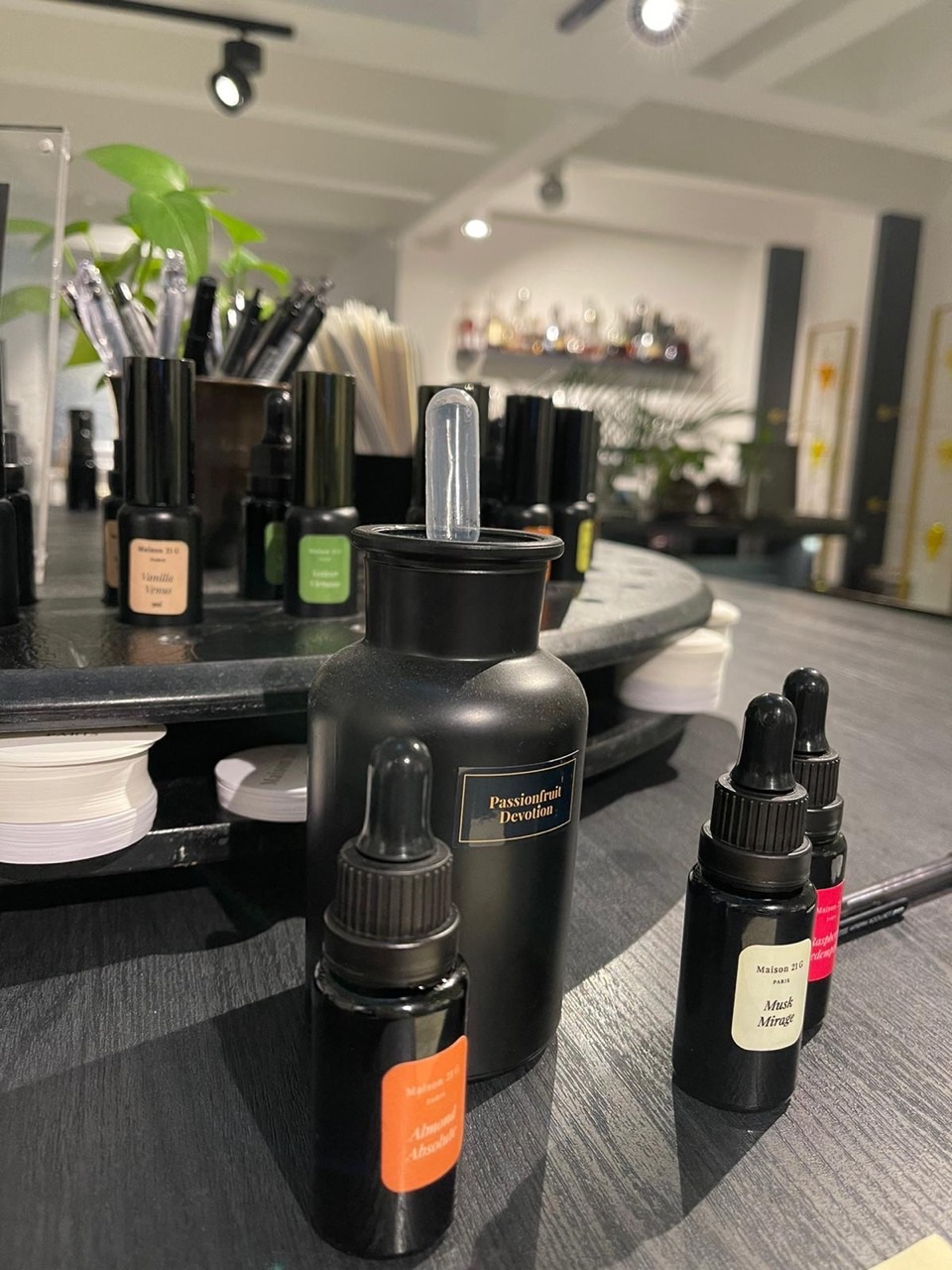
Crazy Rich Singapore | Fragrances, Flavours and the Sensory Science Economy begins with a part of the economy you can encounter without ever seeing the company behind it. The customer notices a scent, a taste or a familiar product experience. Behind that moment may be a laboratory, a formulation, a production process and years of specialised learning.
Did you know that Givaudan opened a CHF15 million fragrance encapsulation centre in Singapore in February 2019? The company described it as an addition to its existing local creative, manufacturing and training capabilities serving Asia. This is an established industrial example, not a newly announced 2026 opening. Read the original company announcement.
Singapore’s fragrances and flavours story is therefore broader than perfume shopping. It includes the business of helping other businesses create products people can recognise, enjoy and use consistently. The finished item might be food, a personal-care product or something used around the home. Those categories require different expertise and different safety considerations.
The interesting question is not simply why a small bottle can cost a lot. It is why a small ingredient, supported by the right knowledge, can influence the value of a much larger product.
Did You Know? The Brand on the Bottle Is Only One Layer
IFRA describes a fragrance value chain involving growers, ingredient producers, scientists, perfumers and consumer-product businesses. The name a shopper recognises at the end is therefore not necessarily the name of the organisation that developed every ingredient or sensory element. The industry association maps those connections.
That arrangement is an example of business-to-business specialisation. A company can become valuable by solving one difficult part of another company’s product. It does not have to own every shop or advertise directly to every consumer.
Consider a hypothetical shampoo brand. Its commercial team may define the intended customer and desired experience, while specialists help translate that intention into a formulation that can be manufactured and assessed. The product is then a collaboration between several kinds of knowledge.
The lesson for understanding Singapore is important. A visible retail economy can have a less visible development economy behind it. One sells the finished experience. The other helps make that experience possible.
Fragrance and Flavour Are Related, but Not Interchangeable
Fragrance work concerns smell in products such as perfumes and personal or household care. Flavour work concerns the sensory experience of food and drink. Similar descriptive words may appear in both fields, but that does not make their ingredients interchangeable or establish that something suitable to smell is suitable to eat.
The distinction is supported by their different applications. IFRA’s fragrance-creation overview describes matching scent to product use, while Givaudan’s food innovation network addresses food development, flavour science and consumer testing.
A useful classroom analogy is colour in printing versus colour in food. Both involve appearance, but the intended contact, exposure and performance requirements are different. Shared vocabulary does not erase the boundary between applications.
This article explains the industry rather than providing formulation instructions. Nothing here is a recipe for applying fragrance materials to skin or adding them to food. The professional value of the sector includes knowing where those boundaries are.
Taste Is Only Part of Flavour
The US National Institute on Deafness and Other Communication Disorders explains that flavour combines basic taste qualities with aroma, texture, temperature and other chemical sensations. Smell contributes through a connection between the throat and nose while eating. This is why flavour is not adequately described as what the tongue detects alone. NIDCD’s explanation separates these sensory processes.
The development implication is easy to understand. If a fictional drink seems unsatisfying, simply making it sweeter may not solve the problem. The issue could involve aroma, texture, acidity, temperature or the balance among several features.
That is an example of why good diagnosis comes before adjustment. Changing the most obvious variable is not always the same as changing the relevant variable.
The same lesson appears in education. A student who struggles with a question may not need more questions of the same type; the difficulty may lie in vocabulary or interpretation. Sensory science provides a vivid reminder that the final experience can be produced by several interacting systems.
A Real Singapore Case: Fragrance Encapsulation
Givaudan’s 2019 Singapore announcement described a centre combining production, warehousing, distribution and a laboratory focused on longer-lasting fragrance solutions. It complemented local facilities opened in 2015, including a creative centre and perfumery school. The stated market focus included home and personal-care brands in Asia. These details come from the original release.
The business question behind such an investment is more demanding than whether a sample smells pleasant at first encounter. When should the sensory effect be noticeable? How long should it last in its intended application? Can the result be reproduced at production scale?
Those are analytical questions rather than claims about a particular customer’s product. They show why the industry needs delivery technology as well as creative composition.
A useful way to think about the difference is music: choosing the notes is one problem; deciding when and how they are heard is another. The value lies in bringing composition and delivery together for a defined use.
Another Singapore Case: Flavour Meets Food Processing
Givaudan’s Protein Innovation Centre in Singapore opened in April 2021 in collaboration with Bühler. Its stated capabilities connect product development, flavour science, processing, application work and consumer testing, with access for food companies, startups and university researchers. The company describes the centre within its global innovation network.
The important point is the combination. A food idea must become a physical product, not remain an appealing description. Processing changes what can be made; sensory work asks whether people will want the result.
Imagine a fictional plant-based filling that performs well nutritionally but has a texture customers dislike. A stronger aroma alone may not solve that mismatch. The formulation and process may need to be considered together.
This does not prove that any product category will succeed commercially. It shows why a useful innovation centre connects disciplines. The laboratory, pilot equipment, application specialist and customer study answer different questions. Putting them in conversation can reveal problems earlier.
Why a Small Country Can Matter to a Much Larger Market
The Singapore facilities above were described in regional terms, not merely as projects serving the island’s consumers. That supports a familiar economic interpretation: a location can become important by developing and coordinating products for markets beyond its own population.
Consider the choice facing a hypothetical regional manufacturer. It needs a place to discuss product requirements, compare prototypes, resolve technical problems and prepare a formulation for wider production. The value of that place depends on the people and capabilities available, not only on the number of local shoppers.
A laboratory can therefore serve a larger market than the city surrounding it. This is a possibility created by specialisation, not a claim that every regional product is developed in Singapore.
It also helps keep national accounting honest. A multinational’s global sales are not Singapore’s output. A local facility’s investment cost is not its annual revenue. Singapore’s contribution must be understood at the level of the actual work performed here: development, manufacturing, testing, training or coordination.
The First Valuable Object May Be a Good Brief
Imagine asking a development team to make a product “more premium”. The phrase sounds decisive but leaves many unanswered questions. More intense? More subtle? More familiar? More unusual? Better suited to a particular use? More expensive to produce?
A useful brief turns an impression into a set of questions that can be tested. It identifies the customer, application, cost constraints and desired sensory qualities. It also states what must not change.
For example, a fictional beverage project might require a recognisable citrus character without making the overall experience harsher. That is still a creative challenge, but it is more precise than “make it exciting”. A fictional laundry product might need an appropriate scent at the point of use rather than maximum intensity at every moment.
These invented briefs illustrate the commercial importance of language. If the client and scientist use the same word to mean different things, the project can spend time solving the wrong problem. Clear English becomes part of the technical workflow rather than a decorative skill added at the end.
The Perfumer and the Instrument Answer Different Questions
IFRA describes fragrance creation as a combination of trained perfumers, ingredients, analytical support and manufacturing. Its overview includes both natural and synthetic materials and notes that laboratory tools support rather than erase creative judgment. See the association’s production explanation.
The distinction matters. A measurement can help establish what is present or whether a batch matches a specification. That is not identical to asking whether a target customer enjoys the result.
Imagine an instrument confirming that two samples differ. The next question is whether the difference matters in the intended product. It might be perceptible but irrelevant, desirable to one group and undesirable to another, or important only after storage.
The lesson is not that subjective judgment defeats science. It is that science needs a clearly defined question. Composition, stability, perception and preference are different outcomes. A capable development process connects them without pretending that one number can represent the entire experience.
A Sample Is Not Yet a Commercial Product
A pleasing prototype is an important milestone, but it is not the end of development. A product has to be made repeatedly, packaged, transported and used under conditions that differ from a quiet evaluation session.
In a hypothetical project, the team would ask whether the sensory result remains appropriate in the actual base product, whether it meets specifications after storage, and whether production can deliver the agreed result consistently. These are questions a responsible project must investigate, not claims that every product has the same technical solution.
This is where creative work meets operations. A wonderful idea that cannot be supplied reliably may disappoint a customer more than a less dramatic idea that performs as promised.
Givaudan’s Singapore examples are useful precisely because they connect development with production or pilot processing. The broader inference is that commercial value often sits in the bridge between invention and repetition. The first successful sample shows possibility. The controlled process makes that possibility usable by another business.
A Worked Example: Small Inputs Can Require Large Responsibility
Here is arithmetic for an imaginary product, not a formula or safe-use recommendation. Suppose a hypothetical ingredient represents 0.1% of a 1,000-kilogram batch. That is one kilogram. At a 10,000-kilogram batch size, the same percentage becomes ten kilograms.
The percentage stays small while the absolute quantity grows. If a measuring or recording error is repeated across many batches, a small-looking mistake can become a large operational problem.
The example also shows why value should not be inferred from mass alone. A low-mass input can materially affect whether the final product meets its intended specification. This is a logical possibility, not a claim about the correct concentration of any real fragrance or flavour.
Students can extend the calculation without handling chemicals: compare batch sizes, percentages and the consequences of a misplaced decimal. The exercise makes precision tangible. Commercial formulation requires both creative ability and the discipline to prevent an elegant idea from becoming an inconsistent product.
Consumer Testing: Liking Is Not a Single Universal Result
Givaudan includes consumer testing among the capabilities of its Singapore Protein Innovation Centre. That is a reminder that a technically successful prototype still needs to be understood in relation to the people expected to use it. The centre’s stated activities are listed here.
Consider a fictional test of two food prototypes. If participants can distinguish them, that establishes one thing. If they prefer one, that establishes another. If they say they would buy it but reject its actual price, the commercial question remains unresolved.
A careful study also needs to ask whom it represents. Testing only colleagues who know the project is not the same as testing the intended customer group. A result from one context should not automatically become a claim about every country or age group.
This is an excellent lesson in statistics and humility. Numbers can make a project more rigorous, but only when the question, sample and interpretation are aligned. A percentage without that context can be impressive and unhelpful at the same time.
Safety Standards Are Not Marketing Decorations
IFRA’s Standards restrict, prohibit or set conditions for certain fragrance materials according to intended use and safety assessment. IFRA also states that a supplier’s Certificate of Conformity does not replace a safety assessment and that IFRA itself does not issue product certificates. Read the Standards and certification explanation.
The distinction matters commercially. A document should mean exactly what it says, not whatever a sales message would like it to imply. Conformity for one intended use is not a universal claim that a material is suitable in every product, concentration or situation.
The wider lesson is about evidence. A premium price, attractive bottle or scientific-sounding name does not establish safety. Nor does an enjoyable smell prove anything about a product’s effectiveness at cleaning, treating or protecting.
Responsible sensory science therefore has boundaries. Creating an appealing experience is one objective; establishing appropriate use is another. A strong industry needs both, and its credibility weakens when either is treated as optional.
Singapore’s Cosmetic Rules Keep Categories Separate
HSA’s cosmetic overview explains the scope of cosmetic products, relevant ingredient and labelling requirements, and the usual need for notification before supply. It also separates cosmetics from products intended to treat medical conditions and restricts unsupported therapeutic claims. The current regulatory overview is the official reference.
This is not a full compliance guide. Different products can sit under different rules, and a business must assess its actual formulation, claims and intended use.
The economic point is that clear categories protect the meaning of the product. A scent described as pleasant is making a different claim from a product presented as treating a disease. Blurring that boundary may create excitement in an advertisement, but it creates a problem for evidence and accountability.
For students, this is a practical example of why definitions matter. A change in a few words can change what a business is claiming to do. Language is not separate from regulation; it helps determine the claim being regulated.
Natural and Synthetic Are Starting Descriptions, Not Final Verdicts
IFRA’s creation overview describes a palette containing both naturally sourced materials and synthetic ingredients. Its Standards also explain that naturally derived materials can contain constituents subject to restrictions. Origin alone therefore cannot answer every question about suitable use. The creation process and the Standards address different parts of this issue.
A useful analytical framework asks several separate questions. What is the material? What function is required? How is it produced? What evidence supports the intended use? What resources does its production require?
Those questions are more demanding than deciding that one label must always be good and the other bad. They also leave room for different answers in different applications.
The same discipline helps with sustainability claims. A renewable input, a biodegradable component and a lower-emission process describe different things. None should casually be substituted for the others. A sophisticated industry must be able to explain the precise claim rather than relying on a reassuring adjective.
The Formula Can Be an Intangible Asset
Imagine a fictional developer that has spent years refining a formulation and the know-how needed to manufacture it. The valuable asset is not only the ingredients in a container. It may also include specifications, process knowledge, customer understanding and the ability to reproduce the result.
That is a useful connection to Intellectual Property, Patents and the Intangible Economy. The appropriate legal protection depends on the actual asset and circumstances; not every formula is patented, and not every scent automatically creates an exclusive right.
The broader business logic is straightforward. A company becomes harder to replace when it provides repeatable capability rather than a one-off sample. Customers may value continuity, reliable documentation and the ability to solve the next technical problem as much as the first creative result.
This is how a small physical input can sit inside a larger relationship. The customer is not merely purchasing matter. It may be purchasing confidence that a specification can continue to be met.
Why Regional Knowledge Must Be More Precise Than Stereotypes
A regional development centre can help a business ask better questions about local use. But “Asian consumers prefer this” is usually too broad to be a useful brief. Asia contains many markets, climates, price points and product routines.
In a hypothetical project, a team might compare the same product across different uses rather than assigning one preference to an entire population. What is the occasion? How is the product stored? What is the intended price? Which existing experience does the customer use as a reference?
These questions turn cultural knowledge into research rather than caricature. They also show why language skills matter in a technical industry. The developer must understand the customer’s description without assuming that familiar words carry identical meanings in every setting.
Singapore’s regional facilities are interesting as places where those conversations can occur. Their value is not that they remove the need to understand other markets. It is that they can organise the work of understanding them more deliberately.
From Laboratory Careers to the Words Used at the Table
The industry brings several kinds of work into conversation: creative development, chemistry, application testing, production, quality, regulation and customer communication. IFRA’s value-chain explanation is a useful starting map, not a complete list of roles at any Singapore company.
A student can see several entry points. Chemistry helps explain materials. Mathematics supports accurate ratios and comparison. English supports briefs, records and meaningful descriptions. Business reasoning helps separate a technically possible product from one that can be supplied at a workable cost.
There is also a connection to the everyday food economy. A cook’s judgment and an industrial flavour project are not the same profession, but both remind us that sensory experience can contain deep knowledge. One should not be treated as merely instinct while the other is called science.
The productive question is what each practitioner knows, how that knowledge is tested and how another person can learn it.
A Classroom Exercise: Turn an Impression into a Testable Description
Begin with a fictional brief, not a chemical experiment. A customer says a product should feel “fresh, familiar and not overpowering”. Ask students to identify what information is missing. Which product? Which user? At what stage of use? Compared with what reference?
Next, separate three kinds of statement. “I like it” expresses preference. “It is more intense than the reference” makes a comparison. “Most customers will buy it” predicts behaviour and needs a different kind of evidence.
Finally, write a better brief in ordinary language. The exercise does not require smelling unknown substances, tasting samples or mixing ingredients. Its purpose is to practise the translation from vague impressions to questions a team could investigate safely and systematically.
This is one of the clearest links between vocabulary and technical capability. Better words do not replace testing. They make it easier to decide what should be tested and whether the result actually answers the original request.
Ten Words for the Sensory Science Economy
Formulation is a defined combination of ingredients for an intended product. Learning use: “A successful formulation must meet more than a first-impression test.”
Application is the setting or product in which an ingredient is used. Learning use: “Performance in one application does not prove performance in another.”
Encapsulation places material within a surrounding structure for a defined purpose. Learning use: “Delivery can matter as much as the sensory composition.”
Prototype is an early version used for evaluation. Learning use: “The prototype demonstrates a possibility, not yet a complete supply process.”
Sensory evaluation examines perception using defined methods. Learning use: “Detecting a difference is not the same as preferring it.”
Specification describes the requirements a product must meet. Learning use: “The team needs a specification that can be checked.”
Traceability is the ability to follow materials and batches through a process. Learning use: “A useful record connects the sample to the batch.”
Scale-up moves a process from smaller to larger production. Learning use: “Correct percentage arithmetic is necessary but does not resolve every scale-up question.”
Conformity means meeting specified requirements. Learning use: “A conformity document should not be described as a universal safety guarantee.”
Business-to-business describes one business supplying another. Learning use: “An unfamiliar laboratory may contribute to a familiar consumer brand.”
Frequently Asked Questions
Does Singapore’s fragrance economy mean perfume retail only?
No. The local Givaudan example includes development and production capabilities for regional home and personal-care applications. Retail is the visible consumer end of a wider industry that can also involve ingredients, formulation, testing and manufacturing.
When did the Singapore fragrance encapsulation centre open?
Givaudan announced its opening on 14 February 2019, with an investment of CHF15 million. The date is historical and should not be confused with the date this article was written. It is a concrete example of Singapore-based capability serving regional customers.
What does the Singapore Protein Innovation Centre illustrate?
It illustrates collaboration between flavour expertise and food-processing capability. Opened in April 2021 with Bühler, it supports several stages of product development and evaluation. Its existence does not guarantee the commercial success of every product developed there.
Are taste and flavour the same thing?
No. NIDCD explains flavour as a combined perception involving taste, aroma, texture, temperature and other sensations. This is why changing sweetness alone may not resolve a product-development problem. The relevant issue must first be identified.
Does natural automatically mean safer?
No such general conclusion follows from origin alone. Appropriate use depends on the material, exposure and evidence. IFRA’s guidance includes restrictions relevant to constituents of natural materials as well as other ingredients. A reassuring label cannot replace assessment.
Does an IFRA document replace a product safety assessment?
No. IFRA explicitly distinguishes a supplier’s Certificate of Conformity from a safety assessment. Businesses also remain responsible for applicable national requirements. The precise intended use and meaning of the document matter.
Why can a small ingredient be economically important?
Physical quantity and economic importance are different measures. A small input can affect whether the final product meets a specification or desired experience. The value may include the knowledge, consistency and support surrounding that input, not only its mass.
Which school skills are relevant?
Chemistry, mathematics, English and careful experimental reasoning all offer useful foundations. The sector rewards people who can connect a sensory description to a testable requirement and then explain what the evidence does and does not show.
Continue Exploring Singapore
Read Intellectual Property, Patents and the Intangible Economy for the value of know-how, Hawker Culture and the Everyday Food Economy for another form of sensory expertise, and Jewel Changi Airport and the Airport Retail Economy for the visible consumer-facing side. The Crazy Rich World hub connects these industries to a wider international picture.
References and Reading Notes
Primary sources checked on 4 October 2026: Givaudan’s 2019 Singapore fragrance-centre announcement and Protein Innovation Centre description; IFRA’s value chain, creation overview and Standards guidance; HSA’s cosmetic regulatory overview; and NIDCD’s explanation of taste and flavour. Company examples are attributed descriptions, not endorsements. All numerical formulation examples and fictional briefs are teaching illustrations, not product instructions.
Crazy Rich Singapore Can Be Noticed with Your Eyes Closed
The sensory economy is easy to underestimate because its contribution may be small in physical size and absent from the brand name a customer remembers.
Yet the work combines creativity with measurement, chemistry with language, and product ambition with the discipline of repeatable production. Singapore’s role becomes interesting where those capabilities meet and can serve a wider region.
Did you know? Some of the most valuable work behind an everyday product is not the work that makes it bigger. It is the work that makes a small, carefully designed difference meaningful to the person using it.