
Did you know that the 2027 G2 Art examination does not simply ask a pupil to produce a finished painting? Its written-and-drawing paper begins with analysis of an unseen artwork and then asks for purposeful exploratory sketches. Its portfolio selects evidence of artistic development rather than only the most polished final image. For families in Bukit Timah, this makes Art a subject about observing, imagining, creating and explaining decisions, not a competition in who owns the most expensive drawing materials.
The quick answer: The 2027 SEC G2 Art K236, formerly 6127, has two compulsory 50%-weighted parts. Paper 1 Visual Response lasts 2 hours 15 minutes, 50 marks: Section A Visual Analysis 10 marks using an unseen stimulus and Section B Exploratory Sketching 40 marks. Paper 2 Portfolio takes 30 hours within 12 weeks, 50 marks and is internally assessed and externally moderated. It includes maximum ten electronic screens of visual material (30 marks) using at least two art forms or media, plus commentary on two works, no more than 500 words and under eight A4 pages when images accompany it (20 marks).
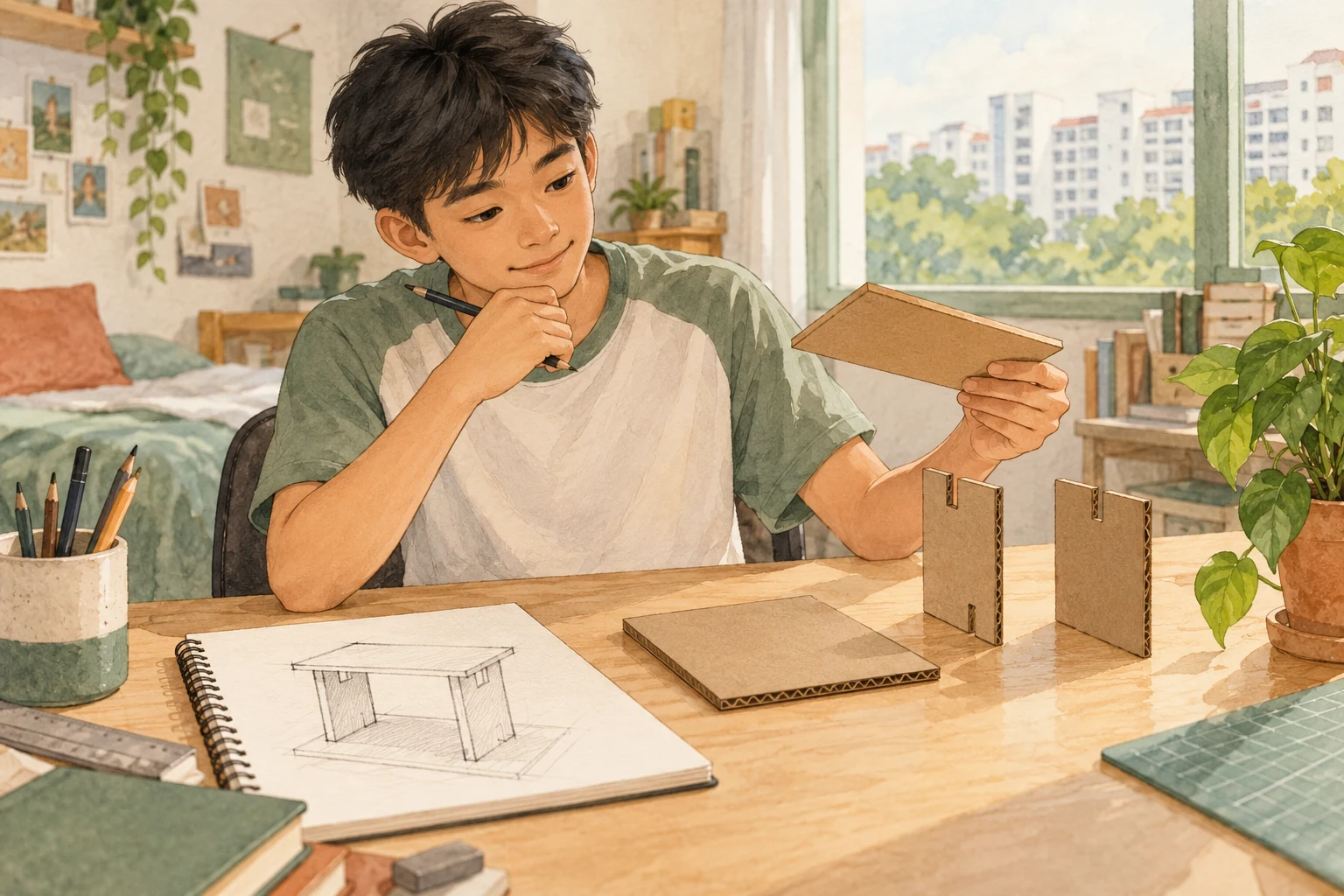
Updated 31 October 2026. The featured illustration shows a student examining sketches and model components, not a photograph of assessed SEC Art coursework. All practice prompts are original and fictional; portfolio authorship and source requirements follow SEAB and school rules.
Jump to: 1. The correct G2 Art code and why it matters · 2. Paper 1 and Paper 2 contribute fifty per cent each · 3. Paper 1 begins with an unseen artwork · 4. Ten marks of visual analysis demand precision · 5. Section B is exploratory sketching, not a finished painting · 6. Which drawing media are permitted? · 7. The Big Ideas connect interpretation and design · 8. Three learning domains: perceive, communicate, appreciate · 9. Building a portfolio over thirty hours · 10. Part A: a maximum of ten screens · 11. At least two art forms and media are required · 12. A process image can be more informative than a polished result · 13. Part B: two artworks and a concise commentary · 14. Citations and academic honesty matter in Art · 15. Five portfolio assessment criteria · 16. Ideas and influences are not the same as copying · 17. Visual language includes line, colour, shape and space · 18. Composition decisions should serve the concept · 19. Art journalling records thinking as it changes · 20. Art Conversations improve interpretation · 21. Observation before personal interpretation · 22. Sketching experiments are not required to be polished drawings · 23. Design and time-based art add different dimensions · 24. Photography and digital images require honest authorship · 25. Art and local identity in Bukit Timah · 26. Reading artwork by another person respectfully · 27. The difference between evaluation and vague praise · 28. How to plan the twelve-week portfolio period · 29. The 2027 Visual Response exam-day plan · 30. How G2 Art differs from G3 Art · 31. A manageable family routine that preserves creativity · 32. The long-term value of Art beyond the SEC · Related 2027 subject guides
1. The correct G2 Art code and why it matters
SEAB lists G2 Art K236 for the first SEC year in 2027 and gives 6127 as the former reference. G1 Art K126 and G3 Art K347 are separate subject-level syllabuses, even when they share broad creative aims. A pupil should follow their registered code rather than assume every Art examination has identical papers or portfolio requirements.
The common certificate records subject levels as part of Full Subject-Based Banding. A child’s entry Posting Group does not alone establish their final Art entry. The school knows which level, materials, timetable and facilities apply to the learner.
Parents can begin by asking what the syllabus assesses: close observation, visual communication, creative exploration, thoughtful choices and reflection. Those capacities are meaningful beyond grades, including understanding advertising, public imagery and the design of everyday objects.
2. Paper 1 and Paper 2 contribute fifty per cent each
G2 Art has a fifty-mark Visual Response paper worth half the qualification and a fifty-mark Portfolio worth the other half. Both are compulsory. This is a distinct balance of on-the-spot reasoning and longer-term artistic process.
A pupil who can draw accurately in familiar conditions may still struggle to interpret an unfamiliar stimulus under a timed task. Another student may have a rich portfolio but difficulty selecting visual evidence and explaining a concept quickly. The course therefore rewards more than one kind of ability.
Encourage revision that respects both parts: practise observation and exploratory sketches while also documenting authentic creative development for the portfolio. More hours spent polishing a single image cannot automatically replace missing evidence of experimentation.
- Paper 1 — 2h15, 50 marks, 50%.
- Visual Analysis: 10 marks; Exploratory Sketching: 40.
- Paper 2 — 30 hours within 12 weeks, 50 marks, 50%.
- Portfolio: visual material 30 marks, commentary 20.
3. Paper 1 begins with an unseen artwork
Section A presents one unseen visual stimulus and a question with two subparts. Students describe, interpret, analyse or evaluate the image using relevant visual qualities, concepts and evidence. They do not need to predict which exact picture SEAB will use in 2027.
An unfamiliar artwork might contain contrasts in scale, repetition, line, colour or arrangement. A response should identify what the pupil actually sees and explain how that quality affects interpretation. Simply saying the artwork is nice or interesting gives little information.
Use legitimate public-domain or teacher-approved images for practice. Ask for an observation first, then an interpretation, then the evidence connecting them. This produces a clearer answer than memorising one paragraph to apply to every work.
4. Ten marks of visual analysis demand precision
The Visual Analysis component is worth ten raw marks, but it can influence the larger sketching task because the student builds from the same stimulus. Careful interpretation is therefore useful beyond a single written answer.
A fictional image showing several figures facing different directions could suggest relationships or tension, but the conclusion should depend on actual composition, gestures and other visible elements. A pupil must distinguish what is observable from what is guessed about the artist’s private intention.
Encourage specific language: ‘the repeated diagonal lines direct attention toward…’ communicates more than ‘it is very creative’. Precise description makes the later design decisions easier to justify.
5. Section B is exploratory sketching, not a finished painting
Section B carries forty marks and asks students to generate, explore and refine ideas using drawing, with possible annotations. The response develops a concept for an under-drawing, illustration or design. SEAB specifically says a fully rendered, shaded and coloured finished work is not the intended outcome.
This matters because some students spend so much time making the first idea perfect that they produce no genuine alternatives. Exploration can show changing viewpoints, modifications or comparisons before a final concept is selected.
Practice several small variations using an invented stimulus, then explain why one offers a more relevant response to the task’s Big Idea. The working process is evidence of thinking, not a collection of unrelated decorative doodles.
6. Which drawing media are permitted?
SEAB allows suitable drawing tools such as pens, markers, HB or B pencils and specified colour pencils or markers. It excludes charcoal, soft graphite, chalk and soft or oil pastels, as well as wet media, for the Visual Response paper.
A child who is familiar with a favourite paint or charcoal medium needs to practise within these restrictions rather than assume the examination will permit every tool used in school Art lessons. The required methods are part of preparing correctly.
Ask the school which items candidates should bring and follow the formal examination instructions. Parents need not purchase specialist materials merely because an advertisement labels them premium Art supplies.
7. The Big Ideas connect interpretation and design
The G2 Art framework uses three Big Ideas, supported by learning content and core experiences. Paper 1 uses a specified Big Idea to guide the conceptual response to the unseen stimulus. That encourages a connection between observation and personal meaning rather than a generic picture.
A student may explore how a visual suggests identity, relationship or place, but the actual concept must follow the theme provided. A drawing that looks skilful yet ignores the question’s Big Idea may not communicate an appropriate response.
Practise turning a short idea into several possible visual approaches: different focal points, viewpoints or compositions. Discuss why one approach better conveys the intention using evidence from the image and the prompt.
8. Three learning domains: perceive, communicate, appreciate
The syllabus describes Perceive as observing and analysing visual stimuli; Communicate as developing artistic expression; and Appreciate as reflecting on one’s own and others’ work in society and culture. These domains interact throughout a project and in the examined responses.
A student observing a photograph might notice the balance of light and shadow, then experiment with representing that contrast in a drawing, and finally discuss why the result changes a viewer’s impression. One sequence joins all three domains.
The vocabulary is useful because it helps a parent recognise why Art includes talking, research and reflection as well as making. The learning is broader than one polished product displayed at the end of term.
9. Building a portfolio over thirty hours
Paper 2 is completed in thirty hours within twelve weeks. It requires selecting evidence of artistic exploration and writing a commentary, not making one predetermined painting from start to finish. The school assesses it internally and SEAB externally moderates the submission.
This is a supervised assessment period with its own milestones and technical requirements. Families should not assume they can replace it with a home-made digital portfolio assembled by an adult, or use unrelated work copied from online artists.
Ask the teacher when the selection and commentary are due, which formats are accepted and how authenticity and source attribution are managed. Supporting organisation is different from supplying the assessed creative work.
10. Part A: a maximum of ten screens
The portfolio’s Selection of Visual Materials accounts for thirty marks and may include no more than ten electronic screens. Suitable materials can include journal spreads, investigations, experimentation, developing pieces and findings drawn from the student’s upper-secondary Art learning.
Maximum does not mean the pupil must fill every available screen with any image they can find. A coherent selection shows how ideas evolved, which choices were tested and how the artist developed skills or understanding.
Students need not sequence or annotate the screens according to the published directions. That is a helpful reminder not to spend time adding unnecessary decorative captions if they distract from choosing meaningful work.
11. At least two art forms and media are required
Part A must demonstrate study of at least two different art forms and media, including one from Fine Art and one from either the Design or Time-based category. A portfolio made entirely from repeated versions of the same technique may fail to demonstrate the required breadth.
Different forms can reveal different strengths: a drawing explores line and tone, while a designed composition or time-based piece may rely on sequence, interaction or another visual language. The actual options depend on what the school teaches and permits.
Parents should not prescribe specific materials without school guidance. The assessed question is how the pupil explored techniques meaningfully, not whether the family purchased the largest assortment of supplies.
12. A process image can be more informative than a polished result
A sketch showing a rejected composition can explain how an artist learned to balance a page. Another may record colour experiments or changes in a material. Such process evidence helps viewers see the decisions that led to later work.
An important portfolio principle is that revision and reflection count. Students should not delete every unsuccessful attempt simply because it looks less attractive than the final piece. The learning may lie in understanding why the initial approach did not communicate as intended.
That does not mean submitting random mistakes. Select examples that reveal a useful change, research connection or experiment within the portfolio’s permitted scope.
13. Part B: two artworks and a concise commentary
The Commentary is worth twenty marks and should be based on two works made by the candidate. It explains artistic intent and connections between the student’s practice and the work of others, using suitable subject terminology and reflection on learning.
SEAB sets a ceiling of five hundred words and fewer than eight A4-sized pages when images accompany the commentary. This makes focus crucial. An overly long autobiographical essay that says little about specific art decisions is not necessarily stronger.
A useful plan identifies what each artwork aimed to communicate, which artistic influences mattered, what techniques were chosen and how the pupil’s understanding changed. The commentary must remain the student’s own authentic writing.
14. Citations and academic honesty matter in Art
Visual artists learn from references, traditions and other creators. The syllabus requires acknowledgement of relevant sources and citations when discussing or drawing on other works. Inspiration should be identified rather than hidden behind a claim of complete originality.
A student might study a particular artistic approach and then create a distinct work exploring their own idea. The commentary can explain the influence without copying the original image and falsely claiming authorship.
Families should check the school’s rules on using online images, tracing, editing and generated content. AI-created finished visuals should not be passed off as the student’s own studied or assessed artwork.
15. Five portfolio assessment criteria
SEAB lists Ideas and Influences, Visual Language, Art Forms and Technical Processes, Artistic Intent, and Making Connections as five portfolio criteria. Each is worth ten marks, but some focus on selected visuals while others emphasise how the pupil articulates the work.
These criteria highlight why an image collection alone may be incomplete. A technically competent artwork can still need explanation of influence or intention. Another student may write thoughtfully while showing too little technical exploration in the selected evidence.
Review the criteria with the teacher and identify which part of the student’s submission demonstrates each one. That is a quality check, not a demand to manufacture evidence that did not genuinely arise during learning.
16. Ideas and influences are not the same as copying
Art can respond to the work of earlier artists, local traditions or visual experiences, but the pupil should make a meaningful choice about how that source informs the new work. Copying a famous image without analysis provides less evidence of independent artistic understanding.
An original exercise might use the idea of repetition found in an artwork to explore a different subject, such as movement in a school corridor. The new composition should communicate the pupil’s own intention and context.
Ask why the influence was relevant and what changed during the student’s experimentation. A clear answer demonstrates growth rather than a superficial resemblance.
17. Visual language includes line, colour, shape and space
Visual language refers to the means by which forms communicate. Line may guide movement, contrasting values can draw attention, and spacing can shape relationships among elements. These effects depend on context and should be explained through the actual image.
A drawing with a single large form surrounded by small forms might create a focal point or evoke a relationship of scale. A student should identify which visible qualities produce that impression, not assume every large object carries identical meaning.
Practise describing an image before deciding whether it is beautiful. Observation helps the learner make deliberate choices when developing a personal concept.
18. Composition decisions should serve the concept
A composition arranges elements so that a viewer experiences them in a particular way. Balance, rhythm, emphasis, contrast and unity are possible visual considerations. The intended idea should determine which choices are appropriate rather than a generic demand to fill every space.
Imagine a fictional visual response about isolation. One interpretation might use a solitary form and extensive empty space, while another could use crowded overlapping shapes to suggest social isolation. Both might be coherent depending on the stimulus.
Students should compare variations and explain which communicates the intended concept more convincingly. Exploration becomes purposeful when it tests a visual idea.
19. Art journalling records thinking as it changes
Art Journalling is one of the syllabus’s core learning experiences. It can record images, sketches, questions, influences and revised decisions during a student’s learning. A journal should help the pupil see development rather than serve only as a decorative scrapbook.
An earlier page may reveal a misconception about material or a composition that later work resolves. That is an opportunity for reflection. Erasing every trace of a change may make the artist’s process harder to understand.
Teachers can guide students to document accurately, and parents can encourage discussion without completing the journal on the student’s behalf.
20. Art Conversations improve interpretation
Art Conversations encourage pupils to look closely, listen to alternative interpretations and discuss what visual evidence supports their reading. People can respond differently to the same work without every interpretation being equally convincing.
Consider a fictional picture of an empty seat facing a crowded room. One pupil may interpret exclusion, while another sees a place being reserved. The strongest discussion compares the relevant visual cues and acknowledges uncertainties.
Learning to give reasons respectfully is part of Art education and develops transferable communication skills useful in other school subjects.
21. Observation before personal interpretation
An observation identifies a visible feature; an interpretation explains possible meaning. The two are connected but distinct. A student who declares what an artist ‘definitely felt’ without textual or visual support may be overstating what can be known.
For a hypothetical image showing a broken line and a repeated circle, the pupil can describe those forms accurately first. Then they can discuss whether the arrangement suggests disruption, repetition or another idea, depending on context.
This method is particularly important for unseen Visual Analysis, where no earlier class essay can substitute for looking at the actual stimulus.
22. Sketching experiments are not required to be polished drawings
The Exploratory Sketching paper assesses developing ideas, visual choices and communication of a concept. Pupils are not expected to render or shade a finished outcome in this task. Several small sketches with meaningful changes can show more reasoning than one beautifully finished but unexamined image.
An illustrative task could ask a student to explore how a public-space image might inspire an original design. Three quick compositions with distinct focal points may help clarify which response connects to the assigned Big Idea.
Teachers should advise on layout and annotation conventions. The examination requires evidence of purposeful exploration, not frantic filling of pages with unrelated images.
23. Design and time-based art add different dimensions
The portfolio requires at least one Fine Art form and another from either Design or Time-based work. Design may involve purposeful communication and audience needs, while time-based work can use duration or sequence as part of expression.
An original fictional poster about shared study space may ask what information a viewer must notice first. A short time-based visual work could explore changes in a place across moments. The two processes require different artistic decisions.
The school’s taught media and equipment determine realistic project choices. Students should not assume the portfolio must include commercial software or video merely because time-based options exist.
24. Photography and digital images require honest authorship
Digital photographs and edited images can be useful documentation, but they can also blur the boundary between the candidate’s work and outside material. An image of a finished project is evidence of what was made only when it accurately records the actual work.
Cropping to improve clarity may be acceptable under permitted procedures, while altering an image to add details that were not present would misrepresent the result. The school’s assessment rules govern submissions and source attribution.
Parents can help the pupil manage files but should not use generative tools or professional editing to substitute for a missing art process.
25. Art and local identity in Bukit Timah
Bukit Timah includes visual experiences ranging from urban architecture and public transport to mature trees and neighbourhood shops. Such settings can inspire observations of pattern, material, movement and changing light, while real coursework needs the student’s own interpretation.
A local botanical illustration can prompt questions about line, texture and colour without claiming that the child studied a particular heritage tree. Similarly, a building facade can inspire design work without requiring photography from unsafe locations.
Respect public-space rules, people’s privacy and any relevant site permissions. The goal is imaginative response grounded in real observation, not trespass or unauthorised image collection.
26. Reading artwork by another person respectfully
Artworks reflect different cultural and personal contexts. The syllabus asks pupils to appreciate diverse perspectives and connect art with identity, society and culture. A single visual symbol may have different meanings in different traditions, so interpretation should be careful.
When looking at a museum image, ask for the artwork’s title, creator, medium and available context. A student can then discuss what they actually see and how knowledge of the source affects interpretation.
Public collections and school-approved resources offer valuable opportunities for study. Avoid copying entire copyrighted works into an online portfolio without permission.
27. The difference between evaluation and vague praise
An Art reflection becomes useful when it identifies a decision, the intended effect and evidence of whether it worked. ‘I like my painting because it is colourful’ does not explain why those colours were selected or what they communicate.
Suppose an original design intended to draw attention to a central message but viewers repeatedly noticed a background detail first. The pupil can discuss what feature caused the distraction and which change made the hierarchy clearer.
Such analysis demonstrates artistic growth. The strongest reflection may acknowledge a limitation and a thoughtful revision rather than claim every experiment succeeded perfectly.
28. How to plan the twelve-week portfolio period
The assessed portfolio work must be completed in thirty hours within twelve weeks. The school should provide the timing, supervision and technical submission instructions. Students can use earlier upper-secondary materials where permitted as they curate their actual learning journey.
Create a simple checklist for selecting up to ten screens, confirming the required breadth, reviewing the two chosen artworks and drafting the concise commentary. Leave time to verify references, exports and file properties before submission.
Families can help with planning and transport where necessary, but cannot produce the assessed visuals or commentary on behalf of the child.
29. The 2027 Visual Response exam-day plan
A pupil should arrive with the permitted materials and follow the final instructions. Read the unseen stimulus and analysis question carefully before starting exploratory sketches. Observe which Big Idea guides the requested response and keep the concept in view as ideas develop.
Time spent noticing visual qualities is not wasted because Section B builds on Section A. However, the student also needs sufficient time to generate, compare and select meaningful sketch approaches.
Nearer the examination, practise full 2h15 sessions under school guidance and review why marks were lost: weak observation, disconnected concepts or poorly explained visual decisions.
30. How G2 Art differs from G3 Art
G3 Art K347 has a separate assessment scheme and expectations. Parents must not assume a project task or duration from that level also applies to K236. Even where both discuss visual analysis and artistic intent, the papers are not interchangeable.
An advanced art enrichment programme may be enjoyable but is not proof of preparation for the correct G2 portfolio. The pupil needs to meet the particular screen, commentary, media and timing requirements published for K236.
Ask the school which components need improvement before paying for specialist materials or private lessons. The correct assessment standard should guide support.
31. A manageable family routine that preserves creativity
Between formal lessons, a child can practise close observation of one image, explore a few quick sketches and describe the intention behind a choice. Some sessions should also allow art for pleasure without turning every drawing into an examination item.
Parents can ask genuine questions, such as why a line was moved or which composition better communicates an idea, rather than insisting on a predetermined result. Students may learn by challenging an adult’s interpretation with visual evidence.
Balanced rest and experimentation support sustained learning. The official portfolio submission schedule and final written examination date come from the school and SEAB, not from a generic online guide.
- Confirm G2 Art K236 and the school-selected media.
- Practise 10-mark unseen Visual Analysis and 40-mark exploratory sketches.
- Use permitted drawing media in the exam.
- Select no more than ten portfolio screens with at least two art forms.
- Write up to five hundred commentary words on two genuine works.
- Complete the 30-hour, 12-week process under school instructions.
32. The long-term value of Art beyond the SEC
Art develops perception, communication, creative choices and the capacity to explain why something matters. These abilities can support interest in design, media, architecture or other fields, but no particular examination result guarantees admission to a course or profession.
The first SEC cohort’s results are expected in January 2028. Post-secondary decisions depend on the complete subject profile and current receiving-institution requirements. Families can discuss genuine interests rather than promise a particular pathway from one Art grade.
The most useful achievement is a student who can observe closely, experiment with purpose, respect creative work and communicate a considered interpretation in their own voice.
Frequently asked questions
What is the 2027 SEC G2 Art code?
K236, with older reference 6127.
How much is the Visual Response paper worth?
50 marks and 50%, lasting 2 hours 15 minutes.
How many marks for Section A?
Ten marks of Visual Analysis based on one unseen stimulus.
What does Section B require?
Forty marks of exploratory sketches and possible annotations developing a conceptual visual response.
Must Section B be fully painted and rendered?
No. The syllabus says the intended outcome is exploratory, not a finished fully rendered painting.
Which materials are not allowed in Paper 1?
The syllabus excludes charcoal, soft graphite, pastels and wet media; check all official permitted materials.
How much is the portfolio worth?
50 marks and 50%.
How long is portfolio assessment?
Thirty hours within twelve weeks.
What is the maximum number of portfolio screens?
Ten electronic screens.
How many art forms are required?
At least two: one from Fine Art and another from Design or Time-based categories.
What is the maximum commentary length?
Five hundred words, with under eight A4-sized pages when supporting images are included.
What does the commentary discuss?
Artistic intent, growth and connections involving two works made by the candidate.
Is the portfolio externally assessed?
It is marked by the school and externally moderated.
Can the pupil use another person’s artwork without citation?
No. The syllabus requires appropriate sources and academic honesty.
Does a high-end art kit automatically improve marks?
No. Assessment rewards observation, exploration, communication and genuine reflection.
Is K236 identical to G3 Art K347?
No. The General levels have different examination requirements.
Where are final assessment dates and file rules?
The school and final SEAB instructions.
More Education at Bukit Timah 2027 SEC Guides
Continue to these related subject-level guides. They explain distinct SEAB 2027 examination requirements; check the pupil’s registered subject code before choosing study material.
- Education at Bukit Timah | G1 Computing — Document, Spreadsheet and Scratch Lab
- Education at Bukit Timah | G2 Nutrition and Food Science — 25-Hour Coursework
- Education at Bukit Timah | G3 Music — Listening, Composition and Recital
Bukit Timah 2027 SEC calendar and national changes — the wider examination-year overview.
Official sources and further reading
SEAB 2027 G2 school-candidate subjects — official source or educational reference.
Official G2 Art K236 2027 syllabus — official source or educational reference.
SEAB SEC qualification overview — official source or educational reference.
MOE SchoolFinder — official source or educational reference.
National Gallery Singapore — official source or educational reference.
National Library Board — official source or educational reference.
eduKateSG 2027 SEC calendar — official source or educational reference.
Bottom line: K236 Art rewards the ability to observe, interpret, experiment and reflect, not merely a finished attractive picture. The two equal-weight components ask for immediate visual response and a carefully selected record of real artistic growth. Thoughtful work, responsible sources and the student’s authentic voice matter most.