
Did you know that the 2027 SEC G3 Music subject asks a teenager to listen analytically to unfamiliar music, compose one original piece and perform two contrasting works? That makes Music a course of creative reasoning as well as technical skill. The examination recognises Western Classical, Jazz, Popular and Asian traditions, and expects the student to explain choices through reflection. For Bukit Timah families, an interest in piano, singing, a school ensemble or digital music production can be a valuable foundation, but the actual G3 Music K350 syllabus determines what is examined.
The quick answer: G3 Music K350, former reference 6085, has three compulsory components. Paper 1 Music Studies: 1 hour 30 minutes, 75 marks, 40%, with six unprepared listening questions across Western Classical, Jazz, Popular and Asian Music. Paper 2 Creating: 30%, 50 marks, comprising a 40-mark original composition of up to three minutes plus 400–500-word reflection notes worth ten marks; the course allows five supervised hours over up to nine weeks. Paper 3 Performing: 30%, 50 marks, comprising two contrasting performance items totalling five to ten minutes, and another 400–500-word reflection. Candidates must work under an approved G3 Music teacher’s supervision.
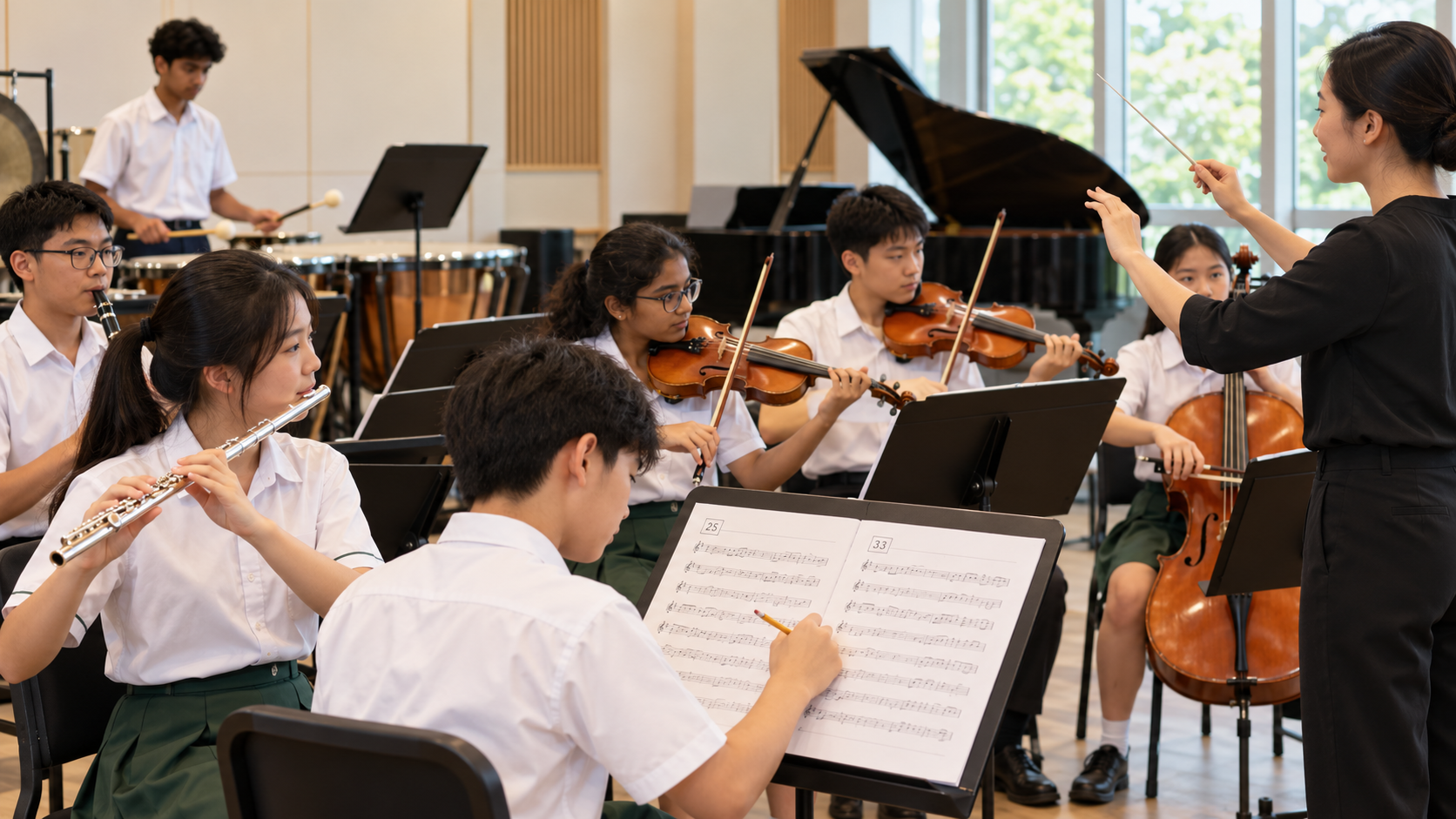
Updated 31 October 2026. The featured image shows school musicians rehearsing, not an official 2027 recital. All miniature music examples are conceptual or original educational exercises. The article does not reproduce copyrighted music, and student assessment work must remain authentic.
Jump to: 1. Why K350 is a subject, not simply a CCA · 2. The forty-thirty-thirty assessment balance · 3. Paper 1 has six unseen listening questions · 4. The three groups of twenty-five listening marks · 5. Western Classical: a range of periods and forms · 6. Question 1 and the skeleton score · 7. Question 2 uses a fuller written reference · 8. Jazz: understand styles rather than stereotypes · 9. Jazz Question 3 and its lead sheet · 10. Popular Music: from pop-rock to synth-pop and soul · 11. Digital effects are examinable listening ideas · 12. Asian Music includes four broad traditions · 13. Asian listening questions have no accompanying score · 14. Listening across cultures is also a thinking skill · 15. Rhythm, metre and tempo must be distinguished · 16. Melody, harmony and texture have different functions · 17. Form and structure organise a musical argument · 18. Dictation and score reading are targeted skills · 19. Creating Paper 2: an original response to a stimulus · 20. The three-minute maximum for composition · 21. Five supervised hours over up to nine weeks · 22. Notation and recorded submissions have specific rules · 23. The composition needs musical coherence · 24. Creating reflection notes: four hundred to five hundred words · 25. Performing Paper 3: two contrasting items · 26. Technical control and musical sensitivity are assessed · 27. Solo, ensemble and accompaniment are different responsibilities · 28. Improvisation can be part of a valid recital · 29. Performing reflection also requires four hundred to five hundred words · 30. Music Studies is not just memorising famous compositions · 31. Practice with legal recordings and original material · 32. The role of digital music tools · 33. A balanced listening-and-making revision schedule · 34. How to manage July-to-October Creating coursework · 35. Why local music exposure can support learning · 36. Comparing G3 Music with Higher Music · 37. A final parent checklist for 2027 · 38. What music education offers beyond the certificate · Related 2027 subject guides
1. Why K350 is a subject, not simply a CCA
The SEAB G3 2027 directory identifies Music K350 and former examination reference 6085. The course is organised around three linked activities: Music Studies, Creating and Performing. A pupil who participates enthusiastically in a choir or band may have useful experience, but a CCA alone does not establish an examined Music registration.
The SEC introduces a common certificate with G1, G2 and G3 subject levels. G1 Music K128, G3 Music K350 and G3 Higher Music K351 are not interchangeable programmes. The school can confirm eligibility, available instruments, learning opportunities and actual assessed requirements.
Families should ask what the child’s interests are and whether those align with the full syllabus. A strong instrumentalist still needs analytical listening and composition, while a creative composer also faces live recital and written Music Studies tasks.
2. The forty-thirty-thirty assessment balance
Paper 1 Music Studies contributes forty per cent; Paper 2 Creating contributes thirty per cent; and Paper 3 Performing contributes thirty per cent. All are compulsory. The written paper has seventy-five raw marks, while each creative or performance component is assessed out of fifty.
Because the percentages differ, practice marks cannot simply be added across the components as though every raw mark is worth the same fraction. A child who excels at performing but ignores analytical listening may leave a substantial part of the subject underprepared.
The best revision plan maintains regular ear training, creative work and performance practice. How many hours each needs should reflect teacher feedback and the learner’s actual difficulties, not a generic demand to rehearse the same piece every day.
- Music Studies — 1h30, 75 marks, 40%.
- Creating — composition 40 marks plus reflection 10, 30%.
- Performing — recital 40 marks plus reflection 10, 30%.
- Direct supervision by a G3 Music teacher at an approved centre is required.
3. Paper 1 has six unseen listening questions
Music Studies is a ninety-minute written examination built around six unprepared recorded extracts. The questions are compulsory and examine aural perception, stylistic knowledge and the ability to describe musical features. Students may receive a score or lead sheet for some questions, while Asian Music extracts do not have accompanying notation.
Unprepared means that the examination extract itself is not a prescribed secret track to memorise in advance. The official Areas of Study establish the genres and types of musical knowledge required. Regular, varied listening gives pupils more transferable skills than guessing the final recordings.
Students should practise identifying a significant feature and explaining how it supports the interpretation. ‘The music sounds exciting’ is less precise than an observation about tempo, rhythm, instrumentation or texture tied to a particular passage.
4. The three groups of twenty-five listening marks
Part 1 Western Classical Tradition sets two questions worth twenty-five marks altogether. Part 2 Jazz and Popular Music uses one question on each, together worth twenty-five. Part 3 Asian Music has two questions adding to another twenty-five. These groups make the paper’s seventy-five marks.
The distribution encourages attention to all four Areas of Study. A pupil who only listens to one favourite genre may find other timbres, conventions or structures unfamiliar. Musicianship grows through curiosity about why different traditions organise sound differently.
Parents can encourage respectful listening and discussion without requiring an expensive private music library. Use legally available recordings or school-approved material and focus on explanation rather than trying to reproduce copyrighted works.
5. Western Classical: a range of periods and forms
The Western Classical syllabus includes Baroque dance suites, Classical sonatas and symphonies, Romantic character pieces, German Lieder and twentieth-century styles including Impressionism and Nationalism. Students should know the relevant characteristics and historical contexts described in the syllabus.
These categories can differ in form, typical instrumentation, harmonic language and musical purpose. A learner should notice what can be heard in the excerpt before inferring a style. One instrument alone is not always enough to identify a historical period correctly.
Study a short school-approved excerpt by asking about pulse, phrase, texture, changes in dynamics and the role of instruments. Then compare those observations with the taught conventions.
6. Question 1 and the skeleton score
The first Western Classical question is worth ten marks and uses a skeleton score. The recorded extract is played four times, allowing pupils to compare what they hear with relevant notation. It may include a short melody or rhythm dictation task where specified.
A skeleton score contains selected written information rather than every part of the complete performance. Students need to recognise what is provided and what they must infer by listening. Copying notation blindly without connecting it to the sound defeats the purpose.
At home, use a very short original practice phrase or authorised teaching example. Ask the child to identify the main rhythmic or melodic detail and explain where the notation supports that observation.
7. Question 2 uses a fuller written reference
The second Western Classical question carries fifteen marks and uses a full or skeleton score. Students may need to make more detailed observations about instrumentation, harmony, period or compositional structure, depending on the extract and actual question.
A score can show relationships that are easy to overlook by ear, while listening can reveal phrasing or expressive detail not obvious from an isolated symbol. Combining them produces a more informed interpretation than treating either as sufficient alone.
Teach pupils to follow the relevant part of the score while hearing the recording. A practice answer should identify a specific feature and explain what it contributes to the musical passage.
8. Jazz: understand styles rather than stereotypes
The Jazz Area of Study includes Traditional Jazz, Swing, Bebop and Cool Jazz from twentieth-century American traditions. The examination asks candidates to recognise musical characteristics and contexts, not simply label any performance with brass instruments as Jazz.
Students can compare rhythmic feel, improvisational roles, ensemble textures and expressive approaches within the taught scope. Differences matter, but so do shared practices; genre boundaries are not always sharp in actual performances.
A stronger listening response explains a feature such as instrumental interaction or rhythmic organisation and why it supports the stylistic inference. Respect historical and cultural origins rather than reducing a tradition to a catchy stereotype.
9. Jazz Question 3 and its lead sheet
Question 3 is worth either twelve or thirteen marks as part of the combined Jazz and Popular Music section. The extract is played four times and accompanied by a skeleton score or lead sheet, sometimes with lyrics. Questions may address musical elements, style and a short dictation task.
A lead sheet can outline melody, harmony and other core information without giving a full transcription of every instrumental part. Students should understand how it relates to the performed recording rather than expect every audible detail to be written down.
Practice can use original short classroom music or properly licensed material to compare a notated outline with an actual performance. The pupil should describe changes in phrasing or texture using appropriate vocabulary.
10. Popular Music: from pop-rock to synth-pop and soul
The Popular Music group includes late-1960s pop-rock, synth-pop, and R&B and Soul. Students learn to connect musical styles with instruments, production technology, arrangement, voice and cultural contexts.
The role of electronic sound in synth-pop, for example, can be relevant to timbre, texture or production technique. A response should not imply that every song using a synthesiser belongs to one identical genre. Consider the overall context and musical characteristics.
Encourage students to describe what they actually hear before naming a style. A justified inference is stronger than choosing a genre because its label feels familiar.
11. Digital effects are examinable listening ideas
The Popular Music specification includes effects such as reverb, distortion, delay, panning and fade-in or fade-out, as well as overdubbing, multitracking and looping. Candidates should understand what these processes do to sound and how they may contribute to a musical work.
A fictional practice question could compare a dry vocal recording with a version using a noticeable echo. The pupil should describe the audible change and the relevant concept, not assume the effect always produces a particular emotional response.
Technical vocabulary supports understanding when used accurately. A learner need not own expensive recording equipment to recognise the concepts from approved demonstrations.
12. Asian Music includes four broad traditions
The Asian Music Area of Study covers music of traditional Malay dances, Chinese ensemble music, Indian ensemble traditions and Javanese gamelan. The prescribed examples include Zapin and Joget, Jiangnan Sizhu and Guangdong Music, Hindustani and Carnatic ensembles, and Javanese gamelan.
Students should respect the different histories, instruments and practices within these traditions. The word Asian does not describe one homogeneous musical style; a Chinese ensemble and an Indian classical performance may organise melody, rhythm and texture in substantially different ways.
Teacher-approved listening should explain the cultural and performance context rather than only ask students to guess the origin of a sound. That makes recognition more accurate and thoughtful.
13. Asian listening questions have no accompanying score
Paper 1 Questions 5 and 6 together carry twenty-five marks and use Asian Music extracts without an accompanying score. They are played four times, so the student must focus closely on audible instruments, rhythmic patterns, texture and form.
This format differs from the Western Classical and some Jazz or Popular questions that provide skeleton scores or lead sheets. A student who depends entirely on notation may need specific practice making musical observations directly by ear.
Use short authorised recordings for practice and ask the learner to describe one identifiable sound or pattern and why it fits the taught tradition. Avoid assuming a single instrument defines the entire performance.
14. Listening across cultures is also a thinking skill
Music students learn to notice sound without immediately forcing it into the terminology of a different tradition. Performance practices, tuning systems, rhythmic organisations and roles of instruments can differ in meaningful ways.
A pupil might find a pattern unfamiliar because they have little exposure rather than because it is disorganised. Listening carefully and reading about its cultural purpose can improve both analysis and respect.
Parents can ask what the child noticed and how their interpretation changed after learning the context. A curious, precise explanation is more useful than rating one musical tradition as superior to another.
15. Rhythm, metre and tempo must be distinguished
Rhythm describes patterns of duration and accent, metre organises pulses into recurring relationships, and tempo concerns the rate of the pulse. These ideas connect but are not synonyms. A passage can become rhythmically more active without its underlying tempo necessarily increasing.
An original classroom exercise can use spoken counting or tapping to illustrate the difference, but the examination asks pupils to analyse actual musical evidence in the prescribed context.
Ask the child to describe what changed: the speed of the pulse, the placement of accents or the duration of a phrase. That specificity improves musical communication.
16. Melody, harmony and texture have different functions
Melody concerns the succession and organisation of pitches, harmony the relationships among simultaneous sounds, and texture how musical parts interact. A thick texture is not automatically louder; volume and the number or interaction of layers are different concepts.
Two performances of the same melodic idea may feel different because of accompaniment, instrumentation or changes in articulation. The student can examine how those choices shape the listener’s experience.
A good answer names the relevant feature and connects it to what is heard, rather than reciting every technical term learned during the school year.
17. Form and structure organise a musical argument
Musical works may use repeated sections, contrast, variation or other forms to create coherence. Students need to recognise how ideas are introduced and developed within the recorded excerpt, not only identify individual notes.
An original invented phrase repeated with a different rhythm can illustrate variation while preserving recognisable material. The purpose of the exercise is to help a child hear relationships, not to claim the example will appear in the 2027 examination.
During revision, ask which section returned, what changed and how the resulting structure contributes to the piece. This prepares students for both listening analysis and composition.
18. Dictation and score reading are targeted skills
The syllabus includes short melodic or rhythmic dictation in the Western Classical, Jazz or Popular parts, with at most two questions across the specified sections. Students need to link written notation to heard musical events, not copy symbols based on visual similarity alone.
Start with very short original practice patterns suited to the student’s level, then compare the written answer with the actual sound. The relevant skill is accuracy and attentive listening, not memorising one particular commercial exercise.
A pupil who struggles may need to practise pulse, rhythmic subdivisions or pitch direction separately before attempting longer excerpts. Appropriate teacher feedback helps diagnose the source of mistakes.
19. Creating Paper 2: an original response to a stimulus
Paper 2 makes up thirty per cent of the grade. It requires a single complete composition responding to one of six released stimuli, together with reflection notes. The composition contributes forty of the component’s fifty marks; the notes contribute ten.
The stimulus may be musical, textual or contextual, such as given pitches, a rhythmic motif, a poem, lyrics or a context statement. Candidates should choose a response they can develop musically rather than assume one stimulus type always produces the highest marks.
All assessed composing must follow the teacher’s supervision and authenticity requirements. A prewritten piece from another person is not a genuine response to the student’s officially assigned task.
20. The three-minute maximum for composition
SEAB specifies a complete composition of up to three minutes. In ordinary acoustic, electric or electronic instrumental or vocal arrangements, one to five instruments or voices are allowed. Digital-audio workstations and sampled instruments have a separately stated exception to that numerical instrument limit.
The time limit encourages a coherent idea rather than an extended unfinished work. A strong composition should have a clear purpose, development and appropriate ending within the chosen style.
Students need to consider the capabilities of their chosen medium. Writing an impractical part for a particular voice or instrument may weaken the result even if the underlying idea is interesting.
21. Five supervised hours over up to nine weeks
Creating coursework provides up to five hours of supervised composition time within a period of up to nine weeks. SEAB states that the official stimuli are issued in July and the composition is submitted by October of the examination year, with exact centre instructions controlling the dates.
Some rehearsal and recording arrangements have separate rules. Work drafts must be collected and held securely by the coursework supervisor at the end of each session, and the school’s approved facilities determine what is available.
Parents can help with organisation and reasonable practice outside formal assessed work, but must not rewrite the composition or provide musical material to submit as the student’s unaided work.
22. Notation and recorded submissions have specific rules
Depending on the work, a pupil may submit staff notation, a lead sheet with commentary, graphic notation with performance notes, or a suitable digital-audio recording. The exact option determines which documents, score or recording are assessed and which supplementary files are required.
An original digital composition may use a DAW and sampled sounds, but borrowed loops or samples must be acknowledged and some raw audio files supplied for verification under the syllabus. A finished audio mix cannot be assumed authentic simply because its creator says so.
Follow the school’s file-format and submission guidance carefully. This article does not generate musical recordings or provide a replacement for the pupil’s assessed composition.
23. The composition needs musical coherence
SEAB marks creating musical ideas in response to the stimulus, musical coherence, understanding of the chosen medium and communication of compositional intentions. A piece that includes many disconnected effects may sound busy without developing a clear musical argument.
A pupil might transform a short original idea through contrast, repetition or variation while preserving an audible relationship. The goal is to explain why those choices communicate the intention, not fill every second with an unrelated sound.
Teachers can ask the candidate to describe the structure in words and identify where the idea changes. If the student cannot explain the connection, further revision of the composition may be needed under permitted conditions.
24. Creating reflection notes: four hundred to five hundred words
The Creating paper requires reflection notes of 400–500 words, worth ten marks. The pupil should explain how the stimulus shaped their musical ideas, what technical or creative challenges arose and how those were addressed during the process.
This is not a generic biography of the candidate or an advertisement for the software used. Effective reflection connects specific decisions to intended effects and authentic observations from composing. Honest discussion of a difficulty can demonstrate meaningful understanding.
Parents should not ghostwrite or use generative tools to supply assessed reflective text. The teacher must authenticate the unaided candidate work under SEAB’s instructions.
25. Performing Paper 3: two contrasting items
The Performing component carries thirty per cent and requires a live recital of two contrasting musical items, together lasting between five and ten minutes. The performance contributes forty marks and the reflection notes another ten, for fifty overall.
Students may choose two contrasting pieces on one solo instrument or voice, or one solo piece paired with a second instrument, ensemble or accompaniment option under the detailed rules. The repertoire and level of technical challenge should be appropriate for the candidate’s development.
SEAB assesses the live performance with two examiners. A highly polished studio recording is not a substitute for the required recital.
26. Technical control and musical sensitivity are assessed
The recital criteria consider technical control or improvisational quality, including accuracy of notes and rhythm and an appropriate tempo. Musicality and sensitivity include phrasing, articulation, dynamics and stylistic understanding. Both matter to communicating a coherent performance.
A candidate who plays every note accurately without shaping the musical line may need work on expression. Another whose interpretation is thoughtful may benefit from controlled practice of difficult passages that interrupt fluency.
A good rehearsal makes the desired musical effect clear and then tests whether the player’s technical means support it. Playing louder or faster is not automatically evidence of stronger musicianship.
27. Solo, ensemble and accompaniment are different responsibilities
An ensemble requires attention to other performers, balance and coordination. An accompanist must support the soloist’s musical intentions, while a solo performance places more direct focus on the candidate’s own musical line. The syllabus gives detailed choices and performance guidelines for each.
Students should not assume that every option is suitable for their instrument or experience. The school’s music teacher can advise which repertoire and format meet the national criteria and represent the pupil’s genuine ability.
Parents can encourage collaboration and respect for rehearsal commitments without directing another performer’s contribution or replacing the student’s assessed work.
28. Improvisation can be part of a valid recital
SEAB permits improvisation as a performance item within its stated options. This acknowledges musical traditions where original decisions during performance are integral to the art. Improvisation is not simply random sound; it involves stylistic understanding, control and communication.
A child who chooses improvisation should be able to explain the relevant structure, practice and intention with teacher guidance. A performance must still satisfy the specified duration and assessment conditions.
Families should avoid assuming only a conventional Western score can demonstrate serious musical achievement. The syllabus explicitly recognises multiple traditions while retaining clear performance criteria.
29. Performing reflection also requires four hundred to five hundred words
Paper 3 requires a separate 400–500-word reflection on the pieces or improvisations selected and the candidate’s musical and technical preparation. The notes are worth ten marks and must be completed under the G3 Music teacher’s supervision.
Good reflection can explain why a tempo, phrase or interpretive approach was chosen, which difficulty was encountered and how rehearsal decisions addressed it. ‘I practised a lot and did well’ gives little detail about the musical learning.
The student may refer to appropriate research or recordings, with correct acknowledgement. The assessed reflection must remain their own authentic account.
30. Music Studies is not just memorising famous compositions
The listening examination uses unprepared recordings from specified musical categories, not simply a fixed playlist of secretly known exam tracks. Students need to identify and explain general stylistic and technical characteristics in the new extract.
Knowing a historical composer or the name of a well-known genre may provide useful background, but the question can still ask what is audible in the specific passage. Accurate listening comes before any claim about origin or style.
Parents can ask children to compare two short authorised examples and justify one meaningful difference, using evidence rather than relying on recognition of a title.
31. Practice with legal recordings and original material
Music education benefits from listening and performance, but copyright and source conditions still apply. Students should use legally obtained recordings, school-provided extracts or their own original material when practising notation or composition.
Copying commercial songs into a public revision resource or using someone else’s sample without acknowledgement can create both legal and academic-integrity concerns. The official syllabus gives explicit rules for borrowed samples in assessed compositions.
An effective study habit is to record where teaching material came from and which features the student is analysing, without treating copyright restrictions as an obstacle to genuine understanding.
32. The role of digital music tools
Digital audio workstations can support composing with recorded or synthetic sounds. A student still needs to choose musical ideas, arrange them coherently and evaluate the resulting balance. Having access to more tracks or digital effects does not guarantee a more imaginative composition.
The syllabus includes digital production concepts and allows some technological submission formats, but the requirements depend on the chosen option. The pupil should use tools authorised by the school and know how to export the necessary files.
Parents should not commission professional mixing or have an external producer build the composition. The national task measures the candidate’s own musicianship and reflective learning.
33. A balanced listening-and-making revision schedule
During ordinary weeks, combine short focused listening with suitable instrument or voice practice and a little original creative work. Use the four Areas of Study so that Western Classical, Jazz, Popular and Asian traditions all receive attention.
One session can practise identifying pulse and instrumentation, another a short passage of notation, and another the pupil’s performance interpretation. Later, a full ninety-minute Music Studies rehearsal can reveal pacing and stamina needs.
Teacher feedback should identify whether the child struggles with aural recognition, score reading, technical control, musicality or reflection. The next task should address the specific issue rather than demand more of every kind of work.
34. How to manage July-to-October Creating coursework
The official composition stimulus is issued in July, with submission in October, and only up to five hours of direct supervised composing during the nine-week assessment period. This makes preparation before the stimulus valuable: pupils should understand methods of developing ideas without pre-empting the actual assigned work.
Plan time for permitted drafting, reflection, checking the final score or recording and following the school’s secure collection and submission procedures. The exact dates and process belong to SEAB and the examination centre.
A family should respect the boundary between encouraging practice and contributing assessable content. Authenticity matters more than the appearance of a flawless externally produced piece.
35. Why local music exposure can support learning
Bukit Timah families may encounter school ensembles, community music activities and the cultural traditions of Singapore. These can spark curiosity about timbre, rhythm, instruments and performance context, but listening to a nearby group alone cannot replace structured study of the prescribed Areas of Study.
Music in Singapore draws on diverse traditions. A thoughtful learner can appreciate an ensemble’s social context without assuming everyone from a cultural group performs in the same way. This sensitivity aligns with the syllabus’s cross-cultural aims.
Students should treat local performances respectfully and obtain permissions where relevant. Observation and discussion can complement authorised musical materials rather than turning a real event into an unsupported exam prediction.
36. Comparing G3 Music with Higher Music
The 2027 G3 directory lists Higher Music as K351, a separate subject from K350. The names may sound closely related, but the school and syllabus specify differences in programme and examination requirements. A parent should not assume a K351 practical schedule also applies to ordinary G3 Music.
An advanced learner’s interests and readiness should be discussed with the school’s music department. The existence of a national higher-level option does not mean every school offers it or that every pupil needs to take it.
The K350 assessment described here remains the authority for students registered for ordinary G3 Music: 40% listening, 30% Creating and 30% Performing.
37. A final parent checklist for 2027
Confirm K350 registration and approved G3 Music teacher supervision. Check the four listening traditions, the July composition stimulus, the five supervised hours and the pupil’s recital format and duration. Understand that the Creating and Performing reflections are separate 400–500-word tasks.
Encourage consistent practice and honest documentation, while respecting the student’s own musical decisions. Do not create the assessed composition, reflection or recording for them. The official instructions determine notation, file formats, accompaniment and assessment conditions.
Use the school’s timetable and SEAB notices for the actual written, recital and coursework dates. The first SEC results are expected in January 2028, but this general results period does not identify an individual candidate’s performance appointment.
- Confirm K350 and teacher supervision.
- Music Studies 40%: six listening questions across four traditions.
- Creating 30%: one original composition up to three minutes and 400–500-word reflection.
- Performing 30%: two contrasting items, five to ten minutes, and separate reflection.
- Use permitted notation, audio submissions and authentic work.
- Check official coursework deadlines and the final examination timetable.
38. What music education offers beyond the certificate
Music helps pupils listen closely, make creative choices, collaborate, interpret cultural expression and evaluate their work. These skills can support further artistic study and broader communication, even if the student eventually pursues another field.
A K350 grade does not guarantee admission to a music diploma, JC programme or a professional career. Receiving institutions have separate eligibility and sometimes audition requirements, and each pupil’s complete qualifications matter.
The lasting result is a learner who understands what is heard, can develop a musical idea coherently and performs with purpose and respect for the traditions being studied.
Frequently asked questions
What is the 2027 SEC G3 Music code?
K350, with former reference 6085.
How many papers are compulsory?
Three: Music Studies, Creating and Performing.
How much is Music Studies?
40%, with a 75-mark, ninety-minute written/listening examination.
How many listening questions are set?
Six unprepared listening questions.
Which traditions are included?
Western Classical, Jazz, Popular Music and Asian Music.
How is Paper 1 divided?
Twenty-five marks each for Western Classical, Jazz/Popular combined and Asian Music.
Is music played only once in the listening paper?
The specified extracts are played multiple times under the official instructions; several are played four times.
How much is Creating?
30%, with forty marks for a composition and ten for reflection.
How long may the composition be?
A complete piece of no more than three minutes.
What is the Creating coursework supervision period?
Up to five supervised hours over up to nine weeks.
When is the Creating stimulus released?
July of the examination year, with submission in October under school/SEAB instructions.
How long are Creating reflection notes?
400–500 words, written by the candidate.
How much is Performing?
30%, comprising forty marks of recital performance and ten for reflection.
How long is the recital?
Five to ten minutes in total across two contrasting musical items.
Can ensembles and improvisations be included?
Yes, within the official repertoire and performance-option rules.
Are reflection notes required for Performing too?
Yes, a separate 400–500-word reflection.
Can AI compose the assessed piece for the student?
No unauthorised assistance should replace genuine candidate work; follow school authenticity requirements.
Does a recital mean the student must hire a professional ensemble?
The syllabus sets repertoire and accompaniment rules; consult the teacher for appropriate arrangements.
Is K350 the same as Higher Music K351?
No. They are separate registered subject syllabuses.
Where can exact 2027 examination dates be checked?
The official SEAB timetable and school examination office.
More Education at Bukit Timah 2027 SEC Guides
Continue to these related subject-level guides. They explain distinct SEAB 2027 examination requirements; check the pupil’s registered subject code before choosing study material.
- Education at Bukit Timah | G1 Computing — Document, Spreadsheet and Scratch Lab
- Education at Bukit Timah | G2 Nutrition and Food Science — 25-Hour Coursework
- Education at Bukit Timah | G2 Art — Visual Response and 30-Hour Portfolio
Bukit Timah 2027 SEC calendar and national changes — the wider examination-year overview.
Official sources and related reading
SEAB 2027 G3 school-candidate subject directory — official syllabus or authoritative further reading.
Official G3 Music K350 2027 syllabus — official syllabus or authoritative further reading.
SEAB SEC examination overview — official syllabus or authoritative further reading.
MOE SchoolFinder — official syllabus or authoritative further reading.
National Arts Council Singapore — official syllabus or authoritative further reading.
National Library Board — official syllabus or authoritative further reading.
eduKateSG 2027 SEC calendar guide — official syllabus or authoritative further reading.
Bottom line: G3 Music K350 balances thoughtful listening, original creating and purposeful performance. The three-paper scheme recognises a range of Western and Asian musical traditions while assessing the student’s own composition, recital and reflection. The best support is accurate syllabus guidance, steady practice and respect for authentic musical work.