
Did you know that a Mathematics student can lose time in an examination by answering one question too many? For G2 Mathematics in Singapore’s first 2027 Secondary Education Certificate, Paper 2 includes a compulsory section and a Section B where candidates choose only one of two questions. The choice sounds simple, but pupils need to understand what is compulsory, how the final real-world question works and how to use the paper’s time wisely. Bukit Timah families can help by practising the decision process alongside the mathematics, without treating G2 as a judgement on the child’s potential.
The quick answer: The 2027 SEC G2 Mathematics syllabus is K210 (earlier reference 4045). Both papers last two hours, carry 70 marks and contribute 50% each. Paper 1 has about 23 compulsory short-answer questions. Paper 2 Section A has 9–10 compulsory questions, ending with a real-world application problem. Section B offers one Geometry and Measurement question and one Statistics and Probability question, each worth 7 or 8 marks; candidates answer only one. Approved calculators may be used in both papers, and omitting essential working can result in mark loss.
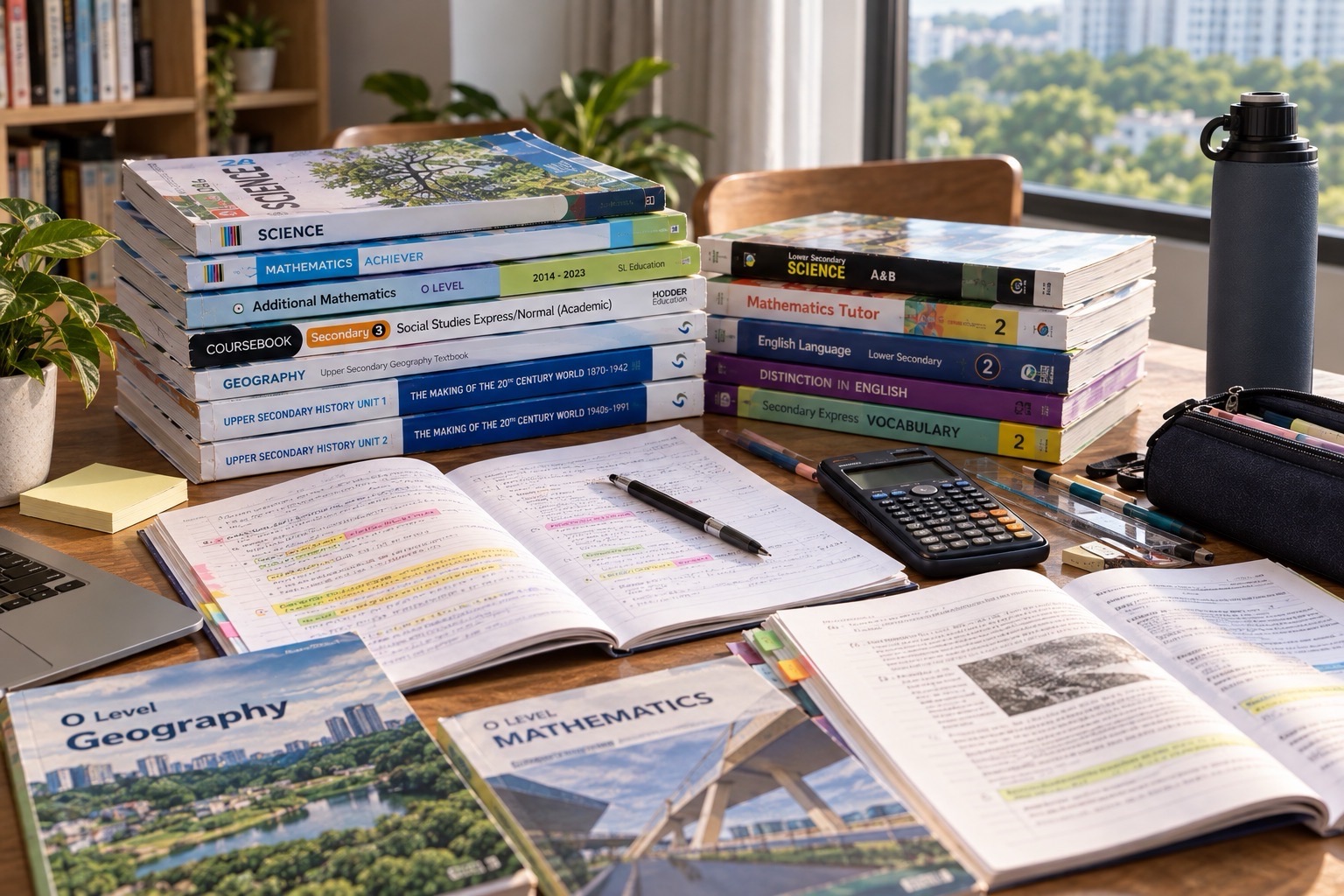
Updated 25 October 2026. Featured media shows school textbooks and Mathematics notes, not a leaked SEC examination. All worked examples are fictional and for teaching rather than exam prediction.
Jump to: 1. 2027 K210: the level and code should match the student · 2. The overall examination scheme in one glance · 3. The underlined syllabus content has a special role · 4. How to choose between the two Section B questions · 5. Why the last compulsory Paper 2 question matters · 6. G2 assessment objectives: technique, problems and explanation · 7. Why essential working should always be visible · 8. Number and Algebra begins with sensible numerical operations · 9. Percentages and reverse percentages · 10. Ratio, proportion and travel contexts · 11. Algebraic expressions: brackets and identities · 12. Equations: translate the situation before solving · 13. Graphs show relationships, not just shapes · 14. Angles, quadrilaterals and circle properties · 15. Pythagoras and trigonometry: select the correct triangle · 16. Mensuration: do not count the hidden surface · 17. Data interpretation: mean, median and standard deviation · 18. What makes the Geometry versus Statistics choice manageable? · 19. Probability: assumptions change the denominator · 20. Use approved calculators without surrendering judgement · 21. A family revision plan from now until 2027 · 22. How G2 Mathematics relates to G3 without ranking children · 23. The value of Mathematics extends beyond the exam mark · Other 2027 Science and Mathematics guides
1. 2027 K210: the level and code should match the student
The SEC brings together previously separate certificates while retaining subject-level standards. G2 Mathematics has the new code K210, with the earlier 4045 listed for reference. That code should guide the choice of official syllabus, specimen materials where available, and examination instructions. It is not interchangeable with G1 K110 or G3 K310.
Under Full Subject-Based Banding, pupils may study different subjects at suitable General levels. An entry Posting Group is not a permanent summary of ability across every subject. That matters when parents buy materials: a child registered for K210 needs preparation for K210, not simply whichever booklet has a familiar school-stream label.
Teachers can advise which areas need support and what a student’s school actually offers. The strongest family conversation focuses on readiness, progress and suitable study habits rather than comparing children by a broad label.
2. The overall examination scheme in one glance
Paper 1 is a two-hour paper with about 23 short-answer questions, worth 70 raw marks and 50% of the subject. Every Paper 1 question is compulsory. Paper 2 is another two-hour 70-mark paper and supplies the other half of the grade, but it has two sections with different answer rules.
Section A of Paper 2 is compulsory and contains nine to ten questions of varying lengths. The last question specifically focuses on applying Mathematics to a real-world scenario. Section B presents two options under specified content: one Geometry and Measurement question, and one Statistics and Probability question. The candidate answers only one.
This is the essential exam-management distinction. A student who answers both Section B options may waste precious minutes that could have been used to check compulsory solutions. A pupil who assumes the entire Paper 2 contains a choice risks skipping work that must be done.
- Paper 1 — 2 hours, 70 marks, 50%, roughly 23 compulsory questions.
- Paper 2 — 2 hours, 70 marks, 50%.
- Paper 2 Section A — 9–10 compulsory questions, with real-world application last.
- Paper 2 Section B — answer one of two 7/8-mark options.
3. The underlined syllabus content has a special role
SEAB explains that certain parts of the K210 syllabus are underlined and will be tested only in Paper 2 Section B. These areas belong to the approved content of the two optional questions. A candidate should read the official 2027 PDF rather than guess which topic appears where from an old practice book.
The two Section B choices come from Geometry and Measurement and Statistics and Probability. They are equally valued under the specified examination. This does not mean students should neglect the wider content of either strand. Many non-underlined concepts remain part of compulsory Paper 1 or Paper 2 Section A.
A parent can ask the teacher which underlined learning outcomes the child has covered and how the optional question is normally approached. The answer should guide targeted revision, not an attempt to identify a ‘sure-win’ topic based on gossip.
4. How to choose between the two Section B questions
Choice is a decision under limited time, not a prediction about a pupil’s general intelligence. Read both options briefly, identify the exact mathematical demands and assess which can be solved more reliably. A familiar diagram can still conceal an unfamiliar proof, and a statistics question may involve more interpretation than calculation.
Suppose one invented option asks for a geometrical relationship while the other asks for a comparison of data spreads. If the student understands the relevant formulae but cannot justify the geometry, the statistics option may be safer. If the student is comfortable with geometric reasoning but often misreads quartiles, the choice may go the other way.
Practice making the selection before starting detailed work. The pupil should still follow their teacher’s timing advice and the official instructions. Answering both options out of anxiety does not create extra marks and may harm the quality of compulsory responses.
5. Why the last compulsory Paper 2 question matters
SEAB states that the last Section A question applies Mathematics to a real-world scenario. Suggested contexts include everyday travel plans, timetables, sports, recipes, household finance, taxation, instalments, utilities and currency exchange. Such questions may integrate topics rather than look like a familiar single-chapter example.
An invented school outing might involve comparing a bus route with a train route while accounting for travel time, transfers and cost. A pupil cannot solve this reliably by multiplying the first two numbers they see. They must identify relevant quantities, time units and the actual decision required.
Successful modelling includes a conclusion in words. If the arithmetic gives a journey of 1.3 hours and the question asks whether the class can arrive before an activity begins, the pupil must translate that to a usable timeline and consider the constraints stated in the problem.
6. G2 assessment objectives: technique, problems and explanation
The official syllabus gives approximate assessment-objective weights of 60% for standard techniques, 30% for problem-solving in contexts and 10% for mathematical reasoning and communication. These are competencies assessed across papers, not optional modules that a child may ignore.
A pupil therefore needs dependable numerical and algebraic procedures, but also the ability to choose which procedure fits a scenario and explain a step when needed. A correct answer after a long chain of unjustified guesses does not demonstrate the same skill as a coherent solution.
Families can support by asking ‘What is known?’, ‘What is the unknown?’, ‘Which representation might help?’ and ‘How would you check?’ These prompts encourage problem-solving without turning every question into a demand for a lengthy essay.
7. Why essential working should always be visible
SEAB warns that omitting essential working leads to lost marks. The purpose of written steps is to make the mathematical relationship and reasoning clear. A calculator may return a number, but without a meaningful equation, it may be impossible to tell whether a student applied the correct model.
Consider an invented equation 5x − 7 = 18. Adding seven gives 5x = 25, so x = 5. A simple substitution checks it. In a realistic problem, the student should also say what x represents and whether five is plausible given the context.
Good working should be concise rather than messy. Label values, align transformations where helpful, keep units consistent and use a quick check. This is a habit worth practising even on short Paper 1 questions.
8. Number and Algebra begins with sensible numerical operations
K210 includes rational numbers, real numbers, indices, standard form, approximation, ratio and percentages. Students who can perform a calculation without understanding the size of the result may not notice errors such as a wrong power of ten or incorrect percent base.
For example, 4.2 × 10³ is 4200, while 4.2 × 10⁻³ is 0.0042. The position of the exponent radically changes the quantity. A student should estimate first and confirm whether their final value is of the right scale. This prevents calculator input mistakes from passing unnoticed.
Before applying a formula, identify what units the quantities use. Numbers do not carry meaning by themselves. Estimation and unit awareness are particularly valuable in personal finance and transport questions.
9. Percentages and reverse percentages
Percentage changes can be especially confusing when the base changes. A fictional price of S$80 rises by 25% to S$100. Recovering the original price from the new price requires dividing by 1.25, not simply subtracting 25% of S$100. The latter uses the wrong base.
Reverse percentages ask students to work back from a changed quantity. The useful habit is to define the initial amount and multiplier before rearranging. Writing ‘after 25% increase = 125% of original’ is a clearer starting statement than guessing a shortcut.
These methods are relevant to K210 and also to everyday spending decisions. Parents can use invented retail examples rather than encourage comparison of private household finances if that would make a child uncomfortable.
10. Ratio, proportion and travel contexts
Ratios compare quantities relative to each other. Scale factors describe how a drawing relates to a real object or distance. Direct proportion is different from inverse proportion, so students should identify which relationship the context actually supports.
Imagine a fictional scaled map where 1 cm represents 500 m. A measured 3.6 cm corresponds to 1.8 km under that scale. The arithmetic is simple once the scale and units are understood. If the question then asks for walking time, the student needs a separate assumed or provided speed; distance alone cannot establish a time.
The most common problem is not the multiplication itself but skipping the interpretation of a unit or assumption. A useful solution includes the unit at every significant stage.
11. Algebraic expressions: brackets and identities
Algebra converts relationships into symbols that can be manipulated consistently. K210 includes expanding, factorising, simplifying and changing the subject of formulae within the syllabus. A pupil who treats every expression as a bag of numbers can lose track of the structure.
For an invented example, 3(2x − 4) − 2x simplifies to 6x − 12 − 2x = 4x − 12. The sign inside brackets matters. The result can be checked for a particular x, but a correct algebraic derivation explains why the expressions are equal for all valid x.
Ask the learner to say what operation occurs first and whether the transformation preserves equivalence. Short explanations can prevent repeated symbolic errors more effectively than copying dozens of almost-identical lines.
12. Equations: translate the situation before solving
Linear, quadratic and simultaneous equations appear in the syllabus. A student may know elimination or factorisation but struggle to define variables from a word problem. One productive habit is to identify the unknowns and write their units before starting calculations.
A fictional event sells adult tickets at S$8 and child tickets at S$5. If the task provides total tickets and revenue, define a as adult tickets and c as child tickets before writing a + c = total tickets and 8a + 5c = total revenue. The variables need meaning for the answer to be interpreted.
If a quadratic equation produces two roots, ask whether both fit the real-world constraints. A length or number of attendees cannot be negative in an ordinary count. Mathematical solutions must be interpreted in the stated context.
13. Graphs show relationships, not just shapes
Straight-line graphs, coordinate geometry and other graphical representations connect algebra to visual information. A gradient represents change in one quantity per unit change in another. A constant gradient may suggest a linear model over a defined range, but the axes determine the meaning.
Imagine a fictional graph of electricity cost against usage, with a fixed charge and an additional charge per unit. The intercept represents the fixed component; the gradient represents the rate under the model. A student who simply writes ‘upward graph means expensive’ has not explained the relationship.
Pupils should label units and read the graph’s actual scale. Not all plotted data justify extending a line indefinitely. This is an important practical limitation in real-world questions.
14. Angles, quadrilaterals and circle properties
Geometry and Measurement includes angle relationships, triangles, polygons, circle properties and constructions. A figure may look convincing while hiding missing assumptions. Students need to justify statements using a relevant theorem or property instead of measuring the picture.
An invented problem may show an isosceles triangle whose equal sides are given. Its base angles are equal; the conclusion follows from the property, not from their appearance. The same care is needed when identifying parallel lines, cyclic quadrilaterals or tangent relationships.
A well-annotated diagram can save time, but annotations must reflect what is given or established. Help pupils explain why an angle is equal or supplementary rather than memorise the final number.
15. Pythagoras and trigonometry: select the correct triangle
Trigonometric ratios and Pythagoras’ theorem are tools for geometric problems, including settings with bearings, elevations and distances. The learner should first decide which triangle applies, which sides or angles are known, and whether the situation calls for a right-triangle ratio or another approved relation.
Suppose a fictional right triangle has legs of 9 cm and 12 cm. Pythagoras gives a hypotenuse of 15 cm. If a problem asks for an angle, a further trigonometric relationship may be needed. The correct answer depends on the specified angle and which sides are opposite or adjacent to it.
Calculator angle mode and accurate labelling matter. A right numerical value without units or a diagram based on the wrong reference angle may fail to answer the question. Always connect the calculation to the original figure.
16. Mensuration: do not count the hidden surface
Area, volume and surface area tasks can involve composite shapes or solids. Before calculating, identify the region or surface the question actually requests. Internal faces created when solids are joined may not count towards external surface area, even though they are part of the separate solids.
Imagine two cuboids joined along a face. Adding their complete surface areas would count the joined faces twice. The student should consider the exposed outer surfaces instead. A sketch and a logical decomposition help more than inserting all dimensions into a familiar formula.
Unit conversion can also cause large errors: one square metre equals 10,000 square centimetres, whereas a cubic metre equals 1,000,000 cubic centimetres. Squaring and cubing the length conversion factor is essential.
17. Data interpretation: mean, median and standard deviation
The Statistics and Probability strand includes tables, charts, measures of central tendency and spread, including standard deviation. A mean describes a location within a dataset, not its variation. Different datasets can share a mean while showing quite different spreads.
Consider two fictional groups with scores 6,6,6 and 4,6,8. Both have mean 6, but the second varies more. A task asking which group is more consistent requires consideration of spread, not only the shared average.
Students should also identify when a graph’s scale exaggerates differences or when a sample does not represent a wider population. The ability to question a display is a useful skill in both the examination and daily life.
18. What makes the Geometry versus Statistics choice manageable?
Section B presents one question from underlined Geometry and Measurement content and one from underlined Statistics and Probability content. Each carries either seven or eight marks under the official format. The equal mark value means the practical decision is about ability to complete the question accurately within time.
A pupil who is strong in formulas but weak at interpreting data should not automatically choose a question merely because it contains a familiar symbol. Likewise, a child who likes graphs should read all parts of a statistics problem before deciding. A two-minute overview of both questions in normal practice can reveal which is more suitable.
The choice should be trained during approved practice rather than left to exam-day panic. Students should still learn the relevant broad syllabus and keep the compulsory Section A secure.
19. Probability: assumptions change the denominator
Probability is a measure of chance under defined conditions. When events are independent, the structure differs from a situation where earlier outcomes change later possibilities. Students should identify the sample space or appropriate representation before multiplying or adding values.
An imaginary bag has two red balls and three blue balls. On a single random selection, red has probability 2/5. If one ball is removed and not replaced, the probability for the next draw depends on the first outcome. A student who keeps using 2/5 for the second draw in every circumstance has missed the condition.
These are safe paper illustrations, not gambling advice. The purpose is to understand conditional information and how a probability model relates to the stated setup.
20. Use approved calculators without surrendering judgement
SEAB permits an approved calculator in both K210 papers. The official notes require essential working and typically non-exact answers to three significant figures, or one decimal place for angles measured in degrees, unless instructed otherwise. Geometrical instruments and relevant formulae are also part of the paper arrangements.
A calculator can give a highly precise result for an incorrectly entered expression. Before pressing buttons, estimate the likely scale and check whether the angle mode is appropriate. After calculating, inspect the sign, units and any contextual restrictions.
Students should avoid premature rounding in intermediate stages. If the problem asks to show accuracy to a particular level, retain higher precision in working before presenting the final requested form. The task’s instructions always take precedence.
21. A family revision plan from now until 2027
During late 2026, confirm K210 and diagnose the most persistent difficulties in percentages, basic algebra, graphs and geometry. Use short targeted exercises with explicit explanations. A student who repeatedly misreads instructions may need work on translating word problems rather than more numerical drills.
In 2027, build longer mixed-topic Paper 2 practice after foundations settle. Encourage pupils to read both Section B options and make a reasoned choice during timed trials. Keep regular practice in compulsory topics regardless of any personal preference for Geometry or Statistics.
Use the official school examination calendar when available and protect time for other subjects, CCAs and rest. Effective revision is consistent, not necessarily long. A good error log can distinguish conceptual errors, missed conditions, calculator mistakes and problems of working presentation.
- Confirm the K210 subject code and latest school instructions.
- Memorise the format, not speculative examination questions.
- Paper 1: 2h, 70 marks, 50%, compulsory.
- Paper 2: 2h, 70 marks, 50%, Section A compulsory and one Section B choice.
- Show working and check units, scales and calculator settings.
- Review errors and maintain a sustainable study routine.
22. How G2 Mathematics relates to G3 without ranking children
G2 K210 and G3 K310 share the large ideas of Number and Algebra, Geometry and Measurement, and Statistics and Probability, but differ in the approved content and examination demands. In particular, G2 has a Paper 2 Section B choice, while G3 K310 has all questions compulsory.
Families should not tell a child to answer G3 papers simply because longer or harder material sounds more prestigious. Learning stretch is useful when a pupil has secure foundations and teacher guidance. Extra questions that are too far ahead may make revision inefficient and discourage confidence.
For a direct comparison, see our G3 Mathematics K310 guide. The subject level should support meaningful progress rather than be used as a label of personal worth.
23. The value of Mathematics extends beyond the exam mark
The first SEC results are expected in January 2028, when new post-secondary admissions arrangements apply. Mathematics may contribute to qualifying requirements, but each JC, MI, Polytechnic or ITE pathway uses its own criteria. Neither an individual G2 grade nor a generic online promise determines placement.
A child who understands how to reason with money, measurements, probability and graphs can use those skills in everyday choices and many fields of further study. The goal of tuition or revision is not merely a higher number on a mark sheet but the ability to solve new problems with increasing independence.
Read our 2027 SEC examination calendar and the transition to 2028 polytechnic and ITE routes for separate planning guidance.
Frequently asked questions
What is the 2027 G2 Mathematics code?
K210, with 4045 as the former reference code.
How long is Paper 1?
Two hours, with about 23 compulsory short-answer questions and 70 raw marks.
How long is Paper 2?
Two hours, with 70 raw marks and both compulsory and optional parts.
What is the weighting of each paper?
Each contributes 50% of the subject.
Which Paper 2 section is compulsory?
Section A, including a final question applying Mathematics to a real-world scenario.
What choice does Section B provide?
Choose one of two equal-mark questions, one from underlined Geometry and Measurement content and one from underlined Statistics and Probability content.
Must students complete both Section B questions?
No. The official instructions require only one.
Does the Section B choice mean candidates can ignore Geometry or Statistics?
No. Compulsory and optional content must be distinguished using the official syllabus; broad strands still inform the papers.
Are calculators permitted?
Yes, approved calculators may be used in both K210 papers.
Is working important?
Yes. Omitting essential working can lose marks.
What rounding is normally required?
Three significant figures, or one decimal place for degree angles, unless otherwise indicated.
Is G2 K210 the same as G3 K310?
No. Both the syllabus content and Paper 2 answer rules are different.
Does Section A always include a real-world question?
The syllabus states the final Section A question will focus on mathematical application to a real-world scenario.
Does K210 include standard deviation?
Yes, the published Statistics and Probability strand includes standard deviation.
Are the exact 2027 paper dates given by the syllabus?
No. Students must consult the final SEAB timetable and school instructions.
Does a G2 Mathematics grade guarantee any particular post-secondary offer?
No. Pathway eligibility and admission decisions depend on current official criteria.
Explore the related 2027 SEC Science and Mathematics guides
Continue with neighbouring subjects in this Bukit Timah education series. Every guide uses the correct General subject level and 2027 syllabus code, so check the pupil’s actual subject registration before choosing practice materials.
- Education at Bukit Timah | G3 Chemistry K324 SEC 2027
- Education at Bukit Timah | G3 Biology K325 SEC 2027
- Education at Bukit Timah | G3 Mathematics K310 SEC 2027
Official sources and further reading
SEAB 2027 G2 school-candidate subject directory — official K210 and former code.
SEAB K210 G2 Mathematics syllabus 2027 — Paper 2 choice, real-world tasks, content and calculator rules.
SEAB 2027 G3 Mathematics syllabus — distinct G3 structure.
MOE SchoolFinder — individual school programmes and subject levels.
eduKateSG G3 Mathematics K310 guide — companion guide for a different SEC level.
eduKateSG 2027 SEC Calendar — national examination and results timeline.
The takeaway: G2 Mathematics K210 rewards reliable techniques, sense-making and a smart understanding of Paper 2’s answer rules. The Section B choice is useful only when students recognise which work is compulsory and can justify their own selection. The most valuable habit is learning to reason through a new situation without losing track of units, evidence or the question.