
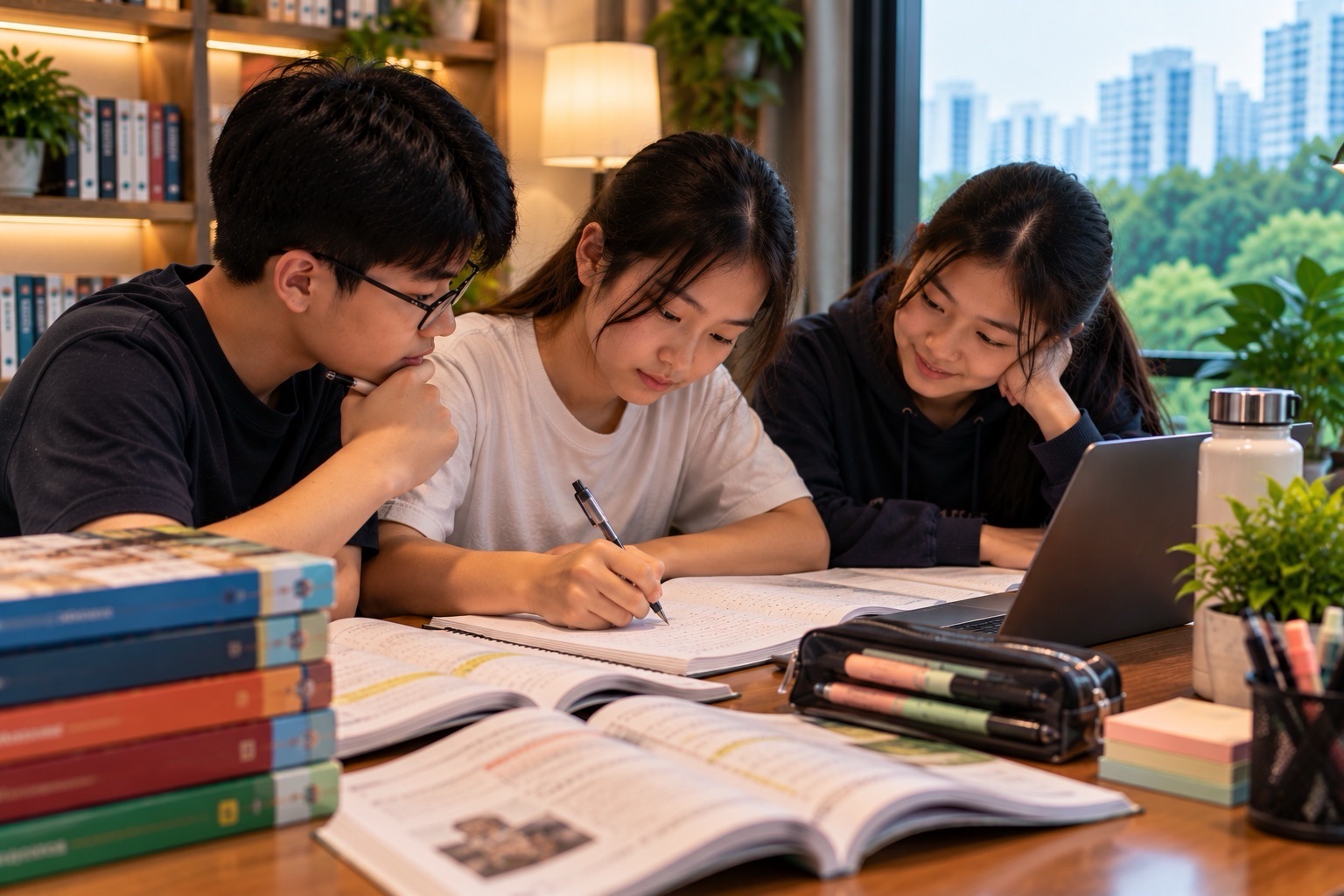
Did you know? A red mark on a Mathematics worksheet does not tell a tutor whether a pupil misunderstood the topic, misread a unit, made one arithmetic slip or forgot the question’s final request. Those mistakes may end with exactly the same score, yet require different corrections. For Secondary 2 G1 Mathematics, a useful correction is not a prettier answer. It is a changed understanding that survives the next worksheet.
Quick answer: the five-minute correction loop
A practical method is Locate → Name → Repair → Check → Retest. Locate the first invalid line, name the type of error, rebuild the idea through one clear example, check by reversing or estimating, and retest without the corrected solution visible. The retest should change the numbers, context or requested unknown so that the pupil must choose the method independently.
This guide is written for Bukit Timah families looking for a Secondary 2 G1 Mathematics tutor. G1 is a Mathematics subject level under Full Subject-Based Banding. Use the child’s actual school worksheet and teacher-issued scope. Our illustrative examples follow relevant G1 foundations, but are not official assessment scripts or a claim that every school tests all topics in the same week.
Read the part you need
- How to correct a worksheet
- Six useful error codes
- 28 correction examples
- A parent–student correction routine
- How small-group tuition can help
- Frequently asked questions
- Official references
How to make one correction last beyond today
1. Find the first line that stopped following the rules
Compare the pupil’s working with the question. An incorrect final number may come from a correct equation followed by a single sign slip, or from a wrong equation solved flawlessly. Start from the first difference that matters, not the final crossed-out answer. If a learner wrote −3x=15 then x=5, check the coefficient and division before rewriting the entire question.
2. Name the error without labelling the child
Write something precise: lost the negative sign, used sale price as the original percentage base, or read y as x. Avoid vague labels such as ‘bad at Maths’ or ‘careless’. A precise error description explains which skill should be taught. A short code also helps a tutor see whether the same mistake returns across different chapters.
3. Rebuild one principle
If the learner added denominators, return to fraction strips and a common unit. If they used the wrong angle sum, ask whether the shape has three sides or four. If they used km/h with minutes, write a units conversion before calculating. One short, correctly chosen explanation is more useful than copying thirty model answers.
4. Use an independent check that fits the topic
For an equation, substitute the result into the original. For a fraction addition, estimate whether the result should exceed either positive part. For geometry, identify the unit and an approximate size. For statistics, count observations and inspect the axis. There is no single universal check that catches every kind of error, so match the check to the skill.
5. Return after the model is hidden
Give a changed-number question later that day or during the next lesson; revisit it once more after a few days. A pupil who reproduces a solution while watching it may still depend on imitation. Independent retrieval after a short delay provides stronger evidence that the correction was learned. Keep practice manageable and stop once the critical idea is demonstrably secure.
Six useful error codes for a paper correction log
- CON: Concept—wrong mathematical relationship, such as adding unlike fractions directly.
- MOD: Modelling—wrong equation or diagram for a word problem.
- PRO: Procedure—valid rule applied incompletely, such as dropping one bracket term.
- REP: Representation—axes, table columns, units or graph scales read incorrectly.
- CAL: Calculation—an arithmetic or calculator-input slip after valid setup.
- ANS: Answer interpretation—saving reported instead of payment, missing units or infeasible rounding.
These codes are optional tutoring labels, not official school or MOE categories. A short correction-log entry can say: ‘MOD—$5 joining fee was multiplied by number of visits; new model C=5+3n; retest on Thursday with $7 fee.’ That is specific enough for a parent or tutor to follow without requiring a full rewritten chapter note.
28 original correction clinics from G1 Mathematics
Use these as a diagnostic menu rather than an instruction to complete all 28 in one sitting. Each case shows how a plausible wrong line can reveal a different learning need. Cover the corrected explanation first and ask the pupil to identify the problem independently, then compare with the repair.
1. An answer changed without finding the first wrong line
What appeared in the schoolwork: A student writes 7−12=5. The corrected paper says −5.
Correct the first wrong idea: The subtraction crosses zero. Seven minus twelve is −5. Moving left twelve places from seven ends at negative five.
Why copying the answer is not enough: Simply crossing out 5 and copying −5 does not teach the signed-number direction.
Independent second attempt: Next try 6−10 and explain why −4 is smaller than zero.
2. The minus sign outside a bracket is forgotten
What appeared in the schoolwork: A learner simplifies −(3x−4) as −3x−4.
Correct the first wrong idea: Multiply both bracket terms by −1: −(3x−4)=−3x+4.
Why copying the answer is not enough: The student has distributed the negative to the x term but not the constant.
Independent second attempt: At x=0, the original equals 4; the incorrect form equals −4. Try −(2y−7) independently.
3. Unlike terms are combined
What appeared in the schoolwork: The pupil turns 5x+3 into 8x.
Correct the first wrong idea: Five x-units and three ordinary units are different types of quantities. The expression remains 5x+3.
Why copying the answer is not enough: A total such as 8x is not equivalent for all x. Test x=2: the original is 13 and 8x would be 16.
Independent second attempt: Change to 4a+2b and explain why there is no single like-term total.
4. An equation is mistaken for an expression
What appeared in the schoolwork: The question says simplify 3x+2x, but the pupil writes x=5.
Correct the first wrong idea: The expression simplifies to 5x; there is no equation to solve because no equality or numerical total is supplied.
Why copying the answer is not enough: Writing a value for x invents a condition that the question never gave.
Independent second attempt: Contrast with 3x+2x=20, which gives 5x=20 and x=4.
5. A fraction denominator is added
What appeared in the schoolwork: A pupil writes 1/2+1/3=2/5.
Correct the first wrong idea: The denominators describe different-sized parts. Rewrite as 3/6+2/6=5/6.
Why copying the answer is not enough: The calculation 2/5 is smaller than 1/2, yet adding a positive third must make the sum larger.
Independent second attempt: Use fraction strips and repeat with 1/4+1/2=3/4.
6. A fraction was inverted in the wrong place
What appeared in the schoolwork: A pupil writes 3/4÷1/2=3/8.
Correct the first wrong idea: Division by 1/2 becomes multiplication by 2/1: 3/4×2=3/2.
Why copying the answer is not enough: The pupil multiplied the two original fractions instead of using the reciprocal of the divisor.
Independent second attempt: Multiply 3/2 by 1/2 and recover 3/4. Try 2/3÷1/3.
7. A decimal place is lost
What appeared in the schoolwork: A pupil says 1.2÷0.3=0.4.
Correct the first wrong idea: Multiply both numbers by ten and calculate 12÷3=4.
Why copying the answer is not enough: Changing only the divisor or moving only one decimal point changes the quotient.
Independent second attempt: Check 4×0.3=1.2, then change the problem to 2.4÷0.6.
8. The percentage saving is given as the payment
What appeared in the schoolwork: An $80 item has 15% off; the learner submits $12 as the final price.
Correct the first wrong idea: $12 is the saving. The actual payment is $80−$12=$68.
Why copying the answer is not enough: The intermediate amount was correct but it answered the wrong noun in the question.
Independent second attempt: Underline ‘payment’ and check 68+12=80.
9. The new value is used as the original percentage base
What appeared in the schoolwork: After a 20% discount, the sale price is $64. A student adds $12.80 and gets an original of $76.80.
Correct the first wrong idea: $64 is 80% of original. Divide by 0.8: original=$80.
Why copying the answer is not enough: The pupil took 20% of the reduced price rather than the old 100% base.
Independent second attempt: Apply the discount forward: 80×0.8=64.
10. A ratio’s whole is not counted
What appeared in the schoolwork: A pupil splits $72 in ratio 5:4 as $36 and $36.
Correct the first wrong idea: There are nine parts. One part is $8, giving shares $40 and $32.
Why copying the answer is not enough: Equal sharing respects the total but not the required ratio.
Independent second attempt: Check 40+32=72 and 40:32 reduces to 5:4.
11. Minutes are entered as decimal hours
What appeared in the schoolwork: One hour thirty minutes is written 1.30 hours.
Correct the first wrong idea: Thirty minutes is 30/60=0.5 hour, so the duration is 1.5 hours.
Why copying the answer is not enough: Decimal place notation is being treated as clock minutes.
Independent second attempt: Check 1.5×60=90 minutes. Convert 1 hour 12 minutes to 1.2 h.
12. A rate calculation has the wrong time unit
What appeared in the schoolwork: For 36 km in 45 minutes, a pupil writes 36÷45=0.8 km/h.
Correct the first wrong idea: The number 0.8 is km/min, not km/h. Convert 45 minutes to 0.75 hour, then speed=36/0.75=48 km/h.
Why copying the answer is not enough: The arithmetic may be internally consistent but the output label is not.
Independent second attempt: Check 48 km/h×0.75 h=36 km.
13. Direct and inverse models are swapped
What appeared in the schoolwork: Six equal workers take eight days for fixed work; a pupil predicts twelve workers take sixteen days.
Correct the first wrong idea: Fixed work is 6×8=48 worker-days. Twelve equally productive workers would need four days.
Why copying the answer is not enough: A direct model wrongly makes more workers take longer under the stated assumptions.
Independent second attempt: Check 12×4=48. Write the real-world assumptions beside the correction.
14. A fixed fee is multiplied by the activity count
What appeared in the schoolwork: A service charges $5 once plus $3 per ride. Four rides are computed as 5×4+3=$23.
Correct the first wrong idea: Model 5+3×4=$17.
Why copying the answer is not enough: The pupil attached the variable to the one-off fee rather than the repeated charge.
Independent second attempt: At zero rides the model still costs $5, assuming the booking fee applies.
15. A negative coefficient is dropped
What appeared in the schoolwork: Solve −3x=15; a pupil writes x=5.
Correct the first wrong idea: Divide by −3, giving x=−5.
Why copying the answer is not enough: Division by a negative must preserve its sign; the coefficient is −3, not +3.
Independent second attempt: Substitute −3(−5)=15.
16. The bracket numerator is split incorrectly
What appeared in the schoolwork: For (x+5)/3=7, the learner multiplies only x by three.
Correct the first wrong idea: Multiply both sides by three: x+5=21, so x=16.
Why copying the answer is not enough: The horizontal fraction bar groups the entire numerator, not just the letter.
Independent second attempt: Check (16+5)/3=7.
17. The first sequence term does not match the proposed formula
What appeared in the schoolwork: For 5,8,11,14 the learner writes the nth term as 3n+5.
Correct the first wrong idea: The common difference is three, but at n=1 the rule must give five. Use 3n+2.
Why copying the answer is not enough: 3n+5 gives eight at position one; the student never tested the starting value.
Independent second attempt: Test positions one, two and ten; the tenth is 32.
18. Coordinates are transposed
What appeared in the schoolwork: The ordered pair (2,5) is plotted two up and five right.
Correct the first wrong idea: The first coordinate gives horizontal movement to x=2; the second gives vertical movement to y=5.
Why copying the answer is not enough: The pupil has reversed the axes, not necessarily misunderstood the numbers.
Independent second attempt: Label x and y and plot (5,2) as a deliberately different point.
19. Gradient is inverted
What appeared in the schoolwork: For points (1,2) and (3,6), the pupil calculates gradient=2/4=1/2.
Correct the first wrong idea: Vertical change is 6−2=4; horizontal change is 3−1=2. Gradient=4/2=2.
Why copying the answer is not enough: Run/rise was substituted for rise/run.
Independent second attempt: Explain that one step right raises y by two on this line.
20. A graph intercept is attached to the wrong axis
What appeared in the schoolwork: The pupil says y=2x+3 meets the x-axis at (0,3).
Correct the first wrong idea: At x=0, y=3, so (0,3) is the y-intercept. For the x-intercept, set y=0 and solve x=−1.5.
Why copying the answer is not enough: The pupil mixed up the condition x=0 with y=0.
Independent second attempt: Plot both points and label the axes explicitly.
21. A triangle rule is applied to a quadrilateral
What appeared in the schoolwork: Three angles 90°, 70°, 100° in a quadrilateral lead the pupil to subtract their sum from 180°.
Correct the first wrong idea: A quadrilateral’s interior angles total 360°. The fourth is 360−260=100°.
Why copying the answer is not enough: A memorised whole-angle total was used on the wrong shape.
Independent second attempt: Draw a diagonal to split the quadrilateral into two triangles.
22. A sloping side is used as perpendicular height
What appeared in the schoolwork: A triangle has base 12 cm, perpendicular height 8 cm and sloping side 10 cm. The learner uses 10 in the area formula.
Correct the first wrong idea: Area=1/2×12×8=48 cm². The height must be perpendicular to the chosen base.
Why copying the answer is not enough: The wrong length was chosen from an otherwise correctly labelled diagram.
Independent second attempt: Find the right-angle marker. Ask why the sloping side is not automatically a height.
23. Surface area is mistaken for volume
What appeared in the schoolwork: For a 5×4×3 cm cuboid the student labels 60 as cm².
Correct the first wrong idea: 60 is volume in cm³. Surface area would require all six faces: 2(20+15+12)=94 cm².
Why copying the answer is not enough: The numerical product is correct for a different quantity.
Independent second attempt: Sketch the layers for volume and net faces for surface area.
24. A mean is divided by the wrong count
What appeared in the schoolwork: For data 4,6,8 the pupil writes (4+6+8)/2=9.
Correct the first wrong idea: The data contain three observations; mean is 18/3=6.
Why copying the answer is not enough: The student counted two plus signs instead of three values.
Independent second attempt: Check three equal values of six also total eighteen.
25. The median is selected without sorting
What appeared in the schoolwork: For data 9,2,6,4,8, the pupil picks six because it occupies the middle written position.
Correct the first wrong idea: Sort first: 2,4,6,8,9. In this case the median is also six, but the reasoning must rely on order. Change to 9,2,8,4,6 to expose the habit.
Why copying the answer is not enough: A lucky correct answer is not proof the correct procedure was used.
Independent second attempt: Use 9,2,4,6,8; the written middle is four but the sorted median remains six.
26. A probability boundary is misread
What appeared in the schoolwork: On a fair die, ‘greater than four’ is counted as {4,5,6}.
Correct the first wrong idea: Strictly greater than four means {5,6}; probability=2/6=1/3.
Why copying the answer is not enough: The word ‘greater than’ was replaced by ‘at least’.
Independent second attempt: Compare with ‘at least four’, where {4,5,6} is correct.
27. A rounded answer is confused with an exact one
What appeared in the schoolwork: A learner rounds 17.486 to two decimal places as 17.48.
Correct the first wrong idea: The third decimal is six, so the hundredths digit rounds up to produce 17.49.
Why copying the answer is not enough: The operation was truncation rather than rounding.
Independent second attempt: Explain why 17.49 is nearer than 17.48.
28. A model answer is copied without the original question
What appeared in the schoolwork: An error-log entry says ‘write 24’ but never records which quantity 24 represents.
Correct the first wrong idea: A useful correction names a quantity and unit: for example, 24 cm² area rather than 24 cm boundary length, with the formula that produced it.
Why copying the answer is not enough: Copying a correct-looking numeral leaves the misunderstanding unexamined.
Independent second attempt: Retest a changed question requiring an area, and ask why the unit must be square.
A 12-minute parent–student correction routine
- Minutes 1–2: ask the child what the question requires, without revealing the answer.
- Minutes 3–5: identify and name the first invalid step; avoid redoing everything.
- Minutes 6–8: rebuild only the unstable idea with a simpler model.
- Minutes 9–10: let the child re-solve the original without looking at the corrected lines.
- Minutes 11–12: create a changed-number retest and schedule a later quick revisit.
A parent does not need to demonstrate every algebra rule. Listening for the learner’s explanation is often enough to identify whether the model has been understood. Ask ‘Why does that step work?’ and ‘How could you check without looking at the answer?’ If the child cannot explain it, note the exact point for the tutor rather than arguing over the final number.
What a focused three-pupil tutorial can do
The immutable eduKateSG Clementi Mathematics programme describes premium three-pupil tutorials near Sixth Avenue MRT. In a G1 lesson, the tutor can look at three schoolwork samples and find that one pupil has a concept error, another a unit-reading error and the third a calculation slip. Each receives a different correction and independent retest. The format reference does not guarantee current class availability, a fixed schedule or particular results.
An illustrative 90-minute lesson can begin with retrieval of an earlier mistake, use 20 minutes to model the current concept, 25 minutes for individually observed solving, 15 minutes of changed-number transfer, 10 minutes of mixed independent questions and final reflection. The value is not the number of pages completed; it is whether the first wrong line becomes less likely to recur after the model is removed.
Which syllabus is relevant?
MOE’s G1 Mathematics content-by-level document identifies Secondary Two topics in number and algebra, geometry and measurement, and statistics and probability. SEAB lists K110 for the 2027 G1 Mathematics SEC syllabus (earlier code 4046). The 2027 SEC is a graduating examination, not a 2026 Secondary 2 school paper. Use the current school’s marking expectations and later the official syllabus for the student’s own examination year.
Frequently asked questions
Should the pupil rewrite every wrong question from scratch?
Not always. One meaningful explanation of the first error and an independent changed-number retest can teach more than copying an entire solution repeatedly. Follow any explicit school correction requirements.
How can we tell a concept error from a calculation slip?
Ask the child why the first operation was chosen, then try easier numbers. If the model remains wrong, the principle needs rebuilding. If the model is sound but a multiplication fact fails, target arithmetic and checking.
Is an error log too much extra homework?
It should be compact: question reference, error code, one-sentence fix and next retest. A record that is too burdensome is less likely to be reviewed.
How often should old errors be revisited?
Soon after correction and again after a delay is a practical starting point. Adjust to workload, fatigue and the number of recurring misconceptions rather than setting a rigid quota.
Can a corrected answer still be wrong?
Yes. A learner may copy an answer for the wrong reason or report a correct number with the wrong unit. Compare the full relationship and requested quantity.
How should tuition use school-marked worksheets?
Start with the school’s actual scope and traceable feedback, respect teacher instructions, and target the earliest repeated misconception. Ask how progress is demonstrated independently later.
Continue with closely connected G1 Mathematics guides
- Revision and exam strategy
- First-lesson learning-gap diagnosis
- Showing clear working
- Understanding Mathematics question verbs
- Three-pupil learning pathways
Official references and editorial note
- MOE: G1 Mathematics content by secondary level
- SEAB: official 2027 K110 G1 Mathematics syllabus listing
- eduKateSG: unchanged three-pupil Mathematics programme
Reader note: All pupil mistakes and example corrections above are invented for teaching and do not represent real learners, official past examinations or guarantees of grade improvement. Fees, tutor assignment, venue and class openings require direct verification with the centre.
If you are considering a Mathematics tutor near Bukit Timah, bring two marked school questions and ask the tutor what first wrong step they would target. Contact eduKate Singapore for the current programme details.