
Did you know that the 2027 G3 Literature in English SEC has four assessed answers, each contributing exactly one quarter of the subject? One is an interpretation of an unseen poem, another is an analysis of a prose text, and two are responses to drama. The challenge is not to memorise the longest quotation from a novel. It is to explain how a writer’s choices create meaning. For Bukit Timah families who enjoy reading but are unsure how to prepare for the exam, this guide distinguishes prescribed texts, unfamiliar poetry and the demands of literary argument.
The quick answer: G3 Literature in English K331, previous code 2065, has two compulsory papers in separate sittings. Paper 1, Prose and Unseen Poetry, lasts 1 hour 40 minutes and counts for 50%: one prose question and one unseen-poem question, each worth 25%. Paper 2, Drama, lasts 1 hour 30 minutes and counts for 50%: one compulsory passage-based question and one essay based on the chosen play, each worth 25%. The syllabus prescribes five prose works and four plays, with specific Singapore texts and Singapore unseen poetry represented among the questions.
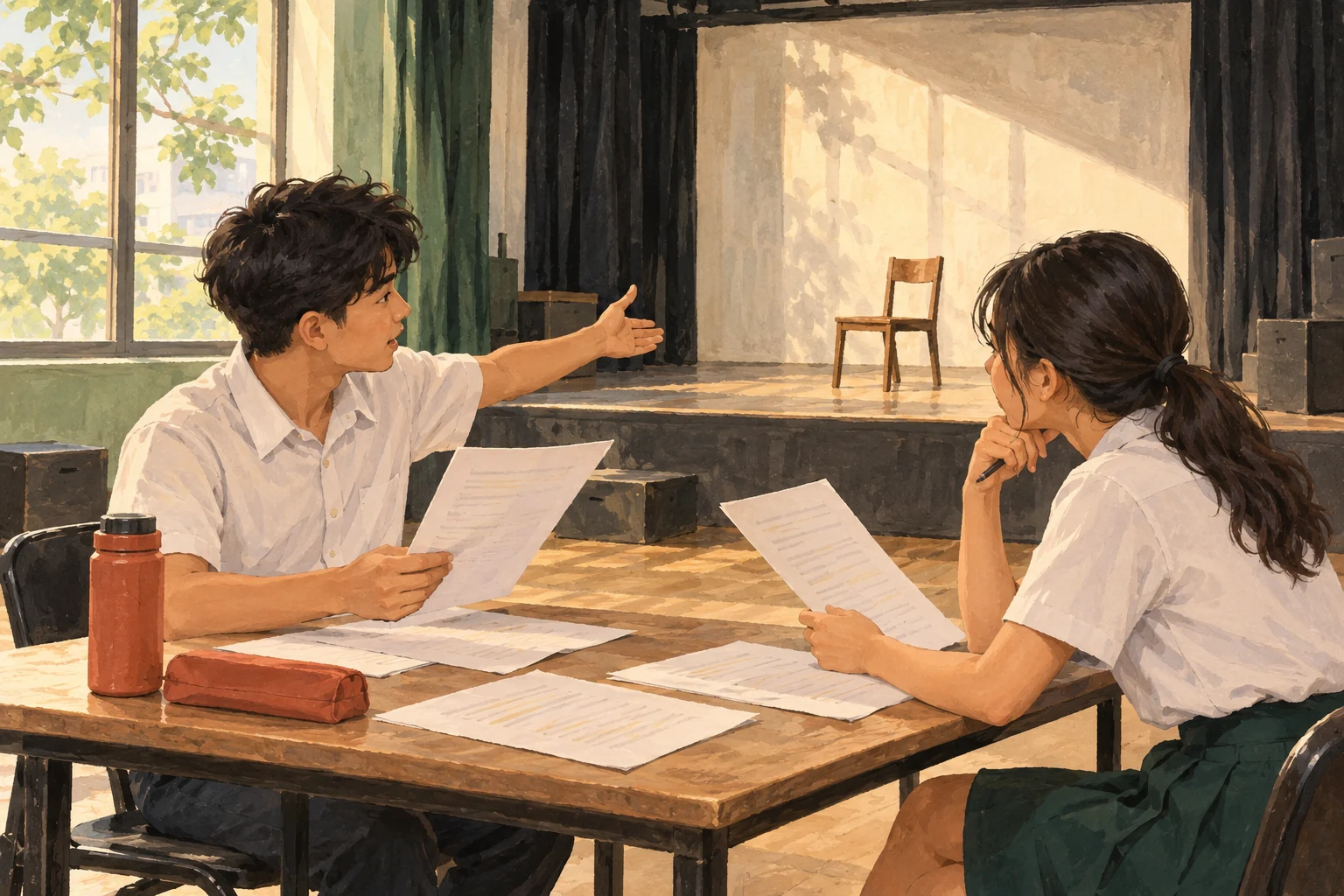
Updated 26 October 2026. The featured artwork illustrates students discussing a theatre script, not an examination scene. Any short practice verse here is original; copyrighted prescribed books must be used through authorised editions and sources.
Jump to: 1. Why K331 is not simply another English comprehension paper · 2. Four answers worth a quarter each · 3. The separate paper durations and total time · 4. The five prescribed prose works · 5. Why a Singapore prose text matters · 6. Paper 1 prose: choose one of three question forms · 7. A passage is evidence, not a summary invitation · 8. The danger of memorising a character template · 9. Paper 1 Section B: two unseen poems, choose one · 10. How to approach an unseen poem for the first time · 11. An original miniature poetry exercise · 12. Imagery and sound: connect technique to effect · 13. Form and structure are part of the writer’s meaning · 14. The four prescribed Drama options · 15. Paper 2: one passage and one essay on the chosen play · 16. Stage directions are part of a play’s language · 17. What makes a drama passage answer analytical? · 18. Why Singapore drama and poetry deserve attention · 19. Context helps, but it must not overwhelm the text · 20. Why evidence needs explanation · 21. Avoid the plot-summary trap · 22. A personal response is not an unsupported opinion · 23. How to plan the four responses under time limits · 24. Reading and annotating without drowning in notes · 25. 2027 prescribed texts and the 2028 continuity note · 26. How Literature relates to G3 English Language · 27. A family-friendly weekly routine for a Literature learner · 28. What to do before school starts the 2027 revision cycle
1. Why K331 is not simply another English comprehension paper
Literature is concerned with how stories, poems and plays represent experiences, ideas and relationships. G3 English Language K300 also assesses reading, but its purpose is broader communication through writing, listening, speaking and comprehension. G3 Literature K331 is a separate examined subject with prescribed texts, an unseen-poetry choice and drama assessment.
A student may understand every word in a passage yet struggle to explain why the writer repeats an image, interrupts a conversation or chooses a particular narrator. Those questions ask for interpretation supported by details. The evidence is not only what happened in the story, but how the author made that event significant.
Families should confirm the subject with the school before ordering books. The 2027 K331 list is specific, and a title from an older syllabus may be enjoyable reading without being the pupil’s actual set work.
2. Four answers worth a quarter each
Paper 1 contributes half of the grade through two responses: one on prose and one on unseen poetry. Paper 2 contributes the other half through two responses on a selected drama text. Each of these four answers carries twenty-five per cent of the total subject weighting.
That balance matters because it prevents any single genre from being treated as unimportant. A teenager confident with novels still needs to read unfamiliar poems, while a pupil who enjoys theatre needs to build a strong passage-based response and a developed essay on the play.
A useful study schedule gives regular time to prose, poetry and drama, then adjusts for specific weaknesses revealed by teacher feedback. Spending every evening rehearsing plot summaries for one novel would leave three quarters of the examination demands underprepared.
3. The separate paper durations and total time
SEAB gives Paper 1 a duration of one hour forty minutes and Paper 2 a duration of one hour thirty minutes. They are taken in separate sittings, making the total examination time three hours ten minutes. Students need to work with the actual individual paper limits rather than divide the full combined duration arbitrarily.
Each Paper 1 answer deserves an appropriate allocation within its hundred minutes. Paper 2 has ninety minutes for the passage and essay. The best time division depends on the pupil’s writing pace, school instructions and the particular questions, so practice should reveal whether planning or drafting tends to absorb too much time.
Timed tasks make sense after the student can develop sound interpretations. Training a pupil to write very quickly before they can read precisely may merely produce longer descriptions that fail to answer the question.
4. The five prescribed prose works
The 2027 syllabus prescribes five prose options: How We Live Now, edited by Yu-Mei Balasingamchow; All the Light We Cannot See by Anthony Doerr; Lord of the Flies by William Golding; Roll of Thunder, Hear My Cry by Mildred D. Taylor; and The Chrysalids by John Wyndham.
Students ordinarily study the prose work selected for their school programme. The exam sets questions for the prescribed choices, but a pupil should not try to memorise detailed commentary on all five as a substitute for understanding the one they have actually read and studied.
Each text raises different questions about individuals, society and human choices. The relevant study method is close reading, understanding of concerns, attention to craft and a well-supported personal response, not a collection of generic paragraphs applied to every novel.
5. Why a Singapore prose text matters
SEAB states that one or two Singapore texts will be set for prose each examination year. The 2027 list includes How We Live Now, an edited collection, alongside international works. Students can find cultural and linguistic contexts closer to familiar local life while still practising universal literary skills.
A Singapore setting does not mean every pupil automatically knows what a story means. Writers can use ambiguity, irony and conflicting perspectives even in environments readers recognise. A good reader asks which details matter and why a particular voice or structure shapes the experience.
Families in Bukit Timah can discuss everyday observations without claiming that a local shopping centre or MRT station appears in the selected book. Keep factual claims about a literary text grounded in the actual edition being studied.
6. Paper 1 prose: choose one of three question forms
For each prescribed prose title, the paper includes one passage-based question and two essay questions. A candidate selects one question based on the prose work they have studied. That choice should reflect the pupil’s ability to address the exact question, not an assumption that passages are always easier.
A passage question asks for close engagement with the supplied extract while understanding its role in the wider work. An essay can ask for analysis of a character, relationship, theme or method across the text. Both require relevant evidence and explanation rather than a retelling of the beginning, middle and end.
Students should practise at least two response approaches before the examination so that the choice is informed. A learner who can only reproduce an essay memorised weeks before may struggle when its title does not match the question.
7. A passage is evidence, not a summary invitation
Consider a fictional prose passage in which a character quietly closes a door after being ignored. A question could ask how the writer conveys a changing relationship. A response that only reports that the door was closed may miss tone, pacing, implication and narrative viewpoint.
Students can look at the verbs, pauses, setting, dialogue and placement of the passage in the narrative. The aim is to explain what these choices suggest about the character or reader’s experience, connecting small details to the question’s specific focus.
Practise writing a claim followed by short textual evidence and interpretation. A quoted phrase does not prove an argument by existing on the page; the pupil needs to explain why it supports the claim.
8. The danger of memorising a character template
A learner might prepare a paragraph saying a protagonist is brave, compassionate or rebellious, then attempt to use it for every question. If the prompt asks how a character changes in a particular relationship, that memorised description may become irrelevant.
Good literary study recognises complexity. A character can act courageously in one moment and hesitate in another. Those differences may be significant rather than contradictions that must be smoothed away. The pupil should select details that answer the actual question.
Ask a teenager to give one example that supports a character interpretation and one that complicates it. This encourages a more mature argument and reduces dependence on stock adjectives.
9. Paper 1 Section B: two unseen poems, choose one
There are no prescribed texts for the unseen poetry section. The paper offers two poems, each with one question, and the pupil selects one. SEAB specifies that one question each year is based on a Singapore text, so students should be prepared to read poems with different local and international voices.
Unseen does not mean impossible. Pupils can identify the speaker, situation, imagery, contrast, sound patterns and structural choices by looking at the actual poem. No student is expected to have memorised the confidential 2027 poem in advance.
The best preparation is reading unfamiliar poetry regularly, then explaining an interpretation with precise evidence. Students should feel allowed to revise an initial idea after noticing a line that complicates it.
10. How to approach an unseen poem for the first time
Read once for the general situation and mood; read again for words or structural choices that make it distinctive. Identify the question’s focus before writing a paragraph. A poem about a journey may be less concerned with transport itself than with separation, memory or a change in perspective.
Ask what the speaker sees, wants or remembers, and whether an image or shift changes the reader’s understanding. A repeated phrase may have a different effect at the end from the beginning because the context has developed.
A strong response does not list every technique in the poem. It chooses relevant devices and explains how they contribute to the particular interpretation the pupil is developing.
11. An original miniature poetry exercise
Consider these two original lines created for practice: ‘The empty chair kept its place beside the light. By morning, even shadows seemed to wait.’ A reader may infer absence, expectation or memory, but a convincing answer needs to examine why the chair and waiting shadows create those possibilities.
The student’s task is not to guess the one emotion imagined by the exercise writer. Instead, explain how personification or an image of stillness affects the interpretation. An alternative reading may also be defensible if supported by details and the prompt.
Using short original classroom material helps practise analysis without reproducing substantial copyrighted poetry. The actual K331 unseen questions and texts remain governed by SEAB’s exam papers.
12. Imagery and sound: connect technique to effect
Metaphor, simile, imagery, alliteration and rhythm are common terms, but merely naming them cannot substitute for explaining meaning. A sound pattern may reinforce urgency, hesitation or continuity, depending on the specific wording and context.
If an imagined poem repeats a phrase at the beginning of several lines, the pupil should ask what the repetition emphasises and whether its effect changes as the poem unfolds. ‘It makes the poem interesting’ is too vague to demonstrate close reading.
Practise one precise observation at a time: identify the word or structure, describe the effect and connect it to the response demanded by the question. This is literary reasoning rather than a technique-spotting competition.
13. Form and structure are part of the writer’s meaning
A literary response can consider who speaks, how scenes or stanzas are arranged and where the author changes time or perspective. A sudden short sentence after several long ones may affect pacing; an interrupted conversation can shape what the reader understands about relationships.
Structure should be analysed in the actual work, not used as a general claim that shorter sentences always create tension. The reader needs to know what the sentence follows and what comes next before explaining its effect.
Have students explain why a scene appears at that point in the story or why a poem changes direction. Such questions encourage reading the whole composition rather than isolated fragments.
14. The four prescribed Drama options
The published 2027 drama list contains ‘Master Harold’ … and the boys by Athol Fugard, The Royal Hunt of the Sun by Peter Shaffer, Romeo and Juliet by William Shakespeare, and Everything but the Brain by Jean Tay. Schools select an appropriate full drama text for study.
Students should read the play as drama rather than only as prose. Stage directions, dialogue, entrances, silences and changes in relationships can shape how an audience experiences the performance.
SEAB specifically says schools must not select screenplays or abridged versions of the prescribed works for study. A film adaptation may help with appreciation if permitted, but it is not a substitute for the actual full examination text.
15. Paper 2: one passage and one essay on the chosen play
The Drama paper lasts one hour thirty minutes and accounts for 50% of the total. Candidates answer a compulsory passage-based question and an essay question based on their selected drama work, each contributing 25% of the qualification.
Unlike the prose section, the passage-based requirement cannot be sidestepped simply because a pupil prefers pre-prepared thematic essays. Students should understand individual exchanges closely and relate them to the wider dramatic text.
Practice should include short extracts and larger questions about character development, conflict, stagecraft and the play’s central concerns. The pupil needs to move confidently between a local scene and the whole work.
16. Stage directions are part of a play’s language
Drama is written to be enacted, so stage directions and theatrical space can matter as much as dialogue. A deliberate silence may indicate conflict; a movement toward or away from another character may change the audience’s understanding of power or intimacy.
These effects depend on context. One silence may show defiance, while another reflects shock or uncertainty. A good response refers to the precise scene and explains how the playwright’s decision shapes meaning.
Students can read extracts aloud or discuss possible performance choices in a school-approved setting. Such practice is useful because it reveals dialogue as action rather than simply information printed between character names.
17. What makes a drama passage answer analytical?
An analytical paragraph should identify how the playwright shapes a situation: through the exchange of lines, contrast between characters, pacing or a stage direction. It must then explain how that choice contributes to the question’s focus.
A weak answer paraphrases the scene from start to finish. A stronger one selects two significant moments and shows how each develops the tension or relationship. It may also connect the extract to an earlier conflict or later turning point where that is relevant.
Reading the wider play makes the passage more intelligible. A candidate unfamiliar with character relationships may misunderstand why an ordinary sentence carries strong dramatic significance at that moment.
18. Why Singapore drama and poetry deserve attention
SEAB states that one or two Singapore drama texts are set each examination year, and one unseen-poetry question uses a Singapore text. This reinforces that literature is not confined to familiar British or American settings and that students should read attentively across voices and cultures.
A local work can engage with experiences, speech or relationships that feel recognisable, yet it still demands interpretation. A Singapore writer may present conflicting viewpoints rather than announce a simple lesson about society.
Encourage students to attend to language and form without presuming that any character speaks for every Singaporean. A particular narrator or role is part of an artistic work, not an official survey of national opinion.
19. Context helps, but it must not overwhelm the text
Historical and cultural background can illuminate a novel or play, especially when it concerns a society or period unfamiliar to the pupil. However, an exam response should remain focused on the literary question and the evidence in the selected work.
An essay that recounts an entire historical event but says little about a novelist’s choices may demonstrate research without demonstrating literary analysis. Context is strongest when it explains why a character acts, why a form matters or how the reader’s understanding changes.
Teach pupils to use context selectively and accurately. An invented claim about the author’s private intention is not a substitute for showing the words, structure or dramatic events that support an interpretation.
20. Why evidence needs explanation
SEAB’s higher band descriptors value a consistent viewpoint supported by judiciously selected textual evidence. The phrase ‘judicious selection’ matters: the best quotation is not necessarily the longest. A small relevant detail, interpreted carefully, may carry more argumentative weight than a paragraph of copied text.
An answer should state what the chosen phrase or event demonstrates and how it contributes to a larger idea. Repeating the quote in different words is less useful than analysing the language, form or context that gives it significance.
Students can highlight one detail in a teacher-provided extract and write two different possible interpretations. Then discuss which better answers the question. This makes evidence selection active and thoughtful.
21. Avoid the plot-summary trap
Plot knowledge is necessary, but the syllabus’s assessment criteria distinguish literary insight from narrative retelling. A student can accurately describe a character’s entire journey and still have a weak answer if it never explains the requested theme or dramatic effect.
To correct this, read the question carefully, identify its key concern and begin paragraphs with an analytical claim. Use plot details to support the claim, not as the paragraph’s main destination.
Parents need not become literary experts. Ask ‘Why did the writer show it this way?’ rather than only ‘What happened next?’ That question encourages interpretive thinking.
22. A personal response is not an unsupported opinion
The syllabus values sensitive, informed personal responses. This does not mean every answer earns equal marks merely because the student says they liked or disliked a character. An interpretation should be coherent, supported and attentive to the actual work.
Different readers may understand an ambiguous image in different ways. The candidate needs to explain why a reading is plausible from the language or dramatic situation. Respecting ambiguity does not require avoiding a conclusion.
A thoughtful classroom discussion can include a second interpretation and what evidence might change the student’s mind. This strengthens confidence without turning Literature into memorising the teacher’s favourite viewpoint.
23. How to plan the four responses under time limits
A pupil has 100 minutes for Paper 1’s two answers and 90 for Paper 2’s passage response and essay. A reasonable plan leaves time to read each question, select evidence, organise the argument and check whether the conclusion addresses the original prompt.
Students who immediately begin copying a memorised opening may spend too long writing material that does not fit the task. An outline of two or three main analytical claims can help, provided it remains flexible enough for the passage’s actual details.
Practise timing after the pupil understands the texts. Use teacher feedback to discover whether the problem lies in selecting evidence, organising paragraphs, writing speed or missing the question’s focus.
24. Reading and annotating without drowning in notes
A practical reading journal can record an event, an important artistic choice and the pupil’s interpretation. Three meaningful lines after a chapter may be more useful than copying every dialogue exchange into a notebook.
Group notes by relationships, themes and methods instead of only by page numbers. A useful note identifies where the writer creates a contrast, how a character reacts and why the development might matter to different essay questions.
Review these notes regularly and revise interpretations when later events provide new evidence. Literature often depends on changes in readers’ understanding over time, so a good notebook should allow ideas to develop.
25. 2027 prescribed texts and the 2028 continuity note
The K331 syllabus lists the 2027 prescribed texts and states they continue to be set in 2028 for Secondary 5 students taking the G3 Literature examination then, and for students retaking the G3 Literature paper after a 2027 sitting.
That is a specific continuity arrangement, not a general guarantee that the same list will continue in every later examination year. Families should not buy books for a much younger sibling on the assumption that all titles will remain prescribed indefinitely.
For the current child, the school-selected complete text and the official 2027 list are the authorities. If a family is uncertain about edition or availability, ask the subject teacher before purchasing multiple copies.
26. How Literature relates to G3 English Language
Literature can strengthen attention to nuance, interpretation and supported argument, while G3 English Language K300 directly assesses writing, reading, listening and oral communication. Skills overlap, but the papers and marking criteria are different.
A student who writes an excellent narrative composition may still need practice explaining how a poem’s imagery creates meaning. Conversely, someone adept at literary analysis may benefit from work on practical situational writing or spoken interaction.
Families can consult our G3 English oral and listening guide for the separate K300 examination. Both subjects reward clarity, but K331’s distinctive demand is justified interpretation of literary craft.
27. A family-friendly weekly routine for a Literature learner
On one evening, discuss a short passage from the school set text. On another, explore an unseen poem and identify two details supporting an interpretation. A third session can involve reading a dramatic exchange aloud and asking what the stage directions change. Later, the student can write one short analytical paragraph and review teacher feedback.
The aim is not to force four extended essays every week. Short tasks that demand precise evidence and explanation may create more progress than mechanically copying model answers. When the pupil becomes more confident, timed essays can develop examination stamina.
Keep time for other SEC subjects, reading for pleasure and sleep. Literary insight often improves when a student has space to think about a text instead of treating every sentence as a mark to collect.
28. What to do before school starts the 2027 revision cycle
Confirm K331 with the school’s subject office and check which prescribed prose and drama texts are being taught. Read the official SEAB syllabus, including the four 25% components and the unseen-poetry choice. Avoid buying a generic combined Humanities Literature book if the child is enrolled in standalone K331.
Ask the teacher how to obtain the complete texts, what annotations are permitted in learning, and which examination rules apply. Keep digital summaries and AI-generated commentary as possible untrusted aids, never as sources to copy into assessed work without understanding.
The first SEC results are expected in January 2028. Post-secondary requirements depend on the complete subject profile. A good Literature result may support further interests in Humanities and the arts, but it does not automatically qualify a pupil for a particular institution.
Frequently asked questions
What is the G3 Literature code for 2027?
K331, replacing the earlier reference 2065.
How many papers and answers are required?
Two papers, four answers in total, each carrying 25%.
How long is Paper 1?
One hour forty minutes for one prose response and one unseen poem.
How long is Paper 2?
One hour thirty minutes, with a compulsory drama passage response and one essay.
How many prose works are listed?
Five prescribed works appear in the 2027 syllabus.
How many plays appear on the list?
Four drama texts are prescribed in the official 2027 list.
Does the unseen-poetry section have a set text?
No. Students choose one question on one of two unseen poems.
Will there be a Singapore poem?
SEAB states that one unseen-poetry question each year uses a Singapore text.
Are film adaptations acceptable instead of the prescribed play?
No. Schools are instructed not to select screenplays or abridged texts for study.
Can pupils ignore drama if they are strong at prose?
No. Drama accounts for 50% of the subject grade.
Can pupils prepare only memorised character essays?
That risks missing the exact prompt; assessment rewards interpretation grounded in relevant textual evidence.
Will the 2027 books continue into 2028?
SEAB specifies continued use in 2028 for Secondary 5 candidates and eligible 2027 retakers.
Does a personal response need evidence?
Yes. The marking criteria expect coherent interpretation supported by judicious textual evidence.
Is K331 the same as Combined Humanities Literature K337?
No. They are separately registered qualifications with different paper structures.
Are the exact 2027 exam poems announced?
No. Unseen poems are not disclosed through the syllabus in advance.
Official sources and further reading
SEAB G3 school-candidate subjects for 2027 — official source or related reference.
Official 2027 G3 Literature K331 syllabus and prescribed texts — official source or related reference.
SEAB SEC overview — official source or related reference.
MOE SchoolFinder — official source or related reference.
National Library Board Singapore — official source or related reference.
Bukit Timah G3 English Language K300 — official source or related reference.
Bottom line: Literature in English K331 rewards sensitive reading and a reasoned voice. The four equal components ask pupils to understand prescribed prose, interpret an unfamiliar poem and explain how a play works. The best family support is genuine reading, careful questioning and time for the student to develop their own evidence-based interpretation.