
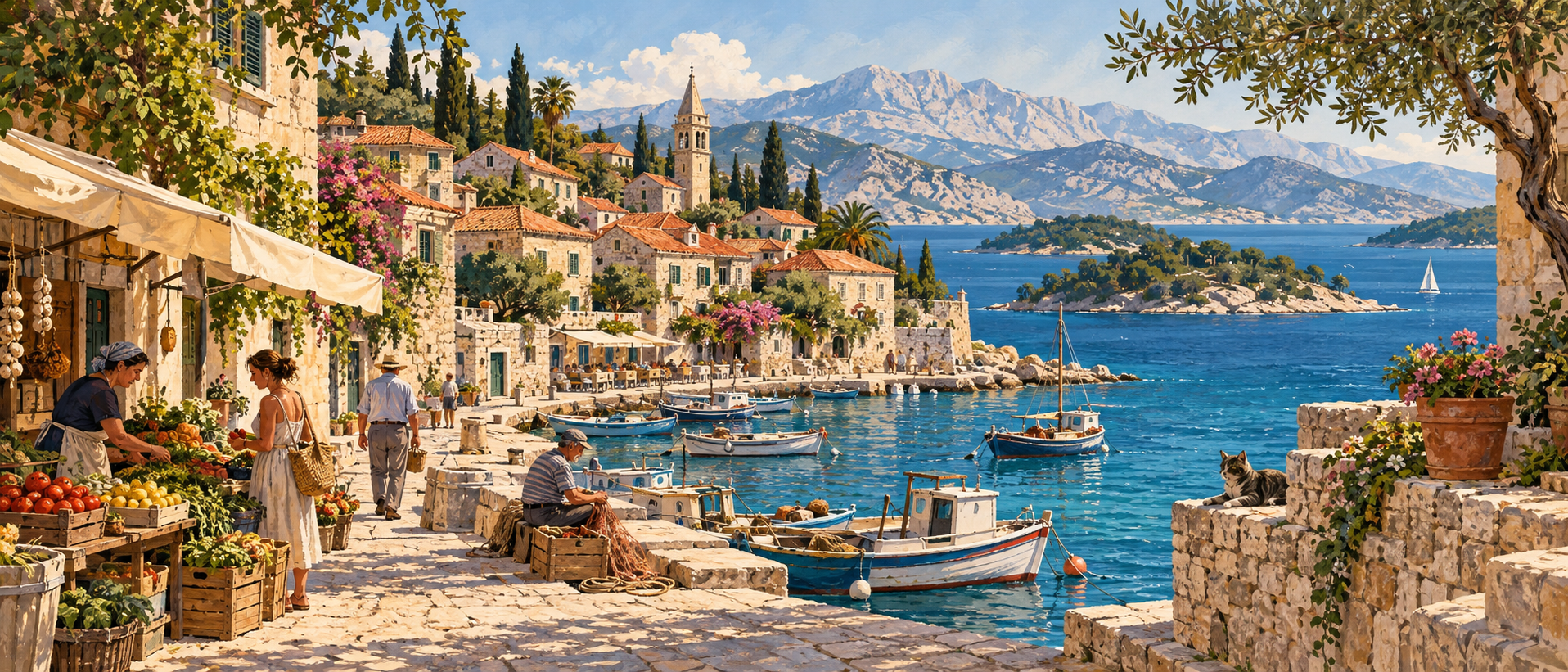
What should you know about Croatia beyond its name? Begin with the relationships behind familiar images. A harbour can be a workplace, a song can carry a local history, and a classroom can reveal how institutions organise opportunity. The chapters below move between landscapes, historical evidence and the choices people make in everyday life.
Begin with geography and history, or move directly to food, music, learning and the environment. Cultural knowledge deserves close attention in its own right. Contemporary challenges also need careful evidence, without allowing one event or statistic to stand in for an entire country.
Croatia at a glance
- Capital: Zagreb.
- UN statistical region: Southern Europe.
- Reading date: 20 October 2026; individual observations retain their own dates.
The capital and regional classification are listed in the UNData country profile. This guide uses specific dated sources for the other subjects rather than treating an old country summary as a current account of every institution.
This is an educational overview, not a travel itinerary or personalised medical, legal or financial advice. A cultural or environmental designation does not establish present access or safety. National data cannot replace the experiences of particular households and communities.
Cover illustration: an original AI-generated artistic interpretation of a stone waterfront town, fishing boats, a produce stall, blue sea and distant pale hills. This is a nonliteral composite, not a photograph or an exact view of a named place.
Choose your route through Croatia
- 1. Geography
- 2. Regions and Settlements
- 3. Earlier History
- 4. Modern History
- 5. Government and Public Institutions
- 6. People and Languages
- 7. Economy and Work
- 8. Agriculture and Food Production
- 9. Infrastructure and Connections
- 10. Education and Learning
- 11. Health and public services
- 12. Food and culinary knowledge
- 13. Music and oral knowledge
- 14. Arts, crafts and design
- 15. Community and everyday life
- 16. Heritage and historical places
- 17. Environment and living systems
- 18. Science, technology and practical skills
- 19. Connections with the wider world
- 20. Student connections with Singapore
1. Geography
Land and rock
Croatia combines an Adriatic frontage with a substantial inland territory. Its land area is about 56,594 square kilometres, distinct from the additional sea area included in some national totals. It shares land borders with Slovenia, Hungary, Serbia, Bosnia and Herzegovina, and Montenegro. These neighbours help locate the country more accurately than a coastline photograph alone: Croatia belongs to an interconnected continental setting as well as a maritime one. (DZS geography)
Velebit illustrates how geology produces a distinctive landscape rather than merely a mountain backdrop. The nature park describes carbonate rocks fractured, dissolved and reshaped by water, ice, erosion and continuing tectonic movement. Its breccias contain fragments of older rocks cemented together. Such material can develop karst features as water works through weaknesses. Water can enlarge fractures below ground while erosion continues to reshape the exposed rock above. The visible surface therefore records several processes and periods, not a single episode when an otherwise finished mountain was formed. (Velebit geology)
Contrasting climates
The meteorological service distinguishes continental, mountain and maritime climates. Inland conditions change as moving high- and low-pressure systems cross the middle latitudes. Winter stillness can bring fog and frost, while mountains alter rainfall between exposed and sheltered slopes. Mediterranean influence reaches inland but weakens eastward. Consequently, an inland place should not be assigned the same seasonal pattern as a coastal settlement simply because both are Croatian. (DHMZ climate)
Altitude creates colder conditions and longer-lasting snow in the mountainous districts. Along the Adriatic, the sea modifies temperatures and daily breezes respond to unequal heating of land and water. Coastal weather is not invariably calm: bura can descend from the mountains in powerful gusts. These contrasts explain why distance from the sea, elevation and exposure are useful geographical questions alongside a location’s latitude. (DHMZ climate)
Water across boundaries
The Sava basin places Croatian geography within a larger catchment. The international river commission describes a basin of approximately 97,200 square kilometres extending across Slovenia, Croatia, Bosnia and Herzegovina, Serbia, Montenegro and a small part of northern Albania. A basin is the area draining towards a connected river system, not the territory of one government. Reading a catchment map therefore reveals relationships that disappear when a map shows only national borders. (Sava basin)
Even a coastline requires a measurement rule. When the Croatian Hydrographic Institute publicly released its coastline dataset in September 2022, it explained the reference to mean high water and the use of charts, hydrographic surveys and aerial imagery. The line is a carefully constructed geographical dataset, not simply the water’s edge in one photograph. Map scale and the chosen reference matter when comparing coastlines, especially around small inlets and offshore formations. (HHI coastline)
2. Regions and Settlements
Administrative and statistical maps
Croatia’s local map contains 428 municipalities and 127 cities, alongside 20 counties. Zagreb has the special status of both a city and a county. The ministry therefore counts 576 local and regional units altogether. These are administrative categories, not a ranking of settlement size or cultural importance. A municipality may contain several settlements, while the separate status of Zagreb means that adding city and county totals without checking definitions can mislead. (Local government)
A second map exists for comparing statistics. The HR_NUTS 2021 classification divides Croatia at its second level into Pannonian Croatia, Adriatic Croatia, Northern Croatia and the City of Zagreb. Below them are 21 third-level units corresponding to the counties and Zagreb. These statistical regions organise comparable data; they are not four new county governments. Knowing which map a table uses prevents a regional economic result from being mistaken for a municipal one. (Statistical regions)
Peninsulas and urban landscapes
Istria shows why a historical or physical region need not match one administrative boundary. The peninsula extends into Croatia, Slovenia and Italy, while Istria County does not encompass every Croatian part of it. Its familiar colour names describe contrasting terrain: White Istria has exposed limestone, Grey Istria includes flysch with marl and clay, and Red Istria has red soils over limestone. The distinctions link regional vocabulary to underlying material rather than to decorative labels. (Istria geography)
Zagreb’s urban landscape occupies the Sava plain between Medvednica to the north and the hills of Vukomeričke gorice to the south. A city environmental study describes streams descending from Medvednica and an east–west valley followed by urban development. It also records how river regulation changed earlier channels and backwaters. The city can therefore be read as a meeting of hillslope, river and built environment, rather than as an isolated collection of streets. (Zagreb landscape)
Eastern and Adriatic regions
In the northeast, Osijek-Baranja County occupies a largely flat Pannonian landscape around the lower Drava before its confluence with the Danube. The county identifies this terrain as favourable for agriculture. Rivers and plains are thus central to understanding this part of Croatia, even though coastal imagery often dominates introductions to the country. The regional description also makes a useful distinction: the lower course of a river connects a locality to a much wider drainage system. (Osijek-Baranja territory)
Split-Dalmatia County describes its territory through three connected subregions: the hinterland, the coastal strip and the islands. Mountain chains running broadly parallel to the coast help explain this arrangement. These are not interchangeable versions of one seaside landscape. A county boundary brings together places with different physical settings, so county-wide figures necessarily combine them. Keeping those internal differences visible is a useful starting point for understanding settlement, transport and the distribution of services. (Split-Dalmatia geography)
3. Earlier History
Evidence and early institutions
Excavations in Pula provide a material starting point for earlier history. Alka Starac’s report on the 2008 work at the St Theodore site describes 27 layers, including Iron Age objects and a Roman temple built in the middle of the first century BCE. Amphorae also formed part of a drainage arrangement. Such finds reveal ordinary engineering alongside monumental construction: archaeologists reconstruct changing uses of a place through relationships between layers, objects and structures. (Pula excavation)
Early medieval history also depends on interpreting written records. Ivica Puljić’s study of the church councils held at Split in 925 and 928 examines ecclesiastical organisation in the period of King Tomislav. It discusses the claims of Split and the position of the bishop of Nin. This is evidence about competing jurisdictions as well as religious life. It should not be simplified into a confidently dated coronation ceremony that the study does not establish. (Split councils study)
Assemblies and diplomacy
The earliest surviving minutes cited in Parliament’s history concern a Slavonian Sabor meeting in Zagreb in 1273. Another important episode was the election of Ferdinand of Habsburg at Cetin in 1527. These assemblies belonged to political worlds unlike today’s electorate: noble status mattered, and representation was not universal. Institutional continuity should therefore be understood as a history of changing powers and membership, not an unchanged democratic system. (Parliament history)
Dubrovnik’s diplomatic past becomes unusually concrete in Vesna Miović’s study of Ottoman tribute receipts. The republic paid tribute from 1458 to 1804, and the examined documents record sums, dates and the envoys involved. Those representatives also undertook diplomatic and consular tasks. The receipts show political relationships being maintained through repeated practical transactions. They offer a richer picture of autonomy and negotiation than describing Dubrovnik either as completely isolated or as simply absorbed by a larger power. (Ragusan receipts)
Borders and political change
The Military Frontier was a Habsburg defensive zone facing the Ottoman Empire, but it was also a space of population movement. Sanja Lazanin’s research examines migrations from the southeastern Dinaric region and later movements associated with the border demarcations of 1699 and 1700. A frontier could attract and redirect communities rather than merely stop them. This history helps explain why borderlands require attention to settlement and administration as well as to battles and rulers. (Frontier migration study)
In 1847, Croatian replaced Latin as Parliament’s official language. The representative assembly established in 1848 still restricted participation through qualifications including property and education. Parliamentary activity was interrupted after entry into the Kingdom of Serbs, Croats and Slovenes in 1918. These changes link language, political inclusion and state organisation, while reminding readers that adopting a representative institution did not immediately give every adult an equal political voice. (Parliament history)
4. Modern History
War and socialist institutions
The Axis invasion of Yugoslavia in April 1941 brought the Ustaša regime to power in the wartime Independent State of Croatia. The United States Holocaust Memorial Museum documents its Jasenovac camp system, where Serbs, Jews, Roma and political or religious opponents, including Croats, were persecuted and murdered. This history requires identifying the responsible regime and institutions. Attributing their crimes indiscriminately to an entire population would obscure both the perpetrators and the diversity of victims. (USHMM Jasenovac)
After the Second World War, Croatian institutions operated within socialist Yugoslavia and changed repeatedly. Parliament’s institutional account describes a single chamber under the 1947 constitution, two chambers in 1953, five councils in 1963 and three in 1974. Multiparty elections and a new constitution marked another transition in 1990. These successive arrangements show why the word parliament alone does not identify how a political system worked: its organisation and the wider constitutional framework also matter. (Postwar parliament)
Independence and reintegration
Independence in 1991 was a sequence rather than a single undifferentiated moment. A referendum took place on 19 May, followed by parliamentary independence decisions on 25 June. The Brioni arrangements suspended their implementation for three months. On 8 October, Parliament severed the remaining state ties with Yugoslavia. Keeping these dates distinct helps explain why different commemorations appear in Croatian public history without assuming that they refer to contradictory accounts of the same event. (Independence chronology)
War followed Croatia’s independence in 1991, with Serb forces controlling substantial territory. Croatian offensives recovered Western Slavonia and Krajina in 1995; the remaining eastern region followed a negotiated route. The UN transitional administration, UNTAES, supported the peaceful reintegration of Eastern Slavonia, Baranja and Western Sirmium, ending on 15 January 1998. Its completion did not settle every outstanding commitment: restoring state authority and rebuilding trust between communities were connected but distinct tasks. (UNTAES background)
European integration
Croatia joined the European Union on 1 July 2013, becoming its twenty-eighth member at that time. Croatian simultaneously became the Union’s twenty-fourth official language. These are historical milestones, not statements about the EU’s present membership count. The accession also provides a clear chronological marker between independence and later integration measures. Treating each stage separately avoids presenting participation in European institutions as one event that occurred automatically with the creation of the state. (EU accession factsheet)
On 1 January 2023, Croatia adopted the euro. The European Central Bank’s announcement explains that the Croatian National Bank joined the Eurosystem and that Croatia entered the Single Supervisory Mechanism for banking supervision. Currency change was therefore more than replacing notes and coins: it also altered the institutional setting of monetary policy and oversight. The date belongs to the history of economic integration and should not be confused with the earlier date of EU accession. (ECB euro adoption)
5. Government and Public Institutions
Constitution and representation
Croatia’s Constitution sets out democracy, rights, equality and the rule of law among its central values. It separates legislative, executive and judicial authority while providing for mutual checks and cooperation. These principles describe how public power is supposed to be organised. They are not, by themselves, a measurement of how every institution performs in practice; evaluating performance requires examining decisions, implementation and avenues through which people can challenge public action. (Constitution)
The parliamentary electoral system fills 151 seats through different forms of representation. Ten territorial constituencies elect 140 members, a separate constituency elects three representatives of citizens living abroad, and another elects eight national-minority representatives. The total therefore cannot be understood by looking only at the territorial map. This arrangement combines general geographical representation with specific provisions for communities whose political participation is not captured by the same constituency structure. (Electoral Commission)
Executive and administration
The government exercises executive authority, proposes legislation and the state budget, and directs the implementation of laws through public administration. Its political position depends on parliamentary confidence. This separates proposing and carrying out policy from the legislature’s role in adopting laws and scrutinising government. The relationship is institutional rather than personal: understanding the responsibilities remains useful when ministers change, without relying on an undated list of officeholders. (Executive framework)
Public administration also has a digital interface. The e-Citizens platform brings together government information and electronic services, including a user inbox for official messages about procedures and their status. Its published description includes access for eligible foreign residents as well as Croatian citizens. A shared portal does not mean that every service has identical eligibility or requirements. The useful distinction is between the platform that provides access and the particular administrative procedure being requested. (e-Citizens platform)
Local services and accountability
Municipalities and cities handle local responsibilities such as utilities, childcare, settlement planning and local transport, while counties undertake regional functions. Education and infrastructure can involve more than one level, with sectoral laws defining particular duties. Public services therefore cannot all be attributed to the national cabinet. Identifying the responsible level is part of understanding accountability, especially when a service is delivered locally within rules established nationally. (Local responsibilities)
The Ombudswoman’s report for 2025, presented in April 2026, described persistent barriers in access to rights and services and issued 181 recommendations. Its concerns included differences between regions and problems that had continued over time. The report links individual cases to wider administrative patterns. Such reporting provides an institutional route for examining failures alongside formal constitutional guarantees. Complaints and recommendations are valuable evidence, but they should not be presented as a survey proving that every resident has experienced the same difficulties. (Ombudswoman 2025 report)
6. People and Languages
Population and linguistic heritage
The 2021 census counted 3,871,833 residents, a decline of 413,056, or 9.64 percent, from 2011. Every county recorded a decrease. The age structure also matters: people aged 65 or above represented 22.45 percent, compared with 14.27 percent aged under fifteen. These figures describe a dated population snapshot. They establish a baseline for studying demographic change, rather than supplying an automatically current population total for every subsequent year. (DZS Census 2021)
The Croatian Language Act adopted in 2024 recognises more than the standard language used in formal settings. Its scope includes the Chakavian, Kajkavian and Shtokavian dialects and a literary heritage written in Glagolitic, Croatian Cyrillic and Latin scripts. This combination distinguishes a shared standard from the wider historical and regional resources of the language. A language can have common public forms without its speakers’ inherited varieties being reducible to mistakes or deviations. (Croatian Language Act)
Minority languages and demographic change
A Council of Europe follow-up published in June 2026 welcomed Croatia’s continuing commitment to minority languages while encouraging further action. It discussed educational provision, cultural activity, media and dialogue with speakers. Language protection thus involves places where a language can actually be learned and used, not only formal recognition. The assessment concerns policy and its implementation; it does not imply that all minority languages, or all communities speaking them, face identical circumstances. (Minority-language review)
For 2025, the statistical office recorded 32,479 live births and 50,007 deaths, producing a natural decrease of 17,528 people. Every county had more deaths than live births. Natural change measures this balance alone, so it excludes immigration and emigration. The distinction is essential when interpreting demographic headlines: a country can experience natural decrease while receiving more residents from abroad than it loses through departures during the same period. (DZS natural change 2025)
Movement and overseas connections
Migration statistics for 2025 recorded 56,665 people moving into Croatia and 37,485 moving out, giving a positive balance of 19,180. Foreign citizens accounted for 70.3 percent of immigrants, while Croatian citizens made up 29.7 percent. These are movements of residents, not counts of border crossings or tourist arrivals. The data include people arriving with Croatian citizenship as well as foreign citizenship, rather than a single flow of people with one background. (DZS migration 2025)
Connections beyond the resident population also appear in public programmes. A 2026 funding call invited Croatian emigrant organisations in European and overseas countries to propose community projects, including cultural, educational, scientific and sporting activities. Such programmes support organised relationships across borders. They should not be converted into an estimate of how many people abroad hold Croatian citizenship or identify with Croatian ancestry: participation, legal status and family heritage are related but different questions. (Diaspora projects 2026)
7. Economy and Work
Growth and visitor activity
The European Commission’s 2026 country report records real economic growth of 3.4 percent in 2025, following 3.8 percent in 2024. It identifies household consumption, rising incomes and employment, and investment among the supports to activity. Real growth adjusts for price changes, distinguishing increased economic output from a larger monetary total caused only by inflation. The report’s dated assessment is a firmer basis for discussion than assuming that an earlier preliminary growth estimate remained unchanged. (Commission country report)
Commercial accommodation recorded about 20.7 million tourist arrivals and 94.8 million overnight stays in 2025. Foreign visitors accounted for approximately 85.6 million of those nights. Arrivals and nights measure different aspects of activity: one counts registered stays beginning, while the other reflects their duration. Neither is a count of unique people visiting the country. The commercial-accommodation scope also matters, because this release does not claim to capture every private or noncommercial stay. (DZS tourism 2025)
Trade and production
A provisional March 2026 release put Croatia’s 2025 goods exports at roughly €25.2 billion and goods imports at €44.8 billion, leaving a merchandise deficit of €19.6 billion. These figures concern traded goods, not the complete relationship with foreign economies. Services are outside this particular balance. Reading the category correctly prevents the goods deficit from being mislabelled as the country’s overall external balance, and this provisional release is not a final annual account. (DZS provisional goods trade)
The industrial statistics show an economy making different kinds of products, including food, beverages, pharmaceuticals and fabricated metal goods. The statistical office reports production volume separately from employment and labour productivity. Those indicators answer different questions: how much is produced, how many people work in the activity, and how output relates to labour input. A rise in sales value alone cannot establish that factories made more physical output, particularly when prices are changing. (DZS industry 2025)
Business size and earnings
FINA’s analysis of 2024 enterprise accounts illustrates the difference between counting businesses and measuring their economic weight. Micro-enterprises represented 87.7 percent of the 162,135 enterprises covered. Large enterprises were only 0.3 percent of the total, yet accounted for 28.2 percent of employees and 44.4 percent of revenue. The results concern the reporting enterprises in that dataset. They do not mean that nearly nine out of ten workers were employed in micro-businesses. (FINA enterprise accounts)
In December 2025, median monthly net earnings among employees covered by the legal-entity statistics were €1,280. The lower and upper quartiles were €964 and €1,732. The median identifies the middle of the earnings distribution, while the quartiles reveal a wider spread around it. This is more informative than presenting one wage figure as everyone’s experience. It is also a measure of covered employees’ earnings, not the income of every household or resident. (DZS earnings December 2025)
8. Agriculture and Food Production
Farms and changing harvests
Croatia’s Common Agricultural Policy Strategic Plan for 2023–2027 addresses farm viability alongside environmental care and rural living conditions. Its priorities include support for smaller and younger farmers and for processing agricultural products. Arable land and permanent grassland form the principal categories of agricultural land in the Commission’s overview. This policy perspective treats farming as a combination of production, stewardship and rural employment, rather than judging success solely by the tonnage harvested in one season. (Croatia CAP plan)
The statistical office’s July 2026 assessment found that agricultural production volume fell 2.7 percent in 2025. Individual crops moved differently: wheat production rose 27.6 percent, while maize fell 18.8 percent. An aggregate decline therefore does not describe every farmer or crop. It combines outcomes that can pull in opposite directions, making the composition of production important when interpreting a national agricultural result. (DZS agricultural volume)
Orchards and livestock
The March 2026 provisional fruit release illustrates contrasting harvests. It reported 33,732 tonnes of olives in 2025, compared with 54,414 tonnes in the final 2024 figures, while mandarins increased from 30,675 to 46,651 tonnes. These are crop-specific quantities, not growers’ earnings, which also depend on prices and costs. The dated preliminary figures should not be confused with a later final series or treated as the latest available harvest assessment. (DZS provisional fruit)
A livestock count answers a different question from a harvest survey. Provisional figures for 1 November 2025 showed fewer cattle, sheep and goats than in the final 2024 comparison, but a small increase in pigs. The reported changes were minus 0.9 percent for cattle, minus 5.8 percent for sheep and plus 0.5 percent for pigs. These are changes in animals present at a reference date, not direct measurements of annual meat or milk production. (DZS livestock November 2025)
Aquaculture and planting material
The Fisheries Directorate’s provisional 2025 statistics distinguish wild capture from farming. Marine commercial landings amounted to about 38.9 million kilograms, while marine and freshwater aquaculture together produced about 31.6 million kilograms. Aquaculture accounted for roughly 45 percent of reported production but 78 percent of its value. Quantity and value therefore tell markedly different stories. The figures also demonstrate why farmed production should not be described as fish taken from wild populations at sea. (Fisheries statistics 2025)
Food production begins before a crop reaches a field. HAPIH’s seed and seedling centre tests varieties, certifies planting material and supervises stages including production, processing, packaging and labelling. Its work also includes conserving plant genetic resources. These activities connect immediate needs for reliable seed with the longer task of retaining biological material for future use. The agricultural system consequently includes laboratories, inspection and documentation as well as the visible work of cultivation and harvesting. (HAPIH seed centre)
9. Infrastructure and Connections
Roads and railways
Pelješac Bridge opened on 26 July 2022 as a major connection between Croatia’s southern territory and the rest of the country. The 2,404-metre structure crosses the Mali Ston channel to the Pelješac peninsula. Its significance is geographical as well as engineering: transport links must respond to the shape of territory and the position of the sea. The bridge is therefore best understood within a network of connections, not merely as an impressive standalone structure. (Pelješac Bridge records)
HŽ Infrastructure reported a railway network of 2,617 kilometres at the end of 2025, with 550 stations and stopping places. The network included 113 tunnels and 552 bridges. These structures indicate the maintenance responsibilities behind the lines drawn on a transport map. Infrastructure management concerns tracks, structures and traffic organisation; it should be distinguished from the operation of particular passenger services. Network length alone does not reveal how frequently trains run on any individual route. (HŽ network December 2025)
Ports and island links
Rijeka Gateway received its first commercial container ship in September 2025, before its ceremonial opening the following month. The city described an initial 400-metre quay, a water depth of 20 metres and annual capacity of 650,000 standard container units. Capacity is a facility’s stated ability to handle traffic, not the amount already handled. Separating the start of operations, the inauguration and future expansion plans gives a more accurate account of a new port project. (Rijeka Gateway records)
Jadrolinija’s fleet categories show that island transport requires several kinds of vessel. Local ferries carry vehicles as well as passengers, while fast catamarans serve passenger movements; other passenger ships and international ferries fulfil additional roles. These differences matter when describing connectivity, because a passenger link and a vehicle-carrying link do not provide identical capabilities. The company’s classification offers a practical way to understand the network without reducing every crossing to the generic word ferry. (Jadrolinija fleet categories)
Electricity and communications
HEP’s disclosed electricity portfolio for 2025 combined its own generation with purchases and imports. Among the reported components were hydropower, thermal generation and electricity from Krško, with imports supplying about 6.96 terawatt-hours of a total 19.57 terawatt-hours available to the group. This is a company portfolio, not Croatia’s complete national generation mix. The distinction shows why electricity statistics must identify both the organisation covered and whether they describe production, procurement or consumption. (HEP electricity sources)
Communications infrastructure is changing alongside transport and energy networks. HAKOM’s report for 2024 recorded a 35 percent increase in active fibre connections and approximately €116 million invested in very-high-capacity networks. Active connections measure use, whereas investment measures resources committed to development. Neither figure alone establishes that every household has the same access or service quality. Together, however, they provide dated evidence of network expansion rather than an unsupported claim that digital coverage is already complete. (HAKOM annual report 2024)
10. Education and Learning
Early years and compulsory schooling
At the beginning of the 2025/26 educational year, the statistical office counted 158,685 children in early-childhood education programmes. About 83 percent attended programmes lasting eight hours or more. The reporting system included kindergartens and programmes delivered by other organisations, so its units should not automatically be read as separate kindergarten institutions. These figures describe participation in the reported provision; calculating an enrolment rate would additionally require the relevant population of children as a denominator. (DZS early childhood 2025/26)
Elementary education is compulsory and free, normally covering eight years for children between approximately six and fifteen. The ministry also describes routes for adults completing elementary education and adapted provision for learners with disabilities. Secondary schooling can prepare students for employment or further study. The system therefore contains different pathways rather than a single uninterrupted route followed in precisely the same way by every learner, with age and individual educational needs affecting the available provision. (Education Ministry overview)
Vocational study and examinations
Vocational reform involves changing teaching practice as well as curriculum documents. At a March 2025 conference, the vocational education agency brought together more than 200 pedagogues to work on modular curricula, learning outcomes, assessment and the CSVET credit system. The programme emphasised planning and cooperation among educators. This is concrete evidence of preparation for reform, not proof that every classroom had already achieved the intended results or that all implementation challenges had been resolved. (ASOO curriculum conference)
The 2026 State Matura regulation sets out compulsory examinations in Croatian, mathematics and a foreign language, with specified alternatives and provisions for particular programmes and minority-language education. It also provides elective examinations. Croatian has two components that must both be passed, while some subjects offer different examination levels. These details show why the Matura is better understood as a regulated set of assessments than as one undifferentiated final test taken in an identical form. (State Matura regulation)
Higher education and evidence
Higher education distinguishes university and professional study programmes. The quality-assurance agency describes undergraduate, graduate and postgraduate stages, with doctoral study in the university pathway and professional programmes focused more directly on occupational competence. Professional studies can include short-cycle, undergraduate and graduate programmes. This is not simply a distinction between learning theory and learning nothing theoretical: the two profiles have different purposes and qualification structures, while both belong within Croatia’s regulated higher-education system. (AZVO study programmes)
PISA 2022 provides one dated measure of learning among fifteen-year-olds. Croatia’s mathematics result was below the OECD average, while reading and science were close to it; 67 percent reached at least the basic proficiency level in mathematics. The Croatian sample included 6,135 students in 180 schools. These results describe the assessed cohort and subjects, not every dimension of education or the performance of students in 2026. Their value lies in a clearly defined comparison. (OECD PISA 2022)
11. Health and public services
Following a route through care
Croatia’s health services connect local consultations with specialist care and national institutions. The European Observatory’s 2024 summary describes mandatory social health insurance organised through the Croatian Health Insurance Fund. Primary care doctors generally provide the first contact and help direct patients towards specialists or hospitals. This arrangement makes coordination important: a health system is not simply a collection of separate buildings and individual appointments.
Responsibilities also differ between levels of government. The Ministry of Health leads national policy, while counties organise primary care and certain regional services. Ownership of general hospitals moved from counties to central government in January 2024. Following these responsibilities helps explain who plans, funds and manages care. The description concerns institutional organisation, rather than a guarantee about waiting times or any individual’s treatment.
Laboratories and everyday surroundings
The Croatian Institute of Public Health’s Environmental Health Division examines connections between human health and surrounding conditions. Its remit includes water, food, air and soil. Monitoring can involve biological, chemical or physical factors, so one laboratory test cannot answer every environmental question. A water sample, for example, may require different specialists to investigate microorganisms and dissolved chemicals before the findings can be interpreted.
The division also coordinates work with county public health institutes and trains laboratory analysts. Its departments include water chemistry, food microbiology and investigation of substances such as pesticides and metals. These less visible activities support public services before a person enters a consulting room. Collecting a sample correctly, using an appropriate method and comparing results are connected parts of the same evidence-producing process.
Prevention, participation and dignity
A September 2026 public health communication broadens physical activity beyond organised sport. It includes walking, cycling, gardening, play, dance and movement using assistive devices. Just as importantly, the institute notes that health, available time, safety, accessibility and the surrounding environment affect people’s opportunities to move. This shifts attention from simply telling individuals to try harder towards considering streets, schools, workplaces and shared spaces. The message is an example of public communication about supportive environments, not a prescribed exercise programme for every reader or a measurement of national participation.
WHO’s 2024 account of mental health reform describes efforts to bring care closer to communities. QualityRights work in places including Zagreb and Split emphasised human rights and professional training. People with lived experience of mental health difficulties also participated as peer workers in mobile teams. Their contribution illustrates a different kind of expertise: understanding how care feels from the recipient’s perspective. The account documents an initiative and its intended direction. It does not establish that every community has identical services, but it makes dignity, participation and practical support visible within the reform discussion.
12. Food and culinary knowledge
Poljica’s hearth and dough
Poljički soparnik connects a named food with the Poljica area of Dalmatia. Its published European product specification describes thin dough filled with chard and red onion. Baking takes place on an open hearth amid heated coals and ash. The ingredients are only part of the knowledge involved: preparing the filling, handling a broad sheet of dough and judging the hearth require different practical skills.
After baking, the surface receives olive oil and garlic, and the finished food is divided into rhomboid pieces. The specification ties its production stages to a defined geographical area. That documentary boundary is useful when studying food heritage: it identifies a particular product and method, rather than declaring that every household in Croatia cooks alike. Shape, technique and place belong together in the description.
Decorated hearts and skilled hands
Northern Croatia’s gingerbread craft brings baking and decoration into the same workshop. UNESCO’s account describes flour, sugar, water, baking soda and spices, followed by moulding, baking, drying and painting. Hearts are a prominent form, but the finished pieces are also carriers of messages and decorative choices. A baker’s control of timing is therefore joined by a maker’s attention to pattern, colour and presentation.
Individual makers decorate their pieces with features such as small mirrors, pictures or short messages. Wedding examples can carry the couple’s names and date. The craft’s transmission has expanded from an historically male practice to include both women and men. Local celebrations provide a setting for making, exchanging and displaying these objects. Their meaning comes from those relationships as well as their recognisable outline.
Cheese, meals and shared knowledge
Paški sir offers a contrasting example of food documentation. The European specification connects the cheese with milk from Pag sheep and describes a sequence of production, from milk preparation and renneting through moulding, pressing, salting and maturation. Those stages must occur within the defined production area. The document also distinguishes whole cheeses, packaged portions and grated cheese matured for more than twelve months. Reading the specification reveals that a familiar product name can carry detailed information about ingredients, process and presentation, not merely a general association with an island.
Croatia also participates in UNESCO’s multinational Mediterranean diet inscription, extended in 2013. Here the subject is wider than a menu: the account includes cultivation, fishing, processing, cooking, food containers and sharing meals. Markets and intergenerational teaching help knowledge circulate. This cultural meaning should not be confused with a claim that all Croatian residents follow one diet or with personal medical advice. It directs attention instead towards how people organise food, exchange skills and give meals social significance, while allowing different communities to retain their own practices and preferences.
13. Music and oral knowledge
Klapa as a shared sound
Klapa singing is associated with Dalmatia in southern Croatia. UNESCO describes singers standing close together in a semicircle, with the first tenor beginning before other voices join. Tenor, baritone and bass parts contribute to the overall blend. The arrangement makes listening as important as projection: each participant must shape an individual voice in relation to the sound being made by the surrounding group.
The tradition includes orally transmitted singing as well as more formally organised festival groups and modern approaches shaped by recordings. Songs address love, everyday situations and the singers’ surroundings. These differences prevent a single performance from standing for every version of klapa. Its continuity depends on people learning together, while the settings in which they learn and present their music can change over time.
Međimurje’s expressive songs
Međimurska popevka belongs to the Međimurje region in northwestern Croatia. Historically it was predominantly a solo vocal practice associated with women. UNESCO’s account also describes present-day group, instrumental and multipart renditions by women and men. The words remain especially important: songs can be grouped around themes such as love, humour, religious devotion or melancholy. The tradition therefore encompasses different moods rather than one fixed emotional character.
Cultural associations support performance, but individual singers remain important because personal interpretation is a valued feature. Women frequently serve as mentors to younger performers. Family occasions, community gatherings and solitary singing offer different contexts for the same repertoire. Studying those settings helps a listener distinguish the song from one particular arrangement, and recognise that safeguarding music involves relationships between people rather than preserving notation alone.
Improvisation and endangered techniques
Bećarac, associated with Slavonia, Baranja and Srijem in eastern Croatia, makes quick verbal exchange central to performance. Lead singers respond to one another with ten-syllable verses, supported by other singers and tambura musicians. They draw on older couplets while selecting, combining or creating material for the occasion. A strong voice is useful, but so are memory, timing and sensitivity to context. This gives oral knowledge an active role: the performer does not simply repeat a fixed script, but reshapes inherited resources in conversation with the people present.
Ojkanje offers another vocal texture from the Dalmatian hinterland. Two or more singers use a distinctive shaking technique produced in the throat, and a song’s duration follows the lead singer’s breath. UNESCO placed the practice on its urgent safeguarding list in 2010. The inscription account discusses migration, conflict and declining numbers of performers, alongside teaching through local groups and recordings. The example shows why recording sound is valuable but insufficient on its own: the bodily technique still requires skilled practitioners who can demonstrate it and help another singer learn.
14. Arts, crafts and design
Three places, different lace
Croatian lacemaking cannot be reduced to a single technique. UNESCO’s inscription distinguishes traditions centred on Pag, Lepoglava and Hvar. In Pag, needle lace develops geometric motifs around a web-like structure. Lepoglava’s bobbin lace instead uses threads wound onto small spindles and braided into patterns. The contrast makes tools and sequence important: similar-looking openwork can emerge from quite different movements of the maker’s hands.
In Hvar, Benedictine nuns produce lace from fine threads extracted from leaves. UNESCO’s account also identifies teaching and festivals as ways that knowledge continues in the different centres. Lace is therefore both an object and an activity involving material preparation, pattern and patient execution. Naming the place and method respects these distinctions better than treating every delicate textile as an interchangeable symbol of the country.
Wooden toys that keep changing
In Hrvatsko Zagorje, wooden toy making joins carving with painted decoration. The UNESCO account identifies willow, lime, beech and maple among regional woods. Drying and shaping the material precede the application of floral or geometric designs. Although makers work within a recognisable tradition, hand production creates differences between toys. Repeated forms do not imply that each object comes from an identical industrial mould.
Horses, birds and pieces of furniture appear alongside vehicles and musical toys. Cars, trains and aeroplanes show how makers have incorporated changing surroundings into an inherited practice. Some miniature instruments are tuned during production, connecting craftsmanship with sound as well as appearance. The tradition illustrates continuity through adaptation: new subjects can enter a workshop without eliminating the hand skills and decorative knowledge passed between generations.
Looking closely at named artists
Ivan Generalić’s Washerwoman, painted in 1936, provides a specific work to study. The National Museum of Modern Art identifies its medium as oil on glass. Curator Lada Bošnjak Velagić connects its clear drawing, flattened composition and Podravina setting with the early Hlebine artists. Her account describes Krsto Hegedušić’s encouragement of Generalić and other self-taught painters. A student can therefore investigate a named work, medium and artistic relationship instead of assuming that rural subject matter is simply a transparent record of ordinary life without artistic choices.
Vjenceslav Richter explored a different relationship between art, architecture and systems. Zagreb’s Museum of Contemporary Art describes his experimental sculptures, prints and theoretical projects alongside the collection he and Nada Kareš Richter donated to the city in 1980. Their house, artworks, archive and library became connected resources rather than isolated objects. The donation also aimed to bring cultural activity beyond the city centre and engage younger artists and the local community. This example expands the chapter’s view of making from traditional handwork to interdisciplinary experimentation and the organisation of public cultural space.
15. Community and everyday life
A boat and its community
The Batana Ecomuseum in Rovinj, also known as Rovigno, grew from local efforts to sustain knowledge around a traditional fishing boat. UNESCO’s 2016 safeguarding decision describes an association begun in 2004 and collaboration involving the municipality, museum, researchers and Italian community. Boatbuilding was linked with fishing equipment, songs and local language. Preserving the vessel consequently meant attending to a wider network of practices and people.
The project combined exhibitions with workshops, a working shipyard and regattas involving younger participants. A boat could be repaired, explained and used, rather than only displayed behind glass. UNESCO selected the project for its register of good safeguarding practices. That category recognises an approach to maintaining living heritage; it is different from listing a monument as a World Heritage property or certifying a tourist service.
Books reaching neighbourhoods
Zagreb City Libraries’ bibliobus service brings a mobile library into neighbourhood settings. Its October 2026 account describes a creative workshop held in Stenjevec with preschool children from the Špansko kindergarten. The Books on Wheels programme used the work of writer Zvonimir Balog as a starting point. The vehicle thus became a place for shared literary activity, rather than functioning only as a travelling shelf.
The library’s published stop information also shows that the service depends on a route, a timetable and a changing network of locations. These organisational details matter to a mobile institution. Taking books towards readers requires coordination between vehicles, collections and people. The documented workshop illustrates one local use of that network, not proof that every child in Zagreb participates or that future sessions follow an unchanged schedule.
Learning to help and participate
Croatian Red Cross volunteer training offers another example of organised community participation. Its introductory programme includes the Movement’s history and principles, the organisation’s activities, volunteers’ rights and responsibilities, and basic life-support training. This combines practical preparation with an understanding of the organisation in which a volunteer acts. Good intentions alone are not treated as sufficient preparation for every task. For students considering service activities, the example raises useful questions about supervision, competence and responsibility, without suggesting that a short description can replace training or authorise someone to carry out medical procedures.
Nijemo Kolo, the silent circle dance of the Dalmatian hinterland, shows community coordination through movement. The defining feature is the absence of musical accompaniment during the dance itself, although music can come before or afterwards. UNESCO’s account distinguishes village variations and spontaneous steps from more standardised versions taught by cultural clubs. Carnivals, celebrations and staged performances provide different settings. A shared practice therefore need not look exactly the same everywhere: local variation can be part of what participants recognise as meaningful, while teaching changes how the movements are organised and remembered.
16. Heritage and historical places
Split’s layers of building
The historical complex of Split contains remains of Diocletian’s Palace, constructed between the late third and early fourth centuries CE. UNESCO’s description does not treat the protected area as a single untouched Roman building. It also includes later churches, fortifications and palaces. The city’s historical interest lies partly in the way successive generations built within, reused and transformed an earlier architectural framework.
The medieval cathedral incorporated the ancient mausoleum, while Romanesque churches and Gothic, Renaissance and Baroque buildings added further layers. This makes reuse a useful idea for understanding Split. A building can change function while retaining evidence of its earlier structure. Reading the complex chronologically reveals those transformations more clearly than placing every wall and doorway into one broad category labelled ancient history.
An agricultural landscape on Hvar
Stari Grad Plain on Hvar is a cultural landscape rather than a collection of grand monuments. Its World Heritage record describes a system of land division established by Greek settlers in the fourth century BCE. Geometric plots, dry-stone boundaries and arrangements for collecting rainwater structured cultivation. The landscape therefore preserves evidence of planning, work and resource management alongside the physical remains of walls and paths.
Grapes and olives feature in UNESCO’s account of continued agricultural use. Tanks and gutters helped organise water collection, linking the parcel pattern with practical cultivation. Continuity does not mean that every detail has remained unchanged for centuries. The important relationship is between an inherited spatial structure and continuing work within it. A field boundary can therefore be historical evidence even when the field remains productive.
Sacred spaces and skilled construction
At Poreč, the Euphrasian Basilica complex brings together a church, atrium, baptistery and episcopal buildings. Bishop Euphrasius’s sixth-century construction incorporated earlier layers, while later periods added further structures. Mosaics and the relationships between buildings help explain the ensemble’s importance. The World Heritage account also connects conservation with continuing religious use and concerns about moisture. Heritage care is consequently not only a matter of admiring old decoration: it involves understanding materials, historical change and the needs of a place that retains religious functions within its surrounding town.
The Cathedral of St James in Šibenik was built between 1431 and 1535. UNESCO highlights exchanges between Dalmatia, northern Italy and Tuscany, as well as the work of successive architects. Its stone construction, including the vaulting and dome, makes structural technique central to its significance. The building shows how artistic ideas travelled through skilled people and were developed in a particular place. Looking at how parts fit together can therefore be as informative as identifying a decorative style, while avoiding the assumption that a major building is the achievement of only one individual.
17. Environment and living systems
Recognising individual dolphins
Blue World Institute researchers use photographs to identify individual dolphins through natural marks such as cuts and scars along their dorsal fins. The images enter a catalogue, allowing sightings to be compared over time. This is more informative than collecting attractive wildlife photographs: a recognisable individual can connect observations from different dates and locations, helping researchers investigate movements and relationships within a defined study area.
The institute explains that repeated photographic captures can support population estimates through mark-recapture methods. Here capture means recording an image rather than physically catching the animal. The method also helps researchers investigate habitat use and social connections. Its usefulness depends on identification and repeated observation. A single boat trip or dolphin photograph cannot establish the size or condition of the whole Adriatic population.
Lynx and genetic connections
The LIFE Lynx project addressed a problem that counting animals alone could not explain: the genetic condition of a small population. Its 2024 report records the movement of eighteen lynx into Slovenia and Croatia, including six released in Croatia. The effort connected conservation with genetic sampling and monitoring. Bringing animals into a population was intended to improve its prospects, not simply produce a larger release-day total.
The report is careful about interpreting genetic results. It notes that estimates depend partly on which introduced animals and descendants appear in samples, and that genetic frequencies need time to settle across generations. This caution is part of the science, not a weakness in the explanation. Conservation involves checking whether an intervention produces lasting relationships and reproduction, rather than equating the completion of releases with recovery.
Floodplains and measured water quality
Kopački rit lies where the Drava meets the Danube. Its Ramsar documentation describes a mosaic of lakes, marshes, wet grassland, reedbeds and riverine forest. Seasonal flooding reaches higher and lower areas for different lengths of time. Water movement helps create this habitat pattern. Understanding the wetland’s ecological character therefore requires attention to connections, timing and variations in water level, rather than simply drawing a boundary around a lake.
Environmental numbers also require careful interpretation. The European Environment Agency’s Croatia factsheet for the 2025 bathing season lists coastal and inland sites separately and includes an unclassified category. Classification concerns two bacterial indicators, Escherichia coli and intestinal enterococci, and depends on sufficient sampling information. An excellent result is therefore not a complete assessment of every chemical, species or ecological process in the water. Nor is a historical classification a promise about conditions on a particular day. Monitoring is most useful when readers understand both what was measured and what remains outside the measure.
18. Science, technology and practical skills
Robotics meets marine biology
The BRIGANTINE project brings Italian and Croatian researchers together around autonomous marine monitoring. A Ruđer Bošković Institute account describes plans for vessels equipped with cameras and sensors to investigate algae, seagrass and water conditions in the Adriatic. Biologists, engineers and oceanographers contribute different kinds of knowledge. Designing the vessel is therefore connected to deciding which environmental questions its measurements should help researchers answer.
The project combines visual observations with chemical and physical data and aims to organise findings into useful databases. An image of the seabed and a water measurement do not reveal the same information, but can complement one another. This makes data integration a practical skill. The institutional description outlines research objectives and planned tools; it should not be read as proof that every proposed conservation benefit has already occurred.
Shared computing infrastructure
Croatia’s academic cloud, HR-ZOO, provides shared research equipment. SRCE’s April 2024 anniversary account describes five data centres across Zagreb, Split, Rijeka and Osijek, connected as shared infrastructure. The system supports computing, storage and virtual services. Such a network allows research resources to be organised beyond one laboratory, while requiring technicians and specialists who can keep the infrastructure usable and help researchers apply it.
The account distinguishes Supek, a high-performance computer, Vrančić, an advanced-computing resource, and Štampar, which supports virtual data centres. These are different tools rather than interchangeable names for the internet. Choosing a resource involves understanding the task, its data and its computing requirements. The example reveals an often hidden layer of scientific work: managing and processing information can be as important as collecting it in the field.
Surfaces and demanding materials
Zagreb’s Institute of Physics studies surfaces, very thin films and small structures using both experiments and theory. Its research description includes the electronic and structural properties of graphene and other materials on carefully defined surfaces. At these scales, researchers ask how arrangement and surroundings affect behaviour. The educational connection is to method: a material’s familiar name does not tell the whole story about its properties. Preparing a sample, defining the surface and selecting a measurement are necessary steps before an observation can become a useful explanation of the material.
Materials research also links Croatian scientists with IFMIF-DONES in Granada, Spain. A 2024 research paper examines requirements for a facility intended to test materials under irradiation relevant to future fusion systems. Its authors describe trade-offs between experimental needs and the constraints of accelerator, lithium and testing systems. Simulations prompted reassessment of the requirements. This is an example of engineering through revision: a proposed design must be tested against what the experiment needs. The facility should not be mistaken for an operating fusion power station or proof that commercial fusion electricity is already available.
19. Connections with the wider world
Working with CERN
Croatia became an Associate Member of CERN on 10 October 2019. CERN’s announcement explains that Croatian researchers had contributed to experiments for decades, and that a cooperation agreement in 2001 had strengthened participation. The formal status therefore developed from earlier scientific relationships. It illustrates how international connections can grow through sustained work, rather than beginning only when a new agreement is announced.
CERN connects research with technical expertise, professional learning and industrial collaboration. Its announcement identified opportunities for Croatian researchers and firms within the associate framework. Associate membership remains a distinct category from full membership in CERN’s current list. Reading that label accurately matters because institutions assign different forms of participation. The important lesson is not a ranking of countries, but how shared experiments depend on organised cooperation across borders.
A defined relationship with ESA
Croatia became a European Cooperating State of the European Space Agency on 16 August 2023. ESA’s announcement describes this as a step beyond an earlier cooperation agreement. The category is specific: it does not mean full ESA membership. Keeping the effective date and status together prevents a misleading shortcut in which every country working with an organisation is described simply as a member.
ESA’s framework links cooperation with an agreed plan for developing scientific and industrial capabilities. It connects national expertise with wider space activities through concrete projects and preparation. The agency’s current status page continues to identify Croatia as a European Cooperating State. For students, this offers a useful distinction between collaboration, associate arrangements and full membership, while showing that international scientific participation takes different institutional forms.
Heritage across national boundaries
Dry stone construction provides a cultural example of shared knowledge. UNESCO’s expanded 2024 multinational inscription includes Croatia and describes building with carefully selected and arranged stones without a binding material. Stability depends on understanding shape, weight, terrain and local conditions. Practitioners also learn through working together and exchanging techniques across regions. This makes heritage cooperation practical as well as ceremonial: people can compare how a wall or arch is assembled, repair a structure together and adapt knowledge to a particular setting without claiming that one country owns every version of the craft.
The Stećci Medieval Tombstone Graveyards form a World Heritage property shared by Bosnia and Herzegovina, Croatia, Montenegro and Serbia. Its twenty-eight component sites preserve examples of tombstones made between the twelfth and sixteenth centuries, with varied carvings and inscriptions. The property’s management combines responsibilities within each country with international coordination. Its geography therefore does not fit neatly inside one modern border. Studying the inscriptions, material and settings encourages attention to historical connections, while the shared arrangement shows why conserving related evidence may require cooperation between several present-day institutions.
20. Student connections with Singapore
Compare what food records preserve
Begin with the European specification for Zagorski mlinci. It describes wheat flour, water and salt made into thin sheets, stretched by hand, cut into rectangles, baked twice on heated plates and dried. A student can map this sequence and label the material changes. Ask what it records, such as thickness and baking, and what it cannot tell you about a particular family meal.
For a Singapore counterpart, the National Environment Agency’s hawker-culture account focuses on communal dining spaces and dishes shaped by different immigrant food traditions. It highlights food, people and shared places rather than specifying one product. Compare the records’ purposes: one defines a named food’s production, while the other explains a social practice. The difference is useful evidence, not a reason to rank either food culture.
Investigate wetlands at the right scale
Croatia’s Neretva River Delta offers a specific wetland case. Its Ramsar documentation identifies reedbeds, lakes, wet meadows, lagoons, sandbanks and saltmarshes. Draw a habitat mosaic rather than colouring the whole delta as one uniform patch. Then ask how the final stretch of a river connects those places. This exercise separates a named site from a national generalisation and makes the relationship between flowing water and habitat diversity easier to investigate.
At Singapore’s Sungei Buloh Wetland Reserve, NParks explains how mudflats provide feeding and resting places for migratory birds on the East Asian–Australasian Flyway. Different bill shapes allow shorebirds to reach food at different depths. Add those observations to a comparison sheet: habitat, water conditions, animal use and wider connections. Do not assume that two places called wetlands contain the same species or migration routes. Compare documented functions before proposing broader similarities between countries.
Distinguish objects from interpretations
The Archaeological Museum in Zagreb’s #DoveTales project offers an exercise in evidence and copies. Its report describes distributing three-dimensional printed versions of the bird-shaped Vučedol vessel and inviting people to photograph them. The original vessel was excavated in 1938; the travelling objects were reproductions. Students can label original, digital record and physical copy separately, then explain what each preserves or changes. A photograph of a replica in a new location does not relocate the archaeological discovery or create evidence of an ancient journey.
Singapore’s Asian Civilisations Museum provides another careful object record through its Tang Shipwreck ceramics. A blue-and-white dish is attributed probably to the Gongxian kilns around the 830s, while its cobalt may have come from Iran. Those qualifying words matter: they distinguish interpretation from certainty. Students can underline them and separate manufacture, material origin, shipwreck discovery and present collection. The wreck was found off Indonesia’s Belitung Island in 1998, not in Singapore. Together, these exercises turn museums into places for asking how evidence supports a claim, rather than simply collecting impressive facts.
Frequently asked questions about Croatia
What is Croatia’s capital?
Zagreb is the capital.
Which statistical region includes Croatia?
The United Nations places Croatia in Southern Europe.
What is Ojkanje singing?
It is a two-part singing tradition of the Dalmatian hinterland, distinguished by a throat-produced voice-shaking technique.
What does dry stone construction use?
It uses carefully arranged stones without mortar or another binding material.
Do the latest pages always contain current statistics?
No. Check each observation’s reference year and footnotes. Reading a page today does not turn an older observation into a current measurement.
Does a heritage designation establish safe access?
No. Heritage value and current access or safety are different questions. This article is for learning, not planning a journey.
Does one local example represent everyone?
No. Keep the people, place and date attached to an account. A documented example can explain a relationship without establishing a nationwide pattern.
How should students use the chapters?
Choose a focused question, preserve dates and definitions, and connect relevant evidence. Explain what remains uncertain instead of filling gaps with assumptions.
Continue reading: specialist guides to Croatia
These links provide subject-specific background. Their travel-themed titles do not establish that visiting is safe or feasible; use them as reading resources here.
- Schools of Croatia | Eight-Year Basic, Gimnazija, Vocational, Matura and 2026 Admissions
- How Ministry of Education for Croatia Works | 2026–27 School Calendar, NCVVO, Matura and Full-Day Reform
- How Education System of Croatia Works | Eight-Year Schools, Matura and 2026–27 Admissions
- What Is Taught in School | Croatia
- Top 100 Batana Boat Heritage Vocabulary Words | Croatia
- Top 100 Dry Stone Walling Vocabulary Words | Croatia
- Food traditions of Croatia
- Cultural and landscape learning about Croatia
Explore the Everything About Countries archive for national overviews. For the 195-country index, see How Countries Work | A–Z Guide to 195 Countries and Everyday Life. Explore government and public services in How Croatia Works. The How Singapore Works collection offers a different national case study; comparisons should account for history, scale and institutional responsibilities.
Keep the country’s people in the explanation
An explanation becomes stronger when it connects a national institution with a concrete question: who can use a service, how knowledge is passed on, what a measurement records, or how a change affects everyday work. Ask whose experience is represented and what additional evidence would help. That keeps analysis clear without turning people into illustrations of a single story.
Sources and further evidence
Sources were checked for this edition in October 2026. Statistical observations retain their own reference periods. Policy announcements and project plans are distinguished from completed outcomes.
- UNData country profile
- DZS: Statistical Yearbook 2011, geographical data
- Velebit Nature Park: Geology
- (DHMZ climate)
- Sava Commission: Sava River Basin
- HHI: Public release of the coastline
- Ministry of Justice: Local government units and responsibilities
- Official Gazette: Statistical regions 2021
- Istria County: Geographic data
- Zagreb: Environmental study of waste-management plan
- Osijek-Baranja County: Territory
- Split-Dalmatia County: General information
- Alka Starac: Rescue excavations at Pula, 2008
- Ivica Puljić: Split church councils of 925 and 928
- Croatian Parliament: History
- Vesna Miović: Ragusan tribute receipts
- Sanja Lazanin: Migration and the Military Frontier
- USHMM: Jasenovac
- Croatian Parliament: Postwar parliamentary organisation
- Croatian Parliament: Independence decisions of 1991
- United Nations: UNTAES background
- Council of the EU: Croatia joins the European Union
- ECB: Croatia adopts the euro
- Croatia: Constitution and executive explanation
- State Electoral Commission: Parliamentary election questions
- (Executive framework)
- Government: Become an e-Citizen
- (Local responsibilities)
- Ombudswoman: Annual report for 2025
- DZS: Final Census 2021 results
- Official Gazette: Croatian Language Act
- Council of Europe: Croatia minority-language follow-up
- DZS: Natural change in population, 2025
- DZS: Migration of population, 2025
- Foreign Ministry: Diaspora project support in 2026
- European Commission: Croatia country report 2026
- DZS: Commercial tourist arrivals and nights, 2025
- DZS: Foreign trade in goods, 2025 provisional
- DZS: Industrial production volume, 2025
- FINA: Enterprise results by size, 2024
- DZS: Monthly earnings, December 2025
- European Commission: Croatia CAP Strategic Plan
- DZS: Agricultural volume and fruit production, 2025
- (DZS provisional fruit)
- DZS: Livestock numbers, 1 November 2025
- Fisheries Directorate: Provisional statistics for 2025
- HAPIH: Seed and seedling centre activities
- Government: Pelješac Bridge opening
- HŽ Infrastructure: Croatian railway network
- City of Rijeka: Gateway terminal begins commercial operations
- Jadrolinija: Fleet categories
- HEP Supply: Electricity sources, 2025
- HAKOM: Annual report 2024
- DZS: Early childhood education, 2025/26
- Education Ministry: Education system
- ASOO: Pedagogue conference on modular curricula
- Official Gazette: State Matura regulation 2026
- AZVO: Types of study programmes
- OECD: PISA 2022 Croatia country note
- Croatia: Health System Summary 2024
- Environmental Health Division
- Every movement counts: JA PreventNCD
- Catalysing mental health reform: Croatia 2024
- Poljički soparnik: single document
- Gingerbread craft from Northern Croatia
- Paški sir: single document
- Mediterranean diet
- Klapa multipart singing of Dalmatia, southern Croatia
- Međimurska popevka, a folksong from Međimurje
- Bećarac singing and playing from Eastern Croatia
- Ojkanje singing
- Lacemaking in Croatia
- Traditional manufacturing of children’s wooden toys in Hrvatsko Zagorje
- Ivan Generalić, Washerwoman, 1936
- Collection of Vjenceslav Richter and Nada Kareš Richter
- Batana Ecomuseum: safeguarding decision 2016
- Zagreb City Libraries: Bibliobus service
- Basic volunteer training
- Nijemo Kolo, silent circle dance of the Dalmatian hinterland
- Historical Complex of Split with the Palace of Diocletian
- Stari Grad Plain
- Episcopal Complex of the Euphrasian Basilica in Poreč
- The Cathedral of St James in Šibenik
- Photo-identification
- LIFE Lynx population-level reinforcement report 2024
- Nature Park Kopački rit: Ramsar information sheet
- Croatia bathing water quality, season 2025
- BRIGANTINE: autonomous marine monitoring
- One year of the Croatian academic cloud
- Institute of Physics: surface physics
- Materials irradiation requirements at IFMIF-DONES
- Croatia becomes an Associate Member of CERN
- Croatia becomes ESA European Cooperating State
- Art of dry stone construction, knowledge and techniques
- Stećci Medieval Tombstone Graveyards
- Zagorski mlinci: single document
- Hawker Culture in Singapore
- Croatia completes updating of its Wetlands of International Importance
- Birdwatching at Sungei Buloh Wetland Reserve
- #DoveTales: the fun side of digitalization
- Tang Shipwreck