
What should you know about Cyprus beyond its name? Start by asking what a place name, a statistic or an institutional description actually covers. This guide moves between the island’s landscapes, historical changes, communities and public systems, preserving the boundaries and dates that make each account meaningful.
Begin with geography and history, or move directly to food, music, learning and the environment. Cultural knowledge deserves close attention in its own right. Contemporary challenges also need careful evidence, without allowing one event or statistic to stand in for an entire country.
Cyprus at a glance
- Capital: Nicosia.
- UN statistical region: Western Asia.
- Reading date: 20 October 2026; individual observations retain their own dates.
The capital and regional classification are listed in the UNData country profile. This guide uses specific dated sources for the other subjects rather than treating an old country summary as a current account of every institution.
This is an educational overview, not a travel itinerary or personalised medical, legal or financial advice. A cultural or environmental designation does not establish present access or safety. National data cannot replace the experiences of particular households and communities.
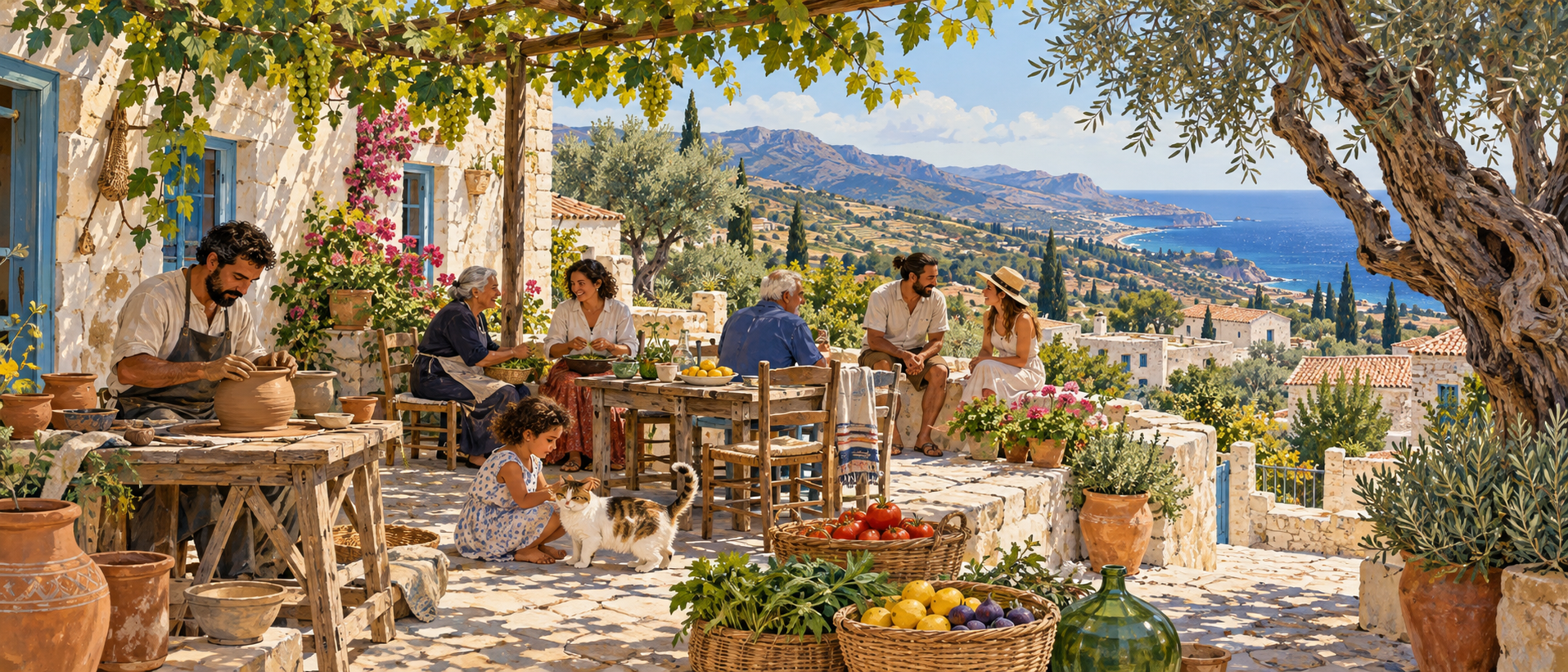
Cover illustration: an original AI-generated artistic interpretation of a potter and neighbours in a vine-shaded stone courtyard, olive trees, produce baskets and distant hills and sea. This is a nonliteral composite, not a photograph or an exact view of a named place.
Choose your route through Cyprus
- 1. Geography
- 2. Regions and Places
- 3. Earlier History
- 4. Modern History
- 5. Government and Public Institutions
- 6. People and Languages
- 7. Economy
- 8. Agriculture and Food Production
- 9. Infrastructure
- 10. Education
- 11. Health and everyday services
- 12. Food, ingredients and shared tables
- 13. Music, poetry and remembered voices
- 14. Art, craft and ways of seeing
- 15. Community spaces and participation
- 16. Heritage sites and shared responsibility
- 17. Environments connected by water and movement
- 18. Science, instruments and practical skills
- 19. Connections with the wider world
- 20. Student connections with Singapore
1. Geography
An island shaped by rock and sea
Cyprus lies in the eastern Mediterranean, south of Turkey and northwest of Lebanon. The island stretches approximately 225 kilometres from east to west and covers about 9,250 square kilometres. These are physical measurements of the island, not the land area administered by any one authority. Its elongated outline places a broad mountainous interior close to surrounding seas, making the relationship between coastal settlements, uplands and neighbouring shores central to understanding its geography. (NASA island geography)
The Troodos mountains preserve rocks that once formed oceanic crust and upper mantle about 92 million years ago. Their later uplift brought this geological record onto land. Olympus, the island’s highest peak, reaches 1,951 metres. Farther north, the Pentadaktylos range forms another prominent mountain belt, with the Mesaoria plain between them. These contrasting landscapes explain why Cyprus cannot be pictured simply as a flat Mediterranean island surrounded by beaches and harbours. (Geological Survey introduction)
Seasonal weather and moving air
Cyprus has a Mediterranean climate, with hot, dry summers and generally mild, rainy winters. Mountains and proximity to the coast modify that broad pattern, so an upland location does not experience exactly the same conditions as a seaside town. The Water Development Department’s drought planning distinguishes these local influences from the island’s wider seasonal rhythm. A wet winter and a dry summer belong to the same climatic system, rather than representing contradictory descriptions of Cyprus. (Drought plan climate chapter)
Air also connects Cyprus with landscapes beyond its shores. A NASA account of an astronaut photograph taken above the Syrian Desert shows a dust plume extending across the eastern Mediterranean and Cyprus. The image records a particular event, not a permanent condition over the island. It illustrates how material lifted from dry land can travel over water, reminding us that a coastline forms a boundary on a map but does not stop atmospheric movement. (NASA dust observation)
Watercourses and seismic activity
Rainfall and mountain relief shape the island’s watercourses. A joint FAO and Water Development Department assessment attributed most surface runoff to the Troodos massif, while describing many rivers as flowing only for limited parts of the year. Such seasonal channels differ from rivers that carry substantial water continuously. Their appearance during a dry period cannot reveal the entire annual water cycle. The assessment describes a hydrological pattern, rather than measuring water available on any particular day. (FAO water resources assessment)
Cyprus also belongs in a regional discussion of earthquakes. The United States Geological Survey recorded a magnitude 6.6 earthquake west-northwest of Polis on 11 January 2022. Its event record separates the earthquake’s magnitude from reports of shaking experienced at different places. That distinction matters: one event can produce different local experiences. A dated earthquake record is evidence of seismic activity, but it does not establish when another earthquake will occur or how every building would respond. (USGS January 2022 event)
2. Regions and Places
Administrative maps and named places
The Republic of Cyprus has six administrative districts in its formal structure. The Interior Ministry describes district officers as representatives of central government, linking national and local administration. However, an administrative boundary and an area of effective government control are different things. A district map should therefore not be treated as proof that the Republic’s authorities administer every settlement shown within it. A map’s purpose and territorial scope both matter. (District administration overview)
Place names appear in several familiar spellings. The Tourism Deputy Ministry pairs Lefkosia with Nicosia, Larnaka with Larnaca, Lemesos with Limassol, and Pafos with Paphos. Its regional descriptions distinguish coastal towns from the Troodos mountains and describe Nicosia’s historic walled centre alongside its modern urban development. These alternatives help readers recognise places across English-language materials. They should not be mistaken for separate cities or for a complete account of every community’s naming traditions. (Official regions and cities)
Physical regions and the buffer zone
Satellite imagery offers another way to organise the island into regions. ESA’s radar image acquired on 12 October 2002 places the Troodos mountains southwest of Nicosia within its view of Cyprus. This perspective emphasises terrain and the relationship between inland and coastal spaces rather than administrative responsibilities. Physical regions can cross administrative boundaries. A mountain system, a plain and a city are therefore different kinds of geographical unit, even on the same map. (ESA Cyprus radar image)
The United Nations buffer zone follows the ceasefire lines established after the fighting of 1974. UNFICYP describes a zone about 180 kilometres long, varying from only a few metres to several kilometres in width. It is not empty: some areas contain villages, agriculture and other civilian activity. Its course is interrupted by the Dhekelia Sovereign Base Area. The buffer zone is a specific peacekeeping space, not a simple synonym for every place between the island’s communities. (UNFICYP buffer zone)
British bases and local services
Akrotiri and Dhekelia are British Sovereign Base Areas retained when Cyprus became independent in 1960. They are not territories leased from the Republic, and should not be included uncritically within descriptions of its sovereign territory. The United Kingdom’s 2012 overseas territories white paper describes their combined area as approximately 256 square kilometres and notes extensive privately owned Cypriot land within them. Sovereignty, land ownership and the military use of particular sites are therefore separate questions, not interchangeable. (UK Sovereign Base Areas account)
Local administration in the government-controlled areas changed on 1 July 2024, when five District Local Government Organisations began operating. Their responsibilities include development licensing and defined water services, with stormwater authority limited to municipality areas. Current waste responsibilities cover selected facilities; collection remains with municipalities and communities. These organisations differ from the Republic’s six administrative districts, illustrating how service-delivery arrangements can follow a different map from the older administrative geography. (District local government reform)
3. Earlier History
Early farming and Bronze Age connections
Archaeology at Klimonas, in southern Cyprus, reveals a farming settlement dated 9000–8700 BCE. The French archaeological mission describes circular earthen buildings, a larger communal structure, cereal cultivation and hunting. The settlement belongs to a period before pottery became routine there. Its evidence suggests connections with the neighbouring mainland, while also revealing local choices about settlement and food. Early island life was neither wholly isolated nor identical to mainland experience. (Klimonas archaeological mission)
Copper helped connect Bronze Age Cyprus to wider Mediterranean exchange. The Metropolitan Museum of Art describes rich ore deposits near the Troodos mountains and the importance of imported tin in making bronze. Cargo from the late fourteenth-century BCE Uluburun shipwreck included more than ten tonnes of copper, illustrating regional metal transport. Mining, manufacturing and seaborne exchange were connected. The island’s geological resources acquired historical importance through the people and networks that used them. (Met copper history)
Kingdoms and imperial rule
Tamassos offers a local view of ancient kingdoms. The Department of Antiquities traces its establishment to the eighth century BCE and describes its growing importance during the following century. Nearby copper resources and surviving royal tombs help explain its political and economic importance. Such sites show that ancient Cyprus contained distinct centres of authority. A modern outline of one island should not be projected backwards as evidence of ancient unity. (Tamassos antiquities account)
Under the Ptolemaic rulers based in Egypt, Cyprus became integrated into a larger eastern Mediterranean kingdom. The Metropolitan Museum describes the replacement of separate island kingdoms and the introduction of a common currency, with Paphos important in connections to Alexandria. Rome annexed Cyprus in 58 BCE. Public buildings and urban development belong to changing imperial systems. They reveal continuity in settlement and exchange alongside changes in political authority, beyond a history of conquests. (Met Hellenistic and Roman Cyprus)
Medieval and colonial transitions
Nicosia’s municipal history describes the city as the capital of the Lusignan kingdom, whose rule began in 1192. Later, Venetian rule reshaped its defences, including major rebuilding of the fortifications during the sixteenth century. Ottoman conquest ended the Venetian period in 1571. These successive periods left traces within a much older urban landscape. Walls, streets and prominent buildings can preserve evidence of changing rulers without representing everyone’s experience. (Nicosia medieval history)
British administration began in 1878 while Cyprus formally remained under Ottoman sovereignty. The National Archives distinguishes that arrangement from Britain’s later annexation during the First World War, recognition of British sovereignty in 1923, and the island’s designation as a Crown colony in 1925. These were different constitutional events. Understanding their sequence makes the colonial period clearer and prevents the misleading shorthand that Cyprus simply became an ordinary British colony in 1878. (National Archives Cyprus chronology)
4. Modern History
From anti-colonial conflict to independence
During the 1950s, demands for enosis, or union with Greece, shaped conflict against British rule. The National Army Museum’s account identifies EOKA’s armed campaign from 1955 and the British response. Independence emerged as a negotiated alternative to both continued colonial government and union with Greece. This does not mean every Cypriot shared one political preference. The period involved competing projects for the island’s future, not a single uncontested national programme. (National Army Museum colonial account)
The Republic of Cyprus became independent on 16 August 1960. Its first president was Archbishop Makarios III, a Greek Cypriot, and its first vice-president was Fazıl Küçük, a Turkish Cypriot. The new arrangements provided separate communal chambers with responsibilities including education, culture and religion. This institutional design recognised two communities within the state rather than one undifferentiated electorate. Independence therefore established common governmental structures and communal responsibilities, a combination central to understanding the Republic’s subsequent constitutional difficulties. (Parliament independence history)
Violence and the development of peacekeeping
Intercommunal violence in December 1963 brought the new state into a serious crisis. In March 1964, the United Nations Security Council adopted Resolution 186, establishing UNFICYP with the consent of the government of Cyprus. Its original purpose included preventing renewed fighting and helping restore normal conditions. The peacekeeping mission therefore preceded the events of 1974. Its establishment reflects insecurity before the island’s later territorial division. (UNFICYP establishment history)
In July 1974, a coup favouring union with Greece was followed by Turkish military intervention. Fighting produced the ceasefire lines shaping the island’s division since August 1974. UNFICYP’s historical outline connects these events with its expanded responsibilities along the buffer zone. This sequence does not make either community a single political actor. A coup, military operations, civilian communities and later administrative arrangements are related but distinct. (UNFICYP historical factsheet)
Recognition and an unsuccessful settlement
On 15 November 1983, the Turkish Cypriot authorities declared a separate state in the north. Security Council Resolution 541, adopted three days later, considered the declaration legally invalid and called on states not to recognise a Cypriot state other than the Republic of Cyprus. This records the international response to the declaration, not a denial that an administration operates in the north. International recognition and day-to-day control must remain distinct in political geography. (Security Council Resolution 541)
Separate referendums on a United Nations settlement plan took place on 24 April 2004. The Turkish Cypriot electorate approved the proposal, while the Greek Cypriot electorate rejected it, so the agreement did not enter into force. The Secretary-General’s statement recorded those contrasting results before European Union accession. A referendum describes a decision on a particular, dated proposal. Its outcome should not be used as a timeless measure of either community’s priorities or willingness to cooperate. (UN referendum statement)
5. Government and Public Institutions
Executive and representative institutions
The Republic of Cyprus operates a presidential system. Its presidency describes the president as directly elected for a five-year term, with executive government exercised through the presidency and the Council of Ministers. The office also has legislative responsibilities, including promulgation and constitutional review procedures. These rules describe the Republic’s governmental framework. They should not be confused with a claim that every part of the island is under its effective administration or that constitutional arrangements operate unchanged. (Presidency constitutional responsibilities)
The House of Representatives has an allocation of 80 seats: 56 for the Greek Cypriot community and 24 for the Turkish Cypriot community. The latter seats remain unoccupied. Representatives of the Armenian, Maronite and Latin religious groups also participate without voting rights. Allocated and occupied seats must be distinguished when explaining representation. Simply giving the larger number as the active chamber’s size would conceal a major consequence of the unresolved constitutional division. (Republic institutional overview)
Courts and the European framework
Judicial reform introduced separate Supreme Constitutional Court and Supreme Court structures from 1 July 2023. The Supreme Court’s 2024 annual review explains its role in the revised hierarchy, including civil and criminal proceedings. The reform shows why descriptions of public institutions need dates: an older organisational chart may no longer explain responsibilities. Courts form part of the Republic’s institutional system, but their existence alone does not explain everyone’s access to justice. (Supreme Court annual review)
The Republic joined the European Union in 2004, but EU law is suspended in areas where its government does not exercise effective control, under Protocol 10 of the accession arrangements. The European Commission also stresses that the Green Line is not an external EU border. These provisions address, rather than erase, territorial complexities. EU membership, the application of EU law and the location of effective administration must therefore be explained separately rather than compressed into one statement. (European Commission Green Line framework)
Recognition and independent oversight
The northern administration uses the name Turkish Republic of Northern Cyprus. The United Kingdom’s official country account states that this entity is recognised only by Turkey, while the Republic of Cyprus is internationally recognised. Describing the northern administration acknowledges institutions exercising practical control; it does not imply wider diplomatic recognition. Conversely, describing the Republic’s recognised status does not mean that it currently governs the entire island. Separating these questions supports accuracy and neutrality. (UK recognition account)
The Commissioner for Administration and the Protection of Human Rights, commonly called the Ombudsman, provides independent public oversight within the Republic’s institutional system. Established in 1991, the office examines maladministration and human-rights concerns; its responsibilities later expanded to include equality functions. Its role differs from an elected government or ordinary service department. Its work illustrates how public administration can be examined and challenged, without implying identical outcomes for every complaint. (Ombudsman institutional history)
6. People and Languages
Counting residents carefully
The final 2021 census counted 923,381 usual residents in the government-controlled areas on 1 October 2021. It is not a population count for the whole island. CYSTAT reported that 66.7 percent lived in urban areas. The reference date and territorial coverage are essential parts of these figures: removing either would change what readers understand the numbers to describe. (CYSTAT final census)
The same census distinguished citizenship categories, including Cypriot citizens, citizens of other EU countries and citizens of non-EU countries. These categories measure citizenship, not ethnicity, home language or birthplace. A person’s passport classification cannot answer every question about their background. Population tables become more informative when their definitions are kept visible, rather than used as substitutes for cultural identity. (CYSTAT citizenship tables)
Changing age profiles and official languages
CYSTAT estimated the population of the government-controlled areas at 983,000 at the end of 2024. This later estimate should not be substituted for the census count without explaining the different date and method. Its age profile also shows change: people aged 65 and over represented 18.3 percent, compared with 11.3 percent in 2000. Children under 15 accounted for 15.2 percent. These proportions describe an ageing population structure, not an assumption that every household or locality follows exactly the same pattern. (CYSTAT demographic statistics 2024)
Greek and Turkish are the Republic’s official languages under Article 3 of its Constitution. The constitutional provisions concern public authority and official communication, rather than a claim that every resident speaks both languages. Official status, language taught at school, language used at home and language chosen in a workplace are different matters. Keeping those distinctions visible helps explain a multilingual society without reducing individuals to constitutional categories or assuming that a legal language framework describes everyone’s daily conversations. (Constitution language provisions)
Local varieties and minority languages
Language variation also exists within Greek and Turkish. Research on Cypriot Greek distinguishes the local variety from Standard Modern Greek and examines how speakers understand their relationship. The study places this alongside a comparable distinction between Cypriot Turkish and Standard Turkish. A local variety is not simply an unsuccessful attempt to speak a standard one. Its vocabulary, pronunciation and social uses belong to a linguistic system, while formal schooling and writing can encourage different choices in different settings. (Cypriot language variation study)
Western Armenian and Cypriot Maronite Arabic are also part of the island’s linguistic heritage. The Council of Europe’s seventh monitoring report on Cyprus, published in 2025, recognised support efforts but identified continuing difficulties, especially for the highly endangered Cypriot Maronite Arabic language. Teacher availability and opportunities to learn and use a language matter alongside formal recognition. Minority-language protection therefore concerns transmission between generations and practical settings for use, not merely adding another language name to a list of national characteristics. (Council of Europe language monitoring)
7. Economy
Services and the common currency
The Republic’s economy is strongly connected to services. In its 2026 assessment, the International Monetary Fund linked recent expansion to domestic demand and export-oriented services, including information and communications activities and tourism. It also highlighted exposure to energy costs and regional uncertainty. These connections expose the economy to developments far beyond its shores. Recent strong performance and vulnerability to future disruptions are compatible observations, not mutually exclusive descriptions. (IMF 2026 consultation)
The euro replaced the Cyprus pound in the Republic on 1 January 2008. The European Central Bank’s changeover account describes the practical transition, including distributing notes and coins and replacing the previous currency. Monetary integration involved everyday cash systems alongside an international institutional decision. This concerns the Republic’s euro adoption, not a claim that every administration or every transaction across the island operates within an identical monetary framework. (ECB euro changeover)
Visitors and maritime business
Tourism connects accommodation, transport and other services with overseas demand. CYSTAT’s 2024 tourism statistics identified the United Kingdom as the largest source market, accounting for 34 percent of tourist arrivals in that series. The report also distinguished where visitors stayed, with Pafos attracting the largest listed share. These measures describe different aspects of tourism: an arrival’s country of residence is not the same thing as a destination within Cyprus; neither measures the sector’s entire contribution. (CYSTAT tourism statistics 2024)
Maritime business extends beyond ships calling at local ports. The Central Bank of Cyprus surveys resident ship-management companies, covering services such as technical management, crew management and full management arrangements. It distinguishes service revenues and expenses from cargo moving through harbours. This internationally connected industry coordinates services for vessels that may operate elsewhere in the world. A country’s maritime economy can therefore include organisational expertise as well as visible waterfront activity. (Central Bank ship-management survey)
Different economic scopes and cross-line exchange
The Turkish Cypriot economy requires its own statistical description. A World Bank report released in June 2025 examined growth supported by consumption alongside high inflation, fiscal pressures and barriers affecting business performance. It recommended stronger competition, efficient trade and economic resilience. Those findings should not be merged casually with Republic-wide national accounts or presented as identical measures for the whole island. Separate reporting scopes are necessary for meaningful comparisons and fair interpretation. (World Bank Turkish Cypriot economy report)
Trade across the Green Line connects these economic spaces. The European Commission recorded approximately €15.24 million in goods moving from the north to the government-controlled areas under the relevant arrangements in 2024. Listed products included construction materials, furniture and plastics. This directional figure is not a total for every kind of commerce on the island. It documents a defined exchange channel, with a defined period, route and regulatory framework. (Commission Green Line report 2024)
8. Agriculture and Food Production
Farm structure and irrigation
The 2020 agricultural census recorded 34,046 agricultural holdings in the government-controlled areas, with an average utilised agricultural area per holding of 39 decares, or 3.9 hectares. Most were operated by individuals rather than legal entities. These figures point to the importance of relatively small holdings. However, an average does not mean that all farms are alike: it summarises holdings of different sizes and activities, rather than describing a typical farm existing everywhere. (CYSTAT agriculture census 2020)
Water management shapes agricultural production. CYSTAT’s 2023 farm-structure survey reported that drip irrigation served 78.4 percent of the irrigated area in its survey coverage. This indicator describes the distribution of irrigation methods, not the proportion of all farmland receiving irrigation. The distinction matters in this seasonally dry environment. A technique that delivers water close to plants can be widespread among irrigated holdings while other agricultural land remains dependent on rainfall or other production arrangements. (CYSTAT farm structure 2023)
Policy and a shared product name
The Republic’s Common Agricultural Policy strategic plan for 2023–2027 links agricultural support with competitiveness, environmental management and rural development. The European Commission’s overview identifies small and medium-sized farms, younger farmers and sustainable use of natural resources among its concerns. These objectives do not prove every intended improvement has occurred. Agricultural policy connects production with who can continue farming, how land and water are managed, and how rural communities remain economically viable. (European Commission CAP plan)
Halloumi/Hellim connects agricultural production with common standards. In March 2023, the European Commission announced the first Turkish Cypriot producer certified under its protected designation of origin framework, following registration of the name in 2021. The development concerned compliance with a defined product specification, not simply a food’s popularity. It also demonstrated that a shared designation could involve producers from both communities, while leaving political and commercial questions distinct from certification. (Commission first Turkish Cypriot PDO certification)
Research and aquaculture
Agricultural research addresses crops’ suitability for local conditions. The Agricultural Research Institute’s 2018–2019 review describes barley breeding concerned with drought and heat adaptation, alongside grain quality and other production characteristics. Its work also considered naked barley for uses including human food. Breeding selects traits valued differently by growers, processors and consumers. A research programme’s stated objectives should not be mistaken for proof that every experimental variety delivers identical results on commercial farms. (Agricultural Research Institute review)
Food production also includes aquaculture alongside land-based crops and livestock. The Department of Fisheries and Marine Research’s 2024 account identifies marine farming dominated by sea bream and sea bass, alongside a smaller freshwater component and research facilities. These activities differ from catching wild fish, although both contribute to fisheries. Keeping farmed production separate from capture fisheries reveals different production systems, facilities and technical knowledge. (Fisheries Department aquaculture account)
9. Infrastructure
Air and sea connections
Hermes Airports recorded about 13.75 million passenger movements through Larnaka and Pafos airports combined in 2025. Larnaka accounted for the larger share. These movements through two airports do not count unique visitors and are not an island-wide total including every airport. One person can contribute more than one movement through arrivals and departures during a journey. This definition clarifies the scale of air connections without converting a transport statistic into inaccurate population or tourism claims. (Hermes passenger traffic 2025)
Port infrastructure includes information systems as well as docks and vessels. The Cyprus Ports Authority’s Port Community System, introduced in 2016, supports electronic coordination among shipping interests, terminals and public authorities. Arrival and departure information, safety requirements and customs-related processes can be handled within a shared system. This illustrates less visible transport infrastructure: goods follow procedures as well as physical routes. Better coordination is a system objective, not a guarantee against delays. (Ports Authority community system)
Road networks and water supply
A European Investment Bank financing package announced in July 2025 supported improvements to the Republic’s road network. Planned works included sections of motorways and rural roads, bridges, tunnels, drainage and facilities for walking and cycling. The announcement concerned a programme of investment, not universal project completion. Roads connect settlements through a network, while supporting structures and drainage help that network function. Transport infrastructure extends beyond carriageways alone. (European Investment Bank road programme)
Urban water supply combines facilities and sources. The Water Development Department’s description of the Nicosia supply system includes water from desalination plants at Larnaca, Dhekelia and Vassilikos, together with treatment works and reservoir connections. The arrangement links coastal production with inland demand. This explains why water-system and rainfall maps differ: treatment, storage and conveyance influence where usable water becomes available, alongside natural water inputs. (Water Department Nicosia system)
Electricity and digital networks
IRENA’s Cyprus profile reports that renewables supplied about 21 percent of electricity generation in 2023, with solar providing most of that renewable output. The remaining generation was non-renewable. These figures belong to the Republic’s national reporting series and are not a separate account of electricity generation under the northern administration. Generation also differs from installed capacity: capacity describes equipment’s rated power, while generation measures the electricity actually produced over a stated period, such as a year. (IRENA electricity generation profile)
Digital infrastructure has developed through expanding high-capacity networks, including fibre connections and 5G coverage. The European Commission’s 2025 Digital Decade report on Cyprus describes progress in connectivity while identifying continuing gaps in digital skills. These are different dimensions of digital participation. A network can be available without every household or worker possessing the equipment, confidence or knowledge to use it effectively. Infrastructure assessments must consider connections and people’s ability to benefit. (Commission Digital Decade 2025)
10. Education
School stages and age requirements
The Republic’s education ministry places primary schooling after pre-primary education. For the 2026–2027 school year, compulsory pre-primary entry is set at four years and four months, within a gradual entry-age reduction. Primary entry requires children to have reached six before 1 September. The ministry also emphasises critical and creative learning and intercultural respect. These dated rules describe its education system, not every school across the island. (Education Ministry primary framework)
Public general secondary education is organised into two three-year stages: Gymnasium followed by Lyceum. The education ministry describes the first stage as compulsory until age 15 or completion of that cycle, whichever comes first. The distinction between stages explains progression without assuming identical aims and requirements throughout. Private schools can follow different curricular arrangements. This institutional outline concerns the Republic’s system and does not erase separate arrangements elsewhere on the island. (Education Ministry secondary framework)
Vocational routes and quality assurance
Vocational education connects classroom learning with occupational preparation. Cedefop’s account of Cyprus describes preparatory and core apprenticeship arrangements, including basic skills, practical workshops and workplace training. Teachers and employers participate in planning workplace learning. Such routes are not simply an absence of academic study: they combine different kinds of knowledge and experience. Their purpose is to support further learning and occupational development, rather than guarantee identical employment outcomes. (Cedefop vocational system)
Higher education has separate quality-assurance structures. The Cyprus Agency of Quality Assurance and Accreditation in Higher Education was established under 2015 legislation and evaluates institutions, departments and programmes within its remit. Its work draws on European quality-assurance standards. Institutional recognition, programme accreditation and an individual student’s achievement are related but different questions. The agency’s existence does not endorse every institution geographically located on Cyprus, regardless of the authority responsible for it. (CYQAA institutional remit)
Learning outcomes and cooperation
The European Commission’s 2025 education monitor reports that 60.1 percent of people aged 25–34 in Cyprus had completed tertiary education in 2024. It also identifies concerns about school-level learning outcomes using a different evidence base, including PISA 2022. These findings concern different cohorts and measures, not contradictory results. A high proportion of young adults holding tertiary qualifications does not establish that every pupil has secure foundational skills or that every group benefits equally from education. (Commission Education Monitor 2025)
The EU Scholarship Programme for the Turkish Cypriot community supports education opportunities within the European Union. Its 2026–2027 programme materials distinguish pre-degree and undergraduate study, postgraduate study and shorter programmes. Implemented by the Goethe-Institut, the programme also aims to maintain connections with alumni and support professional development. These opportunities illustrate an educational connection beyond the island’s separate systems, without implying that scholarship participation resolves political divisions or guarantees the same educational experience for every learner. (EU Turkish Cypriot scholarship programme)
11. Health and everyday services
A system organised around people
The European Observatory’s 2024 review describes the transformation brought by GeSY, the General Healthcare System introduced in June 2019. Here the discussion concerns the Republic’s system in government-controlled areas, not identical arrangements across the island. Public providers and contracted private providers work within the scheme, with personal doctors serving as an important first point of contact.
A personal doctor’s coordinating role helps explain why a health system is more than a collection of hospitals. Referrals connect different services, while staffing affects what those services can provide. The review identifies workforce imbalances and gaps in systematically collected quality information. An expanded system therefore still needs careful evaluation, rather than an assumption that every patient experience is the same.
Cooperation on shared health questions
In March 2024, the bicommunal Technical Committee on Health brought Greek Cypriots and Turkish Cypriots together for training about invasive Aedes mosquitoes. UNDP’s account describes expert discussion, practical demonstrations and exchanges about monitoring. The event offers a specific example of cooperation on a problem whose environmental setting does not follow the lines drawn on an administrative map.
Surveillance means learning where organisms occur and developing consistent ways to recognise and record them. Sharing methods matters because observations become more useful when different teams can compare their work. The training account documents an activity, not proof that a disease has disappeared or that everyone has the same access to care. Its value lies in the practical collaboration described.
Specialist care and everyday dignity
At the Cyprus Institute of Neurology and Genetics, the Blood Disorder Genetics and Thalassemia Department brings laboratory diagnosis, clinical work, research and education together. Its remit includes inherited blood disorders and the development of knowledge resources. This makes the connection between a laboratory and a family easier to understand: identifying a genetic variation is one part of a wider process involving explanation, professional judgement and continuing care. Research into advanced methods is not the same as an available cure. A humane account keeps people’s questions and choices visible instead of reducing them to a condition or a laboratory result.
The Stella Soulioti Children Therapy Centre in Limassol provides a different view of health services. The Red Cross describes physiotherapy, speech and occupational therapy, psychosocial support and adapted learning for children and young people with disabilities. Its account also emphasises friendship, participation and a welcoming atmosphere. These details broaden the meaning of care beyond a procedure: communication, mobility, learning and social life can all matter in a person’s day. This is an example of one programme, not a directory of services or a promise of eligibility. It reminds students to ask whose everyday needs a system is designed to recognise.
12. Food, ingredients and shared tables
Food as knowledge and company
Cyprus participates in UNESCO’s multinational Mediterranean diet inscription, added in 2013. The cultural description extends beyond a list of ingredients. It includes growing, harvesting, processing and cooking, together with the knowledge involved in sharing food. A meal becomes a place where skills, memories and relationships meet, rather than merely a plate that can be labelled Mediterranean.
Markets, celebrations and the making of vessels also belong to that account. They connect food with exchange, seasonal rhythms and learning between generations. This does not mean every Cypriot family eats alike or follows an idealised routine. It gives students a useful starting question: which parts of a meal depend on knowledge that is demonstrated, practised and passed between people?
A cheese with two familiar names
Halloumi and hellim appear together in the name registered by the European Union in 2021. The registration’s description highlights characteristic practices such as heating the curd, folding it and adding mint. Looking closely at these details makes cheese-making visible as skilled production, not simply a finished supermarket product or a symbol that belongs to only one story.
The product’s description connects human technique with place, including the animals and conditions associated with its production. For a classroom discussion, distinguish the food itself from the formal designation attached to its name. A label records a defined scheme; it does not describe every family’s memories or every producer’s circumstances. This is cultural background, not advice about present trading requirements.
Regional details and household variation
Kolokasi is taro, presented in the Republic’s official tourism recipe collection as a vegetable that can be combined with celery and tomato. The illustrated recipe uses pork but also identifies chicken and meat-free variations. That small detail is valuable: a named dish need not have one unchanging form in every household. Students could compare ingredient lists without declaring one family’s version the only authentic one. They might ask which ingredients provide the main substance, which change the flavour, and how a written recipe differs from knowledge learned by watching an experienced cook. This is an exercise in reading food culture, not preparation instructions.
Geroskipou, in the Paphos district, is among the places associated with loukoumi, soft sweets described by the tourism authority as made with sugar, cornstarch and flavourings or nuts. Rose, lemon, mastic and bergamot provide examples of different flavours. The account connects a recognisable food with a locality, but it should not turn that locality into a place where everyone has the same occupation or taste. Packaging, ingredients, family gifts and workshop skills offer different questions to investigate. A useful food portrait leaves room for contemporary preferences, dietary choices and ordinary variation alongside the traditions that promotional accounts choose to highlight.
13. Music, poetry and remembered voices
Quick thinking in poetic exchange
Tsiattista poetic duelling turns language into a lively exchange. UNESCO’s account describes improvised rhyming couplets, often accompanied by violin or lute, in which performers answer one another. Familiarity with the Greek Cypriot dialect, poetic forms and existing repertoire supports the quick response. What sounds spontaneous depends on knowledge built through listening and repeated practice over time.
The tradition was inscribed in 2011, but the important classroom connection is not simply remembering a date. A performer must listen to the preceding verse, understand its direction and construct an answer within constraints. Students can compare that combination of preparation and improvisation with a debate, while recognising that the musical setting and community tradition make tsiattista its own practice.
Chant and a particular religious setting
Byzantine chant, jointly inscribed for Cyprus and Greece in 2019, belongs to the religious life of Greek Orthodox communities. UNESCO describes a vocal, essentially monophonic tradition organised through eight modes. The words of worship are central to its musical form. This specific setting should not be confused with an account of all music or all religious experience on Cyprus.
Learning passes through listening and practice, alongside the work of musicians, teachers and scholars. Rhythm serves the text rather than merely supplying a background beat. For students, a useful comparison is between music designed to support sacred words and music designed for another purpose. Respectful analysis starts with the practitioners’ setting, not a judgement that unfamiliar sound is strange or less developed.
Orchestras and quieter archives
The Cyprus Symphony Orchestra traces its beginnings to the Cyprus State Chamber Orchestra, established in 1987, and its management by the orchestra foundation from 2007. Its institutional account describes work with Cypriot compositions and artists, community activity and international collaborators. An orchestra offers another way to think about cultural continuity: performers rehearse, interpret scores and make choices together, while institutions create opportunities for work to be heard. No single ensemble represents every musical community on the island. Instead, this example adds a professional concert tradition to the oral and religious practices already considered, without placing them on a ladder of importance.
The University of Cyprus’s KARMELA project turns attention towards the Armenian and Latin communities through ethnographic interviews. Its stated aims include recording memories, cultural and religious traditions, language use and multilingual practices. These are voices that can disappear from a country portrait focused only on its two largest communities. An archive does not capture an entire identity, and its development should not be mistaken for complete coverage. Yet the project shows why listening matters: a person’s recollection can reveal how language, family and belonging interact in everyday life. Students should distinguish an interview’s particular perspective from a statement about everyone in that community.
14. Art, craft and ways of seeing
The intelligence in a needle
Lefkara lace, or lefkaritika, combines techniques such as cutwork, hemstitch, satin-stitch filling and needlepoint edging. UNESCO’s description presents hand-making and geometric design as parts of a living tradition, inscribed in 2009. The finished cloth can look delicate, but its making requires decisions about structure, spacing and sequence, together with patient control of materials and tools.
The knowledge is also social, passed through observation and practice between generations. A pattern is therefore more than decoration: it can be evidence of teaching, adaptation and skilled judgement. Students might sketch the repeated geometry before asking how a maker introduces variation. They should avoid assuming that every resident of Lefkara practises lace-making or that tradition prevents individual creativity.
Paintings are interpretations
The A. G. Leventis Gallery’s Cyprus Collection presents work by artists born between 1884 and 1930. Its curatorial account connects much of their painting with everyday life, landscape and historical experience. The collection includes Adamantios Diamantis’s monumental World of Cyprus, a reminder that a large artwork can assemble many observations within one deliberately composed visual statement.
A painting should not be read as a transparent photograph of an entire society. Composition, colour and the selection of figures guide attention. The gallery describes artists learning abroad and working with different artistic vocabularies. A student can investigate those choices while keeping the distinction between an artist’s interpretation, a curator’s explanation and the historical evidence needed for a broader claim.
More than one cultural collection
In Famagusta, in the north of the island, Eastern Mediterranean University’s Center for Cyprus Studies offers another institutional perspective. Its account describes interdisciplinary research, a bilingual journal and work towards a web archive of Turkish Cypriot arts. The archive is presented as an undertaking in development, not a completed record of every artist. This matters because cultural visibility depends partly on what institutions collect, describe and make searchable. Students can ask whose work a catalogue includes and which voices need further investigation. Recognising Turkish Cypriot artistic life does not require treating a community as uniform or using culture to settle political questions.
Pottery provides a more tactile route into artistic skill. The Republic’s tourism authority identifies Kornos and Foini with continuing pottery traditions and describes red-clay vessels historically used to store or carry water, wine and agricultural produce. Form and function meet in the curve of a vessel, the width of its opening and the placement of a handle. A classroom drawing can compare those design decisions without attempting to imitate an entire craft tradition. Objects once used in ordinary work deserve attention as well as objects displayed as art: practical knowledge, material limits and visual choices are often woven closely together.
15. Community spaces and participation
A place for meeting
The Home for Cooperation opened in 2011 in the Ledra Palace area of Nicosia’s UN buffer zone. Established by the Association for Historical Dialogue and Research, it provides space for cultural, educational and community activity. Its location is central to its purpose: a building can make encounters possible even where the surrounding political division remains unresolved.
The centre describes working spaces for organisations and opportunities to develop projects together. Such arrangements are practical rather than magical. A room, a shared activity and time to listen do not erase painful memories or political disagreement. They can, however, create a setting in which people meet as participants with interests and ideas, rather than only as representatives of opposing labels.
Peace education as continuing work
In September 2026, AHDR announced the launch of its Imagine Peace Academy at the Home for Cooperation. The new framework identifies strands for educators, young people, parents and wider partnerships. The dated announcement matters: it describes a particular development in an evolving programme, rather than suggesting that every earlier activity has continued without interruption or difficulty.
Its planned approach links learning with sustained participation, including opportunities for dialogue and collaboration. Those aims should not be confused with independently measured results. For a student, the example raises a concrete question about community work: how can one meeting become an ongoing relationship? Training, follow-up and participation by different generations are possible parts of the answer, not guarantees of success.
Collections can create conversations
The Centre of Visual Arts and Research’s 2014 opening announcement presented its collection as a way to explore Cyprus’s multicultural past. It also described the SHARE partnership involving the Severis Foundation, the Turkish Cypriot Association of University Women and the NGO Support Center. This historical example makes cooperation more specific than a general appeal to goodwill: organisations with different roles proposed to work through exhibitions, research and education. The announcement documents their intentions at that time, not the present availability of every programme. Students can ask how an object might begin a conversation and what additional perspectives a display would need.
The Leventis Municipal Museum of Nicosia tells the city’s history through maps, documents, paintings, engravings and costumes. Its chronological galleries move across different periods, including Ottoman and British rule and the Republic of Cyprus. These materials answer different questions: a map organises space, while a costume records choices about making and wearing. A museum’s narrative is a constructed selection, not the city speaking with one voice. Reading the labels alongside the objects can reveal both the care involved in preservation and the questions left open. Community history becomes richer when familiar streets are connected with evidence rather than treated only as scenery.
16. Heritage sites and shared responsibility
Paphos across different periods
The World Heritage property of Paphos brings together archaeological remains at Kato Paphos and Kouklia. UNESCO’s account connects the sanctuary associated with Aphrodite with urban remains and richly decorated mosaics. These are not all parts of one moment. Their value lies partly in the different layers through which religious practice, settlement and artistic expression can be studied.
The mosaics invite close attention to the relationship between an image and its original architectural setting. A floor was part of a building used by particular people, not merely an isolated artwork. Students can distinguish the surviving material, an archaeological interpretation and a myth associated with the place. Each contributes differently to understanding, and none should silently replace the others.
Painted interiors in mountain settings
The Painted Churches in the Troodos Region comprise ten monuments in UNESCO’s inscription. Their rural exteriors can contrast with elaborate Byzantine and post-Byzantine murals inside. Steep-pitched timber roofs are among the distinctive architectural features described in the property record. Buildings, paintings and mountain conditions therefore belong in the same explanation rather than separate lists of attractions.
Dated inscriptions help researchers place paintings in time, while differences in style reveal changing artistic connections. These buildings also have religious meaning; studying decoration should not erase their purpose as places of worship. A useful student exercise separates observation from inference: describe what is visible first, then identify what a date, an inscription or a specialist comparison allows you to conclude.
From early settlement to conservation today
At Choirokoitia, in the Larnaca district, archaeological remains illuminate a Neolithic settlement of circular buildings made with stone and mudbrick. UNESCO describes groups of structures around courtyards and substantial enclosing walls, evidence that raises questions about household organisation and collective work. Part of the settlement remains unexcavated. That is not simply missing information to hurry past; it is a resource for future research using questions and methods not yet available. Reconstructed buildings used for explanation are distinct from the original remains. Students should label that difference clearly when using photographs, because a convincing reconstruction and a surviving structure are different kinds of evidence.
A July 2025 UNDP announcement records completed conservation at the Church of St. George of the Latins in Famagusta and Tuzla Mosque in Larnaca. The bicommunal Technical Committee on Cultural Heritage worked with UNDP and international supporters on structural, stonework and painted-surface conservation. The two sites have different religious and architectural histories, yet both require careful material work. This is a concrete example of Greek Cypriot and Turkish Cypriot cooperation, not evidence that political disagreements have vanished. Preserving a building can protect information and meaning while leaving room for difficult questions about how different people remember and relate to it.
17. Environments connected by water and movement
A wetland within a British base area
Akrotiri’s Ramsar wetland lies on Cyprus but within the United Kingdom’s Western Sovereign Base Area. Its 2003 designation therefore appears under the United Kingdom, not under the Republic’s Ramsar entry. This is an important distinction between an island’s geography and administrative jurisdiction. The wetland itself includes habitats that need to be understood through water and ecology as well as maps.
The Ramsar description connects the salt lake and surrounding flats with the freshwater marshes of Fassouri. Rainfall is an important input, while the habitats differ in salinity and vegetation. A diagram should show those connections instead of colouring the entire area as identical blue water. The older designation account establishes the habitat framework, not a guarantee of present environmental condition.
Seasonal water at Larnaca
Larnaca Salt Lake, designated as a Ramsar site in 2001, is described as a highly saline seasonal wetland supporting overwintering and passage waterbirds. Its ecological importance is not limited to the occasions when a photograph shows many flamingos. Changing water conditions, food availability and the surrounding salt-tolerant vegetation help explain why different organisms use the site.
The Ramsar account links microscopic algae with small crustaceans that provide food for flamingos. This is a useful food-web example because conspicuous birds depend on organisms a casual observer may overlook. Students can draw arrows for feeding relationships and then add the water conditions that support them. The published habitat description is not a live bird count or a prediction of what will be present on a particular day.
Rock history and journeys at sea
Troodos UNESCO Global Geopark provides a different kind of environmental record. Its ophiolite exposes rocks associated with oceanic crust and the underlying upper mantle, now found in a mountain setting. UNESCO’s profile identifies features such as pillow lavas that help explain seafloor processes. The surprise is educational: present altitude does not tell the whole history of a rock. A student can separate the environment in which material formed from the processes that moved and exposed it. Geological interpretation depends on relationships between layers and structures, not just a dramatic landscape photograph or a single attractive stone.
In northern Cyprus, SPOT’s turtle programme describes satellite tracking alongside long-term monitoring at Alagadi. A nesting beach reveals only one part of a turtle’s life; transmitters help researchers investigate movements towards feeding areas and along migration routes. The programme therefore connects local observation with cooperation beyond the island. A line on a tracking map records the movements of a monitored animal, not the path of every turtle. Students can ask how many animals were tracked, for how long and with what gaps. Those questions make conservation evidence stronger while keeping the individual living creature, rather than only a coloured route, in view.
18. Science, instruments and practical skills
Observing the air over time
The Cyprus Atmospheric Observatory belongs to CARE-C, the Cyprus Institute’s Climate and Atmosphere Research Center. Its stated purpose includes long-term observations of pollutants relevant to air quality and climate. Instruments make changes visible that human senses cannot reliably measure. Repeated observations also help researchers distinguish a brief episode from a pattern that persists across seasons or years.
The wider research infrastructure combines observations with laboratory analysis and modelling. These activities answer related but different questions: what was measured, what processes might explain it, and what might happen under specified conditions? A model is not simply another measurement. Students can appreciate the teamwork behind environmental research by identifying the people needed to maintain instruments, examine samples and interpret results carefully.
Bringing science into heritage research
The Cyprus Institute’s Science and Technology in Archaeology and Culture Research Center, STARC, connects heritage questions with scientific methods. Its research remit includes materials analysis, digital documentation, visualisation and conservation diagnostics. A cultural object can therefore be studied through both its historical setting and its physical composition, with each approach contributing information that the other cannot supply alone.
Digital libraries such as DIOPTRA help organise cultural information, while chemical and physical analyses can support conservation decisions. A digital model does not replace the original object or remove the need to protect it. The interesting skill lies in choosing a method that fits the question. Students can ask what is recorded, what remains uncertain and which details might be lost during translation into data.
Testing systems before relying on them
The University of Cyprus’s KIOS centre describes a water-systems research infrastructure joining physical equipment with a virtual network. Researchers can test monitoring and control ideas under simulated demand, including conditions such as leaks or sensor faults. A controlled testbed makes it possible to investigate problems without experimenting on households’ everyday supply. This is a useful engineering distinction: a promising algorithm must be tested against the behaviour of equipment and the variability of a system. The facility’s capabilities do not prove that every real network has already improved. They show how researchers can examine an idea before making a wider claim about performance.
The ERATOSTHENES Centre of Excellence connects Earth observation and geoinformatics with research on environments, infrastructure and society. Its stated areas include climate, water resources, agriculture and disaster risk, supported by analysis of large amounts of spatial data. An image from above becomes useful when it is connected with a question, a location, a date and an appropriate interpretation. Students might compare what a map shows directly with what an analyst infers from it. The centre’s research programme illustrates the combination of geography, computing and scientific judgement; its objectives should not be mistaken for proof that every intended application has already succeeded.
19. Connections with the wider world
Space cooperation with precise dates
The Republic of Cyprus became an Associate Member of the European Space Agency on 17 March 2026, according to ESA’s announcement two days later. The agreement opened participation in optional programmes. This is more precise than repeating the earlier 2025 announcement that an agreement had been signed and membership was expected: a planned change and its entry into force are different events.
ESA identifies areas including Earth observation, telecommunications and technology development. Participation can connect research institutions and companies with a wider technical community. It is not the same as full membership, nor does an agreement guarantee that every proposed project will receive support. For students, the example shows how scientific opportunities are organised through institutions, programmes and clearly defined forms of cooperation.
Contributing to a large experiment
CERN’s September 2026 country account lists the Republic of Cyprus as an Associate Member from 29 August 2026, following its earlier pre-stage status. The same account describes University of Cyprus contributions to the CMS experiment, including work connected with the solenoid magnet and electronics for the electromagnetic calorimeter. Large discoveries depend partly on these specific technical contributions.
The account also identifies participation in analysing experimental data. Building equipment, checking its behaviour and interpreting results are connected responsibilities, not interchangeable ones. A small research group can contribute a specialised part of a much larger collaboration. The useful lesson is not that size never matters, but that scientific work is organised through complementary expertise and shared questions extending beyond national borders.
Different networks, different purposes
SESAME’s own membership page lists Cyprus among its members, not its observers. It distinguishes those roles and explains that members oversee the centre’s development, operation and finances through its Council. This is another reason to read an institution’s current description rather than assume all international affiliations mean the same thing. A membership list shows a structure for working together; it does not establish that political disagreements between participants have disappeared. Students can draw a network of the organisations involved and label the actual relationship represented by each line. Clear labels turn a decorative diagram into a useful explanation of cooperation.
Cultural networks operate through events as well as formal scientific organisations. The Buffer Fringe festival’s 2023 programme brought together Cyprus-based and international artists around the theme Turning Point, with performances and installations planned across several Nicosia venues. The listed locations included the Home for Cooperation and Rüstem Bookshop. This dated programme offers a specific example of exchange through artistic work, not a claim about today’s festival schedule or every advertised event’s outcome. Students can consider how a venue shapes an audience’s experience and how collaborators bring different methods to a shared question without producing one uniform cultural voice.
20. Student connections with Singapore
Objects, journeys and collection histories
The British Museum’s Cyprus Digitisation Project links object records and images with letters, field notebooks and photographs. Its account also examines how nineteenth-century excavation, collecting and export operated within Ottoman and British imperial settings. Begin a student comparison with provenance: where was an object found, what was recorded, and how did it enter a collection? A polished photograph alone cannot answer those questions or repair gaps in older documentation.
Singapore’s Asian Civilisations Museum presents material from the Tang Shipwreck, discovered off Belitung in Indonesia in 1998. The sewn-plank vessel and its Chinese ceramics provide evidence for maritime connections in the ninth century. Separate the place of discovery from the museum’s present location. Then compare what cargo, construction and excavation records can each reveal. Shared interest in objects does not make the histories of the two collections identical.
Observations that support ecological claims
BirdLife Cyprus explains that it holds both systematic survey data and opportunistic birdwatching records. The latter can be biased towards popular locations, unusual species and migration seasons. Use this as a practical question about evidence: would seeing more birds in one set of records necessarily mean the population had grown? Students can design a comparison that keeps effort, location and timing visible before proposing an explanation for a difference.
At Sungei Buloh Wetland Reserve, NParks describes mudflats as feeding and resting places on the East Asian–Australasian Flyway. Different bill shapes help birds reach prey at different depths. Add those relationships to a habitat diagram, then decide what observations could test it. The comparison with Cyprus concerns methods of investigating birds, not an assumption that the places share a flyway, identical species or the same environmental pressures.
Official records and personal recollections
The Republic’s Press and Information Office archive describes a digitised collection of official releases extending from 1962 onwards, searchable by date and keywords. An announcement can show what an institution stated at a particular time. It cannot, by itself, establish how everyone experienced the event or whether an announced plan was completed. A source sheet should record the issuing body, publication date, purpose and the additional evidence needed to evaluate its claims.
Singapore’s National Archives explains that its Oral History Centre, established in 1979, records and preserves life stories and eyewitness accounts. Compare the purpose of an interview with that of an official announcement, without assuming either is automatically complete or neutral. Ask how memory, questions and the circumstances of recording shape an account. The strongest connection between studying Cyprus and studying Singapore is this habit of careful attention: people, places and evidence deserve more than a convenient resemblance.
Frequently asked questions about Cyprus
What is Cyprus’s capital?
Nicosia is the capital.
Which statistical region includes Cyprus?
The United Nations places Cyprus in Western Asia.
What is kolokasi?
Kolokasi is taro, a root vegetable used in Cypriot dishes.
Is Cyprus a member of SESAME?
SESAME lists Cyprus among its members, not its observers.
Do the latest pages always contain current statistics?
No. Check each observation’s reference year and footnotes. Reading a page today does not turn an older observation into a current measurement.
Does a heritage designation establish safe access?
No. Heritage value and current access or safety are different questions. This article is for learning, not planning a journey.
Does one local example represent everyone?
No. Keep the people, place and date attached to an account. A documented example can explain a relationship without establishing a nationwide pattern.
How should students use the chapters?
Choose a focused question, preserve dates and definitions, and connect relevant evidence. Explain what remains uncertain instead of filling gaps with assumptions.
Continue reading: specialist guides to Cyprus
These links provide subject-specific background. Their travel-themed titles do not establish that visiting is safe or feasible; use them as reading resources here.
- How Cyprus Works | Government, Green Line, EU, Tourism and Water Supply
- How Education System of Cyprus Works | Preschool Ages, Gymnasium, Lyceum and Pancyprian Exams
- What Is Taught in School | Cyprus
- Tutors of Cyprus | How Frontistiria, Pancyprian Exams and School Support Work
- Top 100 Lefkara Lace Making Vocabulary Words | Cyprus
- Top 100 Mosaic Conservation Vocabulary Words | Cyprus
- Food traditions of Cyprus
- Cultural and landscape learning about Cyprus
Explore the Everything About Countries archive for national overviews. For the 195-country index, see How Countries Work | A–Z Guide to 195 Countries and Everyday Life. The How Singapore Works collection offers a different national case study; comparisons should account for history, scale and institutional responsibilities.
Keep the country’s people in the explanation
An explanation becomes stronger when it connects a national institution with a concrete question: who can use a service, how knowledge is passed on, what a measurement records, or how a change affects everyday work. Ask whose experience is represented and what additional evidence would help. That keeps analysis clear without turning people into illustrations of a single story.
Sources and further evidence
Sources were checked for this edition in October 2026. Statistical observations retain their own reference periods. Policy announcements and project plans are distinguished from completed outcomes.
- UNData country profile
- NASA: Cyprus satellite image
- Geological Survey: Geology introduction
- WDD: Drought Management Plan 2016
- NASA: Dust Over Seas
- FAO and WDD: Water resources synthesis
- USGS: January 2022 Cyprus earthquake
- Interior Ministry: District administration
- Tourism Deputy Ministry: Regions and cities
- ESA: Cyprus radar image
- UNFICYP: About the buffer zone
- UK Government: Overseas Territories 2012
- Interior Ministry: District local government bodies
- French archaeology mission: Klimonas
- Metropolitan Museum: Cyprus, Island of Copper
- Antiquities Department: Tamassos
- Metropolitan Museum: Hellenistic and Roman Cyprus
- Nicosia Municipality: Medieval capital and fortifications
- National Archives: Cyprus colonial records
- National Army Museum: Cyprus
- Cyprus Parliament: Historical review
- UNFICYP: Establishment of the mission
- UNFICYP: Force for Peace factsheet
- UN Security Council: Resolution 541
- UN Secretary-General: Referenda statement
- Cyprus Presidency: Office and competencies
- Cyprus at a Glance: Legislature
- Supreme Court: Annual Review 2024
- European Commission: Green Line Regulation
- UK Government: Cyprus political background
- Cyprus Ombudsman: Core responsibilities
- CYSTAT: Final Census 2021 results
- CYSTAT: Demographic Statistics 2024
- Republic of Cyprus: Constitution, Article 3
- Leivada and colleagues: Cypriot Greek writing
- Council of Europe: Seventh language evaluation
- IMF: Cyprus Article IV 2026
- ECB: Cyprus euro changeover
- CYSTAT: Tourism Statistics 2024
- Central Bank: Ship Management Survey
- World Bank: Beyond Bottlenecks 2025
- European Commission: Green Line Report 2024
- CYSTAT: Agriculture Census 2020
- CYSTAT: Farm Structure Survey 2023
- European Commission: Cyprus CAP Plan
- European Commission: First Turkish Cypriot PDO producer
- Agricultural Research Institute: Review 2018–19
- Fisheries Department: Cyprus Aquaculture 2024
- Hermes Airports: Passenger traffic
- Cyprus Ports Authority: Port Community System
- EIB: Road infrastructure agreement 2025
- WDD: Nicosia water supply system
- IRENA: Cyprus energy profile
- European Commission: Digital Decade Cyprus 2025
- Education Ministry: Primary education
- Education Ministry: Secondary general education
- Cedefop: Cyprus VET system 2024
- CYQAA: Higher education quality mission
- European Commission: Education Monitor Cyprus 2025
- EU Scholarship Programme: Turkish Cypriot education opportunities
- Cyprus: health system review 2024
- Successful Training of the Technical Committee on Health on Combatting Aedes Invasive Mosquitoes
- Blood Disorder Genetics and Thalassemia Department
- Healthcare, therapy, and education in an inclusive family atmosphere
- Mediterranean diet
- Commission Implementing Regulation (EU) 2021/591: Halloumi/Hellim
- Kolokasi (Taro Root)
- Loukoumi (Cyprus Delight)
- Tsiattista poetic duelling
- Byzantine chant
- About the Cyprus Symphony Orchestra
- KARMELA: Oral Tradition Archive for the Armenian and Latin Communities of Cyprus
- Lefkara laces or Lefkaritika
- Cyprus Collection
- Center for Cyprus Studies (DAÜ-KAM)
- Traditional Handicrafts
- About Us: Home for Cooperation
- Imagine Peace Academy
- Watch this Space! Centre of Visual Arts and Research Opening Imminent
- Permanent Collections: Leventis Municipal Museum of Nicosia
- Paphos
- Painted Churches in the Troodos Region
- Choirokoitia
- Preserving Cyprus’s Shared Heritage: Completion of Conservation Works Marked at Two Historic Sites
- Akrotiri: Ramsar site 1375
- Larnaca Salt Lake: Ramsar site 1081
- Troodos UNESCO Global Geopark
- Tracking: Cyprus Turtles
- Cyprus Atmospheric Observatory
- Science and Technology in Archaeology and Culture Research Center: Overview
- Water Systems Research Infrastructure
- Research Functional Area: ERATOSTHENES Centre of Excellence
- Cyprus becomes Associate Member of the European Space Agency
- Cyprus: CERN Stakeholder Relations
- Members and Observers of SESAME
- Buffer Fringe Festival 2023 / 10th Edition
- The Cyprus Digitisation Project
- Tang Shipwreck
- Monitoring birds
- Birdwatching at Sungei Buloh Wetland Reserve
- PIO Press Releases Archive
- Our Roles: National Archives of Singapore