
What should you know about Czechia beyond its name? Look beyond a familiar skyline to the systems and skills that make daily life possible. These chapters connect rivers and regions with historical changes, public institutions, workplaces, cultural knowledge and scientific inquiry. Each example retains its own place, date and source.
Begin with geography and history, or move directly to food, music, learning and the environment. Cultural knowledge deserves close attention in its own right. Contemporary challenges also need careful evidence, without allowing one event or statistic to stand in for an entire country.
Czechia at a glance
- Capital: Prague.
- UN statistical region: Eastern Europe.
- Reading date: 20 October 2026; individual observations retain their own dates.
The capital and regional classification are listed in the UNData country profile. This guide uses specific dated sources for the other subjects rather than treating an old country summary as a current account of every institution.
This is an educational overview, not a travel itinerary or personalised medical, legal or financial advice. A cultural or environmental designation does not establish present access or safety. National data cannot replace the experiences of particular households and communities.
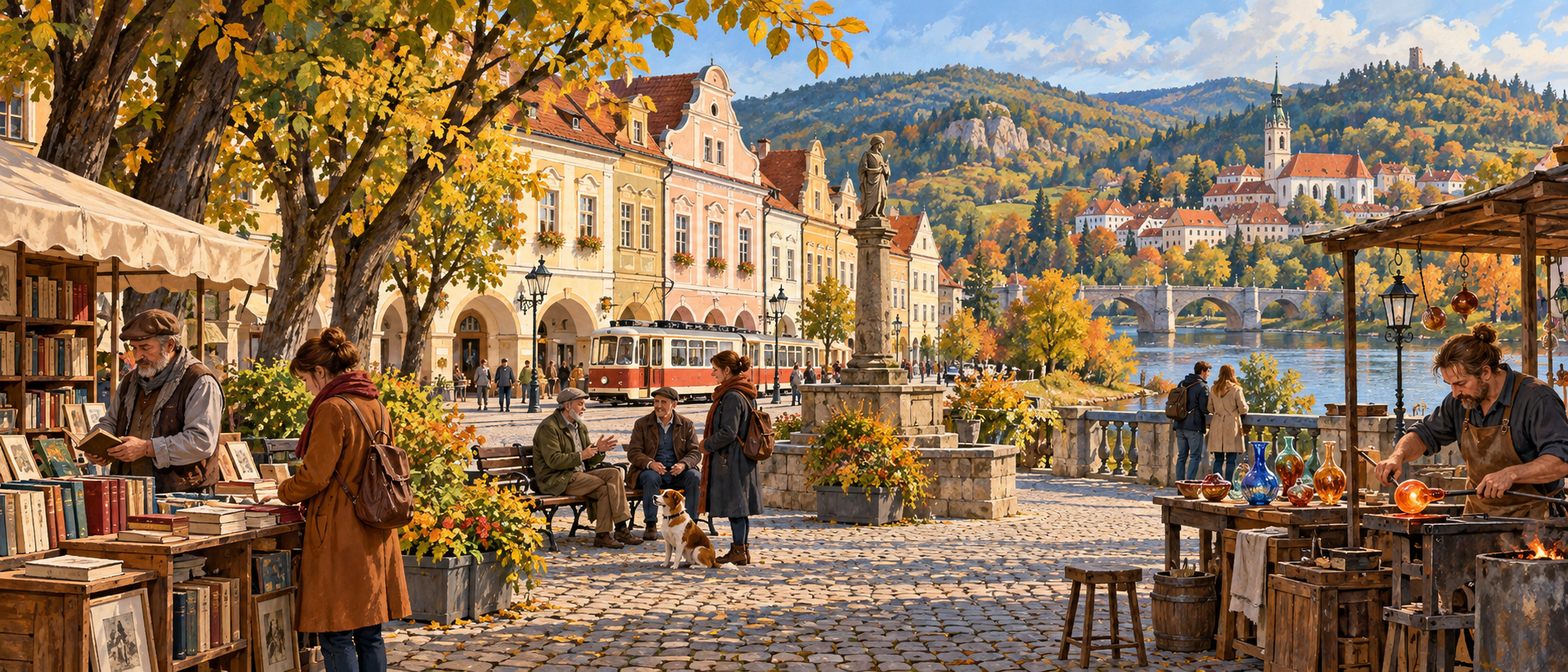
Cover illustration: an original AI-generated artistic interpretation of a bookseller, glass artisan, neighbours and a tram in a tree-lined town square beside a river and wooded hills. This is a nonliteral composite, not a photograph or an exact view of a named place.
Choose your route through Czechia
- 1. Geography
- 2. Regions and Cities
- 3. Earlier History
- 4. Modern History
- 5. Government and Institutions
- 6. People and Languages
- 7. Economy
- 8. Agriculture and Food Production
- 9. Infrastructure
- 10. Education
- 11. Health and everyday services
- 12. Food, regions and shared tables
- 13. Music, voices and memory
- 14. Arts, materials and imagination
- 15. Community and belonging
- 16. Heritage and historical places
- 17. Landscapes and environmental care
- 18. Science, invention and skills
- 19. Connections with the wider world
- 20. Student connections with Singapore
1. Geography
Borders and deep geological foundations
Czechia occupies an inland position among Germany, Poland, Slovakia and Austria. Its territory brings together Bohemia, Moravia and part of Silesia, names that describe historical lands rather than three present administrative regions. Water leaving the country ultimately reaches three different seas: the North Sea, Baltic Sea and Black Sea. This combination of neighbouring states and outward flowing river systems helps explain why a landlocked country remains geographically connected to a much wider European landscape. (MFA geographical outline)
Beneath the landscape lie geological structures formed at different times. The Bohemian Massif preserves rocks shaped by the Variscan mountain building episode, while the Western Carpathians belong to the younger Alpine mountain system. A seismic study published in 2010 investigated their relationship along a 740 kilometre profile. Its measurements reveal differences deep within the crust, showing that present hills and plains are only the visible surface of a much longer geological history. (Geophysical research study)
Mountains and connected rivers
Sněžka illustrates why even a mountain’s height requires a precise definition. In February 2014, the Surveying Office measured its natural summit at 1,603.296 metres, on Polish territory. Czechia’s highest point lies nearby on the international boundary, about ten centimetres lower. The older figure of 1,602 metres referred to a surveying marker rather than the highest ground. The change corrected what was being measured; it did not mean the mountain had suddenly grown taller. (Official Sněžka survey statement)
The Labe, known internationally as the Elbe, begins in the Krkonoše and eventually reaches the North Sea after a journey of about 1,094 kilometres. The Vltava joins this larger river system rather than flowing directly to the sea. The international river commission describes a basin influenced by rainfall and snowmelt, with spring flows often strongest. Heavy summer rain can also produce floods, so the river’s behaviour cannot be reduced to a single predictable seasonal pattern. (Elbe basin commission)
Climate averages and exceptional years
Long climate records show change that a single warm afternoon cannot establish. The Czech Hydrometeorological Institute reports a national annual temperature average of 7.5 degrees Celsius for 1961–1990 and 8.3 degrees for 1991–2020. These are averages over thirty years, smoothing the irregularity of individual seasons. Comparing them reveals a warmer background climate, while leaving room for cold winters, local mountain conditions and considerable differences between one year and the next. (CHMI climate assessment)
The year 2024 illustrates how national averages and extreme events can coincide. CHMI recorded a mean temperature of 10.3 degrees Celsius, two degrees above the 1991–2020 normal. September brought 179 millimetres of precipitation nationally, almost three times its normal amount. Intense rain between 11 and 16 September produced major flooding. These dated observations describe an exceptional year, not a claim that every Czech region experiences identical rainfall or that floods occur uniformly across the country. (Hydrological Yearbook 2024)
2. Regions and Cities
Administrative regions and the Prague hinterland
Czechia has fourteen administrative regions, with Prague holding a special position as both a city and a region. Regional government is only one layer of the territorial system. The statistical office also identifies administrative areas organised around municipalities with extended responsibilities, while Prague has its own district arrangements. Historical labels such as Bohemia and Moravia therefore answer a different question from the names on a current administrative map: one concerns inherited geography, the other public administration. (CZSO territorial structure)
Central Bohemia surrounds Prague but is a separate region, even though its regional authority is based in the capital. Its northern and eastern areas are generally flatter than the hillier south and southwest. Towns including Kladno, Mladá Boleslav and Kolín give it several centres rather than a single uniform character. Strong commuting and economic links connect neighbouring districts to Prague, illustrating how everyday urban relationships can cross the boundary separating two administrative regions. (Central Bohemian profile)
Moravian centres and industrial change
Brno is Czechia’s second largest city and a major centre of South Moravia. Its municipal profile places education alongside business and urban services, while the city’s university overview identifies public, state and private institutions. This concentration makes Brno more than a smaller version of Prague: it has its own regional educational network and institutional identity. A country understood only through its capital would miss this important centre of study, employment and public life. (Brno municipal overview)
Ostrava straddles a historical boundary: the Ostravice separates its Moravian and Silesian parts. Coal and heavy industry strongly shaped its expansion, but the city’s history also records major closures. Its last coal was extracted at the Odra shaft on 30 June 1994, and the Vítkovice blast furnaces stopped operating in 1998. Those dates concern specific activities in the city, not the simultaneous end of every mine or industrial enterprise throughout the surrounding region. (Ostrava historical account)
Western industry and southern basins
Pilsen developed at a meeting point of trading routes, a position that remains part of the city planning office’s explanation of its economic role. Manufacturing, regional services and connections with the University of West Bohemia feature in that account. The combination matters because an industrial city also depends on education, research and the movement of people and goods. Its regional importance is broader than any single product or company associated with its name. (Pilsen planning office)
South Bohemia combines the České Budějovice and Třeboň basins with uplands and the Šumava frontier towards Germany and Austria. Agriculture, forestry and fishponds form an important part of its regional history, alongside manufacturing that expanded during the twentieth century. Rivers including the Vltava, Lužnice and Otava connect this varied terrain. The region therefore offers a useful contrast to a purely metropolitan picture of Czechia, without implying that its present economy is exclusively rural. (South Bohemian profile)
3. Earlier History
Archaeology before modern nations
The Venus of Věstonice was discovered on 13 July 1925, broken into two pieces. The Moravian Museum’s centenary study places this ceramic female figure among other prehistoric representations made from clay and mammoth ivory. The object is evidence of material skill and symbolic expression long before written history. Calling it a find from present Czechia describes its modern location; it does not mean that its makers belonged to a modern Czech nation or state. (Moravian Museum centenary study)
At Mikulčice, archaeological remains reveal a ninth century centre associated with Great Moravia. The fortified core stood among branches of the Morava River and was surrounded by larger settlements and farmland. Stone churches and an important residential building indicate concentrated religious and political activity. Such evidence helps historians reconstruct an early medieval society through buildings, burials and settlement patterns, rather than treating later national borders as a ready made map of its world. (Mikulčice museum account)
Medieval power and learning
Prague Castle’s institutional history dates its foundation to about 880 under the Přemyslid prince Bořivoj. It subsequently became a seat of princely and royal authority and a religious centre. Under Charles IV in the fourteenth century, its role expanded as an imperial residence, with major Gothic building work at Saint Vitus Cathedral. The complex consequently records successive forms of power rather than a single building campaign or an unchanged political system lasting across the centuries. (Prague Castle history)
Charles University was founded by a charter dated 7 April 1348, initially with faculties of theology, arts, law and medicine. Its history also reflects political and religious conflict. The 1409 Decree of Kutná Hora changed the balance of voting within the university, prompting departures among masters and students. Jan Hus served as rector, and the later Hussite wars disrupted teaching. Medieval scholarship was therefore closely connected to authority and belief, not isolated from public disputes. (Charles University history)
Conflict and historical memory
The Battle of White Mountain in 1620 occupies a powerful place in Czech historical memory. The National Museum’s exhibition examines it within wider religious and political struggles involving the Bohemian lands and Habsburg rule. It follows the consequences through punishment, exile and the Renewed Constitution of 1627. By separating the events from their later symbolic treatment, the exhibition shows why a battle can become both a historical turning point and a subject of continuing reinterpretation. (National Museum White Mountain exhibition)
During the later nineteenth century, places and landscapes acquired new importance in national imagination. National Museum research on the period 1860–1914 examines how rivers such as the Vltava and Elbe, and hills including Říp and Blaník, appeared in art and shared memory. These representations helped construct a national landscape amid Czech and German nationalist competition. The research highlights a distinction between physical terrain and the meanings that different communities attach to it over time. (National landscape research)
4. Modern History
Independence and occupation
On 28 October 1918, the National Committee in Prague proclaimed an independent Czechoslovak state by law. The foreign ministry’s historical account connects this event with cooperation between domestic resistance and leaders working abroad. The state created at the end of the First World War was Czechoslovakia, not today’s Czech Republic alone. Keeping that distinction visible prevents the history of the shared state from being mistaken for an unchanged modern national territory. (MFA independence history)
Czechoslovakia’s parliamentary democracy was undermined by the Munich settlement of 1938 and the annexation of the Sudeten borderlands by Nazi Germany. On 15 March 1939, German forces occupied Bohemia and Moravia, which became a protectorate under Nazi rule. Slovakia followed a different political course as a separate Nazi aligned state. The United States Holocaust Memorial Museum’s account makes these changing jurisdictions context for understanding occupation and persecution, rather than treating wartime Czechoslovakia as an unchanged administration. (USHMM historical account)
Communist power and military intervention
The communist takeover of February 1948 followed a confrontation over control of the police and the resignation of several ministers. On 25 February, President Edvard Beneš accepted the resignations under intense pressure, enabling Klement Gottwald to reorganise the government. The Institute for the Study of Totalitarian Regimes reconstructs these events as a decisive seizure of power. The episode demonstrates how formal governmental procedures can be used within a much wider campaign to eliminate effective political competition. (ÚSTR February 1948 account)
The Prague Spring of 1968 opened space for attempts to democratise the communist system. Revived organisations, including an association of former political prisoners, contributed to a renewal of civic activity. Warsaw Pact forces invaded Czechoslovakia on the night of 20–21 August in Operation Danube. The Institute for the Study of Totalitarian Regimes documents the reform movement and intervention, showing that the year involved social participation as well as decisions by political leaders. (ÚSTR invasion archive)
Democratic change and separate states
After the violent suppression of a student demonstration in November 1989, Civic Forum emerged to press for dialogue and political change. Václav Havel became a leading figure in the nonviolent transition known as the Velvet Revolution. He was elected president of Czechoslovakia on 29 December 1989. His later presidency of the Czech Republic, from 1993 to 2003, belonged to a different state, although both offices formed part of the same wider transition away from communist rule. (Havel Library presidential biography)
On 1 January 1993, the peaceful dissolution of the Czechoslovak federation produced separate Czech and Slovak states. State succession involved practical work as well as new political identities: the foreign ministry describes the division of diplomatic property and the organisation of a separate foreign service. The division of property value followed a two to one ratio. This administrative history shows that independence required functioning institutions and negotiated arrangements, not simply a new name placed on an existing map. (MFA state succession history)
5. Government and Institutions
Parliamentary government
The Czech constitutional system combines representative democracy with protections for rights and political competition. Its Chamber of Deputies has 200 members elected for four year terms. The government is the highest executive authority and is accountable to that chamber, making parliamentary support central to governing. These arrangements distinguish the cabinet’s role from that of the president and explain why a presidential election does not, by itself, select the government or its parliamentary majority. (Czech Constitution)
The Senate forms the other chamber of Parliament. Its 81 senators serve six year terms, with one third of the seats contested every two years. This staggered renewal means the entire chamber does not change at a single election. The Senate’s institutional account also explains that it cannot be dissolved. Its electoral rhythm and continuity therefore differ from the Chamber of Deputies, giving the two parliamentary chambers distinct structures rather than making them duplicate elected bodies. (Senate institutional explanation)
Two offices with different responsibilities
As of 20 October 2026, the presidency identifies Petr Pavel as President of the Czech Republic. He won the presidential election in January 2023 and was inaugurated in March. His earlier career included service as chief of the Czech armed forces’ general staff and chair of NATO’s Military Committee from 2015 to 2018. These biographical details describe the current officeholder’s experience, not a requirement that future presidents must follow a military career. (Presidential biography checked October 2026)
The government’s official page identifies Andrej Babiš as prime minister as of 20 October 2026. The office involves organising the government’s work, chairing its meetings and representing it publicly. This is a different role from the presidency, although both feature prominently in international news. Naming the office and the date together is important: current political leadership can change, while an undated description may wrongly preserve an earlier prime minister as still serving. (Prime Minister page checked October 2026)
Constitutional review and public oversight
The Constitutional Court is based in Brno and protects the constitutional order. It has fifteen judges appointed for ten year terms, and its institutional history dates the beginning of its work to 15 July 1993. Constitutional review differs from ordinary litigation: its focus is the compatibility of public action and legal rules with constitutional requirements. This specialised role places the court within the system of checks on power rather than within cabinet administration. (Constitutional Court overview)
The Public Defender of Rights, commonly called the ombudsman, examines problems involving the conduct or inaction of public authorities. The institution also addresses discrimination, monitors the rights of people with disabilities and visits facilities where people are restricted in their freedom. These functions bring attention to how institutions treat individuals. They complement, rather than replace, the work of elected bodies and courts, adding an oversight perspective focused on administration, dignity and equal treatment. (Ombudsman institutional remit)
6. People and Languages
Population counts and personal identities
Czechia’s population stood at 10,915,839 at the end of 2025 in the preliminary statistical release of 31 March 2026. Net migration added about 42,000 people, while deaths exceeded births by roughly 35,700. The resulting increase was much smaller than migration alone. The population series includes resident foreigners, including qualifying residents under temporary protection, so it should not be read as a count only of Czech citizens or confused with a census result. (CZSO preliminary population release)
The 2021 census recorded Czech as the sole mother tongue of nearly nine million people, while others reported Czech alongside another language. Slovak, Ukrainian and Vietnamese also appeared in the results. Mother tongue, citizenship and ethnic identification were separate census variables, not interchangeable labels. Ethnicity was voluntary, and 31.6 per cent did not answer it. Nonresponse means readers should not treat the published ethnic categories as a complete classification of residents. (Census 2021 language and identity)
Written language and spoken variation
Written Czech uses letters with marks such as č, ř and ž, as well as marked vowels. These belong to its spelling system rather than serving as optional decoration. The Czech Language Institute’s reference book also explains that ch counts as one letter in alphabetical ordering. Letters such as q, w and x occur in borrowed words. Even a short place name can therefore carry information that disappears when its original spelling is simplified. (Czech language reference book)
Spoken Czech is not identical everywhere or in every setting. The Czech Language Institute studies traditional dialects, broader regional speech and informal language in cities and border areas affected by migration. Its dialect dictionary draws on vocabulary from Bohemia, Moravia and Silesia over roughly 150 years, combining written collections with field research. This work treats everyday speech as evidence of linguistic diversity and change, rather than measuring all conversation against a single uniform model. (Dialectology research programme)
Minority languages and migration
The Council of Europe’s language monitoring addresses German, Moravian Croatian, Polish, Romani and Slovak in Czechia. The European Charter for Regional or Minority Languages entered into force for the country in 2007, and additional commitments followed in 2024. Such monitoring concerns language transmission and public use, including education and cultural support. It should not be confused with a census ranking or with a claim that every member of a minority speaks the same language. (Council of Europe language monitoring)
The Interior Ministry reported 1,131,197 legally resident foreigners at the end of 2025, an increase of 3.4 per cent from the previous year. Ukrainians formed the largest citizenship group, followed by Slovaks. The ministry connects recent migration both with displacement caused by Russia’s war against Ukraine and with employment. This administrative measure has its own residence definitions; it is not equivalent to foreign born people, asylum seekers or the entire national population. (Interior Ministry migration report 2025)
7. Economy
Output and industrial connections
In its release of 3 March 2026, the Czech Statistical Office estimated that real gross domestic product grew by 2.6 per cent in 2025. Household consumption rose by 3 per cent and fixed investment by 2 per cent, with both domestic and external demand contributing to growth. These are national accounts estimates for a specified year, adjusted for price effects. They describe economic production and spending, not an identical improvement in every household’s circumstances. (CZSO March 2026 national accounts)
Motor vehicle manufacturing is economically important. The OECD’s 2025 survey estimates its direct contribution at around four per cent of value added and employment, with a wider footprint when suppliers are included. Production is closely connected to international networks, especially Germany. The shift towards electric vehicles matters because it changes the components and skills that manufacturers require. Industrial strength therefore brings both opportunities and exposure to technological change and demand beyond Czech borders. (OECD Economic Survey 2025)
Economic resilience and price stability
The IMF’s 2026 assessment links Czechia’s prosperity to participation in international production networks while also identifying vulnerabilities. Concentration in particular products and trading partners can transmit shocks from abroad, and energy intensive production adds another pressure. Population ageing creates challenges for the labour force as well. These observations are an assessment of structural risks, not a prediction of inevitable crisis. They explain why resilience involves diversification and productivity alongside the current growth rate. (IMF Article IV assessment 2026)
The Czech National Bank has targeted annual consumer price inflation of two per cent since 2010, with a tolerance band of one percentage point on either side. A target is a policy objective, not a statement of actual inflation. Nor does it mean that all prices rise equally. The distinction helps readers interpret reports about monetary policy: the central bank seeks overall price stability while individual goods and services can behave differently. (Czech National Bank inflation target)
Tourism and business services
Tourism contributes to the economy, but its scale is better measured than assumed from the visibility of famous city centres. The tourism satellite account released in February 2026 put its contribution at 2.5 per cent of Czech GDP in 2024 and recorded about 233,000 employed people. These accounting measures describe activity associated with tourism across relevant industries. They are different from counting hotel nights, border crossings or photographs of crowded streets in a few prominent locations. (Tourism Satellite Account 2024)
Business services provide another way to understand activity beyond factory production. CzechInvest’s official framework distinguishes software development, data centres, shared service centres and high technology repair operations. These categories involve different forms of expertise, from maintaining information systems to supporting company operations across borders. The agency’s classification is not a measurement of each sector’s size, but it demonstrates why describing Czechia only as a manufacturing economy would leave out important work. (CzechInvest service classifications)
8. Agriculture and Food Production
Farms and the measurement of crops
The European Commission’s Czech agricultural profile describes about 3.5 million hectares of farmland, roughly 45 per cent of the country’s area. Large farms manage around three quarters of agricultural land, alongside smaller holdings. Cereals, oilseeds, potatoes, sugar beet, hops and grapes are among its crops. The 2023–2027 agricultural plan seeks to support smaller and medium sized farms and protect natural resources; those are policy objectives, not proof of completed change. (Czech CAP plan profile)
Crop statistics distinguish the area planted, the amount harvested and yield per hectare. These measures answer different questions: a larger harvest can result from more land being used, better yields, or both. The Czech Statistical Office’s methodology also separates forecasts during the growing season from final harvest information. This distinction matters when comparing reports about wheat, barley or oilseed crops, because an early expectation can change as weather and harvesting conditions become clearer. (CZSO crop statistics methodology)
Specialised crops and certified production
Hop growing involves quality as well as quantity. A study published in 2025 examined alpha acid content in Czech hops harvested in 2024, comparing forecasts with harvested material. It found differences among the Žatec, Úštěk and Tršice growing regions and among varieties including Saaz, Sládek and Premiant. Such measurements show why a crop cannot be understood through tonnes alone: characteristics of the harvested plant also matter to the processing industries that use it. (Original Czech hop quality study)
Organic farming is supported by a system of inspection and certification, not merely a product description. The Central Institute for Supervising and Testing in Agriculture explains its public control role alongside private certification bodies. Checks can cover farm records, feed, fertilisers, plant protection materials, animal welfare and traceability. The institutional framework makes production methods verifiable, while reminding readers that an agricultural label refers to defined practices rather than a contrast between modern and traditional farming. (UKZUZ organic controls)
Fishponds and the care of soil
Freshwater aquaculture adds another dimension to Czech food production. Technical guidance from the University of South Bohemia describes carp farming in ponds, where natural food can be supplemented with cereals. Managing fish growth therefore also requires attention to water conditions and the pond environment. This is neither the same system as catching wild fish in a river nor an enclosed marine cage farm. Its methods connect animal production with the management of a freshwater landscape. (University carp pond methodology)
Soil erosion is a practical concern wherever rainfall can detach and move particles from cultivated ground. Czech soil research maps examine factors including slope, slope length, vegetation cover and soil properties. These help identify where land management needs particular attention. A risk map does not mean that all mapped land has already suffered the same damage. It combines information about conditions that can produce erosion, supporting understanding beyond treating farmland as uniform. (Soil research erosion mapping)
9. Infrastructure
Railways and integrated public transport
At 1 January 2025, the railway infrastructure manager Správa železnic reported a network of 9,355 kilometres, including 3,271 kilometres of electrified lines. These figures describe the network under its responsibility, not every private industrial track in the country. Maintaining rail infrastructure involves keeping routes technically operable as well as building new capacity. The distinction between an infrastructure manager and the companies running trains is important when interpreting railway investment or service changes. (Rail infrastructure snapshot 2025)
Prague Integrated Transport connects rail services with the wider public transport system of Prague and Central Bohemia. Its train network includes stopping services marked S and faster services marked R, linked with metro, tram and bus travel through coordinated arrangements. Integration concerns how different modes work together, rather than implying that they share a vehicle type or operator. It illustrates how a metropolitan transport system can extend beyond the central city’s administrative boundary. (PID integrated rail overview)
Air connections and energy systems
Prague Airport handled about 17.8 million passengers in 2025, according to its operating results, around 1.4 million more than in 2024. Airport traffic measures passenger movements, so someone departing and later returning contributes more than once. The figure should not be read as 17.8 million unique tourists or as the combined traffic of every Czech airport. Aviation infrastructure also depends on terminal operations and other services alongside the flights. (Prague Airport 2025 results)
Czechia’s energy transition involves heating as well as electricity. The International Energy Agency’s 2025 review describes the continuing importance of coal, the role of nuclear power and the challenge of replacing coal based supply while maintaining reliability. A change in power generation does not automatically solve the separate needs of district heating. The review therefore treats energy security, investment and decarbonisation as connected questions, requiring attention to how different parts of the energy system interact. (IEA Czechia review 2025)
Supply routes and digital connections
On 14 January 2025, pipeline operator MERO announced that technical work on TAL Plus had made Czechia ready for full crude oil supply through the western TAL and IKL route. The announced capacity was about eight million tonnes a year. Capacity is not the same as actual annual throughput, and technical readiness is not proof that every shipment changed route immediately. The project nevertheless illustrates how infrastructure can expand the options available for an essential imported resource. (MERO January 2025 announcement)
The European Commission’s 2025 Digital Decade assessment presents a mixed picture of connectivity. Czechia had strong mobile coverage, including extensive 5G availability, while fibre and very high capacity fixed networks remained below the European Union average. Rural deployment remained an important issue. Mobile coverage and a fast fixed connection are different indicators, just as network availability differs from people’s ability to use digital services. Reading them separately is more informative than a single label of connected or unconnected. (Digital Decade country report 2025)
10. Education
School foundations and vocational routes
Czechia’s education system includes a compulsory final year of preprimary education from age five, followed normally by nine years of compulsory school attendance beginning at six. The Eurydice overview, updated in September 2026, also explains the distribution of responsibilities: municipalities commonly establish nursery and basic schools, while regions are important providers of upper secondary education. National rules and local provision therefore operate together, rather than all schools being managed by one central office. (Eurydice September 2026 overview)
Vocational education is a major upper secondary pathway. Cedefop reports that 73.1 per cent of learners at that level were in initial vocational programmes in 2023. Routes include three year programmes leading to a vocational certificate and four year programmes ending with the maturita examination. Practical learning takes place alongside school based education, but Cedefop distinguishes this arrangement from a formal dual system. Routes combine occupational preparation and further study opportunities in different ways. (Cedefop vocational policy brief)
Higher education and unequal opportunities
Higher education includes public, state and private institutions, with both university and nonuniversity forms. The official Study in Czechia explanation describes bachelor’s programmes, follow on master’s programmes and doctoral study, alongside longer integrated master’s courses in some fields. The European credit system normally assigns sixty credits to a full academic year. This structure helps compare study loads and qualifications, but a shared credit framework does not make every programme identical in content or professional purpose. (Official higher education overview)
Strong average results do not mean that educational opportunities are evenly distributed. The European Commission’s 2025 Education and Training Monitor notes Czech strengths in mathematics, science and digital skills while also highlighting the influence of family background and early selection between school pathways. Fragmented provision can add further difficulties. These findings concern the organisation of opportunity, not fixed group abilities. They explain why improving an education system involves both achievement and access to support for learning. (Education and Training Monitor 2025)
Curriculum changes and long term goals
The Education Ministry’s timetable checked on 20 October 2026 postpones compulsory use of the revised basic education curriculum by one year. Implementation is scheduled to begin in September 2028 for first and sixth grades, reaching all grades by September 2032. Schools have a transition period to adapt their own programmes. This current schedule differs from earlier announcements, illustrating why a curriculum reform should be described through its latest implementation rules rather than its original launch date. (Current ministry curriculum timetable)
The national Strategy 2030+, approved on 19 October 2020, sets broader goals beyond any one curriculum document. It emphasises competencies relevant to personal life, work and participation in society, together with reducing educational inequalities. These are guiding aims for policy and implementation, not a declaration that all schools have already achieved them. Understanding the distinction between a strategy, its measures and eventual results helps readers evaluate educational change without confusing intentions with success. (Education Strategy 2030+)
11. Health and everyday services
Organising care across institutions
Czechia’s health system is organised around social health insurance, described in the European Observatory’s 2024 summary as providing virtually universal membership and a broad package of benefits. Compulsory contributions and government transfers help finance it. Health insurance funds purchase services for their members, so the system involves relationships between patients, insurers and providers rather than a single organisation doing everything.
The same summary describes mainly private outpatient providers alongside hospitals that are mainly publicly owned. The Ministry of Health has national oversight, while regional bodies and insurance funds also have responsibilities. These distinctions help explain why financing, ownership and treatment are separate questions. A clinic’s ownership alone does not tell a student how a particular consultation is paid for.
Making information understandable
The National Health Information Portal, NZIP, offers another kind of public service: helping people understand health information. Its content is guaranteed by the Czech Ministry of Health and developed with medical expertise. The portal covers prevention, illnesses and treatment in accessible language. It also includes educational quizzes and a map of healthcare services, joining information with practical orientation.
A health-information portal can support a conversation without replacing the professional who knows a patient’s circumstances. NZIP presents clarity and expert checking as central to its purpose. For a family, unfamiliar terminology can itself be a barrier. Explaining a word, organising a topic and showing where a service is located are therefore meaningful parts of making a large system easier to navigate.
Services depend on people
The Czech Red Cross’s voluntary blood-donation programme shows how care also depends on organised participation. Its account describes educational campaigns, recruitment of new donors and recognition of people who give blood without payment. It includes appreciation for donors’ families, making the supporting relationships visible rather than treating a donation as an isolated event. This is a concrete example of a voluntary organisation working around a medical service. The important distinction is between encouraging participation and deciding whether an individual can donate, which remains a matter for the responsible medical professionals.
A WHO and Czech Ministry of Health review published in March 2024 examined services following the arrival of people fleeing Russia’s February 2022 invasion of Ukraine. Its overview identifies language, housing and financial difficulties among the barriers affecting refugees. The review’s purpose was to strengthen capacity for both refugees and host communities. It invites a humane way of thinking about access: insurance arrangements matter, but so do understanding a letter, explaining symptoms and finding the right place. Studying services means noticing the steps between a formal entitlement and someone actually receiving help.
12. Food, regions and shared tables
A dish with room for variation
Svíčková na smetaně combines beef, root vegetables and a creamy sauce, commonly accompanied by dumplings. CzechTourism’s description also identifies cranberries and lemon, bringing contrasting flavours to the plate. Rather than reducing Czech food to a single ingredient, this dish offers a small lesson in composition: texture, acidity, sweetness and the sauce’s consistency all contribute to the finished meal.
The same account acknowledges variations and the importance of patient preparation. A family version and a restaurant version need not be identical for both to belong to the dish’s story. Food knowledge includes judgement about balance as well as a list of ingredients. That makes a recipe a starting point for understanding practice, not a complete portrait of everyone’s everyday diet.
Soups, pies and regional names
Kulajda provides a different combination: mushrooms, potatoes, cream, dill and eggs appear in CzechTourism’s published recipe, with vinegar adjusting the acidity. Its discussion describes regional variations and the use of fresh or dried mushrooms. The contrast between a creamier, sweeter version and a sharper one is especially useful for understanding culinary diversity. A familiar name can cover several preferences, rather than one universally agreed taste. The recipe is evidence of a dish and its variations, not a guide to identifying edible wild mushrooms.
Moravian Wallachia is associated with frgál, a broad pie whose thin base carries a generous filling. The official food description gives pear, curd, poppy seed, apple and plum butter among the examples. Here the relationship between dough and topping matters as much as the ingredients themselves. Regional food names can preserve a connection to place while allowing bakers to make different choices. A student describing the pie could compare shape, texture and filling without deciding that one example represents all baking in Czechia.
Production leaves a landscape
Olomoucké tvarůžky illustrates the role of time in food production. An EU product notice describes it as a skimmed cheese that ripens beneath a surface smear layer and develops a distinctive flavour and aroma. The notice also discusses continued ripening after packaging. Such details show why a food’s identity cannot always be reduced to its starting material: processes change the product. Reading a specification alongside a recipe reveals different purposes, one defining product characteristics and the other explaining a particular preparation.
At Žatec, food and drink history becomes visible in fields and buildings. The UNESCO-listed Landscape of Saaz Hops links cultivation with drying, packing, certification and trade. Its account recognises contributions by Czech, German and Jewish communities to the town’s nineteenth-century development. Hop poles, warehouses and processing buildings make a network of work tangible. The example concerns agricultural and industrial heritage, not an expectation that anyone drinks beer. It also reminds readers that a regional product can carry the history of several communities.
13. Music, voices and memory
Improvisation within a tradition
Slovácko verbuňk is a regional dance tradition associated with boys and men in southeastern Czechia. UNESCO’s account describes singing followed by slower and then faster dancing. The performance allows improvisation rather than requiring every dancer to repeat an identical sequence. A group can therefore share a musical setting while leaving room for each participant’s timing, movement and expression.
The tradition has regional variants, and its costumes and instruments require skilled making and maintenance. This places the visible dance inside a wider circle of work. Preserving a performance involves more than remembering its name: people need opportunities to practise, musicians to accompany them and ways to pass knowledge onwards. Variety within the tradition is part of its life, not simply an error.
The concert and its documents
The Czech Philharmonic’s first concert took place in Prague’s Rudolfinum on 4 January 1896, with Antonín Dvořák conducting his own music. The programme included his Ninth Symphony, From the New World, alongside other compositions. This event anchors a much larger musical history. An orchestra’s identity is created through performances, rehearsal and successive generations of players, not only through the fame of a composer. A programme records what was planned for an audience on a particular evening.
The Antonín Dvořák Museum preserves a different side of musical life. Housed in Prague’s Baroque Amerika summerhouse since its opening in 1932, it holds manuscripts, correspondence, photographs and other documents. These materials can reveal revisions, working relationships and the circumstances surrounding a composition. The building is a museum setting, not evidence that the composer lived there. Looking at a letter beside a score encourages students to distinguish the work performed in a concert from the many decisions and exchanges that helped create it.
Keeping more than one kind of voice
The Archives of Leoš Janáček entered UNESCO’s Memory of the World Register in 2017. The collection includes manuscripts, corrected proofs, notebooks, librettos and books bearing his annotations. A correction on a proof can be as revealing as a finished page because it shows a choice being reconsidered. This is documentary heritage, a different UNESCO category from a listed historic town. The archive preserves traces of a working mind, allowing later researchers to ask questions that a polished performance alone cannot answer.
The Institute of Ethnology’s Sources of Folk Music of the Czech Lands portal brings together songs, dances and instrumental music through several forms of evidence. Its developing collection includes scans of written notation and historical audiovisual recordings, created with partners including the National Institute of Folk Culture. A notation and a recording preserve different aspects of a performance. Students might compare what each retains about rhythm, voice or context, remembering that a searchable archive is a selection assembled through collecting and documentation, not every song ever sung.
14. Arts, materials and imagination
Many hands behind a puppet
Puppetry in Slovakia and Czechia received a joint UNESCO intangible-heritage inscription in 2016. Its history includes travelling families whose performances absorbed local language and themes. The puppets are often wooden, but the ways of moving them vary. A small figure can become a convincing character through the coordination of voice, gesture and timing, rather than through realistic appearance alone.
The practice brings together performers, writers, puppet makers, costume makers and stage designers. Skills pass through observation and repeated participation as well as organised teaching. This makes a puppet production an example of collective authorship: the person speaking is only one contributor. Recognising the shared Czech and Slovak inscription also prevents a connected tradition from being presented as the exclusive possession of one country.
Learning what materials can do
Handmade glass production was inscribed by UNESCO in 2023 through a nomination involving Czechia and five other countries. The description includes both hot-glass shaping and cold-glass decoration, with specialised tasks often shared by teams. One maker’s work depends on what another has already done. Families, apprenticeships and formal schools all contribute to transmission. The object also embodies timing, coordination and practical judgement. Individual styles remain visible within a common form.
Modrotisk is a resist-printing and indigo-dyeing tradition shared across several European countries. A paste applied with patterned blocks prevents dye from colouring selected areas, leaving a pale design against the dyed cloth. UNESCO’s account describes family workshops and knowledge learned through observation and practice. The pattern therefore records both a visual choice and a sequence of skilled actions. Comparing the block with the finished fabric helps students notice how a design is transferred, repeated and transformed by its material rather than appearing on cloth automatically.
From posters to abstraction
Alphonse Mucha’s Gismonda poster appeared in Paris at the beginning of 1895, advertising Sarah Bernhardt’s theatre work. The Mucha Foundation highlights its elongated format, restrained colours and prominent standing figure. Their collaboration subsequently included posters, costumes and stage design. This places an artist associated with Czech cultural history within a wider European working network. The poster was also communication made for a particular purpose and audience. Asking how its layout directs attention is more revealing than treating it only as a decorative image.
František Kupka’s Amorpha: Two-coloured Fugue, dated 1912, offers another way of thinking about movement. The National Gallery Prague connects its red and blue forms with the artist’s progression from observing a moving ball towards abstraction. Its account suggests that the title may evoke music as well as flight or movement. These are interpretive possibilities, not instructions about the only correct response. Students can begin with what they see, then explain how colour, repetition and direction support their interpretation instead of merely attaching a label.
15. Community and belonging
Making something together
Amateur theatre acting in Czechia joined UNESCO’s Representative List of intangible heritage in 2025. The account describes people of different ages creating performances voluntarily in their free time. Groups may adapt established plays, develop local stories or write original scripts. The shared project gives participants several ways to contribute, including roles that do not involve standing in front of an audience.
Directing, lighting, sound, costumes and scenery are part of this theatre-making alongside acting. Learning happens within groups and families, through workshops and with support from professionals and art schools. A local production can become a place for discussing familiar experiences. Its community value lies partly in repeated work together: rehearsing, solving practical problems and making room for another person’s contribution.
Spaces for participation
Sokol presents physical activity and community participation as connected parts of its mission. Founded in 1862, the organisation’s activities extend beyond competitive sport to cultural and social life. Its own description emphasises participation across generations and respect for others. This stated purpose does not prove every local experience is identical. A club can provide a recurring place to meet, practise and organise activities, rather than simply an occasional sporting event.
The Jezerka branch of Prague’s municipal library combines reading with making and meeting. Its institutional description identifies an Atelier for sewing and other hand skills, areas for adults and younger readers, and an Agora used for readings, lectures and small concerts. These spaces suggest a library understood as more than shelves and borrowing. A person can arrive with a practical question, an unfinished project or an interest in another person’s work. The example concerns the branch’s facilities, not a promise that a particular workshop is running today.
Whose experiences are included?
Brno’s Museum of Romani Culture presents The Story of the Roma through objects, replicas, documents and audiovisual material. Its rooms address livelihoods, settlement, persecution, the Holocaust, postwar Czechoslovakia and artistic expression. The exhibition also includes Romani voices and a section examining media representations from 1989 to 2005. That stated period matters: an exhibition section is not a complete description of the present. Listening to people’s own accounts helps prevent a community being reduced to stereotypes or seen only through problems others associate with it.
The Jewish Museum in Prague uses individual documents in its school programmes. One workshop draws on letters written by Czechoslovak Jewish emigrants during the Second World War, preserved through a family collection. Such material can connect large historical events with decisions about separation, safety and belonging. A careful reader asks who wrote a letter, to whom and under what constraints. Community history then becomes more than a sequence of dates: it includes people trying to communicate with others when ordinary life had been profoundly disrupted.
16. Heritage and historical places
Reading a city in layers
The UNESCO property called Historic Centre of Prague includes both the historic urban centre and Průhonice Park southeast of the city. Within Prague, buildings around the Vltava show successive architectural periods rather than one frozen medieval scene. Gothic structures, Baroque additions and later work belong to a continuing urban history. The official boundary is more precise than the phrase “all of Prague”.
The property account also discusses pressure from new development and changes to the roofscape. Conservation therefore involves decisions about relationships between buildings, views and the wider setting, not simply protecting individual facades. A student comparing old and recent maps could ask what remains recognisable and what has changed. Heritage care has to consider the whole arrangement that gives a place its character.
Towns shaped by power and work
Český Krumlov’s historic centre grew within a bend of the Vltava beneath a castle founded in the thirteenth century. Its medieval layout later acquired Renaissance and Baroque features. The castle hill, river and town explain the composition visible in plans and photographs. A castle was not merely a picturesque backdrop: the town’s development was connected with an aristocratic estate. Reading that relationship reveals the social organisation that shaped the buildings and their positions.
Kutná Hora developed through the exploitation of silver deposits from the late thirteenth century. Its prosperity is expressed in buildings including the Church of St Barbara and the church at Sedlec, later reshaped in Baroque taste. The link between mining wealth and monumental architecture provides a useful historical question: how did work underground influence what was built above it? This heritage reveals earlier economic relationships, not proof that its present economy depends on mining or that prosperity was shared equally.
Preserving complexity rather than simplicity
Třebíč’s listed ensemble includes its Jewish Quarter, cemetery and St Procopius’ Basilica. The quarter preserves shops and workshops below living spaces, along with institutions such as synagogues and schools. UNESCO’s account also recognises the political restrictions that confined the community to limited space. Architectural proximity should therefore not be mistaken for a history without inequality. Studying ordinary rooms, streets and workplaces alongside religious monuments can reveal how people organised daily life within the opportunities and restrictions of their particular time and place.
Litomyšl Castle adapts the Renaissance arcaded residence to a Czech setting, with work beginning in 1568. Its courtyards and decorated surfaces sit alongside later interiors and a theatre from 1796–97 whose stage machinery survives. These layers are important because conservation need not erase later changes in pursuit of one supposedly pure original moment. A building can document several periods at once. Students could make a simple annotated timeline showing which elements belong to which phase and how the whole complex remained useful through changing tastes.
17. Landscapes and environmental care
A forest is not one habitat
The Šumava Biosphere Reserve encompasses a varied landscape in the Bohemian Forest, including mountain woodland, glacial lakes, peat bogs and river valleys. Meadows and pastures are part of the picture too. UNESCO’s description recognises long human influence rather than presenting the area as untouched scenery. Understanding the landscape means noticing a mosaic of habitats, each with different conditions and histories.
The reserve’s profile identifies animals including Eurasian lynx, capercaillie and black grouse, as well as river pearl mussels in the Blanice headwaters. These examples make the mosaic concrete: a forest bird and a river organism cannot be understood through the same habitat description. A useful conservation question is not simply how much land is green, but what kinds of places it contains and connects.
Wind, water and time
The Krkonoše National Park describes its high mountains through an Arctic-alpine tundra framework. Exposed rocky summits experience strong frost and wind, while other zones contain grasslands, dwarf pine, peat bogs and glacial cirques. The term describes ecological relationships and historical processes; it does not place these Czech mountains inside the Arctic. Exposure and snow cover can change over short distances. Landscape diagrams can show these differences rather than depicting one uniform mountain habitat.
In Bohemian Paradise UNESCO Global Geopark, sandstone formations such as the Prachov Rock Cliffs demonstrate the shaping power of water over long periods. The UNESCO profile also connects regional minerals, including agates and jaspers, with jewellery-making around Turnov. Geological history thus intersects with skilled human work. A geopark recognises and interprets geological heritage; it is not the same designation as a World Heritage property. The distinction helps students understand that different conservation and education frameworks can describe different aspects of a place.
Repairing damage and recognising connections
The LIFE for MIRES programme worked across Šumava and the Bavarian Forest to restore wetland water regimes. Its accounts describe blocking drainage ditches and restoring streams, addressing earlier alterations that carried water away. The main project ended in 2024, while an account published in 2026 records educational activities during its 2025 aftercare phase. Restoration is therefore not simply leaving a place alone. It may require deliberate intervention, followed by observation and maintenance, to support processes that previous human decisions had interrupted.
The Punkva River’s underground course in the Moravian Karst draws attention to landscapes that cannot be understood only from the surface. The Czech Cave Administration connects the Punkva Caves with the Macocha abyss and describes the conservation of underground heritage as part of its work. Cave chambers, water and mineral formations are related features, not separate curiosities. For students, a cross-section offers a useful complement to a map: it can show why a river, an opening in the ground and a chamber belong within one explanation.
18. Science, invention and skills
A question that required patience
Gregor Mendel presented his pea experiments in Brno in 1865, in what is now Czechia. Masaryk University’s account emphasises preparation: studying earlier work, choosing suitable varieties, testing expectations and recording results. His achievement was not simply noticing that plants resemble their parents. It involved turning a broad puzzle about inheritance into questions that carefully organised experiments could help answer.
The same account notes that he investigated other plants and encountered less straightforward results. This is a valuable part of the story. An experiment becomes informative when its conditions and observations are clear enough to examine, including when the outcome is awkward. Students can connect Mendel’s work with a habit within reach: record what happened before deciding what they hoped it would mean.
Making a workable instrument
Otto Wichterle’s work on soft contact lenses connects chemistry with practical invention. An institutional exhibition account describes a spin-casting device assembled at home during Christmas 1961 using a Merkur construction set and a bicycle dynamo. The apparatus addressed the problem of forming hydrogel consistently, and his wife helped with subsequent production. This was a contribution to soft-lens development, not the invention of every kind of contact lens. The episode shows how understanding a material and devising a repeatable manufacturing method are closely related challenges.
ELI Beamlines in Dolní Břežany is a different scale of scientific infrastructure. Its high-power laser facility is designed for users investigating questions across fields including materials science, chemistry, biology and astrophysics. Tunable systems allow experimental conditions to be adapted to different research needs. The instrument matters: what can be asked depends partly on what can be measured or controlled. Research capabilities do not prove that every proposed application has become an everyday technology.
Expertise is shared infrastructure
At CEITEC Masaryk University, core facilities make specialised equipment and expertise available to research users. The institutional description spans life sciences, nanotechnology and materials science, with assisted access for academic and industrial work. Sharing a complex instrument also requires people who understand preparation, operation and interpretation. A research centre is therefore more than a building containing expensive machines. Its usefulness depends on training and collaboration that allow different teams to choose suitable methods and understand what their measurements can and cannot show.
The Institute of Scientific Instruments in Brno develops electron-microscopy methods for biological and other sensitive materials. Its Microscopy for Biomedicine group describes cryogenic sample preparation, quantitative imaging, detector development and computational analysis. Preparing a sample without losing important structure is part of obtaining an informative image, not merely a preliminary chore. Students can question the idea that scientific pictures reveal reality unchanged. An image results from a specimen, an instrument and a method, all of which need to be understood when interpreting it.
19. Connections with the wider world
Contributing to a large collaboration
The Czech Republic became a CERN Member State on 1 July 1993, following participation within Czechoslovakia before its dissolution. CERN’s country profile describes Czech involvement in experiments including ATLAS, ALICE and TOTEM. Giving the independent state’s accession date matters: the beginning of a political state and the beginning of its researchers’ scientific relationships are not necessarily the same event.
The profile also identifies Prague’s role in the LHC Computing Grid through a Tier 2 centre. A large experiment depends on more than the apparatus where measurements originate; computing helps make its data usable. This is a concrete way to understand international collaboration. Different institutions contribute specialised responsibilities, and participation can include both research questions and the infrastructure needed to investigate them.
Space and astronomy are organised differently
Czechia became a full member of the European Space Agency on 12 November 2008. ESA’s announcement distinguishes that effective date from the signing of the accession agreement in July. It also records the earlier cooperation stage that prepared the way. Scientific relationships develop through defined arrangements, not a vague promise of cooperation. Membership creates a framework for participation, but it does not mean that every idea proposed by a researcher or company automatically becomes an approved project.
Czechia joined the European Southern Observatory in 2007, connecting its astronomers with another international research organisation. A 2014 ESO workshop report discussed Czech use of its facilities and opportunities in instrumentation and training. This is a different network from ESA, with a different institutional purpose. A student can make that distinction visible by labelling what each organisation does and how researchers participate. Precise labels are more useful than drawing an undifferentiated line from Czechia to “space”, which would hide the varied work involved.
Exchange through culture and fieldwork
Czech Centres, established by the Ministry of Foreign Affairs, describe their role as public diplomacy through culture and exchange. Their activities include art, creative industries, science communication and Czech-language teaching. They also participate in EUNIC, a network of European cultural institutes. The aim is to develop relationships as well as present work abroad. This stated purpose does not prove that every audience responds alike. Cultural exchange allows dialogue rather than treating another country as a display window.
Czech research also reaches Antarctica without making the continent part of Czechia. A Masaryk University account of its 2026 expedition describes work at the J. G. Mendel Station on James Ross Island, including long-term plots monitoring mosses and lichens. Drone imagery was paired with measurements on the ground, while laboratory experiments investigated responses to stress. The combination shows why distant field research depends on patient observation and several methods. Collected samples are material for further analysis, not automatically a finished explanation of environmental change.
20. Student connections with Singapore
Compare processes, not just objects
Prague’s National Technical Museum presents printing through historical presses, typesetting equipment and changing technologies. Its collection includes a hand-operated Jesuit printing press from around the turn of the eighteenth century and an industrial rotary press made in 1876. Begin a comparison by asking what changed in the work: preparing text, applying ink, pressing paper and producing repeated copies. Connect the machine with the people and sequence of actions around it.
Singapore’s STPI offered a complementary perspective in its 3–4 October 2026 Open House programme, which highlighted printmaking, papermaking and the expertise of workshop technicians. The programme connected finished artworks with processes such as turning pulp into paper. Students could compare the questions raised by an industrial printing collection and an artistic workshop: where does repetition help, and where is variation valuable? Compare methods and purposes without assuming the institutions share a history.
Make observations comparable
The Czech Society for Ornithology’s Ptačí hodinka gives participants a defined method for observing winter birds. They remain at one location for an hour and record the largest number of each species seen simultaneously, reducing the risk of counting one bird repeatedly. The rules turn a familiar activity into more comparable evidence. Test the reasoning: if the same bird returns repeatedly, how would counting every appearance distort the result?
NParks’ Garden Bird Watch likewise connects public participation with research on Singapore’s birds. Its review of the 2015–2019 surveys describes training and a point-count method. The worthwhile comparison is how observations become useful data, not whether the two places have identical birds or seasons. A class could create a source sheet recording each programme’s location, timing, counting rule and purpose. Differences in those conditions should be considered before interpreting differences in the totals as evidence of ecological change.
Read the record behind the search result
The Czech National Digital Library offers books, newspapers, maps, music and other digitised materials, mainly from the nineteenth to twenty-first centuries. Its official description distinguishes freely available items from materials requiring login or access within a library. Record what you found and how much you could inspect. A catalogue entry, a searchable extract and a complete document are different levels of evidence. Digital access widens opportunities for research without removing the need to understand provenance and limits.
Singapore’s NewspaperSG makes source-checking concrete. Its FAQ explains that searchable extracts are generated through optical character recognition and can contain errors caused by print quality, damaged pages or complicated layouts. Compare the extract with the page image whenever a detail matters. Then note the newspaper, date, page and context before drawing a conclusion. Studying Czechia alongside Singapore can strengthen this transferable skill: respectful curiosity becomes reliable understanding when a reader checks how the evidence was produced and what it actually supports.
Frequently asked questions about Czechia
What is Czechia’s capital?
Prague is the capital.
Which statistical region includes Czechia?
The United Nations places Czechia in Eastern Europe.
What is modrotisk?
Modrotisk is resist printing and indigo dyeing that leaves pale patterns on dyed cloth.
When did Czechia become an ESA member?
Czechia became a full member of the European Space Agency on 12 November 2008.
Do the latest pages always contain current statistics?
No. Check each observation’s reference year and footnotes. Reading a page today does not turn an older observation into a current measurement.
Does a heritage designation establish safe access?
No. Heritage value and current access or safety are different questions. This article is for learning, not planning a journey.
Does one local example represent everyone?
No. Keep the people, place and date attached to an account. A documented example can explain a relationship without establishing a nationwide pattern.
How should students use the chapters?
Choose a focused question, preserve dates and definitions, and connect relevant evidence. Explain what remains uncertain instead of filling gaps with assumptions.
Continue reading: specialist guides to Czechia
These links provide subject-specific background. Their travel-themed titles do not establish that visiting is safe or feasible; use them as reading resources here.
- How Czechia Works | Government, 14 Regions, Czech Koruna, Industry and Schools
- Czechia Education System: School Stages, Admissions and Qualifications
- Mathematics Tutors of Czechia | CERMAT 2027 JPZ and Maturita Maths
- Science Tutors of Czechia | RVP 2028, Physics, Chemistry, Biology and Maturita
- Top 100 Puppet Theatre Vocabulary Words | Czechia
- Top 100 Glassmaking Vocabulary Words | Czechia
- Food traditions of Czechia
- Cultural and landscape learning about Czechia
Explore the Everything About Countries archive for national overviews. For the 195-country index, see How Countries Work | A–Z Guide to 195 Countries and Everyday Life. The How Singapore Works collection offers a different national case study; comparisons should account for history, scale and institutional responsibilities.
Keep the country’s people in the explanation
An explanation becomes stronger when it connects a national institution with a concrete question: who can use a service, how knowledge is passed on, what a measurement records, or how a change affects everyday work. Ask whose experience is represented and what additional evidence would help. That keeps analysis clear without turning people into illustrations of a single story.
Sources and further evidence
Sources were checked for this edition in October 2026. Statistical observations retain their own reference periods. Policy announcements and project plans are distinguished from completed outcomes.
- UNData country profile
- MFA: Geographic location
- Hrubcová et al.: Bohemian Massif crust
- Surveying Office: Height of Sněžka
- ICPER: Elbe River and basin
- CHMI: Climate change in Czechia
- CHMI: Hydrological Yearbook 2024
- CZSO: Territorial units
- CZSO: Central Bohemian regional profile
- Brno: Regional and university centre
- Ostrava: City history
- Pilsen Planning Office: Business setting
- CZSO: South Bohemian regional profile
- Moravian Museum: Venus centenary study
- Masaryk Museum: Mikulčice stronghold
- Prague Castle: History
- Charles University: Historical account
- National Museum: 1620 Road to the Mountain
- National Museum: National landscape research
- MFA: Czechoslovak independence
- USHMM: Czechoslovakia
- ÚSTR: February 1948
- ÚSTR: 1968 archival project
- Václav Havel Library: President
- MFA: January 1993 state succession
- Parliament: Czech Constitution
- Senate: Institutional overview
- Presidency: Petr Pavel biography
- Government: Current Prime Minister
- Constitutional Court: Role and history
- Ombudsman: About the institution
- CZSO: Population change 2025
- CZSO: Census 2021 identities
- Czech Language Institute: Letters and sounds
- Czech Language Institute: Dialectology
- Council of Europe: Czech language commitments
- Interior Ministry: Migration report 2025
- CZSO: GDP resources and uses 2025
- OECD: Economic Survey Czechia 2025
- IMF: Czech Article IV 2026
- CNB: Inflation target
- CZSO: Tourism Satellite Account 2024
- CzechInvest: Business service centres
- European Commission: Czech CAP plan
- CZSO: Crop statistics methodology
- Mikyška et al.: Czech hop acids 2024
- UKZUZ: Organic farming controls
- South Bohemia University: Carp pond guidance
- Soil research institute: Erosion maps
- Správa železnic: Rail operability
- PID: Integrated trains
- Prague Airport: 2025 operating results
- IEA: Czechia Energy Review 2025
- MERO: TAL Plus technical readiness
- European Commission: Digital Decade Czechia 2025
- Eurydice: Czech education overview
- Cedefop: Czech vocational policy 2025
- Study in Czechia: Education system
- European Commission: Education Monitor Czechia 2025
- Education Ministry: Revised basic curriculum
- Education Ministry: Strategy 2030+
- Czechia: health system summary 2024
- O NZIP: National Health Information Portal
- Czech Red Cross: voluntary blood donation
- Refugee and migrant health system review: Czechia
- Svíčková na smetaně
- Kulajda: recipe and regional variations
- Wallachian frgál
- Olomoucké tvarůžky: 2025 specification amendment
- Žatec and the Landscape of Saaz Hops
- Slovácko Verbuňk, recruit dances
- History of the Czech Philharmonic
- Antonín Dvořák Museum
- Archives of Leoš Janáček
- Sources of folk music of the Czech lands
- Puppetry in Slovakia and Czechia
- Knowledge, craft and skills of handmade glass production
- Modrotisk: resist printing and indigo dyeing
- Sarah Bernhardt: Mucha Foundation
- František Kupka: 150th anniversary
- Amateur theatre acting in Czechia
- Co je Sokol: mission and activities
- Jezerka: Municipal Library of Prague
- The Story of the Roma
- Jewish Museum in Prague: school programmes
- Historic Centre of Prague
- Historic Centre of Český Krumlov
- Kutná Hora: historical town centre and churches
- Jewish Quarter and St Procopius’ Basilica in Třebíč
- Litomyšl Castle
- Šumava Biosphere Reserve
- Krkonoše: Arctic-alpine tundra
- Bohemian Paradise UNESCO Global Geopark
- LIFE for MIRES: restoration and aftercare
- Punkva Caves and underground heritage
- Mendel’s scientific approach to pea experiments
- Otto Wichterle: scientist and inventor
- ELI Beamlines: facility and location
- CEITEC Masaryk University: shared facilities
- Microscopy for Biomedicine: Institute of Scientific Instruments
- Czech Republic at CERN
- Czech flag raised over ESA
- Seven Years in Chile: Czech astronomers at ESO
- Czech Centres: About us
- Our Scientists in Antarctica: 2026 research
- Printing: National Technical Museum
- STPI: Open House 2026, Through the Frame
- Ptačí hodinka: detailed counting method
- Garden Bird Watch: research and conservation
- National Digital Library of the Czech Republic
- NewspaperSG: Frequently Asked Questions