
What should you know about Indonesia beyond its name? This guide connects a country’s landscapes with the people, institutions and skills that give places meaning. It follows historical evidence and contemporary examples across community life, work, learning and cultural expression, without letting one image or headline stand for the whole country.
Begin with geography and history, or move directly to food, music, learning and the environment. Each chapter pairs a broad theme with concrete examples, while the source links let readers follow the evidence. The final chapter examines documented connections with Singapore.
Indonesia at a glance
- Capital listed by UNData: Jakarta.
- UN statistical region: South-eastern Asia.
- Reading date: 21 October 2026; individual observations retain their own dates.
The capital and regional classification are listed in the UNData country profile. This guide uses specific dated sources for the other subjects rather than treating an old country summary as a current account of every institution.
This is an educational overview, not a travel itinerary or personalised medical, legal or financial advice. A cultural or environmental designation does not establish present access or safety. National data cannot replace the experiences of particular households and communities.
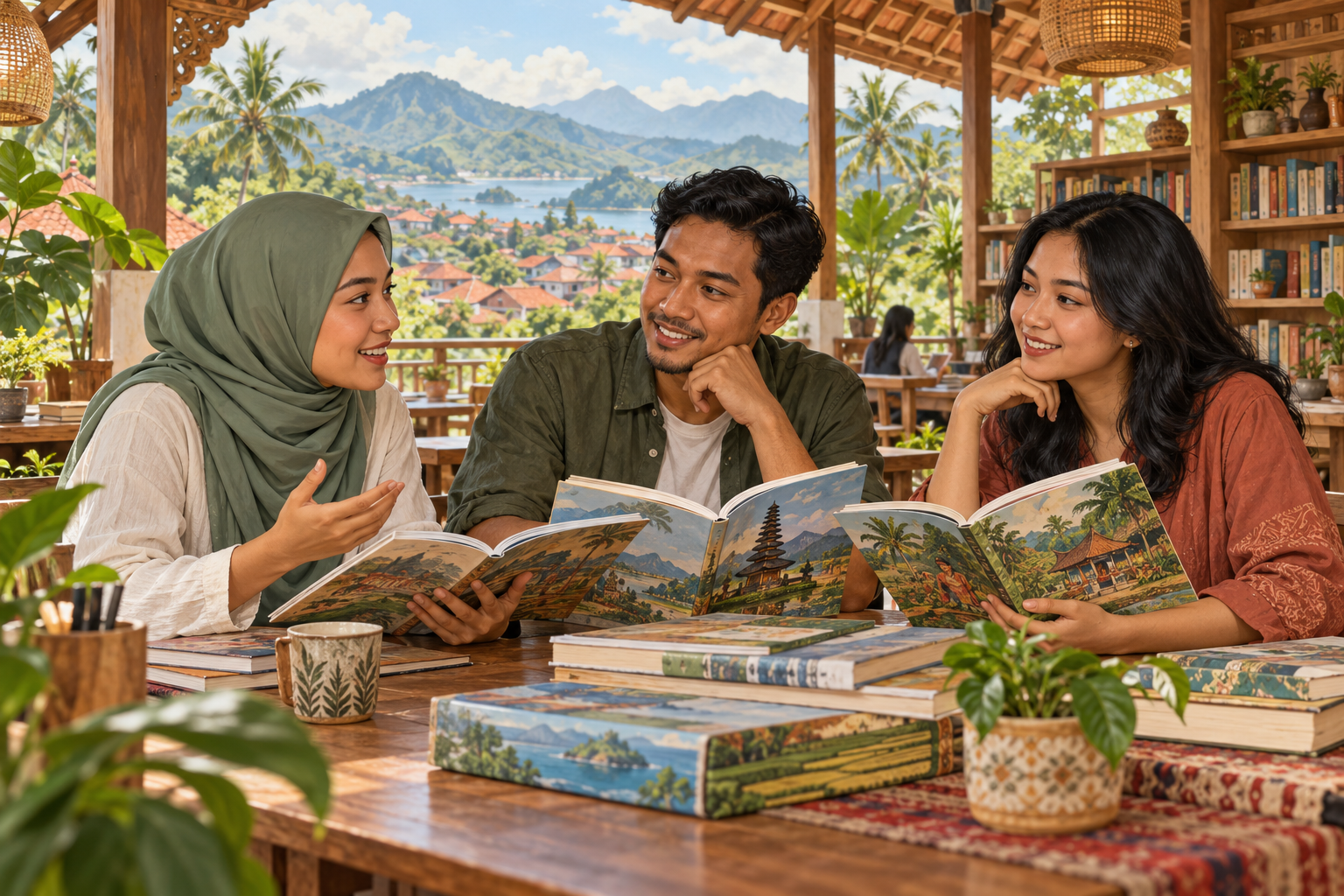
Cover illustration: an original AI-generated artistic interpretation of three adults sharing books in an imagined Indonesia-inspired open-air reading pavilion with tropical plants, hills and water in the distance. This is a nonliteral composite, not a photograph or an exact view of a named place.
Choose your route through Indonesia
- 1. Geography and landscapes
- 2. Cities and regional centres
- 3. Early history and archaeology
- 4. Modern history and international relations
- 5. Government and public institutions
- 6. Economy and Work
- 7. Agriculture and Industry
- 8. Infrastructure and Connections
- 9. People and Languages
- 10. Education and Learning
- 11. Food and Drink
- 12. Music and Dance
- 13. Literature and the Arts
- 14. Health and Community
- 15. Wildlife and Habitats
- 16. Climate and Environment
- 17. Sport
- 18. Science and Research
- 19. Opportunities and Challenges
- 20. Indonesia and Singapore
1. Geography and landscapes
Islands and rainfall
Indonesia’s archipelago is not simply a fixed number on a map. In its 2024 inventory, the Geospatial Information Agency recorded 17,380 named islands with coordinates. Its definition required natural land, rather than reclamation, surrounded by fresh or salt water and remaining above the highest tide. Field verification and geographical change help explain revisions between inventories. These criteria distinguish the mapping of an island from the naming of a settlement or an artificial coastal development. (BIG: island inventory)
Rainfall follows different seasonal rhythms across the archipelago. In a 2018 explanation based on historical observations, the meteorological agency BMKG distinguished three patterns. Monsoonal areas generally had one rainfall peak around December, January and February. Equatorial areas had two peaks, around March and November, while the local pattern peaked around August. This classification makes the timing of rain more informative than a single national wet season, because neighbouring parts of the country need not share the same annual cycle. (BMKG: rainfall patterns)
Volcanic landscapes
Merapi rises immediately north of Yogyakarta in a volcanic chain extending towards Ungaran. The Smithsonian’s geological account distinguishes an older mountain, whose growth ended with a major collapse, from the younger edifice built against the remaining scarp. Repeated lava dome growth and collapse have shaped its activity, sending hot material down its slopes. Lahars also move volcanic debris through drainage channels. The mountain’s form therefore records both the accumulation of material and its subsequent redistribution. (Smithsonian: Merapi)
The Toba landscape in North Sumatra centres on a lake occupying a volcanic caldera. Samosir stands within the lake, while steep walls and surrounding hills give the basin its distinctive relief. UNESCO designated the area a Global Geopark in 2020. Its description connects the lake, island, caldera walls and adjacent plains as parts of one geological landscape, rather than treating the water surface alone as the feature that defines the area. (UNESCO: Toba Caldera)
Karst and wetlands
In South Sulawesi, the Maros Pangkep geopark includes both mainland and marine areas. Its limestone landscape contains tower karst, closed depressions known as dolines, and caves extending horizontally and vertically through the rock. Underground rivers provide another dimension beneath the visible hills. UNESCO’s geological description draws attention to this connected relief: isolated towers above ground are only part of a landscape whose passages and drainage continue out of sight below the surface. (UNESCO: Maros Pangkep)
Research published in 2017 examined the inland wetlands of the Kapuas and Mahakam river systems in Kalimantan. Field observations were combined with satellite measurements to investigate rainfall, inundation and water storage. The researchers found that backwater effects influenced river flow through these connected lowland systems. Wetland storage also altered the movement of water through these lowlands. Their analysis shows why understanding a floodplain requires attention to connected rivers and lakes, not rainfall at one location alone. (Hidayat: wetland rivers)
2. Cities and regional centres
Historic urban plans
Jakarta’s old town preserves the planned colonial port landscape of Batavia. Indonesia’s 2015 submission to UNESCO’s Tentative List describes a grid of streets and canals, warehouses, a town hall, markets and places of worship around the mouth of the Ciliwung. Some former canals survive as street alignments after being filled. The submission also includes four offshore islands associated with the settlement. Tentative listing is not World Heritage inscription. (UNESCO: old Jakarta proposal)
Yogyakarta’s historic axis was inscribed on the World Heritage List in 2023. Established under Sultan Mangkubumi in the eighteenth century, the arrangement places the palace between monuments along a north to south line. Streets, ceremonial spaces and landmarks give physical form to Javanese ideas about life and the wider cosmos. UNESCO’s account describes the adaptation of several religious and cultural influences into this local setting. Its significance lies in relationships among the elements, not isolated buildings. (UNESCO: Yogyakarta axis)
Cities and their hinterlands
Bandung’s municipal history explains that plans for relocation around 1810 were not simply an initiative imposed by a colonial road builder. The local ruler had already considered moving from Krapyak, where flooding was a problem. The new site lay west of the Cikapundung and south of the Great Post Road. Existing routes were improved during construction of that road. The account places urban development at the meeting point of local decisions, environmental conditions and expanding transport connections. (Bandung: city formation)
Surabaya developed on Java’s northern coast as a port connecting maritime exchange with an inland hinterland. Its municipal account traces a trading role to the Majapahit period and describes a later expansion under colonial plantation production. During the nineteenth century, agricultural commodities from the interior were collected for shipment to Europe. This commercial relationship explains why activity on the waterfront depended on goods, labour and connections extending well beyond the port itself. (Surabaya: port history)
Museums and settlement
Makassar’s city museum occupies a former colonial town hall dating from 1916. The municipality’s collection description includes old shipping maps, photographs of mayors, historical currency and objects connected with the kingdoms of Gowa and Tallo. These materials offer different ways of approaching the city’s past. Maps trace routes and spatial knowledge, while administrative photographs and objects show changing institutions and material life. The building and its collections together make urban history visible at several scales. (Makassar: city museum)
Ambon’s municipal history traces the growth of a settlement around the Portuguese fort established in 1575. It records names associated with the fort, including Kota Laha and Ferangi, and describes groups of workers settling nearby. People from surrounding communities, traders and arrivals connected with the Portuguese presence contributed to the emerging town. This account presents urban formation as a process of gathering around a fortified site, with settlement shaped by work, movement and contact. (Ambon: settlement history)
3. Early history and archaeology
Deep time and monuments
Sangiran in Central Java preserves evidence of human evolution within a long geological sequence. Fossils of Homo erectus and associated stone tools have made the site important to research since discoveries in the 1930s. UNESCO’s account connects these finds with sedimentary layers recording changing environments. Erosion has exposed material but also moved some objects from their original positions. Studying the deposits and their context is therefore essential to interpreting what individual fossils can reveal about the past. (UNESCO: Sangiran)
Borobudur was built in the eighth and ninth centuries in Java’s Kedu Valley. Its design combines five square terraces with three circular platforms and a central stupa. Seventy-two smaller openwork stupas contain Buddha figures, while extensive reliefs cover the monument’s walls. UNESCO’s property also includes the nearby temples of Mendut and Pawon. Together, the structures provide evidence of Buddhist architecture through their arrangement, sculpture and surviving relationships within the surrounding landscape. (UNESCO: Borobudur)
Temples and river settlements
The Prambanan property brings several temple compounds into one archaeological landscape. Alongside the Hindu sanctuary of Loro Jonggrang stand the Buddhist complexes of Sewu, Lumbung and Bubrah. Reliefs depicting the Ramayana form part of its sculptural programme. Restoration has required attention to the placement of interlocking stone blocks as well as the appearance of individual buildings. UNESCO’s account describes restoration beginning in 1918 as part of the compounds’ long conservation history. (UNESCO: Prambanan)
Muara Jambi’s archaeological remains occupy natural levees beside the Batanghari River in Sumatra. Indonesia’s 2025 Tentative List submission describes brick temple compounds, settlement traces, canals and ponds. Ceramics, beads and stone objects add evidence of daily activities and connections beyond individual monuments. At Kedaton, fences and ditches help define the organisation of space. The proposed heritage landscape thus includes water management and habitation as well as sacred buildings; its tentative status is distinct from World Heritage inscription. (UNESCO: Muarajambi proposal)
Cities and maritime trade
Trowulan preserves traces of a Majapahit urban landscape in East Java. The state party’s heritage submission describes gateways, reservoirs, canals and large quantities of terracotta remains. Roof tiles, pipes, water containers, models of houses and moulds reveal activities that are less monumental than surviving temples. These finds connect architecture with household storage, drainage and craft production. They allow the former settlement to be approached through its infrastructure and ordinary material objects. (UNESCO: Trowulan proposal)
The Banda Islands preserve a landscape shaped by competition over nutmeg. Indonesia’s heritage submission links plantations with forts, trading buildings and colonial administration in the town. Dutch efforts to control production and commerce during the seventeenth century were contested by English activity on Rhun. The surviving places show how a valued crop could reorganise both land and settlement. Reading plantations together with defensive and commercial buildings reveals the connection between agricultural production, maritime trade and colonial power. (UNESCO: Banda proposal)
4. Modern history and international relations
Independence and sovereignty
On 17 August 1945, Sukarno, accompanied by Mohammad Hatta, proclaimed Indonesian independence at Pegangsaan Timur. ANRI’s archival collection identifies a reproduced document as Sukarno’s handwritten proclamation draft. Its introductory history also describes the Preparatory Committee for Indonesian Independence choosing Sukarno as president and Hatta as vice president. The proclamation and the selection of leaders were related but distinct steps in establishing the new republic’s political organisation, documented through records preserved by the national archives. (ANRI: proclamation archive)
Negotiations at the Round Table Conference preceded the Dutch transfer of sovereignty on 27 December 1949 to the federal United States of Indonesia. The Netherlands’ national archives preserve the transfer document and records of the conference. Their historical account places negotiations after Dutch military interventions and growing international pressure. Conference records and signed instruments show the diplomatic work through which relations between the former colonial power and Indonesian representatives were formally reorganised. (National Archives: transfer)
Conference and reform
The Asian African Conference met in Bandung from 18 to 24 April 1955. Its final communiqué recorded participation by twenty-nine delegations and proposed practical cooperation alongside political principles. Technical assistance could involve exchanging experts and trainees, establishing pilot projects and coordinating research. The text also affirmed nonintervention in the internal affairs of other countries. These provisions addressed practical cooperation alongside solidarity among governments participating in a changing international order. (Bandung communiqué 1955)
The election of 7 June 1999 followed Suharto’s departure in May 1998 and the presidency of B. J. Habibie. The election commission’s historical account describes pressure to bring the vote forward rather than wait for the previous timetable. Forty-eight parties participated. The resulting representative assembly subsequently took part in choosing the president through the arrangements then in force. The sequence illustrates how the Reformasi period changed political competition through both public demands and a reorganised electoral process. (KPU: election of 1999)
Peace and historical accountability
The government and the Free Aceh Movement signed their peace memorandum in Helsinki on 15 August 2005. Its provisions linked an end to armed activity with amnesty and support for reintegration into civilian life. They also envisaged assistance with livelihoods and a monitoring mission involving the European Union and participating ASEAN countries. These were commitments written into an agreement, connecting security arrangements with the practical circumstances of people returning from conflict. (Aceh agreement 2005)
In January 2023, President Joko Widodo publicly acknowledged that gross human rights violations had occurred in Indonesia’s past. His statement referred to episodes including the violence of 1965 and 1966 and enforced disappearances in the late 1990s. He expressed regret and announced efforts to restore victims’ rights without setting aside judicial processes. This was an official acknowledgment and statement of intended action, rather than evidence that every promised remedy had been delivered or every case resolved. (Presidential statement 2023)
5. Government and public institutions
Constitution and executive
Indonesia’s Constitution sets out relationships among several national institutions. The People’s Consultative Assembly comprises members of the House of Representatives and the Regional Representative Council. The president exercises executive authority with the assistance of a vice president. Legislative work involves the House of Representatives, while bills are discussed with the president to reach joint approval. Reading these provisions together helps distinguish the composition of representative bodies from the procedures through which national legislation is considered and approved. (Constitution: institutions)
A presidential secretariat account dated 19 October 2026 identified Prabowo Subianto as president during a meeting with the Presidential Staff Office. The account described a report on priority programmes and instructions to strengthen their monitoring and follow up. It presented the office’s work as helping track implementation and coordinate attention to problems. This record establishes the officeholder and an administrative activity; reported programme progress at the meeting remains the government’s own assessment. (Presidency: October meeting)
Elections and public audit
The election commission’s April 2024 determination named Prabowo Subianto and Gibran Rakabuming Raka as the elected presidential and vice presidential pair for the 2024 to 2029 term. Its recorded result was 96,214,691 votes, or 58.59 percent of valid votes. It identifies the winning ticket through counted ballots and provides a dated reference point for understanding the formation of the national executive. (KPU: 2024 result)
The national audit board’s overview for the second half of 2025 brought together financial, performance and special purpose examinations. Its April 2026 presentation highlighted findings concerning local government food security and human development. Recommendations included coordinating food plans and improving integrated information systems for regional food balances. Such work examines how programmes are organised and managed. The resulting recommendations give public institutions specific administrative weaknesses to address and document for subsequent oversight. (BPK: audit findings)
Services and rights
The Ombudsman reported receiving 23,596 contacts during 2025 across several channels, including complaints, consultations, rapid responses and copied correspondence. These categories should not be mistaken for an equal number of proven violations. Its annual account identified recurring concerns such as service failures, delay and procedural departures. By distinguishing incoming contacts from complaints requiring further handling, the institution’s reporting shows how a public grievance enters an administrative process before a conclusion about the underlying service can be reached. (Ombudsman: 2025 complaints)
In its 2024 review of Indonesia, the United Nations Human Rights Committee expressed concern about restrictions affecting assembly and association. It referred to allegations involving intimidation, surveillance and excessive force against protesters and civil society participants. The committee called for appropriately limited restrictions, investigations and remedies, alongside relevant training. These are the findings and recommendations of an international treaty review. They provide an attributed assessment of rights protection and proposed improvements to public practice. (UN: rights review)
6. Economy and Work
Economic outlook and banknotes
Economic development involves more than increasing production. In its January 2026 assessment of Indonesia, the International Monetary Fund highlighted education, digital infrastructure, simpler business rules and greater openness to trade. It argued that durable growth would require a dynamic private sector. The assessment also recommended directing industrial policies towards market failures while limiting distortions to trade and investment. These recommendations connect business opportunities with the skills, infrastructure and operating conditions that firms need. (IMF economic assessment)
Banknotes provide a concrete example of everyday economic objects. Bank Indonesia’s physical guide describes the 2022 100,000 rupiah note as red on both sides and made from cotton fibre. It measures 151 by 65 millimetres. Its watermark depicts Soekarno and Hatta. The online guide offers views of the front and reverse under normal and ultraviolet light, allowing readers to examine different aspects of the same note alongside its listed physical specifications. (BI banknote design)
Business registration and support
Starting a business involves organising information about its activities. The OSS guide for micro businesses with low risk shows separate steps for recording a business location and adding an activity. Applicants enter an address, land area and supporting documents, then complete business, investment, workforce and product information. The system also provides a way to continue an existing application and inspect its progress. This workflow connects location details with the description of the enterprise itself. (OSS business guide)
Small businesses can seek support beyond completing forms. SMESCO describes incubation and training with business guidance, alongside services for developing or refreshing a brand. Product curation and verification help enterprises prepare what they offer, while exhibitions and promotional events provide ways to present goods. Its fulfilment services cover product management, storage and delivery. The programme therefore addresses several practical stages, from preparing a product and its presentation to arranging how it reaches potential customers. (SMESCO business services)
Careers and employment
Job searching also involves preparing information in a useful form. Karirhub’s guide asks jobseekers to build profiles containing work experience, training, education, certification and skills. Within its vacancy section, people can choose opportunities by industry, expertise or the type of work they want. The guide then shows an application process and a portfolio page for viewing applications. These features bring personal qualifications and vacancy information together within an organised employment platform for jobseekers. (Karirhub job guide)
Employment statistics describe a different side of working life. BPS reported that the February 2026 labour force survey counted 154.91 million people in the labour force and 147.67 million in work. The unemployment rate was 4.68 percent. Agriculture, forestry and fishing together accounted for the largest employment grouping, with 42.49 million workers. The figures describe that survey period and distinguish people working from the wider labour force that also includes those unemployed. (BPS employment survey)
7. Agriculture and Industry
Rice harvests and storage
Rice statistics distinguish harvested land from several forms of output. BPS’s final estimates for 2025, released in February 2026, recorded 11.32 million hectares harvested. Production amounted to 71.95 million tonnes of harvested dry paddy, or 60.21 million tonnes when expressed as dry paddy for milling. Rice intended for food consumption totalled 34.69 million tonnes. Reading the units carefully matters because these figures describe different stages rather than interchangeable quantities of finished rice. (BPS rice statistics)
Storage is another part of the rice supply chain. In a July 2025 account, BULOG described assigning dedicated staff to inspect and monitor paddy and rice in its warehouses. Incoming rice undergoes checks involving independent surveyors. Monitoring continues during storage, alongside regular care of stocks and attention to warehouse cleanliness. The account presents quality control as a sequence of activities from receipt onwards, rather than a single inspection when a delivery first arrives. (BULOG storage account)
Skills and farm supplies
Work in fisheries requires learning as well as equipment. The ministry’s E-LAUT platform groups training into fisheries, fishing vessel crews and marine activities. It also presents specialist programmes for shrimp farming and vessel crew training. A video section provides training guides, while a separate area introduces independent training centres involved in business and skills development. These different formats connect vocational learning with particular roles, instead of treating everyone in the sector as having identical needs. (KKP fisheries training)
Manufacturing supplies also connect factories with farming. In September 2026, Pupuk Indonesia reported annual fertilizer production capacity of about 14.8 million tonnes across products including urea and NPK. Its five producing subsidiaries have facilities in Palembang, Cikampek, Gresik, Bontang and Lhokseumawe. The company described coordinating facilities with different products and planning raw material supplies. Capacity indicates what the facilities can produce, while seasonal supply preparations also depend on how production and inputs are managed. (Pupuk production profile)
Steel and rail manufacturing
Steel manufacturing serves several kinds of customers. Krakatau POSCO’s product catalogue separates steel slabs, plates and hot-rolled coils. Its application categories include infrastructure, shipbuilding and pipelines, as well as general structures, automotive manufacturing, further rolling, pipes and tubes. The catalogue also provides sheets for product sizes, shape control and marking. This organisation shows how an industrial supplier presents both broad product families and the more specific information needed to describe an order. (Krakatau product catalogue)
Indonesia also manufactures railway vehicles. INKA’s freight catalogue includes flat wagons, well wagons, fuel tank wagons, generator vehicles and baggage vehicles. Its passenger range includes economy and executive carriages, with several designs using stainless steel. The company lists its main office in Madiun and a factory in Banyuwangi. Together, these catalogues show a manufacturing business supplying different vehicle roles, from carrying passengers to transporting goods and supporting the operation of trains in service. (INKA manufacturing catalogue)
8. Infrastructure and Connections
Roads and rail travel
Road connections include information services for people planning journeys. BPJT describes Tol Kita as a mobile application for finding toll road information. Its features include estimated toll costs between sections, a road map and camera images showing conditions. Users can find call centre details, follow road news and contact the relevant road operator with a complaint. The application combines route information with ways to obtain updates or raise concerns about a particular road section. (BPJT road information)
Rail passengers can use Access by KAI to organise several parts of a journey. KAI’s own description lists train schedules, ticket purchases, independent check-in and electronic boarding among its features. The application also provides journey information and functions for rescheduling or cancelling a trip. Rather than presenting travel as only the purchase of a ticket, these features cover preparation, boarding and later changes, bringing several passenger tasks into the same digital service interface. (KAI passenger services)
Ports and airports
Ports involve coordinated work on both ships and cargo. Pelindo describes wharves for loading and unloading, enclosed warehouses for storing goods, and open yards for arranging containers or other cargo. Receiving and delivery services transfer goods between storage areas and vehicles. Separate vessel services include berthing, pilotage and tug assistance when ships approach or leave a wharf. This division of activities shows how movement through a port depends on linked handling and vessel operations. (Pelindo port services)
Airport statistics provide a view of another transport network. InJourney Airports’ performance panel for 2025 reported 154 million passenger movements, 1.2 million aircraft movements and approximately 1.3 million tonnes of cargo. These figures cover the operator’s network, rather than every airport in Indonesia. Its profile describes managing 36 airports across western, central and eastern areas. Passenger movements measure traffic through those airports, so they should not be read as a count of distinct travellers. (Airport traffic account)
Electricity and communications
PLN’s 2024 statistics distinguish transmission assets from distribution networks. At the end of that year, its summary recorded about 72,656 circuit kilometres of transmission lines and approximately 1.07 million circuit kilometres of distribution lines. Distribution was divided into medium and low voltage networks. The report also counted substation transformers separately from distribution transformers. These categories make the infrastructure more understandable by distinguishing network levels and equipment, rather than describing electricity supply with one total. (PLN network statistics)
Digital connections also rely on services behind the screens people use. BAKTI’s Palapa Ring guide describes leased bandwidth, passive optical fibre and space for equipment at network operation centres. The project is organised into western, central and eastern packages. Its descriptions cover routes across Sumatra and the Riau Islands, parts of Kalimantan and Sulawesi, and eastern island regions. The service model concerns network capacity and equipment arrangements that support communications, rather than individual household subscriptions. (Palapa Ring network)
9. People and Languages
Population and language mapping
Indonesia’s population census provides a dated picture of its communities. The September 2020 count recorded about 270.20 million people, with results released in January 2021. BPS reported that Java held 151.59 million residents, or just over half of the total, while Sumatra had 58.56 million. The census also recorded more males than females, with 102 males for every hundred females. These figures describe the population at the census reference date, not today’s total. (BPS population census)
Language mapping offers another way to explore the country’s communities. Badan Bahasa’s project describes research conducted from 1991 to 2019 across 2,560 observation areas. It identified and validated 718 regional languages, excluding dialects and subdialects from that count. The website organises its information by broad areas and provinces, with separate language data and statistics sections. This structure lets readers examine the survey’s geographical records while keeping its language categories distinct from a count of speakers. (Language mapping project)
Dictionaries and signing
Written language resources include KBBI Daring, an electronic dictionary. Its 2019 user manual explains searching for words or phrases and viewing meanings with examples. It also describes registered users browsing by alphabet, word class, language label, subject field and usage category. A participation feature allows suggestions for corrections or new words and meanings to reach the editors. The manual therefore presents a dictionary as both a reference resource and a service with structured editorial participation. (KBBI dictionary guide)
Language learning also includes signing. Pusbisindo describes Bisindo classes taught by experienced Deaf teachers, with regular sessions available online or in person. Private classes offer a more flexible schedule. Introductory workshops combine basic signing with an introduction to Deaf culture and opportunities to ask questions. The organisation also develops collaborative classes and workshops. These programme choices recognise that people may begin learning in different settings, from a regular group to a dedicated introductory session. (Pusbisindo learning programme)
Volunteers and shared reading
Volunteers can develop skills for sharing written knowledge online. Wikimedia Indonesia’s WikiLatih Daring course, scheduled from November to December 2025, introduced beginners to editing Indonesian Wikipedia over four weeks. Its learning platform describes short instructional videos, recommended readings and activities that learners complete as part of the course. The focus is understanding how Wikipedia works and practising editing. This is training in contributing to a shared reference platform, rather than simply reading its articles. (Wikimedia volunteer training)
Shared reading also takes place through digital libraries. The iPusnas guide describes browsing collections, looking up books and borrowing them through an application with a reader. Its bookshelf separates current loans, reviews, waiting lists and borrowing history. A timeline includes readers’ reviews, recommendations and comments, while ePustaka areas organise particular collections. These features combine access to reading material with ways to keep track of books and exchange responses with other users of the service. (iPusnas reading guide)
10. Education and Learning
School and independent study
Indonesia’s revised 2025 learning and assessment guide connects lesson planning with evidence of progress. Teachers identify learning goals, consider how pupils can reach them and plan ways to assess understanding. The guide gives particular attention to formative assessment, which supplies feedback during learning. Information about pupils’ readiness, difficulties and progress can then inform teaching adjustments. Assessment is therefore presented as part of an ongoing learning cycle, rather than only a score recorded at the end. (School assessment guide)
Independent study can still include organised support. Universitas Terbuka explains that students may learn individually or in groups using materials prepared for self-directed study. Its guidance also points to libraries, tutorials held in person or online, radio, television and audiovisual learning resources. Students experiencing difficulties can seek information or tutorial assistance through local distance learning support. The approach combines learners’ own initiative with materials and opportunities for help, rather than leaving them to study alone. (UT independent learning)
Practical and online learning
Practical education can connect a campus with industrial workplaces. Polman Bandung describes two approaches in its programme guide. Production-based education brings industrial production cooperation into routine campus learning, giving students experience of productive work. Industrial cooperative education provides opportunities to learn and work within companies through placements. The institute also emphasises practical and field learning in its diploma programmes. These approaches offer different settings for linking study with the activities of manufacturing enterprises. (Polman practical education)
Online courses can connect learners across institutions. SPADA Indonesia’s 2015 programme outline described partnerships in which one university offered selected courses to students at another. Courses were to undergo quality review before being offered. Teaching could take place through SPADA’s learning management system or the provider’s own system, with an aggregator recording and monitoring learning activity. The outline presents a model of coordinated course sharing, combining university partnerships with the digital organisation of teaching. (SPADA online learning)
Assessment and research discovery
Language assessment offers another way to examine learning. UKBI describes tests covering listening, reading, writing and speaking, together with responses to language rules. Its website provides a short simulation containing twenty example questions to introduce the question formats. A longer practice collection contains 105 questions across listening, language rules and reading. These resources allow learners to become familiar with different kinds of tasks and distinguish preparation activities from the assessment itself before taking a test. (UKBI language assessment)
Students seeking academic material can explore GARUDA, a platform for discovering scholarly publications from Indonesia. Its own introduction describes indexing and browsing resources including journals and conference proceedings. Search tools separate documents, journals, publishers and authors. Readers can narrow searches with a source title or publisher name, while author searches include an affiliation field. These tools help organise the process of locating relevant publications, without requiring every reader to begin with a particular journal already known. (GARUDA research discovery)
11. Food and Drink
Fermentation and regional recipes
Tempeh connects a familiar ingredient with fermentation. A 2024 study examined soybean tempeh from eighteen traditional markets in six Indonesian cities, using forty-eight samples. The researchers compared bacterial communities and found regional differences, as well as differences associated with banana leaf or plastic packaging. Their work shows variation within a food often described by one name. It does not establish that one package or regional product is automatically healthier than another. (Wicaksono et al.: tempeh diversity)
Regional recipes also reflect the ingredients available to communities. A 2021 ethnographic study examined rendang lokan in West Sumatra through observation and interviews with twenty selected informants. This coastal version combines shellfish with coconut milk and spices. The researchers described hand preparation, including grinding ingredients with a stone and pressing coconut milk. Their account connects a dish with local skills and cultural identity, rather than presenting one recipe as the food of every Indonesian household. (Fatimah et al.: rendang lokan)
Sago and shared knowledge
In Maluku and Papua, papeda offers a different example of a staple food. Indonesia’s official culinary profile describes it as a thick, sticky preparation made from sago, with a neutral flavour. It is commonly accompanied by yellow fish soup or a spiced fish broth. The profile also links communal serving with togetherness in Maluku. This combination of texture, accompaniment and shared eating helps explain a dish beyond naming its main ingredient. (Indonesia Travel: papeda)
Food knowledge can overlap with other forms of cultural practice. UNESCO’s account of jamu describes makers preparing herbs and spices, sometimes grown by the makers themselves. Knowledge passes through families and neighbours, alongside other learning settings, and most makers in the account are adult women. Trust and confidentiality are important parts of the relationships involved. This is a description of cultural knowledge and social practice, not an endorsement of medicinal claims or advice to consume a preparation. (UNESCO: jamu)
Coffee and cookbooks
Coffee illustrates the work between a harvested crop and a finished product. Toarco Jaya, a producer in North Toraja, South Sulawesi, describes selecting ripe red fruit, using wet processing, drying the beans and removing their parchment layer. Sorting then considers size, shape and weight, followed by hand selection and taste testing. These are the producer’s stated practices, not a description of every Indonesian coffee. They show several stages hidden behind the name on a package. (Toarco Jaya: coffee processing)
Cookbooks provide another way to preserve and reinterpret food knowledge. The publisher’s description of Sri Owen’s Indonesian Food links personal memories with regional and cultural introductions to recipes. It also explains the book’s attention to ingredients, techniques, substitutions and changes in cookery. The extended edition published in 2024 added twenty recipes. This is one author’s account of food, offering readers a route into a varied subject rather than a complete portrait of every kitchen. (Sri Owen: Indonesian Food)
12. Music and Dance
Ensembles and cooperation
Gamelan refers both to a musical ensemble and to its instruments. UNESCO’s description includes metal percussion, gongs and gong chimes, alongside drums, strings and bamboo flutes. Tuning, the arrangement of instruments and rhythmic patterns guide performance. Several players can combine interlocking parts into a shared rhythm. Learning includes formal and informal teaching, with instrument makers and tuners also participating in the tradition. The music therefore depends on coordinated skills beyond any single performer. (UNESCO: gamelan)
Angklung makes cooperation especially visible. Bamboo tubes hang inside a frame, secured with rattan, and sound when the instrument is shaken or tapped. Each instrument produces a note or chord, so several players work together to form melodies. UNESCO’s account distinguishes traditional pentatonic instruments from the diatonic angklung introduced by Daeng Soetigna in 1938. Craft knowledge and musical learning are connected: shaping an instrument and knowing when to play both contribute to the ensemble. (UNESCO: angklung)
Dance and community
Saman belongs to the cultural heritage of the Gayo people of Aceh in Sumatra. UNESCO describes boys and young men sitting or kneeling in close rows, with a central leader guiding sung verses, mainly in Gayo. Clapping, body percussion and coordinated movements create shifting rhythms. Performances can connect village groups through invitations and shared occasions. The description shows how singing, movement and group coordination work together, rather than treating dance as a sequence of individual gestures. (UNESCO: Saman dance)
Traditional dance in Bali includes different purposes and settings. UNESCO distinguishes sacred, partly sacred and community entertainment genres, rather than placing every performance in one category. Its account describes changes of posture and tempo, expressive eye movements and colourful costumes. Children commonly learn in groups, beginning with basic positions before progressing to longer sequences. Understanding the setting matters alongside recognising movement: a sacred practice should not automatically be treated as an entertainment offered to visitors. (UNESCO: Balinese dance genres)
Recordings and new voices
Recordings preserve particular moments in musical life. Smithsonian Folkways’ 1991 Indonesian popular music collection brings together live and studio performances of kroncong, dangdut and related styles. Its catalogue links kroncong with Portuguese musical influences and describes dangdut’s connections with Indian film music and rock. The listed performers include Rhoma Irama, Elvy Sukaesih and Tuty H.P. This historical collection offers evidence of named musicians and styles, not a measurement of what every Indonesian listener prefers today. (Smithsonian: popular music recordings)
Contemporary musicians also build their own forms of expression. Voice of Baceprot’s account identifies Marsya on vocals and guitar, Widi on bass and Siti on drums. It traces their beginnings to school in Singajaya, West Java, with encouragement from a music teacher. The band describes combining metal, heavy rock and punk with social themes. Its name draws on the Sundanese word for noisy, connecting a local language with a musical voice directed towards wider audiences. (Voice of Baceprot: artist account)
13. Literature and the Arts
Literary worlds
Pramoedya Ananta Toer’s novel This Earth of Mankind follows Minke, an ambitious Javanese student living under colonial rule in nineteenth-century Java. The publisher’s synopsis places him between the worlds of colonists and colonised people, with his love for Annelies shaping his response to those divisions. Max Lane translated the novel into English and supplied an afterword. The fictional perspective brings personal aspiration and attachment into contact with the restrictions of a stratified society. (Pramoedya: This Earth of Mankind)
Eka Kurniawan’s Beauty is a Wound takes a different imaginative route through historical upheaval. Set in the invented town of Halimunda, it follows Dewi Ayu and her descendants through a narrative combining family stories, satire and supernatural events. Dewi Ayu’s return after twenty-one years in the grave announces that this is no straightforward chronicle. Annie Tucker’s English translation carries the novel’s mixture of ghosts, local legend and turbulent social change to another readership. (Eka Kurniawan: Beauty is a Wound)
Painting and participation
Museum Affandi describes an artistic journey from photographic realism towards expressionism. Its account identifies early pastel works, including Kartika Affandi from 1939 and Ibu from 1940, before discussing the later practice of squeezing paint directly from tubes onto canvas. Affandi worked the paint with the back of his hand to produce curved marks. The museum connects this approach with emotion, instinct and spontaneity, presenting technique as part of the painter’s response to his subjects. (Museum Affandi: painting style)
Arahmaiani’s Flag Project made shared words into visual art. Museum MACAN’s exhibition guide traces its beginning to collaboration with an Islamic boarding school after the 2006 Yogyakarta earthquake. Participants expressed concerns, thoughts and hopes through text sewn onto flags. The project subsequently involved communities in other cultural and linguistic settings. Its process gave participants a role in determining what the artwork communicated, joining the physical work of making cloth objects with discussion and collective expression. (Museum MACAN: Arahmaiani)
Cloth and puppetry
Batik involves controlling where dye reaches cloth. UNESCO’s description explains how artisans draw dots and lines in hot wax, immerse the fabric in colour, remove the wax and repeat stages when further colours are wanted. Designs on cotton and silk carry varied social and ceremonial meanings. Patterns reflect many cultural encounters, while skills often pass through families. The craft joins material knowledge with design choices, rather than consisting of one motif shared by every maker. (UNESCO: Indonesian batik)
Wayang puppet theatre brings crafted figures and storytelling together. Wooden puppets and flat leather shadow puppets offer different visual forms, while the dalang controls articulated arms with slender rods. UNESCO describes a repertoire drawing on local myths and other epic traditions. Comic characters can provide space for social and political commentary. Knowledge passes through families of puppeteers, musicians and makers, and performance requires both remembered narrative material and the creative ability to give it expression. (UNESCO: wayang puppet theatre)
14. Health and Community
Trials and continuity
A Yogyakarta trial reported in 2021 tested mosquito releases as a way to reduce dengue. Researchers randomly assigned twelve geographical clusters to receive Aedes aegypti carrying Wolbachia bacteria and twelve to comparison conditions; usual mosquito control continued in both groups. Clinic patients with fever were tested for dengue. The study estimated 77.1 percent protective efficacy against confirmed symptomatic disease. The estimate describes this trial, not universal protection. (Utarini et al.: Yogyakarta dengue trial)
Continuity of care was the focus of a study in Garut, West Java. Pregnant women recruited in 2007 were contacted again in 2009 after health centres were assigned to intervention or comparison groups. The maternal and child health handbook combined a home reference with information shared among families and providers. Consecutive use of maternal and child services was more frequent in the intervention group. Follow-up reached 70.2 percent, an important limit when interpreting the findings. (Osaki et al.: maternal and child handbook)
Outreach and primary care
The SMARThealth study examined mobile technology within primary care in eight Malang villages between 2016 and 2018. Community screening, referrals, clinical decision support and patient follow-up formed one connected intervention. Participants at high cardiovascular risk in intervention villages more often reported appropriate preventive medication use than those in comparison villages. The study was quasi-experimental rather than randomised, and medication use was self-reported. Its findings show an association in selected communities, not a demonstrated nationwide clinical outcome. (Patel et al.: SMARThealth Malang)
A WHO account from August 2024 described vaccination outreach around Skouw in Jayapura. Health workers moved beyond waiting for families to attend the centre because transport costs prevented some from coming. Visits to villages and work around the border post responded to communities whose everyday movements crossed between Indonesia and Papua New Guinea. WHO reported that the team vaccinated 442 children by 21 June. Service organisation adapted to mobility and practical access barriers. (WHO: Skouw vaccination outreach)
Community voices and review
Research published in 2024 explored the experiences of seventy-one volunteer mental health cadres in Aceh, Jakarta, West Java and East Java. Eight focus groups held during 2020 examined their motivations, roles, training needs and practical difficulties. Participants described wanting to help people and reduce stigma, while their work included home visits and family assistance. The qualitative study gives attention to the experiences of local supporters, whose capacity depends on guidance and continuing support as well as commitment. (Susanti et al.: community mental health cadres)
Indonesia’s August 2025 tuberculosis programme review combined documents, interviews and field visits, with virtual engagement extending its reach to additional regions. WHO’s January 2026 account described recommendations to improve detection, speed referrals, reduce diagnostic delays and maintain treatment follow-up. It also highlighted household costs, community support and sustainable financing. These priorities linked clinical pathways with the circumstances that affect continued access to care. The review set priorities for subsequent action. (WHO: tuberculosis programme review)
15. Wildlife and Habitats
Primates and island reptiles
Scientific classification can change when researchers combine evidence. A 2017 study described the orangutans of Batang Toru in Sumatra as Pongo tapanuliensis. The team examined skull, jaw and dental features alongside genomic and behavioural evidence, identifying a distinct evolutionary lineage. This was more than assigning a new name to an animal: it showed how anatomy and genetics could be brought together to distinguish a population within a familiar group of primates. (Nater et al.: Tapanuli orangutan)
Komodo dragons also illustrate why populations must be studied separately. Researchers marked and monitored dragons across four island populations in Komodo National Park during 2003–2006 and 2009–2012. Their demographic analysis found relatively stable populations on the larger islands, but a declining population on Gili Motang. Survival estimates varied between sites. These historical observations describe different local trajectories, rather than one uniform park trend, and demonstrate the value of returning to marked animals over time. (Purwandana et al.: Komodo monitoring)
Forest birds and flowers
On Buton in Sulawesi, researchers examined how two endemic hornbills used differently disturbed forest. Their 2005–2007 work combined counts with habitat measurements at six sites. Both species were more abundant in lightly disturbed forest, but the difference was statistically significant only for the red-knobbed hornbill. Large trees were associated with occupancy. That distinction matters: the same landscape comparison did not produce equally strong evidence for both species, even though they shared the study area. (Winarni and Jones: Buton hornbills)
Rafflesia arnoldii draws attention to plants that depend closely on other plants. A study at Pandam Gadang, West Sumatra, recorded seventeen individuals across three local populations during fieldwork from August 2018 to March 2019. Researchers identified the host vine as Tetrastigma leucostaphylum and recorded surrounding vegetation, light and humidity. Their observations included buds, flowers and dead material. Following these different stages helped describe a local population beyond the brief spectacle of an open flower. (Pranata et al.: Rafflesia ecology)
Beaches and reefs
On the Bird’s Head Peninsula, local personnel walked the nesting beaches of Jamursba Medi and Wermon to monitor leatherback turtles. A 2013 paper analysed year-round observations from 2005–2011 alongside earlier records, finding declines at both beaches. Nest counts and tagging supplied different information: one female can lay several nests, while movements between beaches complicate interpretation. The work connected repeated field observations with careful accounting, rather than treating every recorded nest as a separate turtle. (Tapilatu et al.: leatherback nesting)
Reef monitoring can listen as well as look. Researchers recorded underwater sound near Badi and Bontosua in South Sulawesi during 2018 and 2019, comparing healthy, degraded and restored reefs. Restored sites had a richness of biological sounds resembling healthy sites and exceeding degraded ones. However, automated acoustic measures did not all show the same pattern. The study presents sound recordings as complementary evidence of recovery, not a single measurement that captures all reef conditions. (Lamont et al.: reef soundscapes)
16. Climate and Environment
Commitments and peatlands
Indonesia’s Second Nationally Determined Contribution, submitted in October 2025, sets out commitments for 2031–2035. Its emissions pathways depend on stated economic and support assumptions, while adaptation covers economic resilience, social livelihoods and ecosystems. Food, water, energy and health appear within that planning framework. Monitoring, finance and participation are part of the document. These are declared directions and implementation needs, not observations that future reductions or adaptation benefits have already occurred. (Indonesia: Second NDC)
A restoration trial in South Sumatra offers a measured environmental example. Researchers followed a former plantation where 257 peat dams were installed across about 4,800 hectares. Their 2024 paper reported raised water levels, reduced land subsidence and regeneration involving fifty-seven native tree species over a study lasting seven and a half years. The findings connect water management with forest regrowth, while the limited baseline and absence of a complete greenhouse-gas balance constrain broader conclusions. (Hooijer et al.: peatland rewetting)
Coasts and rivers
Along the Demak coast of Java, temporary permeable structures were tested as a way to retain sediment near mangroves. Monitoring from August 2021 to December 2022 compared structures and control areas using bed measurements and poles. Results were mixed: seaward sections eroded, and some sediment accumulation remained below levels suitable for mangrove establishment. The study shows why installing a barrier is not equivalent to restoring a forest; sediment supply, subsidence and structure condition all matter. (Gijón Mancheño et al.: mangrove restoration)
A Jakarta river study combined visual observations with trawls mounted from bridges at five sections during two weeks in May 2018. Researchers sorted collected plastic by material and packaging type and examined how it was distributed through the water. Their annual emission estimate then used hydraulic information to extend beyond the short campaign. The distinction matters: an estimate is not the same as continuous observation across every season or flood. (Van Emmerik et al.: Jakarta river plastics)
Surface heat and mountain ice
Two satellite images provide a bounded view of heat within Yogyakarta. A study in a 2023 journal issue applied the SEBAL energy-balance method to Landsat images from April and June 2019, comparing surface temperatures with land-cover classes. The calculated city averages differed between the two dates. These are measurements of land-surface temperature, not the air temperature experienced by a person. Their spatial detail can inform questions about urban surfaces without establishing a long-term climate trend. (Arif and Nayan: Yogyakarta surface temperature)
High in Papua, researchers combined ice cores with observations of glacier thinning and changing area. Two cores drilled in 2010 near Puncak Jaya preserved evidence extending back roughly half a century. The resulting 2019 paper reported accelerated thinning during the strong 2015–2016 El Niño and warned that the remaining ice could disappear. Its measurements document a historical research record; its forecast must not be mistaken for evidence of the glaciers’ exact extent or condition in 2026. (Permana et al.: Papua glacier records)
17. Sport
Practice and partnership
Pencak Silat connects physical practice with artistic and social traditions. UNESCO describes regional differences in movements, music, costumes and equipment, alongside sporting, self-defence and spiritual aspects. Nonformal schools transmit more than movements: teaching can include greetings, philosophical expressions, poems and instrumental skills. The account therefore presents a varied body of knowledge rather than one uniform competitive discipline. It also places relationships with other people and the surrounding world within the practice. (UNESCO: Pencak Silat)
Badminton offers a documented example of partnership in international competition. At the Tokyo Olympic Games held in 2021, Greysia Polii and Apriyani Rahayu won the women’s doubles final against Chen Qing Chen and Jia Yi Fan, taking the two games by 21–19 and 21–15. Their route included a group match against Yuki Fukushima and Sayaka Hirota that required three games. The sequence shows how different contests contributed to one tournament result. (Badminton Asia: Tokyo doubles)
Strength and speed
In the men’s 73 kilogram event at Paris in 2024, Rizki Juniansyah combined a 155 kilogram snatch with a 199 kilogram clean and jerk to win gold. His total of 354 kilograms placed him ahead of Weeraphon Wichuma and Bozhidar Andreev. The International Weightlifting Federation’s report also identified Triyatno as his coach. Juniansyah declined his last attempt after securing the winning total, illustrating how the competition unfolded through successive decisions and attempts. (IWF: Juniansyah in Paris)
Speed climbing produced another closely decided Paris result. Veddriq Leonardo won the 2024 men’s final in 4.75 seconds, while Wu Peng finished in 4.77 seconds. In the separate bronze medal race, Samuel Watson recorded 4.74 seconds. Those results highlight the difference between winning a particular head-to-head contest and recording a faster time in another race. The event’s format matters when reading the numbers, not simply the order of individual times. (IFSC: Paris speed final)
Teams and competitive routes
Football supplies a different competitive route. In April 2024, Indonesia reached the semifinals on its debut at the AFC Under 23 Asian Cup in Qatar. The quarterfinal against Korea Republic finished 2–2 before Indonesia won the penalty shootout 11–10. Pratama Arhan took the decisive kick. The organiser’s report records a specific stage of the tournament, so that result should not be confused with winning the whole competition or securing another tournament place. (AFC: Indonesia quarter-final)
At the 2024 Para Badminton World Championships in Thailand, Leani Ratri Oktila won mixed doubles with Hikmat Ramdani and women’s doubles with Khalimatus Sadiyah Sukohandoko. Both finals were in the SL3–SU5 categories. Her partnerships also changed across the events: Sukohandoko was among her opponents in the mixed doubles final before joining her for the women’s title. This account centres the actual matches and team combinations, rather than reducing an athlete’s career to a single label. (IPC and BWF: Oktila in Thailand)
18. Science and Research
Dating the deep past
Research can change how evidence from the past is measured. A 2024 study used laser-based uranium-series imaging on calcite deposits above cave paintings in South Sulawesi. At Leang Karampuang, the researchers assigned a minimum age of 51,200 years to a scene of humanlike figures and a pig. The dating concerns mineral growth over the art, not a direct measurement of pigment or an exact calendar date for the act of painting. (Oktaviana et al.: dating cave art)
A different investigation examined small hominin remains from Mata Menge on Flores. The 2024 paper reported an arm bone fragment and two teeth from deposits around 700,000 years old. Microscopic examination of bone tissue supported identifying the arm fragment as adult rather than juvenile. Its small size contributed to the researchers’ interpretation that reduced body size appeared early in this lineage. The evolutionary relationship remains an inference from fossil evidence, not an observed family history. (Kaifu et al.: Flores arm bone)
Images and ocean observations
Scientific work includes improving image reliability. Researchers studying LAPAN A3/IPB multispectral satellite data tested corrections for distortions in raw imagery. Their method used calibration information to reduce uneven brightness associated with the lens, image matching to align spectral bands, and satellite position and orientation information for geographical placement. The study, published in 2018, demonstrates that receiving an image is only one stage: processing and checking are needed before interpreting its details. (Hakim et al.: satellite image correction)
Ocean measurements face another problem: observations cover particular places and depths rather than every moving parcel of water. The INSTANT programme used instruments on moorings to study major Indonesian passages during 2004–2006. Its estimated average outflow through Lombok, Ombai and Timor was fifteen million cubic metres each second. The researchers explicitly discussed uncertainty from unmeasured areas and assumptions used to extend observations towards the surface, seabed and channel sides. The estimate is not a permanent fixed rate. (Gordon et al.: INSTANT observations)
Investigating land and crops
Studies of the 2018 Palu earthquake examined how ground conditions affected landslides. Watkinson and Hall documented fields and buildings moving more than a kilometre on slopes below two degrees. In the area they investigated, landslides were confined to irrigated ground, with a liquefied detachment linked upslope to a water supply canal. Their analysis suggested a mechanism connecting irrigation, terrain and earthquake effects. It does not establish that every irrigated slope has the same risk. (Watkinson and Hall: Palu landslides)
Crop research similarly tests a defined question under specified conditions. A study published in 2017 evaluated the Ciherang Sub1 rice line in greenhouse experiments and field trials across ten locations. Under ordinary conditions, its average grain yield and some agronomic traits resembled its parent variety. Under the study’s submergence treatments, survival and performance differed. The work connects molecular breeding with observed plant behaviour, while leaving no basis for promising identical results under every kind of flood. (Nugraha et al.: Ciherang Sub1 trials)
19. Opportunities and Challenges
Testing ideas and using resources
Solving practical problems begins with understanding what people need. Kopernik describes testing possible solutions through small experiments, often with local partners, before considering wider use. Its account of work in Indonesia explains how a clear hypothesis and collected data help a team decide whether an idea works or needs adjustment. Publishing unsuccessful trials can also help others learn. The approach treats development as investigation and learning, rather than assuming that every new invention succeeds. (Kopernik: testing solutions)
Energy projects also need knowledge and support around the equipment. Rumah Energi describes household biogas approaches, including a small system intended to use organic kitchen or garden waste for cooking energy. Its work includes technical guidance, education, workshops and information about whether installations remain functional. These elements connect an energy idea with the people expected to use it. The example illustrates a supported programme, not instructions for building a system or a guarantee of results. (Rumah Energi: biogas and learning)
Livelihoods and participation
Existing skills can provide a starting point for new livelihoods. Du Anyam traces its beginnings to East Flores in 2014 and describes weaving as an additional source of earnings alongside seasonal farming. Its products include corporate gifts, hotel amenities and home decorations for domestic and international markets. The organisation links this work with women’s participation and cultural continuity. This example shows a way of connecting local craft knowledge with markets, without treating every community’s circumstances as identical. (Du Anyam: weaving livelihoods)
Community participation involves opportunities to organise and discuss shared concerns. Federasi PEKKA lists activities such as local forums, paralegal classes, communications training and meetings of village and district organisations. Its women’s leadership programme includes village discussions and dialogue with government representatives. These activities aim to strengthen participation in decisions affecting communities. The programme list describes an approach and its intended results; it does not establish that every listed ambition has been achieved everywhere. (PEKKA: participation and organisation)
Sharing knowledge and preparing for hazards
People also need ways to tell their own stories. Sokola’s April 2022 field account describes photography and video training for Orang Rimba participants during the previous month. Teaching used their mother tongue and covered storytelling, scripts, filming and editing with mobile phones. Teams then made short videos. The purpose included documenting local knowledge and challenging stereotypes. Here, learning a technical skill was connected with whose voice is heard and how a community represents itself. (Sokola: community storytelling)
Public learning can help people think about the hazards around them. Indonesia’s disaster management agency, BNPB, describes a disaster education diorama that has operated since 2016. It presents learning materials and disaster management activities, including some interactive displays, with school students among its intended audiences. The museum approach makes a serious subject available through objects and demonstrations. Its stated aim is greater awareness, rather than a promise that visiting an exhibition alone ensures safety. (BNPB: learning about disasters)
20. Indonesia and Singapore
Diplomacy and practical connections
Indonesia and Singapore sustain their relationship through meetings and shared projects. At the July 2026 Leaders’ Retreat in Jakarta, Lawrence Wong and Prabowo Subianto discussed further cooperation. Singapore’s published remarks highlighted energy negotiations, exchanges between people and stronger institutional links. They also looked ahead to sixty years of diplomatic relations in 2027. Such meetings establish directions and commitments for cooperation; a planned initiative should not be confused with an activity that has already been completed. (PMO: 2026 Leaders’ Retreat)
Payment systems offer another connection. In November 2023, Bank Indonesia and the Monetary Authority of Singapore launched a cross-border QR payment link. The announcement described customers of participating institutions using mobile banking applications to scan merchants’ QRIS or NETS QR codes in the other country. A demonstration accompanied the launch at the Singapore FinTech Festival. This historical example explains the connection, not the full range of services or conditions available today. (MAS: QR payment linkage)
Industry and community cooperation
Industrial cooperation provides a physical example. Kendal Industrial Park in Central Java was opened in 2016 as a venture involving Singapore’s Sembcorp and Indonesia’s Jababeka. Sembcorp’s project description places it near Semarang, with road, air and sea connections, and identifies light and medium manufacturing among its intended uses. Examples include electronics, furniture and food production. The park shows how companies from the two countries can organise facilities around a shared industrial development project. (Sembcorp: Kendal Industrial Park)
Cooperation also happens through community programmes. The Singapore International Foundation’s Water for Life project in Lamongan worked with the regency’s public works agency. Its retrospective describes Singapore volunteers installing water filters and tanks at schools and villages, alongside hygiene education for students. Public works staff also attended workshops on water management, treatment and conservation. This example brings equipment together with learning and local institutional participation, rather than treating a completed installation as the entire project. (SIF: Water for Life in Lamongan)
Study and cultural understanding
Universities create opportunities for focused connections. The National University of Singapore lists Indonesian partners within its undergraduate exchange programme. Its directory identifies Universitas Gadjah Mada for Southeast Asian Studies and the University of Indonesia for law, both as faculty-level partnerships rather than university-wide arrangements. An academic relationship can have a particular subject and institutional scope. These examples show organised channels for study, not an assurance that every student can join every exchange. (NUS: exchange partners)
Museums offer another way to learn across borders. Singapore’s Peranakan Museum presented Batik Nyonyas from October 2024 to August 2025, exploring three generations of women from Pekalongan in Java. Nyonya Oeij Soen King, Nyonya Oeij Kok Sing and Jane Hendromartono developed distinctive work while responding to changing markets and social conditions. The exhibition connected Indonesian artistic lives with audiences in Singapore. It also showed that a shared heritage contains individual choices, family histories and creative change. (Peranakan Museum: Batik Nyonyas)
Frequently asked questions about Indonesia
What is the island in Lake Toba called?
Samosir. (UNESCO: Toba Caldera)
On which island is Borobudur?
Java. (UNESCO: Borobudur)
When did Indonesia proclaim independence?
17 August 1945. (ANRI: proclamation archive)
Where was the 2005 Aceh agreement signed?
Helsinki. (Aceh agreement 2005)
What colour is the 2022 100,000 rupiah note?
Red on both sides. (BI banknote design)
Which skills does UKBI test?
Listening, reading, writing and speaking, plus language rules. (UKBI language assessment)
What is papeda made from?
Sago. (Indonesia Travel: papeda)
When was Indonesian angklung inscribed by UNESCO?
In 2010. (UNESCO: angklung)
Continue reading: specialist guides to Indonesia
These links provide subject-specific background. Their travel-themed titles do not establish that visiting is safe or feasible; use them as reading resources here.
- Understanding the Education System of Indonesia
- Top 10 Things to Eat When Visiting and Touring Indonesia
- Top 100 Pinisi Boatbuilding Vocabulary Words | Indonesia
- Top 100 Noken Bag Making Vocabulary Words | Indonesia
- Top 100 Wayang Kulit Vocabulary Words | Indonesia
- Top 100 Gamelan Tuning Vocabulary Words | Indonesia
- Crazy Rich Indonesia | KAI, Commuter Line and the Railway Economy
- Crazy Rich Indonesia | Batik, Fashion and Textile Heritage
Explore the Everything About Countries archive for national overviews. The How Singapore Works collection offers a different national case study; comparisons should account for history, scale and institutional responsibilities.
Continue exploring Indonesia: Return to the How Countries Work A–Z directory to compare all 195 countries, or read how Indonesia works for government, infrastructure and public-service systems.
Keep the country’s people in the explanation
An explanation becomes stronger when it connects a national institution with a concrete question: who can use a service, how knowledge is passed on, what a measurement records, or how a change affects everyday work. Ask whose experience is represented and what additional evidence would help. That keeps analysis clear without turning people into illustrations of a single story.
Sources and further evidence
Sources were checked for this edition in October 2026. Statistical observations retain their own reference periods. Policy announcements and project plans are distinguished from completed outcomes.
- UNData country profile
- BIG: island inventory
- BMKG: rainfall patterns
- Smithsonian: Merapi
- UNESCO: Toba Caldera
- UNESCO: Maros Pangkep
- Hidayat: wetland rivers
- UNESCO: old Jakarta proposal
- UNESCO: Yogyakarta axis
- Bandung: city formation
- Surabaya: port history
- Makassar: city museum
- Ambon: settlement history
- UNESCO: Sangiran
- UNESCO: Borobudur
- UNESCO: Prambanan
- UNESCO: Muarajambi proposal
- UNESCO: Trowulan proposal
- UNESCO: Banda proposal
- ANRI: proclamation archive
- National Archives: transfer
- Bandung communiqué 1955
- KPU: election of 1999
- Aceh agreement 2005
- Presidential statement 2023
- Constitution: institutions
- Presidency: October meeting
- KPU: 2024 result
- BPK: audit findings
- Ombudsman: 2025 complaints
- UN: rights review
- IMF economic assessment
- BI banknote design
- OSS business guide
- SMESCO business services
- Karirhub job guide
- BPS employment survey
- BPS rice statistics
- BULOG storage account
- KKP fisheries training
- Pupuk production profile
- Krakatau product catalogue
- INKA manufacturing catalogue
- BPJT road information
- KAI passenger services
- Pelindo port services
- Airport traffic account
- PLN network statistics
- Palapa Ring network
- BPS population census
- Language mapping project
- KBBI dictionary guide
- Pusbisindo learning programme
- Wikimedia volunteer training
- iPusnas reading guide
- School assessment guide
- UT independent learning
- Polman practical education
- SPADA online learning
- UKBI language assessment
- GARUDA research discovery
- Wicaksono et al.: tempeh diversity
- Fatimah et al.: rendang lokan
- Indonesia Travel: papeda
- UNESCO: jamu
- Toarco Jaya: coffee processing
- Sri Owen: Indonesian Food
- UNESCO: gamelan
- UNESCO: angklung
- UNESCO: Saman dance
- UNESCO: Balinese dance genres
- Smithsonian: popular music recordings
- Voice of Baceprot: artist account
- Pramoedya: This Earth of Mankind
- Eka Kurniawan: Beauty is a Wound
- Museum Affandi: painting style
- Museum MACAN: Arahmaiani
- UNESCO: Indonesian batik
- UNESCO: wayang puppet theatre
- Utarini et al.: Yogyakarta dengue trial
- Osaki et al.: maternal and child handbook
- Patel et al.: SMARThealth Malang
- WHO: Skouw vaccination outreach
- Susanti et al.: community mental health cadres
- WHO: tuberculosis programme review
- Nater et al.: Tapanuli orangutan
- Purwandana et al.: Komodo monitoring
- Winarni and Jones: Buton hornbills
- Pranata et al.: Rafflesia ecology
- Tapilatu et al.: leatherback nesting
- Lamont et al.: reef soundscapes
- Indonesia: Second NDC
- Hooijer et al.: peatland rewetting
- Gijón Mancheño et al.: mangrove restoration
- Van Emmerik et al.: Jakarta river plastics
- Arif and Nayan: Yogyakarta surface temperature
- Permana et al.: Papua glacier records
- UNESCO: Pencak Silat
- Badminton Asia: Tokyo doubles
- IWF: Juniansyah in Paris
- IFSC: Paris speed final
- AFC: Indonesia quarter-final
- IPC and BWF: Oktila in Thailand
- Oktaviana et al.: dating cave art
- Kaifu et al.: Flores arm bone
- Hakim et al.: satellite image correction
- Gordon et al.: INSTANT observations
- Watkinson and Hall: Palu landslides
- Nugraha et al.: Ciherang Sub1 trials
- Kopernik: testing solutions
- Rumah Energi: biogas and learning
- Du Anyam: weaving livelihoods
- PEKKA: participation and organisation
- Sokola: community storytelling
- BNPB: learning about disasters
- PMO: 2026 Leaders’ Retreat
- MAS: QR payment linkage
- Sembcorp: Kendal Industrial Park
- SIF: Water for Life in Lamongan
- NUS: exchange partners
- Peranakan Museum: Batik Nyonyas