
What should you know about Iran beyond its name? This guide moves between landscapes, historical evidence and the lives of people whose experiences cannot be reduced to a single headline. Its chapters connect community life, work, learning and cultural expression through dated evidence and specific examples.
Begin with geography and history, or move directly to food, music, learning and the environment. Each chapter pairs a broad theme with concrete examples, while the source links let readers follow the evidence. The final chapter examines documented connections with Singapore.
Iran at a glance
- Capital listed by UNData: Tehran.
- UN statistical region: Southern Asia.
- Reading date: 21 October 2026; individual observations retain their own dates.
The capital and regional classification are listed in the UNData country profile. This guide uses specific dated sources for the other subjects rather than treating an old country summary as a current account of every institution.
This is an educational overview, not a travel itinerary or personalised medical, legal or financial advice. A cultural or environmental designation does not establish present access or safety. National data cannot replace the experiences of particular households and communities.
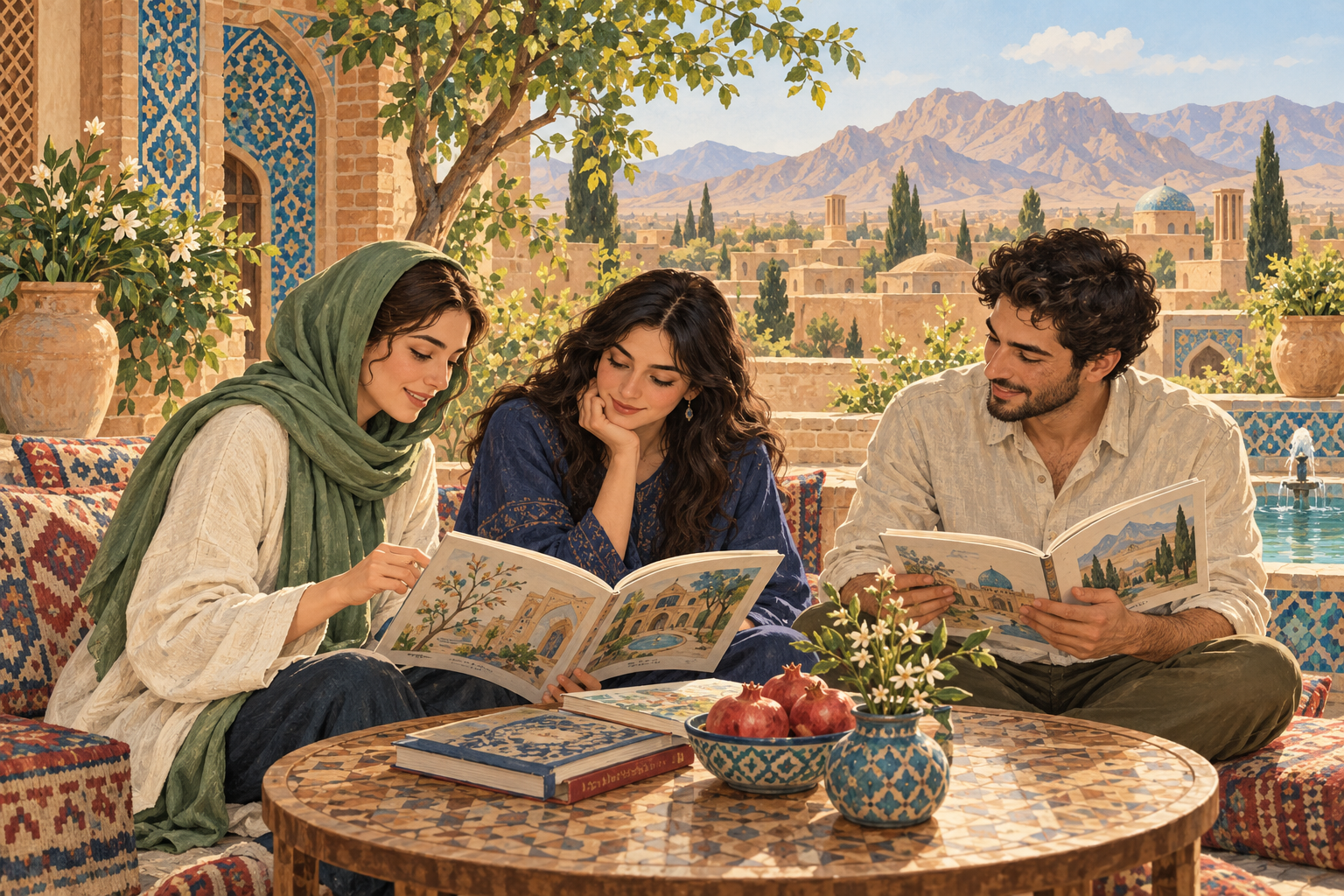
Cover illustration: an original AI-generated artistic interpretation of three adults sharing books in an imagined Iran-inspired tiled courtyard with plants, low buildings and distant hills. This is a nonliteral composite, not a photograph or an exact view of a named place.
Choose your route through Iran
- 1. Landscapes and water
- 2. Cities and urban heritage
- 3. Early societies and empires
- 4. Modern history and diplomacy
- 5. Government and public institutions
- 6. Economy and Work
- 7. Agriculture and Industry
- 8. Infrastructure and Connections
- 9. Communities and Languages
- 10. Education and Learning
- 11. Food and Drink
- 12. Music and Dance
- 13. Literature and Arts
- 14. Health and Community
- 15. Wildlife and Habitats
- 16. Climate and Environment
- 17. Sport and Shared Endeavour
- 18. Science, Research and Discovery
- 19. Opportunities and Challenges
- 20. Iran and Singapore
1. Landscapes and water
Plateaus and mountains
Iran combines extensive mountains with interior plains, deserts and contrasting coastal environments. Its 2017 national communication to the United Nations climate convention described mountains as covering more than half the country. Earlier reporting in the same series explained the strong contrast between wetter northern areas and very dry central deserts. These accounts describe varied landscapes rather than a uniform desert, with altitude and uneven precipitation shaping sharply different local conditions. (Iran: national geography)
The Zagros landscape contains long belts of folded sedimentary rocks. In a 2004 study, geologist Nadine McQuarrie used balanced cross sections to examine how those folds relate to deeper structures. Her interpretation placed much of the deformation in the Lorestan and Fars sectors above an underlying salt layer, with deeper basement thrusting farther inland. The study also linked the pronounced mountain front to a structural step, showing how surface relief can reveal structures below ground. (McQuarrie: Zagros structure)
Volcanoes and deserts
Damavand stands northeast of Tehran in the Alborz Mountains, south of the Caspian Sea. The Smithsonian geological account describes a younger volcanic cone built over an older structure during roughly the last 600,000 years. Eruptions concentrated around the summit produced lava flows spreading down its sides, while flank vents were uncommon. The youngest dated flows are approximately 7,000 years old, making the mountain a record of successive volcanic episodes rather than one event. (Smithsonian: Damavand)
In southeastern Iran, the Lut Desert occupies an interior basin enclosed by mountains. Wind and sediment have sculpted its terrain into ridges called kaluts, separated by corridors aligned with prevailing winds. Elsewhere, erosion leaves stony surfaces, while transported sand accumulates in dunes of several shapes. Intermittent streams contribute sediment and dissolved minerals, producing salt crusts as water evaporates. The resulting landscape displays both the removal of material and its deposition, often within the same desert basin. (UNESCO: Lut Desert)
Wetlands and underground water
Near Bandar Anzali on the southern Caspian coast, the Anzali wetland complex joins inland waters with a coastal lagoon. Its Ramsar information sheet describes permanent freshwater marshes, seasonal marshes, reed beds, open lake water and connecting streams. Some marsh areas are seasonal from autumn to spring, while the lagoon can experience seawater intrusion in summer. These connected water bodies make Anzali a wetland mosaic rather than a lake with an unchanging shoreline. (Ramsar: Anzali wetland)
A traditional qanat collects groundwater and carries it towards settlements or fields through a gently sloping underground tunnel. Gravity moves the water from the collection area towards an outlet. Vertical shafts provide access, ventilation and routes for removing excavated material, while the mother well reaches the underground supply. UNESCO’s Persian Qanat dossier presents this engineering as a combination of surveying, excavation and maintenance knowledge, linking visible openings at the surface to a largely hidden water system. (UNESCO: Persian qanat)
2. Cities and urban heritage
Squares and desert houses
Meidan Emam in Isfahan was commissioned by Shah Abbas I in the early seventeenth century. Arcades frame a large square whose principal buildings connect royal, religious and commercial functions: Ali Qapu Palace, the Sheikh Lotfallah Mosque, the Royal Mosque and the Qeyssariyeh bazaar entrance. The open space accommodated ceremonies, promenades and polo, while shops occupied its edges. Its design brings several urban activities into one coordinated setting, rather than isolating each monumental building. (UNESCO: Isfahan square)
Yazd’s historic neighbourhoods demonstrate the versatility of earthen construction. Thick walls, vaulted roofs and domes shape houses whose sunken courtyards connect with underground spaces. Wind catchers and partially covered alleys contribute to sheltered environments within the desert city. UNESCO’s architectural account also records bazaars, bathhouses, mosques, synagogues and Zoroastrian temples. These buildings reveal domestic routines, public gathering places and different religious traditions, alongside the city’s larger monuments. (UNESCO: Yazd)
Markets and waterworks
The historic bazaar of Tabriz is a connected urban complex rather than just a line of shops. Covered brick passages and enclosed spaces accommodate commercial activity alongside religious, educational and social functions. UNESCO describes professional organisation as closely interwoven with this architectural fabric. Its position on established routes between east and west supported exchanges of goods and ideas. Its significance lies in relationships among buildings, occupations and gathering spaces, not only in decorative details. (UNESCO: Tabriz bazaar)
Shushtar’s historical hydraulic ensemble organised a city around the management of river water. UNESCO identifies a major third-century CE complex with possible earlier foundations, bringing together canals, bridge dams, mills and irrigation works. Diversion from the Karun, including the Gargar channel, served several purposes within this arrangement. Water engineering interacted with urban layout, transport and defence. The remains reveal an accumulated technical landscape shaped by successive contributions, rather than a single isolated machine or building. (UNESCO: Shushtar waterworks)
Palaces and fortified towns
Golestan Palace forms a historic compound within Tehran, with gardens and pools connecting buildings associated with the Qajar court. During the nineteenth century it served residential, governmental and artistic purposes. UNESCO’s account emphasises the interaction between Persian traditions and European visual influences in its decoration and architecture. It also identifies experimentation with building techniques, including cast iron. The ensemble records a court engaging with changing artistic and technological possibilities while developing an elaborate setting for royal life. (UNESCO: Golestan Palace)
Bam’s fortified settlement developed within a desert trading landscape in southeastern Iran. Its prosperous period between the seventh and eleventh centuries was associated with commerce and the production of silk and cotton garments. The citadel distinguished the governor’s area from residential quarters below. Builders used layered earth and sun-dried bricks, with vaults and domes forming enclosed spaces. These materials and arrangements show how administrative authority, housing and craft activity were fitted into a substantial earthen town. (UNESCO: Bam)
3. Early societies and empires
Bronze Age cities
Shahr-i Sokhta preserves the remains of a Bronze Age city occupied approximately between 3200 and 1800 BCE. Its mudbrick structures and archaeological zones distinguish residential areas, production spaces and a burial ground. Finds document work with metals, stone and pottery, alongside connections extending towards Central Asia and the Indus region. Studying these different parts together reveals an organised settlement with specialised activities. Its archaeological record concerns particular ancient communities, without defining every later Iranian identity. (UNESCO: Shahr-i Sokhta)
Susa developed through successive periods from the late fifth millennium BCE, leaving a layered archaeological landscape near the Shavur River. Its mounds contain evidence of administrative, residential and palatial spaces rather than one moment frozen intact. UNESCO’s account places the settlement within exchanges connecting Mesopotamia and the Iranian plateau. Architectural remains and objects can therefore illuminate both local urban development and wider relationships. Buildings from very different periods share this archaeological setting. (UNESCO: Susa)
Sacred and royal compounds
Tchogha Zanbil was founded by the Elamite king Untash-Napirisha around 1250 BCE as a religious complex. Three enclosing walls organised its sacred and residential spaces, with a monumental ziggurat at the centre. Mudbrick construction was protected by baked brick facing, including inscribed bricks naming deities. Palaces, burial structures and water installations formed other parts of the compound. Its design connects religious architecture and royal sponsorship with a planned settlement’s practical needs. (UNESCO: Tchogha Zanbil)
Pasargadae preserves a royal landscape established under Cyrus in the sixth century BCE. Its surviving elements include a limestone tomb, a fortified platform and separate palatial buildings used for reception and residence. Gardens were organised through divisions marked by waterways and paths, linking architecture with deliberately arranged open ground. Rather than presenting a single massive palace block, the ensemble combines several structures within a broader designed setting. Its spaces express the ambitions of early Achaemenid kingship. (UNESCO: Pasargadae)
Imperial monuments and writing
Construction at Persepolis began under Darius around 518 BCE and continued under succeeding rulers. A great terrace supported reception halls, gateways and other royal buildings, connected by monumental stairways. Carved processions and animal figures worked alongside columns and carefully organised approaches to create an imposing ceremonial environment. UNESCO’s account also highlights the structural role of wooden lintels and comparatively light roofs above slender columns. Royal representation depended on this practical engineering. (UNESCO: Persepolis)
At Bisotun, Darius ordered a monumental inscription and relief on a cliff in 521 BCE. Texts in Old Persian, Elamite and Babylonian accompany a royal image and figures of defeated opponents. The inscription presents the king’s own account of gaining power and overcoming rebellions, so its narrative must be read as royal testimony. Its later study became important to nineteenth-century decipherment, connecting an ancient political statement with the development of modern knowledge about cuneiform writing. (UNESCO: Bisotun)
4. Modern history and diplomacy
Constitutional change and intervention
The Fundamental Laws of 1906 set out rules for a National Consultative Assembly during Iran’s constitutional movement. The text provided for two-year representative terms, public proceedings and written petitions. It also assigned the assembly scrutiny of state finances, including proposed revenue and expenditure. These provisions made debate and parliamentary examination part of the written institutional design. The instrument reveals specific mechanisms through which constitutionalists sought to organise public authority under that historical framework. (Fundamental Laws: 1906)
A declassified CIA history describes American and British involvement in planning the overthrow of Prime Minister Mohammad Mossadeq in 1953. The operation sought to replace him with Fazlollah Zahedi and combined political contacts, military planning and propaganda. Its account follows developments culminating in Zahedi’s radio announcement in August. This is an internal institutional history with redactions and acknowledged gaps in surviving records, valuable for examining covert intervention but not an impartial record of every participant. (CIA archive: 1953)
Hostages and war
The seizure of the United States embassy in Tehran on 4 November 1979 became the subject of an International Court of Justice case. In its May 1980 judgment, the Court distinguished the initial seizure from the authorities’ subsequent failures to protect the mission and their endorsement of the occupation. It ordered the release of hostages, protection of the premises and reparation. The judgment addressed diplomatic obligations rather than every subsequent negotiation. (ICJ: Tehran judgment)
The Iran–Iraq ceasefire monitored by United Nations observers began on 20 August 1988 after nearly eight years of war. The observer group deployed before the ceasefire and used patrols and liaison to monitor its implementation. Its responsibilities included investigating reported violations and helping establish arrangements for withdrawal to internationally recognised boundaries. The mission’s account shows how a formal agreement required continuing observation and negotiation, rather than immediately resolving military disagreements. (UN: 1988 ceasefire)
Nuclear talks and recent conflict
The Joint Comprehensive Plan of Action was concluded in Vienna in July 2015. Its text linked specified nuclear commitments and monitoring arrangements with nuclear-related sanctions relief, supported by a Joint Commission for implementation questions. The agreement set out reciprocal steps and verification mechanisms rather than simply declaring that disagreements had disappeared. Its original design assigned importance to sequencing, inspection and coordination; this historical text does not establish its implementation or sanctions in 2026. (JCPOA: 2015 text)
Diplomatic statements in 2026 illustrate the difference between an announcement and a settled outcome. On 14 June, the United Nations Secretary-General welcomed an announced United States–Iran peace arrangement covering a ceasefire, reopening the Strait of Hormuz and a negotiation framework. He thanked several regional mediators and expressed hope for a final resolution. An October United Nations account nevertheless reported a renewed appeal to end the conflict. These dated statements document efforts towards peace, not proof of durable settlement. (UN: 2026 diplomacy)
5. Government and public institutions
Constitutional design and executive
Iran’s Constitution, as amended in 1989, describes legislative, executive and judicial branches under the supervision of the Leader. It assigns legislation to the Islamic Consultative Assembly and provides for Guardian Council review of compatibility with Islam and the Constitution. The Council combines six religious jurists with six other jurists. The President directs executive affairs except matters assigned to the Leadership. These provisions distinguish several centres of authority rather than making the presidency the sole governing institution. (Constitution: 1989 text)
A dated official meeting account identifies Masoud Pezeshkian as Iran’s President in October 2026. Azerbaijan’s presidency reported his meeting with Ilham Aliyev in Turkmenbashi on 9 October, describing discussions of bilateral contacts and regional cooperation. The account also referred to continuing work on a cross-border project, rather than announcing its completion. The event identifies the officeholder at that point and shows the presidency conducting relations with a neighbouring state. (Presidency: October 2026 meeting)
Elections and public accounts
The parliamentary return published through the Inter-Parliamentary Union records elections on 1 March 2024 and a second round on 10 May. It lists 290 returned members, comprising 276 men and fourteen women, with women accounting for 4.8 per cent. These are the figures supplied for that election, not a guarantee that membership remained unchanged afterwards. The dataset records electoral composition and timing without establishing how freely candidates or voters could participate. (IPU: 2024 election)
An institutional account published in 2019 describes the Supreme Audit Court’s presentation of its report on the 2017–2018 financial year. The report examined government revenues and expenditure, considered performance budgeting and offered recommendations. The same account discusses professional exchanges intended to develop audit practice. This example shows financial scrutiny involving records, analysis and communication of findings, not simply the publication of totals. It describes that reporting cycle rather than claiming that every recommendation was implemented. (SAI: 2019 audit account)
Participation and rights
A 2025 study examined citizen participation and environmental management in Tehran’s District 18 through the municipal 137 telephone system. The authors studied 384 residents and combined questionnaires with expert interviews and documentary research. They reported a beneficial relationship between participation and municipal environmental performance. The case connects everyday feedback with public administration, while its district, sample and research design limit inferences about other places or the effects of participation nationwide. (Tehran: participation study)
In September 2026, the United Nations fact-finding mission reported grave rights violations in Iran, including restrictions on assembly and failures to protect fundamental rights. It also identified grounds for finding war crimes in specified United States strikes. The mission used a reasonable-grounds standard, conducted seventy-three interviews and recorded access limitations. Its conclusions should be attributed to that investigative body, not described as court judgments. The report places civilian protection and domestic rights within the same urgent public debate. (UN: September 2026 findings)
6. Economy and Work
Economic analysis and employment
The World Bank’s spring 2024 economic analysis connected Iran’s trading difficulties with both sanctions and domestic trade policies. Banking restrictions complicated transactions and access to technology, while tariffs and other barriers weakened productivity and innovation. Its discussion also identified customs facilities, infrastructure and logistics as needs for developing transport corridors. This dated assessment presents economic development as an organisational challenge involving business conditions and connections, rather than simply producing more goods for sale. (World Bank economic analysis)
Iran’s 2023 Labour Force Survey figures, reproduced in the joint BRICS statistical publication, give a view of employment. Among people aged fifteen and above, the employment to population ratio was 37.9 percent overall, compared with 63.9 percent for men and 12.1 percent for women. Services accounted for 51.9 percent of employment. These measures describe different aspects of work: the first compares workers with a population group, while the second describes employed people. (SCI labour survey)
Business support and inspection
The Tehran Chamber’s service page shows how businesses seek specialised information. It lists separate consultation channels for rules and regulations, foreign investment, and customs matters such as tariffs. A membership validation field lets visitors look up a membership or commercial card number. These are practical points of contact for firms with different questions. The page distinguishes checking a membership record from asking a consultant to explain an issue affecting a proposed business activity. (Tehran Chamber services)
Inspection is another kind of commercial work. Iran Group of Surveyors describes examining quantities and qualities of dry and liquid cargo, investigating ship and cargo damage, and checking industrial machinery. Its catalogue also lists construction supervision, inspections of cranes and lifting equipment, and import and export conformity assessments. Branches in northern and southern ports form part of its service organisation. This example makes visible the specialised checking work surrounding cargo movements and industrial projects. (IGS inspection catalogue)
Careers and online commerce
IranTalent provides an example of online recruitment rather than a count of everyone seeking work. Its vacancy interface separates job category, location, company, industry and seniority. Listed levels range from internships and junior positions to experienced professionals, managers and directors. Applicants can create or upload a curriculum vitae and send it to employers through applications. Searching and presenting experience are therefore distinct stages in the platform’s workflow, before an employer makes a hiring decision. (IranTalent career tools)
Digikala’s group profile describes several activities behind online shopping. Alongside its general merchandise store, it lists Digify services for internet businesses, Digiexpress logistics, Ganje logistics infrastructure and Optime routing software. Magnet concerns product reviews and selection, while Digikala Business addresses corporate purchasing. These examples show the group organising merchant support, information and delivery as separate functions. The catalogue therefore presents online commerce as more than the product page a shopper first encounters on screen. (Digikala business profile)
7. Agriculture and Industry
Crops and farm extension
FAO’s country brief dated June 2026 estimated Iran’s 2025 cereal production at 19.5 million tonnes, including twelve million tonnes of wheat. It separately estimated rice production at 3.9 million tonnes. Its crop calendar described rice planting in Gilan and Mazandaran beginning in May 2026, while harvesting of winter cereals had started in some regions. The figures describe estimated harvest quantities; the calendar describes agricultural tasks occurring at different points in a growing season. (FAO crop estimates)
ICARDA’s cereal systems project outline targets wheat, barley and chickpea production in East Azerbaijan, Kurdistan, Kermanshah and Lorestan. Its design combines sharing tested agricultural practices, trying research developments under farmers’ own conditions, and strengthening skills and facilities. Disseminating results is another stated component. This is a programme description, not proof of an achieved harvest increase. It illustrates extension as a process connecting research stations, practical field experience and the people who manage agricultural work. (ICARDA farm extension)
Tractors and steel
Iran Tractor Manufacturing Company’s 2024 catalogue separates medium tractors from garden tractors and lists versions with different drive arrangements. Its detailed entries compare engines, transmissions, electrical equipment and hydraulic connections. The ITM1500 entry, for example, includes a digital panel, a trailer plug and a three-point linkage. Such a catalogue presents farm machinery as a collection of configurations and working connections, allowing readers to examine equipment details rather than treating every tractor as interchangeable. (ITMCO tractor catalogue)
Mobarakeh Steel describes its hot rolling line as converting slabs into coils to customer specifications. Its cold rolling area lists both coils and sheets, including tin-coated, galvanised and coloured products. The accompanying production description includes cleaning, rolling, cutting, inspection and packaging lines. Different finished forms therefore pass through different combinations of operations. This factory account offers a concrete view of industrial organisation, with several specialised stages between incoming material and a prepared product. (Mobarakeh production guide)
Vehicles and industrial equipment
Iran Khodro’s product index lists models including Tara, Dena Plus, Soren Plus and Rana Plus, alongside the Arisun 2 pickup. Entries provide routes to specifications, equipment lists, photographs, manuals and comparisons. The manufacturer also links to dealer searches, periodic servicing and customer assistance. These functions connect choosing a vehicle with finding information for its later use. A product catalogue describes the offered range and support channels; it does not measure how many vehicles sell. (Iran Khodro catalogue)
MAPNA’s transport profile describes a group of businesses concerned with railway equipment and services. Its activities include locomotive engineering and manufacture, repairs, fleet development and multimodal transport. Freight, passenger and shunting locomotives appear in its manufacturing account. Its wider rail services extend from design and equipment supply to implementation and operation. This example distinguishes making and maintaining railway equipment from merely laying track, showing several kinds of industrial work within a transport supply chain. (MAPNA equipment profile)
8. Infrastructure and Connections
Railways and road information
A railway presentation issued in November 2017 gives a historical snapshot for 2016: roughly ten thousand five hundred kilometres of lines, 556 locomotives and twenty-three million passenger journeys. It also reported forty million tonnes of freight carried. Separate development slides listed proposed suburban lines and connections to industrial centres. Keeping those sections distinct matters: one describes recorded operations, while the other describes intentions. Neither section establishes the size of today’s railway network. (RAI railway account)
Iran’s road management report presented in 2015 described a headquarters linked with provincial centres. Its tasks included gathering road information, registering incidents, coordinating maintenance patrols and informing travellers. Public information channels included the 141 telephone service, an application, a website, text messages and variable message signs. The report shows road management extending beyond construction into communication and coordination. It describes the arrangements reported at that meeting, rather than guaranteeing present availability of every channel. (RMTO road management)
Ports and urban travel
A ministry account dated August 2022 recorded the handover of six mobile harbour cranes at Chabahar’s Shahid Beheshti port. It also reported that the operator had handled more than 4.8 million tonnes of bulk cargo since assuming operations. The cranes were delivered equipment, while the cargo figure was a cumulative operating total. Reading those measures separately helps explain port development: adding handling equipment and recording goods already moved are related activities, but different achievements. (Chabahar port account)
A study published in March 2026 examined how a small group evaluated Tehran metro services. Participants ranked thirty-four service items, producing thirty-four valid responses for analysis. Access to stations and destinations, punctuality and travel speed emerged as prominent concerns across the identified viewpoints. This is evidence about the priorities expressed in that study, not a satisfaction percentage for the entire city. Its approach connects urban transport planning with specific aspects of passengers’ experiences. (Tehran passenger study)
Telecommunications and postal services
Irancell’s service catalogue separates prepaid and postpaid mobile connections from fixed internet options. It lists fibre services, fixed wireless access, modems and different data packages. Coverage maps, dealer information and customer support appear alongside those products. Its MyIrancell application is described as a way to manage SIM services and accounts. The catalogue thus presents both connection products and tools for using them, without implying that every listed technology is available at every household address. (Irancell service guide)
Iran’s 2023 return in the Universal Postal Union tables recorded 10,633 permanent post offices. Most were staffed by people outside the postal administration, a category shown separately from administration employees. Another entry counted 3,931 rural offices, including mobile offices. The tables also separated letter post, express items and parcels rather than combining everything into one traffic total. These categories reveal a service network with different staffing arrangements, locations and kinds of items to handle. (UPU postal statistics)
9. Communities and Languages
Population and language records
The 2016 census counted 79,926,270 people and 24,196,035 households in Iran. Average household size was 3.3 people, compared with 3.5 in 2011. The census presentation classified 74 percent of residents as urban and distinguished rural and unsettled categories. These are national census results, not a current population estimate. Looking at households as well as individuals helps readers recognise that community statistics describe living arrangements alongside the number of people counted. (SCI population census)
The Atlas of the Languages of Iran questionnaire records language variety alongside the location and circumstances of data collection. Its 2023 version asks about speakers’ residence, languages learned at home, proficiency and frequency of use. Researchers seek consent before recording and collect vocabulary, grammatical forms, numbers and oral texts. Word list instructions request repeated responses and notes on uncertainty. This method connects language documentation with particular speakers and places rather than broad labels alone. (ALI language questionnaire)
Dictionaries and signing
The Dehkhoda Lexicon Institute describes dictionary production as editorial work. Its compilation section lists building the Great Persian Lexicon, maintaining a computer corpus of vocabulary and provenance, training compilers and holding compilation sessions. Typing and publication work are also included. The institute’s online lexicon offers a word search and invites comments from visitors and researchers. Together, these activities link collecting and organising language records with making a reference tool available for consultation. (Dehkhoda dictionary guide)
A 2022 paper documented Iranian Sign Language in Kermanshah through recording tasks. Participants produced alphabet signs, fingerspelled words, responded to pictures and retold silent films to a partner. Guided conversations added material about everyday matters. The team then selected conversation passages for annotation, preparing Persian glosses and translations followed by English versions. This account shows language documentation depending on recorded interaction and careful explanation, rather than assuming a list of isolated signs is sufficient. (ZEI documentation study)
Family language and libraries
A 2022 study of families using Kurdish and Persian in Kermanshah drew on interviews and fieldwork involving forty bilingual parents. The researchers found that strong attachment to Kurdish did not necessarily match everyday language practices or efforts to maintain it. They also argued that influences beyond parents affected transmission of the home language. The study concerns these families, illustrating why stated language preferences and actual household routines need to be examined separately. (Family language study)
National Library and Archives staff described a project in 2016 to make Iran’s national bibliography discoverable through web search. Their work included investigating submission methods, submitting catalogue pages and monitoring indexing. Later planned stages concerned analysing errors, improving pages and comparing search visibility. The paper explicitly reported reaching the first three phases. This example distinguishes preparing and submitting library records from demonstrating that every record has become discoverable to an online reader. (National bibliography study)
10. Education and Learning
Schools and applied study
In its June 2022 education report, Iran’s ministry described an aim to move beyond memorisation towards research, skills and creativity. It described digital educational materials and support with devices during the pandemic. Examples of provision included boarding arrangements, classes combining grades, and mobile libraries and laboratories for rural and nomadic education. These descriptions show ways of organising learning materials and access, while the stated reform direction remains an aim rather than a universal result. (School consultation report)
The University of Applied Science and Technology’s 2023–2024 catalogue describes courses designed around jobs and economic sectors. It says practitioners help shape programmes and about seventy percent of each curriculum is practical. Internships appear at the beginning, middle and end of programmes. The catalogue also distinguishes degree courses from shorter skill modules. This structure places workplace practice at stages of learning, rather than leaving all contact with practical tasks until study has ended. (UAST university catalogue)
Technical and online learning
The Technical and Vocational University’s brochure describes a balance of roughly thirty percent classroom theory and seventy percent practical instruction in laboratories and workrooms. Its programme table includes electronics, computer studies, automotive mechanics, manufacturing, civil engineering and accounting. The list shows that applied education covers both technical equipment and organisational tasks. Reading the programme subjects alongside the teaching balance gives a clearer picture of the institution’s approach than treating vocational study as one course. (TVU technical programmes)
Maktabkhooneh’s learning guide describes online courses built around videos and exercises, with projects in some. Learners can watch materials without a minimum completion time, but project submission and staff assessment have course deadlines. Course pages also specify whether videos can be downloaded. These distinctions separate flexible viewing from assessed participation. The guide therefore encourages readers to examine a course’s learning features rather than assume that every online class operates in the same way. (Maktabkhooneh learning guide)
Language assessment and research
The Saadi Foundation describes AMFA as an assessment of Persian listening, speaking, reading and writing. Its guide distinguishes academic and general forms, with the general version intended for purposes beyond university study. The same learning site lists live online classes, independent study and personal tutoring. These are routes for learning and checking language abilities. Considering the four assessed skills together presents proficiency as more than recognising written vocabulary or completing a grammar exercise. (Saadi assessment guide)
IRANDOC’s Ganj description identifies theses and dissertations as the main source of its updated records. Its broader information work has also covered research proposals, projects, government reports, scholarly publications and bibliographic resources. The institute places searching Ganj at several stages of research, including choosing a topic, preparing a proposal and writing a thesis. This presents discovery as a repeated part of study, helping researchers revisit existing work as their questions and writing develop. (Ganj research discovery)
11. Food and Drink
Bread and shared tables
Bread making can be a shared task rather than a solitary kitchen activity. The flatbread tradition jointly inscribed by UNESCO in 2016 includes Iran and four other countries. Its description follows relatives and neighbours dividing preparation and baking duties, with knowledge passed through participation and apprenticeship. Bread accompanies everyday meals and important family occasions. The heritage being recognised therefore includes cooperation and hospitality, not simply the finished loaf or a single national recipe. (UNESCO: shared flatbread culture)
Eftari brings another kind of shared table into view. UNESCO’s joint 2023 inscription describes gatherings at sunset during Ramadan, when Muslims break the day’s fast. Local meals can accompany storytelling, music and other social activities, and people who are not fasting may also participate. Children learn by observing and helping prepare food. This account presents an occasion for exchanging skills and maintaining relationships, while leaving room for differences among families and participating communities. (UNESCO: iftar traditions)
Fermentation and fragrance
Kashk zard, or yellow curd, connects culinary knowledge with fermentation. A 2020 study examined market samples from Sistan and Baluchestan, describing a preparation combining cow’s milk yogurt, wheat flour, herbs and spices. Genetic analysis found communities dominated by lactic acid bacteria, including Lactobacillus, Pediococcus and Streptococcus, but their composition varied substantially among samples. The findings make regional food traditions scientifically interesting without turning a laboratory description into a claim that every product has identical properties. (Pakroo et al.: kashk zard)
Golab, rose water from Rosa damascena, supplies fragrance to food and ceremonial settings. Researchers in Shiraz investigated ten marketed brands in a study published in 2014, extracting their aromatic components and examining them through gas chromatography and mass spectrometry. Phenethyl alcohol, geraniol and citronellol were among the principal compounds detected. Their work shows how a familiar culinary ingredient can be examined chemically, with a particular set of samples rather than an impression of scent alone. (Moein et al.: rosewater analysis)
Regional knowledge
Rasht’s gastronomy profile emphasises fish, seasonal produce and inherited cooking utensils. UNESCO’s Creative Cities account describes the Sabzeh Festival, established in 2014 at the Rural Heritage Museum, where food appears alongside crafts and folk art. Gamaj clay pots are part of this account of cooking methods. Workshops and vocational learning connect recipes with practical skills. The profile thus treats culinary heritage as something people demonstrate and teach, not merely a list of dishes. (UNESCO: Rasht gastronomy)
Najmieh Batmanglij’s account of creating Cooking in Iran describes five years of travelling, visiting workshops and cooking with local cooks. Her examples make regional differences concrete: grouper with tamarind, coriander and garlic in Bushehr, and lamb neck with yogurt, saffron and orange peel in Isfahan. These are encounters recorded for a cookbook, not a survey of every household. They invite readers to notice ingredients, hosts and methods behind the broad label of Iranian cuisine. (Najmieh Batmanglij: Cooking in Iran)
12. Music and Dance
Repertoire and craftsmanship
Radif is a repertoire through which musicians develop the resources for improvisation. UNESCO’s 2009 inscription describes more than 250 melodic units, called gushe, organised into cycles within a modal framework. Students learn through sustained work with a master, memorising material that can inform both vocal and instrumental performance. The relationship between disciplined learning and individual interpretation is central: a musician acquires patterns without being limited to reproducing an identical performance on every occasion. (UNESCO: Iranian radif)
Making a dotar involves knowledge of materials as well as music. UNESCO’s 2019 account describes a plucked instrument with two strings, a mulberry body and a neck fashioned from apricot or walnut wood. Performers accompany narratives about history, ethics and other themes at weddings, celebrations and rituals. Its practitioners include women and men, many associated with farming. Informal teaching links instrument makers, players and students, preserving skills through repeated work rather than notation alone. (UNESCO: dotar craft and playing)
Bowed strings and dance recordings
The kamancheh offers a different relationship between hand, bow and instrument. Iran’s heritage inventory describes it held vertically on a shaft, with the instrument pivoting to change strings while the bow keeps a relatively stable angle. The shared Iranian and Azerbaijani UNESCO inscription of 2017 documents four strings, solo and ensemble performance, and transmission through families and music schools. It recognises makers and teachers alongside performers, giving craftsmanship a place within the musical tradition. (UNESCO: kamancheh)
Recordings preserve selected performances, including their historical gaps. Folk Songs and Dances of Iran, released by Folkways in 1960, includes Raghsé Chubi, labelled as a stick dance, and Bamé Boland, associated in the catalogue with Shiraz. Ahmad Ashourpoor is named on three tracks, while several orchestras and singers remain unidentified. The listed instruments include tar, santur, nay and tonbak. Reading those credits reveals both musical variety and the limits of the documentation accompanying this collection. (Smithsonian: folk songs and dances)
Electronic and acoustic experiments
Dariush Dolat-Shahi’s Electronic Music, Tar and Sehtar, released in 1985, places string instruments within an electronic setting. The Folkways description identifies five original compositions combining computer tones with tar, setar and recorded natural sounds, including birds, frogs and thunderstorms. Titles include Samā’, Shabistān and Razm. This is a documented example of experimentation rather than a division between supposedly unchanged tradition and modern invention: the label describes familiar instruments participating in a deliberately constructed new soundscape. (Dolat-Shahi: Electronic Music)
On Narrante, guitarist Golfam Khayam and clarinetist Mona Matbou Riahi perform as the Naqsh Duo. ECM’s account describes Persian modes, drones, rhythms and improvisation informing their own contemporary compositions. The nine tracks are jointly credited, making collaboration visible in the documentation. Recorded in Lugano in July 2015 and released in May 2016, the album traces one artistic project across places. Its instrumentation shows that engagement with Iranian musical traditions need not require a fixed ensemble. (Naqsh Duo: Narrante)
13. Literature and Arts
Fiction and independence
Simin Daneshvar’s novel Island of Bewilderment follows Hasti Nourian, a young artist and graduate living in Tehran during the mid-1970s. Her attachments pull her towards contrasting futures: an idealistic architect she loves, the radical politics of university friends, and the comfortable life her mother values. Another possible partner brings the attraction of economic security. Through this fictional character, the novel explores independence as something negotiated through affection, political commitments and material circumstances. (Syracuse: Island of Bewilderment)
Shahrnush Parsipur’s Women Without Men brings together five fictional women whose different paths lead to a garden outside Tehran. They include a housewife, a sex worker and a schoolteacher. The publisher’s account describes a narrative drawing on Iranian history and Islamic mysticism as its characters move beyond restrictive family and social arrangements. Their meeting creates a shared setting for otherwise distinct lives, allowing the novel to connect individual struggles without making its women interchangeable. (Penguin: Women Without Men)
Artists and materials
In a 2015 interview, Monir Shahroudy Farmanfarmaian recalled seeing mirrored interiors in Shiraz and wanting to bring something of that experience into domestic rooms. She described combining abstract designs, mirror cutting and painting behind glass. A master mirror worker helped her explore patterns based on hexagons, while craftsmen contributed to later commissions. Her account presents artistic invention as both personal experimentation and collaboration, joining decisions about geometry with skilled work on reflective surfaces. (Farmanfarmaian: Mirroring Monir)
Behjat Sadr’s statement about her kinetic works, written around 1967, explains her interest in colour, shape and motion. She used Venetian blinds to introduce depth and changing visual relationships, rather than keeping a painting entirely flat and fixed. Surviving work records describe oil and aluminium foil on blinds placed over painted wood or canvas. Her writing connects these experiments with a desire to keep changing her practice instead of remaining within an established style. (Behjat Sadr: kinetic works)
Craft and transmission
Kashan carpet weaving combines design, dyeing and construction on a loom known as a dar. Wool or silk yarn forms the pile through asymmetrical knots, secured by woven rows and beaten with a comb. Designs can include plants, animals and historical scenes, while natural dyes come from materials such as madder root and pomegranate skin. UNESCO’s dossier describes apprenticeship in weaving and related crafts, making the finished carpet an expression of several connected practical skills. (UNESCO: Kashan carpet weaving)
Iran’s calligraphy safeguarding programme developed from concerns about declining appreciation of the art during the 1980s. Its activities included public classes, publications, exhibitions, school materials and university courses, with master practitioners involved in teaching. Digital fonts and contemporary uses were included alongside established techniques. UNESCO selected the programme for its Register of Good Safeguarding Practices in 2021. This recognition concerned an organised approach to transmission, rather than declaring that an artistic tradition should remain unchanged. (UNESCO: calligraphy safeguarding)
14. Health and Community
Local training and prevention
Interviews with ninety-one community health workers across eighteen provinces examined how Iran’s behvarz training was experienced in 2009–2010. Participants valued practical placements within the two-year preparation programme, describing gains in clinical confidence and communication. The researchers also found that continuing training needed closer alignment with local needs. Published in 2012, this qualitative study foregrounds workers’ own accounts of learning and support; it did not measure effects on patients’ health or establish nationwide outcomes. (Javanparast et al.: behvarz training)
At its December 2023 meeting, a regional verification commission confirmed that Iran had maintained measles and rubella elimination during 2021–2022. The same report discussed increased measles cases and gaps in immunity, showing why elimination requires continuing surveillance. Recommendations included reaching migrant populations and strengthening vaccination for children in Sistan and Baluchestan regardless of nationality. The dated assessment therefore combined recognition of sustained progress with specific work needed to maintain protection across different communities. (WHO: elimination verification)
Connecting services
A 2018 Iranian study developed a web prototype for sharing information used in diabetic retinopathy screening. Clinicians first identified necessary features; the resulting system brought together patient details, medical history, clinical information and retinal images. Users then commented on the prototype and completed a usability assessment. Specialists, residents and an optometrist rated it favourably, while internet infrastructure remained a challenge. The study evaluated system design and usability, not demonstrated improvements in eyesight or diagnostic accuracy. (Safdari et al.: retinal telescreening)
The SERAJ mental and social health pilot was evaluated over eighteen months in three intervention districts and three comparison districts. Its 2021 study reported improved mental health literacy in intervention areas, alongside mixed findings on service use. Before and after survey samples were not matched, limiting direct comparisons of personal change. The authors recommended further evaluation before wider expansion, including qualitative interviews with health providers, social workers and representatives involved in community action. (Hajebi et al.: SERAJ pilot)
Care and early assessment
A 2019 trial at a Mashhad hospital involved fifty mothers and their premature infants. The intervention continued kangaroo care after discharge and added two home visits during a month at home. Researchers reported higher maternal resilience scores after one month and higher infant development questionnaire scores at two months of adjusted age. These findings concern a small trial with short follow-up, offering evidence about that support arrangement rather than guaranteeing lasting benefits. (Ghazi et al.: post-discharge visits)
A southwestern Iranian study followed a newborn hearing screening programme between March 2013 and April 2016. Its two-stage process used otoacoustic emissions and automated auditory brainstem responses, with further diagnostic evaluation for babies referred after the second stage. Across urban and rural settings, 92,521 newborns were screened and hearing impairment was confirmed in 223. The sequence distinguishes an initial screening result from a subsequent diagnosis, an important feature of the programme’s organisation and reporting. (Saki et al.: newborn hearing screening)
15. Wildlife and Habitats
Following large cats
Camera traps can turn brief animal visits into a record. The Iranian Cheetah Society’s report for 2021–2023 describes monitoring in Touran and Miandasht, with cameras positioned near waterholes, movement routes and marking places. More than 800,000 photographs included 797 cheetah images, all from Touran, identifying 26 individuals across the period, including cubs. These records document encounters over three years rather than a count of animals alive today, and illustrate monitoring work. (ICS: cheetah monitoring)
A study followed Persian leopards through collars in Tandoureh National Park. Between September 2014 and May 2017, researchers monitored six adults, five males and one female. Five travelled outside the protected area into landscapes occupied by people. Animals’ ranges overlapped, but their hunting areas were largely separate. Published in 2018, the findings suggest that protecting a park and understanding its surrounding landscape are connected tasks, because an administrative boundary does not contain every movement. (Farhadinia et al.: leopard ranges)
Streams and nesting beaches
Mountain streams contain another kind of spatial pattern. A 2016 study analysed mitochondrial DNA from 111 Kaiser’s mountain newts across ten populations in southwestern Iran. It identified northern and southern genetic groups, associated with wetter, higher sites and drier, lower sites respectively. None of the seven detected genetic variants was shared between those groups. The work linked geographical separation with genetic differentiation, helping explain why conserving several local populations matters rather than treating them as interchangeable. (Farasat et al.: mountain newts)
At Kish Island, a hawksbill turtle study connected nesting observations with measurements of beaches, females, eggs and hatchlings. Researchers recorded temperature, humidity and sediment grain size alongside reproductive characteristics. Their paper, first published online in 2015, reported an average incubation period of 60.9 days and hatching success of 75.8 per cent. Those figures describe the investigated nests, not a permanent survival rate. The measurements show how reproduction can be studied within a particular coastal setting. (Hesni et al.: Kish nesting)
Coasts and forest structure
Caspian seal research also depends on noticing unusual records. A 2023 paper documented five white-coated pup carcasses recovered along Iran’s coast between 2019 and 2022. Interviews supplied two earlier reports of live pups, different evidence from the examined carcasses. The observations pointed to unusually late pupping dates and prompted a recommendation for annual coastal surveys. They raised questions about breeding locations and frequency without establishing the size of a southern breeding population. (Shirazi et al.: Caspian pups)
Forest structure can be as important as forest area. Research at Shast Kalate near Gorgan, conducted from June 2010 to June 2011, recorded black woodpecker occurrence and habitat features at 103 sampling points. Occupied plots contained characteristics of mature woodland, including large trees and standing dead trees, although habitat suitability varied seasonally. The authors’ management recommendations therefore emphasised retaining those structures. Their study makes dead wood visible as habitat rather than automatically treating it as waste. (Karimi et al.: woodland habitat)
16. Climate and Environment
Water and urban surfaces
Groundwater change can be examined through local measurements. Ashraf and colleagues analysed monthly records from 478 sub-basins across Iran for 2002–2015, estimating depletion of approximately 74 cubic kilometres over that period. Their 2021 paper distinguished the effects of drought from human withdrawals, identifying withdrawals as the main driver at basin scale. This analysis shows why water planning needs to consider demand as well as rainfall, rather than assuming dry weather explains everything. (Ashraf et al.: groundwater change)
Tehran’s changing surfaces offer a different environmental record. A 2021 study used 68 Landsat images to examine land cover and surface heat islands between 1989 and 2019. Its estimated average heat-island intensity increased by about two degrees Celsius, alongside urban expansion and vegetation loss. These are satellite-derived surface measurements, not a record of air temperature experienced by every resident. The maps give planners a way to compare neighbourhood patterns across decades. (Najafzadeh et al.: Tehran surface heat)
Dust and solar performance
Dust research in Shalamcheh, Khuzestan, combined weather information with soil and airborne particle measurements. A study published in 2017 examined the warm months of 2010, using chemical analysis, particle sizes, soil consistency and a model of wind-driven transport. Quartz and calcite dominated the mineral samples, while soil and airborne dust showed similar major oxide compositions. Such comparisons help investigate local sources, alongside relationships between storm occurrence, rainfall and humidity, rather than relying on appearances alone. (Broomandi et al.: dust sources)
Dust can also affect equipment designed to capture sunlight. In a 2021 study, researchers collected material from a University of Kashan solar installation and examined its particles using microscopy, chemical analysis and elemental mapping. Controlled indoor tests then varied the amount deposited on photovoltaic modules. Increasing soiling reduced electrical output. The experiment connects local environmental conditions with engineering performance, while its laboratory loadings should not be mistaken for the typical loss at every installation. (Sadat et al.: solar-panel dust)
Coastal monitoring and treatment
Small debris requires careful sampling. A 2017 study examined surface sediments from five Iranian coastal sites in the Persian Gulf at low tide, taking precautions against airborne contamination. Microplastics occurred in 80 per cent of samples, with fibres the most common form. Infrared analysis identified materials including polyethylene, nylon and polyethylene terephthalate. Differences between sites provided a baseline for further investigation, but the findings did not measure current pollution across the entire coast. (Naji et al.: coastal sediments)
Treatment systems can be investigated at successive stages rather than judged only at the outlet. Researchers studying Qasr-e-Shirin’s constructed wetland collected 168 wastewater samples during hot and cold seasons in 2019, including points along a reed bed. Their 2023 paper reported stronger removal of organic matter and suspended solids than of nitrogen and phosphorus. Required bed length differed between seasons. The work offers an example of evaluating environmental infrastructure through measurements at one operating plant. (Davoodi et al.: treatment reed beds)
17. Sport and Shared Endeavour
Tradition and international competition
Sport can bring together physical practice, performance and ethical ideas. UNESCO describes Pahlevani and Zoorkhanei rituals as combining exercises with poetry and music in a distinctive training space. A leader guides the proceedings through drumming and recitation, while participants use implements recalling earlier weapons. The inscription also emphasises helping others and community responsibilities. This is one particular tradition, not a description of how every Iranian exercises or understands sport in daily life. (UNESCO: Pahlevani rituals)
International wrestling offers a different setting for organised competition. The official results book for the September 2025 World Championships in Zagreb places Iran first in the team standings for both men’s freestyle and Greco-Roman wrestling. These are separate styles within the same championship, with their own results and rankings. The record provides a precise example of achievement at a particular event; it should not be converted into a claim about permanent sporting supremacy. (UWW: 2025 world results)
Archery and team play
Individual careers can also draw attention to different forms of excellence. World Archery recorded Zahra Nemati’s second Paralympic title in the women’s recurve event at Rio in 2016. She defeated Wu Chunyan in a final decided through successive sets, including a maximum score in the fourth. Her achievement illustrates the importance of repeated precision under competitive pressure. It remains a specific athlete’s result, rather than evidence that all people enjoy equal access to sport. (World Archery: Nemati at Rio)
Youth competitions show another stage in sporting development. Volleyball World reported that Iran won the men’s under-21 world title in Jiangmen in August 2025, defeating Italy after losing the opening set. It was Iran’s third title in that competition, following victories in 2019 and 2023. The result belongs to an age-group event. Distinguishing youth teams from senior national teams helps readers understand what a championship actually measures and avoid misleading comparisons. (Volleyball World: under 21 title)
Experience and strategic thinking
Women’s futsal provides an example of sustained participation across a long career. In a November 2025 FIFA interview, Nasimeh Gholami reflected on representing Iran since 2001 and preparing for the first Women’s Futsal World Cup at forty. She attributed her persistence to training and personal commitment. Her account gives readers an individual perspective on sporting ambition. It should be understood as her experience, not as a guarantee that determination alone removes every barrier. (FIFA: Gholami interview)
Competitive achievement also takes place around a chessboard. FIDE reported that Iran won the men’s team competition at the 2023 Asian Games, while China won the women’s event. Iran finished the nine-round men’s tournament with seven wins and two draws. Such a result combines several players’ contributions across successive encounters. It offers a dated example of team strategy and consistency, rather than a claim about the current ranking of every Iranian chess player. (FIDE: Asian Games teams)
18. Science, Research and Discovery
Mathematics and observing the sky
Scientific contributions can emerge through connections between different ways of thinking. The International Mathematical Union awarded Maryam Mirzakhani a Fields Medal in 2014 for work involving Riemann surfaces and their spaces of possible forms. Its account explains how she brought together ideas from geometry, topology and other mathematical fields. Born in Tehran, she pursued a research career across institutions. Her example invites interest in difficult questions, without suggesting that mathematical discovery follows a simple formula. (IMU: Maryam Mirzakhani)
Astronomy depends on conditions on the ground as well as objects in the sky. A 2019 paper on choosing a site for the Iranian National Observatory describes successive comparisons of geography, weather and atmospheric image quality. Researchers narrowed the options through measurements before selecting Gargash. This account shows why establishing an observatory involves careful assessment rather than choosing an impressive mountain view. It concerns the site-selection study, not a claim about present operating arrangements. (INO: site selection study)
Engineering and shared facilities
Robotics research connects mechanical design with sensing and control. Researchers at the University of Tehran described SURENA IV as a humanoid platform designed to handle movement and manipulation tasks. Their paper reports systems for adapting foot placement and controlling the hands when handling objects, with demonstrations including using a drill and writing on a board. These are reported research capabilities. They do not establish that such robots are widely deployed in homes, factories or classrooms. (SURENA IV: robot research)
Some scientific work depends on facilities shared across national boundaries. SESAME, a synchrotron light research centre in Jordan, uses powerful light beams to investigate materials. Its report on a 2012 users’ meeting includes Iranian participants alongside scientists from other countries. Discussions addressed experimental needs and the development of the facility. This historical example illustrates how technical questions can bring researchers together, without implying that scientific cooperation removes political disagreements or guarantees access for every researcher. (SESAME: scientific cooperation)
Evidence from objects and fossils
Laboratory methods can help investigate objects made long before modern science. A 2023 study examined four pottery wares from Tehran’s Mulavi Street using methods that investigate minerals, chemical features and microscopic structure. The researchers combined several kinds of measurement rather than relying only on appearance. This is a useful example of archaeology working with materials science: an ordinary-looking fragment can carry physical evidence about its manufacture, while conclusions remain tied to the samples examined. (Open Ceramics: Tehran pottery study)
Fossils provide another route into the distant past. A 2023 study of large bovids from Dimeh in southwestern Iran compared skull and dental material from the late Miocene. The researchers identified several taxa and described a new species, Tragoportax perses. Their work shows how anatomical comparison supports classification and interpretation. Naming a fossil species is not merely labelling an attractive specimen; it requires explaining which features distinguish the material within the evidence available for study. (Geobios: Dimeh bovids)
19. Opportunities and Challenges
Livelihoods and practical support
Local skills can form a starting point for economic opportunity. In a 2023 account, UNDP described training and small community funds connected with its Iranian wetlands programme. Participating women developed activities such as baking, preparing noodles and catering, alongside support for organising their businesses. The example connects livelihoods with practical knowledge and cooperation. It describes particular participants and programme activities, rather than proving that every household near a wetland has the same opportunities. (UNDP: women and community livelihoods)
Responding to disruption also requires support for existing enterprises. UNDP’s RASER initiative began in April 2020 in response to the pandemic, with work in Hormozgan, Lorestan and Tehran. Its activities included helping small businesses and women producing protective equipment, alongside measures intended to support vulnerable households. The programme illustrates how an emergency response can include livelihoods as well as immediate supplies. Its reported activities belong to that period, not a guarantee of assistance today. (UNDP: RASER initiative)
Skills and access to learning
Access to training can matter for people living away from their country of origin. UNHCR’s Iran report for 2023 recorded vocational and income generation opportunities for 978 refugees through government and NGO partners. Courses included tailoring, hairdressing and vehicle mechanics. One partner also offered women business and life skills sessions and helped with selling products. These are reported training and support activities; the participant total should not be mistaken for a count of permanent jobs. (UNHCR: 2023 Iran results)
Learning opportunities can begin with access to books and adults who share them. IBBY’s account of Read with Me describes a 2014 project involving kindergartens in South Khorasan. Bags of books circulated between participating centres, while teachers received guidance in reading aloud and related activities such as drama and art. This approach combined materials with support for using them. The historical project shows one practical way to connect children, stories and educators in particular communities. (IBBY: Read with Me in Iran)
Preparation and cultural livelihoods
Preparation for emergencies depends partly on learning before a crisis. The IFRC’s Iran plan for 2023 described community Red Crescent Houses, public awareness work and training connected with local preparedness. It also set out ambitions for community response teams and links with emergency structures. These activities illustrate how a large organisation can work through local networks. Because this document is a plan, its proposed activities should not automatically be read as evidence of completed results. (IFRC: Iran 2023 plan)
Craft knowledge can connect cultural continuity with paid work. UNESCO’s January 2026 account describes a project using Baluchi embroidery for bags associated with instructor training support. Women embroidered the designs, while a Tehran NGO helped with sewing. A motif represented the passing of knowledge between generations. The account reports compensation for participating makers. It offers a specific example of organising production around existing skills, without establishing the income or opportunities available to every craft worker. (UNESCO: Threads of Heritage)
20. Iran and Singapore
Diplomacy and academic exchange
Iran and Singapore have connected through official meetings and cultural exchanges. Singapore’s foreign ministry recorded a visit by Maliki Osman in April 2017, including discussions in Tehran and Isfahan. Topics included regional affairs, possible academic exchanges and opportunities to learn from each other in heritage conservation and urban solutions. These were conversations about cooperation. A proposal discussed during a visit is not the same as a project whose completion has been independently established. (Singapore MFA: 2017 Iran visit)
University programmes offer focused contact. NUS records a Civilisation of Iran study trip in 2016, organised with the University of Tehran’s Faculty of World Studies. Participants encountered Iranian experts and visited academic, research and cultural institutions. The programme addressed subjects including philosophy, literature and social sciences. This historical example shows how organised study can bring learners into contact with different intellectual traditions; it does not establish that the same trip remains available. (NUS: overseas programmes)
Discussion and museum collections
Singapore has also provided a setting for discussion including Iranian perspectives. Proceedings published by NUS’s Middle East Institute record a conference on the United States and Iran at the Orchard Hotel in August 2019. Former diplomats and other specialists considered different positions and implications for Asia. The programme included Iranian scholar and official Seyed Mohammad Kazem Sajjadpour. Such a meeting creates space for examining disagreements, without requiring readers to treat every speaker’s interpretation as an agreed conclusion. (NUS MEI: 2019 conference proceedings)
Art offers connections across a longer timescale. The official presentation of Crosscurrents at Singapore’s Asian Civilisations Museum describes a 2026 exhibition bringing together Louvre works associated with the Mughal, Safavid and Ottoman worlds. Objects include ceramics, metalwork and jades from the sixteenth to eighteenth centuries. Its approach places Iranian art within exchanges extending across regions, including Southeast Asia. An exhibition can encourage comparisons between connected traditions without suggesting that their histories are identical. (Voilah: Crosscurrents exhibition)
Cinema and travelling stories
Film festivals bring individual creative voices to international audiences. The Singapore International Film Festival records Iranian director Jafar Panahi as its Cinema Honorary Award recipient in 2024. Its programme announcement also described a dialogue and screenings of several of his works, including The Circle. This is a concrete cultural connection between a filmmaker and a Singapore institution. Recognition of one artist can invite closer study, but his films should not be treated as representing every Iranian experience. (SGIFF: 2024 festival edition)
Literary connections sometimes follow indirect routes. A National Library account discusses a Malay manuscript of the Tales of the Four Dervishes completed in Singapore in 1847. Although its translator attributed the story to a Persian text, the curator reports scholarship identifying an Urdu version from India as his source. The example shows why a Persianate literary inheritance is broader than a direct exchange with modern Iran: stories can travel through several languages, places and acts of interpretation. (National Library: Tales of the Malay World)
Frequently asked questions about Iran
What moves water through a traditional qanat?
Gravity. (UNESCO: Persian qanat)
Who commissioned Meidan Emam in Isfahan?
Shah Abbas I. (UNESCO: Isfahan square)
Which three languages appear at Bisotun?
Old Persian, Elamite and Babylonian. (UNESCO: Bisotun)
When did the monitored Iran–Iraq ceasefire begin?
20 August 1988. (UN: 1988 ceasefire)
What was Iran’s average household size in the 2016 census?
3.3 people. (SCI population census)
Which four skills does AMFA assess?
Listening, speaking, reading and writing. (Saadi assessment guide)
When was the shared flatbread tradition inscribed by UNESCO?
In 2016. (UNESCO: shared flatbread culture)
When was Iranian radif inscribed by UNESCO?
In 2009. (UNESCO: Iranian radif)
Continue reading: specialist guides to Iran
These links provide subject-specific background. Their travel-themed titles do not establish that visiting is safe or feasible; use them as reading resources here.
- Qanats and water sharing
- Education in Iran: Schools, Konkur, Technical Training and University Routes
- Qanat engineering vocabulary
- Top 100 Persian Garden Vocabulary Words | Iran
- Top 10 Things to Eat When Visiting and Touring Iran
- Top 10 Places to Visit When Touring Iran
- Top 10 Things to Learn When Visiting and Touring Iran
- Top 10 Things to Do When Visiting and Touring Iran
Explore the Everything About Countries archive for national overviews. The How Singapore Works collection offers a different national case study; comparisons should account for history, scale and institutional responsibilities.
Keep the country’s people in the explanation
An explanation becomes stronger when it connects a national institution with a concrete question: who can use a service, how knowledge is passed on, what a measurement records, or how a change affects everyday work. Ask whose experience is represented and what additional evidence would help. That keeps analysis clear without turning people into illustrations of a single story.
Sources and further evidence
Sources were checked for this edition in October 2026. Statistical observations retain their own reference periods. Policy announcements and project plans are distinguished from completed outcomes.
- UNData country profile
- Iran: national geography
- McQuarrie: Zagros structure
- Smithsonian: Damavand
- UNESCO: Lut Desert
- Ramsar: Anzali wetland
- UNESCO: Persian qanat
- UNESCO: Isfahan square
- UNESCO: Yazd
- UNESCO: Tabriz bazaar
- UNESCO: Shushtar waterworks
- UNESCO: Golestan Palace
- UNESCO: Bam
- UNESCO: Shahr-i Sokhta
- UNESCO: Susa
- UNESCO: Tchogha Zanbil
- UNESCO: Pasargadae
- UNESCO: Persepolis
- UNESCO: Bisotun
- Fundamental Laws: 1906
- CIA archive: 1953
- ICJ: Tehran judgment
- UN: 1988 ceasefire
- JCPOA: 2015 text
- UN: 2026 diplomacy
- Constitution: 1989 text
- Presidency: October 2026 meeting
- IPU: 2024 election
- SAI: 2019 audit account
- Tehran: participation study
- UN: September 2026 findings
- World Bank economic analysis
- SCI labour survey
- Tehran Chamber services
- IGS inspection catalogue
- IranTalent career tools
- Digikala business profile
- FAO crop estimates
- ICARDA farm extension
- ITMCO tractor catalogue
- Mobarakeh production guide
- Iran Khodro catalogue
- MAPNA equipment profile
- RAI railway account
- RMTO road management
- Chabahar port account
- Tehran passenger study
- Irancell service guide
- UPU postal statistics
- SCI population census
- ALI language questionnaire
- Dehkhoda dictionary guide
- ZEI documentation study
- Family language study
- National bibliography study
- School consultation report
- UAST university catalogue
- TVU technical programmes
- Maktabkhooneh learning guide
- Saadi assessment guide
- Ganj research discovery
- UNESCO: shared flatbread culture
- UNESCO: iftar traditions
- Pakroo et al.: kashk zard
- Moein et al.: rosewater analysis
- UNESCO: Rasht gastronomy
- Najmieh Batmanglij: Cooking in Iran
- UNESCO: Iranian radif
- UNESCO: dotar craft and playing
- UNESCO: kamancheh
- Smithsonian: folk songs and dances
- Dolat-Shahi: Electronic Music
- Naqsh Duo: Narrante
- Syracuse: Island of Bewilderment
- Penguin: Women Without Men
- Farmanfarmaian: Mirroring Monir
- Behjat Sadr: kinetic works
- UNESCO: Kashan carpet weaving
- UNESCO: calligraphy safeguarding
- Javanparast et al.: behvarz training
- WHO: elimination verification
- Safdari et al.: retinal telescreening
- Hajebi et al.: SERAJ pilot
- Ghazi et al.: post-discharge visits
- Saki et al.: newborn hearing screening
- ICS: cheetah monitoring
- Farhadinia et al.: leopard ranges
- Farasat et al.: mountain newts
- Hesni et al.: Kish nesting
- Shirazi et al.: Caspian pups
- Karimi et al.: woodland habitat
- Ashraf et al.: groundwater change
- Najafzadeh et al.: Tehran surface heat
- Broomandi et al.: dust sources
- Sadat et al.: solar-panel dust
- Naji et al.: coastal sediments
- Davoodi et al.: treatment reed beds
- UNESCO: Pahlevani rituals
- UWW: 2025 world results
- World Archery: Nemati at Rio
- Volleyball World: under 21 title
- FIFA: Gholami interview
- FIDE: Asian Games teams
- IMU: Maryam Mirzakhani
- INO: site selection study
- SURENA IV: robot research
- SESAME: scientific cooperation
- Open Ceramics: Tehran pottery study
- Geobios: Dimeh bovids
- UNDP: women and community livelihoods
- UNDP: RASER initiative
- UNHCR: 2023 Iran results
- IBBY: Read with Me in Iran
- IFRC: Iran 2023 plan
- UNESCO: Threads of Heritage
- Singapore MFA: 2017 Iran visit
- NUS: overseas programmes
- NUS MEI: 2019 conference proceedings
- Voilah: Crosscurrents exhibition
- SGIFF: 2024 festival edition
- National Library: Tales of the Malay World