
What should you know about Ireland beyond its name? This guide moves between landscapes, historical evidence and the lives of people whose experiences cannot be reduced to a single headline. Its chapters connect community life, work, learning and cultural expression through dated evidence and specific examples.
Begin with geography and history, or move directly to food, music, learning and the environment. Each chapter pairs a broad theme with concrete examples, while the source links let readers follow the evidence. The final chapter examines documented connections with Singapore.
Ireland at a glance
- Capital listed by UNData: Dublin.
- UN statistical region: Northern Europe.
- Reading date: 22 October 2026; individual observations retain their own dates.
The capital and regional classification are listed in the UNData country profile. This guide uses specific dated sources for the other subjects rather than treating an old country summary as a current account of every institution.
This is an educational overview, not a travel itinerary or personalised medical, legal or financial advice. A cultural or environmental designation does not establish present access or safety. National data cannot replace the experiences of particular households and communities.
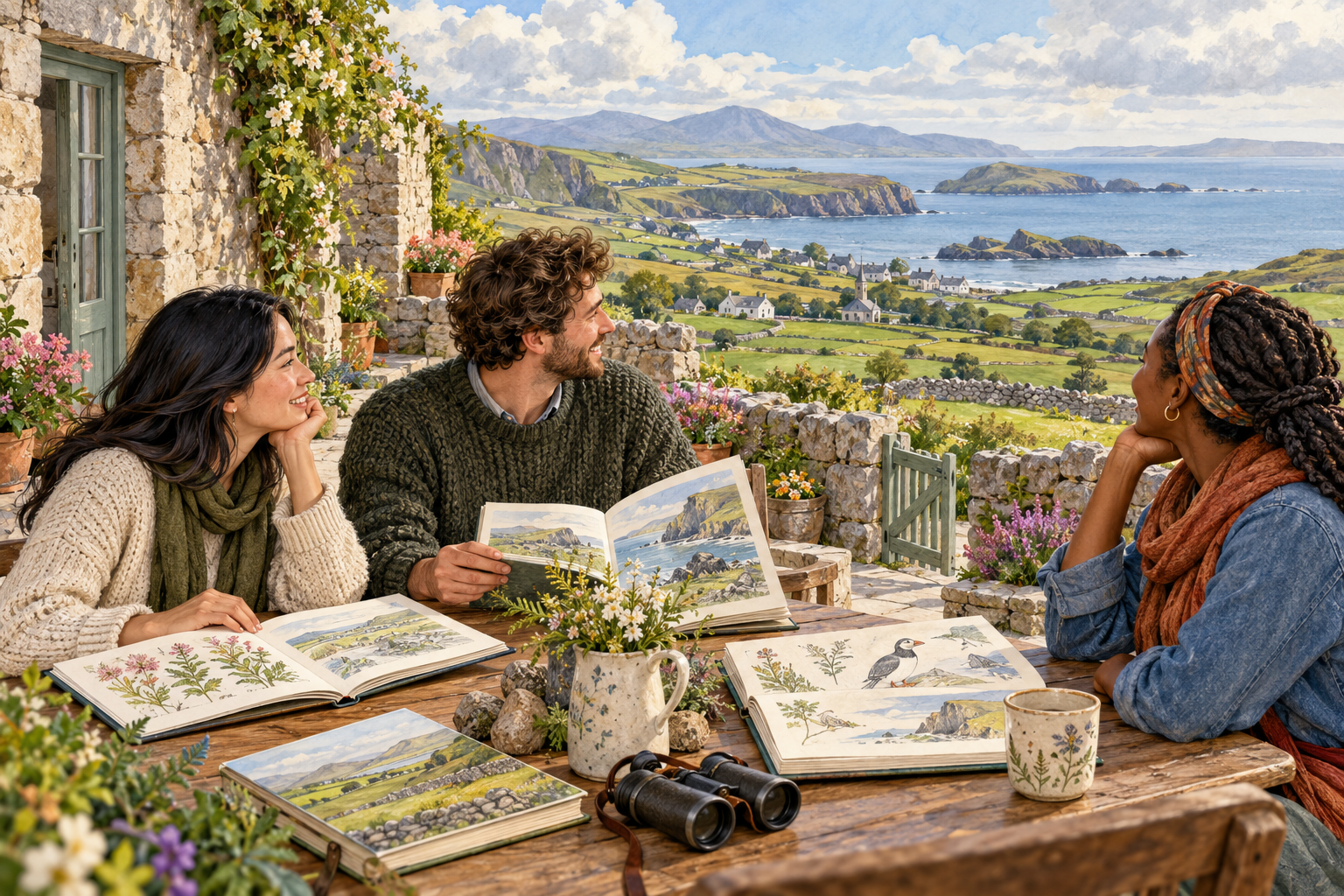
Cover illustration: an original AI-generated artistic interpretation of three adults sharing illustrated books in an imagined Irish stone courtyard overlooking green fields and a coastal inlet. This is a nonliteral composite, not a photograph or an exact view of a named place.
Choose your route through Ireland
- 1. Geography and landscapes
- 2. Cities and regions
- 3. Ancient history
- 4. Modern history
- 5. Government and institutions
- 6. Economy and Work
- 7. Agriculture and Industry
- 8. Infrastructure and Connections
- 9. Communities and Languages
- 10. Education and Learning
- 11. Food and Drink
- 12. Music and Dance
- 13. Literature and Arts
- 14. Health and Community
- 15. Wildlife and Habitats
- 16. Climate and Environment
- 17. Sport and Shared Endeavour
- 18. Science Discovery and Evidence
- 19. Community and Everyday Initiative
- 20. Ireland and Singapore: Connections Worth Understanding
1. Geography and landscapes
State and setting
Ireland names both a country and an island, requiring careful map reading. The independent state lies northwest of continental Europe and does not include Northern Ireland, which belongs to the United Kingdom. Carrauntoohil, reaching 1039 metres, is its highest point, contrasting with lower river and lake landscapes. Traditional provinces cross this political geography: Ulster has nine historic counties, with six in Northern Ireland and three in the Irish state, a warning against treating regional names as borders. (Ireland place names)
The bedrock beneath Ireland records journeys far older than its present shoreline. Parts of the land once belonged to separate continents divided by the Iapetus Ocean. Their eventual collision left a geological seam running from Dingle towards Clogherhead. Later seas deposited limestone across extensive areas, while glaciers reshaped the surface and left loose material above the rock. Reading a landscape therefore means distinguishing its solid foundation from the younger deposits covering it today. (Geology of Ireland)
Rock and river
In the Burren, bare limestone preserves evidence of a sea that disappeared millions of years ago. Marine skeletons accumulated with calcium carbonate on a warm, shallow seabed and became embedded in rock. Much later, moving ice stripped away soil and weakened material, exposing fresh surfaces. Rainwater then dissolved the limestone along cracks. The resulting pavement brings two processes together: glacial erosion uncovered the stone, while flowing water continued to reshape its surface afterwards. (Burren geology)
The Shannon shows how a river can become a natural corridor and an engineered waterway. Monastic settlements, Viking activity and trade all formed part of its history. From 1755, Thomas Omer worked on canals and locks around difficult stretches between Lough Derg and Lough Ree. Later rebuilding addressed problems with the earlier navigation works. A single authority established in 1835 helped coordinate a system whose usefulness depended on connections between its river sections. (Shannon history)
Contrasting coasts
Waterford’s Copper Coast exposes a geological story different from the limestone plains. Its oldest rocks formed beside an ancient continent beneath the sea around 460 million years ago. Volcanic eruptions produced basalt and andesite, followed by a later phase associated with rhyolite. Younger desert conditions left red sandstone and conglomerate. Glaciers added another layer of evidence, depositing mixed material now visible in coastal cliffs. Vanished environments can therefore be read along one shoreline. (Copper Coast geology)
Ireland’s eastern and western shores offer contrasts rather than a uniform coastal landscape. Atlantic sections include steep cliffs, while eastern shores combine sandy beaches with rocky headlands. Inland, glacial deposits cover parts of Meath, Kildare, Dublin, Louth and Westmeath. Farther towards the northern midlands, low rounded hills alternate with boggy ground. These differences show why landscape cannot be reduced to green fields: coast, rock, slope and deposited sediment vary across short distances. (Coasts and lowlands)
2. Cities and regions
Capital and southern harbour
Dublin’s development is tied to the River Liffey. Its bay welcomed shipping, but sandbanks and shallow water complicated the approach upriver. Viking vessels made the settlement a centre of trade at a river crossing. The Irish name Baile Átha Cliath recalls that crossing, whereas Dubh Linn refers to a dark pool near Dublin Castle. Routes arriving overland met maritime routes here, making the river both a feature and a connection beyond the city. (Dublin and river)
Cork’s streets recall channels that no longer carry water. The city grew by reclaiming marshy ground between branches of the River Lee. St Patrick’s Street, Grand Parade and South Mall occupy former waterways, so their shapes reveal an older watery landscape beneath the present street plan. Bridges also had to accommodate demands from ships and railways. Cork’s urban form is therefore partly a record of making land, crossing water and moving goods. (Cork island streets)
Western cities
Galway grew where a river, a bay and trading connections met. Its medieval merchant families developed commercial links with France, Portugal and Spain, while the older street network retained traces of the town’s earlier enclosure. The river supported industrial activity through mills as well as movement towards the harbour. These connections make its compact centre easier to understand: commerce, water power and inherited boundaries helped shape the spaces that later generations adapted. (Galway urban history)
Limerick contains different stages of growth rather than one historical core. A Viking settlement developed around 922, followed by Norman control in the late twelfth century. In the eighteenth century, the removal of city walls opened possibilities for expansion. Christopher Colles prepared a grid plan for Newtown Pery in 1769. That planned district contrasts with older patterns, showing how a city can preserve both inherited streets and a deliberate redesign of its future growth. (Limerick city history)
Waterford and regions
Waterford’s records connect a trading settlement with civic institutions. Vikings reestablished their base in 914, and a royal charter followed in 1215 after the Norman conquest. Merchants defended Waterford’s commercial privileges, including against competing claims from New Ross. Surviving charters, the Great Parchment Book and corporation minutes allow that history to be reconstructed. They show urban power being expressed through documents and trading rights as well as through buildings, streets and harbour activity. (Waterford civic records)
Modern regional planning groups the state into three assembly areas: Northern and Western, Southern, and Eastern and Midland. Every local authority area belongs to an assembly region. Their assemblies bring together councillors from local authorities and work on regional spatial and economic strategies. They also help manage European funding programmes. A town’s development therefore sits within several overlapping maps, from its council area to a wider region concerned with settlement, investment and connections between places. (Regional assemblies)
3. Ancient history
Farming and burial landscapes
At Céide Fields in north Mayo, peat conceals a farming landscape rather than untouched wilderness. Stone field walls, houses and tombs survive beneath the blanket bog, with remains dating back almost 6000 years. The walls extend across hundreds of hectares, revealing organised land use on a substantial scale. Archaeological investigation reverses an everyday assumption: the visible bog is the covering layer, while evidence of the earlier inhabited countryside lies hidden below its surface. (Céide Fields)
Carrowmore in County Sligo reveals a landscape of monuments rather than one isolated tomb. More than 30 monuments survive from a cemetery established almost 6000 years ago. Their distribution gives the surrounding ground historical importance alongside the structures. The site belongs to the wider Passage Tomb Landscape of County Sligo, proposed for World Heritage consideration. That distinction matters: being placed on a tentative list is a step towards nomination, not the same as inscription. (Carrowmore tombs)
Passage tombs and timber roads
The bend of the River Boyne contains the passage tombs of Newgrange, Knowth and Dowth. Built around 3200 BC, they combined burial with elaborate ceremonial architecture. Their stones carry patterns, including spirals, that make the monuments records of Neolithic design. At Newgrange, the roofbox connects the interior with the winter solstice sunrise. Massive construction and arranged light suggest communities investing in places that linked the dead, the landscape and the passage of time. (Boyne passage tombs)
At Corlea in County Longford, timber rather than stone preserves ancient engineering. An oak roadway built in 148 BC crossed boggy ground before sinking into peat, which protected it for two millennia. An eighteen-metre section is conserved indoors. Its purpose remains debated; a ceremonial connection between important centres has been suggested, not demonstrated. The road shows sophisticated construction and the limits of interpretation when written explanations from its builders are absent. (Corlea timber road)
Forts and monasteries
Dún Aonghasa stands above the Atlantic on Inis Mór, where its defences use more than height. Three dry-stone walls enclose the fort, while thousands of jagged stones create an obstacle outside them. Excavations have revealed houses, burials and metalworking within a history extending over 3000 years. Refurbishment around AD 700 to 800 shows that the place still mattered after its beginnings. Its surviving form reflects repeated occupation rather than one moment. (Dún Aonghasa fort)
Clonmacnoise joined river geography with religion and learning. Founded by Saint Ciarán in the sixth century beside the Shannon, it attracted learners from across Europe. Its surviving remains include a cathedral, churches, round towers and carved crosses, alongside hundreds of graveslabs. These are not simply picturesque ruins. Together they preserve evidence of communal worship, commemoration and learning within a settlement whose significance depended on people arriving, living, studying and being remembered there. (Clonmacnoise monastery)
4. Modern history
Famine and rebellion
The Great Famine of 1845 to 1852 can be studied through urgent requests reaching government offices. Letters, petitions and reports in the National Archives describe distress and attempts to obtain assistance. The Relief Commission, established in 1845, changed organisation as the crisis developed and was reconstituted in 1847. These records reveal suffering through the language of supplies, local committees and official decisions. They also show changes in the official response as the crisis continued. (Famine relief records)
On Easter Monday 1916, insurgents occupied positions in Dublin and Patrick Pearse proclaimed a republic at the General Post Office. Preparations had been disrupted by lost arms and conflicting orders, weakening the rising. After several days, leaders decided to surrender to prevent further deaths. Nurse Elizabeth O’Farrell carried the message seeking negotiations. Her role makes the event more than simply a sequence of commanders and buildings: communication also shaped how fighting ended. (Rising preparations)
Treaty and republic
The 1921 Treaty ended the War of Independence but divided the independence movement over freedom’s meaning. Supporters emphasised statehood and British military withdrawal; opponents rejected dominion status, the Crown’s continuing place and the surviving border. Dáil Éireann approved the agreement by 64 votes to 57. Division over the settlement led to civil war between former allies. In December 1922, the Irish Free State formally began, without governing Northern Ireland. (Treaty records)
The Republic of Ireland Act 1948 changed the state’s legal description and external relations. It repealed the 1936 External Relations Act and declared that the state should be described as the Republic of Ireland. It empowered the President to exercise external functions on the authority and advice of the Government. The Act also left its starting date to a government order, separating the passage of legislation from the later moment when its provisions would take effect. (Republic Act)
Europe and peace
European membership followed negotiation and public voting. Applications had stalled when French opposition blocked British entry and, with it, Ireland’s path into the communities. The accession treaty was signed in January 1972. In May, 83 percent of referendum voters supported joining, and membership began on 1 January 1973. This sequence links diplomacy with domestic consent: an international agreement was followed by a decision at home before Ireland entered a framework of shared European institutions. (European accession)
The 1998 Belfast Agreement addressed relationships within Northern Ireland, across the island, and between Ireland and Great Britain. It committed participants to peaceful politics and institutions for cooperation. Northern Ireland’s constitutional status rests on consent, not on an automatic claim by a community. The agreement recognises that its people may identify as Irish, British or both. Shared identity and cross-border cooperation therefore do not require pretending that one government administers the whole island. (Belfast Agreement)
5. Government and institutions
Constitution and parliament
Ireland’s Constitution distinguishes parliament from government. The Oireachtas includes the President, Dáil Éireann and Seanad Éireann, and makes laws for the state. Executive power belongs to the Government, headed by the Taoiseach. The President appoints the Taoiseach following the Dáil’s nomination. These are linked institutions, not interchangeable names: the head of government leads the executive, while the President has separately defined functions within the constitutional system of the sovereign, independent and democratic state. (Irish Constitution)
The annual budget is not a single day’s parliamentary business. The Parliamentary Budget Office’s 2024 timetable follows scrutiny across the year, from revised spending estimates to later expenditure reviews. Estimates link allocations with performance targets, allowing committees to question ministers about both money and delivery. A review during the year compares actual spending with allocations. This rhythm turns a headline budget announcement into a continuing examination of plans, implementation and possible overspending. (Parliamentary budget scrutiny)
Presidency and courts
The presidency also appears in public life through recognition of civic effort. At Áras an Uachtaráin on 21 November 2024, President Michael D Higgins presented Gaisce Gold Awards to young people completing personal development challenges. The scheme encourages participants to choose goals and work towards them. Volunteering with organisations and involvement in youth groups or clubs featured in the ceremony’s account, connecting a national institution with achievements built through sustained participation rather than public office. (Gaisce awards ceremony)
Court administration depends on information systems as well as buildings. In its 2024 annual report, the Courts Service recorded completion of an open data portal and a new digital strategy. Staff data training had begun, while a trial of Microsoft Teams for remote courts remained under review after its initial testing. These differently staged projects show why a completed trial should not be confused with a universally adopted service or an unchanged courtroom routine. (Court service modernisation)
Elections and local government
In Irish elections, voters can rank candidates instead of making one choice. Under the single transferable vote, later preferences may matter when a candidate is eliminated or has a surplus. Dáil, European and local elections return several representatives from each constituency, while presidential elections select one person. Referendums work differently, asking voters to choose yes or no. These distinctions separate choosing representatives from answering a yes or no question, although both involve casting a ballot. (Voting and transfers)
Local government brings public decisions closer to places. Ireland has 31 local authorities responsible for services including roads, planning, housing and fire protection. Elected councillors make reserved decisions including the annual budget, while chief executives manage executive functions and administration. A council therefore combines democratic choices with professional management rather than assigning decisions to one person. Understanding that division helps explain how local policies become services, spending plans and work within an area. (Local government functions)
6. Economy and Work
Measuring an open economy
Ireland’s economic size depends partly on what is being measured. In its 2024 release, the Central Statistics Office estimated modified national income at €291 billion for 2023, considerably below GDP. This measure adjusts for globalisation effects, including aircraft leasing depreciation and intellectual property transactions. Reading these measures together helps explain why a multinational economy needs more than one headline number: production recorded within a country is not identical to income retained there. (Irish economic measurement)
Ireland’s change to the euro happened in stages rather than immediately. The currency first existed as an accounting unit during a three-year transition, before physical notes and coins finally arrived on 1 January 2002. Irish pounds and euros then circulated together until 9 February. This sequence separates adopting a monetary unit from replacing physical cash. The European Commission’s account also records that the Central Bank continues exchanging the former notes and coins. (Ireland and the euro)
Enterprise and investment
An Irish business selling abroad may need more than products. Enterprise Ireland supports Irish-owned companies with finance, advice and business development, helping them increase their scale and enter overseas markets. Its remit runs from startups through smaller enterprises to large Irish companies. Teams based in Ireland and international offices work on growth strategies and market entry. This approach connects domestic company development with export opportunities, rather than treating the two separately. (Enterprise Ireland remit)
Foreign investment brings a different set of relationships into the economy. IDA Ireland’s strategy for 2025 to 2029 combines attracting new investment projects with helping investors renew their Irish operations. It identifies technology, financial services and engineering among its areas of activity. The strategy also seeks deeper relationships with domestic suppliers and educational institutions. These are policy ambitions, not guaranteed outcomes, but they show why investment agencies look beyond a factory opening. (IDA investment strategy)
Workplace dialogue and small businesses
Working life also depends on ways to resolve disagreement. The Workplace Relations Commission provides collective dispute services for organisations and employees in public and private sectors. Their purpose is to help the parties reach a mutually agreed practical solution impartially. Mediation can address individual employment or equality complaints before an adjudication hearing, if both parties agree. The distinction matters: resolving a dispute by discussion is different from having an adjudicator decide it. (Workplace dispute services)
Small businesses often need a route through the support system. Local Enterprise Offices provide an initial contact for entrepreneurs and existing small or micro businesses, explaining state assistance and directing people to organisations. Their connections include local authorities, Revenue, training boards and enterprise agencies. They identify local services and compliance requirements. This coordinating role makes business support less like finding one universal grant and more like matching a particular problem to appropriate expertise. (Local enterprise supports)
7. Agriculture and Industry
Grassland and farm structure
Grassland farming involves active measurement rather than leaving animals in fields. Teagasc’s Grass10 programme links grazing decisions with pasture quantity, soil fertility and the mixture of plants in a field. Introducing white clover into pastures requires careful attention to successful establishment and subsequent grazing management. The programme uses PastureBase information to guide decisions. Its practical lesson is that growing grass and ensuring livestock actually use it efficiently are related but different tasks. (Grassland management)
The agricultural census counted about 135 thousand farms in Ireland in 2020, with an average utilised agricultural area of roughly thirty-three hectares. The national average concealed substantial regional variation. Farms in the West and Border regions were typically smaller than those in the southeast and Dublin and the mideast. Specialist beef production accounted for more than half of farms. These dated figures describe farm structure, not each household’s size or income. (Agricultural census)
Forests and mineral resources
Ireland measures its forest resource by repeatedly returning to permanent sample plots. The National Forest Inventory uses a systematic grid, with circular plots spread across public and private forests. Surveyors record the extent and character of woodland, including tree composition and timber volume. Revisiting the same plots allows changes to be measured over time. That continuity matters: standing timber, new growth and felling are different quantities that cannot be understood from area alone. (National forest inventory)
The ground beneath Ireland has supplied materials with many different practical industrial uses. Geological Survey Ireland identifies gypsum from County Cavan, used in plaster and plasterboard, alongside copper mining in County Wicklow. Copper’s ability to conduct electricity explains its importance in wiring. Lead and zinc commonly occur together, with histories in Meath and Tipperary. These examples connect geology to manufacturing while reminding readers that a mineral deposit and an operating mine differ. (Irish mineral resources)
Standards and industrial skills
Industrial production requires shared measurements and specifications besides machinery. The National Standards Authority of Ireland develops Irish standards and represents national interests in European and international standards work. Its certification activities assess conformity with requirements, while legal metrology checks measuring instruments used in trade and quantities in packaged goods. A national laboratory maintains measurement standards. These functions help explain how a factory’s output can be specified, checked and compared beyond its premises. (Manufacturing standards)
Industrial skills can be developed jointly rather than independently. Skillnet Ireland describes its business networks as groups of companies linked by sector or region, working together to identify training needs. Manufacturing and supply chains are among the sectors within this approach. Networks organise programmes that help workers update skills or learn new ones. The model therefore connects decisions about technology and business competitiveness with the question of what employees need to learn. (Manufacturing skills)
8. Infrastructure and Connections
Railways and roads
Ireland’s railway services operate at several scales. Iarnród Éireann connects Dublin with cities including Cork, Galway and Limerick, while regional routes include Limerick to Galway and services around Cork. The Dublin area has commuter trains and the coastal DART network. The Enterprise connection to Belfast is operated jointly with Northern Ireland Railways. That partnership illustrates a distinction: a journey can cross the island’s political boundary without the railway organisations becoming one institution. (Irish railway network)
A road network is an ongoing service, not a completed project. Transport Infrastructure Ireland explains that toll income contributes to operating, maintaining and renewing national roads, alongside funding from the Exchequer. Some tolls also repay borrowing used by partnership companies to build infrastructure. Maintenance includes drainage, lighting, surface renewal and safety barriers. Understanding these tasks helps explain why road funding continues after a motorway opens: the investment must remain usable as traffic changes. (National road network)
Ports and power
Dublin Port shows how freight movement depends on land as well as ships. Its August 2025 account of Terminal 4 describes trailers arriving without their drivers, being moved from vessels and waiting before hauliers collect them. Creating additional working space for this traffic involved moving empty container storage to inland locations. The change illustrates a capacity problem: a port needs room to transfer and organise cargo, not simply enough water for vessels. (Dublin Port operations)
At Ardnacrusha in County Clare, water reaches the equipment through a canal connected to the Shannon. Three Francis generating units were commissioned in 1929, followed by a Kaplan unit in 1934. Four steel penstocks carry water to the turbines. The station developed alongside a national electricity grid, linking generation with distribution. This combination makes the project an example of infrastructure planning: producing power locally is useful only when a network carries it elsewhere. (Ardnacrusha power station)
Broadband and postal addresses
National Broadband Ireland’s network illustrates the distinction between building communications infrastructure and selling subscriptions. The company designs, builds and operates fibre infrastructure for the National Broadband Plan, combining state subsidy with commercial investment. Its wholesale services are made available to broadband providers serving customers. Construction also involves existing poles and underground ducts. The network and the retail service therefore perform different jobs, although a household encounters them together when using the internet. (National broadband network)
Ireland’s postcode system identifies individual addresses rather than only groups of buildings. Introduced in 2015, an Eircode contains seven characters: three indicate a postal area and four distinguish the address within it. Codes are not assigned in street order, so adding or dividing a building does not require changing neighbouring codes. These postal areas can also cross county boundaries. The system therefore records delivery geography, which need not match administrative county geography. (Irish postal addresses)
9. Communities and Languages
Migration and official languages
Population diversity cannot be described by one label. Ireland’s 2022 census asked separately about citizenship, ethnic background, religion, languages and recent migration. Its summary recorded Irish citizens as well as other citizens among people arriving during the preceding year. That distinction prevents immigration from being treated as synonymous with foreign citizenship. The census warned that changing the nationality question to citizenship could affect comparisons, showing why statistical definitions matter when discussing social change. (Census migration profile)
Public services make language rights tangible through communication. The language commissioner’s guide explains how the Official Languages Act 2003 organised the development of services through Irish. It established an independent office handling complaints and monitoring compliance, alongside duties for public bodies. The guide describes communication through letters, emails, reports and announcements, and explains the role of agreed language schemes. These arrangements connect institutional commitments with services, rather than leaving language provision to goodwill alone. (Official language rights)
Gaeltacht and signed language
The Gaeltacht is not a single western county or a continuous district. Údarás na Gaeltachta identifies areas in Donegal, Mayo, Galway and Kerry, together with parts of Cork, Meath and Waterford. It also includes inhabited islands. Its account connects the Irish language with local identity and enterprise, rather than treating language solely as a classroom subject. This dispersed geography helps explain why supporting everyday Irish involves distinct places, with different settlements, businesses and circumstances. (Gaeltacht regions)
Irish Sign Language has a statutory place in Ireland’s language landscape. The 2017 Act recognises users’ right to use it as their native language and the signing community’s right to develop and preserve it. Public bodies have a duty concerning free interpretation when users seek statutory services and entitlements. The Act addresses its use in court proceedings. These provisions concern a language and its users, rather than treating access as an optional accommodation. (Irish Sign Language)
Traveller identity and place names
Recognition and equality are connected but different. In a statement on racism, then Minister David Stanton recalled the state’s recognition of Travellers as an ethnic minority on 1 March 2017. He described it as acknowledgement of a distinctive identity and culture, while explicitly warning that recognition would not immediately remove obstacles to equality. This distinction is important when learning about Irish society: a public statement can matter without completing the practical work it represents. (Traveller identity)
Irish place names are subjects of research. The Logainm project brings together Dublin City University’s Gaois research group and the state’s Placenames Branch, using technology to support research and make information publicly accessible. The project began in 2007 and launched its first public website the following year. It connects scholarly investigation with geographical knowledge. A name on a map can therefore be approached as evidence to investigate, not a label to memorise. (Irish place names)
10. Education and Learning
Primary and secondary learning
Primary education in Ireland spans eight years, beginning with junior and senior infants and continuing through six numbered classes. The curriculum framework groups learning into five broad areas, including language, wellbeing and social and environmental education. Subjects become more differentiated as pupils progress. NCCA’s framework also allows flexible use of learning time. This structure combines increasing subject depth with connections across learning, rather than assuming that young pupils should experience topics as isolated disciplines. (Primary curriculum)
Secondary education’s first three years form the Junior Cycle. The Department of Education describes a programme combining subjects, short courses and learning experiences, with schools shaping provision around students’ needs. Assessment includes classroom work during the second and third years as well as state examinations at the end. Students receive a Junior Cycle Profile of Achievement. The arrangement makes the learning record broader than a final examination, while retaining a national assessment element. (Secondary education)
Qualifications and apprenticeships
Qualifications become easier to compare when their purposes and levels are explicit. Ireland’s National Framework of Qualifications has ten levels, extending from introductory learning to doctoral study. QQI’s August 2024 guide distinguishes major qualifications from smaller awards, specialist awards and learning that supplements an existing qualification. It also separates level from study volume measured through credits. This matters: two courses can address similarly demanding work without requiring the same time or covering identical ground. (Qualifications framework)
An apprenticeship combines employment with organised learning. The national apprenticeship service’s sales specialist example begins with being hired by an approved employer with an employment contract. Training takes place both at work and elsewhere, with pay agreed between the apprentice and employer. This programme is coordinated by the Mayo, Sligo and Leitrim training board. This shows why apprenticeships are not simply informal work experience: employer approval, structured training and a coordinating provider matter. (Apprenticeship learning)
Higher education and adult learning
Higher education involves institutional independence and public accountability. The Higher Education Authority oversees the system while recognising academic freedom and the autonomy of institutions. Its responsibilities include funding, evidence gathering and assessing delivery of agreed objectives. Objectives include improving teaching and widening access, alongside institutions’ responses to society’s needs. The result is a coordinated system rather than one institution: colleges and universities can have different missions while remaining accountable for the public purposes they serve. (Higher education system)
Learning continues after formal schooling. SOLAS’s Adult Literacy for Life strategy addresses reading, writing, mathematics and digital skills, while asking services to become easier for people with literacy needs to use. Regional coordinators bring organisations together to develop plans and share expertise. This gives the strategy two directions: supporting adults to build skills and changing the systems they encounter. Inclusion therefore depends on accessible communication as well as opportunities to attend a course. (Adult literacy learning)
11. Food and Drink
Ingredients and the hearth
Irish stew brings meat and vegetables together through slow cooking rather than an elaborate sauce. Bord Bia’s version uses lamb, onions, carrots, leek and turnip, with potatoes added later and cabbage near the end. The different timings matter: ingredients enter the pot according to how they cook. Parsley and other herbs add flavour, while soda bread accompanies the finished bowl. This particular recipe illustrates a familiar dish without making every household’s version identical. (Bord Bia: Irish stew)
The older Irish kitchen was an organised workplace. The National Museum describes families growing crops, keeping livestock and supplementing their supplies with gathered plants, fish or game. Women processed food and sold surplus eggs and butter. Around an open hearth, only one vessel could occupy the strongest heat at a time. Cooking therefore required planning as well as ingredients, with other dishes waiting nearby and a versatile pot oven eventually supporting both baking and roasting. (Museum: household food)
Milk and potatoes
Farmhouse cheese shows how food traditions can be renewed rather than simply preserved unchanged. Teagasc’s 2020 account traces a revival especially to dairy farmers working in the late 1970s. Cheesemaking separates curds from whey, then uses shaping and, for many varieties, maturation to develop the finished product. Temperature, moisture and microbial activity influence the result. Milk from a farm thus becomes a distinctive food through skilled processing, not through its geographical origin alone. (Teagasc: farmhouse cheese)
Potatoes also support dishes with quite different textures. In Donal Skehan’s family version of boxty, grated raw potato and cooked mashed potato appear together, combined with flour, buttermilk and baking soda. Small portions are fried into pancakes; spring onions and cheese are optional additions. The contrast between grated and mashed potato helps explain why boxty is not merely another serving of mash. Skehan explicitly presents regional variation, leaving room for traditions beyond his family’s recipe. (Skehan: boxty)
Drinks and their stories
Food stories connect places with journeys beyond them. Foynes Flying Boat Museum attributes Irish coffee to chef Joe Sheridan and an interrupted transatlantic flight in the winter of 1943. Returning passengers were served coffee with Irish whiskey after their aircraft turned back in poor weather. The museum’s account links the drink to a terminal restaurant and its staff, reminding readers that culinary heritage can emerge from hospitality and improvisation rather than ancient custom. (Foynes: Irish coffee)
Guinness offers another connection between ingredients and a recognisable identity. Its Storehouse explains the roles of barley, water, hops and yeast, describing water from the Wicklow Mountains rather than the River Liffey. Its historical account also links additional hops to keeping export beer during long voyages. Reading this as the producer’s explanation reveals a practical story behind the brand: farming, water supply, fermentation and transport all shape the product before it reaches consumers. (Guinness: ingredients)
12. Music and Dance
Instruments and inheritance
The harp is both an Irish symbol and an instrument whose construction has changed. UNESCO’s 2019 inscription contrasts earlier instruments with wire strings, played using fingernails, with many contemporary harps using gut or nylon strings and fingertips. Players learn through listening and through notation. Preserving a repertoire therefore does not require freezing every material or technique. The inscription describes an islandwide cultural practice, a scope wider than the territory governed by the Irish state. (UNESCO: Irish harping)
Uilleann piping depends on people passing on a demanding musical practice. UNESCO’s 2017 account gives particular importance to individual teaching, also recognising instruction through recordings and the internet. Pipers perform at occasions including weddings and funerals, connecting musical skill with social memory. The safeguarding work of Na Píobairí Uilleann includes research, publications, tuition and training. Such arrangements explain how an inherited tradition can remain active in Ireland and abroad rather than becoming a historical exhibit. (UNESCO: uilleann piping)
Dancing and gathering
Irish dancing likewise contains styles that resist a single stage image. Michael and Céline Tubridy learned an older step tradition from Dan Furey and James Keane of Labasheeda in County Clare. Their learning resources combine notation with recordings at ordinary and slower speeds, isolating individual steps for study. The accompanying explanation emphasises an easy, less rigid posture rather than competition. Written symbols and moving bodies consequently preserve different parts of the same local knowledge. (Tubridy: step dances)
Music festivals provide another setting for participation and learning. Comhaltas traces Fleadh Cheoil na hÉireann to Mullingar in 1951 and explains how county and provincial competitions lead towards the larger event. Its programme also connects with the Scoil Éigse summer school. The festival’s cultural geography crosses the political border: Comhaltas announced Belfast in Northern Ireland as its 2026 host. An Irish musical gathering can therefore have an all-island identity without implying an all-island government. (Comhaltas: the Fleadh)
Journeys and everyday objects
Migration carries performance into new neighbourhoods and new relationships. The documentary project From Shore to Shore began recording interviews, music and dance in New York in April 1988. Its archive places contemporary performances beside historical photographs and film, investigating continuity as well as change. Additional recordings preserve material excluded from the finished documentary. This combination matters because an edited film offers one narrative, while its surviving recordings allow listeners to explore a wider musical community. (ITMA: musical migration)
Small objects can reveal how music enters everyday life. ITMA’s collection of musical artefacts includes souvenirs, gifts and items associated with promoting performers or venues. A dancing doll can participate in a performance, whereas a souvenir preserves an association after the music stops. The archive treats these objects as secondary cultural evidence rather than substitutes for sound. They broaden the record beyond celebrated musicians to include audiences, childhood, collecting and the circulation of musical identity. (ITMA: small artefacts)
13. Literature and Arts
Poetry and personal worlds
Literature becomes tangible through the materials around its making. The National Library’s Yeats exhibition includes manuscripts, photographs, personal objects and his Nobel medal. School reports sit alongside celebrated poems in the collection, bringing the writer’s ordinary life into view. The exhibition also follows interests in folklore, theatre, politics and mysticism. These different traces encourage readers to see literary achievement as a working life with changing concerns, rather than merely a list of famous titles. (NLI: Yeats exhibition)
In his 1995 Nobel lecture, Seamus Heaney remembered listening closely to the radio in his childhood County Derry home, in Northern Ireland. Foreign station names and unfamiliar speech widened the world available from that small domestic space. He later recalled family life in County Wicklow, south of Dublin. These personal locations connect Irish literature across the border without erasing it, while his account makes listening itself part of a writer’s developing attention to language. (Heaney: Nobel lecture)
Stage and painted city
Theatre gives literary ideas a setting for public disagreement. Founded by W. B. Yeats and Lady Gregory, the Abbey opened in December 1904 with new plays. Its own timeline records the disturbances surrounding Synge’s The Playboy of the Western World in 1907. A national theatre was therefore not simply a place for comfortable agreement. The stage could test representations of Irish life, with performers and spectators confronting conflicting expectations in the same room. (Abbey: theatre history)
Jack B. Yeats’s painting The Liffey Swim turns a Dublin sporting occasion into an encounter with a crowd. The National Gallery dates it to 1923 and explains the diagonal arrangement separating spectators on the quay from action in the river. The viewpoint places the viewer among people leaning towards the swimmers. Fluid brushwork contributes to the excitement. The painting received a silver medal at the 1924 Olympic Arts Competition, connecting urban spectacle with international recognition. (Gallery: Liffey Swim)
Materials and moving stories
Contemporary art can make familiar materials unsettling. Alice Maher’s Berry Dress, made in 1994, combines rose hips, cotton, paint and sewing pins in the shape of a child’s garment. IMMA’s guide draws attention to pins visible inside the work: something resembling protective clothing also suggests discomfort or harm. Its organic materials are fragile and will deteriorate. The artwork invites attention to appearance and contradictory associations between childhood, beauty, vulnerability and the passage of time. (IMMA: Berry Dress)
Animation gives stories another form. Screen Ireland’s archived production plan for Song of the Sea describes siblings Ben and Saoirse travelling towards their coastal home through a world connected with their mother’s folktales. It also records how the Kilkenny studio Cartoon Saloon planned production work with Danish, Belgian and French partners. A story rooted in Irish imaginative traditions can thus be made through international collaboration, combining local design work with skills and production stages located elsewhere. (Screen Ireland: animation)
14. Health and Community
Services and social connections
Healthcare organisation affects how people move between services. HSE guidance read in October 2026 describes six health regions, with Integrated Healthcare Areas bringing hospital and community management together. Its explanation includes general practitioners, pharmacies and voluntary organisations within coordinated care. Importantly, the HSE also acknowledges that structural change alone cannot deliver integration. A shared organisational map provides a framework; the practical test remains whether different services work together around the person using them. (HSE: health regions)
Community connections can complement clinical care without replacing it. The HSE’s 2021 social prescribing framework describes link workers helping people identify their goals and connect with community organisations or other services. It involves listening and joint planning, rather than a standard activity list. The framework explicitly distinguishes this role from counselling, social work and adequate clinical services. Social participation addresses aspects of wellbeing, but does not remove the need for appropriate professional care. (HSE: social prescribing)
Listening and measuring
Patient experience supplies evidence that organisational charts cannot. The 2024 National Inpatient Experience Survey received responses from 12,367 people across forty hospitals, representing a participation rate of 41 percent. Eighty-five percent rated their overall experience positively. Yet detailed questions still identified weaker areas, including waiting in emergency departments and opportunities to discuss concerns. These findings describe respondents’ experiences, not every encounter. A positive overall result can coexist with specific problems deserving attention and improvement. (HIQA: inpatient experience)
Population surveys ask a different set of questions. Healthy Ireland’s 2024 survey interviewed 7,398 residents aged at least fifteen between October 2023 and April 2024. Its summary reported that 81 percent considered their health good or very good, while 41 percent reported a condition diagnosed by a medical professional. These findings can coexist: people may have a lasting condition while judging their overall health positively. The distinction shows why a single headline cannot capture wellbeing. (Health: population survey)
Donation and companionship
Blood donation depends on an organised chain beyond the appointment. The Irish Blood Transfusion Service explains that whole blood contains components including red cells, platelets and plasma, which can be separated during processing. Its plasma information describes collaboration with a European manufacturer to prepare products for the Irish healthcare system. The example links voluntary contribution with laboratory work and manufacturing. Helping another person may involve several specialised institutions between donation and its eventual clinical use. (IBTS: plasma)
Support at home involves practical obstacles alongside medical needs. ALONE describes coordinators developing individual plans and working with public agencies and community organisations to help older people remain independent. Its befriending service offers companionship through regular contact, with trained volunteers introduced through supported matching. The organisation distinguishes this role from home help or care assistant tasks. Such boundaries make the contribution clearer: friendship and practical assistance complement, rather than silently replace, other forms of support. (ALONE: practical support)
15. Wildlife and Habitats
Habitats before boundaries
Protecting wildlife requires attention to habitats, not only to familiar animals. Ireland’s National Parks and Wildlife Service explains protected sites through habitats and their conservation needs. Its categories include Special Areas of Conservation, Special Protection Areas and Natural Heritage Areas. The agency also emphasises cooperation with landowners and people using the land. A designated place is part of a wider relationship between ecological requirements and everyday decisions about managing, working on and visiting a landscape. (NPWS: protected habitats)
Raised bogs make that relationship particularly visible through water. The LIFE09 brochure explains that peat domes develop over thousands of years and receive their water from rainfall. Wet surfaces support bog mosses that contribute to peat formation, whereas drainage changes the conditions and vegetation. The project planned tree removal and drain blocking on afforested bogs. Restoration rebuilds conditions for the habitat to recover, not instantly recreating a mature bog or guaranteeing ecological success. (LIFE: raised bogs)
Farming and pollinating insects
Farmland can support wildlife when management accommodates its breeding needs. NPWS reported 233 corncrake territories in 2024, while cautioning that the species remained vulnerable. Its account explains how cover plants and later mowing help birds rear chicks, supported by cooperation with farmers and contractors. The figure is a dated measure of territories, not a count of every bird. This distinction preserves the evidence’s meaning while showing how conservation depends on decisions within working fields. (NPWS: corncrake survey)
Pollinating insects need suitable conditions outside nature reserves too. The voluntary All Ireland Pollinator Plan for 2021 to 2025 organised actions across farmland, public land, private land and other priorities. Its participating organisations committed their own resources rather than drawing on one project budget. Gardens, businesses, sports clubs and public bodies could contribute to habitat networks. Its islandwide scope includes Northern Ireland, demonstrating ecological cooperation across a border without merging the responsibilities of separate administrations. (AIPP: landscape action)
Watching life beyond daylight
Understanding wildlife trends requires repeat observations and acknowledging gaps. Bat Conservation Ireland describes surveys using vehicles, waterways and counts of animals leaving roosts to track different species. The programme involves volunteers and support from agencies in Ireland and Northern Ireland. Its overview also identifies species without a reliable, affordable monitoring method. A trend for monitored bats cannot therefore stand for every bat population, and local pressures still matter even when broader trends look encouraging. (BCI: bat monitoring)
Some Irish habitats lie beyond ordinary sight. During the June 2015 QuERCi expedition, researchers used the remotely operated vehicle Holland I to examine coral communities on steep walls of the Porcupine Bank Canyon. The Marine Institute describes corals, sponges, crabs and fish living there. Researchers also observed fishing gear and litter despite the site’s remoteness and protected status. Discovery and protection differ: seeing a habitat does not mean human pressures have stopped reaching it. (Marine Institute: corals)
16. Climate and Environment
Weather and evidence
Ireland’s climate is shaped by the sea, but its weather is not uniform. Met Éireann’s averages for 1991 to 2020 show a pronounced rainfall contrast between the wetter west and the drier east. Coastal temperatures are moderated by surrounding water, while higher ground is generally cooler. These averages describe patterns across thirty years, not the weather on any particular outing. Reading the map therefore means noticing exposure, elevation and the changing season together. (Met Éireann: climate averages)
Climate research also distinguishes an observed record from a modelled possibility. The TRANSLATE study combined two ensembles of regional projections for Ireland, using several emissions scenarios and different climate sensitivities. This structure represents uncertainty rather than hiding it behind a single number. Its mapped results retained geographical detail, while projected changes were spatially smoother. Such work gives planners a common evidence base, without pretending that every place has one predetermined climatic future. (O’Brien and Nolan: TRANSLATE)
Energy and emissions
Ireland’s energy transition looks different depending on what is being measured. SEAI’s account of 2024 shows renewable energy contributing to electricity, heating and transport in unequal proportions. Fossil fuels still supplied 93 percent of transport energy and almost nine tenths of heat. Those figures explain why a prominent wind turbine cannot stand for the entire energy system. Electricity generation, vehicle journeys and building warmth involve different demands, technologies and practical opportunities for change. (SEAI: energy balance)
The EPA’s inventory records greenhouse gas emissions rather than simply counting renewable installations. For 2024, emissions excluding land use and forestry fell by 1.9 percent from the previous year. Energy industries recorded a reduction, but residential emissions rose as heating demand increased. The contrast matters: progress in one sector can coexist with pressure in another. An inventory makes those movements visible, instead of treating national performance as a single uncomplicated success story. (EPA: emissions inventory)
Water and materials
Water quality adds another test of environmental condition. The EPA’s assessment for 2019 to 2024 found that 52 percent of surface water bodies were in high or good ecological status. The proportions differed considerably between rivers, lakes, estuaries and coastal waters. Ecological assessment examines how water systems function, while chemical assessment asks different questions about pollutants. A pleasing view is therefore not a substitute for monitoring, and one national percentage cannot describe every catchment. (EPA: water quality)
The deposit return scheme connects environmental policy with an ordinary purchase. Re-turn’s 2024 report recorded almost 878 million drink containers returned during its opening year. Separating bottles and cans produces cleaner material for recycling than collecting everything together. The refund gives a small, repeated reason to bring an empty container back. Behind that simple action sit collection points, transport and processing, showing how a personal habit depends on an organised material system. (Re-turn: annual report)
17. Sport and Shared Endeavour
Games and their rules
Hurling joins speed and coordination to a network of local teaching. UNESCO’s 2018 inscription describes adult teams of fifteen using wooden hurleys and a small ball called a sliotar. The practice extends across the island and into overseas communities. Its continuity depends on clubs, schools, coaches and volunteers passing skills onward. Recognition concerns this living transmission, not merely a trophy or a spectacular match, and includes the communities that sustain the game between competitions. (UNESCO: hurling)
Sporting traditions also change through deliberate choices about rules. At its October 2025 Special Congress, the GAA adopted football changes developed through its review process. Among them was a clarified two-point score for a qualifying kick from outside the forty-metre arc. An opponent touching that ball no longer reduced its value to one point. Such decisions reveal sport as a designed contest, where scoring incentives and clear interpretation help shape play. (GAA: football changes)
Participation and belonging
Rugby offers a useful lesson in separating sporting geography from political jurisdiction. The Irish Rugby Football Union’s history describes two unions merging in 1879, with branches helping organise the game. Connacht followed in 1885. The union governs rugby across the island, so its sporting remit includes Northern Ireland as well as Ireland. That shared structure should not be mistaken for a governmental system: an international team and a sovereign state are different institutions. (IRFU: union history)
Participation measures a different kind of sporting strength from international medals. The Irish Sports Monitor reported that 49 percent of adults participated in sport in 2024, compared with 47 percent the year before. Yet participation among people with disabilities remained at 32 percent, and socioeconomic differences persisted. These findings put access alongside achievement. A growing overall total is encouraging, but it does not show that opportunities, facilities or practical barriers are distributed equally. (Sport Ireland: participation)
Performance and persistence
At the Paris Olympics in 2024, Ireland won four gold and three bronze medals. The Olympic Federation’s record brings together achievements in boxing, rowing, swimming and gymnastics. Kellie Harrington retained her boxing title, while Paul O’Donovan and Fintan McCarthy defended their rowing title. Rhys McClenaghan won pommel horse gold. The range is worth noticing: national celebration can gather around very different skills, from balance and precision to endurance, timing and partnership under pressure. (OFI: Paris results)
Ireland’s Paris Paralympic results provide an account of sporting endeavour. In 2024 the team earned one gold, three silver and two bronze medals. Katie-George Dunlevy and pilot Linda Kelly won the women’s B time trial, a result that places cooperation inside the performance. Róisín Ní Riain and Orla Comerford also reached podiums. These achievements deserve attention through their events, classifications and demands, rather than being flattened into a story about overcoming difficulty. (Paralympics Ireland: history)
18. Science Discovery and Evidence
Mathematics and materials
William Rowan Hamilton’s work on quaternions shows discovery through formal reasoning rather than measurement. His nineteenth-century account developed numbers with four components and allowed multiplication to depend on order. Reversing two factors could therefore change the result, unlike ordinary multiplication of real numbers. Hamilton retained other algebraic rules while exploring geometric meaning. The achievement was not simply a clever calculation: it was a defined mathematical structure that expanded what algebra could express. (Hamilton: quaternions)
A 2008 study involving Trinity College Dublin researchers investigated how graphite could yield thin graphene sheets in liquid. The team examined dispersions with microscopy, electron diffraction and multiple spectroscopic techniques. The tests identified individual sheets without detecting significant defects or unwanted oxidation. The work linked the behaviour of solvents to the energy of graphene surfaces. Its strength lay in connecting a production method with independent tests of what had actually been produced. (Hernandez: graphene sheets)
Genomes and living systems
Ancient DNA research can test relationships that monuments alone cannot reveal. A 2020 study led from Trinity College Dublin analysed genomes from forty-four people, mostly from Neolithic Ireland. Comparisons identified relatives associated with passage tombs, including sites far apart. The authors used these patterns to investigate social organisation rather than treating every burial as an isolated discovery. Their interpretation also acknowledged sampling limits: sampled individuals cannot provide a census of prehistoric society. (Cassidy: ancient genomes)
Bat research led from University College Dublin investigated ageing by comparing telomeres, the protective regions at chromosome ends. A 2018 study drew on longitudinal capture records from four bat populations. Telomeres shortened with age in some species, but the pattern was absent in the long-lived Myotis bats studied. Genetic analyses explored maintenance mechanisms. The result poses a biological question; it does not establish a treatment or a universal rule for human ageing. (Foley: bat telomeres)
Fields and distant signals
Field observation can complicate a straightforward environmental assumption. Karbassioon and Stanley studied pollinator activity in Irish oilseed rape fields from sunrise to sunset, alongside observations at bee nests. Abundance peaked during the afternoon, but different pollinator groups followed different patterns. Activity at nests also extended beyond what field counts suggested. The findings show why a single observation period can miss behaviour, and why conclusions about pesticide exposure require attention to species and place. (Karbassioon and Stanley: pollinators)
Irish radio astronomy turns repeated observations into evidence. A 2025 I-LOFAR study followed seven pulsars over periods of two to three years, measuring how their signals arrived at different radio frequencies. Variations revealed the influence of material between Earth and the pulsars, including the solar wind. Modelling changes in pulse shape helped separate effects that could confuse interpretation. The released dataset demonstrates discovery through patient measurement, correction and comparison rather than one photograph. (Susarla: pulsar timing)
19. Community and Everyday Initiative
Organising local effort
Community initiative often begins with a place that people share. TidyTowns explains that its competition is not simply a search for the prettiest settlement. Assessment includes planning, public spaces, natural amenities and community involvement, with improvement over time central to the approach. Even a small townland can participate around a recognisable focal point. This makes the village street or meeting place something residents can shape together, rather than scenery maintained only for passing visitors. (TidyTowns: community approach)
Volunteering also needs organisation behind the goodwill. Volunteer Ireland’s 2024 annual report describes support for a network of twenty-nine local Volunteer Centres, alongside training and the national volunteering database. Its volunteers contributed to tasks including translation, design and data analysis. These examples broaden the image of service beyond a single public event. Useful contributions can be technical, administrative or conversational, while coordination helps connect a person’s skills with work that needs doing. (Volunteer Ireland: annual report)
Skills and growing together
Men’s sheds provide one setting where activity and companionship meet. The Irish Men’s Sheds Association describes autonomous groups whose interests can include woodworking, gardening, music or restoring objects. There is no requirement that every shed offer the same programme. Members share knowledge and work alongside one another, with conversation part of the experience. The emphasis is on a welcoming space, where participation can begin with a skill or the willingness to learn something. (IMSA: shared skills)
Growing food together involves cooperation before the harvest. GIY’s community growing guide for the LEAF library project describes seed sharing through a meitheal: different people grow particular plants and exchange them to create variety. The guide also asks groups to consider permissions, water, composting and responsibilities. These practical questions turn enthusiasm into a project. A shared garden is therefore both a growing space and an exercise in distributing effort fairly among its participants. (GIY: community growing)
Repair and shared places
At the Rediscovery Centre in Ballymun, repair becomes a community resource extending beyond the household. Its account traces projects in furniture, fashion, paint and bicycle refurbishment, linking reuse with training and employment opportunities. The centre itself occupies a former boiler house saved and adapted for a new purpose. Building and activities express this idea: an object or place can retain value when people invest the knowledge and effort needed to use it differently. (Rediscovery Centre: reuse)
Shared places also depend on physical improvements. A March 2025 announcement allocated funding for refurbishment at 369 community centres under the 2024 investment fund. The listed purposes included building renovations, better amenities, accessibility measures and energy upgrades. An allocation is not proof that every project is complete, but it identifies the kinds of work communities sought to undertake. Behind a programme of activities are practical questions about whether the building supports everyone using it. (DRCD: community centres)
20. Ireland and Singapore: Connections Worth Understanding
Diplomacy and professional networks
Ireland and Singapore established diplomatic relations in 1974, and Ireland opened its resident embassy in Singapore in 2000. The embassy describes a role extending across political and economic relationships, community support and cultural ties. Those functions give the relationship a permanent working structure rather than leaving it to occasional ceremonial visits. For readers, the dates also distinguish a formal relationship between modern states from the older movements of individuals that can connect distant societies. (Ireland: Singapore relations)
Professional networks add a layer to official relations. The Irish Chamber of Commerce Singapore traces its origins to the Irish Business Association founded in 1992, becoming a chamber in 2010. Its activities bring together people across industries through events, knowledge and connections. The community is not confined to Irish citizens: it includes people of different nationalities with interests linking the two places. Business relationships therefore grow through encounters as well as formal institutional agreements. (Irish Chamber: connections)
Trade and student exchange
Food provides an example of those commercial connections. In September 2022, Bord Bia announced an Irish beef and lamb launch at Singapore retailer Ryan’s Grocery, alongside other Irish products. The announcement described relationships among exporters, a distributor and retail outlets, as well as participation in the Food Hotel Asia trade fair. This dated example shows the work behind market access and visibility; it should not be read as a guarantee of stock or availability. (Bord Bia: Singapore launch)
University exchange creates connections through study. The National University of Singapore’s partner directory lists Trinity College Dublin, University College Cork and University College Dublin among its partners in Ireland. It also distinguishes faculty arrangements from broader agreements. That distinction matters because a partnership is an institutional framework, not an automatic place for every student. The directory offers a starting point for academic links while leaving individual eligibility and course arrangements to the universities. (NUS: Irish partners)
Learning and community abroad
Educational partnerships can finish while their graduates carry the experience onward. In July 2023, the Singapore Institute of Technology marked its collaboration with Trinity College Dublin at a gathering of students, alumni and staff. Their partnership began in 2012 with physiotherapy and occupational therapy programmes. The retrospective noted completion of the joint degree collaboration. Its legacy is therefore visible in graduates and professional relationships, without assuming that a course arrangement remains available today. (SIT: Trinity partnership)
The Singapore Gaelic Lions show how cultural practice can become a meeting place abroad. Founded in 1997, the club developed Gaelic football and hurling alongside social gatherings and regional competition. Its account welcomes people in Singapore whether Irish or not, making participation broader than ancestry. Club history connects Ireland with a Singapore community through activity. These links complement diplomacy: understanding another country can begin with learning a game, joining a team and knowing people. (Gaelic Lions: club history)
Frequently asked questions about Ireland
Where is Ireland?
Ireland is an independent state in northwestern Europe. Northern Ireland shares the island but is part of the United Kingdom. (Ireland place names)
What is the capital of Ireland?
Dublin is the capital of Ireland. (UNData country profile)
What currency does Ireland use?
Ireland uses the euro. Euro notes and coins entered circulation in 2002. (Ireland and the euro)
What are Ireland’s official languages?
Irish and English are Ireland’s official languages; Irish is the first official language. (Irish Constitution)
What is a traditional Irish dish?
Irish stew can combine lamb, potatoes and onions. Bord Bia’s version also includes other vegetables and herbs. (Bord Bia: Irish stew)
How is traditional Irish music passed on?
Irish harping is learned through listening and notation. UNESCO describes a living tradition that preserves older repertoire while adapting to changing instruments. (UNESCO: Irish harping)
Why does habitat conservation matter in Ireland?
Species need suitable places to live. Ireland’s protected sites safeguard habitats, while cooperation with landowners and land users supports conservation. (NPWS: protected habitats)
When did Ireland and Singapore establish diplomatic relations?
Ireland and Singapore established diplomatic relations in 1974; Ireland opened its resident embassy in Singapore in 2000. (Ireland: Singapore relations)
Continue reading: specialist guides to Ireland
These links provide subject-specific background. Their travel-themed titles do not establish that visiting is safe or feasible; use them as reading resources here.
- Top 100 Bog Archaeology Vocabulary Words | Ireland
- Top 100 Raised Bog Restoration Vocabulary Words | Ireland
- Top 100 Hurling Vocabulary Words | Ireland
- Top 10 Things to Eat When Visiting and Touring Ireland
- How Ireland Works | Why Is Ireland Not in the Schengen Area? EU Membership, the UK Common Travel Area and Visas Explained
- Top 20 Unique Vocabulary Words to Know When Visiting and Touring Ireland
- Secondary Education in Ireland | Junior Cycle, Transition Year and Ages 12–16
- Primary Education Around the World: Ireland Junior Infants to Sixth Class, Grades 1–6 and Parent Guidance
Explore the Everything About Countries archive for national overviews. The How Singapore Works collection offers a different national case study; comparisons should account for history, scale and institutional responsibilities.
Keep the country’s people in the explanation
An explanation becomes stronger when it connects a national institution with a concrete question: who can use a service, how knowledge is passed on, what a measurement records, or how a change affects everyday work. Ask whose experience is represented and what additional evidence would help. That keeps analysis clear without turning people into illustrations of a single story.
Sources and further evidence
Sources were checked for this edition in October 2026. Statistical observations retain their own reference periods. Policy announcements and project plans are distinguished from completed outcomes.
- UNData country profile
- Ireland place names
- Geology of Ireland
- Burren geology
- Shannon history
- Copper Coast geology
- Coasts and lowlands
- Dublin and river
- Cork island streets
- Galway urban history
- Limerick city history
- Waterford civic records
- Regional assemblies
- Céide Fields
- Carrowmore tombs
- Boyne passage tombs
- Corlea timber road
- Dún Aonghasa fort
- Clonmacnoise monastery
- Famine relief records
- Rising preparations
- Treaty records
- Republic Act
- European accession
- Belfast Agreement
- Irish Constitution
- Parliamentary budget scrutiny
- Gaisce awards ceremony
- Court service modernisation
- Voting and transfers
- Local government functions
- Irish economic measurement
- Ireland and the euro
- Enterprise Ireland remit
- IDA investment strategy
- Workplace dispute services
- Local enterprise supports
- Grassland management
- Agricultural census
- National forest inventory
- Irish mineral resources
- Manufacturing standards
- Manufacturing skills
- Irish railway network
- National road network
- Dublin Port operations
- Ardnacrusha power station
- National broadband network
- Irish postal addresses
- Census migration profile
- Official language rights
- Gaeltacht regions
- Irish Sign Language
- Traveller identity
- Irish place names
- Primary curriculum
- Secondary education
- Qualifications framework
- Apprenticeship learning
- Higher education system
- Adult literacy learning
- Bord Bia: Irish stew
- Museum: household food
- Teagasc: farmhouse cheese
- Skehan: boxty
- Foynes: Irish coffee
- Guinness: ingredients
- UNESCO: Irish harping
- UNESCO: uilleann piping
- Tubridy: step dances
- Comhaltas: the Fleadh
- ITMA: musical migration
- ITMA: small artefacts
- NLI: Yeats exhibition
- Heaney: Nobel lecture
- Abbey: theatre history
- Gallery: Liffey Swim
- IMMA: Berry Dress
- Screen Ireland: animation
- HSE: health regions
- HSE: social prescribing
- HIQA: inpatient experience
- Health: population survey
- IBTS: plasma
- ALONE: practical support
- NPWS: protected habitats
- LIFE: raised bogs
- NPWS: corncrake survey
- AIPP: landscape action
- BCI: bat monitoring
- Marine Institute: corals
- Met Éireann: climate averages
- O’Brien and Nolan: TRANSLATE
- SEAI: energy balance
- EPA: emissions inventory
- EPA: water quality
- Re-turn: annual report
- UNESCO: hurling
- GAA: football changes
- IRFU: union history
- Sport Ireland: participation
- OFI: Paris results
- Paralympics Ireland: history
- Hamilton: quaternions
- Hernandez: graphene sheets
- Cassidy: ancient genomes
- Foley: bat telomeres
- Karbassioon and Stanley: pollinators
- Susarla: pulsar timing
- TidyTowns: community approach
- Volunteer Ireland: annual report
- IMSA: shared skills
- GIY: community growing
- Rediscovery Centre: reuse
- DRCD: community centres
- Ireland: Singapore relations
- Irish Chamber: connections
- Bord Bia: Singapore launch
- NUS: Irish partners
- SIT: Trinity partnership
- Gaelic Lions: club history