
Where is Jordan, and how can you begin to understand it? Jordan is in Western Asia, and its capital is Amman. This guide moves from landscapes and historical evidence to learning, work, food, art and the environment. Begin with a question that interests you, then follow the connections between chapters.
Choose a reading route: place and history, learning and livelihoods, services and culture, or heritage and wider connections. Each route leads into the full chapters below.
Jordan at a glance
- UN statistical region: Western Asia.
- Capital: Amman.
- Currency: Jordanian dinar (JOD).
- United Nations membership: 14 December 1955.
These introductory facts are listed in the UNData country profile.
This is an educational country overview, not a travel itinerary or personalised medical, legal or financial advice. Institutional plans, historical studies and personal testimony answer different questions. Read their dates and scope alongside the examples, rather than expecting one account to represent every community.
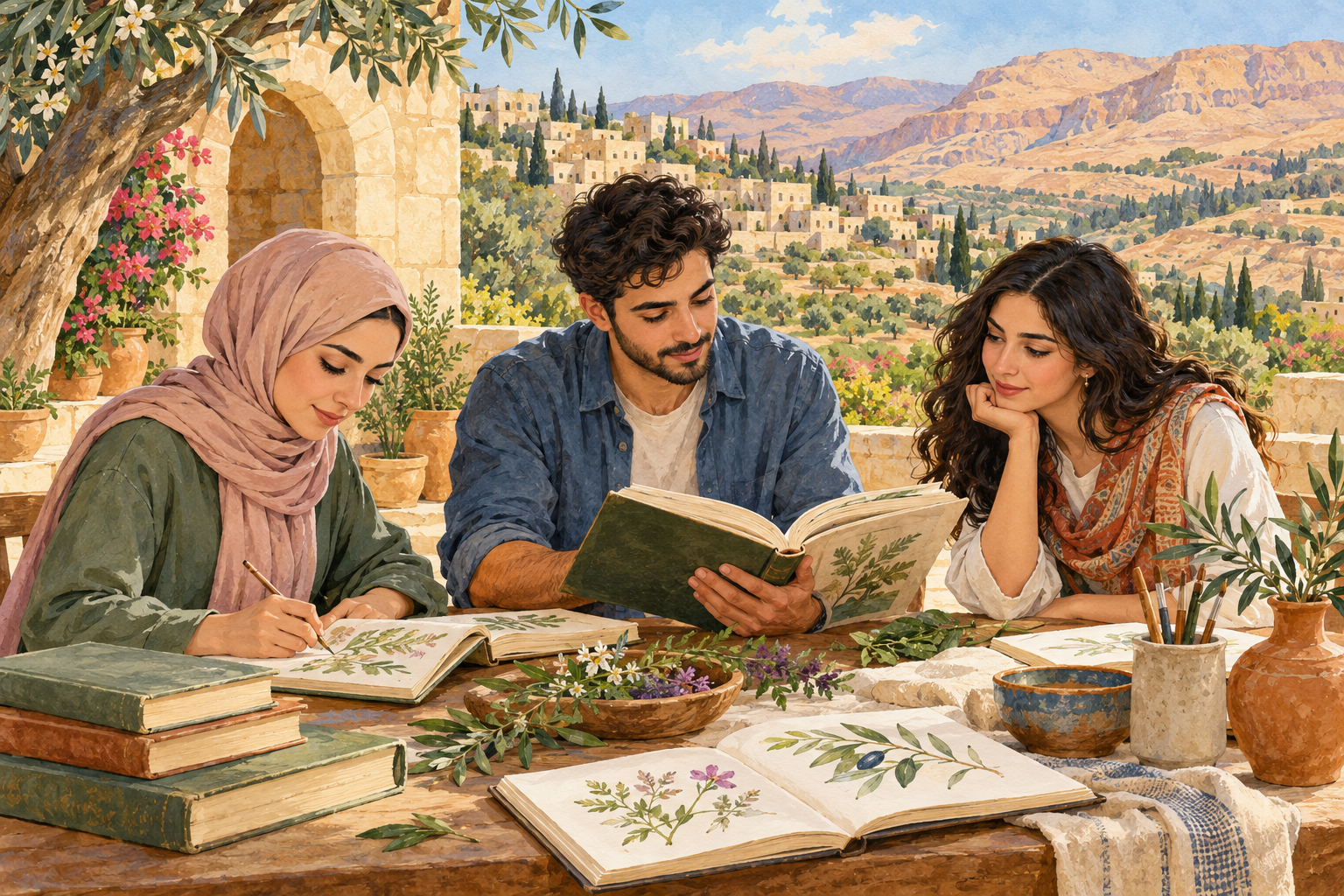
Cover illustration: an original AI-generated artistic interpretation of three adults reading and sketching plants in an imagined limestone courtyard overlooking a hillside town and rocky uplands. This is a nonliteral composite, not a photograph or an exact view of a named place.
Choose your route through Jordan
Place, history and communities
Learning, livelihoods and neighbourhoods
Services, food and creative life
Heritage, environment and wider connections
1. Geography and Landscapes
Location and the rift
Jordan sits in southwestern Asia, where the southern Levant meets the northern Arabian Peninsula. The foreign ministry describes an arid and semi-arid setting, with long hot summers and shorter winters bringing limited rainfall. Its geographical account identifies Aqaba as the kingdom's sole maritime outlet, with roughly twenty-five kilometres of Red Sea coastline. That coastal opening contrasts with the much broader inland territory. (Foreign ministry geography)
The Dead Sea landscape combines a deep depression with sharply rising surrounding ground. In its account of a May 2006 satellite image, NASA identifies highlands and plateaus ending in escarpments beside the basin. The Jordan River enters from the north, while wadis deliver water intermittently after rain. The image also shows irrigated squares along the eastern shore. These observations distinguish natural relief from visible human modifications without presenting an old image as today's shoreline. (NASA Dead Sea image)
Sand and seasonal channels
A satellite view of Wadi Rum taken in July 2001 reveals contrasts within the southern desert. NASA describes rocky peaks separated by sandy valleys whose colours range from beige to brick. Sparse vegetation marks the naturally dry ground, while circular fields east of the protected landscape indicate irrigation. Reading those different shapes together gives a more precise picture than imagining a uniform sand sea. The observation concerns one dated scene, not every desert district. (NASA Wadi Rum image)
Wadis provide another way to read apparently empty ground. A NASA description of southeastern Jordan identifies dense branching networks of these channels in an image acquired in May 2001. Its explanation distinguishes a streambed from a river that flows continuously: a wadi can remain dry except after substantial seasonal rain. The pattern therefore records pathways for occasional water rather than proof of permanent streams. Aridity and drainage belong in the same geographical picture, not in opposing categories. (NASA southeastern Jordan image)
Basalt country and the gulf
The Harrat offers a different desert surface, covered with dark basalt stones rather than continuous dunes. In their 2013 research account, Stephan Kempe and Ahmad Al-Malabeh describe loess beneath the stones and muddy depressions where rainfall redistributes fine material. The loess retains moisture, while stones reduce evaporation. Their account explains how vegetation can emerge among rocks during winter and spring. An apparently barren surface can therefore conceal conditions supporting seasonal pasture and a long archaeological record. (Kempe and Al-Malabeh)
Jordan's maritime geography also extends beyond its own shore. NASA's account of an astronaut photograph from June 2013 locates the Strait of Tiran between the Red Sea and Gulf of Aqaba. Deep passages through this narrow entrance accommodate ships travelling towards Jordan and Israel. The photograph distinguishes deep-water passages from turquoise shallows around Tiran Island. It helps explain how access to a gulf involves a wider marine setting, without supplying navigation instructions or current shipping advice. (NASA Gulf of Aqaba image)
2. Ancient and Medieval Jordan
Investigating early settlements
The Shubayqa project investigates early settlement through material traces. Its University of Copenhagen overview records excavations at Shubayqa 1 during 2012 to 2015 and Shubayqa 6 during 2014 to 2022. Stone architecture, burials, animal remains and plant material survive at these sites beside a northern Jordanian mudflat. Surveys also identified previously unknown prehistoric locations. These finds allow researchers to ask how communities occupied a landscape very different from a permanent urban centre. (Shubayqa project overview)
At Pella, excavation reveals buildings layered above earlier buildings. Stephen Bourke's report on the 2013 season describes work beneath a Late Bronze Age residence that reached a Middle Bronze Age palace. Repeated plaster floors and rebuilt walls preserve changes within these complexes. Large lined pits also contained unusual objects, but their purpose remained uncertain. The report considered water management and ritual interpretations without settling the question. Archaeological knowledge includes unresolved alternatives alongside observed structures and objects. (Bourke Pella report)
Monuments and neighbourhoods
Petra's Great Temple illustrates why a familiar label does not settle a building's function. Martha Sharp Joukowsky's report on the 2005 excavations notes a theatre within the monumental complex and suggests civic as well as religious uses. Excavation addressed several precincts beyond the standing temple. Probes below floors exposed sequences of construction and reuse. The report also identified uncertainties in dating particular stairs, showing how discoveries can complicate an established historical account. (Joukowsky excavation report)
Jerash research looks beyond conspicuous monuments. The Danish-German Northwest Quarter project began in 2011 to examine a terraced hill inside the ancient city walls. Its outline describes dense building remains across approximately four hectares and asks about continuity and change in settlement. It also identifies uncertainties about the nearby street layout. A monumental city can be well known while particular neighbourhoods still require investigation of their own histories. (Jerash project outline)
Medieval villages and castles
Islamic Baydha challenges an account of the Petra region that ends with its ancient monumental city. The project summary for 2018 and 2019 describes investigation of a rural village north of Petra, including a habitation and two mosques. Its questions concern architecture, daily life and relationships with nearby settlements during the Middle and Late Islamic periods. It describes training and local engagement. Training includes Jordanian and international archaeologists, while school activities connect research with communities around Petra. (CBRL Baydha summary)
Karak's castle and town preserve several medieval building phases. Micaela Sinibaldi's project account distinguishes Crusader structures from subsequent Ayyubid and Mamluk additions and reuse. Recording walls through photogrammetry and building archaeology helps researchers reconstruct those relationships before choosing excavation locations. The account reports chapel excavations and identification of medieval town walls during the 2025 season. Rather than treating the castle as a single frozen moment, this approach reads standing masonry as evidence of successive construction, adaptation and occupation. (Sinibaldi Karak project)
3. Ottoman and Modern Transitions
Ottoman connections and revolt
The Hejaz Railway connects Ottoman ambitions with modern Jordan. The Jordanian railway institution dates the announcement of the project to September 1900 and completion to September 1908. Its historical account emphasises the transport of pilgrims and the reduction of journeys previously undertaken by camel. It also records Abdullah using a building at Maan station and travelling by train to Amman in 1921. Railway history intersects with political transition, not only technology. (Hejaz Railway history)
The Royal Hashemite Court places Sharif Hussein at the centre of its account of the Arab Revolt. Its biography dates the opening action to 10 June 1916 and names his sons Ali, Abdullah, Faisal and Zeid as military leaders. It traces his life between Istanbul and Mecca. This is the dynasty's own historical presentation, useful for understanding how it explains its origins. The biography also records two periods of exile in Istanbul and a return as Emir of Mecca. (Royal Court Hussein biography)
An emirate and its council
Abdullah's movements locate the formation of the emirate. The Royal Court biography records his arrival in Maan in November 1920 and Amman in March 1921. It describes an agreement with Britain for an emirate under the British mandate, followed by independence in May 1946. These dates distinguish the establishment of an administration from later sovereign independence. This official dynastic biography includes celebratory judgements that need separating from its chronology. (Royal Court Abdullah biography)
Representative institutions also developed through distinct stages. The Senate's history records elections for the first Legislative Council in 1929 and its first meeting that April. The council could consider legislation and question government policy, but its powers were restricted. The account notes that it could not subject the government to a confidence vote and lacked authority over international treaties. The prime minister chaired meetings when present, directly linking the council to the executive leadership. (Senate historical account)
International membership and agreements
A diplomatic document marks Jordan's entry into the United Nations. Signed in Amman on 11 October 1955, the declaration accepted the obligations of the UN Charter from the point when Jordan became a member. The treaty collection records its presentation later that month and admission on 14 December. The declaration and the admission are therefore separate events. Reading their dates together shows international membership as a documented process, not just a year on a timeline. (UN membership declaration)
The 1994 peace treaty with Israel provides another documentary landmark. Its first article establishes peace upon exchange of the instruments of ratification, while the following article sets out commitments concerning sovereignty, security and peaceful settlement of disputes. The United Nations treaty record distinguishes signature on 26 October from entry into force on 10 November. These are the terms and dates of the historical agreement. They do not establish how relations developed afterwards or describe present border conditions. (UN treaty text)
4. Institutions, Citizenship and Local Government
Constitutional principles and participation
Citizenship has a legal framework and a social meaning. The Constitution published by the Jordanian Senate states that nationality is determined by law and that Jordanians are equal before the law despite differences of race, language or religion. Those provisions describe constitutional commitments, not a measurement of how every person experiences public life. Article 6 also includes women, young people and people with disabilities within its statements of state responsibilities. (Senate Constitution)
The Independent Election Commission's account dates its establishment to 2012 and the beginning of its work to May that year. It identifies the parliamentary election of early 2013 as the first it managed. The account presents independence, participation and public confidence as reasons for creating the institution. Those purposes explain its place in the political landscape, but do not independently evaluate electoral outcomes. Its stated aims include addressing past shortcomings and restoring confidence in electoral outcomes. (Election Commission history)
Reform and local priorities
The Constitutional Court's historical introduction records its first members taking their oath on 6 October 2012, when work began. Taher Hikmat chaired that initial group. The account records three additional appointments in October 2014 and another group in October 2016. It then identifies Hesham Faleh Al Tal as the chairman appointed in October 2018. These entries document successive stages in the institution's personnel history, rather than identifying present officeholders or explaining constitutional powers. (Constitutional Court history)
Local government brings another scale into view. The Ministry of Local Administration describes centralised planning as a difficulty when decisions insufficiently reflect local needs. Its account also acknowledges obstacles to decentralisation, including limited transfer of powers and multiple governmental reference points. Municipal and governorate councils appear within that discussion as participants in local development. The central idea is the relationship between national oversight and local priorities, not that decentralisation automatically removes tensions or unequal outcomes. (Local Administration account)
Rights and public accountability
The National Centre for Human Rights describes itself as a public-benefit institution with administrative and financial independence. Its stated remit includes monitoring and receiving complaints, alongside work concerned with protection and promotion of rights. This gives it a distinct role, different from a court or elected council. The description explains its intended work. The centre also identifies units for studies and international cooperation, strategic planning, and communications alongside its rights commissions. (NCHR institutional description)
The Integrity and Anti-Corruption Commission's welcome statement highlights a tension within public accountability. It presents openness about institutional work as important, while also emphasising confidentiality during inquiries and protection of individual reputations. The statement describes citizens, public bodies, businesses, civil society and the media as partners in resisting corruption. These are declared principles, not a scorecard of performance. They show why demands for transparency do not mean that every detail of an investigation should become public. (Integrity Commission statement)
5. People, Languages and Communities
Population and language
Jordan's 2015 census offers a historical picture, not a population count for today. The Department of Statistics carried out fieldwork from late November to early December and reported roughly nine and a half million people. Its results distinguished Jordanian from non-Jordanian residents and documented household size and geographical distribution. The census reported an average household size of nearly five people and distinguished voluntary movement from displacement in its research aims. (DOS 2015 census)
Language also has an institutional history. The King Faisal Prize biography written for its 2017 award describes the Arabic Language Academy of Jordan, established in 1976. Its work included translating scientific material and publishing specialised glossaries to develop Arabic terminology. Language planning appears as organised intellectual work involving specialists, not merely replacing words. The award recognised translation and technical terminology work; the biography also describes a journal, research, conferences and collaboration with educational institutions. (King Faisal Prize biography)
Communities and associations
Bedu communities should not be reduced to permanent movement across empty desert. UNESCO's account of the cultural space around Petra and Wadi Rum explicitly includes both settled and nomadic communities. It describes environmental knowledge and oral traditions, including poetry, stories and songs connected to particular places. Its discussion also recognises changes associated with settlement. This describes specific communities and their heritage, not every Jordanian family or traditions that never change. (UNESCO Bedu account)
Community associations make another part of social life visible. A Japanese embassy release from January 2009 describes a grant to the women's branch of the Circassian Charity Association. It identifies the branch as a non-profit organisation established in 1972 and explains that the project would equip a kitchen for vocational training and employment opportunities. The release documents a particular agreement and its intended purpose. It does not establish later outcomes or represent all Circassian experiences. (Japanese embassy 2009 release)
Displacement and different categories
UNRWA's Jordan profile distinguishes registered Palestine refugees from the wider population and explains that most, but not all, hold full citizenship. It also distinguishes living in a refugee camp from refugee registration: only a minority of the registered population lives in recognised camps. The agency describes providing services rather than administering or policing those camps. These distinctions keep several categories from collapsing into one, without claiming a complete history of Palestinian communities in Jordan. (UNRWA Jordan profile)
UNHCR's account of its presence in Jordan describes work in Amman, the Azraq and Zaatari camps, and Irbid, alongside outreach through partner locations across governorates. That geographical spread is a useful reminder that a refugee population cannot be understood solely through photographs of camps. Its structure comprises a main country office, two camp offices and an Irbid field unit. Its scope differs from a census: they are not interchangeable portraits of the population. (UNHCR Jordan profile)
6. Education and Learning
Measuring learning and reaching learners
Education can be studied through the information institutions collect. In a 2022 interview, ministry official Wafa Khataneh described Jordan moving from paper and spreadsheet reporting towards a digital monitoring framework. The work covered six areas, including early childhood education, equity, quality and vocational education. Fewer, more useful indicators were intended to support annual reviews. This was an effort to make educational change observable, not evidence that every intended improvement had already occurred. (IIEP UNESCO)
Learning also moved beyond classroom walls during the pandemic. UNICEF described Learning Bridges as a programme for pupils in grades four to nine, combining printed activities with additional digital resources. Parents were encouraged to support exploration rather than replace teachers, while teachers were offered training and guidance for feedback. The design makes an important distinction: home learning need not mean learning alone. Printed materials, family encouragement and professional support played different roles within this approach. (UNICEF)
Skills and discovery
Vocational learning offers another view of education. A UNESCO project announced in 2024, with a planned duration through 2027, brought together curriculum development, teacher training, career guidance and engagement with the private sector. It aimed to strengthen technical and vocational education in Jordan. These were programme intentions rather than a completed national transformation. They nevertheless show how a learning initiative can connect what teachers teach with the capabilities employers and communities may need. (UNESCO)
The Children’s Museum Jordan places investigation at the centre of its educational approach. Its description of learning through play asks children to explore, question, test and reach conclusions through their senses. Alongside interactive exhibits, the museum identifies spaces such as an art studio, library, garden and tinkering laboratory. These settings present learning as something children actively do. They also broaden the meaning of an educational place beyond textbooks, desks and a classroom teacher. (Children’s Museum Jordan)
Participation and opportunity
The 2022 evaluation of UNICEF’s Makani programme offers a cautious account of educational benefits. Participants reported improvements in motivation, confidence and school performance, while centres were valued as inclusive places for children and families. However, the evaluators noted differences between participant and comparison groups, including nationality and vulnerability. Their analysis therefore separated groups to reduce bias. Positive reported experiences mattered, but they did not remove the need to examine who was being compared with whom. (UNICEF evaluation)
University access can depend on support beyond admission itself. A 2022 United Nations account of the DAFI scholarship programme in Jordan described assistance with tuition, books, transport and subsistence for refugee students. It also recorded students pursuing different subjects rather than a single route. This account places the practical costs of participation beside academic opportunity. It describes a particular scholarship initiative at that moment, not a guarantee of funding or eligibility for future applicants. (UN Jordan)
7. Research and Technology
Shared instruments and patient engineering
Jordan hosts scientific infrastructure used by researchers from other countries. SESAME opened in Allan in May 2017 as an international synchrotron light facility developed under UNESCO auspices. Its research fields include materials, chemistry, environmental studies and archaeology. Scientists visit for experiments, then return to their institutions to analyse results. The arrangement separates access to a major shared instrument from permanent relocation, creating opportunities for collaboration while researchers remain connected to their home institutions. (SESAME)
Large scientific facilities depend on carefully checked engineering steps. In March 2023, the BEATS project reported that its beam had reached the sample position at SESAME. Earlier work had brought light into the optics enclosure, followed by alignment, tests and changes to shielding. The account described commissioning underway rather than routine experiments already completed. It shows how scientific capacity develops through installation and verification before an instrument becomes available for research. (BEATS)
Campuses and changing disciplines
El Hassan Science City illustrates another scientific connection. The Royal Scientific Society records its campus inauguration under that name in 2007. In Al Jubaiha, Amman, the site brings together research facilities, Princess Sumaya University for Technology, entrepreneurship support and an incubation organisation. The stated purpose is to connect education, mentoring and practical application. Physical proximity alone does not prove successful innovation, but the campus places stages of that process together. (Royal Scientific Society)
The institutional history of Princess Sumaya University for Technology traces technical education through programme milestones. Established in 1991, it initially offered a single degree in computer science. Later additions included computer engineering, software engineering, doctoral computer science and data science. A degree combining data science and artificial intelligence followed in 2018. These dated additions document how one university expanded its academic range; they are not a complete account of Jordanian higher education. (PSUT)
Organisation and public imagination
Scientific activity also needs institutions that organise priorities and support. The Higher Council for Science and Technology describes its establishment in 1987 to build a national scientific and technological base. Its stated responsibilities include funding, directing research towards development priorities, establishing specialised centres and representing Jordan in scientific activities abroad. This is an institutional description of purpose, not a measurement of research performance. It nevertheless identifies coordination as part of scientific capacity alongside laboratories. (HCST)
Space technology connects engineering with public representation in the story of JY1Sat. AMSAT’s account identifies it as Jordan’s first satellite, under the Masar initiative with university and international support. Its name recalls the amateur radio call sign of King Hussein. The satellite’s described functions included transmitting stored images of Jordanian life and culture and recorded audio. This example brings together university support, radio technology and cultural communication without suggesting that one satellite represents a national space industry. (AMSAT)
8. The Economy, Enterprise and Work
Economic evidence and monetary history
Economic figures become clearer when attached to their reporting period. The World Bank’s summer 2024 economic monitor described growth across manufacturing, agriculture and services during 2023, alongside continuing employment challenges. It also identified disruptions to trade through Aqaba and weaker tourism from late 2023. These observations belong to that report’s July 2024 information cutoff. They illustrate an economy with several productive activities and exposure to regional events, rather than a description of present conditions. (World Bank)
Currency provides a history of economic institutions. The Central Bank’s account records the Jordanian dinar entering circulation in July 1950, replacing the Palestine pound. It describes an earlier currency board established in 1949 and the later formation of the Central Bank in 1964. The first banknote series issued by the bank followed in 1965. These milestones distinguish a currency’s introduction from the creation of its later managing institution, rather than assigning both one founding date. (Central Bank of Jordan)
Enterprises and workplaces
Support for smaller enterprises extends beyond supplying money. JEDCO’s strategic plan for 2022 to 2025 listed technical assistance, capacity building, digital transition and access to international standards among its objectives. Its programmes also addressed marketing, rural development and businesses operated from homes. Read as a plan, this shows what an enterprise agency intended. It does not establish that every planned programme achieved its targets or that all businesses had the same opportunities. (JEDCO)
Factory work deserves attention alongside export performance. Better Work Jordan’s 2025 annual report, covering 2024 into January 2025, described continuing problems with excessive hours, recruitment and implementation of workplace agreements. It also documented training for grievance handling and multilingual induction materials for workers. These findings complicate a story of uninterrupted improvement. The report presents workplace conditions as requiring repeated assessment, not as an automatic consequence of garment exports. (Better Work Jordan)
Care and creative production
Employment depends on arrangements beyond the workplace. The International Labour Organization’s report on its women’s work programme for 2022 and 2023 described collaboration with SADAQA on childcare and transport barriers. Its discussion of daycare emphasised affordability, access, professional recognition and training for care workers. This makes childcare visible both as support for working parents and as work for other people. The report describes policy development and programme activity, not proof that these barriers had disappeared. (ILO)
Textile production can involve design and market connections as well as factory processes. UNIDO’s account of a Jordanian textile value chain project described technical training, support for local brands and a competition for designers. It identified women’s participation as a project target and placed activities in Amman and northern governorates. It linked new collections with promotion in international markets. Its design nevertheless shows how creative skills and commercial organisation can connect in enterprise support. (UNIDO)
9. Agriculture and Pastoral Landscapes
Seeds and living inheritance
Agricultural heritage includes material stored, studied and grown again. Jordan’s National Agricultural Research Center records its seed bank’s establishment in 1993 and the start of operations in 1996. Collections include local crop varieties and wild relatives of cultivated plants. Alongside seeds, preserved plant specimens support identification and taxonomic study. The centre also stresses documenting local knowledge. Conservation here therefore concerns both biological material and information about its origins and uses. (NARC)
Living trees require different care from stored seeds. The research centre’s Mahras olive account explains that the local name refers to trees with trunks exceeding three metres in circumference. It identifies urban expansion and divided agricultural holdings among pressures on these trees. Conservation activity includes research orchards and work with growers. This connects botanical investigation with caring for cultivated landscapes, without requiring every old olive tree to have a precise historical age. (NARC)
Water and rural livelihoods
In the Badia, ICARDA and Jordanian researchers developed a watershed approach linking uplands with areas downstream. Small water-harvesting structures and native shrubs were paired with improved use of floodwater for barley production. Research near Al Majidyya combined monitoring with modelling of runoff and erosion. The project account presents these connected measures as a way to restore degraded pastoral landscapes. Its evidence comes from a particular setting, not proof that identical results follow across all dry country. (ICARDA)
Rural development also involves how produce reaches buyers. IFAD’s Rural Economic Growth and Employment Project describes support for smaller farmers and rural enterprises through training, market connections and financial services. Its design emphasises crops of higher value requiring less water, with an initial focus on Ajloun, Jerash, Balqa, Madaba and Mafraq. These are project priorities, not prescriptions for every farmer. The project links production with enterprise capacity and market access rather than ending with the harvest. (IFAD)
Learning in fields and reading seasons
An agreement announced by FAO in August 2026 proposed farmer field schools in Madaba, Karak, Tafileh and Maan. It followed training for agricultural extension officers and aimed to bring practical learning to farmers. Water efficiency and adaptation to changing climate conditions were central themes. The announcement specified planned activities and expected beneficiaries, not completed results. Its significance lies in connecting extension services, field demonstrations and farmers’ own learning. (FAO)
Agricultural conditions also change between seasons. FAO’s Jordan brief dated July 2026 reported favourable rainfall for winter wheat and barley and forecast production above the recent average. Yet it still anticipated substantial cereal imports during the following marketing year. The contrast is important: a good domestic growing season does not necessarily remove import needs. Because the brief used forecasts around harvest time, its figures were an assessment rather than a final production record. (FAO)
10. Cities, Homes and Community Life
Seeing cities at different scales
A neighbourhood can have utility connections while still facing infrastructure pressure. UN-Habitat’s 2022 Amman profile found electricity, water and sewerage connections in Al Hashmi Al Janoubi, but its capacity assessment indicated high demand on the water network. Residents interviewed in November 2021 also described stormwater problems involving slopes and blocked drainage. These neighbourhood findings distinguish being connected from having adequate capacity, while preserving the date and local scope of the evidence. (UN-Habitat)
The corresponding Irbid profile moved from the city towards particular neighbourhoods. Areas were assessed with the municipality, then selected for closer examination of access to facilities, transport and basic services. Workshops helped identify Al Afrah in Sarih as a pilot neighbourhood for further work. This account shows why citywide averages can be insufficient for local planning. Five areas were evaluated and scored before three neighbourhoods were chosen, creating a staged basis for further scenario building. (UN-Habitat)
Homes and gathering places
Housing questions are not answered by counting buildings. A 2021 UN-Habitat thematic guide highlighted the coexistence of vacant homes and households in crowded or inadequate accommodation. Its recommendations included stronger institutional capacity and closer integration between housing and urban planning. The guide treated provision and access as connected problems. Historically, it helps explain why an apparent supply of dwellings may still leave important needs unmet, without offering a current property assessment. (UN-Habitat)
An urban story appears in UN-Habitat’s June 2025 account of Queen Noor Park in eastern Amman. Young people, local designers and residents contributed to changes including shaded seating, play equipment and tables for gatherings. The account described women and families using the space more. These are reported experiences from one neighbourhood, not a national measure of social cohesion. They show how ordinary design choices can matter alongside larger urban development plans. (UN-Habitat)
Shared resources and housing institutions
Libraries offer another shared urban resource. An undated Greater Amman Municipality announcement described introducing an electronic catalogue linking books in the central library and its branches. It also recalled the public libraries department’s establishment in 1960 and described sections for lending, reference works, children and periodicals. The announcement documents a stage in organising access to collections. Its historical description should not be read as a current directory of branches, opening arrangements or collection totals. (Greater Amman Municipality)
Jordan’s Housing and Urban Development Corporation describes shifts behind housing policy. Its account links recommendations adopted in 1989 with a greater role for private production, followed by the merger of two public bodies in 1992. Further restructuring in 1996 emphasised facilitating partnerships and the production of apartments and serviced residential plots. These changes provide a history of public and private housing participation. They do not imply that affordability challenges ended when institutional responsibilities were reorganised. (HUDC)
11. Transport and Infrastructure
Access before speed
Transport concerns access to work and services as well as movement. The World Bank transport diagnostic of February 2022 identified fragmented operations, disconnected fares and weaknesses in pedestrian access. Its recommendations combined investment with institutional changes rather than treating new vehicles as a complete solution. Read historically, the assessment explains why a useful transport network needs connections between routes, dependable information and attention to different passenger needs, including those of women. (World Bank transport diagnostic)
The EBRD Amman Bus Project, approved in December 2020, illustrates this approach. Its disclosed design combined a fleet with ticketing, passenger information and arrangements for operating and maintaining vehicles. The planned expansion included both diesel buses and an electric pilot. These were project commitments, not a count of vehicles operating today. The distinction matters because buying equipment, arranging maintenance and delivering a reliable service are related but separate stages of infrastructure development. (EBRD Amman bus project)
Gateways for people and goods
Queen Alia International Airport provides another scale of connection. The airport operator records the opening of a new terminal in March 2013 and a further expansion in September 2016. Those stages increased stated annual passenger capacity first to nine million and then to twelve million. Capacity describes what infrastructure is designed to handle, not how many people actually travelled. The operator also describes further expansion ambitions, which should not be confused with completed facilities or measured traffic. (Airport International Group profile)
At Aqaba Container Terminal, infrastructure serves the movement of goods. The terminal operator describes cranes, reach stackers, empty container handlers and terminal trucks as parts of one cargo system. Its account records a partnership agreement signed in 2006 between Aqaba Development Company and APM Terminals. This connects a physical waterfront with commercial organisation. The agreement provided for a twenty-five-year partnership, linking terminal development with the movement of cargo through the Aqaba economic zone. (Aqaba terminal profile)
Maintaining assets and testing proposals
Older projects reveal why maintenance belongs beside construction in a country atlas. The World Bank completion report of March 2001 assessed rehabilitation along the Desert Highway and other important roads. It linked the preservation of road investments with control of heavy-vehicle loads and recorded surveys protecting archaeological remains. Those findings concern a particular historical programme. They nevertheless illustrate a useful distinction: a road is not simply a completed surface, but an asset requiring continuing management. (World Bank transport completion report)
Rail proposals require equally careful reading. An undated EBRD brief requested a preliminary feasibility study for a possible connection between El Mahatta in Amman and Queen Alia International Airport. It asked consultants to examine routes, infrastructure, rolling stock and potential private operation. The document establishes that an option was being investigated; it does not establish an operating airport railway. Separating a study, a financing decision and an actual service prevents a future proposal becoming a misleading present fact. (EBRD airport rail study)
12. Health and Community Care
Prevention and community support
A WHO account dated September 2025 describes Jordanian efforts to bring prevention and management of noncommunicable diseases into primary care. It discusses national strategies on nutrition, tobacco and mental health alongside professional training and public awareness. This is a report of policies and programmes, not proof that every person receives the same care. It shows that health services include prevention and sustained support, rather than only treatment. (WHO prevention account)
Community support appears in the WHO mental health programme account. It describes collaboration with the Ministry of Health beginning in 2008, assistance to community centres and support for an association of service users and families. Training involved several kinds of institutions, including universities and nongovernmental organisations. This historical description places families and community organisations within the health landscape. It does not establish present service availability, but shows why care cannot be understood solely through hospital buildings. (WHO mental health programme)
Information and specialist institutions
Public health depends on information travelling as well as patients. In May 2015, WHO described a Jordanian surveillance programme using mobile tablets to report cases and connect laboratory results with records. Its account followed a pilot conducted during 2014 and described national implementation and staff training. The programme linked disease categories within one reporting approach. This is a dated example of health information infrastructure, not a guarantee about the coverage or speed of reporting today. (WHO surveillance report)
The King Hussein Cancer Foundation profile distinguishes two connected roles. The foundation, established in 2001, undertakes fundraising, advocacy and development, while the associated centre provides cancer care and research. Its institutional account also emphasises outreach and support for patients. A board of trustees oversees both institutions. Their stated priorities include multidisciplinary treatment, patient dignity, prevention, screening and research across the Arab region. The profile connects those goals with fundraising intended to sustain the centre and support access. (Cancer foundation profile)
Equipment and evidence
A UNICEF announcement from February 2022 makes the supporting infrastructure of immunisation visible. It records a donation to the Ministry of Health that included cold rooms, refrigerated vehicles, refrigerators, freezers and temperature-monitoring devices. The announcement also describes work on a national equipment inventory. The point is organisational rather than clinical: delivering a vaccine depends on storage, transport and information about available equipment. This historical example does not provide a vaccination schedule or personal medical guidance. (UNICEF cold chain announcement)
The national emergency obstetric and newborn care assessment examined a different part of the system. Its fieldwork took place from August to October 2022, covering maternity facilities across the governorates. The assessment considered equipment, staffing, records, referral arrangements and the availability and use of services. Such a facility study helps planners identify differences between locations and types of institution. It is evidence about the assessed period, not a promise of current capacity or proof that later outcomes improved. (UNFPA maternity facility assessment)
13. Food and Culinary Traditions
A meal and a welcome
Mansaf carries meanings beyond its ingredients. The UNESCO account accompanying its 2022 inscription describes meat cooked in a yogurt sauce, served with rice or bulgur and thin bread. Preparation can bring conversation, songs and shared work into the occasion. Knowledge passes through families and educational settings. The heritage account therefore presents a meal as a social practice, not simply a national recipe. It also records variation in ingredients and ways of eating rather than one compulsory form. (UNESCO mansaf inscription)
Arabic coffee belongs to a wider regional tradition that includes Jordan in the expanded UNESCO inscription of 2024. The account associates serving coffee with generosity, gatherings and dialogue, while describing practices learned across generations. Poetry and the exchange of memories can accompany the cup. This shared inscription is important: the tradition is not represented as exclusively Jordanian. Its significance lies in relationships between hosts, guests and communities, not in reducing hospitality to a fixed checklist for outsiders. (UNESCO Arabic coffee inscription)
Deep history and local change
Food history in the territory extends far beyond modern national dishes. A 2018 archaeological study analysed charred food remains from Shubayqa 1 in northeastern Jordan. The researchers identified products resembling flat bread made by people living before farming became established. Their evidence challenges the assumption that bread necessarily began with agriculture. It does not demonstrate an unbroken recipe reaching modern kitchens. The finding belongs to a specific archaeological site and scientific analysis, on a deeper timescale. (Shubayqa bread research)
Local research can also challenge the idea of an unchanged tradition. Ammar Alobiedat studied mansaf in Hartha through conversations and ethnographic work during late 2015 and early 2016. Residents recalled changes involving bread, bulgur, rice, sauces and nut toppings. The author explicitly cautioned against extending this local history to all Jordan. Read within that boundary, the study shows how memory, available ingredients and household circumstances can reshape food while its social importance remains recognisable to participants. (Hartha mansaf study)
Skills and livelihoods
A meeting documented by the office of Queen Rania in September 2018 brought together fifteen women producing foods in Irbid, Karak, Zarqa and Salt. Their products included jameed, makmoura, preserves and pickles. The account also records discussion of marketing, networking and financial obstacles. This event presents food knowledge as enterprise. It does not describe every producer, but connects the preservation of familiar foods with the practical difficulties of sustaining a small business. (Queen Rania food producer meeting)
The Jordan River Foundation describes Al Karma Kitchen as an initiative established in 2006, with foods prepared by women from local communities. Its listed products range from maamoul and cookies to locally flavoured macarons and frozen foods. Inherited skills and newer products can coexist within the same workplace. The foundation reports eighty-eight beneficiaries for 2020 and lists thirteen frozen food items, placing food preparation alongside a stated community enterprise purpose. (Al Karma Kitchen profile)
14. Visual Art, Craft and Design
Images and materials
Quseir Amra preserves a striking chapter of early Islamic visual culture. UNESCO describes the reception hall and bath complex of this eighth-century Umayyad establishment as richly painted with human figures, animals and other scenes. A ceiling depicts the heavens. These paintings connect architecture with artistic traditions from the surrounding region. Their significance also depends on conservation: the heritage account identifies moisture, salts and ageing restoration materials among threats, reminding readers that surviving images require active care. (UNESCO Quseir Amra)
Craft traditions continue through changing materials and institutions. The Jordan River Foundation describes embroidery, weaving and products made from reeds and banana leaves within its design programmes. Its account links the Bani Hamida weaving project with Makawir and records the use of plant materials at Wadi Al Rayan. The Wadi Al Rayan project began in 1997. Together within this institutional profile, they show design connecting skilled work, local materials and livelihoods. (Jordan River Designs profile)
Writing and artistic exchange
Arabic calligraphy brings language into visual form. The multinational UNESCO inscription of 2021 includes Jordan and describes skills transmitted through informal teaching, schools and apprenticeships. Traditional instruments and contemporary materials coexist, while script appears in fields such as carving, embroidery and public artwork. This is a shared artistic practice across countries and communities. Its inclusion here recognises participation in that tradition rather than assigning national ownership to the Arabic alphabet or its artistic possibilities. (UNESCO calligraphy inscription)
Darat al Funun describes itself as a platform for contemporary Arab artists and for research, documentation and exchange. Its institutional story begins in 1988, and its spaces include restored historic buildings in Amman. Residencies, workshops, exhibitions and archives place artistic production beside study and conversation. This places the institution beyond simply displaying artworks. Its fellowship encourages doctoral research, while its library and archives provide materials for studying Arab art. (Darat al Funun profile)
Collections and possible futures
The Jordan National Gallery of Fine Arts describes programmes that carry art beyond its exhibition rooms. Its Touring Museum, launched in 2009, uses a vehicle as a mobile gallery and combines works from the collection with workshops. The gallery also describes discussions and collaborations involving different art forms. These activities make the relationship between collections and public learning visible. Its Factory Platform, launched in 2018, adds artist residencies, public art and opportunities for collaborative projects by emerging practitioners. (National Gallery programmes)
Amman Design Week approached design through the theme of possibilities in its October 2019 edition. The organisers invited participants to imagine different futures rather than limiting design to immediate problem-solving. Their statement raised questions about the environment, food and other areas of everyday life. As an event manifesto, it documents an ambition and a way of framing creative work. It is not evidence that the festival solved those problems or that its ideas became public policy. (Amman Design Week 2019)
15. Music, Literature and Film
Performance and musical learning
As Samer combines singing, dancing and poetry in a tradition practised across many parts of Jordan. The UNESCO account for its 2018 inscription describes performances especially associated with weddings and involving people of different ages. Particular participants hold recognised roles, while children are encouraged to join. Performance therefore also enables learning. Its poetry and collective participation connect artistic expression with social relationships, without making every wedding or community celebration identical across the country. (UNESCO As Samer)
The National Music Conservatory offers a route into music. Its account dates its beginning to 1986 through an initiative of Queen Noor and identifies it as a project of the King Hussein Foundation. Training musicians and developing public appreciation appear together in its mission. This places education alongside performance. As a non-profit foundation project, it combines educational opportunities with performances and describes connections with local and international music organisations as part of its work. (National Music Conservatory profile)
Writers and filmmakers speaking
In an interview published in June 2021, novelist Jalal Barjas reflected on winning the International Prize for Arabic Fiction with Notebooks of the Bookseller. He spoke about characters, the meaning of words and the central place of women in his fiction. An author interview offers access to a stated creative outlook, not an objective explanation of every possible reading. An individual voice challenges the idea of literature as one national message. (Jalal Barjas interview)
The makers of Theeb described another collaborative creative process in their BAFTA press conference of February 2016. Rupert Lloyd and Naji Abu Nowar spoke about living with a Bedouin community while developing the film and working with performers who were largely amateurs. They characterised community members as contributors to its authorship. Their testimony is evidence about this production process, not every Jordanian film. It shifts attention from landscape alone towards the people and relationships involved in making cinema. (Theeb BAFTA interview)
Audiences and emerging work
Cinema also depends on places where audiences can discuss what they watch. The Abdul Hameed Shoman Foundation dates its cinema committee to 1989 and its specialised department to 1992. Its programme account brings screenings together with discussion, training and themed film weeks. This suggests a role for cultural organisations in developing audiences as well as presenting works. The description is of an institutional approach, rather than a timetable or a promise that every activity is continuously available. (Shoman cinema programme)
The Amman International Film Festival describes a particular emphasis on first achievements in filmmaking. Its stated programme combines Arab and international films with industry discussions, masterclasses and opportunities to present projects. Awards and audience participation sit alongside professional exchange. The festival offers a meeting point between emerging makers and viewers. Juries select winners in narrative, documentary, short film and international debut categories, while audiences choose favourites. The awards include the Black Iris award and cash prizes. (Amman film festival profile)
16. Heritage and Conservation
Archaeology beyond the familiar image
Petra is more than a recognisable rock facade. UNESCO describes a city whose tombs, temples and public structures depended on channels, dams, cisterns and reservoirs within an arid landscape. Its significance includes successive periods of settlement and exchange. Conservation concerns include erosion and the maintenance of systems that manage flooding. This atlas connects architecture with its setting; it does not replace a specialist Petra account or provide visitor instructions. (UNESCO Petra)
At Um er Rasas, mosaics provide another kind of historical record. The heritage account highlights representations of regional towns on the floor of Saint Stephen Church, alongside remains from Roman, Byzantine and early Islamic periods. Agricultural terraces, channels and cisterns belong to the wider site. UNESCO also notes the vulnerability of masonry and excavated floors to weathering and drainage problems. Preservation involves both celebrated images and less conspicuous structures that give them context. (UNESCO Um er Rasas)
Belief and urban life
The Baptism Site at Al Maghtas joins archaeology with continuing religious significance. UNESCO describes churches, pools, caves and other remains associated with Christian pilgrimage and the tradition identifying the place with the baptism of Jesus. These are distinct forms of evidence: physical remains document religious activity, while attribution to the baptism belongs to a living faith tradition. Conservation also concerns the surrounding river landscape and the character of the setting, not only individual structures within it. (UNESCO Baptism Site)
As Salt illustrates heritage within an inhabited town. Its UNESCO account connects yellow limestone buildings, stairways and shared public spaces with commercial growth during the late Ottoman period. It also recognises traditions of hospitality and social welfare among Muslim and Christian residents. The city is therefore valued for relationships between buildings and social practices. Protecting its historic character involves attention to development and continued use, rather than imagining conservation as the removal of everyday life from an urban setting. (UNESCO As Salt)
Rural settlements and desert records
Umm Al Jimal preserves a rural settlement shaped by basalt construction and the agricultural landscape of the Hauran. UNESCO describes courtyard houses, churches and reused military buildings alongside water collection infrastructure. Its account emphasises continuity in local building traditions through political and religious change. Inscribed in 2024, the site broadens the heritage picture beyond royal monuments. Its remains require maintenance and attention to a surrounding landscape changed by later development and land use. (UNESCO Umm Al Jimal)
Wadi Rum combines natural landforms with a long record of human presence. The UNESCO account describes rock engravings, inscriptions and archaeological remains alongside sandstone mountains and valleys. These traces show that the desert is not an empty backdrop outside history. Conservation includes protecting cultural marks in their original setting as well as the landscape itself. The account identifies weathering, graffiti and development pressures, making the relationship between natural and cultural heritage central to understanding this protected area. (UNESCO Wadi Rum)
17. Nature and Biodiversity
Habitats across contrasting landscapes
Dana Biosphere Reserve contains striking changes in elevation and terrain. The Royal Society for the Conservation of Nature describes a landscape descending from high country towards Wadi Araba, with limestone, sandstone and granite contributing to its variety. Its Arabic profile also links management with community livelihoods and identifies pressures including grazing and tree cutting. Dana illustrates ecological diversity and work to sustain it. A reserve boundary alone does not describe all the processes affecting its habitats. (RSCN Dana profile)
Azraq demonstrates the relationship between water use and wetland ecology. A Ramsar account of the 1990 monitoring mission reported deterioration linked to growing abstraction and called for stronger control, research and ecological monitoring. This records a historical problem and proposed responses, not present conditions. Its wider lesson is interpretive: protecting a wetland involves the water systems beyond its visible edge, including the demands placed on the basin supporting it. (Ramsar Azraq monitoring account)
Conservation as organised work
The Royal Society for the Conservation of Nature describes conservation as a combination of research, education, protected-area management and community projects. Its programme account also discusses captive breeding and a move towards protecting habitats, rather than focusing only on individual species. These activities connect scientific work with people living around reserves. School clubs and programmes bring biodiversity into learning. The organisation also markets community products and tourism ventures under the Wild Jordan name. (RSCN conservation programmes)
The Mujib Biosphere Reserve surrounds a canyon system that descends towards the Dead Sea. UNESCO describes mountains, wadis and an escarpment where altitude and rainfall change across the landscape. Its profile records a biosphere nomination in 2011 and also discusses livestock raising and the work of reserve staff. Nature and human activity therefore appear in the same account. The protected landscape is not understood only through dramatic scenery, but through habitats, local uses and the practical responsibilities of management. (UNESCO Mujib biosphere)
Forests and marine ecosystems
Ajloun adds northern woodland to the picture. The UNESCO biosphere profile, which records nomination in 2025, describes evergreen oak forest and the role of the area for birds using a major migration route. It also connects conservation with local enterprises and environmental education. These are connected biosphere priorities. The account concerns a particular landscape and its management aims, not a claim that forests cover most of Jordan or that development pressures have disappeared. (UNESCO Ajloun biosphere)
Aqaba Marine Reserve received World Heritage inscription in 2026. UNESCO describes connected coral reefs, seagrass beds and deeper reef habitats, with particular attention to corals resilient to thermal stress. Resilience does not mean immunity from damage. The same account identifies water quality, pollution and nearby infrastructure as continuing management concerns. This recent inscription adds a marine dimension to the country portrait and shows why protection must connect ecological research with the activities taking place around a small coastal reserve. (UNESCO Aqaba Marine Reserve)
18. Energy, Climate and Water
Planning for scarce resources
The National Water Strategy for 2023 to 2040 connects increasing supply with reducing losses. Its foreword discusses pressure on groundwater, climate change and demographic demands, while setting out plans for additional sources and expanded reuse. It also targets lower non-revenue water, including leakage and illegal use. These are strategic intentions rather than completed achievements. This distinction separates a planning framework from the changing performance of the water system. (National Water Strategy)
The 2021 renewables readiness assessment prepared by IRENA with the energy ministry makes a similar distinction between resources and delivery. Its recommendations concern electricity networks, heating and cooling, transport, investment and skills. Solar and wind potential alone do not establish a functioning energy transition. It emphasises integrating generation with infrastructure and institutions. Its recommendations belong to the conditions assessed at that time, rather than providing a current inventory of every project or policy in Jordan. (IRENA renewables assessment)
Projects and their stated purposes
The IFC disclosure for Tafila Wind describes a planned power project of 117 megawatts and arrangements to sell its electricity to the national power company. First disclosed in 2013, it also discusses financing and environmental assessment. The project combines a physical site with contracts, capital and monitoring. Its projected benefits should be read as expectations in a project document, not silently converted into independently verified operating results or a present ownership statement. (IFC Tafila project disclosure)
Renewable energy also appears in humanitarian infrastructure. In 2017, UNHCR announced a solar plant at Azraq refugee camp intended to supply electricity for shelters in two villages connected to the national grid. The announcement described a two-megawatt installation and its intended coverage. It is a dated example of using energy infrastructure within a displacement setting. The account does not establish that every camp household was connected at that point or that all later electricity needs were met. (UNHCR Azraq solar account)
Reuse and climate commitments
The MCC account of the As Samra expansion connects wastewater treatment with agricultural reuse and urban water supply. Its closed compact report describes increasing treatment capacity for Amman and Zarqa and using treated water for irrigation in the Jordan Valley. It also describes energy recovery within the plant. This is a specific infrastructure relationship, not a claim that treated wastewater serves every purpose. Engineering, finance and reuse intersect within this programme and its reporting period. (MCC As Samra report)
Climate commitments must likewise retain their dates. The updated Jordanian national contribution of October 2021 raised its stated emissions reduction target relative to a business-as-usual scenario and linked delivery to national action and international support. Its executive summary also connected adaptation with a separate national adaptation plan. This paragraph describes that historical submission, not the latest pledge or an achieved emissions reduction. The distinction helps readers separate a commitment, the resources needed to fulfil it and measured results. (Jordan 2021 climate contribution)
19. Sport and Community
Olympic and football milestones
Ahmad Abu Ghaush won the first Olympic medal for Jordan at Rio in 2016, and it was gold. In an October interview published by the Jordan Olympic Committee, the taekwondo athlete described the attention following his victory and his wish to return to training. He also emphasised his relationship with coach Faris Al Assaf. This testimony connects a celebrated result with preparation, partnership and sustained work. (Jordan Olympic Committee interview)
The Jordanian football team reached its first Asian Cup final in the tournament branded Qatar 2023 and played in February 2024. The AFC account records a defeat to Qatar by three goals to one, with Yazan Al Naimat scoring for Jordan. Keeping the tournament name separate from the calendar year avoids confusion. The result marks a particular competitive achievement, not a permanent ranking, and a country portrait can recognise the significance of reaching a final without obscuring its outcome. (AFC Asian Cup final report)
Teams and pathways
A FIFA report published in December 2022 connected the development of women’s football in Jordan with the legacy of hosting the 2016 under-seventeen World Cup. It described a professional league, a new youth competition and support for coaches and other roles. These were specific developments reported at that time. The account also acknowledged financial constraints. These developments make growth concrete, without suggesting that hosting automatically removes every barrier to participation. (FIFA women’s football report)
Basketball provides another example of a team reaching a major final. FIBA recorded Jordan in second place at the 2023 Asian Games in Hangzhou, after the Philippines won the final by seventy points to sixty. Its report also noted that Jordan had won the earlier meeting between the teams in the group stage. Those contrasting results show a tournament unfolding. They document this competition rather than establishing a fixed hierarchy between the two national teams. (FIBA Asian Games report)
Wider meanings of participation
At the Paris Paralympics on 7 September 2024, Abdelkareem Khattab won gold for Jordan in men’s up-to-97-kilogram powerlifting with a best lift of 270 kilograms. The International Paralympic Committee described celebrations with his coach and spectators. Khattab carried his coach on his shoulder while the audience stood to applaud at La Chapelle Arena. The report identified this as his second Paralympic gold, with his best lift establishing world and Paralympic records in this event. (IPC Khattab report)
Sport can also serve purposes beyond medals. The Volleyball Foundation describes a Jordan programme approved in May 2025 that combines volleyball with leadership development and psychosocial support for vulnerable and displaced young people. Its stated approach involves building trust and community engagement through structured activity. These are programme purposes and reported practices, not independently established effects for every participant. The example broadens this account to organised participation, while retaining a clear distinction between intention and demonstrated outcomes. (Volleyball Foundation programme)
20. Jordan and Singapore
A documented relationship
The relationship between Jordan and Singapore has specific historical foundations. In a speech delivered in January 2024, Prime Minister Lee Hsien Loong recalled Jordanian support for the application of Singapore to join the United Nations in 1965. He also discussed educational ties and later diplomatic exchanges. This official account establishes documented connections, rather than similarities invented for comparison. He specifically recalled a Jordanian flight bringing Singaporean students home during the pandemic, connecting educational ties with practical assistance. (Singapore prime minister speech)
Trade provides one formal connection. Enterprise Singapore records that the Singapore Jordan Free Trade Agreement entered into force on 22 August 2005. Its official materials describe trade in goods and services, with rules and schedules governing the agreement. This is evidence of an established economic framework, not proof of a particular investment outcome or a recommendation to trade. The framework also addresses electronic commerce and business cooperation. Practical eligibility questions require a different guide. (Enterprise Singapore trade agreement)
Education and technical exchange
A university visit offers a more focused example. Nanyang Technological University reported that King Abdullah visited its campus on 20 June 2019 to learn about education, research and innovation. The account identifies its centre for three-dimensional printing and its air traffic management research institute among the places visited. This documents an encounter with particular research activities. It does not establish a joint research programme, a technology transfer or an agreement unless a separate record demonstrates those further steps. (NTU royal visit report)
Vocational training has a more explicitly documented cooperative basis. A Singapore foreign ministry statement of July 2009 records an agreement with Jordan for regional training at a centre in Marka. The subjects included maintenance and diagnosis of heating and air conditioning systems. The statement also described courses already conducted through the Singapore Cooperation Programme. This documents capacity building within an Asia and Middle East framework, not present course or participant numbers. (Singapore regional training statement)
Dialogue and business encounters
King Abdullah addressed the International Conference on Cohesive Societies in Singapore in June 2019. The published translation of his speech emphasised interfaith respect, cooperation and resistance to exclusion. It is a documented contribution to a particular international discussion. A speech states a position and an aspiration; it does not by itself prove that societies share identical histories or that a bilateral agreement was made. This recognises dialogue without overstating its consequences. (Jordanian king Singapore speech)
In January 2024, the Jordan Source programme reported a delegation and technology forum in Singapore involving Jordanian businesses and public institutions. Its account records presentations, meetings and two memoranda involving professional and industry partners. These are documented activities, not evidence that every proposed collaboration produced an investment. One memorandum linked the Institute of Banking Studies with Fintech Academy in Singapore; the other linked Intaj, the Jordanian information technology association, with BIGO. Presentations also addressed outsourcing and gaming. (Jordan Source technology forum)
Frequently asked questions about Jordan
Can arid landscapes contain wadis?
Yes. NASA describes branching wadis in southeastern Jordan that generally remain dry except after seasonal rain. (NASA southeastern Jordan image)
Do all registered Palestine refugees in Jordan live in camps?
No. UNRWA describes camp residents as a minority of its registered Palestine refugee population in Jordan. (UNRWA Jordan profile)
What is SESAME in Jordan?
SESAME describes itself as an international synchrotron research facility in Allan, where visiting scientists conduct experiments before returning home to analyse their results. (SESAME)
What does Jordan’s seed bank preserve?
According to the National Agricultural Research Center, its seed bank conserves local crop varieties and wild crop relatives, alongside documentation and preserved plant specimens. (NARC)
What does mansaf represent?
UNESCO describes mansaf as a communal meal whose preparation and sharing express hospitality and social relationships. (UNESCO mansaf inscription)
Why is Petra more than its rock facades?
Its heritage includes a city and water management structures, with conservation extending to the surrounding landscape. (UNESCO Petra)
How has Jordan used digital health reporting?
WHO documented tablet-based disease reporting and linked laboratory information in a programme rolled out in 2015. (WHO surveillance report)
When did the Singapore Jordan trade agreement take effect?
Enterprise Singapore records its entry into force on 22 August 2005. (Enterprise Singapore trade agreement)
Continue reading: specialist guides to Jordan
Use these links for focused educational reading. They are not live travel recommendations or substitutes for current official information.
- Institutions and public services
- School stages and education pathways
- Petra’s channels, cisterns and water engineering
- Water scarcity and national infrastructure
- Rock-cut architecture vocabulary
- Archaeobotany vocabulary
- Places and heritage vocabulary routes
- Travel and cultural vocabulary practice
Explore the Everything About Countries archive for more national overviews. The How Singapore Works collection offers another case study, with a different history, scale and institutional setting.
Bring the evidence together
Choose one place or practice from these chapters and ask what kind of source explains it. A photograph, an archaeological study, an interview and a policy document reveal different things. Comparing them helps a country become more than a familiar landmark or a single story.
Sources and further evidence
Sources checked 22 October 2026; observations retain original dates.
- UNData country profile
- Foreign ministry geography
- NASA Dead Sea image
- NASA Wadi Rum image
- NASA southeastern Jordan image
- Kempe and Al-Malabeh
- NASA Gulf of Aqaba image
- Shubayqa project overview
- Bourke Pella report
- Joukowsky excavation report
- Jerash project outline
- CBRL Baydha summary
- Sinibaldi Karak project
- Hejaz Railway history
- Royal Court Hussein biography
- Royal Court Abdullah biography
- Senate historical account
- UN membership declaration
- UN treaty text
- Senate Constitution
- Election Commission history
- Constitutional Court history
- Local Administration account
- NCHR institutional description
- Integrity Commission statement
- DOS 2015 census
- King Faisal Prize biography
- UNESCO Bedu account
- Japanese embassy 2009 release
- UNRWA Jordan profile
- UNHCR Jordan profile
- IIEP UNESCO
- UNICEF
- UNESCO
- Children’s Museum Jordan
- UNICEF evaluation
- UN Jordan
- SESAME
- BEATS
- Royal Scientific Society
- PSUT
- HCST
- AMSAT
- World Bank
- Central Bank of Jordan
- JEDCO
- Better Work Jordan
- ILO
- UNIDO
- NARC
- NARC
- ICARDA
- IFAD
- FAO
- FAO
- UN-Habitat
- UN-Habitat
- UN-Habitat
- UN-Habitat
- Greater Amman Municipality
- HUDC
- World Bank transport diagnostic
- EBRD Amman bus project
- Airport International Group profile
- Aqaba terminal profile
- World Bank transport completion report
- EBRD airport rail study
- WHO prevention account
- WHO mental health programme
- WHO surveillance report
- Cancer foundation profile
- UNICEF cold chain announcement
- UNFPA maternity facility assessment
- UNESCO mansaf inscription
- UNESCO Arabic coffee inscription
- Shubayqa bread research
- Hartha mansaf study
- Queen Rania food producer meeting
- Al Karma Kitchen profile
- UNESCO Quseir Amra
- Jordan River Designs profile
- UNESCO calligraphy inscription
- Darat al Funun profile
- National Gallery programmes
- Amman Design Week 2019
- UNESCO As Samer
- National Music Conservatory profile
- Jalal Barjas interview
- Theeb BAFTA interview
- Shoman cinema programme
- Amman film festival profile
- UNESCO Petra
- UNESCO Um er Rasas
- UNESCO Baptism Site
- UNESCO As Salt
- UNESCO Umm Al Jimal
- UNESCO Wadi Rum
- RSCN Dana profile
- Ramsar Azraq monitoring account
- RSCN conservation programmes
- UNESCO Mujib biosphere
- UNESCO Ajloun biosphere
- UNESCO Aqaba Marine Reserve
- National Water Strategy
- IRENA renewables assessment
- IFC Tafila project disclosure
- UNHCR Azraq solar account
- MCC As Samra report
- Jordan 2021 climate contribution
- Jordan Olympic Committee interview
- AFC Asian Cup final report
- FIFA women’s football report
- FIBA Asian Games report
- IPC Khattab report
- Volleyball Foundation programme
- Singapore prime minister speech
- Enterprise Singapore trade agreement
- NTU royal visit report
- Singapore regional training statement
- Jordanian king Singapore speech
- Jordan Source technology forum