
Where is the Maldives, and how can you begin to understand it? Start with its islands, then follow a question through history, learning, work, culture and the environment. This guide brings together twenty chapters and the evidence behind them. Read from beginning to end, or choose the route closest to your interests.
Choose a reading route: country foundations, everyday life, culture and discovery, or connections and perspectives. Each route leads into the full chapters below.
The Maldives at a glance
- Location: Islands in the Indian Ocean, extending across the equator.
- Capital: The island of Malé.
- National language: Dhivehi.
See the geography profile and the constitutional provisions for these foundations.
This is an educational country overview, not a travel itinerary or personalised medical, legal or financial advice. Historical records, institutional plans and measured results answer different questions. Read their dates and scope alongside the examples, rather than expecting one account to represent every community.
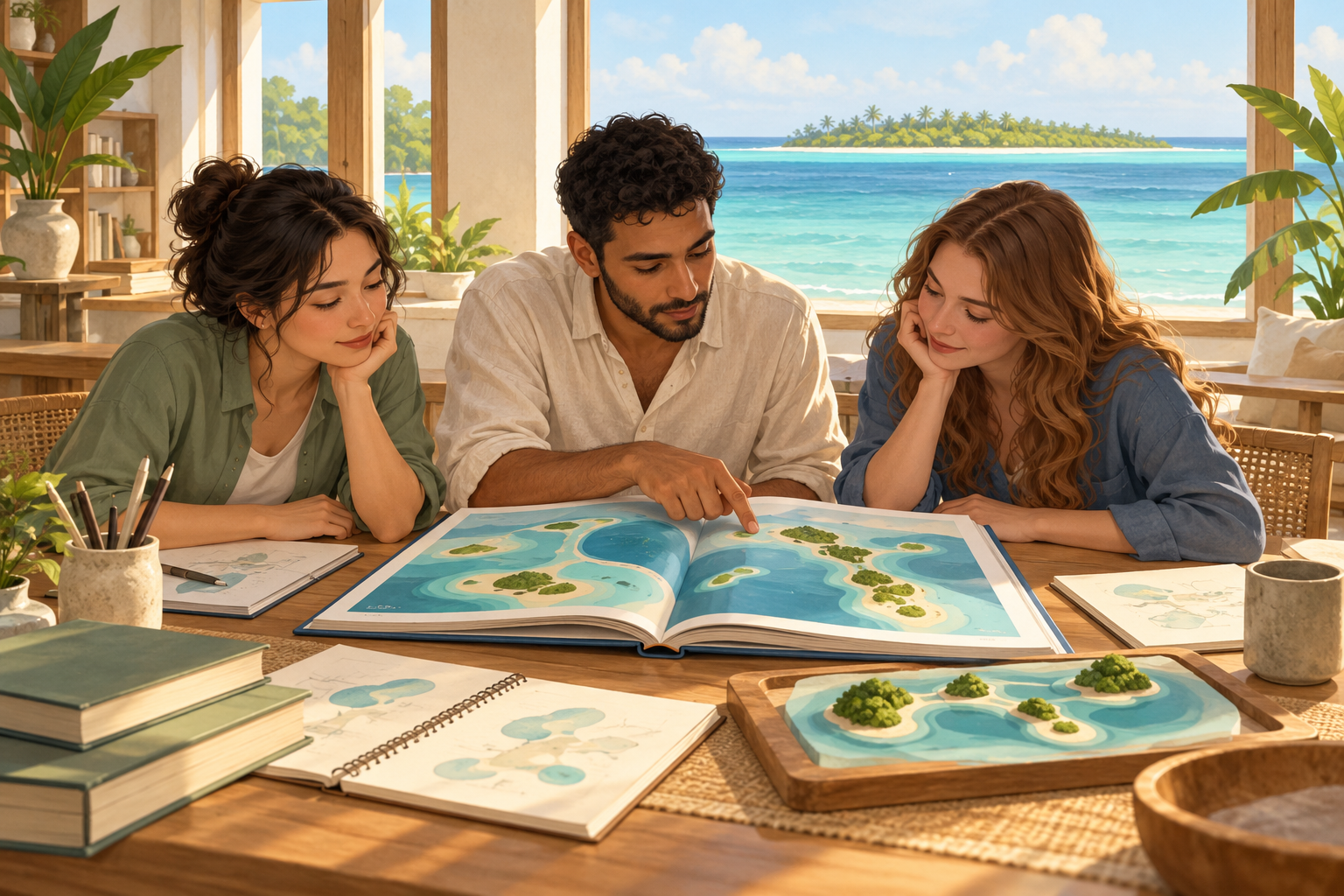
Cover illustration: an original AI-generated illustration of three fictional adults studying an illustrated island book in an imagined coastal reading room, with notebooks and a small island model nearby. This is a nonliteral artistic composite, not a photograph, an accurate map or an exact view of a named place.
Choose your route through the Maldives
Country foundations
Everyday life
Culture and discovery
Connections and perspectives
1. Islands across the Indian Ocean
A country of water and land
The Maldives stretches across the equator in the Indian Ocean, with islands grouped into a double chain of 26 natural atolls. Its official tourism overview describes roughly 1,200 islands scattered through a marine area of about 90,000 square kilometres, with only around 300 square kilometres of dry land. Some islands support residential communities, while others accommodate resorts, agriculture or industry. The sea occupies far more of this national landscape than the land itself. (Island geography)
An atoll is easier to understand by following its edges. Around Felidu, the Lunar and Planetary Institute describes coral rims broken into segments, surrounding shallow lagoons beside much deeper channels. Its account accompanies an astronaut photograph taken in April 1984. The explanation reaches back to lower sea levels during the Ice Age, when exposed carbonate platforms eroded. Later rising seas left reefs developing above those uneven foundations, helping produce the intricate rings in the archipelago. (Atoll forms)
Islands with different shapes
Even an established island need not keep the same outline. A 2023 study of Kandahalagalaa combined sediment dating, beachrock evidence and aerial imagery to reconstruct changes over different timescales. Between 1969 and 2021, erosion along northeastern and eastern shores occurred alongside accumulation elsewhere, shifting the island southward. This detailed study concerned one unusually well documented island. Its changing shoreline and reworked sediments revealed movement across both recent decades and much longer periods of island development. (Kandahalagalaa study)
Fuvahmulah offers a striking contrast to the familiar ring around a lagoon. UNESCO describes this southern island as a shallow bowl, with Bandara Kilhi and Dhandi Magu Kilhi occupying low areas surrounded by marshes. Palms, shrubs and other trees grow around these wetlands. Along the coast, there is no lagoon separating the outer reef edge from the beaches. Waves therefore reach the island from all sides, shaping a landscape that includes the Thoondu pebble beach. (Fuvahmulah geography)
Moving water, growing cities
Water around the islands also has patterns of its own. In an explanation of a January 2010 astronaut photograph of Malé Atoll, NASA describes sunglint: sunlight reflecting from the water towards the observer. That reflection made circulation easier to trace. Northeast monsoon winds shaped surface patterns between islands, while tides produced spreading currents near shallow water. Deeper water carried a southward current, adding another movement to the scene described by the NASA scientists. (Ocean circulation)
People have reshaped the map too. Hulhumalé was created through reclamation in the Hulhulé lagoon as an expansion of Malé. Its development profile presents a planned city welcoming residents from across the islands, with ambitions for greener transport, architecture and energy. Proposed digital infrastructure included fibre optic connections and traffic management systems. The profile also described work on mapping and public information tools, alongside reviews intended to update water, electricity, fire and sewerage networks. (Hulhumalé plans)
2. Histories of an ocean nation
Reading the ground
Coral stone preserves traces of a Buddhist past at Kaashidhoo. Archaeologist Egil Mikkelsen reported that excavations between 1996 and 1998 investigated 64 ruins within part of a monastery whose full extent remained unknown. Most structures used coarse coral stone, with lime plaster and exterior mouldings. Their varied shapes included platforms and forms interpreted as miniature stupas. Often only the lowest portions survived, because building material had been removed and reused over the years. (Kaashidhoo excavation)
Cowrie shells provide another route into island history. During fieldwork in 2016, researchers excavated at Utheemu, Malé and Veyvah, working with the Department of Heritage. At Utheemu, they investigated test pits around the palace and another area. Some sand filled features were interpreted as possible places for processing cowries. Shells, pottery, bone and metal appeared among the finds, but the researchers judged the cowries too scattered and too few to call a hoard. (Cowrie fieldwork)
Republic and independence
The first republic was brief. Mohamed Amin became the first president on 1 January 1953, and his presidency ended that August. The official biography places this episode within a wider public career: he had worked in customs, postal administration and trade, served in parliament, and led Majeediyya School. His education had taken him to Ceylon and India. The biography records a referendum preceding the republic, followed by its collapse while he was abroad for treatment. (Amin biography)
Independence changed the formal relationship with Britain in 1965. A British parliamentary statement on 26 July announced an agreement signed that morning in Colombo, confirming the Maldives as fully independent. Britain would no longer conduct its defence or external political relations. The same statement retained British use of facilities in Addu Atoll under earlier arrangements. This contemporary account shows that recognition of independence and continued access to particular military facilities formed parts of the same settlement. (Independence agreement)
Political change and participation
A second republic followed in 1968, with Ibrahim Nasir as president after serving as prime minister under the sultan. His presidency lasted until 1978. The official retrospective credits his administration with developments including mechanised fishing, tourism, broadcasting and an international airport. It also associates his period in office with an English based school curriculum and a national shipping line. In that official account, political history connects closely with changing opportunities for work, travel and education. (Nasir biography)
The presidential election of 2008 introduced competition between multiple parties and candidates. Commonwealth observers judged the process credible overall and described strong participation and transparent counting. Their assessment also identified serious problems with voter lists. Additional staff and improved procedures helped the second round, but did not remove every registration difficulty. The report records both the importance of the election and the practical work still needed to make the right to vote reliably usable. (Election observers)
3. Dhivehi, languages and belonging
A language and its script
Dhivehi connects the Maldives with a wider South Asian language history while giving the islands a distinctive written voice. Linguist Yumna Maumoon describes it as an Indo-Aryan language with Sanskrit foundations and a close relationship to Sinhala. It is also spoken on Minicoy in India, where it is known as Mahl or Mahal. Her 2002 overview identifies Thaana as the script used for Dhivehi, read from right to left across the page. (Dhivehi overview)
Thaana has its own rules rather than simply copying another script. The Unicode Standard explains that its letters are not joined together in cursive writing, although the direction resembles Arabic. Vowel signs are compulsory, with a special sign marking the absence of a vowel. Some basic letter forms derive from Arabic numerals, and additional dotted letters help transcribe Arabic. European numerals are commonly used within Thaana text, where the numbers run from left to right. (Thaana standard)
Poetry and regional voices
Poetry once helped a Maldivian scholar explain how language worked. Garrett Field examines Naibu Thuhthu, a poet and former chief justice exiled to Fehendhoo in 1888. In 1890, he wrote a description of Thaana that drew on Dhivehi poetry as evidence for usage. He also composed a poem presenting concepts from Arabic grammar. His work brought linguistic explanation and literary creation together, demonstrating a particular scholarly exchange between Dhivehi writing and Arabic learning. (Poetry and language)
Dhivehi varies across the archipelago. Amalia Gnanadesikan distinguishes broad northern and southern dialect groups, with the written standard based on the speech of Malé. The southern varieties are associated with Huvadhu, Fuvahmulah and Addu, separated by substantial stretches of sea. Differences within that southern group are also important. Her account describes southern speakers learning the more widely used northern variety, while northern speakers may find southern speech difficult to understand without that familiarity. (Dhivehi dialects)
Language at home, people across islands
Family language choices can be complicated. A qualitative study interviewed ten selected parents whose schoolchildren predominantly used English, rather than surveying all Maldivian families. Some deliberately used Dhivehi at home to counter the shift; others worried about it while also switching languages themselves. One parent viewed the change positively. Participants also discussed how engaging Dhivehi lessons felt to children. Their differing views show the negotiations within these particular households, not a national measure of language use. (Family language study)
Belonging also includes the people who make their homes in the country without Maldivian nationality. The 2022 census counted 515,132 residents, including 382,639 resident Maldivians and 132,493 resident foreigners. Its resident category excluded tourists and other short stays. About 41 percent lived in the Malé area, which included Hulhumalé, Villimalé and Hulhulé. Administrative islands, resorts and industrial islands accounted for the remaining groups, revealing several different settings for daily life within the census snapshot. (Census 2022)
4. Institutions and public life
Public powers and practical elections
The 2008 Constitution describes a sovereign democratic republic based on Islamic principles. State powers derive from citizens, with legislation entrusted to the People’s Majlis, executive power to the president and judicial power to the courts. A December 2025 amendment provided for abolishing atoll councils at the next local elections. Existing councils would continue until the newly elected councils were duly constituted. (Constitution and amendment)
Holding an election involves many tasks beyond counting ballots. The Elections Commission lists responsibilities for training staff and delegates, arranging equipment and transport logistics, and deciding where polling stations will be located. It also accredits election observers and makes arrangements for Maldivians abroad to vote. Reports published after elections and referendums are another part of its remit. These duties describe the organisation needed to bring a dispersed electorate into a shared democratic process. (Election responsibilities)
Accountability and rights
Public money has its own system of scrutiny. The Auditor General’s Office explains that financial audits examine how fairly accounts are presented, while compliance audits examine whether public bodies follow applicable rules. Its revenue and fiscal audit work includes government ministries, independent institutions and other public activities. Revenue audits look particularly at collection and administration, including possible leakage and fraud. The office describes these checks as a way to strengthen accountability and improve the management of public revenue. (Public auditing)
The Human Rights Commission investigates alleged violations, advises on reforms and works to improve public understanding of rights. In its 2024 retrospective, the independent statutory body described regional programmes, awareness sessions and efforts to strengthen communication with the public. It also acknowledged limits: budget constraints and the geographical spread of islands hindered outreach. That combination of a national mandate and practical obstacles helps explain why reaching communities is an important part of rights protection. (Rights commission)
Local service and public voices
Local public life includes councils and Women’s Development Committees. The Local Government Authority reported that ceremonies for newly elected members began across cities and islands on 17 May 2026. Councillors would take oaths before judges or magistrates, while committee members would sign pledges. Different locations had ceremonies scheduled throughout the day. The announcement distinguished councillors elected from those scheduled to take their oaths, marking the formal steps towards beginning the new term. (Local ceremonies)
Citizens can also address parliament through petitions. A UNDP announcement dated February 2026 describes a digital system developed with the People’s Majlis, allowing people to submit petitions, gather signatures and track progress online. Verification uses eFaas, the national digital identity mechanism. The project drew on consultations with women, young people and civil society groups, and sought to reduce administrative barriers. Its aims included simpler procedures and timelines for responses, making parliamentary processes easier to follow from distant islands. (Digital petitions)
5. Tourism, fisheries and livelihoods
Visitors and local opportunities
Tourism reaches the economy through both visitor numbers and the time visitors stay. The Maldives Monetary Authority reported more than two million tourist arrivals in 2024, nine percent above 2023. Total tourist bed nights grew more slowly, by three percent, with stronger resort performance offsetting a decline in guesthouse bed nights. Average stays also shortened slightly. These different measures explain why rising arrivals do not automatically mean that every accommodation business experiences the same growth. (Tourism in 2024)
Tourism opportunities come with practical questions. Mohamed Naaim Nazim’s 2021 study used ten remote interviews connected with Thaa Guraidhoo, including council representatives, business people and residents. Participants anticipated income from community tourism but raised concerns about transport, harbour condition and land planning. They also discussed keeping tourism development away from residential areas. Conducted during the pandemic, these interviews captured hopes for future income alongside concern about how new visitor activity would fit island life. (Guraidhoo interviews)
Fishing and everyday transactions
Fishing supports livelihoods beyond the moment a tuna comes aboard. The national fisheries report submitted in 2025 describes wooden and reinforced plastic vessels, open working decks and storage needs for fresh catches. Ready access to ice helped the commercial yellowfin handline fishery develop. Boats and handling facilities therefore form part of the economic chain connecting crews with export markets. The report also identifies tuna as a major source of employment, income and foreign earnings. (Fisheries report)
Customers encounter the tax system through the prices businesses display. Guidance from the Maldives Inland Revenue Authority distinguishes general goods and services tax from the tourism category. The general rate has been eight percent since January 2023, while the tourism rate became seventeen percent in July 2025. Its guidance ordinarily requires displayed prices to include GST, with an explained exception where service charges apply. The distinction matters when understanding how a quoted price becomes the final bill. (GST guidance)
Supplies and payments
Supplying scattered islands has a long institutional history. State Trading Organization traces its beginnings to a government business established in 1964 to import essential foods in bulk and distribute them through traders and its own outlets. It adopted its present name in 1979 and later expanded into other goods. Its corporate account describes interests ranging from fuel and building materials to healthcare and shipping, illustrating how one enterprise links household supplies with wider commercial infrastructure. (Trading history)
Payment infrastructure can connect businesses as well as islands. Favara, launched in August 2023, introduced instant transfers between participating banks digitally. At launch, three banks joined the system. Favara ID allowed customers to use identifiers such as telephone numbers instead of account numbers, while Favara Request supported requests for payment. The launch account described continuous availability through banking applications and plans to add further banks, with payment service providers envisaged as future participants too. (Favara launch)
6. Homes and everyday island life
Making a home
A household chore can reveal how an island is changing. In a 2019 ethnographic account, a woman called Amina carried rubbish by wheelbarrow to an island dump after regular collection stopped. Construction sometimes interrupted her route, while land she remembered gathering firewood and coconuts from had become guesthouse space. Her routine brought waste disposal, tourism and changing access to land into the same morning. It was one local experience of environmental change through domestic work. (Everyday island study)
Rebuilding a home after disaster involves more than receiving a house. Interviews discussed in a 2023 study describe mixed experiences among people who moved to Dhuvaafaru after the tsunami. Some appreciated larger homes, space to process fish and sports facilities. Others found kitchens unsuitable for smoking fish or bedrooms lacking privacy. Residents altered houses and created gardens to fit their needs. The same relocation could bring welcome opportunities while leaving difficult adjustments in everyday life. (Relocation interviews)
Care across generations
Support for family life includes learning how to care for children. UNICEF calls its positive parenting initiative Beleniveriyaa, meaning parent or caregiver. Guidance packages address early childhood, middle childhood and adolescence, with communication between children and adults at their centre. The approach combines social models with Islamic teachings. Trained facilitators in schools, councils, health services and other community institutions teach the curriculum, which aims to help families create nurturing homes with support beyond the household. (Parenting programme)
Care work can sit beside paid work within the same home. Writing on ageing in 2025, UNFPA described women combining small businesses or sewing with responsibilities for children, older relatives and people who are ill. It warned that shrinking household support networks can make those combinations harder. The account highlights a pressure that employment figures alone may miss: income earning, rest and learning compete with time spent caring, and informal work may provide little security. (Care and ageing)
Community and household enterprise
On Kudafari, an Elderly Club offered a place for older residents to meet, remain active and share their skills. UNFPA’s account of the 2024 celebrations describes guided art, exercise and cooking activities using locally available ingredients. Participants valued learning while spending time together. Young volunteers also contributed. The council also planned a Children’s Club to encourage connections between generations, and aimed to help foreign workers and residents feel included in community life. (Kudafari activities)
Small enterprises can begin with materials close at hand. An IOM story published in 2017 followed container gardeners on Holhudhoo, including Nadheema and Mariyam. Used water bottles became pots for seedlings, collected with help from family. Plants were sold locally and in Malé, while movable containers helped the growers use limited space. The interviews also described difficulties selling at satisfactory prices and damage attributed to salt spray, showing the effort behind a household business. (Holhudhoo growers)
7. Learning across islands
Access and the shape of schooling
Education brings together family hopes and island geography. UNICEF describes broad access to earlier schooling, but identifies continuing difficulties for older children, remote communities and pupils with disabilities. Some young people must leave home to continue secondary education. Assistive technologies and teachers prepared for different learning needs remain important gaps. Its education work therefore combines attention to classroom resources with teacher development and consultation with children, parents and the communities around them. (Learning access)
The National Curriculum Framework organises learning into foundation, primary, lower secondary and higher secondary phases. Its stage table places primary education in grades one to six, lower secondary in seven to ten, and higher secondary in eleven and twelve. The early phase emphasises experience and play rather than separate subjects. Across schooling, eight competencies combine knowledge, practical skills and values, including critical and creative thought, healthy living and the use of technology. (Curriculum framework)
Teachers and inclusion
The pandemic made the work behind a lesson visible. A UNICEF account describes Nuha Ismail, a business studies teacher at Kalaafaanu School in Malé, adapting to online teaching during the 2020 closures. Preparing digital materials and contacting parents blurred the boundary between work and home. Training helped her become more confident with classroom software and interactive tools. She then supported colleagues, turning an individual learning process into practical help for other teachers facing the same transition. (Teaching through closures)
An inclusive classroom needs more than a place on the register. A 2021 report on disability inclusive education identified a need for mainstream teachers to develop confidence and adapt lessons to different learners. It found training often concentrated on special educators, early identification or general curriculum delivery. The report called attention to the gap between recognising a learning need and teaching effectively in a shared classroom, where the responsibilities of mainstream and specialist staff must connect. (Inclusive education)
Connected classrooms and further study
Satellite schooling offered one response to very small island enrolments. In January 2022, the Education Ministry launched a hub at Huravee School linked with Fehendhoo, Thinadhoo and Rakeedhoo. Children would attend school on their own islands while teachers delivered lessons from the hub, supported by two facilitators on site. Parent schools were assigned financial and teaching support roles, with visits for activities. The arrangement combined online lessons with a physical classroom and local adult support. (Satellite schooling)
Further study is also spread across several locations. The Maldives National University describes a main campus in Malé and additional campuses in Kulhudhuffushi, Gan, Hithadhoo and Thinadhoo, alongside outreach centres. Its academic units cover fields such as education, engineering, nursing, fisheries, tourism and maritime studies. That range links higher education with both public services and island livelihoods. The university offers undergraduate, postgraduate and professional programmes across this institutional network, extending study beyond the main campus. (University profile)
8. Health and community care
Care close to home
Healthcare in the Maldives is organised in levels. The ministry describes primary facilities on inhabited islands, more specialised services at atoll or regional level, and tertiary care. What each facility provides depends on its grading, so a nearby health centre does not mean every specialist is available locally. The ministry also sets standards and coordinates services, while agencies oversee public health, medicines and professional practice. Island access and referral both matter within this arrangement. (Health service levels)
The history of malaria control shows how sustained prevention can change health conditions. WHO records the start of an intensive national programme in 1966 and the last locally acquired case in 1984. Community involvement helped prevention reach the islands. In 2015, WHO certified the Maldives as malaria free. Continued surveillance and rapid response were needed to prevent transmission becoming established again, making certification a milestone supported by ongoing work and attention to possible reintroduction. (Malaria milestones)
Prevention and mental health
Maternal and child health reached another milestone in October 2025, when WHO validated elimination of transmission from mothers to children of HIV, syphilis and hepatitis B. The achievement built on earlier validation for HIV and syphilis in 2019. WHO described pregnancy screening, antenatal care, vaccination and coordinated laboratory services as parts of the effort. The recognition concerns these routes of transmission; it does not mean that the three infections have disappeared from every setting. (Maternal health milestone)
Mental healthcare is also being brought closer to communities. In a March 2025 account, WHO described a primary care pilot in Faafu Atoll that integrated services for selected mental health conditions. The work included professional training and tested forms for supervision and monitoring. Related efforts addressed awareness and stigma, while support for adolescent services remained part of the wider programme. This was a pilot in one atoll, alongside broader efforts to strengthen policies and guidance. (Faafu mental healthcare)
Programmes for continuing care
Schools have served as settings for prevention campaigns as well as lessons. The nationwide HPV vaccination campaign launched at Thaajuddeen School in Malé in March 2019, targeting girls aged ten to fourteen at that time. Parents, teachers, health officials and community representatives joined the event. WHO presented the campaign as a step towards preventing cervical cancer. Its launch illustrates cooperation between education and health services, with teachers and families joining health workers in supporting prevention. (HPV campaign)
Continuing care requires coordination among different professionals. The national thalassaemia guide issued in 2022 addresses doctors, nurses, psychologists and other staff, adapting international guidance to Maldivian services. It calls for a multidisciplinary approach, referral for specialised care and orientation through Maldivian Blood Services. Annual online refresher training is also specified. These provisions describe how the service should support patients over time, including as they grow older, with different forms of expertise contributing to their support. (Thalassaemia services)
9. Transport and digital connections
Journeys by sea and road
A ferry can connect an island household with services on another island. The formal inauguration of RTL services in Huvadhu Atoll took place in August 2023, after operations began in July. The official account placed the Gaafu Alifu and Gaafu Dhaalu routes within a phased national ferry project. It described long journeys previously faced by some residents travelling to Thinadhoo, and presented shorter travel times and stronger social connections as goals of the new service. (RTL launch)
In the capital region, the Sina-Malé Bridge changed the possibilities for crossing water by road. An official account of its 2018 inauguration presented it as a connection linking Malé with Hulhulé and the developing city of Hulhumalé. The president highlighted the repeated crossings people had made between islands and framed the project as part of the development of the capital area. The inauguration brought together Maldivian and Chinese officials, reflecting cooperation behind the new crossing. (Bridge inauguration)
Air gateways and digital identity
Air connections have grown through successive airport projects. The Maldives Airports Company timeline records an Airbus A380 test landing on the new runway in June 2019, followed by full runway operation and the opening of the Noovilu Seaplane Terminal in October 2022. It then dates the opening of Terminal 1 to July 2025. These milestones show investment in both international passenger facilities and the seaplane infrastructure that forms another part of the airport landscape. (Airport timeline)
Some journeys through public services begin with digital identification. eFaas is the national digital identity platform, offering verified identification based on existing government documents. Its FAQ explains that the service does not replace a national identity card, expatriate card or driving licence. Foreigners applying for Maldivian services can also create an identity. The platform describes consent based sharing and access from abroad once verified, connecting identification with online services without making the underlying physical documents unnecessary. (Digital identification)
Connections beneath and beyond the sea
International internet links depend on infrastructure under the ocean. In February 2022, Dhiraagu announced a consortium contract to connect the Maldives to the SEA-ME-WE 6 submarine cable system. The proposed route linked Southeast Asia, the Middle East and Western Europe, with access to internet exchanges and data centres. The company presented resilience and better connectivity as expected benefits. Its announcement envisaged additional connections alongside existing submarine systems, with further possibilities for digital services. (Cable announcement)
For a young contributor writing for UNICEF in 2026, the internet offered more than entertainment: online posts led to conversations, connections and opportunities for advocacy. The author described how people on different islands could collaborate without travelling. Alongside that opportunity came a call for critical digital skills, including checking sources and protecting privacy. This personal account connects digital participation with the responsibility to check information before sharing it. (Youth digital experience)
10. Work, skills and migration
Different routes into skills
Technical education provides several routes towards workplace skills. The Maldives National Skills Development Authority describes training through institutions, employers and schools. Registered providers teach courses based on national competency standards, with certificates dependent on passing the required competencies. Workplace programmes aim to strengthen skills while people remain in their jobs, while institution based courses develop technical and entrepreneurial abilities. These arrangements focus on demonstrating what a learner can do, through assessment of the competencies required for certification. (Training pathways)
One route is illustrated by Firas, whose interest in information technology developed with encouragement from his father. A UNICEF profile published in 2024 describes his decision to leave A levels and pursue more practical training after finding his commitments difficult to balance. He explored options at Maldives Polytechnic and gained experience through vocational study and internships. His training offered flexibility to pursue other projects and activities while continuing his studies, and practical experience helped him expand his professional network. (Firas learning pathway)
Livelihoods and better information
Work can become insecure when wider events interrupt daily business. In a March 2021 World Bank account, Maldivian women described losing earnings during the pandemic, with rent and the possibility of returning to their home islands becoming immediate concerns. Emergency income support helped workers whose earnings had disappeared or fallen. The programme also used outreach and flexible requirements to reach women and people working informally. The Income Support Allowance was nearing its conclusion when the account appeared. (Emergency income support)
Understanding work requires information about more than formal jobs. A July 2025 ILO account described the first standalone national Labour Force Survey, launched with the Maldives Bureau of Statistics in 2024. The survey was designed to examine skills, employment, underemployment and informal work, helping identify gaps that training and employment policy could address. Teams conducted interviews in Greater Malé and other population centres during the second quarter of 2025. (Labour survey project)
Migration and working lives
Support for migrant workers was the subject of a proposed resource centre in 2024. A staffing document described plans for impartial information, individual guidance, referrals and outreach in the Greater Malé area, with technical assistance from IOM. It also envisaged help with accessible materials and activities bringing migrants and local communities together. The proposed staff roles combined individual case handling with community engagement, including referrals to government bodies and legal aid organisations. (Migrant centre plans)
Migrant experiences differ according to skills, recruitment and work location. The IOM country profile published in 2018 drew on interviews with workers and employers in 2017, identifying concerns about unclear contracts, limited promotion and isolation in the atolls. Some workers described arriving without full information about their jobs or conditions. These historical findings underline differences within migrant working lives, and the importance of knowing what a job will involve before travelling. (Migration interviews)
11. Reefs and living seas
Habitats beyond the beach
Baa Atoll brings several island habitats into one watery landscape. Its biosphere reserve includes coral reefs, lagoons, seagrass beds and mangroves, with deep channels opening towards the Indian Ocean. UNESCO describes the atoll as a stepping stone for drifting larvae of reef organisms. Tourism and fishing also belong to this setting, rather than standing outside it. The reserve received its designation in 2011, recognising a place where marine diversity and human livelihoods meet. (Baa reserve)
Local divers help reveal how uneven reef conditions can be. Save the Beach Maldives added 23 reefs to its monitoring series and trained 24 EcoDivers in 2022. Its report described recovering coral at some South Ari sites but persistent rock and rubble at the Thulusdhoo outer reef. The comparison focused on surveys at five metres. Large differences between sites and the missing pandemic year of 2020 make a single national recovery story misleading. (Reef Check 2022)
Seagrass and nesting shores
Seagrass gives shallow lagoons another kind of living cover. A 2024 study used satellite images and field information to map these meadows across the Maldives. Its Landsat series estimated a threefold increase between the periods 2000 to 2001 and 2020 to 2021. A separate map used newer Sentinel imagery. The researchers found associations with inhabited reef platforms, but the suggested human causes remained hypotheses, not evidence that pollution makes marine environments healthier. (Seagrass mapping)
On sandy shores, turtle tracks need careful interpretation. Monitoring from 2018 to 2024 combined trained observers and citizen contributions from 66 islands, distinguishing confirmed nests from visits that produced no eggs. Green turtles accounted for most recorded nests. Much information came from resort islands with resident marine biologists, so the records cannot describe every beach equally. Flooding, predation and evidence of human interference also appeared in this detailed account of nesting activity. (Turtle nesting)
Following ocean neighbours
A manta photograph can reveal more than a graceful silhouette. Researchers used the distinctive markings underneath individual rays to connect sightings collected by staff and citizen observers between 1987 and 2019. They also recorded accompanying animals, including remoras. Adult remoras were more numerous at cleaning and cruising sites than feeding sites when present. Because familiar gathering places received more attention, these observations describe sampled associations rather than a balanced census of all manta habitat. (Manta observations)
Whale shark encounters also follow local seasonal rhythms. Surveys along southern and eastern South Ari waters between 2016 and 2019 were compared with satellite measurements of chlorophyll. Sightings were associated with this indicator of productivity, especially in southern waters during the northeast monsoon. Chlorophyll was not a direct measurement of the animals they ate. Water temperature showed no significant association with sightings in this study, and the western area was excluded from analysis. (Whale shark seasons)
12. Food and fishing traditions
Fish, coconut and island flavours
Fish and coconut form a familiar starting point for Maldivian cooking, but they meet in many different textures. Mas huni combines tuna with grated coconut, onion, chilli and lime, usually beside the round flatbread called roshi. Garudhiya brings fish to the table as broth, often with rice and sharp accompaniments. For evening tea, small savoury foods include fish cake and bajiyaa. These dishes introduce meals and snacks across a varied food tradition. (Maldivian cooking)
Island associations add another layer to the food map. A Visit Maldives account links Laamu with fish ball curry and moringa rice, while Kulhudhuffushi is known for thin haalu folhi and baked masbondi. Addu bondi brings together sweetened coconut and fragrant water. In Baa Eydhafushi, screwpine fruit becomes small sweets with young coconut and jasmine water. Such examples invite attention to local variations without claiming that one island alone can prepare a particular dish. (Island specialities)
Keeping fish and marking occasions
Keeping a catch in good condition has long required practical invention. An FAO assessment published in 2005 described a project begun in 2003 that fitted three boats with chilled or refrigerated seawater systems. Trials examined whether the equipment was technically workable and affordable. Limited ice availability and weak price rewards complicated wider uptake. This was a small historical trial, but it shows how the journey from fishing boat to kitchen also depends on storage. (Fish handling assessment)
Bondibaiy belongs to the sweeter side of celebration. Food writer Iyath Adam describes grains or fruit cooked gently with sugar and coconut milk until glossy, while retaining some bite. Rice and breadfruit are familiar versions, with aromatics such as pandan or cardamom varying between recipes. The account connects the dish with Eid, baby naming and maahefun. It also describes a shift from shared preparation towards bought individual portions, rather than one unchanged family custom. (Bondibaiy traditions)
Work behind a shared meal
The labour behind preserved fish is especially visible in a study conducted in March 1998 and published the following year. It described women boiling, smoking and drying fish in courtyard kitchens, with wooden racks above the stove. Gathering fuel was another substantial task. Men sometimes helped with filleting when catches were large. This historical account recognises specialised processing knowledge, while its division of work should not be treated as a rule for present households. (Historical fish processing)
A keyn gathers a meal into a large covered circular tray. Rice, curries, salads and sweet dishes may arrive together, with around twelve diners given as one illustrative serving size. A 2021 cultural account connects the tradition with meals following Maaloodhu prayers and describes its continuation at Eid and other gatherings. Sometimes a procession carries the tray with boduberu music. The shared presentation matters as much as the variety of dishes arranged inside it. (Keyn tradition)
13. Arts, music and storytelling
Rhythm and musical journeys
Boduberu means big drums, a name that captures the direct physical force of the music. Coconut wood commonly forms the drum shell, with goatskin stretched across its heads. Singing and drumming may begin slowly before gathering speed and drawing people into dancing. Visit Maldives describes a typical group of around twenty performers, including three drummers and a lead singer. That is an example of an ensemble, not a compulsory size for every performance. (Boduberu music)
Individual careers reveal other routes through Maldivian music. The artist profile of Abdul Sameeu traces his beginnings to The Coconuts, a band formed by the Maldives Scouts in 1986. He later spent ten years with Jade and undertook vocal training in Sri Lanka. His work extended into vocal coaching, including Maldivian Idol, while his own band Akasaka produced eight albums. The profile records a 2007 national recognition award for his contribution to singing. (Sameeu profile)
Craft and practical knowledge
Craft can appear beside newer forms of design. Ahead of its 2023 Storytellers Conference, Visit Maldives announced stalls featuring lacquer work, handmade jewellery and photography-inspired products. The feature introduced jewellery designer Hajara Yoosuf and photographer Hassan Ishan alongside the lacquer tradition called liyelaa jehun. It acknowledged that the origins of lacquer work were unknown. These were planned showcases for particular makers, not evidence of how many people attended or how much anyone sold. (Artisan showcase plans)
Mat weaving also carries practical knowledge worth listening to closely. In research published in 2020, one weaver described preparing screwpine leaves by cutting, drying and scraping strips before interlacing them by hand. The wider study involved interviews and informal discussions with 91 people over twelve weeks, including craftspeople and educators. Its translated interview preserves a maker explaining a familiar sequence of work. The publication year does not establish when those conversations actually took place. (Weaving research)
Sea stories and gallery spaces
Stories give the sea an imaginative life as well as a physical one. A Visit Maldives essay recounts Rannamaari, a frightening sea creature in Maldivian legend, and Faru Fureytha, supernatural beings associated with reefs. These are accounts of folklore and belief, not records proving that such beings existed. They show how storytellers could express uncertainty, danger and respect through familiar waters, giving the ocean a place in memory that reaches beyond a map. (Ocean folklore)
Visual art has an institutional home in the National Art Gallery, established by the government in 1999. Its stated purposes include collecting Maldivian art, arranging exhibitions of local and international work, and supporting artists through education and professional connections. Presentations and workshops form part of that support. Building a permanent collection is described as an aim, rather than a completed achievement. The gallery connects opportunities to see art with opportunities to develop artistic practice. (National Art Gallery)
14. Heritage and places of memory
Coral stone and careful restoration
Coral stone mosques preserve a remarkable tradition of shaping local materials. A Maldivian submission to the UNESCO Tentative List in 2013 described six sites, including the Friday mosques of Ihavandhoo, Malé and Fenfushi. Finely fitted coral blocks and timber supported detailed decoration, revealing the skill of earlier builders. This is historical construction, not a model for taking coral from living reefs today. Tentative listing records a proposal, not inscription as a World Heritage Site. (Coral mosque submission)
Kalhuvakaru Mosque offers a separate example of planned restoration. On 19 September 2019, the President inaugurated relocation work near the former Sultan Park by placing a cornerstone. The official account dated the mosque to 1789 and described carved coral foundations and wooden beams carrying Arabic calligraphy. Prayer and public visiting were intended uses at the new site. That ceremony marked the start of the undertaking, rather than documenting completed restoration or present visitor access. (Kalhuvakaru restoration)
Objects and inscriptions
Objects can preserve histories that buildings alone cannot tell. Reporting in 2016 described the National Museum collection as including royal costumes and ornaments, manuscripts on paper and cloth, photographs, weapons and stone objects from before Islam. The museum first opened in 1952, while a new building followed in 2010 with Chinese grant support. At that time, staff were preparing to add further historical objects and gifts received by the President to the displays. (Museum collections)
At Hithadhoo in Laamu, inscriptions help connect a small mosque with particular people and dates. The Maldives Heritage Society interprets a beam inscription as dating its construction to 1688 or 1689, before its patron became ruler. Its account describes Quranic verses, other religious texts and historical information in Arabic calligraphy on wooden beams. Repairs, including restoration after a fire, are also remembered. The building carries evidence of craftsmanship alongside a history of community care. (Hithadhoo mosque study)
Protecting settings and telling history
Protecting a monument can also mean paying attention to its surroundings. In October 2023, the government announced a cultural buffer zone around the Friday Mosque in Malé. The designated group included several historic places, among them Medhu Ziyarai, Muleeaage and Republic Square. Safeguarding heritage and supporting cultural tourism were stated aims. The announcement also anticipated rules for the zone, but did not establish that every intended regulation or economic benefit had already taken effect. (Cultural zone decision)
A newer way of presenting history opened in Utheemu on 15 August 2026. Vaahaka Vau, or Story Forest, was inaugurated in woodland beside Kandhuvalu Mosque. Interpretive displays lead visitors through the story of Bodu Thakurufaanu and the struggle for independence, with scenes arranged along pathways. The inauguration establishes the opening of this heritage park, while the scenes remain a designed interpretation of history. Making Utheemu a wider cultural tourism centre was a separate ambition. (Story Forest inauguration)
15. Science and observing the ocean
Models and measurements
Currents do not simply flow past the atolls unchanged. A 2024 oceanography study combined satellite observations with a model of 2013 and virtual particles to explore mixing and upwelling around them. The simulations showed how steep underwater terrain and changing monsoon currents could bring deeper water upwards and create productive wakes. Fine-scale current speeds could not be directly validated, however. This was an investigation of physical processes, not a live forecast for boat crews. (Ocean current modelling)
Underwater surveys begin with choices about where and how to look. An expedition in January and February 2020 examined 127 sites in the northern and central Maldives, using fish transects and photographs of the seabed. Western shores were favoured for safer diving during that monsoon. Pandemic restrictions stopped work before Malé and the southern atolls could be surveyed. The resulting assessment therefore supplies a structured regional snapshot, not equal coverage of every Maldivian reef. (Reef survey methods)
Carbon and travelling turtles
Sediment samples offer another window into coastal life. Researchers collected eighteen cores in 2019 from seagrass and mangrove habitats on three Laamu islands. Their analysis identified seagrass as the largest contributor to sediment organic material across those sampled islands. Carbon stock calculations had an important limitation: processing problems meant that density values had to come from elsewhere. The findings illuminate links between neighbouring habitats, without providing a national carbon inventory or guaranteeing income from offsets. (Laamu carbon study)
Satellite tags help researchers follow turtles after release. A study tracked 35 animals from a Maldivian rehabilitation and rearing programme between 2012 and 2024, including olive ridley, green and hawksbill turtles. Twenty-five travelled beyond their release atolls into open ocean. Tracking duration varied, and some records ended too soon to classify behaviour. A lost signal could reflect a faulty or detached tag rather than death, making careful interpretation essential when assessing these individual journeys. (Turtle tracking)
Experiments and patient observation
Controlled experiments ask questions that maps alone cannot answer. During four weeks in early 2022, researchers added nitrogen to small seagrass plots at two reef flats beside Gan in Laamu. Leaf growth increased, but responses differed between sites, and cyanobacteria also appeared at one location. Those results concern particular treatments and a short observation period. Faster leaves do not by themselves establish a healthier ecosystem, or justify allowing more pollution into the surrounding water. (Seagrass experiment)
Some discoveries depend on returning after sunset. Marine Savers documented repeated checks of coral eggs and spawning around Landaa and Kuda Huraa during the second half of 2023. At Kuda Huraa, November monitoring totalled 68 hours across seventeen nights and three locations. Observers recorded changes in egg colour and the release of reproductive material. Such patient local records help reveal the timing of coral reproduction, without promising the same dates everywhere or proving later survival. (Coral spawning observations)
16. Sport and shared recreation
Games and growing talent
On a sandy Bashi pitch, a server stands with her back to the net and sends the ball overhead for opponents to catch. A 2022 tourism account describes this team game among women, from evening recreation to island tournaments around public holidays. Equipment has changed: balls once made from rolled coconut leaves have given way to tennis balls and rackets. The familiar contest combines quick reactions with a distinctive serving action. (Traditional games)
Footballer Ali Ashfaq began with an unexpected invitation at nine, filling a gap in the school team where his brother played. In a 2020 FIFA interview, he recalled learning alongside neighbourhood boys rather than through an academy. The Maldivian club Valencia signed him at sixteen in 2001. His fascination with dribbling continued into senior football, while practice with his right foot expanded the finishing options of a player who had initially relied on his left. (Ashfaq interview)
Learning in the water
Success in the pool brought a Maldivian team to the sports ministry on 3 January 2024. The swimmers had returned from the Sri Lankan National Swimming Championship in Kandy with one gold, six silver and eight bronze medals. Minister Abdulla Rafiu thanked them and encouraged continued training for future international competition. He also promised efforts to expand training opportunities, an intention reported alongside the medals rather than evidence that additional coaching had already happened. (Swimming ministry report)
Young surfers and coaches shared another kind of classroom in August 2024, when the Maldives hosted an International Surfing Association development camp. Its eighteen participants came from seven Asian countries, including Maldives, with eleven athletes and seven coaches. Instruction covered technique, competition tactics, judging and choosing waves, both ashore and in the water. Athlete mentors joined the coaching team, giving the gathering an exchange of practical experience as well as organised lessons. (Youth surfing camp)
Sport beyond the islands
Cricket has travelled a long route through Maldivian recreation. A 2016 International Cricket Council history traces an early form to a scholar returning from Ceylon around 1880. Formal rules and the Malé Cricket Club followed around 1920, when courtyards and open spaces served as grounds. Government training expanded during the 1960s. A school programme launched in 1999 brought another generation into a game supported by both active players and retired cricketers. (Cricket history)
National representation also has its ceremonial moments. On 21 July 2024, table tennis player Fathimath Dheema Ali and sprinter Ibadulla Adam were honoured as the designated Olympic flag bearers. The announcement distinguished Dheema Ali gaining regional qualification from wildcard places in athletics and swimming and a universality place in badminton. It captured preparations for Paris, including the planned four sport contingent, rather than reporting how those athletes subsequently performed at the Games. (Olympic ceremony)
17. Weather, water and environmental challenges
Reading seasonal patterns
Island weather follows seasonal rhythms without becoming entirely predictable. The meteorological service describes a wetter southwest monsoon normally running from the middle of May to November, and a drier northeast monsoon from January to March. April and December are transition months. Rainfall generally increases towards the southern atolls. Monthly climate reports distinguish northern, central and southern conditions, helping readers see regional differences rather than treating the archipelago as a single point on a weather map. (Climate overview)
Weather information becomes more specific through the meteorological warning system. Its four levels run from white information and yellow advisory to orange and red warnings. The criteria cover several hazards, including heavy rain, rough seas, strong gusts and tsunami impacts. Observations and forecasts both contribute, with satellite, radar and lightning information supporting thunderstorm assessment. These categories describe how the service communicates danger; they do not mean that any particular alert is currently in force. (Warning levels)
Water and waste systems
Freshwater planning must connect what falls from the sky with what happens beneath island homes. A UNDP programme backed by the Adaptation Fund was designed for Mahibadhoo, Ihavandhoo and Gadhdhoo, combining rainwater collection, groundwater recharge, desalination and wastewater improvements. Community consultation and technician training were also intended parts of the work. Although the programme page marks it completed, its listed objectives alone do not establish which proposed services reached every household on those islands. (Island water programme)
Waste presents a different problem where land for treatment is scarce. In its 2021 account of Greater Malé, the Asian Development Bank described open dumping on Thilafushi and pollution from fires, liquids draining from waste, and plastics. Its linked projects proposed a treatment plant that would generate electricity, handle remaining residues and control air pollution. The design also included raised equipment and drainage against flooding; these were planned features, not a statement of present operating capacity. (Waste project account)
Learning from environmental damage
The 2004 tsunami left investigators with difficult questions about water already under pressure. During February 2005, UNEP and national experts visited sixteen islands across eight atolls. They found groundwater affected by salt and contamination, while noting that sewage leakage and other pollution had existed before the disaster. Missing historical measurements made it hard to separate earlier problems from tsunami damage. The assessment therefore records a particular emergency and its uncertainties, not water quality today. (Tsunami assessment)
Mangrove damage can also reveal connections between island basins and the wider ocean. A 2024 study investigated the dieback that began in 2020 using satellite images, sea level and climate records, wood chemistry and field observations. Damage often began within low basin centres and spread outward. The evidence supported concern about prolonged inundation and salt stress where drainage was limited, but the observed associations did not amount to a controlled experiment proving one cause. (Mangrove study)
18. Regional and global connections
Joining international communities
Maldives joined the United Nations in September 1965, soon after independence. Its relationship with the organisation reaches beyond one office: the country team draws on agencies based in Malé and several regional cities. The cooperation framework for 2022 to 2026 set shared priorities across livelihoods, wellbeing, environmental resilience and accountable institutions. These describe intended collaboration, from policy advice to stronger local capabilities, rather than a scorecard showing that every development goal was achieved. (UN country team)
Membership changes also reflect political decisions. Maldives first entered the Commonwealth in 1982, withdrew in 2016 and rejoined on 1 February 2020. The return followed an approach in December 2018, country assessments, consultations and a formal application. The Commonwealth reported two assessment visits and feedback from observers of the April 2019 parliamentary election. Its announcement documented a completed readmission process, not simply an invitation or a promise of future membership. (Commonwealth readmission)
Exchanging regional knowledge
Regional connections also develop through conversations aboard fishing boats. During an exchange in Bitung, Indonesia, from late August to early September 2023, Maldivian fisheries specialist Ibrahim Nadheeh shared experience and videos with Indonesian captains. Participants compared vessel practices while a trial explored light and sound to attract skipjack tuna. Reducing reliance on live bait was the objective, not an established industry result. The encounter placed working knowledge from different fishing communities side by side. (Baitfish exchange)
Addu City became a meeting place for South Asian leaders in November 2011, hosting the seventeenth SAARC summit. Their declaration linked regional cooperation with movement of people, investment, trade and cultural contact. It called for work on ferry connections, energy cooperation, recognition of qualifications, sanitation and safe drinking water. These proposals show how practical needs entered regional diplomacy, while the declaration itself cannot establish that the promised services or agreements were subsequently put into effect. (Addu Declaration)
Voices in global negotiations
Maldives has also spoken for other vulnerable states in climate negotiations. In Geneva on 8 February 2015, it addressed talks on behalf of the Alliance of Small Island States. The statement sought a binding agreement capable of keeping warming below one and a half degrees. It also argued that loss and damage deserved discussion separate from adaptation, with equal time. These were negotiating demands presented before the Paris agreement, not a summary of its eventual terms. (Island climate statement)
Trade diplomacy gives island concerns a forum. The WTO Secretariat review of 2024 described Maldives participating through its representation in Geneva, including discussions on environmental sustainability and plastic pollution. Fish exports, services and food security were among its stated interests. The country also worked with groups representing small and vulnerable economies, seeking recognition of their needs within trading rules. This dated account describes participation and negotiating priorities rather than guaranteeing market access or stating current treaty obligations. (WTO trade review)
19. Contemporary creativity and enterprise
Art in public conversation
Creative work can move from a small postage stamp to a large mural. Afzal Shaafiu, known as Afu, spent thirteen years at Maldives Post designing stamps before turning fully towards fine art in 2010, according to his Oaga profile. His subjects expanded across social, environmental and personal questions. At the resort, a mural interprets the story of the first settlers through visual art, offering a creative account of identity rather than an archaeological record. (Afu profile)
At the Venice art exhibition in 2013, the Maldives pavilion used the title Portable Nation to bring environmental questions into contemporary art. Its programme listed Maldivian and international contributors, with culture and nature placed together in the curatorial approach. One speculative archive explored migration and cultural continuity under imagined displacement. These were artistic propositions intended to provoke thought, not scientific forecasts of when islands would disappear or predictions that their people must inevitably leave. (Venice pavilion)
Heritage and household enterprise
Textile traditions also support individual enterprise. In an October 2025 profile, WIPO described Aishath Shirhan developing Haajara Feminine Designs around Maldivian clothing and embroidery. Her work included necklaces inspired by Kasabu and newly interpreted Libaas, sold through resorts and Authentic Maldives. Mentoring helped her build a brand strategy and begin seeking trademark protection. She was also preparing a book about weaving; neither a granted trademark nor a published book was reported in that account. (Haajara design profile)
Small businesses face practical questions about reaching buyers. In September 2022, researchers interviewed forty women on Gemanafushi for a fish processing project. Thirty seven owned smartphones, but only nineteen reported confidence using business applications. Some marketed products through local Viber groups, while others used no marketing tools. Thirty eight said they would use the proposed sales application. That willingness suggested interest within this local group, not proof of later adoption or a national pattern. (Women processors survey)
Support for emerging ventures
University support offers another possible route from an idea to a business. The first InnovateHub cohort at Maldives National University had an application deadline of 15 September 2025. Its process involved proposals, pitches, selection and support for developing products or services. The eligibility guidance specified enrolled bachelor or postgraduate students with at least six months of study, alongside further policy criteria. Funding, mentoring and workspace were offered to selected participants, not promised to every aspiring entrepreneur. (InnovateHub programme)
A UNDP programme for 2024 to 2026 proposed business support, research and financing for ventures connected with sustainable ocean resources. It reported establishing a joint financing facility with the Capital Market Development Authority. Its support programmes carried a minimum forty percent inclusion target for women, youth and other underserved groups. Creating the facility and setting that target did not establish that loans had reached businesses or that the intended participation had occurred. (Blue economy programme)
20. Future choices for island communities
Planning environmental change
Climate commitments connect island decisions with support from abroad. The third national climate contribution, submitted in 2025, set a conditional reduction of 1.52 million tonnes of carbon dioxide equivalent in 2035. Its comparison was projected emissions of 6.03 million tonnes without additional measures, not present emissions. Finance, technology and skills support were essential conditions. Renewable electricity, improved grids, transport and waste management formed parts of the proposed response. (Climate contribution)
Tourism planning also reaches into storerooms, workplaces and waste handling. The iCOAST environmental and social plan proposed safer chemicals and better waste practices involving resorts, hotels, suppliers and island councils. Its safeguards included worker protection, community health, training and channels for raising complaints. Monitoring was intended to guide adjustments when risks or concerns emerged. These were measures designed to shape implementation, not evidence that chemical exposure or pollution had already fallen across the islands. (iCOAST safeguards plan)
Energy and public continuity
Solar investment requires more than bright weather. A 2023 World Bank account described ASPIRE and ARISE using guarantees and payment security to reduce risks faced by private investors. Funds held for delayed payments and protections around power purchase agreements helped make the investment framework more predictable. The account also discussed integrating additional solar generation into electricity grids. Its future capacity and savings projections were not installed totals, and procurement prices were not household electricity bills. (Solar investment account)
Keeping public plans alive across changes of government is another future choice. In September 2026, President Mohamed Muizzu described work on a National Development Master Plan reaching towards 2040 and legislation intended to protect its continuity. He argued that stopping projects between administrations could waste resources and interrupt benefits. Both the plan and its proposed legal protection were being developed at that point, rather than presented as an adopted law or a completed national programme. (Master plan announcement)
Community ideas and practical care
Creative communities have proposed connections that extend beyond individual islands. A November 2025 account of July workshops described artists, entrepreneurs and community voices exploring links between tourism and local creativity. Ideas included cultural trails, handicrafts and digital experiences, alongside stronger finance and payment networks. The authors presented an atoll as a model of connected activity, not isolated ventures. These remained concepts for collaboration, rather than operating visitor routes or demonstrated new sources of household income. (Creative workshop account)
Practical care already has a local example at Villimalé. A coral relocation study followed 213 corals on twenty selected frames during 2022 to 2024, reporting sixty six percent survival after two years. Save the Beach Maldives and volunteers, including school scouts, helped attach corals, while regular maintenance removed overgrowth and checked stability. This closely tended site shows the work involved in restoration; its results do not prove that moving corals can replace habitats lost elsewhere. (Coral relocation study)
Frequently asked questions about the Maldives
Are all Maldivian islands rings around lagoons?
No. UNESCO describes Fuvahmulah as a single island with a shallow bowl shape, inland wetlands and beaches exposed to ocean waves without an intervening lagoon. (Fuvahmulah geography)
What script is used to write Dhivehi?
Dhivehi uses Thaana, written from right to left. Its letters are not cursive, and vowel signs are required. European numerals commonly appear within the text, running from left to right. (Thaana standard)
How does satellite schooling work?
The January 2022 launch described an arrangement with local classrooms, online teaching from a hub and facilitators alongside pupils. Parent schools were assigned support roles covering materials, finances and activities. (Satellite schooling)
Does every island health facility offer specialist care?
Facilities are graded. The Health Ministry describes primary services on inhabited islands, with more specialised and tertiary care at other levels. A local health centre does not provide every specialty. (Health service levels)
What is a keyn?
A keyn is a shared meal presented in a large covered circular tray. It can combine rice, curries, salads and sweets, with around twelve diners given as an example rather than a rule. (Keyn tradition)
Does Tentative List status mean the coral stone mosques are World Heritage Sites?
No. The 2013 Maldivian submission placed six coral stone mosque sites on the UNESCO Tentative List. That proposal is distinct from inscription on the World Heritage List. (Coral mosque submission)
What is Bashi?
Bashi is a team game among women, played on sand. A server sends a ball overhead while facing away from the net, and opponents try to catch it. Modern play uses tennis balls and rackets. (Traditional games)
Does every island have the same climate?
The meteorological service distinguishes northern, central and southern conditions. Rainfall generally rises towards the south, while the wetter southwest monsoon and drier northeast monsoon provide broad seasonal patterns rather than daily forecasts. (Climate overview)
Continue reading: specialist guides to the Maldives
Use these links for focused educational reading. They are not live travel recommendations, confirmation of local course availability or substitutes for current official information.
- Islands, tourism and government
- Rainwater, desalination and drinking water
- Schools, qualifications and learning pathways
- Coral stone conservation vocabulary
- Coral restoration vocabulary
- Children’s vocabulary for character and community
- Places and questions for further exploration
- Learning through observation and travel
Explore the Everything About Countries archive for more national overviews. The How Singapore Works collection offers another case study, with a different history, scale and institutional setting.
Bring the evidence together
Choose one place or practice from these chapters and ask what kind of source explains it. An archaeological study, an interview and a policy document reveal different things. Comparing them helps a country become more than a familiar landmark or a single story.
Sources and further evidence
Sources consulted 24 October 2026; observations retain their original dates.
- Island geography
- Atoll forms
- Kandahalagalaa study
- Fuvahmulah geography
- Ocean circulation
- Hulhumalé plans
- Kaashidhoo excavation
- Cowrie fieldwork
- Amin biography
- Independence agreement
- Nasir biography
- Election observers
- Dhivehi overview
- Thaana standard
- Poetry and language
- Dhivehi dialects
- Family language study
- Census 2022
- Constitution and amendment
- Election responsibilities
- Public auditing
- Rights commission
- Local ceremonies
- Digital petitions
- Tourism in 2024
- Guraidhoo interviews
- Fisheries report
- GST guidance
- Trading history
- Favara launch
- Everyday island study
- Relocation interviews
- Parenting programme
- Care and ageing
- Kudafari activities
- Holhudhoo growers
- Learning access
- Curriculum framework
- Teaching through closures
- Inclusive education
- Satellite schooling
- University profile
- Health service levels
- Malaria milestones
- Maternal health milestone
- Faafu mental healthcare
- HPV campaign
- Thalassaemia services
- RTL launch
- Bridge inauguration
- Airport timeline
- Digital identification
- Cable announcement
- Youth digital experience
- Training pathways
- Firas learning pathway
- Emergency income support
- Labour survey project
- Migrant centre plans
- Migration interviews
- Baa reserve
- Reef Check 2022
- Seagrass mapping
- Turtle nesting
- Manta observations
- Whale shark seasons
- Maldivian cooking
- Island specialities
- Fish handling assessment
- Bondibaiy traditions
- Historical fish processing
- Keyn tradition
- Boduberu music
- Sameeu profile
- Artisan showcase plans
- Weaving research
- Ocean folklore
- National Art Gallery
- Coral mosque submission
- Kalhuvakaru restoration
- Museum collections
- Hithadhoo mosque study
- Cultural zone decision
- Story Forest inauguration
- Ocean current modelling
- Reef survey methods
- Laamu carbon study
- Turtle tracking
- Seagrass experiment
- Coral spawning observations
- Traditional games
- Ashfaq interview
- Swimming ministry report
- Youth surfing camp
- Cricket history
- Olympic ceremony
- Climate overview
- Warning levels
- Island water programme
- Waste project account
- Tsunami assessment
- Mangrove study
- UN country team
- Commonwealth readmission
- Baitfish exchange
- Addu Declaration
- Island climate statement
- WTO trade review
- Afu profile
- Venice pavilion
- Haajara design profile
- Women processors survey
- InnovateHub programme
- Blue economy programme
- Climate contribution
- iCOAST safeguards plan
- Solar investment account
- Master plan announcement
- Creative workshop account
- Coral relocation study