
Where is Mexico, and what can you learn about it? Start with a place, a practice or a question. These twenty chapters bring together geography, history, everyday life, creativity and environmental choices. Follow the full guide, or choose a route below and return whenever a new question takes shape.
Choose a reading route: country foundations, everyday life, culture and discovery, or connections and perspectives. Each route leads to the complete chapters.
At a glance
- Neighbours: United States, Guatemala and Belize.
- Pacific coast: west.
Source: SEMARNAT atlas.
This is an educational overview, not a travel itinerary or personalised medical, legal or financial advice. Historical accounts, surveys, research and institutional plans answer different questions. Keep their dates and scope in view when comparing places and experiences.
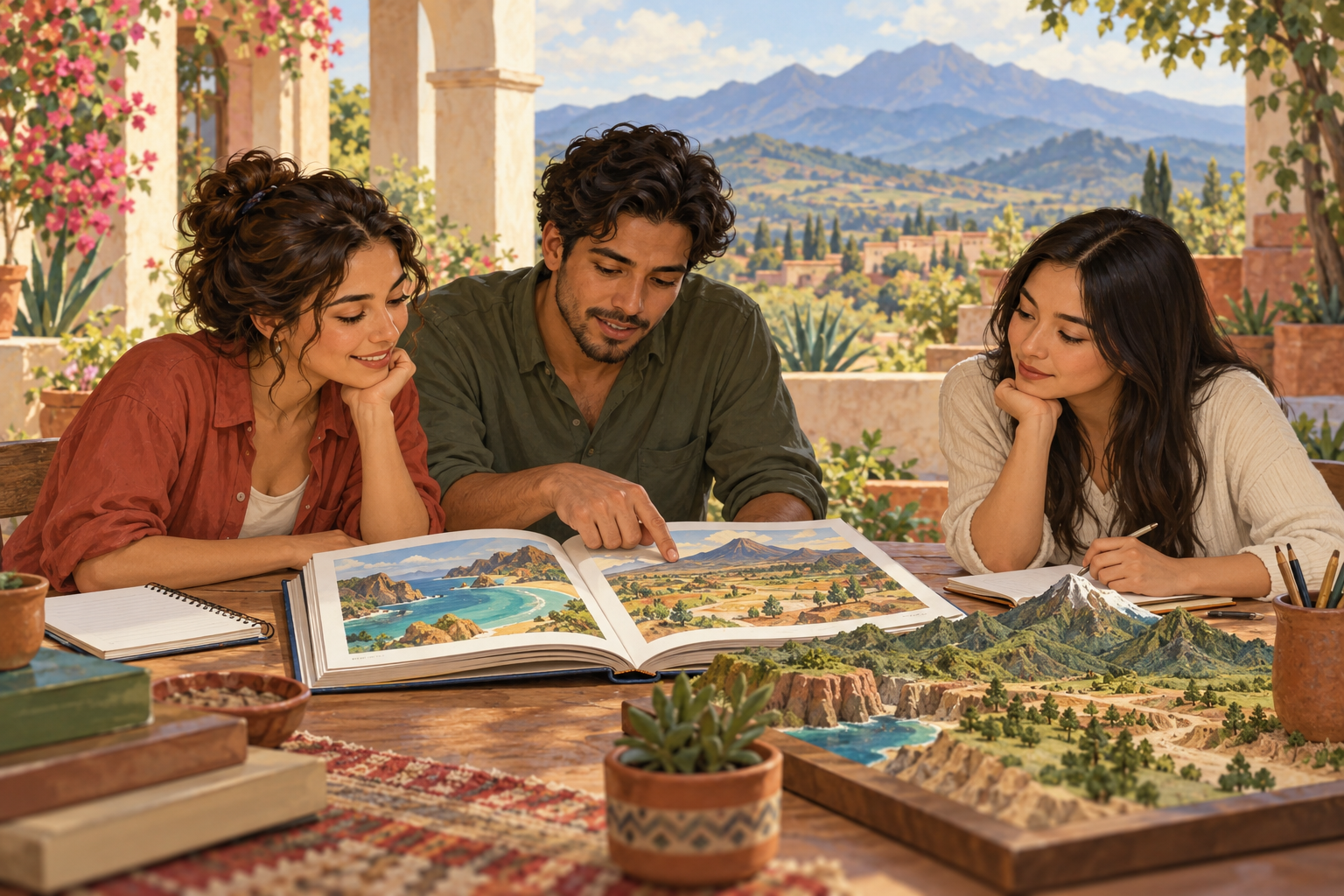
Cover illustration: an original AI-generated illustration of three fictional adults studying a landscape book and a terrain model at a wooden table in an imagined planted courtyard. This is a nonliteral artistic composite, not a photograph, an accurate map or an exact view of a named place.
Choose your reading route
Country foundations
Everyday life
Culture and discovery
Connections and perspectives
1. Geography and regional landscapes
Coasts and heights
Mexico meets the United States along its northern frontier and Guatemala and Belize to the south. The Pacific borders its western coast, the Gulf of Mexico lies east and the Caribbean southeast. The 2015 SEMARNAT atlas records 1,959,248 square kilometres of continental land and 5,127 of islands. It treats these land areas separately from maritime jurisdiction, which includes both territorial waters and the exclusive economic zone. (Atlas).
Mountains share the landscape with plains, plateaus, valleys and depressions. Pico de Orizaba, Popocatépetl and Iztaccíhuatl rise above 5000 metres above mean sea level. In 2020, INEGI described national elevation mapping at a resolution of 15 metres, allowing slopes, heights and drainage basins to be measured. Finer models of terrain and surface features, with a resolution of five metres, then covered approximately 53 percent of national territory, rather than the whole country. (Mountain mapping).
Peninsulas and water
On the Baja California peninsula, irregular mountains run broadly from northwest to southeast between basins filled with sediment. The peninsula contains Baja California and Baja California Sur. Its mountains recharge groundwater and supply surface streams that flow towards lower alluvial basins. Topography also shapes groundwater movement. Northern ranges are mainly granite, with metamorphic and sedimentary rocks along their flanks; farther south, sedimentary and volcanic rocks dominate the mountain landscape described in the geological study. (Hydrogeology).
Beneath the Yucatán peninsula, soluble limestone creates a different water landscape. Rain absorbs carbon dioxide from the atmosphere and becomes mildly acidic, gradually dissolving the rock. This process forms caves, underground rivers and cenotes. Water also transports and deposits minerals, building stalactites and stalagmites within underground spaces. Studying these formations brings together several disciplines: speleology draws on geomorphology, hydrology, mineralogy, chemistry and paleontology to investigate the changing shapes and materials of the subterranean world. (Yucatán karst).
Volcanoes and basins
Much Mexican volcanism is associated with the Rivera and Cocos plates descending beneath the North American plate. The Trans Mexican Volcanic Belt stretches across central Mexico from Nayarit towards Veracruz. In the west it meets the Sierra Madre Occidental and Sierra Madre del Sur; in the east it meets the Sierra Madre Oriental. Regional sections include Ajusco Chichinautzin and Sierra Nevada, with Popocatépetl and Iztaccíhuatl among the major volcanic peaks of the system. (Volcanic belt).
Mexico City occupies a basin enclosed by volcanic ranges, rather than an open river valley. Historically, Xochimilco and Chalco lay south, Texcoco centrally, and Xaltocan and Zumpango north. Rainy seasons could join their waters. The southern lakes held freshwater, while the northern lakes and eastern Texcoco were brackish. Ranges include Cruces west, Ajusco Chichinautzin south, Sierra Nevada east and Guadalupe north. The channels of Xochimilco preserve a remnant of this former watery landscape. (Historic basin).
2. History and political change
Early worlds
The Olmec heartland in southern Veracruz and northern Tabasco includes San Lorenzo, La Venta and Tres Zapotes. Other regions of Olmec culture lay in Guerrero and Morelos, and in Oaxaca and Chiapas. Across these settings, natural or constructed bodies of water were a common feature. Institutions and ruling lineages expressed their authority through cultural symbols. Architecture, sculpture, ceramics, stonework and wood formed part of an artistic tradition closely connected with those representations of power. (Olmec history).
Historian Francisco Quijano Velasco explains territorial renaming as part of colonization and the making of a new political geography. Nueva España appears in the second letter of Cortés, dated October 1520, although the precise moment of its selection remains uncertain. Charles V appointed Cortés governor and captain general of Nueva España in October 1522. From 1535, the name also designated a viceroyalty eventually extending beyond present day Mexico. (Naming New Spain).
Independence and reform
After the Querétaro conspiracy was discovered, Hidalgo began an uprising at Dolores on 16 September 1810. Independence followed a longer struggle. The Plan of Iguala was made public on 24 February 1821, bringing the project of Iturbide into the independence movement. On 27 September 1821, the Army of the Three Guarantees entered Mexico City, marking the end of colonial rule. Spain recognized Mexican independence in 1836, a separate milestone from its achievement in 1821. (Independence).
The government of Juárez promulgated Reform Laws in Veracruz in 1859, transferring particular public functions from ecclesiastical to civil institutions. Nationalization of church property dated to 12 July, civil marriage to 23 July and the civil registry to 28 July. Freedom of worship followed on 4 December 1860. The final battle of the Reform War took place on 22 December 1860. Juárez returned to the capital on 11 January 1861. (Reform Laws).
Constitutions and elections
Following victory in the revolutionary factional struggle, the constitutionalist movement led by Venustiano Carranza convened a constituent congress. Delegates met in Querétaro during December 1916 and January 1917, with the inaugural session held on 1 December. The Constitution was promulgated on 5 February 1917. The new constitutional order embodied social, economic and political demands of the Revolution, making the implementation of its programme a central purpose in shaping national development during the twentieth century. (Constituent congress).
Electoral institutions changed through successive reforms. In 1977, the LOPPE reform widened institutional representation to political forces previously excluded. IFE was established in 1990 under a new federal electoral code. Citizen councillors joined through the 1994 reform, while party representatives retained speaking rights without votes. The 1996 reform removed the executive branch from the composition of IFE. In 2014, IFE became INE, which organized federal elections and coordinated local election organization with the corresponding electoral bodies. (Electoral history).
3. Languages and belonging
Language and recognition
Indigenous linguistic diversity has several layers. INALI distinguishes language families, groupings and variants, listing 11 families and 68 groupings in its synthesis. A family connects languages with a shared historical origin. A grouping follows a historical people name: tepehua has three variants in this classification, while the maya grouping has one. Variants reflect differences in structure, vocabulary and sociolinguistic identity. The catalogue also records the names speakers use for their languages and locations. (INALI classification).
The linguistic rights law protects individual and collective rights and promotes everyday use of Indigenous languages. Recognized Indigenous languages and Spanish are national languages with equal statutory validity. Federal, state and municipal governments have responsibilities for preserving, promoting and developing them. It prohibits language discrimination and recognizes people's right to communicate in their language publicly and privately, including when accessing public services. The guarantees do not establish universal implementation. (Linguistic rights).
Counting and experience
The 2020 census counted 7,364,645 Indigenous language speakers aged three and over, representing 6.1 percent of that age group. In 2010, the corresponding figures were 6,913,362 and 6.6 percent: the count rose while the share fell. A separate household measure counted 11,800,247 people, using the language of the household head, spouse or an ascendant. Afromexican or Afrodescendant self identification was measured separately, so neither language ability nor household criteria describe every dimension of belonging. (Population census).
In the 2022 discrimination survey, 23.7 percent of adults aged 18 and over reported discrimination during the stated July 2021 to September 2022 window. The shares were 24.5 percent for women and 22.8 percent for men. Questions covered characteristics including speech, skin tone, religion, age and disability. Among adults reporting discrimination, 30.6 percent named clothing or personal appearance as a reason; these were reported experiences, not adjudicated cases. (Discrimination survey).
Words and signs
The Dictionary of Mexican Spanish describes how people use words rather than prescribing acceptable speech. Its principal corpus contains 996 spoken and written texts from 1921 to 1974, each comprising 2000 graphic words. The material spans regions, speaker backgrounds and genres. Editors also consult secondary corpora, specialists and direct observations. Entries include colloquial, regional, technical and borrowed vocabulary, while the dictionary acknowledges that its regional coverage is incomplete and cannot capture the full variety of speech. (Mexican Spanish).
Mexican Sign Language has its own syntax, grammar and vocabulary. Deaf people who use it communicate through signs, facial expressions and body movements, conveying ideas, messages and feelings. Forms can vary between communities and regions, and the language can develop new vocabulary for new concepts. A UNAM and COPRED infographic links access to sign language in education and public services with the rights of Deaf people, emphasizing language as a means of participation in these settings. (Sign language).
4. Institutions and public life
Federal and local structures
The Constitution defines Mexico as a representative, democratic, secular and federal republic, bringing the states and Mexico City into one federation. Federal power is divided into legislative, executive and judicial branches. Congress consists of the Chamber of Deputies and the Senate. The Chamber of Deputies has 500 seats: 300 filled through individual electoral districts and 200 through proportional representation lists. Deputies serve terms of three years. (Constitution).
Local government encompasses administration, public services, civil protection, security, civic justice, water and waste. The 2023 municipal census visited 2459 municipalities and 16 Mexico City demarcations, obtaining at least one questionnaire from 2469 units. Its water module separated supply, capture, treatment, drainage and wastewater. Most annual information concerned 2022, alongside specified items for 2021 or the collection period in 2023. The results were updated in February 2025. (Municipal census).
Participation and access
INE examined participation in the elections of 2 June 2024 through marked electoral rolls. The study selected 20160 polling stations and recovered 99.5 percent of the required records. Estimated participation was 64.3 percent for women and 54.8 percent for men, a gap of 9.5 percentage points. Special polling stations and overseas ballot counting were excluded. These sample estimates therefore have a different scope from turnout figures calculated using presidential district returns and should remain distinct. (Participation study).
Public libraries connect access to information with responsibilities across federal, state, municipal and Mexico City alcaldía governments. The General Libraries Law covers the preservation of printed, audio, visual, audiovisual and digital documentary heritage. It defines public consultation as free and without discrimination. Depending on available resources, further services include home and interlibrary loans, reading promotion, cultural education, information technology training and bibliographic guidance. This framework describes responsibilities and possible services, rather than certifying provision at every library. (Libraries law).
Services and community
Services drew varying assessments. ENCIG surveyed adults aged 18 and over in localities with at least 100000 inhabitants. For November and December 2023, satisfaction with basic and requested public services stood at 50.0 percent, compared with 48.2 percent in 2021. Waste collection received 72.6 percent satisfaction, water 50.7 percent, and streets and avenues 27.2 percent. These urban residents' assessments describe perceived satisfaction, rather than technical inspection results or rural service conditions. (Service survey).
Community participation also includes unpaid local work. In ENCUCI 2020, 19.0 percent of people aged 15 and over reported such activity in the preceding twelve months. The question anchored the period from August 2019 to the interview date and offered examples including street cleaning, park maintenance and organizing town festivities. The remaining 81.0 percent included unspecified responses. The finding concerns participation during that reporting period, rather than regular volunteering, employment or a current rate of involvement. (Civic culture survey).
5. Economy and livelihoods
Businesses and regions
The 2024 Economic Censuses recorded 7 093 631 establishments and 36 592 279 people working in them. The establishment anchors economic activity to a location: shops, factories, mines, fishing units and service premises are included, alongside fixed or partly fixed businesses and activity within homes. Itinerant businesses without permanently anchored premises fall outside this coverage. The totals do not encompass every worker or all informal employment. (Economic census).
Output varies across regions. National GDP in 2024 was approximately 33.5 trillion current pesos. Mexico City contributed 15.0 percent, Mexico state 9.1 percent, Nuevo León 8.1 percent and Jalisco 7.5 percent. Separately, real national growth was 1.4 percent compared with 2023. Output grew in 22 entities, contracted in nine and recorded no real change in Baja California. Current price output and real growth answer different questions; neither measures the income of individual households. (Regional accounts).
Land and households
Farming combines irrigated and rainfed land. For the October 2021 to September 2022 reference period, the agricultural census recorded 29 806 706 hectares of agricultural land across agricultural and forestry units, including units with all land resting. Active agricultural units held 25 703 081 hectares, of which 26 percent was irrigated and 74 percent rainfed. Within that active land, 21 635 876 hectares were sown. Annual crops included white and yellow grain maize, sorghum, wheat, potatoes and beans. (Agricultural census).
Household income includes more than wages. ENIGH reported mean monthly current household income of 25955 pesos in 2024, combining monetary and nonmonetary flows. Work supplied 17033 pesos and transfers such as pensions, scholarships and donations supplied 4600 pesos. Imputed rent from an owned home contributed 3022 pesos, without being cash received. Mean monthly current monetary spending was 15891 pesos; food, beverages and tobacco accounted for 37.7 percent, while transport and communications represented 19.5 percent. (Household survey).
Transfers and financial access
Family remittances connect money received in Mexico with transfers from abroad. Preliminary 2024 figures recorded 64746 million US dollars in total, including 64136 million through electronic transfers, 128 million through money orders and 482 million in cash or kind. The table counted 164767 thousand transactions, averaging 393 US dollars per remittance. Its comparable 2019 total was 37250 million US dollars. Transactions are not counts of recipients, and figures are rounded. (Remittances).
In the ENIF 2024 graph for people aged 18 to 70, 76.5 percent held at least one formal financial product. Products included a savings account or card, credit, insurance or an afore retirement savings account. The proportion was 72.8 percent for women and 80.9 percent for men. The national share rose from 67.8 percent in 2021, an increase of 8.7 percentage points. Holding one product does not establish access to every financial service. (Financial inclusion).
6. Homes and everyday community life
Housing and household work
Mexican homes follow several paths into ownership and occupation. In 2020, the housing survey counted 35.3 million inhabited private homes, with 57.1% fully paid and owned by their occupants, while another 10.7% were still being paid off. Rented homes accounted for 16.4%, and 14.2% were borrowed through family, friends or work. Among owned homes, 57.3% had been built rather than purchased, a category that does not necessarily mean occupants personally carried out construction. (National Housing Survey 2020).
Unpaid activity occupies a substantial place in the week measured by the 2024 time use survey of people aged twelve and older. Women averaged 39.7 hours of domestic, care, community and voluntary work, compared with 18.2 for men. The gap was wider among Indigenous language speakers and residents of localities with fewer than ten thousand inhabitants. Total work, including market work and other production, was measured separately from these unpaid activities. (National Time Use Survey 2024).
Wellbeing across generations
Family life received a higher average satisfaction score than housing in the 2021 wellbeing survey. On a scale from zero to ten, family life averaged 9.05 and housing 8.53, against 8.45 for life overall. The survey covered adults aged eighteen and older who could read and write and spoke Spanish, in both urban and rural areas. These personal assessments complemented economic and material measures rather than replacing them with a single definition of wellbeing. (Self Reported Wellbeing Survey 2021).
The 2023 demographic survey estimated a population of 129.5 million, comprising 67 million women and 62.5 million men. Its comparison with 2018 showed a smaller population share below fifteen and a smaller share aged fifteen to twenty nine. Conversely, the proportions aged thirty to fifty nine and sixty or older increased. These shifts describe the changing national age structure, not the membership or living arrangements of an individual Mexican household. (Demographic Dynamics Survey 2023).
Markets and shared spaces
Barter can also sustain relationships beyond the household. Writing in 2016, Argueta Villamar interpreted exchange in Mexican tianguis through reciprocity and the connections between people, communities and nature. His examples included markets in Michoacán, Morelos, Oaxaca, Puebla and Veracruz. He distinguished newly inspired markets from revived customs and longstanding exchange practices. That distinction challenges the idea that every barter market emerged recently as a response to crisis, without implying that all Mexican markets operate through barter. (Argueta Villamar on markets 2016).
At Municipio Libre and Calzada de Tlalpan in Portales Norte, Mexico City, a PILARES centre offers another setting for community activity. Its cultural registry entry gives a founding date of 31 August 2019 and lists chess, boxing, Mexican Sign Language, computing, drawing and textile making. The entry describes PILARES as free centres for cultural, sporting and educational activities, with training and opportunities for participants to spend time together. (PILARES Municipio Libre registry).
7. Learning and education
School structures and communities
The General Education Law organises learning into basic, upper secondary and higher education, with school, non school and mixed arrangements. Basic education comprises initial, preschool, primary and secondary stages, including Indigenous and community services and telesecundaria. Upper secondary options include general, technological, intercultural, artistic and professional technical studies. The law also accommodates education for adults, work training and distance learning, while permitting dual education that combines school and workplace settings. (General Education Law).
CONAFE places community participation at the centre of its programme for 2023 to 2024. Its priorities include initial and basic education for people without conventional services, involving families as well as learners. Tutoring relationships are combined with community organisation, and the model works with children, young people and adults. Its services are multigrade or multilevel, with continuity through secondary education an objective. Recruiting, retaining and continually training community educators are programme priorities, not evidence that every educational goal was achieved. (CONAFE Institutional Programme 2023 to 2024).
Flexible routes through learning
Learning outside a conventional classroom also draws on knowledge people already possess. The 2022 AprendeINEA model recognises formal and informal experience rather than imposing one learning timetable for everyone. It begins with situations from everyday life and moves through inquiry, reflection, dialogue and further questions. Its design provides for Indigenous mother tongues, Spanish as a second language, Mexican Sign Language and Braille. Provision may combine attendance in person with distance and hybrid forms of learning. (AprendeINEA education model 2022).
UNAM reported 22 bachelor programmes in its open modality and 21 through distance education in 2024. Its open and distance undergraduate system enrolled 44,297 students during the 2023 to 2024 academic year, including both new and continuing students. Two editions of a peer tutoring course trained 203 students. The separate B@UNAM programme, established in 2007 for Mexicans abroad, served students in 25 countries in 2024 and had accumulated 9,472 graduates by that year end. (UNAM annual account 2024).
Pandemic experience and assessment
The pandemic brought a different picture of remote study. Telephone interviews in late 2020 examined education among people aged three to twenty nine, using a sample of households with telephone access. For students enrolled during the 2019 to 2020 school year, smartphones were the principal learning device for 65.7%, followed by laptops at 18.2%. These findings describe an emergency period and the covered population, rather than the equipment available to every student today. (ECOVID Education Survey 2020).
PISA 2022 tested the application of mathematics, reading and science among enrolled students aged fifteen. In Mexico, 6,288 participants in 280 schools represented an estimated 64% of the whole age cohort. The shares reaching at least Level 2 were 34% in mathematics, 53% in reading and 49% in science. These are defined performance thresholds within the assessment, not measures of intelligence or results for every Mexican child of the same age. (PISA Mexico results 2022).
8. Health and community care
Finding and providing care
ENSANUT 2023 followed health needs through the steps of seeking and receiving care, asking about the preceding three months. Among 20,018 interviewed individuals, 22.8% reported a health need; of that group, 89% received professional care. The separate breakdown of where care was received covered recipients of care for a reported need. Within that group, 26% used IMSS, 21% private doctors in private premises, and 19% consulting rooms beside pharmacies. (ENSANUT national results 2023).
Hospital accounts capture activity at another scale. The Hospital General de Mexico Dr Eduardo Liceaga recorded 803,437 consultations between January and December 2024. Its realised totals included 715,781 outpatient consultations and 87,656 emergency consultations. Specialist services distinguished first consultations from subsequent visits, while emergency categories included adult, paediatric, obstetric and gynaecological care. These figures count consultation contacts at one hospital, not unique patients or the capacity of the national hospital system. (Hospital General de Mexico yearbook 2024).
Prevention and everyday records
Disease surveillance connects local observations and alerts. A dengue bulletin covering 137 priority localities across 28 states reported conditions at 25 March 2024. National totals distinguished 43,887 probable cases from 8,700 confirmed cases. The priority localities accounted for 5,493 confirmed cases, or 63.1% of the national confirmed total. The bulletin recorded at least one alert in 119 localities that week, using epidemiological surveillance alongside entomological monitoring rather than treating an alert as a confirmed case. (Dengue early warning bulletin 2024).
National health cards track preventive services and health promotion. They combine nutrition, disease detection and prevention, vaccination records and appointments. Separate cards address children, adolescents, adult women, adult men and older adults. Children have sections for growth, oral health and accident prevention; adolescents have material on physical activity, mental health and sexual and reproductive health. The older adult format includes chronic disease prevention, vision, oral health and healthy ageing. (National Health Cards).
Relationships that support care
Respect between care providers was central to sixteen interviews with Tseltal traditional midwives in Chilón and Ocosingo during April 2025. Participants described distrust, mistreatment and dismissal of their knowledge in dealings with health institutions. Some also described direct contacts for ambulances or a WhatsApp group for complications. They wanted closer hospital collaboration based on mutual recognition. The authors proposed respectful referrals and staff training, drawing on this local qualitative study rather than a nationwide survey. (Tseltal midwifery interview study).
Care also includes assistance, companionship and supervision that support basic daily needs. The 2022 care survey estimated that 31.7 million people aged fifteen and older provided care within their own or other households. Women made up 75.1% of these caregivers. Among primary caregivers, women averaged 38.9 hours a week and men 30.6 hours. The survey separately identified people potentially receiving care, a category that does not establish that everyone without assistance had an unmet need. (National Care System Survey 2022).
9. Transport and digital connections
Connections in daily life
Internet measures distinguish people from households. ENDUTIH estimated that 100.2 million people aged six and older used the internet in 2024, representing 83.1% of that population. Separately, 28.8 million households had fixed or mobile internet access. Among users, communication, social networks, entertainment, finding information and education were overlapping activities, not mutually exclusive categories. It measured availability and use through about 65,000 dwellings, without guaranteeing connection speed or service quality. (ENDUTIH technology survey 2024).
Journeys can involve several transport modes. The 2017 Valley of Mexico metropolitan survey estimated 34.56 million trips on a weekday by people aged six and older. Of these, 11.15 million were entirely on foot. Public transport appeared on at least one leg of 15.57 million trips, while private transport appeared on 7.29 million. These overlapping mode counts describe journeys within the metropolitan area, not separate travellers or all travel across Mexico. (Valley of Mexico travel survey 2017).
Railways and road mapping
Railway legislation covers construction, operation, maintenance and interconnection, alongside passenger and freight services. Interconnection includes equipment exchange and movements keeping traffic flowing between operators and terminals. Operators must provide one another with interconnection, haulage and terminal services for previously agreed payment. It provides for service to isolated communities without other public transport, with possible federal subsidies. Passenger safety, insurance and measures serving disabled and older people are statutory duties, not proof of universal delivery. (Railway Service Regulatory Law).
Road mapping supports connections. The National Road Network update for 2024 represented highways, rural roads, trails and urban streets as a connected geographic resource. Its mapped attributes included lanes, widths, direction of travel, prohibited movements and crossings at different levels. It also identified ports, airports and railway stations among its points of interest. The network supports route selection, proximity calculations and evacuation planning; its inventory does not describe roads newly constructed during that year. (National Road Network update 2024).
Urban journeys and bicycles
Selected structured urban systems recorded a preliminary 233 million passenger journeys in December 2024. The Valley of Mexico systems accounted for 170.3 million, Guadalajara for 26.4 million and León for 15.5 million. The monthly programme also covered systems in Monterrey, Puebla, Pachuca, Chihuahua and Querétaro. Operating records supplied these totals and information on routes, kilometres and vehicles. Journeys are not unique people, and coverage excludes some bus services. (Urban Passenger Transport Statistics 2024).
ECOBICI connects short bicycle trips with Metro, Metrobús and Trolebús journeys. Its performance report describes trips of around two kilometres and compares about 23,000 daily uses in 2019 with more than 60,000 during January to July 2024. A separate station comparison for 2022 to 2024 found higher average use at stations within 300 metres of public transport than at more distant stations. That observed association does not establish that proximity itself caused the difference in bicycle use. (ECOBICI performance report).
10. Work skills and opportunity
Work and age
Employment statistics distinguish work, job seeking and labour force inactivity. For the first quarter of 2025, ENOE estimated 60.5 million economically active people aged fifteen and older: 59 million employed and 1.5 million openly unemployed. Another 41.8 million were neither employed nor seeking work. Of this latter group, 5.3 million were available for work and 36.5 million were not. Availability alone therefore did not place someone in the survey category of unemployment. (ENOE first quarter results 2025).
The 2022 child labour survey measured more than paid employment. Among children aged five to seventeen, it estimated 3.7 million in child labour, including prohibited occupations and household services performed in unsuitable conditions. The component estimates were 2.1 million in prohibited occupations and 1.9 million in unsuitable household work, with 0.3 million doing both. Excessive hours and dangerous conditions distinguish this household work from ordinary chores, while the overlap prevents simply adding the components. (National Child Labour Survey 2022).
Training and educational transitions
Workplace training varied among enterprises covered by ENAPROCE. The survey examined micro, small and medium businesses in manufacturing, commerce and private nonfinancial services. For 2017, it reported that 15.3% provided training to their personnel. Among those not providing training, about seven in ten said their staff already had adequate skills. Others preferred recruiting people already trained or considered the cost high. These were business responses, not independent assessments establishing that employees needed no further learning. (Enterprise Productivity Survey 2018).
Competing demands can follow upper secondary education. ENILEMS 2019 studied graduates aged eighteen to twenty, with 7,799 respondents representing about 2.9 million graduates. Among those who did not proceed to higher education, 32% cited lack of money or the need to contribute to their household as their principal reason. Other reported reasons included not obtaining a chosen place or failing the entrance examination, lack of interest, and finding or wanting work. (Graduate Labour Insertion Survey 2019).
Assessing and recognising skills
Adult skills assessments examine tasks, not just literacy versus illiteracy. PIAAC interviewed 6,306 adults aged sixteen to sixty five in Mexico between June 2017 and January 2018. It assessed literacy, numeracy and problem solving in digital environments. At Level 1, literacy tasks involved finding familiar information in short texts; numeracy tasks included counting, sorting and basic arithmetic. The resulting proficiency bands describe assessed skills during that period, not a current judgement about every adult. (PIAAC Mexico adult skills results).
Workplace competence follows a different recognition process. CONOCER links standards, assessment, certification and training across productive, educational, social and government sectors. For 2023, its management report recorded 271,817 competence certificates issued to 231,240 people, alongside 90 published standards and 33 sector committees installed or renewed. Certificates and certified people are counted separately. Neither number is a count of academic degrees, jobs created or demonstrated increases in earnings. (CONOCER government management report).
11. Habitats and living landscapes
Volcanoes, islands and desert
In the eastern Pacific, the four Revillagigedo islands mark volcanic summits rising from an underwater mountain range. San Benedicto, Socorro, Roca Partida and Clarión stand where California and Equatorial waters mix, creating productive habitat for sharks, rays, humpback whales and turtles. Isolation has also shaped distinctive plants and animals on land. Townsend’s shearwater breeds on these islands, bringing the connections between ocean feeding grounds and island breeding habitat into particularly clear focus. Revillagigedo habitats.
In the Sonoran Desert, El Pinacate and Gran Desierto de Altar place two striking landscapes beside each other. To the east, black and red lava flows surround a volcanic shield with ten large maar craters. To the west, active sand dunes reach heights of up to 200 metres, drawing sediment from the Colorado River delta and local sources. Granite massifs add further habitats for plants, mammals, birds and reptiles adapted to desert conditions. Pinacate landscapes.
Forests and moving wildlife
The Gulf of California heritage property joins desert islands with productive sea in northwestern Mexico. It includes 244 islands and islets in eight major groups, alongside nine protected areas; about one quarter of its area is land. Upwelling carries nutrients into waters that sustain plankton and marine food webs. Islands once connected by land and islands reached across the sea offer different evolutionary settings, while birds and succulents add to terrestrial diversity. Gulf island habitats.
Monarch butterflies gather in dense winter clusters in the forests of central Mexico after journeys linking breeding grounds as distant as Canada. The local conditions created by standing oyamel fir forest are crucial to their winter habitat. Logging therefore threatens more than individual trees: it can alter the shelter on which the butterflies depend. Conservation planning also needs carefully managed visitation and benefits for local communities, alongside protection of the forest itself. Monarch winter forests.
Where land meets water
Along the eastern Yucatán coast in Quintana Roo, Sian Ka’an brings tropical forest, wetlands and lagoons together with marine habitats. Mangroves connect regional fisheries with coastal life, while seagrass and part of the Mesoamerican reef extend the landscape underwater. Jaguars, tapirs, manatees and marine turtles use its varied environments. Forested wetland islands called petenes contrast with cenotes, where collapsed limestone exposes groundwater and creates distinctive aquatic habitats within this closely connected landscape. Sian Kaan ecosystems.
Ojo de Liebre and San Ignacio are sheltered lagoons on the Pacific side of the Baja California peninsula. Grey whales use these waters for winter breeding and raising young before migrating towards northern feeding grounds. Around the lagoons, wetlands, dunes, desert and mangroves form a connected coastal setting. Fish, crustaceans, birds and other marine mammals also depend on the area, placing the seasonal presence of whales within a much wider network of coastal life. Vizcaino whale lagoons.
12. Food and shared meals
Knowledge in fields and kitchens
For cooks interviewed in Oaxaca, Puebla and Tlaxcala, preparing food carries knowledge learned within families and passed between generations. Maize, local ingredients and shared techniques connect meals with the places where crops grow and communities gather. Their accounts describe cuisine as a living inheritance rather than a fixed collection of dishes. They also call for recognition of the women who preserve culinary knowledge and fair compensation for rural producers whose work supplies the kitchen. Cooks and heritage.
Chinampas are raised wetland fields separated by canals, built from lake sediment, branches and decaying vegetation. Ahuejote branches and stakes help establish the supporting perimeter before soil is added. The canals supply irrigation and routes between plots, while mixed cropping and regular organic inputs support cultivation through the year. This farming system connects the food needs of the city with practical agricultural knowledge and cultural traditions maintained by farmers, families and surrounding communities. Chinampa cultivation.
Diverse crops and ingredients
A milpa brings maize, beans, squash and other useful plants into the same farming system. In May 2024, FAO described work with GEF and CONABIO to support agricultural biodiversity in Mexico. Its account reported 77 community or family seed bank initiatives involving more than 1444 farmers, and capacity support for nearly 10000 producers over five years. Market studies in six states and direct trading approaches also connected diverse crops with the people buying food. Milpa biodiversity project.
Nopal belongs both to Mexican national imagery and to the everyday displays of food markets. Its pads accompany meat or eggs and enter soups prepared with tomato, giving cooks several ways to use the ingredient. In her UNAM interview, Cristina Barros described fifteen kinds of prickly pear fruit in Zacatecas, with differing colours and regional forms. Some culinary traditions also use cactus flower buds, extending this range of preparations beyond the familiar pads and fruit. Nopal in kitchens.
Food memory and transformation
In five municipalities of central Veracruz, researchers followed clues to cacao trees surviving in gardens, backyards and pastures. Families had kept some trees for household traditions rather than commercial cultivation, including specimens inherited from earlier generations. Their stories recalled roasting and grinding cacao in preparation for Day of the Dead. The older trees and local names gave researchers further leads, joining living plant material with remembered practices in an investigation of cacao beyond commercial plantations. Veracruz cacao memories.
Nixtamalization transforms maize through cooking with water and food grade lime before the grain becomes masa for tortillas and other preparations. At UNAM in Juriquilla, CFATA researchers investigate the physical and chemical interactions among maize, lime, water and heat. Tortilla preferences differ between northern, central and southern Mexico, the interviewed researcher explains. Reducing water use and improving processing remain research directions, connecting the familiar act of making tortillas with questions about how the transformation works. Maize into masa.
13. Arts, music and storytelling
Music within community life
In traditional mariachi, small regional string ensembles follow a leading violin. Jaranas, vihuelas and guitars accompany it, with a harp, bass instrument or drum appearing in some regional forms. The cultural inventory distinguishes religious minuetes from sones and jarabes associated with secular celebration and dancing. Across western Mexican regions, these ensembles contribute to weddings, community festivities and religious observances, giving music a place in the ceremonies that mark shared occasions. Traditional mariachi.
Pirekuas are Purépecha songs from Michoacán about community experience, nature, feelings and political life. Their sonecito and abajeño rhythms accompany occasions including weddings and family gatherings. Georgina Flores Mercado worked with local coordinators in Comachuén, Tsirio and Charapan to bring children and composers into dialogue. Children developed questions, interviewed composers and listened to songs; interviews favoured Purépecha except in Charapan. Murals portraying local composers were created in all three communities when the collaborative project ended. Pirekua across generations.
Artists and reading publics
Frida Kahlo taught at La Esmeralda and later at home, where four pupils became known as Los Fridos. Her 1944 painting The Broken Column places bodily imagery against an arid background, while her diary from 1944 to 1954 combines writing, drawings and paintings. She exhibited in Philadelphia and New York in 1943. In April 1953, Lola Álvarez Bravo organised the only solo exhibition of her work held in Mexico during her lifetime. Frida Kahlo chronology.
Founded by the University of Guadalajara in 1987, FIL brings the publishing trade into contact with a broad reading public. Its nine day format combines literary, academic and cultural activity, creating space for both professional exchange and public discussion. A guest country or region has contributed programming since 1993. The fair also awards the Sor Juana Inés de la Cruz prize to a novel written in Spanish by a woman, connecting recognition with contemporary writing. Guadalajara book fair.
Keeping cultural memory accessible
Diego Rivera painted Dream of a Sunday Afternoon in Alameda Park for the Hotel del Prado in 1947. Among its figures are Rivera as a child, Frida Kahlo, La Catrina and José Guadalupe Posada. Following the 1985 earthquakes, the work was rescued and moved to a site where a museum was then built around it. The museum documents that transfer and provides exhibitions, cultural activities, children’s programming and accessible interpretation alongside the mural itself. Rivera mural museum.
UNAM Filmoteca preserves cinema by examining the materials that carry moving images. The restoration workshop inspects incoming films, maintains them and repairs or restores damaged material when needed. It identifies vinegar syndrome and works to prevent affected material from creating problems for other films. Specialised storage controls temperature and humidity to protect collections. The workshop’s projects include restoring the Mexican silent film El puño de hierro, made in 1927, and preparing it for exhibition. Film restoration workshop.
14. Heritage and places of memory
Cities planned in stone
At Palenque in Chiapas, a Classic Maya city developed during the first millennium CE. Its planning linked ceremonial and civic spaces with residential districts and areas of production. Vaulted buildings, modelled stucco and sculpted reliefs give the architecture its distinctive character. Writing and calendrical systems appear in decoration that records the history and ideas of rulers. Protecting Palenque involves caring for its monuments and forested setting together, rather than treating them as separate inheritances. Palenque urban heritage.
Teotihuacan grew in central Mexico between the first and seventh centuries CE, with planning that reached beyond ceremonial monuments. The Avenue of the Dead organised major pyramids and civic spaces, and the course of the San Juan River was altered within the urban plan. Talud tablero architecture, mural paintings and extensive residential areas preserve evidence of city life. The influence of its art and planning also extended to communities beyond Teotihuacan itself. Teotihuacan city planning.
Settlements and building traditions
Oaxaca’s historic centre and the archaeological site of Monte Albán share a heritage listing but reveal different approaches to making a city. Founded in 1529, Oaxaca used a street grid around a central plaza; thick walls and relatively low buildings responded to earthquake conditions. At Monte Albán, terraces, canals, temples, tombs and ball courts reshaped the mountain. Major occupation of this Zapotec capital extended from about 500 BCE to 850 CE. Oaxaca and Monte Alban.
Paquimé, in Casas Grandes, Chihuahua, preserves an urban tradition built largely from adobe. Its buildings combined living rooms, workshops and storage with patios, and some originally rose through several storeys. Doorways shaped like a T and planned plazas characterise its architecture. The settlement participated in exchange linking Pueblo traditions and Mesoamerican societies. Conserving its earthen walls requires continuing protective work and maintenance, including compatible earth layers that take the effects of weathering. Paquime earthen architecture.
Routes carrying people and water
The historic Camino Real de Tierra Adentro connected Mexico City with Santa Fe, but the inscribed heritage segment covers its southern portion. That section extends about 1400 kilometres to Valle de Allende and brings together five previously listed sites with 55 other places. Silver transport linked mines, towns, haciendas, roads and bridges. The surviving network records colonial extraction alongside the movement of people and ideas, showing how distant settlements became connected through trade and imperial administration. Camino Real route.
Built between 1555 and 1572, the Padre Tembleque water system crosses the present states of Mexico and Hidalgo. Extending up to 48.22 kilometres, it includes springs, canals, distribution tanks, reservoirs and bridges. Local communities and Franciscan organisation combined Indigenous construction knowledge with hydraulic engineering, using adobe formwork to build high arcades. The main Tepeyahualco arcade has 68 arches, yet bridges occupy only a small part of a system whose less conspicuous channels and storage structures are equally integral. Padre Tembleque system.
15. Science and discovery
Measuring the distant universe
About 450 light years away in Ophiuchus, the young double star S 1 tests stellar models. Researchers combined radio observations from distant telescopes across about twenty years and used the mutual orbit to measure stellar mass independently of those models. The primary star measured about 4.1 solar masses rather than the six previously predicted. Model estimates were roughly 20 to 50 percent too high in this case, indicating a need for refinement. Double star measurements.
The first cosmology results from DESI used observations of about six million galaxies and quasars. Thousands of optical fibres allow many galaxies to be observed together, while patterns called baryon acoustic oscillations provide a ruler for investigating distances and cosmic expansion. Six Mexican institutions joined the international collaboration of 72 institutions. The early findings raised the possibility that dark energy changes over time, a possibility rather than an established discovery. DESI first results.
Detectors and biological diversity
On Sierra Negra at 4100 metres, HAWC observes gamma ray sources across the sky. Its main array has 300 water Cherenkov detectors, each with four photomultipliers. Timing and charge measurements from shower particles help reconstruct arrival direction and energy. The observatory studies steady and transient emission from hundreds of GeV to hundreds of TeV. Most detected showers come from cosmic rays, which form the dominant background but also allow separate studies of those particles. HAWC primary detector.
A taxonomic study of fireflies examined the region spanning Tamaulipas, Veracruz, Tabasco, Campeche, Yucatán and Quintana Roo. It described sixteen new species, one in Magnoculus and fifteen in Photinus, and supplied diagnoses and identification keys for several taxonomic levels. Illustrations recorded views from above and below as well as male genitalia used to distinguish species. The paper added state occurrence records and reported 301 Mexican species at publication, a dated inventory. Firefly taxonomy.
Old collections and new experiments
Revisiting a university collection revealed a distinct fossil salamander from Santa María Amajac, Hidalgo, approximately four million years old. Comparative anatomy and tomography helped researchers identify Ambystoma quetzalcoatli, examining skull openings, the palate and seventeen trunk vertebrae. Fine lake sediment had protected delicate bones in an articulated skeleton. The study also considered the retention of juvenile features into adulthood, connecting preserved anatomy with the developmental pattern of an animal that lived in an ancient lake environment. Fossil salamander study.
UNAM investigators described experiments using two species of tenebrionid beetle larvae to develop faster tests for biodegradable and compostable plastic bags. The work examined degradation alongside toxicity and tests under aerobic and anaerobic conditions. A patent had been applied for when the account was published, rather than already granted. Research in coastal conditions, including Acapulco and Isla Mujeres, remained in progress, with practical testing time among the questions being studied in the laboratory and field. Plastic testing research.
16. Sport and shared recreation
Olympic and Paralympic achievements
Mexico City welcomed 112 nations to the Olympic Games from 12 to 27 October 1968. At an altitude of roughly 2240 metres above sea level, thin air affected some performances adversely. Bob Beamon set a long jump record of 8.90 metres that survived until 1991. Political protest also marked the Games: Tommie Smith and John Carlos protested on the medal podium beside Australian silver medallist Peter Norman, following deadly repression before the competition. Mexico City 1968.
Powerlifter Amalia Pérez began her Paralympic medal story with a silver medal at Sydney 2000, then won gold at Beijing 2008 and London 2012. At Rio 2016, her winning lift weighed 130 kilograms; another Paralympic gold medal followed at the Tokyo 2020 Games, held in 2021. She added bronze at Paris 2024 in the event for women weighing up to 61 kilograms, a competition category distinct from the weight raised during a lift. Amalia Pérez results.
Football and diving
Football has repeatedly brought major international tournaments to Mexico, which hosted the World Cups of 1970 and 1986 and reached the quarter-finals at both. For 2026, Mexico qualified automatically alongside fellow hosts Canada and the United States. A pre-tournament profile recalled that Javier Aguirre played at the 1986 tournament and coached Mexico at the 2002 and 2010 World Cups. His team also won the Concacaf Nations League and Gold Cup in 2025. Mexico World Cup profile.
Juan Manuel Celaya Hernández and Osmar Olvera Ibarra earned the Olympic silver medal in synchronised diving from the three-metre springboard at Paris 2024. They led after the fourth competition round and finished with 444.03 points, just 2.07 behind China. Their last dive combined two and a half forward somersaults with three twists. Olvera recalled watching Mexican medallists in 2012 and wanting to follow them, before becoming a medallist himself twelve years later. Paris diving silver.
Space for play
Peatoniños approached recreation through the needs of children in Mexico City neighbourhoods where open space was scarce. The city laboratory collaborated with the UCLA Urban Humanities Initiative, combining geographical information systems and spatial analysis with local knowledge. Mapping identified community relationships, available local resources and possibilities for play streets. Active community participation and road safety shaped the approach, while permanent streets designed around children remained an aspiration rather than an established construction result. Peatoniños play streets.
An invitation to the second CUGDL university chess tournament in 2026 offered active University of Guadalajara students an individual open category for competition. The published tournament rules specified a Swiss format with no more than five rounds and five minutes per player for all moves in a game. They also invoked FIDE and FENAMAC rules, fair play and freedom from discrimination, with recognition for women competitors; these were announced arrangements, not attendance results. University chess invitation.
17. Weather, water and environmental challenges
Drought and destructive storms
Nearly 76 percent of Mexico was experiencing drought on 31 May 2024, following persistent rainfall deficits during 2022 and 2023. Compared with the 2011 drought, the location of affected areas mattered as well as their combined extent. Only 28 tropical waves occurred in 2022 and 29 in 2023, against an annual average of 38. Heavy rain can run off before replenishing local water stores, while El Niño and La Niña influence regions differently. Mexico drought analysis.
After rapid intensification, Hurricane Otis struck near Acapulco on 25 October 2023 at category five, with sustained winds estimated at about 260 kilometres per hour. In 2024, the World Meteorological Organization hurricane committee retired its name and selected Otilio instead. Names normally rotate on six-year lists to support clear warnings about hazards including wind, rainfall, storm surge and flooding. The official eastern Pacific hurricane season extends from 15 May to 30 November. Otis and hurricane warnings.
Reading environmental change
Preliminary NISAR satellite radar measurements from 25 October 2025 to 17 January 2026 found some Mexico City areas sinking more than two centimetres per month during that specific interval. Groundwater extraction and the weight of development compress sediments beneath the city, which occupies an ancient lake bed. Such movement can damage roads, buildings and water pipes. The joint US and Indian mission uses radar capable of observing at night and through clouds and vegetation. NISAR subsidence observations.
Mexico monitors its mangroves by looking at both their changing extent and the condition of the ecosystems within that area. Remote sensing maps mangrove cover alongside neighbouring land uses, while assessments examine fragmentation, connectivity, species and physical or chemical conditions. Social pressures and public policy form another part of the picture. The information supports institutional collaboration and the identification of possible restoration sites, an important planning task distinct from actually restoring those places. Mangrove monitoring system.
Land management and cleaner air
The World Bank reports that a sustainable landscapes project operating from 2019 to 2025 benefited nearly 50,000 people across fifteen states, including about 40 percent women and 62 percent Indigenous people. Community plans, grants, technical assistance and financing guarantees supported the work. Reported sustainable land management covered about 2.4 million hectares, whereas specified productive practices covered roughly 450,000 hectares. FIRA-linked guarantees helped over 8,000 producers access about US$10.2 million in credit. Sustainable landscapes results.
In a UNEP interview, a Mexico City official distinguished progress against several pollutants from the continuing difficulty of controlling ozone. Warm, dry weather and weak winds can favour its accumulation. The discussion placed air quality communication within a national standard published in 2019. NowCast weights recent hours more heavily than a simple full-day average, helping warnings reflect spikes. A notification application and an official response protocol were still described as being developed. Air quality communication.
18. Regional and global connections
Exchanging skills and ideas
Yucatán embroiderer María Dalila Casanova describes meeting Peruvian artisans through a textile exchange supported by UNESCO, Banorte and LATAM. Mexican embroidery featuring flowers and animals met Peruvian weaving techniques in an exchange of practical knowledge and cultural identity. Materials also crossed familiar boundaries: airline uniforms and curtain fabrics became craft supplies, alongside thread made from recycled PET. Women artisans exchanged techniques while reflecting on the cultural identities carried in their embroidery and weaving. Textile exchange in Peru.
Mexico joined the economies endorsing a 2002 APEC statement seeking more open international trade in digital products and services. Its objectives favoured transparent regulation that did not discriminate, together with capacity building projects intended to help developing economies participate. Intellectual property protection and legitimate software use also formed part of the proposed policy direction. These were historical policy commitments for the digital economy, rather than evidence that each proposal had already been implemented. APEC digital trade statement.
Trade and regional diplomacy
Production and supply links between Mexico and the United States span vehicles, electronics, medical devices and textiles. In 2024, the United States received over 80 percent of Mexican goods exports and supplied over 40 percent of its goods imports. Estimated bilateral trade in 2025 reached US$964.1 billion, comprising US$871.6 billion in goods and US$92.5 billion in services. The USMCA took effect on 1 July 2020, replacing NAFTA, which had begun in 1994. Mexico and United States trade.
Concluded in Mexico City on 14 February 1967, the Treaty of Tlatelolco connected peaceful uses of nuclear material with prohibitions on nuclear weapons. Its original text prohibited activities including testing, manufacturing, acquiring and possessing such weapons within the territories of participating states. Territory included territorial waters and airspace. An agency headquartered in Mexico City would supervise compliance and enable periodic consultation, with a General Conference, Council and Secretariat forming its principal institutional organs. Original Treaty of Tlatelolco.
Seeds and peace cooperation
On 24 September 2026, CIMMYT reported more than 4,000 maize and wheat accessions beginning shipment from Texcoco towards Svalbard. Each accession is a distinct sample with documented identity and origin. Seed health and viability checks guide regeneration; distribution requires a sufficient quantity of seed, germination above 85 percent and compliance with phytosanitary requirements. Safety copies in places including Fort Collins and Svalbard protect resources for research and breeding, although departure does not confirm arrival. CIMMYT seed backup.
Mexico joined the Women, Peace and Security Focal Points Network in 2018. Its action plan covered prevention, participation, protection, relief and recovery through ten objectives, sixteen action lines and twenty-three indicators. Mexico and Ireland jointly chaired the Security Council informal expert group in 2021 and 2022. Government reporting on the plan records 42 female uniformed personnel deployed across five peace operations between January 2021 and September 2024, not necessarily all serving at once. Women and peace cooperation.
19. Contemporary creativity and enterprise
Design and practical enterprise
IBERO student Augusto Flores Rodríguez placed third in the product category of the Toyota logistics design competition in 2026 with Tulara. His concept addressed mobility for nomadic pastoral communities living in Africa, combining animal traction with solar components and clay-based food cooling. Bamboo and other locally repairable materials shaped the proposal. Exhibited in Milan, the work connected Mexican design education with an international mobility challenge; it was not a deployed transport programme. Tulara design concept.
Melina and a childhood friend founded an online marketplace connecting cleaners with customers, with trust and safety central to their plans for workers and clients. She describes the Road to Growth programme as a source of practical tools and knowledge, mentoring and contact with a community of other women entrepreneurs. In her account, that support encouraged confidence and business planning changes, including new branding, website work and a model combining employees with contractors. Melina and enterprise support.
Craft businesses and solar lighting
Sofía created Mexikatekatl to connect traditional Mexican artisans with customers in the tourism industry. Her mentor Katy helped her examine finances, develop a more sustainable business structure and build professional contacts. Their discussions included pricing, while Sofía also wanted to equip artisans with skills to market their own products. The account presents entrepreneurship as a relationship involving suppliers, mentoring and cooperation among women, with business planning extending beyond the needs of one founder. Sofía and artisan businesses.
Eight engineers from UNAM and IBERO founded ILUMÉXICO in 2010, developing an approach to lighting access centred on local communities. Their technology included Prometeo, a solar charge controller. A cofounder described the challenges of moving beyond prototypes: learning to sell, finding seed capital and running pilots while refining community engagement. Writing in 2013, the cofounder reported over 2,000 systems reaching roughly 13,500 people across eleven states, a historical account rather than current scale. Early ILUMÉXICO experience.
Animation and visual storytelling
CUAAD teachers Ricardo “Niño” Mora and Mario Ruiz worked on production design for the animated Mexican film Bem, un lémur en fuga. Their role connected characters and settings within a coherent visual world, rather than treating drawings as isolated pieces. Through Ronin Studio, they involved university students and graduates in professional work. They discussed creative work within production and budget constraints and further animation work planned for 2027, not an already released film. Designing an animated film.
At Guadalajara’s Polar Studio, Héctor Fausto and Jonatan Guzmán created a short animated festival identity film lasting one minute. It combined two-dimensional and three-dimensional animation with imagery recalling stop-motion machinery and the history of animation. The scene moved from a workshop into a digital world before ending with a girl whose braids became film. The creators described artistic freedom and the established animation practice of Guadalajara as important influences. Guadalajara festival animation.
20. Future choices for communities
Public space and public voices
Utopía Estrella proposed new public spaces on a former landfill beside the Cerro de la Estrella water treatment plant in Iztapalapa. The design covered about 34,000 square metres and combined sports, cultural, educational and environmental spaces. Its material strategy included reusing construction debris, while a pedagogical wetland connected the scheme with water treatment and environmental education. The design record describes construction beginning in January 2023, without establishing that every proposed facility was complete. Utopía Estrella proposal.
Mexico combined an online survey, digital forums and regional workshops for its Stockholm+50 environmental consultation. Indigenous participants, young people, civil society and private sector voices contributed, with a separate dialogue exploring the perspectives of women. The consultation drew over 1,300 respondents from 31 states, without being described as a nationally representative sample. An interactive map gathered recorded voices, videos and community actions, supported by qualitative and quantitative data analysis that distinguished responses by gender. Environmental consultation map.
Community restoration and energy
On 26 June 2024, Sedema and Reforestamos México presented Tequios por la restauración with UNEP and ICLEI support. The project proposed urban ecological restoration and nature-based solutions in Mexico City through mapping community initiatives, selecting sites, creating operation centres and training community networks. Two pilot interventions were planned, not reported as completed. The intended outcome was documented experience and a community management model, accompanied by recommendations for financing and expansion to other settings. Tequios restoration launch.
The Commission for Environmental Cooperation marks its Mayan women promoting solar power project as completed, reporting two Ecotechnic Fairs in Felipe Carrillo Puerto during 2023 and 2024. Four workshops in communities and schools provided training for at least 80 women. A pilot involved marketing 50 solar lighting systems and four pumping systems, not a confirmed installation total. The Túumben K’óoben cooperative had pursued energy alternatives since 2019 in Quintana Roo, Campeche and Yucatán. Mayan women and solar power.
Shared learning and island recovery
In June 2024, FAO reported a VIDA project exchange among local producers in the La Frailescana protected area of Chiapas. Participants shared knowledge about producing, processing and marketing coffee and honey, as well as organisation and administration. Groups identified useful practices and milestones before considering their next steps. Support for production included agriculture ministry field schools, advice from UNICACH and CIMMYT technical assistance for milpa improvement, connecting community knowledge with institutional support. La Frailescana knowledge exchange.
UNEP and FAO named the ecological restoration programme for Mexican islands a World Restoration Flagship in June 2025. Their announcement reported that 85 percent of formerly lost seabird colonies had returned, alongside work on invasive species, forest restoration and biosecurity. The announcement linked community involvement with sustainable fisheries and ecotourism. Restoring more than 100,000 hectares across almost 100 islands by the end of the decade remained a future target, not a completed area. Island restoration recognition.
Frequently asked questions about Mexico
How do cenotes form?
In Yucatán, mildly acidic rainwater dissolves limestone. This process creates caves, underground rivers and cenotes. (Yucatán karst).
When did Mexico become independent?
The Army of the Three Guarantees entered Mexico City on 27 September 1821. Spain recognized independence in 1836. (Independence).
Is Spanish the only national language?
No. Recognized Indigenous languages and Spanish are national languages with equal statutory validity under the linguistic rights law. (Linguistic rights).
Are public library consultations free?
The General Libraries Law defines public consultation as free and without discrimination. Additional services depend on the resources available. (Libraries law).
Where do monarch butterflies overwinter?
They gather in central Mexican forests, including oyamel fir habitat. Monarch winter forests.
Are chinampas floating islands?
They are raised wetland fields, constructed from sediment, branches and decaying vegetation. Chinampa cultivation.
What is a pirekua?
A Purépecha song from Michoacán, addressing community life, nature, feelings or political experience. Pirekua across generations.
Is an aqueduct only a bridge?
The Padre Tembleque system also includes springs, canals, distribution tanks and reservoirs. Padre Tembleque system.
Continue reading: specialist guides to Mexico
Use these guides for focused educational reading. Visitor-oriented pages are optional reading routes, not confirmation of current access, safety, opening times or services.
- Mexico public systems
- Mexico education pathways
- Learning through places
- Reading about Mexican places
- Chinampa agriculture vocabulary
- Maize processing vocabulary
- Monarch migration vocabulary
- Mural art vocabulary
Explore the Everything About Countries archive for more national overviews. The companion How Countries Work archive follows the systems behind everyday life.
Bring the evidence together
Choose a place, practice or project from the chapters. Which details come from direct observations, which describe an earlier event, and which set out a future aim? Compare two kinds of evidence, then write the next question you would investigate.
Sources and further evidence
Sources consulted 24 October 2026; observations retain their original dates.
- Atlas
- Mountain mapping
- Hydrogeology
- Yucatán karst
- Volcanic belt
- Historic basin
- Olmec history
- Naming New Spain
- Independence
- Reform Laws
- Constituent congress
- Electoral history
- INALI classification
- Linguistic rights
- Population census
- Discrimination survey
- Mexican Spanish
- Sign language
- Constitution
- Municipal census
- Participation study
- Libraries law
- Service survey
- Civic culture survey
- Economic census
- Regional accounts
- Agricultural census
- Household survey
- Remittances
- Financial inclusion
- National Housing Survey 2020
- National Time Use Survey 2024
- Self Reported Wellbeing Survey 2021
- Demographic Dynamics Survey 2023
- Argueta Villamar on markets 2016
- PILARES Municipio Libre registry
- General Education Law
- CONAFE Institutional Programme 2023 to 2024
- AprendeINEA education model 2022
- UNAM annual account 2024
- ECOVID Education Survey 2020
- PISA Mexico results 2022
- ENSANUT national results 2023
- Hospital General de Mexico yearbook 2024
- Dengue early warning bulletin 2024
- National Health Cards
- Tseltal midwifery interview study
- National Care System Survey 2022
- ENDUTIH technology survey 2024
- Valley of Mexico travel survey 2017
- Railway Service Regulatory Law
- National Road Network update 2024
- Urban Passenger Transport Statistics 2024
- ECOBICI performance report
- ENOE first quarter results 2025
- National Child Labour Survey 2022
- Enterprise Productivity Survey 2018
- Graduate Labour Insertion Survey 2019
- PIAAC Mexico adult skills results
- CONOCER government management report
- Revillagigedo habitats
- Pinacate landscapes
- Gulf island habitats
- Monarch winter forests
- Sian Kaan ecosystems
- Vizcaino whale lagoons
- Cooks and heritage
- Chinampa cultivation
- Milpa biodiversity project
- Nopal in kitchens
- Veracruz cacao memories
- Maize into masa
- Traditional mariachi
- Pirekua across generations
- Frida Kahlo chronology
- Guadalajara book fair
- Rivera mural museum
- Film restoration workshop
- Palenque urban heritage
- Teotihuacan city planning
- Oaxaca and Monte Alban
- Paquime earthen architecture
- Camino Real route
- Padre Tembleque system
- Double star measurements
- DESI first results
- HAWC primary detector
- Firefly taxonomy
- Fossil salamander study
- Plastic testing research
- Mexico City 1968
- Amalia Pérez results
- Mexico World Cup profile
- Paris diving silver
- Peatoniños play streets
- University chess invitation
- Mexico drought analysis
- Otis and hurricane warnings
- NISAR subsidence observations
- Mangrove monitoring system
- Sustainable landscapes results
- Air quality communication
- Textile exchange in Peru
- APEC digital trade statement
- Mexico and United States trade
- Original Treaty of Tlatelolco
- CIMMYT seed backup
- Women and peace cooperation
- Tulara design concept
- Melina and enterprise support
- Sofía and artisan businesses
- Early ILUMÉXICO experience
- Designing an animated film
- Guadalajara festival animation
- Utopía Estrella proposal
- Environmental consultation map
- Tequios restoration launch
- Mayan women and solar power
- La Frailescana knowledge exchange
- Island restoration recognition