
What can you learn about Palau? Begin with a place, an everyday practice or a question. These twenty chapters connect geography, history, community life and creativity. Read from the beginning, or choose a route and explore the subjects that interest you.
Choose a reading route: country foundations, everyday life, culture and discovery, or connections and perspectives. Each route leads to the complete chapters.
At a glance
- Location: UN M49 groups Palau in Micronesia.
Source: UN M49.
This educational overview is not a travel itinerary or personalised medical, legal or financial advice. Surveys, historical accounts and institutional plans answer different questions. Their dates and limits matter when comparing experiences or deciding what to investigate next.
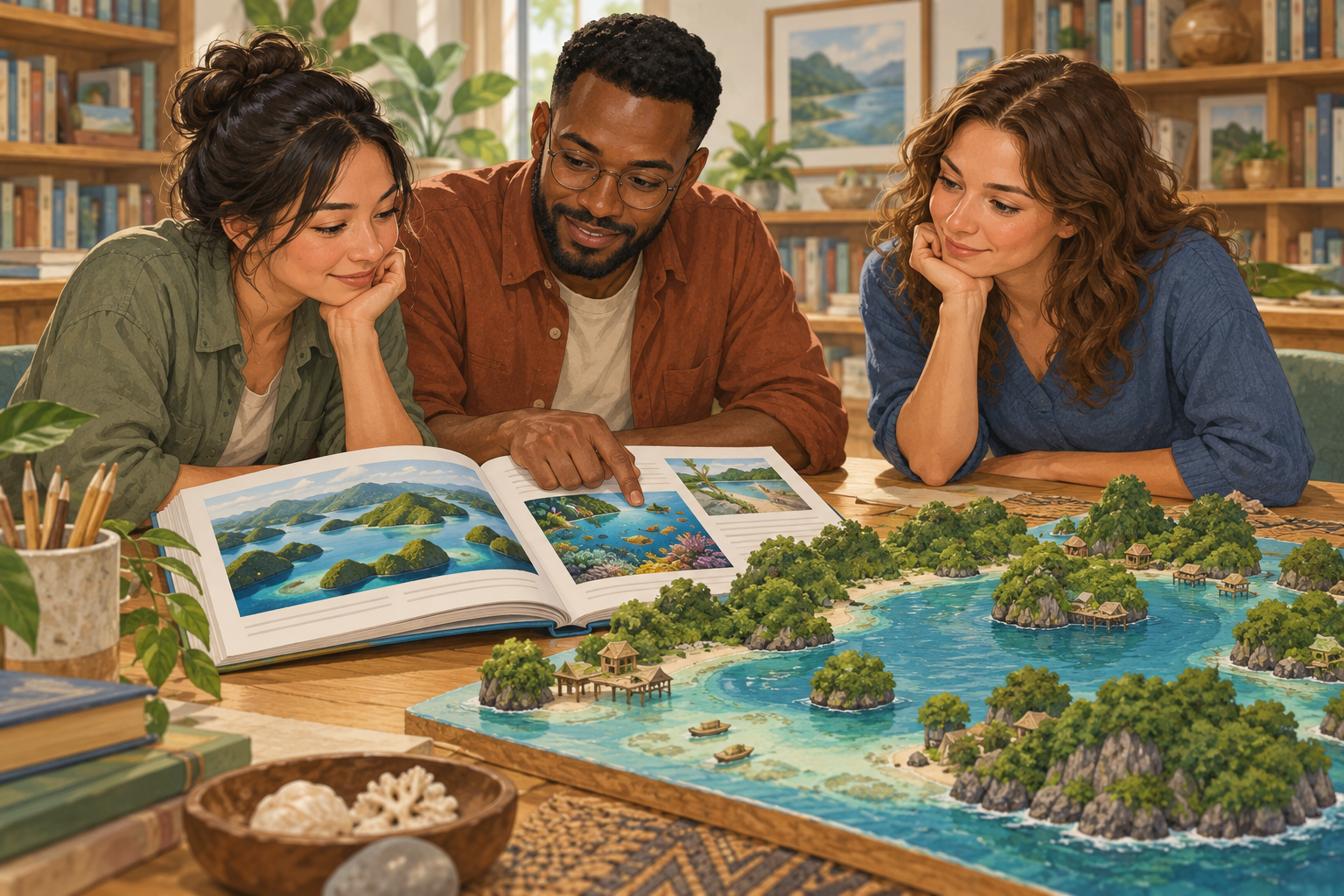
Cover illustration: original AI-generated artwork of three fictional adults studying an illustrated book and a handmade island-and-lagoon landscape model in an imagined library. This is a nonliteral artistic composite, not a photograph, an accurate map, an exact view of a named place or a representation of every region of the country.
Choose your reading route
Country foundations
Everyday life
Culture and discovery
Connections and perspectives
Chapter 1: Geography and regional landscapes
Island setting and reefs
The United Nations M49 classification places Palau in Micronesia within Oceania. Its country row carries numerical code 585 and alphabetical code PLW. These geographical groupings support statistical publications and databases; the United Nations explains that they do not imply a position on political affiliation or territorial status. Source 1.1
Reefs provide a striking perspective on the island landscape in a NASA account published on 15 December 2012. Its caption describes turquoise coral reefs standing out when the archipelago is viewed from above. The accompanying observation was acquired four days earlier by the MODIS instrument aboard the Terra satellite. Source 1.2
Water and soil landscapes
A historical water study offers a different view of the relationship between land and ocean. Otto Van der Brug's 1984 US Geological Survey report brought together fourteen years of hydrological observations. For streams on Babelthuap, it reported that about seventy percent of rainfall ran off to the sea. Correlations linked rainfall on Koror with streamflow on Babelthuap, and discharge measurements across different monitoring sites. The study excluded uninhabited limestone ridge islands without freshwater resources and presented its interpretations for water planning and public works. Source 1.3
The cooperative soil survey of Palau links soils with slopes, drainage, plants and bedrock. Its main fieldwork was completed in 2006, followed by approval of soil names and descriptions in 2007. Scientists examined holes exposing successive soil layers and related their observations to particular landforms. This helped them map likely soil patterns across the landscape. The report also explains a practical limitation of maps: enlarging one does not reveal small contrasting patches that were never mapped at its original scale. Digital maps were prepared to Soil Survey Geographic database standards. American and Palauan agencies jointly contributed, including the college extension service and conservation organisations. Source 1.4
Mapping land and sea
Underwater mapping makes another part of the landscape legible. The Coral Reef Research Foundation describes surveys of shallow inshore areas and outer reef slopes down to 500 metres. Its twelve metre catamaran Kemedukl carries multibeam sonar, gathering successive strips of depth measurements that are merged into a wider picture. These show reef slopes and other features extending towards deep water. The foundation describes an intended atlas combining its work with deeper observations. Its account identifies National Science Foundation equipment funding and support for mapping surveys from the US Office of Insular Affairs. Measurements inform maritime charts and models of currents influenced by underwater terrain. Source 1.5
The Bureau of Lands and Surveys describes land surveying, mapping and resource information as services for courts, public land authorities, national and state governments, businesses and the public. Its organisation separates surveying and mapping from land resource information, with surveying and mapping sections within the former division. Source 1.6
Chapter 2: History and political change
International recognition
Palau joined the United Nations on 15 December 1994. The General Assembly record describes adoption of resolution 49/63 by acclamation at its meeting in New York. The presiding officer then declared the Republic of Palau admitted and asked that its delegation be escorted to its place in the Assembly Hall. Source 2.1
That admission followed the termination of trusteeship. Security Council resolution 956, adopted unanimously on 10 November 1994, took account of the new status agreement entering into force on 1 October. Its summary records approval through a plebiscite observed by a Trusteeship Council mission, alongside approval by Palau's legislature. The Council determined that the objectives of the Trusteeship Agreement had been attained and that its applicability to Palau had ended. Source 2.2
Records of administration and debate
Administrative archives preserve another route into this period. The US National Archives describes an index to copied Trust Territory records covering island groups that included Palau. Entries identify geographical areas, government departments, authors, titles, dates and microfilm locations. Subjects range from education and housing to communication, budgets and property. The copied records are held by the National Archives, while a second copy of the microfilm and index is housed at the University of Hawaii's Hamilton Library. Both institutions received the material in 1988. Entries also specify format and quantity, linking a subject or date with a particular reel and frame. Source 2.3
A Northwestern University catalogue records a discussion of Palau dated 2 January 1979. Its three cassettes cover negotiations with the United States, the constitutional convention, national history and people involved, and a speech before the legislature. The entry belongs to the university's Audio Cassette Collection. Source 2.4
Collections and remembered lives
Museum collections also reflect particular encounters and research interests. Writing in March 1957, Roland Force described fieldwork conducted with his wife from December 1954 to April 1956. Their research examined social structure, political change and emerging leadership. They also collected material for the Chicago Natural History Museum. His planned exhibition paired photographs with clothing, woven mats, containers, fishing gear, utensils, ornaments and other objects. The exhibition was scheduled for Stanley Field Hall from 1 to 31 March. Source 2.5
A later oral history project placed the voices of Palauan elders at its centre. In a presentation associated with a June 2012 symposium, Daniel Long described interviews collected with graduate students since 2008 about experiences before and during the Second World War. The proposed archive would preserve speakers' own Japanese words and voices and make recordings available online. Editing recordings into coherent stories, adding Japanese subtitles and considering English subtitles were part of the work. Long also distinguished permission to record research interviews from the further permission needed to publish them. Intended listeners included Palauans abroad and Japanese schoolchildren, without needing to purchase discs. Source 2.6
Chapter 3: Languages and belonging
Questions and reference works
Language can be recorded through different questions, each revealing something distinct. The 2020 Population and Housing Census questionnaire asked which language a person spoke, with a space for a written answer. A separate question asked whether that language was spoken at home more than Palauan. The Bureau of Budget and Planning produced the census. The person questionnaire metadata, created in January 2023, preserves the wording of both questions and the space for language identification. Source 3.1
Lewis Josephs published the Palauan Reference Grammar in 1975 with assistance from several collaborators, including Helen Wilson and Masaharu Tmodrang. Its contents move from sounds and spelling to nouns, possession, pronouns and verbs. Later sections address questions, negation, relative clauses and connections between sentences, followed by a glossary, bibliography and index. Source 3.2
Vocabulary and community writing
Josephs also authored the New Palauan English Dictionary, published in October 1990. The publisher describes it as a revision of Edwin McManus's 1977 dictionary, with thousands of entries added or expanded. Its broader vocabulary includes plants, animals, Palauan legends and words borrowed from English and Japanese. The account emphasises the richness of meanings and the cultural associations carried by vocabulary. Source 3.3
Writing systems can also develop through community consultation. Vasiliki Vita and Chelsea Pedro's 2021 paper describes a survey process for Sonsorolese, or Ramari Dongosaro. Speakers already wrote the language in varied ways. The project proposed printed surveys accompanied by recordings played on phones, recognising uneven computer access and airtime costs. Adult participants would write words and a text according to their own preferences. Researchers and community representatives would then analyse responses for a language committee to consider. The surveys were designed to be anonymous, and Pedro's summer internship supported workshops and outreach. Agreed writing decisions were intended for state documents and official translations. Source 3.4
Documentation and classroom language
In a 2017 project interview, Peter and Bobby Black described documentation of Tobian through vocabulary, stories, poems and songs in their social contexts. Community participants wanted the language available to children and grandchildren. Illustrated stories in Tobian and English were among the outputs welcomed locally, including a colouring book illustrated by a young Tobian boy. The researchers said variation complicated transcription and that native speakers provided essential assistance. They deliberately avoided trying to impose an authoritative spelling system through their documentation work. The project also sought to preserve traditional knowledge alongside spoken language, supported by a documentation grant. Source 3.5
Classroom materials raise related questions. In a February 2020 education interview, specialist Jay said most students tended to speak Palauan, while most instructional materials were in English except in Palauan Studies classes. The challenge described was encouraging students and teachers to continue using Palauan in those studies. Source 3.6
Chapter 4: Institutions and public life
Rights and legislative discussion
The annotated constitutional text published by Palau Legal in its 2019 file recognises peaceful assembly, petitioning government and lawful association. It also gives citizens a right to examine government documents and observe official deliberations. Its provisions on traditional rights protect customary leadership where consistent with the Constitution. Statutes and traditional law are described as equally authoritative, with a qualified rule for conflicts: a statute prevails only insofar as it does not conflict with the underlying principles of traditional law. Source 4.1
Legislative work involves learning and discussion as well as formal proceedings. UNDP reported a briefing seminar for members of both houses of the Olbiil Era Kelulau, or National Congress, held from 23 to 25 June 2025. Congress led development of the agenda, with Japanese funding and UNDP assistance. Sessions covered ethics, oversight, budget scrutiny, media engagement and consultation with civil society. Newly elected and returning members participated in exchanges designed around Palauan stakeholders and policy questions, including economic development and marine conservation. The seminar formed part of the Strengthening Legislatures in the Pacific Island Countries project, encouraging reflection and planning for the twelfth Congress. Source 4.2
Public scrutiny and representation
The Office of the Public Auditor's report for calendar year 2025 records nine completed performance audits. It explains that such audits may examine compliance, efficiency or achievement of intended results. The report also describes financial auditing of government bodies, professional training and peer review of internal quality controls. Its foreword, dated May 2026, identifies shortages of qualified staff, office space and other resources, including mandates the office remained unable to fulfil. Source 4.3
Representation is documented in the Inter Parliamentary Union's record of the November 2024 election. It lists four women among sixteen members of the House of Delegates and two among fifteen senators. The Senate entry gives 16 January 2025 as the first session date. Source 4.4
Young voices and civic advocacy
Participation extends beyond elected office. In observations adopted in February 2018, the UN Committee on the Rights of the Child welcomed the reactivation of the National Youth Congress and children's growing environmental involvement. It also expressed concern about difficulties children faced in being heard. The committee recommended resources for the Youth Congress, stronger opportunities for participation within communities, families and schools, and systematic involvement in developing laws, policies and programmes affecting children. Source 4.5
An earlier civic perspective appears in Palau Think Tank's September 2015 submission to the Universal Periodic Review. The group advocated cooperation between government and civil society on human rights, with dialogue attentive to Palau's needs and cultural heritage. Among its recommendations was an updated study and database of household incomes and local unemployment, intended to inform responses to household needs and unemployment. Source 4.6
Chapter 5: Economy and livelihoods
Understanding economic choices
Economic accounts reveal how analysts organise evidence as well as the findings they present. The Palau Economic Review 2025, whose cover is dated January 2026, was prepared through EconMAP with US Office of Insular Affairs support. It assesses economic performance and policy and supplies a dataset. For its hotel analysis, EconMAP developed four grades in consultation with industry representatives. The review explicitly distinguishes those analytical categories from a formal national hotel grading system. Source 5.1
The IMF's January 2026 account of its 2025 consultation sets out recommendations for public finances and economic resilience. Directors encouraged debt reduction, more efficient public spending, stronger tax administration and oversight of public enterprises. They also called for stronger financial supervision and a domestic payments strategy suited to Palau's economic scale and resources. Tourism development, climate adaptation and better statistics were connected priorities. Source 5.2
Enterprise and food production
Consultation with businesses and government also informed the Asian Development Bank's February 2017 private sector assessment. Its published synopsis recommends reforms in tourism policy, business law, agriculture and finance. It argues that public enterprises should operate on commercial principles and identifies equal economic opportunities for women and international fibre optic connectivity as areas for action. Source 5.3
The 2015 policy on resilient agriculture and aquaculture takes a broader view of resources than land and equipment alone. Prepared through the Pacific Adaptation to Climate Change programme, it identifies institutions, communities, ecosystems and the economy as four foundations. Skills, knowledge, social relationships and finance all appear among the assets needing attention. Focus groups, interviews, surveys, technical reviews and workshops contributed to its development. Further workshops brought the proposed framework, strategy and action plan back to stakeholders and policymakers for review and endorsement. Source 5.4
Visitors and household livelihoods
Visitor records illustrate one part of economic activity. A Palau Visitors Authority summary for June through September 2024 covers 17,809 entry forms. It reports that 73 percent concerned first visits and 27 percent returning travellers. Leisure accounted for 84 percent of visits, with the remainder attributed to visiting relatives and friends or attending meetings and conferences. Reported activities included swimming and snorkelling, sightseeing, diving, shopping and cultural or historical tours. Online sources had introduced Palau to 37 percent of these visitors. Source 5.5
Local household research shows other livelihood connections. A 2015 survey by the Palau International Coral Reef Center and the University of Queensland collected 64 questionnaires in Ngiwal against a target of 65. In the resulting report, 58 percent of households reported fishing or harvesting invertebrates mainly for food and income, while 94 percent reported growing household crops. Trained local collectors administered the questionnaires. These Ngiwal findings form one part of a wider six state study, not national household estimates. Source 5.6
Chapter 6: Homes and everyday community life
Household evidence and older voices
The Household Income and Expenditure Survey for 2023 and 2024 approaches everyday life through income, spending, household production and consumption. It covers usual residents of private dwellings and people living in barracks. The questionnaire also addresses education, work, transport, communications and transfers. Interviewers use an English electronic questionnaire with recall sections for purchases, gifts and home production during one visit, rather than asking households to maintain the older fourteen day diary. Source 6.1
Older residents' own priorities appear in a study published online in June 2023. Six focus groups held in late 2022 involved 37 people aged at least 55 who lived in their own homes. Discussions used Palauan and English, alongside separate stakeholder consultations and ten interviews. Stakeholder participants proposed arts, volunteering and learning opportunities. Older participants preferred the idea of multigenerational community centres to labels that emphasised old age, highlighting social contact and participation. Source 6.2
Civic relationships and housing
Community leadership also features in the Palau Accountability Ecosystem analysis launched in November 2025. Supported by UNDP's Vaka Pasifika project, the work drew on voices from traditional leaders, officials, churches, women's and youth groups and other advocates. Its launch account describes collaboration with the Belau Association of NGOs. The report highlighted advocacy by Ngara Maiberel and called for continuing platforms beyond Women's Conferences to strengthen women's participation in public accountability. Source 6.3
Housing brings together institutions and local relationships. The National Housing Commission's November 2020 transition report describes its creation in June 2019 to administer a housing development project. Its responsibilities included coordinating the national development bank, housing authority, state governments and citizens, and developing subdivision guidelines. Consultation was also to involve the Council of Chiefs. The report identified shortages of finance, staff and planning expertise, and called for dedicated resources and professionals ranging from architects and urban planners to contractors. Source 6.4
Inclusion and community support
An undated proposal by Palau Parents Empowered illustrates a planned approach to disability inclusion. It requested US$200,000 from the UN Democracy Fund for rights learning, education advocacy and participation in community decisions. Proposed activities included collaboration with Palau Community College on vocational training and a survey of barriers to education. The sustainability plan envisaged community support groups, peer learning and partnerships with educational institutions and businesses. This was a funding request, not evidence that the grant or its activities had been delivered. Source 6.5
UNFPA's December 2023 account describes practical support for institutions responding to violence against women. Eight frontline participants received training in collecting and analysing data. At a forum on 6 December, equipment handed to the government included 26 tablets and file cabinets for offices implementing the Family Protection Act. The account identifies statistics personnel, law enforcement officers and health workers among the intended users of that support. Source 6.6
Chapter 7: Learning and education
Teaching and pathways through college
Palau's Education Master Plan for 2017 to 2027 sets out an approach to strengthening teachers and school leaders. Its leadership section proposes individual coaching, intensive introductory workshops and continuing training in subjects and classroom practice. For principals, it combines mentoring with coursework and a reflective internship leading towards certification. It also planned distinct evaluations for teachers and principals. Recruitment measures included media outreach, development of a substitute teacher pool and incentives to attract experienced teachers with degrees. Source 7.1
A December 2024 study examines a specific pathway into teaching at Palau Community College. Researchers analysed 109 students entering associate degree programmes in the academic years from 2019/20 through 2021/22. Thirty three graduated within two years, and thirty one of those graduates had previous college experience. The study compared groups by prior experience, major and organisational affiliation. Importantly, its measured time to graduation began at entry into the studied programme, excluding time previously spent earning college credits. Source 7.2
Supporting further study
Library education has its own professional support model. The PAL scholarship description covers library science study for Palau residents, whether enrolled full time or part time. Its terms connect assistance with an intention to complete a degree and serve Palau libraries, including active PAL membership for two years. Recipients are also expected to give a continuing education presentation and report on academic progress. The listed uses of funding include books, registration, fees and tuition. Source 7.3
The Palau National Scholarship Board describes a broader mission of helping citizens pursue further education and return to contribute to society. Its institutional webpage distinguishes a general grant for basic study costs from full and partial scholarships. The full scholarship description covers tuition, housing and expenses for a limited number studying priority fields. Partial support is described as tuition funding across a wider range of institutions. Source 7.4
Knowledge and inclusive transitions
Learning also involves which knowledge is recognised. Joy Hannibal's 2024 study drew on nine collaborators, field notes, observations and archival documents to examine Palauan Knowledge at Palau Community College. Its summary describes visual and oral representation, academic activities and community programming. Collaborators discussed both experiences of separation from this knowledge and efforts to sustain it. Their accounts challenged the idea that Indigenous Knowledge belongs only to the past, instead presenting it as continuing to evolve. Source 7.5
A regional inclusive education mapping exercise gathered government and civil society information in 2020 and 2021. Palau's profile described an eighth grade transition workshop for students and parents, alongside individual meetings linking schools for students with disabilities. Those meetings could include teachers, specialists, families and service providers. The profile identified limited resources, attitudes and awareness of available support as challenges. Its stated priorities included involving organisations of persons with disabilities in improving inclusive education. Source 7.6
Chapter 8: Health and community care
Planning and practical learning
WHO's October 2024 overview places Palau within a Pacific cooperation strategy for 2024 to 2029. Its priorities include stronger primary care, disease prevention and attention to risk factors for noncommunicable diseases. Telemedicine is described as a way to extend diagnosis and treatment access across remote islands. The strategy emphasises skilled health workers, cooperation between sectors, early warning systems and infrastructure able to withstand climate threats. Source 8.1
Community learning is part of the Palau Red Cross Society's training description. Its twelve hour first aid and basic life support course combines classroom discussion with demonstrations and practical scenarios. The provider describes an audience including people without medical backgrounds. Assessment involves group participation, verbal questions, observation of practical work and a short written examination. Successful completion leads to a certification card. Source 8.2
Reminders and community evidence
Appointment reminders provide another example of proposed support. A Japanese embassy account dated January 2025 describes a workshop on an SMS reminder system under a UNICEF immunisation project. The design would send prenatal and immunisation appointment reminders one week beforehand and again the day before. A March 2025 launch was planned at the time of the account. The wider project linked Palau with four other Pacific countries and aimed to support cold chain maintenance and provide basic immunisation training. Source 8.3
The 2023 Adult Hybrid Community Health Assessment gathered evidence from 1,931 respondents between 25 April and 28 August. Its target population was residents aged eighteen or older able to understand English or Palauan and give consent. Households were selected randomly within island and state groupings, followed by random selection of one individual per household. Trained surveyors collected data electronically. The study was designed to inform prevention programmes, research and monitoring, addressing community wellbeing alongside noncommunicable diseases and mental health indicators. Weekly uploads and checks against a data dictionary supported the processing of survey responses. Source 8.4
Coordinating care and participation
Turning priorities into coordinated work was the focus of an August 2026 workshop involving the Ministry of Health and Human Services and WHO. WHO's September account describes discussions organised around prioritisation, planning, practice and partnerships. Teams considered financing, procurement and responsibilities using existing programmes as examples. They also discussed how programme design and evidence could support resource mobilisation. National needs were to guide the search for partners and funding, rather than allowing available funding to determine priorities. Source 8.5
Community involvement is also central to the mental health strategy for 2025 to 2035 described by WHO in September 2025. Its launch account presents a shared approach involving several sectors rather than health workers alone. The stated aims include reducing stigma, raising awareness and strengthening social connection. Communication and mobilisation of community resources were presented as ways to encourage engagement with mental health services and support prevention efforts. Source 8.6
Chapter 9: Transport and digital connections
Ocean cables and airport development
Palau's connections extend beneath the sea. In December 2017, Belau Submarine Cable Corporation and NEC announced completion of the Palau Spur. It joins the SEA US cable through a branch between the Philippines and Guam, linking Palau onwards with Asia and North America. The release gives an initial design capacity of 500 gigabits per second. The state owned corporation described its role as providing domestic operators with access to international bandwidth, rather than describing individual customers' connection speeds. Source 9.1
Airport development has also involved international partnerships. JICA's May 2022 account records the full opening of a terminal project on 8 May. It combined a new departures building with renovation of the existing terminal for arrivals. The older building had been constructed in 2003 with Japanese grant assistance. The project brought together Sojitz, Japan Airport Terminal, the Japan Overseas Infrastructure Investment Corporation and construction contractor Taisei, combining investment, operational experience and building work. JICA described the work as a response to growth in tourism and a need to overhaul airport facilities and functions. Source 9.2
Island links and transport planning
The Japan Palau Friendship Bridge links Koror and Babeldaob. A Japanese government publication from autumn 2014 explains that the original bridge carried water and electricity lines as well as vehicles. After its collapse in September 1996, Palau installed a temporary floating bridge and requested Japanese assistance. Construction of the replacement began in November 1999 with grant support. The new design allowed relatively large ships to pass beneath it. Source 9.3
Public transport planning appears in a separate January 2023 JICA agreement. The proposed three year project combined pilot activities with development of a master plan, seeking alternatives suited to a maritime country and tourism destination. Expert teams, equipment and training were intended to support the Ministry of Human Resources, Culture, Tourism and Development. The design connected transport planning and operation with environmental considerations. Source 9.4
Mobile networks and shared information
A June 2023 US Trade and Development Agency grant supported preparation for mobile network modernisation. Its announced technical assistance would provide the Palau National Communications Corporation with analysis, designs and detailed implementation plans. The objectives included replacing existing infrastructure, preparing for 5G services and extending the network towards underserved areas. The account describes support coordinated with Australia, India and Japan. Source 9.5
Digital connections also involve cooperation between agencies. An April 2024 UNDP account describes Palau's consultations with Japan's Digital Agency on an integrated customs, immigration and quarantine system. This followed regional discussions involving Fiji and Vanuatu about digital arrival cards. The wider border management project aimed to strengthen data sharing and cooperation for the movement of travellers and cargo. Palau also sought technical advice for its first strategy bringing those three border functions together. Source 9.6
Chapter 10: Work, skills and opportunity
Routes into study and employment
Palau Community College's Adult High School description combines academic learning, life skills and occupational preparation. Its two tracks share general courses, while the vocational route includes 500 hours of workplace training for students without work experience. The college preparation route adds further academic subjects. Competency based modules allow students to work at an appropriate pace, with initial assessment used for placement. It aims to support a diploma and pathways into further study or entry level employment. Source 10.1
Employment policy was the subject of a March 2025 workshop in Koror. The ILO reported that government, employers, workers and civil society reviewed and validated the final draft of Palau's first National Employment Policy. Its aims included skills development, employment conditions and a more inclusive labour market, with an action plan envisaged for implementation. The report anticipated formal adoption later that year, so the workshop represents draft validation rather than proof that adoption had already occurred. Source 10.2
Practical skills and enterprise
A December 2025 provider account describes the Civic Action Team apprenticeship programme as combining classroom work with practical training in fields including carpentry, plumbing, welding and equipment operation. Participants were selected through interviews considering motivation and work habits. Completion was linked to certification through the National Center for Construction Education and Research. Individual apprentices described ambitions to support their families, improve professional habits and learn alongside the team, giving personal perspectives on the training experience. Source 10.3
Small enterprise learning has a home in the Palau Small Business Development Center. Its description lists individual counselling on business plans, marketing, record keeping, finance and operations, alongside workshops for beginners and established businesses. Resources include a business library, computer laboratory and local information. Outreach presentations extend to schools, village organisations and community groups, covering youth entrepreneurship and the advantages and challenges of owning a business. The centre belongs to the University of Guam's Pacific network. Source 10.4
Producer networks and shared landscapes
FAO's account of the Palau Sustainable Tourism Value Chain Program connects producer learning with tourism. The project mapped suppliers, stakeholders, food systems and flows through the tourism economy. Working with the tourism ministry, Slow Food and Sustainable Travel International, it linked tourism providers with local women's producer groups. Those groups received technical, entrepreneurial and marketing training to support promotion and sales through tourism channels. Source 10.5
Shared landscapes provide another setting for skills and leadership. In June 2026, Aimeliik, Ngardmau, Ngatpang and Ngeremlengui launched the Kiwa Women's Work project through agreements with the Micronesia Conservation Trust. An introductory workshop addressed management, financial accountability, monitoring and reporting. The four states also renewed the Dmakeiukl Declaration on jointly managing shared resources across their boundaries. The project planned support for women's groups leading activities concerned with ecosystems, food security and climate resilience in those communities. Source 10.6
11. Habitats and living landscapes
Lagoons and freshwater refuges
The Rock Islands Southern Lagoon brings forested limestone islands together within a lagoon sheltered by a barrier reef. The UNESCO property lies in Koror State, south of Babeldaob. Its landscape also holds traces of settlement: defensive walls, terraces and house platforms survive from villages occupied before people moved to larger islands. Descendants maintain connections with ancestral islands through oral traditions, including legends, dances, proverbs and place names that recall their former land and seascapes. (Source 11.1).
Lake Ngardok Nature Reserve includes more than the lake itself. Its Ramsar information sheet, updated in March 2012, describes the protected catchment, streams, riverine marsh and freshwater swamp forest within the reserve boundary. Lake, wetland and upland forest habitats support birds found only in Palau. The account names the Palau fruit dove, fantail, flycatcher and ground dove. The site received its Ramsar designation on 18 October 2002, before this information sheet was updated. (Source 11.2).
Stewardship and learning
The PAN Fund account describes a financing arrangement that supports protected places while retaining state ownership and governance. Its independent nonprofit organisation acts as trustee for donations and arrival fees supporting the Protected Areas Network. The fund opened in March 2012. The institutional history explains that the arrangement was intended to help states access financial and technical resources, alongside management planning with stakeholders and the capacity needed for implementation and reporting. (Source 11.3).
Ebiil Society connects environmental learning with local knowledge. Its partnership with Stanford University launched a research course in 2021 for Palauan secondary students, offered over a year on weekends. Students investigate subjects linking community, culture and the environment. Another programme takes learning outdoors: fourth graders explore coastal and reef environments, while fifth graders join restoration activities at the former bauxite mine fields in Ngardmau. The provider describes teaching that brings science and cultural values together. (Source 11.4).
Landscapes linked by communities
Ngaremeduu lies on the west coast of Babeldaob. Its UNESCO biosphere profile records a 2005 nomination and describes a landscape containing freshwater marshes, grass and shrub savannah, mangroves, coral reefs and seagrass beds. The reserve corresponds to the Ngaremeduu Conservation Area. The profile also connects this setting with village livelihoods based on fishing and farming, and with cultural features including stone platforms, paths, monoliths, stone piles and docks. (Source 11.5).
The Babeldaob Watershed Alliance developed cooperation across state boundaries. Its partner case study describes agreements identifying shared conservation goals and incentives, followed by conservation planning involving nine Babeldaob states and three outlying states. Each of the twelve sites used that work to prepare management plans. The alliance also provided a forum connecting state policymakers with technical partners, and updated its strategic action plan through the 2018 GEF Pacific Ridge to Reef work. (Source 11.6).
12. Food and shared meals
Taro and community knowledge
An ADB account published in March 2026 describes support for twenty groups of women taro producers through seed grants agreed with the Bureau of Agriculture. A Food Processing Centre developed products including taro chips, ice cream and flour. Established with the bureau and support from the Palau Visitors Authority, it was intended to connect these foods with tourism. Women cooperatives also received training in processing and business as part of the initiative. (Source 12.1).
Food can also be a subject of community research. Naoto Suzuki and Saori Tachihara reported interviews about dietary culture in Ngiwal following three visits between May 2010 and April 2011. Their 2014 article proposed ways to share that knowledge: taro cooking workshops, books for children and public paintings of food related myths and legends. The authors identified a local gap between valuing dietary traditions and putting those values into practice. (Source 12.2).
Fishing communities and school meals
A government request prompted an assessment of women in fishing communities in November 1998. The publisher’s summary identifies Lyn Lambeth of SPC as the survey leader, assisted by Evelyn Oiterong and Roberta Louch. Its questions extended beyond harvesting to processing and marketing marine resources. The assessment also sought to identify supporting services, understand constraints on participation and develop guidance for women’s involvement, treating fisheries as a field of social and economic activity. (Source 12.3).
School food has acquired a digital dimension. In July 2025, TaiwanICDF described a workshop introducing officials to a platform developed for Palau’s Ministry of Education. Its functions included menus, ingredient inventories, procurement, food waste estimates and meal feedback. The ministry planned implementation across schools for the semester beginning that August. The provider attributed development to collaboration involving the Taiwan Technical Mission, education officials, local technology personnel and JICA volunteers, with specialist nutritional input. (Source 12.4).
Objects and research records
A bird shaped wooden bowl offers another perspective on sharing food. The British Museum’s account describes shell inlay, a removable upper section and use as a sweet drink container. It attributes the bowl to the High Chief of Koror, who gave it to Captain Henry Wilson at a farewell feast in 1783. The account places the vessel within prestigious exchanges of food gifts, and notes a drawing published in George Keate’s 1788 narrative. (Source 12.5).
A separate dietary study interviewed 263 participants between August and December 2023. Its methods describe visits to homes in urban Koror and Airai and several rural states, including Kayangel and Peleliu. Interviews took place in Palauan or English according to preference. Only people identifying as Palauan were included, and empty homes received no follow up visit. The study used an eleven item food diversity questionnaire that did not require detailed portion estimates or dietary recall. (Source 12.6).
13. Arts and storytelling
Collections and young artists
Belau National Museum describes collections spanning art, anthropology and history, with material from Palau and the wider Pacific. Its art and material culture account includes beads, shell money, miniature houses and canoes, domestic utensils and tools. Watercolour and oil paintings are prominent among works by Palauan and other artists connected with Palauan culture. Portraits, scenes of daily life, landscapes and contemporary storyboards appear in the collection, which grows mainly through donations and occasionally through purchases. (Source 13.1).
The Palau International Coral Reef Center has organised its Arts and Tides Calendar Contest since 2001. Kindergarten, primary and secondary students are invited to create work around an annual marine science or conservation theme. The invitation extends across all sixteen states. Winning entries from each grade level appear in the printed calendar and receive prizes, connecting a recurring publication with opportunities for young artists to interpret environmental subjects. (Source 13.2).
Music research and carved objects
Birgit Abels describes music research grounded in conversations and collaboration. The introduction to Music Worlding in Palau recalls fieldwork between 2004 and 2007 documenting contemporary performance and revisiting historical recordings with local interlocutors. During 2006 and 2007, work for the Bureau of Arts and Culture included oral histories and interviews. Later visits continued collaboration with Belau National Museum. The author explains that quoted interviews were conducted in Palauan and normally translated by her, while first names replaced hereditary titles to protect participants’ privacy. (Source 13.3).
A Burke Museum catalogue record identifies a storyboard from Belau by the maker Sbal. The object is listed as carved and painted wood, measuring 23.8 inches high and eleven inches wide. It entered the collection as a gift from Carl and Carol Lahser under object number 2010-42/27. (Source 13.4).
Poetry and documentary film
Microchild collects poetry by Valentine Namio Sengebau, a Palauan writer who spent the final quarter century of his life on Saipan. The 2004 anthology’s introduction describes poems published between 1976 and 1980 in the Micronesian Reporter and Marianas Variety. Their subjects included cultural identity, political negotiations and personal experience. Editors organised the poems into four themes and supplied translations of Palauan and Chamorro expressions in footnotes. A foreword sketches the poet’s life, while an appendix lists poems chronologically with their original places of publication. (Source 13.5).
The filmmakers’ entry for Palau, An Ocean Inheritance presents a documentary concerned with ocean justice, cultural connections and community stewardship. It identifies Skylar Chen and Rayne Sullivan as directors, with Sullivan also credited as writer. The listed producers include Ivory Vogt, Chen, Alex Wang and Sullivan. The English language film runs nineteen minutes and fifty seconds; its production record names Palau as both country of origin and filming location, and describes its format as digital. (Source 13.6).
14. Heritage and places of memory
Buildings and remembered places
A meeting house commissioned in Koror has a long museum history in Berlin. The Humboldt Forum’s account explains that Golegeril and around forty members of the Ngaradegangl men’s club built the smaller scale house for Augustin Krämer in 1907. It was displayed in Berlin in 1908 and again in 1970, with museum additions to its floor and roof structure. In August 2022, Patrick Tellei’s Palauan team renewed its covering using palm leaf shingles made in Palau. (Source 14.1).
Imeong Conservation Area appears in Palau’s 2004 UNESCO Tentative List submission, not as an inscribed World Heritage property. The State Party description includes the Ii ra Milad rock shelter, with a stream, hollowed boulders and a petroglyph. At Ngerutechei village, stone paths connect house platforms, bathing pools, a chiefs’ meeting house and piers. The submission also records local oral history about chiefly titles, presenting remembered meanings alongside the physical features of the proposed area. (Source 14.2).
Stone sites and wartime structures
Palau’s cultural site stamp booklet places Badrulchau in Ngarchelong State, on northern Babeldaob. Its description identifies stone columns on ancient terraces between Ollei and Mengellang and records the site’s inclusion in the national historic register. The booklet also acknowledges several stories about the columns. One attributes their construction to gods or spirits and suggests that they supported a meeting house, a narrative preserved as tradition rather than an archaeological conclusion. (Source 14.3).
On Peleliu, an Architexas project account describes a different preservation challenge. Stanley Graves assessed six fortified Japanese military structures and one American structure dating from the Second World War. The work considered immediate concerns, stabilisation, longer term repair and possible community or visitor uses. Its approach to the Japanese buildings was to retain them as stabilised, battle damaged ruins. The American Orange Beach Chapel was identified for stabilisation alongside planned visitor facilities. (Source 14.4).
Planning and regional connections
In May 2026, JICA announced an agreement with Palau’s Ministry of Human Resources, Culture, Tourism and Development for historical heritage planning. Signed in Koror on 8 May, it envisaged a master plan linking conservation and use of Japan related heritage with regional development and stronger implementation capacity. The planned period was thirty six months from the mission’s arrival. The named implementing bodies included the heritage and tourism bureaus, the ministry and Palau Visitors Authority. (Source 14.5).
Another 2004 Tentative List submission connects Palau with Yap in the Federated States of Micronesia. It describes two Palauan quarry sites where Yapese visitors obtained stone disks before transporting them home. Access involved exchanges and alliances with villages holding rights to particular islands. The dossier distinguishes an inland site between two marine lakes from caves behind a beach, and lists surviving disks, rock alignments, retaining walls, docks and working debris among the material traces. (Source 14.6).
15. Science and discovery
Currents and earthworks
The FLEAT research programme examined what happens when ocean currents encounter steep island and seabed terrain near Palau. Its 2019 overview combines observations with models that included tides. Researchers observed wake eddies and lee waves as small as one kilometre, while incoming flows changed across tidal, seasonal and longer timescales. The programme also described collaboration with Palauan partners and outreach to school students, connecting physical ocean research with local scientific relationships. (Source 15.1).
On Babeldaob, researchers used aerial photogrammetry to create three dimensional models of fourteen earthworks. Their May 2022 methods account explains that these models guided the placement of test trenches investigating construction and possible functions. Analyses of landforms, soils and sediments then informed interpretations of building techniques, ancient land use and the stability of the earthworks. The study brought detailed surface recording together with investigation beneath the ground at selected monuments. (Source 15.2).
Rocks and the seabed
James Hawkins and Osamu Ishizuka’s 2009 geological abstract distinguishes smaller islands formed mainly from uplifted reef carbonate from larger volcanic islands. It places volcanic activity between the late Eocene and early Miocene and describes an island arc rock series. Using plate reconstructions and magnetic evidence, the authors proposed that the arc formed along a transform fault that migrated northward and rotated clockwise by up to ninety degrees. (Source 15.3).
NOAA’s Okeanos Explorer conducted three mapping expeditions in Palauan waters between July and October 2025. Using multibeam sonar, the programme and its preceding transit mapped 97,078 square kilometres inside the exclusive economic zone, including 86,372 within the marine sanctuary. Around the southwest islands, the first expedition identified a previously uncharted seamount rising to less than one hundred metres below the surface. The expedition report also describes community engagement through live interactions and targeted ship tours, alongside planned sharing of data with Palauan partners. (Source 15.4).
Water and changing shorelines
A 1955 study of Angaur examined the consequences of extending phosphate excavations below sea level. Lakes formed in the excavated areas, and salt water moved through fissured rock. Researchers monitored water levels, tidal changes and water properties in lakes, wells and test holes. These observations guided adjustments to mining works, including partitioning lakes and filling compartments connected to the sea. Measurements included tidal amplitude and lag, water temperature and mineral content. (Source 15.5).
William Dickinson and Stephen Athens used cores from Komebail Lagoon reefs and the coastal fringes of Babeldaob and nearby islets to reconstruct earlier shorelines. Their 2007 abstract inferred subsidence of about 0.55 millimetres annually over roughly five thousand years. This changing relationship between land and sea complicates comparison of archaeological settlement sites with evidence of human disturbance. The authors considered environmental indicators alongside the elevations and dates of the earliest known coastal habitation sites. (Source 15.6).
16. Sport and shared recreation
Teams and Olympic experiences
The Palau National Olympic Committee received IOC recognition in 1999, following provisional recognition the previous year and technical assistance in 1997. Its institutional profile describes responsibility for selecting, preparing and leading teams at the Olympics, Pacific Games and Micronesia Games. The committee’s history also records hosting the Micronesian Games in 1998 and the Pacific Mini Games in 2005. Its office is listed in Koror, and the profile describes cooperation with the government through the vice president’s office. (Source 16.1).
Swimming brought siblings Jion and Yuri Hosei to the Paris Olympics in 2024. A PACNEWS report identifies Jion as seventeen and Yuri as nineteen, competing in their respective fifty metre freestyle events. It records personal bests of 25.67 and 30.52 seconds at La Defense Arena. Jion described practising before and after school; Yuri emphasised mental strength and their mother’s encouragement. Yuri was then studying education in Japan while Jion attended secondary school in Palau. Eight other Pacific women also entered Yuri’s event, swimming in different heats. (Source 16.2).
Athletics and baseball
An April 2026 announcement named Palau’s team for the Oceania Athletics Championships in Darwin. Sydney Francisco headed a squad spanning open and under eighteen categories. Brothers Righteous and Peace were assigned to those divisions respectively, alongside younger entrants Elton Miguel Mangeron and John David Julian. In the accompanying interview, Francisco looked forward to competing with the next generation of Palauan athletes, expressing enthusiasm about seeing younger teammates step forward at the championships. (Source 16.3).
JICA’s account of the July 2025 Pacific Mini Games reports Palau’s baseball team beating Guam eight to one in the final. The team had defeated the Northern Mariana Islands in the closing game of the preliminary round. The account identifies volunteer Arai Yoshiaki as training alongside the team and places that support within a longer relationship: a baseball coach arrived in 1997, followed in 2015 by another coach who also organised youth classes and supported coaching skills. (Source 16.4).
Inclusive sport and practice
Special Olympics Palau describes a programme of sports training and athletic competition for children and adults with intellectual disabilities. Its institutional profile lists activities throughout the year in several Olympic style sports and gives a contact location in Koror. (Source 16.5).
Table tennis preparation took a concentrated form in October 2023. An ITTF account describes a camp involving eight athletes, equally divided between men and women, and two coaches preparing for the Pacific Games. Sessions at the national gymnasium took place in afternoons and late evenings because of the heat. Individual skills work accompanied mental preparation. Coaches also explored productive training and organising small tournaments, before a combined round robin competition concluded the camp and offered players another opportunity to assess their progress. (Source 16.6).
17. Weather and environmental challenges
Local observations and water resources
A weather station on Ngeanges Island gives researchers a record away from the larger land masses of Babeldaob and Koror. CRRF established it in 2007, placing instruments on a twelve metre tower above the rocky island. The station account describes a transition from radio modem data transfer to a satellite connection. Its account describes trade winds from October to May and a westerly monsoon from June to September, with historical observations archived in Hawaii. In that station’s record, 2015 had the lowest annual rainfall since 2007, totalling 162 centimetres. (Source 17.1).
ENEA’s Palau drought resilience project is listed for 2017 to 2019. Its programme description frames the work as adaptation to prolonged dry periods associated with the El Nino Southern Oscillation. Listed activities include a feasibility study to identify places for additional water sources, particularly new wells. Monitoring covered construction, water quality and flow, and pump maintenance. Training communities was paired with wider dissemination of practices for sustainable water management. (Source 17.2).
Environmental institutions and response
A UNEP account describes a three year initiative to strengthen Palau’s institutions for chemicals and waste management. Its design includes reviewing existing administrative and technical arrangements, surveying marine litter and preparing an action plan with public, private and community organisations. A central information system would bring together inventories, recycling, disposal and export records. Training for regulators, customs staff, businesses and waste managers, alongside examination of financing mechanisms, was intended to support work under the Basel, Stockholm and Minamata environmental conventions. (Source 17.3).
The International Charter records an activation for an ocean storm affecting Palau on 3 December 2012. The United Nations Office for Outer Space Affairs requested the activation on behalf of the humanitarian coordination office. The Pacific Disaster Center is identified as project manager in this institutional response record. (Source 17.4).
Facilities and energy connections
ADB’s captured Koror and Airai sanitation update reports a November 2025 contract for remaining sewer upgrades, with completion expected in December 2026. It also records two new public toilet facilities and plans for a third at P-Dock. The stated design provides at least two women’s stalls for each men’s stall, along with baby changing and menstrual hygiene facilities. Bidding for the third facility was scheduled to begin in late July 2026. (Source 17.5).
The Palau Renewable Energy Integration Project links a solar facility completed in 2023 with planned changes to the electricity network. Its Australian financing agency describes staged equipment and settings modifications intended to increase the grid’s ability to receive renewable power. Initial activities began at Bus Stop Junction substation in early July 2025. Delivery partners listed in the account include Palau’s government, the public utilities corporation, Solar Pacific Pristine Power and Tetra Tech International Development. (Source 17.6).
18. Regional and global connections
Frameworks and Pacific priorities
Palau signed the Pacific UN Sustainable Development Cooperation Framework for 2023 to 2027 on 9 December 2022, according to an official UN account published the following March. The regional framework covers fourteen countries and territories. Its four connected areas are Planet, People, Prosperity and Peace, with country implementation plans organised over two year periods. The framework was developed through consultation with governments, civil society, development partners and regional organisations to align UN work with national and Pacific development plans and priorities. (Source 18.1).
Palau’s host programme for the fifty fifth Pacific Islands Forum meeting scheduled events in Koror from 30 August to 4 September 2026. Its theme drew on the name Belau and linked building economies with life, action and unity. The concept associated life with families and wellbeing, action with putting commitments into practice, and unity with partnerships among governments, traditional leaders, businesses, women and youth. It presented priorities for the gathering rather than a record of its completed decisions. (Source 18.2).
Membership and development strategies
A Pacific Community retrospective identifies October 1983 as an important institutional turning point. At the Saipan conference, Palau and other Pacific governments and administrations gained full membership through a resolution granting equal participation regardless of political standing. Members shared decision making and financial responsibility through an agreed contribution formula. The account also connects that year with creation of the Committee of Representatives of Governments and Administrations, strengthening members’ ownership of the organisation’s activities. The Pacific Conference was established as the highest decision making body. (Source 18.3).
ADB’s Pacific Approach for 2021 to 2025 provided an operational framework and partnership strategy for twelve small Pacific island countries, including Palau. Its September 2021 synopsis sets out three priorities: preparing for and responding to shocks, delivering sustainable services, and supporting inclusive growth. (Source 18.4).
Ocean cooperation and migration
Palau and the United States hosted the seventh Our Ocean Conference in Koror on 13 and 14 April 2022. The organiser’s account emphasises islander perspectives and the connection between ocean and climate. It also highlights communities whose livelihoods depend on the sea, including those in small island developing states. The event page records 410 new commitments, a measure of announced undertakings rather than a count of completed projects or investment delivered within Palau. (Source 18.5).
IOM’s country strategy for 2017 to 2020 set out a framework for responding to the needs of Palau’s government, migrants and other stakeholders. The publisher’s 2018 synopsis lists three priorities: linking migration with sustainable development and adaptation, improving resilience for displaced people and affected communities, and protecting migrants’ rights. It also places the strategy alongside wider Pacific, Asian and UN frameworks, describing an institutional approach to migration during that historical period. (Source 18.6).
19. Contemporary creativity and enterprise
Campaigns and small businesses
The Palau Pledge campaign brought creative communication to environmental responsibility. Agency Havas describes an approach intended to encourage residents and visitors to consider their actions, with a promise dedicated to Palau’s children. The pledge appeared in English, Japanese, Korean and two written Chinese versions. Producer Yukfoo’s credits identify the associated film The Giant, directed by Evan Viera, with Havas Sydney as agency and Amy Neave as producer. Yukfoo also credits Tommy Wooh as co director. (Source 19.1).
TaiwanICDF’s women and youth enterprise project records a signing date of 30 March 2020. Its design channels lending through Palau’s government to the National Development Bank of Palau, supporting expansion of the bank’s lending operations. The intended beneficiaries include women, young entrepreneurs and micro, small and medium businesses. Improving access to private sector credit is the objective described in the page’s June 2024 update. (Source 19.2).
Glass craft and clean energy
A glass marlin made by Belau Eco Glass Center became a diplomatic gift during the Palauan president’s September 2022 visit to Japan. JICA’s Japanese account explains the practical support behind the workshop: the Glass Craft Association assisted staff with production skills, operations, sales management and proposals for visitor experience courses. The programme aimed to develop the centre as a tourism facility and an example of resource circulation, linking glass craft with business skills and public engagement. (Source 19.3).
A separate clean energy financing design focuses on private businesses. The Disaster Resilient Clean Energy Financing project lists Palau’s development bank as owner and 2023 as its selected year. Grants were intended to support a new subsidised loan product for businesses, including enterprises led by women. Its revolving arrangement would use repaid principal for a further funding cycle. The first cycle identifies solar and battery equipment, while technologies for a later cycle would be chosen subsequently. (Source 19.4).
Restoration and regional networks
The Friendship Canoe illustrates how a cultural gift can acquire a new chapter. An embassy account from December 2019 describes a traditionally built canoe presented to Japan’s Mie Prefecture more than twenty years earlier by former President Kuniwo Nakamura and displayed at a fisheries high school in Shima. Nippon Voyaging Association began restoring it through the Tsukuyomi project in 2015. After repairs, a two year voyage from Miyazaki reached Mie in summer 2019. (Source 19.5).
Grameen Foundation’s BELUU programme was designed to support women entrepreneurs in Palau, Nauru, Tuvalu and the Marshall Islands. Its planned thirty six months began in October 2021, with skills, mentoring, business planning and access to financial services and networks among its aims. The related DEEPR portal provides a learning and exchange framework for grantees, a community of practice and other interested groups, gathering resources relevant to women’s participation in blue and green economies. (Source 19.6).
20. Future choices for communities
Youth voices and adaptation
More than sixty students attended the Digital Smart Squad Forum at Koror’s Palasia Hotel on 17 September 2025, according to the UN event account. Discussions explored cyberbullying, harmful content and digital footprints. Interactive sessions and storytelling led to a shared pledge of kindness, respect and safety. Local service providers worked with UN and UNICEF support, and the event launched a virtual help hub designed to connect students with support services as part of wider child online protection efforts. (Source 20.1).
The NAP Global Network’s Between the Tides account describes Palau preparing a stand alone national adaptation plan, with adoption anticipated in 2026. Led through the Office of Climate Change, the process was designed to connect community knowledge, state governance and national policy. Ten priority sectors included water, food, coastal protection, infrastructure, health and cultural heritage. Green Climate Fund support was intended to help turn risk assessment into coordinated strategies that could be funded and implemented. (Source 20.2).
Community dialogue and preparedness
A UNDP account published on 23 July 2024 describes a workshop on legal literacy and gender based violence organised by its Fiji office with the Micronesian Legal Services Corporation. Community leaders, civil society and government representatives participated. Discussions considered relationships between women and men, access to justice, and cultural factors that could protect women or discourage speaking openly. Participants also learned about available legal support and expressed interest in a longer follow up workshop lasting a full day. (Source 20.3).
The GCCA+ SUPA programme account describes work in five Babeldaob states: Aimeliik, Airai, Ngardmau, Ngaremlengui and Ngatpang. It reports extending supplementary water storage from schools to community emergency shelters. School coastal pollution monitoring was also expanded and incorporated into the curriculum. Support for Eco Paradise FM enabled community broadcasts about climate resilience and disasters, while programme activities included training community leaders and state officers and integrating climate concerns into local development planning. (Source 20.4).
Local stewardship and shared learning
In Ngarchelong, OneReef worked with the state office and Rteluul Community Regeneration Organization on traditional mangrove channels. Its August 2026 account describes clearing channels, maintaining sites and providing practical training. A pilot at Taoch er a Chermang/Ibesang preceded a second phase supported by the Pawanka Fund. Participants included youth, students, teachers and volunteers, with the project linking community stewardship to culture and livelihoods. The second phase took place at Taoch er a Ngerbau. (Source 20.5).
Palau Community College’s July 2023 newsletter records a summer programme at Tan Siu Lin Library from 26 to 30 June. Children aged seven to twelve joined creative and teamwork activities, practised finding information and had an opportunity to obtain library cards. The historical account describes a free programme intended to encourage reading and use of library resources. (Source 20.6).
Frequently asked questions about Palau
How did the agriculture policy define resilience?
Palau’s 2015 policy connected institutions, communities, ecosystems and the economy, drawing on consultations, technical reviews and workshops. Source FAQ1
Who was involved in housing coordination?
The 2020 commission report identified the development bank, housing authority, state governments, chiefs and citizens as participants in housing coordination or consultation. Source FAQ2
What did the Force fieldwork examine?
The 1954 to 1956 research examined social structure, political change and emerging leadership, alongside collecting objects for a museum exhibition. Source FAQ3
How did the education profile describe school transitions?
The 2020 to 2021 mapping described a general transition workshop and individual meetings linking schools, families and specialists for students with disabilities. Source FAQ4
What habitats surround Lake Ngardok?
Streams, marshes and freshwater swamp forest. (Source 11.2).
Who directed Palau, An Ocean Inheritance?
Skylar Chen and Rayne Sullivan. (Source 13.6).
When did Palau host the seventh Our Ocean Conference?
On 13 and 14 April 2022. (Source 18.5).
What did the library summer programme offer children?
Creative activities, teamwork and practice finding information. (Source 20.6).
Continue reading: specialist guides to Palau
These guides offer focused educational reading. The companion How Palau Works explains national and state services and their practical connections; this overview offers a broader route through geography, history, culture and everyday life. Visitor-oriented pages do not confirm current access, safety, opening times or services, and vocabulary material is a reading resource rather than a claim about every community.
- National and state services: How Palau Works
- Education pathways
- Place-based learning ideas
- Visitor-oriented learning ideas
- Place-specific reading routes
- Marine stewardship vocabulary
- Character and community vocabulary
- Reef fish survey vocabulary
Explore the Everything About Countries archive for more national overviews. The companion How Countries Work archive follows the systems behind everyday life.
Bring the evidence together
Choose a place, practice or community project from these chapters. Which details describe observations, which explain an earlier event, and which set out an aim? Compare two examples and write a question that would help you understand them more fully.
Sources and further evidence
Sources consulted 26 October 2026; observations retain their original dates.
- Source 1
- Source 2
- Source 3
- Source 4
- Source 5
- Source 6
- Source 7
- Source 8
- Source 9
- Source 10
- Source 11
- Source 12
- Source 13
- Source 14
- Source 15
- Source 16
- Source 17
- Source 18
- Source 19
- Source 20
- Source 21
- Source 22
- Source 23
- Source 24
- Source 25
- Source 26
- Source 27
- Source 28
- Source 29
- Source 30
- Source 31
- Source 32
- Source 33
- Source 34
- Source 35
- Source 36
- Source 37
- Source 38
- Source 39
- Source 40
- Source 41
- Source 42
- Source 43
- Source 44
- Source 45
- Source 46
- Source 47
- Source 48
- Source 49
- Source 50
- Source 51
- Source 52
- Source 53
- Source 54
- Source 55
- Source 56
- Source 57
- Source 58
- Source 59
- Source 60
- Source 61
- Source 62
- Source 63
- Source 64
- Source 65
- Source 66
- Source 67
- Source 68
- Source 69
- Source 70
- Source 71
- Source 72
- Source 73
- Source 74
- Source 75
- Source 76
- Source 77
- Source 78
- Source 79
- Source 80
- Source 81
- Source 82
- Source 83
- Source 84
- Source 85
- Source 86
- Source 87
- Source 88
- Source 89
- Source 90
- Source 91
- Source 92
- Source 93
- Source 94
- Source 95
- Source 96
- Source 97
- Source 98
- Source 99
- Source 100
- Source 101
- Source 102
- Source 103
- Source 104
- Source 105
- Source 106
- Source 107
- Source 108
- Source 109
- Source 110
- Source 111
- Source 112
- Source 113
- Source 114
- Source 115
- Source 116
- Source 117
- Source 118
- Source 119
- Source 120