
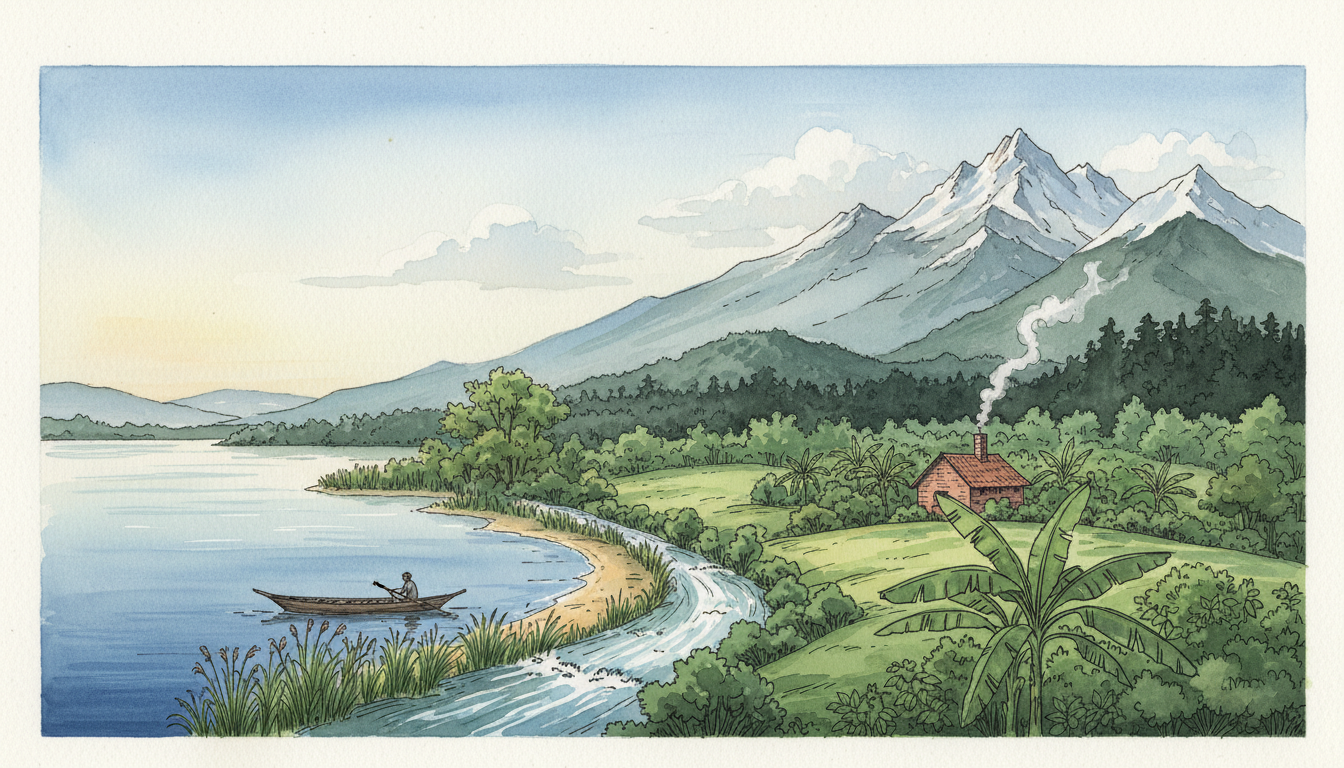
Where is Uganda, what is Uganda famous for, and why is Lake Victoria so important? Uganda is a landlocked country in East Africa, bordered by Kenya, Tanzania, Rwanda, the Democratic Republic of the Congo and South Sudan. Its capital is Kampala, near Lake Victoria. Uganda is famous for the Victoria Nile, mountain gorillas in Bwindi Impenetrable National Park, the Rwenzori Mountains, green farmlands, coffee, cultural heritage, vibrant towns and more. The nickname Pearl of Africa reflects its geographic variety, but the country is much more than a safari image.
Everything about Uganda, in one connected country guide: Uganda’s 2024 census counted 45,905,417 people. A separate Bureau of Statistics projection estimates 50,256,600 by the end of 2026; the projection is not a new census. President Yoweri Museveni was declared the winner of the contested January 2026 presidential election. Meanwhile, major petroleum investments are preparing for first substantial oil production expected in 2027, according to the latest IMF and World Bank forecasts. The rest of this guide explains how Uganda’s geography, people, history, economy, government, schools and culture fit together, and links to related eduKateSG articles.
Uganda at a glance: essential facts
- Official name: Republic of Uganda.
- Capital: Kampala.
- Region: East Africa, African Great Lakes.
- Land neighbours: Kenya, Tanzania, Rwanda, Democratic Republic of the Congo and South Sudan.
- Coast: landlocked; Lake Victoria is freshwater, not an ocean.
- Area: about 241,000 square kilometres, including inland waters.
- 2024 census: 45,905,417 residents.
- 2026 year-end model projection: 50,256,600 residents, not a new census.
- Official languages: English and Kiswahili, alongside many community languages including Luganda, Lusoga, Ateso and Runyankore-Rukiga.
- Currency: Uganda shilling (UGX).
- Time zone: UTC+03:00.
- President in October 2026: Yoweri Kaguta Museveni.
- 2026 election: official result 71.65% for Museveni; opposition disputed legitimacy and rights organisations documented significant abuses.
- Independence: 9 October 1962, from Britain.
- Key environments: Lake Victoria, Victoria Nile, Lake Albert, Lake Edward, Rwenzori Mountains, Mount Elgon, forests and savannas.
- Economy: agriculture, coffee, gold, trade, construction, services, manufacturing and developing petroleum projects.
- World Heritage: three UNESCO sites, two natural and one cultural.
- Education milestones: PLE, UCE and UACE qualifications, with distinct exams and pathways.
Sources: Uganda Bureau of Statistics, 2024 Census; UBOS 2026 population projection; IMF July 2026 assessment; World Bank Uganda; UNESCO World Heritage.
1. Where is Uganda on the map?
Uganda sits west of Kenya and north of Tanzania, east of the Democratic Republic of the Congo and south of South Sudan. Rwanda borders the southwest. Kampala is near the northern shoreline of Lake Victoria, Entebbe is associated with the country’s principal international airport, and Jinja lies near the point where the Victoria Nile leaves the lake. Different Ugandan regions have different rainfall, elevation, roads and livelihoods.
Is Uganda part of East Africa or Central Africa?
It is generally described as East African and belongs to the East African Community, while its western border creates important ecological and cultural connections with Central Africa. Regional labels are useful for particular questions but should not erase local diversity.
Why does being landlocked matter?
Ugandan importers and exporters depend on roads, railways and international transit routes through neighbouring countries to reach seaports. Being landlocked is not the same as being isolated, but it makes border procedures and regional transport costs important to commerce and household prices.
2. How does Lake Victoria connect Uganda with the Nile?
Lake Victoria is a vast freshwater lake shared by Uganda, Kenya and Tanzania. It supports fishing, livelihoods, transport, commerce and ecosystems. The Victoria Nile flows out of the lake near Jinja, a landmark connected with the geography of the upper Nile. But the entire Nile system has tributaries and headwaters extending beyond the lake: a source of the Victoria Nile and the most distant source of the complete Nile basin are not identical questions.
The lake also presents serious service and conservation challenges. Raw freshwater is not automatically safe drinking water. Human settlement, waste, farming, fishing and changes in species can affect water quality. A household needs working intake, treatment, pumps, pipes and quality checks. Lake Victoria can be enormous while an individual family still lacks reliable tap water.
Why do Uganda, Kenya and Tanzania need to cooperate?
Fish stocks, currents, trade and pollution cross political boundaries within a shared lake. Each country has its own laws, but ecological systems do not simply stop at the border. Effective conservation requires information, implementation and cooperation with fishing communities as well as official agreements.
Why do fish markets depend on electricity?
Fish must be handled and preserved safely if it is to reach consumers far from the lake. Ice production, refrigeration, storage and transport can protect quality and livelihoods. A lake full of fish cannot guarantee a nutritious meal if a household has inadequate income or the delivery chain fails.
Is Lake Victoria the only major lake in Uganda?
No. Lake Albert, Lake Edward, Lake Kyoga and many smaller lakes form part of the country’s landscape and hydrology. They have distinct positions, ecosystems and relationships with nearby communities. For geographic questions, name the lake instead of assuming all lake water has the same use or legal regime.
Worked example: a catch moving from shore to school lunch
Imagine fish harvested by a local crew reaches a market, then a supplier serving a school. The chain requires safe boats, lawful catch, proper storage, transport, clean preparation and a budget for the meal. This is a hypothetical case illustrating the link between nature, infrastructure and nutrition.
Read the dedicated Lake Victoria, Nile and fishing systems guide for deeper detail.
3. Why are Uganda’s Rwenzori Mountains and forests famous?
Uganda contains western high mountains, eastern volcanic highlands, savannas, wetlands, lakeshores and forests. Along the western border with the Democratic Republic of the Congo, the Rwenzori Mountains rise to high alpine habitats. Margherita Peak on Mount Stanley reaches around 5,109 metres. Mount Elgon lies along the eastern frontier with Kenya and has a separate volcanic and ecological history.
The UNESCO Rwenzori Mountains National Park protects nearly 100,000 hectares and is known for glaciers, waterfalls, steep ridges and endemic high-altitude flora. Ice can exist near the equator because elevation changes temperature, but tropical glaciers are shrinking under climate change. A historical photograph of snow is not evidence of the ice extent on today’s date.
What is the Albertine Rift?
The Albertine Rift is the western branch of the East African Rift system, linked to tectonic features, lakes, mountains and exceptional biological diversity. It helps explain Lake Albert, Lake Edward and the Rwenzori region, as well as some petroleum geology. Geological potential, actual production, export earnings and local community benefit are separate measurements.
What is Mount Elgon?
Mount Elgon is a large volcanic massif straddling the Uganda–Kenya boundary, with highland ecosystems, mountain communities and protected areas. National border rules still apply even where the geological feature is shared.
Is Murchison Falls a World Heritage Site?
It is a prominent waterfall on the Victoria Nile and part of an important Ugandan national park, but it is not one of Uganda’s three inscribed UNESCO World Heritage properties. A national park, a UNESCO inscription and a tourist attraction are different designations. Conflating them is a common error.
How do mountains affect everyday transport?
An upland district may face steep roads, landslides, heavy rain and longer distances to hospitals or markets. The same national healthcare policy can cost far more to deliver there than in a compact city. A country’s physical map is therefore also a planning map.
4. How did Uganda’s history develop?
The territory now called Uganda contains long histories of settlement, farming, pastoralism, trade, craft and political organisation. Historical kingdoms such as Buganda, Bunyoro, Toro and Busoga developed distinct institutions, while other peoples had different forms of leadership. These societies had histories before the colonial borders of modern Uganda and are not all versions of one kingdom.
In the late nineteenth century, trade, missionary activity, diplomacy and external competition transformed local politics. Britain proclaimed a protectorate in 1894. Uganda became independent on 9 October 1962. Later decades included constitutional disputes, the dictatorship of Idi Amin, violent political struggles, and the rise of the National Resistance Movement under Yoweri Museveni in 1986.
- Before colonial rule: diverse kingdoms and other communities developed governance, agriculture, artistic knowledge and trading relationships.
- 1894: the Uganda Protectorate was proclaimed under British rule.
- 1900: the Buganda Agreement influenced governance and land relations.
- 9 October 1962: Uganda became independent from Britain.
- 1960s: constitutional conflict reshaped the relationship between the central state and historical kingdoms.
- 1971: Idi Amin seized power in a military coup, beginning a dictatorship marked by grave abuses and economic damage.
- 1979: Amin’s rule ended after conflict involving Tanzanian forces and Ugandan groups.
- 1986: Museveni and the National Resistance Movement took power.
- 1993: traditional kingdoms were restored as cultural institutions.
- 1995: the present general constitutional framework was adopted.
- 2005: changes supported the return to multiparty political activity.
- January 2026: Museveni was declared re-elected, while opposition groups disputed the result and rights monitors documented abuses.
The dates are only the skeleton of the story. The lives of people affected by colonialism, dictatorship and conflict matter, as do developments in education, agriculture, art and everyday institutions. Histories of children affected by conflict in northern Uganda and experiences of displacement should not disappear behind a list of presidents.
What is Buganda?
Buganda is a historical kingdom and living cultural community in south-central Uganda, with royal institutions and traditions that remain significant. The Kabaka is its king. Its role in modern Uganda is not that of a separate sovereign country, and Uganda’s constitutional republic remains the national state.
What is Bunyoro?
Bunyoro is another historically important kingdom with its own leadership, culture and political past. It should not be described as a minor subdivision of Buganda’s history. Uganda’s different regions have their own traditions and languages, and understanding them avoids treating the country as culturally homogeneous.
Who was Idi Amin?
Idi Amin ruled between 1971 and 1979, following a military coup. His regime was associated with severe state violence, repression and economic disruption, including the expulsion of many people of Asian descent. Responsible history centres documented events and their human consequences rather than sensationalising the dictator’s personality.
Why does the year 1986 matter?
The National Resistance Movement took power under Museveni after years of fighting. Later decades brought economic and institutional changes, but also continuing concerns about political competition, executive power and human rights. A careful guide recognises both documented reforms and unresolved restrictions.
5. How does Uganda’s government work in 2026?
The Constitution establishes executive, legislative and judicial institutions, with a presidency, Parliament, courts, national ministries and local governments. President Museveni has governed since 1986 and was declared winner of the January 2026 election. Uganda’s Electoral Commission announced 71.65% for him and 24.72% for Robert Kyagulanyi, known as Bobi Wine. The opposition rejected the result. The voting period included an internet blackout and serious reported intimidation, violence and abuse, discussed by Human Rights Watch and in a European Parliament resolution. Official results and independent evaluation of fairness are two separate facts.
What do Parliament, courts and local authorities do?
Parliament considers legislation and budgets. Courts carry out judicial responsibilities. Ministries, utilities and local governments implement different services under the law. A policy announcement is not automatically a classroom teacher, a repaired road or a working clinic. The point of understanding the institutions is to discover the chain from legal responsibility to the person receiving a service.
How many districts does Uganda have?
Uganda Bureau of Statistics’ 2024 census and its related projection dataset use a 146-district framework. Administrative counts can change. When comparing district figures across years, check whether boundaries and naming conventions are consistent rather than treat two unlike units as directly comparable.
Are the historical kingdoms the same as districts?
No. Modern administrative districts and traditional cultural kingdoms serve different functions. Cultural identity and heritage can remain strong without each historical polity having modern independent international sovereignty.
Worked example: a local bridge affects education and commerce
Imagine heavy rain damages a bridge used by children travelling to school and farmers taking produce to market. Officials must verify jurisdiction, inspect structural safety, establish an alternative route, obtain finance and repair it. The physical service exists when people can travel safely again, not merely when a project is approved. This example is hypothetical.
For a fuller treatment of Uganda’s administrative system, see How Uganda Works | Government, Districts, Economy and Daily Life Explained.
6. What drives Uganda’s economy in 2026?
Uganda’s economy combines farming, mineral and other exports, manufacturing, services, trade, construction, tourism and major infrastructure investment. Coffee has long been important to household livelihoods and export earnings, while recent trade statistics also show gold as a major export category. But a large export figure alone does not measure the amount earned by every farmer or worker. The path from a product to public benefit goes through employment, suppliers, prices, taxes and the quality of institutions.
The IMF’s July 2026 consultation reported real GDP growth of about 6.3% for the first three quarters of Uganda’s 2025/26 fiscal year and described strong coffee and gold-related receipts. Its 2026/27 forecasts were sensitive to inflation, regional instability and the schedule for oil production. The World Bank’s Uganda overview projects major oil production from the first half of 2027. These are institution-specific dated views, not guarantees of completed output.
Is Uganda a wealthy country?
‘Wealthy’ requires a specific measure: total national GDP, income per person, household spending, assets or public-service quality. Uganda’s total production and export activity can grow while some families face poverty, expensive transport or limited services. Rising national income does not automatically create equally distributed opportunity. A national figure should be paired with employment, education and household access information.
Why can Uganda’s GDP rise without every family benefiting immediately?
Imagine a new mine expands production, increasing measured output and exports, while nearby households have not yet gained reliable water or school access. The national account records greater activity, but social benefits depend on hiring, revenues, public budgets and local services. A promising macroeconomic number is useful, but it cannot substitute for evidence about people’s actual conditions.
Why are inflation and exchange rates important?
Inflation measures how prices change over time; the exchange rate links the Ugandan shilling with other currencies. Imported fuel, machinery, medicine or materials can become more expensive when trade or exchange conditions change. But a fall in the inflation rate does not mean that earlier price increases have reversed. Households need income and prices considered together.
What does government debt mean for public services?
Borrowing can finance useful infrastructure, but interest and repayments consume public resources. The IMF highlighted debt and fiscal pressures in its 2026 assessment. The practical question is whether the public obtains lasting benefits from borrowing and whether financing costs leave enough resources for education, health and maintenance. Borrowed money is not free economic growth.
7. Why is Ugandan coffee famous, and what else do farms produce?
Coffee is a significant crop and export for Uganda, including robusta and arabica varieties grown under different conditions. Coffee production connects farmers with processors, transport firms, exporters, foreign roasters and customers. Other farming includes bananas, maize, beans, cassava, tea, sugarcane, cattle and regional crops, depending on rainfall, soils, climate and markets.
A farm’s success depends on much more than planting. Growers need good crop management, healthy soil, storage, processing and a realistic route to buyers. A high international coffee price may help sellers, but the benefits depend on contracts, volumes, local processing costs and distribution of earnings.
Is Uganda a major coffee exporter?
Yes. However, the value and quantity of exports vary by month. The Ugandan Ministry of Finance’s July 2026 trade report documented a year-on-year decline in June coffee receipts from US$289.60 million to US$184.43 million, affected by both volumes and prices. A lower month’s export value does not mean all coffee farming has disappeared or that every farmer sold at the same price.
What is the difference between robusta and arabica coffee?
They are different cultivated coffee species, with distinctions in growing conditions, flavour characteristics and markets. Different elevations and local practices may influence production. A quality claim should consider the actual grade, processing and buyer requirements rather than presume that one species is always superior in every use.
How does processing affect the coffee farmer’s earnings?
Harvested coffee moves through drying or washing, sorting, storage and transport before it reaches international buyers. Poor storage can reduce quality; processing equipment can improve consistency when well managed. But value addition also requires capital, energy, quality control and customers willing to pay. The producer’s final income is not simply the price of a coffee drink sold abroad.
What is matooke?
Matooke is a cooking-banana staple especially associated with parts of Uganda. It is prepared in varied forms and eaten with different sauces and accompaniments. A staple crop matters to household food supply, farming livelihoods and regional markets. A common food should not be described as if every family eats it in exactly the same way.
Worked example: a harvest that fails at the market stage
Imagine a grower produces a good crop of bananas, but a damaged road delays trucks and some produce deteriorates. The farm’s technical yield is strong, yet realised earnings may be poor. Investing in road maintenance, storage and predictable access to buyers can therefore matter as much as improving the seed. This fictional example explains a common economic dependency.
8. How will Uganda’s oil projects change the economy?
Uganda has discovered significant petroleum resources in the Albertine Graben region. Production and export plans include oil-field development and the East African Crude Oil Pipeline (EACOP), intended to transport oil through Tanzania to the Indian Ocean coast. These projects involve engineers, workers, investors, public authorities, landholders, environmental decisions and cross-border arrangements.
As of October 2026, the World Bank’s country overview expects meaningful production to begin in the first half of 2027. The IMF’s July 2026 assessment also treats the oil production schedule as a key economic uncertainty. This means readers should not present the value of discovered oil reserves as cash already available to Uganda’s treasury or treat every planned pipeline component as fully operational.
What is EACOP?
The East African Crude Oil Pipeline is a major proposed and developing transport chain associated with Ugandan oil exports through Tanzania. It is intended to connect production areas in Uganda with a coastal export terminal. The pipeline’s performance depends on engineering, safety, legal agreements, financing, environmental management and actual commissioning. Construction progress and completed operations are different milestones.
Why do people debate the pipeline?
Supporters emphasise potential export revenue, investment, employment and infrastructure. Critics raise concerns involving land rights, displacement, environmental risks, climate impacts, biodiversity and the fairness of compensation or consultation. A responsible guide acknowledges both kinds of claims and examines evidence, especially the rights and experiences of communities directly affected, rather than declaring every concern settled by the project’s commercial ambitions.
Does oil production create jobs for everyone?
No. Oil development requires specialised labour and supports some service industries, but the number and quality of jobs depend on the project’s stage and suppliers. Revenues can support public budgets if managed effectively; they do not automatically remove unemployment or improve every health facility. The critical questions are transparency, public accountability, employment, environmental protection and how revenue is used.
Can new oil revenue replace agriculture?
It is unlikely that an oil sector alone can meet all household employment and food needs. Agriculture, local enterprise, manufacturing, education and public services remain crucial. An economy is more resilient when it has productive sources of income beyond one commodity, whose price may fluctuate internationally.
Worked example: money reaches a district school
Imagine government receives new petroleum-related revenues after exports begin. Turning that into better mathematics lessons requires transparent revenue collection, parliamentary budgeting, district allocation, qualified teachers, materials and evaluation of students’ progress. Without those steps, a large national revenue number may not change the classroom. This example describes a possible process, not a reported 2026 payment.
9. Why do gold, tourism and services matter alongside coffee and oil?
Uganda’s trade figures include gold and other mineral products, as well as coffee, agricultural goods and manufactured products. Services include retail, transport, banking, healthcare, telecommunications, tourism and other professional work. Some services involve businesses visible to international travellers, but a domestic repair shop or agricultural trader can be just as important to a household.
The Ministry of Finance’s August 2026 report described higher July export receipts, particularly from gold and other categories. It also recorded fluctuations in coffee volumes and international prices. Mining and gold trade can have complex supply chains, including imported inputs, refining and re-export activity, so export value should not automatically be equated with locally mined gold or locally retained income.
What is tourism’s role?
Tourism can support guides, accommodation, transport, restaurants, wildlife conservation and craft businesses. However, an international visitor’s spending is not evenly distributed across the country. Responsible tourism requires permits, trained staff, safety and regard for communities living near conservation areas. Wildlife should not become a justification to ignore local livelihood needs.
Why are digital payments and telecommunications useful?
They can help families transfer money, firms receive payments, farmers contact buyers and students access information. Yet access depends on network coverage, electricity, device availability, transaction costs and digital literacy. A new app cannot substitute for stable infrastructure and consumer protection.
What does Uganda trade with neighbouring countries?
Food, manufactured goods, energy-related products and other merchandise move through regional routes, with formal and smaller-scale trade affected by border rules, transport and market demand. The East African Community provides a wider institutional context, but an agreement is not proof that every truck moves without delay.
10. How do Kampala, Entebbe, Jinja and other towns connect Uganda?
Kampala is the national capital and major centre for institutions, commerce, services, education and urban livelihoods. Entebbe is associated with the principal international airport and the Lake Victoria shoreline. Jinja is connected with the Victoria Nile and industrial and other activities. Other regional centres—such as Gulu, Mbarara, Mbale, Fort Portal, Arua and others—support distinct agricultural areas, transport routes and local public services.
The country’s urban population is growing, but not every resident has the same access to infrastructure. A busy city may face congestion, housing pressure, drainage problems and high living costs, while a rural community may face long distances to clinics and markets. A national urbanisation statistic alone cannot describe either.
Why is the Entebbe airport important?
It connects Uganda with international passengers, cargo and regional aviation. Air transport can support trade and tourism but depends on air safety, fuel, handling facilities and onward transport to homes or businesses. The presence of an airport does not automatically make every rural area easy to reach.
Why is Jinja important to Uganda’s industrial and river systems?
Its location near the Victoria Nile outlet connects river geography with hydropower, industry, towns and tourist activities. Different physical facilities and rules apply to shipping, manufacturing, leisure and river safety. A visitor photo of rapids cannot establish current access or the operating conditions of power plants.
What does a market need beyond shops?
Safe roads, waste management, reliable water, fair rules, available payments and secure storage. A crowded marketplace might show demand but also create pressure on facilities. Good urban services are measured by whether people can trade and travel safely, not simply how many market stalls appear in a photo.
11. Why does Uganda host so many refugees and asylum-seekers?
Uganda is a major host country for people displaced by conflict and other threats, including arrivals from South Sudan and the Democratic Republic of the Congo. The UNHCR country dashboard reported 2,050,820 refugees and asylum-seekers as of 30 September 2026, comprising 1,965,952 refugees and 84,868 asylum-seekers. These are administrative figures on a specific date, not a prediction that the population will remain unchanged.
Uganda’s legal and policy approach has historically provided relatively broad rights and access to some national services for refugees compared with more restrictive systems, but implementing protections requires safe settlements, food, water, schools, healthcare and sustainable funding. The UNHCR Uganda portal is the appropriate source for current counts; its information should be updated when new figures appear.
Why is receiving refugees also an education problem?
Many displaced people are children who need a place to learn, often after interrupted schooling. Language, documents, classroom space and trauma-informed support may all affect their progress. Host communities also need sufficient teachers and resources, so programmes should help both new arrivals and existing residents without treating either group as an obstacle.
What is the difference between a refugee and an asylum-seeker?
A refugee has a particular protection status under applicable law or recognition procedures. An asylum-seeker is someone seeking protection whose case or status may not yet have been determined, depending on the system. The terms should not be casually interchanged, and UNHCR’s dashboard lists them separately.
Why does funding matter?
Protection and public services require staff, facilities, medicine, food and functioning records. UNHCR’s March 2026 Uganda factsheet described serious funding shortfalls despite hosting nearly two million refugees and asylum-seekers then. A positive law on the books does not automatically finance every classroom or clinic.
Worked example: a school serving local and newly arrived children
Imagine a district school gains many new pupils following displacement from a neighbouring country. The community may need extra teachers, classrooms, safe drinking water and language or catch-up support. Planning that improves facilities for all students is more effective than dividing children into groups and assuming the resources appear automatically. This is a hypothetical school, not an identifiable institution.
12. How does Uganda generate electricity and provide clean water?
Uganda has important hydroelectric generation on the Nile system, alongside other electricity sources including solar and thermal facilities. Power must be generated, transmitted across high-voltage networks, distributed to homes and businesses, safely metered and maintained. An installed power station is not the same as uninterrupted electricity for everyone. Access can differ between towns and remote communities, and electricity affordability matters as much as an available connection.
Water infrastructure is a related but distinct service. Large lakes and rivers provide potential sources, but safe drinking water requires intake, treatment, storage, delivery and water-quality monitoring. In areas without dependable piping, households may have to collect water over long distances or purchase it from other sources.
Why are dams not enough to power every house?
Power availability depends on turbines, water flow, electrical networks, maintenance and household connections. A dam can generate electricity while a neighbourhood still experiences distribution faults. Planning must therefore track reliability, cost, safety and the final service, not only installed generating capacity.
Can solar panels help rural Uganda?
Solar electricity can provide useful power for lighting, communication, schools, clinics and water pumps in suitable circumstances. But it requires reliable equipment, safe installation, batteries or complementary power where needed, and maintenance. Lower-cost pumping can also increase pressure on groundwater if water extraction is unmanaged. Technology must be matched to local resources and service needs.
How does electricity affect agriculture?
Pumps, food processing, refrigeration, milling and communication depend on energy. A dairy producer or fish trader may lose value when refrigerated products spoil. Reliable electricity therefore supports jobs and food safety, not merely household lighting.
Why must water be treated even beside a major lake?
Water may contain pathogens, sediments or pollutants. People need safe treatment and clean storage, and public utilities must inspect networks and respond to problems. A lake’s surface area cannot tell us whether the last household tap is working.
Worked example: a health post loses power
Imagine a clinic has competent workers but suffers an outage. Refrigeration, lighting or communication may be disrupted, and patients could need an alternative referral route. Backup systems and maintenance are part of quality healthcare. This is a hypothetical example; the actual operating arrangements depend on a particular facility.
13. How does Uganda’s education system work in 2026?
Uganda’s familiar formal school ladder includes seven years of primary schooling (P1–P7), a four-year lower-secondary stage (S1–S4) and a two-year advanced secondary stage (S5–S6), followed by different vocational, technical and higher-education pathways. Children preparing for the Primary Leaving Examination (PLE), Uganda Certificate of Education (UCE) or Uganda Advanced Certificate of Education (UACE) have different assessments and next steps.
Uganda has introduced competency-based curriculum and assessment reforms, and 2026 is a particularly important transition year. The National Curriculum Development Centre explains the four-year UCE and two-year UACE secondary stages, including current curriculum subject requirements. The NCDC secondary directorate’s curriculum overview and UNEB’s official 2026 examination registration guidance are better references than undated generic descriptions.
What are PLE, UCE and UACE?
PLE is the primary-school completion examination associated with progression after P7. UCE is a qualification awarded after lower secondary, normally after S4, and UACE follows advanced secondary studies, normally S6. These qualifications are not interchangeable. Each needs correct registration and verification through the responsible examining authority.
What changed in the competency-based lower-secondary curriculum?
The new approach places importance on applying knowledge, project work, continuous assessment and demonstrable competences. UNEB’s 2026 instructions said UCE candidates needed continuous assessment and S3 project scores for certification. It also set a minimum of eight and a maximum of nine UCE subjects for the relevant cohort. Students should rely on their own school and the current board instructions for the exact combination and conditions.
Why is 2026 an important year for UACE?
UNEB stated that 2026 UACE candidates included the pioneering cohort who studied under the competency-based lower-secondary curriculum. The UACE assessment was therefore aligned to modified, scenario-based formats. This does not mean every old examination paper suddenly has no educational value, but copying a past format without checking new requirements can be misleading.
The September 2026 government examination report gave provisional candidature of about 1,627,885 across PLE, UCE and UACE. It is an administrative figure for that exam cycle, not the number of all children attending Uganda’s schools.
Why does a formal certificate matter to future education?
A receiving institution may need the awarding authority, subjects studied, grades, candidate identity and reference year. A learner who transfers across countries should not assume the same grade label guarantees identical curriculum content. For results obtained abroad, UNEB’s 2026 instructions describe an equivalence process before registration for certain candidates.
What is Universal Primary Education?
Universal Primary Education (UPE) is a national policy framework aimed at broadening access to primary schooling. Uganda also has secondary and post-O-Level public education support programmes under applicable eligibility rules. However, a policy of publicly sponsored schooling does not prove that every household has zero associated expenses or that all local schools have adequate teachers, textbooks and facilities.
How can tutoring help without replacing school?
Effective support begins by identifying the exact curriculum, teaching language, topic and assessment. A learner may know algebra but struggle with unfamiliar word-problem vocabulary, or remember a formula without understanding when it applies. A tutor should diagnose the first unstable prerequisite, teach it clearly and measure independent improvement, rather than promise distinction through a pile of random worksheets.
The existing Understanding the Education System of Uganda gives the qualification routes in detail, while Uganda’s mathematics tutor decision guide addresses study support.
Worked example: the learner who knows the answer but not the method
Imagine a student selects a correct multiple-choice answer by elimination but cannot explain the reasoning. An applied examination may reveal the gap when the context changes. A teacher can ask the student to represent the problem, explain each step and test the method in a second setting. This fictional case shows the difference between a lucky response and transferable understanding.
14. How do healthcare and public services reach Uganda’s communities?
Uganda’s healthcare services involve public facilities, private and non-profit providers, trained professionals, medicines, health information, preventive services and referrals. Access differs by geography, financing and the capacity of local institutions. A national hospital in Kampala may provide functions that cannot be performed in a small rural health post, while a community nurse or vaccination team may reach people far from an urban hospital.
Health outcomes depend on safe water, food security, functioning roads, electricity, skilled staff and household resources. Where families need to travel significant distances, transport costs and weather can make a technically available service harder to use.
Why is a clinic building not enough?
A building needs staff, supplies, equipment, medicine, hygiene and referral arrangements. A functioning clinic also needs patient communication and reliable operating conditions. Counting health buildings alone can conceal staffing and equipment gaps.
What role does sanitation play?
Sanitation helps prevent the spread of infections through water, food and the environment. Safe waste management, handwashing facilities, clean drinking water and community health information are connected. A public water pipeline cannot achieve its full benefits if contamination enters through damaged connections or poor storage.
Why do mothers and children need continuity of care?
Pregnancy, childbirth, newborn care and childhood immunisation involve multiple stages. Reliable follow-up, suitable staff and time-sensitive referrals matter. A national country guide can explain the service system but cannot recommend individual treatment, which requires qualified clinical advice.
Worked example: the distance to a hospital is part of healthcare
Imagine a patient needs a specialist consultation available in a regional centre. The family must arrange transport, carry records, understand eligibility and return for follow-up. The existence of a referral hospital on a map is not equivalent to practical access. This is a hypothetical illustration.
15. What are Uganda’s three UNESCO World Heritage properties?
As of October 2026, Uganda has three UNESCO World Heritage properties: one cultural and two natural. They are not interchangeable with every national park or cultural monument in Uganda. UNESCO’s official Uganda country register provides the authoritative list.
- Bwindi Impenetrable National Park (1994, natural): tropical mountain and lower forest habitats with extraordinary biodiversity and a globally important mountain gorilla population.
- Rwenzori Mountains National Park (1994, natural): spectacular equatorial high mountain ecosystems, rivers, glaciers and specialised plants.
- Tombs of Buganda Kings at Kasubi (2001, cultural): royal burial traditions and architecture associated with the Buganda kingdom and its continuing cultural life.
The sites have different conservation priorities. Bwindi requires habitat protection and conservation of species alongside work with neighbouring communities. Rwenzori faces high mountain and climate-related issues. Kasubi combines historic architecture, material skills, royal and spiritual significance, maintenance and community involvement.
Why is Bwindi known for mountain gorillas?
Bwindi protects forest habitat used by endangered mountain gorillas and many other species. Its biodiversity includes birds, plants, mammals and specialist ecosystems, as documented by UNESCO. Gorilla conservation is important, but the park is not merely a photo studio for one charismatic species. Its forest, water and neighbouring human communities are all part of the conservation system.
Can anyone walk into a gorilla habitat?
No. Protected-area access, permits, group sizes, wildlife health precautions and current safety rules matter. Close contact can pose risks to both people and animals. For real activities, follow Uganda Wildlife Authority’s current requirements, not a general description of where gorillas live.
What makes the Kasubi Tombs special?
The Tombs of Buganda Kings at Kasubi preserve a distinctive architectural and cultural landscape involving royal burial traditions, historic buildings and living community relationships. Conservation includes knowledge of materials and traditional craftsmanship, not simply repainting an old wall. The property was removed from UNESCO’s List of World Heritage in Danger in 2023 after significant restoration and safeguarding work, but continuing maintenance remains essential.
What happened in September 2026 concerning UNESCO sites?
UNESCO announced new initiatives with partners to strengthen conservation, sustainable tourism and community engagement at Kasubi and the Rwenzori Mountains. The 8 September 2026 UNESCO report documents the projects. Launching a project is a real milestone, but it is not a guarantee that every stated objective has already been fully achieved.
What is the difference between a UNESCO site and an intangible tradition?
World Heritage properties are places with recognised outstanding universal value. Intangible heritage includes practices, skills, oral expressions and performance traditions transmitted by communities. Barkcloth making can be recognised as a living skill without turning every workshop into a separate World Heritage property.
16. What is Ugandan culture known for beyond wildlife and safari tourism?
Uganda’s cultural life includes many languages, musical styles, dance, storytelling, crafts, ceremonies and food traditions. The history of Buganda is important, but Ugandan identity also encompasses Busoga, Bunyoro, Acholi, Teso, Karamoja, West Nile communities, other regional groups and contemporary urban society. A person’s name, language or area of residence cannot prove their beliefs or political views.
What is barkcloth making?
Barkcloth is made by carefully working the inner bark of the Mutuba tree (Ficus natalensis), using specialist knowledge and wooden mallets. It has cultural roles in the Buganda region, including ceremonies, royal traditions and other uses. UNESCO inscribed barkcloth making in 2008 as intangible cultural heritage, recognising knowledge and practices rather than merely a finished piece of fabric.
The related Barkcloth Making Vocabulary | Uganda explores the tools, techniques and words used to explain the craft. It is a useful lesson in material science, hand skill and cultural continuity.
What is the Empaako naming tradition?
Empaako is a naming tradition used among several communities in western Uganda and recognised by UNESCO as intangible heritage requiring urgent safeguarding. Its meaning lies in relationships, identity and social customs, not simply in a list of names. The UNESCO Uganda intangible heritage record identifies it among six inscribed Ugandan elements.
Why does music matter?
Different communities maintain musical instruments, songs, dances and performance traditions. Bigwala gourd-trumpet music, Ma’di bowl lyre traditions and others have been recognised through UNESCO safeguarding processes. Today’s urban music and other contemporary performance forms are also part of Ugandan culture. Living traditions can adapt over time while maintaining their community meaning.
What food is Uganda famous for?
Matooke (cooking bananas), posho, groundnut sauces, beans, cassava and many other regional foods are important. The popular street-food rolex is a rolled chapati with eggs and other fillings; despite its name it is not a watch. Different households and regions prepare food differently. A food list is not a claim that every Ugandan eats one identical daily menu.
Worked example: what a craft contains beyond its price
Imagine a young person learning barkcloth production from an experienced craftworker. The product has material value, but the learner also acquires timing, the appropriate handling of the tree, tool technique, quality judgement and cultural meaning. A price tag cannot describe that whole body of knowledge. The example is illustrative, not a statement about a specific workshop.
17. How do climate, land use and biodiversity affect Uganda’s future?
Uganda’s varied ecosystems are exposed to changing rainfall, drought, floods, heat and land-use pressures. Risks are not uniform across the country. A farm in a wetter highland zone faces different circumstances from a pastoral household in Karamoja or an urban neighbourhood prone to blocked drainage. A changing climate can influence crops, health, hydropower, roads and forest habitats, but the best response depends on the local hazard and resources.
A conservation policy also has economic consequences. Forests and wetlands store ecological value, support biodiversity and help regulate water processes. Communities may depend on farming, fishing or forest resources. Effective management needs scientific information, fair rules, viable livelihoods and long-term enforcement rather than simply placing a protected-area label on a map.
Why are mountain gorillas important to conservation?
Mountain gorillas are endangered great apes with habitat concentrated in particular forested mountain regions. Tourism may provide revenue and help justify conservation investments, but close contact can also risk disease transmission and disturbance. Permits, visitor rules, ecological monitoring and participation by local communities are vital. The UNESCO Bwindi listing explains the site’s broader biodiversity and conservation significance.
Why are wetlands valuable?
Wetlands provide habitats, influence water flows, and can contribute to flood moderation and water quality. They may also support fishing, farming or plant resources when managed appropriately. Filling or draining a wetland may produce a short-term property benefit while increasing downstream risk or destroying ecological value. Planning needs to consider the entire catchment.
How can intense rainfall cause both floods and later scarcity?
A flood may move water rapidly through a channel and damage roads or homes without creating a safe stored supply for the following dry period. Storage, treatment, watershed protection and demand management determine whether water is available when needed. This is why the words ‘rainfall’, ‘river flow’ and ‘safe drinking water’ must not be used interchangeably.
Does protecting wildlife mean excluding local communities?
Not necessarily. Conservation often requires well-designed cooperation with people living near a park, including fair access, alternative livelihoods, safety and ways to resolve conflicts. Protecting animals while ignoring the land and service needs of neighbours can undermine trust. Successful programmes measure ecological outcomes and community benefits rather than assume one automatically creates the other.
Worked example: a forest and a school’s drinking water
Imagine a community draws water from a catchment influenced by nearby forest and farmland. Better land management may help reduce sediment in watercourses, but safe school water still requires treatment, pipes and maintenance. This hypothetical example distinguishes landscape stewardship from the technical public-water service.
18. What do jobs, wages and the cost of living look like across Uganda?
Ugandans work in farming, commerce, manufacturing, transport, construction, public administration, technology, healthcare, education and many other occupations. National growth can create opportunities, but actual wages, working conditions and costs vary by sector and region. A small trader in Kampala faces different rent and customer patterns from a grower in a distant farming district.
The IMF and World Bank discuss stronger growth and new investment possibilities, but also the need for public finance, employment, skills and productivity improvements. Young people entering the workforce need work that is safe, economically viable and capable of supporting households. New industry announcements are useful only when firms operate and jobs last.
Why is education so closely linked to employment?
Businesses need capabilities that match actual work: literacy, mathematics, technical skills, communication, professional judgement and the ability to learn. A school-leaving certificate can demonstrate completion of a programme, but employers may need additional practical skill or experience. Vocational routes, apprenticeships and university programmes serve different purposes and should not be ranked only by prestige.
What does productivity mean?
Productivity concerns output relative to inputs such as labour, time and equipment. A worker with reliable tools, safe electricity and a clear process may create more value in the same hours. Raising productivity is not simply demanding that people work longer; it can mean making systems function better.
Does mobile money make everyone financially included?
Mobile payments can help traders, workers and households transact, but users need network coverage, documentation, affordable fees, consumer protection and the ability to correct errors. Technology can reduce some distance barriers while leaving others in place.
Worked example: a business loses half a day to transport
Imagine a repair workshop needs an imported spare part, but a delayed shipment prevents it from completing a job. Customers and staff lose time although the workers are skilled and the equipment is ready. Better logistics can increase economic output without changing the workers’ talent or hours. This is a hypothetical business example.
19. How is Uganda connected to other African countries and the world?
Uganda participates in the East African Community, the African Union, the Commonwealth and international institutions. Its geographical position gives it trading, migration and ecological relationships with Kenya, Tanzania, Rwanda, South Sudan and the Democratic Republic of the Congo. Relationships also extend to partners farther afield through coffee, investment, education, development finance and diplomacy.
A regional agreement may facilitate cooperation, but the experience of an ordinary trader depends on current border rules, transport costs, payments and the availability of safe infrastructure. The practical impact of diplomacy must be assessed through what is actually implemented, not simply the number of agreements signed.
What is the East African Community?
The EAC is a regional organisation promoting cooperation among partner states through institutions and various economic integration arrangements. Countries retain their sovereignty and national laws. A regional customs or mobility goal does not guarantee that every traveller or truck has identical documentation requirements at every crossing.
Why are Uganda’s refugee policies important regionally?
Displacement from neighbouring conflicts creates major humanitarian and public-service needs. Uganda’s hosting arrangements are part of wider regional responsibilities; schools, water services and healthcare require sufficient staffing and financing in districts receiving people. The UNHCR country dashboard provides the most useful current reference figures.
Can Uganda’s lakes and rivers be managed entirely alone?
No. Some watersheds and lake systems cross borders. Environmental data, fishing management and upstream water decisions can affect several states. Sharing information and agreeing workable rules can protect livelihoods better than assuming a political boundary confines the ecological system.
20. What should a visitor know about Uganda’s famous places?
Uganda offers opportunities for learning about forests, lakes, mountains, cultural history and communities. Places commonly studied include Kampala, Kasubi, Lake Victoria, Jinja, Bwindi, the Rwenzori Mountains, Murchison Falls and other national parks and landscapes. Their value is not simply a ranked list of photographs: each helps explain a different part of geography, ecology or culture.
Current visitor conditions matter. Gorilla encounters have regulated permits and health and safety precautions; mountain routes require suitable preparation and up-to-date weather information; road journeys can vary by location and season. No historical heritage listing or tourist brochure guarantees safety. Consult official government travel advice and Uganda Wildlife Authority before making real arrangements.
What should students study at Bwindi?
Forest ecosystems, endangered species, conservation, public health and community relationships. The question is not only “Where can I photograph a gorilla?” but “What institutions and knowledge enable gorillas and people to coexist safely?”
What should students study at Kasubi?
The architecture and materials of royal tombs, oral history, living ceremonial traditions and the expertise needed for conservation. The Kasubi thatching vocabulary guide helps name the technical skills behind a heritage structure.
Why is it useful to read about Uganda without booking a journey?
Institutional maps, original photographs, scientific records, oral history and literature provide meaningful learning opportunities. Travel requires money, time and safety; understanding does not require visiting a protected ecosystem in person. A reader may learn more by studying one river or one building carefully than by collecting ten place names.
21. How do all Uganda’s systems connect in one ordinary week?
Imagine a fictional household with a primary-school pupil and two working adults. One adult sells farm produce through a local market; the other works in a small food-processing business. The pupil needs teaching, transport and exam preparation. The household needs electricity, clean water, reasonable food prices and a functioning health clinic. The farmer needs rainfall, reliable roads and buyers, while the processor needs energy and equipment.
A bridge failure can delay produce and make the school journey difficult. An electricity interruption can cause food spoilage and prevent evening study. A water problem can threaten both health and a business. These are separate chapters in a textbook but overlapping experiences in one family’s week.
What would a successful improvement look like?
A repaired bridge shortens dependable travel, a water system delivers tested clean water, a school helps students explain and apply knowledge, a clinic has working supplies, and businesses can reach customers. The key measure is not the size of the public announcement but the service experienced by real people.
Can Uganda be compared with Singapore?
Yes, as two countries whose systems must connect transport, learning, trade, energy and public services. But Uganda is a much larger landlocked East African state with lakes, farming regions and a youthful population, while Singapore is a compact maritime city-state. Their political institutions and histories differ. The useful comparison asks how each country solves a particular problem under its actual conditions, rather than assume either country’s methods can be copied unchanged. Explore How Singapore Works | Civilisation for the separate Singapore case.
Frequently asked questions about Uganda
Is Uganda a country in Africa?
Yes. Uganda is an independent sovereign country in East Africa, with Kampala as its capital. It is a member of the African Union, East African Community and other international institutions.
Is Uganda landlocked?
Yes. Uganda has no direct ocean coastline. Its large freshwater lakes do not change that classification, and international sea shipments must use routes involving other countries.
Which countries border Uganda?
Kenya, Tanzania, Rwanda, the Democratic Republic of the Congo and South Sudan. Uganda shares Lake Victoria with Kenya and Tanzania, which is a separate geographic connection from a land border.
What is Uganda’s capital city?
Kampala. Entebbe, associated with the main international airport, and Jinja, near the outlet of the Victoria Nile, are different cities with important roles.
Why is Uganda called the Pearl of Africa?
The expression highlights diverse landscapes, water bodies, wildlife and highland environments. It is a cultural and travel nickname rather than a measured scientific ranking.
How many people live in Uganda in 2026?
The official 2024 census counted 45,905,417 people. Uganda Bureau of Statistics’ published projection estimates 50,256,600 by the end of 2026. The first is a counted baseline and the second a modelled future-year number, not an exact live headcount.
What language is used in Uganda?
English and Kiswahili have official status. Many Ugandans also speak local languages such as Luganda, Lusoga, Ateso, Acholi, Lugbara and Runyankore-Rukiga. A person’s regional background does not determine all languages they can speak.
What money is used in Uganda?
The Ugandan shilling, usually written UGX. Exchange rates and consumer prices change, so current shopping or financial decisions need a dated applicable rate.
Who is President of Uganda?
Yoweri Kaguta Museveni as of October 2026. He was declared winner of the January 2026 election by the Electoral Commission, a result disputed by opposition representatives amid major concerns documented by international rights organisations.
When did Uganda gain independence?
On 9 October 1962, from British colonial rule. Uganda’s political and cultural histories, including kingdoms and other institutions, extend far earlier.
Is Uganda a monarchy?
No. Uganda is a republic with an executive presidency. Some historical kingdoms have recognised cultural roles; those roles are different from the national sovereign constitutional government.
How many districts are in Uganda?
The 2024 population census and UBOS projections use 146 districts. Always check the reference date because the number and boundaries of administrative units can change.
Is Lake Victoria in Uganda or Kenya?
Both, and Tanzania. It is a shared freshwater lake, and its fishery and environmental governance involve more than one country.
Where does the Nile begin in Uganda?
The Victoria Nile flows from Lake Victoria near Jinja. The broader Nile basin has additional upstream tributaries and a more complicated headwaters question, so the popular “source of the Nile” phrase needs context.
Where are Uganda’s mountain gorillas?
Uganda is particularly known for mountain gorilla habitat in Bwindi Impenetrable National Park and the southwestern mountain region. Access to protected habitats requires current regulations and health precautions; the animals’ presence is not a permission to approach them independently.
Which Ugandan mountains have glaciers?
The Rwenzori Mountains historically contain tropical alpine glaciers near equatorial latitudes. Ice extent changes over time, and warming has caused significant losses. The current condition of a specific route requires official information.
How many UNESCO World Heritage sites does Uganda have?
Three: Bwindi Impenetrable National Park, Rwenzori Mountains National Park and the Tombs of Buganda Kings at Kasubi. They include two natural and one cultural property, according to UNESCO’s official register.
Is Murchison Falls one of Uganda’s UNESCO sites?
No. It is a major waterfall and national park area, but Uganda’s UNESCO-inscribed properties are the three listed above. Significant domestic protection does not automatically equal World Heritage inscription.
What is the Kasubi Tombs site famous for?
The royal burial landscape of the Buganda kingdom, combining important architecture, materials, ceremonies and living cultural heritage. UNESCO and partners launched additional resilience and community-focused initiatives there in September 2026.
What is barkcloth?
A material made by processing the inner bark of an appropriate tree, traditionally using specific skills and tools in Buganda cultural practice. UNESCO inscribed Uganda’s barkcloth making as intangible cultural heritage in 2008.
What crops does Uganda grow?
Coffee, bananas, maize, beans, cassava, tea and other crops, with important regional differences. Livestock and fisheries also contribute to food, livelihoods and trade.
Is coffee Uganda’s largest export?
Coffee is an important export, but recent merchandise-export reports also identify gold as a very large category. Precise rankings change with prices, volumes, inclusion of re-exports and the reference month. The Ministry of Finance’s 2026 trade tables are better than a fixed undated slogan.
Has Uganda started its major new oil exports?
As of October 2026, the World Bank and IMF were still treating substantial oil production as a future milestone, expected around 2027. Construction, drilling preparation and investment announcements are different from steady export production.
What is EACOP?
The East African Crude Oil Pipeline is a major oil transport project linking planned Ugandan production with a coastal export route through Tanzania. Its status must be described by the specific construction, commissioning and operating milestone. Environmental and land-rights concerns are part of evaluating the project.
Why does Uganda host so many refugees?
People fleeing conflict and threats in neighbouring countries, especially South Sudan and the Democratic Republic of the Congo, have sought protection in Uganda. UNHCR’s dashboard recorded 2,050,820 refugees and asylum-seekers on 30 September 2026. Their ability to access schools, health services and livelihoods depends on functioning institutions and funding.
What are PLE, UCE and UACE?
They are the Primary Leaving Examination, Uganda Certificate of Education and Uganda Advanced Certificate of Education. They correspond to different stages and educational decisions. The current UNEB requirements matter especially because of competency-based assessment changes.
What changed with Uganda’s examinations in 2026?
UNEB said the 2026 UCE candidates were the third cohort under the competency-based curriculum and needed continuous assessment and project evidence. UACE’s 2026 cohort also faced an aligned assessment format. Always check the specific year’s official notices rather than rely only on an older exam paper.
Is Uganda safe for tourists?
Conditions depend on location, activity, health needs and current regional security and travel advice. Protected-area permits, road safety, medical preparation and weather must be checked close to travel. A heritage inscription or an attractive photo does not guarantee a safe visit.
What is Ugandan rolex?
A popular street food involving eggs wrapped in a chapati, often with vegetables or other fillings. It is a food name, not a reference to a wristwatch brand in this context.
What is the biggest lesson from studying Uganda?
Water, fertile land, cultural knowledge, young people, trade and natural resources create opportunities, but access to education, roads, clinics, safe utilities and fair institutions determines how communities experience them. The systems are connected; the most useful questions follow their real outcomes.
Continue reading: Uganda’s specialist guides and the 195-country library
This page is the broad country overview. The published articles below own the deeper treatment of specific systems and interests, so readers can move beyond one introductory answer without repeating the same national facts.
- How Uganda Works | Government, Districts, Economy and Daily Life Explained — institutional structure and public services.
- How Uganda Works | Why Is Lake Victoria Important? — Nile, water supply and fisheries.
- Understanding the Education System of Uganda — school stages, examination and postschool qualifications.
- Mathematics Tutor Decision Guide | Uganda — choosing study support based on the actual curriculum.
- Top 10 Places to Visit When Touring Uganda — natural landscapes, towns and historic sites, with current safety rules verified separately.
- Rwenzori Afro-Alpine Ecology Vocabulary — the science behind mountain habitats.
- Kasubi Tombs Heritage Vocabulary — architecture, history and conservation.
- Kasubi Royal Tombs Thatching Vocabulary — specific building techniques and material knowledge.
- Uganda Barkcloth Making Vocabulary — tools, skills and living cultural practices.
- Uganda Banana Fibre Vocabulary — the plant and material-processing context.
- Everything About Countries — broad country atlas entries.
- How Countries Work — related national-systems guides.
- How Singapore Works | Civilisation — a separate Singapore case study.
Authoritative sources and dated 2026 evidence
This guide was prepared in October 2026. Use these primary and independent sources to check what changes over time rather than treating old population data, exchange rates, oil forecasts or examination notices as permanently current.
- Uganda Bureau of Statistics — National Population and Housing Census 2024. Official count of 45,905,417 people and census methodology.
- Uganda Bureau of Statistics — Uganda country profile. End-2026 modelled population of 50,256,600, explicitly a projection.
- Uganda Bureau of Statistics — 2025–2050 projections. District population estimates based on the 2024 census.
- International Monetary Fund — Uganda 2026 Article IV consultation, 28 July 2026. Growth, inflation, public finance and oil assumptions.
- World Bank — Uganda country overview. Updated forecasts including expected substantial oil production in 2027.
- Ministry of Finance — July 2026 external-sector performance. Coffee and other merchandise exports with reference periods.
- Ministry of Finance — August 2026 external-sector performance. July gold, coffee and other exports; separates volumes from prices.
- Office of the Vice President — Constitution and government. Executive, Parliament and judicial framework.
- European Parliament — February 2026 resolution on Uganda’s election. Assessment of electoral restrictions and post-election concerns.
- Human Rights Watch — Uganda post-election abuses, 28 January 2026. Specific rights findings and allegations.
- National Curriculum Development Centre — Secondary curriculum structure. UCE and UACE routes and subject menus.
- Uganda National Examinations Board — 2026 registration requirements. Cohorts, continuous assessment, exams and certificate rules.
- Government information hub — 2026 national examinations. Provisional exam candidature and timetable context.
- UNHCR — Uganda refugee and asylum-seeker statistics. Date-specific population of concern as of 30 September 2026.
- UNESCO World Heritage Centre — Uganda. Three official UNESCO-inscribed properties.
- UNESCO — Kasubi and Rwenzori initiatives, 8 September 2026. Conservation and community engagement.
- UNESCO Intangible Cultural Heritage — Barkcloth Making in Uganda. Cultural practice, inscription and safeguarding.
- UNESCO Intangible Cultural Heritage — Uganda country list. Other recognised living traditions.
- UK FCDO — Uganda travel advice. Operational safety and entry guidance, which may change.
Editorial maintenance: keeping Everything About Uganda reliable
When Uganda’s next official population estimate or census appears, label the actual reference date instead of casually replacing the 2024 census with a 2026 projection. If large-scale petroleum production begins, update the announcement and the operational evidence, not merely the forecast. For electoral developments, distinguish government statements, legal processes, opposition claims and independently documented events. Update education procedures by exam year and cohort, and preserve UNESCO’s official heritage count unless a new inscription changes it.
The central lesson is that Uganda’s lakes, mountains, farms, cultural history, economic opportunities and institutions belong to one connected story. A river can provide water and electricity, but households need utilities that work. A coffee harvest can earn foreign exchange, but farmers need reliable routes to market. A school building can exist, but learning requires good teaching. Understanding Uganda means following those connections all the way to the people who depend on them.