
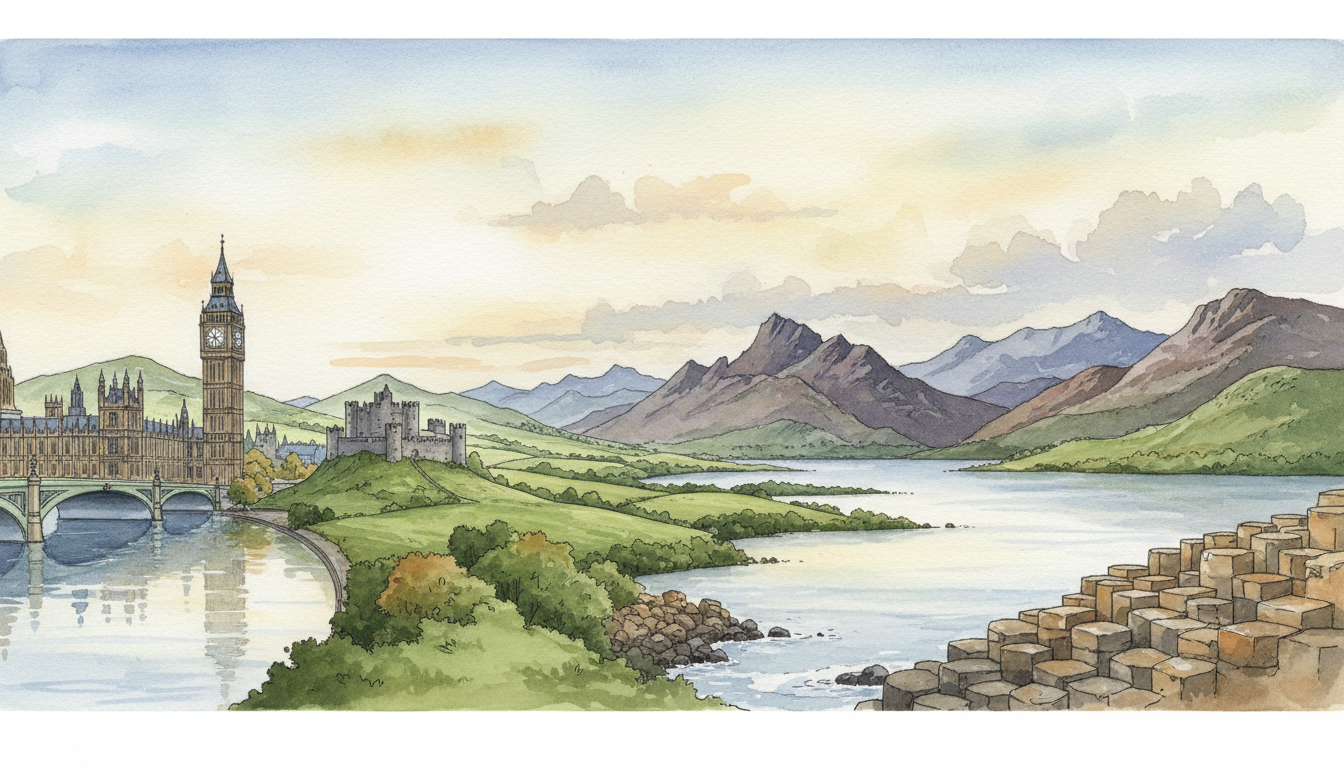
Is the United Kingdom the same as England, what are the UK’s four countries, and how does Britain work in 2026? The United Kingdom of Great Britain and Northern Ireland is a sovereign country in northwestern Europe made up of England, Scotland, Wales and Northern Ireland. Its capital is London. Great Britain is the island containing England, Scotland and Wales; the United Kingdom also includes Northern Ireland, on the island of Ireland. The UK has a constitutional monarchy, a national parliament, devolved institutions, several distinct education and healthcare arrangements, a diverse economy, and internationally famous cultural and scientific histories.
Everything about the United Kingdom in one clear country guide: its story is not simply the King, Big Ben and London buses. The UK includes the Scottish Highlands, Welsh valleys, the mountains and coasts of Northern Ireland, English cities and countryside, numerous islands, and people with many languages and backgrounds. Public policy is shared among Westminster, devolved governments, local councils and other authorities. Schools and the National Health Service operate through arrangements that differ by nation. The Office for National Statistics estimates the UK population was 69,483,900 in mid-2025; that is the latest complete mid-year population estimate published by 21 October 2026, not a live headcount. King Charles III is the monarch, and Andy Burnham became Prime Minister on 20 July 2026. In October 2026, cost-of-living pressures and an upcoming budget were major political and economic issues. This article answers the familiar questions, shows how each system affects everyday life, and links to related eduKateSG articles for deeper reading.
United Kingdom at a glance: direct answers
- Official name: United Kingdom of Great Britain and Northern Ireland (UK).
- Constituent countries: England, Scotland, Wales and Northern Ireland.
- Capital of the UK: London, in England.
- Other national capitals: Edinburgh (Scotland), Cardiff (Wales) and Belfast (Northern Ireland).
- Is England the same as Britain? No. England is only one of the UK’s four nations.
- Is Great Britain the same as the UK? No. Great Britain comprises England, Scotland and Wales; the UK also comprises Northern Ireland.
- Geography: islands off northwestern continental Europe, with surrounding waters including the Atlantic Ocean, North Sea, Irish Sea and English Channel.
- Land border: Northern Ireland shares a border with the independent Republic of Ireland.
- Area: approximately 243,610 square kilometres, depending on statistical boundaries and measures.
- Population: 69,483,900 in the ONS mid-2025 estimate, published 1 October 2026.
- Currency: pound sterling (GBP), divided into 100 pence.
- Languages: English is widely used; Welsh, Scottish Gaelic, Irish, Scots, British Sign Language and other community languages have important and differently recognised roles.
- Head of state: King Charles III.
- Prime Minister: Andy Burnham, in office since 20 July 2026.
- Chancellor of the Exchequer: John Healey, appointed 20 July 2026.
- Government: constitutional monarchy and parliamentary democracy, with the Westminster Parliament and devolved government institutions.
- National legislature: Parliament at Westminster, including the elected House of Commons and House of Lords; laws receive Royal Assent.
- EU membership: not a member of the European Union; left on 31 January 2020, with transition arrangements ending 31 December 2020.
- Latest published annual consumer-price inflation: CPI rose 3.5% in the 12 months to September 2026, released on 21 October 2026.
- Latest monthly GDP bulletin: real GDP increased 0.7% over the three months to August 2026, published 15 October.
- UNESCO World Heritage: 35 inscribed properties as of October 2026: 29 cultural, five natural and one mixed.
- Famous for: parliamentary history, industrialisation, literature, science, universities, London, castles, Stonehenge, music, football, the NHS and distinctive regional landscapes.
- Useful everyday-life question: what changes when a family moves between England, Scotland, Wales and Northern Ireland, although all four belong to the UK?
The key 2026 sources are the ONS mid-2025 population bulletin, GOV.UK’s current Prime Minister record, the Chancellor’s official biography, ONS inflation data, the GDP release and UNESCO’s UK listing. Their dates are part of the facts: a figure for September prices is not the price of every item today, and a population estimate is not a completed 2026 census.
1. What is the difference between England, Great Britain and the United Kingdom?
The distinction is straightforward but frequently confused. England is one constituent country. Great Britain is a geographic name for the large island containing England, Scotland and Wales, and often serves as shorthand for the three together. The United Kingdom is the sovereign country comprising those three plus Northern Ireland. The Republic of Ireland is a separate sovereign country and is not part of the UK.
“Britain” is used less precisely in everyday speech, sometimes for Great Britain and sometimes for the United Kingdom. When citizenship, law, schools or international comparisons are involved, use the precise country name. A “British” passport ordinarily refers to UK nationality categories under law, not merely a person living on the island of Great Britain. The legal details of different British nationality classes require separate checking.
What are the four constituent UK countries?
England has London, Birmingham, Manchester, Bristol and many other cities, with regional and local government structures. Scotland has Edinburgh, Glasgow, the Highlands and islands, and devolved institutions. Wales has Cardiff, Welsh language and cultural institutions, varied industrial and rural histories, and devolved government. Northern Ireland has Belfast, its own distinctive constitutional and political history, and a devolved power-sharing system. These are broad descriptions, not stereotypes about every resident.
Is Scotland an independent country?
Scotland is a constituent country of the UK, not currently an independent sovereign state. It has its own Parliament, government and legal and education arrangements under devolution. There are political movements supporting independence and others supporting continued union, with disagreements about the benefits and constitutional path. An independence proposal should not be presented as a completed change in international sovereignty.
Is Wales independent of England?
Wales is a constituent nation within the UK, with its own devolved government and Parliament, the Senedd. Welsh culture and language have distinct histories, and Welsh institutions have policy responsibilities. Wales is not an independent sovereign member state of the United Nations. The formal legal arrangements matter more than the casual assumption that any place within Great Britain is “England”.
Is Northern Ireland part of Ireland or Great Britain?
Geographically, Northern Ireland lies on the island of Ireland, not on the island of Great Britain. Politically, it is part of the United Kingdom. Its only land border is with the Republic of Ireland, an independent EU member. Northern Ireland’s constitutional arrangements and identities are especially sensitive and are governed through frameworks including the Belfast/Good Friday Agreement. People may identify as British, Irish or both, and constitutional questions remain debated.
Are Jersey, Guernsey and the Isle of Man part of the UK?
No. They are Crown Dependencies with their own governmental and legal arrangements, although the UK is responsible for aspects of their external relations and defence. They are not constituent parts of the UK and should not be inserted into the four-country list. British Overseas Territories, such as Gibraltar, the Cayman Islands and Bermuda, are another distinct category and are not added to the UK’s core territory in the same way as a fifth UK nation. For official distinctions, see government guidance on Crown Dependencies and Overseas Territories.
Why is the national flag called the Union Flag or Union Jack?
The flag brings together symbols linked to the historical union of kingdoms, including crosses associated with England, Scotland and Ireland. Its historical design predates modern devolution. Its existence does not mean Welsh identity is absent or that Northern Ireland’s present political history is simple. Flags are evidence of state history and symbolism; they do not replace a constitutional explanation.
Worked example: four families and four school systems
Imagine four families, one each in London, Edinburgh, Cardiff and Belfast. All live in the UK, but the school curriculum, examining bodies, some healthcare policies and local taxes may differ. Their passports can carry the same UK nationality status while their education experiences are not identical. These are fictional families illustrating a genuine constitutional feature: common sovereignty does not mean one uniform everyday administration.
2. Where is the UK on a map of Europe, and what is its landscape like?
The UK lies off the northwestern coast of mainland Europe. The English Channel separates southern England from northern France, while the North Sea lies to the east, the Atlantic to the west and north, and the Irish Sea between Great Britain and Ireland. Important islands include those in Scotland, Wales, England and Northern Ireland, alongside the substantial archipelagos of the Hebrides, Orkney and Shetland. Overseas territories are legally different from these islands and should not be silently plotted as more British home counties.
Its geography is varied. Southern and eastern England contain substantial lowlands, cities and farming land. Wales is known for uplands and coast, including Eryri/Snowdonia. Scotland contains the Highlands, Lowlands, glens, lochs and islands. Northern Ireland includes lakes, uplands, towns and the striking Giant’s Causeway coast. Rivers such as the Thames, Severn, Trent and Clyde are linked to settlement, industry and transport, while wetlands, estuaries and coastlines need protection.
What is the highest mountain in the UK?
Ben Nevis in Scotland is generally recognised as the highest mountain in the UK, at about 1,345 metres above sea level. Its importance is not merely the number: severe mountain weather, fragile habitats, land management and access safety matter. A tourist photograph taken in sunshine does not indicate that a mountain route is safe in winter.
What is the River Thames?
The Thames flows through southern England, including London, and has been central to trade, transport, water management and the city’s development. The Thames Estuary and tidal flood risk are part of London’s physical geography. A river can carry boats, support ecosystems and influence drinking-water systems while also demanding flood defences and pollution controls.
Why are the Scottish Highlands famous?
The Highlands are known for mountains, glens, lochs, wildlife and cultural histories, including Gaelic traditions. Their modern economy involves many activities beyond tourism, such as services, renewable energy, farming and other rural livelihoods. Roads, ferries, broadband and medical access can matter greatly in a sparsely populated community.
What is Giant’s Causeway in Northern Ireland?
It is a coastal landscape of striking interlocking basalt columns created through volcanic geological processes and later exposure and erosion. The site is a UNESCO World Heritage property. Folk stories about giants are an important cultural layer, but scientific geology and folklore explain different kinds of meaning. The UNESCO listing describes the site’s outstanding natural significance.
Does the UK have volcanic islands?
The UK’s geological past includes extensive volcanism, with rocks and landforms from ancient eruptions, and its overseas territories may have active volcanic environments. But there are no currently active erupting volcanoes on mainland Great Britain. It would be inaccurate to describe the Scottish Highlands as a modern chain of continuously erupting volcanoes.
Why is the UK weather different between regions?
Atlantic weather systems, latitude, altitude, coastal effects and prevailing winds create regional differences in rain, temperature and wind. Scotland’s Highlands can be cooler and wetter than parts of southeastern England, while western coasts differ from inland valleys. Climate trends and specific seasonal forecasts should be read separately. A rainy day in Glasgow does not prove the whole nation has identical weather.
Worked example: a bridge changes a region’s opportunities
Imagine a coastal community whose only convenient route crosses a bridge. If weather damages it, workers may face longer journeys, school buses run late and local businesses cannot deliver goods efficiently. A bridge is therefore an education, employment and healthcare connection as much as a transport structure. This hypothetical example helps explain why rural and island infrastructure needs differ from a busy city road.
3. How did the UK become one country?
The present United Kingdom did not appear as a complete modern constitutional unit in one medieval treaty. England, Scotland, Wales and the parts of Ireland involved had different political, cultural and legal histories. Over centuries, conquest, dynastic unions, acts of Parliament, political negotiation, conflict and changes to borders altered their relationships. A contemporary map should not be projected backward as though it described every century.
- Before Roman rule: diverse peoples and communities lived across Britain and Ireland with distinct regional cultures and trading networks.
- Roman period: much of present-day England and Wales was incorporated into Roman Britain; most of Scotland and all of Ireland were outside permanent Roman provincial rule.
- Early medieval centuries: Anglo-Saxon, Welsh, Scottish, Gaelic, Norse and other polities developed different languages, religions and institutions.
- 1066: the Norman Conquest changed power and administration in England, with wide-ranging later effects.
- Medieval period: the crowns, territories and peoples of England, Wales, Scotland and Ireland experienced conflict and political change.
- 1530s–1540s: the Laws in Wales Acts incorporated Wales more fully into the English legal and administrative system, a process with major cultural and political consequences.
- 1603: James VI of Scotland inherited the English crown, creating a union of crowns without instantly merging the two kingdoms into one state.
- 1707: Acts of Union joined the kingdoms of England (already including Wales) and Scotland into the Kingdom of Great Britain.
- 1801: a further union brought the Kingdom of Ireland into the United Kingdom of Great Britain and Ireland.
- 19th and early 20th centuries: industrialisation, the British Empire, social movements and political reform shaped the UK and countries around the world, including through colonial exploitation.
- 1921–1922: Irish partition and the formation of the Irish Free State changed the constitutional position of most of Ireland; Northern Ireland remained within the UK.
- 1927: the state’s formal title was revised to the United Kingdom of Great Britain and Northern Ireland.
- 1945 onward: postwar reconstruction, the development of the NHS, decolonisation and economic transformation reshaped the country.
- 1998–1999: the Belfast/Good Friday Agreement and new devolved parliaments and assemblies brought major constitutional changes.
- 2016: a UK-wide referendum voted to leave the European Union, with regional differences in the vote.
- 2020: the UK left the EU and later completed the transition to a different relationship with the European market.
- 20 July 2026: Andy Burnham became Prime Minister following a change in Labour leadership, without a new UK-wide general election on that day.
A timeline is helpful but does not tell readers how ordinary people experienced conquest, union, industrial change or empire. Political agreements might produce a change in legal authority long before schooling, language, land ownership or economic opportunity become equal. Official national histories need to acknowledge both achievements and suffering, including slavery, colonial rule, resistance and the ongoing legacies of those experiences.
Did Wales become part of the UK in 1707?
Wales had already been incorporated into English legal and administrative arrangements before the union with Scotland. The 1707 union formally joined the Scottish and English kingdoms, with Wales included on the English side. This is why describing 1707 as four independent nations all voluntarily entering one agreement would be inaccurate.
Why did Northern Ireland remain in the UK?
Ireland’s early twentieth-century political struggle and partition produced separate constitutional paths for the territories that became the Irish Free State and Northern Ireland. Northern Ireland remained in the UK, while the Republic of Ireland subsequently developed as an independent sovereign state. The history involves major debates, conflict and different identities. Treat the past carefully, recognising that people have experienced and interpreted those events differently.
What is the Good Friday Agreement?
The 1998 Belfast/Good Friday Agreement was a major framework for peace and political arrangements in Northern Ireland, involving the British and Irish governments and political parties. It recognises principles about consent and identity, established arrangements for power-sharing and cooperation, and is a cornerstone of the peace process. It did not erase every political dispute or social division. The official agreement text is a direct reference.
How did the British Empire affect the world?
The British Empire governed or exerted power over territories across many continents, leaving major legal, linguistic, economic and social legacies. These include trade networks, institutions and the spread of English, but also slavery, extraction, dispossession, famine, coercion and conflict. The effects were not uniform and should be understood through the experiences of colonised peoples as well as imperial institutions. The Commonwealth of Nations today is a voluntary association of sovereign countries, not a modern extension of the former empire.
What was the Industrial Revolution?
Industrial change beginning in the eighteenth century, especially in Britain, involved mechanised production, coal power, factories, transport, urban growth and new patterns of work. The innovations created large economic and technological changes while exposing workers and cities to pollution, exploitation and inequality. This history connects to the present: Britain’s railways, industrial towns, engineering traditions and many UNESCO-listed sites preserve evidence of those changes.
Why does UK history still matter in 2026?
It helps explain different education systems, the union’s constitutional arrangements, where devolved powers come from, why the NHS has four organisational systems and the continued discussion of Scottish independence and Northern Irish identity. The past is not merely scenery around castles; it helps explain the laws and institutions that govern daily life now.
4. How does the United Kingdom’s constitutional monarchy and Parliament work?
The UK is a parliamentary democracy with a constitutional monarch. The King is head of state, while the Prime Minister leads the government and is politically accountable through Parliament. The Westminster Parliament consists of the House of Commons, House of Lords and Crown, each with a different constitutional role. The government normally needs the confidence of the House of Commons to remain in office.
The UK does not have one single codified constitutional document equivalent to the US Constitution. Its constitutional arrangements derive from Acts of Parliament, judicial decisions, conventions and other sources. This can provide flexibility, but it also means readers must identify the authoritative legal or constitutional rule for the particular question rather than assume all important arrangements appear in one short document.
Who is King Charles III, and what does he do?
King Charles III is the reigning UK monarch as of October 2026. The Crown has constitutional roles including the appointment of a Prime Minister, State Opening of Parliament and Royal Assent to legislation. By established convention, most of these functions are exercised according to constitutional and ministerial procedures rather than the monarch personally deciding the government’s economic or education policies. The UK Parliament’s explanation of the Crown distinguishes formal powers from modern practice.
Who is the Prime Minister in October 2026?
Andy Burnham became Prime Minister on 20 July 2026, following a change in Labour Party leadership. He succeeded Keir Starmer, who had become Prime Minister after the 2024 general election. Burnham returned to the House of Commons earlier in 2026 and was chosen as Labour leader in July. A change in Prime Minister within a parliamentary term does not automatically require a new UK-wide general election. The authoritative GOV.UK ministerial record identifies the date and officeholder.
Who is the Chancellor of the Exchequer?
John Healey was appointed Chancellor on 20 July 2026. The Chancellor is responsible for major Treasury work, including national budget policy, taxation, borrowing and public-finance decisions. A Chancellor’s announcement, however, is not automatically the same as a tax change enacted and in force; legislative and administrative steps may follow. The official ministerial biography gives the current officeholder.
What is the House of Commons?
It is the elected chamber of the UK Parliament, with members representing parliamentary constituencies. The Commons debates laws, questions ministers, authorises public expenditure and holds the government to account. A party may win more seats without winning an equivalent percentage of the nationwide popular vote under the UK’s first-past-the-post constituency system. For the mechanics, see How UK General Elections and First Past the Post Work.
What is the House of Lords?
It is the second chamber, with responsibilities including scrutiny of legislation, detailed revision and public debate. Its membership and powers are different from those of the elected Commons. A House of Lords (Hereditary Peers) Act received Royal Assent on 18 March 2026, an important change that older explanations of inherited seats may not reflect. The detailed implementation of the reform should be checked through legislation and the current membership records.
How does a bill become a law?
A bill normally goes through readings, committee scrutiny and consideration in the Commons and Lords, with both Houses needing agreement on the final text under the usual process. It then receives Royal Assent and becomes an Act. Some Acts enter into force immediately, while others depend on future commencement regulations. See the UK Parliament’s stages of lawmaking and the eduKateSG bill-to-law guide.
Worked example: when a proposed law is not yet the law
Imagine a minister announces a new housing standard. The government may introduce a bill, Parliament may amend it, Royal Assent may be granted, and commencement may occur on a later date. A council or landlord needs to know which stage has happened before acting. An announcement is an intention; legislation establishes authority; implementation makes the rule operational. The example is hypothetical, but the distinctions are essential.
5. How do devolution and local governments work across the four nations?
Devolution means that certain legislative and executive responsibilities are exercised by institutions in Scotland, Wales and Northern Ireland rather than exclusively by the UK Parliament and government in London. Different powers and institutions apply to each nation; the arrangements are not identical. UK-wide responsibilities continue in fields such as defence and many foreign affairs, while major parts of health and education policy are devolved.
England does not have one England-only national parliament mirroring the Scottish Parliament. It is governed through Westminster in many areas, with councils and increasingly devolved regional and city-authority structures handling defined functions. The English Devolution and Community Empowerment Act 2026 provides a current example of statutory changes to English local and strategic governance. Its exact commencement and geographic application should be read section by section.
What does the Scottish Parliament do?
The Scottish Parliament at Holyrood can legislate on devolved matters, while the Scottish Government administers defined policies in areas such as health, education, some transport and parts of taxation. The UK Government retains reserved responsibilities. The powers are set by law and have evolved over time. Readers should not assume that because Scotland has a Parliament it controls every aspect of UK immigration or foreign relations.
What is the Senedd in Wales?
The Senedd is the Welsh Parliament, with legislative functions in devolved areas. The Welsh Government leads administration in areas within its competence. Welsh-language policy, education and health services have important distinct arrangements. For an individual school or provider, the current Welsh rules and awarding bodies must be checked rather than copying English requirements.
Why is Northern Ireland’s Assembly different?
Northern Ireland’s devolved institutions operate within arrangements influenced by the Belfast/Good Friday Agreement, including power-sharing and cross-community principles. The Executive and Assembly have defined responsibilities, and their operation has experienced interruptions at various times. A devolved political institution’s existence in law is not enough to assume every programme is operating identically on a particular day; local government and agency information matters too.
How does a local council affect ordinary life?
Councils may provide or administer services such as waste collection, local planning, libraries, parts of roads, housing-related activities and social care under the relevant nation and local authority arrangement. Some tasks are carried out by independent utilities, national agencies or other authorities. A council boundary is not always a postcode boundary or a school catchment area.
Why are postcodes so important in the UK?
Postcodes are used for postal sorting and widely adopted for addresses, deliveries and locating services. The letters and numbers can help identify a delivery area but do not precisely identify a political boundary, a flood zone or a child’s automatic school entitlement. The dedicated UK Postcodes | Letters, Numbers and Addresses explains what the system does and does not prove.
Worked example: a road and a school in different jurisdictions
Imagine a family moves from Cardiff to Glasgow. Their new local authority may have different school-admission processes, learning stages and council services. Their UK passport does not change, but the local delivery rules can. A productive relocation plan identifies each responsibility by nation and local authority instead of assuming one UK-wide website answers all questions. This is a hypothetical family rather than specific admissions advice.
6. Why do the UK economy, pound sterling and financial system matter globally?
The UK’s economy includes financial and professional services, health, education, technology, manufacturing, construction, tourism, creative industries, agriculture and transport. London is a major international business and financial centre, but other cities and regions contribute different strengths, including advanced manufacturing, energy, scientific research, cultural production and port activity. Total national GDP should not be confused with the income of every worker or the economic conditions of every community.
The currency is the pound sterling (GBP). The Bank of England is the central bank, responsible for monetary policy and other central-bank functions within its statutory framework. The pound’s exchange rate can affect import prices, overseas holiday costs and businesses engaged in global trade. Not everyone receives their wages or pays their mortgage at the same interest rate as a central-bank policy announcement.
What happened to UK GDP in August 2026?
The ONS release dated 15 October 2026 reported real GDP grew 0.7% in the three months to August 2026 compared with the preceding three-month period. Services output increased while some production and construction measures were weaker. This is not the UK’s full 2026 annual growth rate. A three-month comparison and a yearly rate have different reference periods and denominators.
What happened to UK inflation in September 2026?
The ONS release published 21 October 2026 recorded Consumer Prices Index (CPI) inflation at 3.5% over 12 months to September, up from 3.1% in August. CPIH, including owner-occupiers’ housing costs, rose 3.6%. Fuel prices contributed significantly to the increase. The ONS inflation portal distinguishes these measures and their historical changes. Lower inflation at another date would not automatically mean items had returned to previous prices.
Why does the pound matter outside Britain?
Foreign-exchange markets, trade contracts, investments, tourism and cross-border financial relationships involve sterling. The pound is one of several important global currencies. A dollar or euro amount converted to pounds requires a specific exchange rate, date and fees; the existence of a prominent financial market does not mean everyone in Britain holds foreign currency or trades securities.
What is the Bank of England’s role?
The Bank of England sets monetary policy through its statutory arrangements and committee structure, among other responsibilities. Interest-rate decisions can influence borrowing and saving costs over time, but market conditions, commercial lender margins, product terms and household circumstances determine actual rates offered. The Bank also performs financial-stability and currency functions. Use the Bank of England’s monetary policy hub for current rates and minutes.
What does a government Budget actually do?
A Budget outlines fiscal measures relating to taxes, spending and borrowing. The Chancellor presents it and relevant changes may require parliamentary approval and administrative implementation. As of 21 October 2026, Chancellor John Healey’s first autumn Budget was scheduled for 28 October. Its eventual decisions must not be written into the article as though they already occurred. Today’s ONS public-sector finance release reported September borrowing and debt conditions that influenced the debate.
Why does public debt matter to schools or hospitals?
Public borrowing can finance useful needs, but debt servicing also uses resources, especially when interest rates and inflation are elevated. A government must decide how to fund healthcare, schools, transport, defence and social protection within legal and economic constraints. A high debt amount does not, by itself, establish that a particular local service is failing; the service’s budget, staffing and delivery still need examination.
Worked example: what inflation does to a household budget
Imagine a family paying £100 per week for a basket of goods and services. If the same basket costs £103.50 a year later, the price rise is 3.5%. If its household income rises less than the necessary spending, purchasing power is under pressure. That is a fictional basket used to demonstrate percentage change; it is not a claim that every family’s actual expenses rose by precisely the national CPI rate.
7. What does the United Kingdom produce, import and export?
The UK exports financial and business services, advanced manufactured products, pharmaceuticals, transport equipment, technology and creative services, alongside various goods. It imports food, manufactured products, energy and other materials, and maintains relationships with European, American and worldwide suppliers. Different regional economies contribute in different ways; Scotland’s energy industries, Welsh manufacturing, English service centres and Northern Ireland’s agriculture and industry do not all fit one generic template.
A country’s export value is not the same as the income retained by its workers, and a strong services sector does not eliminate the need for physical roads, ports, buildings and energy. For comparisons, use ONS international trade data with its stated reference year and treatment of goods and services.
Why is London important to finance and professional services?
Financial markets, law firms, insurers, business advisers, technology companies and international transport connections cluster in and around London. Economic concentration can support specialisation and jobs but also create high housing and commuting costs. A well-known financial district does not mean every London resident works in finance or has a high income.
What do the Midlands and northern England contribute?
Manufacturing, engineering, universities, transport logistics, creative industries, healthcare and many other sectors are spread across these regions. The Industrial Revolution left physical infrastructure and skills that continue evolving. A historic factory town is not necessarily dependent on the same industry as it was in 1850; modern employment and supply chains should be checked with current evidence.
How do agriculture and food supply work?
British farms produce crops, livestock and dairy products under conditions that vary by region and season. Food supply also involves imports, processors, warehouses, cold-chain transport, retailers and consumer income. A country may grow significant amounts of food and still import many everyday products because of climate, demand, trade and seasonality.
Why do service exports matter if nothing physical is shipped?
A British business might sell design, engineering advice, software, finance, education or other services to a client abroad. The product may be delivered digitally or through professional work rather than a container at a port. A services export can still depend on skilled workers, reliable connectivity, rules and a paying overseas customer.
Worked example: an overseas university student and the UK economy
A student may pay fees, rent housing, use transport and make everyday purchases while studying in the UK. Universities and local businesses can benefit, but the student’s personal costs and eligibility rules also matter. Counting the tuition fee alone would not measure the total economic relationship. The example is illustrative, not a prediction of immigration or university policy.
8. Why does the United Kingdom have four education systems?
Education is substantially devolved within the UK, meaning England, Scotland, Wales and Northern Ireland have different curricula, qualification arrangements and governing institutions. Parents and students cannot safely assume that Year 11 in one UK nation means the same topics, examination body or progression options as a similarly aged pupil in another. Each system has its own stages and transitions, and current reforms can affect younger cohorts differently from older ones.
The useful approach is to follow the pupil: What nation does the school belong to? What age or stage is the learner? Which curriculum and exam specification applies? Which certificate will be awarded? What does a college or university require next? A broad comparison is valuable for orientation but not a substitute for actual school or regulator documents.
What are the main stages in England?
In England, pupils typically move through early years, primary schooling, secondary education and post-16 learning. The Key Stage structure and GCSEs are important, with GCSE examinations normally associated with Year 11 at around age 16. Afterward, learners may take A levels, T levels, apprenticeships and other technical or academic routes. England requires young people to remain in a recognised form of education or training until 18, but this does not necessarily mean remaining in the same classroom-based school. See the English national curriculum overview and the government’s training routes.
What is different in Scotland?
Scotland uses the Curriculum for Excellence and educational stages such as primary years P1–P7 followed by secondary years S1–S6. National Qualifications and Highers and Advanced Highers form important qualification pathways, subject to programme and candidate choices. An important 2026 change is that Qualifications Scotland replaced the Scottish Qualifications Authority (SQA) on 1 February 2026. Older materials may still show SQA branding as systems and documents are updated. Check Qualifications Scotland’s official transition notice.
What changed in Wales in 2026?
Wales has been implementing the Curriculum for Wales, using an approach organised around the four purposes of education and areas of learning and experience. By September 2026 the framework was designed to include pupils up to age 16. GCSE qualifications have also been reformed in phases. Qualifications Wales lists one wave of new GCSEs from September 2025 and another beginning September 2026, with separate first-award dates. A candidate already entered for a legacy award may need different instructions from a younger pupil beginning the new course.
What is different in Northern Ireland?
Northern Ireland has its own curriculum and educational institutions, with GCSE and GCE pathways and separate arrangements governing particular subjects and programmes. The Council for the Curriculum, Examinations and Assessment, or CCEA, has important roles. A candidate may encounter different qualification specifications and school structures from those in England, even where the award is called a GCSE or A level. Consult CCEA’s official resources and the receiving institution rather than assume all examination timetables are UK-wide.
Is a GCSE the same qualification everywhere in the UK?
The term GCSE is used in England, Wales and Northern Ireland, but specifications, examining bodies, subject structure and assessment can differ. Scotland follows different school qualification arrangements. Grades or titles should never be compared without considering the actual awarding organisation, subject and year. Even within one nation, two exam boards may have different specifications for the same broad subject.
How do A levels, Highers, T levels and apprenticeships compare?
They represent distinct programmes and qualifications, not interchangeable labels. A levels are subject-based academic qualifications commonly taken in England, Wales and Northern Ireland. Scottish Highers have their own curriculum and university-entry role. T levels are England-focused technical qualifications combining classroom learning and industry placement; apprenticeships include paid work and structured learning, with nation-specific rules. A university may accept several pathways but needs the exact award, grade and subjects, especially for selective or regulated programmes.
How much does university cost in 2026?
It depends on the student’s home fee status, where they normally live, the university’s nation, the course, year and funding arrangements. For example, UCAS lists the regulated maximum full-time tuition fee in England for eligible programmes in 2026/27 as £9,790, but that figure cannot be applied to every Scottish, Welsh, Northern Irish or overseas student. A Northern Ireland official student-fee guide illustrates how different residence and study combinations produce different fee categories. Always verify status and provider fees before planning.
What is UCAS?
UCAS is the central application service used for many undergraduate courses at UK higher education institutions, but not every course or educational route follows precisely the same procedure. Students still need to check entry requirements, qualifications, course details, fees and deadlines. An offer can be conditional on examination results or other evidence. A famous university name does not establish that a student meets the requirements for a particular degree.
Worked example: a Scottish student applies to an English university
Imagine a student presenting Highers rather than A levels for a degree in England. The university must identify the specific subjects and grades it accepts, and the student must check their fee status and funding arrangements. A general statement that both are British qualifications is insufficient to calculate admission eligibility. This hypothetical example illustrates why precise awards matter more than broad age comparisons.
9. How does the National Health Service work across the four nations?
The National Health Service has a historic shared identity, but healthcare policy and many administrative arrangements are devolved. England, Scotland, Wales and Northern Ireland have distinct health-service organisations, funding decisions, eligibility rules and statistics. The ONS analysis of NHS data specifically warns that patient-experience statistics across nations are not always directly comparable because collection methods differ.
Common public-health principles coexist with practical differences. A family generally starts with primary care, emergency services when appropriate, specialist referral and other services under applicable rules, but provider structures, waiting-time targets, prescription rules and charging can vary. A visiting tourist, resident, student and person with a particular visa may not share identical entitlements.
Is healthcare free for everyone in the UK?
Not in the unqualified sense that every treatment and every person has zero cost. The NHS has many services funded from taxation, but eligibility, dental and optical charges, prescription charges in some arrangements, and services for certain overseas visitors can differ. A person’s immigration or residence status can also affect access and charges. It is important to identify the correct nation and service before giving practical advice.
What is the difference between a GP and a hospital?
General practitioners provide important primary medical care and can refer patients onward to specialist or hospital services. Hospitals provide emergency, surgical, inpatient and other specialised services according to local arrangements. The quality of a national health system cannot be measured only by how many hospitals exist, because staffing, access, equipment, appointments and patient outcomes also matter.
What is social care?
Social care may include support with everyday living, disability-related needs, home care and residential care, operating under nation-specific statutory, financial and local arrangements. It is not identical to acute medical treatment. For an older person, a successful support plan may require coordination between a GP, a hospital, local social care, transport and family or community services.
Why do waiting times matter?
A service is useful when people can obtain safe and appropriate care in a suitable time. Short staffing, demand pressures or regional capacity can create delays. But one country’s waiting-time statistic may measure a different point in the patient pathway from another nation’s. Use the original methodology and reference date rather than conclude that one service is “better” solely from incompatible headline numbers.
Worked example: medical support after a family moves
Imagine a resident moving from England to Wales. They may need to register with a new GP, update medication records and understand the services operating in their new nation. Their UK citizenship has not changed, but administrative procedures and charging rules can differ. This is a hypothetical relocation example, not personal medical guidance.
10. How do taxes, council tax and public services reach households?
The UK has national taxes, local taxation and different arrangements where tax powers have been devolved. HM Revenue and Customs (HMRC) is the central UK tax authority for many taxes, but income tax rates and bands can differ in Scotland for certain non-savings and non-dividend income, and local services operate under their own frameworks. A tax calculation requires the actual residency, income, tax year and relevant jurisdiction.
Council tax is particularly important to ordinary households because it contributes to the financing of local authority services. In England and Scotland, charges are related to banded property values under established systems; Wales also uses property valuation bands but with its own framework. Northern Ireland instead has domestic rates, not the same council-tax system as the other nations. See How UK Council Tax Works | Bands, Discounts and Who Pays for the specialist explanation.
Is council tax a national income tax?
No. It is a local taxation system related to domestic property and liable occupants under the relevant rules. Income tax concerns taxable income; council tax and domestic rates operate under different concepts. A person may have obligations under both systems.
Does the person who owns a home always pay the council tax?
Liability depends on occupancy, the property, exemptions and statutory hierarchies, so ownership alone does not settle every case. Discounts and reductions may apply in certain circumstances. Students, people living alone and specific household structures can have different treatment. For an actual bill, use the local authority’s guidance rather than general articles.
What do local taxes pay for?
They contribute, alongside central government grants and other funding, to services such as refuse collection, social care, libraries, local roads and administration under applicable rules. A particular fee or local tax does not mean every pound is earmarked for one named service. The precise financing structure differs by nation and council.
What happens if a person challenges a local tax bill?
There are procedures for disputes over valuation, liability and other matters, but the correct route depends on the nation and the nature of the issue. A notice’s deadline matters. A broad country guide should not guess a specific appeal rule for an unnamed property or year.
11. How do state pensions and retirement work in the UK?
The UK’s State Pension is a public pension paid to eligible people according to age and National Insurance contribution-related conditions, with separate legal categories depending on birth date and other circumstances. Workplace pensions and private savings can provide additional retirement income. They are not the same account as the State Pension.
State Pension age has been increasing from 66 to 67 during the period from 2026 to 2028, with the actual date depending on when a person was born. It is therefore misleading to state that everyone in October 2026 can claim at exactly the same age, or that people are automatically entitled to a full pension regardless of their contribution record. Check GOV.UK’s State Pension age guidance and the official forecast service for individual planning.
What is National Insurance?
It is a contribution system associated with funding and eligibility for certain state benefits and pensions, with different rules for employed, self-employed and other people. Paying tax and paying National Insurance are related but distinct obligations. The contribution record and any credited periods can affect pension entitlement under the applicable rules.
What are workplace pensions?
Employers and eligible employees contribute to occupational pension arrangements under relevant auto-enrolment and other rules. A pension balance can depend on contributions, investment performance, fees and scheme structure. The retirement income expected from a workplace pension is not identical to the State Pension forecast.
What is the “triple lock”?
It is a policy formula commonly used in determining increases to the State Pension, involving measures such as earnings growth, inflation and a minimum percentage under the prevailing framework. It can be the subject of political debate and future fiscal decisions. A proposed change does not automatically become law simply because someone discusses it ahead of a Budget. Use the actual annual uprating rules for a particular financial year.
How does an older person’s quality of life depend on more than the pension amount?
Retirement income matters, but safe housing, transport, healthcare, accessible public spaces and community participation also shape wellbeing. An older resident may need a reliable bus and nearby services as much as a higher cash payment. This is why pensions, local councils and the NHS are connected subjects in everyday life.
Worked example: pension timing for two people
Imagine two friends born in different months and years, with different National Insurance records. Their earliest State Pension dates and predicted amounts may differ even if they live in the same city. Neither can determine entitlement from an internet generalisation. This is a hypothetical example; use official forecasts and appropriate financial advice for personal decisions.
12. How does the UK education-to-career pathway work after age 16?
The transition from secondary school toward employment, technical skills and university study is one of the most consequential periods in a young person’s life. In England, options include further education colleges, sixth forms, apprenticeships, A levels, T levels and other recognised qualifications. Scotland, Wales and Northern Ireland have their own pathways and funding and qualification rules. A good decision considers the actual award, the skills it develops, admissions criteria and whether the programme fits a student’s strengths.
Why are apprenticeships significant?
An apprenticeship combines paid work and structured learning leading to recognised knowledge and skills under the relevant scheme. Details about minimum duration, assessment, funding and eligibility can vary across nations and occupations. An apprenticeship is not simply an unpaid internship with a certificate attached. England’s Skills for Careers service provides a current route map.
What are further education colleges?
They provide a wide range of academic, vocational, technical and adult-learning courses, although each college’s subjects and funding arrangements differ. Some learners move from college to higher education; others seek specific workplace skills. A programme called Level 3 or a National qualification needs its exact awarding organisation before its equivalence can be assessed.
What if a student already knows the subject but struggles in examinations?
The difficulty may involve exam terminology, timing, presentation, knowledge gaps, stress, or unfamiliar question forms. An effective learning intervention diagnoses the particular failure and teaches the student to explain and apply concepts, instead of endlessly assigning more of the same worksheets. A strong curriculum pathway is one the learner can actually navigate with understanding.
How can a foreign student compare UK qualifications?
Start with the exact awarding body, certificate title, subject and level, along with the receiving institution’s published requirements. A Scottish Higher, an English A level, a Welsh GCSE and an international qualification may each be assessed differently. UK ENIC provides services relating to international qualification comparisons where appropriate; university admissions offices retain their own decisions.
13. How does the UK’s energy system work in 2026?
The UK produces and imports energy using various sources. Its electricity system includes gas generation, wind, nuclear power, solar, biomass, hydro and other sources depending on year and operating conditions. Oil and gas also play roles in transport, heating and industry, which is why an electricity-renewables figure is not a measure of total national fossil-fuel use.
The National Grid is closely associated with the electricity transmission network, while system operation and energy institutions have evolved; different companies and bodies have particular tasks. A household relies on electricity generation, transmission, regional distribution and retail supply, each of which can affect reliability and cost.
Why are North Sea oil and gas important?
North Sea resources have contributed to British energy production and government revenues over decades. Production has changed over time, and decisions about new projects involve energy security, economic value, environmental impacts and regulation. On 21 October 2026, the UK government approved the Jackdaw gas field off Scotland after a revised assessment, citing energy security. Environmental organisations criticised the decision because of fossil-fuel emissions and climate goals. See the government’s dated announcement; approval is not proof that every promised unit of gas has already reached a home.
Why does wind power matter in Britain?
Offshore and onshore wind are significant parts of the UK electricity mix. Turbines produce power when wind conditions are appropriate, and generation can vary hourly. Investment requires transmission capacity, planning consent, suitable infrastructure and maintenance. Offshore wind is not a way to eliminate every other source without grid balancing or storage considerations.
Why is nuclear energy still discussed?
Nuclear plants can produce large quantities of electricity under suitable operating conditions, while their costs, construction periods, waste management and safety arrangements require careful planning. Some older plants retire as newer projects are planned. The existence of a project announcement is not the same as the plant producing power today.
What is the energy price cap?
Ofgem regulates aspects of domestic energy markets, including a price cap on certain default-tariff rates in Great Britain. It does not set one unlimited all-inclusive fixed household bill, and arrangements in Northern Ireland differ. The actual cost depends on units used, standing charges, payment method, location and the tariff. Look at Ofgem’s current cap information for applicable dates rather than an older headline figure.
Worked example: a winter electricity bill
Imagine two households with the same tariff but different heating equipment and insulation. One uses more energy to maintain a similar indoor temperature. Their actual bills may differ even when the regulated tariff rates are identical. A country’s energy costs depend on buildings, consumer behaviour, fuel, infrastructure and policy rather than the raw price of electricity alone.
14. How do roads, railways, ferries, airports and ports connect Britain?
The UK is connected through a complex network of motorways, local roads, railways, urban transit, buses, ferries, seaports and airports. Its geography makes some routes particularly important. Rail and road link London with other English cities, Wales and Scotland; sea and air connections support Northern Ireland and many offshore islands; and the Channel Tunnel provides a rail link between England and continental Europe.
Transport systems need management, investment and daily maintenance. A new railway line may attract attention, but the most important result for a student or worker may be a reliable local bus connection at the beginning and end of the journey. Networks can be congested, and fares, timetables and operator responsibilities are not uniform across the whole country.
What is the Channel Tunnel?
It is the undersea rail tunnel connecting the vicinity of Folkestone in England with the area around Calais in France. It supports train services and vehicle-shuttle operations subject to operator arrangements. It is not a road tunnel where any driver can simply drive through independently. The UK’s separation from continental Europe by water still shapes trade and travel, even when a fixed rail connection exists.
What is the difference between the London Underground and National Rail?
The London Underground is an urban metro network serving much of the capital, managed within London’s transport arrangements. National Rail refers to the broader passenger railway network with many operators and routes. A city commuter may combine underground, train, bus and walking. A ticket for one service may not cover every other service without a specific integrated arrangement.
Why do buses matter outside major cities?
Buses connect towns, schools, hospitals and workplaces, including places not served by rail. Services need viable routes, drivers, vehicles and funding or commercial support. A rural resident may depend on only a few services a day, making a missed connection consequential. In Greater Manchester, policy changes around public bus control became associated with Andy Burnham’s earlier mayoral work; different English regions have different arrangements and reforms.
Why are ferries essential to Scotland and Northern Ireland?
Ferries help connect islands and communities, enabling the movement of residents, food, vehicles, medicines and commercial goods. The reliability of routes can depend on weather, vessels, ports and scheduling. Some journeys within the UK require crossing the sea, and the value of those connections is felt through healthcare access, employment and ordinary family needs.
How does the UK’s international trade reach ports?
Containerised and bulk cargo enters and leaves through seaports, while air freight supports certain high-value or time-sensitive goods. Customs, warehousing, road and rail transport and documentation are all part of the chain. A port’s economic value is not determined solely by the number of cranes visible on its skyline. It depends on the shipment getting from producer to customer reliably.
How do postcode and address systems help delivery?
Postcodes assist with sorting, locating delivery areas and identifying addresses. They are widely useful in mapping services and finding businesses. Yet a postcode should not be treated as evidence of a particular council, school catchment, service entitlement or flood risk without checking the relevant administrative boundaries. Read How UK Postcodes Work for the specialist guide.
Worked example: transporting a medical sample from an island
Imagine a rural island clinic sending an urgent laboratory sample to a specialist centre. The route may involve a road journey, ferry or aircraft and a further courier. The final medical service depends on packing, schedules, weather, laboratory capacity and communication, not simply the existence of a hospital somewhere on the mainland. This is a hypothetical example illustrating the dependency between transport and healthcare.
15. Why do housing costs and living conditions vary so much across the UK?
Housing prices and rents depend on location, job opportunities, land availability, infrastructure, regulation, household demand and the type and quality of housing. A property in central London may cost much more than a similar-sized property in a less expensive town, but salaries, transport costs and access to services can also differ. An average UK house price does not tell a particular family whether it can afford a home.
Housing policy and rules also differ among the four nations and, in some cases, local authorities. Tenancy arrangements, property taxes, planning, building standards and eligibility for assistance are not identical everywhere. A resident considering a move should identify the relevant nation’s current housing law and compare the total household costs rather than only the advertised rent.
What is the difference between renting and buying a home?
Renting normally creates contractual rights and obligations under tenancy law, while buying involves ownership rights, finance, taxes and long-term maintenance responsibilities. Both can include service charges or other costs under their particular arrangements. Legal rights vary by nation and type of property. A property listing is not a legal explanation of the deal.
Why is commuting a major part of housing affordability?
A home with lower rent may require an expensive and unreliable journey to work. Fuel, parking, rail tickets, childcare coordination and lost time can change the total value of the choice. A realistic budget adds transport and utility costs to housing payments. The cheapest-looking address is not necessarily the lowest-cost place to live.
Why is planning a housing estate also an education question?
New homes bring additional families, and families need school places, primary care, roads, waste services and water and electricity capacity. Building houses faster than those systems can respond may create service problems. Good planning follows the population who will use the homes and the facilities they require.
How does the cost of living differ between countries of the UK?
Prices, incomes, transport, housing and some public charges differ. Energy regulation, tax arrangements, school services and healthcare charges can also vary. A national CPI rate describes aggregate price change, not a universal household basket. For actual comparisons, use local data and the relevant reference date rather than infer a whole nation’s affordability from London prices alone.
Worked example: comparing two job offers
Imagine someone receives one job offer in London and another in a town in northern England. The London salary is higher, but rent and commuting may absorb a larger share. The other job offers less cash pay but shorter travel. Neither choice is automatically better. A decision requires comparing net income, housing, opportunity, family needs and time. This is a hypothetical budgeting example.
16. Who are the people of the United Kingdom, and which languages matter?
The UK’s population includes people with diverse national, regional, linguistic, religious and cultural identities. Residents may identify as English, Scottish, Welsh, Northern Irish, Irish, British, more than one of these, or in other ways. Immigration and historical relationships have also contributed many communities and languages. The 2021 census in England and Wales, 2022 census in Scotland and 2021 census in Northern Ireland were run by different national statistical institutions, so researchers must be careful when combining definitions.
The most recent UK-wide mid-year population estimate is 69,483,900 for mid-2025, published 1 October 2026 by the ONS. Population estimates account for births, deaths and migration and are subject to revision. Population size is not the same as the number of registered voters, taxpayers, households or citizens. Data should be read with the appropriate definition.
Is English the UK’s only language?
No. English is widely used across the UK, but Welsh has specific official recognition and use in Wales. Scottish Gaelic, Irish and Scots have historical and contemporary importance, and British Sign Language is recognised under UK law. Many communities use languages such as Polish, Punjabi, Urdu, Arabic and others. A particular public authority’s language obligations depend on law and location.
Why is the Welsh language important?
Welsh is a living language with deep literary and cultural history, used in education, media, government and daily life. Language rights and bilingual service provision are significant aspects of modern Wales. The existence of English-speaking residents does not mean Welsh is a relic or merely an optional decorative addition to a sign.
What about Scottish Gaelic and Scots?
Scottish Gaelic is a Celtic language with important communities and cultural traditions. Scots is a distinct historical language variety widely discussed in Scottish literary and linguistic contexts. They are not interchangeable with each other, and neither is simply the same as English. The way public institutions recognise or support them depends on legislation and policy.
How do identities work in Northern Ireland?
Some people identify as British, some as Irish, some as both, and others use additional or different identities. The Belfast/Good Friday Agreement includes important protections concerning identity and citizenship rights, subject to relevant law. No government guide should decide a resident’s identity from their postal address, religious background or surname.
Why is Britain described as multicultural?
Its history includes successive movements of people, trade, imperial connections, refugees, work migration and students, alongside indigenous and long-standing regional communities. Urban centres and many other areas contain diverse languages, food and religious or nonreligious practices. Cultural diversity does not mean every household has identical preferences or that all historical experiences were equally positive.
Worked example: a multilingual school notice
Imagine a parent reads conversational English well but struggles with a technical school admission notice. An accessible translation or an opportunity to ask questions can make the difference between understanding and missing a requirement. The challenge is communication, not a measure of the parent’s care for their child. This hypothetical example shows why language access can be an ordinary public-service concern.
17. Why are Britain’s literature, music, football and other cultural traditions world famous?
The UK’s cultural influence includes writers, scientists, artists, musicians, theatre, television, film, design, fashion, literature, sports and a wide range of regional traditions. The works of William Shakespeare, the novels of Jane Austen, the music of the Beatles and many contemporary creators have reached audiences internationally. Yet UK culture is not only English-language entertainment exported from London: Welsh-language performance, Scottish music, Northern Irish writing and many migrant and minority traditions make distinct contributions.
Cultural influence depends on institutions and industries as well as artistic talent. Publishing, schools, music venues, broadcasters, museums, publishers, libraries and recording studios help ideas spread. A bestselling book may begin in one writer’s room but reach the world through many professional networks.
What is special about British football?
Association football developed many of its modern codified rules in Britain. England, Scotland, Wales and Northern Ireland maintain separate national football teams in many international competitions, despite being constituent countries of one sovereign state. This is a useful example of how sports organisation can differ from political sovereignty. Clubs and communities also express strong local identities.
Why are the Beatles important?
The Beatles, formed in Liverpool, had a major influence on popular music and global youth culture in the twentieth century. Their success also depended on recording technology, radio, touring, managers, publishers and audience networks. The history of popular music is more complete when it includes other artists and genres and avoids treating one band as the only origin of musical innovation.
What does Shakespeare represent in education?
His plays and poetry are studied for language, dramatic craft, historical interpretation and their influence on later literature. They can also prompt debate about power, identity and relationships. Studying a playwright is not merely memorising quotes; it involves understanding text, stage performance, language change and how different audiences interpret the work.
What about food?
Fish and chips, roast dinners and afternoon tea are internationally recognisable, while local and regional dishes such as Welsh cawl, Scottish dishes, Northern Irish breads and an enormous range of South Asian, Caribbean and other cuisines contribute to everyday food culture. No single dish is eaten by everyone. Modern culinary life reflects supply chains, immigration, local produce, household preferences and changing work patterns.
Why are museums and heritage so important?
Public museums, local archives, heritage sites and national collections support research, education and cultural memory. Historic collections also raise questions about colonial-era acquisition, provenance and repatriation, which deserve careful attention rather than an assumption that possession always proves rightful ownership. Conservation includes the voices and histories of people connected with objects and places.
18. Why does the UK have 35 UNESCO World Heritage properties?
The UK’s World Heritage portfolio recognises globally significant cultural and natural places, including historic architecture, industrial sites, archaeological landscapes and important ecosystems. As of October 2026, UNESCO’s state-party list records 35 inscribed properties: 29 cultural, five natural and one mixed. These are UNESCO inscriptions, not a count of all listed buildings, monuments or national parks.
Prominent sites include the Tower of London, Stonehenge and Avebury, the City of Bath, the Palace of Westminster and Westminster Abbey, the Old and New Towns of Edinburgh, the Giant’s Causeway, the Castles and Town Walls of King Edward in Gwynedd, the Slate Landscape of Northwest Wales, the Jodrell Bank Observatory, the English Lake District, the Flow Country in Scotland and the mixed St Kilda property.
Is Giant’s Causeway in England?
No. It is in Northern Ireland, and it is a natural World Heritage property associated with volcanic geology. A famous UK landmark should not be casually relocated into England. The distinction between UK and England is as important for heritage maps as it is for government and education.
Is Stonehenge in London?
No. Stonehenge is in Wiltshire in southern England, far from central London. It is part of the Stonehenge, Avebury and Associated Sites inscription. Studying it involves prehistoric archaeology, construction, landscape and continuing research rather than simply guessing what every stone meant to everyone in the past.
What is Scotland’s Flow Country?
The Flow Country is an extensive blanket bog landscape in northern Scotland, inscribed by UNESCO in 2024. Its significance includes ecological processes and peatland habitats. A wetland can store carbon and support biodiversity while also requiring careful management of drainage, restoration and human land use. See UNESCO’s Flow Country record.
Why does UNESCO list sites in UK Overseas Territories?
The UK’s state-party list also includes properties in certain Overseas Territories, including Henderson Island and Gough and Inaccessible Islands. Those places are not additional UK constituent nations. UNESCO State Party responsibility and the constitutional geography of a territory are separate categories; a country’s World Heritage list can include distant territories under its international responsibilities.
Was Liverpool removed from the World Heritage List?
Yes. UNESCO removed Liverpool – Maritime Mercantile City from the World Heritage List in 2021 after assessing irreversible loss of attributes supporting its outstanding universal value. The decision does not mean Liverpool has no history or heritage; it means the official UNESCO inscription no longer applies. Older articles that still count it as current should be corrected. UNESCO’s delisting notice explains the decision.
Worked example: comparing a natural and cultural heritage site
Imagine two school groups: one studies Stonehenge, the other the Flow Country. The archaeological group asks about materials, dates, settlement and evidence of past human activity. The peatland group asks about ecosystems, hydrology, carbon and habitat conservation. Both investigate heritage, but they need different evidence and methods. The example shows why the designation cannot substitute for understanding what is being protected.
19. How do climate change, water, flooding and conservation affect Britain?
The UK faces environmental questions including flood risk, coastal erosion, changing rainfall, heatwaves, ecosystem condition, air pollution and the transition toward lower-carbon energy. Risks differ between river valleys, coastal towns, uplands and major cities. A single national climate average cannot tell a homeowner the flood exposure of one address or the ecological condition of one watercourse.
Public policy requires forecasting, investment and maintenance. Flood defences, drainage, water utilities, nature restoration, transport and energy systems often involve different agencies and responsibilities among the four nations. Some environmental issues cross internal and international boundaries, making coordination essential.
Why is flooding not the same problem everywhere?
Heavy rainfall may create river flooding inland, intense local rain may overwhelm urban drainage, while storms and tides create coastal risk. Houses and infrastructure need protection appropriate to the actual hazard. A town beside an estuary faces different conditions from one on a steep mountain stream. The Environment Agency and devolved environmental bodies provide different mapping and alerts by jurisdiction.
How do water shortages occur in a rainy country?
Rainfall may be abundant at one time and poorly distributed over the year or across the country. Treatment, reservoirs, abstraction limits, leakage and growing demand affect usable supply. A reservoir’s existence does not prove every household has continuous safe service. Environmental planning considers water quality, quantity and the long-term health of ecosystems.
What is the UK trying to do about greenhouse-gas emissions?
The UK has a statutory net-zero greenhouse-gas emissions target for 2050, with interim targets and policies subject to legal and governmental changes. Implementing climate policy involves energy, transport, industry, buildings and land use. A statement that a technology is low carbon should not be taken to mean it has no environmental cost or will be available at a specific hour.
Worked example: a storm damages an English coastal road
Imagine a storm damages a coastal road that serves several villages. Engineers must assess safety, councils or highways authorities must establish responsibility, emergency services need alternatives, and local shops and schools must adapt while repairs are planned. The road may require redesigned drainage or protection, not simply another layer of asphalt. This hypothetical example shows why climate resilience is a service-delivery issue.
20. How does the United Kingdom connect with Europe and the world?
The UK left the European Union on 31 January 2020, with the main transition period ending on 31 December 2020. It remains closely connected to EU countries through trade, tourism, research, migration, diplomacy and family relationships. Its trade and travel rules differ from those of EU members, and particular provisions address Northern Ireland’s distinct relationship with the Republic of Ireland. The existence of close European relationships does not mean the UK has rejoined the EU.
The UK is also a permanent member of the UN Security Council and belongs to organisations such as NATO, the G7 and the G20. These bodies have different purposes: defence cooperation, global diplomacy or economic discussion. The Commonwealth is a voluntary association of independent countries with varying historical relationships; it is not a present-day empire administered from London.
Is Northern Ireland in the European Union?
Northern Ireland is part of the UK, which is not an EU member. But the land border with the Republic of Ireland creates special trade and regulatory considerations. The Windsor Framework and related arrangements address some of those questions, while the Belfast/Good Friday Agreement remains a crucial part of the constitutional and peace context. A business must check the actual rules for a particular product rather than assume that the words “UK” and “EU” alone settle its obligations.
What is the Common Travel Area?
It is a long-standing arrangement involving the UK, Ireland and the Crown Dependencies, with particular rights for British and Irish citizens. Its rules must not be extended automatically to every tourist or other nationality. The Republic of Ireland remains a distinct sovereign country. See the government’s Common Travel Area guidance.
Why are British universities and research influential?
Universities and research institutions have contributed to mathematics, medicine, engineering, science, humanities and other fields, often through international partnerships. However, a famous institution’s reputation does not guarantee admission or the suitability of one programme. Students should evaluate recognised qualifications, tuition fees, academic requirements and individual course quality.
How can a treaty affect an ordinary household?
A trading arrangement may alter customs or product costs; a research agreement may support a university project; a travel agreement may change administrative requirements. Each effect needs implementation and evidence. Signing a treaty is not proof every promised benefit has reached every family.
21. What does everyday life in the UK teach us about a country?
One UK passport and one national government do not make daily services identical across four constituent nations. A parent may meet different curricula and exams in Edinburgh and London. A retired person may face different social-care administration in Wales and England. A young worker may see large contrasts between London housing costs and those of a smaller city. A Scottish island family may depend on a ferry that someone in Birmingham never uses.
Imagine a hypothetical household relocating from Cardiff to Belfast. It needs to check a new school, medical arrangements, housing rules, local transport and service providers. Its UK sovereign state remains the same, yet several everyday systems change. That is why country knowledge works best when the reader follows the person, the institution and the final service—not only the flag.
How can this be compared with Singapore?
Singapore is an independent city-state with a different territorial scale, education system and constitutional structure. Britain has devolved nations, varied geography and a much larger population. Both cases show why transport, utilities, governance and education must connect if families are to receive reliable services. Read How Singapore Works | Civilisation for the separate Singapore case rather than assuming its policies apply unchanged to the UK.
Frequently asked questions about the United Kingdom
Is the United Kingdom one country or four?
It is one sovereign country comprising four constituent nations: England, Scotland, Wales and Northern Ireland.
Is Great Britain the same as the UK?
No. Great Britain contains England, Scotland and Wales. The UK also includes Northern Ireland.
What is the capital of the United Kingdom?
London. The respective capitals of Scotland, Wales and Northern Ireland are Edinburgh, Cardiff and Belfast.
Is the Republic of Ireland part of the UK?
No. The Republic of Ireland is independent. Northern Ireland is part of the UK and shares its island and a land border with the Republic.
Are Jersey, Guernsey and the Isle of Man in the UK?
No. They are Crown Dependencies with their own governmental and legal arrangements, distinct from the four UK nations.
What currency does Britain use?
Pound sterling (GBP), rather than the euro as its national currency.
How many people live in the UK?
The latest complete ONS estimate was 69,483,900 in mid-2025, published on 1 October 2026. It is not an exact population count for today.
Who is the King in October 2026?
King Charles III. The Crown has important formal constitutional duties, while the government leads ordinary policy.
Who is the Prime Minister in October 2026?
Andy Burnham, appointed on 20 July 2026, succeeding Keir Starmer.
Is Britain part of the European Union?
No. The UK left the EU in 2020 and has separate trade and diplomatic relationships with its members.
What are the Commons and Lords?
They are the two Houses of the UK Parliament, with different membership and legislative responsibilities.
What is devolution?
The assignment of certain legislative and executive powers to institutions in Scotland, Wales and Northern Ireland, while UK-wide responsibilities remain at Westminster.
Why does Scotland have a different examination system?
School education is devolved. Scotland uses National Qualifications, Highers and Advanced Highers. Qualifications Scotland replaced SQA in February 2026.
Do all children in the UK take the same GCSEs?
No. Scotland has distinct school qualifications, and England, Wales and Northern Ireland can use different specifications and assessment arrangements.
Are UK university tuition fees the same everywhere?
No. Fees and support depend on home residency, the nation’s rules, the university, the programme and the academic year.
Is NHS healthcare identical in all four nations?
No. The UK’s publicly funded healthcare systems share a history but have separate administrative and policy arrangements under devolution.
Does every British resident pay council tax?
Liability and exemptions vary by property and household. Northern Ireland also uses domestic rates instead of the same council-tax framework as the other nations.
What is the State Pension age in 2026?
It depends on birth date. The pension age is increasing from 66 to 67 during 2026–2028. Check the official State Pension age service for a person-specific date.
What was the UK’s latest inflation rate?
CPI rose 3.5% in the year to September 2026, published 21 October. The ONS also publishes a different CPIH measure.
Does the UK have World Heritage Sites?
Yes. UNESCO lists 35 UK State Party properties as of October 2026, including significant natural and cultural places across the four nations and certain overseas territories.
Is Giant’s Causeway in England?
No. It is in Northern Ireland and is recognised by UNESCO for its volcanic geological landscape.
Is the British Empire the same as the Commonwealth?
No. The British Empire involved historic imperial rule; the contemporary Commonwealth is a voluntary association of sovereign countries.
Does the UK have a written constitution?
Its constitutional system is based on many statutes, judicial principles, conventions and historic documents rather than one single codified constitutional document.
Can someone travel freely between the UK and Ireland?
Rules depend on citizenship, nationality, immigration status and the Common Travel Area. A UK or Irish arrangement should not be assumed to cover every foreign visitor in the same way.
Why is the UK famous for football and music?
Its sporting, artistic and cultural institutions have international influence. England, Scotland, Wales and Northern Ireland field distinct national football teams in many competitions, and British music reflects many communities and styles.
What is the most useful lesson from the UK?
The location of political authority determines how everyday services work. A UK national policy, a devolved school curriculum and a local council road service are different steps that must fit together for a family.
Continue reading: United Kingdom specialist articles
These published eduKateSG guides provide deeper information about particular UK systems:
- How the United Kingdom Works | Four Nations, Parliament, NHS and Devolution — the main institutional companion.
- How UK General Elections and First Past the Post Work — constituencies, votes and seats.
- How a UK Bill Becomes Law — Commons, Lords, Royal Assent and implementation.
- How the NHS Is Funded and Who Gets Free Healthcare — eligibility, administration and financing.
- How Council Tax Works — domestic property charges and local services.
- How UK Postcodes Work — address and delivery systems.
- Everything About Countries — the worldwide broad country atlas.
- How Countries Work — the separate national-systems explainer library.
- How Singapore Works | Civilisation — a distinct country case study.
Continue exploring United Kingdom: Return to the How Countries Work A–Z directory to compare all 195 countries, or read how United Kingdom works for government, infrastructure and public-service systems.
Primary evidence and 2026 reference dates
Readers can verify important numbers and current institutional facts directly:
- Office for National Statistics — mid-2025 UK population, released 1 October 2026.
- GOV.UK — current Prime Minister, Andy Burnham.
- GOV.UK — Chancellor John Healey.
- UK Parliament — King Charles III and the role of the Crown.
- UK Parliament — how laws are made.
- ONS — GDP monthly estimate for August 2026, released 15 October 2026.
- ONS — CPI for September 2026, released 21 October 2026.
- ONS — comparing health systems across the four nations.
- Qualifications Scotland — establishment in February 2026.
- Qualifications Wales — GCSE reforms in 2025 and 2026.
- England’s official training and qualifications routes.
- UCAS — higher education fee and finance guidance.
- GOV.UK — Belfast/Good Friday Agreement.
- UNESCO World Heritage Centre — United Kingdom’s 35 inscribed properties.
- UNESCO — Liverpool’s 2021 removal from the World Heritage List.
- The National Archives (UK) — primary historical records and learning resources.
Editorial maintenance: how to keep Everything About the United Kingdom useful
This country guide is reviewed for 21 October 2026. Its enduring claims describe four constituent nations, the difference between Great Britain and the UK, historic milestones, physical geography and constitutional principles. Its changing claims include officeholders, laws, economic data, education qualifications and immigration requirements. A planned Budget is not yet enacted policy; a population estimate has a reference date; and new qualification arrangements can begin with particular student cohorts rather than replace every existing certificate overnight.
The central lesson is that the UK combines one sovereign state with several layers of identity, history and public administration. Its roads, schools, NHS services, energy network, scientific institutions, businesses and cultural traditions depend on people and organisations doing ordinary work. Understanding how those parts connect tells the reader far more than memorising a handful of landmarks.