
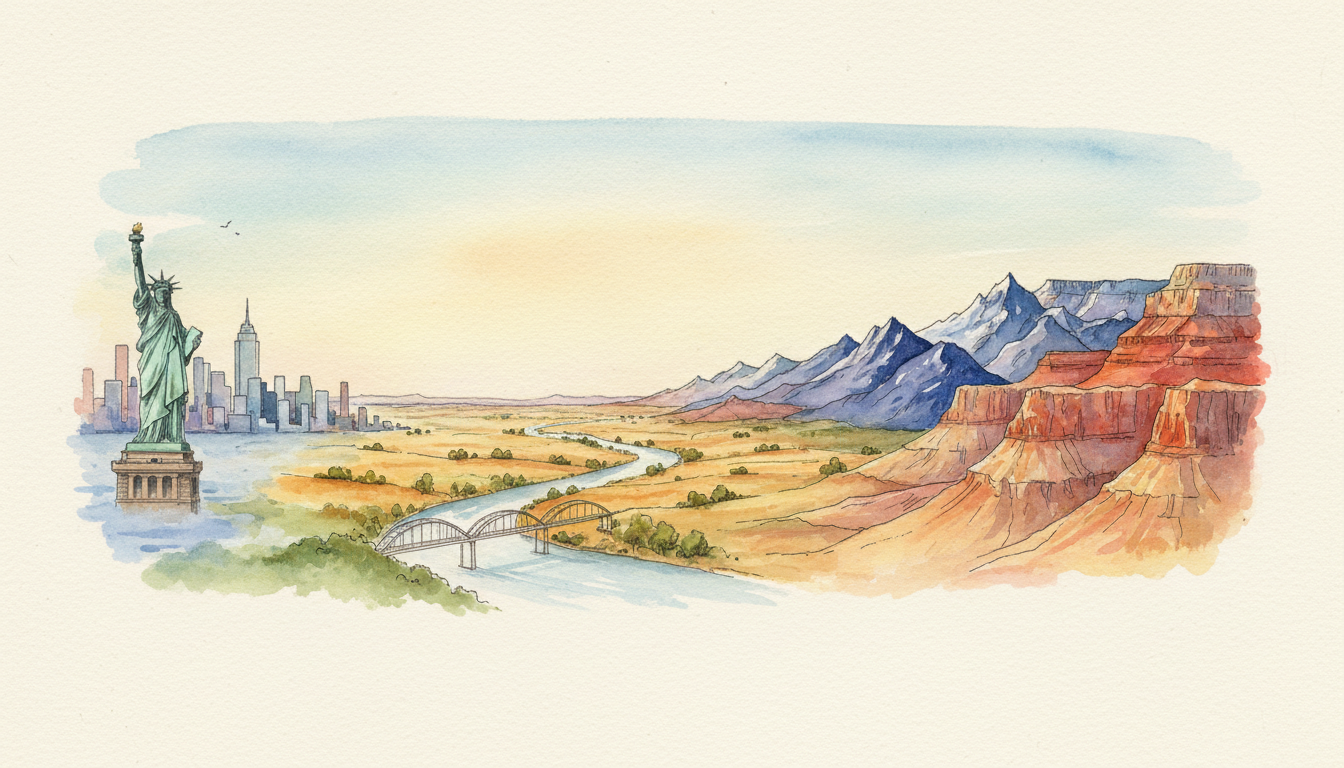
Where is the United States, why does it have 50 states, and what makes America important to the world? The United States of America is a federal republic in North America, with Washington, D.C. as its capital. It consists of 50 states, a separate federal capital district and several territories. The contiguous 48 states sit between Canada and Mexico, while Alaska extends into the far northwest of the continent and Hawaii is an island state in the Pacific Ocean. The United States is known for its extraordinary geographical range, constitutional institutions, universities, scientific research, technology and entertainment industries, major companies and financial markets, national parks, and influential role in global trade and diplomacy.
Everything about the United States in one complete country guide: the USA cannot be explained simply by saying “New York, Hollywood and the President.” A household’s experience depends on which state, city, county or tribal jurisdiction it lives in. Public schools are often funded and governed locally, state laws can differ, health insurance involves distinctive public and private arrangements, and a highway numbered “Interstate” is part of a national road system used every day by people and freight. In 2026 the United States marked the 250th anniversary of the Declaration of Independence, while economic, technology and public-policy debates continued. A new 27th UNESCO World Heritage property, the Okefenokee National Wildlife Refuge in Georgia, was inscribed in 2026. This guide uses accurate dates and original public data, answers practical questions early, and connects readers to the deeper articles elsewhere in eduKateSG.
United States at a glance: quick facts for curious readers
- Official name: United States of America (USA, U.S. or US).
- Region: North America, with major Pacific and Caribbean territorial connections.
- Capital: Washington, District of Columbia (Washington, D.C.).
- How many states? 50, including Alaska and Hawaii.
- Contiguous states: 48 states sharing the large mainland landmass; Alaska and Hawaii are not contiguous with the other 48.
- Federal district: Washington, D.C., which is not a state.
- Major inhabited US territories: Puerto Rico, Guam, US Virgin Islands, American Samoa and Northern Mariana Islands; none is one of the 50 states.
- Land boundaries: Canada and Mexico; Alaska also shares a land border with Canada. There are no other conventional land-border states.
- Oceans: Atlantic and Pacific, with Alaska also on the Arctic Ocean and coasts facing the Gulf of Mexico and Caribbean Sea.
- Area: about 9.8 million square kilometres in broad standard international comparisons, with rankings varying by whether inland and territorial waters are included.
- Population: 341,784,857 in the Census Bureau’s July 1, 2025 estimate; its population clock estimated roughly 342.9 million on October 3, 2026. Neither is a census count taken this minute.
- Currency: United States dollar (USD), used in many international transactions and reserves.
- Official language: English was designated the official language through Executive Order 14224 on March 1, 2025; other languages and language-access arrangements remain important under applicable law.
- Time zones: multiple, ranging from the Eastern and Pacific zones to Alaska, Hawaii and territories; daylight saving time does not apply uniformly.
- Political system: constitutional federal republic with legislative, executive and judicial branches.
- President as of October 21, 2026: Donald J. Trump, 45th and 47th President.
- Vice President: JD Vance.
- National legislature: Congress, comprising the Senate and House of Representatives.
- Historical milestones: Declaration of Independence, July 4, 1776; Constitution signed, September 17, 1787; present constitutional government began in 1789.
- 2026 anniversary: 250 years since the Declaration of Independence, celebrated on July 4, 2026.
- 2025 electricity mix: around 41% natural gas, 24% renewables, 18% nuclear and 17% coal of utility-scale generation (rounded).
- Latest completed quarterly GDP estimate as of the article date: real GDP grew at a 2.2% annualised rate in the second quarter of 2026, per the Bureau of Economic Analysis’ September 30 third estimate, not an annual growth rate.
- UNESCO World Heritage: 27 properties as of October 2026, including 13 cultural, 13 natural and one mixed; the newest was Okefenokee National Wildlife Refuge.
- Central learning question: how does one federal country coordinate 50 state governments, thousands of local communities, huge physical distances and worldwide economic relationships?
These are facts of different kinds. The number of states is relatively stable; the Census Bureau’s estimated population changes; presidents and administrative policy change; annual electricity percentages require a reference year; and a quarterly GDP release is revised. The sources include Census Bureau QuickFacts, the White House administration roster, USAGov’s official language explanation, BEA economic releases, EIA electricity data and UNESCO’s World Heritage list.
1. Where is the United States on a world map?
Look at North America between the Atlantic and Pacific oceans. Most of the United States occupies a broad stretch south of Canada and north of Mexico, with mountain ranges, rivers, plains, deserts and coastlines. Alaska lies north and west of much of Canada, extending toward the Arctic and the Bering Strait. Hawaii comprises islands in the central Pacific. Puerto Rico, the US Virgin Islands and Pacific territories give the United States additional geographic connections beyond the 50 states.
The word “America” has more than one meaning. In ordinary international English it often serves as shorthand for the United States; in geographical contexts “the Americas” refers to the much larger landmasses and societies of North and South America. A country guide should use “United States” when political boundaries matter and specify the geographical continent when discussing broader cultures or ecosystems.
Is the USA part of North America or both Americas?
The United States is a North American country. It has territories and relationships spanning Caribbean and Pacific settings, but that does not make its state territory the whole of North or South America. Canada, Mexico, Central American countries and the rest of the hemisphere are independent places with their own cultures and systems.
Why are Alaska and Hawaii different from the other states?
Alaska is geographically separated from the contiguous 48 states by Canada and borders Arctic and Pacific waters. Hawaii is an island state in the central Pacific, thousands of kilometres from the mainland. Both are full US states, with senators, representatives, state governments and residents’ federal rights under applicable law. Their distance creates different practical issues for shipping, electricity, travel and environmental management.
Where is Puerto Rico?
Puerto Rico is a US territory in the Caribbean, not one of the 50 states. It has its own local government under the US constitutional and statutory arrangements applicable to territories. Its residents are generally US citizens by federal law, but electoral representation and some federal programmes differ from those in states. A visitor should not confuse Puerto Rico with a foreign sovereign state or describe it as a US state.
Does the United States have land borders with Russia?
No conventional land border. Alaska and Russia are separated by water across the Bering Strait. Geographical closeness may create maritime, environmental and strategic relationships, but it does not mean trucks can ordinarily cross a US–Russia land frontier.
How does the country’s size affect an ordinary journey?
Imagine comparing a commuter travelling within a city in Massachusetts with a resident moving between towns in rural Alaska. The word “American” describes both, but the relevant transport, climate, internet, energy and service constraints differ. A country can have high-speed urban rail in some corridors and remote communities reachable only by air or boat. National averages must be matched to local reality.
2. Why does the United States have 50 states?
The original United States formed from 13 former British colonies that declared independence in 1776. Later the union expanded through state admissions, territorial changes and historical processes including purchases, treaties, settlement, wars and actions that displaced Indigenous peoples. The present total of 50 states followed the admission of Alaska and Hawaii in 1959. Each state has its own constitution, executive, legislature and courts, subject to the federal Constitution and applicable federal law.
A federation divides authority. The national government has constitutional powers such as foreign relations, federal taxation and interstate commerce regulation; states retain important roles including education and many other daily rules. Cities, counties, towns, school districts and special-purpose bodies add further layers. Some Indigenous nations have distinct forms of sovereignty and government-to-government relations as federally recognised tribes, a separate constitutional and legal category that should not be erased.
Is Washington, D.C., the 51st state?
No. Washington, D.C., is a federal district established for the national capital. It has a local government and residents, but its representation and relationship to Congress differ from those of a state. Proposals for changing its status exist, and arguments about democratic representation continue, but a political proposal does not become statehood unless the required law and institutional steps actually occur.
What is the difference between a state and a territory?
A state is a constituent member of the federation with constitutionally defined representation and authority. A territory has its own legal and political arrangements established under US law and may have different congressional representation, voting arrangements and federal programme treatment. Puerto Rico, Guam, the US Virgin Islands, American Samoa and the Northern Mariana Islands are five inhabited territories; their statuses are not identical. For example, nationality and citizenship rules in American Samoa differ in important ways from those of territories whose residents are US citizens by birth.
Why do states have different laws?
The Constitution assigns some responsibilities to the national government and leaves other areas under state authority, subject to federal constitutional and statutory constraints. Consequently, rules concerning licences, education, insurance, taxation, property, employment and various other subjects can differ by state. A law that applies in California may not match a law in Texas or Massachusetts. The How the United States Works | Why Do States Have Different Laws? guide explains the division with everyday examples.
Who governs Indigenous tribal nations?
Federally recognised tribes exercise forms of self-government and sovereignty with specific powers, responsibilities, treaty histories and relationships with federal and state authorities. The United States’ Indigenous peoples are not merely historical inhabitants whose governments disappeared when states were created. Tribal jurisdiction can matter for law, land, language, education and services today. Consult the Bureau of Indian Affairs’ FAQ for an official introduction, while also reading tribal nations’ own sources.
Worked example: the same family moving between two states
Imagine a family moves from Illinois to Florida. The children may attend schools using different curricula, schedules and graduation requirements. The parents may need new driving licences or vehicle registrations, and the household’s tax arrangements can change. They have not entered another sovereign country, but local rules have changed. This is a hypothetical move illustrating federalism rather than a specific legal checklist for those states.
3. What rivers, mountain ranges, plains and deserts shape the USA?
The United States has extraordinary geographic range. The Appalachian Mountains extend through much of the east; the Great Plains and Mississippi basin are central to food production and transport; the Rocky Mountains run through the west; the Colorado Plateau contains canyon landscapes; deserts shape parts of the Southwest; Alaska contains glaciers, mountain ranges and Arctic environments; Hawaii has volcanic islands and ocean ecosystems.
The variety means there is no single “American climate.” Florida’s warm coastal conditions, Minnesota’s winters, Arizona’s desert heat, Alaska’s subarctic and Arctic environments and the Pacific Northwest’s temperate rainforest all demand different infrastructure and preparedness.
Why is the Mississippi River important?
The Mississippi River system drains a vast part of the country, carrying water and supporting agriculture, wildlife, cities, shipping and industries. Inland waterways and locks connect some agricultural and industrial regions to ports and world markets. Flood management, levees and water quality also matter. The river is not just a line on a classroom map: it is a working economic and ecological system.
What is the Great Lakes system?
The Great Lakes—Superior, Michigan, Huron, Erie and Ontario—lie in North America, with most shared by the US and Canada. They form an immense freshwater system used for shipping, water supply, recreation, industry and ecology. Lake Michigan lies entirely within the United States. International and local cooperation is important for pollution prevention and sustainable use. A freshwater lake with abundant volume does not automatically guarantee safe drinking water for every household.
What makes the Grand Canyon famous?
The Grand Canyon is an immense geological landscape carved over millions of years by the Colorado River and other erosional processes. Its layered rock records vast stretches of Earth’s history, while Indigenous nations have continuing relationships with the area. UNESCO’s Grand Canyon National Park listing describes its natural significance. A dramatic photograph should prompt questions about geology, river management, conservation and visitor safety, not just scenic ranking.
Where are the Rockies and Appalachians?
The Rocky Mountains extend through western North America and are particularly prominent in parts of the western US and Canada. The Appalachian system is older and runs through much of eastern North America. They differ in geological history, relief and climate, influencing ecosystems, transport and economic activities. A highway through mountains requires different engineering and maintenance from one crossing open plains.
Why do hurricanes, tornadoes, wildfires and earthquakes occur in different regions?
They have different causes. Atlantic and Gulf Coast storms are influenced by tropical ocean and atmospheric conditions. Tornadoes can develop in severe thunderstorms in multiple regions. Wildfires depend on fuel, ignition, weather and land management. Earthquakes occur through tectonic faults and related processes, particularly in parts of the West, Alaska and Hawaii. Disaster readiness needs local hazard information rather than one countrywide alarm. Ready.gov and NOAA provide institutional starting points.
A worked example: what a weather map misses
Suppose a coastal town faces an approaching tropical storm while an inland western town faces high wildfire risk. Both might be under emergency warnings, but the protective actions, shelters and infrastructure priorities differ. Forecast categories and the local emergency authority are essential. The example is hypothetical and does not serve as real-time hazard advice.
4. How did the United States become an independent country?
The history of the land begins with Indigenous peoples and nations long before European colonisation. Diverse cultures developed cities, farms, trade networks, governance, languages and environmental knowledge. European empires later colonised different regions, creating settlements and institutions amid conflicts, displacement, epidemic disease, slavery and resistance. The British colonies along the Atlantic coast became the central setting of the American Revolution, but the modern United States eventually expanded far beyond those original boundaries.
The Declaration of Independence was adopted on July 4, 1776. It announced independence from Britain and articulated influential claims about rights and consent of the governed. The revolutionary war ended with British recognition of independence in the 1783 Treaty of Paris. The Constitution was signed in 1787 and the new federal government began functioning in 1789, with the Bill of Rights ratified in 1791. These are distinct milestones and should not be compressed into a single founding day.
- Before European colonisation: Indigenous nations developed complex political systems, trade, agriculture and cultural traditions across the continent.
- Sixteenth to eighteenth centuries: colonisation by European powers and the transatlantic slave trade reshaped societies, land and power.
- 1776: the 13 colonies declared independence on July 4.
- 1783: the Treaty of Paris formally ended the Revolutionary War.
- 1787–1789: the Constitution was drafted, ratified and put into operation.
- 1791: the Bill of Rights, the first ten constitutional amendments, was ratified.
- Nineteenth century: expansion, industrial changes, immigration, slavery and resistance reshaped the United States; many Indigenous nations faced forced removal and dispossession.
- 1861–1865: the Civil War arose fundamentally from conflicts over slavery and its extension, with other constitutional and political issues intertwined.
- 1863–1870: emancipation and major constitutional amendments abolished slavery and redefined citizenship and equal protection, while the struggles of Reconstruction continued.
- Late nineteenth and early twentieth centuries: rapid industrialisation, urban growth, migration, labour movements and reform campaigns changed daily life.
- 1920: the Nineteenth Amendment prohibited denying voting rights on account of sex, though many women of colour continued facing discriminatory barriers.
- 1930s: the Great Depression and New Deal transformed debates about employment, regulation and federal welfare responsibilities.
- 1940s: World War II brought extensive economic mobilisation, military conflict and post-war global influence.
- 1950s–1960s: major civil-rights movements challenged racial segregation and discrimination and helped achieve important federal legislation.
- Late twentieth century: Cold War competition, computing, global trade and demographic change reshaped the country.
- 2000s–2020s: the economy, politics, wars, technology, public health and social debates continued changing.
- July 4, 2026: the United States commemorated 250 years since the Declaration of Independence, with programmes including a major National Archives anniversary event.
The point of this history is not to reduce the country to a story of unbroken success or unbroken failure. Its constitutional ideals had deep influence, while practices such as slavery, exclusion, dispossession and discrimination contradicted those ideals. Movements for abolition, Indigenous rights, labour protections, women’s suffrage and civil rights changed laws and institutions over time. Historical evidence and citizens’ experiences should be taken seriously even when interpretations are contested.
Why is July 4, 1776 the national birthday?
It is the date the Continental Congress adopted the Declaration of Independence. The Revolutionary War was not over, and the present constitutional federal government did not yet exist. The National Archives’ Declaration resource explains the document and its history. An anniversary of 250 years in 2026 commemorates that declaration, not the 250th year under the current constitution.
Why was the US Constitution written in 1787?
The earlier Articles of Confederation created a relatively weak national arrangement. The constitutional convention proposed a new federal structure with separate powers and a stronger ability to act nationally. Debates about representation, power and rights shaped its design, including compromises with serious consequences relating to slavery. The National Archives’ history of the Constitution provides the original documents and political context.
What role did slavery play in the founding and Civil War?
Enslaved Africans and their descendants contributed labour, culture and resistance under a coercive institution that violated fundamental human rights. Conflicts over slavery were central to the nation’s political development and its Civil War. The Thirteenth Amendment abolished slavery except as punishment for crime, while the Fourteenth and Fifteenth amendments addressed citizenship and voting protections. Legal changes were vital but did not instantly end unequal treatment or violence. The National Archives’ Thirteenth Amendment record is a useful primary source.
What happened to Indigenous nations as the United States expanded?
Treaties, military actions, settler expansion, forced removals, reservations and federal policies transformed Indigenous lands and communities. Some Indigenous nations survived and continue to exercise sovereign governmental authority today. Describing western expansion only as the acquisition of empty territory is historically false. A fair account draws on tribal historians and original sources as well as federal documents.
Why did the United States become globally influential in the twentieth century?
Industrial capacity, large domestic markets, scientific research, military power, technological developments and major roles in two world wars and post-war institutions increased American influence. These developments also involved political choices and conflicts, including the Cold War, civil-rights struggles and foreign interventions. Influence differs by topic: US entertainment, universities, banking and defence have global reach, but other countries have their own sovereignty and agency.
What did the 250th anniversary in 2026 celebrate?
The anniversary was the semiquincentennial of the Declaration of Independence, observed on July 4, 2026. The National Archives organised ceremonies and exhibitions focused on the original founding documents, while numerous other institutions held commemorations. It is also a useful opportunity to examine how the meaning and practical reach of liberty, citizenship and rights changed across 250 years. The National Archives press release dated June 17, 2026 documents the programme.
5. Which American natural and historical places are on UNESCO’s World Heritage List?
As of October 2026, UNESCO lists 27 World Heritage properties in the United States: 13 cultural, 13 natural and one mixed. They include famous national parks, historic and Indigenous cultural landscapes, important architecture and sites connected to American history. This is a count of UNESCO properties, not the number of US national parks or historic landmarks. One UNESCO property can cover multiple components or even parts of more than one country.
One of the freshest facts is the inscription of Okefenokee National Wildlife Refuge in Georgia in 2026, recognising the immense peat-filled blackwater wetland ecosystem. Its designation increased the national count to 27. It is wrong for a current overview to repeat a pre-2026 figure of 26, or to treat every National Park Service unit as UNESCO-listed.
Which famous sites are included?
The list includes Grand Canyon, Yellowstone, Yosemite, Great Smoky Mountains, Everglades, Hawaii Volcanoes, Redwood National and State Parks, Olympic National Park, Mammoth Cave, the Statue of Liberty, Independence Hall, Monticello and the University of Virginia, Taos Pueblo, Mesa Verde, Cahokia, Chaco Culture, and several others. Puerto Rico’s La Fortaleza and San Juan National Historic Site is also an inscribed US property. The entire official list is on UNESCO’s United States country page.
Why is Okefenokee important in 2026?
The Okefenokee National Wildlife Refuge contains an internationally significant wetland and peatland landscape in the southeastern United States. Its UNESCO designation recognises natural ecological processes and habitats. The area also holds profound historical, cultural and spiritual significance for Indigenous peoples including the Muscogee (Creek) Nation; conservation should not erase those relationships. A UNESCO inscription is not a declaration that all ecological threats have been solved.
What is the difference between a national park and a World Heritage Site?
A US national park is designated under domestic legal and management arrangements. UNESCO inscription recognises a property’s outstanding universal value under an international convention. Some areas have both designations; many domestic parks do not have a World Heritage inscription. A visitor should use the responsible park or site authority for tickets, closures and safety, not UNESCO status alone.
What can students learn from the Statue of Liberty and Independence Hall?
The Statue of Liberty has become a major symbol of freedom and migration, while Independence Hall is associated with the founding documents. Their meanings have been interpreted and debated across generations. Students can ask what ideals each place represents, who was excluded when the ideals first emerged, and how civil-rights changes later expanded their practical reach.
Why are Indigenous cultural sites important?
Places such as Taos Pueblo, Mesa Verde, Chaco Culture and the Hopewell Ceremonial Earthworks demonstrate the knowledge, engineering, social and ceremonial traditions of Indigenous societies. Their histories did not begin with European exploration. Some sites have ongoing spiritual and community significance, and conservation should respect the descendants and living nations associated with them.
Worked example: why a UNESCO label requires another question
Imagine a school project compares Yellowstone and Independence Hall. Both are UNESCO properties, but their main reasons for inscription are different: ecological and geothermal processes on one hand, constitutional historical significance on the other. A table recording only “famous places” loses that distinction. The project improves when it connects each site’s recognized values with the evidence needed to protect them.
6. How does the United States federal government work in 2026?
The United States is a constitutional federal republic, organised through three branches of federal government. Congress makes federal laws, appropriates funds and oversees federal institutions. The President leads the executive branch and administers laws through departments and agencies. The Supreme Court and other federal courts interpret and apply federal law and constitutional rules in cases within their jurisdiction. These branches have distinct responsibilities and mechanisms intended to limit the concentration of power.
Donald J. Trump is President as of October 21, 2026, serving his second, nonconsecutive term; JD Vance is Vice President. The White House roster identifies them. Current leaders’ policy priorities are changeable; the constitutional structure is much more durable. A guide should distinguish an executive order, a congressional statute, an agency regulation, a court decision and a proposal under discussion.
What does Congress actually do?
Congress has two houses: the House of Representatives and the Senate. The House apportions seats among the states principally according to population under constitutional and statutory rules. Every state has two senators, while the House has 435 voting members under present statute. Washington, D.C., and certain territories have delegates or other arrangements distinct from those of states. Congress makes laws, debates budgets, conducts hearings and exercises oversight. The precise stage of a bill matters: an introduced bill is not yet federal law.
Is the Senate a government department?
No. The Senate is one chamber of Congress, part of the legislative branch. It has particular constitutional functions, including roles in confirming certain appointments and approving treaties under specified rules. Federal ministries are generally called departments—such as the Department of State, Department of Education or Department of Transportation—and form part of the executive branch.
Does the President make every law alone?
No. The President may propose policy, sign or veto legislation, issue executive orders within lawful executive authority and direct agencies under applicable statutes. Many policies require congressional funding or new legislation, and some executive actions may be reviewed in court. Describing a presidential speech as if it were an enacted statute can lead readers badly astray.
What is judicial review?
Federal courts can consider whether particular government actions or laws comply with the Constitution and applicable law, in cases properly before them. Court systems do not automatically answer every policy argument, and the Supreme Court takes only certain cases. It is important to distinguish a district court ruling, an appellate decision, a Supreme Court opinion and an executive agency’s own interpretation.
Why do states retain so much power?
Federalism combines a national government with state governments whose powers and responsibilities have constitutional foundations. The precise division involves the Constitution, federal statutes, state constitutions, court decisions and intergovernmental arrangements. States manage broad areas of daily life, including major education, transport, licensing and public-health functions within legal constraints. For an extended explanation, use How the United States Works | Federal Government, States, Taxes and Daily Life.
Why is the Electoral College discussed so often?
US presidents are selected under a constitutional Electoral College system rather than a simple nationwide popular-vote rule. The state-based structure, elector allocation and laws governing the process can lead to debate over representation and fairness. Supporters emphasise federal design and state roles, while critics question the possibility of a difference between national popular-vote totals and the electoral result. This overview explains the distinction rather than advocating one side. The dedicated Electoral College explainer treats the constitutional and public debate in much greater depth.
Worked example: a nationwide public-health warning
Imagine federal scientists identify a risk affecting products sold throughout the country. They may publish evidence and guidance, while federal and state agencies exercise particular regulatory powers. Local institutions communicate with people, retailers take appropriate actions, and courts can review legal disputes. Successful public protection therefore needs science, lawful authority, business cooperation and clear communication—not just one press conference. This is an illustrative scenario.
7. Why are federal, state, county, city and tribal responsibilities different?
The United States has layers of public administration that do not fit into one uniform national chart. States use different arrangements for counties, parishes, boroughs, townships, municipalities, independent school districts and special-purpose districts. Federally recognised tribal nations may exercise distinct sovereignty under relevant legal frameworks, and US territories have their own arrangements. A learner should identify the actual jurisdiction before asking which office operates a service.
Some responsibilities may be jointly financed or subject to national standards while implemented locally. A public school can have state learning standards, district employment decisions, local taxation and federal civil-rights requirements. A highway can have a federally recognised route number but be built and maintained by a state transportation department. These are not contradictions: responsibility can be divided by function.
Who collects taxes in the United States?
The federal government levies taxes under federal law, while states and local governments may impose their own taxes or charges. Sales taxes, property taxes, state income taxes and local taxes vary. The Internal Revenue Service administers important federal tax rules, but it is not the tax agency of every city and county. Before calculating obligations, a resident or business must determine the relevant location, tax type, current law and filing status.
Why do property taxes affect public schools?
Local property taxes help finance many public school districts, though the funding balance among federal, state and local sources varies by jurisdiction. Areas with expensive taxable property may have different revenues from areas with much lower property values, while state equalisation formulas and other programmes can alter the picture. The dedicated Why US Public Schools Are Funded by Property Taxes guide explains the financial mechanisms and equity questions.
Why might two neighbouring towns have different services?
They can be in different municipal boundaries or school districts, have different tax bases, budgets, utility providers or local policies, and serve different populations. A new school, a snow-clearance route, public transport or emergency service depends on which institution is accountable. National averages do not establish conditions on a particular street.
What responsibilities do tribal governments have?
Their authorities vary under tribal, federal and sometimes state law, with important roles concerning governance, land, justice, cultural protection, education and other services. Tribal nations should not be described as ordinary counties or as symbolic clubs. Government-to-government relationships, histories of treaties and present law matter. Tribal sources should be used alongside Bureau of Indian Affairs guidance.
A worked example: an address crosses three different service maps
Imagine a household in a suburb. It may pay property tax to a county, attend a school run by an independent district, receive water from a regional authority and use a state-maintained highway. Four different maps can overlap one address. If a school bus is late, the water is discoloured or a major road is damaged, reporting everything to the mayor may not reach the right office. This hypothetical example explains the practical importance of jurisdiction.
8. How does the United States economy work, and why is the US dollar so important?
The US economy includes consumer spending, business investment, manufacturing, services, technology, research, agriculture, construction, finance, government and international trade. It has one of the world’s largest domestic markets and substantial financial influence. Yet a large aggregate GDP is not a measure of what every worker earns or what every family can afford. Wages, prices, taxes, housing, healthcare and wealth distribution are distinct questions.
As of the latest available completed-quarter release on October 21, 2026, the US Bureau of Economic Analysis estimated second-quarter 2026 real GDP grew at a 2.2% annualised rate, with first-quarter growth revised to 2.5%. The September 30 release is a third estimate and may be revised further; the first estimate for third-quarter GDP was scheduled for October 29. An annualised quarterly rate is not the same thing as the whole year’s realised growth.
See BEA’s GDP release and revision schedule. Use the specific quarter and estimate version when quoting growth, especially in a rapidly changing economic debate.
Why is the US dollar used around the world?
The US dollar is used in domestic transactions and in major international markets, finance and reserve holdings. Its role reflects the size of the US economy, the scale and liquidity of US financial markets, historical institutional relationships and many trading practices. However, international use does not guarantee a stable exchange rate against every foreign currency or that all international contracts must use dollars.
What is the Federal Reserve?
The Federal Reserve System is the US central-bank system. Its functions include monetary policy, aspects of financial-system stability, supervision and payments. The Federal Open Market Committee makes key monetary-policy decisions under statutory arrangements. Congress has established the Federal Reserve’s legal mandate and oversight context, while its operational monetary-policy decisions have a particular degree of institutional independence. The Federal Reserve’s own overview explains the institutional design.
Why do interest rates matter to a family?
Interest rates influence borrowing costs, savings returns and credit conditions. A household taking a mortgage or an enterprise financing equipment may care about the price of credit, but the rate quoted by a bank is not necessarily identical to the Federal Reserve’s policy target. Risk, term, collateral and lender policies also matter. For a consumer, the useful figure may be the actual annual percentage rate and total repayment cost rather than a central-bank headline.
What does GDP measure, and what does it leave out?
Gross domestic product measures the value of final goods and services produced within the economy over a defined period. It does not by itself measure distribution of income, unpaid household work, environmental damage, subjective wellbeing or access to healthcare. GDP can rise while some groups face high housing costs or economic insecurity. This is why US economic interpretation uses wage, inflation, employment, poverty, household and regional data as well.
Why do prices vary so much between states?
Housing supply, local earnings, taxes, transport, geography, competition and insurance costs differ. The price of renting in a major coastal city can be very different from a rural town. A wage that sounds high in one region may buy less after essentials than a lower wage elsewhere. A responsible comparison states the location and the period, not just a national average.
Worked example: a country’s economic growth versus a worker’s budget
Imagine an economy with GDP growth and rising employment, while a particular family faces a sharp rent increase and higher childcare bills. The national figures and the family’s difficulties can both be true. Their experience requires comparing income after tax, housing, food, transport, healthcare and education costs. This hypothetical household illustrates why broad economic outcomes must be connected to practical budgets.
9. What does the United States make, grow and export?
The US produces a large range of goods and services, from aircraft and machinery to software, entertainment, pharmaceuticals, agricultural products and professional services. Large regional differences matter. The Great Plains are associated with agricultural production; parts of the Midwest and Southeast have manufacturing concentrations; the West Coast includes technology and trade networks; financial and professional services have important centres in New York and other cities. These are broad patterns, not exclusive labels for any region.
Why is the US considered a technology leader?
Universities, research institutions, engineering teams, investors, companies and a large domestic market have supported innovation in computing, software, semiconductors, aerospace, medical technology and artificial intelligence. Success depends on skilled people, institutions, capital and global supply chains. A technology product may be designed in one state, fabricated abroad, assembled elsewhere and sold worldwide. Calling it “American” does not automatically establish the location of every component or job.
How does agriculture connect to the rest of the country?
Farmers grow crops such as corn, soybeans, wheat, fruits and vegetables and raise livestock, but food reaches consumers through harvesting, storage, processing, inspection, refrigeration and transport. A large agricultural output can coexist with unequal access to nutritious food because income, location and distribution matter. Agriculture also affects land, water, soil, energy and ecosystems.
Why are ports, trucks, trains and warehouses essential?
A factory’s finished goods need a path to customers. Ports connect shipping with domestic rail and road; warehouses store goods and support reliable delivery; trucking provides flexibility for local distribution. Congestion, labour constraints, equipment availability and customs procedures can increase costs. The worth of a transport network depends on the full journey, including the last mile to a household or business.
What are tariffs, and why do they matter in 2026?
Tariffs are taxes or duties applied to certain imported goods under applicable law. They can affect government revenue and the prices and incentives facing importers, domestic producers and consumers. Their economic effects are debated and depend on the product, demand and how firms respond. Policies can be amended or challenged, so an article should cite the specific measure and date rather than state that all imports are taxed at one permanent rate.
What is the relationship between the US and China?
It includes major trade, investment, technology, security and diplomatic relationships, alongside economic competition and disputes. Specific policies can change rapidly. The existence of trade does not mean both governments agree on every political issue, and disagreement does not automatically end all commercial exchange. Analysis should distinguish a current negotiated agreement from a proposal, public statement or headline.
Worked example: an American factory depends on five countries
Imagine a US manufacturer receiving materials from domestic suppliers and parts from firms in other countries. Engineers assemble and test the product and send it to a domestic customer. A disruption at a foreign supplier or a US port can delay the delivery even if the US factory works perfectly. The example is hypothetical but explains why imports, exports and domestic industry can support one another rather than always be opposites.
10. How does the US electricity and energy system work?
The United States has diverse electricity sources and a large, interconnected set of electricity networks with different regional markets and regulatory arrangements. According to the US Energy Information Administration, in 2025 about 41% of utility-scale electricity generation came from natural gas, 24% from renewable sources, 18% from nuclear energy and 17% from coal. These rounded shares refer to electricity generated by utility-scale facilities, not the entire country’s transport fuel or total energy consumption.
The national generation total was about 4.43 trillion kilowatt-hours for utility-scale plants in 2025. The EIA separately estimated additional output from small-scale solar installations. Annual generation shares also differ from a plant’s installed capacity and from the sources serving a particular state in a given hour. See EIA’s 2025 electricity explainer and the capacity-and-generation comparison.
Why do different states have different electricity mixes?
Fuel resources, geography, past investment, regional interconnections and regulation differ. Hydropower has major roles in some western and northern regions, while natural gas, nuclear, coal, wind and solar have varying concentrations. A customer may receive power from a regional grid rather than directly from the nearest power plant. A national percentage cannot tell a household the exact source of each electron at a given moment.
What is the difference between renewable energy and nuclear energy?
Solar, wind, hydro, geothermal and some biomass sources are commonly classified as renewable under defined statistical frameworks. Nuclear fission is a low-carbon source of electricity but is generally counted separately rather than as renewable. Fossil-fuel generation can emit greenhouse gases and other pollutants, while every technology has its own land, material, cost and environmental considerations. A neutral energy explanation names the statistical categories and their trade-offs.
Why do power outages still happen in a technologically advanced country?
Severe storms, wildfires, equipment failures, overloaded systems, damaged transmission lines and local distribution problems can interrupt service. Electricity generation might be available nationally while a specific community loses power because of a failed line or transformer. Reliability requires resilient transmission and distribution, repair crews, clear communication and appropriate backups.
What is the difference between 98% renewable Uruguay and 24% renewable United States?
Those figures describe the same broad category—annual electricity generation from renewable sources—but for different national systems, scales and years. Uruguay generated approximately 98% renewable electricity in 2025, compared with about 24% of US utility-scale electricity in 2025 under EIA’s method. The comparison is useful only after checking classification and scope; it is not a scorecard for every aspect of national prosperity, price or climate policy. Read Everything About Uruguay for the contrasting country system.
Worked example: an electricity outage affects four sectors
Imagine heavy storms damage a substation. Homes lose lights, a grocery store needs refrigeration, a factory stops production, and a medical facility switches to backup systems. One technical failure creates separate risks for food, wages, schoolwork and health. Engineers and public authorities need maintenance, restoration plans, safety decisions and public notices; simply counting national megawatts does not solve a local outage.
11. How does the United States education system work from kindergarten to university?
The American education system is large and decentralised. Public school education is mainly organised by states, local school districts and other education authorities under a framework of federal constitutional and legal requirements. Children typically move through kindergarten, Grades 1–12, and then possible postsecondary education. However, entry age, attendance requirements, school calendars, curriculum frameworks, exams and high-school graduation requirements vary by state and district.
The common label K–12 means kindergarten through 12th grade. It does not mean that every district uses the same seven-year secondary sequence, textbooks or standardised examination. Some districts operate elementary Grades K–5, middle Grades 6–8 and high-school Grades 9–12; others have different boundaries. The responsible state education agency and school district publish their current arrangements. The US Department of Education’s K–12 resource page links to state report cards, school districts and learning outcomes.
What is the difference between a public school, charter school and private school?
A district public school is operated within a public system under state and local rules. A public charter school is publicly funded but may have different governance or operating arrangements under its charter and state law. A private school is established and governed outside the ordinary public district structure, subject to applicable regulation and accreditation or certification arrangements. Names alone do not establish academic quality; parents need to examine actual teaching, access, fees, admissions, student needs and school accountability.
Why do American schools have different textbooks and exams?
States and districts play large roles in curriculum and assessment decisions. National legislation and programmes can set requirements or incentives, while local schools choose implementation within applicable rules. A mathematics course in two states may teach many shared concepts yet have different sequences, benchmarks, calendars and exams. A student moving between schools needs the current syllabus and transcript, not a promise that ‘all Grade 8’ content is identical.
What is a high-school diploma?
A high-school diploma is typically awarded after meeting the relevant state and local school requirements, including credits or other completion conditions. It is not one centrally awarded nationwide examination certificate. The subjects, tests and methods required for graduation vary by jurisdiction. A university admission officer may therefore consider school courses, grades, tests where applicable, recommendations and other contextual evidence, according to its own policies.
What are SAT and ACT exams?
SAT and ACT are standardised tests that some colleges use or allow as part of undergraduate admissions, with institutional rules varying and changing. They are not US federal high-school graduation examinations. Some institutions are test-optional or have other requirements, and rules can change for particular entry years. Families should check the specific college and applicant cohort rather than assume one test is mandatory nationwide.
What is a community college?
Community colleges commonly provide associate degrees, certificates, career and technical education and possible transfer routes to four-year institutions. The exact programmes and credit-transfer agreements differ by state and institution. A good transfer plan confirms whether credits apply to the intended bachelor’s degree rather than assume every course transfers automatically.
What does undergraduate and graduate study mean?
Undergraduate education may involve an associate or bachelor’s degree, while graduate education includes master’s, professional and doctoral programmes. Admissions, accreditation, cost, duration and licensing requirements vary widely. A degree title alone does not determine professional permission to practise medicine, law, engineering or teaching, which often requires further regulated steps.
Why is accreditation important?
Accreditation involves review by recognised quality-assurance bodies under applicable US and other rules. Institutions may differ in accreditation status, and academic credit or professional recognition can depend on the exact programme and accreditor. Before paying tuition or using an overseas qualification, students should verify the institution, awarding authority, programme, licensure implications and transfer policy. The US Department of Education’s accreditation information is a useful official starting point.
Is university education free in the United States?
Not generally. Tuition and total attendance costs vary enormously by institution, resident status and financial-aid eligibility. Public colleges can have different in-state and out-of-state tuition rates, and private institutions use their own fee and aid arrangements. Scholarships, grants, work opportunities, loans and family contributions need to be distinguished. The sticker price, net price after grants and total borrowing are not identical amounts.
Why are education and household finances connected?
Students may need transport, childcare, housing, reliable internet and learning materials. A family’s ability to pay for those essentials can affect attendance and success even where a public school’s basic instruction is tuition-free. For policy evaluation, compare enrolment, attendance, teaching quality, completion and actual learning rather than the number of new classrooms or devices purchased.
Worked example: a foreign student moving into Grade 9
Imagine a child who completed a lower-secondary mathematics syllabus in Singapore and moves to a US high school. The receiving school may evaluate credits and grade placement differently from the previous system. The child may know algebra but lack a topic normally taught in the new state’s earlier grade, or the opposite. The right response is a diagnostic and careful credit review, not assuming the child is simply ‘one year ahead’ or ‘one year behind.’ This scenario is illustrative.
For a detailed explanation of school finance and state differences, explore Why US Public Schools Are Funded by Property Taxes and Why States Have Different Laws.
12. How does healthcare work in the United States?
Healthcare in the United States involves hospitals, primary-care clinics, specialists, pharmacies, public-health agencies, private insurers, employer-sponsored plans, and public programmes such as Medicare and Medicaid. A person’s ability to receive and afford a particular service may depend on insurance, eligibility, provider networks, deductibles, copayments, state law and the urgency of the need. The system is not one universal national health service identical in coverage and cost for every resident.
The federal Centers for Medicare & Medicaid Services administers important programme rules and publishes current information, while states operate crucial parts of Medicaid and other services. Medicare generally serves eligible older adults and certain other eligible people; Medicaid eligibility and arrangements differ according to state and federal rules. The term “insured” does not prove that every clinic visit, medicine or specialised procedure is free or covered without limitations.
What is the difference between a premium and a deductible?
A premium is the regular amount paid to maintain insurance coverage. A deductible is an amount the insured person may need to pay for covered services before some benefits apply, under the policy’s rules. Copayments, coinsurance, networks, exclusions and maximum out-of-pocket limits are additional concepts. A low premium plan may have higher costs when care is needed, and a high premium plan is not automatically better for every household.
Why can an American hospital bill be expensive?
Prices and billing may involve hospitals, physicians, laboratories, procedures, pharmaceuticals, insurers and different negotiated rates. The list price, the insurer’s negotiated amount, the provider’s actual receipt and the patient’s responsibility can differ. Emergency care and protections are subject to particular laws. A detailed explanation requires examining the actual policy and bill, not just the headline cost of a hospital stay. Read How the United States Works | Why Is Healthcare So Expensive? for the specialist guide.
What does the public-health system do?
Public-health agencies monitor disease, provide information, support prevention and respond to emergencies under differing federal, state and local powers. The Centers for Disease Control and Prevention, state health agencies and local departments have overlapping and distinct functions. A medical recommendation should depend on current evidence and the individual’s circumstances, not on a general country atlas.
Is Medicare the same as Medicaid?
No. They are different programmes with separate eligibility, financing and service rules, though some people can qualify for both. Medicare is commonly associated with age 65 and older, among other groups. Medicaid serves qualifying people under state-administered arrangements constrained by federal law. A resident must check their own eligibility and plan rather than assume all Americans over a particular age pay nothing for healthcare.
Worked example: a medicine covered by one plan but not another
Imagine two employees prescribed the same medication. Their employer plans may have different formularies, pharmacy networks and cost sharing. The clinical need is similar, but the amount paid and the approval process can differ. This hypothetical comparison is one reason ‘the cost of healthcare in America’ is not one fixed price for everyone.
13. How do Social Security, retirement and old-age support work?
Social Security provides retirement, disability and survivor benefits under federal legislation and eligibility rules. Retirement benefit amounts depend on a person’s earnings history and the age at which they claim, among other factors. A common early-claiming age is 62 for eligible workers, while the full retirement age depends on birth year, reaching 67 for many younger cohorts. Waiting beyond full retirement age can increase monthly benefits up to the relevant cap, usually age 70.
The detailed How the United States Works | Social Security Retirement at 62, 67 or 70 explains why the claiming age affects the amount and how to examine an actual record. The Social Security Administration’s official retirement planner provides authoritative rules.
Is Social Security a private investment account?
No. It is a statutory social-insurance system financed largely through payroll taxes and structured benefits, subject to its legal rules. The retirement benefit calculation is different from withdrawing an ordinary investment portfolio. Private pensions, workplace retirement plans and personal savings may form additional parts of someone’s retirement income.
Does everyone get the same retirement amount?
No. Benefit amounts depend on earnings history, claiming age, eligibility and other factors. A statement that ‘Americans retire at 65’ is an oversimplification: people may work, claim benefits or qualify for Medicare at different ages and under different programmes. A family making retirement decisions should use its actual earnings record and current SSA information.
What is Medicare’s role in retirement?
Medicare is a health-insurance programme, while Social Security retirement is an income benefit. They often intersect for older adults but have different legal requirements, enrolment choices and costs. Receiving one benefit does not mean all possible health costs are covered automatically.
Why does population ageing matter?
An ageing population can increase demand for healthcare, long-term care and retirement benefits while changing the balance of workers and beneficiaries. Decisions about programme financing involve legislation, taxes, demographics and economic growth, all subjects of public debate. A responsible country guide distinguishes long-term projections from enacted changes to an individual’s current entitlement.
14. How do highways, railways, air travel and ports connect the country?
Transportation networks connect people to schools, employment, hospitals, markets and other communities across vast distances. The United States has interstate highways, state routes, local streets, freight rail, passenger rail, airports, public transport systems and extensive seaports and inland waterways. However, access varies sharply by region. A person living near a metropolitan transit network may have very different options from someone in a rural area without frequent bus service.
The Interstate Highway System supports national and regional travel, but the name does not mean every road crosses a state boundary. Interstate routes are part of a federally designated network, with states playing major roles in maintenance and operation. The existing How Do Interstate Highway Numbers Work? article explains numbering and exit conventions in a focused way.
How do Interstate highway numbers work?
Broadly, major odd-numbered Interstate routes run north–south and are numbered progressively from west to east; major even-numbered routes run east–west and are numbered progressively from south to north, with auxiliary route numbering having its own logic. But actual routing and exceptions are more complex. Interstate 5 runs along the West Coast, while Interstate 95 runs along much of the East Coast; Interstate 10 crosses the southern part of the country and Interstate 90 is a northern east–west corridor. Check road signs and current navigation rather than use number logic to assume an open route.
Why is freight rail so important?
Rail carries large amounts of bulk commodities and containers over long distances, connecting farms, factories and distribution centres with ports and markets. Trucking complements rail by reaching the final warehouse or shop. A railway’s existence does not guarantee a particular town’s passenger service; freight and passenger networks have different operators, rights of way and timetables.
Does every American city have a subway?
No. Some major metropolitan areas have extensive urban rail and bus networks, while others rely more heavily on private vehicles. Accessibility, operating hours, costs and the shape of neighbourhoods influence practical choices. A metro line is only useful for a family if stations, sidewalks and connections make the whole journey possible.
Why are airports and coastal ports part of the same national story?
Air travel moves people and high-value or time-sensitive cargo; seaports handle enormous quantities of goods; both depend on roads, warehousing, security, customs and logistical planning. A shipping delay can appear as an empty shelf or higher price far from the coast. US geographic reach means international and domestic routes are connected through many operators and authorities.
Worked example: following a product from a ship to a rural shop
Imagine imported machinery arrives at a container port. Customs and handling must be completed, a container travels by rail to an inland terminal, and a truck takes it to a rural business. The price depends on every stage, including tolls, fuel, storage and delay. The machinery is not truly available just because the ship docked successfully. This example illustrates the complete supply chain.
15. Why are housing, water, weather and the cost of living so different among states?
Housing and living costs are influenced by local income, building supply, land-use rules, property taxes, geography, insurance, energy and access to transport. Big metropolitan markets may experience high demand and limited available housing, while some smaller areas have lower nominal prices but fewer jobs or services. Comparing two salaries without considering taxes, rent and travel can produce the wrong conclusion about living standards.
Water conditions also differ. Western communities may confront drought and river-allocation limits, Gulf and Atlantic coastal areas may face flooding and hurricanes, and colder regions require winter-ready pipes and transport systems. Utilities, cities, state agencies and federal institutions share varied roles. A physically large country needs local solutions rather than one uniform blueprint.
Why does the Colorado River matter?
The Colorado River basin supports communities, agriculture, ecosystems and water arrangements across several US states and into Mexico. Demand, dams, drought, long-term hydrology and legal agreements intersect. A reservoir appearing full on one photograph does not resolve obligations or future risks across the basin. Water management requires decisions about conservation, infrastructure and the effects on Indigenous communities and downstream users.
Why are American ZIP Codes important?
ZIP Codes are postal routing tools developed by the US Postal Service to support mail delivery. They are not perfect definitions of city, county, school district or municipal boundaries. A single ZIP Code can cross local jurisdiction boundaries; different codes can serve particular facilities or delivery arrangements. A family’s street address must be matched to actual school district, tax and service boundaries when those details matter.
Why does a mortgage rate change housing affordability?
The monthly cost of a house depends on its purchase price, borrowing amount, interest rate, loan term, insurance, taxes and maintenance. A small change in borrowing costs can have a material effect over decades. Renters face different issues, including rental supply and lease rules that vary by jurisdiction. Neither a national house-price average nor a standard rate can determine an individual family’s affordability.
Worked example: one school day in two states
Imagine a student in a dense urban area rides public transport to school, while another needs a long rural school-bus trip. Both require safe travel, but their transportation networks, weather risks and scheduling challenges differ. A delayed bus can affect attendance regardless of how advanced the school’s curriculum is. The example is fictional, highlighting the role of geographic context in education outcomes.
16. Who are Americans, and what languages and cultural traditions shape the country?
The US population includes Indigenous peoples, descendants of people brought through slavery, descendants of many historical migration waves, newly arrived immigrants and countless families with mixed backgrounds and personal histories. No single ancestry, region, religion or household routine can describe every American. People may identify with national citizenship, a particular state, Indigenous nation, language, local community or cultural heritage in different ways.
English is the predominant language of public and much everyday communication, alongside Spanish, Indigenous languages, Asian languages, other immigrant languages and American Sign Language. Under Executive Order 14224, issued on March 1, 2025, English was designated the official language. Before that order, the federal government had no similarly declared single official language. The order does not itself require agencies to stop all materials or services in other languages; actual obligations depend on applicable statutes and agency arrangements. USAGov and the original executive order explain this important, dated nuance.
Why is Spanish widely spoken in the United States?
Spanish has deep historical roots in parts of the present US that long predate today’s border arrangements, and it is also spoken in numerous communities connected to Latin America and elsewhere. Different people learn or inherit Spanish through family, schooling and work. A multilingual household can participate fully in American society while maintaining more than one language. Language use and immigration status are not synonymous.
What are Indigenous languages, and why are they important?
Indigenous languages represent diverse language families and living traditions in North America and US island territories. They carry knowledge, law, place names, stories and community identity. Many were harmed by policies of forced assimilation and schooling, while speakers and communities continue revitalisation efforts. Language preservation is not merely collecting dictionaries; it depends on community rights, education, use and intergenerational transmission.
Is American Sign Language simply signed English?
No. American Sign Language is a natural language with its own grammar and historical development, distinct from English. Its use is important to parts of the Deaf community, while other signing systems and communication preferences also exist. Accessibility in schools and public services requires appropriate linguistic and technical provision rather than assuming every signed message can be translated by word-for-word English gestures.
What religions are practised in the United States?
The country includes many Christian denominations, Jewish, Muslim, Hindu, Buddhist and other religious communities, as well as people without a religious affiliation. Religious freedom and the relationship between government and religion are governed in part by constitutional principles and changing legal interpretation. A national category should not be used to infer one person’s private beliefs.
Why do culture and geography vary so widely?
A family in coastal Maine, an Indigenous community in New Mexico, a farming town in Iowa, a neighbourhood in New Orleans and a Hawaiian community may have different languages, food traditions, music and relationships with land. Some cultural forms cross many states and national borders, while others are strongly local. A thoughtful country guide presents common features without flattening those differences.
17. What music, sports, films, food and ideas is the United States known for?
American culture has had an extensive international influence through music, cinema, television, literature, scientific research, higher education, digital media and sports. Jazz, blues, hip-hop, country, gospel, rock and many other styles have roots in particular communities and historical conditions. Hollywood became a major centre of film production but is not the sole source of American filmmaking. US food traditions include regional and immigrant influences rather than one universally shared menu.
Why is jazz important to the country’s history?
Jazz developed through African American musical traditions and distinctive urban and cultural settings, including New Orleans and other cities, with extensive innovation and interaction across generations. It involves rhythm, improvisation, ensemble listening, harmonic development and social history. It is not accurate to describe jazz as the invention of one individual or assume every performer has the same style. Its development also reflects inequality, creativity and the struggle for cultural recognition.
What makes hip-hop important worldwide?
Hip-hop emerged in late twentieth-century New York, particularly through communities in the Bronx, and developed forms such as DJing, MCing, breaking and graffiti-related artistic expression. Its influence spread globally, with local reinterpretations. A music style’s commercial success does not erase its origins in community practice and the experiences of young people.
Why is Hollywood famous?
The Los Angeles region became an influential film and television production centre through industry development, talent, technology, investment and distribution networks. Contemporary entertainment involves many production regions and streaming systems beyond one neighbourhood. A film’s copyright owner, shooting location and country of cultural setting can differ; one Hollywood label should not erase the global labour behind it.
Which sports are particularly popular?
American football, basketball and baseball are especially prominent in professional and school sports, while soccer, ice hockey, athletics, motorsport and many other sports have substantial followings. The United States co-hosted the 2026 men’s FIFA World Cup with Canada and Mexico, an example of how international events can rely on transport, stadiums, security, hospitality and broadcasting networks. The existence of a professional league does not guarantee inexpensive access to participation for every child.
What is distinct about American food?
Regional cuisines reflect Indigenous traditions, African American and other historical contributions, migration, farming and commercial innovation. Barbecue traditions differ among regions, Tex-Mex has a distinct cultural history, and many Americans also regularly prepare foods associated with family roots in other countries. A hamburger or pizza cannot explain every household’s meals. Food supply and culture meet in markets, farms, restaurant kitchens and home cooking.
Worked example: studying one song as a cultural system
Imagine a student studies a recording. They can identify musical structure, the artist and date, the community and technology involved, the business that distributed it and the social context of the lyrics. The most useful learning comes from connecting artistic technique and lived history instead of merely labelling the genre “American.” This is an illustrative learning method.
18. How do climate change, water and conservation affect the United States?
Climate and environmental issues vary greatly across the country. The West may face drought, wildfire and river-allocation tensions. Coastal cities face storm surge, flooding and sea-level concerns. Arctic Alaska is affected by changing sea ice and permafrost conditions, while other places face heat waves, intense rainfall or ecological disruption. These are not uniform effects; the actual risk depends on location, season, infrastructure and social vulnerability.
Federal agencies, states, local governments, tribal nations, businesses and residents all have responsibilities in hazard preparedness and resource management, with policy disputes over costs, authority and priorities. NOAA, USGS, the National Weather Service and other scientific agencies provide monitoring and evidence. A research-based country guide should distinguish measured climate trends from one storm or one political assertion.
Why does the Colorado River basin matter to seven states?
The basin connects water users across Colorado, Wyoming, Utah, New Mexico, Arizona, Nevada and California, and extends into Mexico. Agriculture, cities, ecosystems, tribal rights and hydropower require coordination. Reservoir levels, drought and long-term use create hard policy trade-offs. Agreements and legal entitlements are different from actual water flowing at a given moment.
What is the role of national parks?
National parks and other protected areas can safeguard habitat, geological features, historical places and cultural traditions. Some are managed by the National Park Service, while other protected lands have different federal, state, tribal or local authorities. Conservation does not mean every trail or region is open to unlimited visitors. Proper maintenance and respect for Indigenous and local communities are important.
Why is an electricity transition not the same as ending pollution?
Using more low-carbon electricity can reduce emissions in parts of the system, but industrial processes, transport and other activities have separate energy uses. Land management, water and biodiversity can also be affected by different technologies. Environmental success should be measured across relevant sources and outcomes, not one appealing percentage without a denominator.
Worked example: a flooded school and the recovery chain
Imagine heavy rain floods a school building. Reopening safely requires engineering inspection, cleaning, power and water checks, replacement of damaged materials, transport arrangements and communication with families. A district can announce a reopening date, but the building and services must actually be ready. This hypothetical example shows how climate resilience and education depend on the same public infrastructure.
19. Why does the United States matter to world trade, science and diplomacy?
The United States has extensive diplomatic relationships and plays major roles in global commerce, international finance, technology and defence. Its companies, universities and institutions collaborate and compete with counterparts worldwide. Its dollar-denominated markets and financial infrastructure influence international transactions. But global importance is not the same as a right to determine other sovereign countries’ policies.
Trade relationships with Canada and Mexico are especially relevant because of geography and cross-border supply chains, while Europe, East Asia and many other regions are major partners. The USMCA provides a framework for trade among the United States, Mexico and Canada under its rules. Other commercial and strategic relationships have separate agreements. Policy on tariffs, technology exports and trade agreements may change with laws and negotiations, so use the precise date and measure when researching an actual transaction.
What is the United States’ relationship with the United Nations?
The United States is a founding member of the UN and one of the five permanent members of the UN Security Council. It participates in numerous international organisations and agreements, but the details of membership, funding and policy positions are not fixed forever. The Security Council’s permanent-member arrangements differ from the voting rights and roles of other UN members. A reader must distinguish legal membership from any government’s position on a particular resolution.
Why do US universities matter globally?
Research universities can attract scholars, students, investment and international partnerships in science, medicine, engineering, economics and the humanities. Their influence reflects both research and education, but admission, funding and visa arrangements are institution- and programme-specific. A famous university ranking cannot tell a student whether a course is affordable or suited to their goals. Compare actual qualifications, admissions requirements, living costs and professional recognition.
What role does NASA play?
NASA is a federal agency involved in space science, aeronautics, Earth observation and exploration. Its programmes involve scientists, engineers, institutions, contractors and international partners. A proposed mission, a successful launch and verified research results are distinct milestones. NASA’s official website provides current programme information and datasets. Technology development is not simply the result of one dramatic televised rocket.
How do other countries experience American policies?
An American decision can influence international prices, investment, visas or technology supply chains, but effects differ between countries and households. A tariff may affect importers and exporters in different ways; a university rule may affect a specific student; a change in monetary policy can influence worldwide financial conditions. Avoid claiming one policy automatically benefits or harms every country without data about actual outcomes.
A worked example: a Singaporean student studying in the USA
Imagine a student from Singapore applying to an American university. The student must examine the academic programme, admissions criteria, scholarship and living costs, and the currently applicable visa process. Admission by the university, ability to pay and permission to enter the country are different legal and practical conditions. A well-prepared student checks all three rather than assume a famous university offer answers every question. This is an illustrative case, not immigration advice.
20. How do the main US national systems meet in ordinary life?
Consider a household in a US town with a parent working for a small manufacturer and a child attending public school. The employer needs electricity, suppliers, transport and customers. The school needs teachers, safe buildings and a local funding system. The family needs housing, health coverage, affordable food and ways to travel. Federal law, state rules and local services each influence particular parts of those needs.
If an interstate highway closes, freight can be delayed. If the utility loses power, a factory might stop and a student may lose study time. If housing costs rise faster than wages, a worker may struggle even when national GDP is increasing. A school curriculum change may help students, but only if teachers have the capacity to implement it. Each event reveals links among the otherwise separate subjects of geography, governance, economics and education.
What counts as a useful improvement?
An improvement is useful when the final person sees a measurable benefit. A school reopening safely, a faster bus, a lower water-loss rate, dependable electricity and a reliable health referral can matter more to an individual than a very large national headline. Good policy analysis follows goals through funding and implementation to observed outcomes.
Can American systems be compared with Singapore’s?
Yes, but without assuming one country’s institutions are a universal template. Singapore is a compact city-state with highly integrated urban infrastructure and nationally coordinated education, while the US is a vast federation of states and local jurisdictions. A Singaporean may be accustomed to a different division of education, healthcare, housing and transport responsibility. Compare a specific service chain rather than simply rank the whole country. Explore How Singapore Works | Civilisation and How Singapore Connects Roads, Expressways and Junctions.
What are three mistakes readers should avoid?
First, treating the federal government as if it operated every local school or street. Second, treating one economic average as every household’s experience. Third, treating a historical, future or proposed policy as if it were already in force nationally. Readers who check the right institution, location, source and date will understand American life far more clearly.
Frequently asked questions about the United States
How many states are in the USA?
There are 50. Alaska and Hawaii were admitted in 1959. Washington, D.C., is a federal district, while Puerto Rico and other US territories are not additional states.
What is the capital of the United States?
Washington, D.C. New York City is an important financial and cultural centre but is not the federal capital.
Is the United States the same thing as America?
In everyday usage, “America” often refers to the United States. For geography, “the Americas” can mean North America and South America together, so specify which meaning is intended.
What is the population of the United States in 2026?
Census Bureau QuickFacts estimates 341,784,857 residents on July 1, 2025. Its population clock estimated about 342.9 million on October 3, 2026. Neither is a new complete census conducted on that day; the source and reference date matter.
What is the official language of the United States?
English was designated the official language through a presidential executive order dated March 1, 2025. Other languages, including Spanish, many Indigenous languages and American Sign Language, are used across the country. The order did not itself require all agencies to stop other-language services.
Who is President of the United States in October 2026?
Donald J. Trump, the 45th and 47th President, with Vice President JD Vance. The White House administration roster confirms the current officeholders.
Why are there 50 states?
The union grew from the original thirteen colonies through centuries of state admission, territorial change and legal and political history. The process also involved displacement and loss of lands for Indigenous peoples. The number reached fifty when Hawaii was admitted in 1959.
Is Washington, D.C., a state?
No. It is the federal district containing the national capital. Debates and proposals about its representation and possible statehood have not changed that designation as of this article’s date.
Is Puerto Rico part of the United States?
Yes, it is a US territory, not a state. Its legal relationship, political representation and federal-programme treatment differ in important ways from the arrangements in the fifty states.
Does Alaska border Russia?
Not on land. Alaska and Russia face each other across the Bering Strait. Alaska is one of the fifty states and shares a land border with Canada.
Why are states allowed to have different laws?
Federalism divides authority between national and state governments, subject to the Constitution and applicable federal law. States also organise local government differently, so licences, education, taxation and other daily rules can differ by location.
Is the United States a democracy or a republic?
It is a constitutional federal republic with representative democratic institutions, separate branches and state governments. Debates about representation and democratic practice are legitimate, but the institutional terms describe different aspects of the system.
What was the USA’s 250th anniversary in 2026?
July 4, 2026 marked 250 years since the adoption of the Declaration of Independence on July 4, 1776. The Constitution was drafted later in 1787, and the present constitutional federal government began operating in 1789.
Does America have the world’s largest economy?
The US is one of the world’s largest economies and a major international financial centre. Rankings can differ by nominal exchange-rate GDP and purchasing-power parity. Comparisons need a year, economic measure and source rather than an unqualified slogan.
Did the US economy grow by 2.2% in 2026?
The 2.2% figure was the annualised growth rate for real GDP in the second quarter of 2026, as estimated by BEA on September 30. It is not the final growth figure for the complete calendar year.
What is the US dollar used for outside the country?
It is used widely in trade, foreign exchange and international finance. Other countries retain their own currencies and monetary systems, and dollar exchange rates can change.
Is electricity in the USA mostly renewable?
No. EIA reports about 24% renewable generation in 2025 at utility-scale plants, alongside roughly 41% natural gas, 18% nuclear and 17% coal. These are annual national electricity shares, not a description of all energy consumption or every state.
Does the United States have universal free healthcare?
No. Coverage and costs involve employer and other private insurance arrangements, Medicare, Medicaid and other public programmes, with different eligibility, provider access and payment terms. A person must check their actual plan and circumstances.
Is K–12 schooling the same in every American state?
No. K–12 means kindergarten through Grade 12, but curriculum, school calendars, graduation requirements and district operations differ across states and local education authorities.
Are SAT and ACT national school-leaving examinations?
No. They are standardised tests used or accepted for some college admissions under institution-specific rules. A high-school diploma is generally awarded under state and local completion requirements, not one universal national Grade 12 exam.
Is American university education free?
Not generally. Tuition and total costs depend on the institution, programme, student residence, grants, scholarships and other arrangements. A public university can charge different in-state and out-of-state tuition.
At what age can people claim Social Security retirement?
Eligible individuals may begin retirement claims at age 62, with reductions relative to their applicable full retirement age. That age depends on birth year, and waiting up to age 70 can change the monthly amount. See the Social Security retirement planner.
Why do Interstate highways have odd and even numbers?
Broadly, primary odd-numbered routes run north–south and even-numbered routes run east–west, with established numbering patterns and exceptions. An Interstate need not physically cross a state border to be part of the network.
How many World Heritage properties are in the United States?
UNESCO lists 27 as of October 2026: thirteen cultural, thirteen natural and one mixed. Okefenokee National Wildlife Refuge in Georgia became the twenty-seventh when inscribed in 2026.
Are all American national parks UNESCO World Heritage Sites?
No. US national-park status and UNESCO World Heritage status are different designations. Certain parks are both, while many are only domestically protected.
What is the biggest lesson about how the United States works?
A national president, economy and constitution are only part of the picture. Fifty states, local governments, tribal nations, territories, utilities, businesses and schools create different practical arrangements for households. The most useful question is which institution is responsible and whether its service actually reaches people.
Continue reading: the US knowledge network in eduKateSG
This overview is the country-wide entry; the following specialist guides go deeper without duplicating the full article:
- How the United States Works | Federal Government, States, Taxes and Daily Life — the federal, state and household-service chains.
- Why Do US States Have Different Laws? — federalism, jurisdiction and daily rules.
- How Does the Electoral College Elect the President? — a specialised constitutional explanation and competing perspectives.
- Why Are American Public Schools Funded by Property Taxes? — education finance and local differences.
- Why Is Healthcare So Expensive in the USA? — billing, insurance and medical costs.
- How Does Social Security Work? Retirement at 62, 67 or 70 — the retirement-income system.
- How Do Interstate Highway Numbers Work? — routes, exit signs and road logic.
- Top 10 Places to Visit When Touring the United States — a narrower heritage and travel guide.
- Everything About Countries — the 195-country broad reference collection.
- How Countries Work — specific international systems explained.
- Everything About Uruguay — a particularly instructive comparison of renewable electricity and national scale.
- How Singapore Works | Civilisation — the separate Singapore systems case study.
Continue exploring United States: Return to the How Countries Work A–Z directory to compare all 195 countries, or read how United States works for government, infrastructure and public-service systems.
Original sources and verified 2026 reference dates
The most changeable statistics and policy claims above include a reference date. Primary documents and agency data are preferred over undated summaries:
- US Census Bureau QuickFacts — the July 1, 2025 US population estimate, and other demographic measurements.
- US Census Bureau Population Clock — ongoing modelled population estimates, not a new daily national census.
- White House Administration — October 2026 President and Vice President.
- USAGov Official Language and Executive Order 14224 — English designation, dated March 1, 2025.
- National Archives Declaration of Independence — the 1776 founding document.
- National Archives Constitution — the 1787 constitutional design and later implementation.
- National Archives June 17, 2026 announcement — 250th anniversary activities.
- Bureau of Economic Analysis GDP — September 30 third estimate for second-quarter 2026 growth.
- Energy Information Administration Electricity Explained — the 2025 national generation shares.
- Federal Reserve: About the Fed — central-bank authority and monetary policy roles.
- US Department of Education K–12 overview — state and district school systems.
- US Department of Education Accreditation — postsecondary quality-assurance routes.
- Social Security Administration Retirement Planner — claiming-age differences.
- Centers for Medicare & Medicaid Services — Medicare, Medicaid and programme information.
- Bureau of Indian Affairs — information on tribal nations and relations, to be read with tribal sources.
- UNESCO United States World Heritage properties — the list of 27.
- UNESCO Okefenokee National Wildlife Refuge — the 2026 inscription.
- NOAA and Ready.gov — climate and hazard science, and public preparedness; real-time alerts remain separate.
Editorial maintenance: keeping Everything About the United States useful
This guide is framed for October 21, 2026. When future data are released, preserve the difference between a census, a population estimate and a daily population-clock model. Do not convert a 2.2% annualised quarterly GDP growth rate into the country’s full-year result. Identify whether an electricity share describes utility-scale output, all power generation or total national energy use. A presidential executive order is not automatically equivalent to a constitutional amendment. An electoral proposal is not an enacted law, and a domestic national park is not automatically a UNESCO World Heritage inscription.
The useful final question remains the same whether a reader studies the United States, Uruguay, Singapore or any other country: what must happen between a national promise and the service a real person receives? Federalism, rivers, roads, schools, health systems, money, culture and technological innovation make sense when they are understood as connected parts of people’s ordinary lives.