
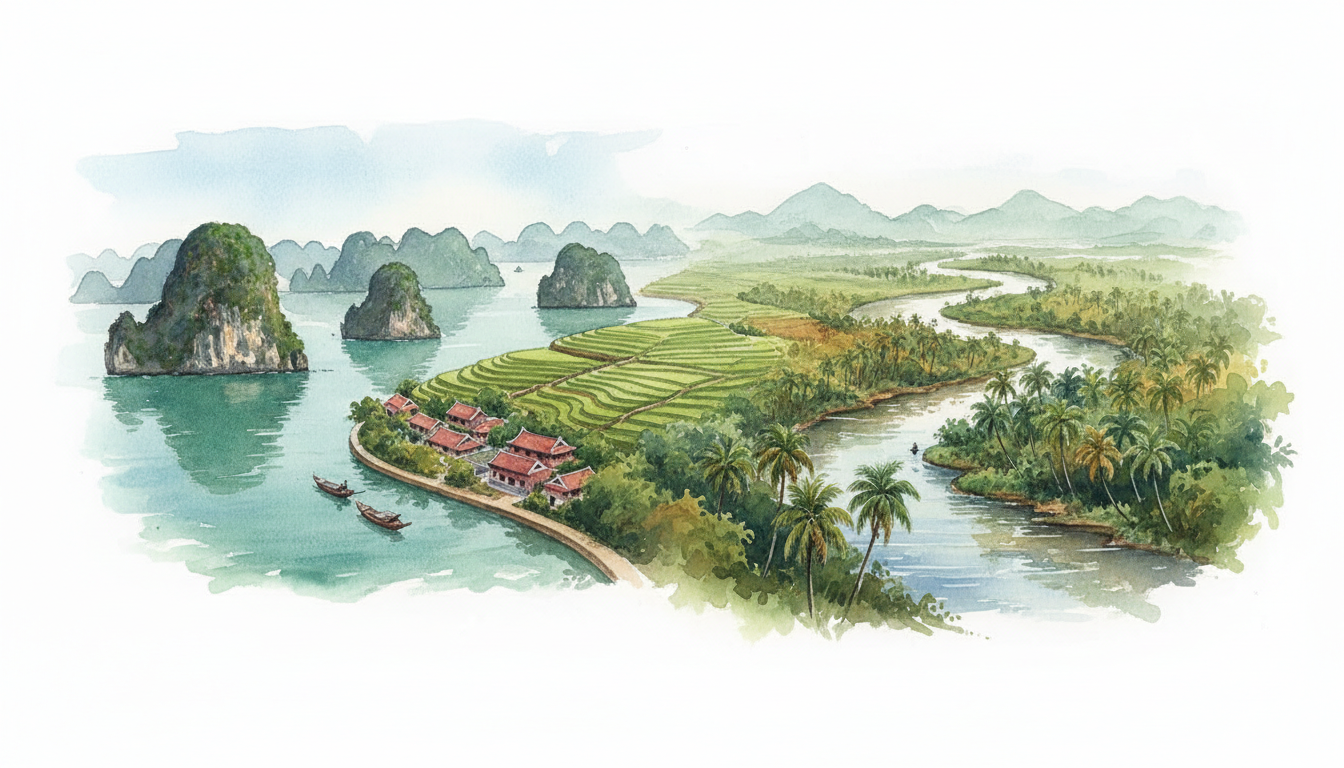
Where is Vietnam, what is Vietnam famous for, and why is it important in Asia? Vietnam is a country in Southeast Asia, bordered by China, Laos and Cambodia, with a long coast beside the South China Sea (called the East Sea in Vietnamese). Its capital is Hanoi, and its largest urban economy is centred on Ho Chi Minh City. Vietnam is known for its rice-growing deltas, limestone landscapes at Ha Long Bay, historic streets in Hoi An, mountains and terraced fields, Vietnamese food such as phở and bánh mì, the history of wars and reunification, and an enormous manufacturing and export economy.
Everything about Vietnam, in one useful guide: Vietnam is not only a holiday destination or an electronics factory. It is a society of more than 100 million people with diverse communities, distinct regional histories, coastal cities, farming regions and economic relationships that stretch across the world. The north’s Red River Delta and south’s Mekong Delta help explain food production, settlement and flood risks. The country’s economic reforms from 1986 onward helped turn a largely closed, centrally planned economy toward greater market activity and global trade. A major administrative change in 2025 reduced provincial-level units from 63 to 34, and a new free-trade agreement was signed with EFTA on 18 October 2026. This article answers the big reader questions first and connects readers to the more detailed eduKateSG guides on how Vietnam’s government, factories, schools, trade and regional economies work.
Vietnam at a glance: the essential facts
- Official name: Socialist Republic of Vietnam (Cộng hòa xã hội chủ nghĩa Việt Nam).
- Location: mainland Southeast Asia, on the eastern side of the Indochinese Peninsula.
- Land neighbours: China, Laos and Cambodia.
- Capital: Hanoi (Hà Nội).
- Major commercial centre: Ho Chi Minh City (Thành phố Hồ Chí Minh).
- Area: approximately 331,000 square kilometres, with small variations among national and international area statistics.
- Population: Vietnam’s National Statistics Office estimated an average of 102.3 million people in 2025. This is a dated average, not an exact live 2026 population count.
- Official language: Vietnamese, alongside languages used by many ethnic and regional communities.
- Currency: Vietnamese đồng (VND).
- Time zone: Indochina Time, UTC+07:00.
- Government: a socialist republic governed through the political leadership of the Communist Party of Vietnam, state institutions and elected bodies operating under the constitution.
- Leaders in October 2026: Tô Lâm serves as Communist Party General Secretary and State President; Lê Minh Hưng became Prime Minister on 7 April 2026.
- Administrative divisions: 34 provincial-level units—28 provinces and six centrally governed cities—following the June 2025 reorganisation.
- Traditional foundations: rice cultivation, river deltas, local crafts, trade, fishing and regional cultural systems.
- Important industries: electronics, machinery, textiles, footwear, food processing, services, manufacturing, logistics and agriculture.
- 2025 economic growth: an estimated 8.02% real GDP expansion, reported by the National Statistics Office in January 2026.
- 2026 growth forecast: 7.4% in the World Bank’s October 2026 East Asia and Pacific Economic Update—an estimate of the future year, not a final result.
- UNESCO World Heritage: nine inscribed properties as recorded in UNESCO’s 2026 country listing.
- Major current policy milestone: a Vietnam–EFTA Free Trade Agreement was signed on 18 October 2026; signing and entering into force are separate legal steps.
These facts have different time limits. Rivers and historic sites are enduring. Population, political appointments, administrative rules and economic forecasts require dated sources. See Vietnam’s national statistics release, the government account of provincial restructuring, UNESCO’s heritage register and the October 2026 World Bank economic update.
1. Where exactly is Vietnam on the map?
Vietnam stretches along the eastern side of mainland Southeast Asia, with a long north-to-south shape. China lies to the north, Laos along much of the western inland border and Cambodia to the southwest. Vietnam’s coastline faces the South China Sea and connects the country to maritime routes serving ports, islands and regional trade. The country’s shape gives it great geographic variety: subtropical or temperate-influenced northern highlands, central coastal regions and a tropical southern delta.
A country’s map looks simple when the boundaries are drawn. But for a household, usable geography is determined by the actual road, river bridge, ferry route, railway, port and bus that connects a location to school or work. Long coastlines can create trading opportunities while also exposing communities to storms, coastal flooding and the costs of maintaining coastal infrastructure.
Is Vietnam in China?
No. Vietnam is a sovereign state with its own national institutions, language and history. It borders China and has extensive historical and economic relationships with it. Centuries of political and cultural interactions have influenced Vietnamese institutions, language, architecture and literature, but those connections do not make modern Vietnam part of China.
Is Vietnam part of Southeast Asia?
Yes. Vietnam is a member of ASEAN, the Association of Southeast Asian Nations. Mainland Southeast Asia includes neighbouring countries such as Laos and Cambodia, while maritime Southeast Asian states form another part of the region. Vietnam’s connections reach into both mainland transport corridors and sea-based commerce.
Why is Vietnam shaped like an S?
The long outline narrows in parts of central Vietnam between mountains and the sea, then widens toward the north and south. This is sometimes described as an S shape for map-reading convenience. However, a metaphor is not an explanation: modern borders reflect long histories of settlement, governance, conflicts, negotiation and changes in territorial authority.
Does Vietnam have islands?
Yes. Its offshore islands and archipelagos include places with significant ecology, livelihoods and maritime transport relationships. Some maritime claims in the South China Sea are disputed between states. A map should distinguish land administered by Vietnam, the territorial sea and other maritime claims, and the legal status of contested features. Do not colour every disputed water area as uncontested territory.
What is Vietnam’s highest mountain?
Fansipan (Phan Xi Păng), in the northern Hoàng Liên Sơn range, is commonly described as Vietnam’s highest summit, around 3,143 metres. Its highland environment helps illustrate the country’s range of elevations and climates. A mountain’s height does not establish that a trail, cable car or viewpoint is safe and operating on a particular day.
2. Why are the Red River and Mekong Delta so important?
Vietnam’s two great delta regions are critical to understanding its settlement, farming, trade and environmental concerns. In the north, the Red River system supports a densely populated area that includes Hanoi and surrounding towns and farmland. In the south, the Mekong Delta is a vast network of channels, fields, settlements and ecological systems. The two regions differ in climate, river characteristics and development but both demonstrate how people depend on the relationship between water, land and infrastructure.
A delta forms where river water and sediments interact with low-lying land and the receiving sea. Deltas can be fertile and well-connected by waterways, yet they may also be vulnerable to flooding, changing sediment, erosion, salinity intrusion and sea-level rise. Farming methods, drainage, flood protection and urban development influence their long-term future.
What makes the Mekong Delta special?
The Mekong River begins far beyond Vietnam and flows through a complex international basin before reaching the sea. Its Vietnamese delta supports rice cultivation, fruit farming, aquaculture, trade, transport and towns. Conditions depend on upstream water use, rainfall, sediment, canals, groundwater and local infrastructure. The expression ‘rice bowl’ is useful but incomplete because the delta also contains cities, fishing communities, factories and people with many different livelihoods.
Why is saltwater intrusion a concern?
When salty seawater moves into channels or groundwater used for farming and drinking water, it can reduce the suitability of supplies for certain crops and households. Dry-season river flow, sea conditions, canals and groundwater extraction all affect the outcome. A farmer may need different crop timing or water storage; a public utility may need different treatment or supply sources. Salinity is not a reason to declare every part of the delta unusable: it calls for location-specific measurements.
What is the Red River Delta?
It is a lowland and river network in northern Vietnam, centred on the Red River’s course toward the Gulf of Tonkin. It has long supported agriculture, settlement, craft industries and modern urban and industrial activity. Hanoi belongs to this wider geographic setting, but a capital-city boundary is not the same as the natural basin of a river.
Worked example: following rice from a field to a family
Imagine a farmer grows rice in a delta. The crop needs water, seed, labour and agricultural knowledge. After harvest, rice must be dried, milled, stored, transported and sold. Good irrigation cannot fix a broken road, and a good road cannot guarantee an adequate selling price. The household purchasing the rice also needs enough income. The farm and family are hypothetical; the supply-chain dependencies are real.
3. Why does Vietnam have different climates and natural landscapes?
Vietnam extends across many degrees of latitude, with mountains, highlands, coastal plains and river deltas. The north experiences distinct seasonal changes, including cooler periods. Central Vietnam faces its own rainfall and typhoon patterns. The south is broadly tropical, with wet and dry seasons. Elevation further changes local conditions. A traveller who knows the weather in Hanoi cannot assume the same weather in Da Nang or Ho Chi Minh City.
Monsoons, tropical storms, floods, drought and extreme heat shape local risks. These are not equally severe everywhere or every year. A coastal fishing community may need storm shelters and marine forecasts, while a farmer in the delta may be focused on salinity and drought. A hillside community may face erosion or landslides.
What are Ha Long Bay and Cat Ba known for?
Ha Long Bay and Cat Ba Archipelago include striking limestone islands and marine ecosystems. UNESCO has a single expanded World Heritage property titled Ha Long Bay – Cat Ba Archipelago; that label is not two separate World Heritage entries. Tourism, shipping, fishing, habitat protection and water quality intersect there. A striking photograph of limestone formations should lead readers to ask how the ecosystem is protected amid human use.
Why are northern rice terraces important?
Terraces make sloped land more suitable for growing crops by creating usable steps and water-management systems. They represent generations of labour and practical knowledge. Their appearance changes by planting and harvest season. Maintaining terraces requires drainage, retaining walls, labour and attention to slope stability. A green aerial view is not a permanent description of every month.
What is Phong Nha–Ke Bang?
It is an area associated with important karst landscapes, caves and biodiversity in central Vietnam. UNESCO’s property has been extended to a transboundary nomination including Hin Nam No National Park in Laos. The new official title is Phong Nha–Ke Bang National Park and Hin Nam No National Park. This illustrates why country heritage counts must identify whether one UNESCO inscription is shared across two states.
How does tourism interact with the environment?
Tourism creates demand for accommodation, transport, food, local guides and public services. It may help finance jobs and conservation while also creating pressure on waste management, water, beaches, caves and habitats. The correct question is not simply how many tourists visited but whether the destination’s natural and cultural values can be sustained alongside resident livelihoods.
4. What happened in Vietnam’s history?
The history of today’s Vietnam contains many interacting regional traditions and changing polities. Ancient and early historic societies, contact with Chinese empires, independent Vietnamese dynasties, Cham and Khmer histories, maritime exchange, European colonialism, twentieth-century wars, reunification and market-oriented economic reform all matter. Modern Vietnam is not identical to any one ancient kingdom, and the story is not explained by a single twentieth-century war.
- Ancient and early historic cultures: archaeological traditions including Đông Sơn in northern Vietnam, and multiple societies elsewhere, reveal agricultural, craft and trading networks.
- Periods of Chinese imperial rule and local resistance: political and cultural influence interacted with Vietnamese language, institutions and traditions over centuries.
- Independent dynasties: Vietnamese states developed their own courts, military institutions, literature, religions, irrigation and trade.
- Champa and southern histories: distinct Cham and Khmer histories shaped areas now within Vietnam, rather than all regions having one identical past.
- Nineteenth century: French colonial expansion led to changing political arrangements within French Indochina.
- 1945: Ho Chi Minh declared independence for the Democratic Republic of Vietnam, followed by renewed conflict over French colonial rule.
- 1954: the First Indochina War ended and the Geneva settlement led to a provisional military division, not a permanently agreed national border.
- 1955–1975: war between North and South Vietnam involved major international intervention, severe civilian suffering and intense political conflict.
- 30 April 1975: the fall of Saigon marked the end of the war and the communist victory.
- 1976: formal reunification under the Socialist Republic of Vietnam.
- 1986: the Đổi Mới reforms began a major period of economic transition and increasing openness to markets and international trade.
- 1995: Vietnam joined ASEAN.
- 2007: Vietnam joined the World Trade Organization.
- 2025: provincial-level administrative reorganisation reduced 63 units to 34.
- 2026: continuing changes in political leadership, government administration, trade agreements, infrastructure and the economy.
A responsible history distinguishes the formal date of an event from the consequences felt by real people. The effects of war, displacement, lost family connections and economic hardship lasted far beyond the signing of agreements. Different communities experienced those events differently. Historical writing should not erase civilians, local cultures or competing perspectives to create a neat timeline.
Who was Ho Chi Minh?
Ho Chi Minh was a major Vietnamese revolutionary and political leader closely associated with the struggle for independence and the Democratic Republic of Vietnam. His place in official national memory is prominent, but his history belongs within a wider context of anticolonial movements, socialist politics, state-building, war and international relations. An individual leader cannot by himself explain every event or every Vietnamese citizen’s experience.
Why was Vietnam divided?
The 1954 Geneva arrangements followed the end of war with France and established a provisional military demarcation. The country then experienced competing political systems and an escalating conflict, with significant involvement by foreign powers. The line should not be presented as a timeless historical frontier or as proof that every family chose the political system governing its region.
What happened in the Vietnam War?
The conflict involved North and South Vietnam, Vietnamese political and armed movements, major American intervention and other international participants. It caused extensive loss of life, displacement, environmental harm and long-lasting social consequences. Public accounts often focus on military operations, but an adequate understanding must also address civilian life, refugees, the countryside, urban communities and the consequences for neighbouring Laos and Cambodia. The term used for the conflict and its chronology can differ across countries and historical traditions.
Why is 1975 different from 1976?
The war ended in April 1975 with the collapse of the South Vietnamese government. Formal state reunification as the Socialist Republic of Vietnam followed in 1976. Those are distinct milestones. A good timeline does not force a military event and a constitutional event into the same date.
What was Đổi Mới?
Đổi Mới refers to reforms beginning in 1986 that moved economic practice toward market mechanisms, greater enterprise activity and international integration while retaining the country’s one-party political framework. Reform was not a switch that instantly created modern Vietnam. Trade institutions, infrastructure, foreign investment, education, agricultural productivity, labour and government policy changed over subsequent decades.
Why does modern history still matter to families?
History influences urban development, land arrangements, language, education, international relationships and personal memory. Families may have experienced war, migration or economic reform in different ways. The country has also developed new professional and educational opportunities. A complete portrait respects both historical suffering and ordinary achievements without treating them as mutually exclusive.
5. Who lives in Vietnam, and what languages do people speak?
Vietnam’s National Statistics Office estimated an average population of 102.3 million in 2025. Its reported labour force aged 15 and above was around 53.5 million for that year. A country of this size contains vastly different experiences: urban professionals, coastal fishing families, northern highland communities, farmers in the Mekong Delta, factory workers, entrepreneurs and people living overseas. A statistic describing the whole population cannot describe the income, language or opportunity of each household.
Vietnamese (Tiếng Việt) is the national official language. The country recognises numerous ethnic communities, commonly grouped in official statistics as 54 ethnic groups. The Kinh or Viet form the majority, alongside many other peoples with distinctive histories, languages, crafts and local traditions. Population shares require a named census date, and formal ethnic classifications cannot tell us every individual’s personal identity.
Is Vietnamese the same as Chinese?
No. Vietnamese is a distinct language in the Austroasiatic family, with many historical borrowings from Chinese, and is written today primarily using a Latin-based alphabet with diacritics. Chinese-language historical influence is significant in Vietnam’s literary and political history, but linguistic influence does not make the languages interchangeable. A person can study classical vocabulary or regional history without assuming that spoken Vietnamese and Mandarin are mutually intelligible.
Why does Vietnamese have tone marks?
Vietnamese is tonal, so pitch contours can help distinguish the meaning of otherwise similar-sounding syllables. The modern writing system marks tones and some vowel distinctions using diacritics. Correct accents are part of spelling, not decoration. For a learner, pronunciation, vocabulary and literacy all need attention; removing marks can change the word or make it ambiguous.
What languages are spoken in highland regions?
Different ethnic and language communities live in the Central Highlands, northern mountains and elsewhere, using languages from several families. Hmong, Tay, Khmer, Cham and many others appear in regional contexts. People may speak Vietnamese for school and administration while using a community language at home. Accurate education or healthcare communication requires identifying which language a particular family understands, not simply choosing a national default.
What religions are practiced in Vietnam?
Vietnam has complex traditions involving Buddhism, ancestor veneration, folk religious practices, Christianity, Cao Dai, Hoa Hao and other beliefs or nonreligious identities. Religious and cultural traditions can overlap in everyday practice. Do not assume that a person’s participation in a festival proves a single formal religious affiliation. Religious policy and freedom of practice are also distinct from the history of the beliefs themselves.
What is the Vietnamese diaspora?
People of Vietnamese heritage live in many countries, reflecting trade, education, employment, family movement, war and resettlement across different periods. Diaspora communities may retain languages and family connections while developing new cultural experiences. The overseas population is not part of the same definition as a resident-population estimate inside Vietnam, and individuals abroad do not necessarily share one view of history or politics.
6. How does Vietnam’s government work in 2026?
Vietnam is a socialist republic in which the Communist Party of Vietnam is the leading political institution. Government, the National Assembly, courts, public agencies and local bodies have formal responsibilities under the constitution and laws. The Party’s leadership and the state’s administrative institutions interact, but they are not interchangeable offices. A public announcement may come from a Party body, ministry, provincial authority or another agency; identifying which issued it helps explain its legal and practical meaning.
In April 2026, the National Assembly elected Lê Minh Hưng as Prime Minister. Tô Lâm is both Communist Party General Secretary and State President as of the October 2026 reference point, confirmed by the Vietnamese Ministry of Industry and Trade’s 18 October trade-signing report. These are dated officeholder facts. Names and responsibilities should be revisited whenever appointments change.
Why are the President, Party General Secretary and Prime Minister different positions?
The Party General Secretary heads the Communist Party, the President holds a formal state leadership role and the Prime Minister leads government administration. Their powers arise from distinct party and legal frameworks. The same person may hold more than one position, as in Tô Lâm’s dual role in 2026, but that should not erase the institutional distinction. A school regulation, road plan or business licence still goes through the responsible agencies and laws.
Does Vietnam have multiparty national elections?
Vietnam’s governing structure is a one-party system under Communist Party leadership. The National Assembly and other bodies have electoral and representative roles within that structure; it is not the same arrangement as a competitive multiparty parliamentary system. Analysts and international rights organisations raise concerns about restrictions on political expression, independent organising and dissent, while official institutions describe their own frameworks and goals. An educational country guide should identify both the formal structure and independently documented realities without treating slogans as proof of performance.
Why did Vietnam change from 63 provinces and cities to 34?
In June 2025, the National Assembly approved a major territorial reorganisation, reducing the number of provincial-level units from 63 to 34: 28 provinces and six centrally governed cities. A two-tier local-government system began operating on 1 July 2025, with provincial-level and commune-level administrations replacing the former three-tier arrangement that included district-level government. The government’s 1 July 2025 report explains the transition.
The stated objectives included reducing duplication, improving administrative efficiency and changing how local services are delivered. But a merger does not automatically shorten every journey or make every application faster. Records, local office capacity, digital systems, staffing and citizen access determine actual performance. Older maps, address forms and statistical tables can also retain obsolete divisions, which is why the date matters.
Which six cities have centrally governed status?
Hanoi, Ho Chi Minh City, Hai Phong, Da Nang, Can Tho and Hue are the six centrally governed cities under the 2025 framework. These are province-level administrative units, not simply six biggest settlements ranked by population. Other cities exist within provinces and have different administrative positions. The term “city” can mean an urban settlement, a named local government and a particular legal level depending on context.
What happens to districts after the reform?
District-level local administrations ceased operating in the new two-tier model from July 2025. Former district names can still appear in historical writing, older maps, company addresses and everyday speech, but should not automatically be used as current administrative jurisdictions. For an actual application, use the currently competent commune-level or provincial-level office and its published procedure.
Worked example: a family updating a business address
Imagine a small company registered under an address format that included a former district. Following administrative reorganisation, it must understand the updated commune or ward and any registry process required. The goal is accurate documentation and smooth service, not simply inserting a new province name into an old form. This is a fictional example, illustrating why legal and administrative changes need practical guidance.
7. Why has Vietnam become a manufacturing and export centre?
Factories depend on a combination of skilled and available workers, investment, infrastructure, suppliers, reliable utilities, trade access and competitive production processes. Vietnam’s economic integration created opportunities in electronics, machinery, garments, footwear and other manufacturing, alongside agriculture and services. Industrial zones, ports, airports and roads can make business operations more efficient, while education, management and logistics determine the quality of output.
The government’s economic statistics estimated Vietnam’s GDP growth at 8.02% for 2025. Its National Statistics Office reported manufacturing growth of nearly 10% and substantial contributions from industry and services. The World Bank’s October 2026 regional update projected 7.4% growth for Vietnam in 2026. These figures must be kept separate: one is a measured estimate for a completed year; the other is a forecast for an ongoing year. Read the national statistics report and the World Bank’s October projection.
What does “made in Vietnam” actually mean?
It means a product satisfies the applicable country-of-origin rules for its relevant transaction or label; it does not necessarily mean every part was invented, designed or manufactured inside Vietnam. A factory may import electronic components, assemble a finished product, test it, package it and export to another country. Global value chains divide production across locations. Origin rules can be complex, and a seller must not treat simple repackaging as sufficient for an origin claim unless the law says so.
What is the role of Samsung and other foreign manufacturers?
Large foreign-invested manufacturers and their supplier networks play visible roles in Vietnam’s electronics and export economy. Their activities can create direct and indirect employment, demand for infrastructure and opportunities for local suppliers. Yet a large factory’s export value should not be mistaken for the income retained in Vietnam: imported components, wages, taxes, local purchasing and profits sent abroad all affect the distribution of value.
Can a growing export sector solve every economic problem?
No. Growth can increase overall income and opportunities while leaving local differences, pollution, housing needs or skill gaps. Export dependence can also create exposure to foreign demand, tariffs, trade disputes and shifts in technology. A strong economic strategy considers domestic firms, wages, skills, finance, infrastructure and environmental costs, not simply the total shipment value.
What does a full factory-to-customer supply chain look like?
Imagine a factory assembling household appliances. It orders parts from suppliers, receives containers at a port, moves them inland, produces goods with electricity and skilled workers, performs quality checks, and sends finished products to overseas customers. Customs, transport, payment, safety, inventory and the buyer’s requirements all influence success. This is an illustrative factory, not a claim about a particular 2026 business.
How does Vietnam earn money beyond manufacturing?
Services, retail, banking, tourism, construction, software, logistics, agriculture, fishing and other activities contribute to national income and employment. A family’s livelihood may depend on a café, farm, delivery business, public service or professional work rather than an industrial park. The economy’s health cannot be assessed from one sector alone.
Why is the US–Vietnam trade relationship important in 2026?
The United States is an important destination for Vietnamese exports, and the rules governing market access affect factories and supply chains. As of 14 October 2026, Vietnamese officials described trade negotiations as nearing completion, while US officials were more cautious, according to Reuters’ dated report. Near completion does not mean a final agreement has already taken effect. For a changing trade relationship, distinguish negotiation, signature, ratification, tariff implementation and actual shipment decisions.
8. What changed with Vietnam’s EFTA trade agreement in October 2026?
Vietnam and the European Free Trade Association—Switzerland, Norway, Iceland and Liechtenstein—signed a free-trade agreement on 18 October 2026 in Hanoi. The agreement covers goods, services, origin rules, investment, intellectual property, sustainable trade, government procurement and other matters. Both the EFTA secretariat and Vietnam’s Ministry of Industry and Trade confirmed the signing.
A signed text is a major diplomatic and commercial milestone, but it does not automatically mean every tariff change is already being applied at a port. Legal consent, entry-into-force conditions, schedules and product-specific rules matter. A company needs to read the actual applicable tariff and origin provisions rather than assume every export is duty-free immediately.
Is EFTA the same as the European Union?
No. EFTA is a four-country association distinct from the European Union. Vietnam also has a separate EU–Vietnam Free Trade Agreement. A country can trade through different agreements with overlapping markets without those agreements being one institution. For business planning, the relevant question is which treaty applies to the specific shipment and country of destination.
What are rules of origin?
They establish how a good qualifies as originating in a partner economy for treaty benefits. They can depend on the share of local value, a change in tariff classification or defined production processes. Imagine imported materials are assembled in Vietnam: the result may or may not meet a particular treaty’s requirements. A bill of materials and a certificate cannot be guessed from a marketing slogan.
9. Why is Vietnam a major rice, coffee and seafood producer?
Vietnam’s deltas, highlands and coastal environment support a broad range of farming and fishing activities. Rice is particularly associated with the Red River and Mekong deltas. Coffee is important in parts of the Central Highlands, while pepper, fruit, cashew products, aquaculture and seafood form other parts of its agricultural economy. Crop patterns vary by rainfall, soil, temperature, irrigation and market demand.
Producing more is only one part of a successful agricultural economy. Farmers also need fair markets, reliable transport, access to finance, processing equipment, food safety systems and information about prices. Export buyers may require traceability and quality controls. Weather and environmental change can affect both yield and costs.
Why is the Mekong Delta sometimes called Vietnam’s rice bowl?
It produces a large share of national rice output and contains important agriculture and aquaculture systems. But the phrase should not reduce the region to rice fields. People also live in cities and towns, work in services, manage ports and pursue many other occupations. The delta’s survival depends on the relationship between its natural water system, local communities and investment choices.
How does coffee reach international customers?
Coffee cultivation involves planting, harvesting, processing, grading, storage, transport, trading and roasting. A cup sold abroad can carry value created at several stages. Farmers may not receive the retail value of the final drink. Good supply-chain analysis asks about farm income, processors, logistics, price volatility, labour conditions and environmental practices, rather than treating Vietnam’s export ranking as the whole story.
What is the role of fisheries and aquaculture?
Coastal and delta communities harvest or cultivate fish and other seafood for domestic and international markets. Production needs clean water, disease management, responsible feed, cold chains, regulations and viable prices. Fisheries also raise ecological questions about stocks, habitats and sustainable harvesting. Different species and farming systems require different measures.
Worked example: a fruit shipment from the Mekong Delta
Imagine a grower sells perishable fruit. It must be harvested at the right maturity, stored, transported, inspected and delivered before quality declines. A road improvement can help, but refrigerated storage and predictable border procedures also matter. A trade agreement might reduce a tariff while strict plant-health requirements remain. This illustrative shipment shows why trade is a system rather than a single official signing.
10. How do Vietnam’s roads, railways, ports and cities connect?
Vietnam’s long north–south geography creates substantial demand for national connectivity. Roads, expressways, the historic North–South railway, domestic aviation, seaports and urban transit all contribute. A named highway or railway exists within a broader chain of maintenance, funding, stations, interchanges, safety and last-mile access. A road that saves an hour between cities is less useful if the final market still cannot be reached.
Hanoi and Ho Chi Minh City are especially important urban centres, with major differences in history, planning and geography. Hai Phong, Da Nang and Can Tho have distinctive regional roles; Hue has cultural and administrative significance. Other cities and industrial locations connect people to jobs, markets, schools and ports. A list of city names does not explain their functions without looking at the networks connecting them.
Is Ho Chi Minh City the capital of Vietnam?
No. Hanoi is the capital. Ho Chi Minh City is a major financial, commercial and industrial hub and was historically known as Saigon. The city’s name change and the continuation of “Saigon” in some everyday and historical uses belong to the country’s modern history. A reader should not confuse the former South Vietnamese capital with the current national capital.
Why are Hai Phong and Da Nang important?
Hai Phong is associated with northern maritime trade and industrial transport. Da Nang is a central coastal city important to regional connectivity, services and tourism. Their roles depend on ports, road links, logistics and nearby businesses, not merely their location beside the sea. A port’s throughput should be reported from current operator or statistical sources rather than assumed from the number of cranes in a photograph.
What is the role of the North–South railway?
It provides a long-distance rail connection between northern and southern parts of Vietnam. Conventional passenger and freight services can be useful for different journeys, while proposals for major rail investment involve distinct construction and financing stages. Do not confuse a future high-speed rail proposal with the operating timetable of today’s rail network.
How do city buses and urban rail affect ordinary life?
Rapid urban growth creates demand for reliable access to work, school and services. Metro and urban bus networks can reduce dependence on private vehicles for some journeys, but effectiveness depends on stations, frequency, fares, accessible walkways and connections. A new train line does not automatically remove congestion if people cannot use it for their particular route.
Why are motorbikes so visible in Vietnamese cities?
Motorbikes have long played important roles in personal mobility and small-scale delivery, reflecting affordability, convenience and the structure of urban streets. Their widespread use also raises traffic-safety, emissions and congestion questions. Policy must distinguish the needs of commuters, pedestrians, delivery workers and public transport rather than treat all travellers as interchangeable.
11. How does Vietnam’s education system work in 2026?
The standard school ladder is five years of primary education, four years of lower secondary and three years of upper secondary, followed by different vocational, higher education and continuing education routes. Students typically enter Grade 1 around age six. That 5–4–3 structure is a useful starting point; admission rules, curriculum, examinations and qualifications depend on current policies and individual school pathways.
The government issued an updated national education framework in July 2026 that took effect on 7 September 2026. The framework preserves the broad five-, four- and three-year stages while defining duration ranges for vocational and higher education. Transitional provisions mean programmes already in place can continue under applicable earlier arrangements for enrolments before 2027. See the government’s 2026 framework explanation and the companion Understanding the Education System of Vietnam.
What is the difference between primary, lower secondary and upper secondary?
Primary school builds literacy, numeracy and broad foundations. Lower secondary develops a wider subject base and more complex reasoning. Upper secondary prepares students for further education and other choices, subject to the exact programme and assessment rules. Formal age or grade labels are not enough to determine whether a transferred student has learned a particular topic; examine the curriculum and record.
How important are Grade 10 admissions and graduation examinations?
Transitions can influence access to particular schools or programmes, and graduation requirements can affect university and vocational opportunities. But specific examination formats, subject choices and dates are subject to policy changes. A responsible guide identifies the examination year and awarding authority instead of presenting a past paper as proof of every future requirement.
What makes Vietnamese education relevant to the economy?
Factories, engineering firms, healthcare providers, agricultural businesses, digital services and public administration need people with technical and general skills. Education can widen opportunity and support productivity, but strong test performance alone is not a guarantee of equal access or well-paid employment. Outcomes also depend on learning quality, finances, location and matching skills to available work.
What should a family do if a student is transferring systems?
Obtain the student’s detailed academic record, subjects, years, language of instruction, assessments and recognised certificates. Then verify the receiving institution’s requirements. A subject called mathematics in two countries may have a different sequence and scope. Targeted support should repair actual conceptual or language gaps rather than automatically repeat an entire year.
What does useful tutoring look like?
A credible tutor knows which programme the learner follows, checks the current topic, diagnoses where understanding breaks and measures whether the student can explain and apply the concept independently. The separate Vietnam mathematics tutor decision guide addresses this directly; it does not replace the country-wide overview. Similar resources exist for science and English learning.
12. How does Vietnam produce and deliver electricity?
Vietnam’s energy system uses a combination of coal-fired generation, hydropower, gas and renewable technologies such as solar and wind. Generating electricity is only the first part of the service. It must be transmitted over long distances, distributed through local networks, managed safely and supplied at a cost households and businesses can afford. A factory’s productivity and a school’s ability to operate can both be affected by interruptions or expensive backup power.
Hydropower depends on river flows and reservoir management; thermal stations depend on equipment, fuel supply and maintenance; renewable generation depends on weather and grid integration. Each technology offers different benefits and costs. Electricity demand may rise with urbanisation, industrial investment, electric transport and digital services. A statement about how many megawatts were installed does not establish that those megawatts are operating at every hour.
Why do electricity and manufacturing depend on each other?
A manufacturer needs predictable power to run machines, protect inventories, maintain quality and meet delivery dates. If outages occur, a business may use generators or change production schedules at additional cost. Meanwhile, new factories increase demand on the grid. Energy planning therefore needs to anticipate future industrial needs while accounting for funding, environmental impacts and reliable operations.
Does solar power automatically replace coal?
No. Solar generation depends on daylight, panel output, weather and suitable power networks. It can be a valuable resource, but high shares of variable generation require careful planning for storage, grid stability, complementary generation and demand management. Coal generation also has significant emissions and public-health consequences. Sound planning compares costs and benefits across the full power system rather than declaring a technology sufficient on its own.
What does a reliable household connection mean?
A connection should be assessed through safety, available power, outages, voltage quality and affordability. A family with a working meter but unstable service may still struggle with cooking, work or a child’s evening study. The meaningful result is dependable service, not merely a statistic about new connections.
Worked example: a power interruption at a small factory
Imagine a workshop making parts for an electronics exporter. A power interruption causes a machine to stop mid-process. The worker must inspect or discard affected components; the next company in the supply chain receives them late; the overseas order risks missing its deadline. This fictional incident illustrates why energy reliability, skills, quality management and global trade are linked.
13. How do healthcare, housing, water and public services connect?
Public services become real when a person can obtain the help promised by policy. Healthcare requires trained professionals, medicine, safe buildings, equipment and referral arrangements. A household needs clean water, drainage, waste collection, electricity, transport and access to education. Modern hospitals and impressive urban infrastructure are only part of that picture; access and reliability vary by location, need and resources.
A national programme may build facilities or expand coverage, but those outputs should not be confused with actual results. Health-insurance eligibility, referral processes, hospital capacity and personal costs depend on current regulations and individual circumstances. The answer for a tourist can differ from the answer for a Vietnamese resident. Avoid assuming that every public service is provided free to everyone.
Why is water quality important near major rivers?
The presence of abundant river water does not guarantee drinkable water. Cities and rural households need collection, treatment, distribution and quality monitoring, while pollution and salinity can create additional challenges. Wastewater systems must prevent contamination. A low-lying delta can experience floods and still face shortages of safe water at certain times.
Why is housing an economic issue?
Housing determines where workers, students and families can live relative to jobs, schools and public transport. Urban land prices, construction cost, rental supply and household earnings all affect affordability. A factory offering jobs may still struggle to recruit and retain workers if nearby housing is unsuitable or transport is unreliable.
What is a livable neighbourhood?
A neighbourhood needs more than apartment towers or shops. It needs walkable connections, safe roads, water, drainage, electricity, schools, healthcare, open space and accessible transport. A plan may look impressive in an architectural image but still require years of coordination to become a functioning community.
Worked example: following a child’s school journey
Imagine a child living on the edge of a growing city. The nearest school may be within a few kilometres, yet the journey could require several busy crossings and two transport connections. Improving the child’s daily access could involve a safer walking route, school transport, better timetables or a new neighbourhood school. This is a hypothetical case, showing why access measures need travel time and safety, not simply a map distance.
14. Which famous places in Vietnam have UNESCO World Heritage status?
Vietnam had nine inscribed World Heritage properties in UNESCO’s register in October 2026. They are six cultural properties, two natural properties and one mixed natural-and-cultural property. A national park, old town or tourist attraction may be important without being inscribed, and a property on UNESCO’s Tentative List is not already a World Heritage Site.
The nine listed properties are:
- Complex of Hué Monuments: a former imperial capital and its built heritage.
- Ha Long Bay – Cat Ba Archipelago: limestone islands, coastal landscapes and natural ecosystems.
- Hoi An Ancient Town: a historic trading port with architectural influences from multiple cultures.
- My Son Sanctuary: the architectural and religious heritage of the Champa civilisation.
- Phong Nha–Ke Bang National Park and Hin Nam No National Park: a transboundary natural property with Laos, featuring important karst systems.
- Central Sector of the Imperial Citadel of Thang Long – Hanoi: archaeological and architectural evidence of Vietnam’s historic political centre.
- Citadel of the Ho Dynasty: a distinctive historic fortification and capital landscape.
- Trang An Landscape Complex: a mixed cultural-and-natural property combining karst scenery and archaeological history.
- Yen Tu–Vinh Nghiem–Con Son, Kiep Bac Complex of Monuments and Landscapes: a serial cultural property inscribed in 2025.
The source is UNESCO World Heritage: Viet Nam. The UNESCO list is authoritative for official inscription names, including expansions and transboundary titles. This article should not count Ha Long Bay and Cat Ba as separate entries, or present the Laos component of Phong Nha as an additional tenth property.
What makes Hoi An special?
Hoi An is associated with its past as a commercial port connecting different trading communities. Its old-town streets and buildings preserve evidence of Vietnamese, Chinese, Japanese and other influences across history. Study it as a city in which international trade left lasting architectural and cultural patterns, not merely a backdrop of lanterns. The companion Hoi An merchant-house architecture vocabulary guide helps readers describe its buildings more accurately.
What is My Son Sanctuary?
My Son is a historic Cham religious and architectural complex in central Vietnam. It is important because the modern country’s history includes distinctive Cham and other regional civilisations, not only the political centres of Hanoi. Buildings, inscriptions, archaeological layers and conservation projects provide evidence of religious practice, technical skill and historical interactions.
Why is Hue important?
Hue was a major imperial political and cultural centre under the Nguyen dynasty. The Complex of Hué Monuments includes structures associated with royal institutions, ceremonies and urban design. The presence of a royal complex does not mean that all historic residents lived in the same conditions; good interpretation examines everyday crafts, trade and social life as well as the architecture of rulers.
What does a World Heritage inscription tell a reader?
It identifies a property whose outstanding universal value has been recognised under the World Heritage Convention. It does not promise that every building is open, every route is safe or every conservation problem is solved. UNESCO’s state-of-conservation reports help readers understand the responsibilities and risks that follow inscription.
15. What is Vietnamese culture famous for?
Vietnamese culture includes poetry, music, folk art, architecture, festivals, traditional crafts, theatre, lacquer painting, water puppetry, food and many local customs. The expression of culture differs by region, community and generation. Some traditions involve ancestor veneration and family ceremonies; others are associated with particular craft villages or minority-language communities. A broad national identity can contain significant diversity.
What is Tết?
Tết Nguyên Đán is the Vietnamese Lunar New Year celebration and a major period for family reunions, hospitality, customs and ceremonies. Its date follows the lunar calendar rather than a fixed date on the Gregorian calendar. Traditions and dishes differ across families and regions, and contemporary celebrations may involve travel, businesses and urban activities alongside inherited customs.
What are water puppets?
Water puppetry is a traditional form of performance in which puppets are operated on a water stage, associated especially with northern Vietnam. Its techniques include craftsmanship, performance, stories and music. A puppet may appear simple to a viewer, but the movement requires skill, materials and sustained cultural transmission. Read Vietnam’s water-puppetry vocabulary guide for a deeper explanation.
Why is lacquer art significant?
Vietnamese lacquer traditions involve layers of material, careful preparation, polishing, composition and often considerable technical work. Its artists have used the medium in decorative arts and modern painting. A finished surface hides the labour beneath it—an especially good example of how culture stores knowledge in methods, tools and apprenticeship. The lacquer painting guide explores the terminology.
Is everyone in Vietnam culturally the same?
No. The Vietnamese majority and other communities have diverse experiences and cultural traditions; contemporary life also changes with urbanisation, migration, education and media. A food custom in Hanoi cannot automatically be assigned to everyone in southern Vietnam or a mountain community. Ask whose tradition is being described and whether the claim comes from participants or credible research.
16. What food is Vietnam known for?
Phở, bánh mì, bún chả, gỏi cuốn, cơm tấm, bánh xèo and many regional noodle, rice and seafood dishes are associated with Vietnamese cuisines. The ingredients and preparation methods vary by location and household. Nationally famous foods can be different in different cities; a dish prepared for tourists may not represent every home version.
Vietnam’s food story is also a geographic story. Rice production links deltas to households. Herbs and vegetables connect climate and markets to everyday meals. Noodles, breads, soups and preserved products involve supply chains, labour and regional exchange. A meal may seem simple to a customer, but it depends on land, water, transport, safety and skills.
What is phở?
Phở is a noodle soup associated with Vietnamese cooking, commonly involving rice noodles, broth, herbs and meat or other ingredients. Regional and personal variations are significant. It is inaccurate to prescribe one version as the only authentic national recipe. Phở is also an example of how a dish carries histories of ingredients, urban street food and changing tastes.
What is bánh mì?
Bánh mì refers to bread and is widely associated with filled Vietnamese sandwiches. Its history reflects Vietnamese culinary adaptation and interactions with French colonial-era bread-making traditions. Today’s fillings and bread styles vary. A familiar snack can therefore open a larger question about historical influence, local entrepreneurship and daily commerce.
What do families eat beyond famous street food?
Common meals may include rice, vegetables, fish, meat, tofu, soups and other regional preparations. Agricultural seasons, prices, preferences and circumstances affect what is served. A list of famous restaurant dishes is not a national nutritional survey.
17. Why do climate change and environmental protection matter to Vietnam?
Vietnam faces varied environmental pressures because it has long coastal exposure, river deltas, cities and highlands. Typhoons and floods can damage homes and roads. Heat can affect public health and electricity demand. Sea-level rise and salinity intrusion pose long-term risks in the Mekong Delta, while urban air quality and industrial emissions create their own problems. Mountain landslides, erosion and changing rainfall are different risks needing different responses.
Environmental protection is not simply a choice between factories and forests. Cities, industries and farms require water and energy; healthy ecosystems support livelihoods and safety; and infrastructure must account for long-term hazards. Decisions involve public agencies, businesses and residents. A well-designed plan needs local measurements, practical maintenance and a fair understanding of who receives benefits and who bears costs.
How can a flood affect a school far from the coast?
Heavy rainfall in upland catchments may lead to river flooding downstream or landslides that block transport. Even where a school building is undamaged, pupils and teachers may be unable to travel safely, and supplies may be delayed. A useful education-continuity plan therefore works with road maintenance, warnings, evacuation routes and family communication.
Why is the Mekong Delta particularly important to climate adaptation?
Its low elevation, intricate water networks and agricultural dependence make it vulnerable to salinity, subsidence, erosion and sea-level pressures. A single seawall cannot solve every issue if upstream river flows, groundwater extraction and farming practices remain unchanged. Adaptation may involve crop choices, monitoring, water storage, ecosystem restoration and coordinated basin management.
Worked example: comparing two flood investments
Imagine one project raises a short embankment protecting a road while another improves drainage across a wider neighbourhood. Each can be valuable, but effectiveness depends on rainfall scenarios, downstream impacts, costs, maintenance and who is protected. Counting kilometres of embankment or pipes laid is less meaningful than measuring reduced harm. These are hypothetical projects used to explain evaluation.
18. How does Vietnam connect to the wider world?
Vietnam participates in ASEAN, the World Trade Organization and numerous bilateral and regional trade relationships. Its ports, factories, airlines, universities, diaspora and cultural exchanges make it part of international networks. Trade creates opportunities but also dependence on overseas customers, supply chains and rules. Diplomacy balances relationships with nearby countries and major global powers.
Why is China’s relationship with Vietnam important?
The two countries share a land border and extensive economic connections, alongside complex historical experiences and differences over some maritime claims. China can be a source of manufacturing inputs and commercial exchange for Vietnamese businesses. Cooperation, competition and disputes can coexist. A balanced account treats each current issue on its evidence rather than assume one relationship describes every kind of contact.
Why does the United States matter economically?
US consumer demand and trade policy affect Vietnamese exporters in multiple industries. Negotiations and tariffs can shape investment decisions. Reuters reported on 14 October 2026 that Vietnamese officials believed negotiations were close to completion but US officials were more cautious. That is a dated report of differing positions, not proof of a final agreement’s terms. Read the report.
Is Vietnam a member of the European Union?
No. Vietnam is an independent Asian country with trade agreements and diplomatic relations with European partners. Its EU–Vietnam and EFTA trade relationships are not EU membership, and signing a trade agreement does not change national sovereignty.
19. What should travellers and students check before visiting Vietnam?
Vietnam is a popular destination for cultural learning, food, historic sites and landscapes. Real travel choices still depend on passports, nationality-specific visa requirements, permitted length of stay, insurance, transport safety, weather, health needs and the current situation in the destinations visited. An article published in October 2026 cannot promise that a train, mountain path, cave tour or border crossing will operate next month on the same terms.
Check the appropriate official immigration website and current government travel advice near departure. A UNESCO World Heritage inscription is not a travel-safety guarantee. Likewise, a photograph of a place does not prove the road and facilities are accessible today.
Can I visit Hanoi, Hoi An and Ho Chi Minh City in one short trip?
Those places are geographically far apart relative to local day trips. The best itinerary depends on available travel time, weather, flight and train schedules, budget, accessibility and interests. An itinerary should allow for real travel and rest rather than counting destinations as though they were neighbouring city districts.
Why should travel plans consider regional seasons?
Rainfall and storm risks vary across north, central and south Vietnam. A month favourable for one location may not be ideal for another. Local forecasts and up-to-date guidance are more helpful than a single nationwide slogan about the best month to visit.
20. How does the whole country work together?
Vietnam’s geography, economy and public institutions make more sense when seen as connected rather than isolated subjects. The Red River and Mekong deltas support farming, settlement, commerce and environmental management. Roads and ports connect workers and suppliers to factories. Schools and vocational institutions help build skills. Electricity keeps businesses operating. Housing and transport influence whether workers can live near their jobs. International trade creates markets but also exposes industries to changing overseas demand.
Consider a hypothetical family in a provincial town. One adult works in an electronics supply business; another sells prepared food; their child is moving into secondary school. The factory needs stable power and accurate orders, while the food stall needs fresh ingredients and reliable customers. The child needs accessible lessons, safe transport and clear information about the next education stage. A damaged bridge or unstable power supply could affect all three. A functioning road, dependable electricity and good local services make different parts of the family’s life more manageable.
The family is fictional, but the connections are useful. A country’s success is not just a record GDP growth rate, one skyline, one tourist attraction or one examination result. It is the practical ability of people to reach opportunity, obtain services, learn, do business and remain safe across different circumstances.
What should a policymaker measure?
Measure the result experienced by people. A road project should improve dependable travel. A school investment should improve access and learning. An electricity programme should provide safe, reliable supply. A factory incentive should lead to sustainable jobs and useful local value. A flood barrier should reduce actual harm. Project announcements, ribbon cuttings and budgets are steps toward those outcomes, not substitutes for them.
Can Vietnam’s national system be compared with Singapore?
Yes, as a comparison of how countries connect education, transport, trade, government and infrastructure. Their histories, geography, political systems, populations and constraints differ. Vietnam has a large manufacturing economy spanning a long mainland territory; Singapore is a compact city-state with extensive port, airport and urban infrastructure. Comparisons are most useful when they reveal how each place addresses a particular problem, not when they imply that one country’s choices can simply be transplanted to another. Explore How Singapore Works | Civilisation and Singapore’s roads and expressways for the separate Singapore case study.
Frequently asked questions about Vietnam
Is Vietnam a country in Asia?
Yes. Vietnam is a sovereign state in mainland Southeast Asia. It borders China, Laos and Cambodia and has a long coast beside the South China Sea.
What is the capital of Vietnam?
Hanoi. Ho Chi Minh City is an important commercial centre, but it is not the present national capital.
Is Saigon the same as Ho Chi Minh City?
Saigon is the former name of the city and remains in various everyday, historical and commercial usages. Ho Chi Minh City is the official present name. The name change belongs to the country’s post-1975 history.
What language do people speak in Vietnam?
Vietnamese is the official language. Other regional and ethnic communities also use their own languages, and many individuals are multilingual.
Is Vietnam a communist country?
Vietnam is a socialist republic governed under Communist Party leadership. It has a state and National Assembly with defined institutional roles, while the overall political system differs from competitive multiparty systems.
Is Vietnam part of China?
No. Vietnam has its own sovereignty, language and institutions. It shares a border, historical connections and significant trade relationships with China.
What money is used in Vietnam?
The Vietnamese đồng (VND). Current exchange rates and prices should be checked for the date and transaction; the currency name is not a measure of affordability.
How many people live in Vietnam?
Vietnam’s National Statistics Office estimated an average population of 102.3 million in 2025. The number is a dated average, not an exact live figure for October 2026.
Does Vietnam still have 63 provinces and cities?
No. The 2025 reorganisation reduced the provincial-level count from 63 to 34: 28 provinces and six centrally governed cities. The two-tier local-government model began on 1 July 2025, so older administrative guides need updating.
Why is Vietnam famous for rice?
Its river deltas and farming regions support substantial rice production. Rice cultivation is an important part of history, food culture and trade, but modern Vietnam also has large urban, industrial and services sectors.
Why is Vietnam an important electronics exporter?
Manufacturing investment, labour, industrial facilities, supply chains and global trade access have helped create electronics and other production industries. A finished export can contain imported components, and export value is not identical to local income retained.
Is Vietnam’s economy growing in 2026?
The World Bank forecast 7.4% real GDP growth for 2026 in its October regional update. Vietnam’s own statistics reported 8.02% growth in 2025. One is a current forecast and the other a completed-year estimate; neither establishes every household’s welfare.
Does Vietnam belong to the European Union?
No. It is an Asian country with trade and diplomatic relationships with European partners, including the EU and EFTA.
What happened with EFTA in October 2026?
Vietnam and the four EFTA states signed a free-trade agreement on 18 October 2026. Signing is not automatically the same as legal entry into force. Check official tariff schedules and ratification milestones before applying the treaty to a shipment.
What are Vietnam’s school stages?
The broad system is five years of primary education, four of lower secondary and three of upper secondary. Programmes, qualifications and transitions have detailed requirements; a new national framework became effective in September 2026 with transitional arrangements for existing cohorts.
Is Ha Long Bay the same as Cat Ba?
They are distinct geographic areas covered by one expanded UNESCO World Heritage inscription, Ha Long Bay – Cat Ba Archipelago. They should not be counted as separate properties in Vietnam’s official total.
How many UNESCO World Heritage properties does Vietnam have?
Nine as listed by UNESCO for the October 2026 context, including transboundary and expanded properties. Vietnam’s ninth inscription was the Yen Tu–Vinh Nghiem–Con Son, Kiep Bac serial cultural property in 2025.
What is the Mekong Delta?
A low-lying region of waterways and land near the Mekong River’s outlets to the sea, important to agriculture, aquaculture, ecology and settlements. Its future depends on water flows, land use, salinity, subsidence and climate adaptation.
What is Vietnam’s most famous food?
Phở and bánh mì are internationally recognised, alongside many other dishes. A ranking of the single most famous dish is subjective. Regional cuisine is diverse.
Is Vietnam safe to travel to?
A general article cannot guarantee personal safety. Check updated official travel advice, individual entry requirements, local weather, transport and the activities planned. A picturesque destination or UNESCO inscription does not replace a current risk assessment.
Why was Vietnam divided during the twentieth century?
A provisional division followed the 1954 Geneva arrangements after war with France, and competing political systems and war developed. The conflict ended in 1975, with formal reunification in 1976. The historical process was much more complicated than one border line.
What made Vietnam economically successful after 1986?
Đổi Mới and subsequent reforms expanded market activity and international integration, while manufacturing investment, infrastructure, trade, education and enterprise development contributed. No single policy or factory explains the entire transition.
What is the biggest lesson about Vietnam?
A country’s geography, history, people, institutions and economy are connected. Look at how a river becomes food and electricity, how a factory connects to workers and ports, how a school leads to skills, and how those systems affect an ordinary family. That is more useful than memorising disconnected national facts.
Continue reading: specialist Vietnam guides and the wider 195-country atlas
This page owns the broad country overview. Detailed questions belong to the existing articles that study each system and subject. Follow the link that answers your particular question:
- How Vietnam Works | Government, Cities, Factories and Trade Explained — national institutions and the mechanisms linking them.
- How Vietnam Works | Why Does Vietnam Have 34 Provinces? — the 2025 mergers and current administration.
- How Vietnam Works | Why Is Vietnam a Manufacturing and Export Hub? — factories, global supply chains and economic value.
- How Vietnam Got So Rich | From Đổi Mới to Factories, Trade and Abundance — historical economic transition and trade.
- Understanding the Education System of Vietnam — primary, secondary, vocational and higher education pathways.
- How to Decide Which Mathematics Tutor to Go To | Vietnam — diagnostic and curriculum-aware study support.
- Top 10 Places to Visit When Touring Vietnam — historical and natural geography with changing travel conditions checked separately.
- Vietnam Rice Farming Vocabulary — the words behind delta agriculture, irrigation and production.
- Vietnam Water Puppetry Vocabulary — traditional performance, craft and technique.
- Vietnam Lacquer Painting Vocabulary — artistic materials and methods.
- Everything About Countries — the broad 195-country overview collection.
- How Countries Work — the neighbouring systems-focused country guides.
- How Singapore Works | Civilisation — an independent case study, not a generic model for Vietnam.
Sources and fact checking: permanent geography versus dated 2026 conditions
This guide was reviewed for 21 October 2026. Figures and policy statements are labelled by reference period because a current decision, estimate or trade discussion can change. The links below identify primary sources and detailed research routes.
- National Statistics Office of Vietnam — January 2026 press release. Population, employment, economic growth and sector performance for 2025.
- National Statistics Office — 2025 socioeconomic report. Economic breakdown and methodology.
- World Bank — East Asia and Pacific Economic Update, 6 October 2026. Vietnam’s updated 2026 growth forecast.
- Government of Vietnam — two-tier local administration, 1 July 2025. 34 provinces/cities, commune-level responsibilities and abolition of district administration.
- Government of Vietnam — National Assembly provincial restructuring, 12 June 2025. 28 provinces and six centrally governed cities.
- Ministry of Industry and Trade — Le Minh Hung elected Prime Minister, April 2026. Dated officeholder evidence.
- European Free Trade Association — Vietnam FTA signing, 18 October 2026. Treaty parties and scope.
- Vietnam Ministry of Industry and Trade — VEFTA signing, 18 October 2026. National confirmation of the signing and attending leaders.
- Government of Vietnam — 2026 national education framework. Standard study duration and transitional provisions.
- UNESCO World Heritage Centre — Vietnam. Nine inscribed properties, official names and site histories.
- UNESCO — Yen Tu inscription and ninth World Heritage property. 2025 inscription context.
- Reuters — US–Vietnam trade negotiations, 14 October 2026. Different positions during talks; not confirmation of a completed agreement.
- UK Foreign, Commonwealth and Development Office — Vietnam travel advice. Current safety, entry and regional travel considerations, subject to revision.
Editorial maintenance: a practical guide that can be updated
Maintain one clear purpose: help readers answer “What should I know about Vietnam?” and provide the right link when they need specialist information. When the annual population estimate changes, update its year and definition. When the economy’s final 2026 outcome is published, do not leave a forecast labelled as fact. When leadership or administrative responsibilities change, verify the primary legal and institutional record. When UNESCO expands a property, preserve its official count. When trade agreements move from signature toward implementation, report each legal step separately.
Vietnam’s lasting story is not only rice fields, war, factories or iconic limestone islands. It is the interaction between geography, people, institutions, work, skills, culture and international connections. The clearest country guide keeps those relationships visible and makes it easy to move from one quick answer to deeper evidence.