
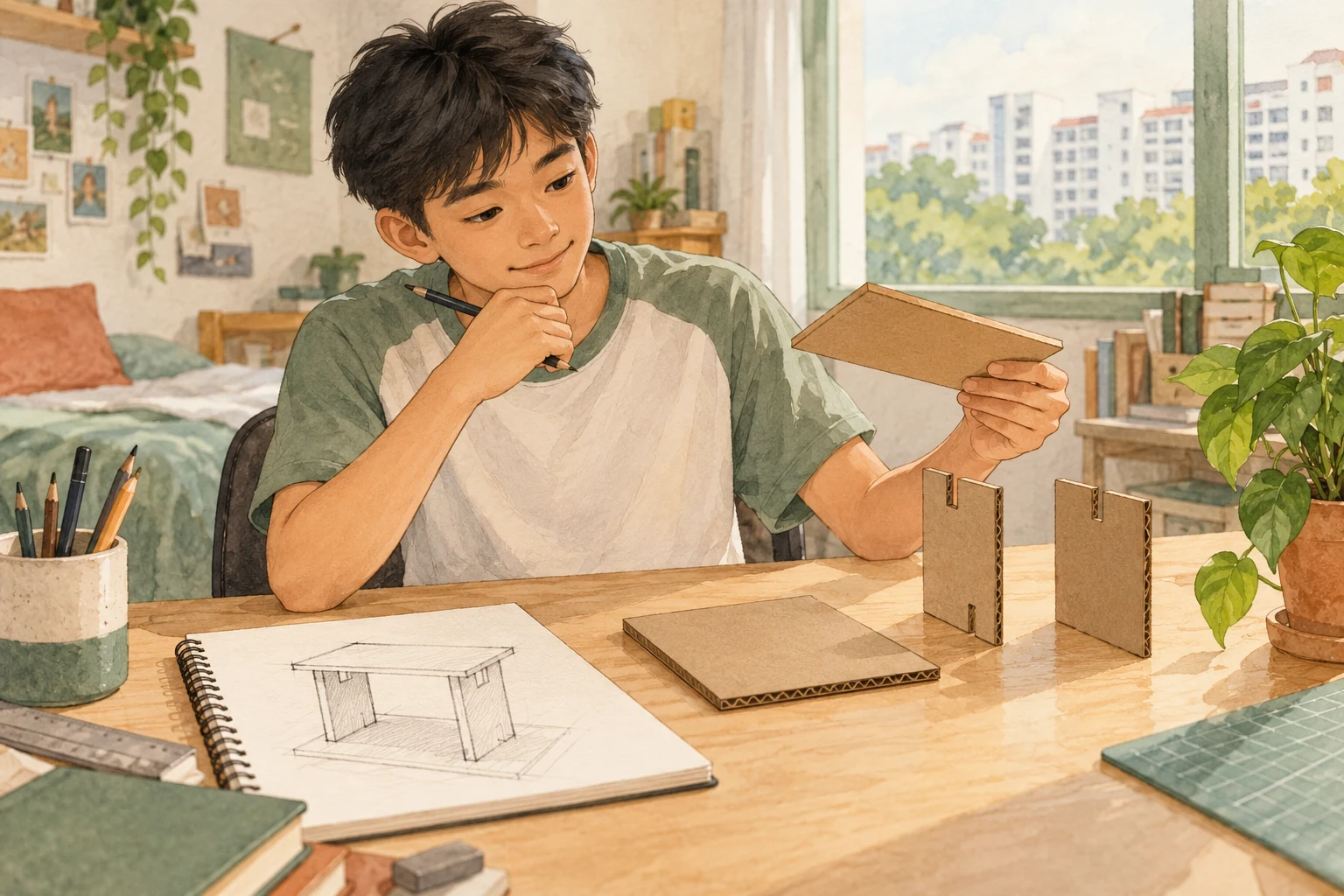
Did you know? A G1 Design and Technology (D&T) student who can make a careful cardboard model already has a useful design foundation. The step towards G2 is not simply to make a more complicated object. It is to frame a real user need accurately, explore different possible solutions, justify choices involving materials and technology, and manage a coherent design process. The 2027 Singapore-Cambridge Secondary Education Certificate (SEC) assesses those capabilities differently at G1 K124 and G2 K234.
This guide is for students and parents considering G2 Design and Technology under Singapore’s Full Subject-Based Banding (Full SBB). A published syllabus shows that a national examination subject exists; it does not establish that a particular secondary school offers the subject, has a spare workshop place or permits a late G-level switch. Parents should get the school’s written subject-combination and eligibility information before changing books or buying equipment.
The strongest preparation can start with inexpensive observations and low-risk paper prototypes. A student should develop the discipline to ask, ‘Whose problem is this? What evidence do we have? Which design choice is most suitable? How can we test it?’ That thinking serves both G1 and G2, whatever the school’s final allocation.
2027 SEC G1 versus G2 D&T: the verified examination differences
| 2027 requirement | G1 D&T K124 | G2 D&T K234 |
|---|---|---|
| Paper 1 | Written, 1 hour, 30% | Written, 1 hour 30 minutes, 40% |
| Paper 2 | Individual Design Project, 20 weeks, 70% | Individual Design Project, 20 weeks, 60% |
| Assessment domains | Knowledge, design thinking, design-manipulating skills | The same broad domains, with different emphasis and depth |
| Exam format | Design-centric written questions plus design journal and presentation board | Design-centric written questions plus design journal and presentation board |
| Technological areas | Materials, processes, mechanisms and electronics | Materials, processes, mechanisms and electronics, with greater analytical expectations |
The official 2027 G1 D&T K124 syllabus allocates 30% to its written examination and 70% to the design project. The 2027 G2 D&T K234 syllabus allocates 40% and 60%. Both projects run over 20 weeks, excluding school holidays under the published requirements. The change in weighting does not make G2 automatically easier or harder for a particular pupil; the assessment expectations also change.
Both syllabuses are built around design opportunities in everyday life. Students work through needs analysis, idea development, mock-ups and prototyping, supported by research, planning and reflection. The formal Design Project is school-supervised coursework, not something an external tutor or parent can complete on the child’s behalf.
What actually becomes more demanding?
The G1 syllabus asks students to recognise everyday needs and consider relevant information about the user, functionality, aesthetics, technology and environment. The G2 syllabus places greater emphasis on detecting and framing needs, inquiry and analysing and synthesising evidence; its decision-making considerations also explicitly mention economics and culture. That shift is about the quality of the design argument.
For example, ‘I am making a phone stand because it looks cool’ is a solution statement. A more precise design opportunity would be: ‘A student following a school-approved online lesson needs to see a screen without holding it, using limited desk space and a stable, affordable support.’ This identifies a user, context, constraints and a measurable purpose. Only then should the child compare possible designs.
A diagnostic before any attempted level change
| Capability | Try this question | Evidence of stronger readiness |
|---|---|---|
| Needs analysis | Who encounters this difficulty and when? | Identifies a real context rather than a fashionable gadget |
| Research | Which observation supports the need? | Uses credible, relevant evidence and avoids invented interviews |
| Ideation | Can you propose three genuinely different solutions? | Alternatives change the method, not only the colour |
| Prototyping | What can be tested with paper, cardboard or foam? | Tests a specific property under safe conditions |
| Technology | Why choose that material or mechanism? | Links strength, stability, durability and practicality |
| Evaluation | Which trade-off led to the final choice? | Explains a justified revision and a remaining limitation |
This is a home practice diagnostic, not an official G2 entry test. The school decides if a proposed subject or level change is possible. A child may already be strong in technical sketches but need help articulating design specifications, or be creative yet overlook measurement and feasibility.
A four-week practice bridge for a thoughtful young designer
Week 1: Observe and describe a useful problem
Choose a harmless daily-school situation: pencils rolling off a small desk, exercise books becoming difficult to identify or frequently used materials taking too long to retrieve. Ask the learner to observe or simulate the task, identify the specific user and describe what an improvement should achieve. Keep a simple record of evidence and constraints, without collecting unnecessary personal information about classmates.
Write a brief such as, ‘Design a compact way to keep frequently used stationery visible and accessible at a shared table.’ Then define three criteria: occupies little space, makes objects easy to find and stays stable during normal use. A design goal should be testable; words like ‘nice’ and ‘innovative’ are not enough on their own.
Week 2: Create and compare different concepts
Sketch three different concepts: an open divided tray, an upright holder and a foldable labelled organiser. For each, explain how the shape, layout and material choice relate to the brief. Use a decision table, but do not treat numerical scores invented by the student as objective truth. A useful rating should have a stated reason.
The learner can also practise isometric or orthographic communication at the level taught by their school. The purpose of technical drawing is to help someone understand a proposed object, not simply produce elegant shading.
Week 3: Test a mock-up safely
Use paper or cardboard, blunt tools and appropriate adult supervision to build a small non-functional or low-load mock-up. Ask whether it fits the space, whether labelled objects remain visible and whether it can stand securely. Record what actually happened. If the model collapses under a harmless small load, that is useful feedback about stability and support.
Avoid powered saws, sharp workshop machinery, heated tools, soldering, hazardous adhesives or electrical circuits without school-authorised supervision. The examination syllabus includes workshop techniques, but knowledge that a process exists is not permission to carry it out unsupervised at home.
Week 4: Improve and explain the revision
Redraw the concept after the mock-up test. Include the original observation, two rejected alternatives, the test result and a short explanation of the final change. Ask, ‘What did we learn about the user or function?’ A learner should be able to say why the revision improves the design rather than merely claim that the finished version looks better.
Four weeks is a family learning example, not the 20-week examination project or a compulsory school bridge. The formal coursework must be completed under the designated procedures. A school may not permit entry once key project milestones have passed.
Worked design example: stability versus appearance
Suppose a student’s first cardboard phone stand has a narrow base and an attractive tall back. When a safe lightweight dummy is placed on it, the stand falls backwards. The student observes that the support point and base are unsuitable for the intended use. A revised concept uses a wider base and a different angle.
What makes this a strong learning example? The student identifies the failure, states an explanation that can be tested and documents why the revised version should improve stability. It is also sensible to note a trade-off: a wider base may use more desk area. G2 preparation strengthens the ability to make such decisions explicitly.
The written paper is not separate from the design process
A G2 student needs to use knowledge of materials, mechanisms and electronics to reason about a design need. Simply listing the names of gears or plastics is insufficient. The pupil should explain how a particular property or movement suits the intended function and recognise limits. The 2027 G2 written paper is longer and carries a greater proportion of marks, so conceptual explanations deserve sustained attention.
A helpful weekly routine alternates a short design-response question with the learner’s own small development record. Ask for clear labelled sketches, appropriate terminology and decisions tied to the brief. Avoid spending all study time on making attractive models while neglecting the written questions, or on memorising technology notes without ever applying them.
How Full SBB affects the decision
G1, G2 and G3 are subject levels; the original Posting Group is not the level of every subject forever. Nonetheless, D&T is not an unrestricted subject-level menu. Schools set available combinations, prerequisites, teacher and workshop arrangements, and any permitted review or appeal process. The child should attend and prepare for the confirmed subject, not one inferred from a retail textbook.
If the student is currently learning lower-secondary Design and Technology as part of the common curriculum, that does not necessarily mean they already take G1 SEC D&T K124. The upper-secondary examination option is a separate school allocation. Parents should ask the school which exact course and year they are discussing.
Do you know? Frequently asked parent questions
Is G2 D&T project work shorter than G1?
No. Both published 2027 SEC syllabuses specify a 20-week Design Project. The weighting differs: 70% at G1 and 60% at G2. The task and assessment criteria must be read at the correct level.
Can my child use a home-made prototype as the SEC project?
Not automatically. Examination coursework is an authorised, supervised and authenticated assessment. Practice models are useful for building skills, but a home project cannot substitute for the official design brief and process.
Does G2 D&T require expensive electronics kits?
No general kit purchase should be assumed. The school specifies the allowed technology and resources. Ask the teacher before paying for parts, workshop tools or subscriptions.
Can a G1 pupil move to G2 immediately after one strong test?
A strong result may support a discussion, but eligibility and timetable decisions rest with the school. The timing and feasibility can be particularly restrictive once upper-secondary coursework has begun.
Will G2 D&T guarantee entry into engineering or design courses?
No. Later study routes have their own current academic and portfolio requirements. D&T helps develop useful transferable problem-solving skills but does not guarantee an offer.
Build a designer who can explain every decision
The immutable eduKateSG Secondary 1 Mathematics Clementi small-group teaching reference describes closely observing a learner’s reasoning, identifying the incorrect step and testing an independent correction. That teaching principle applies to D&T: a tutor asks where the design does not meet its user need and encourages an evidence-based revision. The immutable article itself is a Mathematics page, not a claim that the course provides workshop lessons.
For the next level, read the G2-to-G3 Design and Technology bridge. For official rules, use SEAB’s G1 2027 directory and the G2 directory. A student is progressing when they can observe, propose, test and justify a solution with growing independence, not simply when the prototype becomes more complicated.