
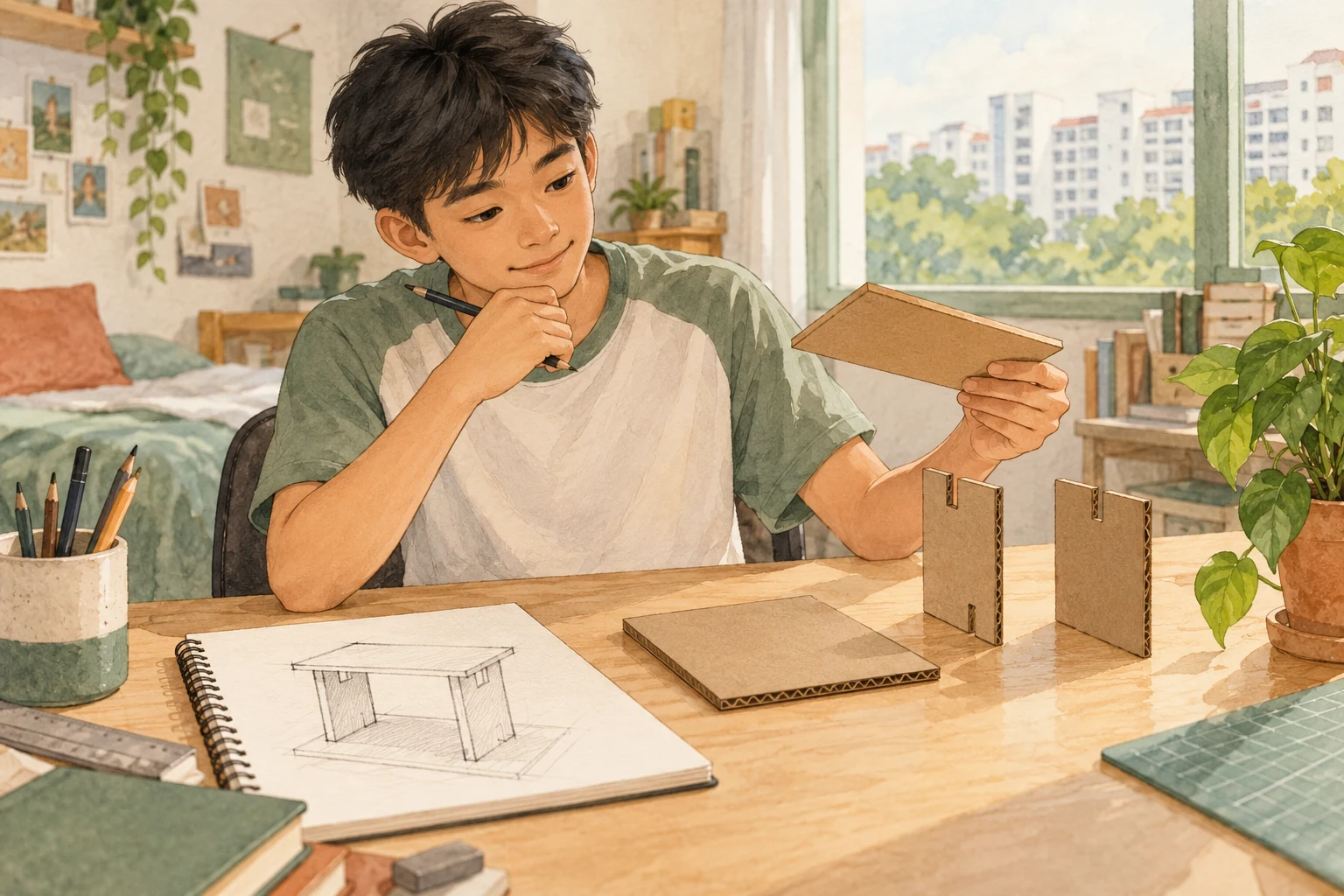
Did you know a useful design often starts with an everyday inconvenience instead of an expensive machine? If a school bag keeps falling against a walkway, a learner can begin by noticing the problem, asking whom it affects and testing simple alternative ideas.
Design and Technology (D&T) helps students connect thinking with making. Under Full Subject-Based Banding, lower-secondary D&T is part of the shared curriculum in mixed form classes. Students learn about users, constraints, sketches and safe practical processes rather than simply constructing objects to take home.
The first distinction for parents is important: lower-secondary common D&T and examined SEC G1 Design and Technology K124 are different learning arrangements. Being posted through PG1 does not automatically mean the child is registered for that upper-secondary national examination.
A Singapore parent–student guide based on the MOE curriculum and the 2027 SEC/2028 PSE arrangements, reviewed 24 October 2026. The actual school timetable, examined subject level and destination admission rules should always be checked for the student’s cohort.
The 60-second answer
- PG1 is the Secondary 1 posting grouping; it is not a separate D&T syllabus level.
- Design and Technology is one of six shared lower-secondary Full SBB common curriculum subjects.
- MOE’s published lower-secondary D&T materials describe a design process in which learners investigate a user need, explore possible solutions and test decisions.
- Common lower-secondary D&T is not itself a nationally examinable SEC G1 subject entry.
- SEAB’s distinct 2027 SEC Design and Technology codes are G1 K124, G2 K234 and G3 K345, subject to the school’s offerings and student eligibility.
- Model-making and technology interests can open conversations about future fields, but formal ITE, polytechnic, JC and university pathways require qualifying results and prerequisites.
First, Posting Group 1 is not a permanent subject level
Posting Group 1 (PG1) is a Secondary 1 posting arrangement under Full Subject-Based Banding (Full SBB), introduced from the 2024 Secondary 1 cohort. Students attend mixed form classes for six common subjects: CCE, PE, Art, Music, Design and Technology and Food and Consumer Education. Their other subjects may be studied at approved G1, G2 or G3 levels according to eligibility and school offerings.
For Lower Secondary Design and Technology, the common lower-secondary programme is designed for learning and participation, not a separate ‘PG1 national certificate’. Some related electives are nationally examined at upper secondary, but families should distinguish the student’s present classroom programme from the actual 2027 SEC subject entry.
From 2027, the Singapore-Cambridge Secondary Education Certificate (SEC) replaces the previous N- and O-Level examination structure. The SEC records the subject and G-level actually examined. It is not a certificate that fixes an individual forever at the original posting group.
The 2028 Post-Secondary Admissions Exercise (PSE) unifies the main results-based application process for eligible JC/MI, polytechnic and ITE routes, while retaining the formal entry conditions of each destination. A worthwhile practical lesson does not by itself substitute for an examinable academic result.
Why Lower Secondary Design and Technology is useful even before national examinations
Design begins by finding a problem that is specific enough to solve. ‘Make a better bag holder’ is vague; ‘make a support that helps a particular student store a heavy school bag without blocking the corridor’ identifies a user, purpose and context.
Sketches are tools for thinking, not just decoration. Two simple designs on paper allow a learner to compare stability, ease of use, safety, accessibility and how much material or space would be required.
The MOE lower-secondary D&T syllabus published in 2017 describes the design process as a platform for learning, using basic design, technology, project-driven skills and reflection. It predates Full SBB and uses former course labels, so families should look to the school for its current common-curriculum implementation rather than assume every old assessment detail remains unchanged.
Materials and mechanisms introduce practical considerations. A wooden surface and a cardboard model behave differently. A hinged lid needs a different kind of movement from a sliding tray. Students should learn to predict constraints before making something more elaborate.
Useful design also includes responsible judgment. A proposed solution may work for one person yet be awkward for another. Good feedback is evidence about the intended user, not an insult to the first idea.
By observing, planning, testing and revising independently, a learner develops habits relevant to many future choices even when D&T is not a later examined subject.
The core skills behind this subject
- Notice and define a real user need instead of starting with a favourite gadget.
- Create a short design brief specifying user, purpose and meaningful constraints.
- Research a problem responsibly and distinguish direct observation from unsupported assumptions.
- Explore multiple ideas with labelled sketches or simple models before selecting one.
- Explain how materials, structures or basic mechanisms relate to a function.
- Plan safe, teacher-supervised practical steps and recognise when a tool is inappropriate.
- Use testing evidence to revise a design rather than altering parts randomly.
- Document decisions honestly, including what did not work and why.
Did you know? One worked example worth discussing
Imagine a fictional class brief: several students leave water bottles on a narrow study table, where they are easily knocked over. Design an unassessed, paper-only concept that keeps a bottle stable without making the table awkward to use.
First identify the user and constraints. The student needs the bottle within reach, but the proposed support must not obstruct a notebook, create sharp edges or rely on an unavailable material.
Next draw two ideas. One might be an under-table holder; another might be a small weighted base. The first saves table space but requires checking how it would attach safely. The second is simpler to place but uses more of the surface.
Now choose one condition to test with a mock-up in the school’s approved environment: is the space sufficient, does the bottle fit or does the arrangement hinder writing? Do not use unsupervised cutting, heating or mains-powered tools.
Write an evidence statement: ‘I adjusted the holder because the first position blocked the student’s knee space; the new sketch allows more clearance, although I still need to test the fit.’ That is stronger than ‘I made it look nicer’.
Try the reasoning again with a changed object, such as a book stand. The important learning is the connection between need, constraints, design choice and test rather than copying the original shape.
MOE common curriculum versus the 2027 SEC examination
Lower-secondary common D&T is shared with students from different posting groups as part of Full SBB. The current school timetable, teacher guidance, facilities and tasks determine the particular design activities a child experiences.
MOE’s published 2017 lower-secondary D&T syllabus provides a useful explanation of the design process and concepts such as user needs, basic design, materials, structures, mechanisms and electronics. Because it predates Full SBB, parents must not treat every historic stream label or detail as a current 2027 SEC requirement.
Schools may use worksheets, visual journals, design tasks, supervised practical activity and appropriate feedback to assess learning. Those school-based activities do not automatically constitute national SEC coursework.
For 2027 upper-secondary school candidates, SEAB lists separate examined Design and Technology subjects: G1 K124, G2 K234 and G3 K345. These syllabuses have different learning and assessment demands; a child should use the one corresponding to their actual registered level.
At G1, formal K124 includes an individual design project and a written examination under its own requirements, unlike everyday common D&T lessons. Neither parents nor tuition providers should make assessed project work on behalf of a student.
School facilities, group sizes and subject offerings vary. If the child has an interest in taking examined D&T later, ask the school how subject combination, readiness and any coursework arrangements are determined.
Six common learning gaps and useful repairs
- Designing a product before stating the user’s actual difficulty: write a one-sentence need statement before sketching.
- Producing a beautiful drawing with no explanation: label which feature performs which function and why.
- Selecting one idea without comparison: draw a second possibility and identify a meaningful trade-off.
- Testing many changes at once: identify one design question and change one condition at a time.
- Treating workshop safety as optional: use only authorised school equipment and supervised procedures.
- Confusing lower-secondary common D&T with 2027 G1 SEC K124: confirm the actual examination status before buying a specialised guide.
A practical learning routine that builds independence
Begin by asking the learner to identify one everyday inconvenience that affects a specific user.
Write a short design brief: who, what, where and which constraints need to be respected?
Compare two labelled sketches, then ask the child to explain a benefit and limitation of each.
Choose a safe, small classroom-approved model or paper test rather than a complicated build.
After feedback, ask the learner to make one purposeful revision and retell the reason independently in a different situation.
From Secondary 1 to Secondary 4
- Secondary 1: practise observing needs, basic sketching, discussion of user context and safe awareness of materials.
- Secondary 2: deepen comparison of design options, simple mechanisms, testing and honest reflection on results.
- Secondary 3: where D&T is offered as an examined elective, verify its actual G1/G2/G3 SEC syllabus and the student’s eligibility.
- Secondary 4: complete any authentic assessed work according to school and SEAB rules while mapping the full formal subject profile to post-secondary options.
Education pathway: ITE, Polytechnic, Junior College and University
Did you know ‘could my child eventually pursue university study?’ and ‘can my child enter a particular diploma immediately after Secondary 4?’ are different questions? The first is a longer-term possibility. The second is answered by the full set of formal results, subject levels, programme entry conditions and selection.
A child’s original PG1 posting is not a lifetime educational ceiling, but subject-level changes and subsequent admissions are neither automatic nor interchangeable. Build the plan one recognised qualification at a time.
1. ITE Higher Nitec and practical progression
ITE: students may later explore technical, design, engineering-support, fabrication or service-related Higher Nitec programmes where offered. Common D&T is useful exploration but not a stand-alone national admissions result.
2. Polytechnic diplomas and qualifying pathways
Polytechnic: relevant design, media, engineering or built-environment diplomas may require specific English, Mathematics or other subjects and grades. Some students qualify for direct entry while others may pursue recognised ITE progression. The exact destination determines eligibility.
3. Junior College and Millennia Institute
JC/MI: pre-university admission is based on the published qualifying academic results. Under the announced 2028 JC L1R4 framework, the counted subjects are at G3 level. Common D&T is not a substitute for them.
4. University: a later qualification checkpoint
University: future technology or design-related degree study is possible through appropriate qualifying routes, subject to institutional prerequisites and selection. Initial PG1 status is not an irreversible ceiling, and one project does not guarantee admission.
A realistic one-week practice plan
- Monday: observe a small user problem and state it without suggesting a solution.
- Tuesday: identify three constraints that would make a proposal useful and safe.
- Wednesday: sketch two alternatives and compare their likely strengths.
- Thursday: explain how one material or simple mechanism supports a function on paper.
- Friday: record a realistic test and one change based on its outcome.
- Weekend: explain a different design problem without borrowing the previous drawing or adult hints.
Three parent–student conversations that make decisions clearer
First ask your child for one example of a skill they can now perform without a model answer. The most informative answer describes exactly what changed, not a broad claim such as ‘I am better at everything’.
Next ask the teacher how the current lower-secondary programme is assessed and what the child could practise independently. Separate school-based common curriculum participation from entry into a nationally examined upper-secondary elective.
Finally choose one possible future course and read its actual prerequisites. Compare those requirements with the student’s realistic English, Mathematics, other subject levels, grades and, where relevant, additional selection arrangements.
What parents should record in a small learning notebook
Keep four columns: the task attempted, the first uncertain decision, the correction the student made, and the next date for a changed independent test. The purpose is to track understanding rather than produce another long document.
At monthly intervals, ask the student to describe one real change in skill or confidence, then seek targeted advice from school about subjects and pathways. Progress is strongest when it can be shown in a fresh example without hints.
Frequently asked questions
Is common lower-secondary D&T the same as SEC G1 Design and Technology?
No. Common D&T is shared lower-secondary learning; G1 K124 is a distinct examined upper-secondary subject.
Can a PG1 pupil study D&T alongside PG2 and PG3 classmates?
Yes. Full SBB mixes students in common-curriculum form classes for subjects including D&T.
Do students need power tools to learn design thinking?
No. User needs, sketching, comparison, tests and reflection can begin safely on paper. School practical tasks require trained supervision.
Is the 2017 MOE D&T syllabus a 2027 SEC paper?
No. It is an older lower-secondary syllabus reference. Current SEC entries have separate 2027 SEAB subject codes and syllabuses.
What D&T examination codes does SEAB list in 2027?
G1 K124, G2 K234 and G3 K345, subject to school offering and candidate registration.
Can parents build the student’s assessed model?
No. Graded coursework must follow school instructions and represent the student’s authentic independent work.
Does taking D&T guarantee engineering diploma eligibility?
No. Each course sets its full grade, subject-level and any other entry conditions.
Where to verify the syllabus and admission rules
MOE’s national curriculum guidance sets the lower-secondary learning context, while SEAB’s 2027 listings show the actual examination titles and codes for school candidates. Use the correct document for the student and do not silently assume that a common lesson creates a national examination result.
For the post-secondary intake concerned, read MOE’s PSE updates and the specific course criteria at ITE, polytechnic, JC/MI or university. Rules, available programmes and admission thresholds may change.
MOE — published 2017 lower-secondary D&T design-process reference (historic labels)
MOE — Full SBB common curriculum and subject flexibility
SEAB — 2027 G1 Design and Technology K124
SEAB — 2027 G2 Design and Technology K234
SEAB — 2027 G3 Design and Technology K345
SEAB — Singapore-Cambridge SEC overview
MOE — post-secondary admissions from 2028
MOE — 2026 education and pathways announcement
ITE — academic progression after Higher Nitec
Continue reading on eduKateSG
What is PG1? Posting groups versus subject levels
Full SBB: the six lower-secondary common curriculum subjects
SEAB 2027 school-candidate subject directory
Education pathways from SEC to ITE, polytechnic, JC and university
D&T under Full SBB: common learning and the different examined G-levels
What is PG1 Design and Technology? The distinct SEC G1 K124 pathway
What is PG1 Food and Consumer Education? Another practical common subject
Secondary 1 Mathematics Tutor Clementi | Small Groups Tutorials — a foundation-first approach
One good question to ask tonight
Ask your child: ‘What need did your design address, and what observation would convince you that it works?’ A specific independent explanation is a better starting point for learning than simply memorising a label, grade or attractive answer.