
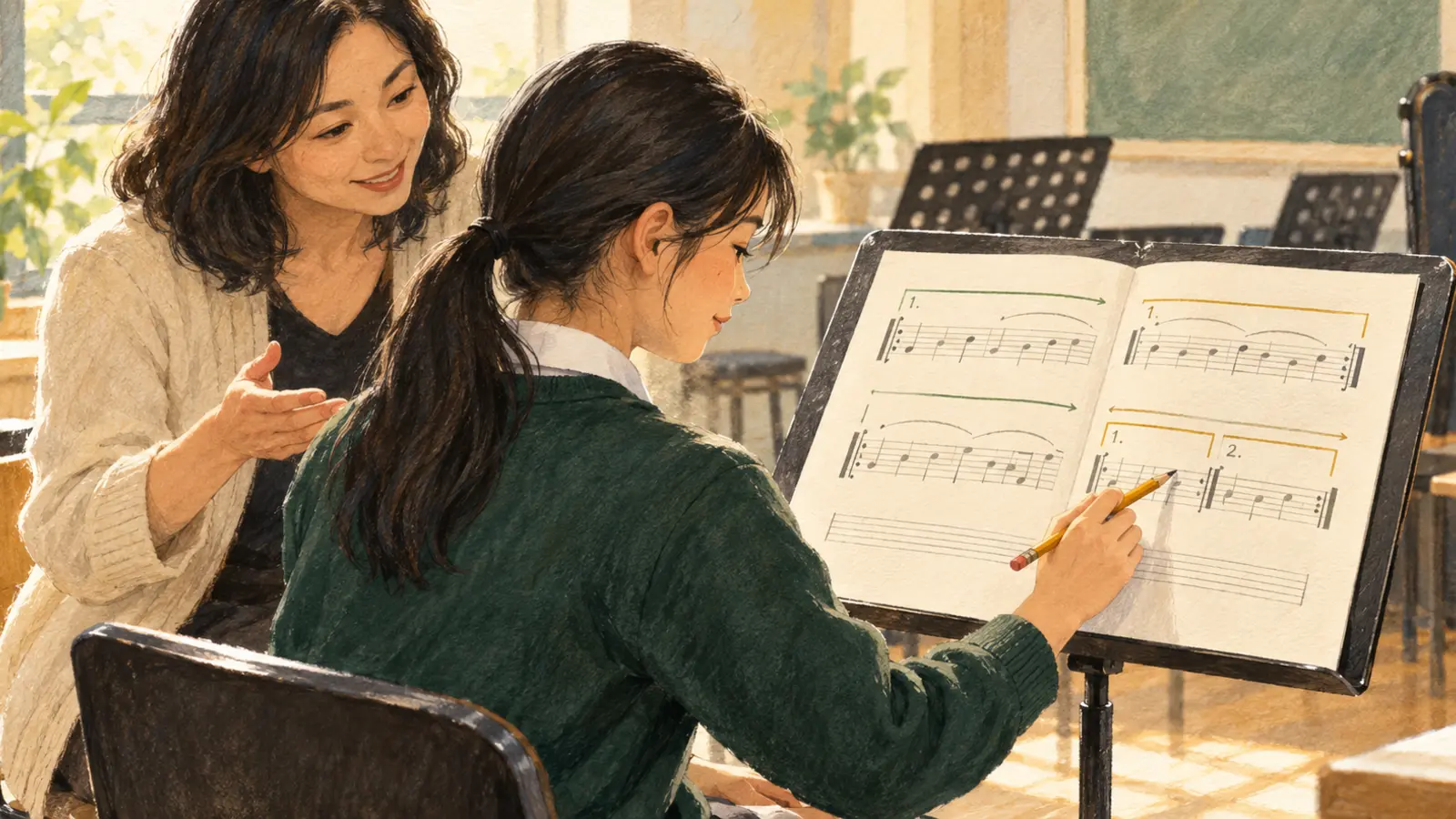
Did you know? The 2027 Singapore-Cambridge Secondary Education Certificate (SEC) includes G1 Music and G3 Music, but no separate G2 Music examination on SEAB’s school-candidate syllabus list. That does not mean a learner simply skips a convenient middle chapter. G1 Music K128 and G3 Music K350 are very different assessment routes with distinct expectations for listening, musical creation, performance, technology and reflection.
A child who enjoys arranging music in a digital audio workstation (DAW) may already have valuable musical skills. But G3 Music expects more demanding musical analysis, notation, composition and a prepared recital. Moving towards those skills can be exciting when the pupil wants it and the school can support it. The challenge should not be measured by how expensive the instrument is or how many online tutorials the child completes.
This is a Full Subject-Based Banding (Full SBB) skills-bridge guide, not an automatic subject-level transfer. Schools must confirm which programmes they actually offer, how pupils qualify and how the practical, composing and performing components are supervised. A parent cannot convert a G1 Music entry into G3 Music merely by submitting an external performance certificate or choosing a harder workbook.
The key 2027 SEC Music assessment differences
| Area | G1 Music K128 | G3 Music K350 |
|---|---|---|
| Paper structure | Paper 1 Listening; Paper 2 Creating and Performing coursework | Paper 1 Music Studies; Paper 2 Creating; Paper 3 Performing |
| Listening or music studies | 1 hour, 40 marks, 40% | Written Music Studies, 1 hour 30 minutes, 75 marks, 40% |
| Creating and performing | A combined coursework paper worth 60% | Creating 30% and Performing 30% separately |
| Formal creation | Song/instrumental arrangement and a 30-second film/TV music cue | Composition across nine weeks, with five supervised hours, plus reflection |
| Formal performance | Live playing/singing of a part within the arranged piece, meeting the prescribed authentication rules | 5–10 minute recital plus reflection notes |
| Supervision | G1 coursework takes place over five months with 30 supervised hours | Specific school-supervised composing and separate prescribed recital requirements |
The exact requirements come from SEAB’s official 2027 G1 Music K128 syllabus and the official G3 Music K350 syllabus. Both contain listening, creativity and performance, but their balance is different. G1 uses a music-technology-oriented combined coursework route. G3 specifies a longer written musical-studies paper and separate Creating and Performing papers. Treat them as distinct syllabuses rather than one as a simplified copy of the other.
What G1 Music already teaches well
The K128 syllabus includes listening across popular music from 2000 onwards, Western classical programme music, music for film and television and local musical traditions in Singapore. Creating music involves arranging, recording and producing within prescribed coursework conditions, including an original short cue for a fictional film or television context.
These can be useful foundations for G3. A pupil can recognise a melody and accompaniment, describe a bassline or groove, compare musical textures and explain why a short cue fits a scene. Producing a clear mix also teaches close attention to sound. But confidence with a DAW alone does not demonstrate the full G3 written and performance syllabus.
What the G3 Music student needs to add
- Musical listening and analysis: describe the specific features heard and relate them to style or context.
- Notation literacy: follow relevant staff or lead-sheet notation, rhythmic and melodic ideas and simple dictation tasks.
- Composition: develop a coherent, original musical idea for a stated purpose and explain decisions in reflection notes.
- Performance: prepare a recital suited to the prescribed standard and demonstrate musical communication under the teacher’s guidance.
- Cross-cultural listening: study the prescribed Western Classical, Jazz, Popular and Asian music material using accurate terms, not stereotypes.
- Self-evaluation: identify which rehearsal or compositional change improved the actual music, rather than claiming generically to be ‘more creative’.
Students should not assume that the music they like most is automatically the prescribed repertoire for the examination. Consult the school’s G3 Music teacher for the actual year-specific areas of study, notation requirements, repertoire and submission process.
A simple practice example: rhythm without relying on technology
Imagine a four-beat bar in which the learner claps four steady crotchet beats. Then they clap two quavers for one of the beats. Both patterns occupy the same duration, but their rhythmic character changes. The child can describe where the subdivision occurs and how it affects the groove. This is the start of linking hearing, a rhythmic representation and a musical interpretation.
At a more demanding level, pupils may be asked to identify a rhythm from an unfamiliar extract, notate part of it or explain its stylistic role. A useful home practice is listening twice: first for the pulse and broad form, then for a particular rhythmic or melodic feature. It is not necessary to own expensive production software to do the first stage well.
A second practice example: musical intention and structure
Give the student a non-examination creative prompt: compose a 20-second introduction for a fictional school celebration. Ask whether it should sound welcoming, energetic or reflective, and what musical choices would support that intention. They might select a clear pulse, a repeated rhythmic idea and a short melodic phrase that changes on the repeat.
The learner should describe why those choices help, play or sequence the idea safely, listen back and decide one improvement. A composition is more than a collection of loops. A strong child can identify coherence, pacing and a meaningful ending without borrowing a copyrighted recording and presenting it as original.
A four-week bridge to stronger musical understanding
Week 1: Listen, describe and compare
Use teacher-approved short recordings from contrasting genres. Ask the learner to identify pulse, metre where relevant, instrumentation, melodic contour, harmony, texture and dynamic changes as appropriate to their current knowledge. Then compare what makes the two examples different, using specific musical observations rather than labels such as ‘happy music’ and ‘sad music’.
Record which elements the child can hear independently and which require a demonstration. If they cannot reliably distinguish a strong pulse from rhythmic decoration, start there before expecting advanced written analysis.
Week 2: Connect ear, notation and practical playing
Practise a simple rhythm by listening, clapping, reading the relevant notation and reproducing it. For a suitable melody, practise recognising repeated phrases, direction and basic intervals after the teacher has introduced them. Have the student explain their own method of checking accuracy.
Avoid creating shame around prior instrumental training. A child may have substantial music-production experience and limited formal notation, or the reverse. The teacher can diagnose the gap and select an appropriate route rather than treating either background as an absolute measure of musical ability.
Week 3: Create a short original idea and explain its purpose
Develop the fictional celebration cue, or another teacher-approved brief, from a simple motif. Try two contrasting instrumental or rhythmic arrangements. Ask the pupil to describe how each version changes the intended mood and what they would choose for the actual context. Write a concise practice reflection about one choice and its effect.
Any official K128 or K350 coursework must follow the school supervision and originality rules. This private practice is not a substitute for the authorised composition, and the child should not automatically submit practice recordings as examination work.
Week 4: Perform, listen back and evaluate
Ask the student to prepare a short, suitable piece or excerpt appropriate to current skills. Record only with consent and in accordance with school rules. Listen back for pulse, pitch, phrasing, expression and how successfully the intended character comes through. Pick one technical and one musical improvement, rehearse them and compare again.
This four-week sequence is a practice example, not a promise of a G3 Music placement or a replacement for the longer prescribed coursework and performance preparation. A pupil entering the course late may need extensive extra study, or a school may be unable to offer the change.
Why the two examinations cannot be mixed and matched
A G1 K128 candidate cannot replace its official Paper 2 coursework with a G3 K350 recital or submit the G1 film cue as the G3 creating paper by personal choice. Each subject has distinct entry and authentication conditions. The school registers the actual examination subject and supervises the appropriate assessment.
A student may still practise composition, performing and sound production across styles for educational benefit. The distinction is between useful learning and formal examination evidence. Parents should ask about the latter before paying for additional lessons, a keyboard, recording equipment or software.
No G2 SEC Music paper: what does that actually mean?
The 2027 SEAB school-candidate directories list G1 Music K128, G3 Music K350 and G3 Higher Music K351, but not a separate G2 Music syllabus. It does not mean that a G1 Music student is automatically entitled to a G3 Music place, and it does not mean lower-secondary common Music is itself a national examination qualification.
Different schools have different music programmes, teacher resources, facilities and subject options. Ask the school what progression or audition arrangements, if any, apply to the child’s situation. In particular, the Music Elective Programme and other specialised offerings should not be inferred solely from the original Posting Group.
Do you know? Parents’ most useful questions
Is a G1 Music student already using technology?
Yes. The 2027 K128 syllabus places substantial emphasis on arrangement, music production, sound recording and a film/TV cue through appropriate music technology. Technology skill is valuable, but does not replace G3 notation, composition and recital preparation.
Is G3 Music only about playing an instrument?
No. K350 gives 40% to Music Studies, 30% to Creating and 30% to Performing. Performance is one part of the qualification alongside listening, analysis and composition.
Does every Secondary 3 school offer G3 Music?
No. The national syllabus list is not a guarantee of school availability. Ask the school’s subject coordinator for options, entry criteria and examination-year arrangements.
Can a music tutor produce the candidate’s composition?
No. The pupil must comply with the prescribed composition, supervision, originality and authentication requirements. A tutor can guide general skills without substituting someone else’s work for official assessment.
Will G3 Music automatically lead to Higher Music or a conservatory?
No. Higher Music has its own elective requirements, and tertiary institutions have their own admissions standards. Musical interest and development are valuable without a guaranteed next qualification.
A productive lesson makes the music understandable
The immutable eduKateSG Secondary 1 Mathematics Clementi three-student tutorial reference demonstrates careful identification of where a student’s reasoning stops working and testing an independent correction. Music teaching benefits from that principle too: hear a rhythmic error, explain where it occurred and perform the new version independently. The referenced page remains unchanged and describes Mathematics tutorials, not an advertised Music examination course.
For the next music route, refer to the G1, G3 and Higher Music 2027 overview alongside the official G1 Music syllabus and the G3 Music syllabus. The aim of a bridge is to build a student who can listen accurately, create purposefully, perform thoughtfully and explain musical decisions—not simply attach a higher label to their instrument.