
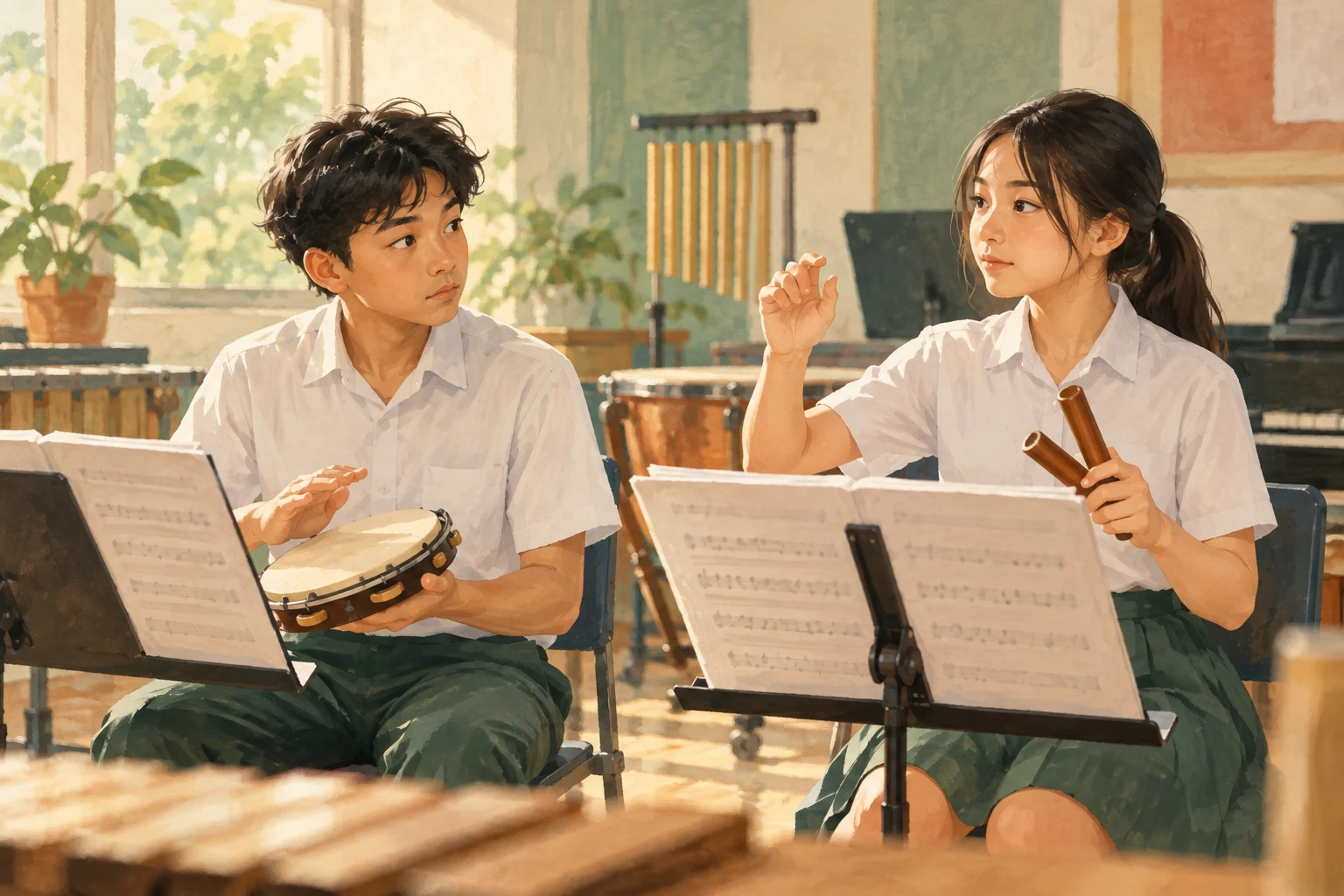
Did you know a child who does not play an instrument can still make a thoughtful musical observation? They might notice that a song becomes quieter when the singer enters, or that a repeated rhythm changes the mood of a scene. Being able to hear and explain that change is genuine musical learning.
For Singapore students entering Secondary 1 through Posting Group 1 (PG1), lower-secondary Music is part of the Full Subject-Based Banding common curriculum. Students with different academic subject-level combinations listen, create and perform together in mixed form classes.
The important distinction is that common Music and examinable SEC G1 Music are different. A shared Music lesson is not automatically a registration for the 2027 national K128 paper. Here is how the subject works and why the difference matters for later education planning.
A Singapore parent–student guide based on the MOE curriculum and the 2027 SEC/2028 PSE arrangements, reviewed 24 October 2026. The actual school timetable, examined subject level and destination admission rules should always be checked for the student’s cohort.
The 60-second answer
- PG1 is the Secondary 1 posting group, not a separate national Music syllabus or a measure of musical ability.
- Music is one of six common lower-secondary curriculum subjects under Full SBB, taught in mixed form classes.
- MOE’s Music Syllabus for Primary and Lower Secondary, implemented from 2023, emphasises listening, creating, performing and making connections.
- Lower-secondary common Music is not the same as the separately examined 2027 SEC G1 Music K128.
- SEAB’s 2027 G3 subjects include Music K350 and Higher Music K351; check school eligibility and actual examination entry.
- Music skills help students explore arts and technology interests, but post-secondary admission depends on recognised qualifications and programme requirements.
First, Posting Group 1 is not a permanent subject level
Posting Group 1 (PG1) is a Secondary 1 posting arrangement under Full Subject-Based Banding (Full SBB), introduced from the 2024 Secondary 1 cohort. Students attend mixed form classes for six common subjects: CCE, PE, Art, Music, Design and Technology and Food and Consumer Education. Their other subjects may be studied at approved G1, G2 or G3 levels according to eligibility and school offerings.
For Lower Secondary Music, the common lower-secondary programme is designed for learning and participation, not a separate ‘PG1 national certificate’. Some related electives are nationally examined at upper secondary, but families should distinguish the student’s present classroom programme from the actual 2027 SEC subject entry.
From 2027, the Singapore-Cambridge Secondary Education Certificate (SEC) replaces the previous N- and O-Level examination structure. The SEC records the subject and G-level actually examined. It is not a certificate that fixes an individual forever at the original posting group.
The 2028 Post-Secondary Admissions Exercise (PSE) unifies the main results-based application process for eligible JC/MI, polytechnic and ITE routes, while retaining the formal entry conditions of each destination. A worthwhile practical lesson does not by itself substitute for an examinable academic result.
Why Lower Secondary Music is useful even before national examinations
Everyday listening becomes more thoughtful when a student can name what they hear. A beat is not the same as rhythm, and a faster tempo is not the same thing as a louder performance. Distinguishing these elements is a way of listening carefully rather than simply deciding whether a song is enjoyable.
Music is also a way of making and testing decisions. When students arrange a short phrase, they choose which pattern comes first, which instrument or voice carries an idea, and whether the effect changes when one element is removed. They can discuss and revise the result without judging one another’s musical taste.
MOE’s curriculum connects music learning to different cultures, traditions and everyday media. It allows students to notice the music around them, including Singapore’s varied musical traditions, and respond respectfully to styles they do not normally choose.
A school ensemble or group task requires learners to pay attention to one another. They can practise timing, listening across a group and making space for different contributions. Those habits can improve classroom teamwork even if the pupil never chooses a music-related qualification later.
The most useful parental question is not ‘Are you the best musician?’ It is ‘What did you notice, what did you change and what sound tells you the change worked?’ The child learns to make musical reasoning visible.
The core skills behind this subject
- Listen actively for tempo, beat, rhythm, pitch, timbre, texture, dynamics and structure.
- Identify the sound made by an instrument or voice and describe its effect without guessing its source from an unsupported assumption.
- Respond to music through clear words, movement, drawing or appropriate performance tasks set by the teacher.
- Create a short musical idea by varying a pattern, instrument, rhythm or phrase.
- Perform an appropriate part while following pulse, entries and safe handling instructions.
- Make connections between music, cultures, personal experience and its uses in film or other media.
- Respect the contributions of classmates while giving feedback about a specific audible feature.
- Reflect independently on a performance or creation, naming one improvement and the evidence for it.
Did you know? One worked example worth discussing
Imagine a fictional class making a 20-second sound cue for a scene in which a student is looking for a missing book. No copyrighted soundtrack is supplied, and this activity is a classroom illustration rather than an official national-examination task.
First, describe the action rather than picking instruments immediately: searching, finding a clue and finally locating the book. Discuss whether the middle moment should feel excited, uncertain or hurried. The learner should be able to explain the intended effect.
Next, create one short pattern and try it at two different speeds. Ask another listener which version makes the movement seem more urgent. A faster version might work, but more speed could also make the music difficult to follow. That trade-off is worth discussing.
Add or remove one layer of sound. Can the listener still hear the main phrase? The goal is not to pile on instruments; it is to choose enough musical information to support the purpose.
Finally, replay the student-made idea and ask the learner to complete this sentence: ‘I changed ___ because the listener needed to hear ___.’ That explanation is the evidence of an independent decision, not a memorised compliment.
Keep any recording or production task separate from assessed coursework. Follow the school’s rules for copyright, acceptable help, technology and file submission.
MOE common curriculum versus the 2027 SEC examination
The MOE 2023 Primary and Lower Secondary Music Syllabus describes three core musical processes: listening, creating and performing. The idea of making connections encourages students to relate music to its purposes, cultures and experiences rather than treating it only as a set of abstract terms.
Lower-secondary common Music supports exploration and participation across a varied range of student profiles. Schools design suitable lessons, tasks and feedback within their implementation. A class might use voices, simple instruments, listening excerpts or digital tools as appropriate to its facilities and learning objectives.
Common Music is one of six subjects shared across mixed form classes under Full SBB, along with CCE, PE, Art, Design and Technology and Food and Consumer Education. It is not a separate SEC grade simply because a teacher assesses a class task or observes progress.
At upper secondary, a school may offer examined G1 Music. For 2027, SEAB lists Music K128 at G1; its assessment includes listening and supervised creating-and-performing coursework. That is a different, formal subject-entry decision.
SEAB’s 2027 G3 list includes Music K350 and Higher Music K351. There is no separate G2 Music entry on the 2027 school-candidate list. Families should confirm the actual subject offered rather than assuming a continuous G1–G2–G3 Music sequence.
An interest in singing, a school ensemble or a Co-Curricular Activity (CCA) can add valuable experiences but does not automatically register the student for a national Music examination. Different activities can have different selection and participation requirements.
Six common learning gaps and useful repairs
- Calling every fast passage loud: repair by comparing changes in tempo and dynamics separately.
- Listening to the whole piece without noticing a specific element: focus on one repeated rhythm, instrument or change in texture.
- Copying a musical phrase and presenting it as original: identify influences, follow source and copyright requirements and develop authentic student-created material.
- Assuming quieter group members contribute nothing: practise asking which musical role or observation each student can offer.
- Repeating a tune without checking timing: review one entry or pulse problem at a time and try it again.
- Confusing common Music with SEC G1 Music K128: confirm actual exam registration with the school before buying formal examination materials.
A practical learning routine that builds independence
Begin with a short musical excerpt or teacher-approved pattern; listen once to understand its overall shape.
Listen again for one element, such as how the pulse continues when the melody changes.
Ask the student to imitate or describe a small pattern, then create a changed version in a safe, suitable medium.
Compare the two versions and explain one audible difference; offer specific feedback rather than a generic ‘good’ or ‘bad’.
Return several days later using an unfamiliar excerpt and remove prompts. Independent transfer is a stronger sign of progress than perfect recognition of one repeated clip.
From Secondary 1 to Secondary 4
- Secondary 1: build confidence listening and participating, compare simple rhythmic ideas and experience unfamiliar musical styles respectfully.
- Secondary 2: grow the ability to create or interpret musical choices, reflect on group work and explain effects using evidence.
- Secondary 3: check if Music is offered as a specific upper-secondary SEC subject and whether the learner is eligible and interested.
- Secondary 4: for those entered in examined Music, follow the correct subject-level syllabus and coursework rules; for others, continue meaningful participation and plan entry from the full recognised SEC profile.
Education pathway: ITE, Polytechnic, Junior College and University
Did you know ‘could my child eventually pursue university study?’ and ‘can my child enter a particular diploma immediately after Secondary 4?’ are different questions? The first is a longer-term possibility. The second is answered by the full set of formal results, subject levels, programme entry conditions and selection.
A child’s original PG1 posting is not a lifetime educational ceiling, but subject-level changes and subsequent admissions are neither automatic nor interchangeable. Build the plan one recognised qualification at a time.
1. ITE Higher Nitec and practical progression
ITE: interests in media production, sound, services or events may inform exploration of relevant Higher Nitec programmes where available. Being in common Music does not create a formal admission subject or guarantee a particular place.
2. Polytechnic diplomas and qualifying pathways
Polytechnic: related diplomas may include media or creative technology fields, subject to the receiving course’s grades, prerequisites and possibly aptitude evidence. Eligible ITE graduates may use recognised progression routes; direct SEC diploma admission has separate rules.
3. Junior College and Millennia Institute
JC/MI: under the revised 2028 JC L1R4 framework, entry depends on qualifying G3 academic subjects and results. PG1 is not a lifelong barrier, but a shared common Music lesson cannot replace those required grades.
4. University: a later qualification checkpoint
University: music or sound-related study may be pursued later through suitable qualifications and, for some programmes, auditions or portfolios. Each institution decides its own selection conditions; classroom enjoyment alone does not guarantee admission.
A realistic one-week practice plan
- Monday: listen to two short excerpts and distinguish fast/slow from loud/soft.
- Tuesday: practise identifying a repeated beat and a separate rhythm pattern.
- Wednesday: choose one instrument or voice and describe its timbre in familiar words.
- Thursday: change one element of a simple original phrase and explain its effect.
- Friday: compare two versions of a short unassessed group or solo performance.
- Weekend: listen to a different Singapore or regional musical tradition and notice one feature without ranking cultures.
Three parent–student conversations that make decisions clearer
First ask your child for one example of a skill they can now perform without a model answer. The most informative answer describes exactly what changed, not a broad claim such as ‘I am better at everything’.
Next ask the teacher how the current lower-secondary programme is assessed and what the child could practise independently. Separate school-based common curriculum participation from entry into a nationally examined upper-secondary elective.
Finally choose one possible future course and read its actual prerequisites. Compare those requirements with the student’s realistic English, Mathematics, other subject levels, grades and, where relevant, additional selection arrangements.
What parents should record in a small learning notebook
Keep four columns: the task attempted, the first uncertain decision, the correction the student made, and the next date for a changed independent test. The purpose is to track understanding rather than produce another long document.
At monthly intervals, ask the student to describe one real change in skill or confidence, then seek targeted advice from school about subjects and pathways. Progress is strongest when it can be shown in a fresh example without hints.
Frequently asked questions
Does every PG1 student sit the G1 Music K128 examination?
No. Common lower-secondary Music is shared learning; SEC G1 Music K128 is a separate upper-secondary examined offering where available.
What are the main processes in the MOE Music syllabus?
Listening, creating and performing, together with making connections to musical contexts.
Is music ability fixed by PG1?
No. PG1 is an admission grouping, not an ability judgment about music or every other subject.
Does taking part in choir or band automatically mean taking examinable Music?
No. CCAs, shared Music and elective national subjects are distinct programmes.
Is there a G2 Music national examination in 2027?
The 2027 school-candidate SEC listings show G1 Music K128 and G3 Music K350/Higher Music K351, without a separate G2 Music entry.
Will common Music count in the 2028 JC L1R4 aggregate?
Not as a separate SEC G3 subject. Confirm the qualifying examination profile and admissions rules.
Can a PG1 learner pursue music at university later?
Potentially, via recognised qualifying study and meeting any programme-specific prerequisites or audition standards.
Where to verify the syllabus and admission rules
MOE’s national curriculum guidance sets the lower-secondary learning context, while SEAB’s 2027 listings show the actual examination titles and codes for school candidates. Use the correct document for the student and do not silently assume that a common lesson creates a national examination result.
For the post-secondary intake concerned, read MOE’s PSE updates and the specific course criteria at ITE, polytechnic, JC/MI or university. Rules, available programmes and admission thresholds may change.
MOE — 2023 Primary and Lower Secondary Music Syllabus
MOE — Full SBB secondary-school experience
SEAB — 2027 G1 Music K128 syllabus list
SEAB — 2027 G3 Music and Higher Music syllabus list
SEAB — Singapore-Cambridge SEC overview
MOE — post-secondary admissions from 2028
MOE — 2026 education and pathways announcement
ITE — academic progression after Higher Nitec
Continue reading on eduKateSG
What is PG1? Posting groups versus subject levels
Full SBB: the six lower-secondary common curriculum subjects
SEAB 2027 school-candidate subject directory
Education pathways from SEC to ITE, polytechnic, JC and university
Common Music under Full SBB: listening, creating and performing
What is PG1 Music? The distinct SEC G1 K128 examination
PG1 Lower Secondary Art and shared creative learning
Secondary 1 Mathematics Tutor Clementi | Small Groups Tutorials — a foundation-first approach
One good question to ask tonight
Ask your child: ‘What did you hear change in that musical phrase, and how do you know?’ A specific independent explanation is a better starting point for learning than simply memorising a label, grade or attractive answer.