
EDUKATE SINGAPORE · GOLD STANDARD PRACTICAL CASE STUDY 237
Earthquake magnitude six is not merely twenty percent larger than five
A fictional school compares magnitudes 5 and 6 with an ordinary percentage calculation. Earthquake magnitudes are logarithmic; a one-unit step corresponds to about tenfold wave-amplitude scaling and roughly 32-fold radiated-energy scaling, not a universal increase in local damage or shaking.
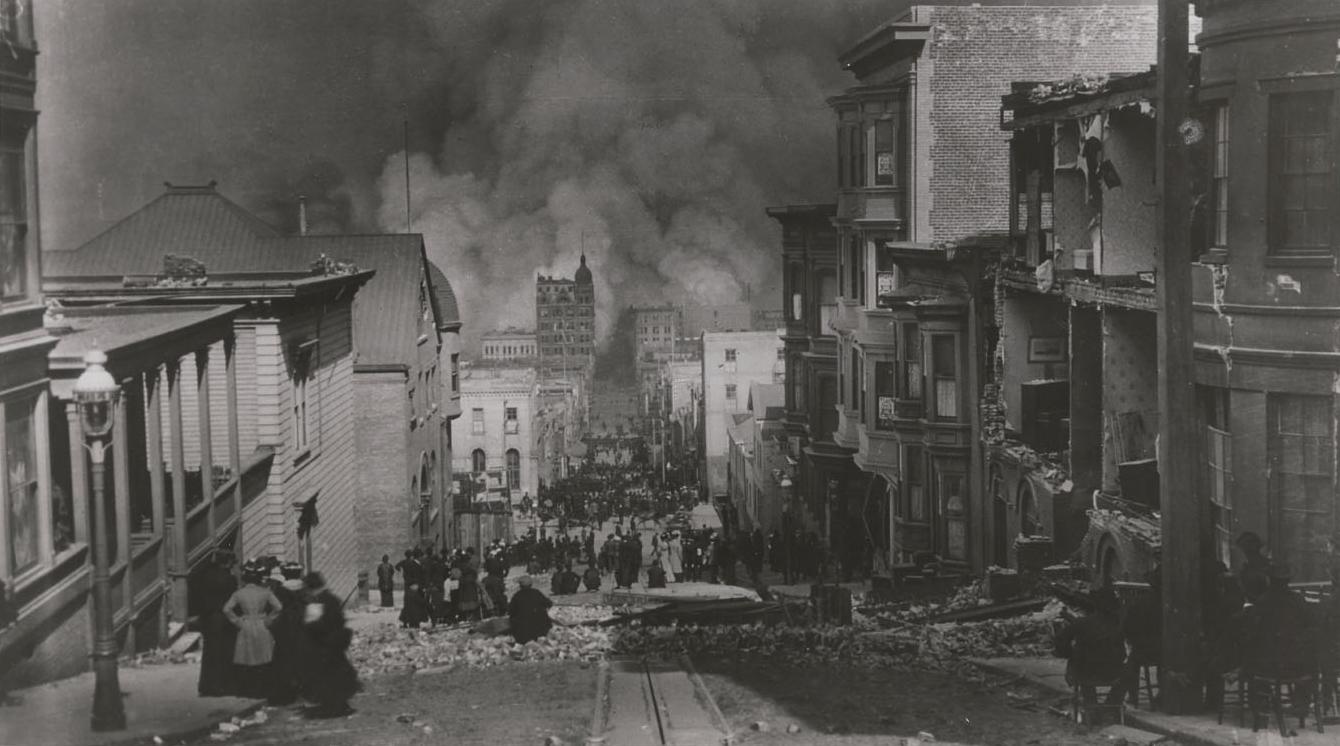
The events and school are fictional. The historical earthquake image is contextual and does not depict either event.
The calculation at a glance
- Magnitude 5.0 to 6.0: ΔM=1.
- Approximate amplitude factor: 10^1=10.
- Approximate radiated-energy factor: 10^1.5≈31.62.
- Magnitude 5 to 7, by the same approximations: amplitude 100-fold; energy roughly 1,000-fold.
- Neither multiplier directly establishes local intensity, casualties or structural loss.
Chapter navigation
- 1. A familiar percentage gives the wrong event comparison
- 2. Magnitude is not shaking intensity at a school
- 3. The base-ten wave-amplitude relation
- 4. Energy has a steeper approximate scaling
- 5. Why the two multipliers can both be correct
- 6. Damage cannot be obtained by multiplying the magnitude
- 7. Magnitude estimates have methods and revision dates
- 8. How a correction can help parents understand the concept
- 9. Worked practice across multiple magnitude steps
- 10. Verification and the management decision
1. A familiar percentage gives the wrong event comparison
A fictional secondary-school geography club compares two earthquake reports, magnitude 5.0 and magnitude 6.0. One pupil calculates (6−5)/5×100 and writes that magnitude 6 is twenty percent stronger. The calculation would describe the relative change between two ordinary linear quantities, but earthquake magnitude numbers are logarithmic labels, not directly proportional physical amounts.
The US Geological Survey’s earthquake magnitude reference explains that a one-unit difference corresponds to roughly ten times the relevant recorded-wave amplitude and about 32 times the radiated seismic energy. Both magnitudes may be accurately measured and transcribed while the headline built from them is wrong.
The lesson is not to replace 20% with an unqualified ’32 times more dangerous’. That would use an energy multiplier to infer building damage or individual safety, which the two source-event magnitudes do not measure. Every claim needs the physical quantity to which it actually refers.
All earthquakes, students and local conditions here are hypothetical. The archival cover photograph is not a picture of either imaginary event.
2. Magnitude is not shaking intensity at a school
An earthquake’s magnitude is a source-size estimate under a defined method. Intensity describes shaking or observable effects at a particular location. One event can generate different intensities across a region. Distance, depth, source geometry, wave propagation and local sediments can affect what people and instruments experience.
The USGS distinguishes magnitude from the Modified Mercalli Intensity scale, which uses Roman-numeral categories for local effects. A magnitude-6 event does not automatically yield intensity VI everywhere, and the Roman numeral cannot be calculated by copying the magnitude numeral into a different column.
A smaller but nearby earthquake may produce greater shaking at one school than a larger distant event. Without station observations and location-specific context, the fictional class cannot say which town or building experienced more motion. That is an entirely different evidence question.
3. The base-ten wave-amplitude relation
For a simple comparison under suitable conditions, the relative amplitude relationship is approximately 10^(M2−M1). With magnitudes 6.0 and 5.0, the exponent is 1, so the factor is ten. With 7.0 versus 5.0 the exponent is 2 and the corresponding factor is one hundred.
A half-magnitude step gives about 10^0.5≈3.16. The fact that a change of just half a printed unit can correspond to a several-fold relationship demonstrates why subtracting and dividing the labels as ordinary numbers is physically misleading.
That shorthand does not say that every station measures a wave ten times taller. Waveforms depend on frequency, path, sensor, distance and magnitude method. The phrase should be ‘roughly ten times the relevant amplitude under comparable conditions’, not ‘ten times the shaking everywhere’.
4. Energy has a steeper approximate scaling
A widely used rough relationship for radiated seismic energy is E2/E1≈10^(1.5ΔM). For one magnitude unit this is 10^1.5≈31.62, often rounded to 32. Across two magnitude steps, 10^3 equals 1,000. These are multiplicative ratios, not percentage changes of the numerals printed beside the earthquake report.
Radiated energy is not identical to seismic moment, which is used to characterise rupture and underpins moment magnitude. The USGS distinguishes magnitude types, and exact event-specific energy measurement requires appropriate seismic analysis rather than reliance on a rule of thumb.
An educational chart should label the tenfold relationship ‘amplitude’ and the thirty-twofold relationship ‘approximate radiated energy’. Without these headings, readers could understandably mistake the ratios for competing claims about damage or local movement.
5. Why the two multipliers can both be correct
Students may hear tenfold amplitude and 32-fold energy and think one statement must be false. The difference comes from the different properties measured. A wave’s amplitude and the total seismic energy radiated through its spectrum are not the same variable, and their common magnitude relationships use different exponents.
A useful worksheet keeps three columns: magnitude difference, appropriate amplitude factor and approximate energy factor. For ΔM=1 the latter columns read ten and about 31.6. For ΔM=2 they read one hundred and about one thousand. Each value has an explicitly labelled meaning.
The reasoning transfers to logarithmic sound and absorbance, where applying elementary arithmetic directly to a displayed level can also produce false physical conclusions. However, every scientific scale has its own definitions; the same formula should not be assumed to apply across unrelated measurements.
6. Damage cannot be obtained by multiplying the magnitude
Earthquake consequences depend on shaking intensity, how long different frequencies of ground motion continue, site geology, distance and exposure. Building vulnerability depends on design, materials, maintenance and other circumstances. A radiated-energy ratio does not specify which schools, roads or homes would be damaged.
The fictional class should not assert that magnitude 6 destroys thirty-two times as many structures as magnitude 5. It does not have the structural inventory or ground-motion analysis needed to support that statement. The correct observation is the relative source-event scaling, not a loss estimate.
Any real safety or preparedness decisions require current authoritative local hazard information and competent assessment. The purpose of the class is scientific literacy, not prediction of the next earthquake or certification of a school’s safety.
7. Magnitude estimates have methods and revision dates
Earthquake agencies may issue preliminary magnitudes soon after an event and later revise them as additional data become available. Two reports with slightly different values can represent different stages of a responsible scientific process rather than evidence of a mistake or cover-up.
Students should preserve the source agency, event identifier, magnitude type, timestamp and any revision history. Magnitudes may be computed with different methods—local, moment-based or otherwise—with applicability that must be understood before exact comparisons are made.
A displayed value to one decimal place is still an estimate. Calculating a ratio with six digits and advertising it as precise would overstate the information that the original measurement provides. Rounding and uncertainty should match the purpose of the communication.
8. How a correction can help parents understand the concept
The school’s correction could read: ‘In our fictional comparison, magnitude 6 is one full magnitude step above magnitude 5. Under common scaling, that corresponds to approximately tenfold wave-amplitude scaling and roughly 32-fold radiated-energy scaling. It does not guarantee any fixed multiplication of shaking or damage at a given location.’
This sentence answers the common question without technical overload and tells readers what the number does not establish. The class can keep the original 20% arithmetic in a worked example marked as inappropriate for the magnitude scale.
Publishing a dated correction is preferable to quietly editing a chart and leaving the earlier misleading headline on social posts or slides. The source observations stay in the record; the inference and reader-facing description are what change.
9. Worked practice across multiple magnitude steps
Give pupils hypothetical event cards marked magnitude 5.0, 5.5, 6.0 and 7.0. Ask for ΔM relative to 5.0, then compute 10^ΔM and 10^(1.5ΔM). The 5.5 comparison gives approximately 3.16 in amplitude and 5.62 in energy scaling; the 6.0 comparison gives ten and 31.62; 7.0 gives one hundred and one thousand.
A second group should examine a pair of localities with different distance and ground conditions and explain why neither table alone predicts their experienced intensity. The class should not invent a particular expected number of casualties or losses from the energy ratio.
An advanced group can explain how logarithms compress huge physical ranges and why labelled variables matter more than dramatic graphics. The exercise requires paper or a calculator, not hazardous earthquake simulation.
10. Verification and the management decision
The fictional school should retain the original magnitudes and reject the twenty-percent source-size explanation. It should replace it with the bounded logarithmic comparisons, identify which relation is an approximation, and separate local shaking and damage as additional questions.
A defensible record states the authority for the numbers, magnitude type, source version and calculation used. If later earthquake data change, the team can update the article without concealing the original report or claiming more precise knowledge than it possesses.
The Gold Standard conclusion is that a logarithmic event magnitude is not a linear percentage of its displayed numeral. Accurate science follows the measurement definition through arithmetic to a statement readers can responsibly use.
A closer look at half-steps and non-integer magnitude differences
A magnitude difference does not need to be exactly one whole unit. Suppose two additional fictional earthquakes are rated 5.2 and 6.0 under comparable reporting conventions. Their difference is 0.8, and the simplified wave-amplitude factor is 10^0.8≈6.31. The common radiated-energy approximation gives 10^(1.5×0.8)=10^1.2≈15.85. These figures are neither a twenty-percent nor an eighty-percent comparison, because the relevant relationship is exponential in the magnitude difference.
A difference of one tenth of a magnitude unit also matters. Under the same simple assumptions, 10^0.1≈1.26 for the amplitude relationship and 10^0.15≈1.41 for the energy relationship. Such differences should not be treated as precisely observed physical ratios when the reported magnitudes have measurement uncertainty or come from differing conventions. The purpose of the exercise is to teach the scale, not to manufacture precision beyond the underlying observations.
How many smaller earthquakes equal one larger event in energy?
The rough thirty-twofold energy rule invites a useful thought experiment. Under the standard simplified relationship, approximately thirty-two magnitude-5 events collectively radiate roughly as much seismic energy as one magnitude-6 event, if the energy estimates are comparable. About one thousand magnitude-5 events would match the approximate radiated-energy scale of a magnitude-7 event. This is an addition of energy estimates, not an assertion that many small events physically reproduce the same rupture or shaking.
A population of small earthquakes spread over different locations and times will not necessarily produce the same consequences as one larger event. Shaking duration, intensity distribution, building response and exposure differ. The class should reject the slogan that ‘thirty-two small earthquakes are just as dangerous as one large earthquake’ unless an appropriate hazard analysis actually supports a much narrower claim. Equal cumulative energy is not equivalent to equal social or engineering outcomes.
What a school risk discussion must keep separate
Students may want to predict whether a local school would close after a magnitude-6 event. That decision cannot follow from the magnitude numeral alone. It would involve where the event occurred, what local ground motion was observed or forecast, whether the school had damage, and the guidance and decisions of competent local authorities. An educational worksheet must distinguish those operational questions from a source-event comparison.
The first evidence record would contain an event identifier, agency, origin time, location, focal depth, magnitude type and any uncertainty or revision details. A separate local-effects record could identify relevant ground-shaking measurements, building observations and advice from an appropriate authority. Joining those records without a valid location and time match could be worse than leaving the impact question unanswered.
A reader-facing worked example with error diagnosis
A helpful instructional table has three rows. The first shows magnitude 5.0 to 5.5, a 0.5 difference, with about 3.16 amplitude factor and 5.62 energy factor. The second shows 5.0 to 6.0, a one-unit difference, with approximately 10 and 31.62. The third shows 5.0 to 7.0, a two-unit difference, with 100 and 1,000. The table should be labelled as a theoretical scaling exercise and should not assign unobserved physical amplitudes to real stations.
Ask learners to choose among four proposed headlines: ‘20% stronger’, ’10 times the local damage’, ‘approximately 32 times the radiated energy under a common rule’, and ‘the next earthquake must be magnitude 7’. Only the appropriately bounded energy statement is supported by the model. The activity teaches how a numerical fact may be valid while a broader assertion built from it remains unsupported.
Why the scale and its context belong in search summaries
An online educational article often presents a short answer before its technical explanation. It can safely open with the tenfold and thirty-twofold distinctions, but the same sentence should name amplitude and radiated energy explicitly. Readers who only see a snippet or a summary still need enough information not to mistake source magnitude for local intensity or predicted destruction.
The final quality check should ask whether every stated multiplier has a physical noun, every real-world claim has a suitable source and any illustrative scenario is identified as hypothetical. Those controls make the explanation concise where it needs to be and suitably detailed for pupils who want to reconstruct its logic.
A defensible reporting checklist
- Record magnitude method, source and date.
- Apply the correct logarithmic relation for the physical quantity being compared.
- Label amplitude and radiated energy separately.
- Do not infer shaking intensity or damage at a site from magnitude alone.
- Preserve preliminary and revised source data.
- Use official hazard guidance for real earthquake preparedness.
Frequently asked questions
Is magnitude 6 only 20% larger than magnitude 5?
No. Under standard scaling a one-unit step corresponds to roughly ten times relevant amplitude and about 32 times radiated seismic energy.
Does a tenfold amplitude relation mean all towns shake ten times more?
No. Local shaking intensity depends on many factors beyond the event magnitude.
Are the 32-fold energy ratios exact?
They are useful approximations, not detailed energy measurements for each event.
Does 32 times as much energy mean 32 times as much damage?
No. Damage depends on local ground motion, structures, exposure and vulnerability.
Why do earthquake magnitudes sometimes change after an initial report?
Additional seismic observations or processing can lead to revised magnitude estimates.
Official sources and related cases
- USGS · Earthquake Magnitude, Energy Release and Shaking Intensity
- The Gold Standard of Seismology
- G3 Geography · Earthquake Magnitude Versus Intensity
- Additional Mathematics · Logarithmic Earthquake and Sound Scales
- Gold Standard Case 233 · Two 60 dB Sources
- Gold Standard Core Requirements
- Gold Standard Casebook
The USGS reference provides general seismological relationships, not evidence about any actual earthquake in this fictional case. The illustrative ratios are not estimates of local hazard outcomes.